Archive | Shorts RSS feed for this section

The Man in the Moon (Short Film) (2012)

17 Feb

277791154_640

Smith’s Verdict: ***1/2

Reviewed by Tanner Smith

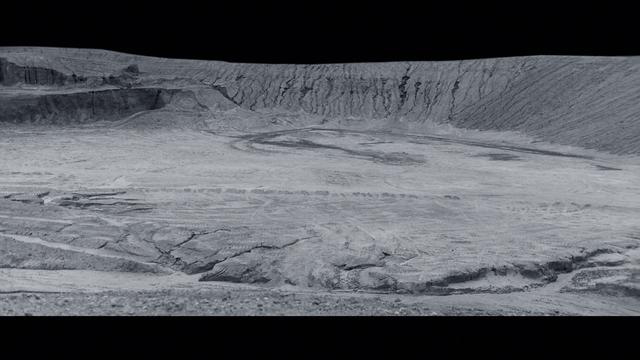
The Man in the Moon, made in association with the UCA Digital Filmmaking Program, had already caught my interest with its clever teaser trailer, featuring a strange, gray landscape with what looks like a golf cart making its way across, as the camera pans up to the sky … only to reveal the Earth. Yes, we are in outer space, the “golf cart” is a lunar rover, and this landscape is on the moon. It’s a great teaser, and the title suggests … well, take a guess.

This 20-minute short film is an imaginative, well-put-together science-fiction story that starts out as a futuristic prison fable and heads into different, even more interesting, territory once it unleashes that always-reliable moment in which a character digs for quite a time and then suddenly hears an unexpected THUD. (And of course, there’s another THUD to be sure of what he heard.)

The character is named Dave; he’s part of a new prison program that sends convicts into complete isolation up to the moon. As one of those convicts, he is completely alone on the moon … or so he thinks. When digging for experimental dirt or stones (there’s a machine in his prison that somehow brings it back to Earth for experimentation — I’m not quite sure how that works, but oh well), he digs a little deeper and then…you guessed it — THUD.

Dave (Lynnsee Provence) discovers a doorway leading to the underground lair of the Man in the Moon, which is actually somewhat welcoming—it looks like the inside of a suburban house…in the 1960s, which makes things kind of unnerving and unsure. But the Man in the Moon, named Manuel (Leonard Schlientz), is a kindly old man with a generous hospitality. He takes Dave in, making him feel at home, but there seems to be something more that Manuel has in mind. For example, what is inside that forbidden room right beside the back bedroom?

The more mysterious The Man in the Moon gets, the more intriguing it is. I apologize for giving away what Dave finds beneath the lunar surface, but I stopped immediately at the plot device of the “forbidden room.” There’s a lot of creativity flowing through the story and I was interested throughout, to the point where I didn’t care much for questions such as how does that machine in Dave’s prison work, and where does Manuel get all of his food if he’s been secretly living in the moon?

The film has a nice visual style. The moon setting is terrific. I hear the scenes taking place on the moon landscape were actually filmed on a quarry with color digitally added in post-production to give the illusion of moon rocks, space dust, and emptiness of outer space. The result is very effective. Also of note are the interiors—Dave’s prison and Manuel’s home. Each is different, but interesting. Dave’s home has a rustic-if-retro look, suitable for an isolated prison on the moon, and Manuel’s home looks as if it was stuck in a ‘60s time warp—the appropriate colors and props really stand out.

An interesting story idea, a continuing guessing feel, and good performances from both Provence and Schlientz makes for a pretty good film. How much did I appreciate The Man in the Moon? Of the twelve short films I saw the night it premiered at the 6th Annual Little Rock Film Festival, this is the one that I was most fond of when the night was over.
John Wayne’s Bed (Short Film)

17 Feb

stills_JohnWaynesBed

Smith’s Verdict: ****

Reviewed by Tanner Smith

The short drama John Wayne’s Bed, right at the beginning, is said to be “inspired by a true story.” And whenever I see that subtitle in a movie, I get cynical — that’s even how I felt before I watched “War Eagle, Arkansas.” It’s just the sudden feeling of manipulation and heavy handedness (movies like Amelia and — sue me — The Blind Side come to mind). But like War EagleJohn Wayne’s Bed treats its subject material, as well as its audience, with enough respect that it doesn’t have to succumb to heavy dramatic clichés just to make us care. It just effectively tells the story. The acting is great, the cinematography is nice, the dramatic elements are well-handled, and it’s over in just 20 minutes.

John Wayne’s Bed is writer-director Sarah Jones’ thesis film for the University of Central Arkansas Digital Filmmaking Master of Fine Arts Program, but according to Jones in the“Indiegogo” blog supporting the film, it means a lot more to her than receiving her Master’s degree. The story behind the film is based upon her father’s friend who was diagnosed with Lou Gehrig’s disease, and made the most of his final days with his love for life and the help of his friends. Jones stated, “Even before I started studying filmmaking, I knew that this was a film that I needed to make.”

The film stars Alan Rackley as Allen, an Arkansan man who loves to hunt and fish and doesn’t let his disease slow him down. His best friend (Bob Boaz) helps him and accompanies him on the outdoor activities, and his wife (Angela Woods) provides for him, though she states that it’s getting more difficult to handle because he’s unable to perform most daily activities. Allen knows he’ll never be independent and he’ll most likely die soon, but his stubbornness and optimism keeps him going.

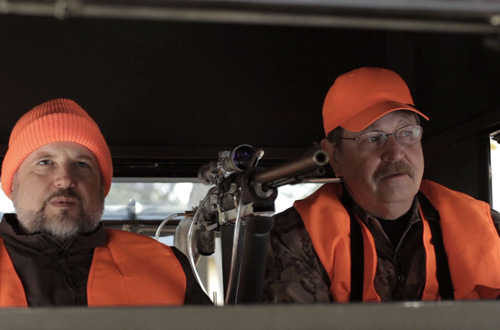
Allen’s luck picks up when he is accepted into a hunting program for mobility-impaired people. Accompanied by his wife and friend, he lives the perfect hunting trip for him—he has a rifle that doesn’t require pulling the trigger (there’s a tube he can blow into that fires the weapon) and even gets to sleep in John Wayne’s bed.

The approach that Jones took to this story is wonderful. This story is told in a moving but never condescending way, and it flows smoothly as we get from this setup at Allen’s home to his “dream-come-true” at the cabin. The actors do great jobs in defining these characters. By the time this film is over, we have spent twenty minutes in the company of real people. John Wayne’s Bed is a wonderful film.

NOTE: The film can be seen here: https://vimeo.com/67408995

Hitchhiker (Short Film) (2011)

17 Feb

459142_294920593909216_2141328867_o

Smith’s Verdict: ***

Reviewed by Tanner Smith

OK, we all know the story. An innocent person drives on an empty road in the middle of the night when along comes a hitchhiker, whom the innocent decides to take a chance on and give the stranger a ride. Only it turns out that this hitchhiker is quite different and may actually be a dangerous stalker. It’s an old campfire story that has also been included in many horror films, in which that element leads to certain doom.

But I don’t think there has been a hitchhiker story quite like this. In this ten-minute short film—aptly titled Hitchhiker — the innocent person may not be so innocent in the first place, the hitchhiker has something more on his mind that you’d like to know about, and there’s a neat, original twist revolving around redemption.

The film, written and directed by Allison Hogue, is set up in the middle of the night. A young woman (Courtney Howard) is out for a drive when she runs out of cigarettes. She comes around a man in a hooded sweatshirt on the side of the road, signaling for a ride. She stops, and asks the hitchhiker (J.D. Cariker) if he might have any cigarettes. He offers a pack for a ride into town. She agrees, and the two are in each other’s uncomfortable company. The hitchhiker asks her ominous questions, such as why she usually wouldn’t pick up a hitchhiker. After an awkward talk, you’d think this would be the moment when danger strikes. And at this point, I have to warn that SPOILER ALERTS are coming! SPOILER ALERTS are coming! Before reading the rest of this review, I ask that you check out Hitchhiker by Allison Hogue on Vimeo (or above) and come back. SPOILER ALERT!

The opening seems like standard stuff for this kind of story (although the soothing spiritual pop music manages to give a sense of ominousness). The reason I’m recommendingHitchhiker is the twist. The woman drops off the hitchhiker at his destination, only to find that that he is pursuing her. When he catches up with her at her house, she finds that a gun-wielding intruder (the late Keith Mulberry) has been waiting for him. It is then that the hitchhiker makes himself known as probably something not of this world, but possibly from the next world.

The characters are not how we expected. For example, the woman could be seen as the innocent that gives the hitchhiker a ride and finds herself in a bizarre situation she didn’t want to be in. But maybe she isn’t so innocent. When we first see her driving, we see someone who is either hiding something or trying to get over something she may have started in her life. Whatever it is has her somewhat bitter and cold. You can feel it in the scene in which she at first refuses to give a ride—she’d rather stop and ask a hitchhiker for cigarettes than give him a ride. That’s really low, if you ask me. Then, there’s the ending, in which she is redeemed and given a second chance. We’re not entirely sure of exactly what it was that she began with before this night—things are left somewhat vague. And also, who is that intruder? Is he a burglar in the wrong place at the wrong time? Or did he have connections to the woman? There’s a lot you can read into this.

Then, there’s the hitchhiker. At first, he seems like he can’t be trusted, but that’s because he’s asking the questions that would put you on edge. The reality is that he’s testing you when he asks those questions. Then, when he chases the woman home and saves her from the intruder, he gives her a Bible and a message saying that she deserves a second chance. And then he leaves, to find someone else to deliver the message to. The hitchhiker is not a madman. He has the motivations of a savior.

Hitchhiker begins as a typical horror film and turns into something more of a spiritual tale than anything else. It’s an effective short film that plays with the seen-before hitchhiker story element, and leaves with something special that you didn’t expect.

Watch the film here: https://vimeo.com/31127434