Archive | Shorts RSS feed for this section

Last Shot Love (Short Film)

21 May

537636_304262883000910_23165206_n

Smith’s Verdict: ***1/2

Reviewed by Tanner Smith

It’s good that the comedic short films, “Last Shot Love” by Nolan Dean and “The Discontentment of Ed Telfair” by Daniel Campbell, were screened in the same block at the Little Rock Film Festival. Playing two comedies with terrific setups and great punchlines delivers all the more laughter and enjoyment, especially after having to endure quite a few “artful” projects. “Last Shot Love” is somewhat broader in comedic style than the latter, but the laughs are still there and they come as a punch to the gut (or in this case, a shot to the…well, never mind). It has a great buildup and a surprising, unexpected, hilarious payoff that I won’t forget anytime soon.

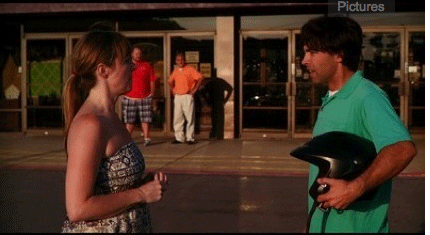
“Last Shot Love” is about a love-struck 30-year-old named Michael (Brian Villalobos) whose platonic relationship with the beautiful, appealing Annie (Akasha Villalobos) constantly has him thinking of more than just being friends. For ten years, Michael has been working up the courage to ask her out on a date. When he finally does, he’s foolish enough to take advice from his friend Colin (Seth Kuhn)—well, “foolish enough” for us anyway, since we all know that most “best-friend” characters in romantic comedies are some of the most unreliable schmucks to come across.

Colin gives Michael the idea to stage a seemingly harmless presentation to further impress Annie on their date, and make her fall in love with him. But wouldn’t you know it—something goes terribly wrong.

I won’t give away the last five minutes of “Last Shot Love” because the less you know, the more you’ll wind up laughing at the payoff. But to that point, the buildup is funny because it’s relatable. The character of Michael is relatable (for men, anyway) as he’s just a guy caught in a girl’s “friend zone.” This is a guy who just seeks just one date with this woman for the sake of the possibility that there might be something between him and this woman. I’ve been in that situation more than once, and I bet every man has. And of course, there’s that other possibility that states that if this date doesn’t go well because these two people (who are already good friends), then things would be quite awkward and the friendship would be ruined because of that one damn date. (Man, I hate when that happens…)

So it would make sense that Michael would listen to Colin and go to certain extremes in order to make Annie fall for him the same way he has for her. And again, without giving away the utterly-hilarious surprise, those “extremes” that one should take when attempting this approach…should just take caution of what they’re getting themselves into.

I thought I could see where this was going; I wasn’t even close. And that’s all I’m going to say about that.

“Last Shot Love,” written and directed by Nolan Dean, is a funny, engaging 15-minute film. The writing is fresh, the actors are good (especially Seth Kuhn, who’s a riot as Colin), and the payoff…you know what? I’m going to stop talking. Go see the film—it’s still in its festival run, and it’s worth the trip to see whenever and wherever you can.

La Petite Mort: The 48-Hour Film Project (Short Film)

16 May

little-rock-la-petite-mort-by-brickhut

Smith’s Verdict: ****

Reviewed by Tanner Smith

I was going to pass on reviewing this one. I like this five-minute short film quite a lot, but I figured it would have been very tough to review. It has no story, no characterization, and no real setup-payoff. When you get down to it, Matt Owen’s “La Petite Mort” is just a bizarre, well-crafted, darkly funny music video. In other adjectives and adverbs, it’s twisted, ingeniously executed, rigorously edited, and when it is all said and done, strangely engaging to watch.

This is a horror story fit into a music video style, as two men—Tommy (Chris Kindrick) and Tammy Shuttles (Joe Maneiro, in a dress)—serenade their love for one another in a quite unusual but very unforgettable love song. But the video is intersected with moments of graphic violence in a torture-room that makes it seem like an unusual romance was intersected with elements of “Saw” and “Hostel.” The result is strangely intriguing.

There—it’s that simple. I love this five-minute short film made by Brick Hut Productions for the Little 48-Hour Film Project in summer 2012. That’s enough of a review right there, given what little it has and yet how much of an impact it has. If any Little Rock friend/filmmaking-acquaintance ask me what I think of it, I say I loved it. But there is one important detail that I may have overlooked that changes everything (for the better). It’s not just that “La Petite Mort” is well-shot, cleverly-edited, and, for a music video, has a tune that I practically dare you to forget once you’ve heard it. It’s that it was all done—planned, filmed, edited, and completed—within a little less than two days. That is very, very impressive.

I’ve participated in the 48-Hour Film Project twice already. Let me tell you—it’s not simple. It’s a challenge for filmmakers to do what they can do within 48 hours of preparing, shooting, and finishing a short film. Given that limited time, it’s quite complicated to do, and even more so to make a short film that really stands out among the other competitors’ films. And while making the film, there’s always a great deal of conflicts (such as disagreements) and a lot of pressure on the filmmaker in charge of the crew. What’s important is for the competitors to do their best and have fun with this filmmaking test.

I’m not sure how the making of “La Petite Mort” went for Brick Hut Productions, but I imagine they took advantage of every hour they had to make it happen. I imagine a lot of coffee was involved to keep them alert, especially the film’s editor who had to edit the song with the sinister deeds the singers do in their free time. The result is just brilliant—it’s a corny love song (with not the best lyrics but a memorable melody) between two men, intersected with gruesome scenes of torture and murder. it’s ironic, dark, and yet somewhat (intentionally) amusing at the same time, and I think the song is more memorable because of the subject matter—it’s that deliciously ironic dark aspect. Who these victims turn out to be, revealed midway through the short, is beyond ingenious.

“La Petite Mort” is a weirdly ingenious short film that hardly seems to have a flaw in what it needed to be. And given some of the projects made in competition for 48-Hour, that’s really saying something. What else can I say, except I love this short film and the energy that was put into it.

NOTE: The short is in a festival run right now; hopefully sometime soon, it will be posted online for you to see. When it is, I’ll post a link immediately.

OTHER NOTE: When I do, be aware of these three 2012 48-Hr. requirements the film needed—a singer character (Tommy or Tammy Shuttles), a melon for a prop, and the line of dialogue, “What do we have here?”

Diamond John (Short Film)

4 May

321425_569445063085864_193779341_n

Smith’s Verdict: ****

Reviewed by Tanner Smith

John Wesley Huddleston was a quite peculiar man with a passion for prospecting. Ever since he was told (as a child) a legend of riches, he has been searching and digging for gold and precious stones, while also trying to support his family. But he has never found anything in all the years he’s been searching, which tries the patience of his wife and five daughters who wish he would get a job and rescue them from what would seem like inevitable bankruptcy. It seemed as if all hope was lost until he found exactly what he was seeking.

Those who are familiar with the folk tales surrounding “Diamond John” (as Huddleston would be labeled) also know that Huddleston discovered “one of the largest naturally occurring diamond sites in the world” in Murfreesboro, Arkansas 1906. This story is always traced back to when it comes to “diamonds” and “Arkansas,” and I have to wonder what a feature film (90-120 minutes of running time) would deliver on it. It is a fascinating tale and deserves to be told through film.

What there is, however, is a rather delightful, well-made short film (about 14 minutes of running time), aptly titled “Diamond John,” that surprisingly manages to tell a good chunk of the story in a non-rushed manner and with enough feel-good spirit to make it endearing.

This is a great short film. It’s well-executed. It’s engaging. It’s amusing at times. It looks good. You can tell that a lot of hard work and energy went into the making of this project, and also going by the minute-long applause at the UCA Film Festival (where this film premiered, and also following an afterparty/awards ceremony at which it dominated with about seven or eight awards), it all paid off.

935795_569445079752529_658903991_n

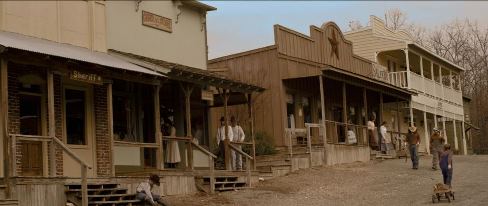
“Diamond John” was presented by the University of Central Arkansas (UCA) Digital Filmmaking department, and written and directed by Travis Mosler as a student project. Mosler, a Digital Filmmaking major, has done a lot of research based around the biography of John Huddleston (a lot more than I have in the first paragraph of this review, let’s just say), and has conducted an effective period piece with a talented cast and crew. Taking place in 1906 Arkansas, a majority of funds the crew gained on their Indiegogo campaign went into the look and feel of the appropriate era. It’s astonishing, how authentic it all looks, from costumes to props to locations. In particular, John’s family home looks like the appropriate setting for such; there’s a realistic-looking western village that looks just right for the time-period; and also, there’s even a Model T Ford Coupe that makes an appearance—how they managed to get that is anyone’s guess, but I’ll take it!

Unusually for reviewing a short film, I feel obligated to praise the acting, but the roles here are hardly thankless anyway. Tom Kagy, as Diamond John himself, effectively captures the eccentricities and passion of the character. Ann Muse is credible as John’s wife, Sarah, who constantly tries to get John out of his dream and into the real world. Also, Jason Willey is very funny in a small but important role as a nervous bank clerk.

“Diamond John” runs for about 14 minutes. I’m not going to lie; I wish that with this talent in front of and behind the camera, this endearing story was crafted into (at the very least) a 30-minute film or even a 90-minute feature film. But as it is, it hardly feels rushed. It’s tightly edited, but has enough to keep your attention and more importantly, to make you care. It worked for me; it could work for you.

Tomahawk (Short Film)

21 Apr

183793_130023463737871_130020100404874_186969_2429919_n2

Smith’s Verdict: ***1/2

Reviewed by Tanner Smith

Seeing Eric White’s short film “Tomahawk” for the first time at the Ozark Foothills Filmfest in Batesville, Arkansas a couple weeks ago, I had already known that 13 minutes were cut from the film’s original running time (which was about 30 minutes in length). While I liked the version I saw fine, I did notice a few inconsistencies in its storytelling and maybe it was because I knew there was a longer version, but I did feel the story was somewhat rushed and couldn’t help but wonder what was removed from this “festival cut,” because I could tell White was onto something here. It was well-made, gripping, and had a hell of an ending.

Having met and conversed with White at the festival, and also thanks to a suggestion by filmmaker Sarah Jones (whose “John Wayne’s Bed,” already reviewed by me, was also shown at the event), I managed to gain a DVD copy of the original 30-minute version of “Tomahawk.” That was the cut that White had always preferred in the first place, and as if unsurprisingly, it’s better.

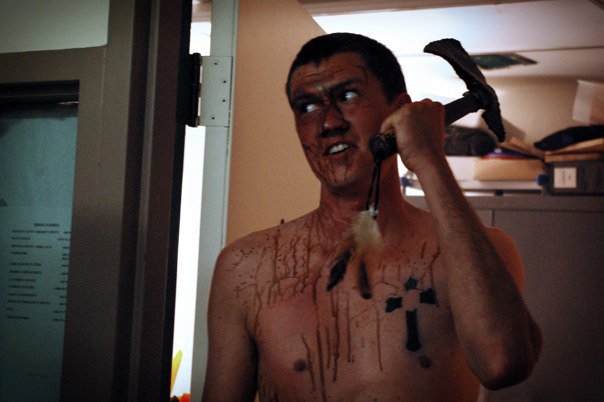
“Tomahawk” is a gritty, violent revenge tale about an ex-convict, John (Steve Helms), who returns to his hometown in Tennessee. Armed with a tomahawk (hence the title), he sets out to deliver revenge on the people who sent him to prison.

There’s a quite curious change between the 17-minute cut and the 30-minute cut. The 30-minute cut tells a story is more shrouded in mystery, as John’s actions are rough but not with much motive. That is, until midway through, when the truth becomes clear. This is pretty interesting, because this buildup makes John seem like the antagonist for the people he’s after—clean-looking Bobby (Shayne Gray), Sheriff Murray (very well-played by Bob Boaz), and a few cops—only to discover in the midsection of the film that they have done him wrong in a horrible way, and thus we sympathize with him.

The 17-minute cut, on the other hand, opens with a quick scene with the “supposed protagonists” that indicates a sense of guilt that sort of lets on that they’re not to be trusted. While John is seen as the rough, vagrant outsider visiting this small town for his own personal business, he could be considered a heroic figure strangely because of that little beginning. With the 30-minute cut, something doesn’t feel right with this guy from the start. He comes across as an Anton Chigurh type feeling the need to cause anarchy and chaos, and that’s what he does for the people he comes across—including two passersby and two obnoxious guys in a bar, before moving on to the people who would turn out to be his true targets.

And for the record, I’m not spoiling much of anything—the 17-minute cut is the version that’s being shown around in film festivals, and so people will already know that John is the hero throughout the film. The most notable changes include the cutting-down of key action sequences, and even the deletion of the whole sequence set in the aforementioned bar. I understand that the action scenes had to be toned down for a shorter running time, and it seems as if the bar scene is rather pointless in a way. But I preferred it when the action went about its own pace in the original—the buildup works, the tension is present, and it makes it seem all the more satisfying.

I mentioned that “Tomahawk” was a well-made film, and it is impressive. The action scenes (including a nicely-done chase near a railroad) are very well-done and believably violent to the point where the hits, kicks, punches, strikes, etc. seem very real. The cinematography is terrific, and there’s a consistently tense tone that flows throughout the film.

And here’s a fascinating story element—save for a couple cops, the people who have wronged John in a big way don’t seem like villainous types. In particular, Bobby seems like an ordinary family man that you wouldn’t suspect of doing something as horrible as revealed. What’s also chilling is the notion that even though Sheriff Murray knows very well that Bobby has done what started this deadly crusade, he actually agrees to assist him in a way out.

The ending…damn. What can I say? Without giving too much away, after an inevitable action climax involving an intense showdown between John and crooked police, I was surprised how strong the final outcome turned out to be. It ends with a sense of psychological terror after the final decision is made about how this is all going to turn out, followed by an unending shot of the victor walking off alone. That last shot is played silently as the end credits roll, without a music score. It allows the audience to sink in everything that has occurred. It either works or it doesn’t; it worked for me. That same impact was present in the 17-minute version too, but with everything else in the 30-minute cut, it’s even more powerful because of everything else that has occurred earlier.

I like the 17-minute “festival-cut” of “Tomahawk” fine; I believe the 30-minute cut is even better. But either way, both versions show the true craftsmanship that was put into it—Eric White proves to be a capable filmmaker; Lyle Arnett Jr.’s cinematography is great; and the hard-edged music score by Kerry Loveless and Avery Moorehead is excellent. So I’d say see either version for its own merits.

Disillusioned (Short Film) (2011)

17 Apr

images

Smith’s Verdict: ***

Reviewed by Tanner Smith

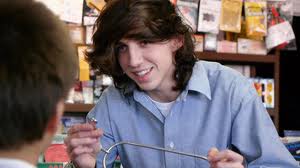
An aspiring magician (Seth Savoy) believes that the best magicians perform flashy tricks/illusions, instead of the simpler, more subtle ones he can do easily. While working at a magic shop, he constantly attempts to perform complicated tricks to customers. Unfortunately, he tries too hard and can’t seem to get them to work the way his idol, theatrical illusionist Ace Manhattan (Mark Cluvane), can. So his boss (Derrick Rose) tries to convince the boy it doesn’t take big magic to impress an audience. Upon ultimately meeting Manhattan face-to-face, he begins to see that fame isn’t everything.

The idea of a young man wanting to perform something bigger with his talent, and then realizing maybe settling for what he can do best (something smaller) is the best thing for him, isn’t really new. But it is welcome, and does make for some satisfying coming-of-age comedy/dramas. I must admit I’ve never seen it done with magic before, which is the case for “Disillusioned,” a 7-minute short film written and directed by Kim Risi. The result is an interesting, nicely-done short comedy.

I’ve always been a fan of magic. When I was a kid, I would perform the little ball-and-cup trick to my friends and family because it was the only trick I was able to pull off. The reaction I got still satisfies me, and so I would sometimes look into more tricks and wonder how the bigger, more complicated illusions were done. Even as I got older, I still enjoyed going to the occasional magician-workshop at certain events (a Baptist convention, particularly). Some things never get old. But I digress. Anyway, that’s why “Disillusioned” appealed to me, not only in the story’s metaphor that the message mentioned above doesn’t amount to just magic (but also to filmmaking, for those who thought I was just a film critic), but because of the comic ways in which the struggling magician attempted to free himself from handcuffs in five seconds or a straitjacket in 10. The disappearing ball works every time; try it sometime (but after a little practice first).

Not much acting is required in “Disillusioned,” but the one who really steals the show is Mark Cluvane, who is (for lack of a better word) amazing as Ace Manhattan. How do I properly describe his subtly manic portrayal of a flashy magician? I’m not convinced I can, so I’ll just state that he’s hilarious here.

(It was also an effective move to cast Seth Savoy who knew very little about magic, and Derrick Rose and Mark Cluvane who are both skilled magicians. Rose/Cluvane’s experience and Savoy’s inexperience make each magic-trick scene seem more or less real.)

“Disillusioned” may be somewhat predictable, but it is an appealing short film with some effective funny moments (the over-the-top commercial for Ace Manhattan is utterly hilarious), a neat motif with the soundtrack (classical music that shadows the opposite of Savoy’s character’s belief that “people don’t want classical music; they want rock n roll”), and an admittedly welcome-and-effective moral about selflessness.

NOTE: The film can be seen here: https://vimeo.com/27359862

The Antagonist (Short Film) (2010)

17 Apr

178675534_640

Smith’s Verdict: ****

Reviewed by Tanner Smith

Even though I’m aware that the same filmmakers don’t make all the short films by Spy Hop Productions, I always have high expectations for the newest films every time I go to the yearly T Tauri Film Festival, an Arkansas film festival for young people. I’ve seen a lot of films presented by Spy Hop Productions and they all had intriguing filmmaking styles and a surprising amount of intelligence that comes when bright teenagers, such as the ones who make the films, work together to make a short film. It really feels like the films have real production value.

My favorite Spy Hop production is a documentary called “Touching Sound” (a documentary featuring a deaf boy getting a Cochlear implant), but my second favorite is a narrative film called “The Antagonist.”

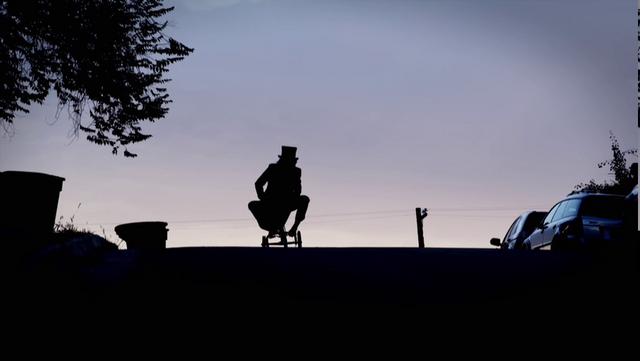
“The Antagonist” is a postmodern fantasy in which the “antagonist” is actually the protagonist. You see, the story features a creepy man with a burlap sack over his head, a top hat, a tricycle, and a wooden board with a long nail sticking out of it. He’s like a character in a slasher film. But the twist here is that he really is a character in a slasher film. He’s being manipulated by a young screenwriter who doesn’t know (at least, I don’t think he knows) that his antagonist exists in his world and is being controlled by whatever his writer types for him.

That’s a wonderful premise and the film features the “Hat Man” as he rides his tricycle through town, finding more victims. Meanwhile, the screenwriter takes breaks to ask other people (including a little girl) what they think of what he’s just written. It works for comedic purposes. But then, “The Antagonist” becomes even more special when it goes deeper into drama. The Hat Man meets a woman at a Laundromat and they strike up an interesting relationship. This is even more remarkable, considering what the filmmakers had to work with because the Hat Man has no dialogue. The scenes involving the Hat Man and the woman are handled delicately. And, as you can tell, it gets even more complicated when the writer goes back to manipulating the Hat Man to create his idea of an artful thriller.

For a twenty-minute film, “The Antagonist” has plenty of surprises. It starts as a quirky comedy and ends up being an even more compelling piece of work. I named it one of the best films I’ve seen in 2010, and I don’t care how short it is; don’t ignore it if it works, no matter what the length.

You can see the film at https://vimeo.com/49177543

Forget About It (Short Film) (2006)

16 Apr

forget-about-it

Smith’s Verdict: ***1/2

Reviewed by Tanner Smith

We usually have a bunch of movies where street kids are robbing stores and banks just to get themselves some dough. But “Forget About It” tells us why it’s not such a good idea because thieves will get caught. No, this isn’t a drama about teenagers robbing a bank and what happens afterwards. Instead it’s a comedy about two bored teenaged guys who sit in a Jeep one night and imagine robbing a bank and talk through small (or huge) situations.

Zac Larsen plays Andrew and Levi Whitlock plays Spencer, both of whom I’m guessing were voted “most likely to be seen in a Judd Apatow comedy” in their high-school yearbook. These two idiots (wait I’m sorry—“misunderstood teenagers”) just have this idea to rob a bank and think about it first. Very smart, I guess. Through fantasy sequences, Andrew and Spencer try sequence after sequence to get into the bank and into the vault without being shot by the smirking (and utterly hilarious) security guard (Matt Lopez). No luck, and they just try again and again and again, and you know what? I was laughing out loud the whole time.

These sequences are fun to watch because you know that it’s a bad idea to rob a bank because something will happen every time. First they try it dressed in black—they get shot. Then they try it just by showing the teller the gun—they got shot when she turns on the alarm. A lot happens here and I was really interested and laughing all the way through.

Spencer has some of the funniest moments, such as when he first walks in with a sniper rifle and when he gets shot by the guard and usually goes “Oh, man! I got shot! Dude, let’s do it over again!” Levi Whitlock is very funny here and Zac Larsen is the brain who also has a couple of funny moments, such as when he freaks out when things go wrong. The guard is the funniest character in this movie. It’s a small role, but his smirks and dialogue makes him look like a cross between Clint Eastwood and Will Ferrell.

The screenplay is great and the direction is good also. James Bereece is the director and Spencer Stuard is the writer. They don’t disappoint. The idea is very good to have two guys in a car imagining robbing a bank and then get to see fantasy sequences about their many attempts to succeed. And the dialogue is just funny. These two seem to be channeling Kevin Smith comedic work and they pull it off here very well.

This film was made by a youth production company in Utah called Spy Hop Productions, who have made some of my favorite short student films, including the short documentary “Touching Sound.” This company founded by youths makes such great short films and I look forward to seeing more of whatever they have to offer.

You can see this film at https://vimeo.com/48849032

The Accountant (Short Film) (2001)

15 Apr

MV5BMTMwMzM2OTMzMl5BMl5BanBnXkFtZTcwNjgyNTg2Mw@@._V1._SX640_SY512_

Smith’s Verdict: ****

Reviewed by Tanner Smith

One of the best ideas from the Academy of Motion Picture Arts and Sciences was to create an awards category for short films, because any good or great film at any length—long or short—can tell a story and create effectiveness all the same. This is especially true of “The Accountant,” a short film (about 35 minutes) that won the Academy Award for Best Live Action Short Film. Watching the film on DVD, it’s easy to see why.

“The Accountant” takes place mainly on the O’Dell family farm in the South. Walton Goggins and Eddie King play brothers Tommy and David O’Dell, who call in an accountant (Ray McKinnon) to help save the farm. They get more than they bargained for, as the Accountant (whose name is never revealed) is a walking calculator who finds an amount in just about everything. He doesn’t even use a calculator—he figures numbers with his hands and feet. He also smokes chain and swigs beer like it’s no one’s business (he drinks a lot in this film and for those who are wondering when he has to take a leak, you’ll have a big laugh midway through the film).

The Accountant is a tall, well-dressed man who constantly leers at those around him, is intelligent, and also smokes, eats, and drinks a lot. He also has his own conspiracy theory about how things work in the South. Is he right? The strange thing is that he could be. I bought this character completely, and Ray McKinnon portrays the role excellently.

The other actors—Goggins and King—have good, convincing chemistry together. You really buy them as brothers.

Another great thing about “The Accountant” is the writing. This is an intelligently written film—not only does every line reading sound like the opposite of a line reading, but when these guys talk, we’re interested in what they have to say. Whether it’s listening to the Accountant’s unheard-of solution to the brothers’ problem (funny at first but shocking toward the end), the Accountant figuring the odds of David’s wife cheating on him (very funny), picking on Southern stereotypes (love the references to “Sling Blade” and “In the Heat of the Night”—by the way, all three actors guest-starred on an episode or two of that show, so that’s a neat in-joke), or ranting about the conspiracy that the South losing touch with its heritage, I loved listening to what these people had to say.

“The Accountant” was written and directed by McKinnon (that would definitely explain how he played the lead role so well); it was also produced by Goggins and McKinnon’s wife Lisa Blount. You can tell that they put their hearts into this film. It’s well-made, superbly written, and well-acted with a great blend of humor, quirkiness, and an effective message. It deserved the Oscar win.

Three Short Films by Jordan Mears

14 Apr

75080_10152468408285080_113412405_n

Santa Run

Smith’s Verdict: ***1/2

Reviewed by Tanner Smith

Here’s a delightful lump of coal for your stocking come Christmastime. Written, produced, and directed by Jordan Mears, the 10-minute short “Santa Run” is a Christmas fable that can best be described as “naughty.” It’s a crude, vulgar, profane, shocking dark-comedy that is also unique, original, and imaginative.

“Santa Run” is mostly made up of dialogue, and so it belongs to the group of independent short films that are created by the thought, “I have no money; I’ll write funny jokes.” (See my review of Daniel Campbell’s “Antiquities” as well.) I honestly have no idea what was going through Mears’ mind when he decided to write “Santa Run,” but I’d like to know.

The concept is inventive, to say the least. The film takes place on the night before Christmas, just a few minutes before midnight, as (get this) two Santa Claus clones sit in a car and prepare to deliver gifts in a certain neighborhood. Apparently, Santa Claus can’t deliver presents to every child in the world in just one night—his scattered clones do the work for him. Santa doesn’t even go out to do what he should be doing (“Santa Claus gets to sit naked in a hot tub full of eggnog,” one of the clones complains to the other).

One of those clones (whom we learn has dyed his hair and shaved his chin, in contrast to his partner who resembles the traditional Santa Claus) is a rebellious young man who decides not to go through with this this Christmas. This leads to an argument between the rebellious Santa clone and the good-natured Santa clone…and I can’t believe I just typed that.

Despite that silly premise, this is about as dark a Christmas movie could possibly get (with the exception of sexual activity in “Bad Santa” starring Billy Bob Thornton). Both Santa clones constantly spew profanities (it’s more shocking to hear the “traditional-Santa” say “f***in’ quit” than to hear the “rebellious-clean-shaven-Santa” angrily yell to the sky, “I f***ed Mrs. Claus!”); one of them snorts cocaine and drinks booze; they both talk about having sex with Santa’s elves (herpes is even mentioned at one point); and the resolution of the argument, without giving anything away, results in a tremendously dark matter. “Santa Run” may open and close with shots of Christmas decorations in a suburban neighborhood, but the central section is anything but jolly.

It’s weird how this twisted short film “Santa Run” works, but it is original and it is intriguing, and Mears’ script hardly lets up on how devious the tale can get (though I wonder what a feature-length script of this idea would look like). The acting is somewhat natural, as Shannon Dellapelle (as the traditional Santa clone) and Ryan Heumier (as the rebellious Santa clone) deliver convincing banter with each other. The cinematography is surprisingly well-handled. And more importantly, I did laugh. That was the intention of “Santa Run” to begin with—to shock and to amuse. It did its job well.

NOTE: The film can be seen here: http://www.youtube.com/watch?v=md8avhcwPhI

543611_10151525728415038_1141319815_n

Mime Time

Smith’s Verdict: ****

Reviewed by Tanner Smith

“Mime Time” is yet another imaginative short film from the very talented, creative young filmmaker Jordan Mears, who also made the 10-minute dark-comedy “Santa Run.” While the tone is somewhat lighter now, for “Mime Time,” the inventiveness is still as impressive. What’s the premise? A young street mime must find a new job before is evicted from his apartment. Enough said, right?

I don’t think so.

Seen entirely in black-and-white and virtually no dialogue, the short begins as a talented young street mime (Shannon Dellapelle, from “Santa Run”) is performing on the street, when he is upstaged by a “rocker” mime who performs air-guitar. His decrease of tips (one dollar) forces the Boss Mime to revoke his license—I swear, I am not kidding; there is a Boss Mime that sits behind a desk in a dimly-lit office, and sports white makeup with a black mustache and (get this) exaggeratedly-thick black eyebrows. I don’t care who you are; that is hilarious!

Anyway, the mime is also about to be kicked out of his apartment and has to find a new job soon. This leads to a very funny montage in which he looks through the newspaper want ads and imagines him in certain positions, such as telemarketer, therapist, and even singing-instructor. What can you even say about this? It’s so out-there and so damn funny.

The ending, or rather the “punchline” of the film, I wouldn’t dare give away, but I can truly say it’s beyond hilarious…and yet oddly touching at the same time as well.

“Mime Time” is a treasure. It’s funny, it’s touching, and when all is said and done, it’s just a wonderfully-inventive short film created by a truly talented young filmmaker.

NOTE: The film can be seen here: http://www.youtube.com/watch?v=ryl7KluBoaM

408393_10151197246216447_1988381504_n

A Way Out

Smith’s Verdict: **

Reviewed by Tanner Smith

I can’t blame Jordan Mears for wanting to experiment with something new in filmmaking. Usually known for his wildly-creative short films “Santa Run” and “Mime Time,” Mears tries his hand at directing and co-writing (with Rachel McGee) a serious drama. Unfortunately, while I give credit for effort, “A Way Out” is mainly a rushed, unsatisfying melodrama.

The film is about two sisters who live together—one is in her early-20s and works as a waitress at the local bar in a small community; the other is just about to graduate high school. When the older sister learns that her younger sister has been accepted into college, she learns that she can’t fully pay for tuition, and so she tries to figure out how to handle the situation.

Now let me just state that I am not saying that the drama in this 13-minute short film isn’t legitimate. I’m saying that it’s too rushed for me to care. With a film with this short amount of running time, it’s difficult to make it work effectively. As it is here, there’s hardly enough room for development to make its dramatic payoff fully satisfying. For this to work, maybe at least another 10-15 minutes (in addition to further work on the script) could have allowed for more to tell, and then there would be that chance of pulling viewers further into what’s occurring in the characters’ lives. As it is, in my opinion, there just isn’t enough to work with here.

The film isn’t a total failure, however. F.E. Mosby is quite good in the lead role; she and Johnnie Brannon (as her friend and co-worker) share a nice, credible scene in which they talk about how to pay for Mosby’s sister’s college tuition; and Mears certainly shows his growth as a director (the opening shot that shows the goings-on in a bar, where the lead character works as a waitress, is chillingly realistic). But the dysfunctional interaction between the two sisters is unoriginal, the younger sister is too much of a brat for me to care about whether or not she winds up going to college (and her obligatory mood change, into better understanding, comes so sporadically that the shift doesn’t work), the ending is rushed (we get just one shot to clarify a dramatic payoff, and then boom! Credits roll), and “A Way Out” just wasn’t as effective as it should have been.

NOTE: The film can be seen here: http://www.youtube.com/watch?v=bRR9Cfx_iu4
Antiquities (Short Film) (2010)

6 Apr

1275924313-anitquities

Smith’s Verdict: ****

Reviewed by Tanner Smith

“Antiquities” is an independent short film that seems to have come from the mindset of aspiring writers who gain further inspiration by thinking, “I have very little money; I’ll write funny jokes.” Arkansas writer-director Daniel Campbell is obviously so intelligent a filmmaker that he’s able to get laughs by just everyday quirkiness, because the comedy in “Antiquities” comes from the oddness of a particular day at work. It’s short (with a running time of about 18 minutes), it’s funny, and it has something to say about the oddities of everyday life.

The film is centered on an awkward young man named Terrence (Jason Thompson) who works in an antiques mall. To call him socially-inept would be an understatement; Napoleon Dynamite would be more easily approachable by comparison. Campbell is not afraid of making Terrence as uncomfortable as possible. Of course, this sets the tone for the rest of the film, as Terrence interacts with his co-workers. This particular workday is Terrence’s “LAST CHANCE” day to hopefully get the courage to ask out the sole female employee, Marissa (Jennifer Pierce), on her last day at work. And apparently, the store’s standard S.O.B. Blundale (Roger Scott), who is also Terrence’s boss, is out to put his mind on other things, like a bad haircut and an inane strip joint.

There’s a feature-length film that could be made with the material in “Antiquities.” It’s the kind of material, for an offbeat, romantic comedy, that indie-film lovers love to search Internet film-forums about.

There’s a specific rhythm that adds to the charm of “Antiquities” that comes with the pacing of the story. For a film that has a lot of quirky material, everything seems to flow naturally without rushing into it. Even the characters seem fleshed out and very real, despite the fact that we follow only one (Terrence) as he interacts with the people around him—that’s the surprising part: each of the supporting characters seems realized and memorable. Aside from Blundale, we have the flamboyant Lewis (Tucker Steinmetz), lazy Ben (Matt Newcomb), “gangsta”-imitating Nathan (Jason Willey), and even Marissa herself has her own quirks.

The actors playing these characters are in tune with the rhythm of the film, making the performances praise-worthy. Jason Thompson is excellent as Terrence, and is ably supported by Roger Scott, Jennifer Pierce, Matt Newcomb, Greg Ballard, Tucker Steinmetz, and Jason Willey as his co-workers.

I mentioned “Antiquities” is quite funny, and it did get some good laughs out of me, particularly with the oddness of what seems like everyday quirks in this setting that, again going with the rhythm of the film, flow naturally, particularly when showing how much of an a-hole Blundale really is—he’s a jerk who knows he’s a jerk, and doesn’t care. And there are some great lines of dialogue here, such as when Blundale ropes Terrence into getting a haircut because “the board doesn’t like shaggy hair.” My favorite line comes when Blundale, trying to keep his mind off Marissa, takes Terrence to a strip bar, where the female stripper is too slow to impress; the stripper retorts to Blundale’s rude remarks toward her: “You try doing this when you’re three months pregnant!”

I’m not quite sure I made my point well enough in how good “Antiquities” is, and how delightful it is. But it is a very well-executed short film with a smooth comic flow and an original quirkiness in its writing and characterization. It’s a real treasure.