Archive | Shorts RSS feed for this section

Stuck (Short Film)

13 May

1614319_269154369930564_7839115434050606911_o

Smith’s Verdict: ***1/2

Reviewed by Tanner Smith

“Stuck” is a short film with a quite original hook: an offbeat comedy about a door-to-door salesman who sells…glue. That’s right—lots and lots of glue; so much glue that the man’s entire home kitchen leaves very little room for the dining table because of so many boxes of unsold products. “Stuck” is the University of Central Arkansas Digital Filmmaking undergraduate thesis film by John Hockaday, and it’s a delightful, funny short that does more with that premise.

The glue salesman is named Spence (played by Scott McEntire). He’s a bored, repressed, working-class family man with hardly any time for his wife (Julie Atkins) and his young son (Peter Grant) or especially for fun. And he hasn’t seen either his parents or immature man-child of a brother, Bob (P. Jay Clark), in years. It comes as a shock when he receives a phone call from Bob, saying, “Mom and Dad are dead.” How did they die? This is a riot—skydiving! That is hilariously tragic. Anyway, the situation becomes more tragic to Spence because Bob, who has stayed with his parents all his life (“They’ve been asking me to leave for 20 years,” he says at one point), now needs a place to live. (“It’s just I never slept without them!” Bob says.) Spence shudders at the very idea of letting this childish fool into his house, but Bob does move in, befriends his nephew who lets him sleep in his bedroom, and makes himself at home. Spence’s wife and son love the guy, but Spence is of course nearly driven crazy by his antics. Will he ultimately learn the true meaning of family and brotherly love?

Well…the answer to that question is “yes,” of course. It’s the old story of a buffoonish clod that enters the life of an uptight straight man who at first hates him and then slowly but surely comes to love him. But that the story is predictable is not the point here. What’s important with any story, old or new, is how it’s presented. And the way Hockaday, who wrote, directed, and edited the film, presents this story is fresh and very funny, and with a certain love for his characters. Nowhere is that clearer than in a scene near the end where Spence and Bob, in a playground where Bob goes to play, talk about the good and bad qualities about Bob and how Spence may actually learn how to loosen up while also learn the importance of family. Yes, it’s essential, but it’s still touching because at no point do you want these two to hate each other or to take the wrong path in their relationship, especially since (hilariously) tragic circumstances brought them together.

The character of Bob takes a little getting used to, but I guess that’s the point. Bob can be aggressively obnoxious, but his energy and spirit grew on me and I came to like him. Also, I thought P. Jay Clark was flat-out hilarious in the role.

At the same time, you can understand the frustration that Spence goes through when he has to put up with his antics, such as gluing the TV remote to the coffee table, talking his son into skipping school, and so on. One of the pleasures about the film is that it isn’t necessarily one-sided. Even with the ending I could see some people having trouble with (and by the way, I’ll save that for a spoiler-review when the film is online), Hockaday doesn’t mean for one character to be right and the other be wrong.

It’s not just that Hockaday loves his characters; he also loves film and filmmaking. Watch this film on a technical level, and it’s hard not to enjoy the way it’s shot, the way it’s edited, the overall spirit of it all, etc. I like to think Hockaday had everything pictured in his head the whole time and this came pretty close to his vision. Jarrod Beck, the film’s DP, deserves credit for the film’s look as well.

Now I want to review the first scene of “Stuck,” because it is quite honestly the film’s best part. It’s so wonderfully done that you could argue that maybe the rest of the film doesn’t top it because it’s so great. It’s an introduction that establishes Spence’s job as a door-to-door glue salesman…in musical form. That’s right—it’s a musical sequence that begins the film, as Spence sings the catchy theme song (think the “Super Mario World” theme crossed with Danny Elfman’s “Simpsons” score) about the glue (called Grant’s Glue: The Miracle Glue) to one of his customers (Amber Erdley, who deserves credit for capturing the same kind of reactions that anyone would have to craziness such as this). It’s a fast, funny sequence that had me laughing out loud as Spence frantically goes over what this glue can do for the common household, as outlandish as it all seems, and then slows down to sing about his plight; how he hates his job and his glue; how he must provide for his family; and then speeds back up again to finish the song with an “all sales are final” closer. This scene is hilarious, perfectly-crafted, and even worthy of being watched and studied by film students who would like to craft the same kind of musical-theatre type of scene. Also, the song is pretty good too; credit goes to Hockaday, who wrote it, and Michael Xiques, who created the music for it.

I can think of one other filmmaker who would like to attempt to create this film (albeit a feature film), and that would be Wes Anderson, a filmmaker who delights in, for lack of a better phrase, making the unusual usual. I think he would be proud of this short.

The film can be seen here: http://www.johnhockaday.com/stuck.html

Turn Right On Madness (Short Film) (2014)

21 Jan

1477348_190896667767974_1673487650_n

Smith’s Verdict: ***

Reviewed by Tanner Smith

“Turn Right On Madness” is a short slasher film, and we can go through a checklist of certain elements for the subgenre.

Wrong turn: Check.

Wrong gas station: Check.

Psychotic killer in the middle of the woods: Check.

Death, death, death: Check.

One left alive: Check.

Obligatory scary ambiguous ending: Check.

Heavy blade involved: Check.

Dumb decisions made by characters: Check.

You come to expect these things in a slasher film, and “Turn Right On Madness” is no exception. Indeed, the film is about a group of three young people (that’s a change; usually it’s a group of five) who decide to go camping in the middle of nowhere, take a wrong turn, and get stalked and hunted by a psychotic killer with an axe.

Some of you may be thinking while reading this, “Sounds good! Keep talking!” The rest of you may be thinking this has already been done. And yes, it has already been done, but not entirely. For one thing, there’s something more ominous afoot, as if the characters (played by Geneva Galloway, Steve Helms, and Hannah Blackburn-Parish) were pawns in some sort of sinister game. Technology is involved (echoes of “The Cabin in the Woods”); people inform others through radio that their targets are moving, and what brings these people to danger (or “madness,” if you will) is actually their GPS, which has brought them to their doom. And a delightful touch is that the GPS voice is set to a scary-voice track. There is also where most of the film’s humor comes from—its sinister voice stating a new direction, followed by something along the lines of “if you dare,” followed by mechanized evil laughter. I’ve heard the rant of “technology is evil,” but…wow.

And yes, the GPS does bring them to the “wrong gas station.” Well, at least this one actually looks modern (despite what the Blackburn-Parish character thinks, as she packs a “pink tazer” with her).

Well OK, it does accept cash-only (originally spelt on a sign as “ownly,” being not-so-thoroughly scratched out) for gasoline, but what can you do?

Not too far from the gas station is where the GPS leads them to a remote area, and (in the film’s funniest moment) the car suddenly stops, leaving them stranded in the woods. As they look at the map (yes, there is actually a map), they realize they were led the wrong way, as two of them go into the woods looking for help. Big mistake.

By the way, I love this line by the character left behind while the others embark into the woods—“I would’ve taken the road instead of the woods, but that’s just me.”

Something that shouldn’t surprise me yet nevertheless does is that this film was written, edited, and directed by Sarah Jones, a graduate of the University of Central Arkansas Digital Filmmaking MFA program. The surprise is “Turn Right On Madness” is her first film since the effective 20-minute drama, “John Wayne’s Bed,” Jones’ graduate thesis film. But the more I think about it, this shouldn’t surprise me, as she was involved in shorts such as a vampire thriller and a zombie flick. I can tell she’s a fan of the horror genre, and I can tell those who helped her make the film (including producer Jennifer Mazzacane, who wrote/produced the short horror film, “Campout”) like the horror genre as well. It has a tense moment or two (being a film of 10 minutes in length, that’s about the best you can do, I guess), its blood and gore effects are nicely-done, it seems to have an affection for the slasher-film subgenre, it has some surprises, and of course, being the modern horror film, it can even be a little self-referential.

When all is said and done, “Turn Right On Madness” is a slasher film, and it all depends on whether you can tolerate this type of film and also appreciate the little touches thrown in to make it somewhat more original than the average. The idea of a GPS being the cause of the madness that befalls these three people is both original and funny. There are funny lines of dialogue at certain points in the first 4-5 minutes. The lead actors are fine, though not much range is required for a film like this (even though a certain amount of credible screams help). And I must admit there were a couple moments that did get to me: one was the first death, because it came out of nowhere, and another was the final appearance of the killer (played by Johnnie Brannon). So I’d say I enjoyed this short film. It is what it wants to be and you can tell the filmmakers had fun while making it…well, except for maybe that time when Jones apparently cut her foot with a sheet metal door. But what’s making a horror film without losing some blood in the process?

OK, that may have been a sick joke, and I apologize for that.

On a side-note, I asked Jones why she chose to make this film after something as serious as “John Wayne’s Bed.” She said she wanted to do something “campy and fun after JWB [“John Wayne’s Bed”].” Being a filmmaker myself, I can respect that.

Yellow (Short Film)

11 Nov

419811_10100215044536027_1249789668_n

Smith’s Verdict: ***1/2

Reviewed by Tanner Smith

I remember a time back in high school when I realized how much I loved my best female friend and I couldn’t deny it anymore. When I found this out, I immediately turned to my best male buddy and told him how I felt. Then I asked for advice, hoping he would say that telling her would be the right move to make. What was his response? Don’t tell her.

I asked why. He said it was because she and I were great friends since grade school and if she didn’t feel the same way about me, it would make things very awkward and lead to our separation. That wasn’t something I wanted, so I let it be for a while. But as time went on, I told some other people (my parents, my sister, and some other peers) how I felt about her. Some said I should go for it; others weren’t so helpful and even said some discourteous comments that I probably shouldn’t reveal here.

I eventually did tell her, one day during our senior year. Of course, she said she only saw us as “just friends” and didn’t see this relationship going any further than that. I asked her to forget what I said; she agreed…but things weren’t the same between us at all. We stopped having lunch together, she stopped answering my phone calls, and we spent very little time together, until eventually we drifted apart.

Telling a close friend of the opposite sex you love them isn’t an easy decision to make, whether you’re in high school or not. Maybe that’s why I admired Jasmine Greer’s film, titled “Yellow,” as much as I did—because it knows that. It’s a 13-minute short about an earnest young man named Max (played with convincing sincerity by Brian Roberson) who spends a few days trying to convince himself that “today’s the day” to tell his best female friend the truth: that he loves her. He’s unsure about what would happen and turns to those around him for advice. But no one is fit to offer help—not his weird roommate (Jason Willey, hilarious) who uses a “Temple of Doom” reference as a metaphor for how it’ll turn out (badly), and definitely not his oblivious family (his mother played by Jeri Shire, his grandfather played by Tony Gschwend, and his uncle played by Alan Rackley) who have little to give other than rude remarks. His older sister (Krystal Kaminar) is the only sane one in the family, but by the time he calls her, he’s lost his confidence yet again to listen to new advice.

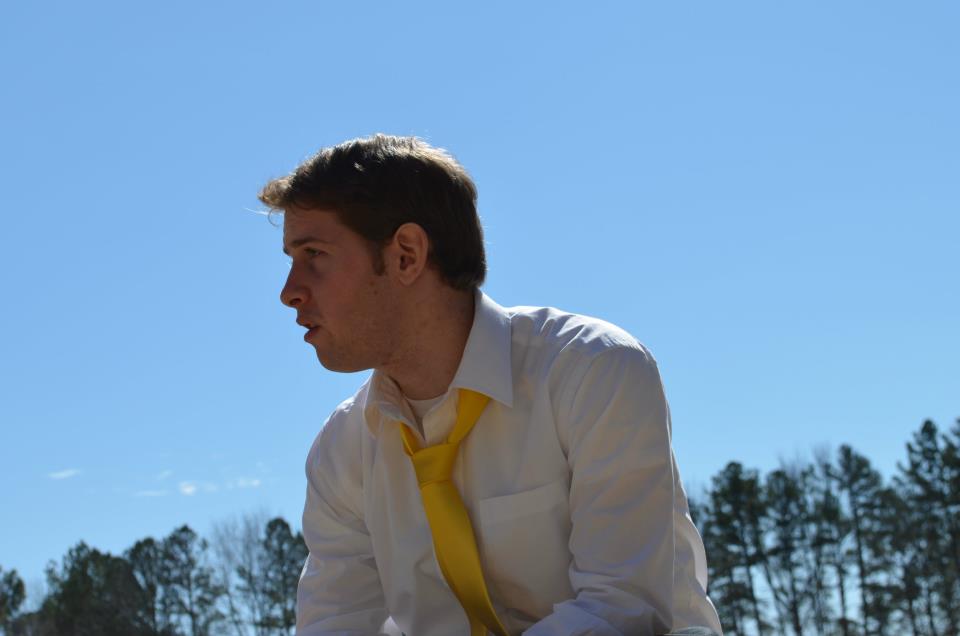
“Today’s the day,” Max keeps telling himself as he builds up confidence before losing it. Is it “the day?” Max knows he won’t know for sure unless he just lets it out, but if he does let it out, will it be the beginning of something more for him and this girl or will it be the end of a solid friendship? Questions like this run through Max’s mind as he expresses in thought (and through voiceover) his nervousness. He’s so nervous that he doesn’t even know what color tie he should wear at work—black or yellow?

Midway through “Yellow” is my favorite scene in the short, and it involves Max’s encounter with a friendly, attractive co-worker (Brittany Reed) in an elevator at work. Her action, in a way, mirrors Max’s goal. His reaction imagines the anxiety and confusion for the reaction for that goal. It’s a well-written, suitably awkward moment that feels true and is an effective prelude to the film’s final scene.

I don’t want to make “Yellow” sound so wholesome and melodramatic that no one would be interested in seeing it, because it is actually very funny. The comedy comes from the situation—the film has a goofy sense of humor, but it also knows how a young man in this setting would talk and behave. The film is fresh and cheerful in that it uses human comedy as it’s found in this situation. It also helps that writer-director Jasmine Greer doesn’t hate her characters—she never condescends to Max, and the side characters are portrayed as suitably weird instead of overly or scornfully so. There’s the semi-annoying slacker-roommate character played by Jason Willey (we all have a friend like him in our lives); Max’s jackass boss played by Scott McEntire who mocks Max’s yellow tie (I love his sarcastic dialogue about if the tie has superpowers); the three family members Max calls for advice are people who just might say the things they say, as they have experienced love long before; and that attractive co-worker, Myra, has her quirks as well.

We don’t see Max’s potential girlfriend until the end of the film, but when we do, it’s hard to question why Max didn’t just decide to give Myra a chance. They have a sweet moment together and surprisingly, the way it’s developed and presented is enough for us to care. You could argue that because the film waited until the end to introduce this girl that Max has been obsessing about throughout the film, it’s hard to care about whether or not their friendship goes further. But somehow it worked for me, and I’ve been trying to figure out why. Maybe it was because she seems much kinder than everyone else in Max’s life, and so it was a relief that there really is a tender moment that Max shares with someone, finally. Oddly enough, these two do feel right together. And so I did find myself wondering whether Max would ultimately tell her how he felt about her or just keep the friendship they share together.

Telling your close friend of the opposite sex you love them is a tough decision to make. It can go one way or another, for better or for worse. I felt that Max’s anxiety was legit and I cared about what would happen for him. That’s how effective “Yellow” was for me. It’s an insightful, well-written, and often very funny short film.

NOTE: The film can be seen here: http://www.youtube.com/watch?v=Yf77YIC42FM

S For Sally (Short Film)

5 Nov

resized_99265-img_8929_48-16924_t728

Smith’s Verdict: ***1/2

Reviewed by Tanner Smith

Melanie Addington’s “S For Sally” is an unsettling short film about a mother who is concerned about her daughter Sally’s disturbing behavior. How disturbing? In an opening scene, she stands in the doorway to Sally’s bedroom, shocked by the things Sally says when she plays with her dolls. “You’ll have to die like the others,” she says. “They should all die.”

Sally’s mother, Mona (Jennifer Pierce Mathus), has good reason to be unnerved by her daughter’s behavior. (As do we, for that matter—that was a quite upsetting opening scene.) But weirdly enough, what’s more disturbing is how Mona’s husband, Phil (Rhes Low), reacts to Mona’s expressive thoughts. “Something is very wrong with our little girl,” she tells him. How does he respond? He’s bitter and cold, as if he’s heard this many times before (at one point, he tells her, “We’ve been through this”).

What person acts like this? What does he know about it? Does he notice it as much as Mona does? And what about Sally’s school teacher whom Mona and Phil talk with at a parent-teacher conference? She seems as calm as Phil, bringing Mona to reveal Sally’s behavior, only to have the teacher say in order to comfort her, “It’s not the school that can help.” It’s even more unsettling when the reverend Mona visits isn’t much help either.

There’s a consistently creepy tone throughout “S for Sally” that makes the film both unsettling and convincing. It’s effectively done and well-made, making the unnerving moments in this film even more so. There’s hardly a way of knowing exactly what’s going on in this family’s life until the film reaches its twist ending. Yes, there is a twist ending here, and to my surprise (without giving anything away), it worked for me. It made me want to analyze what I’d just seen in the last 12 minutes, and so I watched the film again; the more I thought about it, the more I appreciated the film.

We’re as confused as Mona about what’s going on here, and since we follow her throughout the course of this 12-minute film, I’m obligated to talk about the performance. To start with, I really like Jennifer Pierce Mathus as an actress. I’ve admired her in side roles in short films such as Daniel Campbell’s “Antiquities” (already reviewed by me) and Christy Ward’s UCA thesis film, “tree.” She has a true presence that can’t be forced. It’s nice to see her in a leading role such as this. She’s excellent here as this concerned mother, not once striking a false note.

With a suitably dark tone, skillful direction by Melanie Addington, and a standout performance by Jennifer Pierce Mathus, “S For Sally” is an effectively unsettling short film.

NOTE: The film can be seen here: https://vimeo.com/76911811

Greed (Short Film)

14 Jun

stills_Greed

Smith’s Verdict: ***1/2

Reviewed by Tanner Smith

Before I start this review, it’s fair to warn you that SPOILER ALERTS are coming! SPOILER ALERTS are coming! Check out the film on the link below before reading this review.

When watching the 8-minute short film “Greed,” I wasn’t sure how I was going to review it, since it felt like a story we’ve seen/heard before, though shot and acted very nicely. I would recommend it for that skillfulness, but to be honest, it’s the ending twist that really makes the film. It’s the kind of twist that has you think about what you just saw, and unlike a lot of twist-endings I can think of, you actually care to look back because it’s a good film.

“Greed,” which was written and directed by University-of-Central-Arkansas digital-film-major Trenton Mynatt, is a Western, set in the Ozark Mountains in the 1800s. And let’s get this out right now—the look of this short is incredible. Not only is this film shot very nicely, but also you really get a sense of being there with these characters in this desolate environment. Even something as simple as handwritten words on a letter or a knife sharpened against a stone looks great.

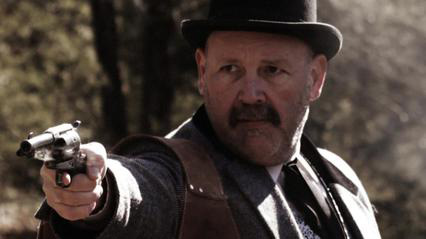
But I digress. What’s the story? Well, it’s fairly simple and straightforward…so you would think. It begins in a cat-and-mouse chase that has already begun in a story that I wish could have been made, so the film could be longer and more effective, but you stick with what you got. Anyway, a wealthy man named Jimmy who, along with a small posse, is on a search for gold and also on the run from a malevolent Marshal for mysterious reasons. The Marshal has already killed their guide, so they must move further or else they’ll pay the same price. But a price for what, you ask? This is actually what makes “Greed” original and quite fascinating—the twist. And at this point, I’m obligated to state again—SPOILER ALERT!

Believe it or not, I’ve only described the first three-and-a-half minutes of this eight-minute short, which consists of Jimmy turning on the remaining two members of his group, killing one and leaving the other to die—all so Jimmy can claim the fortune for himself. Earlier, it seemed as if Jimmy and his posse were the heroes and the Marshal was the villain—and while the Marshal isn’t technically a protagonist, he’s not much of an antagonist either. And it all becomes clear at the end, when it’s revealed that…well, let’s just say there’s more to this man than bringing justice. What is the price that Jimmy and his group must pay? Death. For what? Greed—one of the seven deadly sins. It’s a unique, well-executed twist that brings things into perspective and makes you think about what you’ve just seen.

In a certain way, “Greed” reminded me of another UCA-produced short film: Allison (Hogue) Bristol’s “Hitchhiker” (already reviewed by me), which was made the year before. It’s the simple, seemingly-generic story with a fresh manner of execution and a resolution that turns it all around and makes you think maybe it wasn’t so “simple” or “seemingly-generic” after all. (And wouldn’t you know it—some of the people involved in the making of this film were also involved in the making of “Hitchhiker.”) Now that you’ve watched it on Vimeo before reading this part (I hope you did; if not, don’t say I didn’t warn you about spoilers), watch it again knowing what you know now and think about what you see. For example, notice the look on Jimmy’s face early on when he’s reading the letter stating a brother is dead—is it indifference due to his greed, sadness because of the loss, fear because he knows who’s after him? This is what twist-endings were made for—not to merely confuse us or take us off guard, but to make us look back and really reflect about what was set up for it. “Greed” is a short film that worked in that sense.

Check out the film here: https://vimeo.com/43716364

Blood Brothers (Short Film)

25 May

481670_138465319634100_996633824_n

Smith’s Verdict: ****

Reviewed by Tanner Smith

“Blood Brothers” is a half-hour-long short film with an interesting backstory. The main question I had to ask myself while seeing it (at its Little Rock Film Festival premiere) was whether or not the film turned out to be as interesting as how it was made. Before I get into the actual review of “Blood Brothers,” I feel an obligation to share what I know of the backstory:

Two young, independent filmmakers—Jason Miller and Seth Savoy—met and associated with many different film projects in Central Arkansas (most of which made in association with the University of Central Arkansas’ Digital Filmmaking Program). The two, despite their differences in vision and directing (and age difference, as Miller is about seven or eight years older than Savoy), became very good friends and effective creative-partners. Savoy announced he would be moving to Chicago to attend Columbia University to further go into the art of filmmaking, and so the summer before he left, he and Miller co-directed a short film called “The Backland’ (which is still in post-production, due to complications). But as Savoy moved away, and he and Miller kept in touch online, the two came up with the idea to continue making films together. So they had an unusual plan to make two parts of the same film. See if you can follow this—the two would write their own stories and link them as two separate stories for one whole screenplay; then they would collaborate on how it would seem like they were really making the same film in a way; and whatever they film (Miller in Arkansas, Savoy in Illinois) would be sure to connect to an ending in order to make it whole, for sure.

So basically, what Miller and Savoy had here was an ambitious project that required them to collaborate from their own living environments. And so, “Blood Brothers” was the project that was created—two different directors, two different casts/crews, and two different parts of the country. Miller and Savoy put their heart and soul into this project and went all out to make it the best damn film they could make together, despite being separated from each other. (And reportedly, according to Miller, collaborating on this project made the friendship between him and Savoy even stronger—“I’d say we were good friends before he left for Chicago; we’re great friends now.”)

If I’m going to go into “Blood Brothers,” I suppose it’s important to present it with the two guys’ angles.

Miller filmed his part in all over Arkansas (one part Northwest AR, another part Southwest AR, other parts Central AR) with his own crew and his own style of filmmaking. Set in a rural Southern area, Miller’s story feels quite gritty in its surroundings. The environment gives it a sense of dark, deep perception, much like a Southern Gothic tale. (It’s also worth noting that Miller’s main strength as a filmmaker is the way he allows his scenes to flow naturally.) His story involves a troubled young man, Travis Ray (Jeff Fuell), who returns to his Arkansan hometown, long after he and his brother were driven out by the local drug operation. Living a life of shame and misery, he comes back to town to take action in an attempt to hopefully make everything back the way he wants it to be. He kidnaps the drug kingpin, Marty (Kenn Woodard), and runs his own show. However, things don’t really work out the way he hoped, as meanwhile, his brother is having his own troubles in Chicago…

And speaking of which, Savoy filmed his part in Chicago with his own crew and his own style of filmmaking as well. (And for among other things, give Savoy credit for casting an Arkansan actor—Kyle Wigginton—as his story’s protagonist.) Shooting in the Windy City gives quite an effective backdrop, particularly when Savoy plays certain scenes near large, glass windows in areas several stories high (and especially in a pivotal scene that takes place on a high rooftop). This piece is somewhat more action-oriented and has the sense of a crime thriller. (It’s also worth nothing that Savoy’s strength as a filmmaker is the symbolism he uses often—some subtle (like the use of color), others not so much (such as a heroic figure walking in front of a cross in slow-motion); all in all, he has a knack for this style.) This story (or rather, side-story) involves Travis’ brother, Michael (Wigginton), who has put his previous life in Arkansas behind him and is now leading a clean, successful life in Chicago. He proposes to his girlfriend, Laura (Jessica Serfaty, bewilderingly beautiful), she says “yes,” and it seems like life couldn’t be any better. And wouldn’t you know it—it instead takes a dark turn, as he is visited the next day by a thug named Tony (Sean Athy) and his gun-wielding henchman, both of whom work for Marty. They kidnap Laura and interrogate Michael, demanding to know why Travis is back in Arkansas and why Marty is missing. While being held captive and with lives at risk, Michael must think of a way to fix this situation.

There’s an interesting contrast between both parts of this story, which does ultimately add up and bring it all together at the end. That contrast not only comes from the surroundings of each of the two protagonists, but also in the structure, in that Travis is hoping for things to be the way they were and is now holding someone prisoner, while Michael is happier now that things aren’t the way they were and is being held prisoner because of Travis’ actions. The characterizations of the two men are both solid, as you feel the pain that Travis is going through, especially when you hear how much worse things have gotten for him after he left his hometown. As for Michael, he starts off as somewhat ordinary, but when his backstory involving his brother comes into place, you can see how complicated the character is. He too has been through a lot in his life, and while he would rather forget his past and move on, too many things get in the way that just won’t let him. Both actors—Jeff Fuell as Travis and Kyle Wigginton as Michael—do terrific jobs at playing these roles.

So back to the question I mentioned earlier—is this film (which runs about 32 minutes) as interesting as the story behind it? My simple answer is that as Jason Miller and Seth Savoy set out to make a film with this much ambition and skill (not to mention, distance), this is a hell of a film. Despite being of two different minds, locations, and narrative elements, it’s gripping throughout and well-crafted by both directors. To make a film like this would have been tricky, but Miller and Savoy were clearly each on the same track in making this film, and the results are just captivating. “Blood Brothers” is a solid success.

Mary (Short Film)

24 May

625622_508333739224239_528916055_n

Smith’s Verdict: ****

Reviewed by Tanner Smith

In two reviews I’ve written of short films lately (“Last Shot Love” and “The Discontentment of Ed Telfair”), I couldn’t reveal their resolutions for the sake of people who should be pleasantly surprised by twist-ends. But in the case with Zach and Caleb Turner’s 25-minute film “Mary,” you won’t have to worry about me giving much away here. That’s because honestly, I’m not entirely sure what I just saw. I mean, I think I have some idea, but this is one of those fantasies that play with minds of the audience. And those who care can think about what they just saw and come up with certain interpretations about certain details.

I recommend “Mary” because I did care. Did I understand it? Not entirely. But it did leave me thinking about it.

But I’m getting ahead of myself. What’s the story? The main character is Craig Rifter (played by Matt Newcomb), a depressed, sleep-deprived schoolteacher who is coping with divorce. No one seems to help cope; least of all, a weird janitor (Graham Gordy) who babbles about reincarnation. While browsing in the local bookstore, he notices a beautiful woman staring at him, and wants to find out more about her. So he seeks advice from one of the clerks—a supposed psychic (Jason Thompson, a riot) who constantly puts him down (with strangely, a lot of penis jokes…OK) until he is convinced that he is the right one for her and states her name is Mary. Once Craig and Mary (played by an astonishingly beautiful Raeden Greer) ultimately meet, Craig is surprised to find that she is genuinely attracted to him.

And don’t ask me how, but things only get strange from there. Somehow, the subject of reincarnation comes back into the mix (so that the janitor’s ramblings actually had a point), and there’s also the strange aspect of a dreamlike matter, indicating maybe this is all a dream, or maybe it’s not. There are symbolic images (such as floating pieces of paper early on that probably indicate Craig’s life out of his control, though I could be wrong) and effective moments of magic realism, all of which surprisingly work in the film’s favor. It’s all quite fascinating and seems to know what it’s going for…although maybe a lot more than we do! “Mary” leads to somewhat of a resolution that could be a happy ending or a sad ending, depending on what you would figure what you’ve just seen, because this is not a film that relies on conventional storytelling; instead, it’s an artful film that asks the question of whether or not we deserve “the girl of our dreams.” For that matter, is this a dream? Does Mary really exist? Has Craig’s sleep deprivation gotten the better of him, causing all of this? Or, wait a minute…who or what even is Mary? Is she real? Is she a manifestation of Craig’s desire? Is she a ghost? Is she…something else?

I don’t know! I’m still trying to figure it out. Now I want to see “Mary” again. Maybe I can go back and see if it answers any of the questions I have. It’s kind of like “Donnie Darko” in that there are questions involving these fantasy-supernatural elements and because of the effective setup leading to it, its ambiguity worked in the film’s favor. That’s the case with “Mary”—I actually cared enough to ask these questions. I don’t hate this film, by any means. I’m intrigued by it. Spellbound. Fascinated. It worked for me. And I’ll admit I have a short fuse when it comes to symbolism (because while it can be effective and subtle, I’m usually not a fan of its occasional broadness in short art films), so this was a pleasant surprise!

What can I even rate this? 4? 3.5? 4? 3.5? 4? You see what this short film is doing to me?!

This is a deep, intriguing short film that is now in its festival run. If you haven’t already seen it at the Little Rock Film Festival, see it whenever and wherever you can. But prepare yourself.

Twinkletown (Short Film)

23 May

547667_380113565370260_1794727755_n

Smith’s Verdict: ***

Reviewed by Tanner Smith

The tagline for the short film “Twinkletown,” written and directed by Scott McEntire, states, “Absolute power corrupts absolutely in a small Southern town.” And knowing that tagline doesn’t make the subject matter for this film seem necessarily “new,” but there is something oddly captivating about a premise that mostly involves greed and power taking over a small (Southern) town almost as if it were a run of the Mob. With that said, “Twinkletown” is satisfying in the way it handles this premise, and is able to overcome its minor flaws.

“Twinkletown” (which is 20 minutes in running time) opens with three men chained in a warehouse, where they are tortured by Eve Wallace (Kristie Pipes), the latest of the corruptive Wallace family, who has run a small town in the Arkansas Delta for years. Eve learns that these three men have stolen Wallace money, as she and her henchmen, including her right-hand man Max (Johnnie Brannon), torture and kill the other two. The last one alive, a young man named Terrence (Dustin Alford, “Foot Soldier”), is given a chance to save himself. But as Eve allows him to settle things, Terrence’s grandfather (Tucker Steinmetz) suddenly becomes involved and this leads to a complicated situation that Terrence must get himself out of before he puts himself in more danger with the Wallaces.

One thing that stands out about “Twinkletown” is that there is a real feel for the sort of system that this town seems to run through. Eve and Max are broadly developed, but that’s what makes them memorable and their presences impactful. Particularly, there’s a scene in which Eve talks with the town sheriff (Don Pirl), and it’s clear where everyone seems to stand in this town. You either accept the melancholies here, or your ass is grass if you’re desperate enough to make the wrong choices in order to escape. No one can mess with Eve, and you’d have to be as crazy as Terrence’s grandfather to go up against her.

But really, what “Twinkletown” fully seemed to represent is an effective metaphor for the differences between the rich and poor in small Southern towns, taken to the level of a crime drama about the Mob, practically. In that sense, it’s more intriguing.

But there is a problem I had with “Twinkletown,” and unfortunately, it had to do with Terrence’s story. Terrence is merely a clean-cut kid who fell with the wrong crowd, and that’s why he found himself in this situation. As a result, the character is not very interesting. Maybe it’s just a personal preference, but I wonder how it would have been if a member of that “wrong crowd” was put in this situation himself. That’d be interesting because he’d have to rely on his wits and question his own morals and ethics, as well as the Wallaces’. As it is, Terrence is boring (though not exactly the fault of talented actor Dustin Alford, who was great in “Foot Soldier”), but I think his grandfather makes up for it (though that probably has to do with Tucker Steinmetz’s delightful overacting).

Kristie Pipes is enjoyable to watch as this despicable, unsympathetic woman who does anything to get her way and keep the family in power (even to the point, such as the case in the opening scene, of mocking sympathy to toy with somebody in order to receive some answers). At times, Pipes comes close to overacting, but for the most part, she’s quite good here. Johnnie Brannon underplays the role of Max, Eve’s cold-blooded associate. He doesn’t say much, or do much, and yet surprisingly he really leaves an impression. He’s great here. Tucker Steinmetz…to say his role here is more flamboyant than his “Antiquities” character would probably be an understatement. But to be honest, it did sort of grow on me. Sure, he’s over-the-top, but he does put a lot of energy to the role, and I admire him for that.

It would seem as if there are some roles that are somewhat one-dimensional, but there is a twist at the end of “Twinkletown” that changes that, for the most part. It shows there were further motivations than what may have been declared earlier. And without giving away certain details, it does bring the film full-circle in a satisfying way. While “Twinkletown” does have its flaws, it impressed me with its story structure, its moments of humor and danger, and some nice camerawork as well.

The Discontentment of Ed Telfair (Short Film)

22 May

images

Smith’s Verdict: ****

Reviewed by Tanner Smith

“The Discontentment of Ed Telfair” is yet another brilliant short film from a most unique, inspiring filmmaker named Daniel Campbell. Campbell’s previous short films/festival favorites were “Antiquities” (already reviewed by me) and “The Orderly,” both of which were fiercely inventive in their human (and comic) elements. These films are not only funny but also very memorable. They’re some of my prime examples of excellent short narratives in that they’re very successful in screenwriting, pacing, and even an artistic sense. It’s almost as if Campbell makes the films that he would like to see play at film festivals, and the results make quite an impact on filmfest audiences, making them not only laugh but also care. “The Discontentment of Ed Telfair” is no exception, by any means.

Like the previous films, “The Discontentment of Ed Telfair” is a short comedy, but with a somewhat dark edge to it. It begins with a shot of two seemingly-ordinary men standing yards away from the camera, facing away from it. They stand for a while, not doing anything, until one of them points a pistol at the other man’s head and shoots him dead. The way the shooter looks at the fallen man (as the film’s title appears) practically sets the tone for the rest of the film. It’s disturbing and yet oddly funny.

That opening shot is worthy of the Coen Brothers.

Cut to shortly before that incident, as we see what led up to that surprise kill. Ed Telfair (Jeff Bailey) is an insecure, mundane man who runs a trophy shop (in a scene that recalls “Antiquities,” he’s pushed around by a client who isn’t satisfied with his order, and he’s just forced to take it). Ed has a beautiful wife, Cindy (Mary Faulkner), and a likeable best friend, Doug (John Isner). But he starts to notice a few things about the two that become somewhat clearer to him, the more he translates from afar. So he decides to take care of things on his own.

Period. That is all I’ll say about the plot. I’m not even sure what I can get away with revealing anymore. But treading a little bit of water here, I’ll just say that this setup is leading up to a payoff that is beyond hilarious. I’ve noticed that Campbell’s films seem to end exactly when the time is right (and being comedies, they also serve as effective “punchlines”), particularly with “The Orderly” and especially with this one. Without giving anything away, the ending to this film is just perfect.

When all is said and done, “The Discontentment of Ed Telfair” is pure Campbell through and through. This guy is clearly distinguishing himself as a very talented, inventive independent filmmaker—somewhat of an “unsung hero” in that sense (although certainly not in the Central Arkansas filmmaking field; he has a respectable position there). I heard that he is working on a feature-film version of his short film “Antiquities”—if it’s as great as the original short (or Campbell’s other shorts, for that matter), I think independent-film audiences all over the country are in for a real treat. For now, we have this fantastic short film called “The Discontentment of Ed Telfair,” which is currently in its festival run. If it plays in a festival near you, check it out. It’s shot nice, it leads to a brilliant resolution, and it’s quirkily deranged to the high point of enjoyment.

Death of a Superhero (Short Film)

21 May

532557_197176317063003_661340127_n

Smith’s Verdict: ***

Reviewed by Tanner Smith

“Death of a Superhero” is a 10-minute short film that asks the question, what happens when a superhero loses his powers? Of course, he would have to give up the job (and throw away the costume) and reduce himself to his regular human alter-ego permanently. That’s the case with John Jameson, a.k.a. Captain Amazing. After an intense battle with his arch-nemesis, Dr. Disaster, Amazing loses his powers and therefore his identity of a superhero.

After his battle (which I’m assuming he easily ran away from after the final thrashing), Amazing (well-played by Ed Lowry) is bloodied and beaten as he returns to his apartment. Now without his strength and whatever those cool-looking lightning/laser effects that Amazing shot out of his hands were supposed to be (yeah, what were those again?), he is forced to live with his identity of John Jameson. He burns the Captain Amazing attire (which include cape and mask), his identity is declared dead by the media, and John prepares to accept a relatively normal life. However, it turns out that it isn’t so easy, as he still finds himself listening to a police band waiting for a crime he can stop. He does try to foil some thieves, but gets his ass handed to him. It’s then that he comes to grips with the concept that Captain Amazing is now dead. But is there a way a normal person can become a hero without superpowers?

For a 10-minute film, it’s intriguing how “Death of a Superhero” was able to tell an admittedly complex story and manage to tell it within certain limits so that it doesn’t feel rushed. There’s no padding involved, so there’s nothing really slowing it down, which works to the film’s advantage. The Amazing/Disaster battle is simply overlooked in the opening credits, but with enough intensity to deliver the point. This means the story gets rolling real quick, as John comes to his apartment, realizes his loss of identity, interacts with people (including a little girl who lives in the same apartment building), tries to bring himself back to being a hero, and then there’s the ending, which is satisfying with a positive (and subtle) message that isn’t forced in the slightest.

I think what I really liked about “Death of a Superhero” was that while it was about a superhero, it wasn’t a superhero movie in the traditional sense in that there’s a supervillain and a big climax. There is a climactic moment near the end, and something close to a villain (in the form of an abusive husband/father), but it’s played in a realistic way and, in a clever move, in a way that mirrors the opening battle. So we have three fights in this short film—one that serves as a traditional superhero duel (with some good visual effects by Brandon Bogard, who also provided FX for the short film “The Man in the Moon”…and unfortunately with a lot of camera-shaking so that those effects are not fully appreciated); one that serves as a standing point for the failed hero midway through the film; and another that gives the hero a moment of redemption, as a person. It’s a clever structure that works.

“Death of a Superhero,” which was made by student filmmakers of the Digital Film program at the University of Central Arkansas, is an effective short that serves as a metaphor for how modern, everyday people can be heroic in their own form or fashion. It’s a touching, well-made film with a respectable message delivered successfully.

NOTE: You can see the film here: https://vimeo.com/44162407