Archive | One star * RSS feed for this section

The Neverending Story II: The Next Chapter (1990)

18 Mar

MCDNEST EC006

Smith’s Verdict: *

Reviewed by Tanner Smith

Every once in a while, a family-adventure movie will be released and fail miserably because of its showing to “try” and make a family-adventure movie. If you’re confused by that statement, I’ll put it this way. A family-adventure movie should store a moral—the moral in this movie is taken the wrong way. A family-adventure movie should have amazing visuals—there will be no amazement. A family-adventure movie should have a young hero—the young hero is an idiot. What movie shares all of these traits? “The Neverending Story II: The Next Chapter.”

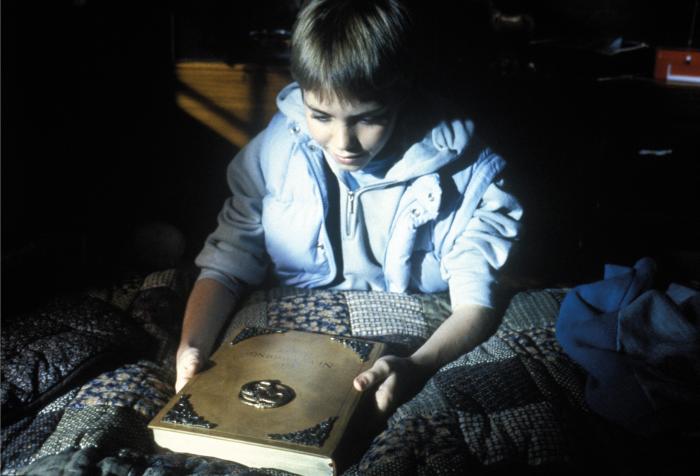
This is the sequel to 1984’s popular fantasy-adventure movie “The Neverending Story,” which I admired for its compelling characters, interesting plot, and surprisingly-legitimate drama, as well as its amazing visual look and neat adventure elements. If you recall, the movie featured an imaginative young boy named Bastian who read a book called The Neverending Story and discovered that he will become the hero that will save a very real fantasy world called Fantasia from being consumed by nothingness. That movie was about ideas and had a subtle way of teaching young children to read.

The message is the same in its sequel, “The Neverending Story II: The Next Chapter,” but it’s all over the map. How so? Because people stopped reading books, the library in town suddenly disappeared. That’s sort of convenient, in the way that the actor playing the mysterious librarian is the only actor returning for this sequel.

This time, the young hero Bastian is played by Jonathan Brandis. And here’s the movie’s first problem—he’s not very good in this movie. It’s a one-note performance that requires him to be cheerfully dim and a poorly-written character who is a terrible role model for kids. This kid is such an idiot. If you think I’m being too harsh, keep reading. Fantasia will thank you for it.

Bastian, while thrust into Fantasia to fight the Emptiness (the human form of lost ideas), has the power of a necklace called Auryn to wish for anything. What he doesn’t know is that the Emptiness has created a machine that will erase one of Bastian’s memories every time he makes a wish. And right there, you see the big character flaw—he doesn’t know that! There are many scenes in which his and his best friend Atreyu’s (Kenny Morrison) life is at stake and he doesn’t even think about making any wishes. And when he finally wishes for a weapon to fight the Emptiness’ silly-looking giant minions, what does he wish for? A spray can!

And why was this kid chosen to save Fantasia? Because the Childlike Empress (even more annoying and dim than Bastian) knows he’s the most imaginative kid in the world and is the one who can save this world that can’t survive without the pure imagination of human beings. Well, that was in the first movie. In this sequel, they picked the wrong kid.

By the way, the Emptiness is annoying too. This time, it’s in the form of a woman who wants to—you guessed it—destroy the world. But then, where would she and her minions go? Earth? What are they going to do there? I don’t know and also, I don’t care because this woman is as over-the-top as any other over-the-top villain or villainess in bad adventure movies.

Other characters are back too—Atreyu, Falkor the Luckdragon, and the Rockbiter (this time, accompanied by an annoying rock-son)—and they make some good company. But the hero is unappealing, the plot is uninteresting, the message is taken too literally, and there’s no wonder here. Fantasia just looks strange this time around. It makes me wonder what the filmmakers were thinking when they made “The Neverending Story II: The Next Chapter.”


Can’t Buy Me Love (1987)

10 Mar

600full-can't-buy-me-love-screenshot

Smith’s Verdict: *

Reviewed by Tanner Smith

Among the “teen movies” that came around during the mid-‘80s, 1987’s “Can’t Buy Me Love” is a stupid one. Not just stupid because of the lazy storytelling and unfunny dialogue, but because its teenage characters are stupid. This is a disgrace to the genre of “teen movies,” if there ever was such a genre. (And let’s face it—there is.)

The film’s main character is a geeky outcast named Ronald Miller. The only reason he’s labeled a nerd and a geek is because he doesn’t play football, tell raunchy jokes, act nasty even in public (one of the football players has a—excuse me—gas problem, ho ho), or date the most popular girl in school. Instead, he spends most of his days playing poker with his friends and mowing lawns to save up for an overly expensive telescope. (Really? A telescope? Is it really worth it?) He mows the lawn of the school’s queen bee, named Cindy, who is completely irresponsible, shallow, and selfish (but she’s beautiful—that’s all that counts in this high school, right?). Her first scene shows her mother disappointed that she used her credit card on the most expensive wardrobe—her mother asks, “Why can’t you be as responsible as Ronald Miller?” Cindy scoffs, “Mom, get real.”

One of Cindy’s acts of irresponsibleness leads her to a desperate need for a thousand dollars, which Ronald conveniently happens to have. He’s desperate to become popular in school so he offers the money to her in exchange for her pretending to be his girlfriend for a month, hoping that it will make him popular.

Let me stop there—what springs her need for cash is that she stole her mother’s suede jacket and wound up accidentally spilling red wine on it at a back-to-school party. This is unrealistic and (broken record) stupid. Or maybe the filmmakers wanted to highlight the expensive items they could possess (i.e. the jacket).

So the plan works (again, stupid) and Ronald is among the elite crowd and ditching his “nerdy” friends. But the way these popular students are portrayed is insulting. They’re portrayed as cruel, mean-spirited jocks that look ready to go for the kill whenever the “nerds” stand up at a high school dance. And they’re also dumb and witless, to be added. Ronald becomes one of them—a snobbish jerk who forgets the better deal of high school life and everyone looks to him as the popular guy in school. There’s one scene set at a high school dance in which he performs a dance move which he learned from “African Hour” instead of “American Bandstand,” looking like a complete idiot. The elite crowd doesn’t know what to think, but then they state, “Since he’s doing it, let’s do it too.” And it’s the nerds who have a big laugh (I have to admit, that one bit was kind of funny).

What about the parents? With the exception of Cindy’s mother, the parents are either uncaring or missing. Then again, this is a “teen movie.” They don’t have much to do in this genre anyway, with the exception of “Sixteen Candles,” with that scene in which the father and daughter have a nice little talk.

The actors who portray Ronald and Cindy—Patrick Dempsey and Amanda Peterson—do give off some appeal, but they deserve a whole lot better in script and role. Their characters would fit in with no problem in a dumb high school sitcom, which is exactly how “Can’t Buy Me Love” functions.

The Last Airbender (2010)

9 Mar

THE LAST AIRBENDER

Smith’s Verdict: *

Reviewed by Tanner Smith

I’ll state right away that I haven’t seen a single episode of the popular animated TV series, aired on Nickelodeon, called “Avatar: The Last Airbender.” So I don’t know the exact details of its story, characters, etc. But I do know that it is held in high regard—it has a cult following and apparently even the most stubborn critics can’t help but like it. So when the fans heard of a theatrical film adaptation of the show, they were hyped. When they heard that it was going to be live-action…they were worried. When newcomers to this story heard that the writer/director was M. Night Shyamalan, we had little to no expectations.

We all know that Shyamalan is a talented filmmaker and has brought us some outstanding achievements (“The Sixth Sense,” “Unbreakable,” and “Signs”). But he has really lost his way since then. Projects like “Lady in the Water” and “The Happening” were not promising evidence that Shyamalan was gifted, if we hadn’t seen the other three films. And now here he is adapting a film from this animated TV series. I’m surprised that the Paramount studio entrusted this man with something as apparently delicate.

Like I said, I haven’t seen the original show, so I’m reviewing “The Last Airbender” (the “Avatar” was omitted for obvious reasons) as a movie, like it should be. And the verdict is I hated it. It’s a confusing, uninteresting, jumbled mess that is a huge case of bad writing, bad storytelling, and bad filmmaking. This is not only M. Night Shyamalan’s worst film to date—it’s one of the worst fantasy films I’ve ever seen.

The plot is incomprehensible, though to be fair, I think it’s because I’m not accustomed to watching it develop in episodes on TV. There’s a scroll that tries to explain everything in the very beginning, and most of the dialogue is full of spewing exposition. But I couldn’t tell you what happens in this story or why it happens. I just know that in some distant future (or maybe a parallel dimension), mankind has split into four tribes, each representing an element—earth, air, water, and fire. And there are people in these tribes who can enchantingly manipulate their elements—or “bend” them, as they put it. These tribes are at war with each other, particularly because the Fire-benders are brutally hostile because…whatever. Only one can bring peace to the world—the “Avatar,” who can control all four elements.

The Avatar, named Aang (Noah Ringer), is found by two water-benders—a sister and brother named Katara (Nicola Peltz) and Sokka (Jackson Rathbone, the “Twilight” movies). They release him after he’s been buried under the ice for years. But by the time they figure out who he is, they are attacked by the Fire tribe warriors, led by Prince Zuko (Dev Patel) who tries to capture him before Fire Commander Zhao (Aasif Mandvi) claims him for the Fire Lord (Cliff Curtis)…at least I think that’s why this is happening. Oh, and Aang, aided by Katara and Sokka, heads to the lands of different tribes to train and master his own abilities, so he can make himself known as the Avatar.

“The Last Airbender” takes itself way too seriously, to the point where we’re supposed to be familiar with most of the material. But it’s hard to be invested when it’s pretty much just a callback to those fantasy films that tried for the same “complexity” that this one does, and it ends up looking like a joke as a result. (Well hey, not every fantasy film can be “Lord of the Rings” or “Harry Potter”—at least those films knew how to tell their stories.)

The screenplay is horrible. The dialogue is laughably bad and the story developments are inconsequential. It’s like we’re being challenged to follow along with what’s going on in this movie. I wouldn’t mind so much except that it’s so rushed and ends on a note that suggests a sequel, which I would definitely not look forward to seeing. And like I said, most of the dialogue is just awkward exposition—there’s no reason for these characters to explain these details except for informing the audience what’s going on. It’s not informatively helpful; it’s boring.

The special effects range from average to completely unconvincing. Some visual shots are clever, like the water spheres that the Water-benders create, and even a few shots of this “giant water buffalo” (I have no idea what Aang’s humongous pet really is). But mostly, they’re very weak. The fire looks like obvious CGI flames, the twister scenes (in which air is “bended”) are unimpressive, and every battle sequence is unintelligible, making for an uninteresting final-battle climax. Shyamalan’s gifts do not include action scenes.

I’m just glad I didn’t see “The Last Airbender” in 3-D.

But to be fair, the settings are quite extraordinary. It really does look like we’ve entered another world. Look at the icy mountains, the medieval-looking castles, the large-scale ships—the production design deserves credit.

I really don’t like to criticize young actors, but Noah Ringer is totally flat as Aang, and is given unable support by his two co-stars Nicola Peltz and Jackson Rathbone. All three young actors are dull, stiff, and unconvincing. The villains—Cliff Curtis, Aasif Mandvi, and Dev Patel—are slightly better, but here’s the main problem with them. They play it too straight, like they’re leading men in another movie. Dev Patel, in particular, has apparently forgotten that his role is supposed to be hammy, not deadpan serious.

“The Last Airbender” is an unintelligible, badly-made fantasy film. And I find it very hard to believe that Shyamalan, this man formerly known as an influential filmmaker, botched up this adventure that should have been exciting. Maybe he’ll find his way again. I sure hope so.

NOTE: Sometime, I will watch an episode or two of “Avatar: The Last Airbender” and see what all the love is about.

Like Father, Like Son (1987)

23 Feb

Like Father Like Son3

Smith’s Verdict: *

Reviewed by Tanner Smith

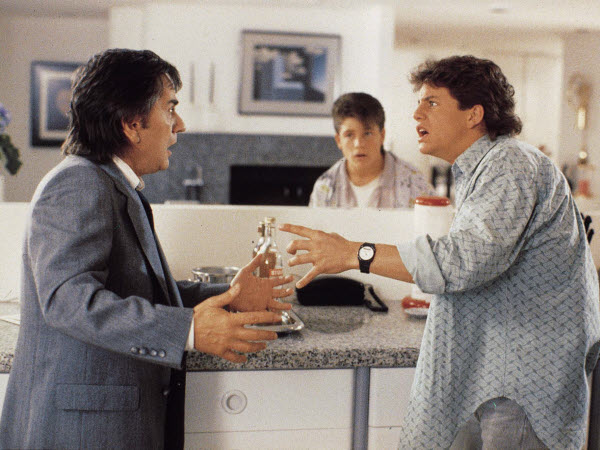
“Like Father, Like Son” is a comedy so desperate to get any kind of laugh just by one gimmick only. That gimmick is the same one used in “Freaky Friday,” in which parent and child switched places for a day. Well, a gimmick isn’t enough. A smart, funny screenplay was needed to lift it into the air. “Like Father, Like Son” barely makes it off the runway.

It’s a shame too, because it stars Dudley Moore, who has shown in many other comedies to be an effective British comedic actor. It also stars 1980s teen idol Kirk Cameron (best known as the smarmy teenager from the TV sitcom “Growing Pains”), who I believe is capable of a good performance when he’s not incredibly annoying (I’m not much of a “Growing Pains” fan…anymore). But these two don’t have any juicy material to work with. They play a squabbling father and son. (Where’s the mother? Never addressed.) Moore plays a doctor who wants Cameron to follow in his footsteps. (“But I’m 17,” Cameron complains, to which Moore responds, “When I was 17, I was in my second year at Oxford.”) But Cameron’s highest grade in high school biology class is a C, which won’t do well with Dad.

Cameron has a wisecracking friend nicknamed “Trigger” (played by Sean Astin in, believe it or not, a smarmier teen performance than…Kirk Cameron’s “Growing Pains” role), who has a weird uncle who came across a magic potion that can transfer minds.

Moore accidentally drinks the mind transference serum and suddenly, he and Cameron switch bodies. So, Moore is inside Cameron’s body, and vice versa. And so, until Trigger can get in contact with his uncle again and find an antidote, the father and son have to lead each other’s identities. Moore (with Cameron’s mind) goes to work in the hospital and Cameron (with Moore’s mind) goes to high school. Constant misunderstandings occur, and not one of them made me laugh. Cameron acts with a certain authority to his high school teachers; Moore behaves silly without understanding medical procedure. So what?

See if you can follow this. Apparently, if you drink the mind transference serum, you look at somebody and switch bodies with him or her. So, how would you change yourself back to normal?

Exactly! Drink the potion and look at the same person again. There’d be another switch—problem solved. See? You’re already smarter than the writers and the characters they created.

I’m serious—Moore and Cameron’s characters never consider just doing the same thing again, because the movie would be over too quickly. Also, it’s not a mind transference serum; they make it perfectly clear that it’s a “brain” transference serum. In that case, how come the brain isn’t connected to the tongue in this movie? In the first test of this potion, it is. Cameron and his friend test the potion on a cat and a dog, so that the cat has the dog’s mind and vice versa. The cat growls and barks like the dog. So then, when father and son switch places, why doesn’t Kirk Cameron speak with Dudley Moore’s British accent? Moore, with Cameron’s mind, still speaks in that accent, and Cameron, with Moore’s mind, still sounds like a Southern California teenager.

Here’s a surprise—the writing is so inept that the dog/cat joke isn’t taken advantage of. In fact, it’s never mentioned again.

This is one of those movies where all of the characters have to be total idiots to keep the story going. Why is this interesting? Why is this funny? Just because two guys switch bodies, that itself isn’t funny. You need actual jokes, characters, and a well-developed script. I didn’t care about these two clods. You could have two guys trade law files and it’d be more interesting. Dudley Moore is trying his best, as in one plot thread, he’s seduced by his boss’ wife. But Kirk Cameron doesn’t get one good moment. He’s forced to wade through the script just simply misreading things. Yes, he thinks the music at a rock concert is too loud. Where does this lead him on his date? Nowhere. Come on! There could’ve been an interesting discussion with him and the girl he was dating. But no. It’s just glanced over. It’s 1987, writers—you’re not helping with Kirk Cameron’s movie career. He could show talent; give the guy something to do.

“Like Father, Like Son” stinks all the way through. All we’re left asking ourselves after watching it is, “Were they really that cheap to not synch Moore’s voice with Cameron’s?” The premise didn’t work, I never cared, and most criminal of all for a comedy, I never laughed.

Children of the Corn (1984)

17 Feb

images-2

Smith’s Verdict: *

Reviewed by Tanner Smith

“Children of the Corn” is a movie in serious need of punishment. This is a sick, depraved movie that isn’t enjoyable unless you like to see children under the age of 19 butcher adults and attempt to sacrifice a woman to their deity He Who Walks Behind The Rows, shouting “Kill! Kill! Kill!” Why is their deity called that, anyway? He doesn’t walk behind the rows, he tunnels underneath them.

These little monsters are led by the sadistic young preacher named Isaac (John Franklin), who brings the children of small town Gatlin, Nebraska into the clearing of the corn fields to preach about He Who Walks Behind The Rows. He orders the children to follow his orders and kill all of the adults in town. His main executioner is another sadistic little snot named Malachi (Courtney Gains), who always has his hunting knife handy for slitting throats of children who rebel against Isaac.

Where did Isaac come from? How did he get to be this way? We don’t know. All we know is that we would love to kill this kid, along with Malachi with his own hunting knife. The rest of the kids are practically just their robots, agreeing with them in deadpan.

The narrator of the movie is a boy named Job (Robby Kiger)—he explains in narration that the town has been adult-free for three years. He, his older brother Joseph, and his psychic sister Sarah (she can draw what is going to happen) are nonbelievers, but they keep it a secret from the other children. Joseph plans to run away from Gatlin through the cornfield. He doesn’t make it—he gets his throat cut by Malachi and is thrown out into the road, where his body is hit by a traveling young couple (Peter Horton and Linda Hamilton). The couple is traveling to Seattle and is passing through Gatlin to report the body but they don’t know what they’re in for.

The only thing that looks good in “Children of the Corn” are the shots of the cornfield (someone running through them looks like someone stumbling through a maze) and the music score, which is quite eerie and belongs in a different, more acceptable horror movie. The character are uninteresting—the young couple is bland and stupid and the kids are annoying and sadistic—and the movie is not well-made by most means. There are cheap shots through almost 85% of the movie. Also, there’s a character of a grizzled gas station manager played by R.G Armstrong that doesn’t work at all.

The climax of the film in which He Who Walks Behind The Rows must be stopped is tacky with an unfinished and unsatisfying feeling.

Then there’s the narration by the kid named Job. For the first half-hour, we hear his narration and then the filmmakers just forget to finish it up or pay it off. There is no ending narration—instead, there is a credit that seems to come out of nowhere rather than end the movie.

“Children of the Corn” is loosely based on Stephen King’s short story in his collection of short stories called “Night Shift.” I don’t know what he was thinking of when he wrote the story to begin with. This premise could never work. It certainly doesn’t work here. However, to be fair about the story, it has more cleverly-written dialogue than any of the lines in this movie.

Milk Money (1994)

13 Feb

600full-milk-money-screenshot

Smith’s Verdict: *

Reviewed by Tanner Smith

Is “Milk Money” for kids or adults? I think a better question is—is “Milk Money” trying too hard to let itself off easy? Either way, it stinks.

This is either a charming family film, a romantic comedy, a thriller, or all three. I can’t tell, because it switches back and forth. What’s the premise? Well, a trio of pre-teen boys go to the city to see a naked lady and she winds up living in their suburban home, where she hides from gangsters and falls in love with the single father of one of the boys.

Wow. With a premise like that, I’m surprised you’re still reading this.

The boys—shy Frank (Michael Patrick Carter), neat-freak Kevin (Brian Christopher), and cool Brad (Adam LaVorgna)—are about twelve years old and go to middle school, where they learn sex education. (By the way, isn’t 9th grade when you’re supposed to start taking that class?) In an opening scene, we see them talk about stuff they find in their mothers’ and sisters’ rooms, like a diaphragm. They notice the girls in their school, and they also watch porn, to look further into their curiosity.

The boys come across some money and they ride their bikes into the nearby city of Pittsburgh, where they hope to find a prostitute naked and pay her for it. This is where they meet “V” (Melanie Griffith), who takes her shirt off for $103.

Right away, you can probably tell how uncomfortable this is. The scene in which she takes her shirt off to the boys is creepy. OK, we don’t see any nudity except from the back, since this movie is rated PG-13, but that doesn’t make the scene any less creepy to see the boys’ reactions—one of which has his eyes closed. (“I can’t do it—I wanna be a gentleman!”) How does the movie try to force itself out of the awkwardness? By cutting to the boys walking down a nearby alley, with cigarettes in the mouth—the cigarettes aren’t lit and there’s cheerful music playing over the scene. This is far from less-than-awkward.

The boys’ bikes are stolen, so V gives them a ride home. But as V drops Frank off at his house, her car stalls and she’s forced to stay in the suburbs—specifically, Frank’s treehouse. Frank’s dad Tom (Ed Harris) is led to believe she’s a math tutor, helping a friend with his homework. And of course, there are many misunderstandings and misreading of double meanings, neither of which are more painful than funny. This sets up the romantic angle of the film, as V and Tom start to fall for each other, with Tom not knowing until later that she’s a hooker living in his son’s treehouse until her car is fixed. It’s more unfortunate that Griffith and Harris don’t share much chemistry together, so it’s harder to buy into their supposed romance.

But wait a minute—it turns out the broken-down car belongs to V’s pimp (Casey Siemaszko) who has hidden a load of money in the trunk (V doesn’t know this). So, an angry gangster, who has killed the pimp, is looking for V because he knows she has the money and thinks she stole it. This leads to an action climax to show that the film surely just does not care about what it’s supposed to be about. We have it all—the gangsters crashing the kids’ school dance, the kids getting away by driving a car, and can you believe that car actually blows up?

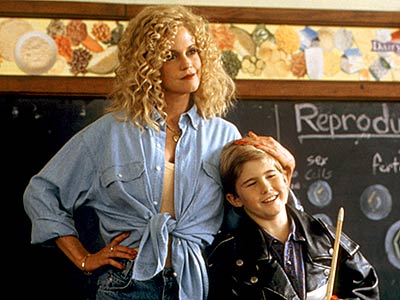
The worst scene in the movie is when Frank brings V to class for his sex ed presentation. Tell me if this makes any sense—Frank locks the teacher out of the classroom, surely doesn’t get graded for this, sneaks V in through the window, uses her as a visual aid for a reproduction assignment, and doesn’t even get punished for it.

What were these writers thinking when they wrote “Milk Money?”

The three young actors—Michael Patrick Carter, Brian Christopher, and Adam LaVorgna—are fine, despite given clichéd writing to their characters. Ed Harris does what he can with his role and even manages to give the character some dignity—he’s a high school science teacher trying to save some wetlands. But Melanie Griffith, who used to be an exciting comic actress (see “Working Girl”), is pretty bad. She fails miserably at her dramatic moments and her comic moments are merely OK.

“Milk Money” is a mess. When its writing isn’t embarrassing, it’s very much clichéd. The film pretty much fails when the setup makes itself known, the stuff with the gangsters is completely unnecessary, the romance isn’t convincing, and it tries to make itself into a charming family comedy when really it’s a mashup of stuff for kids and adults. Well, let’s face it—“Milk Money” isn’t for either. It’s made for rocks.

The Blue Lagoon (1980)

30 Jan

images

Smith’s Verdict: *

Reviewed by Tanner Smith

Of all of the lame, obnoxious teenage sex movies, I have to give credit to “The Blue Lagoon” for one thing—it is probably the best-looking of the sort. Not only do the central young actors look like they stepped out of magazine covers (and their bodies are fully tanned), but the setting is a tropical island in the South Pacific.

That, and the cinematography is lovely.

And I should give it credit for not taking place in the suburbs, where most of these films take place (to try and give it a realistic, identifiable feel).

But “The Blue Lagoon” is one of the absolute worst. It made my skin crawl. It may have tried something new, but it didn’t impress me and it didn’t make me care—it just made me want to turn the movie off. (And trust me—I really could have turned the DVD off, if I didn’t endure the rest of the movie to review it.)

The film stars Brooke Shields and Christopher Atkins as two young, attractive teenagers marooned on a deserted island since they were little. They spend their days fishing, swimming, and playing in their handmade hut. Of course, they have the intelligence of seven-year-olds, which makes their life together difficult once they reach puberty. They experience many changes to their bodies, and they also fall in love with each other. Later in the film, they are naked in the jungle and they experience sexual intercourse.

By the way, am I the only one who simply can’t believe that these dumb kids have lived on this island for years without anything seriously bad happening to them?

And on top of that, isn’t it established early in the film that these two young people are cousins? They either don’t know it, or don’t know just sick their deeds are, being cousins. Either way, it just makes the whole film…icky. And I know that the sex scenes are supposed to be erotic, but all I’m thinking about is whether or not Randal Kleiser was actually intending to create a big-budget teenage porno. Well, probably not. There’s a subplot to make sure of that, and to try and make sure that there is conflict on the island—it’s a mysterious ghost tribe in the middle of the island that the kids are forbidden by their late caretaker (Leo McKern) to go to, and there’s an idol that they praise, which the kids believe is God. What is the purpose of this subplot? To distract us from all the exoticness, or lack thereof? There’s never a resolution; there’s not even a scene where the tribe sees the kids as a threat, or where they put them in danger. They never even meet. Oh, I should also note the distracting shots of the sea turtles having sex. I guess this isn’t a teenage porno after all. But who cares?

The movie really hits a new low when the girl gets pregnant, and she has a baby. They spend long months wondering what is going on inside the girl’s stomach, and why there’s a baby now. They try to feed the baby fresh fruit before discovering the act of breast-feeding.

Also, I have to say that both young actors who take up most of the screen together are equally bland. These kids may be attractive, but they need better acting coaches. And no, this has nothing to do with my resentment towards the decision to see all of Christopher Atkins, and not all of Brooke Shields, since her long hair was so carefully draped to her breasts (even her body double doesn’t bare all).

“The Blue Lagoon” absolutely makes me cringe. It’s a horrid, misguided, irresponsible teenage sex movie…but it looks nice.