I didn’t know much about Robert Zemeckis’ “Flight” when I first saw it. I knew it starred Denzel Washington, I knew it involved a plane crash, and more importantly, I knew it was directed by Robert Zemeckis (“Back to the Future,” “Who Framed Roger Rabbit,” “Forrest Gump,” “Cast Away”); I was going to see it regardless!
What I got was…a two-hour movie about Denzel suffering addiction and its terrible effects. But even when it catches me off guard, at the end of the day, it’s a very well-done, disturbingly effective portrait of an otherwise decent man and the damage that occurs from his alcoholism.
What gets the film started is a realistically terrifying sequence in which Denzel’s pilot manages to use his skills to pull off something that not other pilots could’ve pulled off. He loses only a few people in the crash, saving over a hundred others. But it turns out he was intoxicated and high at the time he was flying, raising more questions about what happened and heightening the issue.
From that point on, it’s an uncompromisingly dark picture about how Denzel must stay clean and never look back or face consequences set up for himself long before.
I got so into this story that when it comes to a crucial point in which Denzel mustn’t drink and yet faces temptation involving a hotel refrigerator, I was nervous as to what was going to happen.
And of course, as with any Denzel performance, he’s giving it his all. He was nominated for an Oscar for his performance here, and for good reason.
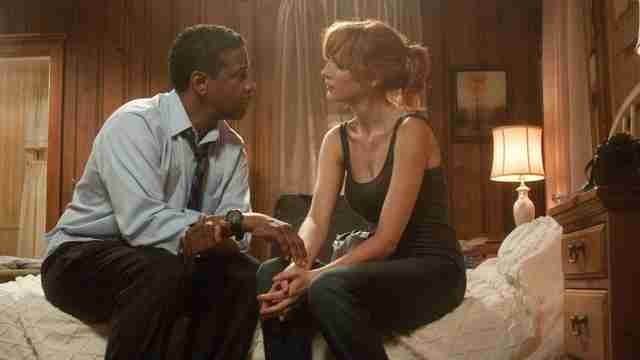
Also great is Kelly Reilly as a younger woman who is addicted to drugs and has already hit rock-bottom, hoping for a chance of recovery. I was just as invested in her story as I was in Denzel’s.
The film is rarely an upper, but it’s consistently compelling and packs a dramatic punch.
Rob Reiner’s “Flipped” is yet another underrated treasure that I think more people should check out. It had a limited release in Fall 2010 before heading straight to DVD. No one saw it, and I probably wouldn’t have either if I hadn’t read two highly positive reviews by Roger Ebert and James Berardinelli. And that’s a shame, because this would have been the film that would have earned Rob Reiner some respect again, after a long dry spell.
And he’s still struggling, with subsequent films such as “The Magic of Belle Isle,” “Being Charlie,” “And So It Goes,” and “Shock and Awe.” (Though, I thought “LBJ” was decent.)
“Flipped” is a film that shows a love story between two pre-teens that has an ingenious storytelling gimmick of showing scenarios from the perspectives of both the girl and the boy. The girl has liked him since 2nd grade, the boy has been trying to avoid her all this time, and as time goes by, their feelings for each other start to change–he starts to like her while she develops a disinterest in him. And the best thing is, you’re able to understand from both angles.
Family film, schmamily film. That doesn’t make it a “kid film”–Watch this movie, and tell me you don’t recognize certain feelings you felt when you were a kid.
There is one major thing that nearly kills the movie for me. Bryce’s father (played by Anthony Edwards) is such an ass. I can’t stand him. He always says the wrong things without thinking about them, and I just want to smack him each time he shows up on screen. Later, when the film tries to make us see him as “a coward,” I groaned because I still couldn’t see a character there.
The only reason I originally rated this film three-and-a-half stars instead of three (which would still be a recommendation) is because while there are many family-oriented films that feature supporting characters as one-note jerks (“The Education of Little Tree,” “Secondhand Lions,” “The Odd Life of Timothy Green,” among others), this one only has ONE. So I guess that’s a relief.
“Flipped” is still Rob Reiner’s best film in years–probably not up there with “This is Spinal Tap,” “Stand by Me,” “The Princess Bride,” “When Harry Met Sally,” “Misery,” “The Sure Thing,” “A Few Good Men”…man, he’s made some great stuff before “North,” hasn’t he? (Bring ’em back, Rob!) But anyway, then again, so few films are up to those standards. “Flipped” is still a pleasant, touching, satisfying romantic comedy that more people should give a watch.
After “The Avengers” became a humongous box-office hit, we knew we were going to see something great from the Marvel Cinematic Universe. But when?
Well, “Phase Two” begin in May 2013 with “Iron Man 3,” which was fun enough. But then came “Thor: The Dark World” in November 2013, which was dull as dishwater. We needed something that was going to be the next big thing for the MCU! And what’s this? A “Captain America” sequel? OK, let’s see what you got…
One viewing later, everyone was convinced, like “Holy cow this is what I didn’t know I was waiting for and it’s freaking amazing.”
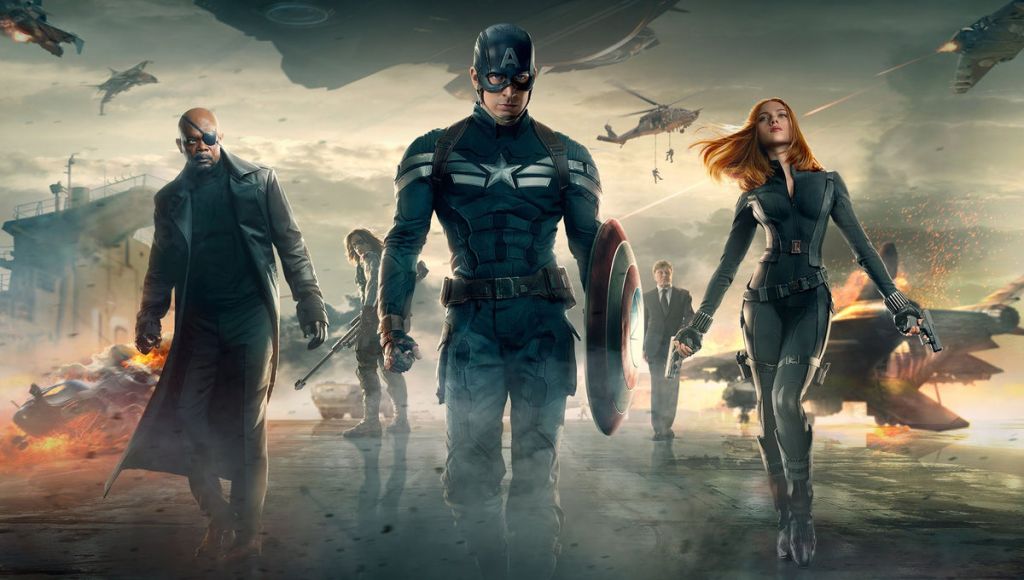
“Captain America: The Winter Soldier” is a film that dared to challenge its audience and it paid off in a major way. We still got the kick-ass action we go to these blockbusters for, and for that matter, we still got Steve Rogers aka Captain America (Chris Evans), Black Widow (Scarlett Johansson), Nick Fury (Samuel L. Jackson), among other MCU characters we recognize from other movies. But we got more than that. We got a more complicated story that asked questions we didn’t bother to think about in a movie like this. And as it progressed, it got even more interesting.
Before Steve Rogers was thawed out after being frozen for decades, he was led to believe that there was a simple war he was fighting: obvious good guys and obvious bad guys, no in-between. But now he’s in a world he’s trying to understand, not just because many people he knew are gone or even because of pop culture (about which he makes a list of things to keep track–I’ve paused that moment several times just to read the list), but because things are more complicated within who he thought he was fighting for and why. Now he can’t trust anybody except maybe Black Widow, and the two go on the run from HYDRA, the organization that’s taken over SHIELD, and their newest weapon, The Winter Soldier.
Suddenly, Captain America, the Boy Scout who always wanted to do good in his time, is suddenly the most interesting character in the MCU because he’s now in a time where he’s afraid he’s not doing as much good as he thought. You can tell that it’s eating him up inside that he just doesn’t know who to trust anymore and what’s worth fighting for. And then comes the reveal of the Winter Soldier…
I would issue a SPOILER ALERT but I think we all know by now that the Winter Soldier is Bucky (Sebastian Stan), Steve’s buddy from long, long ago, now brainwashed by HYDRA. It becomes a plot point in “Captain America: Civil War,” which everyone saw, so let’s move on and say this was another big strength in the story development for “Captain America: The Winter Soldier.” It adds to Steve’s confusion about what he needs to do. What is his purpose now? To save Bucky? To stop him? Who else is he supposed to be fighting against/alongside? The moment Bucky’s reveal is brought onto us, everyone knew this movie was what we as comic-book movie fans needed. It’s great, and where it goes from there is not “predictable” so much as “inevitable.”
Every twist and turn “Captain America: The Winter Soldier” throws at us feels important and we’re completely invested in what’s going to happen next.
Even a cameo by the late Garry Shandling can feel like a big deal. (“Hail HYDRA.”)
This was the first MCU entry for the Russo Brothers (Anthony and Joe Russo), who would later give us more of the best MCU movies (“Captain America: Civil War,” “Avengers: Infinity War,” and “Avengers: Endgame”). They know we need something new to add to the familiar stuff we want to see, and this would only be the beginning of their impressive MCU track record. (Hah! I use the mild word of “impressive” when they’re responsible for this year’s highest-grossing film!! But you get what I mean.)
For one thing, they didn’t use much CGI. It is there, but it’s not what’s focused upon. It was surprising to find real stuntmen doing their thing or actual sets being built. For another thing, they let the actors play with their roles–reportedly, Chris Evans and Scarlett Johansson wrote their own dialogue for many scenes they shared together; that’s why their chemistry as partners is spot-on. Also, the Russo brothers let the characters feel like real people we could know in our own lives–the opening scene introduces Steve to Sam aka Falcon (Anthony Mackie), and their dialogue together genuinely feels like two war veterans sharing their stories.
And also (and I’m saving this for last because I think it’s really cool), they’re big fans of Honest Trailers, the web series from YouTube channel Screen Junkies that picks apart little details here and there–they aimed for this film to be “Honest-Trailer-proof.” That just lets you know they’re thinking of both the audience and the film critics.
Fun fact: Screen Junkies did an Honest Trailer for this movie, which led to the Russo brothers being interviewed by the channel’s host Hal Rudnick and Honest Trailers writers Dan Murrell and Spencer Gilbert.
So, yeah. This movie’s great. It’s one of my favorite MCU movies. What are my other favorites? Well, I’ll post about those as well in this Looking Back at 2010s Films series…except “Iron Man,” one of my top-3 MCU faves, because that awesomeness came out in 2008.
As I’m sure most people were last December, I was totally surprised by this addition to Netflix: not just a “Black Mirror” movie but a “Black Mirror” INTERACTIVE movie!
I’m fascinated by video games that serve as movies, during which you control the character’s actions and thus control the story. When they’re done right, such as “Until Dawn” on PlayStation 4, it can make for a most entertaining experience.
And “Bandersnatch” didn’t disappoint. My fiancee and I watched (er, “played”) it together at first. Then, as soon as it was over, we did it again. Then, a few days later, my parents came over to my apartment and we also played it together.
I’ve played it several times since its original Netflix release, and I know that director David Slade (“Hard Candy”) and writer/”Black Mirror” creator Charlie Brooker did their homework and created as many scenarios and paths as possible to make every decision matter…until they decide to let you try something else again, but even that, I didn’t mind because “Bandersnatch” itself is a story about different outcomes within the butterfly effect.
The greatest joy I get from an interactive movie is getting into both mindsets of a filmmaker and a film critic. It’s not simply a matter of what I would do if I made the hard choices but more a matter of what choice seems the most logical given the story that’s already been set up from the other decisions I’ve made.
Too “gimmicky” for a “Black Mirror” narrative? If I’m enjoying myself, I don’t care about that.
I’m changing it up a little this time–talking about a TV series in my Looking Back at 2010s Films series. Even though I am a movie guy, there are some shows I like to make time for.
And I rewatched both seasons of the Netflix Original series “American Vandal” again recently, so I figured, it is a 2010s treasure and I should look back on it.
“American Vandal” is something special. What drew me in was its ambition to parody/make homage to the true-crime documentary shows (such as “Making a Murderer” and “The Jinx: The Life and Deaths of Robert Durst”) that crazy white people seem to go crazy for. (And as a white person myself who saw half the first season of “Murderer” with mild interest and enjoyed the entirety of “The Jinx” with great interest…I kind of get it.) It’s a mockumentary series that makes it appear to be told from a teenage perspective, as a high-school AV crew makes a documentary series as they investigate an impactful crime on campus. What kind of crimes? Well…season 1 is finding out who spray-painted phallic images all over the vehicles in the high-school faculty parking lot and season 2 is about who might have caused all of the students in the school cafeteria to defecate themselves.
Side-note: I first found out about “American Vandal” because my fiancee’s mother thought it actually was a true-crime show–when she described the crimes to me, I knew something was off about it. That’s when I decided to check it out and it became clear to me that it was a mockumentary rather than an actual documentary (…mostly because I recognized an actor from “22 Jump Street” playing a high-school student).
So I was intrigued, because I’m a supporter of the found-footage/faux-documentary format and I was curious to see how this would turn out.
Watching season 1, I was of course laughing at how seriously this silly juvenile crime (drawing penises all over teachers’ cars) was taken in the same purpose as “Making a Murderer.” But then, the rug was pulled out from under me and I realized something. This series was not particularly interested in comedy to sell us on its true intent. Instead, creators Dan Perrault and Tony Yacenda used humor to lure us in and then went in for the kill (so to speak) about how heavy the consequences are for an underachiever who is accused of a ridiculous prank that could ruin his future. That stuff is handled in gripping serious manner, and rather than accuse the filmmakers of inconsistent storytelling, we realize that they’ve been setting us up for it the whole time, because what they really wanted to do was provide effective social commentary about the way high-school teens are treated and even how they treat themselves in times of crisis. If you’re a class-clown, you’re the prime suspect for a heinous prank that you may have had no involvement in. And if you didn’t, hardly anyone will believe your story. Your teachers won’t trust you, some won’t listen, and even more unfortunate, the rest will throw you under the bus because they refuse to believe you.
I won’t give away the ending, but we’re left on a very bitter note that provides a cautionary warning relative to how high-school underachievers are treated on campus.
As good as season 1 is, I think season 2 is even better.
The creators of the show within the show, high-school sleuths Peter (Tyler Alvarez) and Sam (Griffin Gluck), have gained national popularity due to their “American Vandal” series that documented their previous investigation. They receive numerous inquiries to use their techniques to solve more crimes (including a murder!), but they only answer one: an incident at a Catholic high school during which the students who drank the lemonade at lunch, which was laced with laxatives, were forced to defecate all over campus in horrid fashion at costly expenses. The culprit is anonymously addressed as “The Turd Burglar.” And that’s not all–other poop-related pranks occur on campus. A piñata turns out to be filled with excrement, and a t-shirt launcher at a pep rally…well, you get the idea. One student steps up the principal and the police to accuse a friend of the crimes, and the friend, an oddball outcast named Kevin (Travis Tope), is brought in to confess. Kevin is kicked out of school and placed under house arrest. But there’s one problem: he was a victim of the initial cafeteria prank as well. Unless he “shat” himself on purpose, something’s wrong here. Thus begins another heavy investigation to see who else might have been involved and when/where the Turd Burglar might strike again…
OK, so “American Vandal” features a lot of gross, juvenile humor. But like I said, it’s a bait-and-switch type of thing. Season 2 has even more to say about teenage life than what we thought Season 1 covered already. This time, without giving too much away, it’s about how teens live most of their lives on social media, which is a common problem today (as many paranoid adults will make you believe).
(Yeah, I know I get analytical in my Looking Back at 2010s Films series, but in the case of this series, I want people to go in not knowing much. I’m just summing up the lessons at work and then moving along.)
Despite its disgusting setups, “American Vandal” is a wonderful series. I would love to see it progress into a potential season 3. Maybe the next one will feature a crime centered on that “time of the month” for high-school girls…you know they would go there.
Ugh! “Boy Erased” didn’t make my decade-end top 20 either? Seriously??
I loved this film when I first saw it, and I’ve seen it about four times since–each time, it’s gotten an emotional reaction out of me…the first time made me cry.
The moment in Joel Edgerton’s “Boy Erased” that made me cry–midway through the film, Jared Eamons (Lucas Hedges) is a Christian conversion camper who is already uneasy about the “methods” being used to “cure” homosexual teenage boys…and it’s this point when he realizes he needs to get out of there: when one of his fellow campers is repeatedly, physically beaten with a Bible…not just by the therapists but by his own father. My heart wept for the poor kid.
Three cinematic moments from 2018 legitimately made me cry–the funeral discussion in “Won’t You Be My Neighbor?,” Jake Gyllenhaal’s drunken arson attempt in “Wildlife,” Jared’s revelation in “Boy Erased.”
This moment is followed by Jared standing up to Victor Sykes (Edgerton), who is trying to force a reason for hatred out of Jared. Jared can’t take it anymore–he won’t lie to “save” himself and he doesn’t hate his father; he challenges Sykes. He storms out of the room and yells as he exits: “I hate YOU! But what does that help?!” And that’s when he decides he’s getting out of there.
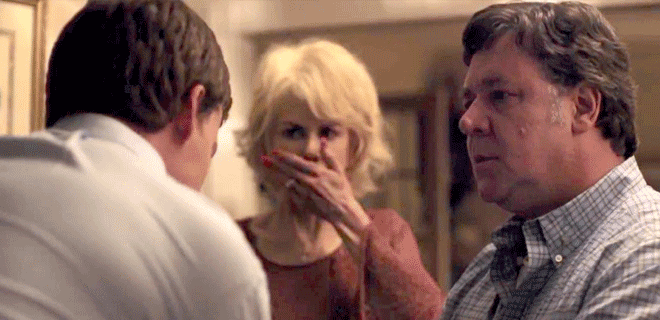
He tried as best as he could, for his father, a small-town Arkansas pastor played by Russell Crowe. His father gave him an ultimatum–go to the camp and be “cured” of his homosexuality, or be kicked out of the family. Jared either wants to believe something is wrong with him or simply doesn’t want to be shunned by his father (or both), but he chooses to undergo conversion therapy. His loving mother (Nicole Kidman) is rather submissive of her husband’s deal but wants to help her son any way she can. When she finally understands that something is wrong well into the program, she doesn’t back down in helping Jared break free. Soon, his father realizes the harm that these conversion therapy programs cause but isn’t ready to admit it to himself or to his family.
That leads to the emotionally powerful ending, in which four years have passed and Jared hasn’t been on speaking terms with his father. He can’t take it anymore–after writing an article that exposes the wrongdoings of the program, he comes back home to confront his father. He doesn’t simply want him to hold himself accountable for his actions–he wants him to love him as his son. And here’s a brilliant move in the telling of this story, which results in some of Russell Crowe’s finest moments as a dramatic actor–the father, having held on to his strict religious beliefs probably his whole life, isn’t fully accepting of his son’s sexual identity but also isn’t ready to lose him. The two reconcile with somewhat of an understanding, on a beautifully ambiguous note.
I’ve just described three of many powerful scenes in “Boy Erased,” a film that asks (or rather, demands) families to accept and love their LGBT children. And it does so tenderly and tactfully…which is why I’m frankly surprised and a bit disheartened that it didn’t get the attention it deserved.
Don’t get me wrong–it didn’t necessarily bomb; it was able to make its budget back. And it was well-reviewed (mildly positive, from the reviews I’ve read, but still positive) by critics. And it was nominated for some accolades (Hedges was nominated for a Golden Globe; Nicole Kidman for a Critic’s Choice Award; among others). Watching it again today (before writing this post), I can’t help but feel like it deserved more. More people should have talked about this film; awards shows should have recognized the script (which was adapted from a real-life memoir of the same name by Garrard Conley); Russell Crowe’s superb performance should’ve gotten more attention; and what about the Oscars?
Well, I’m not going to forget this film. It’s too good for that. And it was only the second directorial outing for Joel Edgerton, whose previous film, the psychological thriller The Gift, definitely impressed me. Edgerton knows and loves movies and he knows what it takes to get audiences debating and discussing over particular issues such as bullying and identity. (Edgerton has also gone on-record stating that he himself was a bully, so it’s interesting to see him as someone seeking redemption.)
I mentioned in my original review that Edgerton’s character of Victor Sykes, the therapy group leader, becomes more interesting in hindsight. Why did I say that? Because of an ending caption that outs him as gay–after leaving the group, he lives in New York City with his husband. This film did such a great job of showing the characters as realistic people with more-or-less moral/ethical dilemmas that even the ones who seemed like caricatures can be looked at in different ways. Why do they do what they do? How were they brought up? What is their thought process? Among many other questions that probably don’t even need answering. I can name so many bad “Oscar-bait” melodramas that have answers as simple as “they’re just jerks.”
But with “Boy Erased,” these characters are as complicated as real-life people.
NOTE: And speaking of “real-life people,” my parents know the real Jared Eamons (Garrard Conley) and his parents. And they have both pointed out the one fact-vs-fiction flaw they just wouldn’t let go: that Garrard’s mother (Martha Conley) isn’t nearly as tall as Nicole Kidman.
If there’s a movie that should have received a lot more attention in 2018, it’s “The Hate U Give.”
And I missed it too. I didn’t see it until it hit Blu-Ray well into 2019. If I had seen it on the big screen wherever I could, I would have championed the film so hard! (Not that it would’ve made that big a difference–but you know what they say: every little bit helps. Right?)
This would have ranked high on my year-end Top 20–I really think it’s that good.
It’s a film about race relations. Modern-day race relations. One of the biggest hits of the year (maybe you’ve heard of it–the Oscar-winning “Green Book”) dealt with race relations at a distance, whereas this film (and “Blindspotting,” for that matter–another small treasure from 2018) deals with it head-on. For some reason, we don’t like to deal with this issue unless it’s set in an era in which it was at its worst. We seem to forget that things aren’t so peachy-keen today either! (Actually, we don’t forget it, because we see it often in today’s media!)
OK, I’m not going to be the young liberal white guy that makes a political statement (I’m more of a centrist anyway–what place do I have in politics?) in a blog post that looks at an excellent film. So let me talk about the film…
“The Hate U Give” is a coming-of-age story based on the young-adult novel of the same name by Angie Thomas. Our main character is 16-year-old Starr (yes, with two “R’s”), who lives two identities in her life. One of them hangs out at home in her impoverished, predominantly African-American neighborhood. And the other goes to a prestigious, predominantly white prep school, where she doesn’t want to be labeled as the “poor girl from the hood,” so she has white friends calling her “girl” and overcompensating by overexposing black culture around her.
Starr has trouble balancing out both identities, especially when she has to keep her white potential-boyfriend, the preppy but sincere Chris, a secret from her old-school father, Maverick. She’s not comfortable at home either, knowing first-hand the effects of drugs and gangs and racism at an early age. She’s unsure where she belongs, as she’s uncomfortable either way.
Starr’s worlds collide one fateful night when she witnesses a friend being shot dead by a police officer (who mistook the friend’s hairbrush for a gun at initial glance) and is handcuffed by his side. Since then, she opens her eyes and realizes she can’t live two different identities anymore. Thus, she sets out to find her own voice.
The story of the killing is national news, but Starr’s identity as witness is kept secret to everyone outside of her family. Her prep-school friends know nothing of her involvement, and Starr’s troubling attempt to keep it secret bears down on her, especially when it becomes clear that her friends have no idea what they are talking about regarding the subject. She does agree to be interviewed on TV to testify her role as long as her identity is still hidden, but the name-drop of a neighborhood gang gets her in more hot water than expected. And that’s only the midway point for this dilemma.
Some of the most brutally honest moments involving race relations occur with Starr’s prep-school friends. For example, her classmates stage a “Black Lives Matter” walkout, but it’s clear to Starr that they’re not very troubled by the tragic incident as much as they are excited to have an excuse to miss class. And there’s also her boyfriend Chris, whom Starr starts to distrust, especially after he says he doesn’t see color when he sees her (to which she replies that he needs to see her race). But in a sweet development, he does come around to seeing her point and he sticks with her because he does genuinely care for her, and she becomes less ashamed of him (as do we).
The direction from George Tillman, Jr. is terrific, as he handles both the quiet, heartfelt moments and the (very) tense, violent moments flawlessly–even when things go from bad to worse (I’m talking “street riot” kind of worse), we still feel like we’re in the same universe that was set up before and this was inevitable. The writing from the late Audrey Wells (who died of cancer shortly before the film’s release) adapts the book beautifully, stating such effective social commentary and brilliant characterization. All of the acting is spot-on from everybody, from Russell Hornby as Starr’s father to Sabrina Carpenter as who Starr was her best friend. But there is obviously one standout that practically makes most of the movie: Amandla Stenberg as Starr. She delivers a performance that is nothing short of brilliant as a 16-year-old girl who would like nothing more than live a normal life as a regular 16-year-old girl but sadly has no choice in the matter. Stenberg has been a star on the rise since “The Hunger Games”–I can’t wait to see what she does next.
I did mention that things go from bad to worse in this story, but don’t mistake the film as a depressing outlook for a hopeless future. It does remind of the struggle that many people (mostly young people) face against an unfair, corrupt system by sticking to their beliefs, but it also shows that the battle can be won (even if they’re still fighting the war).
“The Hate U Give” deserves more attention. It’s available for streaming, on DVD, on Blu-Ray, what have you–I can’t recommend it enough…it got an A+ on CinemaScore, for crying out loud! Doesn’t that mean anything to anybody?
If you recall my “Stuck” post, I mentioned that one of the “Stuck” director’s classmates (still anonymous) confided in me that he was jealous because he felt his undergrad thesis film was far better than his own. Well…this time, I myself am that classmate.
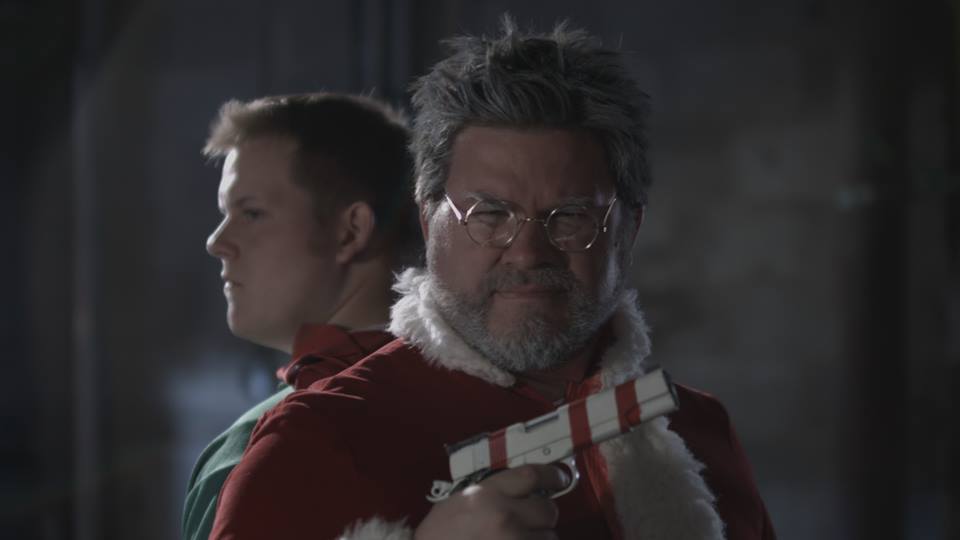
The year I wrote and directed my own undergrad thesis film at the University of Central Arkansas, I was jealous of another undergrad film from one of my classmates. The writer/director was Donavon Thompson. The film: “‘Twas the Night of the Krampus.”
My film, “Sassy & the Private Eye,” was a fun, goofy action-comedy about a private detective helping a Sasquatch clear his name of murder. Thompson’s film, “‘Twas the Night of the Krampus,” was a fun, goofy action-comedy about a badass Santa Claus fighting the demonic Krampus. We had respect for each other’s visions, we often showed our work to each other because we wanted to know how the other was doing, and both of our finished films screened at the 2015 Little Rock Film Festival. But even so, I couldn’t shake off the feeling that “‘Twas the Night of the Krampus” was better in just about every way.
Thompson’s film had better writing (and funnier one-liners). It took more advantage of its premise (right down to the holiday-appropriate costumes, production design, and props, such as a white pistol with red stripes like a candy cane–oh, and a candy-cane sword as well!). It had more heart to it, with the story of overcoming grief and loss at its surprisingly emotional center.
My film had unnecessary profanities, a hackneyed character arc about respect, a pitiful excuse for a “mystery,” and “shock” humor that I simply wasn’t able to pull off in writing or in execution. (Don’t believe me? Watch it here. If you like it, that’s fine. I personally don’t like it.)
“‘Twas the Night of the Krampus,” even watching it now, is still a good deal of fun–from the opening loving homage to “Lethal Weapon” to the kickass battle with kick-ass Santa (Johnnie Brannon) and his (robotic-)right-hand elf (Matt Mitchell) versus the villainous Krampus (Xavier Udochi) to the closing-credits rendition of “Please Come Home for Christmas” that I can’t deny warms my heart.
But as was the case with “Stuck,” I now have to find something to pick on about the film, just to show I’m playing as fair as can be. It’s too easy to pick on continuity errors, such as a clock that tells different times in between cuts–as a student filmmaker, I can identify. So, I guess I’ll simply have to mock the unimaginative design of the Krampus. They shoot him in shadow to make him appear more menacing, but it still looks like they draped an actor in black and put a long black wig on him. And also, there’s the Krampus’ defeat…I get that there was so much Thompson and his crew could do, but still…this is hard for me, guys, you have to understand.
Also, here’s a side-note: Sam (Kandice Miller), one of Santa’s elf assistants, originally had a bigger role in early drafts of the script. Due to severe cuts demanded by our film professor, Sam’s role is simply reduced to…the “you should take a look at this” cliche. She tries to have some semblance of character in the “master-control” scene, but Santa persists in interrupting her before she can begin her sentences…thus, I have this joke I often said aloud when reviewing the rough cuts in class: “Shut up, Sam! How dare you try to have a role in this film?”……..Shut up, past-Tanner–you wrote a script about a Sasquatch and a private eye, and you couldn’t even make that funny.
Oh, and imagine our surprise when we learned there would be a “Krampus” feature film to released later that year, in time for Christmas.
“‘Twas the Night of the Krampus” is an entertaining short, and I’m glad Thompson was able to pull it off.
To conclude this piece, I share my one contribution to the film. During pre-production, Thompson told cinematographer Nikki Emerson that he wanted the film to have a “Lethal Weapon” sort of vibe, visually. So I lent her my collection of “Lethal Weapon” DVDs, since I was hanging out with her at the time.
Yes, I’m looking at another short film for my Looking Back at 2010s Films, and it’s another one produced by the University of Central Arkansas (UCA) film program. Why? Because I’ve seen a lot of them in my time at UCA and I’m hella nostalgic. So why not?
“The Whisperers” was Jason Miller’s UCA graduate thesis film, and it’s a very well-made 17-minute horror movie that emphasizes that familiar precaution we all heard as children: “be careful what you wish for.”
And here I warn you–SPOILER ALERT SPOILER ALERT SPOILER ALERT!!!
In my original review of this short film, almost five years ago, I expressed genuine interest in discussing the film’s ending. But the film hadn’t even been accepted into the 2015 Little Rock Film Festival yet, and I had just seen it as its premiere-screening at UCA, and so I could hardly analyze it. Now that it’s had its festival run and is now available on YouTube, here I go…
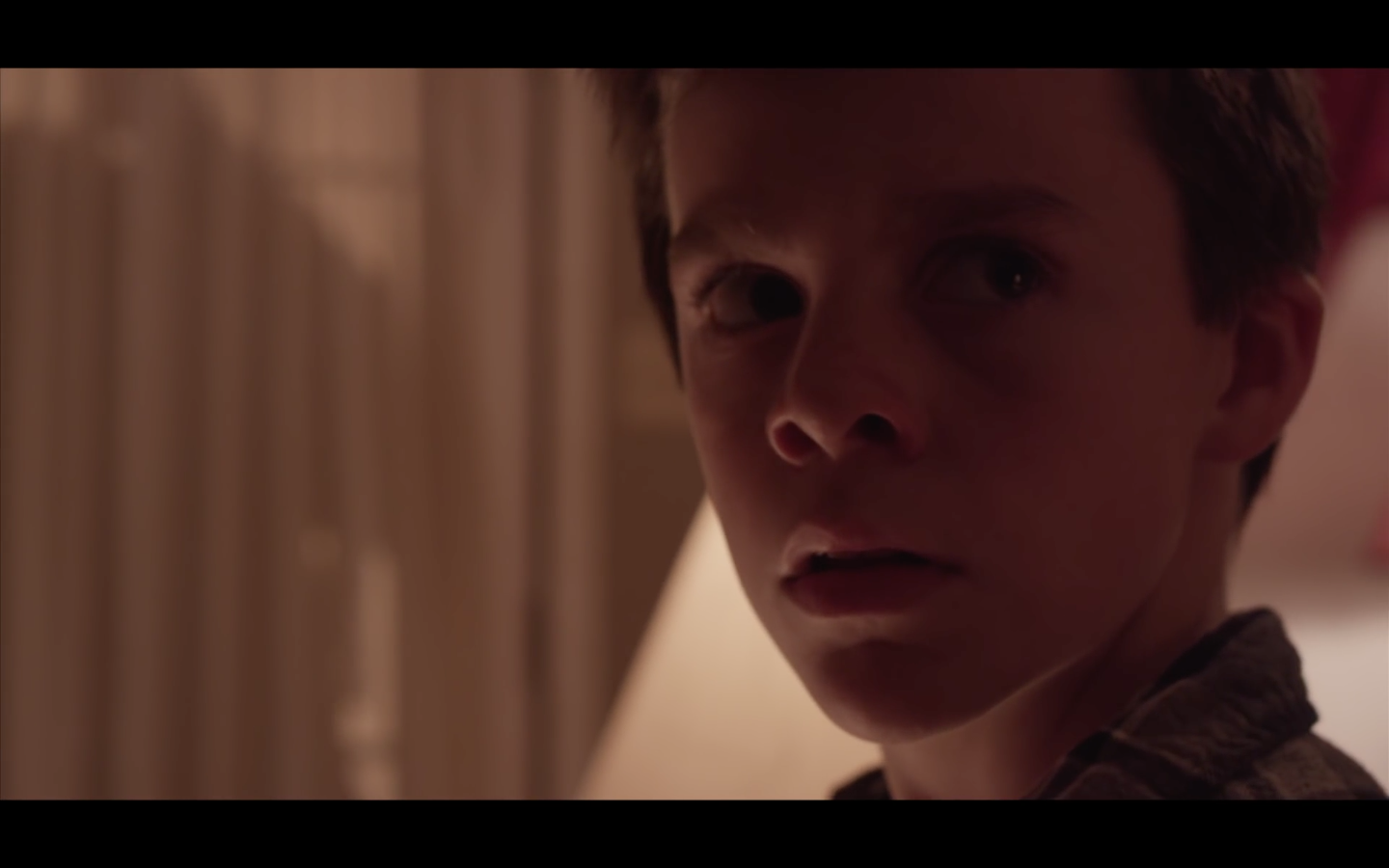
The story is about a pre-teenage boy, Nathan (Hayes Polk), who has to look after his obnoxious little brother, Zachary (Chance Creden), one night while their parents are out. Nathan and Zachary bicker constantly, and Nathan wants nothing more than for Zachary to just stay out of his life–a relatable sibling dynamic. So we have two little boys who are alone in a rural farmhouse at night…and there’s someone (or something) outside…whispering…
Who are the “whisperers?” What are they whispering? Well, at first, it’s too indistinct to tell, but later it becomes clear that these mysterious dark-shrouded figures (with sharp claws and rapid-moving lips) are in fact whispering (repeatedly) Nathan’s exact words for wishes of living a life without Zachary. (“I wish I was an only child,” “You are the worst brother ever,” etc.) Zachary doesn’t seem to hear them–only Nathan does. And as the whisperers come inside the house and Nathan hides himself and Zachary underneath the bed, Zachary is snatched by the whisperers, who disappear along with him! Nathan conquers a fear (set up an earlier throwaway line of dialogue) to use the family ATV to try and chase them, but he ends up running into his parents. “Where’s Zachary?” an injured Nathan asks his parents. They don’t know who Zachary is. As it turns out, the whisperers granted Nathan’s wish–Zachary had never been born and there’s no proof of his existence whatsoever.
End of story? No. This is what I really wanted to talk about before. The film concludes with an epilogue in which Nathan, now grown up (played by Mark Cluvane), revisits his parents at the old house. He goes to the room that used to be Zachary’s, which is now a study. He’s still not over what happened all those years ago, and you can safely assume that he’s never been able to let the memories fade away. This sad point is further emphasized when he retrieves from his pocket the only memento probably saved from that time: a Pog which Zachary gave to him in exchange for the confiscated Sega player the boys were fighting over earlier. We then hear more whispers…this time, they’re of Zachary’s dialogue: “Why don’t you want to play with me?” They continue as Nathan looks mournfully at the toy faded by the time and the bedroom that was and never would be again… The End.
If the film had just ended with young Nathan’s realization that his brother is gone, it probably would have been powerful enough–a nice, chilling, effective moral lesson along the same lines as ’90s kid-horror shows such as “Are You Afraid of the Dark” and “Goosebumps.” (Fittingly enough, “The Whisperers” is set in the ’90s, hence the Pog.) But adding this extra bit at the end is, in my opinion, a stroke of genius. It’s great to see this character having grown up with the consequences of what he’s done as a child.
I mentioned before that “The Whisperers” is a well-made movie, and it is impressive, especially in hindsight. For example, the opening shot of the film pans across framed pictures on a wall–one is of a family, the other is of the two brothers. In the background, we hear the brothers fighting. As it gets physical, the picture is bumped off the wall. That brilliant example of subtle foreshadowing, especially after watching the film again, reminds me of what a careful and skilled filmmaker Jason Miller is.
He’s also thankfully not very blatant with ’90s references to match the setting. In fact, my favorite scare in the film involves the Clapper. (Does anyone still use the Clapper today? Just curious.)
“The Whisperers” began its festival run at the 2015 Little Rock Film Festival (sadly, that was the last year for LRFF) and received the award for Best Arkansas Film. It was fun to revisit the film again, and just in time for Halloween.
Check out the film here: https://www.youtube.com/watch?v=FFAhE9dJSvY
“Overlord” is part wartime drama, part horror flick, part B-monster-movie, and overall entertaining and thrilling as hell–a terrific, energetic, tension-fueled thrill ride that you either accept or you don’t. I accepted every tense, crazy moment of it and had a real good time in the process.
Just look at the premise and tell me if it might be your cup of tea: on the eve of D-Day, a few American soldiers are trapped behind enemy lines and discover secret Nazi experiments. What do they find? Well…Nazi zombies.
Yeah, why not?
It’s like a big-budget b-movie with the right combination of energy and clever filmmaking, and for as over-the-top as it gets (especially towards the final act, when all hell inevitably breaks loose), that’s just part of the fun.
The film opens with a bang as the soldiers are dropped into a French village, where Nazis have a radio tower in a church, which our heroes are sent to destroy. The plane crash and parachuting escape themselves are so intense that it reminded me of two Spielberg moments: the brutal Normandy sequence in “Saving Private Ryan” and the paratrooper’s jump in “Bridge of Spies.” Can you imagine jumping out of a falling plane fired upon by the enemy, and making the jump with all the fire, explosions, gunfire, and debris all around you as you try to parachute and land safely?
The paratrooper we follow is Private Boyce (Jovan Adepo, “Fences”). He joins up with a few others–Corporal Ford (Wyatt Russell), who takes command; Private Tibbet (John Magaro), our welcomed, trashmouthed comic-relief; and Private Chase (Iain De Caestecker), a photographer. They encounter a young French woman, Chloe (Mathilde Ollivier), who helps them and hides them in the attic of her mother’s house, as they figure out how to continue their mission of blowing up the tower.
Admittedly, the characters are rather underdeveloped, but they’re all played by appealing actors, particularly a sense of innocence given by a likable Jovan Adepo and a commanding presence from the leadership of Wyatt Russell, plus a good mix of obnoxiousness and charisma from a Brooklyn-accented John Magaro–his annoyed interaction with Chloe’s kid brother, who just wants someone to play baseball with, is priceless. But “Overlord” isn’t about character as much as it is about story. What helps is an incredible amount of buildup. We’re already told that the Nazis have some very grisly goings-on in the church, as a French civilian threatens Chloe that “they’ll take [her] to the church” if she’s caught outside past curfew. We also learn that Chloe’s aunt, confined to her bedroom, is ill due to her own experience in the church. We know something is up here, and the mystery makes for intriguing buildup, even if we do know the payoff. The plot thickens as Boyce sneaks inside the church and makes a few odd, twisted discoveries of his own…
This leads to a payoff of pure insane entertainment, as our good old boys go up against the dirty Nazis…some of which are invincible beyond belief, thanks to the experiments.
Much of it is very grisly (and gives the film a deserved R-rating), and much of it, I was surprised to learn, is done with practical effects. There are more practical effects than CGI effects, so that the actors involved can react accordingly. Thus, the audience can react as they do if they’re in the moment as well. There’s a moment involving a broken neck of a reanimated corpse…and that’s all I’ll say about that except that I appreciate the old-school trickery that was used for the effect.
Fans of Bad Robot (the company that produced the film) were disappointed that “Overlord” was not a new “Cloverfield” sequel. I personally didn’t care for that. I was just glad to get the fun movie that I got.






 Smith's Verdict