Archive | Four Stars **** RSS feed for this section

Star Wars (1977)

22 Nov

movies_star_wars_episode_iv_a_new_hope_1

Smith’s Verdict: ****

Reviewed by Tanner Smith

What can I say about “Star Wars” (or as it has since been called, “Star Wars Episode IV: A New Hope”) that no one else has said about it before? It was a cinematic game-changer when it originally released in 1977. It changed the way we look at film. Many have tried to imitate its brilliance with little to no success. It made the science-fiction genre respectable again. It began a revolution in special effects, thanks to Industrial Lights and Magic. And it’s still influential now, even after almost 40 years since its original release.

I agree with everything said by those who have hailed it as a masterpiece. In fact, it’s one of my all-time favorite movies. So what can I say about it that no one else has? Probably nothing. But I’ll review the film anyway.

There is one thing I will say about it. I have never seen the Special Edition, and frankly, I don’t care to either. Seeing what was done with “updated effects” in “E.T.” was painful enough, and so I felt I didn’t need to see Jabba the Hutt’s appearance in an extended version or the possibility that Greedo shot first instead of Han. With that said, I am reviewing the original theatrical cut (which was titled “Star Wars” without the subtitle “A New Hope”) because that’s the only version I’ve seen and held in high regard.

With that said, the effects back then still hold up pretty well. I believe I am seeing starships soaring into space; I believe I’m within the vastness of space; I believe I’m seeing a real battle in space; and the practical effects are outstanding as well, adding more to the universe. The technical aspects from back in the day still look impressive even now. (Some of the computer graphics are noticeably dated, but even then, I don’t mind too much.)

For those who don’t know the story, even if it’s a rare few, the film is about a civil war in the galaxy. The Rebel Alliance is in hiding and the evil Darth Vader (performed by David Prowse, voiced by James Earl Jones) seeks them out after they’ve stolen plans for the Galactic Empire’s Death Star, a space station with enough power to destroy planets. Rebel leader Princess Leia (Carrie Fisher) hides data containing the information in a droid called R2-D2, which escapes with fellow protocol droid C-3P0 (Anthony Daniels), before she is taken prisoner. R2-D2 and C-3P0 manage to make their way onto a desert planet, Tatooine, where they are captured by traders and sold to moisture farmers, where they meet Luke Skywalker (Mark Hamill), the farmers’ young nephew. Luke receives the message Leia left in R2-D2 and thinks he knows who the message is intended for—an “Obi-Wan” Kenobi, who may be an old family friend named Ben Kenobi (Alec Guinness).

Believe it or not, that’s only the first half-hour of “Star Wars.” While we’re introduced to these new worlds, we’re getting a good sense of back-story. It was a masterstroke on writer-director George Lucas’ part to begin the film from the perspective of these two droids—two strange beings we’re learning about and learning from. And the opening shot is just brilliant—a Rebel fighter ship being overpowered by a much larger Empire ship; it lets you know right away that the Empire has the upper hand. I also like that Luke, despite being the main character, isn’t introduced for about 20 minutes. It keeps us guessing in that sense.

Anyway, Luke meets the aging Ben Kenobi and learns that he was once known as “Obi-Wan” when he was a Jedi Knight. He’s a teacher of the mysterious Force, a mystic energy that can help bring balance to the universe. Luke also learns that his late father, who he never knew, was once a Jedi Knight before he was destroyed by the dark side. Kenobi convinces Luke to join him and the droids on a quest to rescue Leia, join the Rebels, and destroy the Death Star. They hire a smuggler/pilot, named Han Solo (Harrison Ford), and his first mate, hairy Chewbacca (Peter Mayhew), and they set off into space to carry out the mission.

At the heart of “Star Wars” is a science-fiction coming-of-age tale with Luke in the center of the action, accepting his destiny as a soldier in the fight for freedom in the galaxy. He gets his chance to join the battle against evil and is not the same person he was by the time the movie ends. It’s a strong arc that gets better by the film’s second sequel.

The performances are adequate but suitable for the material. (Sometimes I have to wonder what Lucas’ intent was when he was directing Fisher, who delivers an on-again/off-again British accent.) They play familiar types with enough personality to make them individuals and their portrayals are improved upon in the sequels, “The Empire Strikes Back” and “Return of the Jedi” (both of which, I’ll get to later). Mark Hamill is the would-be hero with some learning to do, Harrison Ford is the cocky, wisecracking ally, Carrie Fisher is the kind-hearted but stubborn warrior princess, Alec Guinness is the wise old leader, Anthony Daniels is the worried comic-relief, Peter Cushing (as villainous Governor Tarkin) is a leader that’ll remind you of a Fuhrer Nazi, and David Prowse/James Earl Jones is an intimidating dark lord who will use the Force to get what he wants and doesn’t care who stands in his way. They’re interesting enough so that you want to know where they go from point-one. And I give the actors credit for not sleepwalking through their roles in order to cash nice paychecks—they feel like they belong in this universe.

“Star Wars” has been copied many times to capture the same magic and style and tone, but many filmmakers forget that “Star Wars” was famous for being its own thing while paying homage to various sources—Greek mythology, religion, adventure serials, Akira Kurosawa, even World War II, among others. Lucas took these ideas and crafted a story within certain traits that made “Star Wars” his own. Compare that to most filmmakers who practically rip off other movies. “Star Wars” is its own thing. It has a unique blend of adventure, masterful storytelling, appealing characters, inventive concepts, and new worlds. It was the beginning of something special that would make its mark in motion picture history, and for good reason.

Letters from Iwo Jima (2006)

13 Nov

Letters-From-Iwo-Jima-1-16x9-1

Smith’s Verdict: ****

Reviewed by Tanner Smith

It’s very rare for an American-made war film to portray a battle from the failures’ perspective—it’s something else to practically make the US armed forces the “enemy,” from their point of view. But director Clint Eastwood has made something unique and special with “Letters from Iwo Jima,” the companion piece to his “Flags of Our Fathers.” That film showed the same battle from the Americans’ perspective, how iconic symbols can be formed, and asked the question of what it means to be a “hero.” “Letters from Iwo Jima” is the film that completes the portrayal of the 1945 Battle of Iwo Jima. (Both films were released a few months apart in 2006.)

Ken Watanabe delivers a brilliant performance (one I think was overlooked by the Oscars) as General Tadamichi Kuribayashi, who arrives on Iwo Jima in late 1944, months before the big battle. Knowing the Americans will target the island, the Japanese set up surprise attacking maneuvers, diversion tactics, and dig tunnels in preparation. But Kuribayashi’s tactics are unusual to his fellow soldiers, beginning with taking artillery from the beaches to the higher ground, and so while some of his men see him as smart, others see him as weak.

It shouldn’t surprise anyone that the Japanese end up losing the ultimate battle, and most of the platoon will be dead by the time the end credits roll. But it’s nice to see things most of us Americans already knew about seen from the other side, such as when the Japanese spot the raising of the flag on top of the mountain. It’s interesting to understand both mindsets of these opposing forces, which is probably the reason why Eastwood made both this film and “Flags of Our Fathers” back to back: to take notice of similarities as well as differences. What is surprising is how vulnerable the Japanese were, especially after seeing “Flags of Our Fathers” and assuming they were a faultless (faceless) force to be reckoned with. Here, we see the dangers they faced on that island, having to deal with sickness, shortage of food and water, loss of ammunition, no air cover, and no reinforcements when needed. They had much more to deal with than most people acknowledge. There are also some soldiers with mutiny on their minds, some with surrender on their minds, and some who claim that Kuribayashi isn’t on their level.

What’s also surprising is how they reacted to the inevitable. The main theme in the film seems to be “honor” and it’s precisely clear in each scene in which Kuribayashi’s orders to fall back are ignored and many soldiers force themselves and others to take such extreme alternatives to surrender, including suicide attacks and blowing themselves up with grenades. This is where audiences can ask themselves what honor really is, especially in the face of war. What is dying with honor and what is a wasteful charge?

Two characters in the film stick out and are helped with flashbacks to help build character. First is Kuribayashi, who has strong points even if some of his tactics do end up backfiring (you get the feeling that if he had more outside assistance, he would’ve had more advantage). And the other is Private First Class Saigo (Kazanari Ninomiya, very good here). He wakes up to everything surrounding him and starts to wonder why he’s even there. At one point, he considers surrendering; but his platoon, crossed with his own honor, won’t let him, seeing it as a crime to be what they label a “coward.” You see a lot of the action through his eyes—he’s just an ordinary young man who doesn’t know why these battles are even needed and just wants go home to be with his wife and daughter.

The look of the film is striking. Most of it is monochromatic with only instances of color in things such as explosions; you could almost see the movie as being in black-and-white. When the explosions do come, they look and feel all the more real and horrifying.

“Letters from Iwo Jima” is not propaganda, nor is it even pro-war. It’s not even that hard-hitting a war drama but rather a thoughtful representation of people who knew even before going to the island that their next stand could be their last. Instead, it’s a straightforward, powerful interpretation of an important part of history from a side we don’t often hear about, and it’s more pro-humanity. There are no forced debates about war; everything we need to know is shown to us effectively, and we see both sides of human nature layered within the film and its characters. The film also demonstrates Clint Eastwood’s continuing restrained maturity as a director; with this and “Flags of Our Fathers,” he clearly respects (or at least acknowledges) what went on in the heads of each soldier (particularly the “vulnerable” ones) on each side of the Battle of Iwo Jima. “Letters from Iwo Jima” is one of Eastwood’s best directorial efforts and it’s undoubtedly one of the most gripping, beautifully done war films I’ve ever seen.

The End of the Tour (2015)

10 Nov

the-end-of-the-tour

Smith’s Verdict: ****

Reviewed by Tanner Smith

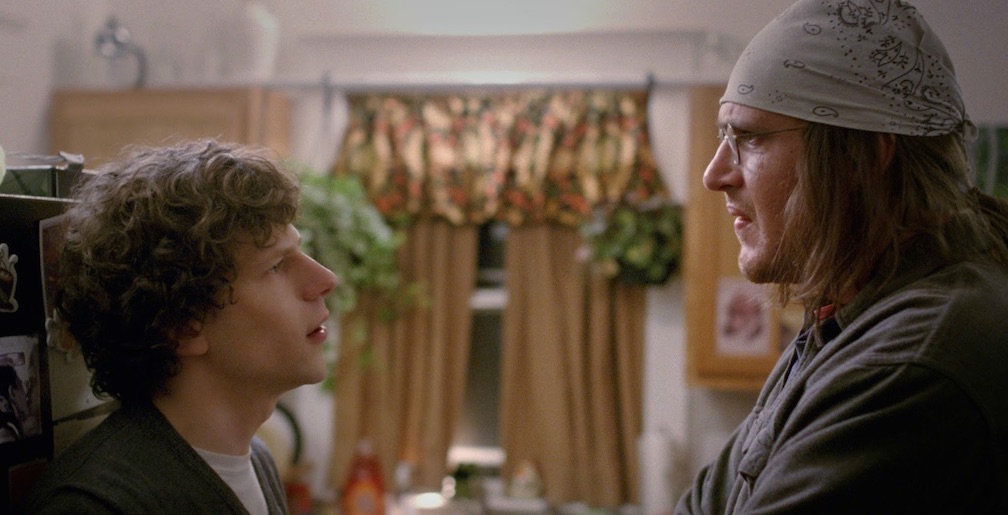
Okay, confession time, guys—before seeing “The End of the Tour,” I had absolutely no knowledge of either David Foster Wallace or his significant novel, Infinite Jest. After watching the fictional film about a few days in his company (which, as far as I can tell, is mostly accurate), I feel like I should read the novel and get into Wallace’s mindset even further.

Directed by James Ponsoldt (whose previous film was “The Spectacular Now,” one of my new personal favorite films), “The End of the Tour” is not a biopic about the life of a troubled artist but a slice-of-life film about a reporter’s interpretation of said-troubled artist while spending five days with him. The result is a comedy-drama that is honest, insightful, a great balance of drollness and pathos, and brilliantly acted. It’s one of the best films of 2015.

The story is told in flashback in 1996, when writer David Lipsky (played by Jesse Eisenberg) is assigned by Rolling Stone to join David Foster Wallace (Jason Segel) on the last few days of his multi-city book tour. He gets to know the offbeat Wallace, keeps his tape recorder handy and running most of the time, and the more he gets to know what kind of person he is, the more hesitant he is to ask him what his editor is demanding to know: was Wallace addicted to heroin?

I’ve always liked Jason Segel in his comedic roles, but with his performance as Wallace, he shows a side I haven’t seen before. He’s brilliant, portraying an artist who is trying to hide from the world while observing modern (or, pre-9/11-modern) society’s pros and cons (at one point, it’s revealed that he himself is addicted to trash TV), and he’s terrified of fame for numerous reasons (some obvious, others understated). There are many levels to Segel’s performance that are fascinating to interpret; to see this film is to admire this performance.

Jesse Eisenberg’s role, who is technically the film’s main character, doesn’t require a stretch in range for the actor who has given similar performances before—as the twitchy, brainy, self-absorbed, quick-witted person who has a heart of gold—but Eisenberg still does an effective job here.

Also to be admired is the screenplay by Donald Margulies, adapted from the real David Lipsky’s reflective novel, Although Of Course You End Up Becoming Yourself. The conversations Lipsky has with Wallace are great and fascinating to listen to, with a great amount of pitch-perfect dialogue. It’s a long shot for the film to get a Best Adapted Screenplay nomination come Oscar-time, but I would cheer if it did.

With a fantastic script, a remarkable performance from Segel, and numerous effective moments that are dramatic, humorous, or both, “The End of the Tour” is a film I won’t forget anytime soon. I see a spot open in my year-end list for the best films of the year. I love this movie.

Napoleon Dynamite (2004)

7 Oct

napoleon_dynamite

Smith’s Verdict: ****

Reviewed by Tanner Smith

“Vote for Pedro.” I challenge you to find anyone who doesn’t immediately get that reference.

“Napoleon Dynamite” is certainly a strange film. I tend to refer to it as the “anti-teen-movie” or the “anti-coming-of-age-movie.” It’s a slice of life centered around some particularly strange characters who live in worlds all their own. These people are so off-putting that they’re the very reason people either love it or hate it. If you can’t tell by the Verdict rating, I belong to the former group.

The title character is a high-school teenager who would be classified as a “nerd” due to his outward appearance (thick glasses, odd fashion sense, and hair that must’ve taken hours to look bad), deadpan monotone, and asocial behavior, but you might be far off. This kid, Napoleon Dynamite (Jon Heder), wouldn’t even fit in with the other nerds at school because he’s so repellent and aggressively obnoxious. This isn’t one of those high-school dramas that portray teenage outcasts as tragic figures; we see more than enough of Napoleon to realize he probably deserves to be an outsider.

And yes, he is the protagonist of “Napoleon Dynamite,” and in any other movie, he would be one of the worst movie characters in history. But with this film, it strangely works, because the film itself is so low-key and with a good amount of biting satire that it’s easy for me to admire the decisions director-writer Jared Hess and his wife, co-writer Jerusha Hess, make with it and their characters. They have conveyed a tone in this film that really works because everything is underplayed and so is everyone. Let me put it this way—the comedy in “Napoleon Dynamite” works not because the actors are playing their parts or the material for laughs but because they aren’t, and as the movie goes, their characters grow on us. (State a quote from this movie, and there’s no doubt many people won’t know who or what you’re referencing.)

Who else in this group of strange characters can we count off? Well, there’s Napoleon’s older brother, Kip (Aaron Ruell), who is almost as asocial as he is. He still lives with Napoleon and their grandmother, and his daily life revolves around an Internet Chat Room. (Their grandmother gets very little screen time, but I’d like to know more about her, especially considering what we see of her social life.) Then there’s Uncle Rico (Jon Gries), a pathetic 30-something ex-jock who constantly lives in the past and hopes to relive his glory days of playing football; after Grandma is hospitalized, Uncle Rico stays at the house with Napoleon and Kip (anything to get away from his trailer), and he and Kip go into business as door-to-door salesmen, selling the most bizarre products.

Pedro (Efren Ramirez) is Napoleon’s only friend. He’s the new kid in school and has as much trouble fitting in as Napoleon. What’s so strange about their friendship is that they are often together and exchange words with each other, but they rarely show any emotion whatsoever. Then there’s Deb (Tina Majorino), a shy, awkward girl who has a crush on Napoleon for…reasons, I’m sure. Pedro asks her to the upcoming dance, so Napoleon, having been stood up by his date, has to cut in for one dance.

There isn’t much that happens in “Napoleon Dynamite.” The closest thing it has to a story is introduced in the back half, in which Napoleon and Pedro start a campaign for Pedro to become Class President, with Napoleon as Pedro’s campaign manager. His opponent is a stuck-up popular girl, Summer (Haylie Duff), who Pedro once asked to the dance. (By the way, I love how she responds.) But even that doesn’t have much of a focus, nor does the buildup to the dance or hardly anything else. It just leads to a payoff where Napoleon ultimately gains some kind of victory (though not on the account of anything you might expect, keeping in consistency). “Napoleon Dynamite” is mainly an episodic slice-of-life where we spend an hour-and-a-half spending time with odd, quirky characters, particularly the sadsack loser Napoleon. Strangely enough, there are even side-spots which we’re not even sure why they’re there in the first place. For example, Napoleon and Kip visit a steroid-built dojo owner named Rex (Diedrich Bader), who shares his unorthodox advice on how to defend yourself. What does this have to do with anything? I’ve never figured this out, but it just adds to the “stuff-happens” element that the film offers.

The film doesn’t force us to hate these characters, because it doesn’t necessarily mock or even hate them. It shows its heart near the end and we can appreciate any hint of redemption these people might have in their lives. The film isn’t about that, mind you, but it does show a bit of hope seeping underneath the surface.

As someone who is generally a fan of coming-of-age/slice-of-life movies, I find “Napoleon Dynamite” to be very funny and even more admirable in the way they go against what this type of film usually offers and delivers. Maybe that’s why people seem to be split on it. Some people look at it like I did—a charming, unusual comedy with amusingly disconcerting characters. Others have seen it a different way, because they’re turned off by the film’s characters and tone, they don’t find it funny, and/or they expected something different and more generic. The former group has turned the film into a cult classic. I’m happy to call myself a part of that “cult.”

Three Colors: Red (1994)

22 Sep

threecoloursred

Smith’s Verdict: ****

Reviewed by Tanner Smith

“Red,” the final chapter in Krzysztof Kieslowski’s “Three Colors Trilogy,” was sadly also Kieslowski’s final film before his untimely death. That the film is excellent for reasons I’m about to describe is a testament to the great Polish filmmaker’s magnificent career.

If the first two parts of the trilogy were very good, then “Red” is one I would call one of the best foreign films of the 1990s if not of all time. (Of course, calling a certain kind of film one of the greatest of “all time” would indicate that I’ve seen every movie, which I certainly haven’t.) Having seen it five times now, I’m always convinced with each viewing that I’m seeing a masterpiece. This is a film that explores the themes of fraternity, platonic love, and kismet in such a rich, complex way that it can lead to heavy discussions among movie-loving groups upon seeing it.

The best thing about a certain series is how each chapter has a story from one individual’s point of view. That makes the ideas similar and somewhat connected to other episodes but also causes each separate one to become its own self-contained story. You can watch “Red” as a stand-alone film and get as much about the ending as one would when associating it with the previous “Three Colors” films, “Blue” and “White.” Those who have seen “Blue” and “White,” like me, however, get an even stronger feeling from “Red.” Its ending brings closure to the other films while tying to this one as well. I won’t give it away here, but it brings its complicated, unstable characters together in a brilliant way that makes the central themes of the entire trilogy even more powerful.

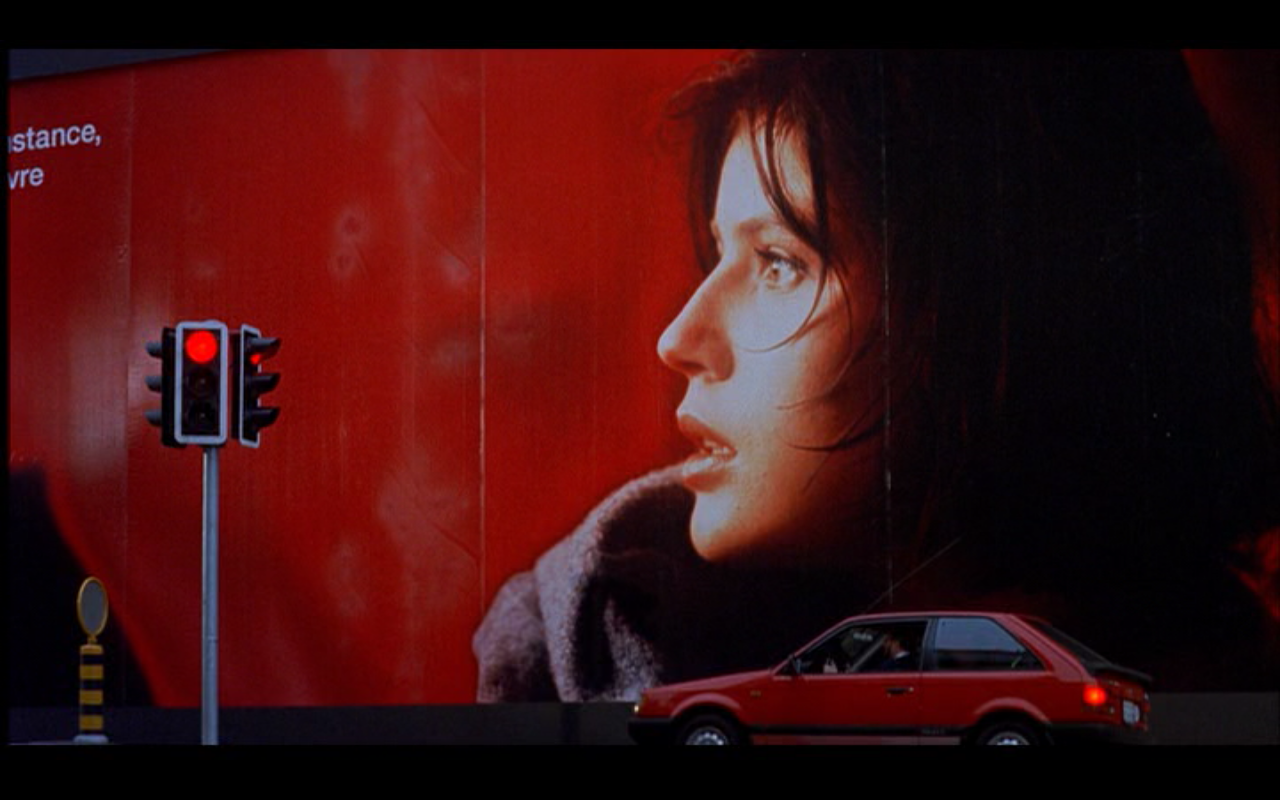
But back to “Red”—the story involves a young, beautiful model named Valentine (Irene Jacob), who accidentally hits a dog with her car. She tracks down the wounded dog’s owner, a retired old judge (Jean-Louis Trintignant), and is surprised to find that the judge is indifferent to the dog and seemingly to her. He tells her she can keep the dog, but the dog runs back home, and this is when Valentine discovers the judge’s secret: he has tapped into people’s phones illegally so he can listen in on their conversations. She’s confused as to why he would invade their privacy; he simply listens in and analyzes what they will do after certain calls. (And sometimes he’s right.) But he doesn’t enjoy it—he hardly enjoys anything anymore, ever since tragic instances caused him to leave the court. He doesn’t even interfere in these people’s lives; he simply listens and lets them go about their day, much like God giving the human race free will (a bit of heavy symbolism, but it’s still there). Valentine is fascinated and somewhat unnerved by her discovery of the judge’s private life, while the judge is interested that someone now knows his secret, and they form an odd friendship. While that’s going on, we see the story of a would-be judge, named Auguste (Jean-Pierre Lorit), who is actually a neighbor to Valentine and also one of the people being spied upon by the judge. He’s devoted to his girlfriend, Karin (Frederique Feder), but it seems fate has another idea for them.

I didn’t quite get the parallel story involving Auguste and Karin the first time I saw “Red,” but the more times I watch it, the more I realize how similar Auguste’s present is to the old judge’s past, which I found fascinating to ponder. And I was unsure why exactly Auguste and Valentine would be in the same frame without ever actually meeting (or maybe they will); hell, the film even opens (with a remarkable shot, by the way, of telephone wires crossing) with Valentine making a call and then Auguste answering a call but not from her (instead, she was calling her boyfriend and he received a call from Karin). What does this mean? Again, I have to go back to the ending, which I still can’t talk about, but the more I thought about it, the more intriguing the concept of fate became as I watched it. And while we’re on the subject of fate, that’s what’s been controlling the characters of “Blue” and “White,” as well as the characters of this film, all along. When watching all three films, especially after seeing this one and returning to the others, you start to think about the themes that are apparent in each one, especially the theme of destiny. (It’s also worth nothing that this film loves to play with foreshadowing. Watch the film and you’ll see what I mean.)

The color “red” stands for the theme of fraternity, or “platonic love.” Of course, the color is seen in nearly every shot with red objects and filters (and, by the way, the cinematography is absolutely lovely). There are no sexual overtones to be found in the friendship between Valentine and the judge; just interest. She’s fascinated by him, and vice versa. Their relationship is even more interesting when you realize that they’re on opposing sides on views of human nature—he has very little hope for humanity and she keeps her faith, despite him trying to convince her. And sometimes, she even gets to him; the moment that spells that out clearly is the scene where he shows up at a fashion show to see her—something otherwise unexpected for him to do. That’s the beauty of this friendship: you have no idea what’s going to happen. As with “Blue” and “White,” nothing is as simple as it may seem (or…even as simple as the judge might believe it to be; really think about that).

There is so much I’m probably missing in discussing “Red,” and I embrace this film for challenging me and making me think about what’s happening in the film and what it relates to in life. The more I watch this film, the more I learn from it. “Red” is a masterful conclusion to an already riveting trilogy, and even better, Kieslowski’s finest film in an already glorious career.

And I’ll tell you something else I got from the ending, which I still won’t give away: life is precarious and every moment you can cherish should be cherished forever. I love this film.

The Up Series (1964-2013)

16 Sep

neil

Smith’s Verdict: ****

Reviewed by Tanner Smith

The “7 Up” project began in the mid-1960s as an episode of a British investigative current affairs program called “World in Action.” The near-40-minute episode, entitled “Seven Up!,” followed 14 children, all age 7, who were interviewed. The purpose of the program was to present “a glimpse of Britain’s future” and ended with the infamous quote, “Give me a child until he is seven and I will give you the man.” The participants were chosen to represent different social classes in Britain in the 1960s.

Seven years later, when the children were 14, researcher-turned-director Michael Apted directed “7 Plus Seven” (or “14 Up!,” as it’s also known) with follow-up interviews. And because Apted believed that human lives reform in some manner within seven years, he would continue to follow these same participants (for the most part; a few dropped out, since there was no long-term contract requiring them to participate in each film) at ages 21, 28, 35, 42, 49, and 56. (As of now, it’s unclear whether the series will continue at age 63.)

Watching these films as a whole, spanning five decades from “Seven Up” to “56 Up,” is a marvelous experience, capturing the truest essence of life possible for a documentary. It’s not only one of the best documentary projects of all time; it’s a real sociological study. It represents the lives of these people, they talk about what has changed every seven years and what hasn’t, and while we see the changes in each character, we still see who they were and get a sense that they are who they are. It’s like when you look at a photograph of yourself as a child—you know that you are the child and the child is you, but it’s difficult to comprehend the connection due to how much time has passed since the photograph was taken. And so, when each of these people in the “Up” series are shown as children and as adults, you notice the changes in each of them, but you also recognize some of the characteristics in them as children.

These are ordinary people—Tony, Suzy, Neil, Nick, Bruce, Jackie, Lynn, Sue, Symon, Paul, Andrew, John, Charles, and Peter. We don’t know them (though we feel like we do, through the films) and we can’t necessarily say that we at times are like them, because as the entire project indicates, no one is the same as another. But we do recognize parts of ourselves in some of these people that allow us to identify with them, want to know more about their lives, and become engrossed in everything else they have to say. Originally, the project was conceived as a way to make a political point about social class, but as Apted learned more about his subject’s lives, he lost sight of the bigger picture. But that’s fine, because the audience did too. He grew close to his subjects, so we did too.

The individual films in the series are all special in their own way. Some are more exciting and interesting than others, but there are hardly any downsides. The first two (“Seven Up!” and “7 Plus Seven”) are fairly standard, but that’s not bad at all. It starts to get very interesting at around “21 Up,” which shows the growth and maturity of the subjects as they prepare for the rough road of life. After “28 Up,” which some a couple fascinating changes (which I’ll get to in a moment), it becomes clear what the (new) purpose of the project is.

Now let’s talk about the participants. Jackie, Lynn, and Sue are all from the East End of London. While Lynn has a family and career, Jackie and Sue each married young, became single mothers, and later divorced their husbands. Andrew, John, and Charles, each representing the rich upper class people who usually map out the lives of children. These three pretty much followed the path that was already set for them by their parents and society. Of these three, Andrew is the only one who has participated in all of the films, Charles quit after 21, and John skipped 28 and 42. Symon and Paul lived in a children’s home run by charity—since then, Paul emigrated to Australia and has lived there with a wife and children ever since, and Symon has gone through a divorce and remarriage. (It’s also reported that his ex-wife didn’t care for the project, while his current wife does. He and his wife are now foster parents.) Nick grew up on a farm but didn’t see himself working on it in the future; he instead grew up to study science and become a professor and nuclear physicist in the United States. He married before 28, though everyone who saw the film apparently felt the marriage was doomed, due to her commentary. Because of this, she didn’t return for 35 or 42, and by 49, Nick was divorced and remarried. Bruce was a quiet boy who wanted to be a missionary and became a teacher and traveled to places such as Bangladesh. One of the more pleasing developments in the series is when he is 35 and regrets not having been married and in “42 Up,” he is a newlywed. He’s now a devoted husband and father. Neil and Peter were middle-class boys living in Liverpool. Peter skipped 35, 42, and 49, and returned in “56 Up” (mainly to promote his band). (I’ll get to Neil in a moment.)

Of the 14 participants, three stand out most to me (and a lot of other people, for that matter). One is Tony, also from the East End. He’s a favorite because he’s so open and charismatic and one of the biggest supporters of the project, which means he’ll most likely stay with it till the end. He dreamed of being a jockey at age 7; at 14, he was an apprentice at a horse-racing stable; at 21, he talks about a race where he had a photo-finish, from which he keeps a photograph as a souvenir, but he had to move on from being a jockey and instead concentrated on being a taxi driver; at 28, he owned his own cab, got married, and started raising a family. One of the most poignant moments in the series comes from “42 Up,” when he sits with his wife and confesses an affair he had; a real rough patch in their relationship. But they still stayed together after his wife forgave him. A particularly funny moment in the series is in “56 Up” when he tells an anecdote about how he was recognized for the series by someone who wanted his autograph instead of Buzz Aldrin’s (Aldrin was Tony’s fare).

Suzy, who comes from a wealthy background, was always reluctant about doing the films, as she was forced to do it in the first place by her parents. She’s always said she would stop participating, but she kept coming back (probably because she feels obligated to do so after so many years). Suzy was a very shy girl growing up, and by 21, she formed a very negative opinion about marriage. The most dramatic change in the series is from her from age 21 to 28. When you see her in “21 Up,” she’s bitter, chain-smoking, and nervous. But then in “28 Up,” she’s cheerful and happy and married with children; a remarkable transformation.

And last but definitely not least, there’s Neil, from a Liverpool suburb. Neil is the most complex person in the series and his story is consistently captivating and unpredictable. As a child, he was happy and excited, though you have to wonder what his home life was like, since he is also saying things like “I don’t want to have any children because they’re always doing naughty things and making the whole house untidy.” I don’t know many 7-year-olds who would talk like that, especially while smiling (like he does), so it may be indicated that Neil’s happiness was hiding something. By 21, he was living in a squat after dropping out of school after one term. By 28, he was homeless and living in Scotland; in “28 Up,” he provides the most heartbreakingly frank statement about why he will never have children: he’s afraid the child will inherit the most negative traits from him. Many people thought Neil would be dead by 35, but he was still alive, though his life had hit rock bottom. But luckily, by 42, he was able to put his life back together; he’s been involved in local council politics as a Liberal Democrat and he’s even made friends with Bruce, who let him live with him for a while.

This is what the most compelling documentaries contain: real human drama. You don’t find movie characters as fascinating as Neil.

Another special thing about the “Up” series is that with each film being released every seven years (and it still remains to be seen whether we will see “63 Up” in 2020), it allows the audience to think back about themselves and how their lives have changed in the past seven years. That reason (and more) is what truly makes the “Up” series special—it’s documentary filmmaking at its best.

Inside Out (2015)

8 Jul

Inside-Out

Smith’s Verdict: ****

Reviewed by Tanner Smith

The new collaboration between Disney and Pixar Animation Studios, Inside Out, is an endearing, intelligently-written comedy-drama with candy-colored imagination. While Disney-Pixar has been stuck in a bit of a rut in the past few years with mediocre films such as Cars 2, Brave, and Monsters University, Inside Out reminds us of the collaborative strengths that made their earlier films, such as the Toy Story movies and Up, special. These are films children love because of their fun, memorable characters, colors, and engaging stories with themes complex enough to keep adults interested. Inside Out belongs in that same category.

Brilliant. Bright. Funny. Imaginative. Profound. Moving. Sometimes sad. All of these adjectives can be used to describe the power of Inside Out, which is easily one of the best films of 2015.

Despite the bright colors, artistic settings, and delightfully varied characters, Inside Out may be somewhat of a hard sell for the smallest of children. This is arguably a more meaningful film than any of Disney-Pixar’s previous works, heading deep into psychological regions. The adventure takes place in the human mind and the central characters are emotions—by making it this way, the film explores complex themes of personality.

Riley (voiced by Kaitlyn Dias) is an ordinary 11-year-old girl who is forced to move with her parents (Diane Lane and Kyle MacLachlan) from Minnesota to California because of a new job opportunity. She wants to make the best out of this situation, but it only gets worse as the moving truck is lost, the house is a dirty mess, the nearby pizzeria has only one topping (broccoli), and she has trouble fitting in at her new school. It’s difficult for her to be cheerful and upbeat as she misses her friends, her old house, and her hockey team. We see Riley’s world through the emotions in her head, which is where much of the film’s story is told. We meet Joy (Amy Poehler), our green-colored (each emotion has a different color) narrator and Riley’s chief emotion who keeps the other emotions in check so that Riley is consistently happy. The other primary emotions are blue Sadness (Phyllis Smith), purple Fear (Bill Hader), red Anger (Lewis Black), and green Disgust (Mindy Kaling). They run the Control Room inside Riley’s mind, which allows them to see what she sees and for her to feel what they feel. Memories are created and stored in collections of glass spheres, whether they’re short-term, long-term, or forgotten entirely. And there are also theme parks connected with one another, with the themes being dreams, nightmares, her favorite sport (hockey), imagination, and so on. It’s amazing to see how this “world” inside a person’s head works. There’s a dark abyss where forgotten memories are stored and eventually fade away, a dream-land that resembles a Hollywood studio where actors act out Riley’s dreams and nightmares, and all sorts of inventive components.

Something goes wrong, as Joy and Sadness are accidentally ejected from the Control Room. With Fear, Anger, and Disgust in charge, Riley, on the outside, snaps at her parents, fears attempts at making new friends, and even considers running away, while Joy and Sadness go on a quest through the craziness of Riley’s subconscious in order for Joy to regain control. They encounter many strange things along the way, including abstractness, fears, daydreams, and even a forgotten imaginary friend, named Bing Bong (Richard Kind).

The film shows complication and difficulty in adjusting and other psychological issues in a way that’s basic but also important and relatable. Some little kids may wonder why some of Riley’s worlds such as Hockey Land or Friendship Land are deteriorating, but adults will understand what Riley is going through and what everything on this journey means. With Joy and Sadness gone, Riley’s personality is shutting down, causing her to lose sense of the bright side of life and what it means to express herself. Even her associated memories are fading, adding more depth to the situation. But even if it all goes over kids’ heads, and they’ll understand it more as they get older, they’ll at least get a kick out of the film’s overall visuals.

There’s a fascinating dynamic between Joy and Sadness. Joy wants nothing more than for Riley to be happy. Sadness knows nothing but sadness and also has a Midas-like touch, so that every one of Riley’s memories she touches turns blue and sad. But in order to get back to the Control Room, they have to work together. I wouldn’t dare give away how, but something occurs to Joy later in the film about how much Sadness is needed. This leads to a wonderful conclusion that delivers a message about how we can’t always have our happy ending and we just have to deal with what we have rather than what we don’t and it’s important to express yourself. That’s a message you rarely find in especially family films. I applaud this movie for not taking the easy way out.

But the film isn’t so dark that its target audience won’t be turned off (after all, films don’t always have to be dark to be deep). There are some laughs to be had as well, such as long-term memories being trashed (such as piano lessons, with the exception of “Chopsticks” and “Heart and Soul,” of course) and brief visits inside the minds of others, including Riley’s parents. (By the way, the biggest laugh I got from this movie is when Riley encounters a boy near the end, and we see what goes on inside his head.)

With the perfect balance of comedy and drama, wonderful computer animation, amazing visuals, and a script that knows more about the subconscious than one might expect from seeing the film’s trailer, Inside Out is an instant classic, the best animated film to come around in a long time, and one of Disney-Pixar’s absolute finest.

Reservoir Dogs (1992)

30 May

reservoir-dogs-acting

Smith’s Verdict: ****

Reviewed by Tanner Smith

“Reservoir Dogs” was writer-director Quentin Tarantino’s breakthrough effort. Released in 1992, it introduced what would be known now as his famous trademarks—large amounts of sharp dialogue and violence. It’s also known as a milestone in independent filmmaking and was a major influence in independent cinema. How does it hold up? Greatly. It’s still a riveting thriller. The violence is still bloody (while the heavier acts are offscreen, leaving it to our imagination, which is more horrifying); the dialogue is very fun to listen to, with lines such as “Are you gonna bark all day, little doggie, or are you gonna bite?” and also with constant usage of the “f” word as poetry, like David Mamet’s writing; the characters are still enjoyable despite their horrific deeds and the actors playing them are spot-on; the non-linear way of storytelling (which Tarantino would use to greater effect in his next film, “Pulp Fiction”) works in the film’s favor; and no matter how many times you watch it, whether you know the big plot twists or not, it’s still an exhilarating film that grabs you and doesn’t let you go until it’s over.

The film mostly shows us what crime films are afraid to show us, which has since been copied for years to come (hello, Martin McDonagh)—the humor, the conversations about things that aren’t very important, and even the sloppiness. It’s set up in the opening scene, which shows eight men, led by mob boss Joe Cabot (Lawrence Tierney) who name them after colors (Mr. White, Mr. Orange, Mr. Pink, and so on), eating breakfast at an L.A. diner before they set off on a big heist. They talk about Madonna discography and the importance of tipping waitresses before they embark on their planned mission. It’s a wonderfully well-written scene that introduces the characters and lets us know we’re in for an unusual but fun ride.

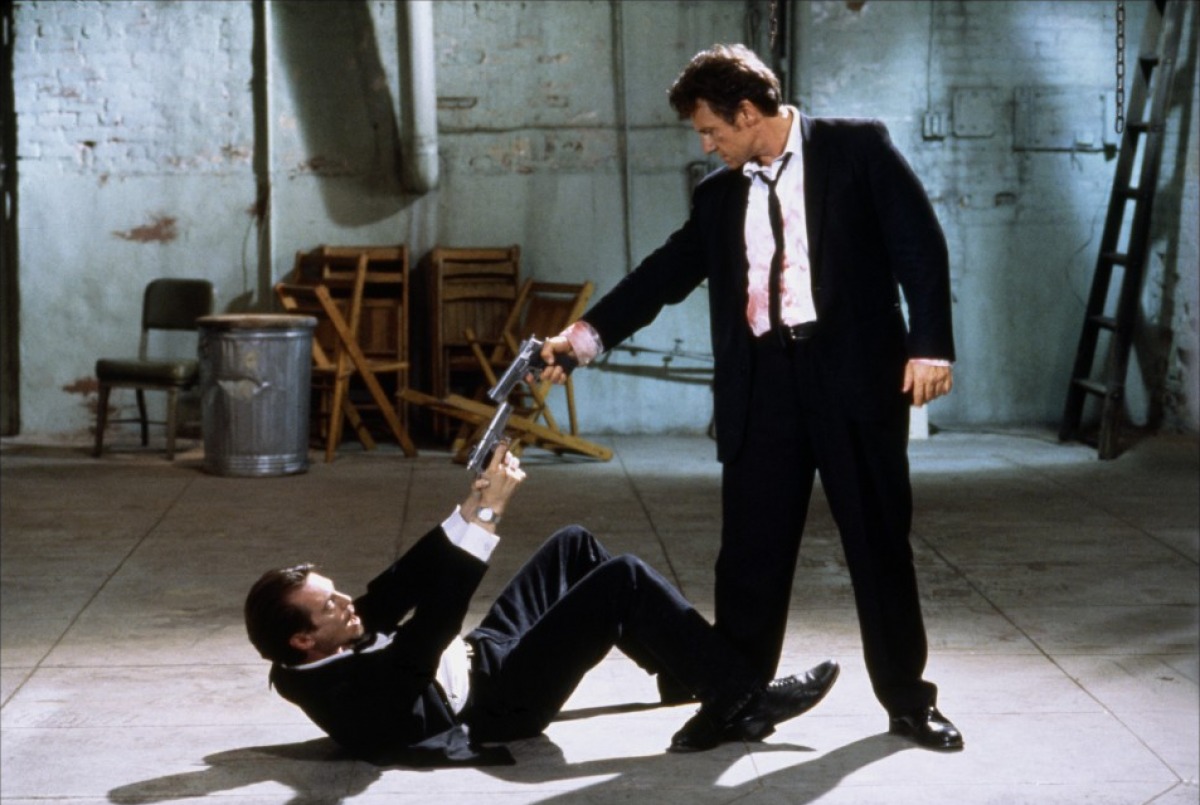
The heist is never actually seen, but the aftermath lets us know quickly that it went horribly wrong, as the cops arrived on scene and started shooting, causing the gangsters to shoot back. Mr. White (Harvey Keitel), the cool-headed one, speeds away from the scene with Mr. Orange (Tim Roth), who was shot in the stomach. He takes him to an abandoned warehouse, which is the rendezvous for the whole group, and he comforts him for a while, until the paranoid Mr. Pink (Steve Buscemi) arrives. He believes the whole thing was a setup, since the police apparently responded too quickly. He and Mr. White try to figure out how to handle the situation, with one of their gang dying on the floor, several others missing, and the psychopathic Mr. Blonde (Michael Madsen) having killed many civilians during the heist when police came. Mr. Blonde shows up with a little surprise in the trunk of his car…

The casting for this film couldn’t be more perfect. Each one of the actors does a spectacular job, bringing these characters to life. In particular, Michael Madsen is delightfully sadistic and calm; a scene in which he tortures someone for answers is both hard to watch and fun to watch. Harvey Keitel is calm, cool, and collected; Tim Roth is charismatic; and Steve Buscemi is excellent as a distrustful guy trying to make sense of things. Also effective are Lawrence Tierney as the leader, Chris Penn as his hot-headed son, Tarantino himself as Mr. Brown, and Eddie Bunker as Mr. Blue. Tarantino also gives his characters well-established personalities so that they’re not stereotypes but real people who do shocking things and yet show their humanity at certain points.

There’s a big twist revealed midway through the film, but I wouldn’t dare ruin it for those who haven’t seen it. To see it for the first time is not to know anything about the surprisingly well-developed plot. That way, you can enjoy its many twists and turns. But even if you already know it, you shouldn’t let that ruin it. I’ve seen this movie 10 times already, and I never let my knowledge of the central twist spoil it because it makes way for more interesting developments, flashbacks, and fun dialogue. Also, not only is the film wonderfully-written and intelligent, but it’s also fun to watch. It’s visceral, the cinematography is well-handled, and you can see Tarantino’s early influences from directors such as Scorsese and John Woo while adding some style of his own.

Simply put, “Reservoir Dogs” is an unforgettable movie. It’s funny, it’s chilling, it’s fun, it’s energetic, and it’s just all-around great. It’s a film I could watch numerous times for those very reasons. And Quentin Tarantino has only gotten better since then.

LRFF2015 Review: “Made In Arkansas” Shorts Block 6

23 May

Reviewed by Tanner Smith

Go to the Ball with Me, Jenny

Smith’s Verdict: ***1/2

Cole Borgstadt’s (Pyro) 3-minute comedy, “Go to the Ball with Me, Jenny,” is shot like an amateur YouTube video in which an odd, quirky high-school teenager addresses a girl he likes (named Jenny, of course), asking him to go with him to their school’s Winter Ball, while telling a few things about himself such as his family, his pets, his hobbies, his…never-born twin brother he ate while in uterus (wait, wha…?). We’ve all been there—working up the courage to ask someone to a school dance can be a tricky effort and some of us felt we had to go the extra mile, like the kid in this film. What results is a funny, sweet…You know what? I can’t do it justice with a review. The film is online. Check it out here:

Sassy & the Private Eye

No Verdict rating

“Sassy & the Private Eye” is another short film of mine that was selected to screen at this festival. It’s a comedy, like The Making of ‘Sensitivity Training’, but much different, in that it’s a film-noir parody, it’s not to be taken seriously in the slightest, and it features a certain Sasquatch character from Vampire-Killing Prostitute…named Sassy.

Kristopher Pistole (audience member)—“I really liked ‘Sassy.’ The writing was very strong, really fun premise and your lead was charismatic. If I had any nitpicks, I could tell there were some technical hiccups, like dubbing. But that kind of thing gets better with time and experience.”

I thought Sarah Bailin, who reviewed The Making of Sensitivity Training, would be harsh toward this one, but she actually send me a positive message saying it’s one of my best! “It’s a nice genre mash-up and generally well done,” Bailin said. But she also criticized the slight audio issues the film may have had. “Please tell me it was a style-thing,” she said. I’m sorry, Bailin. It was a mistake.

Here’s a trailer for the film:

10511096_663444157058698_3236168490307898911_n

Simple

Smith’s Verdict: ***

Scott McEntire’s 10-minute short action film, “Simple,” is a hard-edged misunderstanding-gone-wrong, with a wry sense of humor that’s more than welcome for the violent material. It begins as mild-mannered Sam (Clayton Bowman) delivers an important package to a crime boss (Tony Gschwend) as a favor to his lazy slacker friend, Jacky (Kelly Griffin, very funny). When Sam finds out too late what was inside the package, he finds himself running and fighting for his life against the boss’ henchmen. What ensues is a series of fistfights, knifefights, narrow escapes, etc. as Sam must survive to make things right. As a straight-up action flick, it’s exciting and well-made. As a dark comedy, it works too, particularly when it cuts to Gschwend as the crime boss and Griffin as screwup Jacky. Also, Clayton Bowman is a likable lead. Though, my main criticism of the film is that it may have benefitted from tighter editing, which is an odd complaint for a 10-minute short. Aside from that, I liked “Simple”; it’s a nice 10-minute thrill ride.

11070023_829190690462239_1420823634781011477_o

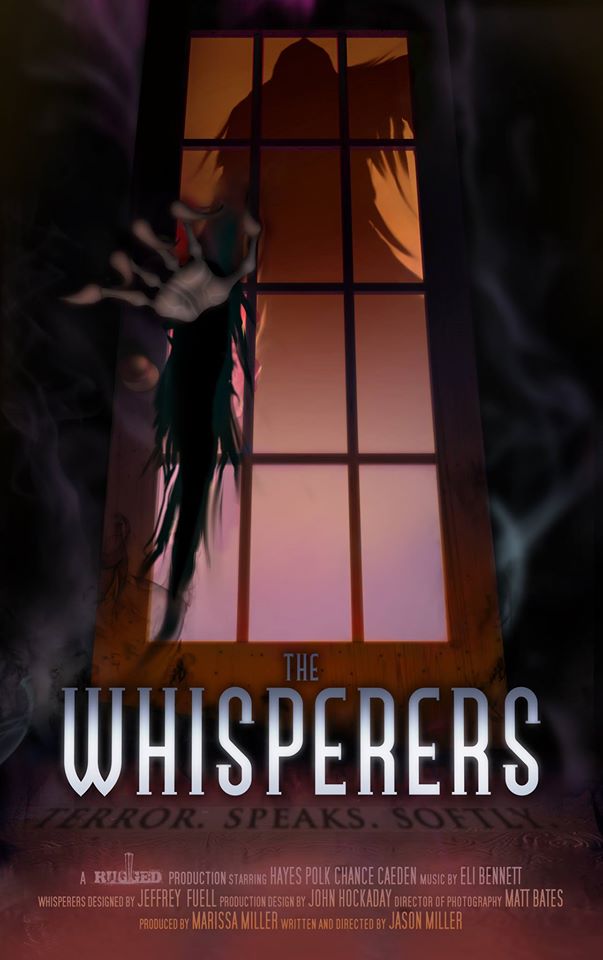
The Whisperers

Smith’s Verdict: ***1/2

The full review can be found here. (NOTE: This film went on to win the LRFF award for Best Arkansas Film and is now available on demand: https://www.indiereign.com/v/da5d3 I recommend you check it out.)

Stay a While

Smith’s Verdict: ***1/2

Michael Kelley’s 4-minute short “Stay a While” is as much a music video rather than a short film. I actually had an interesting conversation with a friend about what it works best as: a narrative short or a music video. He said it works much better as a music video, so I told him, “Then it’s a music video.” Either way, it’s still a well-done piece—a good example of editing that show contrast between what was once here and what is now gone, as a young man is happy with his girlfriend but has suddenly lost her and is frantically searching for her. It’s well-done and has a nice payoff.

1511385_234521863419124_1179789493335139821_n

Perfect Machine

Smith’s Verdict: ****

And now we’ve come to the final review in the LRFF2015 Made In Arkansas Shorts Block collection: Jarrod Paul Beck’s 25-minute science-fiction drama, “Perfect Machine.” After 3 years in the making, as well as an ambitious funding & marketing campaign (see Homefront and MatchMaker), the final creation works wonderfully.

The film takes place in (supposedly) the near future, as a new government system makes everything “perfect.” All citizens of new, altered civilizations are forced against their will to daily comply with this arrangement, by taking special medication, and those who don’t are forcibly “reprogrammed” to get with the program. It’s a world in which all choice is replaced with obedience, and it’s all controlled by the ominous Administration. Stevens 8936 (Kristof Waltermire) is a citizen who has stopped taking his medication for a couple days is starting to “feel,” which doesn’t bode well, seeing as how it’s against the system. Soon after his latest Administration checkup, Stevens 8936 (everyone is given a number to their name, making it easy for matching; again, see MatchMaker) evades two guards and escapes from the city, along with an unwilling woman, Warner 5964 (Caitlin Covey), into a forbidden, untouched world of nature where they take refuge in a cabin. As Stevens 8936 to the new feeling of freedom within himself, he helps Warner 5964 get adjusted to hers. Upon seeing/feeling the beauty of this environment, they learn there’s more to life than what they were forced to believe. And in each other, they find something deeper.

The background of this society is sketchy, but read/see other futuristic fables such as this and their explanations for their universes will probably make as much sense. I’m actually glad Beck doesn’t give us an answer to the question of how this world came to be. I don’t think his characters know either. Within the first five minutes of the film, writer-director Jarrod Paul Beck establishes this new world before taking his characters, as well as us, on a journey of emotion and self-discovery, which takes up more than half of the film. This is a film that uses a sci-fi gimmick to set up the two central characters, carefully develop a trusting relationship into love, contemplate complex issues such as free will and nonconformity, and results in a heartbreaking resolution but with a final shot that brings a beacon of hope. And it’s so beautifully done. The first five minutes of the film, which show the world in a certain amount of detail, are well-executed, and the visual effects are nice. But surprisingly, it’s everything with the more familiar world, taking up mostly the rest of the film, that I take back from “Perfect Machine.” This whole sequence is moving, insightful, and beautiful. It’s also well-written; there are a few extended dialogue-free sequences, but when the characters do engage in conversation, their words are carefully chosen. It’s also great to look at, with fantastic cinematography by Eric White. Watch this on a big screen, like I did, and you’ll most likely feel like you can reach out and touch this film, especially in the nature shots; you can feel the location. Few films I’ve reviewed in these blocks provided such a pervasive sense of time and place; I wasn’t tempted to go elsewhere, not even the inventive sci-fi world established earlier.

Both Kristof Waltermire and Caitlin Covey do great jobs portraying sympathetic characters trapped in a world they didn’t make and content with one that’s been there for them all along. I cared for these two and hoped for the best. Will they remain here for the better or will the cruel, forceful hand of the Administration bring them back for the worse?

The ending makes the film yet another short film I’d like to write a “spoiler review” for, just so I can talk about the final shot and what it could mean. Without giving it away, it’s ambiguous and people will see it one of two ways: positive or negative. Maybe it’s the emotion that was brought up in the mid-section, but I’m leaning toward the positive.

There’s no other way to put it—I loved “Perfect Machine.” It’s well-made, intelligent and charming. Beck and his crew put a lot of effort into this film. It pays off beautifully.

NOTE: Beck received the LRFF2015 Best Arkansas Director award for this film. I’d say his hard work really paid off.

LRFF2015 Review: “Made In Arkansas” Shorts Block 5

22 May

Reviewed by Tanner Smith

maxresdefault

Not Interested

Smith’s Verdict: ****

The full review can be found here.

Southern Pride

Smith’s Verdict: ***

In Nick Lane’s 7-minute short film, “Southern Pride,” an Arkansas gay couple is walking around their suburban neighborhood while their son prepares for a proposal dinner at home. It seems their son is going to propose to his girlfriend. Their conversation soon grows from worrying about how the son will prepare the potato salad to the subject of marriage and whether or not their son is making the right choice. They discuss the pros and cons of marriage when it becomes clear that they’re not merely worried about their son’s proposal but the possibility of getting married themselves. The way it builds up to its surprisingly inevitable payoff is subtle and well-handled, and it digs through the surface of what’s truly bothering these characters. “Southern Pride” is as well-written as it is well-acted.

1619239_10201647049857540_8158271712985537232_n

The Making of “Sensitivity Training”

No Verdict rating

“The Making of ‘Sensitivity Training’” was a 25-minute documentary I made highlighting humorous moments from the making of a short film (called “Sensitivity Training”) made by the team Flokati Films (which includes Johnnie Brannon, Tony Taylor, and Jason Willey, among others) for the 2014 Little Rock 48-Hour Film Project. So, obviously, I can’t review it. But I did find a couple people who had some things to say about it. Here they are:

Paige Murphy (producer, Vampire-Killing Prostitute)—“It was interesting seeing the 48-Hour Film Project from someone else’s perspective (I did it with a group one year). I liked seeing how the group decided on the story that they did. It made me really want to see the film. I think some parts in the beginning were a little unnecessary and possibly could have been replaced with a couple title cards briefly explaining 48HrFP and what genre the group got. Having said that, I’m familiar with how it works, so maybe it felt natural to someone who isn’t.” Murphy goes on to say, as a note to me, that if I do the same thing for this year’s 48-Hr, I should capture how making a film in 48 hours takes a toll on a group of people. “Getting BTS on the movie itself is really good, but I would have liked to see people sleeping on chairs or rubbing their eyes or whatever they did to cope with the lack of sleep. That’s not a criticism so much as just a random thought on my part. Overall, a good job capturing funny and interesting moments on sets.”

Kristopher Pistole (audience member)—“[…] had great editing. I enjoyed it all the way through. Very tight. I didn’t think it needed the intro at the beginning. I thought the film could have been introduced with just a few lines of text—not bad, just not wholly necessary.”

Sarah Bailin (Wellesley student)—“’The Making of Sensitivity Training,’ is, shockingly, about the making of the 48-hour film festival entry, ‘Sensitivity Training’—or as I’d like to think of it, a weekend in the life of a surprisingly unstressed group of filmmakers considering they have 48 hours to make a masterpiece. It is clear throughout the film that these filmmakers truly love the work that they do, and this featurette is all the more enjoyable because of it. Personally it was an odd experience watching a film about the making of a film I haven’t seen, but it’s to Tanner Smith’s credit as a filmmaker that I never felt as though I were missing anything, and I encourage anyone in a similar situation to me not to let their lack of familiarity with ‘Sensitivity Training’ hold them back from seeing this film. In true Behind The Scenes fashion, Smith’s camera was both unobtrusive and omniscient, providing us with a thorough glimpse into the genesis of ‘Sensitivity Training.’ This is not to say the film was without its flaws, but if any genre can get away with a little self-aggrandizing and a certain amount of inside jokes, it’s a behind the scenes video like this one. Ultimately the goal of any featurette is to document and provide insight into the atmosphere in which a film was created, and to this end, Tanner Smith’s ‘The Making of Sensitivity Training’ was more than adequate.”

Here’s a trailer for the film:

10391429_944997935518437_6557944063406988990_n

The PaperBoy

Smith’s Verdict: ***1/2

Thien Ngo’s 7-minute action-comedy “The PaperBoy” is a wild ride—a very funny, skillfully made romp that takes us to a strange universe in which newspaper deliverers engage in all-out war, with two different sides fighting for different meanings of “truth.” “The PaperBoy” is not exactly a satire on news or media or even how the public can interpret it in terms of their own politics; it’s just a brief action-adventure that thrusts two rookie paperboys (Keith Hudson and Tres Wilson) into a life-threatening situation with enemy paperboys who use attack dogs, newspaper cannons, and even newspaper-nunchucks. And that’s just some of this film’s original material, which is just full of original material. My favorite sequence is a half-a-minute montage of training at the Newspaper Academy, where the typical shouting drill instructor gives a speech about “how tough it is out there” and our trainees endure tests such as vicious dogs that will be a nuisance to them on their paper routes. (By the way, dog-lovers should probably not watch this scene.) There are other elements that make this a unique, stylish short, including a brief cameo by Johnnie Brannon as a newspaper-cannon-wielding maniac and a final sight gag that is as hilarious as it is grisly. “The PaperBoy” is tight, fast-paced, and over in just a few minutes. It’s just plain fun.

11058417_1555274804754572_4141377977809437307_n

‘Twas the Night of the Krampus

Smith’s Verdict: ***1/2

The full review can be found here.

I Hate Alphaman

Smith’s Verdict: ***

Hunter West’s 8-minute action-comedy “I Hate Alphaman” is a cheesy, fun callback to old-school comic book adaptations. The characters and material are original, but the goofy tone and style are the same, if not totally exaggerated. You know those over-the-top scheming villains who always say they’re ultimately going to stop their adversaries but never do and constantly try again and fail? No one knows that feeling better than Alex Arthur, who doubles as a rather pathetic supervillain who wants to stop a superhero, named Alphaman, for no reason other than…he hates him. Intercut with news footage, we learn how many times Arthur has tried and failed to defeat Alphaman. Each encounter leads to one embarrassing disaster after another (he’s frozen, he’s burned, etc.; this Alphaman possesses so many abilities that I kind of hate him too). That’s pretty much what the film is about; there’s hardly even a story being told here, but rather, a series of events that include news anchor footage, encounter after encounter, and even chats with other pathetic villains, such as a rhymer and a fortuneteller. And that’s fine. It’s fun, amusing, and has a nice visual style that recall the ‘60s campy Batman TV series (though, to say these special effects are better is kind of a no-brainer). My only complaint about the film is that it sort of stops when it should keep going; it ends a little too quickly and I wanted it to continue. But for what it has rather than what it doesn’t, “I Hate Alphaman” is a lot of fun.

1888555_412804585522736_819095362_n

Vampire-Killing Prostitute

No Verdict rating

BRIEF SUMMARY: “Raven is a vampire-slaying prostitute hell-bent on exacting revenge for the death of her father 18 years ago. One night, after killing a vampire, Raven gets a surprise visit from a group of vampire hunters who need her help.”

As I did with The Town Where Nobody Lives, I decided to collect other people’s opinions of Jordan Mears’ 15-minute grindhouse homage, “Vampire-Killing Prostitute.” Because I worked as BTS Videographer for the film, I cannot review it.

Kayla Esmond (actress, Spoonin’ the Devil)—“VKP was equal parts crazy, fun, and horrifying! Brittany Sparkles does just that in her performance as Raven, a, you guess it, Vampire Killing Prostitute. Jordan Mears’ directing was spot-on from beginning to end with an impressive balance of gore and true emotion. Basically, this movie rocked!”

Mathew Thomas Foss (director, Not Interested)—“It was a nonstop thrill ride. Good acting. Great nostalgic writing. More splatter than a slaughterhouse. A Sasquatch playing the piano. It had it all. And comedy for the whole family.”

Cody Harris (director, Rites)—“I think the thing the film had going for it was its use of color and lighting to emphasize the story. I also enjoyed the satirical type of acting that made the film have a comedic relief but not so over the top that it took us out of the story. I think Jordan Mears was pretty clear on what he wanted and it definitely showed.”

Kristopher Pistole (audience member)—“I liked it a lot! Loved the lighting and where Jordan put the camera. The idea of cutting the film off to not show the fight scene was hilarious.”

Donavon Thompson (director, ‘Twas the Night of the Krampus)—“’Vampire-Killing Prostitute’ feels like it was a missing piece of 2007’s ‘Grindhouse’ and Jordan Mears says, ‘Oh! I found it! Here it is!’ It’s a crazy concept involving: vampires, the end of the world, and a Sasquatch named Sassy. Yes, there is a Sasquatch. All these elements come together to deliver a fun film and work wonderfully. The film is full of gore and vulgar jokes, but it is exactly what the genre calls for. If you don’t like that sort of thing, you may be turned off to the film. In short, this film was made by a fan of the genre FOR fans of the genre.”

Al Topich (director, The Town Where Nobody Lives)—“’Vampire-Killing Prostitute’ knows what kind of movie it is. It’s not trying to change the world with any philosophical or symbolic undertones. VKP is Grindhouse. It’s a fun movie meant to entertain, just like other horror and exploitative movies of the genre from the 70s and 80s. It does a fantastic job at replicating the genre, from the blood splattering gore effects all the way down to the highly stylized lighting. Though, I would say that VKP is a notch or two better than the films it tries to emulate. It has an interesting and coherent plot, minus a certain Sasquatch. But its most endearing quality is the fact that it has a strong female lead, which is something that tends to get lost in modern films, especially in shorts. The character of Raven, played by the delightfully badass Brittany Sparkles, has a beautiful character arc that cumulates into a well choreographed final battle between her and her nemesis.”

For the record, my short documentary about the making of the film can be seen here: