Archive | Four Stars **** RSS feed for this section

Scent of a Woman (1992)

9 Feb

images

Smith’s Verdict: ****

Reviewed by Tanner Smith

In “Scent of a Woman,” Charlie Simms (Chris O’Donnell) is a shy Boston prep-school student who needs a good role model in his life. His mother and stepfather live in Oregon, and he and his stepfather don’t see eye-to-eye. And he’s not the most popular kid in a school where most of his classmates are spoiled by their wealthy fathers. Some of those classmates have pulled a prank on the headmaster, damaging his new Jaguar. Charlie knows who did it, but won’t snitch. However, if he doesn’t, he’ll be expelled. So, a disciplinary hearing is scheduled after Thanksgiving break to determine Charlie’s scholastic future.

Enter Lt. Col. Frank Slade (Al Pacino), a lonely, blind veteran. He’s an embittered man with two things that keep his spirit alive—his sense of humor and his romanticism. Charlie is working over the Thanksgiving weekend as his aide and companion. When he first meets him for an interview, Slade takes joy in making him feel as miserable as he feels. He uses sarcasm, anger, and abrasiveness to further confuse and slightly frighten Charlie.

In that first scene you see Slade, you get the feeling he enjoys doing this, as if his interviewees are his “victims.” And it’s probably not the best way for the audience to be introduced to this character, because he is so coarse that he comes so close to being a turnoff for the movie. But as performed by Pacino and written by Bo Goldman, the character gradually becomes more fascinating as the role and movie progresses. We can see why he acts this way and also why he isn’t such a miserable old fart.

“Scent of a Woman” takes these two characters, and their own stories, and brings them into a story that uses the reliable coming-of-age formula in which a young man is counseled by an older man who has lived through a lot and has a thing or two to teach his new pupil. In that case, these two characters seem just right for each other.

Anyway, it turns out Charlie gets the job of housesitting and looking after Slade. Charlie agrees to put up with more of Slade’s insults, mainly for the money. However, Slade has other plans in mind. Slade ropes Charlie into a trip to New York City to have a good time. Charlie tries to get away, as he is uncertain of whatever’s going to happen this weekend (and Slade has many tricks up his sleeve), and on top of that, he’s got the hearing to think about. But he has to do his job and keep Slade out of trouble…even though Slade is stubborn to keep making trouble.

Slade is blind, but he sees himself as a ladies’ man and tries to let Charlie in on his ideas about women. Slade sees women as the most exotic and beautiful creatures on Earth, and even believes he can tell a lot about a woman by her scent—hair color, eye color, perfume, etc. And while his ideas may seem old-fashioned (and being in the military most of his life, he has never really known a woman very well), Charlie can’t argue with him…especially after his charm works with an attractive young woman, Donna (Gabrielle Anwar), with whom, in one of the movie’s best scenes, he shares a tango. Slade and Charlie meet Donna at a hotel ballroom, and during conversation, Slade is finally able to convince her to tango with him.

Charlie doesn’t trust every of Slade’s actions, especially when Slade drinks heavily. He’s constantly on guard whenever Slade has something in mind that he neglects to let Charlie in on beforehand. Sure, riding in a limo and staying at a suite at the Waldorf-Astoria is nice, but Slade has already mentioned that he’s going to enjoy everything New York has to offer before committing suicide. What can Charlie do except respond politely to keep Slade from being more extreme, until he can find some way to stop him if he’s serious about killing himself?

Al Pacino was not going to let this film go down. He knows a lot rides on this character of Col. Slade, and I wouldn’t be surprised if he forced himself to give the “performance-of-a-lifetime” for this role. Because “Scent of a Woman” rides mostly on his performance, the character, and the central relationship between Slade and Charlie, Pacino’s effectiveness is all the more welcome, to say the least. He delivers a great portrayal of a man who has a vindictive outlook on life with a few ways of making things interesting for him. And who can deliver a hearty “hoo-ah” every now and then better than him?

Chris O’Donnell is solid as Charlie, playing a nice kid to sympathize with. Most of the story is seen through his eyes.

This complicated relationship these two characters share—in that one is going to learn something from the other—is executed brilliantly. It’s believable and doesn’t go for the easy way through. The “easy way” would be for these two to befriend each other early on, but “Scent of a Woman” has them keep their distances, so that Slade is doing his thing and Charlie is staying on guard. And then when it comes to the tense moments when they need to help each other, you feel what each person is going through and sense how it all came to this.

Everything leads to the final act, in which Charlie’s scholastic future is on the line. Charlie is pushed into telling what he knows about the school prank, and there may or may not be a way out of this with his honor intact. It’s amazing how, without giving much away, everything that was set up before seems to come together for this.

“Scent of a Woman” is often criticized for its running-time length of two hours and 37 minutes. I don’t care about how long it had to be. It was as long as its storyline needed it to be. In fact, I could watch this go on for another half-hour, if given another plot element. As most film critics say it, no great movie is too long. And “Scent of a Woman” doesn’t feel as long as it would seem.

I think “Scent of a Woman” is a damn good movie. The performances are brilliant, the writing is intelligent, the music score by Thomas Newman is excellent, every setup has its payoff, and the whole film has a skillful and intriguing feel. What else can I say but…hoo-ah!
The Karate Kid (1984)

8 Feb

karate-kid1

Smith’s Verdict: ****

Reviewed by Tanner Smith

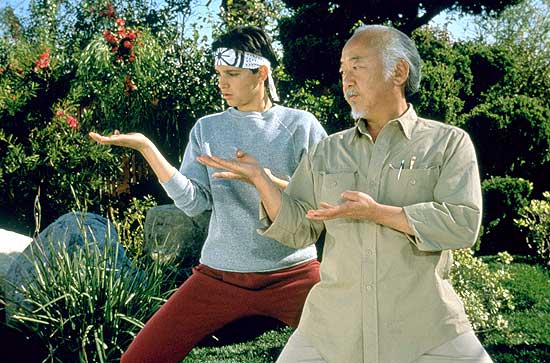
Any subject matter can be done well. In the case for “The Karate Kid,” it’s an underdog story that is done very well. This movie could be considered as a “younger Rocky,” since it’s from the same director—John G. Alvidsen—and has the same basic premise of a character—younger this time—preparing for a big fight at the end. But it’s not fair to make that comparison because this movie stands out on its own. This is a much better film than you’d expect when you hear the title of the film—it’s touching, fun, well-acted, and well-made.

Ralph Macchio plays the protagonist—sixteen-year-old Daniel Larusso. He and his mother (Randee Heller) move from Newark, New Jersey to Reseda, California and Daniel isn’t as excited as his mother. (“This is the end of the line,” the mother says as they arrive at their new home. “You’re tellin’ me,” Daniel sullenly says under his breath.) Then he meets a beautiful blonde girl named Ali (Elisabeth Shue) and they hit it off nicely. But that angers her ex-boyfriend Johnny (William Zabka), a blond hunky jerk with a black belt in karate. He beats the stuffing out of Daniel, who tries to fight back but he’s only studied karate at the YMCA in Jersey; this kid is from Southern California and takes karate at the dojo near the drug store.

Daniel is menaced and beaten more and more as days go by—he considers checking out the karate place, but the problem is the instructor is a sadistic Army vet who believes in “no mercy.” Daniel is amazed to discover that Mr. Miyagi (Pat Morita), the Japanese handyman at the apartment building he lives in, knows a great deal about karate as he takes down Johnny and the bullies one night. Mr. Miyagi offers to teach Daniel karate in preparation for a karate tournament, in which Daniel must beat Johnny and the other Cobra Kai students in order to gain respect. His methods are not promising—Miyagi has Daniel wash his car, paint the fence, paint the house, and sand the deck. Daniel thinks he’s doing manual labor, but it turns out there’s a method here.

This is great—it’s smart writing here. And while Miyagi still teaches Daniel karate, there’s a nice friendship between the two. It seems fresh and original—this is a wonderful student/teacher relationship. They understand each other and feel like they’re each other’s best friends in quite a while. Actually, there are more relationships within characters and they all work fine. The romance between Daniel and Ali is nicely handled and then there’s the relationship between Daniel and his mother. All of these relationships are credibly handled and acted. There hardly seems to be a moment of acting. It all seems natural.

And that’s a wonderful thing about this movie—the filmmakers know what to do to make a movie with martial arts as a central theme. They think of the story and characters before they think of the martial arts. Too many kung-fu or karate movies would care less—not “The Karate Kid.”

Ralph Macchio is a natural actor and extremely likable as Daniel. He has a wit, but knows when to shut up and pay attention. He’s nervous, but good at hiding it. That makes him a likable main character to follow. Pat Morita is wonderful as Mr. Miyagi. In reality, Morita is a Japanese-American, but in the movie, he plays a different person (of course, that’s acting) by playing a Japanese import with a struggle for English. On top of that, the character is a true original—a breath of fresh air for the “wise old man” character. He has a sense of humor and knows a convincing lot about karate, but he also has his tragic past to try and forget. Morita is great here. The supporting cast is strong as well. Elisabeth Shue is beautiful, sweet, and likable. Randee Heller portrays a tough mom character, enthusiastic and with a street-smart personality. William Zabka is suitably slimy. And then there’s Martin Kove as the psycho karate instructor—“ruthless” is an understatement description of his character. He makes this character so villainous that it’s so over-the-top…but it’s so darn memorable and fun to watch.

Just like “Rocky,” “The Karate Kid” ends with a fight climax, in which Daniel must finally fight the bullies after learning everything he was taught by Mr. Miyagi and putting it to use. These fight climaxes seem almost obligatory, but this one is well-handled and it actually means something because we feel like we know the characters and buy into their relationships with each other. The heart is with “The Karate Kid’s” story and characters, and unlike most underdog stories, it’s about something.

Full Metal Jacket (1987)

8 Feb

images

Smith’s Verdict: ****

Reviewed by Tanner Smith

The opening sequence of Stanley Kubrick’s war film “Full Metal Jacket” features young Army recruits getting their heads shaven in time for training camp. The expressions on each of their faces represent misery…but they haven’t experienced anything yet.

That’s one of many amazing, complex touches added to this story set during the Vietnam War. It’s the story of the descent into madness that war can bring. “Full Metal Jacket” is not a warm, heavy-handed movie about the Vietnam War, but a traumatic, blunt tale about war itself.

But what more could you expect with this kind of complexity from the great director Stanley Kubrick? This is a director who goes out of his way to make sure not one shot rings false or forced, to the extent of filming more takes than any other director (or actors to be directed) could imagine. Kubrick makes sure to capture every little detail on screen, positioning the cameras right where he needs them so we can feel what he captures.

Kubrick’s favorite close-up shot to use in each of his movies—a character has his chin down, but his eyes straight up at the camera. In “Full Metal Jacket,” that close-up is focused on Pvt. Leonard “Gomer Pyle” Lawrence, a chubby misfit who is the subject of humiliation at basic training on Parris Island and is about to be pushed over the edge.

Kubrick’s favorite camera movement—the Steadycam. This comes in handy almost throughout the entire movie, particularly in sequences that feature the drill sergeant on Parris Island instructing the marine grunts, and sequences in the final half that feature heavy war action in Vietnam.

Those are all essential to the tension that “Full Metal Jacket” brings—first to training camp, then to war.

The first 45 minutes of “Full Metal Jacket” are just brilliant, as we see the marine grunts undergoing basic training. Sometimes, it’s funny, but it’s mostly brutal, mainly because of the grunts’ instructor (R. Lee Ermey) making their lives hell when not giving speeches about the great Marine marksmen, which include Lee Harvey Oswald. Especially vulnerable is “Pvt. Pyle” (Vince D’Onofrio) who starts out as a complete loser not cut out for all of this. I’ll never forget the unbroken shot in which the other men thrash the poor guy at night in bed. That pummeling opens his eyes to what’s around him and causes him to slowly but surely give in to the madness.

That’s the first half of “Full Metal Jacket” and it’s pure Kubrick—irony, harshness, terror, and art. It’s so good that it comes close to overshadowing the rest of the movie, which takes place in Vietnam, following another Marine nicknamed “Pvt. Joker” who was the squad leader on Parris Island. Now he’s a journalist who doesn’t take the War seriously (he wears a peace symbol while wearing a hat that has “BORN TO KILL” written on it). Joker goes out into the wild to do a story on a platoon, just to relieve himself from boredom in De Nang, and gets more than he expected.

But even the second half is well put together and pretty strong. It’s also where “Full Metal Jacket” comes full circle—from basic training to real warfare. It shows how war affects these characters and in a key scene, we see the startled but joyful nature of these soldiers.

The Vietnam sequences were shot on stages and outdoor sets in England, and they look so realistic that, with the cinematography and no-nonsense acting, it feels like a documentary is being shot instead of a war narrative (that’s even more convincing when a news camera crew comes in to interview the soldiers—“We’re getting killed for these people, and they don’t even appreciate it. They think it’s a big joke,” one of them declares). This is one of the best-looking war movies I’ve ever seen.

The acting is excellent, particularly from Vince D’Onofrio and R. Lee Ermey in the first half of the movie. Matthew Modine, as Joker, takes a little getting used to, with the constant joking despite knowing where he is. But as the movie progresses, he does become more of a character than a “joker” and Modine shows how surprisingly solid he is at playing him. The other actors—which include Adam Baldwin, Arliss Howard, Dorian Harewood, and Kevyn Major Howard—seem so real, they help make the movie feel like a documentary. Kubrick has directed them well, as he always does (though I can imagine the hard work they must have been put through).

“Full Metal Jacket” makes Oliver Stone’s war drama “Platoon” look like a bedtime story. While that film was about embracing the soldier within, this film digs deeper into the terrors of the Vietnam War and the insanity that was brought about. It’s a harrowing, tensely-built story that is not for the faint of heart.

Say Anything (1989)

8 Feb

say-anything-1040cs022412

Smith’s Verdict: ****

Reviewed by Tanner Smith

In the 1980s, movies featuring teenagers were just as popular then as they are now. But they were very rarely given a good name. There would be sleazy teenage sex movies and deplorable slasher movies. Every once in a while in the ‘80s, there would be welcome exceptions—teen movies that feature solid writing and good development for their teenage characters, like “Lucas,” “Tex,” “Risky Business,” “The Breakfast Club,” and “Permanent Record,” among others. Then near the decade’s end, “Say Anything” came along and made itself known as what is not only a great teen romance movie, but possibly the best of its kind. It’s treated intelligently with well-developed, likable characters, credible situations, and well-drawn relationships that are emotionally involving. At times it’s funny, other times time it’s touching, and mostly it’s engaging.

“Say Anything” stars John Cusack as Lloyd Dobler, a recent high school graduate. Lloyd has no future plans as of yet, because there’s nothing out there that catches his interests except kickboxing. He tells one of his teachers that he’s looking for “something great, you know—a dare-to-be-great situation.” He’s a real optimistic guy and has his hopes up when he decides to ask out the class valedictorian Diane Court, said to be “a brain trapped in the body of a game show hostess.” True, Diane Court (Ione Skye) is very smart and very beautiful, and most people wouldn’t see her and average Lloyd together. But Lloyd gives it a shot and calls her up—I love the bit in which Lloyd dials her phone number and checks himself in the mirror before pressing the last digit.

At first, Diane doesn’t answer the phone—her father (John Mahoney) does. Lloyd asks him to have her call him when she gets a chance, and his tone of voice gives the assumption that Lloyd isn’t the only guy that’s called for Diane. “Is this the guy with the Mustang,” he asks. “Why don’t you just leave a message—that’s usually how it works,” he says. Lloyd repeatedly tells him his phone number. Then he hangs up the phone, shrugs it off, and quickly goes back to reading his magazine. But Diane does call Lloyd back and Lloyd asks her to a graduation party. At first, Diane tries to let it down easy, but changes her mind when Lloyd makes her laugh.

Diane is someone who needed a good laugh, as a lot of things are going on in her life. As she confides with her caring father, she’s scared for her future even though things seem to be going great for her. Really, her father is more excited for her than she is. What she needs is someone outside of her father to socialize with. She realized while making her valedictorian speech that no one at school actually knew her—they knew of her. She wishes she didn’t take any summer school courses. And so, when Diane agrees to go to the party with Lloyd, she’s able to finally mingle with her peers. And not only that—even though she and Lloyd have very little in common, she finds that she genuinely likes him.

The relationship between Lloyd and Diane is sweet and believable, but another key relationship is between Diane and her father James. It’s a trusting, confiding relationship between the two; Diane feels she can say anything to him. But when Diane wins a scholarship at a school in England, James is more excited for it than Diane is. Diane is scared for the future, but the father just wants her to deal with it. Then, Lloyd comes along and as their relationship grows, the father becomes skeptical since Lloyd has no real plans for the future except “to spend as much time as possible with your daughter.”

James is written with more intelligence than one would expect from a parent in a teen movie. He has his own problems too, and there’s a pivotal subplot involving a pair of tax collectors that turns his world upside-down. Mostly though, he’s Diane’s confidant. And he tries to keep his daughter close to him as they usually are, but the screenplay doesn’t turn him into a device to try and keep Lloyd and Diane apart. (Though, there is a time when they do separate, but for believable reasons.) And when he does get angry, he respects his daughter enough to listen to what she has to say, leading to one of the best scenes in the movie, as Diane tells James what happened between her and Lloyd on one of their dates. The scene cut away from when it looked like Lloyd and Diane were about to have sex, right to when Diane comes home the next morning—the way she describes to her father what exactly happened is a smart, well-written moment. It’s very rare in a teen movie that a teenager has this kind of relationship with his or her parent(s).

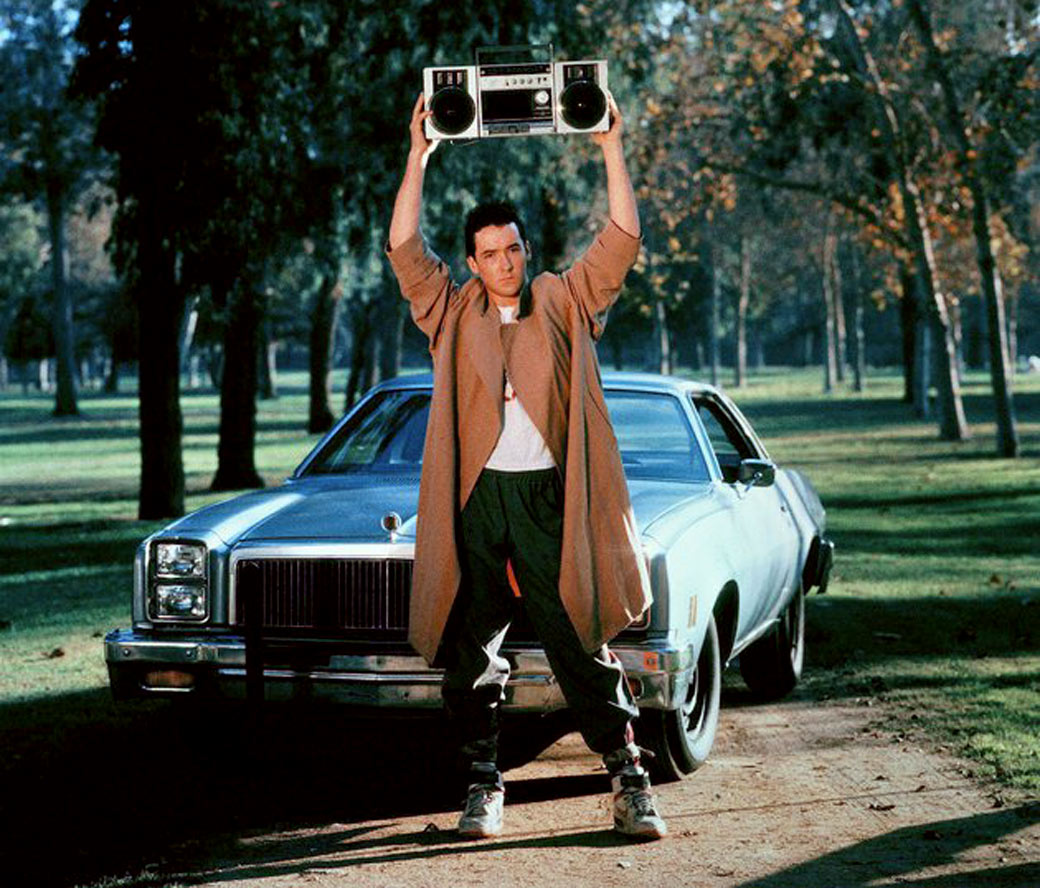
This is a great screenplay by Cameron Crowe (who also directed the film). All three central characters—Lloyd, Diane, and James—are well drawn out and easily identifiable. Every one of their situations seems believable, thus making it all effective. Aside from the great scenes I mentioned before, there are many other great ones—Diane’s amusing first talk with Lloyd, Lloyd’s best friend Corey (Lili Taylor) using her guitar at a party to get over a breakup, Lloyd meeting up with some guys at a gas station after he and Diane break up (they think they know a lot about women, even though they hang out with each other on Saturday night), and who could forget the later scene featuring Lloyd as he stands in front of Diane’s house and holds a boombox over his head, playing Peter Gabriel’s “In Your Eyes” in an attempt to win Diane’s heart again.

I love this exchange between Lloyd and Diane when Lloyd takes Diane home the morning after their first date. Diane says she’ll call him tomorrow. Lloyd: Today is tomorrow. (beat) Diane: I’ll call you later, then.

John Cusack is perfectly cast as Lloyd Dobler. He’s immediately likable and so sincere in his performance that it’s so hard not to feel for him. He has a great deal of optimism, humanity, and self-respect to believe that he deserves the prettiest and smartest girl in the class, and we’re hoping for the best. (There’s no surprise that the film’s poster features the tagline, “To know Lloyd Dobler is to love him.”) Ione Skye is wonderful and totally convincing as Diane Court—a better performance than her role in the 1987 teen drama “River’s Edge.” Both actors share great chemistry together. John Mahoney does great work, making James into a three-dimensional father character. Llil Taylor and Amy Brooks as Lloyd’s friends, and Joan Cusack as Lloyd’s older sister whom he lives with, fill supporting roles effectively.

“Say Anything” is such a treasure. It’s very human, very believable, always pleasant, extremely-well-written, and wonderfully-acted. It features a teen romance, but to be honest, it’s not necessarily a “teen movie.” This is a movie for all people—it’s a movie about relationships and trust. It doesn’t condescend to romantic comedy clichés—it tells it like it is. The result is a wonderful movie that I can’t imagine anyone not enjoying.

The Impossible (2012)

7 Feb

the-impossible_2012-4-1200x800

Smith’s Verdict: ****

Reviewed by Tanner Smith

Knowing what “The Impossible” was about, a feeling of nervousness overwhelmed me and yet a feeling of fascination followed it. The fascination came from the notion that this movie would set up many things that would pay off later after a harrowing journey. The first few minutes feature the central characters—a family of five—enjoying their vacation time at a resort beach in Thailand. They’re solidly developed and feel like a real loving family. But then when there’s a shot of the family looking at the peaceful-looking beach at sunset, a feeling of horror took hold of me because I knew that this was to be a huge amount of irony for what will happen very soon. And surely enough, the next day, they’re enjoying the day after Christmas; the kids are playing in the pool with their father; the mother is reading a book on a beach chair. And then there’s an ominous wind…

Describing it like that would make “The Impossible” seem like a clichéd disaster movie, but there’s something about the way director Juan Antonio Bayona sees these scenes that make them convincing and unnerving. The audience is seeing this movie because of what is going to happen to them and for them, and thus seeing these opening scenes play themselves out as peacefully as possible works in the film’s advantage as an element of suspense.

“The Impossible” tells the story of this family as they endure one of the worst natural disasters in the world—the 2004 tsunami that devastated the Pacific Basin. You would think after Clint Eastwood’s 2010 film “Hereafter,” there couldn’t be another film to portray the outcome of its survivors. Well, “Hereafter” relied on a character’s psychic connection as a need for redemption in that case. Here, it’s pure hope—hope that all your close friends and family members are still alive after a disaster that claimed the lives of millions. That’s the case here, with this central family in “The Impossible.” They’re based on a real family—though their nationality has been changed from Spanish to British for international appeal. This is the story of how they were separated from each other and struggled to survive in the catastrophe’s aftermath to be reunited.

But first, a word about the tsunami sequence. My mouth was open the entire time at how phenomenally brilliant the special effects were, and how masterful the scene was executed. I could barely breathe—you read that right; I could barely breathe. I felt like I was there with the characters just struggling to stay afloat as the water rushed through the village. This was a brilliantly-executed sequence—one of the most terrifying disaster scenes I’ve ever experienced in a movie theater.

Maria Bennett (Naomi Watts) and her oldest son, 12-year-old Lucas (Tom Holland), are separated from Henry Bennett (Ewan McGregor) and the two younger sons, Simon and Thomas (Oaklee Pendergast and Samuel Joslin), as they struggle through the aftermath (floodwaters and mud) to seek help.

A good portion of the movie is seen through the eyes of young Lucas, who has to learn to grow up fast. His mother is badly injured with punctures to her right leg and chest, and so he must help her to keep going. But he also feels the worst for his father and two little brothers, so his mother has to keep hope alive for him. Lucas and Maria do find refuge at a hospital, where many of the tsunami survivors are being treated. It’s then that Lucas is asked to seek patients’ family members who may be around the hospital somewhere. And it’s here that hope comes for Lucas—if they’re alive, then maybe his father and brothers are too. This makes “The Impossible” an effective coming-of-age tale as well as an effective disaster movie.

Extreme devastation; a paradise turned into a wasteland; many people dead; separation from loved ones; not knowing who’s dead or alive. All of these elements are ongoing in “The Impossible” and they’re all powerfully portrayed. The fear and despair that come with these characters are existent. You really get a sense of what they’re all going through, and sincerely hope for the best (although, those who know the true story of this family already know the outcome).

The performances from the principal actors are spot-on. Naomi Watts has the most physically-challenging role, since her character is mostly confined to a hospital bed as she’s in critical condition. Her Oscar nomination for her work is well-deserved. Ewan McGregor, as her husband, is powerful as well. Of the three child actors, Tom Holland, as Lucas, is just brilliant in his feature debut. He has Lucas’ emotions down to a T and delivers the complexity of a little kid looking to live through this crazy situation.

I don’t want to say too much about “The Impossible,” especially for the sake of those who don’t know the story of this family. I didn’t know, when I saw this movie. I think the less you know, the more emotionally involved you are with the story’s execution. From the beginning to the middle to the end, I was absorbed by “The Impossible.” If you’re looking for a disaster movie in the style of Michael Bay or Roland Emmerich, then just keep looking. “The Impossible” is not escapist entertainment. It’s much more complicated than that.

The Outsiders: The Complete Novel

7 Feb

Curtis_Brothers_Talking

Smith’s Verdict: ****

Reviewed by Tanner Smith

I gave 1983’s “The Outsiders” a negative but affectionate review, saying that it needs more material to be a better movie. Well, fans of the movie, who were also fans of the novel it was based on, wrote many letters to the director Francis Ford Coppola and they all asked the same question as to why the film wasn’t more like the book. And now, in 2005, there is a much better version of “The Outsiders” with twenty minutes of deleted scenes. It’s called “The Outsiders: The Complete Novel” because it covers more of the original novel. It also makes the story more clear, gives room for the characters to develop, and gives the thought of why in the world didn’t Warner Bros. release this film in the first place?

I love this movie. It reminds me so much of why I love reading the book in the first place. It’s touching, powerful, and a much better film than its original cut. I am even going to give it four stars. I think it deserves that rating.

In a never-before-seen opening scene, the hero Ponyboy Curtis, a fourteen-year-old greaser who lives on the wrong side of the tracks, is jumped by the socs, a gang of rowdy rich kids from the other side of town. His older brothers and buddies come to his rescue. This is great—we are given proper introductions to all of the “greaser” characters and we get a sense of the relationship between Ponyboy (C. Thomas Howell) and his brothers Darrel and Sodapop (Patrick Swayze and Rob Lowe). With other additional footage, the characters are given room to develop into people we care about. One character in particular who given special treatment is Sodapop. His added scenes—especially one in which he breaks down at the end—remind us that Rob Lowe is a very good actor for dramatic situations, not just deadpan comic effect.

Ponyboy and his buddies—tough, mean Dallas (Matt Dillon) and scared, sensitive Johnny Cade (Ralph Macchio)—are hunting for action one night at the local drive-in. While there, Dallas tries, very rudely, to pick up a soc girl named Cherry Valance (Diane Lane). She tells him to go away and then she unexpectedly picks up Ponyboy and Johnny, knowing very well who they are (she tells them, “I’ve met people like Dallas Winston; you two don’t look mean”). Her friend Marcia is picked up by Ponyboy and Johnny’s friend Two Bit (Emilio Estevez), the jokester of the greasers who loves Mickey Mouse cartoons. But soon, there’s trouble. The girls’ boyfriends spot them with the greasers which leads to them hunting Ponyboy and Johnny, finding them alone later that night. While drunk, they come very close to drowning Ponyboy in a fountain and one of them—Cherry’s boyfriend Bob (Leif Garrett)—is murdered by Johnny. This leads to Ponyboy and Johnny being aided by Dallas to figure out what to do about this situation. They hide out in a church for a week, then they become heroes for saving children in a fire, then they return home to resolve issues with the socs.

There are more touches to this director’s cut that really make this film special. The story is better developed, the characters are more complex, and that music from the original film is gone—thank God (I hated that music in the first place). This is a much more faithful adaptation to the beloved book by S.E. Hinton.

Watching this new cut, it’s fun to see all of these actors before they made their big career moves. Matt Dillon is fantastic as Dallas, the rebel without a cause—it’s fun seeing him here and in “Tex” and “Rumble Fish” (all of which were film adaptations of S.E. Hinton novels) as this tough teenager with a lot to do and say. Ralph Macchio (yes, the Karate Kid) is very good as Johnny—he’s just that kid you want to see good things happen to, despite his murderous deed. Patrick Swayze, Rob Lowe, Diane Lane, Emilio Estevez, and Tom Cruise (yes, Tom Cruise) are all great in their roles. What really surprised me was that C. Thomas Howell, playing the narrator of the film, didn’t go on to bigger and better things like his co-stars. Howell is wonderful here—he gives a convincing, complicated performance as this nice, scared kid who is smart and thoughtful. Since this movie, he’s played pretty much the same character until his career bomb, “Soul Man,” in 1986.

“The Outsiders: The Complete Novel” is a much better film than Warner Bros. thought it to be in 1983 and I loved it.

50/50 (2011)

7 Feb

50-50-movie-images-seth-rogen-joseph-gordon-levitt-01

Smith’s Verdict: ****

Reviewed by Tanner Smith

When a movie is made in which cancer is the central conflict, it’s so easy to go overboard with the movie’s dramatic elements. And it’s hard to feel anything for the cancer patient when the movie is trying so hard to make the audience weep that it just becomes corny. But “50/50” managed to beat that problem and is, in my opinion, one of the very best films of 2011.

The film stars Joseph Gordon-Levitt as a young man named Adam Lerner who learns that he has a rare form of spinal cancer and the chances for survival are 50/50. He feels his life turning upside down, as he didn’t expect to be expected to die so young. He breaks the news to the people in his life, who react in different ways. He first tells his girlfriend Rachael (Bryce Dallas Howard), who guarantees to stand by him and look out for him. Then he tells Kyle (Seth Rogen), his vulgar but loyal best friend who wants to keep Adam’s spirits up even though sometimes he can go too far when it comes to parties. And then he tells his mother (Angelica Huston), who constantly calls to check on him and already has to care for her husband who has Alzheimer’s disease.

During chemotherapy, he befriends two other cancer patients (Philip Baker Hall and Matt Frewer) who are constantly stoned with medical marijuana and “weed macaroons.” He also gets a therapist—a pretty, naïve, innocent 24-year-old named Katherine (Anna Kendrick) whose new patient is her third.

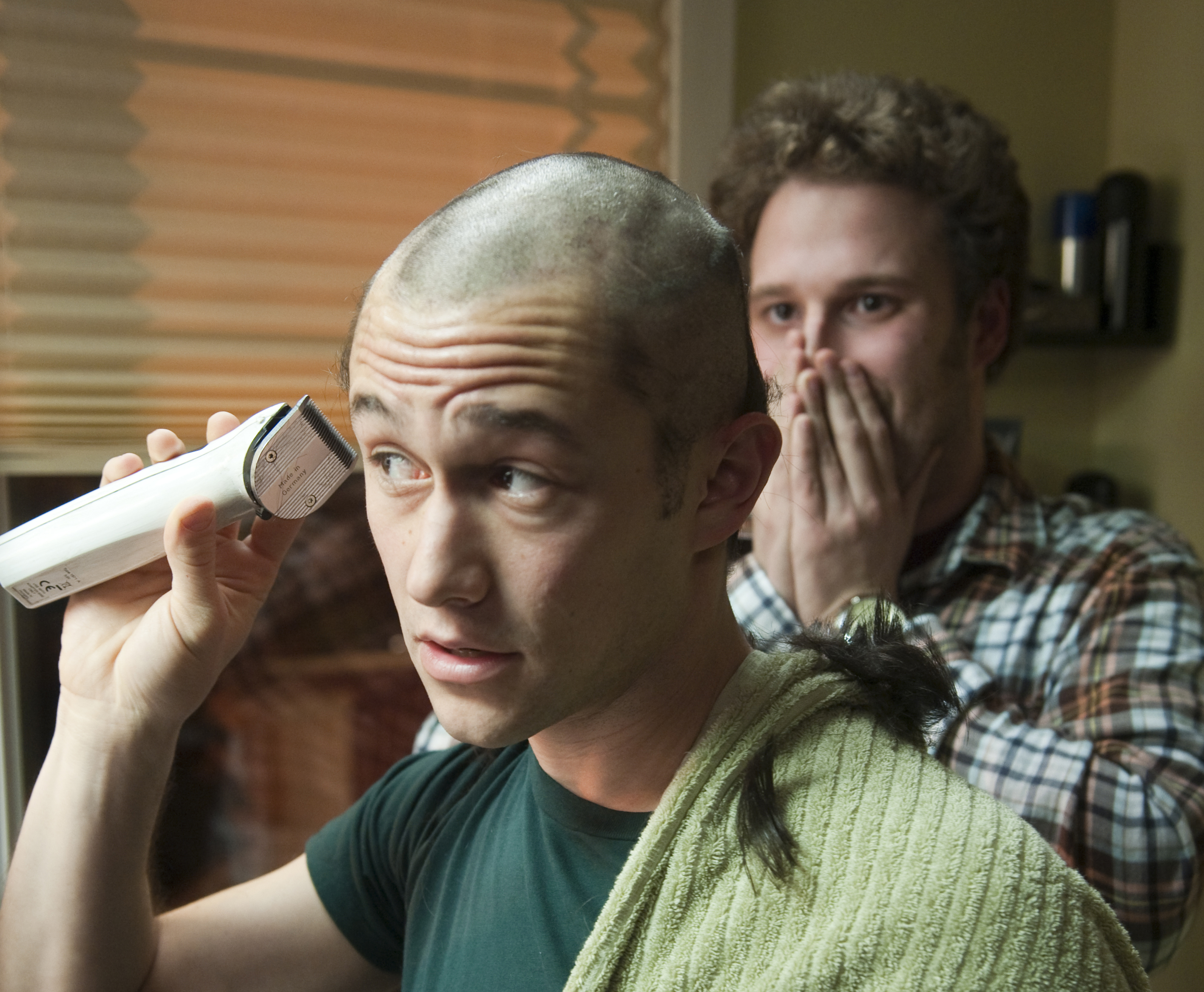
The screenplay for “50/50” by Will Reiser, a comedy writer, is loosely based on his life, as he had spinal cancer like the main character of this movie. Mostly, he writes from past experience about dealing with this disease, and delivers well-written scenes that feature how Adam deals with his cancer and how his friends react around him. But more importantly, he adds another key ingredient to making “50/50” work—comic relief. Observe the naïve behavior of the Kendrick character in her first scene, and then keep watching and listening to the dialogue in the following scenes that feature her. They’re both funny and endearing. And then there’s the improvised-in-character scene as Adam shaves his head as Kyle watches in confusion and something close to fright. And then you have Seth Rogen, who specializes in playing the goofy, profane, vulgar best friend in many other movies. Rogen is Reiser’s friend in reality and his role is essentially based on how he dealt with his friend’s cancer. Reiser and Rogen take Rogen’s usual characteristics that people have seen in other movies and just when you think it’s starting to wear thin on us, the story moves on to something else for a while before coming back to him. Don’t get me wrong—Rogen is pretty funny in most of his scenes, but when a lot of other situations in the movie are to be taken seriously, only sometimes he seems out of place. But then, Rogen’s character becomes even more endearing when we get to his payoff in the final act of the story. It’s handled in a very effective way. The drama and comedy in “50/50” blend wonderfully.

The actors in “50/50” are all wonderful as well. Joseph Gordon-Levitt, one of the best young actors in recent memory (he was also fantastic in 2009’s “(500) Days of Summer”), as Adam is so winning and endearing that when the time came for his final surgery, I was almost as worried about what his outcome would be as he and his family and friends were. There’s one scene in particular that is just heartbreaking—it’s when he finally snaps and lets out all of his anger on the night before his surgery. I sure hope he gets an Oscar nomination for this performance. Seth Rogen, like I said, is more than a smartass best friend. Angelica Huston avoids the cliché of overbearing mother and makes her character more three-dimensional than she starts out with when she hears the news. Philip Baker Hall and Matt Frewer steal their scenes together. And then there’s Anna Kendrick, the Oscar-nominated actress from “Up in the Air” and who was also in the “Twilight” movies. She always has a charming screen presence and makes her character likable, always. I will watch her in any movie, even if it’s just a brief appearance. Many reviews of this movie have complaints against the Bryce Dallas Howard character because of her actions as the movie progresses. I have no complaints because even if what she did was a wrong move, I believe she did learn her lesson and actually sympathetic towards her in her final scene.

With great acting and a great screenplay, “50/50” is a movie dealing with cancer in a touching but also funny way. It reminds us that when faced with a situation like this, there are only two ways to get through it—with tears or with amusement. This is one of the best films of 2011.

The Fly (1986)

6 Feb

images

Smith’s Verdict: ****

Reviewed by Tanner Smith

David Cronenberg’s “The Fly” is a perfect example of the “experiment-gone-wrong” movie. It’s when a mad scientist wants to create a device that will change the way humanity sees things and something goes terribly wrong, and the direst consequences occur. That’s always one of the enjoyable of stories to be told in movies, and “The Fly,” a re-imagination of the 1958 sci-fi thriller of the same name (but a different story), is one of the best. It’s one of those horror movies in which we get to know the characters first and know the important setups to the oncoming rules of the gimmicks, so that when the terror happens, it amounts to something.

It begins as scientist Seth Brundle (Jeff Goldblum) meets a pretty journalist named Veronica (Geena Davis) and wants to impress her. So he puts it bluntly, starting out by saying that he has an invention that will change the world as we know it. Being a curious mind, Veronica accompanies Seth to his home. Seth wastes no time in impressing her—he shows her a pair of “telepods” connected together by cable and run by computer. He explains to Veronica that it’s a sort of “teleportation” device, which can move something from one telepod to another. It works great on items, such as a stocking that’s used as a test…but it turns living things inside out. (There’s a really gruesome scene in which Seth tests the machine on a baboon, and we actually see the outcome.)

One of the interesting elements of “The Fly” is that the science seems believable. That’s rare for a movie like this—usually, you roll your eyes at the very idea of certain experiments. But not here—I believed in this experiment, whether it could work or not.

Anyway, Seth figures out the problem with the invention, tests it another baboon with success, and then finally decides to try it on himself. However, something unexpected happens during the process. A housefly has made its way into the telepod with Seth and he makes it out, but with certain side effects. He suddenly has a great amount of energy and increased strength. However, that’s just the beginning and it may seem positive…but things are about to get a whole lot worse.

Seth is no longer Seth. He’s slowly but surely turning into a man-sized fly—or “Brundlefly,” as he describes himself. Ugliness starts to emerge and, thanks to first-rate makeup and effects, only looks worse and worse every time we see him again. Also, Seth’s nature is reversed, letting the menacing insect side take over what little of Seth is left. What’s Veronica to do? She wants to help him, but she’s ultimately powerless to do anything for him.

Too many of these mad-scientist movies are focused on ideas, but not so much with characters. Of course, there are exceptions, like “Frankenstein.” Now, here’s “The Fly,” in which we get to know and care for the two central characters played by Jeff Goldblum and Geena Davis. Goldblum’s Seth is a socially awkward but excited and likable character who gets his enthusiasm from his continuing experiment and his relationship with Davis’ Veronica, a curious reporter who gets way more than she bargained for. Goldblum gets lost in the role—it has to do with the way his eyes get wider whenever he gets excited or when he casually tries to explain certain elements of this new experiment. He plays it like he sees it. The result is a powerful performance. Davis is very good too, and she and Goldblum show great chemistry together.

The character development and interaction is arguably the most important aspect of “The Fly.” We care about these people, we fear for them, and we hope that somehow things will turn out all right for them. There’s a particularly strong scene in which we see Seth probably as bad as he’ll get before his human side is completely gone—the line “I’ll hurt you if you stay” (Seth saying it to Veronica) is chilling because of everything that led up to it.

The makeup and creature effects, created by Chris Walas, are horrifyingly excellent. I mentioned that Seth looks worse and worse every time we see him again, and I wasn’t exaggerating. The work done on making Jeff Goldblum look nearly human before transforming into a horrific insect-beast is consistently effective—creepy and sometimes even hard to watch, but remember, this isn’t a geek-show. The effects don’t make the movie—they’re there to serve the story.

There are troubling scenes in “The Fly,” but it’s a great film with terror that actually amounts to something with two well-developed, likable characters to feel for. And for people out there who search for new ways of changing the world as we know it, just be sure you know what you’re doing.

Oh yeah, I almost forgot—Be afraid. Be very afraid.

Running on Empty (1988)

5 Feb

MSDRUON EC021

Smith’s Verdict: ****

Reviewed by Tanner Smith

Children, and even teenagers, sometimes feel like they’re being punished for crimes they didn’t commit. In the case of Danny Pope, they don’t know the half of it. Here’s this kid who has not only moved from place to place, but also changed his entire identity countless times, along with his family. He’s living in a world of secrets and hiding. He can pretend to lead a normal life, every time he moves to a different place and engages a new identity, but he never truly will. And it’s all because of his parents.

Danny has kept an enormous secret with the family. Before he was even born, his parents were radicals in the ‘60s. They blew up a napalm laboratory, nearing killing a janitor whom they didn’t know would be there. Since then, they’ve been living underground, hiding from the authorities and raising Danny and his younger brother to their same lifestyle. Every time it seems like their identities are discovered, the Pope family moves away to create new ones.

The Pope family are the central characters in the film “Running on Empty” and it tells the story of how Danny (River Phoenix), now a high school senior, would love to live a normal life, for once. He’s a gifted piano player and has finally shown his gift in this new town to his music teacher at school. With the teacher’s help, Danny gets a scholarship to the Juilliard School. But he can’t accept it, because then he would have to abandon his lifestyle and leave the family.

For Danny, this is his chance to actually become an individual. Why must he pay his parents’ mistakes? Why shouldn’t he go out and live his own life, now that he’s turning 18? For his parents, it’s a real complication. His father Arthur Pope (Judd Hirsch) is a real hard-ass who has kept the family in line for years and is not about to mess it up now. He either doesn’t understand Danny’s plight, or simply doesn’t want to understand. Then, there’s the mother Annie Pope (Christine Lahti), who has made her mistakes and barely regrets them because she did what she felt she had to do, back in the time when radical politics were hers and Arthur’s lifestyle along with others in the ‘60s. What she does care about, and what causes her heart to break, is the fact that Danny would be sacrificing his future if he stays hidden, paying for mistakes that she made. She doesn’t know if she can handle it. The big issue is that if Danny comes clean and goes to college, he can’t see his family again because he may just have the FBI following his every move—who knows?

This is all powerfully well-done and very effective in the way this family’s lives are developed and how their plight is legitimately told. We see it right away in an opening scene in which the family must leave another town—they leave their dog on the side of the road and drive away, and it feels like this isn’t the first time they’ve done this. Then there’s the situation of Danny gaining more than he did in previous lives—not only with his music and the college scholarship, but also with his first girlfriend (Martha Plimpton). She’s the daughter of the music teacher and together, they form a trusting relationship in which there are hardly any secrets, leading to the scene in which Danny finally confesses and tells her everything she wanted to know about him—how it begins: “My name isn’t Michael…It’s Danny.”

The emotional high point of the film comes during the question of whether Danny will go to the school. The film’s strongest scene features Annie arranging to meet her father (Steven Hill) for lunch—she hasn’t seen her father for years, since she disappeared from his life completely. Now she must ask him to take her son away from her so that he can live the future that she has denied herself. It’s a very heartbreaking scene.

“Running on Empty” is an extremely moving drama about choices and about consequences. It’s well-acted, especially by Christine Lahti and River Phoenix (who, despite his character’s story being told, was only given a Best Supporting Actor nomination), and well-executed, with direction by Sidney Lumet and a great screenplay by Naomi Foner. This easily could have been a throwaway melodrama made for TV, but it’s smarter than that. It’s played in a realistic way and is specific in exactly what it’s trying to convey. It’s a great film.

On Golden Pond (1981)

4 Feb

images

Smith’s Verdict: ****

Reviewed by Tanner Smith

SPOILERS THROUGHOUT REVIEW

“On Golden Pond” is a collection of brilliant short segments that wraps around at the end so that the film has a linear story structure. It has a story with a beginning, middle, and end, but even between them, if it’s possible, the story has its own wraparound with the two central characters—an elderly couple who love each other to death.

The couple is Norman and Ethyl Thayer (Henry Fonda and Katharine Hepburn). They’re long-married and still share strong simple affection for each other. But Norman is feeling like he’s getting older and it seems that she’s the only thing in his life that matters anymore. That’s good enough for him, since he gripes about everything else.

Anyway, as the story opens, Norman and Ethyl arrive to their lakeside summer cottage near Golden Pond. It’s here that we see Ethyl’s free-spiritedness that apparently stays with age, and Norman’s shyness and stubbornness towards pretty much everything, even Ethyl. He knows he’s getting older and we suspect that he doesn’t see what one more summer at this old place will do to him anymore. But Ethyl assures him that he’s her “knight in shining armor” and will always be.

That’s the opening segment of the film, which could make for a short film of its own. By the time it gets to that pivotal scene, we feel like these two characters have been developed and we like them almost as much as they like each other. But this is just the setup for the real story, which begins as Normal and Ethyl’s grown-up daughter Chelsea (Henry Fonda’s real-life daughter, Jane Fonda) arrives to the cottage to celebrate Norman’s birthday. She brings along her new boyfriend Bill (Dabney Coleman) and his thirteen-year-old son Billy (Doug McKeon). And this is where the conflicts are established. We discover that Chelsea feels resentment towards her father, as Norman has never really given Chelsea her due. It’s as if he really wanted a son to bond with, or he just never really understood how to be a father.

The midway point arrives as Norman and Ethyl agree to let young Billy stay with them while Chelsea and Bill take a trip to Europe. Of course, with no TV and no “chicks” to “cruise” (he’s from San Francisco, where he and his friends “cruise chicks”), the kid acts like a brat. But with some pushing from Ethyl, Norman takes the kid fishing, and the two develop a sort-of father/son relationship together. They bond together, share communication, and trust each other. Later, Norman has learned how to be a father.

By the time Chelsea returns to pick up Billy, she notices the friendship between her father and her new stepson (she married Bill in Brussels, as it turns out), and is even more resentful because Billy is having the relationship with Norman that she never had. But maybe there’s still time for reconciliation.

When Norman and Ethyl are alone again at the cottage, the story ends with the payoff of Norman’s realized mortality. Even though it’s predictable, it’s touching nonetheless. When “On Golden Pond” is over, we feel like we’ve spent time with warm, appealing characters in a peaceful place like Golden Pond. The emotions are there and you feel good about yourself while watching this film.

The performances are first-rate. Henry Fonda and Katherine Hepburn share amazing chemistry together and share distinct characteristics that make them memorable. A lot rides on these two veteran actors and there’s nothing short of greatness for them. Jane Fonda acquits herself nicely to the role of Chelsea, Dabney Coleman shares a great scene with Henry Fonda about asking permission to sleep in the same room as Jane (the questions and reactions are just fantastic), and Doug McKeon does more than expected with the plain role of the kid—he starts out as a bratty tyke, but becomes likeable as his coming-of-age story continues.

I heard that this is the only film featuring Henry and Jane Fonda together. Maybe some of the character Chelsea’s resentment is reflected from a possible, similar relationship between these two. Whatever the case, having this father and daughter together in the film just adds to its effect.

“On Golden Pond” deals honestly with its issues of relationships, resentment, realization, and mortality, while also showing that life can be beautiful, even if things don’t go as planned. With great acting, nicely staged scenery, and a darn good screenplay, “On Golden Pond” is a real treasure of a movie.