
Archive | Four Stars **** RSS feed for this section

Do the Right Thing (1989)

24 Feb

images

Smith’s Verdict: ****

Reviewed by Tanner Smith

Spike Lee is a director that tackles controversial subjects and brings them to independent films that go beyond the usual mainstream prospects. He loves to speak valuable issues through film and brings everything he can get to the screen—even if it’s light comedy to contrast the heavier material. Lee is a prominent voice in American cinema and his third film, “Do the Right Thing” (following “She’s Gotta Have It” and “School Daze”), was the one that made him known as the risky filmmaker with the eyes and the ears.

Oddly enough, “Do the Right Thing” is also the angriest and most aggressive of Lee’s films—showing racism head-on. He shows it like it is, rarely flinches at the subject at hand, and doesn’t resort to political correctness or sermons. He tells a story—he sets up the characters and allows set-up events to play out around them.

The film takes place in a 24-hour period in the Bedford-Stuyvesant area of Brooklyn, on the proclaimed hottest day of the summer. We meet many of the neighborhood locals as they go about their daily lives. Most of them meet at Sal’s Famous Pizzeria, which has been around for about 25 years. The owner Sal (Danny Aiello) has seemingly gotten used to working in a neighborhood mostly composed of African-Americans, and believes that whites and blacks can live together in harmony, though there are some hints of racism partially present. His two sons work with him—Pino (John Turturro) and Vito (Richard Edson). While Vito is easy-going and color-blind, Pino is a hot-headed racist who mostly uses vulgarities about the black customers that come in for pizza.

We also meet other characters such as—Sal’s pizza delivery boy Mookie (Spike Lee) who is hostile and bored, but responsive when he wants to be (there are times when he offers Vito advice not to listen to Pino all the time); Da Mayor (Ossie Davis), an old gentleman whom everyone else constantly ranks out because he’s constantly drunk; Mother Sister (Ruby Dee), the strict, self-proclaimed “high-and-mighty” elderly woman that Da Mayor tries to court; and Tina (Rosie Perez), Mookie’s girlfriend who cares for their toddler son Hector. Others start up the conflict of the story—particularly Mookie’s friend Buggin Out (Giancarlo Esposito) and mild-mannered, boombox-carrying giant Radio Raheem (Bill Nunn). Buggin Out notices that the pictures all over Sal’s pizzeria wall are all of Italian celebrities, and not one “brother,” and attempts to boycott the restaurant. He gets Radio Raheem to help him and this leads to a long day that ends with the occurrence of something alarming.

The film has just been a slice-of-life picture up until this final act, in which a fight occurs, a character dies, chaos ensues, and there’s a full-scale riot.

The title comes from a quote by Malcolm X—“You’ve got to do the right thing.” Let’s look at the facts here—Malcolm X is considered a leader and one of the greatest, most influential African-American leaders in history; a character named Smiley is going around trying to sell pictures of Malcolm X, as well as Martin Luther King, Jr.; and the film is centered around racial tension in the projects. I suppose we’d like to think that racism is toning down in our society, but as Spike Lee shows in “Do the Right Thing,” it’s always going to be present and it can sometimes spin things out of control. And it can be brought back to this simple statement—because of this, everyone in this movie fails to do the right thing. What is the right thing? Who does it? The way I see it, nobody does. That’s what makes it ironic and all the more credible and disturbing. We even have a character that we have come to like performing an action that makes the violent situation even worse than it already was. (By the way, props to that, because in a more mainstream movie, I bet someone we’ve come to hate would’ve done the exact same thing.)

This is what Lee sees and that’s what he brings to the screen, while having his own understanding of what’s happening. This film is not trying to offend races—it’s not anti-white, nor is it anti-black. It just shows how misunderstanding and racial tension would/could lead to violence.

The oddest thing about the movie is actually the most interesting—amongst the angry, aggressive tone that’s felt throughout the movie, the filmmaking is so lively. The camera focuses on many images, a rocking soundtrack is present in a lot of scenes (Public Enemy’s high-powered “Fight the Power” serves as the film’s anthem, especially in the opening-credit sequence, featuring a young woman dancing in the street), the colors stand out, and just a thrilling sense of entertainment. How can you describe a film like this? It’s so angry, so aggressive (sorry for repeating myself here), and yet so damn entertaining. Also, the performances each have a high power to them—particularly Danny Aiello, Ossie Davis, John Turturro, and Spike Lee himself (he’s actually a pretty good actor).

So maybe there isn’t a solution to the racism problem in society that we can find in “Do the Right Thing,” but there’s not supposed to be. What Lee is trying to do is bring the problem to realization, if it hasn’t been realized already. This is a film that’s trying to say something and throwing all it can to make you listen. That’s a film to be duly noted, in my opinion.
A Fish Called Wanda (1988)

24 Feb

142618__wanda_l

Smith’s Verdict: ****

Reviewed by Tanner Smith

“A Fish Called Wanda” is one of my favorite comedies—I think it’s one of the funniest, brash, offbeat movies I’ve ever seen, along with some of the Monty Python films. (Though, oddly enough, some of the Monty Python troupe takes part in this film, so there you go.) Every time I watch this movie, I laugh and laugh and laugh. But how often is it that among all the laughs and funny performances from the actors, there’s actually a highly imaginative story to go along with it? Then by definition, there’s a great movie here—good story, characters, actors, and of course, laughs.

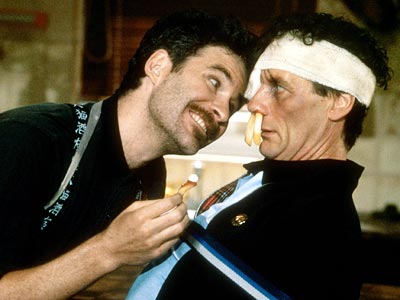
It’s a caper story set in England and centered around a band of jewelry store robbers, consisting of the ringleader/mastermind George (Tom Georgeson), his stuttering, animal-loving friend Ken (Michael Palin), and two American recruits—Wanda (Jamie Lee Curtis) and her psychotic and quite idiotic lover Otto (Kevin Kline). They pull off the heist, but Wanda and Otto make an anonymous tip to the police. George is arrested, but not before hiding the loot. So to let himself off somewhat easily, he suggests giving away the location of the jewels to his barrister Archie Leach (John Cleese), resulting in Wanda planning to seduce Archie.

Archie Leach is a mild-mannered lawyer living an unpleasant home life with his materialistic wife (Maria Aitken) and spoiled daughter. When Wanda comes into his life, it’s a more interesting case of romance and excitement, making things more complicated since Wanda was his client’s aide, and especially because Otto is a jealous man (whom Wanda tells Archie is his brother) who constantly spies on the two of them and also takes some extreme action.

These are wonderfully nutty characters in “A Fish Called Wanda” and the actors are more than game. Everyone in the cast has his/her moment to shine while the audience is laughing out loud. Comedian John Cleese, who also wrote the screenplay and is also a “Monty Python” alum, is at his best as Archie Leach, making an appealing, unlikely hero and giving some big laughs along the way. His reactions to many of the zany, bizarre situations are hilarious. Kevin Kline is excellent as Otto, a man so deranged that he doesn’t believe himself to be deranged. This is a guy who reads Nietzsche and thus thinks he’s so intelligent, even though he misreads his style. He’s so stupid that he thinks the London Underground is a political movement. There’s also a running joke in which he’ll repeat the memorable line “Don’t call me stupid” and then go to unforgettable conditions to those who do call him “stupid” (like swing somebody from a window!).

Jamie Lee Curtis is sexy and playful as Wanda. And then there’s Michael Palin, also from “Monty Python,” having a lot of fun as Ken, a stutterer with a love for animals, particularly his pet fish (one of which is named Wanda). He’s the one who has to do away with the old lady who was a witness to the heist getaway, but constantly (and accidentally) winds up killing off her little pet dogs instead.

If you had told me that I would love a movie in which three dogs are knocked off (one of which is pounded into the cement of the street), I wouldn’t have believed you. I guess anything can be funny or maybe I’m just sick. Or hopefully, I’m not sick, because I’m sure that you would laugh at that too. Bottom line: I laughed out loud.

Most of the humor in “A Fish Called Wanda” is the nuttiness involving these zany characters and the physical comedy that occurs during most of their circumstances. I can’t give a lot of the best gags away, because that would defeat the purpose of surprise. I won’t even describe them just to make the review funny. I think I’ve explained just about enough.

“A Fish Called Wanda” is one of the funniest movies I’ve ever seen—It’s original, inspired, gamely-acted, and…it’s just funny from beginning to end.

Pulp Fiction (1994)

23 Feb

pulp-fiction-originall

Smith’s Verdict: ****

Reviewed by Tanner Smith

Quentin Tarantino is a filmmaker who must truly love movies. And he obviously loves making them. It’s as if someone gave him a computer and a camera, and he started right away on a script and film, aching to make a movie (much like a kid that plays with his toys). You can definitely see in “Pulp Fiction,” which he co-wrote and directed, that he wanted to get every shot and every story detail just right to create a masterpiece.

Well, he definitely succeeded there. And if he hasn’t, then he definitely didn’t bore me with “Pulp Fiction,” a movie about…basically, everything from gore to violence to sex to drugs to whatever. Tarantino couldn’t possibly bore anybody with “Pulp Fiction”—he’s too gifted a filmmaker to do so. He does many complicated things with “Pulp Fiction” and it’s amazing how he’s able to pull them all off. This movie shows us one series of characters and situations, then another series, then another, and then it almost blends them all and the movie sort of doubles back on you before it’s over. These characters live in a world of crime and danger, but also excitement and intrigue.

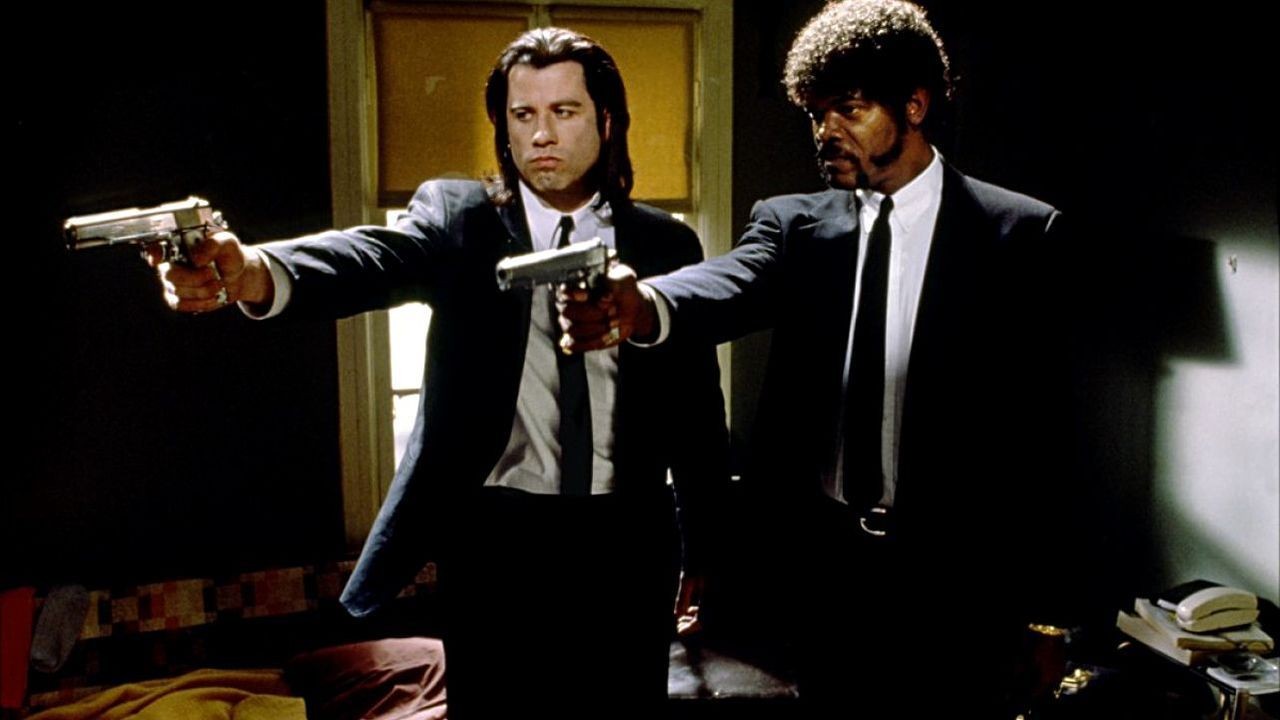
John Travolta is Vincent Vega and Samuel L. Jackson is his partner Jules. They are hit men working for a crime boss to carry out assignments that end in death for the people they are assigned to visit. But what Tarantino does is sensational—he allows these characters to talk before and during their assignments. For example, on their way to visit somebody they’re supposed to receive a mysterious briefcase from, Vega and Jules discuss why they call a Quarter Pounder with cheese in Paris a “Royale with cheese” because of their metric system. And just when it seems like action is going to happen, it’s delayed and what happens? They still talk, giving pointless conversation, but also comic timing and somewhat realism. I loved listening to these characters talk. And throughout this movie is plenty of great dialogue written by Tarantino and Roger Avery.

It’s interesting how these characters are played out. Vega doesn’t clean up after himself, probably because he doesn’t know how, but he knows plenty of people who are able to help him out, some of them involuntarily. There’s another complicated character—a boxer named Butch Coolidge (Bruce Willis) who was ordered to throw a fight, but doesn’t, so he leaves with his sweet girlfriend (Maria de Medeiros) right away. Of course she doesn’t understand why. And then there’s the watch that Butch was given which becomes an important part of Butch’s story. The story of that watch is told in a flashback through a monologue by Christopher Walken and gives the film its biggest laugh. Then there’s the outlaw couple played by Tim Roth and Amanda Plummer who also talk before robbing a restaurant in the beginning and end of the movie. And then there’s the wife of the crime boss (Uma Thurman) whom Vega is paid to take on a night of the town. This results in a wonderfully tense sequence in which Vega is forced to take her to his friend’s house after she overdoses on heroin. He has to give her an injection of adrenaline straight into her heart. His friend (Eric Stoltz) says, “You brought you here! You give her the shot!” That scene is sensationally well-written and well-crafted. I could watch that scene over and over again. And almost all of the scenes in this movie are inventive and original. Another great thing about this movie is I never knew from one point to the next what was going to happen…and then something bigger happens.

“Pulp Fiction” is a great film to watch and a great film to listen to. It’s truly a film that shows what a great filmmaker Quentin Tarantino is, and how great it came to be in the years since. I loved every minute of “Pulp Fiction.”

Signs (2002)

22 Feb

signs2

Smith’s Verdict: ****

Reviewed by Tanner Smith

“Signs” is an unusual piece of work. It goes into the “science fiction” genre yet it features a limited arrangement of special effects, does not show any signs of authority such as the US Government, strays away from unnecessary explanations for these unusual occurrences, and focuses only on one family during one big event that could mean the end of the world—usually we go back and forth through different characters, but not here. Because “Signs” never takes the easy way out, it becomes one of the most intriguing science-fiction films I’ve ever seen. Produced, written, and directed by M. Night Shyamalan, the filmmaker best known for the 1999 hit “The Sixth Sense” (which also strayed away from the easy way out, in the sense of being a psychological thriller), “Signs” is quite extraordinary.

Mel Gibson stars as Graham Hess, a former minister who has lost his faith in God ever since his wife died in an accident. He lives with his more faithful brother Merrill (Joaquin Phoenix) and his even more faithful two kids, 10-year-old Morgan (Rory Culkin, Macaulay and Kieran’s youngest brother) and 5-year-old Bo (Abigail Breslin), in Bucks County, Pennsylvania, surrounded by a cornfield. As the movie opens, the family awakens to discover a series of crop circles in the field behind their house. You know what crop circles are—those geometric shapes drawn into cornfields in the 1970s that created paranoid proof of extraterrestrials, dismissed as hoaxes in the early 1990s. But now, there are crop circles all over the world. This cannot be a hoax. There is absolutely no way that so many people around the world would create such an elaborate prank. It could be real.

The crop circles are shown on the film’s poster and may be just the interpretation of the title. But there is much more to the title of “Signs” than just the crop circles and where they come from. The movie progresses into deep, dark material as it seems like something from the beyond is going to kill us all. The signs in the title refer to signs that maybe there is someone out there watching over us. Graham, however, is skeptical because of his wife’s tragic death—“There is no one watching over us. We are all on our own.” Then again, he is skeptical about the alien theory as well. But soon, nothing really matters except for the safety of his family. That’s one of many important points within this movie—whether or not aliens actually appear in this movie doesn’t matter all that much.

M. Night Shyamalan treats this science fiction story like a horror movie, even using the main element that made Alfred Hitchcock’s “The Birds” effective. That element is silence. Shyamalan doesn’t rely on a heavy score to scare us. He frames shots exactly right, he lets his characters talk about dramatic subjects without even a subtle music score to keep the mood, and even the scariest moments are without music. Also borrowing from “Psycho,” the score from James Newton Howard that reminds us of the music in “Psycho” is there at the necessary points, such as the opening credits and moments of discovery and pain. But the best parts of the movie did not need that score and it isn’t used for those parts—it’s more frightening that way. Through the movie, we hear dogs barking, we jump at the sound of a phone ringing, and we fear during the moment when Graham encounters something (I will only say “something”). Also, an element from “Jaws” is used in the way that the family—these four central characters—is the only thing we care about during all this madness. We care and fear for them. And I also love how Shyamalan is able to use everyday objects for something more. A knife is used as a mirror, many glasses of water that Bo leaves behind because of her fear of water create an uneasy feeling, and then there’s a baseball bat.

In the second half, when everything supposedly pays off, nothing is predictable—you can’t tell what’s going to happen even for the slightest bit. What will become of Earth? What will happen with this family? Are there aliens? Are they friendly or hostile? On the night when “something” is supposed to happen, the bizarre alien theory is not the subject of fear because this family has been through enough already to be scared. “Signs” is thrilling, edgy, suspenseful, intelligent, attentive, and frightening with superb performances by Mel Gibson, Joaquin Phoenix, and those two talented child actors Rory Culkin and Abigail Breslin, a nice blend of science fiction and thriller elements, big ideas, and masterful filmmaking.

Another Earth (2011)

21 Feb

images

Smith’s Verdict: ****

Reviewed by Tanner Smith

It’s a wonderful, thought-provoking image—another planet looking very much like Earth just visible up there in the sky. If you saw that, what would you feel? I’d be asking many questions—What is it like up there? Is something up there? If this is indeed another Earth (“Earth 2,” everybody calls it), does that mean there are mirrored identities of ourselves up there as well? We all imagine traveling to distant worlds “up there.” Only this one seems to be “another Earth.”

This image is seen through “Another Earth,” a low-budget indie drama with science fiction elements and a human emotion story. It gives us the premise of an essay contest that NASA is throwing, and whoever wins gets to travel to Earth 2, four years after it was first seen in the sky. What is truly up there? This is a big chance to find out, given that those chosen to travel up there don’t perish from the journey. But then something mysterious happens. On the TV news, “first contact” is attempted and accomplished…seemingly by an exact copy of the woman making radio contact with Earth 2. Whatever she went through, the other went through. What does this mean? Earth 2 is a mirror of us and our own planet?

Here’s a great dialogue exchange between the two central characters of “Another Earth”—she asks him, “If you met yourself, what would you say?” (pause) “’Hey, wanna play a video game?’…He’d probably beat me.”

OK, since the planet is right up there in the sky, you can go ahead and question the laws of physics—say that the planets would collide and we’d all be cosmic dust, instead of having us so close to each other that we could visit each other. But maybe there’s another possibility. Maybe this Earth 2 is parallel to our own. If you’ve seen “The Twilight Zone,” you’d know that science doesn’t always explain everything. Maybe this is a mysterious entity wrapped around a newly-formed planet that mirrors our own—thus a parallel dimension that could give us all second chances in our other selves up there. Physics wouldn’t matter anything then, if it doesn’t matter much itself.

“Another Earth” is also about the crossing paths of a bright young woman named Rhoda Williams (Brit Marling, who also co-wrote the screenplay with the director Mike Cahill) and accomplished composer John Burroughs (William Mapother, Ethan from “Lost”). This was the night when Earth 2 was discovered in the night sky, just as Rhoda was celebrating her acceptance into M.I.T. by getting drunk. When she looks up at the sky while driving to see the other Earth, she crashes into John Burroughs’ car, accidentally taking the lives of John’s wife and son, and placing him in a coma.

Four years later, Rhoda is released from prison and feels like an outcast. There doesn’t seem to be anything there for her anymore. She feels devastated by the deaths she has caused and wishes for a way to redeem herself. Then, she learns that John has awakened from his coma and decides to pay him a visit, posing as a cleaning lady. She wants to tell him that she’s the one responsible for the death of his loved ones, but she’s too afraid to say anything.

“Another Earth” is far from a typical sci-fi movie. It has sci-fi elements, but it keeps the human elements in focus. As Rhoda and John get more acquainted with each other (with John still not knowing who Rhoda really is—because she was a minor at the time of the accident, he was never told her real name), they really become good friends together. Rhoda is the only one of the two that is aware of their deep connection with each other and it’s because of her that John stops becoming a depressed recluse and starts becoming more open and friendly.

The relationship is brought upon by chance of Earth 2, and meanwhile, Rhoda has submitted her own essay into the contest to go into Earth 2 and see if there’s another Rhoda up there that deserves a second chance because of the original Rhoda’s first chance. Maybe John can get another chance as well. Just maybe.

I cared very much for the plot of “Another Earth” and found myself thinking more about the possibility of another world out there similar to ours. I was also interested by this relationship between Rhoda and John. Brit Marling and William Mapother do convincing jobs at showing us these characters and what they’re going through.

Now, without giving anything away, I’m not quite sure I understand the ending correctly. And this ending is split with people—they either hate it or tolerate it. I don’t hate it. In fact, writing this review just gets me thinking about it. If you want to know what I mean, seek out “Another Earth” and come up with a conclusion for yourself.

Castle in the Sky (2005)

20 Feb

snapshot20091223030317

Smith’s Verdict: ****

Reviewed by Tanner Smith

“Castle in the Sky” is an animated family film made by the sensational style of Studio Ghibli and written, directed, and supervised by Japanese animator Hayao Miyazaki. Miyazaki is responsible for great animated films such as “Princess Mononoke” and “Kiki’s Delivery Service.” “Castle in the Sky” is among his best work. It’s ingenious, exciting, and a truly fine action-adventure.

The best thing about “Castle in the Sky” is how it continues its storytelling with many twists and turns. We get from one place to another, to another, to another, and it’s all linked together so that we aren’t wondering if it could’ve gone different ways. It begins on an airship, where a girl named Sheeta (voiced for US dubbing by Anna Paquin) is being held by a man named Muska (Mark Hamill). A gang of air pirates (complete with their own personal small jets) invades the ship, seeking the crystal that Sheeta wears around her neck. Sheeta tries to hide from the pirates by hanging out a window, but she slips and falls to the ground. But a miracle occurs—because of the crystal, she falls incredibly slowly so that a boy in the village down below can catch her with ease.

The boy is named Pazu (James Van Der Beek). He’s an adventurous young man who hopes one day to save his late father’s good name by finding Laputa, a floating island said to be hidden by a thunderstorm, which his father claims to have seen. People called him crazy; Pazu wants to prove that he was right. Pazu and Sheeta befriend each other and Pazu tells Sheeta about his dream to find Laputa, which it seems has a connection with Sheeta’s crystal.

In a well-drawn, riveting action sequence, the air pirates invade the village and chase after Sheeta and Pazu on the nearby railroad tracks. You can feel the intensity coming through the screen as the chase continues. By this point, we are sucked into the story and intrigued by the execution—the animation is excellent; full of color and life.

The rest of the story is the adventures that these kids have—facing Muska who turns out to be a government agent working with the Army; encountering the air pirates and later befriending them (the bumbling pirates, led by their anxious, fed-up mother, gamely voiced by Cloris Leachman, provide most of the film’s comedy); and of course finally reaching Laputa itself and engaging in a battle over it. What do they find when they finally get there? I shouldn’t say. One of the pleasures I had with this film was that I didn’t know what was going to happen, or what I was going to find. But I can say that I wasn’t let down by the outcome. I can think of many adventure movies that run out of steam before their final act, but not “Castle in the Sky.” This is an engaging, imaginative, vigorous action-adventure from beginning to end. Indiana Jones would have been proud of these two adventurous young characters.

Wayne’s World (1992)

20 Feb

images

Smith’s Verdict: ****

Reviewed by Tanner Smith

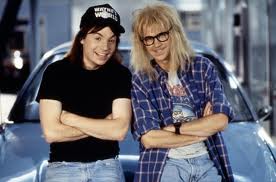
Is it possible to give a movie like “Wayne’s World” a four-star rating? In my case, it is. It’s a comedy based on the Saturday Night Live sketch “Wayne’s World” featuring Mike Myers and Dana Carvey. The sketches are funny, but strangely, the movie might actually be funnier. I can watch this movie several times and still be able to laugh and smile at it. That’s a sign of a great comedy. So in that case, I am giving four stars to “Wayne’s World” and am proud of it.

Just consider this a more personal review.

Wayne Campbell (Mike Myers) and Garth Algar (Dana Carvey) are two 20something party dudes who have their own cable access show in the basement of Wayne’s parents’ house…where Wayne still lives. On the show they usually talk about babes, guitars, and weird stuff, like the invention of a vacuum cleaner that also cuts people’s hair. The SNL sketch was always a recording of their show; the movie stretches it further than that (it has to, doesn’t it?) to show Wayne and Garth hanging out with their friends and going on a night on the town, seeking local parties.

The plot is admittedly predictable. An ad executive named Benjamin (played with inspired casting by Rob Lowe) and his producer, Russell (Kurt Fuller, very funny in a deadpan way), want to use their show to sell it to a client (Brian Doyle-Murray) who owns a video arcade chain. Benjamin offers Wayne and Garth a lot of money for doing the show, while having the client sponsor the show and clean it up a little. Things get complicated when Benjamin begins hitting on Wayne’s new girlfriend—an Asian rock singer named Cassandra (Tia Carrere). When it seems like things are going wrong for Wayne and Garth, can they be right again?

“Wayne’s World” is in the same spirit of movies like “Bill and Ted” and “Pee-Wee’s Big Adventure”—anything can happen just to get a laugh, and I mean anything. We have the guys singing along loudly to Queen’s “Bohemian Rhapsody,” we have breaking-the-fourth-wall jokes, we have the subtitle “gratuitous sex scene” when it looks like Wayne and Cassandra are about to…you know (the movie is PG-13 so no actual sex is shown on camera), we have the subtitle “Oscar clip” when Wayne makes his version of a sad speech (“I never learned to read!”), and more funny jokes. The funniest bit is a satire on product placement—in one scene, six products are brought in to get their plugs (the sequence begins when Wayne holds up a slice of Pizza Hut pizza, with the logo shown on the pizza box, and says, “Contract or no, I will not bow to any sponsor”) and it’s only that one scene where that happens. It doesn’t happen anywhere else in the entire movie.

Wayne and Garth are both likable and very funny. Mike Myers plays Wayne as a Bill Murray type of smart aleck, with a touch of Woody Allen as he addresses the camera frequently. Dana Carvey plays Garth as a paranoid technogeek whose brain may have been fried by partying too much. This makes him an awkward person to be around, unless you know him very well, like Wayne does. I love the scenes in which they hang out together—they have too much time on their hands and when they’re not partying or doing their show, they play hockey in the neighborhood street (they move the net when a car is coming) and park outside of an air field so that they can sit on the hood of their car and anticipate the noise of the oncoming airplane above. You don’t expect scenes like these in a movie like this. They have a real whimsy to them. I suppose that’s what makes it more intelligent than “Bill and Ted” or “Pee-Wee’s Big Adventure.”

Even if the plot is predictable, the jokes sure aren’t, and you’ll most likely enjoy “Wayne’s World” for its good nature, likable and funny characters. I love this movie, it’s hilarious, and I have no regrets in giving it four stars.

WarGames (1983)

18 Feb

wargames-hacker

Smith’s Verdict: ****

Reviewed by Tanner Smith

It’s a little tough to review “WarGames” without pointing out that this film is more like a time capsule from the 1980s. The technical aspects within the film’s story are really dated with how our computers worked back then, as opposed to the tremendous upgrades decades later. In fact, every year, our technology is growing more impressive, with new and expensive ways to advance our technology. We, as mankind, have gone pretty much to the point where we can’t progress without our computers, which is why many people were paranoid about the theory of Y2K.

But there is that fear that while our technology is advancing as time goes on, it could be getting to the point where it winds up destroying us. (Not that I believe it—how does technology expect to take over mankind if my cellphone keeps acting up on me?) That is why the story of 1983’s “WarGames,” still in the time of the Cold War, is still engaging and thrilling, even if its technical aspects have grown dated. It’s an entertaining film and an effective cautionary tale.

It opens brilliantly with a great teaser scene, in which a launch test brings about the tensions of being in charge of what could lead to a nuclear launch. The two men at the hand (played by Michael Madsen and John Spencer) don’t know that their current job is just a drill and they panic as they confront the possibility that they could be starting an international nuclear attack by order. It’s a brilliant scene—it sucks you in and keeps you on edge. However, the movie that follows doesn’t quite bring about what to expect from this opening.

Fortunately, “WarGames” gets on track as it leads to an action (as a reaction to the two men) that leads to the real story. And we’re already drawn in to see what’s coming next.

NORAD is relying more on computers for evaluating and preparing for nuclear attacks, so John McKittrick (Dabney Coleman) and a few other experts are called in to bring in a supercomputer named WOPR. It has a system that plays war games and strategizes appropriate responses to crises.

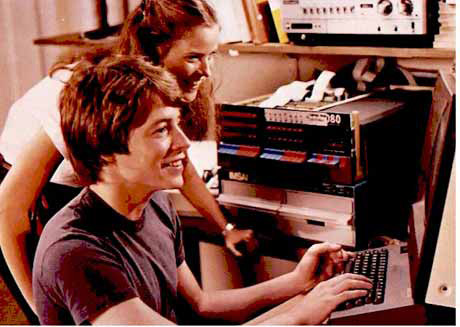
Enter our protagonist David Lightman (Matthew Broderick), a teenage computer hacker who can break into the school’s computer network from home and change his failing grades to passing grades. Along with his girlfriend Jennifer (Ally Sheedy), David is able to sneak into the WOPR system through a backdoor. David and Jennifer find some pretty interesting games in the computer and decide to play one particular war game called “Global Thermonuclear War.” But what they don’t know is that while playing this game, the computer is taking over NORAD and scaring the agents into nearly launching a strike.

McKittrick tracks down young David and forces into an interrogation. David’s story doesn’t sound convincing to him. McKittrick can’t believe that this high-school kid caused this chaos by himself and thinks he might be a spy. But David knows for sure that the computer is continuing to play the game on its own and force NORAD into launching DefCon1, resulting in Armageddon.

The tension that comes with the well-produced 1983 reality is outstanding. The idea that one little act from a high school kid has the possibility of an even bigger problem (for all of mankind, no less) is an uneasy one and “WarGames” handles it effectively, with a mix of intrigue and complexity. The film starts out fun, as David and Jennifer are playing with their computer before coming across all of this. It evolves into something more complex.

There’s also a fascinating sci-fi edge to it, as the computer is learning as it continues to play the game. David at one point asks the computer, “Is this a game or is it real?” The computer responds, “What’s the difference?” It’s thinking on procedural rules, not ethical ones. This leads to a tense climax in which David and the original creator of the machine, Dr. Falken (John Wood) must attempt to force it into learning that this game should not (or cannot) continue. And they have to do it before time runs out…

What also stands out in “WarGames” are the performances, particularly from Matthew Broderick, Ally Sheedy, Dabney Coleman, and John Wood. Broderick has a nice blend of cockiness and innocence that makes us sympathize with David. Sheedy is the kind of girlfriend teenage geeks hope for—cute, fun, and willing to listen to you talk about your computer skills. Coleman is sardonic but ethical as McKittrick, and Wood, showing up late in the movie, has an effective speech about natural selection.

That speech, by the way, is the setup for the climax. Dr. Falken makes that speech to David and Jennifer, after learning that they’ve played with his creation and is willing to accept his fate so that something else will rise after humans. David retorts by stating that it shouldn’t be this way if there’s a way to stop it.

The only thing I don’t like about the movie is the music score. With its overblown orchestral tune, it just sort of grows annoying. That aside, though, “WarGames” has a thrilling story with good acting and execution, and is a genuinely moving thriller. A lot of it may be dated, but it’s more of its time and can’t be complained about.

Amid Amor (Short Film) (2010)

18 Feb

mqdefault

Smith’s Verdict: ****

Reviewed by Tanner Smith

(Originally reviewed in Spring 2011)

“Amid Amor” is a most pleasant surprise. It’s a seven-minute short film made by teen-cousin filmmaking prodigies Andrew and Matthew McMurry for the 48 Hour Film Project in Little Rock, Arkansas. And I must say, it’s very impressive and surprisingly treasurable for a film with such a short length. This short film won the Audience B Award at the 48 Hour festival—it’s easy to see why.

Andrew and Matthew McMurry take unusual measures for this new project, compared to their other projects. For one thing, they don’t star in it—they have a unique screen presence in their previous work. For another, they have story help from Michael Scott, the filmmaker behind the “Scot Murray” film series (my guilty-pleasure films) on Vimeo. But some of their trademarks are present—the comedic effect of special effects (forgive that pun), the whimsical directing style, and the odd-but-charming storyline.

Michael Scott stars as Ben, who is actually Cupid. Yes, the Cupid. We see in an opening scene that he can shoot balls of light from his hands that cause a man and woman to fall in love—kind of a cheat, but hey it’s Cupid. Ben leads kind of a superhero life in the way he can’t tell anyone who he is or show his abilities. He’s also the person you’d least expect to be Cupid. He has no tutu, wings, or bow-and-arrow and he’s not the best-looking guy in town. But Michael Scott is a nice choice for the role. His personality and tone of voice would remind people of Barry White crossed with Bill Murray. In that way, he’s a perfect casting choice for Cupid—just a smooth-talking average Joe…who is anything but smooth.

Austin Blunk, star of the “Scot Murray” series, plays Ben’s best friend Geoff Cooke, a camp counselor who tells Ben about Camp Kettle (one of the 48 Hour requirements was to mention a camp counselor named Geoff Cooke). Ben and Geoff are sitting on a bench in the local park when a girl named Gina catches Ben’s eye—they both are reading John Grisham novels; nice touch. Ben is nervous talking to her—hey, just because Cupid can make people fall in love, that doesn’t make him a ladies’ man. So just this once, he tries to use his powers to make her fall in love with him. But the plan backfires and Gina instead falls in love with Geoff, so they spend a wonderful afternoon together while Ben can only watch.

And that’s not the end of the movie. I don’t know if you can believe that. I shouldn’t spoil the ending for you, but I will say that it has a good message—you can’t force love. It’s subtle and very sweet.

Austin Blunk isn’t given a lot to do in the acting department because he’s given very little screen time—well, what’d you expect when Cupid is the lead character in a seven-minute film? But given the circumstances, that’s amazing. Let me explain—as Scot Murray, Austin Blunk was the irrepressible, ruthless loudmouth who wouldn’t shut up. But here, he’s calm and relaxed. This is not the Austin Blunk I recognize.

Anyway, why is Gina worth it for Cupid to break his own rules? Because she’s played by Enji Wagster (credited as Angie Wagster), that’s why! She made this film on her day off from performing for my romantic-comedy-drama-fantasy, “Interior/Exterior.” That was the movie in which Enji played my character’s romantic interest, who was mainly a voice in my head until we saw how beautiful she was in a mirror in one scene. In this film “Amid Amor,” she has the same acting treatment as Austin Blunk, but hey, she’s beautiful and fun.

“Amid Amor” is solid proof—Andrew and Matthew McMurry are filmmakers. They have the equipment, they have the special effects (the balls of light that Cupid shoots out of his hands), they have the stories, and they have the direction. These are the guys responsible for two of my favorite short films, “9/19/2055” and “Dad vs. Boy” (both of which can be found on www.youtube.com/user/pinnaclepointstudios along with this one). “Amid Amor” is their best film and I will make room for it on my Best Films of 2010 list. I mean it; it’s that good.

Foot Soldier (Short Film) (2011)

18 Feb

Foot_Soldier2-1317227267

Smith’s Verdict: ****

Reviewed by Tanner Smith

Oh boy… how am I going to talk my way through this one? To tell the honest truth, it’s hard for me to explain why this unusual short film “Foot Soldier” works. It just sort of does. It’s weird with its odd little touches that move the story along, but it’s also exceedingly original and very well-executed.

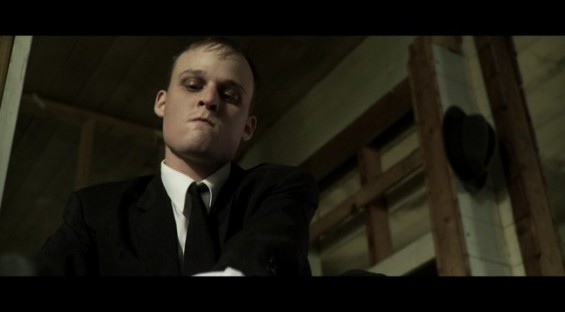
Foot Soldier” is a Southern Gothic tale with cinematography that captures the essence of the backwoods of the South. It’s desolate, yet comforting and wistful. Making his way through a small town with that sense is a door-to-door Bible salesman named Emmitt (Dustin Alford, giving an excellent performance with a convincing blend of innocence, gullibility, and sorrow). Emmitt is apparently homeless, as he wakes up in an abandoned house and has very little money in his pocket. He lives by his belief in God and by his door-to-door sales.

Oh, and he also has this habit of stuffing the inside of his shoes with pebbles and gravel, so that he’ll endure the pain to continue with his faith, while attempting to continue his sales. But it’s after an uncomfortable encounter with a sleep-around (Natalie Canerday) that Emmitt starts to lose his faith and see things in a new, twisted way. But his next attempt at challenging his own faith leads to a new view on life.

I don’t want to give too much away, except that after that encounter, Foot Soldier features Emmitt as he makes a ill-advised choice and then finds himself in the company of…well, about the one who delivers helpful advice, you will either accept, laugh at, or (possibly) be offended. In fact, the entire second half of “Foot Soldier” had me questioning why it worked as well as it did, considering the choices being made. But I am praising it for its originality and its sense of humanity. When “Foot Soldier” was over, I found myself wishing to see more of this protagonist’s journey, and oddly enough, I found myself enjoying the little things in life a little more.