Archive | Four Stars **** RSS feed for this section

Where the Wild Things Are (2009)

21 Mar

where-the-wild-things-are-061

Smith’s Verdict: ****

Reviewed by Tanner Smith

How did I feel about “Where the Wild Things Are” immediately after I saw it? I imagine it was the same reaction that open-minded audiences had when they saw it in on the big screen—stunned silence, followed by a stating “Huh,” and then walking out trying to think about what they just saw. That happened to me as well. This is one of those late-reaction movies, where you have absorbed everything that the movie has thrown at you, and once it’s over, you slowly but surely realize how much of an impact it left with you.

What can I really say about “Where the Wild Things Are?” It’s adapted from a short children’s book and directed by Spike Jonze of “Being John Malkovich” and “Adaptation.” It has a fairly simple family-movie idea to start with—a little boy goes to a mystical island to have fun with gigantic, playful beasts. But it goes way beyond the silliness of that idea, and manages to give a pleasurable mix of concepts, imagination, director’s vision, and complexity that goes deeper into the original source material. It is also, in my opinion, just one of those absolutely perfect movies. Everything about it works, from beginning to end. I can’t seem to find a single thing wrong with it.

The fact that it’s a family-oriented picture makes it even better because there’s something here for everybody. Although, some parents may complain it may be a little “too dark” for their kids to see, but the movie earns its dark moments by playing it straight. It’s not dark; it’s deep, and not in a ridiculous way either. And the kids are probably going to see a bit of themselves reflected in this film—the emotions that the young protagonist goes through are relatable to, I believe, every kid.

A little boy named Max (Max Records) is a wild little boy. Sometimes, he can be sweet and loving, while other times, he’s moody, lonely, reckless, and even violent in some cases (he tries to bite his mother at one point). One day, he feels lonely and left out when a snowball fight with his older sister (Pepita Emmerichs) and her friends ends gloomily, and his mother (Catherine Keener) ignores him because she has a date (Mark Ruffalo). Angry, Max escapes into his deep imagination and appears on an island where the natives are gigantic, furry creatures known as the “Wild Things.” There are about seven of them, each of which represent a part of Max’s being. They make Max their king, and they all have fun together—running, playing games, being wild. But soon, Max learns that these Wild Things do actually have conflicts the same as he does back home. There are issues with a certain group (or “clique,” if you will), games can get a little too rough, and feelings that can be hurt as easily as Max’s was. These are all issues that Max has to deal with back home, and he learns that things aren’t as different here as they were there.

“Where the Wild Things Are” has a low-key approach—it’s more soft and bitter in its key sequences while using pure emotion to tell most elements of the story. This could have been handled with more of a blockbuster feel with a lot of machinery and cuteness to try and appeal to a mainstream audience (see the deplorable Dr. Seuss film adaptations, for example). It’s amazing how director Spike Jonze and co-writer Dave Eggers somehow managed to take a simple story and create a soft, deep family movie that is not like many others in recent memory.

The idea of Max running off to the fantasy island of Wild Ones is Max’s way of escaping into his own imagination, which is why these beasts resemble parts of Max’s psyche. Max develops a strong bond with a few of them, particularly Carol (voiced by James Gandolfini) who represents Max’s soul—someone who seeks friendship and love while feeling destructive when internally pushed. There’s also a kindly Wild One named KW (voiced by Lauren Ambrose), who represents Max’s unconditional love for his family.

This couldn’t have been as clear (or as effective) without the fifteen-minute-long prologue that shows Max’s recklessness, imagination, the way he sees the world around him, and of course his relationships with his mother and his sister. Everything comes back around for Max on this island. Things start to fall apart on the island, as Max’s fantasy world starts to turn against him. It’s then that he learns certain things about his own life, including how hard it is to negotiate with family and friends. When Carol is suddenly destructive, and Max has to reason with him, it’s really Max’s way of understanding himself more.

As for those Wild Things themselves, they’re not only imaginative in their creature designs (live-action but not cartoony, looking like they stepped right off the pages of the original book); but they have distinct emotions and personalities. The effects team gets the look of each of these creatures exactly right, and the voice actors (which also include Chris Cooper, Catherine O’Hara, Paul Dano, and Forest Whitaker) do successful jobs of helping make them three-dimensional.

Every kid likes to pretend they’re somewhere else when they’re all alone with no friends or family members to interact with. While doing so, they make up people or creatures or all sorts of characters to interact with, and the kid can further figure out certain things this way. That is really what this fantasy land is all about with “Where the Wild Things Are”—it’s Max’s way of figuring out what’s happening around him in reality. The film is more fascinating in this sense. “Where the Wild Things Are” is truly an excellent film. It’s insightful, indefinable, and enchanting, to say the absolute least.
Little Miss Sunshine (2006)

19 Mar

26suns.2.600

Smith’s Verdict: ****

Reviewed by Tanner Smith

“Little Miss Sunshine” answers the question, “Is it possible to create something great with elements of a formula road movie?” The answer for this movie is yes. “Little Miss Sunshine” could be described as a road movie because a dysfunctional family is forced to travel halfway across the country, but what makes it very original, compelling, and funny is that this movie is also a character study. These characters within this family are well-developed and are unique individuals. They give “Little Miss Sunshine” its strength.

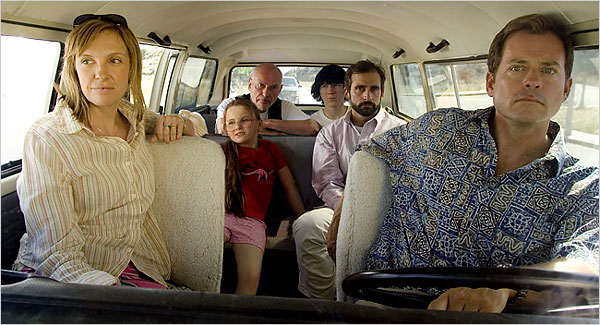
These people are the Hoovers. To call them dysfunctional is an understatement. The man of the house is Richard (Greg Kinnear), an overconfident, winning-obsessed life-lessons coach who can be unbearable to live with. His wife is Sheryl (Toni Collette), a completely honest housewife who tries to keep her family from falling apart. Sheryl’s brother is Frank (Steve Carell), a suicidal, gay Proust graduate. Richard and Sheryl’s children are seven-year-old Olive (Abigail Breslin), a glasses-wearing girl a little on the plump side who is determined to win a beauty contest someday, and teenager Dwayne (Paul Dano), an oddball who reads Nietzsche and has taken a vow of silence. That leaves Grandpa (Alan Arkin), a heroin-snorting wise guy.

These people are so original and so much fun to watch. They deliver the strengths to this story, which is interesting and funny because of the more appropriate reason—its script is funny. The writing here is Oscar-worthy. It’s rich, alive, funny, and touching. All of these elements of the writing are put to the screen to perfection by directors Valerie Davis and Jonathan Dayton, and by the actors, who know these characters by heart and don’t seem like they’re reading lines at all. I loved watching these people act and listening to them speak.

For example, there’s a dinner scene in the beginning of the film, in which all six family members are eating chicken at the dinner table. Here we get to know who these characters are, without annoying exposition. Too many introductions to characters just read lines that describe to the audience who they are at random. But in this dinner scene, they made cute, little Olive the questioning little girl who causes Frank to explain his reason for committing suicide. He explains it as calmly as possible.

But soon, it’s time to hit the road. Olive is in a top spot in a little girls’ beauty pageant and has a chance to compete in Little Miss Sunshine. They drive an old, yellow VW bus to California, where the contest is being held. But it doesn’t seem like the bus will survive this trip. Its clutch is shot so they have to run out and push it to start it. That’s one of many road trip problems this family goes through—there is also comedy, tragedy, and revelations, all of which written very well. But nothing could prepare them for when they finally make it to Little Miss Sunshine. I will not give away the outcome except to say that it comes totally unexpected and will cause discomfort for some people but big laughs for most.

And let’s be honest–these types of pageants are disturbing, disturbing, disturbing! And “Little Miss Sunshine” thankfully knows that enough to make audience members cringe at certain moments. But at least the movie delivers a solid punchline.

The story is somewhat similar to a lesser family road movie released earlier in the same year (2006), “R.V.” This one—“Little Miss Sunshine”—has more heart and more humor, as well as a lack of cliché. In “R.V.,” you knew the R.V. was going to be dumped in a lake. In “Little Miss Sunshine,” you may think you know what will happen when Richard confronts a man who ripped him off and they have an argument near a swimming pool. If you’ve seen as many movies as I have, you would think that Richard would throw the man in the pool…but he didn’t! Another great bit is when Dwayne writes in his notepad to explain to Frank that he hates everyone. Frank asks about his family, and that forces Dwayne to underline the word “Everyone.” There are many other great bits in this movie and a few great scenes as well, like the dinner scene. I love the scene in which Grandpa gives some vulgar advice to young Dwayne, every scene in which the family has to get out and start the bus, an encounter with a highway patrolman, and other scenes as well-written and acted as those.

The acting is top-notch. Greg Kinnear is well-cast in a role that basically requires him to be a pompous, winning-obsessed man. Toni Collette is great as the pro-honest mother. Paul Dano does everything he can with a performance that requires hardly any dialogue—his facial expressions say everything about the character. Abigail Breslin is an absolute delight as Olive. She’s very talented and understands her part very well. And she doesn’t go for the deadly cuteness that many child stars fall into. Alan Arkin steals all of his scenes as Grandpa. But the biggest surprise here is Steve Carell, who plays it straight in this role. Carell is wonderful as this strange person. His line-delivery and facial expressions are unique—sometimes they’re funny and other times, they make us care for him. This is a career highlight for Steve Carell.

“Little Miss Sunshine” is a delightful movie—funny, charming, and alive. With its clever script and truly original characters who are well-acted by the actors, “Little Miss Sunshine” is the movie that “R.V.” wanted to be.

Super 8 (2011)

17 Mar

Super-8-Movie-Image-2

Smith’s Verdict: ****

Reviewed by Tanner Smith

To get straight to the point before I type my review, “Super 8,” one of the most highly anticipated movies of the 2011 summer season, is a love letter to the summer blockbuster season—it has gripping action, first-rate special effects, and great acting. Take all of those elements up a notch and there’s a movie that deserves four stars from me.

“Super 8” clearly loves the tradition of the summer blockbuster. It reminds of how “Jaws” created that phrase. And that reference to Steven Spielberg’s 1975 hit brings us to this note: “Super 8,” which was produced by Spielberg himself, is also in the tradition of the early Spielberg classics, paying homages to “Jaws,” “Close Encounters,” “ET,” “Poltergeist,” and “The Goonies.” We have a likable bunch of kids as the film’s central heroes, an ominous threat, a small town, awe-inspiring visuals, and scary moments to boot. Writer-director J.J. Abrams, of “Lost,” “Mission: Impossible III,” and “Star Trek,” obviously has a great affection for Spielberg and “Super 8” is his way of showing that as a tribute to Spielbergian elements.

Abrams also shows his affection for filmmaking. When he was a kid, he was making movies in his neighborhood with an 8mm camera. Spielberg did the same, as the kids in “Super 8” do. The film takes place in 1979—no iPods, Smart Phones, or Internet are found here. Instead, the kids use whatever they can get ahold of, even if at one point it’s another kid’s dad’s Super 8 camera. The kids (each about 12 years old) are Joe Lamb (Joel Courtney), the makeup artist; Charles (Riley Griffiths), the intense director; Cary (Ryan Lee), the pyromaniac practical-effects expert; Martin (Gabriel Basso), the nervous leading actor; and Preston (Zach Mills), the lighting guy. They’re making a zombie movie in their small town of Lillian, Ohio, and they need a leading lady. So they recruit Alice Dainard (Elle Fanning, Dakota’s sister), one of the prettiest girls in school.

Alice is unsure of Joe because both their fathers—Deputy Jackson Lamb (Kyle Chandler) and Louis Dainard (Ron Eldard)—hate each other and their kids. You see, Joe lost his beloved mother to an accident at the factory she works in, and his father hates Louis because he couldn’t make his shift at that same factory and Joe’s mother had to fill in for him. Jackson blames Louis for the accident, and tells Joe, whom he barely connects with, to stay clear of Alice. Louis tells Alice to stay clear of Joe. But Joe and Alice, while making Charles’ movie, form a nice friendship together.

Anyway, the kids work on the movie secretly (it’s more fun that way, so no matter). They sneak out in the middle of the night (stealing Alice’s dad’s car) to film a dramatic scene near some train tracks. A train passes by, but this is coming to an advantage—“Production value!” Charles gladly exclaims to his friends. But something goes really, really wrong as the train derails while the kids are filming. In one of the best special-effects sequences I’ve seen recently, the kids nearly get killed as they outrun the train cars and debris crashing down. You’ve seen parts of this sequence in the trailer (and in FOX sneak peeks), but once you’ve seen the whole sequence, you’ll realize how “insane” the actual scene is. I mean it—when I saw that scene, I was close to hyperventilating, and I tell no lie. I was in complete awe and fright. Now, there’s a cinematic experience I’ll never forget.

OK, those who’ve seen the trailers and TV spots know that the train crash was no accident and that something escapes from one of the train cars. We don’t know what it is and we continue to not know until the final act of the film. Following the rule of “Jaws,” we see only glimpses of the monster until its big reveal much later in the film. But whatever it is, it scares all of the dogs in town away, steals almost every electrical appliance in town, and comes out only at night to attack people. What it is, where it came from, and what its true motivations are, I won’t give away.

Anyway, the US Air Force shows up after the big train wreck. At first, it seems as if they are going to clean up after it, but to Deputy Lamb, it becomes clear that they’re here for something more. When he asks Colonel Nelec (Noah Emmerich) if the cargo is anything to be concerned about, he gets the response, “I can assure you the answer is no.” He’s lying. Lamb and Nelec are in a constant battle of wits as Lamb tries to get some answers out of him and hopefully explain to the panicked townspeople exactly what is going on.

Kyle Chandler is so good in these scenes in which he tries to piece things together, much like police chief Martin Brody in “Jaws.” He also has to find way to get through to his son, since he wasn’t as much of a parent as his deceased wife. Chandler handles these scenes in an effectively strong way.

But he’s only in a supporting role. Most of the screen time is given to the kids. They try to get on with their lives after barely surviving witnessing the train derailment. But certain events happen that lead to them searching for clues and figuring out everything about the escaped creature. They’re on a crazy adventure that would make the Goonies envious.

These are some very talented young actors. When playing nerdy adolescents, they don’t seem to be acting at all. You really buy their friendship with each other, whether they’re singing “My Sharona,” playfully trading insults to each other, or just sitting at a diner and talking. They are always convincing and have the energy to carry the film. In particular, Joel Courtney is a promising newcomer whom I hope to see more of in the future, and Elle Fanning (who was last seen as Stephen Dorff’s daughter in Sofia Coppola’s “Somewhere”) really shows off some acting chops. There are some very touching moments when these two are together, including one in which Joe helps Alice with her zombie makeup and another in which they talk about the accident that killed Joe’s mother. The other kids—Riley Griffiths, Ryan Lee, Gabriel Basso, and Zach Mills—are likable, funny, and, like I said, convincing. I love how Griffiths handles this role of a bossy, yet chirpy and excited young director and shows a convincing jealous-adolescent side of the character when he knows that Alice likes Joe when he wanted her to like him. Then there’s Lee, who plays the character of a fireworks nut that parents tell their kids to be careful around, and Basso, who is always vomiting whenever he’s scared. It’s amazing these kids are still able to function after what they go through.

I say that last sentence in the previous paragraph because there are many scary moments in “Super 8”—this movie is rated PG-13 not only for its constant use of profanity, you know. This movie is not for those under the ages of 10 or 11. Maybe 12, like the kids in this movie, but I dunno. There’s one particularly frightening scene in which the creature attacks a bus with four of the kids in it. It’s even more effective because the monster still hasn’t been fully seen yet.

I really didn’t mind that the action hits harder when the film reaches the final act. It has to, or it wouldn’t be a summer blockbuster in the 21st century. But these action sequences are exciting and actually have purpose within them. Besides, the whole movie isn’t about action or the creature—it’s about the kids and how they react to this strange, terrifying situation. This is one of the best types of film—the characters are introduced and developed so that when the action happens, it amounts to something. “Super 8” is the best summer blockbuster to come around in a long time.

Frailty (2002)

16 Mar

frailty

Smith’s Verdict: ****

Reviewed by Tanner Smith

Does anyone have the right to enforce their will on us in this world because of what they believe will happen in the next world? It’s a question that can work not only as the foundation for a documentary, but also for a gripping thriller. “Frailty” is such a film, and it’s a special case—an original, chilling story that sets itself apart from the standard serial-killer thriller.

In “Frailty,” here are a series of Texas murders simply known as the “God’s Hand killings.” There are no suspects and hardly any leads to begin with. Then one night, a scruffy young man, Fenton Meiks (Matthew McConaughey), appears in the office of FBI agent Doyle (Powers Boothe), who is investigating the continuing murders. Fenton claims he knows who the God’s Hand killer is. The killer is Fenton’s younger brother Adam, who has already killed himself. Doyle is curious about what else Fenton has to say about the killings, and also why Fenton waited until now to confess to anything—he states, “I’m here because I can’t live with what I know anymore.” So Fenton tells Doyle a tale about how it all started.

Seen in flashback sequences, we see Fenton and Adam as children living with their widowed father (Bill Paxton, who also directed the film) in a small Texas town. They seem to live a normal, happy life together, until Dad wakes the boys up one night to tell them about a “vision from God.” An angel has visited him, telling him that demons are walking the Earth and that it’s his and his family’s duty to destroy them. Fenton doesn’t know how to react to this, but Adam believes Dad and wants to help him. Fenton is even more frightened when Dad makes a list of demons to destroy—people’s names. Dad has three useful tools, “weapons from God”—an axe, a pair of gloves, and a metal rod. And then when Dad finally claims his first victim, Fenton wants to tell somebody, believing that Dad has lost his mind—“If you do, someone will die,” Dad warns his son. “The angel was very clear on this.” Fenton can only watch in horror as Dad claims more victims, becoming a serial killer with Adam helping and supporting his father wholeheartedly.

Are these people really demons, or just chance victims of Dad’s delusional mind? For that matter, is the angel real or was it originally just a bad dream? You certainly know that there’s something mystical afoot here, and certain things are left open for interpretation. Which is scarier—if it’s all real, or if it’s not? One thing’s for sure—the body count is definitely real.

“Frailty” is a very tense thriller—original and effectively creepy all the way through with the right blend of disturbing atmosphere and expository writing. And it does a great job of keeping the viewers invested all the way through. The situation itself is horrifying, and the story involving the two boys is probably the most disturbing, since they’re caught in a world they didn’t make where their father suddenly wants them to assist him in these murders (although Dad doesn’t call it killing people, but “destroying demons”). Fenton is constantly worried as things get worse, and constantly tries to convince Adam that “Dad’s brainwashed you; he’s a murderer, and you’re helpin’ him.” (Adam of course reacts the way a young child would—“Nuh-uh! I’m tellin’ Dad on you!”) Young Fenton and Adam are played by Matt O’Leary and Jeremy Sumpter, both of which are convincing and very effective—with the wrong duo of child actors, “Frailty” would not have worked as well.

Bill Paxton completely sells it with his performance in the film’s most prominent role. He doesn’t play Dad as a villain, but a sincere man who would never harm his children, though he believes that when God tells you to do something, you do it. Paxton is also a pretty good director. After having been directed by some very skillful directors in the past (Sam Raimi, Ron Howard, and James Cameron), this is the directorial debut for the high-profile actor. It seems as if he took lessons from the very people who directed his acting. He knows how to set mood and atmosphere, and uses suspense-tricks that even the late Alfred Hitchcock would have been envious of. For example, there’s one scene in which Fenton is sitting in a car with Dad, who is awaiting his latest victim to walk out of a nearby store. It’s a point-of-view shot—Fenton worriedly eyes back and forth from his father to the store entrance. You can feel that Fenton doesn’t want the man to exit the store, because he knows what will happen. From that shot, Paxton has me hooked and proves himself to be a more-than-capable director. (Also give him credit for having the murders occur off-screen.)

Paxton also does a great job with directing the present-day sequences, continuing the ongoing tension between the two characters of (older) Meiks and the FBI agent. Meiks is obviously going through a deep psychological trauma that came about because events that we see come into place, while he’s telling the story. But there might even be something going on with the FBI agent, who also challenges Meiks, thinking he’s hiding something from him. In that way, it’s more of a challenge of wits that ultimately comes together to put an end to the story. It’s cleverly handled, and keeps its consistently eerie tone.

I won’t give away the ending to “Frailty,” but I’ll admit that I didn’t see it coming. It manages to surprise us and mess with our expectations, and brings about new fascinating details about certain plot elements that kept us wondering. And yet, these new additions to the elements still keep us wondering because they also bring about something new to think about! Watch the film and you’ll see what I mean.

Lucas (1986)

15 Mar

tumblr_l3phddo2TP1qzcwkno1_1280

Smith’s Verdict: ****

Reviewed by Tanner Smith

I have seen many high school movies in which the jock gets the cheerleader, the class brain is harassed, and the football team wins the big game at the end. However, with “Lucas,” it is as if I have never seen it before. What I mean is that this is truly an original high school movie with teenagers not full of lust, selfishness, and hate. Those three traits are what Hollywood filmmakers think every teenager has. For “Lucas,” what we have here is something really special—that very first feeling of falling in love.

Lucas (Corey Haim) is a truly original character. He is a teenager who doesn’t look old enough for high school (“I’m accelerated,” he proudly states), wears thick glasses, is shorter than the other teenagers at school, and is really a sweet kid. Every day, he goes into the fields to look at insects—he does not collect them, only looks at them. He’s also sort of an outcast because his mouthing off about useless information makes him the butt of the football team’s jokes.

One day, Lucas walks near a tennis court and sees her—we all know “her;” she’s that girl we all see for the first time and start to fall instantly in puppy love with. The girl’s name is Maggie (Kerri Green) and she is astonishingly beautiful. Lucas meets Maggie and not only is she beautiful; she is also smart. They soon begin talking. Lucas becomes sort of a guidance counselor to her—saying that sports and cheerleading are just superficial. The two soon become fast friends. They play tennis, they have nice little talks, they even listen to classical music from inside a sewer tunnel. Lucas is deeply in love with Maggie, but she is two years older than him. Maggie sees him as a real good friend and declares him “special.”

Things go great until school starts. Other teenagers are out to make Lucas miserable and Maggie starts to fall for Cappie (Charlie Sheen), the captain of the football team. Then, she considers trying out for cheerleading. Soon, Maggie and Cappie go together to the school dance. That makes Lucas jealous. Therefore, he tries out for the football team to see if he will make an impression.

The film centers on the Lucas character—he’s not like one of those cute-boy roles who just look at the camera as if saying “Aren’t I cute?” He sports thick glasses, is skinny, and has a gift for talking himself into situations where he doesn’t belong. Corey Haim, who plays the kid, is excellent for the part. He gives us one of the most interesting and complicated portrayals of a teenager I’ve ever seen. Haim is wonderful as Lucas. Also, the other two main actors in this movie are Kerri Green (“The Goonies”) as Maggie the loved one and Charlie Sheen as the football captain. They’re both effective as well. Green gives a wonderful performance as sweet, sensitive Maggie and Sheen gives a nice surprise to his character in an especially effective performance. His character of the popular jock is original because he isn’t played as the jerk that practically rubs everything into everyone’s face and wins the heart of the girl with his position in the game. Instead, the original part and the surprising aspect is that he likes Lucas. He protects him from the bullies at school and does what he can to keep him from getting hurt and while he won Maggie away from Lucas, he still cares for the kid’s feelings. Sheen is given the most difficult role in the film and he pulls it off big time. All three performances by Haim, Green, and Sheen really make this film work.

The performances aren’t the only things that make “Lucas” work. There are many scenes in this movie that are just so well-written and so well-directed, it’s just so hard to decide which one is the best. Almost every scene in this movie works with great dialogue, terrific characterization, and excellent performances. The last half of the movie worries us a little because it revolves around the “big game.” Of course when a movie talks about football and has a couple of scenes of football practice, you’d expect a “big game.” And of course, you’d expect the underdog to impress the girl by winning the game and getting the respect he deserves and then, the credits start to roll. But you’d be wrong. As it turns out, the “big game” succeeds far from falling into predictability. What a relief too.

Director/writer David Seltzer has given us a real terrific piece of work. He obviously knows that not all teenagers are full of lust, selfishness, and vulgarity, but that there are a lot that are actually sensitive, innocent, and vulnerable. When the kids in this movie talk, we’re actually interested in what they have to say. “Lucas” is smart, funny, sweet, non-condescending, non-vulgar, and very well-done with the three great performances, well-executed sequences, and a terrific script. I love this movie.

Spider-Man 2 (2004)

15 Mar

2004_07_spiderman2

Smith’s Verdict: ****

Reviewed by Tanner Smith

Remember in “Superman II,” when Superman thought about living a human life, rather than a superhero life, just so he can have a relationship with Lois Lane? She must’ve been quite a woman—indeed, she was and you couldn’t blame Superman for wanting to retire from being Superman. Being a superhero is like carrying a burden with you. You can’t do the things you’d love to do some of the time, you can’t reveal your secrets to anybody because your enemies may come after them to get to you, and you think you’d be better off as a socialite rather than an independent, mysterious figure.

Peter Parker wonders the same thing in “Spider-Man 2.” For about two years now, he has led a double life. First, he’s Peter Parker (Tobey Maguire), the nerdy but likable college student. Then he’s Spider-Man, the web-slinging, costumed vigilante. Much like Clark Kent in “Superman II,” Peter realizes the burden he’s carrying as Spider-Man. It interferes with Peter’s life—it makes him late for class, it causes him to be fired from his pizza-delivery job, it alienates him from his friends (including Mary Jane and best pal Harry Osborn, played by Kirsten Dunst and James Franco), and never gives him a chance to live. He can never have what he wants while leading this double life. Maybe it’s time to give up being Spider-Man.

That central theme is one of many great aspects of “Spider-Man 2,” a thrilling, awesome, and—when it needs to be—touching superhero movie. “Spider-Man 2” has action, drama, and light comedy to keep it interesting. Thanks to a well-thought-out screenplay, masterful direction, and good acting, this is a top-notch superhero movie. It has interesting likable characters to watch and root for, and stellar action sequences that actually mean something. I can think of a few other superhero movies (or other action movies, for that matter, but I’ll keep the references short in this review) that share both of those elements—the first two “Superman” movies, Tim Burton’s “Batman,” 2008’s “Iron Man,” and especially Christopher Nolan’s “Dark Knight” trilogy (those last two references were released after this movie, of course). The original “Spider-Man” only had the interesting, likable characters, but was a little short on the action scale.

The villain in “Spider-Man 2” is also interesting—even more so than the Green Goblin in the original film. He is nicknamed Doc Ock (and played by Alfred Molina) because of his mechanical, artificially-intelligent limbs attached to his spine. He was a brilliant scientist on the brink of a breakthrough before something went terribly wrong and his machine was destroyed, the robotic arms took lives of their own (it’s not as silly as it sounds), and his wife was killed in the process. Therefore, he became the villain Doc Ock, recreating the machine that could harness the power of the sun, robbing banks to pay for some of the equipment. This is where he becomes Spider-Man’s arch-nemesis, as they fight for the life of Aunt May (Rosemary Harris), who is caught in the middle of all this and (it should be added) not afraid to strike at her captor with her umbrella.

This subplot involving Doc Ock is interesting—Doc Ock is being manipulated by the artificial intelligence of the mechanical arms. He’s not a monster; he’s just becoming one.

The action scenes are riveting. One sequence, in particular, is a standout—it involves Spider-Man in a desperate race to stop a runaway train before it runs off track. I don’t know how they managed to pull it off, but I don’t care. I just loved watching it. I was hooked, interested, and on the edge of my seat. The special effects are outstanding and much better handled than in the original. And while we’re speaking of top-notch special effects, I did believe there were metal arms attached to Doc Ock throughout the movie. Odd thing to praise, but OK.

The drama also works in “Spider-Man 2.” I already mentioned the central theme of the movie, which was Peter wants to give up his superhero life. Also noticed are the scenes in which Peter copes with the guilt he feels because of his uncle’s death. Then there’s the scene in which he finally tells Aunt May why it was his fault that Uncle Ben is dead. Also realized is the subplot involving Harry as he wants nothing more than for Spider-Man to be destroyed for killing his father, who, if you recall, was the Green Goblin in the original film. There’s a great sense of revelation in James Franco’s face in one particular scene.

“Spider-Man 2” is a rarity—a superhero-movie sequel that is better than its predecessor. I liked the first film fine (I gave that three stars), but I felt that there were some elements about it that were either overplayed or not played well enough. This sequel is just what I was looking for, and had just the right upgrades I felt it needed. The effects have upgraded, Spider-Man is just as interesting as the always-likable Peter Parker, and the villain is a complex character. It’s a highly satisfying sequel, and a great superhero movie.

The Goonies (1985)

14 Mar

goonies

Smith’s Verdict: ****

Reviewed by Tanner Smith

I’m going to state in this review right at the start that “The Goonies” is one of those movies that just get better and better to me every time I watch it. I loved it as a kid, and I still love it now. By this point, I must have watched it over a hundred times. I feel I have a tough grasp on everything in “Goonies trivia,” I’ve watched it that much.

Actually, I’ll just confess that I can’t just watch the movie itself anymore. I have to watch the DVD bonus features as well—the cast/director commentary, the deleted scenes, even the cheesy music video for Cyndi Lauper’s theme song (which I ironically hate).

You get the point—I love “The Goonies.” I can’t help myself. I understand that there are some obvious flaws and it’s not perfect, and I know people are rather split on this movie—some people love it, while others are incredibly annoyed by it. But I am going to give this movie four stars anyway, just for personal fondness.

(And for the record, I am probably at that point where personal fondness overtakes me—in fact, after watching “Runaway Train” so many times now, I’m even considering changing its rating from three-and-a-half to four.)

For so few of you who don’t know what “The Goonies” is (even modern-day kids have had this movie shown to them by their parents), it’s a 1985 fantasy-adventure flick about a group of young teenagers who find a lost pirate map, and they explore underground tunnels and brave treacherous traps as they set out for the treasure. Directed by Richard Donner of “Superman,” executive-produced by Steven Spielberg, marketed as an “Indiana Jones for kids,” and a controversial overuse of the “s” word, no kid in the ‘80s was going to miss seeing this on the big screen. It became a box-office hit, and since then, it has become a cult-classic and is still remembered with fondness today (mostly).

OK, enough of the “retrospective” shtick. On to the review…

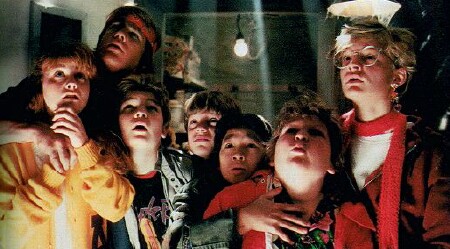
The story takes place in Astoria, Oregon. A neighborhood known as the Goon-Docks is known as the “poor part of town,” and the local kids who live there are dubbed the “Goonies.” Unfortunately, their homes are about to be foreclosed upon to expand Astoria’s country club. On the “last Goonie weekend,” a small group of Goonies—asthmatic Mikey (Sean Astin), his cool older brother Brand (Josh Brolin), overweight Chunk (Jeff Cohen), wisecracking Mouth (Corey Feldman), and little-Asian-genius Data (Ke Huy Quan, Short Round from “Indiana Jones and the Temple of Doom”)—hang out and explore the attic of Mikey and Brand’s house, where a lot of museum artifacts are stored (their father was a museum-curator). There, they discover an old map that supposedly leads to the lost ancient treasure of pirate One-Eyed Willy. So, seeing this as an opportunity to possibly save their homes, Mikey decides that they all should follow the map and retrieve the hidden loot.

Accompanied by two girls—Andy (Kerri Green), who has a crush on Brand, and Stef (Martha Plimpton)—the Goonies head to the first spot, an old restaurant just near the coast. They sneak around the basement, where they discover the secret entrance to a tunnel cave. But they also discover that the restaurant is also the hideout for a family of crooks, the Fratellis—Mama Fratelli (Anne Ramsey) and her two dim-witted sons Jake (Robert Davi) and Francis (Joe Pantoliano). They chase after the kids, hoping to get their hands on the pirate treasure themselves. As the kids venture further into the tunnels, getting closer to the tunnels and away from the crooks, they have to endure a series of life-threatening booby traps, just like in “Indiana Jones.” There are crashing boulders, sharp spikes, and many more.

It’s easy to admire the craftsmanship of these impressive cavern sets, as well as one hell of an ancient pirate ship that the kids come across later in the film. But it’s also just a ton of fun! These kids go through one entertaining adventure after another, and it’s just a thrilling rollercoaster ride all the way through. My favorite sequence features a piano made up of skeleton bones—there are notes on the back of the map that the kids must play, and every time they hit a wrong note, a large chunk of ground disappears into the deepest cavern. It’s a well-paced, well-edited, and quite tense sequence.

Some of you might be thinking, how is it even possible to make a piano like that? I don’t know, and frankly, I don’t care. It’s a fantasy, it’s an adventure! I don’t want to think about little details like, how is it that one rigged boulder conveniently crushes someone and yet, when the Goonies set off that trap, all of them come crashing down. Or how Data survives a fifty-foot fall into a cavern (nearly being skewered by spikes) by using plastic-chompers (“Pinchers of Peril,” he calls them) to grab onto the cave wall and save his life. (That’s a great sight gag, by the way.) Or even why the cavernous waterslide the Goonies slide through looks more like a Disneyland attraction. “The Goonies” doesn’t require you to ask questions like that; it just wants you to have fun. It’s not trying to insult audiences; it’s just telling an adventure story. You don’t ask these kinds of questions in “Indiana Jones” movies, do you? In fact, a lot of Steven Spielberg elements are found in “The Goonies”—the energy of the kids calls back to “E.T.,” the idea that the greedly land developers wanting to destroy the Goonies’ homes is a callback to “Poltergeist,” and of course, the adventures recall “Raiders of the Lost Ark.” Also added, and evident in “Jaws,” “Close Encounters,” “Gremlins,” etc., is a brisk pace to keep things interesting and intriguing from each setup to each payoff. There are shocks, comic relief, special effects, and thrills just about every minute of this movie. Some people will argue that this makes “The Goonies” quite noisy, but if you’ve gotten into the spirit of things by the time the adventurous second half comes around, it’s more appreciated. It’s a nice mixture of the joyful and the macabre.

I mentioned the overuse of profanity in this movie. Oddly enough, for a PG-rated family movie, the “s” word is said about 19 times, and this created a huge controversy when it was released. But it reminded me of the line in Spielberg’s “E.T.” when a kid called his older brother “penis-breath”—kids love to incorporate vulgarity into their everyday conversations because it just sounds cooler and more honorable to them. Plus, they can be funny when used right. Also, I should add that these kids act and talk like real kids should, right from the beginning. In the first half, they’re all constantly talking over each other, interrupting each other, arguing, trading insults—just like any group of kids would do!

I can’t deny that most of the Goonies are stereotypes—the wisecracking cutup, the Asian inventive genius, and of course, the fat kid. Every “fat-kid” stereotype that can be found in some family movies can be traced back to Chunk in this movie. He eats constantly, he loves to talk about eating, and constantly complains about everything. That doesn’t mean it doesn’t garner a few funny moments every once in a while, but the bit starts to become old…until when he’s captured by the Fratellis. Chunk is not with the others for most of the action; he’s locked inside the old restaurant with the other Fratelli—a deformed, Quasimodo-like figure named Sloth (John Matuszak) who is chained to the wall in the basement where he watches TV. And he’s just as hungry as Chunk is, which means they have something in common. This is where Chunk becomes less of a stereotype and more of a three-dimensional character, as he develops a sort of bond with Sloth (and they even share a Baby Ruth bar together).

The rest of the kids remain within their stereotypes, but they’re still likeable and quite memorable. Mikey is the brave leader, keeping the others in line, including his older brother; Brand is the strongest and oldest whose only concern is impressing Andy; Mouth and Stef deliver some witty one-liners; Data’s gadgets come in handy; and Andy…is pretty much the damsel-in-distress waiting for Brand to save her. If you thought Willie from “Indiana Jones and the Temple of Doom” did very little, Andy does even less. Though, to her credit, she is the one who plays the bone-piano and manages to play enough right notes to save everyone’s lives. (And she remembers the retrieve the map afterward when everyone else forgets about it—somehow, that little moment is quite satisfying.)

The soundtrack, by Dave Grusin, is fantastic as well—ranging from soft and whimsical to grand and adventurous.

“The Goonies” is fast, funny, cheerful, gruesome, and flat-out entertaining. The adventure sequences are a lot of fun, the sets are unique, the Goonies themselves are fun to watch as they solve clue after clue, Richard Donner’s direction is very brisk, and…you know, I could go on and on about how much I love this movie (despite its flaws I already mentioned), but this review is already so long that I have to quit while I’m ahead. Bottom line here—“The Goonies” is a real treasure.

The Dark Knight Rises (2012)

13 Mar

The-Dark-Knight-Rises-and-Bane-get-high-marks

Smith’s Verdict: ****

Reviewed by Tanner Smith

Let’s face it—even if we know that the third and final chapter of a trilogy is somewhat underwhelming compared to the previous movies, we can’t help but see them anyway because we have to see for ourselves what these franchises will end on. This is especially true of the updated “Batman” series by Christopher Nolan, whose “Batman Begins” is brought the Marvel hero Batman to a new darker level, and whose “The Dark Knight” is practically a masterpiece. “The Dark Knight Rises” is the third and concluding chapter in this trilogy and it’s a marvelous, extraordinary, satisfying conclusion to one of the great trilogies in film history.

It’s unbelievable, what Nolan and his crew have not only done to Batman, but also to the superhero genre. Not only are they excellently crafted when skillful filmmaking and top-notch action sequences, they bring heavy doses of conflict and pull off the riskiest move—making the hero an anti-hero. All of that is brought to the nth degree, in that it makes the films the darkest in the genre, and that is why these “Dark Knight” films are so great. They weren’t popcorn films or even lighthearted entertainments—they were deep, rich movies that really made you think about human issues and conflict…and the protagonist just happens to sport a black mask and cape.

“The Dark Knight Rises” picks up eight years after the events in “The Dark Knight.” Bruce Wayne (Christian Bale) is a recluse and his night identity as Batman is no more. If you recall in “The Dark Knight,” the hero-turned-villain Harvey Dent was killed, with only Batman and Commissioner Gordon (Gary Oldman) knowing his true deeds. Gotham was led to believe that Dent was the hero all along and that Batman is no longer needed. Eight years later, Bruce Wayne doesn’t leave the east wing of Wayne Manor and is aided by his loyal butler Alfred (Michael Caine), who thinks it’s time for him to live a new life away from Gotham, as it just made him more miserable. Alfred believes that Wayne just wants things to go bad again so he can feel better.

And coincidentally, enter the mercenary Bane (Tom Hardy), sporting a metal breathing mask and carrying a voice that is part Sean Connery, part Darth Vader. He comes from the League of Shadows, once communicated by Ra’s Al Ghul (Liam Neeson, making a brief cameo as he reprises his role in the first film). He comes to Gotham to expertly spread chaos, and also to rule it as his own. Who can stop him?

Introduced into the mix is a heroic young cop (Joseph Gordon-Levitt), a reluctant deputy (Matthew Modine) who is forced to work that “hothead” cop, and two possible romantic partners for Bruce—one is the sexy, thieving, feisty, not very trustworthy Selina Kyle (Anne Hathaway) also known as Catwoman, and Miranda Tate (Marion Cotillard) who may be able to rescue Wayne Enterprises after Bane’s stock market wipes out Wayne’s finances. I think Wayne has more chemistry with Tate, but then again, he and Catwoman are too busy trying to trust each other to create foreplay (unless that is the foreplay).

But anyway, with help from his new sidekicks and some new gear created by the Q-like Lucius Fox (Morgan Freeman), Bruce Wayne rises again as Batman to assist Gotham in restoring its safety. However, as Catwoman states, there’s a storm coming. Without giving too much away, Bane is surely taking over Gotham and he actually manages to get Batman out of the picture so that he wins. The question is, can the Dark Knight rise again?

Too often do we get the villains attempting to succeed in taking over whatever it is they’re trying to take over. Only in the case of “The Dark Knight Rises,” Bane actually succeeds for the most part. In the middle of the movie, he is able to overrule Gotham and run things along with his followers—mainly prisoners and would-be criminals. (There’s a nice touch having the Scarecrow, played again by Cillian Murphy, being the Judge that sentences mutineers to either exile on thin ice, death by execution, or death by exile.) The city is an absolute hell-on-earth scenario, and only Batman can bring everything back to normal. But how?

As was the case with the previous movies, the action sequences are outstanding. There are scenes of physical violence involving Batman and Bane, and of course Catwoman gets in a few kicks every now and then. But there are also some great chases, with vehicles like the Batmobile, Batplane, and even a Batcycle, most of which come in handy in the sensational action-filled climax. I don’t know how Christopher Nolan is able to take an action sequence and make it look as kick-ass without being overdone, but he always seems to pull it off. I can’t necessarily explain how he does it; marvel at the action here and in his films such as “The Dark Knight” and “Inception” and you’ll see what I mean. I would have loved to see this movie on an IMAX screen—heck, I’d even see it in IMAX 3D if I could!

The Bruce Wayne character is even more conflicted this time around—he’s more heroic, but he’s also more flawed. Not only does he have some major disadvantages that come into place at crucial points in the movie, but also we get more of Bruce’s status as an anti-hero. He’s a hero who could at any point be pushed into joining the dark side, which is why we’re happy that he is our hero and wants to stay our hero. But will he stay that way or will he end up like Harvey Dent, after he realized that being a hero brought nothing to him?

All of the cast members are excellent. Christian Bale is still a solid Bruce Wayne/Batman. Gary Oldman, Morgan Freeman, and Michael Caine are still very game at their reprising roles. The almost-unrecognizable Tom Hardy is a solid villain, though his voice takes getting used to at first. And other newcomers to the trilogy Anne Hathaway, Marion Cotillard, and Joseph Gordon-Levitt are more than welcome.

The ending is just perfect. It hits all the right notes about how to conclude this story of Batman, and that is all I’m going to say about that.

How do I rank “The Dark Knight Rises” along with “Batman Begins” and “The Dark Knight?” To me, that’s kind of a tough decision to make, as I love all three movies the same. It’s like asking me which fast food chain I like better, when the answer is just unnecessary. I love this movie, it’s absolutely thrilling, and it’s one of my favorite films of 2012.

There’s something else I should bring up, and it’s very important. “The Dark Knight Rises” has a running time of two hours and 44 minutes. It was the fastest two hours and 44 minutes I’ve experienced in a cinema. I was not bored for a minute.

NOTE: I state that the third and final chapters of great movie trilogies are underwhelming only when compared to the previous films. “Return of the Jedi” and “The Godfather Part III” may not be as (I’ll just say it) “perfect” as their predecessors in their own series, but they are still fine films. And look at the Academy Award winning film “The Lord of the Rings: The Return of the King”—need I say more?

The Sixth Sense (1999)

11 Mar

sixth-feat

Smith’s Verdict: ****

Reviewed by Tanner Smith

“The Sixth Sense” is more of a psychological thriller than a traditional ghost story. It has its gruesome moments, its tense moments of terror, and even some ghosts, but they exist to serve the story and its characters. This is a call back to those original ghost stories that featured ordinary people in unbelievable situations they couldn’t quite understand. Probably one of the more notable aspects of the stories was that children were more attentive of the ghosts, while the adults are more skeptical. “The Sixth Sense” is about a little boy who claims he can “see dead people.” And he really does.

The story begins with a child psychologist named Malcolm Crowe (Bruce Willis) who is celebrating with his wife Anna (Olivia Williams) after he receives an award for his work. But he encounters an intruder, who is actually a patient from many years ago, now completely cracked and believing that Malcolm failed him. The intruder shoots Malcolm before pulling the gun on himself.

Cut to the next fall, when Malcolm has somewhat recovered from the encounter. I use the term “somewhat” because he seems more dedicated to his work while his life at home with Anna seems to have no special meaning anymore. He works on a new case—a small, odd boy named Cole Sear (Haley Joel Osment), who seems to have the same problems that Malcolm’s earlier patient did. He hopes to get it right this time as a form of redemption.

Cole reveals his deep secret to Malcolm, that he sees ghosts. They frighten him, never seem to go away, and are even capable of physical harm towards him. Malcolm doesn’t quite believe the kid’s stories and thinks he might be intensely disturbed. But Cole knows things that others shouldn’t know and Malcolm can’t deny the truth.

One of the great things about “The Sixth Sense” is that it eases us into the scary stuff. There’s always a great deal of tension underlying the story, from one scene to the next. It takes its time to develop the characters and the terror that most of them experience, and then delivers the payoffs. The result is chilling and quite fascinating in the way it continues straight with the story, instead of resorting to mindless violence and smoke-and-mirrors.

We don’t see the ghosts right away—it would have sucked away the film’s credibility. But we can feel that they’re there because of certain strange occurrences (for example, the mother leaves the kitchen for a few seconds and comes back to see every cupboard door mysteriously opened). When we finally do see them, they are as frightening as Cole makes them out to be and we feel his fear. But then the story asks a question you rarely hear in a ghost story—what do the ghosts want from him? Why do they make themselves visible to him? Ghosts are not just there to be seen by people who delight in seeing them. Ghosts don’t just appear to scare people. They want something they weren’t able to finish in the time they were alive, so they can rest in peace. Malcolm uses his attempt at understanding to convince Cole that the best way to be rid of them is to help them.

I haven’t mentioned the writer-director—I have to. It’s M. Night Shyamalan, who proves with this movie that he can write and direct the best sort of thrillers. He doesn’t care about simple gimmicks to keep the story going and get the audience invested. Instead, he uses rules, clues, and sensibility to cover those two important qualities. I also love the way he stays focused on characters in a single scene, just letting the scene play out. He lets the actors feel their characters and thus make the relationships between them feel natural—Malcolm and Cole, Malcolm and Anna, and Cole and his mother (Toni Collette).

The acting is first-rate. Bruce Willis, in my opinion, delivers his best work here. He’s been appealing in action movies, but in “The Sixth Sense,” he delivers some serious acting chops and is more than capable of delivering a dramatic role. He has a real quiet sensitivity and a true sense of trust that makes you believe in him. Haley Joel Osment is a very good young actor and a lot of the story rides on him. He fully succeeds in getting the motions of Cole exactly right. He’s odd, yes, but he’s scared, reactive, and believable. We feel for this kid and just hope that he doesn’t have to be scared anymore. Osment proves he can play heavy scenes with older, more experienced actors. Also, Toni Collette is great as Cole’s mother Lynn, in the way she reacts to her son’s behavior—her final scene with Cole is especially heartbreaking and wonderfully acted by both Collette and Osment. Of the rest of the supporting cast, both Olivia Williams as Anna and Donnie Wahlberg as Malcolm’s former patient Vincent deliver solid work.

There’s a twist ending at the end of the movie, which I would not dare give away, even if you already know it from other people who saw this movie and blabbed about it. For those who don’t know the twist, it will most likely surprise you as it did me. What’s great about it is not that you didn’t see it coming, but that there were a lot of hidden clues throughout what was leading up to it that you can understand the second or third time you watch it. This is a movie that has you thinking, asking questions, talking about it—I love that kind of movie.

Actually, now that I think about it, the more I watched this movie, the more unnerved I become because I know what is going to happen. I especially get nervous when I think about the connection between Cole and Vincent. I understand the full meaning of Vincent when he delivered his final words in a shouting, panicked manner, and worry about what would happen if Malcolm failed Cole—would Cole have ended up like Vincent? And without giving too much away, there’s an element of coldness throughout the story. Whenever someone says it’s getting cold, I let my guard up, even when I know what’s happening.

“The Sixth Sense” is a masterful thriller—great screenplay, credible performances, skillful direction, involving story, and some truly scary moments that amount to something. There’s hardly a moment where it steers wrong and it serves as one of the very best thrillers I’ve ever seen.

Big (1988)

10 Mar

Tom-in-Big-tom-hanks-9828233-1024-576

Smith’s Verdict: ****

Reviewed by Tanner Smith

If “Back to the Future” brought up the idea that teenagers don’t think their parents were ever young and that their parents never think they’re old, then “Big” brings up the idea that teenagers should embrace their youth and shouldn’t hurry to become old.

“Big” is a wonderful comedy-drama and it comes with a surprising story idea that has been done in so many other movies around the time this movie was released. It’s a body-swap movie—a movie in which one person turns into somebody else, and sometimes it’s vice versa. This string of movies started in October 1987, when “Like Father, Like Son,” a bad reimagining of the OK 1977 Disney comedy “Freaky Friday,” was released. Then, in early 1988, two other movies were released around the same idea—the terrific “Vice Versa” and the bland “18 Again!” One can imagine the pleasantly surprising success of “Big.” With a funny, intelligent screenplay and an excellent performance by Tom Hanks as a young boy’s mind inside an older man’s body, “Big” is a triumph—a most appealing comedy that’s amusing, insightful, and a lot of fun.

Josh Baskin (David Moscow) is your typical, average 13-year-old boy. He hangs out with his best friend Billy (Jared Rushton), hates doing household chores, and has a crush on the tall popular girl in school, but is too nervous to talk to her. He gets his chance to talk to her while in line for a carnival ride, but he’s embarrassed when he’s told he’s too short to ride the ride. While walking in misery, he comes across an arcade game—a strange fortune-telling machine that isn’t plugged in, but still seems to work, as it asks Josh to make a wish. Josh wishes to be “big” and gets a fortune saying his wish is granted.

The following morning, he’s surprised to realize that his wish has come true. He no longer looks like 13-year-old Josh anymore; he’s 30-year-old Josh (played by Tom Hanks), though he still has his 13-year-old mind. When his own mother doesn’t recognize him, Josh turns his buddy Billy for help. Billy believes that this strange man really is Josh and helps him find the same game to wish himself back to normal.

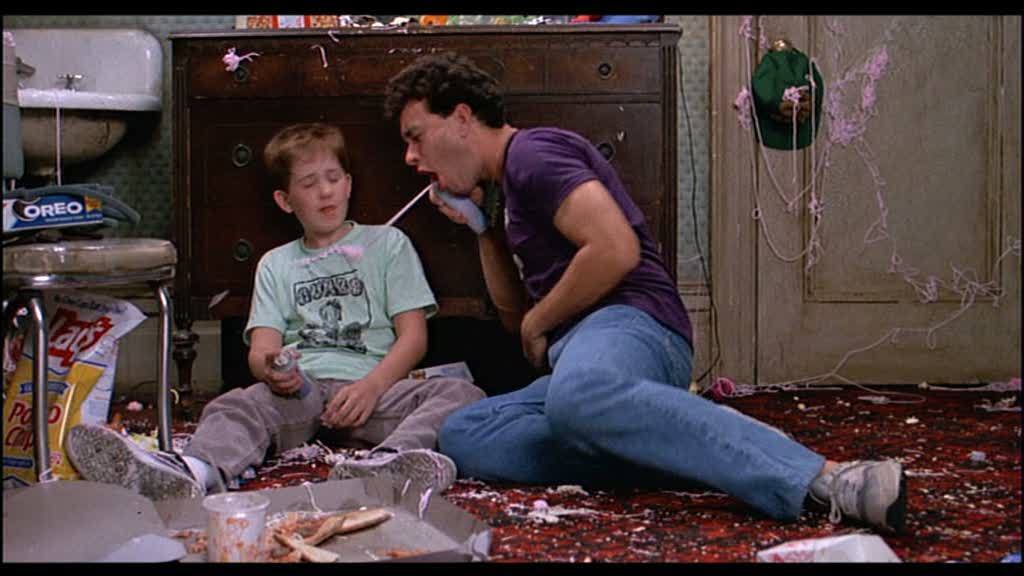
Josh goes to New York City to find the game anywhere he can, but has to wait six weeks for a list of all carnivals and arcades so he can track it down. This means he’ll have to live in the city, so he has to find a job and he gets one, working as a data processor for McMillan Toys. He meets the boss (Robert Loggia), who likes his energy and enthusiasm around the office, at FAO Schwartz, where he’s pleased to see how much Josh knows about toys and moves him up to Vice President of Product Development. Billy can’t believe Josh’s good fortune—they pay him to play with toys and report on them, to which Billy playfully replies, “Suckers!” I wouldn’t blame him; it’s a kid’s dream come true.

As Josh continues with his job, he meets a co-worker named Susan (Elizabeth Perkins), the floozy who, as hinted, has slept with almost everyone at the company. She plans to do the same with Josh, but is genuinely attracted to his child-like innocence as he invites her over to his new apartment, that has what every kid would want in his own place, which include a free-Pepsi machine (by that, I mean the machine is rigged), a pinball machine, and a giant trampoline. Josh falls for Susan and Susan is surprised to feel the same way towards him.

That human-interest story is surprisingly well-handled. They lead to sweet, lighthearted moments in which we feel for the characters and realize what exactly was missing from the other body-swap movies released around this time. Credit for that must go to the writers Gary Ross and Anne Spielberg (Steven Spielberg’s sister) for taking their time to develop the characters as well as the situations. There are a lot of great scenes in the movie that either lead to laughs or smiles. Examples—the scene in which Josh gives an idea for a toy in a board meeting; Josh’s response to Susan first saying she wants to spend the night with him (“OK…but I get to be on top!”); Josh and Susan jumping on that trampoline in Josh’s apartment, and more. There are also moments of convincing drama, such as Josh’s first night in the city and Josh calling his mother to hear her voice because he misses her.

Also, the movie has no real villains. I mean, sure, there’s a co-worker—Susan’s ex-boyfriend named Paul, played by John Heard—who wants to humiliate Josh for getting all the attention. But it isn’t pushed further; he’s just an office jerk. And that’s actually kind of refreshing. “Big” doesn’t need a villain. The only conflict that should be focused upon is developed in the final act. The final act is when Josh is too much in tune with his new body, new job, and new girlfriend, and then Billy comes along to remind him of who he really is and why he came to the city in the first place. This brings the question of whether or not Josh will make the decision to wish himself to be young again or stay the way he is, losing his teenage/young adult years.

Before “Big” was released, most people have labeled Tom Hanks as just OK in the early 1980s. Many critics thought he was bland in comedies like “Splash” and “The Man in One Red Shoe” (and I’d be lying if I said I didn’t see what they meant). But in “Big,” he gives a star-making performance. Tom Hanks is brilliant as a young boy trapped in an older man’s body. He behaves like a kid, talks like a kid, and has the innocence of a kid. Therefore, the audience is convinced that they’re watching a “big” kid. The way Hanks acted in this performance was very clever—the director Penny Marshall rehearsed many of Hanks’ scenes with the young actor David Moscow’s scenes, so that Hanks could observe how Moscow would act in those scenes and copy him. The result is Tom Hanks’ excellent performance.

The supporting cast members do nice jobs. In particular, Elizabeth Perkins is convincing as Susan, Jared Rushton is appealing as Billy, and Robert Loggia, with a twinkle in his eye, is wonderful as the boss who admires this strange man’s energy. In the best-looking scene in the movie, Josh and his boss play/dance to “Heart and Soul” together on a giant carpet piano in the middle of the toy store, as everyone watches. It’s a wonderful scene—good-looking, funny, and played wonderfully, while Hanks and Loggia perform without stunt doubles.

“Big” is a treasure of a movie—pleasant, enjoyable, funny, well-written and well-acted.