Archive | Four Stars **** RSS feed for this section

Antiquities (Short Film) (2010)

6 Apr

1275924313-anitquities

Smith’s Verdict: ****

Reviewed by Tanner Smith

“Antiquities” is an independent short film that seems to have come from the mindset of aspiring writers who gain further inspiration by thinking, “I have very little money; I’ll write funny jokes.” Arkansas writer-director Daniel Campbell is obviously so intelligent a filmmaker that he’s able to get laughs by just everyday quirkiness, because the comedy in “Antiquities” comes from the oddness of a particular day at work. It’s short (with a running time of about 18 minutes), it’s funny, and it has something to say about the oddities of everyday life.

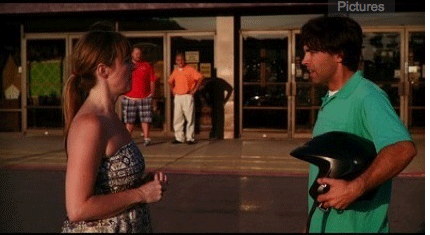
The film is centered on an awkward young man named Terrence (Jason Thompson) who works in an antiques mall. To call him socially-inept would be an understatement; Napoleon Dynamite would be more easily approachable by comparison. Campbell is not afraid of making Terrence as uncomfortable as possible. Of course, this sets the tone for the rest of the film, as Terrence interacts with his co-workers. This particular workday is Terrence’s “LAST CHANCE” day to hopefully get the courage to ask out the sole female employee, Marissa (Jennifer Pierce), on her last day at work. And apparently, the store’s standard S.O.B. Blundale (Roger Scott), who is also Terrence’s boss, is out to put his mind on other things, like a bad haircut and an inane strip joint.

There’s a feature-length film that could be made with the material in “Antiquities.” It’s the kind of material, for an offbeat, romantic comedy, that indie-film lovers love to search Internet film-forums about.

There’s a specific rhythm that adds to the charm of “Antiquities” that comes with the pacing of the story. For a film that has a lot of quirky material, everything seems to flow naturally without rushing into it. Even the characters seem fleshed out and very real, despite the fact that we follow only one (Terrence) as he interacts with the people around him—that’s the surprising part: each of the supporting characters seems realized and memorable. Aside from Blundale, we have the flamboyant Lewis (Tucker Steinmetz), lazy Ben (Matt Newcomb), “gangsta”-imitating Nathan (Jason Willey), and even Marissa herself has her own quirks.

The actors playing these characters are in tune with the rhythm of the film, making the performances praise-worthy. Jason Thompson is excellent as Terrence, and is ably supported by Roger Scott, Jennifer Pierce, Matt Newcomb, Greg Ballard, Tucker Steinmetz, and Jason Willey as his co-workers.

I mentioned “Antiquities” is quite funny, and it did get some good laughs out of me, particularly with the oddness of what seems like everyday quirks in this setting that, again going with the rhythm of the film, flow naturally, particularly when showing how much of an a-hole Blundale really is—he’s a jerk who knows he’s a jerk, and doesn’t care. And there are some great lines of dialogue here, such as when Blundale ropes Terrence into getting a haircut because “the board doesn’t like shaggy hair.” My favorite line comes when Blundale, trying to keep his mind off Marissa, takes Terrence to a strip bar, where the female stripper is too slow to impress; the stripper retorts to Blundale’s rude remarks toward her: “You try doing this when you’re three months pregnant!”

I’m not quite sure I made my point well enough in how good “Antiquities” is, and how delightful it is. But it is a very well-executed short film with a smooth comic flow and an original quirkiness in its writing and characterization. It’s a real treasure.
The Buddy Holly Story (1978)

3 Apr

bholly

Smith’s Verdict: ****

Reviewed by Tanner Smith

It was described by Don McLean as “the day that rock and roll died”—February 3, 1959; the day in which musicians Buddy Holly, Ritchie Valens, and J.P. “The Big Bopper” Richardson all died tragically in a plane crash. They were each music legends in their time.

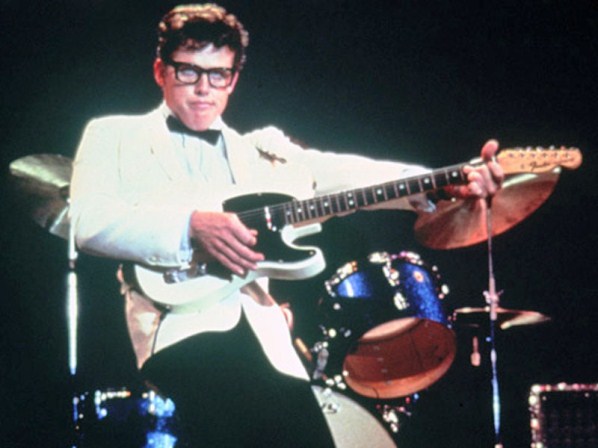
I suppose if movies were made about these three talented stars, the best way to start would be to tell the story of how in three short years, Buddy Holly and the Crickets broke new ground in music and shot to national stardom. That story is told in the wonderfully told biopic (the aptly named) “The Buddy Holly Story.”

It stars Gary Busey in an electrifying performance as Buddy Holly and it begins as he and his two best friends and bandmates (played by Don Stroud and “American Graffiti’s” Charles Martin Smith) are performing at a skating rink in Lubbock, Texas. They play the traditional country music, which doesn’t sound very exciting to Buddy. And he knows that it doesn’t sound very exciting to the youths at the rink either. So he tells his friends to take it up a notch; bring their music to a bop beat. Everyone at the rink is into it. The radio show they’re performing for is against it and so is the local minister.

Buddy Holly and the Crickets have their way of making music by combining country music and rhythm & blues. The band has a shot at a recording, but that doesn’t go well since the producers just want them to go with the usual stuff and Buddy wants things his own way. One even utters, “He doesn’t like Elvis.” Buddy responds, “I like Elvis fine. But I’m Buddy Holly.” But as a big city radio station plays the band’s demo tape, one thing leads another.

The movie follows the important details of Buddy’s life. We get his beginnings in Lubbock, we meet his snobby girlfriend (soon to be ex-girlfriend), we see the constant arguments that go with Buddy’s music style and what others want him to perform, then comes his early hits, his performances, his marriage, and his final appearance on stage with the other two musicians, Ritchie Valens and Big Bopper. Maybe the movie altered some things or left out some other details, as some rock historians would point out, but the feel of the movie is absolutely right.

There’s a real energy in the performing scenes. The main reason is probably because they were all performed live, not post-dubbing. No moment seems flat or unsuccessful in these scenes. Gary Busey tops off his excellent performance by performing all the songs himself and matching his tone and energy to exact Buddy Holly’s. Busey really gets into his character—I didn’t feel like I was watching Gary Busey performing “Peggy Sue,” “It’s So Easy,” “That’ll Be the Day,” “Oh, Boy!” and the rest; I felt like I was watching Buddy Holly.

Was there anything I didn’t like about “The Buddy Holly Story?” Well…the ending. It ends right after the final performance with Valens and Bopper with a freeze-frame, with dead silence and a pop-up text that states what happened afterward. The credits scroll up while zooming on Buddy’s face. I’m aware that Buddy died after that concert, but the way of explaining it right then and there is just sporadic. It’s just terrible. Younger viewers who watch this are going to be devastated because this movie has such a light, energetic, and inspirational feel to it that is thrown right out the window just as it ends. But for the most part, “The Buddy Holly Story” is a rich, wonderful story of how this small-town kid and his friends made it to the top in music. Add the remarkable performance by Gary Busey and the undoubted energy of the concert scenes and you have a special movie about rock n roll.

The Big Chill (1983)

2 Apr

tumblr_mgfwwlXU6W1rcgfbao1_1280

Smith’s Verdict: ****

Reviewed by Tanner Smith

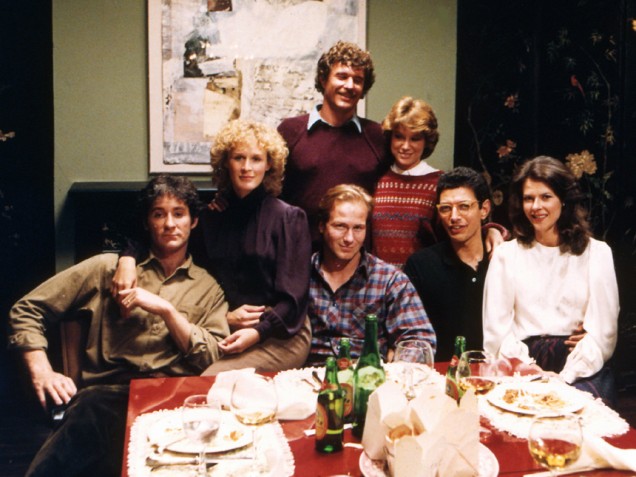
I’m not entirely sure why I love “The Big Chill” enough to give it a four-star rating, so I’m going out on a limb trying to explain why. It’s a film about a reunion of old friends and…that’s about it. We’re basically just in the company of these people as they reminisce their past and consider their present selves. The screenplay is entirely in dialogue for these conversations to take up the whole film. There’s hardly any payoff to be had. And it seems more like an exercise than an actual mainstream drama—an exercise in writing and directing a movie with eight of the brightest up-and-coming actors at the time.

But the exercise worked. I found myself invested in the goings-on of these people. I liked watching them and listening to them.

The friends, veterans of the activist 1960s, reunite briefly in 1983 to attend the funeral of their friend who has committed suicide. They’re all between laughter and tears. The men, especially, crack jokes at their deceased friend’s expense and one of them takes notice of this and asks, “Are we afraid to express our feelings?” Well apparently, they’re not afraid to express their feelings, since they acknowledge that they are survivors of the 1960s and their lives have indeed changed in their 30s.

The friends are suitably diverse—Sam (Tom Berenger) is a TV star and a nice guy; Karen (JoBeth Williams) is a housewife bored by her husband Richard’s (Don Galloway) devotion; Michael (Jeff Goldblum) is a toady journalist who previously wanted to be a novelist; Meg (Mary Kay Place) was once a dedicated public defender who abandoned her lesser clients to succeed further as a lawyer. The ones who fare better than the rest are Harold (Kevin Kline) and Sarah (Glenn Close)—they married, live a suburban lifestyle, and have good paying jobs (he’s a shoe-retailer; she’s a physician). The most complicated of the group is Nick (William Hurt), a drug addict who was a radio psychologist, and a Vietnam veteran. His life has no ambition.

Completing this group is a newcomer to the group—their deceased friend’s girlfriend Chloe (Meg Tilly). She’s pretty (and about a decade younger than the rest), but she’s not very big-picture. The death of her lover hardly phases her—there’s one scene in the beginning where she tells Karen that Alex’s death caused a real mess, but Chloe assuredly states “It’s OK—we cleaned it up.” There’s another funny bit in which she says she’s disappointed to ride from the funeral in an ordinary car instead of a limousine. She’s unconcerned about the passing of time that the others are concerned about, and when everyone is eating at Harold and Sarah’s dinner table and feeling bad for their loss, notice that she’s the only one that’s eating.

Oh, and she also exercises quite often. Call me immature, but…her flexibility does it for me.

All of these actors do great jobs and they all share a convincing camaraderie that comes through to their characters. In particular, the actors that stand out the most are Tom Berenger as this nice guy embarrassed by his starring role in a TV show, William Hurt as the aimless (and impotent) Vietnam vet, and Meg Tilly who has fun as this dizzy broad, who when you really think about it is actually the narrative’s center (she’s the observer and reactor to the others).

“The Big Chill” also has a very funny screenplay. To keep the drama from being monotonous, there are many great one-liners for everyone in the cast to deliver. One of my favorites is the funeral’s reception, in which Michael states, “They throw a great party for you on the one day they know you can’t come.” (I’m sorry to say I used that line at my own grandfather’s funeral. Very sorry.) These jokes come across as pretty frank, too. It’s like the humor that these people give from the screenplay are reflecting their emotions between laughter and tears, like I mentioned before.

Actually, this is why I love “The Big Chill” the way I do. It’s not just a drama about the reunion of a group of friends who talk about their past and present; it’s a comedy as well. The laughs are there to serve as comic relief, keeping the film from what could have been monotonous. I cared about these people, the actors are perfect, the screenplay is great, and by the end of the movie, I feel like I was in the company of people I’ve gotten to know, and I’m not as bored as I, or you, might think.

Breaking Away (1979)

1 Apr

Breaking-Away_-Cutters-Boys

Smith’s Verdict: ****

Reviewed by Tanner Smith

“Breaking Away” is a funny, cheerful, and unpretentious movie that is one of the great feel-good movies that I’ll always remember. It has a wonderful screenplay, great acting, sharp direction, and most importantly, it has a spirit that leaps out at you, but doesn’t seem to slam in your face and force you to be pleased by what it has to offer. That’s what makes “Breaking Away” a small masterpiece.

It’s a coming-of-age tale featuring four kids living in Bloomington, Indiana. These kids are just out of high school and labeled as “cutters.” A “cutter” is a slang term to describe the workers of the town’s limestone quarries; most of them are “townies” who never went to college. That fits these four nineteen-year-old boys who want to spend one last summer with each other before making valuable choices in life, like college and jobs. They’re slowly but surely breaking away from each other, as it seems.

The main focus of the lead characters is Dave Stoller (Dennis Christopher), who not only wants to be a champion bike racer, but an Italian one. He has it in his head that he can simply be Italian and drives his father (Paul Dooley, who is easily the standout of the actors in this movie) to near madness. His mother (Barbara Barrie) is more passive, but his father can hardly seem to stand to further hear Italian opera, eat “ini” foods (zucchini, fettuccini, etc.), and listen to his son talk in an Italian accent, saying words like “ciao” and calling him “papa.”

Dave has his own racing bike and trains for a big race against some Italian champions, who are coming to town for a big race. But in the meantime, he sincerely tries to win his father’s respect again (and even works at the car lot where his father cons college students into buying lousy used cars). And he also is hopelessly in love with an attractive college student named Katherine (Robyn Douglass), who really believes that he’s an Italian exchange student. That’s how far Dave has taken his Italian interests.

Dave’s friends each have some sort of ambition in life. The former high school football jock Mike (Dennis Quaid) would love to play college ball, but may just stick around town. He likes to say he isn’t interested in playing college ball, but he really is. The tall, goofy Cyril (Daniel Stern) has very little ambition in life, but wallows in knowing so. And the short-for-his-age Moocher (Jackie Earle Haley) is secretly planning to marry his girlfriend. But for them, it really does feel like something is missing in their lives and we wonder, as much as they do, what really is in store for them in the future.

A lot happens in “Breaking Away” and most of it is with offbeat humor and characterization. All of the characters are fully realized and have their own quirks and personalities. The dialogue in the screenplay by Steve Tesich mixes realism with comedy to make it seem like these are everyday jokes that young people trade amongst each other in reality. We know the film is scripted, but it doesn’t seem so, even though the dialogue includes some weird humorous lines of dialogue.

But the film has moments of cheerfulness, including one sequence in which Dave races a semitrailer truck on his racing bicycle, along the highway. That scene is wonderfully directed by Peter Yates, who knows how to direct action scenes (one of his films is “Bullitt”). That scene, and a few others, takes a hint at potential disaster that doesn’t occur. They’re well-directed moments of pure pleasure. And then, we get to a big bicycle race—not with Dave and the Italians, but with the four cutters and the college students. This would have been impossible to direct, even after the scene I mentioned before with the truck, but it’s shot and directed with as much high energy to make us want to cheer for the cutters to win the race.

On to the acting—this is a wonderfully acted ensemble piece. Dennis Christopher is likable and gets our attention in his misadventures, whether it’s with his father, with his new girlfriend, or with bicycle racing. He’s great here, and so are the actors playing his friends—Dennis Quaid, Daniel Stern, and Jackie Earle Haley. They effectively capture the lack of confidence they have in their lives as they watch, with resentment, what college students have for themselves. Paul Dooley is hilarious in the role of Dave’s father who just can’t seem to take anymore of Dave’s Italian attentions to family. He rants and raves, even yelling to the cat that his name is “Jake” and not “Fellini,” as if he’s about to explode. It’s a very funny running joke. But he’s also a “cutter” just as much as his son and his friends. There’s a cute scene in which he and his son walk around a college campus and he and his son talk about what has been, what could be, and what could have been—these are two generations of Bloomington natives talking about their thoughts of a big university. And last but not least, Barbara Barrie, as Dave’s mother, is sweet and loving, but she also has to play straight to Dooley’s outbursts. When that is done, she’s quite funny too.

“Breaking Away” is a wonderful, endearing movie—one of the best coming-of-age films I’ve ever seen. It made me feel good inside and it has a sincerity that comes with quirkiness, realism, and high spirits. Count that with the acting, writing, and direction and “Breaking Away” is a small masterpiece.

Aliens (1986)

31 Mar

images

Smith’s Verdict: ****

Reviewed by Tanner Smith

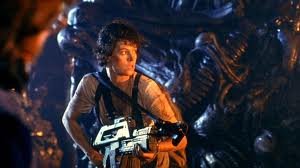
If 1979’s “Alien” is considered a science-fiction thriller, or rather a haunted-house movie set in space, then 1986’s “Aliens”—sequel to “Alien”—would be considered just a relentless series of sci-fi action sequences. And there’s not a thing wrong with that. “Aliens” is a gripping, adrenaline-fueled powerhouse of thrills, tension, and action. It throws just about everything it can think of right at you and hardly backs down.

Sigourney Weaver reprises her role as Ellen Ripley from the original “Alien.” She was the lone survivor of the terrifying events in “Alien”—when an alien creature found its way on a space ship and killed off the rest of the crew before Ripley was able to kill it. Now, a salvage crew has found the ship with her (and the loyal cat Jones) in cryonic sleep. Ripley is brought back to Earth, where she realizes how much time has passed and that her daughter is now deceased. She is also met with skepticism when she delivers her story about the alien. But an agent from the corporation—Burke (Paul Reiser)—has his suspicions when contact is lost on a vacation-planet, which also turns out to be the same planet where the alien was discovered. He plans to send a military team to check it out, and goes to Ripley to act as an advisor.

Reluctantly, she agrees, but only if none of the alien creatures of brought back to Earth.

That’s the setup to “Aliens,” which leads to absolute madness once Ripley, Burke, and the team reach the planet and discover just exactly what is living there. What they encounter are some of the nastiest, vicious, slimiest alien-monsters you’ll come across. And give special praise to Industrial Lights and Magic for making distinctive, realistic creatures that are so convincing that at times, you could actually be terrified of them, which is mainly the point of a monster movie.

Then the action picks up once the crew is forced to fight for their lives against an ever-growing army of aliens. With director James Cameron coming off the action-packed “The Terminator,” and Ridley Scott—director of the first “Alien” movie—not returning, it seemed necessary to let Cameron come in and see what he can do. Like “The Terminator,” Cameron uses a hostile, limited scenario to set up his action sequences before letting them upon us with suspense, tension, and just as important, a brisk pace. These are some pretty nifty action scenes.

Sigourney Weaver, reprising her role from the first “Alien” movie, is fantastic and makes an interesting heroine to follow. She plays Ripley as a psychologically distraught woman, stuck with the remorse of how everything on Earth has changed except for her, and now she’s forced to fight for her life, as well as the life of her surrogate daughter, on that planet. And speaking of the “surrogate daughter,” I forgot to mention the little girl that the team finds lost and alone on that planet. Her name is Newt (a nickname, I hope) and she’s put under the team’s protection as the aliens attack. This is where the human-interest part of the story kicks in—the mother/daughter relationship between Ripley and Newt. While the camaraderie among the rest of the crew is fun to watch, this relationship is the most touching in the film. I can think of many action films that don’t contain heart with its human characters amongst all the action and effects (and if the filmmakers realize that, they just force it anyway), but “Aliens” is not one of them.

The supporting actors do game jobs and their characters are fun and memorable. There’s Burke whom I’ve already mentioned, faced with the choice of doing the right thing while constantly…not. Then there’s the rest of the team—in particular, there’s Apone (Al Williams), subdued Hicks (Michael Biehn), smartass Hudson (Bill Paxton), and unflustered Vasquez (Jenette Goldstein). My favorite was Bishop (Lance Henriksen)—the quiet android on the ship that Ripley doesn’t trust, seeing as how the android on her last expedition tried to kill the crew himself in “Alien.” Ripley is on edge around him, though Bishop tries to keep his good nature and trying to remain trustworthy. Truth is, though, he may turn out to be more human than the actual humans, kind of like Mr. Spock in “Star Trek.”

From beginning to end, “Aliens” has us invested in its story. From the introduction to the discoveries to the many chases to the supposed final struggle to its twist ending, by the time this movie is over, we are exhausted by everything that has been thrown at us, but glad to have taken this journey. This is one wild ride.

Mask (1985)

29 Mar

MASK19

Smith’s Verdict: ****

Reviewed by Tanner Smith

“Mask’s” opening scene in which the central, disfigured young character first appears on screen delivers a visceral reaction. With a strange face, he certainly doesn’t look like a normal teenage boy. But as he talks and goes about his day, we realize he is a teenage boy. His name is Rocky Dennis, and he’s just a normal kid with an unfortunate facial abnormality. He collects baseball cards, he has dreams of traveling the world, and there’s no reason as to why he shouldn’t attend public school like other kids his age.

Rocky’s face resembles that of a lion, as his disease is sometimes known as “Lion-itis.” It’s called craniodiaphyseal dysplasia, and it causes calcium on his skull to distort the face. People see him, and keep staring in disbelief, to which he likes to ask, “What’s the matter? You never seen anyone from the planet Vulcan before?” But just because he looks different doesn’t mean he’s any less special. He’s a good kid; just see the good in him. That’s why we accept Rocky almost immediately after we’ve seen what he looks like. And right away, you see the point “Mask” makes—don’t judge people by how they look.

Rocky does encounter people who judge too quickly. In an early scene, his mother, Rusty (Cher), registers Rocky at a new school district and sees the school principal who takes one look at the boy and suggests “special schools” that fit his “needs.” “Do you teach algebra, biology, and English here?” “Of course,” the principal responds reluctantly. “Those are his needs,” Rusty says with a grin. She shows him the report card from Rocky’s last school, which shows he’s a good student, and she practically calls him a jerk before giving the name of her “lawyer.” (She doesn’t really have one, but who doesn’t cringe at that word?)

That’s just less than 10 minutes into “Mask” and we’re already absorbed into the material. Right at that scene, you can see that Rusty is the ideal mom for Rocky. But that’s not to say she’s normal; far from it. She rides with a motorcycle gang, heavily takes drugs, brings strange men home with her night after night, and I wouldn’t guess she’s employed. She’s a free-spirited, wild, complicated, angry-at-the-world woman who does love her son, even if he sometimes gets on her nerves as he tries to get her to stop taking drugs. But she will if it will make him happy, or at least she’ll try. This is an outstanding character study, and Cher turns in an excellent performance as Rusty, bringing further effectiveness to an already well-written role.

Eric Stoltz, buried under a very convincing latex mask, does a terrific job at making Rocky into a normal teenager with a handicap, and not some special case like the Elephant Man. He’s very likeable and convincing, and we accept him as Rocky Dennis.

“Mask,” directed by Peter Bogdanovich and written by Anna Hamilton Phelan, shows us almost a year in the life of these characters. We spend time with them and get into their relationships—the relationship with Rocky and Rusty, the relationships they have with the motorcycle gang who acts as surrogate fathers to Rocky, the relationship between Rusty and her old lover Gar (Sam Elliott) whom she really loves, and also there’s even a sweet romance between Rocky and a cute blind girl (Laura Dern) who feels Rocky’s face and says, “You look all right to me.” (And unfortunately, wouldn’t you know it, her parents see his face and that’s all they notice of him.)

All of these make “Mask” into a unique, wonderful movie full of high spirits and good intentions, but never to a point where this could have been a stale Disease-of-the-Week TV movie. It’s smartly written, nicely-executed, and we like and care for the characters. The point of “Mask” is delivered effectively—looks don’t matter. Anyone who accepts Rocky right away at the beginning of the movie is most likely to apply that lesson to life.

Elephant (2003)

28 Mar

images

Smith’s Verdict: ****

Reviewed by Tanner Smith

“Elephant” is a dark little movie, somewhat based upon the shootings at Columbine High School in 1999. It’s a very controversial subject that probably shouldn’t have been made into a film. Gus van Sant probably knew that, but also figured that depicting a school shooting in a film would succeed in frightening audiences. That film is called “Elephant” (why it’s called that, I’m not quite sure).

I don’t think “Elephant” necessarily needed a script and it shouldn’t be considered a docudrama because it doesn’t document nor does it dramatize. It simply watches as students of a high school (not named Columbine High School) go throughout their daily routine until two of them bring guns and shoot up the hallways. Students of the high school were allowed to work as extras for this movie and they blend with the young actors who improvised most of their dialogue. Almost every kid in this film is a non-actor and they are all called by their real first names (Alex Frost is Alex, Eric Deulen is Eric, John Robinson is John).

At many times, we feel like stalkers as we view these kids go throughout their days. A majority of the movie shows nothing in particular happening—just a school day. And since we know that kids are going to shoot up the school, we see certain motives from most of the kids. For example, John is embarrassed because his drunken father causes him to be late for school, a geeky girl named Michelle is embarrassed by her legs, etc. But instead we see two other kids named Alex and Eric. In a quiet scene, we simply observe them as Alex plays the piano and Eric plays video games. We never figure out why they become killers. Maybe they were just had nothing better to do. And once you think about that concept, this is a really terrifying movie. There is not much in this movie that explains why the shootings in this movie took place.

But then again, if Gus van Sant did take the time to fit in an explanation for the shootings, the movie would’ve been more offensive and sadistic rather than frightening. The movie leads up to those shootings with one uneventful day at the school and one of the scariest things about the movie is that it takes place in such a realistic setting. This is just a high school. There is hardly anything different about this school from any other school. And then this terrible event, such as the Columbine High School Massacre, takes place and you get the sense that maybe routines can change and there is no safe place to be. I admire Gus van Sant’s cinematography. He uses Steadycam shots to follow many students through the school day through the hallways, into the cafeteria, and through the school yard. We can’t help but fear that someone is going to come around the next corner with a shotgun.

NOTE: I just discovered why the movie is called “Elephant.” According to imdb.com, Gus Van Sant borrowed the title from Alan Clarke’s film of the same name, and thought that it referred to the Chinese proverb about five blind men who were each led to a different part of an elephant. Each man thinks that it is a different thing. What Clarke’s title actually referred to was the idea of the “elephant in the room.” It’s an idiom for an obvious truth that gets ignored, like an elephant in a room that no one will acknowledge is there.

Kramer vs. Kramer (1979)

27 Mar

Kramer_vs_Kramer_26856_Medium

Smith’s Verdict: ****

Reviewed by Tanner Smith

“Kramer vs. Kramer” is a well-acted family drama concerning divorce and child custody. It could have been a sappy made-for-TV melodrama, but this screenplay (based on a novel) has its characters dealing with things either lightly or poorly, depending on the circumstances—just like real people. In that way, this movie is intriguing in the way it deals with the situations at hand because the people in this movie deal with them in realistic ways. That’s why “Kramer vs. Kramer” hardly steers wrong.

It begins as Joanna Kramer (Meryl Streep), a married woman, tells her seven-year-old son Billy (Justin Henry) that she loves him. The son Billy, half-asleep, says, “I’ll see you in the morning.” One look at Joanna’s face and you know that he won’t.

Joanna is leaving her workaholic husband Ted (Dustin Hoffman) and little Billy because she doesn’t feel like she belongs in their lives anymore. She’s unhappy. She has tried to talk to Ted about it, and even tries to tell Ted that she’s leaving, but he’s wrapped up in his work to listen. Eventually, Ted does understand and tries to talk Joanna out of it, but it’s too late.

The next morning, Billy goes into his parents’ bedroom and sees Ted sleeping alone. He wakes him up, asking “Where’s Mommy?” twice. Ted asks what time it is, Billy looks at Ted’s wristwatch and says, “The little hand’s on the 7 and the big hand’s on the 9,” before immediately asking again, “Where’s Mommy?” This scene shows that Ted hasn’t exactly been paying much attention to his son either. But Ted knows his plight and does what he can to please Billy.

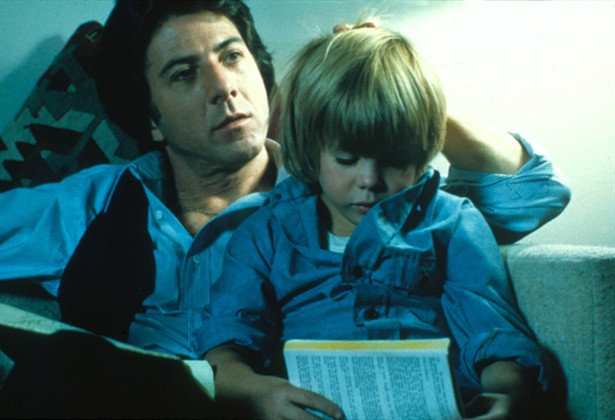
He cares for the boy for 18 months. Sometimes Billy complains that something “isn’t the way Mommy does it,” Billy interrupts Ted while he’s working, Billy has an accident on the playground so Ted has to take him to the emergency room quickly, and Ted teaches Billy how to ride a bicycle. A real bond forms between a father and son. These scenes are really the highlight of the movie—furthering the relationship between Ted and Billy and showing just how much Ted cares for his son.

So when Joanna finally returns, wanting her son back, you feel something.

“Kramer vs. Kramer” made the wise decision not to tell it from the child’s point-of-view and showing us his plight. Instead, we see the plight of the parents. They make some wise decisions regarding it, but they also make not so wise decisions as well. What they both want is attention from their own son, instead of the son wanting attention from both parents. You want a movie with the exact opposite premise, see the Little Rascals short “Big Ears,” featuring little Wheezer getting himself ill so his parents will notice him. “Kramer vs. Kramer” doesn’t work that way.

“Kramer vs. Kramer” leads to the custody case in court, which from what we’ve seen should be a no-brainer. We’ve spent so much time with Ted that the movie actually seems to take his side—the kid is going to stay with him, no question. But when they call Joanna to the stand and she gives her testimony, she actually proves to have some good points about why she should be in custody of her son. That’s when “Kramer vs. Kramer” decides not to take sides, and just let the case play out with these characters. The ending of the movie isn’t predictable.

Great performances hold the movie together. Dustin Hoffman does some of his best work here, playing Ted as very normal and all the more convincing. His love with the kid, played by Justin Henry with unforced charm, comes off as genuine. You truly believe these two as father and son. Meryl Streep shows from the first shot that she’s an actress of many emotions. Watch the first shot that is just a closeup of her face as she’s thinking of leaving her son, but not truly wanting to because she loves him. You can practically sense her mind leading to a decision. And when her character Joanna gives her testimony in court, you feel the sincerity that Streep brings to the scene. Also of note is Jane Alexander, who is winning as Joanna’s friend whom Ted sometimes turns to for advice.

“Kramer vs. Kramer” is a winning movie with a talented cast and a brilliant screenplay. It’s an appealing family drama that plays itself realistically and succeeds in showing a very good portrait of divorce and child custody. They’re both tricky subjects; “Kramer vs. Kramer” pull them off.

Sling Blade (1996)

24 Mar

images-1

Smith’s Verdict: ****

Reviewed by Tanner Smith

The first scene in “Sling Blade” lets you know that you’re in for something unique. It’s a remarkable monologue delivered by its lead character Karl Childers. Karl is mentally retarded, has a raspy voice, an overshot jaw, and a chilling story to tell. He has spent years in a mental institution after killing his mother and her lover. He is telling the story to a high school student for her newspaper and the only light in the room in which he tells the story is from a lamp. The lighting makes the scene even more chilling while he’s giving his monologue. But we also see the pain in Karl’s eyes as he tells it. It’s a great scene.

Karl is being let out into the world, because the doctors think he’s cured. He probably is. He’s not a killer; just a misunderstood human being. When asked if he could kill again, he says, “I reckon I got no reason to kill nobody.”

Karl Childers is one of the most memorable movie characters I’ve ever seen. Think of Forrest Gump crossed with a country man, give him a chilling back story, and you have a truly original character. He has little intelligence but feels pain and has a sort of sweetness to him. He also speaks and acts in a much distinctive way. Karl is played by Billy Bob Thornton, who also directed and wrote “Sling Blade,” with brilliance. He came up with the character, he notes, one day while shaving and practicing in the mirror, talking in a raspy voice. And Thornton makes “Sling Blade” a truly original, compelling, fascinating piece of work.

When he’s released, Karl finds work as a mechanic and befriends a boy named Frank (Lucas Black). Frank is a troubled boy whom Karl senses has a wounded spirit. He lives with a loving mother (Natalie Canerday), who lets Karl live in her garage. But Frank’s wounded spirit and troubles are caused by his mother’s boyfriend Doyle (country singer Dwight Yoakam), who is one of the slimiest characters in any movie. This is an example of Evil Personified. He lounges around the living room, has loud hurtful opinions about everyone, is abusive, and criticizes Frank very cruelly. Why the woman just doesn’t dump Doyle is beyond me, but whatever. Love is blind.

Another key character is Vaughan (John Ritter), a homosexual who is insecure about his sexuality but trying to accept it. He’s also a nice guy who looks out for Frank and his mother.

Even though I’m giving “Sling Blade” four stars, I have to admit I knew how the movie was going to end and what was going to happen. It became obvious when we have a character who has murdered in the past and another who might murder a boy and his mother. But it’s the way it’s all played out that grant the movie four stars instead of three-and-a-half. Everything else is great. The characters are well-developed, especially Karl who is, like I said, one of the most memorable movie characters. I enjoyed going along with Karl on his journey through the town—ordering French fries, going to work, and spending time with Frank and those around him. We see everything through Karl. We hardly stray away from him. Thornton is just wonderful as Karl—it’s the kind of performance that deserves recognition (and thankfully, it did). Lucas Black delivers one of the best child performances as far as I’m concerned (and that’s saying something, considering all the young talent that’s introduced year by year), John Ritter doesn’t hit a wrong note with his performance, and Dwight Yoakam is suitably (and memorably) slimy as the abusive Doyle.

“Sling Blade” is a fantastic movie. I loved almost every moment of it. Even the obvious destination isn’t overplayed, but just played. With great performances by the talented cast, excellent direction, and great writing, “Sling Blade” is a spellbindingly good film.

Take Shelter (2011)

22 Mar

TAKE-SHELTER-Jeff-Nichols

Smith’s Verdict: ****

Reviewed by Tanner Smith

“Take Shelter” brings about a subject that is one of the main envelopments of mankind—fear. Everyone is afraid of something, and how we deal with that fear is up to us. “Take Shelter,” written and directed by Jeff Nichols, is essentially about a man who deals with his fears while not completely understanding them.

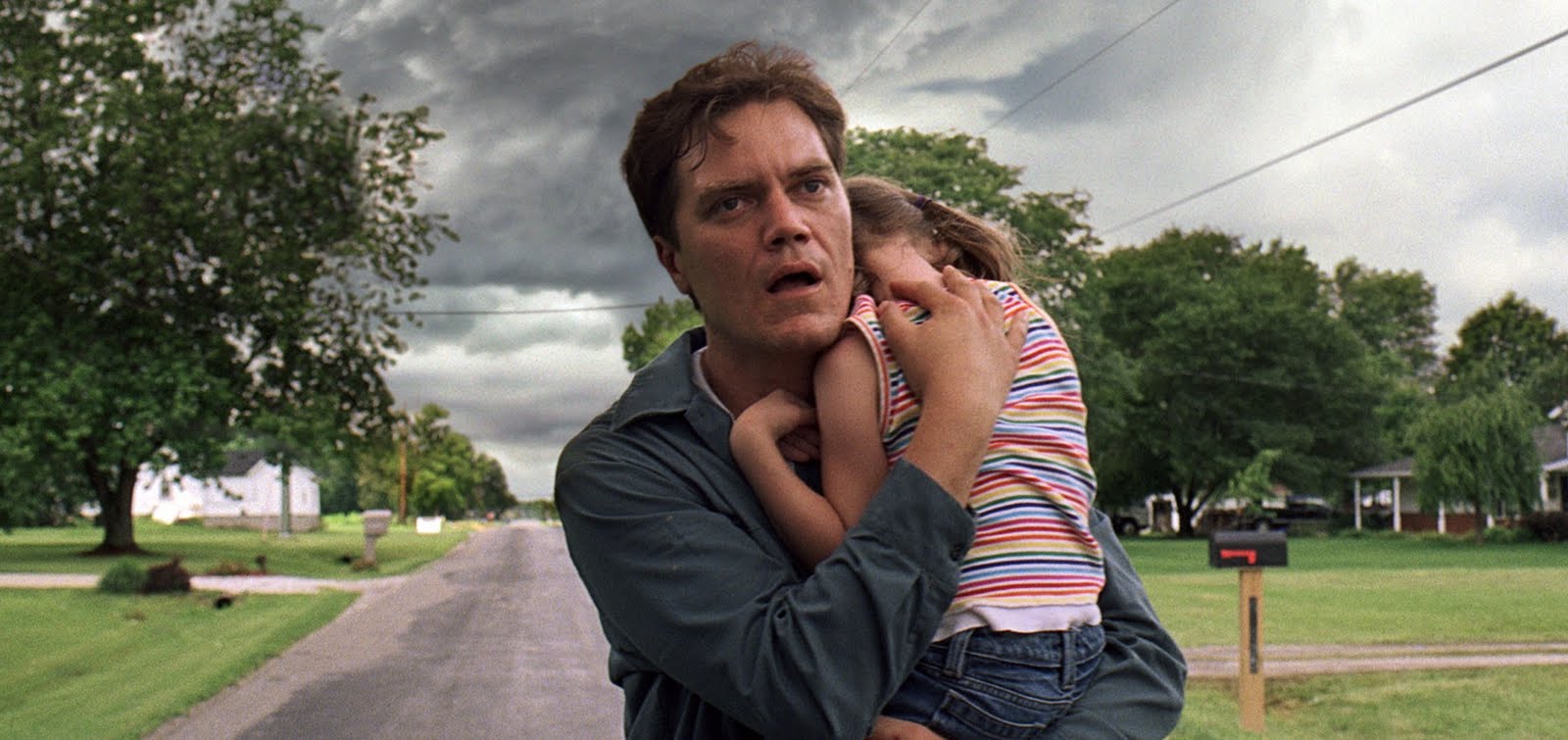
The man’s name is Curtis (Michael Shannon). He’s a working-class man in his mid-30s with a loving wife named Samantha (Jessica Chastain) and an adorable little daughter named Hannah (Tova Stewart), who is deaf. Curtis has a nightmare about a strange thunderstorm that oddly rains what looks like motor oil. He dismisses it as just a strange dream, but the next night, it’s even stranger when he dreams of the same storm and the family dog attacks him. But while the dog only bites him in the dream, Curtis can still feel the pain when he wakes up.

The nightmares get worse and more vivid. Curtis dreams of the same storm with the strange rain that apparently causes people to act crazily and violently. But during his day job as a sand miner, he has hallucinations of a similar theme—he’s the only one who notices that the birds in town are acting strangely. He soon starts to believe (and fear) that the dreams are not only dreams, but also visions of an impending disaster. So he gets the idea of rebuilding the old tornado shelter in his backyard and reconstructing it into a safe haven for him and his family if the visions are indeed accurate.

But there’s a problem here—Curtis is dealing with his fear in this way while also fearing something that runs even deeper. You see, his family has a history of mental illness—his mother (Kathy Baker) has been confined to a home since Curtis was ten years old. Is Curtis slowly but surely going crazy? Are these visions signs of possible schizophrenia? It’s unclear, but while Curtis goes to see several doctors and counselors about his dreams, he’s still working on that shelter to be ready in case he isn’t crazy. How’s everyone else with his “home improvement project?” Samantha is concerned, but will stick with him through thick and thin like the loving wife she is. Curtis’ work buddy Dewart (Shea Wiggum) helps him a couple times, though it means borrowing a few things from work.

What’s really happening here? Curtis doesn’t know, and a great thing about “Take Shelter” is that I didn’t know either. I’m watching this man as he deals with his fears in these ways. Is he going mad? Is there something dangerous headed our way? Is Curtis protecting his family from an impending storm or himself?

“Take Shelter” is a piece of masterful filmmaking. Jeff Nichols, whose previous outing as a writer/director was the excellent indie film “Shotgun Stories” (which also starred Michael Shannon), creates this story with a real intelligence for its audience. For example, the dream sequences—anyone in the audience can tell that a certain scene is one of Curtis’ nightmares. And I hate those old, cheap payoffs in which the dreamer wakes up in a cold sweat. But the thing is, there’s always a small feeling that these aren’t just dreams. With the way the story is developing, it’s hard to tell whether or not what we just saw will relate to anything else in a later scene or not. That’s another great thing about “Take Shelter”—its lack of predictability. The story is told in a way that any of the two possibilities could be real, and it keeps us guessing. And then when the film hit the climactic moment in the final moment, I had chills. I couldn’t tell what was going to happen. I won’t dare give away what will happen, but either way you’d expect it go down, it’d be hard to deny that the final product has a great sense of dramatic tension.

Also, there’s the excellent cinematography (by Adam Stone) from the open skies to Curtis and Samantha’s bedroom to inside the shelter, while the special effects blend in credibly. There’s a sense of atmosphere here.

Michael Shannon and Jessica Chastain deserved Oscar nominations for their work (and unfortunately, the whole film was snubbed). Shannon—one of the perhaps odd but most reliable character actors working today—delivers a powerhouse performance, showing emotional fragmentation, and Chastain is excellent as the reactor to Curtis’ problems and deeds.

To be honest, I’m not sure if I’m making “Take Shelter” sound like the great movie that I sincerely think it is. Let me put it this way—I wrote in an above paragraph that I thought Nichols’ earlier film “Shotgun Stories” was excellent, and I think that his follow-up “Take Shelter” is even better. If that’s not enough, let me put it this way—I think this is the best film I’ve seen in 2011. It’s inspired, unpredictable, chilling, wonderfully-acted, well-executed, and intriguing.