
Archive | Four Stars **** RSS feed for this section

Risky Business (1983)

4 May

risky-business-1983-02-g

Smith’s Verdict: ****

Reviewed by Tanner Smith

In a time when the teen-movie genre was leaning towards being sex comedies for commercial appeal (and no, I won’t bring up the gimmick-setting “Porky’s” again—everyone else is thinking of it anyway), “Risky Business” was like a breath of fresh air. It wasn’t as mature and as slice-of-life as “Tex,” released the year before. But it managed to be charismatic, funny, well-executed, surprisingly insightful, and even romantic rather than lustful, unlike the sleazy teenage sex comedies that were released around the same time as this one. This film is unique and yet still entertaining to teenagers.

But “Risky Business” is mainly well-known for ascending the fame of Tom Cruise. When this was released in 1983, Cruise was regarded as an actor to watch out for—a true movie star. After this movie’s release, his image was everywhere, and his fame would grow and grow and continue to do so.

Cruise plays Joel Goodsen, a suburban Chicago high school senior who always does the right thing, listens to his parents, and has his eyes set on higher academics. But like most teenagers, Joel is worried about his future. In the film’s terrific opening scene, Joel explains to the audience this reoccurring dream he has in which he’s tempted by a beautiful woman before realizing he missed his college-board exams. That’s a common fear among teenage boys—nervousness about taking those tests and worrying that they won’t get to college. Most of us have that going through our mind, along with sex, hence the beautiful woman in the dream.

Joel’s friends are the horny set of teenagers you find in most teenage sex comedies, but they’re still funny and actually pretty likeable. One is Miles (Curtis Armstrong), who gives Joel the advice to just take some chances and “make your move.” Joel starts to take this advice when his parents go out of town for the week—first, he sneaks a drink from the liquor cabinet before taking his father’s Porsche out for a spin. But then thanks to Miles’ persistence, Joel gets in touch with a call-girl named Lana (Rebecca De Mornay). She’s beautiful, sexy, and sweet—and Joel falls for it immediately. After an intimate night, he owes her $300 the next morning. While leaving her alone in his house, he discovers that an important ornament is missing. From here, things take a turn for the unusual and out-of-control status, as Joel encounters Lana’s pimp Guido (Joe Pantoliano), his dad’s Porsche winds up in Lake Michigan, and Joel’s house turns into a brothel for his friends to pay for a night with Lana’s friends/fellow-prostitutes…and also at a time when a Princeton representative (played by Richard Masur) arrives to interview Joel. (I love his line upon meeting Joel, “If this is at all an inconvenient time…”) Joel must get himself out of each and every situation before his parents come home soon.

Joel and Lana’s relationship grows as the movie progresses, and it’s a common male fantasy that a sex expert would fall for a regular guy. That’s only part of “Risky Business’” widespread appeal, which also manages to work in some economic satire in the ways Joel and his friends start a business venture with the “new brothel.” The film is highly stylized, particularly with Joel and Lana’s first sex scene to make it seem more erotic, and has a tempting electro-pop soundtrack that adds to the magnetism of situation after situation.

As for the romance between Joel and Lana, they do share good chemistry together and trust each other with meaningful conversations (though usually followed by sex). But there’s a problem here that helps Joel to grow up after this experience, making “Risky Business” an effective coming-of-age tale—their romance can’t last very long, as Lana must still do her job once this is all over. But there’s no denying that she genuinely does feel something for Joel, which if you think about it makes it even more difficult. (Watch the film’s original ending on the DVD and you’ll see what I mean.

Tom Cruise is this movie. He delivers a highly-magnetic performance with a great deal of charisma and an “average-guy” image, making us like and believe in him throughout the movie. It’s far from difficult to understand why Cruise became a star since then. As for Rebecca De Mornay, she’s very good here as well. Playing a hooker with a good heart, it’s a thankless role, but De Mornay plays it in such a way that makes it far from predictable. She’s not entirely pleasant, despite a pretty face, but she does have her moments of affection that make her not only believable but also complicated. She’s terrific in this movie.

“Risky Business” is a terrific teenage comedy that still holds up today. It’s funny, erotic, appealing, perceptive, and features an impressive leading performance from Tom Cruise that would further lead him to Hollywood stardom.

Platoon (1986)

2 May

images

Smith’s Verdict: ****

Reviewed by Tanner Smith

Oliver Stone’s “Platoon” is arguably the strongest, most powerful war film to released in cinemas. I know I’m making a bold statement by saying that, seeing as “Apocalypse Now,” “The Deer Hunter,” and “Full Metal Jacket” are held in high regard when it comes to the genre. But as great as those films are, “Platoon” gets my vote as number-one mainly because of one important detail—this is not a war movie based on opinion. It doesn’t matter who is right and who is wrong; “Platoon” doesn’t work that way. Instead, “Platoon” is all about experience. It’s the middle-ground. We see in great detail what it really meant to be serving in the Vietnam War. What happened? Why did it happen? How did it feel? Those answered questions are what really make “Platoon” into a great film. You do see what happened, you do understand why it happened (even if you don’t approve most of it), and you do know how it felt when it did happen. Vietnam vets are going to see this film as a flashback to the times they fought in the actual war; those who were born long after the war are going to be given a history lesson that they’ll never forget.

Oliver Stone is the writer and director of “Platoon,” and he makes it as somewhat of an autobiographical look at his experiences in the Vietnam War. He bases his main character upon himself from when he was an infantryman in Vietnam, and also bases his supporting characters upon those he served with in the war. Arguably, this is why “Platoon” is so strong in the way it deals with experience—it’s Stone’s experience. He went through it, he wrote about it, he made a film, and he just tells it like it is.

Charlie Sheen stars in the “Stone” role as Chris Taylor, a fresh-faced newcomer to the Vietnam War. The film begins as he first arrives after basic training and meets his fellow soldiers. Some of them respect him for not having gone through what they have, while others have him do some of the harder work (e.g. digging foxholes). But he does manage to survive a few ambushes and gain the respect of most of the infantrymen.

Two of Chris’ sergeants are Barnes (Tom Berenger), an angry, straightforward veteran who is scarred physically and emotionally and pushes his men to be as brutal as the war made him to be, and Elias (Willem Dafoe), who still remembers that his men are still human beings. Chris is unsure of which one to follow, as he tries to be as gruff and fierce as Barnes but then remembers his human side which he recognizes in Elias. And so there’s an interesting question of which one Chris will pledge his loyalty to in order to survive his experience in the war. On top of that, there’s already an hint of tension between both sergeants, and midway through the film, that tension ultimately erupts into a projected anger that splits the platoon apart.

The characterization of both sergeants is fascinating in the way they seem to represent the loss of innocence and the true casualties of war. Barnes isn’t merely an effective killer; his mind is at the point in which his human side is practically gone. War has overtaken him as it becomes a part of his existence. And yes, Elias would act decisively at times too, but never to the point where he loses his humanity. I think the sequence that makes it clear what war is about and how it affects people is the sequence in which the platoon enters a Vietnamese village and discover that the villagers are hiding supplies for the Viet Cong, and the body of one of their men is found nearby. The platoon reacts extremely, killing innocent civilians and torching the village. Barnes nearly shoots a little girl before Elias comes in to help, and another girl is being raped by some of the platoon until Chris comes to stop them. (“She’s a person, man!”)

By the time the film has ended, Chris will have been a changed man after coming into this world as an innocent, rich college dropout (who volunteered for this duty) to committing as many mindless and violent acts as Barnes.

Those who have seen news reports and read articles in the paper about such behavior have probably questioned and debated why these American men would act this way. Here

The acting is a crucial element to “Platoon’s” success. If we didn’t believe in any of these characters, the film would fall apart because it would have lost the harsh credibility. You could argue that Charlie Sheen didn’t really belong in this role, that he seems a little too clean to be in this performance. But the truth is, his character doesn’t belong in the platoon at first, and slowly but gradually he does find his way in the platoon. Sheen delivers effective work as he grows into the role of Chris Taylor.

Tom Berenger and Willem Dafoe provide two great performances as opposing figures of war. They’re both intense and fierce, one probably more than the other. They’re great in this film, and so are the other cast members, which include John C. McGinley as a not-so-eager sergeant; Kevin Dillon as a scared kid who acts tougher than he really is; Francesco Quinn as Rhah; Mark Moses as Lt. Wolfe; Forest Whitaker as Big Harold; Johnny Depp as Lerner; and more.

The combat scenes add to the realism of the film, because unlike most movies about war, these scenes don’t have the distinction of being planned out. Nothing feels as if something is going to turn out in a certain way, because like real war, it’s unpredictable what will happen, such as who will live and who will die. What’s more interesting is that this movie was released at a time when Hollywood seemed to promote war as a fun shoot-em-up entertainment, such as the “Rambo” movies. After seeing “Platoon,” I think some people felt a bit differently in that there’s hardly an exaggeration that “war is hell.”

“Platoon” doesn’t care about the politics, the symbolism, or the basic conflicts of the Vietnam War. It just tells the story as an experience, like a nightmare that was based upon war flashbacks. Death surrounds these soldiers, overtaking several of them. And it really did happen. Nothing in “Platoon” seems forced in the slightest—it effectively gives us a tale of war, survival, mental state, and as Chris puts it in a voiceover narration describing the war, “Hell without reason.” Nothing is as clear as what we feel throughout “Platoon”—that alone is the main reason I think it works so well.

Mona Lisa (1986)

2 May

capture3

Smith’s Verdict: ****

Reviewed by Tanner Smith

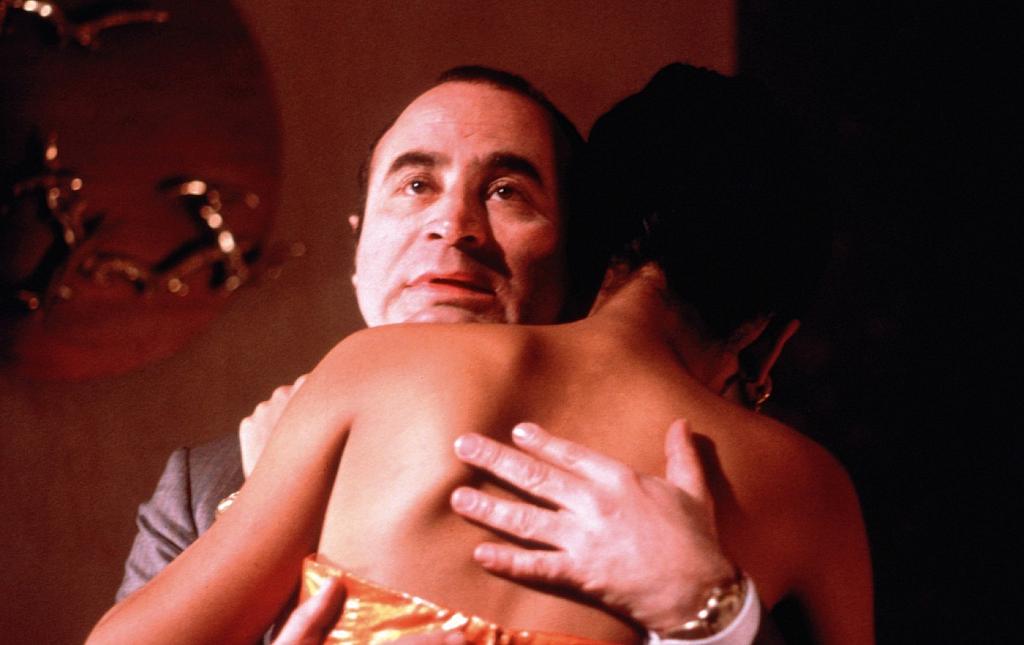
“Mona Lisa” tells the story of a man and woman who start out hating each other before coming to like each other. But unlike most movies that share that premise, “Mona Lisa” delivers in a slap-in-the-face way that it’s not so easy. This is not merely a romance. In fact, it’s hardly a romance. The best way to describe it is to remind of how most of us thought of someone of the opposite sex as not only beautiful and cryptic, but also unattainable. It’s like a crush from afar. Whomever that is, you see that person as a mysterious figure—you don’t know that person’s story or that person’s history, and that notion draws you in further. Only for the most part, you find out more about that person and find that you weren’t very pleased by that person’s personality. But until then, that person is like Da Vinci’s portrait of the Mona Lisa. In “Mona Lisa,” George (Bob Hoskins) feels the same way. His representation of the Mona Lisa is a young, beautiful prostitute named Simone (Cathy Tyson). She’s attractive, mysterious, and unreachable—but who is this person, really?

George is a foot soldier for the London underworld, working for the smooth boss (Michael Caine) who may have been the reason he served a long term in prison. Now that he’s released, and with hardly a way of connecting to his family (including a teenage daughter he never got to know), he is hired by the boss’ henchman to chauffer a young, tall, black, striking local prostitute, Simone. Their first meeting is not hopeful. George is repulsed by her profession; Simone sees him as a cheap bastard. They argue frequently, day and night, until they realize that they enjoy (and are entertained by) each other’s arguments. They form somewhat of a friendship with each other, and Simone sees something in George that could help her with a certain thing. She tells him a story that ends with her subtly asking for help, which he does offer once she’s finished her story. But what he learns causes trouble for himself and Simone.

“Mona Lisa” is more of a drama and a thriller than it is a romance, but more importantly it is an effective character study of George. Here is this conflicted criminal, working for such a sleazeball like Michael Caine’s character, who puts himself back in the underworld even though he should be reformed after a stint in prison. But he still would like to get to know his young daughter, despite his ex-wife’s objections. And then there is his fascination with Simone, as he finds himself able to love. Although, the relationship between George and Simone is purely platonic—there’s not a scene in which they sleep together, which is what you would expect in a film like this. But the main problem is that most of what Simone tells him isn’t true, and she is actually using him to get to someone else that she loves—this upsets George; his feelings are hurt; and worst of all, he doesn’t know how to cope with his feelings. Bob Hoskins was nominated for the Best Actor Oscar for his performance here; it’s easy to see why. He’s brilliant in the role, effectively delivering a credible, sympathetic character to follow throughout the film. He’s ably supported by a luminescent Cathy Tyson, a menacing Michael Caine, and strong support by Robbie Coltrane as George’s friend who gives George a place to stay.

“Mona Lisa” is a great film with solid acting, some good surprises here and there, and a great deal of atmosphere in the way the writer-director manages to capture the essence of the streets of London, both night and day. And it delivers a concept about love that is not only heartbreaking, but even more so, it’s true.

Sweeney Todd: The Demon Barber of Fleet Street (2007)

1 May

sweeneytodd_l

Smith’s Verdict: ****

Reviewed by Tanner Smith

Most films released in 2007 dealt with darker plots, such as “No Country for Old Men” and “There Will Be Blood.” But those two weren’t musicals. Tim Burton’s “Sweeney Todd: The Demon Barber of Fleet Street” is one of the best musicals to come around in a long time, and I’m pretty sure it’s the darkest (and bloodiest). “Sweeney Todd: The Demon Barber of Fleet Street” was originally a Broadway play, and for years I don’t think just any filmmaker would have dared to make a film adaptation until Tim Burton decided to give it a shot. If you know the story, or even if you don’t know the story, you’ll be amazed by this film of great direction, amazing sets, memorable characters, and a great story of revenge.

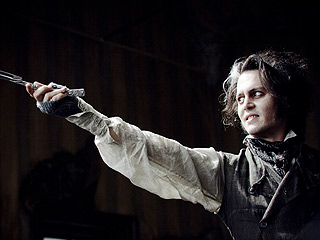
The story—Benjamin Barker (brilliantly played by Johnny Depp in his seventh Depp-Burton collaboration) is a barber living in London with his wife and baby daughter. But when the dastardly Judge Turpin (Alan Rickman) notices his wife’s beauty, he ships him to Australia on false charges to be with her and adopts his daughter. Years later, Barker is a changed man. He’s released from prison and has come back to London to discover that his wife is dead and his daughter is locked up by the judge. He hears this news from Mrs. Lovett (Helena Bonham Carter), who is noted to make the “worst pies in London.” He changes his name to Sweeney Todd and reopens his barber shop right next to Mrs. Lovett’s pie shop. He vows revenge on Judge Turpin and is just waiting to slit his throat. In the meantime, he practices on unworthy throats…

Well, it is a musical. How’s the singing? Well, people may think that Johnny Depp sings in “Crybaby,” but some people forget that wasn’t his voice. We hear him sing throughout the whole movie, and it’s not exactly a big Broadway voice but he doesn’t need one. His acting is unique and now, so is his singing. And this movie never has more than five minutes of no singing. The songs are quite good and very memorable. Stephen Sondheim is the finest music maker, having to keep these songs alive for this movie. The music is amazing and intriguing.

There are also subplots involving a young sailor who falls in love with Sweeney’s daughter and may end up helping getting her back (without knowing who she really is), and a boy who is adopted by Sweeney and Mrs. Lovett that could cause trouble when Sweeney is acting strange, or even more so. And also, we know that Mrs. Lovett is absolutely in love with Sweeney while Sweeney couldn’t care less about she feels. To him, Mrs. Lovett is like a sister to him and she doesn’t understand that Sweeney’s only love is his wife. These are created so we don’t have to see a whole lot of blood throughout the whole movie’s running time, and they work effectively.

We also get a great comic moment from “Borat’s” Sacha Baron Cohen as an Italian rival barber who has a shaving contest with Sweeney. He’s hilarious here, and that’s great comic timing in such a film that has Sweeney slitting the throats of his customers and Mrs. Lovett cutting the remains up and cooking them into her meat pies. Suddenly, she doesn’t make the worst pies in London anymore.

Like most Burton movies, the movie looks so good while also looking quite eerie. Tim Burton has yet another unique style of filmmaking. He’s made London look so dark because this is a dark movie and the character’s faces look so gothic to blend in with the dark surroundings. Burton scores again here and this is most definitely his best film since “Ed Wood.” The acting is first rate. Johnny Depp is such a great actor who has all these memorable roles. He creates another memorable character for his career as the vengeance-seeking Sweeney Todd. And Alan Rickman is game enough to make a role his own. This is the best I’ve seen him act since 1988’s “Die Hard.” And also there’s Timothy Spall as the silly assistant to Rickman’s character Beadle, who’s also very good.

To sum it all up, with Stephen Sondheim’s spellbinding music, Tim Burton’s direction, Johnny Depp’s fantastic role, and a few scares here and there makes this one of the best musicals I’ve seen in a long time. And I guess the blood spurting out of the throats also makes this the bloodiest classic musical I’ve ever seen.

Let the Right One in (2008)

25 Apr

images

Smith’s Verdict: ****

Reviewed by Tanner Smith

I get the feeling that “vampire movie” is a genre. Like any genre, we can try and ignore it but it just keeps coming back, for better or worse. Films like “Let the Right One In” make me optimistic about it, though. Yes, “Let the Right One In” features a vampire, as did “Twilight,” and yes, the vampire falls in love with a human, as does the vampire in “Twilight.” But one of the joys about “Let the Right One In” is how less exploitive it is about the vampire standards than “Twilight.” In fact, the human that the vampire comes to like doesn’t even realize that this strange person is a vampire until more than an hour into the film.

The vampire girl and the human boy are both reaching adolescence (“How old are you,” the boy asks. “Twelve…but I’ve been twelve for a long time.”), but despite their age, this film is not intended for children. It is deadly grim. The deeds these kids perform may even give adults nightmares. The girl has to kill in order to feed on human blood and the boy would like to exact serious revenge against a sadistic bully. At night, he practices by stabbing a pole and repeating what the bully says to him. And then there’s that scene that involves a swimming pool that puts you on edge—I won’t give away what happens in that scene, but having a vampire on your side may come in handy, just so I’ve said it.

The boy’s name is Oskar and the girl’s name is Eli. They are both lonely, strange, and in need of a better existence but of course, nothing is very simple. A great connection and friendship builds between the two. And for us in the audience, the connection moves us—we feel empathy for these kids, we feel sorry for them, and we may not like the dirty deeds these kids perform but understand why they do them.

I haven’t even tried to describe this film, which is very well-made. The setting of the snowy small town in Sweden sets a dark and creepy mood for the whole film and director Tomas Alfredson knows how to stage a scene. He keeps his camera focused on one thing so what happens in the background is what we’d really like to see—it’s what we don’t see that scares us. Consider the scene where Eli’s adult apartment-mate kills a man and fills a pitcher with blood coming from the wound. Do we see the actual act? No. That shot of the victim being killed is obscured by a tiny tree among others near an icy pond. And then there’s that scene in the swimming pool I mentioned earlier—with the scene I just told you about, you’ll understand just how great the payoff looks.

But how can I really describe just how deadly grim this film is? I guess I can’t. But the vampire element is definitely not exploited enough and I love that. This movie is described as a “vampire movie,” but what really is a vampire movie? One about self-discovery and relationships between human and vampire? Or one about exploitation and a heavy amount of lust for blood and sex between human and vampire? What we really have is a relationship that occurs between these two lonely twelve-year-olds who perform deadly deeds and try to get by in this cruel world. I love this movie a little more than “Near Dark,” also a so-called “vampire movie” about self-discovery. Still, “Let the Right One In” features a vampire, and if the term “vampire movie” is in fact a genre now, I can say that “Let the Right One In” is one of the best.

Groundhog Day (1993)

24 Apr

Groundhog-Day

Smith’s Verdict: ****

Reviewed by Tanner Smith

Bill Murray is one of the funniest men…period. In any movie he appears in, he can make us smile and laugh. His deadpan voice, improvised one-liners, and his facial expressions are worth any price of admission. He raced to kill a gopher in “Caddyshack,” joined the army in “Stripes,” and helped catch ghosts in “Ghostbusters.” And now, he’s repeating the same day over and over again in the movie “Groundhog Day.” In this movie, he plays a role that could’ve been played by almost any other actor, but Bill Murray successfully makes the character convincing, funny, and even touching and also helps make the movie magical in a sense.

In “Groundhog Day,” Murray plays selfish, Scrooge-like, Pittsburgh weatherman Phil Connors, who is asked to cover Groundhog Day (February 2) in a small town called Punxsutawney. Nothing special—the groundhog sees its shadow, the townsfolk are upset because this means a longer winter for them, and Phil is miserable, as well as making people around him miserable. This includes his attractive co-producer Rita (Andie McDowell) and cameraman Larry (Chris Elliott). When he can’t go home due to a blizzard, he spends another night in Punxsutawney and when he wakes up…it’s Groundhog Day all over again.

And it will Groundhog Day again tomorrow too…and the same after that and so on. The idea is that for everybody else in town, it’s just the same as before. Only Phil is repeating the same day over and over again. Nothing he does will matter because he will wake up the next day and everything will be the same again, so there is literally no tomorrow for him—he is trapped in the same day, like a time warp.

This is a genius idea, developed by co-writer and Murray’s usual co-partner Harold Ramis (“Ghostbusters” and “Caddyshack”) and put into the situation with Phil. As he figures out what is going on, we follow him throughout. He (and we) realize that he can find out one thing and then use it the next Groundhog Day. He uses this on Rita as a seduction technique in a great scene—he finds out her favorite drink and what she likes to drink to. “I like to say a prayer and drink to world peace,” Phil says. Rita stares at him baffled and raises her drink, “To world peace.” We also realize that he won’t die. He tries many attempts at suicide, and he wakes up and it’s Groundhog Day again. But then, he realizes that he can change himself and become a better person and maybe—just maybe—he can actually wake up to February 3. And even Rita is surprised when one Groundhog Day, she begins to like him.

This is a truly endearing comic fantasy—ingenious, well-acted, and wonderful in the whole element of the time warp. It reminds me of Frank Capra’s “It’s a Wonderful Life,” in which a person sees the error of his ways and realizes what could be if he stuck it out longer (in this case, if he COULD stick it out longer). And through it all is Bill Murray, who is phenomenal as Phil. This is truly one of Bill Murray’s very best performances. He starts out as a Scrooge and becomes a better man towards the end and he’s very convincing in his change. He’s very funny in the first half, endearing in the second, and just great throughout. Also, his relationship(s) between him and Andie McDowell works because it’s low-key—he’s funny, she’s serious, so the only way it could work is if the relationship(s) was low-key.

“Groundhog Day” also delivers a good message. Just because we’re known to be unlikable doesn’t mean we have to stay that way; it’s our choice. And a supernatural force is helping Bill Murray realize that.

The Simpsons Movie (2007)

24 Apr

27simp-600

Smith’s Verdict: ****

Reviewed by Tanner Smith

“The Simpsons” is one of the best TV shows to come around and I’m sure I’m not the only one who believes that. And with “The Simpsons Movie,” here is a triumph. We have waited for this film for a long time and now that it’s here, I am not disappointed. Not one bit. In many ways, “The Simpsons Movie” is a triumph. It’s funny all the way through. And I never thought I would ever say this about “The Simpsons,” but “The Simpsons Movie” is also well-animated. Watch the sequence with the angry mob carrying torches and you’ll see what I mean. The animators spent a long time trying to satisfy fans of the popular TV series and they didn’t disappoint us. I loved the look of this film and I also loved the energy put into it with the script and voiceovers.

Even the Simpsons are surprised to see themselves in a movie. As they watch a movie, they wonder who would be dumb enough to watch something they can get on TV for free. Who would be so dumb? “Suckers.” He’s pointing straight at us.

Of course it has to have a plot but even so, the movie satisfies. It delivers satire with a capital S. On second thought, make every letter capitalized. The EPA (Environmental Protection Agency) has declared the Simpsons’ hometown of Springfield a crisis zone. The lake is polluted and young Lisa Simpson is going door-to-door to convince people to help prevent people from dumping in the lake again. (One house even flees.) Things take a turn for the worse when the lovable dope himself—Homer Simpson—dumps a silo of pig droppings into the lake. The EPA takes action and imprisons the townsfolk in a gigantic glass dome (threatening their lives but what do the government care, right?). Wait until you see who the president of the United States is.

I could easily give away the big laughs of the movie but that wouldn’t be fair. In a way, this movie is like “Airplane.” One gag happens after another, usually one gag funnier than the last. I won’t spoil the biggest laughs in the movie but they feature a skateboarding scene inspired by Austin Powers and a unique way to go fishing. There are more big laughs—those made me laugh the hardest…I think. I was laughing loudly through a lot of this movie—those two scenes made me laugh the loudest, I think.

The Simpsons don’t just become action heroes, though that’s what they become when they race to save Springfield from certain doom. They remain the same American family that we all know and love. Bart is still mischievous and devilishly clever. Lisa is still the squeaky-voiced voice of reason daughter. Maggie is still an accident, sadly, but she finds her worth (hasn’t she always?). Marge is still toughing it out and dealing with her husband’s idiocy. Her voice has yet to improve—but really, does it have to? And Homer Simpson—what a lovable goofball he is. Just watching this guy stand around will bring a smile. Watching him act around, while being voiced by Dan Castellaneta, will always bring a laugh. It’s impossible to dislike him.

What else can I say? I love this movie. I love the biting satire, I love the fact that the animators and screenwriters were trying so hard to make us laugh, and I love the Simpsons themselves. The polished writing and the stylish animation help a lot as well. “The Simpsons Movie” relives the glory days of the great TV show. To those who disagree with me, eat my shorts.

The Kids are All Right (2010)

24 Apr

kids_are_alright_movie_image_annette_benning_julianne_moore_josh_hutercherson_mia_wasikowska_mark_ruffalo_01

Smith’s Verdict: ****

Reviewed by Tanner Smith

(Originally reviewed mid-2010, hence the hopes for Academy Award notice…which it got)

The kids lead somewhat normal lives. One of them has just graduated from high school and is starting off to college soon. The other, younger kid is a well-natured jock whose best friend happens to be the wrong kind of friend to hang around with. But the kid doesn’t know it yet. These kids are nice, well-natured, and like regular kids, they have some issues. The issue they’ve lived with their entire lives is that they are the children of a lesbian couple. They’re half-siblings because each mother gave birth to them with the same anonymous sperm donor used. All their lives they’ve been trying to live normally but it’s hard. They love their moms, nonetheless. But they can’t help but wonder what their biological father is like and who he is.

The kids are 18-year-old Joni (Mia Wasikowska, “Alice in Wonderland”) and 15-year-old Laser (Josh Hutcherson, “Bridge to Terabithia”). Joni is the one who is going to college and has written a paper in high school about donors. Therefore, she could figure out who donated the sperm that their moms took. Laser is desperate—he wants to know who the father is and this may be his only chance. He looks to his sister for help—“I’ve never asked you for anything.” So Joni contacts the sperm bank to track down the father, who happens to be Paul (Mark Ruffalo), a chill, hippie-type gardener who sells organic food at the local market. His persona is like, “Yeah, you know, that’s cool, man.”

Joni arranges for her and Laser to meet with Paul and this leads to an awkward but funny scene in which they sit down and have a talk with each other. It’s not long before the kids want to see Paul again but there’s one catch—he has to have lunch with the whole family, the order of one of the moms. So they do and this sets up a series of complicated relationships between the family members and Paul.

The lesbian couple are Nic (Annette Bening), a doctor who is very strict in the house, and Jules (Julianne Moore, who is unfocused and doesn’t know what to do with herself. They love each other and perform nasty sexual activities, which are not exaggerated but still pretty disturbing to anyone who doesn’t approve of this kind of activity. They watch gay-man-porn. But there is something happening lately. This happens to all adults. They are experiencing midlife crisis. And with Paul around, it doesn’t make matters much better. Jules is already thinking of trying new things. What she tries may jeopardize the lifestyle of the family. The kids may be all right, but the adults aren’t.

The family life may be imperfect but it’s somewhat stable. (At one point, Laser says to the moms he’s going out. One of the moms asks for a hug and Laser scoffs, “Hug her. That’s what she’s there for.”) This is what makes “The Kids are All Right” very convincing. The people in this movie are just regular people. They could be your relatives, your next-door neighbors, your friends. You may know them or you may seem them around every once in a while. This is the kind of independent film about people in the world that reminds me of “Juno.” Both movies focus on people who think they have situations played out by themselves but they don’t really know what to do or how to go through with them. Sometimes they do, sometimes they don’t. But in the end, you feel something for the characters. By the end of “The Kids are All Right,” I felt satisfied that the story unfolded in a convincing way and there are no loose ends.

This is one of the best movies of the year. The cast is absolutely perfect. Julianne Moore is fantastic at playing the complicated Jules, Annette Bening goes as far with the strictness without overselling it, Mark Ruffalo is the best character in the movie (the way he talks and has insights about his own life are outstanding), and Mia Wasikowska and Josh Hutcherson are two of the brightest, appealing, most convincing teenagers in movie history. All of these actors deserve Oscar nominations. The direction by Lisa Cholodenko is sharp and bright—her previous films were “High Art” and “Laurel Canyon.” And the writing is fantastic. I love the scene where the moms confront Laser about what he was doing lately and fear he might be gay. This talk they have with him is greatly written and acted that I wouldn’t be surprised if, just for that scene, this film gets a nomination for Best Original Screenplay. But there are a lot of great scenes—Laser and Paul talking about being buried or cremated, Jules telling Paul that she sees Laser’s expressions in his face, Jules and Nic confronting each other after a revealing moment of truth, the lunch talk the family has with Paul, and many more.

“The Kids are All Right” is a great film—one of the best films of the year, as I’ve said already. I will not call it a “gay film.” This is just a movie about complicated characters facing complicated situations and learning how to deal with them. And with Mark Ruffalo’s Paul, we see a different side of a character we’ve seen before—offbeat yet casual and pleasant—in a movie that deserves Academy Award notice.

Bull Durham (1988)

23 Apr

bull-durham-1988-tim-robbins-kevin-costner-pic-3

Smith’s Verdict: ****

Reviewed by Tanner Smith

1988’s “Bull Durham” could be taken as both a romantic comedy and a baseball movie, but the truth of the matter is that it knows more about baseball than it does about love. And that’s fine with me. It’s probably one of the very best baseball movies I’ve ever seen. It doesn’t merely have a clear intelligence of the game, but also the players’ mindset. And it would make sense—the movie was written and directed by former minor-league player Ron Shelton. His experience shows.

Consider, for example, the scene in which “Crash” Davis, playing for a minor-league team called the Durham Bulls (fictional team, I believe), first goes up to bat in this movie. A masterstroke in this scene—we hear his inner thoughts. He’s thinking of which pitch to take a swing at, but he’s also thinking about a woman he met the other night, and that’s breaking his concentration and practically driving him crazy.

And later in the movie, we also eavesdrop on the pitcher’s inner thoughts, struggling to find the right way to control his pitches. I should also mention that he’s been coached to breathe through his eyelids like lava lizards.

My favorite moment is the hilarious private conversation the players have on the mound during a game—one of the players needs a “live chicken” to lift the curse put on his glove and nobody else knows what to get as a wedding present for one of the players and a groupie (“Candlesticks always make a nice gift”).

This is some, fresh funny writing and there are a lot of scenes like those. It’s very funny, but also insightful.

But the movie isn’t just about baseball—it’s mainly about a romantic triangle. It begins as the Durham Bulls take in a rookie pitcher named LaLoosh (Tim Robbins) for the new season. LaLoosh has a fastball that can hit the strike zone…but only occasionally. There’s a very funny line said by one of the groupies, describing how LaLoosh pitches, right after a sexual encounter in the locker room—but I’m too much of a gentleman to type it for a family magazine.

Anyway, the Bulls hire veteran catcher “Crash” Davis (Kevin Costner), who has been in a lot of minor league teams for years, though never making it to the “Show” (the major leagues), to act as an on-field guide for LaLoosh. It’s not exactly a trusting relationship at first—when they first meet, they’re fighting over a woman they meet at the local bar.

The woman is named Annie Savoy (played by Susan Sarandon) and she’s a lover of baseball and baseball players. She explains in an opening monologue that she’s tried “all the major religions, and most of the minor ones” but only believes in the “Church of Baseball.” She also states that there hasn’t been a ballplayer slept with her who didn’t have the best year of his career. She picks out the two more-promising players of the Durham Bulls this year—Crash and LaLoosh (whom she nicknames “Nuke”). Crash doesn’t give in, leaving the affair to Annie and “Nuke.”

But the problem is Annie is constantly on Crash’s mind.

As the movie progresses, Crash and Annie realize they have similar things in common—they want to help Nuke improve his game, and they can state in great detail the things they believe in and appreciate each other’s principles…more or less. Will this relationship develop into a heavy love affair? One knows there’s one waiting for them.

“Bull Durham” is a sports movie not about winning or losing, but about finding more off the field. It never really seems to matter whether the Durham Bulls are winning or losing. They play the games, they win, they lose, they hang out, and meanwhile there’s an affair between Nuke and Annie, and surprising sparks that fly between Annie and Crash. Things get more complicated when Nuke lets a winning streak go to his head and decides not to sleep with Annie again until the team loses.

All three actors—Kevin Costner, Susan Sarandon, and Tim Robbins—are excellent here. Costner, who at the time was proving his stardom with movies like “The Untouchables” and “No Way Out,” is playing a role that isn’t especially flashy and just plays it straight, making it more effective. Susan Sarandon is attractive and sexy, and her character Annie Savoy is more three-dimensional than you might think. She’s bright, complex, and just needs somebody to love. Tim Robbins is perfect as the goofy rookie pitcher “Nuke” LaLoosh.

Let’s face it, though. With a romantic triangle like the one featured in “Bull Durham,” you’d see much more problems for them to face and eventually, everything would just fall apart. This is not the movie where that happens. Actually, maybe it would happen like that in reality, maybe it wouldn’t. But either way, when all is said and done, “Bull Durham” is a movie. In the movies, we like to believe that love can be found in the most non-fateful ways.

“Bull Durham” is as nonconventional as a sports movie can get. It doesn’t resort to overblown clichés in the baseball scenes. It knows what it’s talking about and it comes from a great screenplay from Ron Shelton, a man who learned from experience. “Bull Durham” is a grand slam.

The Lion King (1994)

22 Apr

images-1

Smith’s Verdict: ****

Reviewed by Tanner Smith

Remember those old Disney animated movies which featured moments that scare little kids (and maybe some older ones too), or at least emotionally scarred them? “The Lion King,” a Disney animated feature released decades after those films, recalls such moments and creates a whole movie with them. One of those Disney animated features was “Bambi,” and everybody mourned Bambi’s mother. Here in “The Lion King,” another young animal character loses a parent. It’s a sad moment. Disney animators can create such appealing animated characters and then have the courage to a) put them in danger or b) kill them off.

“The Lion King” is one of the best Disney animated features I’ve ever seen. It takes elements of “Bambi,” crosses them with “Hamlet,” and turns the characters into lions, a bird, a warthog, and a meerkat (whatever that is). And of course, the makers of “The Lion King” add some ideas of their own.

And also, it adds some very memorable songs. The film features a cute little lion cub named Simba who dreams of being king of the pride one day, as he expresses to his little cub girlfriend Nala in one of the film’s best musical numbers, “I Just Can’t Wait to Be King.” Other great, memorable songs include “Circle of Life,” which establishes the power of the lions’ home and order of the other animals in a great-looking-and-sounding opening sequence. Also, there’s “Hakuna Matata,” sung by Simba’s newfound friends late in the movie, which tells him not to worry about his past. (“Hakuna Matata” means “no worries” in Swahili.) But by far the best song is the film’s love song “Can You Feel the Love Tonight,” by Elton John and Tim Rice. These songs add to the charm of this wonderful movie.

The story is about guilt and redemption. Simba (voiced by “Home Improvement’s” Jonathan Taylor Thomas) is the heir to his father’s throne. Something goes horribly wrong and he is led to believe that he is the cause of his father’s death. So he runs away and lives with a meerkat named Timon (voiced by Nathan Lane) and a warthog named Pumbaa (voiced by Ernie Sabella) to find peace. But letting go of the past isn’t easy.

The cub’s uncle Scar (Jeremy Irons, with his dry British accent) is the one who made Simba feel guilty. He comes from a long line of Disney villains and he’s definitely one of the best. Scar is the farthest from a buffoon. He’s a slimy, conniving, mysterious, evil lion who travels with a pack of laughing hyenas (two of which are voiced by Whoopi Goldberg and Cheech Marin). He kills his own brother Mufasa (voiced by James Earl Jones) and leads his nephew to believe he caused it. This is not a lion to be trifled with. In fact, I don’t know if the scene in which Mufasa meets his demise should even be shown to children under 8. For a film rated G, this film has a rather large amount of violence, including a sequence in which two lions fight to the death. Parents, take that into consideration.

Aside from the drama and the grimness of the story, we get some great comic relief. The hyenas are like angry villagers who don’t get paid enough at their odd jobs. And Timon and Pumbaa are very funny supporting characters, helping Simba get over his problems. How do they help him feel better? By feeding him a grub and singing him a song about no worries.

The animation, as if predictably, is amazing. The best handdrawn animated sequence in the film features a stampede of wildebeests chasing young Simba through a gorge. Amazing, and it looks almost life-like. Disney animators always seem to master handdrawn animation. Remember the ballroom scene in “Beauty and the Beast?” In “The Lion King,” they use lighting and colors to make everything bright and great-looking and doesn’t forget that these characters are not human.

This is truly a great animated film by the Disney studios, telling a tale of redemption and guilt and facing the past. It also adds comic relief and a good deal of fun. The animation is bright, the songs are memorable, the story is great, the characters have depth, and I’d even put “The Lion King” in a class with “Bambi” and that’s a very high class indeed.