Archive | Four Stars **** RSS feed for this section

Margot at the Wedding (2007)

22 Jun

margot_l

Smith’s Verdict: ****

Reviewed by Tanner Smith

Noah Baumbach’s “Margot at the Wedding” is one of those “acquired-taste” films—particularly independent comedy-dramas that either enthralls you with what it presents or makes you angry if not annoyed. And while grittiness and documentary-style filmmaking takes a huge part of the films’ craft, what is mostly singled out is how unlikeable the characters can become. “Margot at the Wedding” does indeed feature characters who say and do mean, hurtful things to each other, and the film has divided critics because of this (I especially remember a 2007 “Ebert & Roeper” review with guest-critic Michael Phillips’ enthusiastic review of the film, followed by Roeper’s quite negative response). Now where do I stand on viewing the characters, and therefore the film?

Well, you saw the “Smith’s Verdict” rating above, so it’s not exactly a mystery that I personally love this film.

Noah Baumbach is the writer-director of “Margot at the Wedding” and it’s evident from his earlier film “The Squid and the Whale” how intelligently he handles the characters and situations he goes through. He doesn’t give the characters (or the actors playing them) one-note roles; they’re fully realized and have some redeemable qualities that can either be ignored or acknowledged depending on how much you’re able to accept them as real people. And since he sees them as real people, he finds it important that film audiences view them as real people; so thanks to specific direction and long, moving shots, a documentary-style of filmmaking is handy.

The characters in “Margot at the Wedding” are a family so dysfunctional that the family in “The Squid and the Whale” (divorced parents and two struggling sons) looks happier by comparison. Nicole Kidman plays the title character, Margot, a bitter woman who writes short stories, cares for her young son Claude (Zane Pais) after an ending marriage, and is, on her worst days, a neurotic, self-important bitch. It’s clear that in order to keep her own unsteady ego, she constantly hurts and insults those closest to her—even her own adolescent son, who does nothing to hurt anybody and is probably the most innocent character in the entire movie. (Watching this movie, I felt the same sympathy for this kid I did for the teenage son trying to survive a broadly-crazy family in “Arrested Development.” This kid does not deserve the type of mental scars parents’ battles can bring.)

Margot and Claude come to the Eastern shoreline family house of Margot’s sister Pauline (Jennifer Jason Leigh), who is about to marry Malcolm (Jack Black). Already, this reunion between siblings is sensitive and it only starts to get worse when Pauline confides in Margot with a secret: she’s pregnant. So of course, Margot tells Claude who in turn tells Pauline’s daughter Ingrid (Flora Cross) and her teenage babysitter Maisy (Halley Feiffer), and Pauline has to tell Malcolm before he hears it from someone else. And of course, because Margot is in the middle of separating herself from her husband (John Turturro), she starts an affair with Dick Koosman (Ciaran Hinds), Maisy’s father. Oh, and because Margot can’t cause enough damage, she constantly states that marrying Malcolm is a mistake, thinking him to be a loser, despite everyone else, including Claude, seeing him as a nice good-guy type. And then she snaps at the rude behavior of Pauline’s next-door neighbors, which starts another conflict.

Yes, it’s clear that Margot is mostly an unlikeable, fixated, selfish woman who manipulates her family and others around her, with Pauline being the butt of manipulation for the most part. Her positive qualities are her genuine love for her son (despite a questionable decision later in the film) and at times a certain respect for her sister—if she wasn’t going through a failing marriage, she’d probably be happy for Pauline and more respectful for Malcolm (though to be fair, Malcolm does have a flaw that is revealed midway through the film).

It’s brilliantly ironic that the happiest occasion—a wedding—provides the course of problematic, emotional scarring for this dysfunctional family. It’s almost like an opposite version “National Lampoon’s Vacation” movie; drained of energy, showing the real deal, and hardly any room for compromise. Margot is a mother who is blatantly honest in her observations and hurts those around her, whether intentional or not, and for the most part it is, just so she can come off as “sophisticated.” This is the kind of thing that Baumbach has to be praised for—showing skill in leaving discomfort with realistic situations and characters who talk like natural people would talk. Sometimes, there’s wit; other times, there’s honest truth; mostly, it all sounds very natural. It’s as if Baumbach knows to draw the fine line between appalling and truthful, and at times you get laughs from the darker wit-aspects.

Kidman delivers one of the best performances of her career, showing no fear in making Margot as pathetic as she doesn’t like to believe she is and somehow finding a way to show that the character is not a one-note caricature—there are times when she does care for those around her. Jennifer Jason Leigh presents an appealing Pauline, who is a nice woman but also flawed herself in how she defends herself from Margot’s remarks. And you really buy Kidman and Leigh as sisters, as they bicker but also have genuinely-sweet moments together when there’s nothing to fight about. The supporting cast is good, especially the young actors who deliver personality and appeal. But Jack Black, usually known for broadly-comedic roles, is probably not as successful as he could be in a role like Malcolm, but he’s not terrible at all—it’s the quiet, low-key moments that he’s able to pull off, while he can’t quite handle the louder moments.

Like I said, people will either get into “Margot at the Wedding” or you’re put off by the Margot character and how good Kidman is at making her unlikeable. With an unhappy universe in which the film takes place, is it effective? For me, it is. It spoke to me and I admired it for the characterizations and craftsmanship…

I’m just thankful Margot is not my mother.

Once (2007)

21 Jun

once-440

Smith’s Verdict: ****

Reviewed by Tanner Smith

John Carney’s “Once” is a “musical” in the most nontraditional meaning possible. For one thing, it tells its tale while grounded in reality so that the usual corniness and improbability found in “traditional” musicals are nowhere to be found. And second, the music/songs come naturally, so that occasionally characters will play a certain song all the way through, but in a reality setting. And strangely enough, all of the songs serve as part of the storyline. In that case, then, it’s one of the most intriguing musicals I’ve ever seen. Although, I don’t think I want to call “Once” a musical. Instead, I’ll just call it what it is: a damn good film.

The minimalist plot focuses on the relationship between two people in Dublin, Ireland. Those characters are an Irish street guitarist (Glen Hansard) and a Czech flower saleswoman (Marketa Irglova). She hears some of his songs and notices his true talent, and they start to spend time together. She also plays piano and accompanies him in singing and playing a piece called “Falling Slowly” in a piano shop. It’s the start of something good, but their relationship is mainly platonic, as he is trying to get over an old girlfriend who left him to move to London, and she is married but has left her husband for a better life for her child. Both connect very well through music. They play music together, he plays her a few tunes, she comes up with lyrics for one of his soundtracks, and she moves him forward to recording a song at a studio, which is what they attempt to do.

All of the songs are memorable and help to move the story along and bring insight into the characters’ lives. For example, the lyrics to “Falling Slowly” state a lot about what the characters have gone through in their lives—singing it together to one another makes it all the more intriguing. That song, by the way, is my choice for the best one in the movie (then again, I’ve always known that—I first heard it when it was performed on the televised 80th Academy Awards, where it won Best Original Song), although another song, “When Your Mind’s Made Up,” is great as well.

This relationship between these two characters is very sweet and well-done, and the actors playing them display a great deal of chemistry. (And they’re talented musicians too, which is an important quality for this craft.)

I mentioned that “Once” is as nontraditional as a musical can get. It also has a low amount of choreography, as opposed to old-school musicals that rely on a heavy amount. Instead, “Once” tells its story in a documentary-style, with tracking shots, awkward closeups, shaky handheld shots, and zooming in and out. At first, I found this distracting, but I never lost the illusion that I was there with these people. Just as I never lost the illusion that there was real heart and passion put into “Once.” It’s a genuine treasure of a movie.

Before Midnight (2013)

16 Jun

images

Smith’s Verdict: ****

Reviewed by Tanner Smith

Eighteen years ago, in “Before Sunrise,” Jesse (Ethan Hawke) and Celine (Julie Delpy) met in their early-20s and were only able to spend one night of conversation and romance. Nine years later, in “Before Sunset,” they were reunited, realizing their mistake of never sharing ways of contact, and thinking this is a second chance for them to be together. That film ended with a delightfully ambiguous ending, though with most of us leaning towards the possibility that they do ultimately end up together. These were two nice, likable people who liked each other and we, while watching them, enjoy their chemistry and could listen to them for another hour-and-a-half. And granted, that extra hour-and-a-half is given to us…nine years later, but still it’s nice to catch up with these two people.

So, nine years since “Before Sunset,” we meet yet again with Jesse and Celine in “Before Midnight.” There’s an indication that every nine years, director Richard Linklater and co-writers Hawke and Delpy will create another “Before” story that will catch up with these two characters in their relationship. We could see them grow old together and it’d be fine because they’re both so appealing together.

However, in “Before Midnight,” that appeal is not entirely seen anymore. This is especially true if this third film is your introduction to the series. To be honest, I think that if you watch this film as a stand-alone story, you’d appreciate more of the craftsmanship and acting than the characters themselves and their relationship. Let me explain—Jesse and Celine are still together and have been for nine years (and they have two daughters and live in Paris, France), and so, instead of the usual nonsense they love to talk about, they instead bicker about issues involving certain things in their lives. And when that happens, and it does get very, very rough as the film reaches its final half-hour, you start to wonder whether or not you want to listen to them anymore—the appeal that was present between the two in the previous films is now gone at this point, as their argument gets more and more ugly. They’re like a married couple—problems that they don’t know how to deal with that they have to talk about, which make them almost seem to hate each other while continuing to talk about them. Will something bring an end to it, will one be able to make amends with the other, is the spark between them still present or is it gone—how will this argument end?

I’m getting ahead of myself here. “Before Sunset” had Jesse and Celine reconnected with each other after nine years of separation. In “Before Midnight,” they’ve spent the past nine years together. Like any long-term committed couple, they have much difficulty coping with life with each other. They’ll sometimes talk a little nonsense every now and then, but there’s a hint that the relationship is harsher than they thought it would be. Happy days, for the most part, are behind them.

Much like the previous films, everything seems very natural in a film that is mostly composed of dialogue. All of these are driven with dialogue throughout very long takes, giving more of the illusion of eavesdropping than arguably any other movie that attempts to be very truthful. It helps that Hawke and Delpy themselves co-write the screenplay along with Linklater, and because they know their characters so well, they’re able to improvise in their conversations onscreen. Linklater simply lets the camera follow them as they interact naturally—a simple yet effective move.

The issues they deal with seem very real. With Jesse, in particular, it’s the feeling of resentment after divorcing his ex-wife to be with Celine, thus not seeing his 14-year-old son from the previous marriage as much as he wants to. He wants to move to Chicago to be closer to him and not miss any important moments that a father should live for; Celine has a new job to think about, and also is not particularly fond of moving away from her home. This leads to the centerpiece conversation, which is essentially a heated argument between Jesse and Celine in a hotel room. It’s quite ugly and not entirely appealing, but it is all too real. This is a couple’s conflict with a very natural feel that can’t be denied. You get the feeling every couple has been through this. And here, having known Jesse and Celine from this “Before” series, there is a real tension of whether or not this argument will be the end of this relationship.

Yes, “Before Midnight” is certainly the darkest tone of this film-series. It’s as realistic as the previous film, but for different reasons. Jesse and Celine may have met in a pleasant chat, but long since then, their relationship has been reduced to bitterness that can come with real life. Sometimes the truth hurts, and in films, it can be told in a powerful way. As a result, “Before Midnight” may not be the most appealing of the series in that sense, but it is all too effective.

Will there be another “Before” chapter in 2022? I wonder.

Ed Wood (1994)

12 Jun

Ed-Wood-007

Smith’s Verdict: ****

Reviewed by Tanner Smith

Moviemaking is a pure art. Why should people in Hollywood be in it just for the money? Why not the joy and storytelling of the actual thing? Moviemaking should be about filmmakers appreciating the art and joy of what they do.

That’s why Tim Burton’s comedy-drama biopic “Ed Wood” is a true delight—a wonderful film based on the life-career of filmmaker Edward D. Wood, Jr. If you’re not familiar with that name, he was well known for making some of the worst and most laughable movies of all time, such as “Glen or Glenda” and “Plan 9 from Outer Space.” But Ed Wood didn’t see them that way when he was making them. He just had stories to tell—somewhat weird, offbeat stories—and wanted to create them on film. He loved doing what he does and despite the roadblocks put in his way, he didn’t give up.

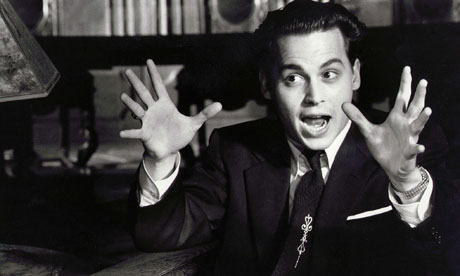
One of the best things about the movie “Ed Wood” is that the title character is played with enthusiasm and energy by Johnny Depp as a 30-year-old enthusiastic, slightly weird optimist whom we can learn to root for. Watching this guy, we don’t care that he’ll make some pretty bad movies, and some bad decisions to make them. We just see him doing what he loves to do. Johnny Depp definitely succeeds in making this guy likable and capturing the true essence of who this guy really is. The character isn’t portrayed in a mean-spirited way and that is one of the many joys of this film.

As the movie starts, Ed is at a premiere party for one of his bad productions (this is a stage play). The scene is laughably bad with the strange dialogue by Ed’s own crew and the lame special effect used in the background. Then, the scene cuts to Ed and his friends celebrating but then reading a negative review towards the play. But Ed, always the optimist, states, “We can’t let the negatives rule over the positives!” Then, once that is done and we see Ed at home, with his girlfriend, and looking for new projects, we see him as a likable character right then.

The movie features Ed as he goes into filmmaking and creates three projects that will become cult classics nowadays—“Glen or Glenda,” “Bride of the Atom,” and “Plan 9 from Outer Space.” Who does he get to play the lead parts in the movies—Ed’s friends, his girlfriend, people who paid him money to get them started in the first place, and the old movie star Bela Lugosi, best known for “Dracula.” He’s really old but Ed, still a big fan of his, knows he can still act. So, he and Bela become fast friends and Ed gives him a part to jumpstart his career again. The relationship between Ed and Bela is handled nicely and believable. Bela is played by Martin Landau, under a lot of makeup, and it’s a good, tough, eerie performance to pull off—he does.

One of the strangest things about Ed is that he always liked to dress in women’s clothing. His girlfriend Dolores Fuller (Sarah Jessica Parker) is always wandering why some of her clothes are missing. He finally reveals the truth when he makes a movie about a transvestite—“Glen or Glenda.” And he never shot a second take, saying that the first take was “Perfect!!!” Even in the scene where a wrestler-turned-actor named Tor Johnson (“The Animal” Steele) has a bit of trouble going through a door, he still says it’s perfect. “It’s fine—it’s real.” I guess he just liked to film shots.

“Ed Wood” is filmed in black and white. But don’t let that stop you watching it. The black-and-white aspect is appropriate because it captures the zaniness of the idea and it traditionalizes the Ed Wood pictures, which were filmed in black-and-white. Then, for those who have watched the Ed Wood pictures, the scenes in which the movies are being created are satisfying. One of the best moments in the movie involve Ed’s actress asking which color dress she should wear; one of the producers says he’s color blind but he likes the “dark-gray one.”

This movie could have been called “Worst Director of All Time” but instead, it’s called “Ed Wood” because the movie celebrates him more than it mocks him. Johnny Depp does an extraordinary job at playing the filmmaking optimist and proves himself to be one the best actors of our time. He just finds the right balance of making this guy likable and a little weird as well. Also, the actors playing the original characters from back in the real Ed Wood’s day look remarkably like their counterparts—Bill Murray portrays Ed’s openly-gay friend Bunny Breckinridge known as the “Ruler” in “Plan 9,” Max Casella and Brent Hinkley portray Ed’s reliable production assistants, Jeffrey Jones plays local psychic TV entertainer Criswell, and Lisa Marie is Vampira of that old “Vampira Show.” Once again, Martin Landau gives a striking resemblance to the real Bela Lugosi with a terrific makeup job by Academy Award winning makeup artist Rick Baker.

Director Tim Burton, best known at the time for directing “Beetle Juice,” “Batman,” and “Edward Scissorhands” (also featuring Johnny Depp as a man named Ed), as well as for producing “The Nightmare Before Christmas,” has always been known for making unusual yet visually and virtually intriguing projects with characters that some people find touching and fun. Ed Wood is a character that all people will find touching and fun. He’s a young energetic filmmaker who is obsessed with Hollywood. I just love the scene in which Ed is ticked off during one of his productions—two stiff producers want to do things their own way—and Ed meets Orson Welles (Vincent D’Onofrio), who tells him that “visions are worth fighting for”, as encouragement.

But Ed also just happens to dress in women’s clothes sometimes. At one point, someone asks him, “Are you a homosexual?” He proudly replies, “No, I’m a transvestite!”

“Ed Wood” is one of my personal favorite films. It’s a great movie that should be required viewing for every film school because it’s about a guy who loves what he does and will do anything to get a movie done. I mean, I’m not saying, “Hey, go out and make the worst movies ever made,” but rather, “Follow your dreams—don’t let them get away from you.”

The Dark Knight (2008)

29 May

2008-the-dark-knight-6

Smith’s Verdict: ****

Reviewed by Tanner Smith

If I thought Christopher Nolan’s “Batman Begins” was one of the darkest (and very best) superhero films I ever saw, then I hadn’t seen anything yet. “The Dark Knight” is the follow-up to the film that represented Nolan’s new look at the dark, harsh “Batman” universe, and to get it right out of the way, this is not just one of the best sequels I’ve ever seen; it’s also the best superhero film I’ve ever seen. I don’t even want to necessarily call it a “superhero film.” For a film about Batman, this film is unbelievably tough, powerful, adult, moody…and oddly enough, that all works in the film’s favor. Aside from being extraordinarily well-crafted in story and execution, the tone and staging of “The Dark Knight” reminded me of a Caped Crusader version of “The Godfather,” in terms of uncompromising actions and consequences. I mean it—it’s that great.

“The Dark Knight” is a film about power, chaos, hope, deceit, selfishness, actions, and consequences. It’s a deeper film than one might have expected from a film such as this—not that the original Tim Burton film or Nolan’s “Batman Begins” weren’t dark; it’s just that apparently, they weren’t this dark. It’s the kind of film that provokes thought and leaves you stunned by everything it had to offer. It seems as if Nolan figured that the origins of Batman were already spelled out in the other film, and now it was time to go all out and give him a story that builds upon solid themes and concepts that were implied before.

Batman is a symbol of Gotham City and people’s great hope whenever trouble is near. Although, there are debates about whether or not Batman is a hero or a menace, and it doesn’t help that his presence influences “copycat Batmen” who wear similar costumes, but carry rifles and sport hockey pads. Crime bosses are on edge because of him, which serves as a good purpose for the city’s new D.A., Harvey Dent (Aaron Eckhart), to take them on. Dent is the White Knight to Batman’s Dark Knight—he doesn’t have to wear a mask and knows how to push someone’s limits and handle himself as well. He’s an ideal hero for Gotham City. Thanks to a meeting together brought upon by incorruptible police lieutenant Jim Gordon (Gary Oldman), Dent and Batman know they’re on the same page in a crusade to stop crime, so they do their parts in order to continue.

But a new threat has made himself known in Gotham. Enter the Joker (the late Heath Ledger in his final film role); a sadistic psychopath with as much taste for theatrics as Batman, only he dresses like a clown and keeps a flamboyant personality that also reads sadism and madness. His mission as the new mob enforcer is to spread anarchy and chaos throughout the city. Knowing Batman stands in his way, he demands that he remove his mask and turn himself in, or else many people will die at his hands.

Bruce Wayne (Christian Bale), Batman’s human alter-ego, is more arrogant than before, but that’s just a cover for everyone around him. The only people he confides in are his butler, Alfred (Michael Caine), and Assistant D.A. Rachel Dawes (Maggie Gyllenhaal, replacing Katie Holmes). Through them, he acknowledges that things are getting even more out of control now that he has all of these duties to handle, and especially now that he must reveal himself as Batman or people will be killed by the Joker. And the Joker does keep good on his word, making things even more complicated and painful.

This is not a superhero film in which despite everything being thrown at the hero, everything turns out right in the end. Mostly, everything just goes wrong, and even more so as the situation continues. Batman may be a heroic figure, but he’s not perfect. He has his flaws and he can’t save everybody, which is especially true in the cases of some important characters. No one is safe in this movie; there’s danger all throughout and consequences for every action, whether they be your own or not. This is what differentiates “The Dark Knight” from pretty much every other Batman film, in that it’s bleaker with hardly any compromises in how situations occur. It’s grim and unpredictable.

Batman is more intimidating than ever and his presence says a lot about what he represents and what he’ll go through to fight for it. He doesn’t take any bull from anyone, even from the city’s most psychotic villains. I won’t say anything about the growling voice that everyone seems to make fun of, because really, it does work at delivering words of menace when they’re needed.

(At this point, I’d like to issue a SPOILER ALERT!)

Anyone who knows the name “Harvey Dent” before seeing this movie already knows that Dent becomes the villainous Two-Face. This becomes an important transition midway through the film, as Dent does become Two-Face as the result of an incident that (SPOILER ALERT!) takes the life of Rachel, because Batman could only save one of them. With half of his face horribly burnt, Dent’s personality changes as well. He’s out for vengeance against those who betrayed him, and goes through many lengths to do it. And this man was supposed to be Gotham’s new hero. This is all very powerful stuff, as he transforms into the very hateful criminals he was trying to protect Gotham from; but due to deceit and false hopes for the city, he only becomes no different than the rest of them. It’s a tragic portrait, and it’s also even more thought-provoking when you realize that this is who Batman could have become if Bruce Wayne were corruptible.

(END OF SPOILER ALERT!)

“The Dark Knight” gave movie audiences a new, truly-intimidating villain in the Joker. This villainous character has already made himself known in so many Batman tales that it seemed inevitable that he would show up to battle Batman. But this representation of the Joker, portrayed by Heath Ledger, is just excellent. Ledger may not have been people’s first choice to play the role, but you never see Ledger in this performance—you only see the Joker. The Joker is not only darkly funny, but he’s also menacing and very scary. He may look like a clown, but there is no humor with him whatsoever. This guy is vicious and twisted, and worst of all, intelligent and enjoying every minute of what he does.

The scariest scene in the movie is seen through home-video footage of the Joker as he tortures and interrogates one of the Batman impersonators—the realism of the footage and the sickness of the Joker will make any audience member silent minutes after this scene is over.

But what about the action? While “Batman Begins” was a bit annoying in its camera-shaking, “The Dark Knight” delivers its action with swift camera movements so that everything is seen and admired. The action itself is exhilarating and some of the best I’ve ever seen in a film. The best action scene comes midway through the film—it’s a car chase through the streets of Gotham, and the situation is made even more intense in that it’s also a race against time for Batman to save somebody. The editing isn’t as quick as most action films like to do; it just shows the action head-on and puts the viewer right in the middle of it.

Oh, and there are also new, improved Batman-gadgetry, invented by Q-like Lucius Fox (Morgan Freeman). This includes a type of sonar-invention that allows Batman to keep track of everyone in the city via their own technologies. Even Fox can’t help but think that this is wrong on so many levels.

Christopher Nolan has crafted a masterpiece with “The Dark Knight.” It’s strange about how a film about a man dressed as a bat can have the same amount of gravity as a crime thriller such as “The Departed.” But with a clear vision of concepts and ethics, a series of masterful action sequences, an even-more-complex hero, quite possibly the most memorable movie villain in a long time, and even more elements that I don’t even think I mentioned in this review, “The Dark Knight” is the best superhero film I’ve ever seen.

Batman Begins (2005)

28 May

images

Smith’s Verdict: ****

Reviewed by Tanner Smith

“People need dramatic examples to shake them out of apathy. I can’t do that as Bruce Wayne; as a man, I’m flesh and blood. I can be ignored, I can be destroyed. But as a symbol…I can be incorruptible.”

That’s a crucial line of dialogue said early on in Christopher Nolan’s “Batman Begins,” and yes, it is said by billionaire playboy Bruce Wayne to his loyal butler, Alfred. Wayne has traveled the world and seen many faces of evil and corruptibility. Now he returns to Gotham City to introduce a new image in the name of justice, which is of course…Batman.

As the title suggests, “Batman Begins” digs deep into the origins of Batman and the psychology of Bruce Wayne. This is the Batman movie that people have been waiting for, after two movies directed by Tim Burton and two others directed by Joel Schumacher. Burton’s movies were very dark in tone, but they focused more on the villains than on the Dark Knight himself (which I thought worked extremely well to the first film’s advantage, but that’s another story) and Schumacher’s movies were much, much campier. Fans hated his “Batman & Robin” and it seemed as if the story of Batman was dead. Christopher Nolan took things from scratch about eight years later, and decided to tell his version from the eyes of Bruce Wayne/Batman. While not exactly having the noir-look of the original Burton film, Nolan’s “Batman Begins” is still very dark, very tense, and very exciting. “Batman Begins” is a serious, gritty, hardcore version of a superhero origin-story. It shows the origins of Batman in an unbelievably realistic way (well, realistic for its world, anyway).

As the movie opens, Bruce Wayne (Christian Bale) is rescued from an Asian prison by a vigilante group known as the League of Shadows, led by Ducard (Liam Neeson) and Ra’s Al Ghul (Ken Watanbe). We see in flashbacks why Bruce is haunted by his past, as is revealed when he falls into training with the League. He fears bats due to childhood trauma and has watched his parents be gunned down and killed by a street thug; years later, as the culprit is finally put on trial, he attempts to kill him, but someone beats him to it. Now he has been wandering the world, picking fights wherever he can until he is picked up by the League of Shadows, whose main purpose is to restore balance to a world that seems inconsistent due to the high rise of crime. After much training under Ducard, Bruce becomes a powerful weapon. But once he sees that…well, the League of Shadows is freaking demented in their morals and ethics (according to a line of dialogue, they “burned London to the ground”), Bruce bails and makes his way back to Gotham and bring an end to the city’s crime wave. But he decides not to do this as Bruce Wayne, but as a menacing alter-ego. Enlisting the help of his butler Alfred (Michael Caine) and an inventor who has some ingenious tools and contraptions (such as what will be the Batmobile), Bruce becomes Batman, with a black costume & mask and an aerodynamic cape. He also enlists the help of a good cop, Lieutenant Gordon (Gary Oldman), in his crusades as Batman, and makes two enemies in the process—the crime lord, Carmine Falcone (Tom Wilkinson), and a crazed psychiatrist (Cillian Murphy), who has a drug that makes people go crazy (he uses this to be his clients in his asylum). Oh, and he’s also known as the Scarecrow.

Elements of Batman’s history have been reconstructed by Nolan and co-screenwriter David Goyer so that it all becomes the film’s focus—how the Caped Crusader/Dark Knight came to be. Things were sort of hinted at in the other movies, such as the deaths of Bruce’s parents, but we see everything in great detail—how Bruce became a fighter; where he got his weapons and armory; where the Batmobile came from; why Bruce chose bats as a symbol of fear; how the Batcave was created. More importantly, there’s a clear understanding of Bruce Wayne. We know who he is and why he does all of this. In the Burton film, it was hinted at. Here, you know everything. While to me that may seem like an inconvenience, as I felt in the original film that less was more, but here it’s all solidly handled and very riveting.

Christian Bale owns it as Bruce Wayne/Batman. It would have been hard to rival Michael Keaton’s definitive Batman, and it’s an even bigger risk seeing as how this is essentially all about the Bruce Wayne character, but Bale is very good here. He’s sympathetic and a solid heroic figure to follow and root for. And he also makes Batman his own performance as well (though that gruff voice gets a little tiresome after a while).

Bale is more-than-ably supporting by an excellent supporting cast. The cast members in this movie—Michael Caine, Morgan Freeman, Gary Oldman, Tom Wilkinson—don’t seem to be playing their roles as if they knew they were in a “superhero movie.” They get the reality of this world, and play their roles straight to great effect. Oldman, in particular, is surprisingly convincing as Lieutenant Gordon, who, hey, could one day become Commissioner Gordon if he keeps on Batman’s side.

The story is very involving and gets even more so with a hell of an evil scheme, devised by the Scarecrow, to vaporize the city’s water and insert the “crazy drug” in it so people will inhale it and go crazy. All depends on how fast and easily Batman will be able to stop a fast-moving elevated train carrying the drug from getting to the center, which happens to be Wayne Tower. This scene, along with many other action scenes, are tense and kinetic. This is another Nolan strength—keeping the action adrenaline-fueled and knowing how to keep it from being boring or repetitive.

Oh, and there’s also Rachel Dawes (Katie Holmes), a lawyer who was Bruce Wayne’s childhood friend and now has the possibility of being a romantic-interest. At first, I thought her character was superfluous, but she does grow to become essential to certain things that are what Batman is meant to do, and meant to protect. And it’s obvious her role is meant for further development in a sequel (lucky there was one, but I’ll get to that some other time).

In addition to being entertaining, “Batman Begins” works on a dramatic level. The psychological elements involving the Bruce Wayne character work perfectly and the film is consistent in tone. The characters are strongly-developed. The look is suitably dark. The story is very strong. The action is far from distracting. “Batman Begins” is a strong film—one of the best involving a superhero I’ve ever seen.

And it would only get better one movie later, but that’s another review…

Blood Brothers (Short Film)

25 May

481670_138465319634100_996633824_n

Smith’s Verdict: ****

Reviewed by Tanner Smith

“Blood Brothers” is a half-hour-long short film with an interesting backstory. The main question I had to ask myself while seeing it (at its Little Rock Film Festival premiere) was whether or not the film turned out to be as interesting as how it was made. Before I get into the actual review of “Blood Brothers,” I feel an obligation to share what I know of the backstory:

Two young, independent filmmakers—Jason Miller and Seth Savoy—met and associated with many different film projects in Central Arkansas (most of which made in association with the University of Central Arkansas’ Digital Filmmaking Program). The two, despite their differences in vision and directing (and age difference, as Miller is about seven or eight years older than Savoy), became very good friends and effective creative-partners. Savoy announced he would be moving to Chicago to attend Columbia University to further go into the art of filmmaking, and so the summer before he left, he and Miller co-directed a short film called “The Backland’ (which is still in post-production, due to complications). But as Savoy moved away, and he and Miller kept in touch online, the two came up with the idea to continue making films together. So they had an unusual plan to make two parts of the same film. See if you can follow this—the two would write their own stories and link them as two separate stories for one whole screenplay; then they would collaborate on how it would seem like they were really making the same film in a way; and whatever they film (Miller in Arkansas, Savoy in Illinois) would be sure to connect to an ending in order to make it whole, for sure.

So basically, what Miller and Savoy had here was an ambitious project that required them to collaborate from their own living environments. And so, “Blood Brothers” was the project that was created—two different directors, two different casts/crews, and two different parts of the country. Miller and Savoy put their heart and soul into this project and went all out to make it the best damn film they could make together, despite being separated from each other. (And reportedly, according to Miller, collaborating on this project made the friendship between him and Savoy even stronger—“I’d say we were good friends before he left for Chicago; we’re great friends now.”)

If I’m going to go into “Blood Brothers,” I suppose it’s important to present it with the two guys’ angles.

Miller filmed his part in all over Arkansas (one part Northwest AR, another part Southwest AR, other parts Central AR) with his own crew and his own style of filmmaking. Set in a rural Southern area, Miller’s story feels quite gritty in its surroundings. The environment gives it a sense of dark, deep perception, much like a Southern Gothic tale. (It’s also worth noting that Miller’s main strength as a filmmaker is the way he allows his scenes to flow naturally.) His story involves a troubled young man, Travis Ray (Jeff Fuell), who returns to his Arkansan hometown, long after he and his brother were driven out by the local drug operation. Living a life of shame and misery, he comes back to town to take action in an attempt to hopefully make everything back the way he wants it to be. He kidnaps the drug kingpin, Marty (Kenn Woodard), and runs his own show. However, things don’t really work out the way he hoped, as meanwhile, his brother is having his own troubles in Chicago…

And speaking of which, Savoy filmed his part in Chicago with his own crew and his own style of filmmaking as well. (And for among other things, give Savoy credit for casting an Arkansan actor—Kyle Wigginton—as his story’s protagonist.) Shooting in the Windy City gives quite an effective backdrop, particularly when Savoy plays certain scenes near large, glass windows in areas several stories high (and especially in a pivotal scene that takes place on a high rooftop). This piece is somewhat more action-oriented and has the sense of a crime thriller. (It’s also worth nothing that Savoy’s strength as a filmmaker is the symbolism he uses often—some subtle (like the use of color), others not so much (such as a heroic figure walking in front of a cross in slow-motion); all in all, he has a knack for this style.) This story (or rather, side-story) involves Travis’ brother, Michael (Wigginton), who has put his previous life in Arkansas behind him and is now leading a clean, successful life in Chicago. He proposes to his girlfriend, Laura (Jessica Serfaty, bewilderingly beautiful), she says “yes,” and it seems like life couldn’t be any better. And wouldn’t you know it—it instead takes a dark turn, as he is visited the next day by a thug named Tony (Sean Athy) and his gun-wielding henchman, both of whom work for Marty. They kidnap Laura and interrogate Michael, demanding to know why Travis is back in Arkansas and why Marty is missing. While being held captive and with lives at risk, Michael must think of a way to fix this situation.

There’s an interesting contrast between both parts of this story, which does ultimately add up and bring it all together at the end. That contrast not only comes from the surroundings of each of the two protagonists, but also in the structure, in that Travis is hoping for things to be the way they were and is now holding someone prisoner, while Michael is happier now that things aren’t the way they were and is being held prisoner because of Travis’ actions. The characterizations of the two men are both solid, as you feel the pain that Travis is going through, especially when you hear how much worse things have gotten for him after he left his hometown. As for Michael, he starts off as somewhat ordinary, but when his backstory involving his brother comes into place, you can see how complicated the character is. He too has been through a lot in his life, and while he would rather forget his past and move on, too many things get in the way that just won’t let him. Both actors—Jeff Fuell as Travis and Kyle Wigginton as Michael—do terrific jobs at playing these roles.

So back to the question I mentioned earlier—is this film (which runs about 32 minutes) as interesting as the story behind it? My simple answer is that as Jason Miller and Seth Savoy set out to make a film with this much ambition and skill (not to mention, distance), this is a hell of a film. Despite being of two different minds, locations, and narrative elements, it’s gripping throughout and well-crafted by both directors. To make a film like this would have been tricky, but Miller and Savoy were clearly each on the same track in making this film, and the results are just captivating. “Blood Brothers” is a solid success.

The Purple Rose of Cairo (1985)

25 May

images-1

Smith’s Verdict: ****

Reviewed by Tanner Smith

What if you saw the same movie so many times that one of the characters (who is practically the main reason you keep seeing this movie in the first place) actually starts to notice you? That’s what happens to Cecilia (Mia Farrow) in Woody Allen’s delightful fantasy-comedy “The Purple Rose of Cairo.” During the Great Depression era, in a distressing time in her small-town life, Cecilia finds solace in the cinema, feeling the magic of the movies. The movie she goes to see is “The Purple Rose of Cairo,” an adventure movie about an archaeological explorer named Tom Baxter. After Cecilia sees the film several times, in a fabulous scene, Tom notices her seated in the audience, breaks the fourth wall, and starts up a conversation with her. He has apparently noticed her watching all this time, and so he literally steps off of the movie screen and into the real world, as Cecilia decides to show him around town.

This is fantastic! It’s great wish-fulfillment for movie buffs alike; what if this happened to you? What if your favorite actor/actress (or rather, your favorite actor/actress playing a character) suddenly emerged off the silver screen just to talk to you and be with you? “The Purple Rose of Cairo” wants to play that, and the way it goes along with this idea is thought-provoking, fun to watch, amusing, and sweet. This is a movie that truly loves movies and is made with skill and delight by the great writer-director Woody Allen.

The movie has fun with the simplicity of this woman and this movie character in how they can develop a romance with no setbacks whatsoever. Tom knows that things aren’t so simple as in the movies, but his presence is a relief to Cecilia who sees him as a way of making her bleak, unfair life feel better. There are problems, though. In the movie’s funniest subplot, the rest of the characters in the fictional film are still lingering about on the screen, waiting impatiently for Tom to return so the movie can keep going. Audience members that pop in complain, stating “they didn’t do this last time I saw the movie.” And also, the theater owner has called the studio that distributed the film, stating the problem that the character is missing. And so what do the studio executives do? They bring in the actual actor of that character of Tom, Gil Shepard (both roles played by Jeff Daniels, by the way), and send him to that town so that he can convince his character to go back into the movie. He encounters Cecilia, who understands the situation…and then they develop a sort of romance themselves!

I love how creative Allen gets with the storytelling here, with the love triangle between Cecilia, Tom, and Gil; the other characters lingering on the screen; the decision that Cecilia must make between the two men now in her life; and so on. “The Purple Rose of Cairo” is a wonderful film from beginning to end. Even in the ending, which people have questioned Allen about, there’s something to be said about the sudden frankness of the situation. Without giving it away, there’s not a “happily-ever-after” in a traditional sense; it resolves itself as a reality sense. But there’s still one element of comfort—the movies. When Allen was asked why he didn’t film a happy ending for the film, his reaction was simple enough: “That was the happy ending.” The more you think about that while watching this film and pondering the details these characters go through, the more intriguing it is. “The Purple Rose of Cairo” is pure movie-magic.

Mary (Short Film)

24 May

625622_508333739224239_528916055_n

Smith’s Verdict: ****

Reviewed by Tanner Smith

In two reviews I’ve written of short films lately (“Last Shot Love” and “The Discontentment of Ed Telfair”), I couldn’t reveal their resolutions for the sake of people who should be pleasantly surprised by twist-ends. But in the case with Zach and Caleb Turner’s 25-minute film “Mary,” you won’t have to worry about me giving much away here. That’s because honestly, I’m not entirely sure what I just saw. I mean, I think I have some idea, but this is one of those fantasies that play with minds of the audience. And those who care can think about what they just saw and come up with certain interpretations about certain details.

I recommend “Mary” because I did care. Did I understand it? Not entirely. But it did leave me thinking about it.

But I’m getting ahead of myself. What’s the story? The main character is Craig Rifter (played by Matt Newcomb), a depressed, sleep-deprived schoolteacher who is coping with divorce. No one seems to help cope; least of all, a weird janitor (Graham Gordy) who babbles about reincarnation. While browsing in the local bookstore, he notices a beautiful woman staring at him, and wants to find out more about her. So he seeks advice from one of the clerks—a supposed psychic (Jason Thompson, a riot) who constantly puts him down (with strangely, a lot of penis jokes…OK) until he is convinced that he is the right one for her and states her name is Mary. Once Craig and Mary (played by an astonishingly beautiful Raeden Greer) ultimately meet, Craig is surprised to find that she is genuinely attracted to him.

And don’t ask me how, but things only get strange from there. Somehow, the subject of reincarnation comes back into the mix (so that the janitor’s ramblings actually had a point), and there’s also the strange aspect of a dreamlike matter, indicating maybe this is all a dream, or maybe it’s not. There are symbolic images (such as floating pieces of paper early on that probably indicate Craig’s life out of his control, though I could be wrong) and effective moments of magic realism, all of which surprisingly work in the film’s favor. It’s all quite fascinating and seems to know what it’s going for…although maybe a lot more than we do! “Mary” leads to somewhat of a resolution that could be a happy ending or a sad ending, depending on what you would figure what you’ve just seen, because this is not a film that relies on conventional storytelling; instead, it’s an artful film that asks the question of whether or not we deserve “the girl of our dreams.” For that matter, is this a dream? Does Mary really exist? Has Craig’s sleep deprivation gotten the better of him, causing all of this? Or, wait a minute…who or what even is Mary? Is she real? Is she a manifestation of Craig’s desire? Is she a ghost? Is she…something else?

I don’t know! I’m still trying to figure it out. Now I want to see “Mary” again. Maybe I can go back and see if it answers any of the questions I have. It’s kind of like “Donnie Darko” in that there are questions involving these fantasy-supernatural elements and because of the effective setup leading to it, its ambiguity worked in the film’s favor. That’s the case with “Mary”—I actually cared enough to ask these questions. I don’t hate this film, by any means. I’m intrigued by it. Spellbound. Fascinated. It worked for me. And I’ll admit I have a short fuse when it comes to symbolism (because while it can be effective and subtle, I’m usually not a fan of its occasional broadness in short art films), so this was a pleasant surprise!

What can I even rate this? 4? 3.5? 4? 3.5? 4? You see what this short film is doing to me?!

This is a deep, intriguing short film that is now in its festival run. If you haven’t already seen it at the Little Rock Film Festival, see it whenever and wherever you can. But prepare yourself.

Fargo (1996)

23 May

images

Smith’s Verdict: ****

Reviewed by Tanner Smith

“Fargo” is one of the most original films I’ve ever seen. I practically dare you to name one element from another movie from which you can say something from this movie borrowed. Everything—from its premise to its protagonist to its screenplay—feels like you hadn’t seen it before. It takes the scheme-gone-wrong thriller element and provides it with fresh twists in its story and its characters. Crafted by the Coen Brothers (Joel and Ethan Coen), “Fargo” is a masterpiece—an amazing, well thought-out film that was absorbing and original from beginning to end.

You could say that the minds of both Coen brothers are unusual and somewhat twisted, compared to most filmmakers, but there’s no denying that they have a great deal of ambition that comes through with their scripts. “Fargo” represents all of their trademarks, taken up a notch—quirky humor, dim-witted characters, visual knack, and more.

The film even uses a stylish device as an inside-joke, saying it’s based on a true story when it’s not. There’s an opening caption stating that events similar to those in 1987 were the inspiration for this story, and the characters’ names have been changed. Reportedly, it turned out not to be true and just a sly joke at the concept.

The story begins in Fargo, North Dakota, as a Minnesota car salesman, Jerry Lundegaard (William H. Macy) meets two thugs, Carl Showalter (Steve Buscemi) and Gaear Grimsrud (Peter Stormare). Jerry has a bizarre, absurd plan for these two to put in motion for him—to kidnap his own wife in his Minnesota hometown and hold her for a ransom of 80 grand. He plans to have his father-in-law, Wade (Harve Presnell), pay the ransom so that Jerry can receive about 50-percent of it. It seems like a foolproof plan to him—he gives them a car and a plan and simply waits it out. But what he didn’t rely on was the notion that Carl and Geaer are not very good at what they do; in fact, they’re actually lousy, pathetic crooks. They do kidnap Jerry’s wife, all right, but then while driving through Brainerd, Minnesota, they wind up killing a state trooper and two witnesses to the crime.

That’s the first 30 minutes of “Fargo” and believe it or not, that’s just the prologue. We are then met with our true protagonist, a pregnant cop named Marge Gunderson (Frances McDormand). Marge is a grinning individual who lives a good life with what she has—a good husband (John Carroll Lynch) and a nice outlook on life, in that it’s the little things that bring her pleasure. She goes to investigate the murders, as she questions those who may have seen the two killers and takes lead upon lead until she is led to the truth.

Meanwhile, things only get worse for Jerry and the two thugs. Jerry’s kidnapped wife is hysterical and shrieking throughout to the point where her constant freakouts amuse the two. They are obviously having fun doing this, which brings a creepy, sardonic edge to the situation. And as Marge is soon enough led to Jerry, Jerry fully understands that his stupid plan has gotten way out of control, and unless he can do something about it, he’s going to be in big trouble.

The character of Marge is arguably the best thing about “Fargo.” This is just a fantastic, wonderful character to follow. She’s a police chief in Brainerd who happens to be seven months pregnant, and maintains a chipper attitude as well as a heavy Minnesotan accent (her “yeah’s” sound like “ya’s”). She’s very smart, very bright, and able to reconstruct certain events in the investigative situation she’s called to solve. Even if she knows someone is lying to her, she’ll still maintain her cheerful attitude with a smile, knowing something new will come from this eventually. And at the end, you realize she is the character in “Fargo” with the most control and the most ideal outlook on life. She doesn’t focus on just money for happiness; she knows the little things in life are worth having. Everyone else either wants something big, like money for instance, so desperately that all it does is bring them to hell. Marge is the one that stands tall among the rest. I loved watching this character work throughout this film, and Frances McDormand did a wonderful job at portraying her.

William H. Macy is also fantastic as Jerry Lundegaard. His fear and frustration that comes through as the character realizes his big mistakes in hiring the wrong people (and starting the idea in the first place) comes through with a great performance. Steve Bucsemi is wonderfully talkative as the beyond-sly Carl, while Geaer Grimsrud is very droll as the tougher, and bloodier, companion. They’re surprisingly three-dimensional psychotics—pathetic but not willing to admit it yet, if ever.

There are many moments in “Fargo” that create comedy from views on human nature. For example, there’s a scene in which the two thugs have sex with hookers in a sped-up one-shot that immediately cuts to them all in bed together watching “The Tonight Show.” There’s also the behavior of the cops, particularly Marge’s dim-witted male partner who doesn’t understand that the “DLR” on license plates means that they’re “dealer plates.” (I love it when Marge states, “I’m not sure I agree with ya a hundred percent on your police work there, Lou.”) Other moments like that provide effective comic relief. There is one scene that comes out of nowhere (actually, I should probably rephrase that because every scene seems to come out of nowhere in order to keep it all going). It involves Marge meeting up and having dinner with a high-school classmate, Mike Yanagita (Steve Park). She is simply there to have dinner with an old friend, while he obviously has something else in mind. After the dinner, she learns from another high-school friend (a woman) that Mike has lied about everything to her in order to get closer to her. At first, I didn’t see the purpose in this scene, but the more I thought about it, the more I thought it made sense. You see, this is sandwiched between Marge’s two meetings with Jerry. In the first meeting, Marge was unsure of Jerry’s story, but this encounter with Mike served as a sort-of wakeup call for her. This then leads her back to Jerry’s office, where she is determined to find some true answers—and this is the interview that Jerry just can’t take anymore.

“Fargo” is built upon originality and is a true delight that way. It’s well-made, well-acted, well-executed, and just so incredibly detailed without ever getting boring or clichéd. This is a wonderful movie that truly highlights the amazing talent of the filmmaking Coen brothers.