Archive | Four Stars **** RSS feed for this section

The Way, Way Back (2013)

13 Sep

THE WAY, WAY BACK

Smith’s Verdict: ****

Reviewed by Tanner Smith

You ever have that experience when you’re there with what seems like the wrong people at the wrong place and time, and you can’t leave because you don’t know where else to go? And during those times, were you ever picked on for being so awkward by simply being there and not contributing to the conversation everyone else is having? Has this happened many times in your life? Chances are this has happened to us numerous times, and most often when we were young and attending family reunions or other social events.

It’s always a most uncomfortable situation because not only are you not relevant to the conversation these people are having, and don’t have much input (if any at all), but you barely know these people to feel like you want to be part of it. You’re just sort of stuck there, not knowing what to do.

“The Way, Way Back” knows what that feels like, as its young protagonist, an awkward, shy, nerdy 14-year-old named Duncan (Liam James), is dragged to the beach house of his divorced mom’s new boyfriend, Trent (Steve Carell), and is the butt of humiliation when he isn’t bored of being stuck in the middle of uncomfortable get-togethers with Trent and his neighbors and friends. It’s one thing to be stuck on vacation with your family, because most teenagers don’t enjoy that very much; it’s quite another to be stuck there particularly with someone you don’t like very well.

While Trent sometimes seems like an okay guy, Duncan has legitimate reasons to hate him. In an opening scene, on the drive to the beach house, Trent asks Duncan to rate himself on a 1-to-10 scale; when Duncan nervously answers “6,” Trent says he sees him as a “3.” Trent has his own ways of “tough love” that show that he surely doesn’t know the full meaning of “sensitivity,” which also puts a bit of a strain on his relationship with Pam (Toni Collette), Duncan’s mother.

By the way, that opening scene is great at setting up the story because it makes us easily sympathize with Duncan and establishes that people can see you how they want and it wouldn’t be very true. We only see Trent in this scene through the rearview mirror so that we see his eyes looking back at Duncan—nicely-done move on the filmmaker’s part.

Anyway, Duncan is trapped at this beach house with nothing to do and no one to hang out with, until he discovers the local water park, called “Water Wizz.” There, he meets the park’s offbeat manager, Owen (Sam Rockwell), who takes a liking to the kid and decides to give him a job at the park. So, while Duncan has to endure the behavior of Trent, his mother, and the next-door neighbor, Betty (Allison Janney), (who is always drunk and knows even less about tact than Trent does, and sometimes points out what should never be pointed out in public, even when it has something with her own children) by night, he works the park by day and finds he fits in with the other employees and has fun working the pools and slides. He even learns to be cool, or at least “cool” by Owen’s eyes. It’s a safe haven for him, and he tells no one back at the house about it—the only one who finds out is Betty’s rebellious but sweet teenage daughter, Susanna (AnnaSophia Robb), who also takes a liking to Duncan, if only Duncan can find the right words to say to her.

“The Way, Way Back” is an effective coming-of-age movie in how it presents this gawky, socially weird boy and how he can stand up for himself, talk some sense into his somewhat-meek mother who should know better than to date a jerk like Trent, form a friendship with some unlikely fellows, and even work up the courage to talk to a girl he likes. Duncan is able to do all of this by the time the vacation (and the film) is over. And the transitions are presented in a credible way with intelligent writing and believable characters who don’t like types in the slightest, but real people. Even Trent, who could have been written as a villainous type, is not entirely evil; he’s mainly a flawed individual who isn’t fit for certain situations that require parenthood or reliability. He tries, though. But it doesn’t quite work.

The character of Pam surprised me as the film went on, because early in the film, I wasn’t so sure what this mother figure was going through when socializing with these bizarre characters (including Rob Corddry and Amanda Peet as an offbeat couple) and doing something she shouldn’t be doing, like getting high (as she’s led on by Trent and company). As the movie progresses, you do get to see more of the character and that she is a complete person and not simply a dopey “mom” role. You see that this is a woman who clearly wants as much time with her son as she does fulfilling her own interests, and before the film ends, the relationship between her and her son is mended too.

A lot of nicely-formed characters are put into this screenplay by Nat Faxon and Jim Rash (who also co-directed the film and each have supporting roles as two of the water park workers), and they’re played very well by the actors. Steve Carell is a convincing jerk, which is a surprise considering he’s one of the nicest guys to see on screen or on TV; Toni Collette is very good as Pam; AnnaSophia Robb delivers her best, most sincere performance since “Sleepwalking” five years ago; Allison Janney is freaking hilarious as Betty, and she gets some of the funniest moments in the film; the actor who gets the rest of the film’s funniest moments is definitely Sam Rockwell, who is just excellent as the park owner Owen (I mean it—this performance needs to be seen to be believed; writing about it doesn’t do it well); and last but definitely not least, Liam James is perfectly natural in playing the awkward teenager who comes of age and becomes more comfortable with his life.

“The Way, Way Back” is a very charming film that also has a seamless blend of humor and drama, mainly because the comedy plays from the awkwardness and unpredictability of most of these events. Aside from character moments from Betty and Owen and some of the park workers (including Maya Rudolph as Owen’s potential girlfriend who can’t take any more of his antics), there are laughs that just come from simple things, like a legend on one of the waterslides, for example. They add to the charm and appeal of this film.

The Spectacular Now (2013)

8 Sep

130729_MOV_TheSpectacularNow.jpg.CROP.rectangle3-large

Smith’s Verdict: ****

Reviewed by Tanner Smith

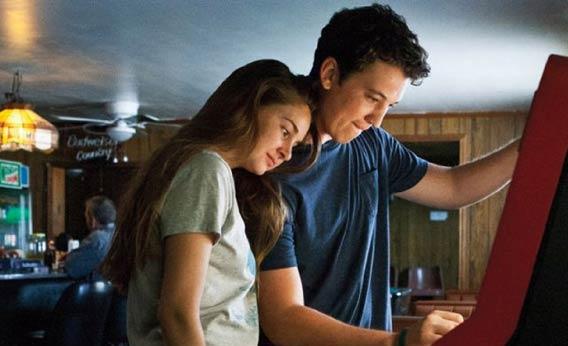
When a film truly captures what it’s like to be a teenager in high school, or in a high school romance, it’s something special. Generally, most of us come of age in a major way in our high school days and so, a film that captures certain dilemmas or relationships (either platonic or romantic) can make for a great, effective coming-of-age story, given the right amount of detail in writing and characterization. I can think of many such films that are great examples of such, including “Tex,” “Lucas,” and last year’s “The Perks of Being a Wallflower” among others; another to add to the list is “The Spectacular Now,” a truthful, incredible film about forming a high school senior forming a new relationship with someone he’d never met before, and learning to fully prepare for his own future.

His name is Sutter Keely (played by Miles Teller). He’s a semi-popular 18-year-old who lives in the “now” mainly because he doesn’t look forward to growing up and dealing with life the way adults in his life do. He has an amusing, likable personality that compensates for somewhat of a sad existence, having been without a father for a while and with not much of a relationship with his mother (Jennifer Jason Leigh). He also drinks a lot, carrying around a whiskey flask to spike his soda cups, even at his part-time job. He would probably be best referred to as an “alcoholic Lloyd Dobler,” in reference to the John Cusack character in “Say Anything,” but that probably wouldn’t be fair.

One morning, Sutter is found lying flat on the front lawn of a house he doesn’t recognize, having drank heavily the night his girlfriend, Cassidy (Brie Larson), broke up with him. The person who finds Sutter is Aimee Finnicky (Shailene Woodley), who goes to the same school as Sutter (though he doesn’t recognize her). Aimee is in the neighborhood covering for her mother’s paper route, and Sutter decides to help her with the rest of it, having nothing else to do. Sutter decides he wants to spend some more time with her, and wallflower Aimee is glad to be accepted by someone like him. So they share conversation after conversation as Aimee tutors Sutter in geometry, Sutter invites her to a lake party, and their relationship is mostly consisting of talks and meetings that simply don’t need any reason to be—they enjoy each other’s company, talk to and listen to one another, and their relationship flows naturally as it becomes something more.

Then comes the time when Sutter can’t deny his true feelings for Aimee, despite what he tells his friend who thinks Sutter is using Aimee as a clumsy rebound for Cassidy. Then comes the prom, to which they go together and see the good time that everybody has, despite being a somewhat pointless tradition. Then comes a sex scene, which I have to say completely surprised me in how it was handled. This could have been a low point of the film, in that it would have been sloppy and in a mean-spirited way. But instead, with the careful direction of James Ponsoldt, it’s handled in such a careful and delicate way that at no point does it seem embarrassing or a cheat. Sutter and Aimee don’t merely have sex; they make love. And as a plus, it knows just when to fade away from it.

Sutter and Aimee look, act, and feel like real high-schoolers. Their conversations, their world around them, their misadventures, etc. feel like the real deal, and with enough conflicts in their lives to make them even more interesting, these two are a high-school-film romance that is undoubtedly worth paying attention to. I loved watching these two together; they’re sincere, appealing, and well-rounded characters that feel like people we knew, or even people we were. The film goes even further with them as the film continues. As the first hour or so creates a unique spin on high-school-film territories, as the relationship and their situations are played with a great natural realism, the rest of the film, in my opinion, is surprisingly even better. This is the point in the film in which Sutter and Aimee are willing to help each other out—after Aimee has taken Sutter’s advice and stood up to her overbearing mother, Sutter then decides to take Aimee’s advice and get his deadbeat dad’s phone number from his mother or his older sister (Mary Elizabeth Winstead). And what happens? Sutter, bringing Aimee along, goes to visit Dad (Kyle Chandler) and he realizes how clear things are becoming. Not only does he see why he’s better off without his dad, but he also realizes the kind of person he himself might become if he keeps living life the way he does. And he truly realizes that he must somehow create his own future. But how? And does he want to? Can he change?

The final half-hour of “The Spectacular Now” is what truly pays off about the film. It’s all about coming of age and things coming into full perspective for the subject of that concept (in this case, Sutter). It’s not predictable and it’s as realistic and natural as what was set up before. It’s played with a sense of harsh reality and a possibility of learning to deal with it. I felt for the characters all throughout the film, and this final act made me care even more about them.

“The Spectacular Now” is a wonderful film—a film that is smart and knows how teenagers talk and act; the characters are three-dimensional and always appealing; the director and writer(s) don’t go for the easy ways out of a situation because they’re too respectful to their audience for that; and all in all, a rich, deep, meaningful, effective drama about growing up, forming a relationship, and facing your own future. This is one of the best films of 2013.

Peggy Sue Got Married (1986)

29 Aug

Peggy Sue Got Married (1986)

Smith’s Verdict: ****

Reviewed by Tanner Smith

Francis Ford Coppola’s “Peggy Sue Got Married” is a film that tells a sweet-natured story from the concept of going back in time to a certain point in your life when you feel you could do things dissimilar to the way you did before, knowing what you know now. It begins at a high-school reunion, at which 40something Peggy Bodell (Kathleen Turner) practically relives her past—not only is she reunited (and catching up) with her old friends and acquaintances from the glory days of high school, but she also imagines what things would have been like if she hadn’t married her boyfriend at the time because she was pregnant shortly before graduation. “If I knew then what I know now,” Peggy tells her friends. “I would have done things differently.” She is divorcing her disloyal husband, Charlie (Nicolas Cage), who has been cheating on her and hasn’t been there for her or their two kids.

Peggy and her friends look back on high school memories and notice how times, as well as their classmates, have changed. It turns out Peggy doesn’t quite know the half of it, as she will experience her senior year for a second time. This happens when Charlie shows up at the reunion, she doesn’t know how to deal with the situation, and she suffers a heart attack (I think) and passes out. She then awakens in her 18-year-old body in the year 1960—twenty-five years before. Her 43-year-old mind is still intact, but everything else around her has changed. She relives high school, she hangs out with her friends, she dates Charlie again, she eats with her family for breakfast and dinner, and she even hears her grandmother’s voice again, which almost breaks her heart.

Peggy knows what will happen in the future, but no one else does. With this knowledge, she isn’t quite sure about how to deal with what may or may not affect her life, if she can help it. To start with, she is cold and somewhat distant towards Charlie, who can’t understand why she is acting silly lately. But she also recalls the fun she has with Charlie and relives some of those moments, including “parking.” Though, this particular parking moment is different, seeing as how she is the one who wants to go all the way, while nervous Charlie wants to get his car to start so he can take her home.

Peggy can also say the things she could have said to her parents long ago. She’s nicer and more helpful around the house. And she can even experience life with the people she may not have wanted to or was afraid to have been affiliated with—those include young, Hemingway-bashing beatnik Michael Fitzsimmons (Kevin J. O’Connor), with whom she shares pot, and math-science whiz Richard Norvik (Barry Miller), who is the only one she tells about her predicament of time-travel (she is also able to reveal inventions to him that haven’t been invented yet, to see what he can do for the future—“think ‘high-tech,’” Peggy tells him).

What it comes down to is whether Peggy will change her destiny as well as other people’s destinies, so that if and when she returns back to her old self in her present time, things will have been different from when she left. And one question I’m sure many people will be asking after watching “Peggy Sue Got Married” is whether or not Peggy really did travel back in time. Was it a dream? Did it really happen? I don’t think it really matters whether or not it really did happen, because if you ask me, “Peggy Sue Got Married” is more about an experience rather than much else. It’s the experience of reliving and revisiting what it felt like to be young again and trying to understand whether or not things were better off for you then. You know how people will say that high school is the best time of your life? What if they were right? If there is a way of knowing what will happen to you in the future, or in Peggy’s case, if there was a way of reliving those days because you have already lived the future, wouldn’t you find a way to make it feel as good as it can be? The point here is that it doesn’t matter whether or not you change events in your life—it’s how you can deal with events that are inevitable. And without giving away the ending, Coppola and co-writers Jerry Leichtling and Arlene Sarner, found an effective, subtle way of presenting that message and making a satisfying conclusion and presenting an answer to the question of whether or not Peggy really did time-travel. Some things, you just have to figure out for yourselves, and I admired that about this story.

The theme of nostalgia is present throughout “Peggy Sue Got Married” even before Peggy has her flashback experience. The high-school reunion at the beginning of the film presents what it feels like for these people to find themselves back in the good ol’ days. They’re not only there to provide setups for certain payoffs when Peggy goes back (hell, one character, in a wheelchair, is never even seen again after this opening)—they set the tone for the rest of the film.

And what would you feel/say if this ever happened to you and you weren’t sure of whether or not it was a dream? What if you answered the phone and suddenly there was the voice of your grandmother on the other end of the line? This is a voice Peggy hasn’t heard in many, many years, and there she is on the phone, making a casual call to say hello. What would you say? You couldn’t tell her what would happen to her, but you would know it, and it’d be hard to say anything.

“Peggy Sue Got Married” is a great film when it comes to the theme of nostalgia and the way it presents its story to a puzzling payoff (but in a good way), and it’s also very well-made as you can tell certain Coppola shots (there’s one such optical effect in the very first scene that I’m wondering how it was done). But there’s one very important element to its success, and that is the lead performance by Kathleen Turner. Turner is nothing short of excellent in this film. I don’t know how she was able to play this part in two different ways—as an adult and as a teenager—but she pulls it off in a spectacular performance. Sometimes she’ll even go back and forth between adult and teenager and we can catch on even though we’re just not sure how she did it. How did she change back and forth in certain scenes? Did the lighting help? Did Coppola have anything to do with this? I don’t know, but it’s fascinating to watch Turner play one shot as an adult and then another shot as a teenager, because she knows her character inside and out, and she knows how each side would react to any kind of situation being thrown her way.

I know no one who has seen this movie and are reading the review will not stop reading until I say something about Nicolas Cage’s performance as Charlie, the boy Peggy will later marry and then divorce. Yes, Cage’s performance is slightly odd (but nothing as odd, to understate it, as most of his roles to come later after this) and he would only do this movie if his character’s speech impediment matched that of Pokey’s (and he was almost fired from the movie entirely because of this). But to be honest, I don’t really mind him very much here. Sure, his voice can be a little grating, but Cage gets what it’s like to be an awkward high-school teenager, and he gets the body language down as well as Turner does.

And the other actors, for the most part, had to play young and old versions of their characters—from 1986 and from 1960. They deserve credit too, in their early roles before their profile careers in film and TV, particularly Jim Carrey, Joan Allen, Catherine Hicks, Lisa Jane Persky, and Kevin J. O’Connor. Barry Miller, known at the time for his roles in “Saturday Night Fever” and “Fame,” acquits himself admirably in the role of nerdy Richard; it’s a shame his acting career didn’t go much further. Also in one of her early roles is Helen Hunt, as Peggy’s teenaged daughter. (And also look out for future director Sofia Coppola as Peggy’s kid sister.)

What have I left out? Only a handful of wonderful, delicate scenes that you’ll just have to see for yourself. “Peggy Sue Got Married” is a superb movie with sharp direction from Francis Ford Coppola, an appealing concept, and to top it all off, a great leading performance from Kathleen Turner.

The Last Picture Show (1971)

9 Aug

hero_EB20040704REVIEWS08407040301AR

Smith’s Verdict: ****

Reviewed by Tanner Smith

Anarene, Texas. Fall 1951. The weather is either too windy or too humid. The wind blows down the empty main street in the morning, and from looking at it, you’d think it was a ghost town. Even a few tumbleweeds can be seen whisking down the street. There’s nothing special to look at, but for the locals, the three key places to go to are the pool hall, the diner, and the Royal movie theater. All three are run by Sam the Lion, though he sometimes prefers to enjoy time away from town, at a pond called “the tank,” where he takes two local boys fishing (even though there are turtles instead of fish)—he enjoys the setting and always recalls fondly a moment from his past. (He doesn’t like fish, anyway.)

This small Texas town of Anarene is presented as a backdrop for a character study—Peter Bogdanovich’s 1971 film “The Last Picture Show,” a classic that shows the certain death of a small community in a narrative that presents the town’s inhabitants as real people having true-to-life experiences. Taking place in the early-1950s, the film is pure nostalgia for anyone who grew up in that era. But this is an effective film for members of any generation (I was born in the early-1990s) because this is one of those “nostalgic” films that feel nostalgic because even though most of you weren’t raised or coming of age around the time the film was set, you still feel like the situations that occur are real or even had some of them happen to you in one way or another.

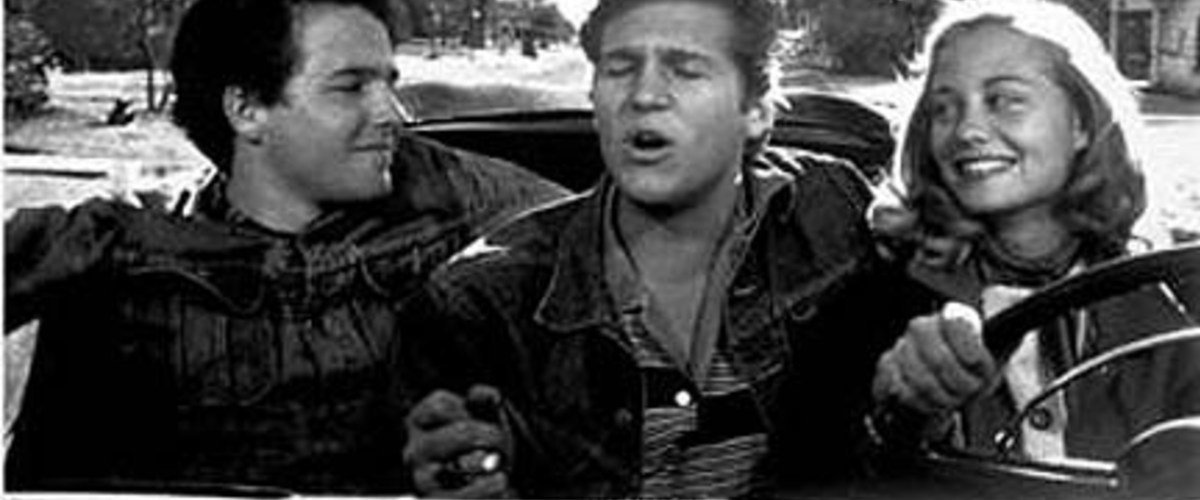
The character study that is “The Last Picture Show” follows three important characters—three young people; graduating high school seniors who live in Anarene and are about to step into the realities of…reality. They are naïve Sonny Crawford (Timothy Bottoms), smooth, distracted Duane Jackson (Jeff Bridges), and sexy, rich, manipulative Jacy Farrow (Cybill Shepherd). Sonny doesn’t have much ambition in life and mostly tends to getting himself in situations he can’t out on top of; Duane is his friend who is slick and handsome but is unfocused and mostly tends to ask too much of a girl he’s in a relationship with; and the sexually inquisitive Jacy uses her good looks and wealth is influence any boy she wants into having sex with her…and then dump him. It’s quite easy to label Jacy as a “bitch.” And she is a real bag of tricks in how she cunningly seduces these boys in order to increase her sexual interest and thus, have her continue to do so, which results in her not only dumping Duane, but also going after Sonny, even when he is in somewhat of a relationship. But the thing is, Sonny’s relationship is an adulterous one.

Presented in glorious black-and-white (which I know was chosen due to technical problems and aesthetic reasons; I don’t care either way because it looks great), “The Last Picture Show” shows a year in the lives of these young people, from November 1951 to October 1952. Sonny and Duane are best buddies and co-captains of the local high school football team, which the locals constantly mock in how inept they are at the fundamentals. Jacy is Duane’s girlfriend, which gives another reason for Sonny to envy Duane, aside from the fact that he’s handsome, popular, and amusing. Sonny is nicer and more sensitive, but his girlfriend is an unpleasant one, so they break up…after more-or-less a year of being together.

At Christmastime, something unusual and fascinating happens to Sonny. He finds himself in an affair with Ruth Popper (Cloris Leachman), a depressed 40-year-old woman who is married to Sonny and Duane’s football coach. Sonny doesn’t know everything about her marriage, but he does understand that Ruth is not happy, and she sees what a kind, loving young man he is and invites him into bed. Of course, this affair is doomed and anyone could tell you that, but in the moment, no one could convince you at all. Not even those who know about the affair (it’s a small town where most people seem to know everything that goes on). And this goes on for quite a long time, until about summertime.

Meanwhile, Jacy has her eyes set on wealthy Bobby Sheen (Gary Brockette), whom she meets at a naked indoor-pool party. The only problem is, as long as Jacy is a virgin, he’s not interested. And this is where she shows her true colors in the film, as she toys with Duane for him to have sex with her and then dump him for selfish reasons. Where are her parents, you may ask. Well, her father practically lives on the living-room couch in front of the TV while her mother, Lois (Ellen Burstyn), (get this) advises Jacy to sleep with Duane so that she’ll know that sex isn’t all that it’s built up to be. (Though, Lois will sometimes sleep with one of her husband’s co-workers.) She does understand what Jacy’s rebellion is about, and she knows it won’t end well.

(And by the way, Jacy’s parents are the only parents we see in this film. Sonny and Duane’s parents are hardly ever seen at all. And we don’t see their home life either. Just an observation—not a judgment.)

As you guessed from the descriptions I’ve already given for the story (or stories, if you will), “The Last Picture Show” features more sex in manipulation or adultery than in tenderness or warmth. Well, there is the latter in the relationship between Sonny and Ruth. It’s a need to connect with someone that makes it special in comparison to what Duane and Ruth continue to go through. But reality eventually (and unfortunately) will take its toll, leading to the “stuff-happens” effect that seems to be apparent throughout this film.

I almost forgot where I was going with that last paragraph, and that’s what this film can do to you, I guess. A lot happens in the two-hour-six-minute running-time of “The Last Picture Show,” a good deal of it having to do with the sexual encounters these kids face. This all happens mainly because when these kids don’t have the diner, the pool hall, or the theater to go to, the next place they can think of, aside from home, is the bed (or, in the case of one particular scene, a pool table—don’t ask). And midway through the film, that does seem to be the main place to go, especially after the aforementioned Sam the Lion (Ben Johnson), the soul of Anarene, is put out of the picture, leaving Sonny the pool hall and the theater in danger of closing down. Without the soul of Anarene comes the certain death of the town itself, with less ambitions for the people still living here and the human condition only decreasing with each passing week. No wonder the sex in this movie is mostly out of lust rather than love.

“The Last Picture Show” was filmed in 1971, but is set in the early-1950s, and the odd thing is that it’s easy to forget that. That’s because the feel of this setting in the film is exactly right. It really looks like a small town in the ‘50s, and we as an audience are taken there. Credit for that not only goes to the director Peter Bogdanovich, but also to cinematographer Robert L. Surtees, and the set design deserves a lot of credit as well. (Though, I’m not sure the explicit nudity in the film would have been allowed in a drama back in 1951.) Shooting it in black-and-white helps as well, strangely. And you really get a feel for this small rural town in Texas; you really feel the environment that these people live in.

And you also get a good sense of who these characters are, and what sort of people they will become, and despite some of their deeds, you do sort of hope for them to do better than they do now in life. Duane may smarten up now that he’s joined the US Army (and gone off to fight in Korea), Jacy may learn a bit about what her mother has been trying to tell her, and Sonny may be stuck in town, but may make the best of what he has, though it may be difficult (especially in a few crucial moments in the final act, each having to do with grief, regret, and resentment). The characters’ stories are rich and with many levels to them that you want to imagine what their lives will be like.

Timothy Bottoms is solid as Sonny; Jeff Bridges brings a rugged appeal to Duane; and Cybill Shepherd wonderfully brings her role of Jacy to where it can be seen as a three-dimensional dream-girl (she’s not invulnerable and only uses her moxie and body as a way to make things exciting in this town). Of the supporting cast, Ben Johnson is excellent as Sam the Lion; you really feel that he truly is the “soul of Anarene” and without him, there’s hardly a way for the town to be cured of the illness that’s killing it. The scene in which he tells Sonny and a mentally-disabled boy, Billy (Sam Bottoms, Timothy’s brother), about a time he cherished back when he was younger is just wonderful. His presence is an important one, and even though he disappears from the film midway through, it doesn’t make us forget him. Cloris Leachman is equally great as Ruth, capturing the character’s warmth, loneliness, and pain. Also good are Ellen Burstyn as Lois and Eileen Brennan as Genevieve, a waitress at the diner.

Anarene, Texas is dying. By this time, many decades later, it may already be dead. The title of the film is symbolic for meaning the closure of the movie theater and thus the loss of a place where teenagers can meet, hang out, make out, etc. Once that’s gone, there isn’t much else, except for loneliness and harshness. That’s what I got from the meaning of the title “The Last Picture Show,” even though the theater has no key role in the film. In the end, when the theater closes, there is that sense that the people in this town have lost something special. They may not know it until later on, but there is something disappearing there. Peter Bogdanovich’s “The Last Picture Show” is a highly accomplished slice-of-life drama with a feel for its setting and strong characterization. It’s a thoughtful, well-put-together nostalgia-trip that is powerful no matter what generation you belong to.
Hoosiers (1986)

2 Aug

hdEmvJqqt6SEWhDWcVtAc13EQ9h

Smith’s Verdict: ****

Reviewed by Tanner Smith

I never played high-school basketball. I was the oddball that played “b-ball” from 4th grade to 6th and then decided to focus on other things, like the school band and choir. But I never backed down from a little game in P.E. class and also, maybe going to a game wasn’t exactly what I wanted to do on a Friday night, but back then, what else was I going to do? And truth be told, I somehow found myself enjoying the game—it’s alive, intense, uplifting (when it can be), and entertaining, and you really find yourself rooting for the home players. That statement can be used to describe “Hoosiers,” which is my favorite film about basketball and is as much fun as attending a high-school basketball game.

“Hoosiers” is based on the true story of a small-town Indiana high school basketball team that, in the early 1950s, surprised everyone by not only progressing to the Indiana State Championship, but also winning. Despite that story to back it up, “Hoosiers” doesn’t use the “based on a true story” caption early on to manipulate us, and that’s probably a good thing, because much of the movie is focused on how the triumphant underdog concept can fully come through. This is a movie that is all about heart and you could see through the writing, direction, and acting that everyone put their all into this. The result is a wonderful movie.

Right at the opening credits, you can tell we’re in for something special, and nothing has necessarily happened yet. The first few shots are of a car going down rural streets of the Midwest in the autumn season, with fallen leaves swirling around by the wind. Assisted by a nice, soft music score by Jerry Goldsmith, you truly get a sense that you are there. And since we already feel at home in these shots, we feel throughout the rest of the movie that we’re in a good place to be.

Making that long trip is Norman Dale (Gene Hackman), who has come to the small town of Hickory, Indiana to coach the local high school basketball team, the Hickory Huskers. This would prove as a challenge for quite a few reasons. One is, he’s being asked to replace a coach that everyone in town knew and loved, and so he’s constantly being tested at just about each turn by a local—it doesn’t help that he bans parents and other supporters from practices either. Another is, there aren’t many players on the team—indeed, there are seven and their star player, Jimmy Chitwood (Maris Valainis), is taking a year off from sports to focus on his academics. And also, this is Dale’s chance to redeem himself from a mistake he made coaching many years ago, and if he screws up now, his coaching career is over for good. This is a changed man, and he’s out to prove it. He uses disciplinary tactics to further boost the team’s confidence and athletic ability, and though they don’t start out very well, he is able to make them into a team that can play good basketball.

One of the things that further increase the townspeople’s displeasure is that Dale hires the father of one of the boys, who is Shooter (Dennis Hopper), the town drunk, to come on as an assistant coach. While his worst moments show him as a drunken buffoon that sometimes embarrasses his son, his best moments show how much he knows about basketball, which is why Dale decides to take a chance and bring him on and give him a chance of redemption as well.

This decision, along with quite a few losses, lead to a petition signed for Dale’s resignation. Just as a clear verdict is about to be brought up, Jimmy steps up and says that he’ll finally play again…but only for Dale. (This is one of the best scenes in the movie—it’s the perfect “up-yours” to cynical people.) Soon enough, they all play better and start winning, and their successful run eventually leads to a spot in the State Finals, which is incredible for a small school.

With Dale redeeming himself, Shooter shaping up and getting himself a new, respectful image, and a small school about to show all of Indiana who they really are, “Hoosiers” is not only a film about basketball and the community that celebrates it—it’s mainly about redemption. And in that respect, this is a powerful film because the relationships that these people have in this town make it all the more worthwhile because of who they were and who they will become. By the time the movie is over, with the Big Game and the ultimate win, you feel like these people have truly done well for themselves and are happy for them, just as you’re excited at the success of this basketball team. The basketball scenes are riveting and well-shot, but they’re not the center of the film. It wasn’t supposed to be. But with this theme of redemption, it works even better as a sports underdog story.

And you do get a feel of the game itself—the coaching tactics, the basketball drills, the sense of the gym, the excitement of the crowd, the thrill of the game, etc.—which is why “Hoosiers” is regarded as, for good reason, “one of the best sports films ever made.”

The rock of the picture is the performance by Gene Hackman, who is excellent here as Coach Norman Dale, giving him full characterization and a three-dimensional portrayal. He has the competitive spirit down to a T, but he has a real human side to the character as well. He nails the quiet moments as well.

Dennis Hopper, as Shooter, was honored a Best Supporting Actor nomination for his performance in this film, even though the actor himself believed he should have been nominated for “Blue Velvet,” released that same year. This must have come as a surprise for most people who believe that weaker individual characters are often ignored by the Academy, and while that wasn’t what he played in “Blue Velvet,” that’s definitely what he played in “Hoosiers.” Shooter is a loser, to be sure, and in need of gaining self-respect and respect from his son. But Hopper makes us care about him and want him to change that it is a sympathetic portrayal of such a man, and I think the Academy made a good choice in voting.

There’s another character in this movie—Myra Fleener, played by Barbara Hershey. She’s one of the few Hickory locals who have experienced big city life before moving back here because it’s where she has what she needs. She’s a bit cold toward Dale because she doesn’t trust him to stay away from Jimmy, as she sometimes looks out for him ever since his father died, so that he doesn’t push him into playing basketball again, before Jimmy decides for himself he wants to play again. But of course when she does see the true man Dale is, she realizes she can trust and possibly love him. This is admittedly one of the weaker aspects of the movie, as it does sort of make her into a regular love-interest for our protagonist, but I’ll let it slide because she does have a reason for starting out the way she does. And Hershey does a fine job in the role.

I’m also glad that actual young athletes were trained to be actors, instead of the other way around, because this way, you get natural performances from the young men who play the team players. They may not be the greatest actors, but the script allows them to stay within the limitations of their range.

I’ve tried, but I don’t think I can think of a better basketball movie than “Hoosiers.” You know how they say, “It’s not if you win or lose, but how you play the game?” That serves as an effective metaphor for this story of redemption on and off the court. This is a well-made, effective, wonderful movie that earns its title as “one of the best sports films ever made.”

The Haunting (1963)

29 Jul

images-4

Smith’s Verdict: ****

Reviewed by Tanner Smith

When people ask me what my favorite horror film is, I guess they would expect me to say “Halloween” or “The Exorcist.” And while I do love those movies and they, along with “Psycho” for instance, would be in my top-five of the genre, I say that my favorite in the genre is definitely “The Haunting.” And the trouble is, I always have to back up that title by labeling it “the Robert Wise haunted-house film from the 1960s” because I know that they’re thinking of the other “The Haunting” (the 1999 Jan De Bont remake of the 1963 film with Liam Neeson and Catherine Zeta-Jones). I’ll have something to say about the remake later and why it definitely doesn’t work in comparison to its predecessor, but I truly love the original film. In fact, I love it so much to admit that it’s just my favorite scary film—it’s one of my all-time favorite movies.

“The Haunting” is a superb, gorgeously-shot, very well thought-out chiller that uses psychological tension and character development in the same concepts of mystery and atmosphere. It takes place in a haunted house—Hill House, to be exact—and it’s about a group of characters who would like to investigate the supernatural occurrences of such a place but get much more than they expected. That premise sounds pretty simple, but Wise’s direction, along with great cinematography as well as great acting, makes it far more than what it could have been. Even if you don’t really find it very scary (it depends on whether or not you accept the “less is more” aspect—I’ll explain later in this review), it’s still a gripping psychological thriller, Gothic story, and character study.

“The Haunting” begins with an opening narration over a shot of an ominous-looking mansion in the night, and right away, the narration sets up the premise in a most interesting way. I don’t think I’ve ever heard a depiction of a haunted house, or rather just exploring a haunted house, has ever been put in a better way. “An evil old house, the kind some people call haunted, is like an undiscovered country waiting to be explored. Hill House has stood for 90 years and might stand for 90 more. Silence lay steadily against the wood and stone of Hill House, and whatever walked there…walked alone.” And when the intellectual voice of Richard Johnson puts it like that, I think I might follow him as well as those his character, Dr. John Markway, are brought into his experiment. And yes, his experiment is simply to investigate any sort of paranormal activity while spending several nights in Hill House. The house is full of history that connects to further evidence that it may be haunted, which fascinates him even more. He wants to know if everything he’s heard and studied is as real as it may seem.

Brought in on the project are Eleanor “Nell” Lance (Julie Harris), clairvoyant Theodora “Theo” (Claire Bloom), and the house’s cynical new heir, Luke Sanderson (Russ Tamblyn). Eleanor, in particular, is our main focus of the film, as we hear her inner thoughts a good amount of time and has the most compelling character arc of the group. She’s a meek, insecure, guilt-ridden woman who has spent most of her adult life caring for her sick mother until her death, leading to further severe guilt that she has to deal with everyday. She seeks to belong somewhere with somebody, which is why she does take a chance and leaves her sister’s apartment (where she sleeps on the couch), and steals her sister’s car to make her way to Hill House, where she is finally expected somewhere.

images

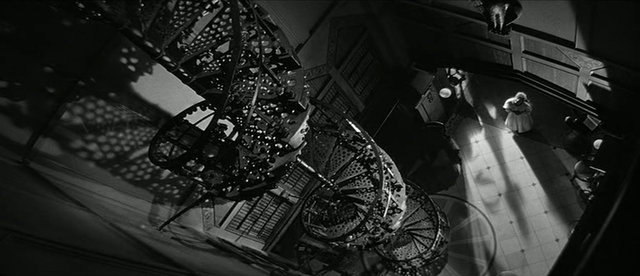
Hill House itself is a marvel to look at. It’s a large, maze-like mansion that looks like a Gothic castle, with many secrets and unsettling decorations and such. Among the most notable unsettling locations in the house is the library, which features a tall, spiraling staircase that is very rickety and unsafe. The exteriors and interiors of Hill House are just extraordinary and the whole place gives off a creepy vibe. You definitely can tell that something is not quite right with this place. Eleanor notices this upon first arriving, thinking to herself that “it’s looking at me” and if she goes into this house, she’s afraid she won’t come out the same way. But she does come inside, get to know Markway, Theo, and Luke, and surely enough, many strange things occur with apparent supernatural forces at work here.

But how much of the supernatural is actually “supernatural?” We spend so much time with Eleanor and we know that she isn’t quite mentally-stable because of her insecurities that sometimes take her over, so you have to wonder just how much of this ghost-story is actual ghosts and how much of it is actually in Eleanor’s mind. It’s evident that ghosts are real in these surroundings, as Eleanor is not the only one to experience these happenings. But what about when she explores the house herself and feels herself to be more at home, in a way depicted creepier than it sounds? Is she being controlled by the paranormal forces, is she letting in to her hopes of belonging somewhere, are her insecurities getting the very best of her? I won’t go into too much detail about what I get out of the connection between her and Hill House, but trust me when I say it’s an excellent psychological study. And that this is a character who seeks redemption and acceptance within a haunted house makes it even more unnerving.

It’s hard to pick my favorite “scary moment,” as most people choose their own favorite scary moments from their favorite horror films (the opening in “Halloween,” the exorcism in “The Exorcist,” the shower scene in “Psycho,” and so on). There are literally more than I could think of right off the bat, and oddly enough, every time I watch the movie again, I find myself unnerved throughout the whole movie because of those many moments. To name some of these scenes, I’d start with the introduction in which we see in flashback (with help of Dr. Markway’s narration) the past historic happenings of Hill House (suicide, accidents, etc.)—it’s a great opening and also very well-crafted in how it’s able to set up the environment and build up suspense for the rest of the story, and of course quite unnerving. There’s the first occurrence on the characters’ first night in Hill House, as Eleanor and Theo are frightened by loud, pounding noises coming from outside their bedroom and hold onto one another in fear—the terror is genuine and the scares come as unexpected so that the characters’ fear becomes ours, because we know just about as much as they do. Most memorably, arguably, is the scene in which Eleanor awakens at night to hear what sounds like a child being beaten and crying in pain. She wants to yell but is too afraid to, and she holds hands with Theo who is obviously as frightened as she is because, as we hear through Eleanor’s inner thoughts, she is holding on to her hand a little too tightly. When she finally yells “STOP IT!” and the lights turn on, she looks to see that…nobody was holding her hand the whole time. This is a perfect “scary moment”—the buildup, the tension, and the payoff are all very well-handled, making the standard-but-needed question “Whose hand was I holding” seem all the more impactful. There are many more moments like that in this movie. And do I even need to mention that the aforementioned “tall, spiraling staircase” comes into place for a crucial moment later?

staircases-haunting63-preview

One major important aspect of “The Haunting” is simply pure terror, in that it’s really the things that you don’t see that scare you. indeed, there is no monster or blood and gore or any visible ghosts present at all throughout the entire movie (unlike the remake, which used endless amounts of CGI, completely missing the point of “less is more”). It’s all psychological and we can imagine what we think are making all those noises that we (and the characters) hear. (Also, there are hardly any special effects in the movie, with the exception of a door bending due to whatever is outside pushing in on it.) This is pretty much on the same level of feeling like you’re alone in a room and you’re shocked because there’s a sudden knock at the door. It’s that kind of tension that is evident throughout “The Haunting.”

The casting of the four principal roles is spot-on. Julie Harris is excellent as Eleanor, creating a believable portrait of an odd, meek woman who is possibly misguided to find a place to feel accepted. It’s a great performance and it makes “The Haunting” more of a character study than a haunted-house story. Richard Johnson is also great as Dr. Markway, a man who could convince you to jump off a cliff if he found a solid reasoning behind it. I love the way he puts the supernatural occurrences most of us have heard of, particularly the difference between “ghosts” and “ghouls.” Claire Bloom makes Theo her own character and also gives a certain indication that she might actually be a lesbian, which could explain why she acts the way she does toward Eleanor (compassion mixed with teasing most of the time) and also would give another disturbing sense in the scenes when they’re the only ones in a room together. Bloom makes risky decisions with this role, but they’re never over-the-top and are played effectively. I even enjoyed Russ Tamblyn’s comic relief—as Luke, Tamblyn plays a man who doesn’t believe in the supernatural or the phenomena; he’s just protecting his investment after being left the house and simply enjoys poking fun at whatever experience or little detail that the other characters bring up. He’s a smooth, wisecracking guy who likes to drink and crack jokes (“This ghost I can expect in my room tonight—is it male or female?”), which makes his ultimate belief in what’s really happening here all the more effective because all this time, he has served as a representation for some of the more cynical audience members. When he finally seems as scared as everyone else, it’s believable.

The filmmaking serves as another reason “The Haunting” works as well as it does. A good number of shots in this movie looks like it’s been fully prepared for first, so that we feel a hint of unease and also fascination. Even the reaction shots, which are mostly thankless, say something about the consistency—some of them are even at low angles with characters on either the right or left side of the screen. With a location as grand as Hill House, it’s important to know how to frame certain shots and Robert Wise obviously went out of his way to create something unique.

“The Haunting” is undoubtedly my favorite horror film. Its scares are more than effective because of how much its psychological terror works well. The themes are very well-presented. The depictions of the “haunted” aspects of this house and the occurrences are fascinating to listen to. The lead character of Eleanor is a great character for this sort of story. And it fascinates me and of course continues to scare me every time I watch it. It’s a well-crafted, excellent chiller.

NOTE: I mentioned the brilliant opening lines earlier in this review. I should also add that the similar-sounding ending lines are even more chilling, particularly because of who says them.

OTHER NOTE: If you want a perfect side-by-side comparison of both the original and the remake (and why one works and the other doesn’t), check out this Nostalgia Critic video-review on Blip: http://blip.tv/nostalgiacritic/nostalgia-critic-the-haunting-5634970

No Country for Old Men (2007)

24 Jul

09count600

Smith’s Verdict: ****

Reviewed by Tanner Smith

“No Country for Old Men” provides a fascinating character study with three complicated types—a good guy, a bad guy, and an anti-hero. One wants to do the right thing; one is practically anarchy-and-misery-personified; and the other walks that fine line between good and evil. First, let’s talk about the “anti-hero.” This is Llewellyn Moss (Josh Brolin), a down-on-his-luck ex-welder who lives in a trailer park with his wife (Kelly Macdonald) and sometimes sticks his nose in places he shouldn’t. While on a hunting trip, he comes across a drug deal gone wrong in the middle of nowhere. He looks around, finds a lot of bodies, and finds a suitcase full of money. So he decides to keep it for himself.

This scene, early in the proceedings, also has Moss coming across a lone survivor who is immobile in the driver’s seat of a pickup truck and weakly asks for water. So what does Llewellyn do? He takes the guy’s gun and ammo and moves on because he knows that where there are drugs (and there is a truck full of “Mexican brown”) and moves on. Why does he do this? Did he have any intention of helping him if he did have water to give to him? Well, later that night, as he lies in bed in his trailer, he does have a change of heart and decides to go back and help the poor man, thus establishing that Moss is not a good guy or a bad guy—just a guy in between.

There is a definite bad guy here, and he’s a man you never want to meet anytime soon. He’s Anton Chigurh (Javier Bardem), a cold, heartless killer whose murder weapon is a high-pressure air gun that can kill a cow (or kill a man with one shot to the forehead). Chigurh (emphasis on the “gurh” so it doesn’t sound like “Sugar”) is not charismatic and he’s not even enthusiastic. There’s never a sense that he enjoys what he does, as he goes around doing one horrific deed after another. What does this mean? Who is this guy? If he were a tree, what kind would he be? You can’t really ask much about this guy, because what he represents is the psychoticism of the criminal mind and how it’s only getting worse and worse. This is something that our movie’s good guy, local sheriff Ed Tom Bell (Tommy Lee Jones, looking more at home than ever), discovers, as he’s been on the job long enough to know that with everything going wrong and, even worse, confusing, this is all becoming too much to handle or even attempt to understand. He knows as well as we do that Chigurh is not going to stop doing these things anytime soon, and as long as people like him are around to spread anarchy and misery, what does that say for the world around him?

Chigurh goes after Moss because the drug-deal happened in his territory and now he wants the money. Moss packs up and leaves, sending his wife to her mother’s until he can figure a way out of this. Moss goes from place to place, with Chigurh catching up to him, and Bell being thrown into this because Chigurh had escaped from (and killed) one of his deputies.

Really think about that money—if you were a poor guy and you saw a way you could keep a mysterious bag of cash, would you take it? You’d think you’d get away with it and just enjoy yourself with it, but it’s not that easy when there are people who want it back, and they’re people that are best not to be trifled with and probably can’t be reasoned with. I’ve seen Sam Raimi’s “A Simple Plan”—I can already tell you before seeing this movie that this shouldn’t end well for a character deciding to take a chance and keep the stash. In “No Country for Old Men,” Moss is a bright guy who does realize his mistakes, even if he doesn’t want to acknowledge that maybe he isn’t as smart as he thinks he is (just smart enough to outwit Chigurh at a few crucial points). Either way, Moss is an intriguing anti-hero—his mistake leads to the question of what he’ll do afterwards and we wonder what will become of him and actually care for him. This is my favorite performance from Josh Brolin; he’s very strong here.

Javier Bardem is excellent as Anton Chigurh. I think he’s one of the best, most compelling villains you’ll ever find in a film. With that cold stare and indefinable accent he carries with him, Chigurh is one creepy S.O.B. If you ever come across this guy in the middle of nowhere, you should say your prayers quickly because you’re more than likely never going to be able to say them again. He doesn’t feel pity or remorse, and he can’t be bargained with. And you never know exactly what he’s going to do. Take this scene, which comes at the half-hour mark—it involves a coin toss. Chigurh is at a gas station, the clerk decides to make small talk, and Chigurh manages to take his words and twist them around to some weird cryptic speak, before he ultimately flips a coin and tells the unnerved man to “call it.” The tenseness of this scene is enhanced by Bardem’s performance as he messes with the clerk’s mind, as well as ours, because we don’t know what he’s going to do. Is he going to kill him? What will happen when the guy finally calls it? One thing’s for sure—Chigurh won’t leave until a decision is made. That’s a great scene, and this is a great performance from Javier Bardem.

“No Country for Old Men” was crafted by the Coen Brothers (Joel and Ethan Coen), and they definitely know how to pace a film like this. With a story as complicated and with as many twists and turns, pacing is one of the more important aspects to keep us on edge and invested. With that said, the pacing in this movie is flawless, which helps with some of the most disturbing, suspenseful, uncomfortable scenes in the film, such as when Moss must escape his hotel room before Chigurh can piece together where he is. “No Country for Old Men” is very edgy throughout, with the terror counterbalanced by laconic wit that the Coens tend to put in their films (here, some of the comic bits come from Tommy Lee Jones’ wit). And being a Coen Brothers film, to expect a conventional way to tell this story (which is adapted from a Cormac McCarthy novel) would be foolish. Don’t watch this film and pretend you know everything that’s going to happen, because I made that mistake and nearly hated myself for it. This is not like any other movie I’ve seen before—it plays with our expectations, catches us off-guard, and among everything else it has to offer, it delights in making us think and wonder while also unnerving us with what it thinks it can get away with. One last thing I’ll say about that is this—if you feel the least bit hateful towards the open ending, just think about how you would rather see it end. “No Country for Old Men” is a great film. 

The Flamingo Kid (1984)

19 Jul

Matt-Dillon-The-Flamingo-Kid

Smith’s Verdict: ****

Reviewed by Tanner Smith

“The Flamingo Kid” is a movie that fascinated me in how non-formulaic it is. When you get down to the basic premise, it’s about a kid from a poor neighborhood takes a job at a beach club, where he idolizes one of the fanciest locals who shows him a new way of looking at life that is against what the kid’s father wants for his son. Before the summer is over, the kid will know which path to ultimately take and will learn a few valuable life lessons. I don’t know how director/co-writer Garry Marshall did it, but he managed to take this old-school idea and form it into a treasure of a movie that is not only solid and entertaining, but also original in show, very well-constructed, and more effective than you might expect.

“The Flamingo Kid” is about a young man from Brooklyn who lives with his family in a poor Brooklyn neighborhood. His name is Jeffrey (Matt Dillon), and he’s a good kid about to leave for college. But for now, summer is here and his working-class father (Hector Elizondo) has set up a job for him in an office. But when Jeffrey’s friends bring him to assist in a card game at a classy beach club in Long Island, Jeffrey decides he likes the place and is even offered a job as a valet, which he accepts.

By the way, the scene in which Jeffrey sits with his family at dinner, and tells his father that he’s decided to work at the beach instead of taking the job that his father has set up for him, is one of many pleasant surprises in this movie. This could have ended up in a screaming match between father and son, but it resolves in a civilized manner (though not without cynicism). I liked that scene.

Jeffrey parks cars at the beach club, but is soon moved up to “cabana boy.” While serving people, he becomes friendly with a sexy young woman (Janet Jones) with whom he forms a nice relationship, and he also meets a flashy car dealer, Phil Brody (Richard Crenna), who is also a master at gin rummy, which is often played with the locals. Brody comes to like Jeffrey and decides to teach him a few things he learned in life.

And here we have two opposing sides of Jeffrey’s coming-of-age journey. On the one hand, you have a hard-working father who wants what’s best for his son, because he knows that dreaming doesn’t get you far in life, as he found out in his time. And then there’s Brody, who hasn’t gone to college and mainly has the beach club, the game of gin rummy, and his car dealership as his necessities in life (he also believes that “you are what you wear,” which is his excuse for always wearing fancy clothes). Jeffrey comes closer to joining Brody’s side, as he now feels that his old neighborhood has grown very boring and is fascinated by what goes on at this beach club. When he tells his father that he’s decided not to go to college and work at Brody’s dealership, his father doesn’t believe in this “easy money” type of career and becomes impatient with Jeffrey. His advice doesn’t come clear for Jeffrey, who is constantly led to listen to Brody’s ideas. (And it doesn’t help that Brody is easy to believe.) And so the film is about how Jeffrey will learn over the course of the summer to respect his father and see what kind of man he is, and also see what kind of man Brody actually is.

Despite what I’ve just described, this material is not entirely predictable and portrayed in a way that both sides of this kid’s life each have a way of making it seem that they’re both right, instead of the movie just taking the easy way through with just one person clearly knowing all. Because of that and how effective it is in handling the growth of the Jeffrey character, “The Flamingo Kid” is a very well-done coming-of-age story. It’s able to tell the story of this young man’s journey in a successful, credible way that doesn’t feel rushed or contrived at all; it’s played just right, which is a most pleasant surprise.

But I don’t want to make “The Flamingo Kid” seem kind of dreary, because it really is entertaining and also very funny. It has a great share of comedic moments, particularly when it comes to seeing Brody’s lifestyle, a few side characters and their antics on the beach, and also with Brody’s wife (Jessica Walter), who is posh and conceited and so stuck-up that she even shows her disapproval of a “parking attendant” having dinner with the family with suspicious looks as she sips her wine. There are more moments like that are worthy of some good chuckles or laughs.

I forgot to mention that “The Flamingo Kid” takes place in the 1960s, and the film pays good attention to detail in giving it that ‘60s feel. Indeed, this does feel like one of those fun ‘60s beach-movies at the time, when a kid goes to the beach and meets the people who spend most of their time there and know (and envy) each other very well. Also, the ‘60s soundtrack is appropriate with some good, timeless, memorable songs.

The characters in “The Flamingo Kid” are all richly developed and complete, and they’re played by really good actors. Richard Crenna, in particular, is excellent here as Mr. Brody. He plays it in a proper manner that makes his vulgar moments and his manipulative moments seem all the more fascinating while also occasionally making for some good laughs. He’s smart and wise, but maybe to an extent, which of course Jeffrey will come to learn. It’s a nicely-developed character that Crenna pulls off successfully. Hector Elizondo is a three-dimensional working-class father who truly knows best. But it really comes down to Matt Dillon in the lead role. He’s terrific in this movie—he’s natural, believable, subtle, and likable. The character is bright, but doesn’t quite know all the answers about life, which is what he’ll learn (and he does learn, in a fresh way), and here’s a surprise—he’s able to teach the adults a thing or two as well. His performance in this movie reminded me a little of James Dean in a sense.

I really love this movie. It’s very well-put-together in the way it presents the environment that these complete, three-dimensional characters inhabit; the actors do solid work; no scene is too short or too long, which surprised me; there are some very effective funny moments; the ‘60s nostalgia is present while also telling a timeless tale; the writing is great; the ending works so well; and so on. It’s just an all-around entertaining movie that I have nothing but kind words for. Garry Marshall and co-writer Neal Marshall (no relation) have crafted a wonderful summer movie that really leaves an impact.

The Royal Tenenbaums (2001)

30 Jun

images

Smith’s Verdict: ****

Reviewed by Tanner Smith

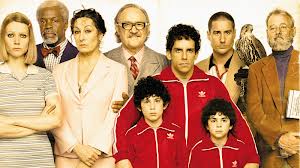
How the hell am I supposed to feel towards many story elements within Wes Anderson’s “The Royal Tenenbaums?” It’s unusual, bipolar, and twisted…and I loved every minute of it. This is a very original, effectively deranged comedy that toys with audience’s emotions, delights in eccentricity, is wonderfully deadpan, and presents a memorable group of quirky characters. It’s smart and sophisticated, while you can also add “devilishly clever” to the adjectives.

This film is sort of like the flip-side of the usual feel-good family comedy-drama; if anything, it’s more like a satire on the genre. The family in this film is as dysfunctional as a movie family can get. First and foremost is Royal Tenenbaum (Gene Hackman), and yes that is his real name. Royal is the family patriarch who has left home abruptly and has lived in a hotel room on credit for years. He has left his wife Etheline (Anjelica Huston), whom he has not divorced yet, and three children who have each grown up to be neurotic people with conflicts and issues. They are: Chas (Ben Stiller), who become a financial prodigy at a young age and is now afraid of more-or-less of everything; the adopted daughter Margot (Gwyneth Paltrow) who was successful as a young playwright and is now married to an older man (Bill Murray) who hardly ever takes the time to know her; and Richie (Luke Wilson), a former tennis player who is in love with Margot (whom, let me remind you, is not blood-related to him). (Wait, what?)

There are other characters in the story, including Chas’ two young, personality-free sons (who seem to dress in the same identical athletic-wear every day); Royal’s loyal Indian servant Pagoda (Kumar Pallana) who…tried to murder Royal on one occasion (wait, what?); Eli Cash (Owen Wilson, who also co-wrote the film with director Wes Anderson) who writes Western novels that get mixed reviews and is like a member of the Tenenbaum family; and Henry Sherman (Danny Glover), an accountant who proposes to Etheline after 10 years with her as a client. This proposal gets the attention of Royal, who hasn’t seen his family in years, and so he decides to win back Etheline. How does he do it?…By faking a terminal illness. (Wait, what?)

So now the Tenenbaums are all together under the same roof, and it’s not pretty. With each odd personality trait and with a lot of resentment towards Royal, this is not a happy family in the slightest. Will they learn to love and respect one another?…Well yes, but it’s a bit of a bumpy ride getting there.

One thing I notice about Wes Anderson’s films are that each character is understated and he directs his actors in such a way that these people have all but lost their effervescence at some point in their lives. As a result, the actors are effectively deadpan for the roles. Even a character as broad as Royal is given the “whatever-seen-it” attitude. Thus, when the dramatic changes occur (such as Royal’s transformation from jerk to semi-respectful again), they’re interesting in the way they’re portrayed which is not over the top but with a suitable amount of wit, quirkiness, and understatement.

There are laughs in “The Royal Tenenbaums,” but the film is never “hilarious” in the sense that you fall out of your seat, rolling with laughter. The humor comes from cleverness in its satirical elements. And that’s another oddity of “The Royal Tenenbaums”—it seems to wallow in the task of making sure the audience is uncertain on how to feel during certain scenes. When you think you know how a scene will pay off, it suddenly turns around on you. it’s like there are some parts serious, some parts funny, in both the characters and the screenplay. How far does it go? Not too far, which is refreshing of itself. However, there are a few moments that took some serious bravery on Anderson and Wilson’s part, including the killing of a dog and the risky (or it is risqué?) relationship between Margot and Richie.

“The Royal Tenenbaums” is wonderfully offbeat and effectively deadpan. It’s a most unusual type of comedy in that it has a dark tone and a lot of weirdness to the story and characters. All of the characters are memorably original, the oddness is always present and strangely enough always welcome, and the film itself is intensely (entertainingly) silly. It’s weird, but I love it.

Ruby Sparks (2012)

28 Jun

ruby_sparks_trailer

Smith’s Verdict: ****

Reviewed by Tanner Smith

“Ruby Sparks” is like a wake-up call to all hopeless romantics. Those searching for the “perfect one.” Those who ignore the notion that the Honeymoon Stage will end. Those who are only interested in a specific vision of said-“perfect one.” It’s not so easy, and I’m sure many people would agree with me. Relationships take time and practice in order for it to work. Certain problems can either be dealt with or ignored, depending on how much you care for a future with this person.

Take Calvin, the protagonist of the romantic-comedy “Ruby Sparks.” Calvin (Paul Dano) is a twentysomething author whose first novel, which he wrote just after high school, was very successful. But now, he has a bad case of writer’s block, is asocial, lives alone in his apartment with his dog, and has been through a nasty breakup. He’s also a hopeless romantic, hoping to find the “perfect girl” which his married brother, Harry (Chris Messina), says doesn’t exist. One day, his inspiration appears in a dream—a muse in the form of a beautiful woman named Ruby Sparks (played by Zoe Kazan, who also wrote the screenplay for the film). She can’t possibly be real, says Harry. He may be right, but Calvin doesn’t want to believe that. So he decides to write a book about a fictional version of him in a relationship with Ruby. He falls in love with the character of Ruby, as he doesn’t want a real woman—he wants the “perfect woman.”

Then something magical happens. And when I say “magical,” I mean you just go with it, just like with “Groundhog Day” or “Stranger than Fiction.” Ruby has suddenly appeared into Calvin’s home, and also into his life. Calvin at first thinks he’s going crazy and just seeing her as a manifestation of his hope for “the one.” But no—it turns out that other people can see her too. She’s very, very real. She believes she’s real and has all of the personality traits and memories that Calvin has given her, so they’re actually in a relationship together.

But that’s not all. Calvin realizes that he can also change anything about her just by typing on his typewriter. He convinces Harry of this by having her speak fluent French without knowing it. When he realizes this, he finds he can’t help but try it again when he realizes that the relationship between him and Ruby has somewhat turned downhill, as they don’t see eye-to-eye on certain things, she becomes more independent, and he doesn’t see her as the “perfect woman” anymore. So he decides to make a few changes…

I’ve heard of authors falling in love with their characters, but this is ridiculous. And that’s part of the reason I adore this film. “Ruby Sparks” is that rare “magical” look at the creative process, in that the creator is passionate about a creation, in this case an author and a favorite character. What serves as inspiration for a new novel? Maybe a dream that represents a manifestation of something that a person yearns for, hopes for, wants to know more about, etc. Think of how an author must feel having to kill off a favorite character to bring the story to a more dramatic quality and effect. With “Ruby Sparks,” we have Calvin, who creates this character and has this magical event occur in his life that actually brings that character to life. He feels the responsibility to keep the character consistent to his original thoughts. But when she’s real, he can’t deal with it and tries to make things the way they were. But it’s not easy. He could have dealt with certain little issues by talking with Ruby, but instead, he changes her personality. First he makes it as if she’s miserable without him; she’s clingy beyond belief (she won’t even let him go to the bathroom without her). Then he brings her an endless amount of joy; she becomes an annoyance pretty fast. Every change he can make goes very wrong and he can’t seem to fix it. Can it be fixed? Should it even have been trifled with? What are Calvin’s responsibilities as his creator? Does he have the right to twist Ruby’s persona in order to satisfy his desires? The fantasy aspect of “Ruby Sparks” delighted me in the way it mixed romance and the creative process with a magic element. And I love how Kazan’s screenplay never explains how Ruby can exist. I don’t think I needed to know. It’s quite intriguing that way, and I was with it every step of the way. Even when it takes a tragic dark turn (which I might add, is very well-handled) later in the film, I was with it, wondering how it was going to play out.

I’ve always seen Paul Dano as an actor who can either be very solid or very annoying. Here, he’s very likable and identifiable, and his low-key performance makes the story even more effective. This is probably the best work I’ve seen from the actor whose résumé also includes memorable titles such as “Little Miss Sunshine” and “There Will Be Blood.” Zoe Kazan, Dano’s real-life girlfriend, makes her writing debut and was previously seen in supporting roles in indie films such as “Me and Orson Welles” and “Meek’s Cutoff,” in which she also appeared with Dano. As an actress, she has an ethereal presence and an immense appeal. As a writer, she’s even better, knowing how to keep the narrative flowing, how to restrict myth from reality, and how to develop each character, even the supporting characters who could have been typical romcom walking clichés, but are given much personality and three dimensions.

Speaking of which, the supporting cast is just great. Chris Messina plays the type of role that is usually the wisecracking buddy, but the character is able to give helpful advice that makes sense. Annette Bening is a riot as Calvin’s hippie mother, and Antonio Banderas is even better as her lover; I have to wonder how a movie centering around them would play out. Steve Coogan is a sleazy author. Elliott Gould is a helpful shrink that Calvin turns to when he has writer’s block. The actors add light and color to what could have been thankless roles.

I mentioned before that “Ruby Sparks” does take a dark turn, and indeed it does, once the gravity of this bizarre event fully grabs hold of Calvin. This is a sequence that some viewers are divided upon. They either love it or hate it. As for me, this is the kind of descent into darkness that most romantic comedies don’t have the nerve to take a chance on. Without giving much away, it fits very well with the magic aspect and opens Calvin’s eyes to what he was looking for and what may or may not be real. It’s bleak, but effectively so.

“Ruby Sparks” is quite the unusual romance film. With Kazan’s screenplay and husband-and-wife directing team Jonathan Dayton and Valerie Faris (whose previous film was “Little Miss Sunshine”), the aspects of the romantic comedy have been deconstructed into something that seems much like the typical one at first, but then develops into something more and ultimately, much deeper than you might expect. I admire that “Ruby Sparks” took chances in its story and characters, and to me, it pays off in a most refreshing way. I love this film.