Archive | Four Stars **** RSS feed for this section

To Kill a Man (2014)

16 May

14036-1

Smith’s Verdict: ****

Reviewed by Tanner Smith

The Chilean film “To Kill a Man” is one of the most rare of revenge films: a type that is morally uncertain. This film, based on a true story, sets up a conflict that drives its protagonist to kill the antagonist and then the resolution causes the protagonist, and the audience for that matter, to wonder what has been resolved. On the one hand, some people are safe again. On the other hand, the protagonist is left wondering what vengeance solved, and with his usually emotionally-insecure inner life even worse than before. By trying to change things for the better, the worse has risen as an effect.

That’s not a mark against the film, necessarily. In my opinion, it leaves a stronger impact and causes you to think about what you’ve seen after you leave the theater.

The film, written and directed by Alejandro Fernandez Almendras, sets up the conflict as we’re introduced to our main character named Jorge (Daniel Candia). Jorge is a caretaker at a nature reserve and lives with his wife, Marta (Alejandra Yanez), and two children. He’s also somewhat emotionally timid. He can’t stand up for himself and tries to avoid confrontation. When he encounters a gang of thugs from the projects, the gang picks up on this right away and decides to mock and humiliate him before actually mugging him. His teenage son is anxious to stand up to the leader of the thugs, Kalule (Daniel Antivilo), since Jorge won’t, and sneaks out in the middle of the night. By the time Jorge catches up with him, Kalule shoots the son and is sent to prison for 18 months.

Two years later, Jorge is not living with the family anymore, as Marta has kicked him out of the house for not standing up for himself in the first place, thus putting their son in that situation. Kalule is released from prison and seeking revenge. He harasses the family with threatening phone calls and vandalism on their property. He even sexually assaults Jorge’s young daughter. Jorge and Marta try to get Kalule arrested for terrorizing the family but are unsuccessful. That leaves Jorge with the choice to man up and decide to take the matter into his own hands.

“To Kill a Man” uses long, interrupting tracking shots and static shots to give a documentary-like/voyeuristic feel. It’s both disturbing and fascinating to watch events unfold; and as the inevitable creeps around the corner, it gave me tension waiting to see how it would play out. The two most memorable scenes occur halfway through the film, as Jorge sets out on his crusade. One is a tracking shot involving a car alarm as a lure. The other is a long-running static shot where more is heard rather than seen.

It’s easy to see what’s coming; even the title renders it expected. But what makes “To Kill a Man” more memorable is what happens afterwards. The pride that Jorge expected from performing his deed is instead replaced with guilt and more apprehension. He can’t even bring himself to tell his family not to worry about Kalule coming after them anymore. This turns the film not only into a well-crafted revenge tale but also an effective character study. Jorge is an outcast and will remain so for the rest of the life. There’s not a clear answer as to how long he’s been the way he is or how it originated; there are just subtle emotions from his family that state they’ve put up with it for so long.

That Jorge spends most of his time in an empty forest is symbolic in the isolation that he feels. There’s also a scene in which he tries to tell a vagrant to move from the forest, as part of his job, but then he returns to chase him away with a shotgun. I could be reading too much into this, but I took it as a way of saying that Jorge prefers to be alone and possibly doesn’t want change in his life after all.

Something else that can represent this is the camerawork that leaves plenty of headroom for the character. This originally annoyed me (and I even felt like I wanted to grab the camera and tilt it down a little bit), but shortly after my friend saw the film, he had a comment that changed my view for the better—that the headroom was further emphasizing Jorge’s seclusion from everyone and everything. Looking back with that in mind, I let it pass.

Even if we’re not sure exactly what to take from “To Kill a Man,” from a moral stance, it’s hard to deny the sheer power it delivers with the way it presents a dilemma, a possible resolution, and how a flawed protagonist can act and feel throughout such an ominous situation. It’s a dark, compelling film that I won’t forget anytime soon.

Sidearoadia (Short Film)

14 May

Screen-Shot-2014-05-03-at-6.11.35-PM

Smith’s Verdict: ****

Reviewed by Tanner Smith

“Sidearoadia” is a short film by University of Central Arkansas Digital Filmmaking professor Bruce Hutchinson, and it’s a deeply moving tale of two different people coming together as they accept life by dealing with death.

Teenaged Rose (Hannah Culwell) has just lost her older sister, Dawn (Kristy Barrington), and doesn’t know how to deal with it. In comes David (Warren McCullough), Dawn’s boyfriend, who attempts to comfort her. Rose is more into outdoor hobbies and mythical legends, and doesn’t like to talk about something as tragic as her sister’s death. So when David first approaches her, she tells him not to even mention it. Instead, he decides to get to know her better, as he watches her with small animals (such as a rabbit), listens to her talk about mythical creatures (such as “selkies”), and so on. Rose and David spend more time together, as their conversations turn to the subject of Dawn and how her death has affected their lives deeply.

Where do I begin with this film (which runs for about 15 minutes)? Just about everything in this film is done just right. The screenplay is great, with dialogue as insightful and natural as reality (I love the conversations these two have together). The acting and characterizations are excellent; Hannah Culwell and Warren McCullough are great together, exhibit convincing chemistry, and portray realistic characters with a few quirks, particularly with Rose. The film looks great, thanks to top-notch cinematography; this is a beautiful-looking film that brings the Southern outdoors to life. And the film, for all its great dialogue, even knows when to be quiet. There’s a scene in which the two characters sit together in a field, and, for some type of ritual Rose knows more about, they use only notepads and short messages to communicate. It’s a touching scene that says more about what the characters are going through.

That “Sidearoadia” is not predictable is rare and it really works. There’s hardly a story being told here; it’s just the friendship between two people who need comfort, consultation, and assurance, and find all three in each other. It’s interesting and very effective. And I can’t tell you how glad I was when the relationship between Rose and David didn’t go in the direction I was expecting it to. In any other film, they probably would have been romantically involved.

I can’t think of anything I dislike about “Sidearoadia,” except for perhaps the final line of dialogue that feels somewhat random and seems a little off in mood and tone. But if that’s the biggest problem with this short, I have little to complain about. I love this short film.

The film can be seen here:

Come Morning (2013)

3 Apr

MlaX6fe9cLTROakOq21mlDTJ7IxD6odqkI2IEFOjXLYnOejeD43XZqNYXDDeKDDJ9Mql_0skzmy-NWKBK7Nwhk

Smith’s Verdict: ****

Reviewed by Tanner Smith

As I’m writing this review, it’s been a few days since I saw “Come Morning.” And I’m convinced that it’s one of those films that haunt you with not only how good it is but also how profound, effective, and unforgettable it is. It has a premise that sounds like a suitable idea for a tense thriller, and it’s easy to expect something exciting but also kind of generic. But not with “Come Morning.” It has its effective setup, it grabs you, and then it takes you where it wants to go.

The film is about 10-year-old D (Thor Wahlestedt) and his grandfather Frank (played wonderfully by Michael Ray Davis) who are on an afternoon hunting trip. The trip takes a tragic turn when D accidentally shoots and kills a trespassing neighbor. D wants Frank to call the authorities and explain what happened. But due to a long-running, complicated (and violent) feud between the two families, Frank knows that telling the other neighbors that the death was an accident won’t go well, and so he and D set out to bury the body deep in the woods.

The story occurs mostly in the woods and mostly at night, which creates an ongoing, effective, metaphorical visual for the narrative—the deeper into darkness the characters embark into, the more lost they become in their moralities. Things slowly but surely go more wrong as suddenly the realization of D’s accidental murder isn’t as relevant as what becomes revealed later with Frank. Some of his demons come back to haunt him, he runs into enemies from the past, and his actions causes him to consider his own morals and ethics as well as the loss of D’s innocence.

What really makes this whole film special is just how subtle it is. There is much revealed of the history between Frank’s family and the neighboring family, but hardly anything is spelled out for the audience. We just get visual storytelling, understated dialogue, and thought-provoking questions to interpret by the time the film is over. Without giving too much away, there isn’t just the guilt that D feels, but there’s more than Frank feels when it comes to facing his demons and trying to find ways out of the danger he put his family through; you can feel that he has had things happen that he can’t feel proud of and also can’t forgive himself for. It is also a damn good thriller; very suspenseful and becomes even more so as it continues.

Derrick Sims

Most of the praise for “Come Morning” unquestionably goes to Derrick Sims, who not only wrote and directed the film but also edited and photographed it. Not knowing another way to put this, I’ll say every move he makes for this film is the right one. There’s one particular scene in this film that spoke me in many ways as to just how great Sims was as a filmmaker; without giving too much away, it involves the final moment in a character’s life. It’s an amazingly effective scene that could have gone one of two ways and may have sunk the film. It went the other way and became the best scene in the film.

I also admire how he shot the film himself. It’s as if he had this vision in his head and just wouldn’t be satisfied unless he created it. And indeed, the cinematography is first-rate. I don’t know how he managed to create beautiful scenery when most of the film takes place in the wilderness in the dark, but he certainly did.

This is a great film; one of the best I’ve seen in a long time. That’s why it shocks me that while it had great reception at festivals (including the Oxford Film Festival, where it received the Jury Award for Best Cinematography), the film never got a real theatrical release. That’s a shame, because I can see a lot of people seeing “Come Morning” the same way I did: as an atmospheric, unforgettable, well-executed, haunting piece of art.

NOTE: “Come Morning” is available on DVD and BluRay, and can be purchased at www.fabledmotionpictures.com.

The World’s End (2013)

10 Feb

the-worlds-end-simon-pegg-nick-frost-martin-freeman1-600x399

Smith’s Verdict: ****

Reviewed by Tanner Smith

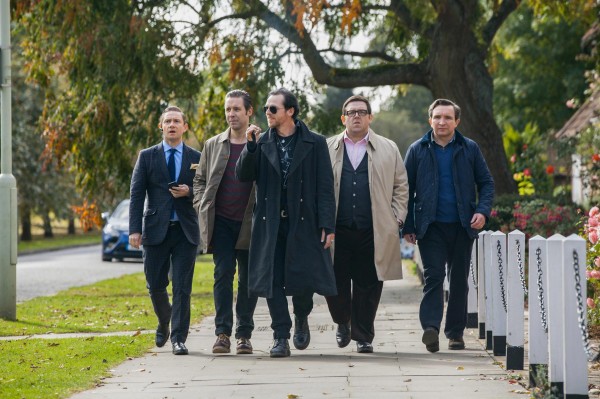
“The World’s End” is the supposed final entry in the “Cornetto” (or “Blood and Ice Cream”) trilogy, and I seriously hope that doesn’t mean writer-director Edgar Wright and co-writer Simon Pegg aren’t going to make any movies together, because with “Shaun of the Dead,” “Hot Fuzz,” and now this, they make some of the most intriguing, entertaining, ambitious, wonderful films (not just comedies; that’s too easy) to give us the pleasure of seeing. I don’t know what it is; maybe they bring out the best in each other through each other. But I love all three of these movies. I would be first in line to the next Wright-Pegg collaboration.

The review has barely started and I must sound like a fanboy right about now. Let’s get right to it.

“The World’s End” stars Pegg as Gary King, a middle-aged man stuck in a stage of arrested development and always lives in the past. He recalls a time 20 years ago when he and his four best friends, when they were teenagers, embarked on a journey known as the Golden Mile, which is mainly a series of 12 pubs, with the World’s End tavern being the final stop. Gary looks back with fondness but also with regret since he and his friends didn’t make it to the World’s End. But he still likes to see himself as a king of cool, as back in his teenage days, he was a charismatic, daring teenager who felt like he could take on the world as opposed to actually dealing with real-life issues.

Nowadays, 20 years later, he’s a pathetic middle-aged man who still thinks things can return to the way they were, still drinks, and still sees himself as king-of-cool. He hasn’t aged mentally and doesn’t care how pathetic he looks to everyone else. His friends, meanwhile, have drifted away from him. They live their lives with jobs, marriage, families, etc. They get surprise visits from Gary, whose plan is to rally his group together to relive the old days and do it right this time. He manages to talk his friends (Andy, played by Nick Frost; Steven, played by Paddy Considine; Peter, played by Eddie Marsan; and Oliver, played by Martin Freeman) into returning to their hometown of Newton Haven and finish the Golden Mile.

The only reason the friends, one of which (Andy) holds a grudge against Gary, go along with Gary’s plan is because they feel worried about his way of living and because he said his mother died (which isn’t true). Gary becomes a little too much for them to handle at times, and the friends have to try and talk sense into him and bring up that what he’s doing isn’t healthy or welcoming, and he needs to grow up and face reality.

Oddly enough, this first part of “The World’s End,” which runs for about 35 minutes, proves that it would be a great, funny and effective movie about a reunion of old friends thinking about the old days and when their lives are like now. They notice what’s changed and what hasn’t changed, and that includes their first few pub-stops in Newton Haven, which have been cleaned up and “Starbucked.” Gary even finds that his old flame, Sam (Rosamund Pike), isn’t interested in Gary anymore.

Think Adam Sandler’s “Grown Ups” done right. There’s great writing (the dialogue and one-liners are absolutely wonderful and very funny) and great acting and it seems like the story is going somewhere mature with what it has already. And it kind of does, but…not quite in the way those who haven’t seen the trailers or read the plot synopses would have expected. Those who have are waiting for me to bring up the “blanks,” the nicknames the main characters give to the robot-alien-things that have invaded the town.

Yep. Gary and friends discover that Newton Haven has been invaded by an alien intelligence, and most of the townspeople have been replaced by blue-ink-filled, life-size action-figure like, robotic replicates. Rather than get the hell out of that town, Gary figures the best solution is to continue on the Golden Mile so as they don’t raise suspicion and thus don’t fall victim.

Makes sense to me.

Bottom line is that Gary came here to complete a pub crawl and he’s going to do it, no matter how many times his friends try to convince him otherwise or how many other messy situations they get into with the robots. Gary pours himself a pint everywhere they go and rarely lets anything stop him. No matter what other changes he’ll come across, Gary will not back down. Through all this madness, there is still time to keep true to the reunion story by taking time to bring up new issues about past, present, and future. It all manages to oddly fit together, mixing comedy, drama, and sci-fi to give us a spot-on satire and a gripping story at the same time. Also, this is probably the most personal story Wright and Pegg have put together, since the focus is mainly on Gary’s character and how he’ll grow despite not wanting to and not expecting to.

But of course, I cannot forget to talk about the action sequences. They’re very entertaining to watch, as we get some of the funniest fight choreography I’ve ever seen in a comedy. Great stunts and the right moves help make these scenes gripping action and fast-paced comedy. And in these scenes, be sure to rewatch them a couple more times on DVD because there’s a chance you’ll miss a couple things, it’s so fast. It’s edited energetically, much like the other films (as well as “Attack the Block,” a Wright production). The special effects are pretty damn good too.

Simon Pegg delivers what is arguably his best performance here. He’s been good in movies before; this is his most accomplished work. I could also say the same for Nick Frost, who has co-starred opposite Pegg in the other “Cornetto” movies. As Andy, the uptight businessman who constantly tries to talk some sense into his friend, Frost is very effective. That comes as a surprise, as Pegg is usually the straight-man and Frost is usually the jokester. Here, it’s the other way around, and Frost is wonderful here. The rest of the cast, which includes David Bradley as a crazy old man who knows the score and Pierce Brosnan in an uncredited cameo, perform well and make for an appealing supporting cast. I don’t know why, but seeing Martin Freeman with an earpiece and a suit trying to fight is a joy to watch.

Everything builds to a climax in which Gary faces off against the leader (who’s just a voice of reason, so to speak) of the aliens. I won’t give away the ultimate resolution, but let’s just say it’s very clever and leads to one hell of an epilogue that you don’t see coming and are nevertheless fascinated by (or at least, I was). Mainly though, “The World’s End” is a joyous experience. A ton of fun. A funny, slick, well-made film. There’s more I could say about this film that express how much I love it, but I’ll do you a favor and leave you to enjoy it for yourself. What else can I say but it’s time to look into the future. And in my future, there’s more viewings of this film.

Wait, doesn’t that go against the “don’t cling to the past” message?

Ah well, I’ll figure it out later.

Saving Mr. Banks (2013)

28 Jan

saving-mr-banks-tom-hanks-emma-thompson-slice

Smith’s Verdict: ****

Reviewed by Tanner Smith

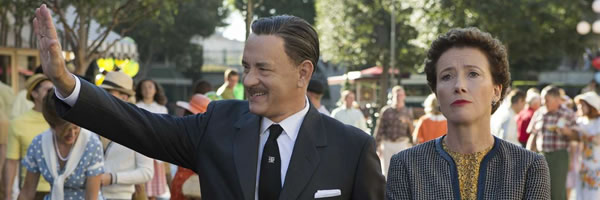
Here’s something I’m not sure anyone would have expected: a Disney film about the making of a Disney film. And it’s not just any Disney film, but “Mary Poppins,” well-known as one of Walt Disney’s best. Yet it also seems kind of ideal of an idea to be made, since the story behind Walt Disney and co. getting the rights to the original source material by author P.L. Travers is an interesting one. That story is made into Disney’s “Saving Mr. Banks.”

The film takes place in the early 1960s. Emma Thompson stars as P.L. Travers, the author of the popular “Mary Poppins” books, which Walt Disney (played by Tom Hanks) has been trying to obtain the rights to for years so he can produce a film adaptation. For 20 years, Travers has resisted the urgency because she isn’t a particular fan of Disney. She can’t abide cartoons, she doesn’t like his lighthearted fare, and she just can’t see her beloved characters treated in a way she’s afraid Disney would do. But now, she’s struggling with her financial situations and feels she has no choice but to agree to let the Disney studio make the “Mary Poppins” film.

She travels from London to Los Angeles to meet and negotiate with Disney, the songwriting Sherman brothers (Jason Schwartzman and B.J. Novak), and the writer Don DaGradi (Bradley Whitford). But each session tests her patience, as she doesn’t always agree with their decisions. She’s a stubborn, bitter woman who won’t stand for nonsense. They come to compromises (sometimes to her disdain) and Disney tries to open Travers’ heart to what magic he has to offer.

There is a lot of delight in the scenes where she visits with her collaborators, especially for those who know and love the popular Disney film. There are comic moments that reference what almost was and what did become part of the film, and the dialogue in these scenes is just fun to listen to. This is one of the most interesting, entertaining films I’ve seen about the collaborative process in Hollywood filmmaking. Even if some of it doesn’t necessarily ring true, it’s still interesting to watch.

It’s kind of unusual for this film to be made, since it isn’t an entirely pleasant story to be told. But director John Lee Hancock (who also directed the 2002 sports film released by Disney, “The Rookie”) and writers Kelly Marcel and Sue Smith found a way to make this film sweet and entertaining but also very effective. The story is intercut with the rougher edges of the film, which occur in flashback sequences in which Travers, living in Australia, deals with the sickness of her father (Colin Farrell) who is fighting a losing battle with alcoholism. In these sequences, we see where Travers got the idea for most of the characters and events in her books. We understand their meaning and why they’re so important to Travers.

It can be argued that the contrast between the 1900s flashbacks and the 1960s events makes the former feel like a different film. But I think the combination of light and darkness is suitable for giving the audience an understanding for why Travers feels the way she feels about certain things occurring now. This gives most of her meetings with Disney a greater meaning. And because of the flashbacks, we also have a complete portrait of P.L. Travers, seeing her as a child played by Annie Rose Buckley and as a middle-aged woman played by Thompson.

Emma Thompson carries this movie. Her performance as P.L. Travers is definitely spot-on. She plays a stubborn woman who has had a troubled past, as well as a writer who loves her characters too much to see them ruined. Any writer could relate to that in some way. Thompson’s great here. The surprise performance for me came from Tom Hanks. I didn’t know how well he would portray Uncle Walt himself, but he managed to project the right amount of optimism and happiness that can definitely remind you of the late Hollywood titan. And it’s just hard not to see him as Disney. Note the scene later on when he talks to Travers about why years back, he never gave away his character of Mickey Mouse for money; you can see and hear the sincerity in his performance.

Those who know the story beforehand may have a bit of an issue with the ending of “Saving Mr. Banks.” Without giving too much away, it may rub some people the wrong way. But personally, I would see it as a “on the one hand/on the other hand” resolution. Maybe it doesn’t entirely make clear what Travers is feeling at the premiere screening of “Mary Poppins,” but so what? It didn’t need to go one way by fully presenting what should be felt here; that would have been cheating. Instead, we get an ending that can be analytical and heartwarming at the same time.

For those with a soft spot for “Mary Poppins,” “Saving Mr. Banks” is a treasure. For those who are interested in the collaborative process in a movie studio, it’s also a treasure. And of course that can also be said for those who are straight-up Disney fans. I can relate to all three. I loved “Saving Mr. Banks.” It’s solidly-acted, it’s entertaining, it has an effective balance of comedy and drama, and for lack of a better term, it’s “Disney magic.”

Fruitvale Station (2013)

25 Jan

images

Smith’s Verdict: ****

Reviewed by Tanner Smith

“Fruitvale Station” is one of the strongest films I’ve seen in quite some time. It’s an effective, tragic, well-done account of the last day of the year 2008 and the last day in the life of Oscar Grant III. For those who don’t know, Grant was a 22-year-old Bay Area resident who was celebrating New Year’s with his friends when he was shot and killed by police at the Bay Area Rapid Transit (BART) Fruitvale Station in Oakland, California. The event was recorded by bystanders on their cellphones and uploaded online, leading to international outrage.

Ryan Coogler makes his feature debut with “Fruitvale Station,” a film based on the events leading up to the incident. It’s obvious Coogler cares so much for the subject that a film about it would have to be done exactly right. And thankfully, he knew how to tell the story. The film is presented in a straightforward way, as if the viewers are innocent bystanders or eavesdroppers as Oscar Grant III goes about his day, not knowing it will be his last. It’s an effective process.

The film begins with actual footage of that incident on the platform, as police brutally pin him to the ground, people shout “hey” and “let him go,” and the cop brings out his gun. Then the film starts, as it’s a dramatization of the day that led up to the incident. Oscar (played by Michael B. Jordan) is just going about his day—spending time with his girlfriend Sophina (Melonie Diaz) and their 4-year-old daughter Tatiana (Ariana Neal), looking to regain his job after having lost it, calling his mother and wishing her a happy birthday, finding her a birthday card, buying seafood for his grandmother’s gumbo, eating dinner and chatting with family, and more, with only one flashback showing that Oscar was once in jail for dealing drugs.

The first half of the film is just an ordinary day in Oscar’s life, but what makes it all tragic is that we know something important that Oscar doesn’t—whatever he does on this day is going to be his last. We know how it will end. He doesn’t. That makes a moment in which he tells his daughter goodnight before he and Sophina set out for a night out with friends—he promises to take her to Chuck E. Cheese the next day, but we know it’s not going to happen.

Then comes that night. Oscar, Sophina, and their friends ride the train, party before the countdown to New Year 2009, come across a couple pleasant people to talk with, and then they step onto the train leading to Fruitvale Station. A fight breaks out when Oscar comes across a hateful ex-cellmate, leading to the arrest of Oscar and his friends on the platform, leading to…

“Fruitvale Station” may be more about Oscar’s final day than it is about Oscar himself, but we do learn a few things while in his company. We know some things about his past, we see how his year in prison makes things uneasy for his mother (well-played by Octavia Spencer), we see his good qualities, we see his bad, we see him interact with people who love him. It’s enough for us to get a good sense of who he was, and Coogler is careful not to present him as a heroic type but as a many-sided human being. Oscar was a regular guy who had his problems but also had people who love him and would miss him. It’s a compelling portrait of such a man who befell a case such as this, and it also leads to one of the most brutal, uneasy scenes I’ve seen in recent memory. When the climax arrives, it’s a truly effective tough case of police brutality and even tougher to stomach as it was based on a true event. Though it also makes you think—do you think anyone would have even remembered Oscar’s name if he wasn’t killed the way he was?

“Fruitvale Station” is never manipulative (even a scene in which Oscar helps a young woman at the grocery store decide which fish to buy is convincing), and even when you think it’s going to be (such as when he helps a dog who just got hit by a car), Coogler finds a way to effectively roughen up the scenes, keeping with the consistency of the film which feels gritty and realistic. He’s aided by an excellent actor in the role of Oscar Grant III. Michael B. Jordan turns in a star-making performance, giving a powerful portrayal of a young man who goes about his day, not knowing it’s his last. He, along with the nontraditional cinematography and solid supporting cast, adds to the compelling nature of “Fruitvale Station,” a film I will not forget anytime soon.

It’s a Wonderful Life (1946)

13 Nov

It's_A_Wonderful_Life

Smith’s Verdict: ****

Reviewed by Tanner Smith

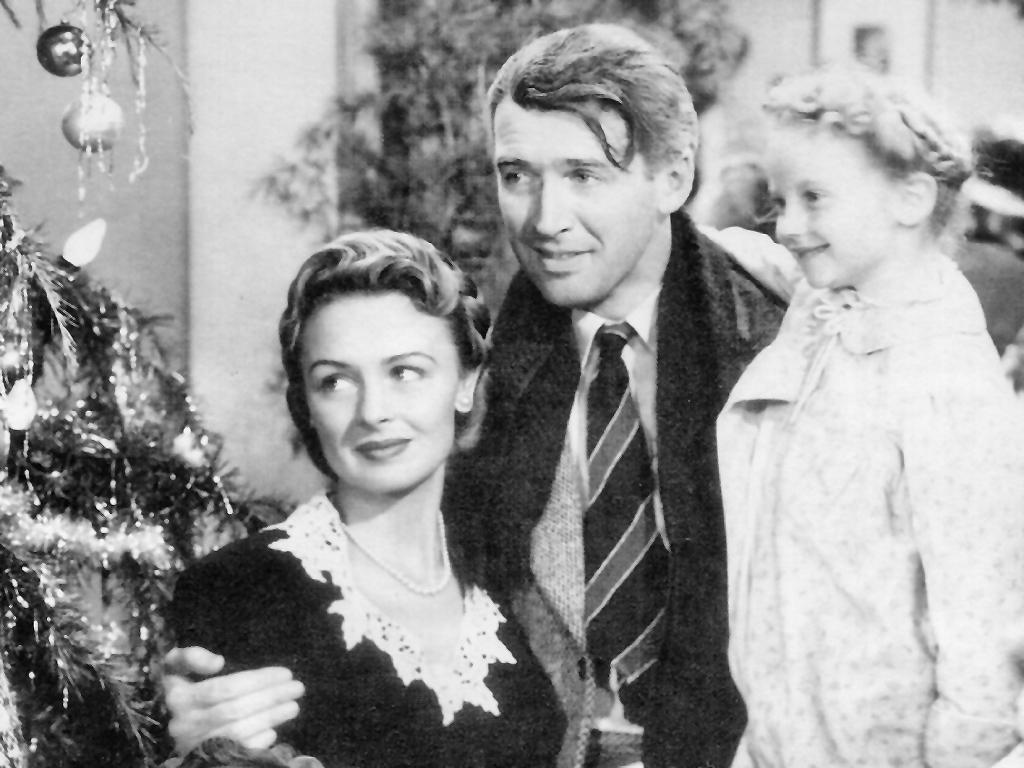
“It’s a Wonderful Life” is undoubtedly one of the most well-known, popular Christmas films, but it really is something more than that. To call this film a treasure would be to understate it. It’s not only a celebration of storytelling and filmmaking, but also a celebration of life. It’s about acknowledging what you have, knowing that things can be good, and how you couldn’t imagine your life going another way. That its important final half occurs during Christmastime just raises its emotional level.

I love this wonderful movie, and I still find it hard to believe that it was obscure when it first released in 1946. Even though it was nominated for five Academy Awards (including Best Picture), it received mixed reviews and barely made back what it cost, despite the box-office popularity of filmmaker Frank Capra. But as time went by and it hit public domain, it did find its audience as movie-lovers fell in love with what this beautiful film had to offer.

“It’s a Wonderful Life” is a masterpiece in storytelling. The structure of the film is just brilliant. It begins with shots of a quiet, snowy small town called Bedford Falls on the night of Christmas Eve, with voiceovers from people praying to help George Bailey. The prayers reach Heaven, as God assigns a “2nd-class” angel named Clarence (Henry Travers) to be George’s guardian angel. But first he has to show him (and the audience) who George is and what led him to contemplate suicide…

George grew up in Bedford Falls, but had big dreams of seeing the world and becoming a world-famous explorer. But as he grew to adulthood, he had to give up those dreams, as well as college, to take over the Bailey Building and Loan Society after his father passed away. George continues through his life in Bedford Falls, always putting human need above anything else such as wealth, always supported by his family and friends. His main problem: a ruthless banker named Potter (Lionel Barrymore) works the opposite way, using his riches to drain the spirit of Bedford Falls. Potter wants to hit the Bailey Building and Loan because it’s the one place in town he doesn’t own, and he knows if he can buy George out, he’ll run the whole town. As Potter constantly thinks of a new way to get his hands on the institution, George thankfully finds a way to foil him.

This is essentially the first two-thirds of “It’s a Wonderful Life”: giving us insight into George’s life, showing events from his childhood to his adulthood. We know what he was expecting his life to be, and are as heartbroken as he is when things don’t work out the way he planned. While there are many comic, upbeat moments (such as the infamous swimming-pool scene where George dances with his first love, Mary), there are also some grim moments in between, particularly those that lead to George standing on a bridge, about to jump off and end his own misery.

After all this buildup, we finally get to Clarence being sent to Earth to help George however he can. This is what this film’s admirers remember most from this movie: the final third of the film. Clarence jumps into the river under the bridge so that George can save him. When George does save him and Clarence introduces himself as his guardian angel, George doesn’t believe him and only sees him as an oddball. But Clarence has a way of proving himself and also showing George how wonderful his life truly is: by making it so that George can see what Bedford Falls would have been like if he was never born. It’s in this alternate reality that George makes some shocking discoveries about how things would have turned out without him around—everyone is much worse off. Potter owns the town; George’s uncle, Billy, is committed; George’s brother, Harry, is dead; his wife, Mary (well-played by Donna Reed), is single and lonely; his children are gone; and so on.

And so George learns that each contribution he could give is helpful to others, that things in life can work out though not always in ways expected, and that the greatest values in life are family and friends. It’s no wonder that “It’s a Wonderful Life” is one of the very best “feel-good” movies (in fact, you could make the argument that it’s the absolute best)—its story is told in such a way that when the payoff ultimately occurs, it really means something and strikes emotional chords with audiences.

Everything about “It’s a Wonderful Life” works. The story, the characters, the filmmaking, the message, and the acting all make this film all-around, for lack of a better word, “wonderful.” I watch it numerous times every Christmas, and I see no reason why I shouldn’t watch it about 8-10 times this season.

War Eagle, Arkansas (revised review)

4 Oct

Luke Grimes and Dan McCabe in

Smith’s Verdict: ****

Reviewed by Tanner Smith

This is a “revised” review of “War Eagle, Arkansas.” When I first watched and reviewed this film three years ago, I saw it as the great film it was and wrote a very favorable review. It was a film I would definitely want to see again. And surely enough, I did. I rented this film several times at the local video store in my Northeast-Arkansas hometown until I ultimately bought it there for $10.75. It was well worth the cash. The reason I’m writing a new review of it is because I feel there’s more I can say about it now, especially considering that it’s now one of my absolute personal favorite movies.

I love this film. I mean, I really love this film. It’s not just that it’s a well-executed, well-acted, and very credible independent film, but there’s also its sense of place (an idyllic rural community that hits very close to home), the excellent characterizations (believable, effectively-realized characters all around; they remind me of people I know/knew), and its courage to tell a story that is emotionally accurate even if it goes against what most audiences would like to see (the resolution is melancholy and yet hopeful, with a hint of satisfaction nonetheless). All of those elements speak to me in ways I didn’t expect.

The film is somewhat based on the true-life friendship of producer Vincent Insalaco’s son, Vincent III, and wheelchair-bound Tim Ballany. A similar friendship is imagined in the film, with Enoch Cass (played by Luke Grimes) and Samuel “Wheels” Macon (Dan McCabe) in the small town of War Eagle (said to be “at the top of a plateau in the Ozark Mountains”).

Enoch and Wheels are both outcasts—Enoch, because despite him being a gifted baseball player with a chance at a university sports scholarship, he has a terrible stutter that doesn’t allow him to carry out a full sentence half the time, and that also makes him somewhat insecure; and Wheels, not only because he’s confined to a wheelchair due to cerebral palsy, but because he is a witty loudmouth who rarely shuts up. They’ve been friends their whole lives, they hang out around town every day, and despite their disabilities, they are able to create a full personality all their own in a way that a long-running friendship can create.

The film takes place in the summer after Enoch and Wheels have finished high school, and is essentially a slice-of-life drama simply about certain events in this time period surrounding this central relationship. Things happen because they are supposed to do happen—they simply are, and it’s more about how these things happen. It’s told episodically, as it shows Enoch preparing to pitch for the All-Star baseball game in Fayetteville, working up the courage (and speech) to ask a girl he likes out on a date, and wondering about his life in his hometown and what life could be like elsewhere.

These are all very relatable issues. Particularly for me, speaking as someone who has lived in a small town most of his life (and also in Arkansas, believe it or not), there were many times when I would feel tired of the all-too-familiarities and think of moving outward to a new life in a new surrounding. But there would always be at least something in that town that always made it feel like home—it was my home, and the people in it made it worth staying for a little while longer. And that’s Enoch’s deal here—his best friend Wheels, and also his family, are important to him, despite his wishes of leaving.

Even if you haven’t felt that way in your life, you realize how accurately it is portrayed in this film. In the case of Enoch wanting to ask out a local girl, Abby (Misti Traya), every guy has felt this way before. Working up the courage to ask her out, not knowing what the response will be, uncertain of what will happen if she actually says yes, and so on. There are embarrassing moments that ring true, one of which is very painful—it’s when Enoch meets Abby and her friends and tries to ask her out, but because of his stutter and inability to even let out the first word, her friends can’t help but giggle and laugh at him until Enoch is humiliated and leaves. Eventually, he does score a date with Abby but has to bring Wheels along just in case.

But there are two problems with this new relationship between Enoch and Abby. One is that Wheels is now the odd man out and feels lonely without Enoch (he also gets the feeling that Abby is not right for Enoch after all), and the other is that it gives Wheels time to think about what not only his relationship with Abby does but also what their own relationship does, which is to keep Enoch in a working-class town when he should be taking his chance at a baseball scholarship in Tennessee. This leads to a confrontation in which Wheels, after trying to keep everything bottled up inside, finally lets out to Enoch that he needs to wake up and know what he has to do.

It all manages to fit around a decision that Enoch must ultimately make—either stay in his hometown or leave to play baseball for a Tennessee university. The result may not be obvious to most people, but what’s really important about this resolution is why and how it had to happen, and it becomes even more clear the more times you watch this film (or at least, for me, anyway). Whether you’re satisfied with it or not, it’s hard to deny that it feels very true to life.

What also makes the film silently tragic is the character of Wheels. This is a person that can never be independent and always needs someone to help him, whether it’s his mother or Enoch. So while Enoch has a chance of getting out of this hometown he’s lived in his whole life with Wheels, Wheels is going to feel more and more imprisoned by the community he’s been way too familiar with. You feel for him, because amidst all the wit and profane talk he spews, you understand more of the isolation that he feels and can’t help but sympathize with him.

The film is called “War Eagle, Arkansas,” and surely enough, the town itself feels like a character in the film. A great deal of atmosphere is noticed all throughout as you get a good sense of the environment these characters live their lives in. Particularly, there’s the local diner, the practice baseball field, the farm Enoch lives on with his grandfather and mother, the open fields, the main street, and the overlook near the “War Eagle” sign, where Enoch and Wheels sometimes sit and contemplate. There’s enough atmosphere here that you can understand why Enoch does in fact like this place and why Wheels is imprisoned by it.

I should mention the supporting characters, because they are terrific. For instance, there’s Pop (Brian Dennehy), Enoch’s grandfather and baseball coach, who is crusty and tough with his grandson, and has reasons for being so. This is not a Wilford Brimley type of character that has all the answers and kindly puts them in ways that those in need of help can understand, and he is not a warm presence. Sometimes he’s a jerk, he’s not always right, and he can get a little carried away. Yet at the same time, there’s a sense of humanity that keeps him from fully being a jerk. As the film progresses, we get a little more of his story through Enoch’s eyes, learning more about him through little actions and few words. He is trying to give Enoch the opportunities that were denied to him in his past, like baseball glory.

There’s also Jack (James McDaniel), a black video store clerk who wants to start his own church in a community that’s…well, mostly-white. You would think, since he is a preacher, that he would fit the role that the Dennehy character could have had, and while he does have a few inspirational speeches, they’re not overly written or played unrealistically. This film is consistent in how it doesn’t always go for the easy way out, and that’s true of how Enoch slowly but surely reacts to some of Jack’s advice. Also among the supporting characters is Belle (Mare Winningham), Enoch’s resolving mother who is sick and tired of the feud going on between Enoch and Pop because of the way Pop treats him; she’s an understanding woman who knows when to step in. And last but not least, there’s Jessie (Mary Kay Place), in a brief role that says a lot, as Wheels’ hardworking mother who is still trying to make ends meet.

All of these characters are believable and fully-realized, and the dialogue they deliver seems very genuine. The credit for that, as well as for the ways the story is presented, has to go to the writer, Graham Gordy, and the director, Robert Milazzo. They have created a great portrait of relationships, ambitions, and small-town life, with authentic characters and situations to help present them. And a great deal of credit also has to go to the actors; there is not a single false note in any of the performances. This film probably has my favorite performance delivered by character actor Brian Dennehy, who creates a very credible “crusty-old-man” character with purposes and also regrets. I learn more about him each time I watch this film. Luke Grimes (not a stutterer) and Dan McCabe (not diagnosed with palsy) are absolutely perfect in their roles, and their friendship is very convincing, as if they really had been friends all their lives. Misti Traya is a three-dimensional dream girl, with her quirks and flaws that balance out her good looks and nice qualities. James McDaniel, Mary Kay Place, and Mare Winningham are solid as well.

There’s hardly anything more I need to know about Enoch, Wheels, Abby, Jack, Belle, and Jessie than what I know from this film (and it helps that there are ending texts explaining what happened to half of these people later on). But if there was ever a sequel to this film, I would definitely check it out, because I certainly wouldn’t mind spending another hour-and-a-half with these people. But because I’m sure that a sequel will never come about, I guess I’ll just have to stick with this film as is.

And I have. I’ve watched “War Eagle, Arkansas” a hundred times already and will continue to watch it a hundred more times in the future.

Mean Streets (1973)

23 Sep

mean-streets

Smith’s Verdict: ****

Reviewed by Tanner Smith

What’s it like to live in a gangster environment? More important, what’s it like to survive it? Martin Scorsese’s “Mean Streets” presents a portrayal of people going through life in New York’s Little Italy in a way that it’s hardly about gangsters as much as it is about those who have grown up and developed an understanding about that place. Some people are innocent, others strike deals, others are enforcers, and then there are those you really don’t want to cross. One of the characters states it as practically living in a constant state of sin, but continuing through with it because that’s what’s expected of him and his friends.

“You don’t make up for your sins in church. You do it in the streets.” Those are the opening, narrating words from Charlie (Harvey Keitel), a small-time hood collecting on the mean streets of Little Italy. He’s a Catholic with hints of feelings of guilt, but is too focused on the mob business to feel much guilt for what he does or sees. He’s also not entirely good at this business, and can hardly take care of himself. With the money he can bring in from collecting from his uncle’s protection racket, he’ll be lucky just to open a small business. But what separates him from the other Mafiosos is that he actually does have a conscience, as part of his Catholicism. Sometimes it does make him wonder (he even hovers his hand over a candle while thinking about the fires of Hell).

We meet the people in Charlie’s life, including Johnny Boy (Robert De Niro), Tony (David Proval), Michael (Richard Romanus), and Teresa (Amy Robinson). Johnny Boy is a special case—being an out-of-control, intense thug, he embraces the criminal street life, takes everything as it comes, and tends to take out his anger and emotions by beating whomever he can find. He is also very pathetic, as he paid his debts to Michael, the local loan shark, in quite a long while, and his extensions are running out. Charlie sometimes feels forced to look out for him and make sure he stays on track with everything, including a pivotal moment in which he must calm him down when he’s shooting a .38 on a rooftop. His constant getting into trouble leads to even more trouble.

Tony is also part of the Mafia community—along with Michael, he co-owns a local bar and is much a Mafioso as Michael. That leaves Teresa, Johnny Boy’s epileptic cousin, who is very beautiful and the object of Charlie’s affections. But due to her epilepsy, she is shunned by society and thus her and Charlie’s relationship is kept secret.

These are the characters of “Mean Streets,” and the film’s main focus is on what they do, how they live, how they relate to each other, what they get into, etc. Scorsese takes these fully-realized characters and puts them in a fully-realized world for a film that has something to say about them and we’re interested in knowing what that is. By the time the film is over (to its tragic end), you sympathize with them and hope they continue to survive in this messed-up place, no matter what it takes, and just hope it doesn’t push too far.

When you follow a group of characters in a film that doesn’t have a story in the traditional sense, and just focuses on how they live their lives, it helps the most when they feel real. Charlie, Johnny Boy, Teresa, Tony, Michael, and others around them seem exactly right for this material, and are played excellently by the actors, especially Keitel who brings the sincerity within the budding Mafioso, and De Niro (his very first collaboration with Scorsese; three years before “Taxi Driver,” seven years before “Raging Bull”) who brings a powerful screen presence to his performance. They feel real; the brotherly relationship between Charlie and Johnny Boy feels real; their whole world feels real; the way Scorsese frames them all feels as if we’re eavesdropping on them; the scenes of violence are very well-controlled.

“Mean Streets” came out the year after Francis Ford Coppola’s “The Godfather,” the gangster film to end all gangster films. While most gangster films released back then would try to imitate that film’s success and grand scale, Scorsese opted to make a dark, small, personal film that was more mature than a good deal of the copycats that “The Godfather” inspired. “Mean Streets” is a great film, and it was the commercial debut of Scorsese, who of course would become later known to us as America’s greatest filmmakers.

After Hours (1985)

21 Sep

936full-after-hours-screenshot

Smith’s Verdict: ****

Reviewed by Tanner Smith

When I first heard the premise for Martin Scorsese’s comedy “After Hours,” I didn’t think much of it. An uptight workaholic has the craziest night of his life? Maybe it’s because I’ve seen too many movies, but I kind of thought it wouldn’t be anything special, because I didn’t think there would be enough creativity or enough courage to really go all out and make it something unforgettable. In other words, I thought it would be relatively safe and I wouldn’t care much about it. But boy, was I wrong. “After Hours” is not only original and funny, but it is also unrelenting, unafraid, riveting, and best of all, unpredictable. This is a great film—one that had me hooked from the start of the mayhem to the end, and that couldn’t make me even begin to guess what was going to happen one minute to the next.

Why tonight? Why did all of this have to happen to him tonight? Why is he in one mess after another? Why can’t he just catch a break and call it a night? Why can’t he just go home? When will this ever end? Those are the exact questions that ordinary, uptight word-processor Paul Hackett (Griffin Dunne) asks himself as he takes a cab to SoHo, Manhattan, on a night that starts out as an interesting date with a beautiful woman and transforms into a nightmare that he cannot escape from. It all begins as he meets said-woman, knockout Marcy (Rosanna Arquette), in a café. They strike up a conversation, she gives him her phone number, and as soon as he gets back to his apartment, he immediately calls her up and asks her for a date.

Big mistake. Now, I’ll only reveal just the beginnings of this “wild night” that Paul finds himself in the middle of, because trust me, I want you to be as surprised as I am so that you’ll enjoy the film more. (I’m doing you a favor, trust me.) Paul takes a cab to SoHo, but the ride is so violent that it causes all of Paul’s money to fly out the window. A frustrating start, but no matter. Paul has a date with a beautiful woman and is even roped into giving her sculptress roommate (Linda Fiorentino) a massage after she finishes up a sculpture that looks like a man calling for help. (Very effective foreshadowing aspect here.)

Not enough for you? Of course it isn’t. How could it be? It sounds relatively harmless so far. It’s only keeping me interested so far because I can relate to this guy’s confusion—losing his money, just wanting to move forward with his date, etc. Then, they go to a diner and Paul finds that Marcie is not exactly date-material; he doesn’t like her very much. So he bolts. He wants to catch a subway train home and he only has 97 cents. Not a problem, right? He can just forget all about it.

Wrong. The fare went up and he can’t get a token for the train. He’s stuck there in the SoHo district with no money and no reason to be there. What else could go wrong? You name it. The whole rest of the night only gets worse and worse and worse, in a series of confusion, misunderstandings, violence, craziness that later leads to a huge misunderstanding, a death, and an angry mob.

“I mean, I just wanted to leave my apartment, maybe meet a nice girl. And now I’ve gotta DIE for it?!”

“After Hours” is a hard-edged comedy-thriller with a lot going on, and all of it very original and with a very clever blend of humor and horror. It’s an urban nightmare that never seems to end, as Paul tries to find some way to get himself out of this mess and back home. And being a Scorsese-directed film, you also expect the film to be very well-made, and it is. Scorsese uses all kinds of camera shots to get each point across and also to add to the agitation that the main character is going through. And it’s obvious that Scorsese, as evidenced in some of his other films, has a great eye for big cities—the SoHo district seems like a character of itself. The film is also very cleverly-edited—for example, there’s a scene in which Paul finds himself in yet another messy situation, and after an important line is delivered, suddenly there’s the sound of a mousetrap snap (mousetraps are set all around the windows of a certain character’s apartment). Paul is the mouse. He was curious, and now he’s trapped.

But wait, you may ask. How can I possibly reveal so little of the story for “After Hours,” when I said in the first paragraph that just hearing the premise wasn’t enough to impress me, and so how are you supposed to be impressed? Well, that is kind of tricky, I’ll admit—it took a risk for me to have to do that. My only hope is that you’ll take a chance on the film, as I did, and maybe you’ll be surprised by what it has to offer. It’s a scary, funny, wild ride that I was glad to have taken. I loved every minute of “After Hours.” Take that for what it’s worth.