Archive | Four Stars **** RSS feed for this section

The Guard Responds (Short Film)

16 Oct

1000w_q75

Smith’s Verdict: ****
Reviewed by Tanner Smith

In late April 2014 came a major tornado outbreak in the central and southern United States. Seven of the outbreak’s tornadoes were deadly, causing 35 fatalities. One such tornado cut an 80-mile path of destruction in Arkansas, hitting the towns of Vilonia and Mayflower the hardest, causing extreme damage. Many people lost everything. Many homes were flattened. And about 16 people were confirmed dead. More than five months have passed and there are people who were affected deeply by the storm, still trying to move on.

The six-minute documentary “The Guard Responds” tells about how the Arkansas National Guard was called on to assist local authorities with traffic safety, search-and-rescue, and medical evacuation in those areas hit by the tornado. But some members of the Guard were also affected by the storm. Some lost their businesses and homes, and one (airman Daniel Wassom) lost his life.

The film is a blend of older news footage (chronicling the event and the aftermath), new wreckage footage, voiceover narration by LTC Matt Snead (who also produced the film), and interviews from Guard members and civilians. Among the interviewees is former Faulkner County judge Preston Scroggin, who recalls what it like seeing the tornado while driving home. Also among the interviewees is Wassom’s father, Daniel Wassom Sr., who remembers his son as a hero in his eyes—Wassom Jr. died to protect his family while their whole house was destroyed.

“The Guard Responds” is about the aftermath of disaster, but it doesn’t just state the facts so that it becomes more of a reporting-news story than a short documentary—it uses footage, testimony, and masterful editing to tell a story about those who will take time of their lives to help. CSM Steven Veazey, one of the interviewees, puts it best in a truly moving final speech—“They put their lives on hold to help these other lives.” Even if “The Guard Responds” were a TV commercial for the Arkansas National Guard, I would still highly recommend it.

NOTE: “The Guard Responds” was directed and co-written (with Lt. Col. Keith Moore) by no stranger to my Shorts reviews, Sarah Jones. I realize I don’t give her enough credit for editing; she edited her own previous films (“John Wayne’s Bed,” “Turn Right on Madness,” and “An Ode to Angeline”) and also edited other Arkansas-made short films (including previously-reviewed “La Grande Fete”). She edited “The Guard Responds” as well; it’s definitely among her best editing work.

La Grande Fete: The 48-Hour Film Project

12 Oct

1170851_1379612195600575_2145006655_n

Smith’s Verdict: ****
Reviewed by Tanner Smith

“La Grande Fete” is a seven-minute short made by the team Flokati Films for the 2013 Little Rock 48-Hr. Film Project. For those who don’t know how it works, it’s a competition in which filmmaking teams craft a short film in just two days. It begins when each team draws a genre. For Flokati Films, it was “Operetta.” So, they had to write, shoot, edit and compose a short film in only 48 hours!

If I thought I was impressed with the 2012 48-Hr. film “La Petite Mort,” I hadn’t seen anything yet.

Directed by Johnnie Brannon and written by three members of Little Rock’s Red Octopus Theater comedy troupe (Jason Willey, Luke Rowlan, and Sandy Baskin), “La Grande Fete” is a remarkable achievement in what dedicated filmmakers can do in just one weekend.

The story: Debi (Karen Q. Clark) brings her new beau, a shy plumber named Andy (Jay Clark), to meet her friends. Things seem fine until Debi’s charming ex, Blade Diamond (Sam Clark), arrives and convinces her to take him back. Can Andy gain enough confidence to fight for Debi’s love. Will Debi make the right choice in the end? The story itself is as simple and old-fashioned as a typical romantic comedy, but “La Grande Fete” isn’t about story. It’s about one important thing: making people laugh. I’ve seen this short with four different audiences at four different film festivals, and each screening I attended had an uproar of laughter all throughout, from beginning to end. And I was among them. I think “La Grande Fete” is freaking hilarious! Willey, Rowlan, and Baskin create a funny script out of familiar material with funny characters and clever lines of dialogue…or should they be described as “lyrics?” Being an operetta, nothing by the characters is said generally, but musically. Everything these people say is sung loudly. This is where a lot of the comedy comes from, and it really works. Another clever “operetta” move—all of the action takes place inside one location (a house), much like a play or (pfft!) an opera.

“La Grande Fete” is a treasure of a short that made me laugh and smile all throughout, but it’s also skillfully crafted. Director-of-photography Will Scott gives the film a sort-of “you-are-there” quality, making the (intentionally-) awkward moments even more awkward and funny, the editing by Sarah Jones is quick and well-timed (important for a comedy), and I also compliment Sam Clark for not only acting as Blade Diamond (isn’t that a great name?) but also creating the score that accompanies the singing. I can’t forget to compliment the game comic actors giving funny performances; everyone in this short is so funny. Jay Clark, who I loved in John Hockaday’s “Stuck,” is effectively low-key (or as “low-key” as you can be in an operetta) while playing a shy, awkward man looking to earn love and self-respect. Sam Clark is funny in his attempt to be smooth, and the supporting cast members (Jason Willey, Moriah Patterson, Michael Goodbar, Alli Clark, Drew Ellis, and Patti Airoldi) deliver amusing lines (er, verses). But the biggest standout is Karen Q. Clark as Debi. I can’t even begin to describe how humorous, luminous, expressive, and appealing her performance is in this short; it has to be seen to be believed. She’s wonderful here.

Oh, I should also mention Brian Chambers as well, since he has some of the biggest laughs as a one-man running gag, but… You know what? I’m sorry, but a review for “La Grande Fete” simply won’t do. You have background information, you have a Smith’s Verdict rating (the highest one, I might add), and now…

NOTE: You have the film. (Vimeo link: https://vimeo.com/101564615)

2ND NOTE: While watching this, be on the lookout for three important things: a plumber character named Andy Benoit, a horn for a prop, and the line of dialogue, “Tell me the truth!” Those were the three requirements for all 2013 48-Hour films. I won’t dare give away how they work in a horn in this film.

3RD NOTE: “La Grande Fete” received three awards at the 48-Hr 2013 Awards Ceremony: Best Music, Best Actress, and Best Film.

Y tu mamá también (2002)

17 Sep

y-tu-mama-tambien

Smith’s Verdict: ****
Reviewed by Tanner Smith

Describing the premise doesn’t necessarily describe the film. In the case of “Y tu mamá también,” its basic premise can be described like so: two horny teenage boys embark on a road trip with an attractive, older woman and learn a thing or two about life, friendship, sex, and each other. To call this film a “teen drama” in that regard is to call “Hoop Dreams” a “basketball movie.” It’s technically true, but doesn’t give enough reason to see the movie.

“Y tu mamá también,” a Spanish film whose title translates as “And Your Mama Too,” takes place in the summertime in Mexico. Teenage best friends Tenoch (Diego Luna) and Julio (Gael Garcia Bernal), one from a rich family, one from a working-class background, are bored with their routines after their girlfriends left for vacation in Europe. They attend a wedding where they meet a stunning, lively young woman named Luisa (Maribel Verdu) and attempt to flirt with her, which leads to inviting her to come with them to a supposedly-secret beach called Heaven’s Mouth. What they didn’t expect was her accepting the invitation. So, they quickly pack up the car with supplies (including condoms, of course), get a map to the beach they didn’t even think existed, and pick her up to embark upon the adventure of a lifetime.

While on this car trip, the horny teenagers continue to attempt impressing this older, sexually progressive woman with how cool they are and how they’re in control of their own sexuality. Luisa likes to cheerfully tease Tenoch and Julio about their attitudes and methods of living, while also luring them into eroticism. She does this because her husband has been cheating on her and she feels the need to be desired. What makes Luisa the most interesting character in “Y tu mamá también” is that while doing this, she feels like teaching them something about sex as well. To them, sex is like a sport they win with their girlfriends and they take it (and them) for granted; maybe Luisa can change that and make them see sex as something more special.

Just listen to the premise—two teenage boys embark on a road trip with an attractive, older woman and learn life lessons along the way. This could’ve been made into a conventional mainstream comedy-drama, especially seeing as how this film was released in the early-2000s at a time when most teen films that came out were about grossout gags (sometimes involving a pie). But listen to the dialogue, written by director Alfonso Cuaron and his brother Carlos…or rather, read the English subtitles over the Spanish dialogue. It looks and sounds like real people talking. The way “Y tu mamá también” is filmed also makes it feel more real, with shaky camera movements and numerous long takes. That, and the film has one of the most frank depictions of sex I’ve ever seen, with characters talking about it in a realistic manner and even showing a lot in graphic detail. There’s plenty of nudity to please any male and/or female who’s tired of reading subtitles. You don’t see this very often in most films, or least of all, “teen dramas.”

Being a film with a road trip device, it’s a long journey and a worthy destination. Along the way, we as an audience see a lot of Mexico that they drive through. They go through small poor villages, pass police checkpoints, and also come across a roadblock of people stopping oncoming vehicles so they give donations to their queen, who is a girl dressed in white, representing the Virgin. The boys think nothing of it, but Luisa probably sees more to it, as she compliments and embraces the oddities they come across, especially when they finally reach the beach and come across more quirky characters. Why? That’s something I can’t answer right now without giving away something important, but let me just say watching the film again, knowing what you know from the first viewing, makes it more of a story about how you face your own mortality, and how no one should take life for granted.

Throughout the film are times when the sound cuts out and an omnipresent narrator states many background details about the characters and the places they come across on their trip. We realize while listening to it all how much of Mexico we’re seeing and what a message it’s conveying about its unfortunate peasantry left by a successful economy. It becomes even more apparent when the characters arrive at the beach and meet a fisherman named Chuy, and we learn that this “unspoiled paradise” will be purchased as a tourist attraction and Chuy will work as a janitor.

And what exactly do Tenoch and Julio learn after all this? That’s not really for me to say, but after seeing the ending of “Y tu mamá también,” it might make you want to see it again. Seeing it once doesn’t quite cut it. I would say that it’s one of those “coming-of-age” films that really has more to say than what its premise might suggest, but honestly, I don’t think I’ve ever seen a film quite like “Y tu mamá también.”

Streetwise (1985)

24 Aug

3e0fbeac60369bbb4641cc6436924d28_large

Smith’s Verdict: ****

Reviewed by Tanner Smith

The first shot of Martin Bell’s documentary “Streetwise” is a medium-shot of a teenage boy named Rat, drenched with water and staring off into space deep in thought. It’s followed by a faraway shot of him climbing up a side-rail on a bridge and then jumping off. The camera follows his 50-foot plunge into a river. Over this is his narration:

“I love to fly. It’s just, you’re alone in peace and quiet and nothing around you but clear, blue sky. No one to hassle you, no one to tell you where to go or what to do. The only bad part about flying is having to come back down to the f*cking world.”

This sets the underlying grim tone for the whole film “Streetwise,” which is a documentary about young street people in Seattle—streetwise teenagers and young adults who lead empty lives. Most of them are homeless. Most of them are con artists. Most of them are seen roaming the busy streets of Seattle, begging for spare change. Some are prostitutes; others, pimps. It’s hard to tell which is worse—that most of them are more or less content with their freedom or that hardly anyone is helping them.

Take Erin (a.k.a. Tiny), for example. She’s a 14-year-old prostitute who cons herself into calling her clients “dates.” She sees her mother every now and then, mostly to borrow money or makeup. But the mother just figures that Tiny’s prostitution is “just a phase she’s going through.” When stating this in the film, she doesn’t seem at all concerned that Tiny might develop an STD or become pregnant by any of these “dates.” And get this—there’s even a moment in which she tells her daughter not to bug her. Why? “I’m drinkin’.”

Then there’s Dewayne, a 16-year-old beggar/thief as well as a drug addict. He doesn’t get any help from his father because he’s in jail. He does wish he was around to look out for him.

Rat, short, 17, and a loudmouth, has no help either. He lives with an older man, Jack, in an abandoned hotel and has about the same daily routines as Dewayne with no guidance, no help, and not much to care for when he finally hops a train to leave the city, which he constantly talks about with his girlfriend, Tiny, who doesn’t want him to leave.

Then there’s Shellie, a 16-year-old blonde prostitute. In probably the most upsetting moment in the film, she has an argument with her mother about what her perverted stepfather did to her when she was little and didn’t know what he was doing. Shellie sounds sad and miserable just talking about it. What is her mother’s response? “Yeah, but he doesn’t do it anymore.”

These are only four of the kids that are the subject of “Streetwise,” one of the most heartbreaking films about troubled youth that I have ever seen. This was based on a 1983 Life magazine article on a group of the homeless and/or abandoned children who roam the streets and become hookers, beggars, thieves, squatters, dealers, junkies, and hustlers. The film came about as an extension of that, as writer Cheryl McCall and photographer Mary Ellen Mark team up with director Martin Bell to first gain the trust of many of these kids for weeks, and then bring in their cameras to film their routines, eavesdrop on conversations, and explore the usual flophouses, abandoned buildings, and mean streets that these kids spend most of their days in. We even see how one of them (Rat) manages to get food for free through a trick. He orders a pizza with an odd choice of topping on it, then waits for a while until it’s tossed in a dumpster, so it’s there waiting for him.

These are not all bad kids. They know their ways of getting by, they’re tough enough to manage, they look out for each other since no one else will (one prostitute’s income even pays for the clothes of another streetwise girl), and yes they break the law, but how many legal ways are there for young people to use to care for themselves on the street?

Something I have to wonder about this film is, is any of this staged? There are many moments that are shot and edited like a “real” film, as if these people don’t notice the cameras on them or around them. Do they really want to say what they say, particularly Tiny’s mother when she tells Tiny not to bug her because she’s drinking? Or what about when Tiny breaks down during a tender moment with Rat—I sort of wondered why she didn’t just turn to the camera and ask the people around to go away? Or what about when Dewayne visits his father in prison? It plays kind of like a parody of estranged father-son relationship, as if the father is telling Dewayne what he wants people to hear. But then again, that’s probably what he wants Dewayne to hear too, which actually says a lot considering the other parents you see in this film!

However it was all done, it doesn’t make the finished product “Streetwise” any less effective. At its most tragic is in its ending when we attend the funeral of one of the kids…and it’s so empty. Only a few people, such as the deceased boy’s father, a few social workers, and some strangers, attended the funeral; not even his closest streetwise friends came to mourn. What’s worse is that even though this is a solid example showing the scenario of these kids’ lives, nothing changes after this death. After the funeral scenes, we see these kids one last time, going through their usual procedures. It says a lot about some of their futures.

NOTE: It’s worth noting that Rat and Tiny have made it out of this lifestyle since this film was released in 1985. According to Wikipedia, Rat is married with children and has grandchildren, and Tiny (I’ll just call her Erin Blackwell now) has gotten worse as time went on, until cleaning up and settling down in the mid-2000s with a husband. Another (Lulu, whom I’m sorry I forgot to mention is an 18-year-old angry lesbian who gets involved in the wellbeing of some of these kids in the film, and seen as somewhat heroic) is sadly stabbed to death soon after the film’s release.

Boyhood (2014)

23 Aug

boyhood_promotionalstills3_1020_large_verge_medium_landscape

Smith’s Verdict: ****

Reviewed by Tanner Smith

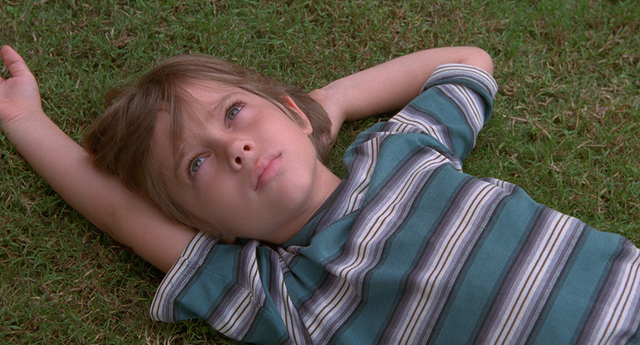
I’ve always been fascinated by the concept of following characters through real time. I think that’s why I enjoy Michael Apted’s “7-Up” documentary series, because each film, released every seven years, shows the same people as they progressed since we last saw them. Richard Linklater did kind of the same with his “Before” trilogy (“Before Sunrise,” “Before Sunset,” “Before Midnight”), following fictional characters through real time (in this case, 18 years with nine years between each film). But with “Boyhood,” Linklater has taken that concept quite a step further. He has made a film that shows moments from the life of a boy growing into a man over the course of twelve years. How did Linklater do this? By getting his core cast together once every year for 12 years. It’s not exactly like “Hoop Dreams,” the documentary that followed the lives of two young men closely for about six years—each year, Linklater and his cast & crew get together and make a short film, and when it’s finished, it’s all compiled into one big epic to create the ultimate slice-of-life; a chronological coming-of-age tale showing the life of a young man from age 6 to 18.

By making it like this, the actors are allowed to develop their portrayals of the characters as they age. We get to watch these actors grow up on screen and it changes the way we look at this film in a sense of knowing it’s the same actor playing the same character rather than having different actors play the same character from time to time in most movies.

“Boyhood” is a great film and is already being hailed as a masterpiece and a landmark film, and thankfully it’s not a gimmick film where its background history makes it great. I’m not sure what all I can say about it that no one else has already, but I’ll give it a shot.

Let’s start with the actors and characters. Ellar Coltrane and Lorelei Linklater (Richard’s daughter) play siblings Mason and Samantha. Mason is first seen as a typical, curious-minded little boy who constantly fights with his sister who is a precocious little brat. We follow these two children over the next decade as they grow and mature as events in their lives slowly shape up their future. We see them do what most young people do as they grow up—discover the opposite sex, experience heartbreak, try some drugs, drink alcohol. By the end of the film, when they’re both in college, Mason is a thoughtful, good-hearted college freshman and Samantha is a self-assured young woman, and they both know the feeling of freedom, having moved out of their mother’s house.

But we’re also treated with professional actors Ethan Hawke and Patricia Arquette who also play characters that grow. Arquette plays Mason and Samantha’s single mother, Olivia, whom they live with. Olivia is struggling to make ends meet and trying to keep a social life intact while also carrying the huge responsibility of motherhood while the kids’ father, Mason Sr. (Hawke), is away in Alaska following some dream. (At least, that’s what Olivia and her mother tell the kids—for all we know, Mason Sr. could be in jail or they just didn’t want him around at this time; it’s like when your parents tell you, when you’re a little kid, how they “sent your dog to live on a farm.”) We get to see Olivia come of age in this film as well—she will marry and divorce a second time, explore new romantic relationships, struggle with finances, go back to school, finally get a job she likes, and ultimately find herself. When you first see her, she is a somewhat bitter young woman who isn’t all that proud to be a parent; that becomes clear when she has to call off a date because of Mason and Samantha at home—she states out loud that she’d like nothing better to do than to go out and have fun. By the end of the film, she tries to stay connected to her children and resents the fact that they’ll both be leaving.

Mason Sr. is in these kids’ lives as well, seeing them on every other weekend and during summers. At first, he’s the typical absentee father with big ambitions that make him sound like he’s just full of it (and he has a kick-ass car which he will have to sell later on, to Mason’s disappointment). He’s in a band and likes to spew some B.S. life lessons (wait ‘til you hear his philosophy when he takes Mason and Samantha bowling), but over the course of the film, he does become a better person and even settles down with a new wife and kid while still staying connected to Mason and Samantha whom he still loves.

Hawke and Arquette each give some of the best performances of their careers (Arquette, in particular, deserves Best-Supporting-Actress consideration come wintertime), but it’s amazing how these two unprofessional child actors, Coltrane and Linklater, were able to remain in character all these years even as they go through their own growing-up in their own real lives.

Things happen in this film that don’t always pay off because that’s the way life is. Sometimes it is random; mostly it is pivotal; other times it’s essential; and so on. And “Boyhood” is very successful at showing these moments in the lives of these people, particularly Mason (hence the title suggesting his coming of age). People come in and out of their lives and we don’t hear back from a few of them; one day they’re interested in one thing but indifferent about it later; etc. I think the only time “Boyhood” comes close to semi-typical melodrama is when Olivia’s second husband, an alcoholic, loses his temper at the dinner table and pushes Mason, Samantha, and his own two kids around when Olivia leaves for a while. (That dinner-table scene is almost laughable, but it’s not very long.) Soon after, he isn’t seen again after Olivia and the kids have left him. Where did he go? What will become of the other kids? Will they be put in a foster home if the alcoholic is reported unfit for parental care? Life just goes on like that.

“Boyhood” is a simple, universal story, told through Mason’s eyes, that is so easy to relate to. I felt like I knew this kid or even was this kid, and I definitely felt like I knew those around him. That’s why it moved me so much. As time goes on, as the film continues in its nearly-three-hour running time, it’s very, very important that the growth and coming-of-age of this kid and his family are shown. Not only did I see them grow; I wanted to know what was going to happen to them for another 12 years. “Boyhood” is an ambitious project that absolutely paid off, and it’s by far one of the best films of 2014.

Man Shot Dead (2014)

28 May

1488182_681277818586835_3910100358730003304_n

Smith’s Verdict: ****

Reviewed by Tanner Smith

Filmmaker Taylor Feltner, the oldest of four boys in a big family, left his small Arkansas town of Morrilton at age 17 while everyone else stayed. “So I always felt a bit like an outsider,” he says. “When I come home with a stranger’s curiosity, I look at the family that raised me and I wonder what their lives were like before I came along.”

That’s part of his opening narration in his 74-minute documentary, “Man Shot Dead,” which premiered recently at the Little Rock Film Festival. He states that he will talk to certain members of his family and ask them about a certain incident that resulted in the murder of his grandfather. In some way, it has affected everyone in the family, and he is going to find out how. He comes home to Morrilton, AR, with his documentary crew and equipment, and aspires to gain insight about what happened, why it happened, and what happened after.

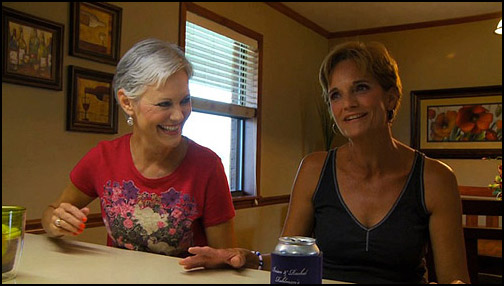
The main focus of “Man Shot Dead” is not the subjected incident itself but the reactions to it in present-day, as we learn through the dialogues of Feltner’s grandmother (Bernie), mother (Karen), and aunts (Glenna and Wanda). We’re first introduced to Bernie, who talks about how she first met her husband, Glen Dickson, and what he was like and how they related with each other through marriage. (“We never called each other by our first name,” she says at one point. “It was just ‘Honey.’”) Their daughters, Glenna, Wanda, and Karen, loved him and have fond memories of him.

It’s after that nostalgic opening that the documentary steadily decides to talk about the incident that cost Glen’s life on the night of July 25, 1966. Feltner and his brother, Grant (who we see often in the film), haven’t been told much about it; Grant has only heard little things about it. Feltner wants to know the full story, but because there are no reliable witnesses available and an inconsistent police report, he asks Karen, Bernie, Glenna, and Wanda to tell what they know about it. The only things that are most absolutely certain are that he was on another person’s property and he was shot with a rifle. It was ruled as justifiable homicide.

Why Glen was there to begin with is anyone’s guess. No one knows for sure, save for the only living witness, whose father was the one that shot him. Unfortunately, it seems she is unreliable. Later on, we see Feltner send her a handwritten letter, only to receive a response from presumably her lawyer. He sends another; no response. There are no clear answers to the reasoning behind Glen Dickson’s death, and to Karen, Bernie, Glenna, and Wanda, it seems that while there’s hardly a way to forget about it, it doesn’t hurt to at least try and let it be after all this time.

The main story being told in “Man Shot Dead” is how this family, the surviving mother and three daughters, continued on with their lives after Glen, the sole provider for the family, was killed. Understandably, they were all devastated at first (though Karen was probably better at hiding it, since according to Glenna, she didn’t cry the night they all heard the news). They stayed at a relative’s house for a while in Morrilton before Bernie knew they had to have a home of their own and bought a house. Bernie admits that raising and providing for three kids was rough at first, but through time they all managed to get by. They’ve grown very close together, always taking care of each other.

stills_ManShotDead

Now, some things may be kept inside that neither person wants to talk about, and they even joke about counseling and how they all might need it, particularly Karen who says she has more to say about herself that she won’t on film. Midway through, she sums up her life, and her family’s life: “Whether it just be that one night or things that happened before that, it set the stage for our lives. Our life has been great. We have a wonderful mother that took care of us. But it also robbed us of the things that we’ll never know about.” All the more heartbreaking is that she hardly had a chance to know her father, as she was only eight years old when he died. In probably the most poignant moment of the film, she states while holding back a tear, “I think every girl needs her daddy.”

The film is also a story of a man really getting to know his family in ways he hadn’t before. With his family’s history and the important event that changed their lives suddenly revealed to him, through this documentary project, Feltner can see these people not just as his mother, his grandmother, and his aunts; he understands what they’ve been through, knows what kind of people they were and how they became who they are now, and now sees them, particularly his mother, as stronger than he may have originally conceived.

And we do too, as a result of the finished product. I felt like I knew these people while I was watching this documentary and listening to them talk about what they knew, what they discover, how things were then, how they are now, and how they’ll go on living. And I understood them and was interested in everything they had to say. Karen Feltner, in particular, is one of the most fascinating people I’ve come across in a documentary—you don’t see characters in narrative fiction as compeling as this woman.

I should also praise “Man Shot Dead” on a technical level as well. Using old photographs, written documents, home-video footage, and even sound effects in the chilling sequence in which we’re told, according to the police report, what happened that fateful night, the film’s editing, by Jessica Schilling, is top-notch and makes the film even more captivating. It’s also shot gorgeously, by Feltner, Jennifer Braddock, Gabe Mayhan, and Andy Featherston—the sequence I think of in particular is where we see the brother, Grant, walking through a rural countryside and fishing in a nearby river.

“Man Shot Dead” is one of the very best films I’ve seen so far this year. I hope that after its world premiere at the Little Rock festival, it receives more audiences and recognition any way it can. It’s worth seeing to meet this family.

13 Pieces of the Universe (Short Film)

17 May

resized_99261-13-pieces-of-the-universe_85-18301_t728

Smith’s Verdict: ****

Reviewed by Tanner Smith

“13 Pieces of the Universe” is an Arkansas-made short film that follows a trait I’ve seen in a few other films at the Little Rock Film Festival, where it premiered—quiet. I admire a film, even a short, that has the nerve to be quiet every now and then so that we can take in the atmosphere and situations that are present. I’ve seen it in “Sidearoadia,” “Watch the Rhine,” and especially the feature documentary “Rich Hill”; this is pretty strong material as well.

Written and directed by Tara Sheffer, “13 Pieces of the Universe” tells the coming-of-age of a 16-year-old girl named Sara (Emily Cotton) in the Arkansas delta. The title is based on a poem that Sara remembers, which is Jamey Jones’ “Elsewhere in the Universe,” which states that there are pieces of the universe within each of us. Indeed, within Sara’s coming-of-age story, we can get about 13 individual occurrences in this 20-minute film that create senses of themes that stay true to the story structure, such as uncertainty, choice, stability, emotion, the little things in life, and so on. It’s told in a story that shows Sara in different situations such as canoeing with her friend, seeing a boy in town, unknowingly abandoning her friend for a while, dealing with her parents’ divorce, and so on, until a tragedy occurs.

This is a beautifully-made film that doesn’t have a lot of dialogue and only has a few conversations between characters, and relies on visuals to further suck its audience in by letting us breathe in what it’s getting across to us. There’s a lot of great atmosphere in this film, as the South is shown in a way that can either be seen as a wonderful thing or as a haunting memory, depending on the conditions. And I think the reason I liked this short so much was that it managed to speak volumes by saying very little and showing something as artful as, say, a burning forest as Sara watches from a distance.

In the end, I got a great feel of the film’s landscape, I bought the character’s emotions, and I felt the grief that was left by an unfortunate circumstance at the end of the film. There’s a sense of loss present in this film, not just for something physical but for something psychological as well. It’s mostly told through visual storytelling and by the end, it requires you to think about what it means not only in this girl’s life but also in your own life. After seeing it, I asked myself questions such as what are the little things I enjoy in my own life and do I take them for granted; whom can I rely on; what made me the person I am today; and so on. That it can bring out such a reaction from me convinced me that this short film worked wonderfully, and I recommend it sincerely.

Rich Hill (2014)

17 May

A007_C067_0929FV

Smith’s Verdict: ****

Reviewed by Tanner Smith

“Rich Hill,” a Sundance-Grand-Prize-winning documentary about three disadvantaged Missouri teenagers, is one of the finest films I’ve seen this year. It’s only midway through the year of 2014, as I recently saw this film at the Little Rock Film Festival, and so I expect some films will come along later to be even more impressive. But this film is simply the best I’ve seen so far this year; any film I see in the next couple weeks, or even in the next month, is going to be given the difficult task of topping this film. If it did, it’d be great, but I don’t see it happening anytime soon; I love this film that much.

I’ve seen films try and truly capture what it’s like to live in the South, especially for a kid. Some of them have been successful; others have proven embarrassing; but this one, being a documentary, shows the real deal in a hard but sensitive journey into the lives of three teenage boys who live in Rich Hill, Missouri.

Produced and directed by Tracy Droz Tragos and Andrew Droz Palermo, “Rich Hill” follows and observes its three subjects, Andrew, Harley, and Appachey, as they go about their daily lives. Sometimes the camera will be like a fly on the wall, showing events in a cinematic fashion, while other times the kids will have fun with the fact that they’re being documented for a film, and sometimes talk to the lens. But while they will make jokes to the camera at times, they will have the courage to express themselves with dark secrets from the past when they feel comfortable enough, so that you know how things have been for them in the past. And when the camera is simply observing, you see even more of what they go through.

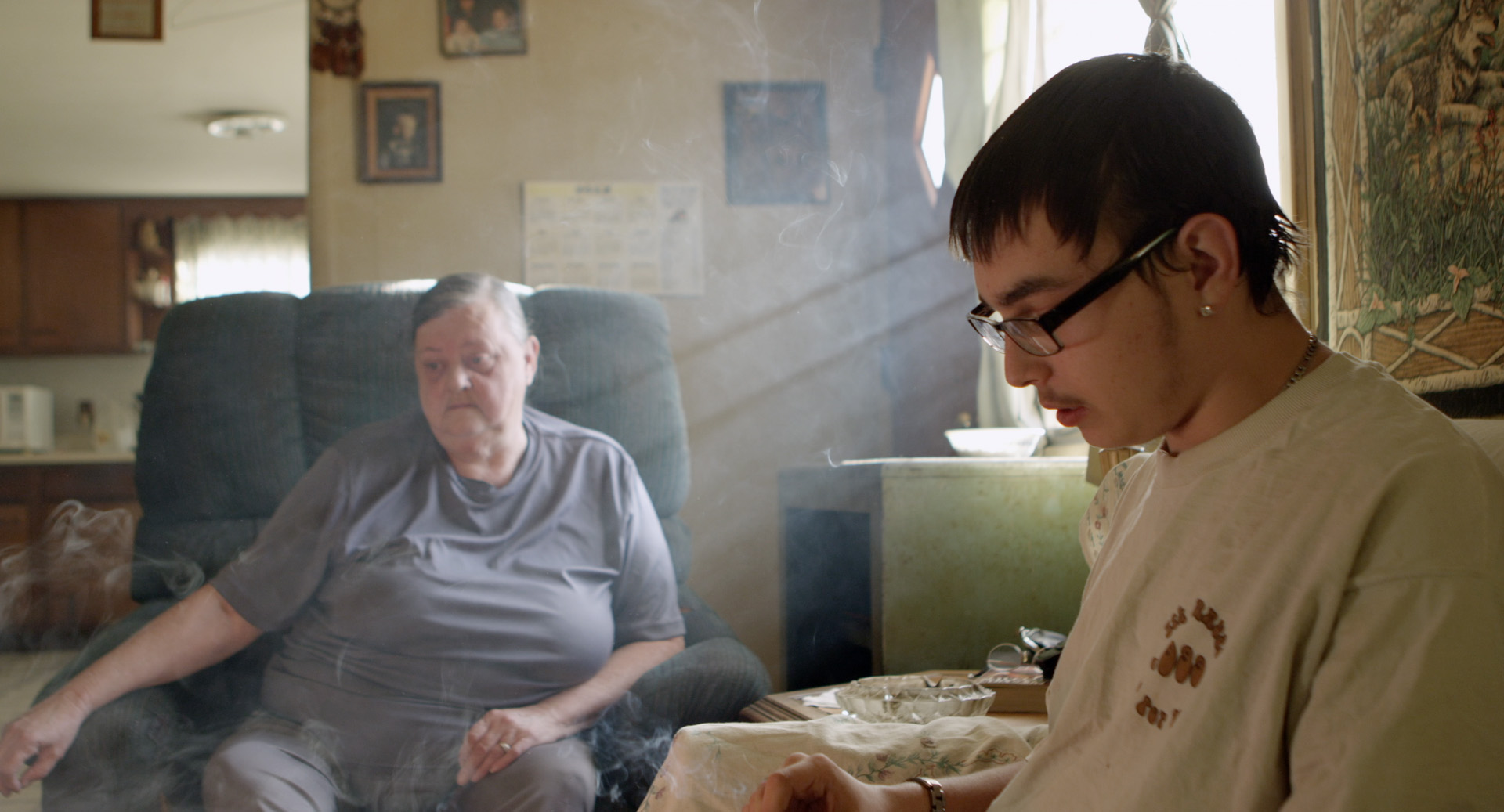
Appachey is a portly, unpleasant 12-year-old who comes from a broken home, often acts out when he’s angry, and lives with his multiple siblings and widowed mother, who is tough, bright, and often irritated by her son’s behavior (though it is a relief to find later, in a touching moment where he awaits a juvenile court hearing, that she does love her son). It’s clear in scenes where he wanders off alone and does things like break puddle ice that this kid doesn’t care about much in this world—not school, not home, nothing. He likes to think he’s old enough to know what he wants to be like, as he smokes a cigarette and mouths off to people. But it’s apparent that he won’t live out his limited dreams, such as “moving to China” to be an art teacher and “get to draw dragons all day,” as he keeps getting into trouble.

images

15-year-old Harley is the most disturbing and yet the most interesting of the three subjects. He hasn’t had a normal childhood and won’t get a chance at one before adulthood, but he has a good sense of humor and is good-natured, though he is doing poorly in school. He lives with his grandmother after his mother has been incarcerated for attempting to kill his stepfather. Later, we discover what drove that to happen and worst of all, why the mother is imprisoned and the stepfather is not. Harley talks to his mother on the phone once a week and they still remind each other they love and think about each other.

006

14-year-old Andrew is more optimistic and one to adapt to his surroundings. He has two things to remember in life—one is, “We’re not trash; we’re good people”; the other is, “God is busy with everyone else” while he believes that God’s plan for his family will come into motion eventually. He and his family move around a lot because his handyman father, who is also a Hank Williams Sr. tribute artist, can’t keep a steady job and often keeps the family in a state of isolation. Andrew knows more about how it all works, as he has grown quickly into manhood, while he also wants to continue to be his mother’s baby boy. Even when it seems he might be a little ticked as the family moves from house to house, he still keeps an optimistic point of view because he still relies on his Christian faith.

These are real teenagers with real problems. It’s how they deal with it that speaks volumes about what the future can hold in store for them, whether they like it or not. In that sense, especially in the case of Appachey, it’s kind of sad and tragic that after he’ll have spent some time in juvenile hall, he may still resort to what brought him there in the first place. We might be catching glimpses of these three kids before they become the violent, addicted Southerners that small Southern towns are often typecast by. And it’s all real; it’s all being documented. That’s why I hope that they choose the right paths in life down the road—I hope Andrew still keeps the faith; I hope Harley can be reunited with his mother; I hope Appachey is reformed. Do you know what I would like? I would like a sequel to this documentary, some time later (like Michael Apted’s “7-Up” series) so we can see how these kids turn out.

Even if you don’t live in the South, you can notice some familiarities from when you were that age—struggling with class grades, making friends, thinking about the future, and so on. What makes them different from most teenagers is their lifestyles. Sometimes, Harley’s grandmother can’t afford energy drinks and can’t always rely on food stamps. Andrew’s family doesn’t have gas for heating water, let alone a good home. Appachey’s home is too crowded, too messy, and too unstable. They’re all used to it by now and they just learn to survive whatever comes.

Sometimes there is room for fun, such as when Harley and his friends go out for Halloween and one beautifully-photographed sequence in which Andrew and his family and friends shoot off fireworks and light sparklers on the 4th of July. And sometimes there is possibility that the American Dream is hidden within this realm of shakiness. That makes the whole film melancholy and yet somewhat hopeful at the same time.

And I like that the film’s producers/directors chose their three subjects carefully by choosing a nice kid, a not-so-nice kid, and another kid in between the other two. And neither of these kids are portrayed as bad kids, like Andrew says in the beginning (“We’re not trash; we’re good people”); they just have their misfortunes and bad moments. The documentary does a great job at presenting these kids in a rural setting.

I’ve seen films that try to feature real life in the South, but “Rich Hill” is as real as it gets. You don’t find scenes quite like the ones in this film in other films. It’s authentic, it’s crafty, it’s riveting, it has characters as compelling as any fictional movie character, and it’s one of the best films of the year. I can’t recommend “Rich Hill” enough.

Andrew+Jewell+Rich+Hill+Portraits+2014+Sundance+Dm7RPbsmUoAl

Sacred Hearts, Holy Souls (Short Film)

17 May

1622208_267085190117598_419312271_n

Smith’s Verdict: ****

Reviewed by Tanner Smith

Something I notice now in Mark Thiedeman’s films (particularly his shorts; I haven’t seen his feature “Last Summer” yet) is not merely how artsy and practically story-free they are, but how similar they are in theme and trademark. They all take place in the South; Christian elements are present; the main character is usually a homosexual male; and what I notice with his latest short, “Sacred Heart, Holy Souls,” is the assumption that the character’s homosexuality is possibly a burden when it comes to his Christian faith. That’s a fascinating concept, and while it was assumed in his slow-paced, artsy projects before, it’s actually discussed in “Sacred Hearts, Holy Souls,” as Thiedeman tries a narrative story arc for once and allows his characters to talk about what they’re going through.

This can be either very schmaltzy or very effective, depending on the dialogue. Thanks to sharp writing by Thiedeman, it fits into the latter category. He shows a departure from his earlier films that really works.

That’s not to say none of his trademarks are absent in this one. They are there; they’re just not as blatant in this narrative. Though there is one exception, it makes for a clever gimmick. Often, the film shows pictures of Biblical elements that introduce a new story in this episodic piece (for example: a picture of “David & Goliath” is shown before a boxing match between two characters).

“Sacred Hearts, Holy Souls” takes place at an all-boys Catholic boarding school, where a nervous boy, Max (Harrison Tanner Dean), attends. Max has been at the school for about a month now and doesn’t fit in with the other boys, who, particularly bully Kirby (Schafer Bourne), like to torment him. The usual places Max experiences torture is Sex-Ed and Gym class—Sex Ed, because the other boys like to make jokes about anatomy and sometimes call on Max to get a rise out of him; gym, because he keeps having certain feelings towards his classmates and is (possibly) afraid he might act on them. The only one at the school who knows that Max is unquestionably gay is a friendly nun, Sister Dolores (Karen Q. Clark), who understands what Max is going through and tries to help him through it. But Max knows he cannot tell anyone else at the school nor can he act upon his feelings. He does believe in God (“I’m not ready to be an atheist,” he says at one point), and he knows that he is gay, but he doesn’t see it as a choice as much as a curse.

In a Catholic school where all the boys make sexual jokes at one another and the priest produces punishment in old-fashioned ways, Max is in a predicament. The priest punishes students who smoke by smoking cigars with trash barrels over their heads, and even demands that two students who quarrel in the hallway must box each other in front of the whole school for humiliation on the weaker one’s part. Imagine what he would do if he found out Max was gay. These are some pretty complex issues presented in “Sacred Hearts, Holy Souls,” and thankfully, they’re all portrayed in a convincing way. I bought Max’s plight and felt for him throughout the film. The conversations he has with the nun and his only friend & roommate sound like genuine conversations; Theideman not only has an eye for visual style, but he also has an ear for convincing dialogue. This is a very well-written script. Even when the story descends into a Big Match cliché, with a boxing match between Max and Kirby near the end of the film, he doesn’t go for the easy way out nor does he forget the importance of the situation at hand. After the match, it ends on a satisfactory note that says little but projects much.

The credibility not only goes to the writing but arguably more importantly, to the acting. Great acting is an important asset to this film. Harrison Tanner Dean doesn’t have a false note in his performance; C. Tucker Steinmetz is both funny and menacing as the old-fashioned priest who delights in humiliating students; Quinn Gasaway is excellent in the role of Andy, Max’s wiseass (straight) roommate/confidant, and delivers some funny one-liners as well; Karen Q. Clark presents genuine sweetness as the one who feels for Max; and Schafer Bourne is a credible jerk.

You just don’t see issues like this addressed this well in a teen feature film (though I would say “The Perks of Being a Wallflower” is still very close, to be fair), and so I was pleasantly surprised to see how successful Mark Thiedeman is at switching gears in his own work to make this short film (which runs about 40 minutes in length). He has crafted a well-made, well-acted, well-written drama that shows what he can do when he steps outside his comfort zone. This is one of the best short films of 2014.

Two Step (2015)

16 May

twostep2

Smith’s Verdict: ****

Reviewed by Tanner Smith

(Originally reviewed in May 2014 for the Little Rock Film Festival)

“Two Step” is an unconventional thriller that I must give my highest compliment about out of the way quickly: I couldn’t predict from one point to the next what was going to happen. The way events occur in this dark, violent, gruesome film, I would have expected anything to happen. As a result, the film kept me on edge from the disturbing start to the violent settings to the bitter end. This is one hell of a film.

It’s hard to pick where exactly to begin with this film, so let’s just start with the story. The first half of the film introduces us to its two main characters separately—college dropout James (Skyy Moore) and career criminal Webb (James Landry Hebert). James comes to a small Texas town to visit his grandmother, only to be there as she passes away. He’s left with everything she has, including the house and his late parents’ money. He moves into the house and gets to know part of the town, as well as strike up a friendship with kindly middle-aged neighbor Dot (Beth Broderick), who is also a ballerina and dance instructor. Meanwhile, Webb is released from prison after eight months and goes to see his girlfriend Amy (Ashley Rae Spillers). But she isn’t particularly pleased to see him, since he broke her nose before he was locked up. She leaves with his money (in an account they both share), and Webb’s trouble begins again once Duane (Jason Douglas), the local crime boss, pays him a visit and expects him to pay a heavy debt in two weeks. Otherwise, he’ll have to leave town.

For a long while, it seems like two separate stories being told (Webb turning back to crime and James being shown the local bar scene). We’re wondering when they’ll intersect and how. Almost halfway through is when things start to get intriguing, as James uncovers one of Webb’s cons to fool elderly people into putting money into Webb’s account. James learns that Webb has tried to con his grandmother and decides to bust him somehow. But the situation turns ugly very quickly…

Period. That’s all I’m going to say about the plot. I knew close to nothing about this movie when I first watched it, and trust me—not knowing what’s going to happen makes it more special. Let’s just say that…Oh wait, I’m sorry, I’m rewriting my review of the Coen Brothers’ shocking thriller “Blood Simple.” Back to “Two Step”… Actually, no. That’s it with the story for now. Like I said earlier, I couldn’t predict what was going to happen in the latter half of the film, and I would like each of its audience members to feel the same way I felt when they see it.

The first half of “Two Step” does a great job in developing its characters with the right amount of time and situations for them to develop themselves into fully-realized characters. When the blood hits the fan eventually, it matters particularly if you care about who is in jeopardy, what is at stake, and what these people have to face. You get a good feel for these characters before things start to get grisly—James is an outsider trying to find his place in a new town; Webb is a live wire with a taste for violence and torture, and Duane constantly threatening him isn’t making things any easier; and Dot is a kind woman who also possesses a lively spirit and an acid tongue.

You know a little bit about Webb’s past and even see him do a horrific deed (such as break a man’s arm as he reaches for his money at an ATM), and so it leaves a good amount of suspense as we wait to see what will happen when he eventually meets up with either James or Dot. When he does, that’s when writer-director Alex R. Johnson, making his feature debut, delivers the punches (no pun intended). By taking the time to get to this point, the abrupt shocks of violence seem all the more surprising. There’s one particular random act of violence that did something for me that hasn’t happened for me in a thriller in a long time: it made me jump out of my seat and shout a hard exclamation at the same time.

All of the actors perform excellent work. Hebert and Moore effectively portray opposing ends of a grim situation. Hebert, in particular, has the juiciest role as the violent criminal who can be vulnerable at times when he doesn’t quite know how to handle a situation he put himself into. With the right balance of charisma and horridness, Hebert is great in this role. Beth Broderick, while playing her character as kindly and tender, is mostly on hand for much-needed comic relief and makes a very good impression here. Jason Douglas adds a dose of one-liners into the mix with his villainous character and creates an effective comic bad-guy.

Also, “Two Step” is a very good-looking film with great cinematography. Even a few things as standard as a dead body, a person tied to a chair, and a dull knife are attention-grabbing in the framework of the story and situations. It also delivers a great dose of Texas atmosphere. You feel like you are there in this environment as you’re watching it.

The story structure is fantastic, as you learn more and more as the film continues. Johnson manages to make scenes more meaningful by revisiting certain undercurrents introduced before (such as the interaction between Webb and Duane) and creating effective payoffs.

The characters’ relationships are convincing, and so we buy why certain events happen when it comes to where they fit into them. It makes the horrific and very intense second half all the more credible as well as shocking, chilling, and well-executed. I apologize for not saying more about the thriller aspect of this film, but I will say this: This film is not for the squeamish; there are only a few brutal acts of violence, and so Johnson makes the most of his limitations.

“Two Step” is such a good film. How effective a thriller was it? I’ll be honest; after I’ve seen it and left the theater, I had to walk several blocks in North Little Rock to get to my car, and I was afraid someone was going to come along and strike me. The film premiered at SXSW and recently screened at the Little Rock Film Festival. If and when it gets a theatrical release, check it out and see if it has that same effect on you afterwards.