Archive | 2017 RSS feed for this section

Looking Back at 2010s Films: Brigsby Bear (2017)

10 Oct

67481162_10211421993985034_6384049898559373312_n.jpg

By Tanner Smith

Continuing my series of Looking Back at 2010s Films, “Brigsby Bear” is dope as sh*t!……Someone please tell me I’m not the only one who has seen this movie, and you understand that reference!

“SNL” regular Kyle Mooney co-wrote and co-stars in one of the most original indie dramedies I’ve ever seen. (I don’t think that’s hyperbole.) I don’t even want to say too much about this one, because it’s best to go into it knowing as little as possible.

That’s how I watched it for the first time. I knew it was produced by The Lonely Island, I knew Mark Hamill was in it, I knew it got good reviews, and that there was some kind of Barney-like children’s mascot named Brigsby Bear. (I didn’t know who Mooney was though–I haven’t watched “SNL” in years.) That was literally all I knew about the film when I rented the DVD from the library. If somebody reading this already saw this movie (please tell me you did), you can imagine the questions I had within the first 10 minutes:

-“Why is Brigsby more off-putting than Barney the Dinosaur?”
-“What’s with the math problems?”
-“Why is this 20something-year-old man obsessed with this kiddie fare?”
-“What kind of world are we in? Post-apocalyptic?”
-“What’s up with this guy? What’s up with his parents?”
-“WHAT IS GOING ON??”

It was so weird! But I kept watching because something about it just demanded me to. And boy, was I glad I did.

I didn’t know where it was going. And then at around the 10-minute mark, when the rug was pulled out from under me and I exclaimed to myself, “OHHHH!,” that just leveled the scenic ground because there was new territory to discover and venture through. I was happy watching this film as this guy, a naive, 25-year-old innocent named James (played by Mooney), found himself forced into a whole new life and needs Brigsby to get him through it, even if no one else understands why.

The friends he makes, the new connections he forms with his family, the misadventures he shares with them, the new material he discovers, his newfound passion for being creative–I really like all of that. Yeah, some of it is sitcomish, but much of it is very sincere, and I keep watching it because it’s just so likable.

I’m trying to be less “spoiler-y” in these posts if I’m not talking about something that’s very popular. The other day at work (at a movie theater), my coworkers were rolling/packaging movie posters, I noticed one for “Brigsby Bear,” I expressed my enthusiasm for it…they had no idea what I was talking about. You know you’re in trouble when arthouse theater workers don’t know something that should be known. And I can’t recommend “Brigsby Bear” enough.

It’s dope as sh*t!

Looking Back at 2010s Films: I, Tonya (2017)

8 Oct

Image result for i tonya movie

By Tanner Smith

Continuing my series of Looking Back at 2010s Films, there’s a moment late in the film that shows why Margot Robbie was cast as Harley Quinn as “Suicide Squad.”

It’s a moment late in “I, Tonya.” Everyone’s harping on her. She’s dealing with a great deal of stress. Very few people are on her side. She has to go out there on the ice again and impress the judges again. Did I mention she’s Tonya Harding?

Yep, it’s the film that makes the harsh statement that we are all in fact terrible people. I mean…we just suck. No question about it.

The film didn’t even need to necessarily take sides in the whole Nancy Kerrigan scandal to make that assessment. That’s because it doesn’t even go on record saying “THIS IS REAL; THIS REALLY HAPPENED.” Instead, it uses the clever technique of crafting the story based on interviews/testimonials not from Nancy Kerrigan or anyone who followed her but from Tonya Harding and everyone who followed HER. There is evidence that implicated Tonya criminally, and other people have criticized her actions. We could’ve gotten a film from Nancy’s perspective. But Nancy’s barely even a character, so what we have with “I, Tonya” is a different perspective that may or may not be true…especially because many characters saw things differently!

It’s like “Rashomon,” with the many different perspectives of an incident contradicting each other, except we never even hear from the supposed victim of said-incident! A strange method, but intriguing nonetheless.

I love biopics that use different techniques to take creative liberties with “true” stories. Some other brave ones that came out in the past few years were “The Big Short” and “Vice.” But my favorite is “I, Tonya”, mostly because…I just think it’s smarter and funnier.

Here’s where the film first grabbed me. We start off with “irony-free” interviews of Tonya (Margot Robbie), her husband (Sebastian Stan), her mother (Allison Janney), her coach (Julianne Nicholson), her husband’s friend/”bodyguard” (Paul Walter Hauser), and…the reporter (Bobby Cannavale). The reporter’s opening line is GREAT: “I was a reporter for ‘Hard Copy,’ a pretty crappy show that legitimate news outlets looked down on…and then became.” Bravo, movie! BRAVO! I was hooked from that moment forward.

And he’s right too. When the Incident happened, everyone was obsessed with it, and so, when tabloids and “crappy” news outlets like “Hard Copy” covered it heavily, everyone was looking to them for “the truth.” That’s when they started to be taken “seriously,” and nowadays, it’s a common popular thing, especially now that the Internet has grown significantly since then.

This film pretty much tells us that truth is in the eye of the beholder and we’re all just going to believe what we want to believe, even if we harp on people to further our own points of view.

How much of “I, Tonya” is accurate?? I don’t know! But it’s interesting to think about, isn’t it?

The writing is brilliant, the directing from Craig Gillespie (who also directed “Lars and the Real Girl” and “Fright Night”) is top-notch, the editing (which was nominated for an Oscar) is very clever as it goes from one point to the next just as we’re wondering what it might be, and of course, the acting is excellent. Margot Robbie is chillingly good as Tonya, and Allison Janney…wow. I mean, Janney is always great in funny, endearing supporting roles, but here, she gave herself the challenge of making this character of Tonya’s coldhearted, foul-mouthed mother as unlikable as possible. And for that, she deserved the Oscar for Best Supporting Actress.

And I also really liked Paul Walter Hauser as the burly, delusional “bodyguard” who promises to “take [Nancy] out.” Again, who knows how this really went down? But HE claims he masterminded the attack…DID he? It’s so easy to fact-check and debunk his stories.

See? This movie raises questions, provokes thought, gives insights, blah blah blah…and we don’t know how much of it is factual! In the end, it doesn’t matter. What does matter is this most important question…why wasn’t this nominated for Best Picture at the Oscars??

(OK, obviously, there are more important questions to ask about it, but I’m trying to be funny here.)

Looking Back at 2010s Films: The Big Sick (2017)

7 Oct

024a_tbs_sg_30719-h_2017.jpg

By Tanner Smith

Continuing my series of Looking Back at 2010s Films, I was trying to think of what was my favorite romantic comedy of the decade. It didn’t take too long to realize it was “The Big Sick.”

The script for “The Big Sick” was written by comedian Kumail Nanjiani and his wife Emily Gordon, based on the true-life experience of how they met and fell in love. Thanks to producer Judd Apatow, they were able to get the screenplay made into a film. (And the screenplay was nominated for an Oscar!)

This semi-autobiographical romcom stars Nanjiani as more-or-less a fictional version of himself, a Pakistani-American stand-up comedian whose strict, traditional family don’t want him to partake in the American Dream. That’s why when he meets a white grad student (Emily, played by Zoe Kazan) and starts up somewhat of a relationship with her as time passes, he keeps her a secret from his parents and vice versa. But when Emily finds out, she feels like he’s ashamed of her and breaks up with him.

The end? Of course not! (I can’t even issue a spoiler alert–the writing credits alone are a spoiler.)

Midway through the film, Kumail learns Emily has suffered a serious lung infection and needs to be immediately placed into a medically induced coma. Feeling guilty, he signs the permission form and calls her parents. Now that Emily’s being treated in comatose, Kumail has to deal with her parents (Holly Hunter and Ray Romano), who already know Kumail and Emily broke up. As they deal with Emily’s illness, the three grow closer and find common ground. In particular, Kumail learns more about relationships from being around this married couple who has been together through good times and bad. This causes him to want to patch things up with Emily when she wakes…if he can gently let his parents know how he feels.

I’ve said this before, and I’ll say it again. If there’s anything more important than a comedy that can make you laugh, it’s a comedy that can make you feel. There’s a lot to laugh at in “The Big Sick” (such as “positive heckling,” Holly Hunter’s mocking of a racist heckler, Ray Romano’s liberal guilt, Kumail’s one-man show, and the differences between good and bad standup comedians). But we also feel for the main characters and see the side characters as real people. Therefore, when something dramatic happens, like when it seems Emily may not make it through after the illness spreads throughout her body or when Kumail’s parents disown him after he finally tells the truth, it really means something for them. It also helps that Kumail and Emily are great together. (Though, I have to wonder how the real Emily herself felt about her husband reliving their meet-cute and honeymoon phase with an actress instead of her.)

Btw, Bo Burnham is in this film, playing one of Kumail’s comic friends. Not knowing anything about his standup, it was surprising watching this film again after watching “Eighth Grade,” seeing his opening credit, and being like, “Wait, that guy directed ‘Eighth Grade’? Whoa. Next, you’ll be telling me director Michael Showalter was in ‘Signs’…I need to watch ‘Wet Hot American Summer,’ don’t I?”

Looking Back at 2010s Films: Logan (2017)

5 Oct

logan-review-759

By Tanner Smith

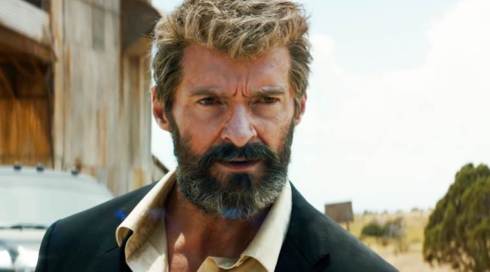
Continuing my series of Looking Back at 2010s Films, I still have not seen 2013’s “The Wolverine.” But maybe I don’t have to, seeing as director James Mangold made another Wolverine film and it was pretty great!

I’m of course talking about “Logan.”

I give up trying to fit this movie into the X-Men chronology…actually, I didn’t even try. I just enjoy the film on its own.

What does it mean to be an aging comic book hero whose glory days are far behind them? We all know how awesome Logan/Wolverine (played memorably by Hugh Jackman) was from the previous “X-Men” movies. To see him in decline is bittersweet; to see him still able to take action is still pretty cool.

“Logan” isn’t so much a “superhero movie” as it is a sci-fi Western. There’s good guys who are the outlaws and a bunch of ruthless and greedy baddies who will stop at nothing to take them down. (There are even many references to “Shane,” the classic Western.)

Oh, and it’s R-rated. Very, VERY R-rated. All the gruesome kills Wolverine is able to perform with his vicious metallic claws–hell yeah you see some graphic gore this time around! With all the slicing and dicing in this one, you know Logan isn’t messing around this time.

But that’s only for those foolish enough to try to jack his car in an opening scene. Soon after, we see that Logan is making a living as an Uber driver long after Professor Xavier’s School for Gifted Youngsters has shut down for good. In fact, Logan even cares for Professor X (Patrick Stewart), whose mind is fading day by day.

So here we are…the final chapter in the X-Men story. We know this can only end in tears. And once we accept that, we can only hope for something inspiring to come from this.

Anyway, Logan is roped into taking care of Laura (Dafne Keen), a young mutant who is hunted by government agents who bred her as a secret medical experiment that would result in a super-mutant army. When it becomes clear she shares Wolverine’s DNA, it also becomes clear that this little girl doesn’t mess around either. Logan doesn’t want to get involved, but he has no choice, and he has to protect her against the villains and bring her to a place where she’ll be safe.

What happens to superheroes when they get old? Not many movies want to play with that idea, but Logan does unbelievably well. And it introduces us to a villain that is even more relatable than any of the antagonists Logan and X have to face: mortality.

But the film isn’t too grim that one can’t get any enjoyment out of it. There is some pretty intense action, including one of the best car chases I’ve seen in any action flick, and when Laura gets where she needs to be, it is nice to see that there will be a spirit to carry on the legend that will inevitably be left behind. But overall, “Logan” gives its audience answers to questions comic book fans never wanted to ask, and it gives them what they didn’t know they needed.

When it comes to dark, compelling, what-is-life superhero movies, I say DC has “The Dark Knight” and Marvel has “Logan.” (And Marvel also has the excellent Netflix series “Daredevil,” for that matter.) That’s how good I think this film is! And it only gets better the more times I watch it.

And I gotta be honest…it almost made the list of my picks for the best of the decade.

Looking Back at 2010s Films: It (2017)

5 Oct

Movie-Cast-2017-1024x549

By Tanner Smith

Continuing my series of Looking Back at 2010s Films, let’s talk about one of the most pleasant surprises of the decade, one of the most successful horror films of all time: “It.”

Or rather, “It: Chapter One.” I did see “It: Chapter Two,” and I’ll probably post its own review for that one–but “Chapter One” is what I want to focus on right now.

I love the central premise of “It”–there’s this thing that consumes children after feeding on their personal fears, and there’s a group of outcast kids that fight back, and as they reach adulthood, they have to confront the thing again, as well as their childhood traumas they tried to forget. The Stephen King novel of the same name has a lot of great stuff in it (and a lot of not-so-great stuff as well). The 1990 TV miniseries, as entertaining as it was (especially with Tim Curry as Pennywise the Dancing Clown), couldn’t quite tackle the heavier material with the adult portion of the story. (Even the director, Tommy Lee Wallace, doesn’t like the second part of the miniseries.)

The stuff with the kids in the miniseries was fine, mostly because the child actors were great, but there just wasn’t enough time to fully develop their experiences, their fears, what they have to overcome, etc. We needed a whole movie about all of that…and that’s where “It: Chapter One” came in.

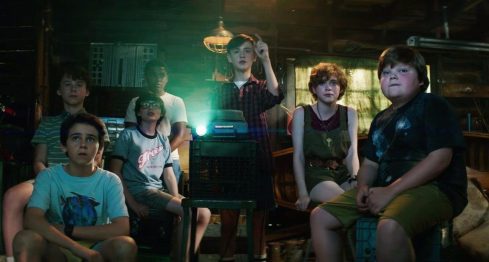
“It: Chapter One” only focuses on the kids as they encounter and combat It, which can become each of their personal fears and mostly takes the form of Pennywise the Dancing Clown (played by Bill Skarsgard). For Bill (Jaeden Lieberher), it’s guilt over the loss of his little brother Georgie; for Beverly (Sophia Lillis), it’s her abusive, sicko father; for Ben (Jeremy Ray Taylor), it’s bullies and morbid histories; for Mike (Chosen Jacobs), it’s fire (since his parents were killed in a house fire); for Stan (Wyatt Oleff), it’s a creepy abstract painting in his rabbi father’s temple office; for Eddie (Jack Dylan Glazer), it’s germs; and for Richie (Finn Wolfhard), it’s…clowns. (Tough break there, kid.)

This film knew to take the time to get to know these kids–who they are, what they go through, and just as important, how they relate to each other. They understand each other and therefore can help each other out. And they know the only way to defeat It is by sticking together, which is also how they can face their inner demons.

Despite the clown taking so much of the promotional material before the film’s release, Pennywise doesn’t have as much screen time as you would think. That’s because the clown isn’t as important as what It can become. But thanks to Skarsgard’s remarkably chilling portrayal, it’s hard not to feel Pennywise’s presence. And when he does show up…let’s just say he doesn’t help Bozo-phobics get over their fears.

The eyes…the mouth…the inflections in his voice…..Tim Curry’s Pennywise was a good clown and used it to lure children into his trap–if I saw Bill Skarsgard’s Pennywise, I’d be running for my life. Poor Georgie should have, too…

Georgie’s death is one of the most shocking moments I ever experienced in any movie in a theater. Of course, I knew Georgie was going to die–I read the book, I saw the miniseries, everyone knew his fate. What I DIDN’T know was that it was going to be played so horrifically! I thought he was going to be sucked into the sewer drain with a scream (the “safe” way to kill a child in a horror movie)–but nope!

I didn’t think they’d go there…they went there. My mouth was agape for about five minutes after that scene. (And I usually skip over it on the DVD–as soon as Pennywise bares his sharp teeth and the second he bites into Georgie’s arm, I skip to the opening title.)

Another reason for this film’s success–it is scary! Director Andy Muschietti knows just as much as modern horror master Mike Flanagan and the classic horror directors that the best way to reach an audience with a horror film is with character, story, and ATMOSPHERE. Because we can relate to the characters and we understand the world they’re living in, we can get unnerved when the tension settles in yet again in many parts of the movie. And with nearly every eerie setup, there’s a frightening payoff. Speaking of which, whenever you see a red balloon, you know something’s going to happen…

I love the climax of the movie, which plays like a superhero action fight, as all of the kids take turns beating up Pennywise as It tries to take the shape of all their fears. It’s exciting and well-executed, and it made me want to take a shot in as well.

But we know it’s not over after that. After the kids think they’ve defeated It, they oath to each other that they’ll come back to finish the job if they need to. “Chapter Two” will take place 27 years later, when they’ve all become like the adults who wouldn’t help them as children and they must go back and finish what they started.

We’ve had many terrific horror films in the past few years, and “It: Chapter One” is one of the best. (And I’ll get to “It: Chapter Two” soon enough. I know a review for it’s already overdue.)

Looking Back at 2010s Films: The Disaster Artist (2017)

4 Oct

Brody-The-Disaster-Artist

By Tanner Smith

“Here’s to the ones who dream, foolish as they seem. Here’s to the hearts that ache. Here’s to the mess we make.” -Emma Stone, “La La Land”

“You don’t want to be good. You want to be great.” -Tommy Wiseau, writer-producer-director of “The Room”

“No refunds.” -Sign outside the Laemmle Fairfax, June 27th, 2003, opening weekend of “The Room”

Continuing my series of Looking Back at 2010s Films…seriously, “The Disaster Artist” isn’t on my top-20-of-2010s list? Ugh. Screw lists.

Greg Sestero, actor/co-producer for “The Room,” wrote and released a memoir about his experiences in making “The Room” with his offbeat filmmaking friend Tommy Wiseau. That book became “The Disaster Artist: My Life Inside The Room, the Greatest Bad Movie Ever Made.” And of course, fans of “The Room,” which may very well be “the greatest bad movie ever made,” flocked to pick up their copies as soon the book was published, because they just had to know… What really went on behind the scenes? What was the thought process behind many of these decisions? Can Greg answer these questions as well as Tommy, who seems too far out of his mind to give his own clear answers? Well, maybe–Greg is Tommy’s best friend; he’s the one who always sticks up for his weird behavior. Maybe he knows something we don’t.

I bought and read the book in December 2015, and when I heard there was going to be a film based on it, I was very excited. James Franco was going to play Tommy Wiseau (perfect casting) and the book was going to be adapted by Scott Neustadter and Michael H. Weber, who previously wrote “500 Days of Summer,” “The Spectacular Now,” and “The Fault in Our Stars.” So far, so good.

Two years later, when the film released in theaters, it didn’t disappoint. In fact, I even placed it as #2 on my best-of-2017 list. To me, it’s one of the most throughly entertaining movies of the decade.

And again, it’s not on my list?? Dammit.

This biopic is more straightforward than the book’s nonlinear, loaded storytelling, but that doesn’t make it any less entertaining. And I’m well aware of the things that were changed around or removed entirely (I read the book in print and listened to the audiobook, read by Greg Sestero himself). I don’t care–the film is still fun as its own thing.

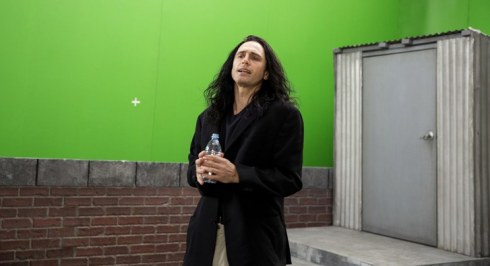
Greg (played by Dave Franco) is an aspiring actor/model who just wants his time to shine…as does Tommy (James Franco), another aspiring actor from presumably another planet. Tommy invites Greg to move to LA with him so they can chase and achieve their dreams. But Tommy is too off-putting for any casting director to give a chance, and Greg is too insecure and shy. It gets to the point where Tommy decides to write his own movie for himself and Greg to co-star in. And that movie becomes…”The Room,” a Tennessee Williams-inspired drama about fear, guilt, tragedy, and misunderstanding…amidst a lot of sex and quotably weird out-of-context dialogue and the strangeness of Tommy Wiseau himself taking the lead role. And it wasn’t easy to make the film–Tommy got too demanding, continued mistreating his cast/crew, and never listened to decent advice from anyone who had something to say about his own vision. But in the end, he still made his vision come to life, which is always inspiring.

Btw, that’s only the simplification of what truly happened according to the book. If you haven’t checked it out, you should–it’s really interesting!

James Franco is 100% believable and spot-on as Tommy Wiseau. He captures his weirdness to a T, but there is also a sense of humanity to him, which makes it all the more interesting to the point where you have to ask yourself, “IS Tommy playing an act on us the whole time?” Franco was robbed of an Oscar nomination for this performance–he truly deserved one.

What’s even better about someone seeing this film without even knowing what “The Room” is or who Tommy is is just the sheer shock when they realize that this stuff actually happened in real life. They know this not just because of the prologue that features some of today’s celebrities (including J.J. Abrams, Kevin Smith, Adam Scott, Kristen Bell, among others) talking about The Room and its impact on cult culture…but because the film ends with side-by-side comparisons of actual clips from “The Room” and reenacted scenes for “The Disaster Artist!” (I showed this film to my grandma–she was also shocked that this wasn’t an act!)

Oh, and stay after the credits–there’s an interesting cameo appearance by…somebody who knows a thing or two about the true story.

The scenes in which some of “The Room’s” more popular scenes are reenacted are a ton of fun to watch. You can tell Franco and his crew have done their homework and tried to get it as close as possible. And it’s also great to see actors like Josh Hutcherson, Ari Graynor, Zac Efron, and Nathan Fielder play these roles of actors trying to make something out of Tommy’s poorly-written characters.

(Though, there is one thing missing that I think Franco could’ve had comedic possibilities with–the real Tommy overdubbed a lot of his dialogue, whereas the fictional Tommy had his recorded lines kept intact. Considering how unbelievably lazy the dubbing is, I think Franco could’ve had fun with it. But oh well.)

Another thing I love about this movie: Seth Rogen as script supervisor Sandy Schklair. He basically speaks for the audience in pointing just how ridiculous everything is on set of The Room. (“Oh we got a bottle now. Look out.”) And if you read the book, you know he basically was the unsung hero in terms of directing “The Room” because Tommy was completely inept in just about every way of directing, and it also didn’t help that Tommy would constantly do things his own way rather than listen to someone else’s directing. Rogen delivers some of his best work here.

And I barely even scratched the surface in presenting to you just how much I enjoy “The Disaster Artist” and why I embrace this film wholeheartedly. Much like “Ed Wood,” one of my favorite movies of all time (and also about a notoriously bad filmmaker), this is a film about passion and dreams and appreciating the thing you love to do despite how other people see it. The haters can hate all they want–these guys still made the film and it’s still popular today.

Looking Back at 2010s Films: Last Flag Flying (2017)

4 Oct

lead_720_405

By Tanner Smith

Continuing my series of Looking Back at 2010s Films, “Last Flag Flying” was a most pleasant surprise to me for three reasons. 1) It was based on the sequel to the novel that was adapted into the 1973 film “The Last Detail,” my favorite Jack Nicholson movie. 2) It was directed by Richard Linklater, one of my absolute favorite film directors still working today. And 3) I didn’t even know about it until it was about to be released!

Apparently, the characters in the novel are the same ones from “The Last Detail.” And in the film, the characters are given very similar traits–but for whatever reason…they have different names here, as if to separate them from “The Last Detail.” But I can’t un-see it. “Doc” Shepherd (Steve Carell) is Meadows. Mueller (Laurence Fishburne) is “Mule.” And Sal (Bryan Cranston) is “Bad Ass.” Why not just call them that? We understand actor replacements in movies (for the most part).

OK, to be fair, the main change that’s added between movies is these three apparently served in the Vietnam War and the reason Doc went to prison is different from Meadows’ petty crime. I haven’t read the book, so I don’t know if this was added for the movie to add more of a contrast or not. But I’ll take it, I guess.

Anyway, “Last Flag Flying” is set in 2003. The Iraq War is going on, and Doc’s son has been killed in combat. He reaches out to his Vietnam War buddies, Sal and Mueller, and they agree to help him bury his son at home. So, they go on a cross-country road trip together, talk about the past, and contemplate the idea of war, going from one (the Vietnam War) to another (the Iraq War).

As is typical of a Linklater film, the characters have a lot of interesting things to say–philosophies, contemplations, predictions, and so on. It’s just these three guys talking about what they went through, what’s happened since, and that other people are going through something similar to them.

But it’s not an anti-war movie. Some people would make that distinction, seeing as how at the center of this road trip is the body of an Iraq War soldier who was the son of a Vietnam vet, thus representing the consequences from the perspective of other VW vets. Yes, there are cynical and bitter comments about the military and the overall purpose of war that heavily indicate that while opponents and locations have changed, the reasoning never changes. But at the same time, when the three main characters (plus a young soldier who is commanded by his superior to come along for the ride) get down to it, they still remain loyal patriots who were proud to help serve their country. I think it’s more of an area in which they’ll do what they feel is their duty even if they’re entirely sure why it’s their duty to begin with. It’s ambiguous and it’s smart because of that.

It’s also smart that Linklater, who wanted to adapt the novel in the mid-2000s, chose to wait until the time was right.

But there’s also room for funny moments such as when the three guys are bonding together…and buying cellphones. That’s right–mobile phones! Remember how shocking and innovative they were back in 2003? How times have changed, indeed.

Looking Back at 2010s Films: Star Wars Episode VIII: The Last Jedi (2017)

3 Oct

4adbe3-20171212-star-wars-last-jedi.jpg

By Tanner Smith

Ohh boy, I’m getting nervous writing this one now.

Continuing my series of Looking Back at 2010s Films…before I start this one, here’s my favorite bit from the Nostalgia Critic review of “Star Wars: The Last Jedi”:

YODA: You must let go of the past and create a future of new challenges and ideas.
(pause)
LUKE: You do know you’re talking to “Star Wars” fans, right?
YODA: Bite my ass, they can!

I’m nervous to bring up “The Last Jedi” to people after the INSANE backlash it’s gotten since its original release. Those who hate this flick act like director Rian Johnson killed their dogs!

Yeah, this “Star Wars” film is…very divisive, to say the least. Some appreciate the film’s action and tone and deviation from traditional “Star Wars”…others saw it as too progressive, inconsistent, unfair to fan theories, insignificant (in terms of Rey’s parents), had underdeveloped characters (like Snoke), a betrayal Luke Skywalker’s character from the original trilogy, and…just too different for them to accept.

If I recall correctly, there was even a petition to redo Episode VIII entirely….yeah I’m sure that’ll happen, right after they redo “Game of Thrones” season 8.

Well, I love “The Last Jedi”…or…parts of “The Last Jedi,” anyway.

OK. *cracks knuckles* Let’s do this…

The thing is, we’re not going to get the old “Star Wars” again. We already had the old “Star Wars.” Hell, we still have the old “Star Wars” to watch whenever we want. Even “The Force Awakens,” which used the old formula, used it to pave the way for the NEW “Star Wars.” New ideas. New challenges. New questions. New answers. New characters. This is “Star Wars” taking risks with the old “Star Wars” ways, and I applaud Disney for that.

(If only they’d taken those same chances for the Han Solo movie, but that’s another post for another time.)

The character of Rey represents exactly that. She learned in the previous movie that she’s Force-sensitive and she wants to learn more about it. But not only did she learn more than she anticipated, but she also learned that there is so much more that could be done with it. And she’s not going to learn from it from reading the old scrolls/texts that explain the Jedi’s ways of The Force, because she also learned what Luke Skywalker learned the hard way long ago–that the Force has more possibilities than the Jedi ever even found use for.

So, who are we to say that the Force can’t do this/that? Think of all the things we’d miss out on.

People complain about Luke Skywalker turning his back on the Jedi and closing himself off from the Force and becoming so damn “cynical.” (Even Mark Hamill himself argued with director Johnson about it.) Well…yeah. This is years later. As with Han Solo in “The Force Awakens,” we see times have changed with Luke Skywalker in “The Last Jedi.” He’s seen things, felt things, been a part of something he thought would benefit people–of course he’d be bitter.

Why doesn’t this bother me? Because he directly acknowledges the decisions made by the Jedi in the prequels as the ultimate wrong choices. No kidding–they’re the ones responsible for Anakin becoming Darth Vader in the first place! Luke is someone who wants to do the right thing and is uncertain anymore about what it is, especially when there are other influences that can make things better or worse. Hell, he even thought of KILLING his student because of how strong he was with the Force! And because he couldn’t handle the pressure, he went into exile, and not for reasons as simple as why Yoda went into exile.

People complain about Rey coming from “nothing”–fans expected her to be Luke’s daughter or related to some other character. I was hoping they wouldn’t go in that direction, so I was pleased they didn’t. She’s just someone new who could either bring balance back to the Force or aid the First Order in completely taking over…or being totally neutral, which, again, would be something new. What matters is that she knows her past doesn’t matter and it’s what she does next that truly matters. And Luke realizes it too. And you could also argue Kylo Ren does too.

Everything involving Rey, Luke, and Kylo Ren in this movie, I absolutely love. The story moves forward with each of these three characters, and it brings the new challenges/ideas to life in ways I’m glad I didn’t expect. I also liked Poe Dameron’s arc. This is a brash, over-confident heroic type who learns that being stealthy and knowing when to run to fight another day is usually the best option rather than just jump into things and risk lives……BUT (and this is a big “but”) couldn’t Leia and/or Admiral Holdo have at least told him they were planning a stealthier approach in escaping the First Order’s clutches? They had to risk a mutiny that Poe was leading in order to teach him this lesson??

I’m going on a huge ramble here…I guess it all just comes down to whether or not it works for you. And this works for me…for the most part. Speaking of which, what parts don’t I like about “The Last Jedi?”

-The subplot about Finn and a new character named Rose doesn’t do a thing for me after rewatching the film. That’s not to say Rose is a bad character (especially not bad enough for actress Kelly Marie Tran to receive online attacks….seriously, some people need to grow the hell up); she’s spunky enough to catch interest. At first, I thought their journey to a casino was interesting because we could see how the wealthy live in this galaxy. But nowadays, I skip through it to get back to the good stuff with Rey and Luke and whatnot. It’s a shame, because Finn is an interesting character–there’s a lot for him to do, and I hope “The Rise of Skywalker” gives him much to do.
-Leia using the Force to shoot herself back to the ship after being thrust into space…yeah, I can’t really defend that either.
-Laura Den as Holdo. I love Laura Dern, but she doesn’t have the right amount of commanding power to make the character work.
-The Porgs…actually, I can’t hate the Porgs all that much; it’s not like “Star Wars” hasn’t tried even more desperate attempts to sell toys in the past.

That’s really all I have in terms of things I don’t like about “The Last Jedi.” Not explaining who Supreme Leader Snoke is, especially after revealing that he’s the one who drew Ben Solo to become Kylo Ren, doesn’t bother me as much…though maybe I’m under the impression that it’ll be explained at least slightly in “The Rise of Skywalker.”

“The Last Jedi” has SO much more going for it than so many fans are willing to accept, and I really like it because of that.

I know fans are also ticked off that this sequel trilogy doesn’t adapt any of the “Star Wars” books…that at least is more understandable to me than the other reasons they’re upset about it.

But then again, I also liked the “Game of Thrones” finale, so what do I know?
Looking Back at 2010s Films: The Meyerowitz Stories (New and Selected) (2017)

2 Oct

Image result for the meyerowitz stories (new and selected)

By Tanner Smith

Continuing my series of Looking Back at 2010s Films, Noah Baumbach has had some pretty terrific films this decade. “Greenberg,” “Mistress America,” “De Palma,” “While We’re Young,” and he also co-wrote “Madagascar 3!”

(That last one, I probably need to revisit, based on that credit alone!)

Oh, and he also made “Frances Ha”…I’m going to have plenty to say about that one by the end of the decade. I’ve gone from liking that film to leaving it everything in my will!

Baumbach’s movies have that effect on me. I’ll “admire” his work before I “like” them after watching them again. And again. And again.

“The Meyerowitz Stories (New and Selected)” is his 2017 Netflix Original film that impressed me when I first saw it…and I’ve lost count as to how many times I’ve streamed it since then. (I even listened to it play on my phone while walking around my local library, I’m that familiar with it by now!)

You’d think “The Meyerowitz Stories” is based on a novel or a collection of short stories…it’s not. But you’d think it is.

“The Meyerowitz Stories (New and Selected)” is a comedy-drama about adult siblings who are still in the shadow of their father. Their father, Harold (Dustin Hoffman), is a retired Bard College art professor and sculptor…this guy is a piece of work……OK, let’s just say it–he’s a self-centered asshole who resents any attention not given to himself. He even turns down Bard’s faculty group show to present some of his sculptures because he doesn’t want to be part of any group show. (Oh get over yourself, you miserable loser!)

His unemployed son Danny (Adam Sandler) moves in with him after separating from his wife. Danny loves his father and wants to be closer to him, but it’s clear Harold’s favorite son is Danny’s half-brother Matthew (Ben Stiller), a successful financial advisor who works on the other side of the country probably just to be as far away from his father as possible. Matthew resents Harold for preferring a life of art over money. (“I BEAT YOU!” he shouts at him at one point.)

Oh, and there’s also Jean (Elizabeth Marvel), Danny’s sister and Matthew’s half-sister. She’s withdrawn and awkward and probably my favorite character in the film, right next to Danny’s sexually charged college-bound aspiring-filmmaker daughter Eliza (Grace Van Patten). Jean’s laid-back, sincere one-liners make me chuckle each time I revisit the film.

All of these characters are united when Harold goes to hospital due to illness. The siblings decide to manage his care themselves and they grow closer together in the process.

All of these actors are GREAT. Including Adam Sandler. When he’s not making “The Cobbler” (ugh) or “Jack & Jill” (UGGGGHHHH) or “Just Go With It” (BLECH!!!) or “The Ridiculous Six” (…OK, I skipped that one), he can show how good of an actor he is in a good movie. He’s not only good as Danny–he’s heart-breakingly good. I FEEL for this guy. It’s one of his most authentic performances of his career.

Oh, and the songs he plays in this movie? Nice tunes. (I don’t know if he or Baumbach wrote it, or if they wrote it together, or if composer Randy Newman did it, but still, these are good sounds. “Mommy and Daddy and Genius Girl Make Three”…OK, that title alone sounds like a Newman song.)

Oh yeah, I forgot about Emma Thompson as Harold’s boozy wife Maureen. This may be the best attempt at an American accent she’s ever accomplished…though that might be because she has to play the role as drunk most of the time.

Yeah, the acting is great, but what really makes the film great is the writing. Baumbach’s always been great with dialogue, and this is probably his most enthralling script. Everything these characters say, I’m listening to. And then I’m thinking about what they said. Sometimes, I need to rewatch scenes a few more times to make sure I heard everything, because as is typical of a Baumbach film, most of the characters talk over one another constantly, which also doesn’t help when the dialogue switches from topic to topic at great speed. (And as I said before, I have watched this film countless times in the past two years.) We get poignant insights and sharp comedy from just how privileged and ridiculous these people are.

Later this year, another Baumbach film is coming to Netflix–“Marriage Story,” starring Adam Driver and Scarlett Johansson. It’s gotten a lot of buzz at festivals, but I was looking forward to it even before that.

Looking Back at 2010s Films: T2 Trainspotting (2017)

1 Oct

Image result for t2 trainspotting

By Tanner Smith

Continuing my series of posts about 2010s films I really like…”T2: Trainspotting”……there is only ONE T2 in my life (Terminator 2), so I am NOT referring to the “Trainspotting” sequel as “T2”!!

Though, I can see why they didn’t give it the title of the book this film was based on (“Porno”).

Anyway, TRAINSPOTTING 2 (as I’m calling it) catches up with the characters of “Trainspotting” 20 years later. I always like this idea of revisiting characters years later (…when it’s done right).

This one explores the long-term consequences of the junkie “Trainspotting” characters, after one of them sold the others out at the end of the original film. Now it’s two decades later, and we see that they’re older but not necessarily wiser. Renton (Ewan McGregor) has been living straight as an accountant in Amsterdam; the manic Sick Boy (now known by his legal name Simon) (Jonny Lee Miller) runs a pub and performs petty deeds on the side; the psychotic, dangerous lover of arguably the most offensive word in the English language (you know the one) Begbie (Robert Carlyle) has been in prison all this time; and Spud (Ewen Bremner) is still struggling with hardcore addiction to the point of attempting suicide.

Renton comes back to his hometown, where he’s ready to face his old friends again and own up to the mistakes he’s made in the past. But his old friends are just as messed up as they were before. One of the most tragically telling moments of this sequel is when he prevents Spud’s suicide attempt and cries that he tried to help him by leaving $4,000 to him (and leaving none of the money from the score for Sick Boy and Begbie)–Spud has to remind Renton that he’s a junkie and that money wasn’t going to be around for long.

Oh, and Begbie’s escaped from prison. One of the funniest sequences in the film is when he learns Renton has returned and so he’s determined to chase him down and kill him. (Maybe this IS supposed to remind me of “Terminator 2”–Begbie’s starting to remind me of T-1000.)

There are a lot of callbacks to the original “Trainspotting,” as characters continuously look back on the “good old days.” Sometimes, it’s to remind themselves of how good they felt, not realizing how pathetic those times were. Other times, it’s to go right for the throat during an argument–remember the ill fate of the baby that was apparently Sick Boy’s daughter? Yeah, Renton reminds Simon of that! (Harsh.) And of course, the “Choose Life” monologue comes back into play, with some adjustments–that scene was the one that made it clear that “Trainspotting 2” is part-nostalgic, part-moving-ahead…

Just like the characters.