
Archive | 2015 RSS feed for this section

The Martian (2015)

12 Oct

The-Martian

Smith’s Verdict: ***1/2

Reviewed by Tanner Smith

“The Martian” has an intriguing premise: an astronaut is left behind on Mars after a fierce storm caused his crew to believe he was dead. Now he’s alone and stranded on a desolate planet and must rely on his skill, inner strength, and wit to survive and find a way to contact Earth. From there, it’s a question of whether or not he can leave Mars and get home.

One of the biggest pleasures of this science-fiction drama, based on the novel by Andy Weir, is the humor that allows itself within it. It’s relatively realistic and believable in its science (at least, for me—I’m not a scientist) and its dramatic moments are warranted and very effective. But at the end of the movie, it’s easy to realize it was still a lot of fun. The film has a sense of humor, with a clever, sharp script, which requires the characters to say many witty lines of dialogue.

Some examples:

  • “Mars will come to fear my botany powers,” states astronaut Mark Watney (Matt Damon) when he realizes he has to “grow food on a planet where nothing grows.” Luckily, he’s a botanist.
  • “They say once you grow crops somewhere, you have officially colonized it. So, technically, I colonized Mars. In your face, Neil Armstrong!”
  • “I’m going to have to science the shit out of this.”
  • At the time NASA officials finally realize one of their astronauts is stranded on Mars, one of them (played by Chiwetel Ejiofor) wonders “what this does to a man psychologically.” The immediate cut back to Mars results in probably the funniest moment in the movie (which I will not reveal here).

I wasn’t surprised by this welcome comic angle to what would otherwise be just a tense, dark sci-fi thriller when I realized who wrote the screenplay—Drew Goddard, who wrote and directed the delightfully entertaining “The Cabin in the Woods.” However, I was surprised to find it was directed by Ridley Scott, who has made films such as “Alien,” “Blade Runner,” and “Prometheus,” neither of which are as cheerful or even as adventurous or hopeful as “The Martian.” I still like those movies, but I kind of appreciated this change of pace more.

And that’s really what it comes down to, more than the movie being humorous—it’s hopeful. The main character is an optimist. Even though he’s trapped on a desolate planet with very few resources on hand, he simply states, “I’m not going to die here.” So he does everything possible to make sure everything’s going to be fine (and also that he believes it himself). Even when things are at their darkest and he starts to doubt himself, he knows that it’s better to die fighting than not try to survive. I admire stories that show how a lone survivor in a dire situation copes with seclusion (like “Cast Away,” “Gravity,” “127 Hours,” “Touching the Void,” among others), and “The Martian” has a real good share of challenges, both internally and externally, and they’re all captivating.

The film cuts back and forth from Mark’s experiences on Mars to the many attempts of NASA on Earth seeking to find a way to save him. A month after mission controller Vincent Kapoor (Ejiofor) and NASA director Teddy Sanders (Jeff Daniels) made the news of Mark’s death public, they do become aware of his survival, and they find ways to communicate as they race to find a solution to the problem. This is, of course, after stick-in-the-mud PR director Annie Montrose (Kristen Wiig) mentions how bad it would make NASA look if they announced they were wrong about Mark’s death—nice sense of priorities there. (Commentary!) The film also cuts to Mark’s crew in space (played by Jessica Chastain, Michael Pena, Kate Mara, Sebastian Stan, and Aksel Hennie), as they realize what’s happened as well and have to make a choice to either defy authority to turn around and go back for Mark or continue straight on to Earth and hope for the best.

Another statement about the humor—it’s low-key. The film doesn’t lose sight of the urgency of the situation at hand, but it also knows to lighten up at times, which I greatly appreciated. But the main reason it works perfectly in a story that would otherwise be a dark, deep, depressing exploration of a man’s awareness in a remote area is because these characters feel like real people. Many of the things they say feel like what most of us would say, even the one-liners; in fact, especially the one-liners—most of us like to joke in order to relieve ourselves of some stress at times. (I know I do.) The scenes in which Mark expresses himself in his video logs leave opportunity for this humor to shine in particular. Even in the scenes set on Earth, even though they’re not widely comedic, they are played with a relaxed susceptibility.

I could relate to Mark easily; he feels like a real, likable, easy-going person and not merely a plot device. A lot of credit for that goes to Matt Damon, who turns in one of his truly best turns in a long career of strong performances (right up there with “The Departed” and “Good Will Hunting”). He shines brightly in a movie in which he’s allowed to, having only himself to work with. He has to portray every emotion imaginable in this ordeal—fear, optimism, enjoyment, hopelessness, anxiety, agony, whatever…and he does it all brilliantly. There isn’t a false note in this performance at all.

Of course, I can’t talk about a movie set on Mars without talking about the look—Mars looks suitably unwelcoming as is expected, the special effects are top-notch, and the visuals are nicely done. What else can I say? But then again, what all do I want to say? The effects aren’t the focus of the movie, which is always a refreshing change of pace for a sci-fi film.

I mentioned “The Martian” in my “2015 Review” post. I said, “With this and the new Star Wars film, maybe now we’re moving toward an era where our sci-fi blockbusters can have characters most of us optimistic wiseasses can actually relate to.” What I meant was, if these movies can continue to have their characters say things most general audiences would say if they were in the same situations, that makes the characters more relatable and therefore more sympathetic, and therefore they make us more willing to care for them. Keep this up, filmmakers of mainstream blockbusters, and we’ll be out of a cinema slump that people on the Internet claim we’re living in. (By the way, guys, that’s not true—just keep looking for movies like this one.)

Contracted: Phase II (2015)

27 Aug

ContractedPhase2b.jpg

Smith’s Verdict: ½*

Reviewed by Tanner Smith

Before I begin my review of “Contracted: Phase II,” I should clarify something from my review of its predecessor, the 2013 body-horror film “Contracted.” I refrained from using a certain word that other reviewers were using; just one word that gave me a pretty good idea of how the film was going to end. Since this film picks up where the first one left off, I might as well just use said-word now. (And if you’re reading this, chances are you saw the first film to begin with.) The word used by critics was “zombie.” The main character, Samantha (Najarra Townsend), has been going through bizarre, scary changes, including her body falling apart, and guess what—she turns into a zombie. I bet you thought it was just a very messed-up sexually-transmitted disease, didn’t you?

Yes, apparently B.J., the sicko who gave Samantha the sickness to begin with (and is not played by Simon Barrett this time), is the carrier for a would-be zombie apocalypse.

Our hero in this sequel is Riley (Matt Mercer, reprising his role from the original). If you saw the original, you remember him as the guy who barely had a role aside from having a hopeless crush on Samantha, and it led to the point in which Samantha presumably gives him the disease near the end of the film. I remember writing in my review that I didn’t think that was warranted, since we hardly knew anything about him. And it’s amazing to see that even though most of this sequel is centered around him, I still don’t know a damn thing about him, nor do I care. He’s dull, uninteresting, and unsympathetic—he made me wish for the return of the comic-relief druggie from the original film. (That guy, played by Charley Koontz, does come back late in the film—I really wish he took center stage in this one.) I don’t blame Mercer for this; he just has nothing to work with.

Anyway, “Phase II” picks up where “Contracted” left off, with Samantha becoming a zombie and attacking her mother (Caroline Thompson) before being shot dead by police. And like I said, Riley now has the disease Samantha had in the original. His body’s falling apart, he feels a strange sensation despite his doctor saying he’s clean, and he tries to find answers as to what’s happening to him.

There’s really nothing to this movie. It’s pretty pointless, to say the least. The questions raised from the first film are answered, but they were answers most of us have figured out before we saw this second one anyway. There are some disgusting gory moments to gross the audience out, such as when Riley pulls a broken fingernail out of a claw mark on his back or when his nosebleed becomes too messy (and even leaks into cheese dip at a memorial service—blech) or even pulling out a maggot from under his skin…but then what? What else is there to this movie? There’s no mystery to keep us invested, either with Riley or with the police detective, Crystal (Marianna Palka, sporting an on-again/off-again American accent), investigating mysterious dead bodies, because we know what’s happening to Riley and we know what the detective is going to find. If nothing new could be added, why make a sequel at all? The original ended at just the right moment—nothing more was needed.

All the titular “Phase II” turns out to be is spreading the disease around, which was already implied in the original film—we understood that very quickly; B.J. was going to be responsible for creating more (sigh) zombies. (“Mankind is a bacteria that needs to be obliterated,” he says at one point.) The film tries to take a new interesting turn by having Riley attempt to track down B.J. and kill him, but even that doesn’t work because nothing about this development in both the story and the character of Riley turning into a public avenger seems interesting, let alone convincing.

The first “Contracted” worked as a character study with some horrific body-horror elements attached. This second film is not only a retread (minus interesting characters) but also a failed zombie movie—tame, weak, and ironically bloodless (figuratively). Needless to say, “Contracted: Phase II” suffers from the disease shared by most unnecessary horror films—the Pointless Sequel Syndrome.

A Girl Like Her (2015)

15 Aug

cast_of_a_girl_like_her.jpg

Smith’s Verdict: ***1/2

Reviewed by Tanner Smith

Afterschool Specials. Lifetime movies. ABC Family (er, sorry—Freeform) Original Movies. Some of the films in either of these categories are well-done. But they have a reputation among many for throwing out several manipulative, bland, not-especially-well-made films that tell stories that deal with important issues that aren’t as effective they should be, as a result of being insipid. How do you make a film that tackles an important issue while making it well?

Simplest answer: make it well. Focus on the writing, the characters, the direction. Take the issue from a clear-eyed point-of-view. Write people who could be you or people you know. Don’t just base it on what you see/hear; base it on what others see/hear too, maybe. Hell, take risks. Think outside the box (the box within which most of the offenders continue to think).

Take school-hallway bullying. This is still a big problem in society, and for as long as it’s been around, I’m sorry to say it shows no sign of disappearing anytime soon. Making a film about bullying and the tragedies that result from it is not an easy task, as most films that try to tackle the issue end up being either wishy-washy or flat-out ordinary. Not that any film is going to make something go away, no matter what it is, but there needs to be some good attempts.

Amy S. Weber’s “A Girl Like Her” is a very good attempt. This is the kind of film teachers should show their students that just could maybe—maybe—raise a few eyebrows.

“A Girl Like Her” is a “mockumentary” (a fictional story told in documentary-style fashion), but it might as well be real; its emotional honesty about an important subject made me forget that everything was scripted and actors were playing roles (even though I’d seen one of them—Jimmy Bennett—in many other movies before, like “Orphan” and “Trucker”). The high school portrayed in the film could be any high school. The students feel real. And so on. Even if it doesn’t entirely work (I mean, it is possible some people would forget cameras are rolling on them and say certain things, but it is unlikely), I praise it for attempting to understand the mindset of both of the school bully and the bully’s victim.

A documentary is being filmed at a high school that is being proclaimed as one of the top 10 in America. The documentary’s director (played by the director herself, Weber) finds an interesting angle after student Jessica Burns (Lexi Ainsworth) attempts suicide and rumors indicate that the harassment she received from popular girl Avery Keller (Hunter King) might be responsible.

The film constantly switches points of view by showing additional footage from time to time—footage recorded by Jessica, her best friend & video geek Brian (Bennett), and even Avery herself, as she’s asked by the director to show what her life is like. We learn that Avery has in fact harassed Jessica countless times in the halls and even through text messaging and email. Brian gave Jessica a secret camera hidden in a necklace (and he filmed some things with his own camera as well), because he felt this behavior had to be exposed somehow. We also learn that Jessica didn’t want it brought to light, because she thought things would only get worse rather than better. And more importantly, we see what Avery’s home life is like: she comes from a dysfunctional family with an overbearing mother who demands too much, and she tries to hide it as best as she can. And of course, when more and more rumors pile on about her part that led to Jessica’s attempted suicide, she’s in denial, claiming she couldn’t have done that much damage.

Anyone remember the 2012 documentary “Bully?” (You know, the one that caused that ridiculous MPAA rating controversy?) Anyone else think that should have been called “Bullied” instead? After all, it didn’t focus on any of the bullies; just the victims of bullying. What did the bullies go through in their lives? What caused them to inflict harm onto others? “A Girl Like Her” mercilessly shows a lot of the physical and verbal abuse perpetrated by Avery onto Jessica (and it’s pretty hard to watch—the movie doesn’t shy away from it, which is another honorable element to its success), but then in the last third, it pulls off an incredibly surprising trick: making us empathize with the bully too, as the gravity of the true hurt Avery caused comes crashing down on her, internally and externally. It leads to an ending that may be a little too immaculate, but it is very effective nonetheless and adds to the cautionary-tale aspect. And Hunter King portrays the part extraordinarily well in a final monologue that led to chills running down my spine.

“A Girl Like Her” is a powerful film with three winning performances (King, Ainsworth, and Bennett) and a careful examination about a problem still being faced today. Will it change the way things are? Probably not. But as I said before, it’s a real good attempt.

Star Wars Episode VII: The Force Awakens (2015)

4 May

Star-Wars-7-Force-Awakens-Teaser-Trailer-2-Finn-Rey-Explosions-Wide

Smith’s Verdict: ***1/2

Reviewed by Tanner Smith

Yes, I know I’m late in reviewing this one. But hey, better late than never, right? And I’m actually glad I’m reviewing this movie now that I’ve seen it a third time, because even though I enjoyed the film the first time I saw it, I found myself enjoying it more and more the second and third viewings.

“The Force Awakens,” the seventh episode in the “Star Wars” universe, is a return to greatness in the franchise, nearly 40 years after the release of the original “Star Wars” (now known to us all as “Episode IV: A New Hope”). Since then, there has been an excellent sequel (“The Empire Strikes Back”), a passable conclusion to the trilogy (“Return of the Jedi”), two major disappointments disguised as prequels (“The Phantom Menace” and “Attack of the Clones”), one watchable prequel (“Revenge of the Sith”), and an animated TV series (“The Clone Wars”), all with an enormous fan base surrounding it all, making the franchise a monster of fandom, merchandising, all that good stuff. Now comes “The Force Awakens,” a joyous, thrilling, riveting, awesome space-opera thrill-ride that I have no shame in calling my third-favorite “Star Wars” adventure, behind “The Empire Strikes Back” and “A New Hope.”

Actually, considering the downward spiral the franchise has turned into, I think “A New Hope” would have been a more appropriate subtitle for this episode!

“The Force Awakens” could be titled “Star Wars: The Next Generation.” The characters we’re familiar with, such as Han Solo (Harrison Ford), Leia (Carrie Fisher), Chewbacca (Peter Mayhew), C-3P0 (Anthony Daniels), and R2-D2 (Kenny Baker), are more like supporting players to the new key characters in this new story—Luke Skywalker (Mark Hamill)…well, I won’t give anything about him away here. The new characters include heroes such as a defective, rebelling Stormtrooper named Finn (John Boyega), a young scavenger-turned-heroine named Rey (Daisy Ridley), and a wisecracking Resistance pilot named Poe Dameron (Oscar Isaac), as well as new villains, such as the imposing Kylo Ren (Adam Driver) and his second-in-command General Hux (Domnhall Gleeson).

The story: 30 years after the events of “Return of the Jedi,” a new evil galactic military organization known as the First Order is terrorizing the galaxy. Resistance fighter/pilot Poe Dameron and his cute little droid, named BB-8, hold the key to the future of the rebellion: a map to the whereabouts of Luke Skywalker, who may be the last great hope. BB-8 escapes with the knowledge, but Poe is captured by the First Order. Fortunately, one of the Stormtroopers, Finn, has developed a conscience and decides to escape and help Poe. He ends up on the junkyard wasteland planet of Jakku, where BB-8 also happens to be, and they’re both found by Rey. Being of a new generation, Rey isn’t sure what to believe in and thinks Luke Skywalker and the Force are part of some mythology. But when she learns what knowledge BB-8 contains and that soldiers of the Dark Side will do anything to obtain it, she and Finn find themselves in a crazy adventure to find the Resistance. Along the way, they come across the old, wise Han Solo, the villainous Kylo Ren, and all kinds of strange beings and situations before playing a part in a plan to destroy the First Order’s new concepts for domination.

That’s as best as I can describe it without digging into spoiler territory (even though some of the plot details are practically memes now but I’ll still be nice for those who haven’t seen the film). And yeah, okay, obviously there are questions that can be asked, such as how this First Order came to be. But visually, “The Force Awakens” is so good at telling the story that I let them slide and just see if they might be answered in some way or another in later installments (which there are sure to be).

The new heroes are likable and well-developed (for the most part). Finn, played brilliantly by John Boyega (who I also loved in “Attack the Block”), reacts to many of these crazy “Star Wars”-ish situations the same way I think most people would, and as a result, he has the funniest lines. Rey is a strong, plucky, resourceful heroine. Poe hasn’t had much time to shine yet, but…eh, maybe in Episode VIII. And BB-8 is a cute little toy—er, I mean, droid. The villains are either complex, intimidating, or both. The more you know about Kylo Ren, who sports an attire much like Darth Vader originally did, the less you’re intimidated by him, but fortunately, that’s not necessarily a bad thing. He’s a three-dimensional villain, in ways I won’t give away here, and I’m interested to see where his story goes in later installments. The one who is consistently intimidating throughout the film is General Hux, who reminds me of Adolf Hitler in a sense, particularly when he addresses a crowd. And it’s nice to see the old heroes again. The closest one of the old characters to play a crucial part is Han. It’s good to see Han fly the Millennium Falcon again, interact with Leia and Chewy, and crack some more one-liners, but you can also tell the character has aged mentally as well as physically. In addition to good writing, the subtleties in Ford’s performance make this character more complex than before. And even when his resolution is pretty predictable (which everyone in the audience I saw it with seemed to agree on), it’s still heartbreaking because of who he was, who he is, and who he has become, which is a real hero. And that’s all I’ll say about that.

The director is J.J. Abrams, who I think outdoes himself here, as much as I enjoy “Mission: Impossible III,” “Star Trek,” and “Super 8.” For one thing, there aren’t many noticeable lens flares (rim-shot). For another, the pacing is excellent. For another, the action is very impressive. And he also co-wrote the script with Lawrence Kasdan, who originally penned the great “The Empire Strikes Back,” and the best part about the writing is the humor—I’m so relieved that this big, bombastic sci-fi adventure had developed a sense of humor. This is one of those rare instances in which the comic relief serves the story as well as make audiences laugh. I feel like with this film and “The Martian,” we are approaching an era in which filmmakers don’t have to take their epic stories so seriously that they’re not fun.

“The Force Awakens” is the start of a new trilogy of “Star Wars” films (Episode VIII will be directed by Rian Johnston, and Episode IX by “Jurassic World’s” Colin Trevorow). I’m excited to see where the franchise continues to go in this direction. Here’s hoping this is the start of something new and something improved.

The Walk (2015)

20 Mar

the-walk

Smith’s Verdict: ***1/2

Reviewed by Tanner Smith

I won’t issue a Spoiler Alert, because the story of Philippe Petit walking a tightrope across the Twin Towers is very well-known.

Early in the morning of August 7th, 1974, an amazing occurrence/performance happened at the original World Trade Center. French acrobat Philippe Petit walked on a tightrope that spanned from the top of one tower to the top of the other—a 200-foot length over a thousand feet in the air! He spent a little over a half-hour performing his “walk,” with many New Yorkers watching from the ground. He risked life and limb with no harness to support him and no safety net to catch him if he fell. You could call it paid-off training crossed with instincts or a miracle, but what Petit did up there was incredible.

There was already a documentary made about the event, called “Man on Wire,” but director Robert Zemeckis (known for such well-crafted works such as “Back to the Future,” “Who Framed Roger Rabbit,” “Forrest Gump,” “Cast Away,” “Flight”) decided to use his skills with camera angles and digital effects to recreate the performance in “The Walk,” a fictional retelling that goes into Petit’s origins, his team’s efforts in helping plan the “coup,” and ultimately his famous “walk.”

The film is split in three segments. The first segment is somewhat biographical, as Petit (played with energetic charisma by Joseph Gordon-Levitt, whose French accent is mildly distracting at first but grows on you quickly) doesn’t like to think about “death.” When he’s on the wire, performing on the streets of Paris, he claims he never feels more alive. When he hears about the Twin Towers in New York City, he immediately thinks of the perfect place for his “wire.” While in training, under master wire walker Master Rudy (Ben Kingsley), he meets people like his partner in crime (and in love) Annie (Charlotte Le Bon), photographer Jean-Louis (Clement Sibony), and math teacher Jeff (Cesar Domboy), who has a fear of heights—they all become his accomplices as he plans a heist at the Twin Towers. It’s a different kind of heist: a mission to steal a moment in time.

The second segment leads up to the “walk,” as Petit and company go to New York, gain more accomplices, and put their plan into motion. There is much suspense involved when the gang is attempting at night to get the wire ready by morning and in danger of being caught at any time. (And of course, there must be at least two moments in which the acrophobic Jeff has to face his fears—a cheap shot but effective nonetheless.)

Then comes the actual walk, about an hour-and-a-half into this two-hour film. This is unquestionably the film’s highlight. Do I even need to say how fantastic it looks? It’s Robert Zemeckis making a reenactment of Philippe Petit’s famous Wire Walk—knowing his reputation for great-looking craft, I knew this was going to be something special. And I have to admit, as someone who is terrified of heights, watching this was so effective that I cringed and held onto my seat in fear. (Though, I did at first see it in a theater, and my second viewing, on a laptop screen, wasn’t nearly as effective. But it still looks good.)

Many critics have complained that the film has too much buildup to its final act, but honestly, I didn’t mind. I enjoyed getting to know Petit’s origins, his friends are appealing company, and the film is consistently good-looking, with numerous camera tricks and neat effects that occur even before the walk, such as passages of time. I also admired how Zemeckis executed the film much like a spy thriller, with the characters scoping out the layout of the Trade Center, trading secrets, and sneaking in to perform the ultimate task. Whatever problems you may have with “The Walk” may be counterbalanced by the final act alone, which is truly a spectacle to behold. But do yourself a favor, find the biggest screen you can, and watch it on that.

True Story (2015)

14 Mar

JonahHillJamesFrancoTrueStory1

Smith’s Verdict: ***

Reviewed by Tanner Smith

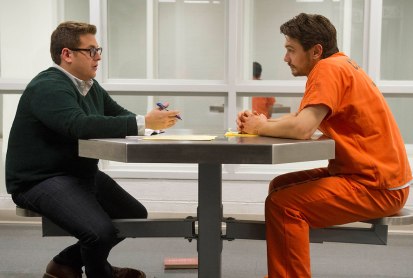
“True Story” couldn’t be more aptly titled. When one hears another tell a story about something, especially when that something is a serious crime, it’s hard to tell if the person telling the story is telling the exact truth or an exaggeration of the truth (if not lying entirely) and even harder for the listener to know what to believe, especially when there is no second side to the story, or at least no one to hear it from. In this film, journalist Mike Finkel was booted off the New York Times for fudging some facts of an important story he wrote for them, after he had defended himself by saying he got enough important details from the experience (but with no notes to back it up). His attempt to redeem himself comes when convicted killer Christian Longo steals Finkel’s identity and Finkel, oddly flattered by the fact that someone knew of him, decides to visit him from time to time to know more about him and get his true side of the story behind his crime of murdering his wife and children. Finkel plans to write about his meetings with Longo for a book, titled “True Story.” But the more Finkel learns about Longo and about the crime, the more he questions what’s true, what’s fabricated, and what’s exaggerated. What is truth? What are lies? What is manipulation? Is the title “True Story” accurate or ironic? You can wonder if the story within the film is true even of itself. (Surely, some liberties were taken, of course.)

“True Story,” based on the actual Michael Finkel’s 2005 book of the same name, is less of a crime story and more of a drama about the codependent relationship/twisted friendship between Christian Longo (convicted killer) and Mike Finkel (his biographer), each of whom begin their relationship with an agenda, though it’s unclear whether they’ve achieved it or not. That’s one of the things that makes the film all the more fascinating, on top of the efficiently understated performances by the actors playing the parts: James Franco as Longo and Jonah Hill as Finkel. Both these actors are known for comedic roles, but their low-key approaches to these serious roles suit them rather well. Hill is believable as a writer who’s sure about his brilliance in his craft, which makes it even more believable when he feels he’s been duped. And Franco delivers one of his very best performances in an unsettling turn as a master manipulator who is so sure of himself as someone who may be able to win over a jury with his charm at a murder trial.

Also very good in this film is Felicity Jones as Finkel’s girlfriend, Jill, who stands by her man when things are tough and mostly stays out of things until a crucial moment late in the film when she meets Longo for herself and decides to tell him a thing or two. I normally grow tired of the cliché in which a secondary character stays quiet for a majority of the film until late in the game when he or she finally says something of significant importance, but when it works, it really works. And that is certainly the case here—Jones nails this scene and her dialogue is choice.

True_Story_2015_Blu_Ray_1080p_mkv_004859000

But this also brings up a problem I have with “True Story”: the script. It may sound odd to you, but I think the script “True Story” is too good. It’s a weird criticism, I know, but a good deal of the dialogue sounds too carefully written. Take this introductory exchange between Longo and Jill when they first meet: she tells him, “I thought you’d be taller.” “Why?” “I don’t know. Maybe because [Mike] looks up to you.” Something about that sounds rehearsed, like it’s part of a play, and her story she tells to Longo, as tough as it sounds, still sounds staged.

But wait…she’s telling a story to get something important across to Longo, much like how Longo has been telling stories to get points across to Finkel and the trial jury. So…isn’t that kind of the point and I’m contradicting myself with this criticism?

Well, another problem with the script is that it can be a little heavy-handed, with obvious statements to make, sometimes repeatedly. And the scene I praised before probably wouldn’t plausible without Longo getting some chance to defend myself, no matter how hard Jill’s words may hit home for him.

Maybe I’m a little unfair with that criticism, because the overall film is very powerful and a solid drama with respectable performances and neat direction by Rupert Gould. It’s an interesting portrait about biography, human conduct, and how it’s not always easy to get what you want no matter how high the stakes are raised. Especially in the aftermath of a heinous crime.

The Gift (2015)

14 Mar

JoelEdgertonTheGift_article_story_large

Smith’s Verdict: ***1/2

Reviewed by Tanner Smith

You know the setup, you saw the trailer, you’ve seen movies like this before: a seemingly mild person identifies himself/herself to an average family but soon becomes violently dangerous, resulting in a deadly battle between them. You think you might be able to guess where filmmaker-actor Joel Edgerton’s “The Gift” is going, right?

Wrong.

“The Gift” may seem like it’s going in that direction, but what you may have heard about it is certainly not the case. I’ll explain the setup before I get to what I mean by that:

Newlyweds Simon (Jason Bateman) and his wife, Robyn (Rebecca Hall), move to a nice new place in Southern California after Simon receives a new job nearby. Soon after they settle in, they meet an old friend of Simon’s from high school: an oddball named Gordo (Joel Edgerton, who also wrote and directed the film). He wants to restart a friendship with Simon, though Simon says they were never close to begin with. But Gordo sends the couple gifts to win their friendship and even starts inserting himself in places where they don’t want him. Robyn doesn’t mind much, but Simon just wants him to go away. He lets Gordo know this in unkind terms, which results in Gordo reacting impulsively and unpredictably.

I didn’t see the film’s trailer, as most people have (and reacted negatively too, especially after actually seeing the movie), and so while I didn’t know what the trailer revealed, I did have some idea from other movies of this sort where this was going to go. Even though I was half-right, I was also…half-wrong (duh). The situation is familiar and recognizable, but when I thought I was getting one thing, I was pleasantly surprised to find myself getting another entirely. That has to do with the ways Edgerton tweaks with the story and makes it more of a story about how whatever wrong you’ve done in the past followed by the insistence not to own up to it and confess eventually will come up and ruin your life. I won’t give away how “The Gift” gets that across (and wonderfully so, I might add), but let’s just say that karma will come and get you when you least expect it.

The filmmaking involved is also impressive, with very carefully constructed execution by Edgerton. Edgerton proves himself worthy as a filmmaker and also turns in a performance that is also creepy and chilling but also strangely sympathetic when you learn more about his character. That’s all I’ll say about him.

Rebecca Hall is suitably vulnerable as a woman who doesn’t know as much about her husband’s past as she thinks she does. And speaking of her husband, Jason Bateman is perfectly cast as a person who can seem charming and likable but also slimy and apathetic, showing he has some things to hide…

The themes of “The Gift” are damage and karma. Secrets are kept from everybody, everyone is damaged in one way or another, and in some way, when the film builds to a haunting finale, the past will come back to haunt you for the rest of your life. “The Gift” works wonderfully as a dramatic thriller. I wish I could tell you more about exactly why it works, but I will leave it for you to discover its secrets for yourself, because it is worthy of checking out. It may even force you to think back to your own past and wonder if there are any secrets of your own that you should own up to…

Straight Outta Compton (2015)

3 Mar

hero_StraightOuttaCompton_2015_1

Smith’s Verdict: ***1/2

Reviewed by Tanner Smith

When it came to musical biopics released in 2015, many people may have forgotten about the Beach Boys movie, “Love & Mercy,” one of my favorites of the year; but who could forget the N.W.A. flick, “Straight Outta Compton,” which was a monster hit. Ironically, while “Love & Mercy” was more grounded and low-key, “Straight Outta Compton” is surprisingly conventional as well as energetic. It contains certain music biopic tropes—naysayers, uncertainty of something new and different, downfalls, tragedy, betrayals, etc. We’ve seen all that before. But the film’s electrifying energy is the key to its success—hell, if a film about N.W.A. wasn’t energetic, it’d probably be a major disappointment to nostalgic N.W.A. fans. The point I’m getting at early in this review is that it doesn’t matter how “conventional” a movie of this sort is, much like it doesn’t matter where certain ideas may come from for any movie—it’s what’s done with the material that really matter.

I enjoyed “Straight Outta Compton.” It’s an enthralling, powerful, powerfully acted film about a risk-taking, game-changing rap group, even if the film itself isn’t game-changing (for that matter, it may not be all that risk-taking either, since some original members of N.W.A. were consultants for the film and most likely didn’t want certain things from their life to be portrayed on screen). But I don’t mind so much.

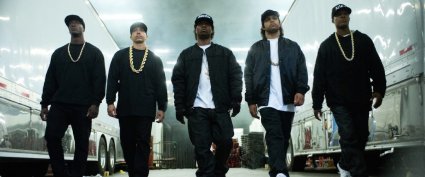
The film takes place from the mid-1980s to the mid-1990s. It begins in Los Angeles in 1986, when Eazy-E (Jason Mitchell) was selling weed, Dr. Dre (Corey Hawkins) moved out of his mother’s house, and Ice Cube (O’Shea Jackson, Jr.) was writing rap lyrics based on everyday things he noticed around him. This is a time when young black men were stopped, frisked, and even beaten by police even when they were just standing on the streets. (Hell, what am I talking about? We still live in that time today!) The anger that came from these kids’ experiences crossed with their dreams of making it big with rap led to “reality rap,” for which they form the group N.W.A. (if you don’t know what that stands for, this isn’t the movie for you) and create angry music based on what they go through day after day. They tell it like it is and become very successful, which in turn makes other people worried that they endorse violence and anti-authority behavior. And of course, the irony becomes clearer when they’re warned not to perform their most angry piece, “F*ck the Police,” at a concert guarded by police; of course, they do and the police start shooting, ending the concert—tell me who’s being violent here?

The first half of “Straight Outta Compton” is by far the best part, showing the creative process of getting this craft done, feeling the intensity of the energetic live performances, and more importantly, letting us feel the anger that they feel, especially when they’re attacked by police. It keeps its riveting edge as the group’s manager, Jerry Heller (Paul Giamatti), manipulates Eazy-E into making him think he’s bigger than everyone else, which then leads to Ice Cube leaving the group to go solo, which then leads to him becoming a hit, which then leads to a nasty war between labels, which then leads to Dre forming Death Row Records with the violent, hulking Suge Knight (R. Marcos Taylor, quietly chilling in the role), and other events that lead to the end of N.W.A. The film gets less energetic as it goes along and its tone grows suitably more grim (especially when it comes to a tragedy late in the film), and while that’s not necessarily “fun” to watch, it is still captivating, well-acted, and intriguing for those who don’t know how N.W.A. went through the downward spiral. I can’t complain that much about it, except for the argument that it suffers from a few pacing issues as a result; I feel like it stalls at certain parts, particularly at the melodramatic material.

The casting is pitch-perfect all around. In particular, Jason Mitchell is abrasive and charismatic as Eazy-E, Corey Hawkins is immensely appealing as Dr. Dre, Paul Giamatti is smooth as a slick album producer who manipulates Eazy-E to betray certain people in the group, and then there’s O’Shea Jackson, Jr. as Ice Cube—damn is he good! This is a truly remarkable performance, bringing Ice Cube’s look and feel to authentic levels. Oh, and did I mention he’s actually Ice Cube’s son? And it’s not just an imitation either, which is more than a plus. Also solid are Aldis Hodge as MC Ren and Neil Brown Jr. as DJ Yella, and I was also impressed by Keith Stanfield (who I remembered from “Short Term 12”) in a brief cameo appearance as Snoop Dogg; I wish he had more screen time.

I mentioned in an above paragraph that the film isn’t entirely “risk-taking.” For one thing, it doesn’t mention Dr. Dre’s violence toward women, which is well-known to quite a lot of people. I get that the writers, Jonathan Herman and Andrea Berloff, chose to keep some things out for the actual band members’ sake, but it’s not like the film portrays them as role models anyway (it does show them as misogynistic at times, even throwing in a “Bye Felicia” joke midway through), so it’s not like they have that much to lose.

“Straight Outta Compton” does work surprisingly well as commentary…unfortunately a little too well. Think about what Ice Cube was rapping about almost 30 years ago and what’s going on in the news even to this day. But “Straight Outta Compton” is still an entertaining film for the power of the material, the live performances which are entertaining, the acting which is spot-on, and the screenplay which is very well-written. I mentioned in my “Love & Mercy” review that I wouldn’t be able to listen to a Beach Boys song the same way again; I feel the same way about N.W.A. songs after seeing this film.

Love & Mercy (2015)

1 Mar

love-and-mercy5

Smith’s Verdict: ****

Reviewed by Tanner Smith

I remember listening to Beach Boys songs when I was a little boy. My parents, as well as cheesy cover bands/children’s entertainers, introduced me to these catchy tunes and even gave me a cassette tape to listen to (and eventually wear out). Good Vibrations. Don’t Worry Baby. Surfin’ USA. Little Deuce Coupe. I Get Around. Help Me Rhonda. Wouldn’t It Be Nice. These were all among the many Beach Boys singles I enjoyed listening to then and still enjoy now. And as I got older, I got into their deeper pieces, especially “God Only Knows,” which is undoubtedly one of their best. And now, with “Love & Mercy,” Bill Pohlad’s biopic about the Beach Boys’ Brian Wilson, I realize I may know their music but I knew practically nothing about what into making the music and what Wilson went through in his life.

Brian Wilson of the Beach Boys was a young, ambitious artist with numerous ideas (possibly too much for him to handle) that led to taking the Beach Boys from catchy surf-themed hits to more detailed, trippy, beautiful works, some of which were ahead of their time. He was also helplessly strung out on drugs, which led to paranoia, schizophrenia, and alienation. For many years since, he would live in a state of awkward arrested development until the woman who would become his second wife helped him out of it.

“Love & Mercy” tells two parallel stories back and forth; one of Brian Wilson at his creative heights, the other of Brian Wilson well after his successes. One story, set in the 1960s (roughly 1965-1968), begins as Brian (played as a young man by Paul Dano) starts to hear voices in his head. He tells his brothers, fellow Beach Boys Carl (Brett Davern) and Dennis (Kenny Wormald), it’s because he has so many ideas on his mind that he simply has to let out. While the band is on tour, Brian stays behind to work in the studio, making new music and intending to make “the greatest album ever made.” His new pieces, including the offbeat “Pet Sounds,” are unusual, innovative, and one might say “unusually innovative,” but neither of them are becoming hits, which angers Beach Boys co-founder/singer Mike Love (Jake Abel). Meanwhile, his grip on reality loosens when the voices in his head attempt to overtake him and his addiction to drugs becomes worse and worse…

The other story, set in the 1980s, shows a middle-aged, broken, confused Brian (played this time by John Cusack) under the pharmacological care of therapist Dr. Eugene Landy (Paul Giamatti). He meets a Cadillac saleswoman, Melinda Ledbetter (Elizabeth Banks), and starts to date her. She notices the grip Landy has on Brian and how he’s using it to his advantage, and so she tries to help him.

The film is really two movies in one, and they both work equally well. Granted, the story involving Brian in his Beach Boys involvement is arguably the most engaging, but the present-day story is very strong and intriguing in the way Brian behaves in his lost state, and we’re genuinely hoping he finds himself again. These two stories intersect effectively, showing two kinds of developments: creative and personal. We wonder how Brian got from who he was in the past to who he is now (or rather, the 1980s, when the “present-day” is set) and we hope he finds his way again.

That’s the ultimate power of “Love & Mercy,” which is without a doubt one of the best musical biopics I’ve ever seen. The film is not only a loving tribute to the Beach Boys, but it’s also a compelling portrait of a tortured artist whose career doesn’t always work out well for him, and it shows that in a non-condescending manner. In other words, it doesn’t take the easy way out, like most music biopics. Even when there’s a triumph, it’s quick and low-key.

But the film is also a lot of fun when it’s paying tribute to the Beach Boys. It opens with a glorious montage of the Boys in their heyday, recording, performing, and having fun (on the beach, of course). It takes us behind-the-scenes on the creation of pieces such as “God Only Knows,” “Pet Sounds,” “Good Vibrations,” among others. The actors portraying the other Boys are credible in their roles, especially Jake Abel who makes a very convincing Mike Love. And the attention to detail is simply marvelous—for example, I love how Brian’s practice piano is in a circle of sand in his living room.

Oh, and I can’t forget to mention the cinematography and editing in many of these sequences. Among the scenes that stick out in my mind is a scene in which Brian, as a young man, is playing a rough piano version of “God Only Knows” and singing nervously, presumably to himself—the camera spins slowly around the piano as he’s performing until it stops to reveal his father (played by Bill Camp), sitting on a nearby sofa and listening. That leads into a hurtful scene in which Brian’s father criticizes Brian harshly and Brian pathetically tries to counter-argue. Suddenly, that tracking shot makes a lot more sense. As for editing, I admire the way the film shows passages of time through the band’s art, such as with the montage, the making of “Good Vibrations,” and Brian’s downward spiral, among others. The film is technically brilliant.

This is the best performance I’ve seen from Paul Dano, an actor I’ve admired many times due to his performances in films such as “Little Miss Sunshine” and “Ruby Sparks.” Not only does he look right for the part, slightly resembling the real Brian Wilson—he feels right. He does such an incredible job of capturing the man’s increasingly peculiar convulsions and characteristics. John Cusack is just as good, capturing the right speech patterns and somewhat childish ways of exposing secrets from his past.

I’ve seen “Love & Mercy” four times now, and I don’t think I can forgive the Academy for passing up this truly superb film, to be honest. I would’ve put Paul Dano in either one of 3-4 slots in the Best Actor category—that’s not a slam against the nominees but a statement of how strongly I felt about this performance. Maybe an Editing nomination, a Best Adapted Screenplay nomination, a Sound Editing nomination, or even a Beat Director nomination would have been warranted. Maybe Academy members should have seen the movie more than once. As for me, I will never listen to a Beach Boys song the same way again.

The Death of “Superman Lives”: What Happened? (2015)

24 Feb

Smith’s Verdict: ***1/2

Reviewed by Tanner Smith

tumblr_m28ii1crg01qztzndo1_500

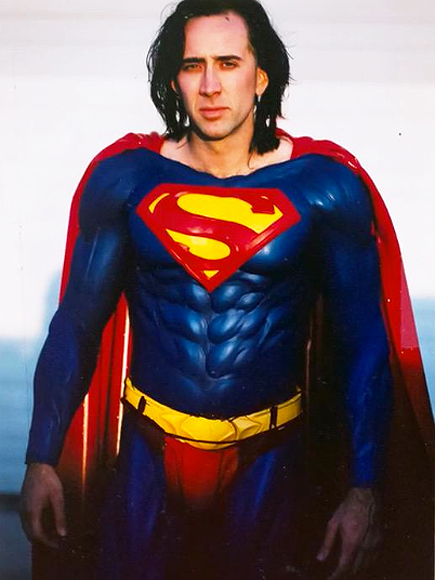
This is a photo taken at an early costume fitting session for which Nicolas Cage was trying on a new Superman suit, because he was going to play the Man of Steel in a Superman project in the late 1990s, titled “Superman Lives,” to be directed by Tim Burton. In this photo, Cage’s eyes are barely open, his long hair looks ridiculous, and the costume looks sillier than the other Superman-suit renditions. People all over the Internet look at this photo and scoff, laugh, groan, or all of the above. Director Bryan Singer, who helmed 2006’s “Superman Returns,” apparently even showed the picture to his crew members, reminding them of how much worse their movie could be.

Now, take a look at THIS photo…

nic-cage-435

Now, that’s Superman—albeit a somewhat different version, but you can still see how a new, improved Superman could look rather awesome. This is the photo most people seem to ignore.

“Superman Lives” was called off just three weeks before production, and people nowadays wonder what would have happened if it were made. Would it have been a welcome new addition to the Superman franchise or would it have been as memorably bad as late-‘90s comic-book movies such as “Batman & Robin”? We’ll never know. But with this documentary, “The Death of ‘Superman Lives’: What Happened?” we now have a good idea about the kind of movie it could’ve been.

Writer-director Jon Schnepp, of Collider Movie Talk on collider.com, was apparently as intrigued about the doomed project’s backstory as everyone else, which would explain why he delves into so deeply, with insights into Hollywood insider power and comic book geek behavior, as well as engaging in-depth interviews with Tim Burton, screenwriter Kevin Smith, producer Jon Peters, former Warner Bros. executive Lorenzo di Bonaventure, among others. (Cage unfortunately wasn’t interviewed, but don’t worry—there are wonderful pieces of archival footage of him mentioning the film in talk-show interviews and even footage of him trying on the costume.)

One of the more fascinating interviewees is Peters, who started out in Hollywood as a hairdresser and then went on to become a successful producer/studio executive. He’s very open about certain topics of discussion and speaks candidly with Schnepp about the process of the film’s pre-production. And it turns out the others have things to say about him too, particularly those who have fought him on numerous things. For example, Smith, who was the first person called upon to write the film, mentions three particularly strange demands Peters had for him—1) Superman should never fly, 2) Superman shouldn’t wear the silly costume, and 3) Superman should fight a giant spider. (These are allegations that Peters denies.)

Maybe Nicolas Cage could have pulled off the role of Superman. We know him today as a crazy actor who will take just about any role thrown at him, but what we forget is that he can be a damn good actor (and “Superman Lives” was being planned at the height of his career, having come off an Oscar win for “Leaving Las Vegas”). He’s not the first choice people think of in the role of Superman, but then again, neither was Michael Keaton for the role of Batman, which the documentary reminds us of. One of the common things mentioned in this film is the mixture of fear and ignorance when news is delivered to comic book geeks and how they will react when an actor they don’t favor is considered for a Hollywood adaptation of their favorite artworks.

“The Death of ‘Superman Lives’: What Happened?” is an engaging documentary to learn from about the planning of a notorious failed project, to listen to these infamous artists talk about it, and even to discover some notions about odd behavior presumably brought upon by Hollywood. (Watch the movie and you’ll see what I mean, the more you learn about Peters.) The inside material is fascinating, the interviewees pleasing, and the overall story intriguing.