Archive | 2013 RSS feed for this section

Star Trek Into Darkness (2013)

28 May

images-1

Smith’s Verdict: ***

Reviewed by Tanner Smith

With 2009’s big-budgeted reboot of “Star Trek,” director J.J. Abrams and screenwriters Roberto Orci and Alex Kurtzman introduced a new look at the popular saga originated from Gene Roddenberry’s imagination—darker, more kinetic, very exhilarating, and very action-packed, while also keeping true to the spirit of the original TV series in terms of creativity and of the memorable characters. 2009’s “Star Trek” was a big hit, and so it was inevitable that a follow-up in the same style and tradition would be constructed. Four years later, we have “Star Trek Into Darkness,” which is believe it or not, a bigger, more bombastic sequel than its predecessor.

And to get it out of the way, the first hour-and-a-half or so of this two-hour-and-12-minute sci-fi blockbuster is just incredible. The action scenes are tense and very exciting; the characters are all solid (Spock is pretty badass in this “Star Trek” entry); the villain is great; and there’s good social commentary among all the madness that ensues in this story, and it’s not unlike the best “Star Trek” movies or TV episodes. But then in its final half-hour, it’s as if something went wrong. Usually in big-budget action films with strong buildups, it’s usually the payoffs that are lacking in substance. But here, it’s just a lack of knowing any better. There is twist upon twist, and I wouldn’t mind so much if it wasn’t trying to straight-up copy an easily-remembered sequence from one of the earlier “Star Trek” movies. Then there’s a silly chase scene that results in a fistfight. Then there’s a total copout to what has been built up before with that aforementioned “copied scene.” Then there’s a rushed epilogue so that it’s hard to feel exactly what Abrams and co. were going for.

I didn’t give much away, but you get my point. I was really enjoying this movie, ready to call it one of the best films of the summer so far. I was so into the story and the action and what all the characters were doing and etc. and so on. This was “Star Trek,” and I loved it. Then it all goes downhill in its final act. Abrams and co. deserve credit for the first hour-and-a-half-or-so and why it works so well, in my opinion. But they also have to take the blame for what happens to the movie.

The film starts with a bang in a fabulous scene set on an alien planet. The crew of the USS Enterprise are sent to save the primitive natives of this world from an erupting volcano. In the process, Spock (Zachary Quinto) is in peril and Kirk violates the Federation’s prime directive in order to save him. Because of his insubordination, Kirk is demoted from Captain to First Officer. But shortly after, the Federation is under siege by a fugitive, a rogue Starfleet officer named John Harrison (Benedict Cumberbatch), who murders Admiral Pike (Bruce Greenwood) in his attack. Kirk wants revenge and requests to go after Harrison. Admiral Marcus (Peter Weller) agrees and puts Kirk back in his ranking, but with simple instructions to track down Harrison and kill him. Kirk rounds up his crew, including Spock, Dr. McCoy (Karl Urban), Uhura (Zoe Saldana), Sulu (John Cho), and Chekov (Anton Yelchin) (Scotty, played by Simon Pegg, joins later after being unsure about this mission), and heads to Kronos, the Klingon planet where Harrison is sure to be located.

There’s a lot to like about this movie, and among the chief aspects is the villain. This is not a one-dimensional bad guy. At first, he seems like a standard action-flick terrorist that just wants to blow stuff up. But there’s actual reason to his actions here, and the more they’re developed, the more they make us understand why he’s doing all of this even if we don’t tolerate it. There’s a good amount of depth to how this character is portrayed, and Benedict Cumberbatch plays the role so well.

(By the way, even though most people will know the villain’s true identity before its reveal, I won’t reveal it here. All I can say is that I think it works really well.)

The heroes are all as appealing as their original counterparts (though without the truer sense of camaraderie that will probably be further developed in later installments). In particular, Kirk has a credible story arc about doing what he believes must be done, even if it isn’t the best thing for everyone else around him. Whatever he’ll do, he’ll do it to save his friends and crewmembers. And in a way, he and the villain, without giving too much away, are practically the same person in motivation, which makes things more interesting. But if there’s a flaw in this arc, it’s that its resolution is not strongly-handled, which is one of the many flaws with the film’s final act.

Spock has already been established as half-human/half-Vulcan and constantly walking that fine line between logic and emotion. He doesn’t quite understand why Kirk risked his job and life to go and save him in the opening sequence, and Kirk must convince Spock what the meanings of being human and forming friendship mean. Spock goes through a lot in this movie, continuing to walk that line. And it does pay off in an emotional way, to the credit of the final act.

(By the way, Leonard Nimoy shows up in a brief cameo as “Spock Prime.” While it’s pointless, it results in a great reaction when Spock asks if he knows who the villain is.)

Being a summer blockbuster, “Star Trek Into Darkness” moves with a fast pace that only breaks when it needs to. It stops at the most appropriate times for the audience to breathe and take in what we’ve just endured. And there are some terrific action scenes—along with that opening scene, we also have a desperate battle between Enterprise crew and Klingons (yes, there are Klingons in this movie), and an attempt to get from the Enterprise ship to a space station through space, if only Scotty could open the airlock in time. This is an epic journey that works as a glorious space opera—we have space battles, distant planets, all sorts of conflicts and interruptions along the way, and many surprises along the way.

There are many other old-“Star Trek” references making appearances. There’s a Tribble that McCoy experiments with (and Good Lord, could the payoff to this thing be any more obvious in the final act?); there are a few throwaway memorable quotes (“Shut up, Spock! We’re rescuing you!”); there are models of old Enterprise ships in Admiral Marcus’ office; and (possible spoiler alert) many, many references to the “Star Trek” TV episode “Space Seed.” Also introduced in this rebooted franchise is Dr. Carol Marcus (Alice Eve), who, for those who are familiar with the early-‘80s “Star Trek” movies, will become the mother of Kirk’s son. (By the way, for those who say she’s underused in this movie, calm down—it’s just her introduction.)

And then, there’s the final half-hour, which almost completely ruined the whole movie for me. While some parts of it aren’t bad, everything else about it hit the wrong notes, in my opinion. It begins with a segment borrowed from one of the earlier “Star Trek” films, and it’s practically repeated word-for-word (except with a role reversal). I wouldn’t mind this so much, as it is a powerful scene that does pay off with certain character arcs in this movie (and I would have looked forward to it being resolved in a third movie if they just took it easy from here on out). But from that point, it all goes downhill. I can’t help but wonder why they had to go this route (I think it may have been for the fans, but I think some of the most diehard fans might feel let down).

So, do I recommend “Star Trek Into Darkness,” despite a disappointing resolution? Well…it’s a close call, but I suppose I do. A good majority of the movie is entertaining and exhilarating, and I was having a great time up until that point of no return. So marginally, I recommend checking it out. But as a warning, you may feel like watching “Star Trek II: The Wrath of Khan” afterwards (you’ll know why).

Iron Man 3 (2013)

7 May

images-1

Smith’s Verdict: ***1/2

Reviewed by Tanner Smith

Funny, I kind of thought last year’s “The Avengers” was “Iron Man 3” in a way (that would also make it “Thor 2,” “Captain America 2,” and “The Incredible Hulk 2” in that same sense), but…whatever. It doesn’t matter. Robert Downey Jr.’s memorable, likeable, witty, solid Tony Stark a.k.a. Iron Man is back for more, and he’s more than welcome on the big screen. With more action and more humor, “Iron Man 3” is the best in the popular superhero-movie franchise (based on the Marvel comic book series) since the original five years ago. The second film may have been somewhat disappointing for fans of the original; this third film (yes, I might as well quit calling “The Avengers” a “third film” in this franchise—it’s not necessarily fair anway) is more than likely to satisfy those fans and more. It’s action-packed, intense, funny, and well-executed. A good time at the movies.

People who were disappointed by “Iron Man 2” may be satisfied with this film. But if people are expecting something as big and bombastic as “The Avengers,” that may be reason for them to be disappointed. But it may also be too much to hope for. This is a smaller picture by comparison, not relying entirely on a large amount of action, explosions, and CGI. But not to worry—there are still enough extended action sequences to deliver, which is what we expect in summer entertainment.

“Iron Man 3” takes place shortly after the climactic New York battle in “The Avengers,” as Tony Stark is back in Malibu making more improvements on his new “Iron Man” suits (such as making parts of the suit fly over to him and attach themselves). But he suffers from insomnia and anxiety attacks that may have to do with his experience in the “wormhole” (for those who recall, it may not have been easy to escape from). This doesn’t do well with his relationship with his lovely girlfriend, Pepper Potts (Gwyneth Paltrow), as he spends more time in his basement-laboratory than in the bed with her at night.

A new villain has entered the story—two, actually. One is a terrorist, known as The Mandarin (Ben Kingsley), and the other is his henchman, a slimy genius named Killian (Guy Pearce). They attack mostly with a special kind of suicide bombers—people who are altered to explode after their missions are complete. After one of these attacks puts Tony’s bodyguards, Happy (Jon Favreau, not directing this “Iron Man” movie, by the way), in a coma, Tony makes a public threat to the Mandarin, swearing revenge. In response, the Mandarin’s army attacks Tony’s mansion with great force, leaving Tony for dead. But Tony is still alive (though with limited materials and a low-on-paper Iron Man suit) in a small Tennessee town, and so he must find a way to stop the Mandarin before he strikes for the President (William Sadler).

Where are the other Avengers during all of this? You’d think that an assassination plot for the President would get their attention, but no. Tony and his friend Rhodes (Don Cheadle), who is now the “Iron Patriot,” are the only ones with the right abilities to stop it. Wouldn’t it be rather awesome if the Hulk suddenly came in and smacked Killian to near-death?

There is plenty of action and humor to please audiences. The best action sequences are the attack on the mansion; a low-scale barfight with one of the “suicide bombers”; and the climactic final battle on a ship, in which the ultimate deus ex machina is brought upon to help (you either accept it or you don’t; I thought it was rather awesome). The film is briskly paced and high on energy, but also has plenty of humor. There are Tony’s one-liners, which are always welcome because they’re delivered by Downey with great sharp wit every time. There are some neat visual gags involving the suits. And there’s also a nice buddy-comedy element in that Tennessee town, in which Tony gains assistance from a smart young boy and they banter like Murtaugh and Riggs.

We’re used to seeing Tony Stark as a wisecracking, cocky, likeable cutup (who also happens to be a rich genius), so it’s refreshing to see another side to him. These anxiety attacks say a lot about his vulnerability, giving him even more dimensions than we thought he had. The only little problem I had with this movie was that the attacks don’t have much of a payoff. Why not have these memories of the wormhole come back to him somehow during the climax? There would be more psychological conflict that way.

Robert Downey Jr.—what can you say? It’s RDJ. He’s Tony Stark. He’s always solid and powerful when playing this role. The rest of the actors are no slouches either—they’re very game and do credible jobs. Gwyneth Paltrow does more than play the love-interest and she gives us more reason to sympathize with her—she even sports the Iron Man suit at one point (awesome). Don Cheadle is great as the new “Iron Patriot” (formerly known as “War Machine”). Guy Pearce is suitably slimy and callous and does what the role requires him to do.

If this is the final installment in the series, it wouldn’t be very surprising, as it does have the final of a concluding entry (and a satisfactory one at that). But I am sort of hoping that at least one of the other post-“Avengers” movies feature Robert Downey Jr.’s character of Tony Stark, because he really is the most engaging of the team, and the most amusing. Either way, “Iron Man 3” is a terrific superhero-movie sequel. It’s enjoyable, engaging, and fun all the way through.

NOTE: Stay after the end-credits for a little bonus treat. (And no, it’s not Samuel L. Jackson in an eye-patch again.)

Mud (2013)

5 May

Jeff-Nichols-Mud-Movie-Reviews

Smith’s Verdict: ****

Reviewed by Tanner Smith

Jeff Nichols is undoubtedly one of the best modern filmmakers of our time. He obviously cares deeply for film and filmmaking, which was clear evidence in 2008’s “Shotgun Stories” and 2011’s “Take Shelter” (both of which are different yet excellent films), and doesn’t always go for the easy way out, yet finds new ways to satisfy audiences. So when I found out that his third feature, “Mud,” was aimed for more mainstream appeal, I was wondering if he would stoop to the new low that David Gordon Green (another visionary filmmaker who began in the indie circuit) took with his stoner comedies. And for the record, I know Green’s latest films have their audiences, and maybe they were the kind of films he wanted to make all along. Maybe “Mud” was the kind of film that Nichols wanted to make while he was making his other films to give himself an image in order to do so; but either way there is to look at it, his move into the mainstream is welcome with this film.

I love this film. This might be the kind of movie that Nichols wanted to make for a long time, but this is also the kind of movie that I would love to make. It’s a coming-of-age story in a nontraditional sense, using elements of adventure to tell the story of two young boys learning some important life lessons. Another such film is 1986’s “Stand by Me,” which was one of my main influences to become a film critic and a filmmaker. There’s just something so engaging about a coming-of-age adventure such as this.

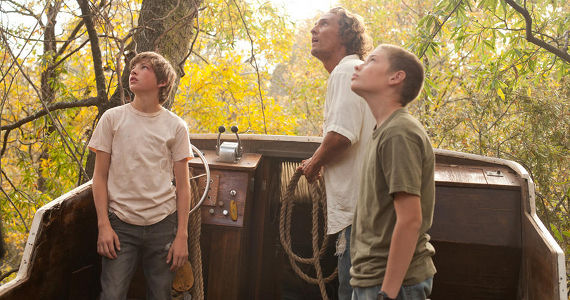
“Mud” takes place in the Arkansas Delta, near the White and Mississippi rivers, giving the film its great deal of Southern grittiness. Our main characters are two 14-year-old boys—Ellis (Tye Sheridan) and Neckbone (Jacob Lofland)—who spend their days riding a dirt bike and using a skiff to explore the Mississippi. They come across an island in which a boat is lodged high up in a tree, due to a flood. But they find that the boat is inhabited by a ragged-looking man named Mud (Matthew McConaughey).

Mud may be homeless, hiding out on the island, and he does carry a gun for “protection,” but he comes off as unthreatening to the boys, telling them tales of superstition (nails in the shape of crosses in his boot-heels, his white shirt representing “good luck,” his snake tattoo representing “bad luck,” etc.) and about his love who is supposedly coming to meet him so they can escape together. Ellis and Neckbone decide to help him out, bringing him food and running a few errands for Mud in town, which includes finding his girlfriend, Juniper (Reese Witherspoon), and bringing her messages from him.

The main reason Ellis wants to help Mud and Juniper get back together is because he still wants to believe that true love still exists, despite the upcoming divorce his parents will go through. He wants something to believe in, and so he does what he can to make sure it follows through. The fact that Mud killed a man to protect Juniper doesn’t decrease his intrigue; if anything, it increases it.

Mud’s devotion to Juniper also mirrors that of Ellis’ infatuation with an older girl, May Pearl (Bonnie Sterdivant). After Ellis defends her honor by punching out a high-school senior, she lets him take her out on a date, which doesn’t lead to what he would hope for. Without giving too much away, his disappointment to a certain reveal about her is heartbreaking, because I think we all went through something like that in our young lives. And it does fit into the adult-romance that Mud and Juniper should have while there’s a high chance that things aren’t exactly what they should be.

This new look upon reality, which Ellis is starting to realize, is what makes “Mud” an effective drama, as well as an adventure story. His interaction with Mud increases his self-esteem and the pride he feels in what he feels he should do. He also learns some harsh truths that Mud learned the hard way, giving this character much room to grow. By the end of the story, Ellis has learned some important things about life (which is the case for any coming-of-age tale), while Neckbone is more or less the same adventurous boy he was at the beginning of the story, and so that leaves an interesting contrast between the two boys. This didn’t necessarily have to be a coming-of-age tale involving two boys; just one is enough, while the other is suitable for the “adventure” element.

Speaking of which, things get even more dangerous when the boys encounter a nasty bounty hunter (Stuart Greer) who is seeking vengeance against Mud (the man Mud killed turned out to be his brother) along with a posse led by his father (Joe Don Baker). They keep close watch on Juniper, believing that she’ll lead them to him, and so Ellis and Neckbone must plan a sneaky way to get her back to Mud.

Matthew McConaughey is receiving well-deserved praise for his strong, memorable portrayal of a man who has risked (and is still risking) everything for who he believes is his soulmate and truly believes he’ll figure something out with each misstep. He’s truly brilliant here. But the real stars of “Mud” are the two excellent young actors playing Ellis and Neckbone. Tye Sheridan and Jacob Lofland are already labeled as resembling Tom Sawyer and Huckleberry Finn in their performances, and deservedly so (this is a Mark Twain type of story). Sheridan’s Ellis is more enlightened and thoughtful while Lofland’s Neckbone is more outgoing and defiant (and he also provides some funny moments as well). The blend of these two is excellent and is played in an entirely credible way.

This is more of the boys’ story as they are the main focus, though the adult characters (aside from Mud) play pivotal roles in their tale. Reese Witherspoon’s role of Juniper is more complicated than just being a “soulmate” and there manages to be more complexity implied than actually stated; Sarah Paulsen and Ray McKinnon are convincing as Ellis’ squabbling parents who each try to give Ellis further outlook about growing up; the bounty hunters, led by Joe Don Baker and Stuart Greer, are given a specific purpose of vengeance for the man Mud killed; and we also get Sam Shepard as Tom Blankenship, Ellis’ neighbor who has a past connection with Mud.

Oh, and there’s also Neckbone’s uncle and guardian, played by Michael Shannon (a regular for Jeff Nichols’ films). He’s pretty much an overgrown teenager who slacks off and plays “Help Me Rhonda” (by The Beach Boys) during sex with random women. And…that’s about it. Aside from one little talk to Ellis about how Neckbone looks up to him, he really serves no purpose to the story. I think if you remove his scenes in the editing room, you wouldn’t miss anything. But I’ll let it slide because he is quite solid in the role, and frankly it is good to see him in a Jeff Nichols film.

The look and feel of the Arkansas Delta is captured perfectly. As someone who has spent a majority of his life so far in an Arkansan small town, a sense of familiarity overcame me. The small town; the boondocks; the landscapes. I felt like I wasn’t too far from home. And for anybody, with the way the film captures this particular essence, those who live in large cities are most likely to notice the vividness of atmosphere.

“Mud” is a wonderful film, and yet another winner in Jeff Nichols’ great résumé. This is further proof that Jeff Nichols is one of the most impressive filmmakers of our time. I love his films, and I eagerly await his next project.

Oblivion (2013)

21 Apr

Smith’s Verdict: ***

Reviewed by Tanner Smith

Post-apocalyptic world. Futuristic technology. Aliens. Impending doom. Chases. Dogfights. Crashes. Tom Cruise racing to the rescue. How many times have we seen that in a sci-fi movie? (OK, maybe not all at once, but you get the point.)

“Oblivion” is the latest sci-fi action-thriller to contain all of these elements, and more. We get the usual science-fiction basics that we’ve seen in such movies as “The Matrix,” “Total Recall,” “Minority Report,” and many more I could go on naming. But strangely enough, “Oblivion” is welcome for two reasons—1) It is still pretty intriguing and exciting, and you can sense that the filmmakers have a real respect for the genre; 2) It is always good to see a sci-fi film that is mainly idea-based. There may be a lot of action and special effects, but there are also all sorts of twists and turns along with many different concepts that are brought into the story.

However, that probably wouldn’t work in the film’s favor for box-office reasons and even for narrative reasons. For the former, I mean that “Oblivion” might actually be the rare sci-fi flick that teenagers won’t enjoy unless they’re willing to open their minds to such puzzling inclusions that come into place, particularly in the final half. Therefore, it may not make as much money as it would like to. And for the latter, I mean that there is way too much story material to fit into a 126-minute movie. I admire the creativity, but maybe half of it could have been the main focus (most of it is backstory, anyway). As a result, there are a few questions that come to mind because not all of them are answered in the movie.

But to the credit of the movie, I actually did care about what was happening onscreen, and even though I was somewhat confused by certain parts, I find myself thinking more about possible answers. That’s a sign that the movie did indeed work for me, and so I’m recommending it.

“Oblivion” takes place in the year 2077, years after a war between humanity and an invading alien race. Humanity won but Earth was destroyed—survivors have fled to Titan and set up home there. The Earth is watched by a series of drones and a few humans whose job is to look after them, while a few scattered survivors (known as Scavs) lurk about the remains of New York City. Tom Cruise stars as Jack (because just about every action hero needs the name “Jack,” doesn’t he?) who teams with Vic (Andrea Riseborough) to take care of these drones, just a couple weeks before they’re allowed to join the other humans. Their memories have been wiped out before the mission, but Jack seems to recollect certain vague memories that appear in his dreams, most of which involve a beautiful woman (Olga Kurylenko). Jack spends his days locating and repairing lost drones, but he isn’t as anxious to return to Titan as Vic, who would just as soon forget about anything except Jack and the mission. Jack would rather stay in a make-shift cabin he built himself in a safe zone because Earth feels like home. “We won the war,” Jack thinks to himself. “Why do we have to leave?”

Period. That’s all I’m going to say about the plot. Let’s just say that Jack comes across one important, revealing situation/development after another, and leave it at that. “Oblivion” piles on idea after idea after idea, and you have to pay attention because you just might miss something.

Tom Cruise delivers what the role of Jack needs—the same physicality and roughness that made Tom Cruise eligible for action flicks and sci-fi films in the first place. And he’s pretty solid, making us like and root for him as Tom Cruise does best in this kind of movie. But he shares no chemistry with Andrea Riseborough, who is pretty bland anyway; however, once Olga Kurylenko comes into the picture, those two actually click. And Kurylenko is an actress I can describe as “ethereal”—she has a wonderfully expressive face and brings a true appeal to her character. Also in the cast is a cigar-chomping Morgan Freeman as a ringleader for a human resistance living on Earth (don’t worry, that’s not a spoiler, as the ads for this movie make clear). He does what Morgan Freeman does best—express coolness with that distinctive deep voice of his.

The visual effects in “Oblivion” are practically Oscar-level. We have small aircraft for Cruise to fly around in, a high-rise apartment that sees over practically the entire East Coast, and of course a post-apocalyptic environment that includes the ruins of cities such as Washington DC and New York City. Even though we’ve seen this sort of world before, it’s still an effective setting for this sort of film. Even if people don’t care much for the story and how everything sort of (though sort of doesn’t) play itself out along the way, you can’t deny that “Oblivion” isn’t a great visual experience. See it in IMAX if you can.

After you’ve seen “Oblivion,” it’s probably best to talk about it with someone who already has seen it. This is one of those sci-fi movies that require to really think about what has just been thrown at you. Talking to someone about certain details may surprise you in what you can come with as a result. Or maybe just see it a second time and hope you catch certain things you didn’t notice the first time; that’s exactly what I’m going to do soon. I may have missed something, but I give “Oblivion” credit for actually making me care about what it was I had to consider. For that, I give it a mild recommendation.   

The Host (2013)

5 Apr

revthehost

Smith’s Verdict: **

Reviewed by Tanner Smith

The young-adult novel “The Host” was yet another attempt from Stephenie Meyer to tell a story about true love conquering all even in the most surreal (and supernatural) of struggles. That’s what she presented with the “Twilight” books (which inspired the “Twilight” movies), which was about a sadomasochistic girl and a brooding vampire boy risking everything to be together. And then she followed with “The Host,” which is more like a teenage version of “Invasion of the Body Snatchers” in that most of humanity is controlled by alien parasites, and the main characters are mostly young people (in love, of course). Now that the series of “Twilight” adaptations are finished, it was inevitable that the other Meyer young-adult novel would be adapted for a film to cash in on that “craze” (if you will). That of course is the science-fiction teen-romance of the same name, “The Host.”

As the movie opens, we learn that most of the human race has been assimilated by an alien race—a species of parasites called “Souls” that enter a body though a slit in the neck and take over. (The only giveaway side-effects is that the eyes are now glowing-blue and, for some reason, everyone is required to wear white suits.) This way, the humans are dying out, and the aliens are spreading with their bodies and identities.

A small resistance of surviving humans includes teenage Melanie Stryder (Saoirse Ronan) who is captured by a “Seeker” (Diane Kruger) while on a looting mission with her brother and boyfriend. She leads them away from her brother and boyfriend, but gets captured after an accident and becomes the “host” for an alien named Wanderer. But because Melanie was still alive when her body was invaded, she still lingers, imprisoned in her own mind. Wanderer can hear Melanie’s voice, and the two often struggle for control. When Seeker can’t get the information she needs to find the whereabouts of Melanie’s family and friends, she decides insert her own Soul into Melanie’s body and gain the information herself. With Melanie’s help, Wanderer escapes and travels to the desert to find the rebellion group Melanie was with.

Soon enough, they’re united with Melanie’s younger brother Jamie (Chandler Canterbury, “Knowing”), Melanie’s boyfriend Jared (Max Irons), and Uncle Jeb (William Hurt), who is the smartest person in the entire movie. (The movie even takes a crack at his intelligence a couple times.) They are all part of a rebellion that hides in a cavernous home from patrollers in helicopters and search cars. Of course no one, except Uncle Jeb (like I said, smart guy), believes that Wanderer is on their side. But she manages to gain trust from some of them, and even convinces a few of them, especially Jamie and Jared, that Melanie is still around.

In the meantime, Wanderer (who gains the nickname of “Wanda”) develops a life of her own, becoming part of the group and falling for Ian (Jake Abel). This of course leads to complications, and a most bizarre love triangle. Or is a love rectangle? We have Melanie and Wanda in one body, but we have Jared hoping to start things over with Melanie and Ian who wants to be with Wanda. And whenever Jared wants to kiss Melanie, she’s really kissing Wanda who occupies Melanie’s body; and whenever Ian kisses Wanda, Melanie is disgusted and attempts to push him away by gaining control of her own body. Now, if that sounds the least bit ridiculous, it basically is ridiculous. But that’s not basically the problem here. The main problem is that while the movie spends so much time with this (and to the movie’s credit, there is no boring jealous rage boiling between both young men), you never feel like you know anything about either Jared or Ian. They’re just two strapping young lads with little to no personality, and I didn’t really feel any chemistry between Melanie/Wanda and either of them.

Writer-director Andrew Niccol (“Gattaca,” “In Time”) seems to be trying hard to make “The Host” into a good movie. You can feel that effort was put into the making of this adaptation of Stephenie Meyer’s novel. But as I hear he’s also very faithful to the source material (as far as I heard; I never read the novel in the first place), there lies the problem here. If the novel’s dialogue is as hokey and embarrassingly bad as in the screenplay (lines include “It’s not me you want, it’s this body”), then my notion is that this could’ve been improved if it was rewritten as a different story. That’s because as the dialogue is clumsy, the narrative structure is also awkward. The story seems to jump all over the place, particularly evident when we’re dealing with Seeker and her persistent search for Wanda and the resistance. OK, I guess it is interesting how Seeker discovering her dark side with this invasion (and by the way, it’s funny how no one else seemed to bring that up all this time), as she does start to feel guilt after making a few mistakes in finding what she wants. But Seeker doesn’t have enough significant screen time to make it really amount to anything—there are hardly any compelling issues to sense here. It leads to a flat resolution as a result.

I mentioned that Niccol put some effort into this film, and there are some scenes that are quite effective, such as when Jamie shows Wanda his secret cave with a thousand glowworms that make the cave wall look like the night sky. That’s a nice scene, and there are some other pleasant scenes in which Wanda interacts with the people in the caves. I can’t help but feel how this would have been if Niccol just removed the Meyer material and told a story using the same premise, because while it’s not entirely original, it is admittedly engaging.

What really makes “The Host” at least watchable is Saoirse Ronan as Melanie/Wanda. Having been from the big screen for about two years, she still proves to be one of the best young actresses of this generation. She’s very good here, though hardly anyone else is of the same strength. Diane Kruger is dreadfully miscast as Seeker; Max Irons and Jake Abel do what they’re required to do (which is to say not much); William Hurt doesn’t even seem to be trying for credibility as Uncle Jeb.

So while I can’t say “The Host” is a terrible movie, I can’t say it’s really that good. Let me put it this way—it’s more mediocre than it is godawful. It could have been a lot worse. It has some interesting ideas for dramatic tension in its subject matter, but the film is so one-note that it robs it much opportunity.

Spring Breakers (2013)

28 Mar

images-1

Smith’s Verdict: ***1/2

Reviewed by Tanner Smith

How do I even begin to describe my feeling towards Harmony Korine’s “Spring Breakers?” This film is so surreal, so oddly-executed, so vulgar, so raunchy, so ambitious…and yet so unique, so powerful, and so effective. This film, written and directed by the polarizing Harmony Korine (whose screenplay for Larry Clark’s “Kids” was very unusual and yet effective in that way), is like a bizarre, candy-colored fantasy about wild, reckless teenage girls having a blast on a most peculiar Spring Break.

Anyone who knows of Korine’s work (which also includes “Gummo” and “Trash Humpers”) is most likely going to expect something very strange out of a fairly simple concept—capture the lives of ordinary people as characters. The results are usually not as “simple” as they would seem—the characters in his stories don’t feel like characters in execution; actually, they’re not even very likeable…but they seem all too real. That was the case with the loathsome teenager Telly in “Kids,” and this is the case with the four teenage girls in “Spring Breakers.”

Teenage girls Faith (Selena Gomez), Candy (Vanessa Hudgens), Brit (Ashley Benson), and Cotty (Rachel Korine) are four lifelong friends who seek a memorable Spring Break vacation. But they lack enough money for room-and-board, as well as booze and drugs. How do three of the girls (the three nastier ones of the group) obtain the money? They rob a chicken restaurant, with ski masks and fake pistols to make them look threatening.

By the way, that scene is very well-done, as it occurs in one tracking sequence that shows from the camera’s exterior perspective how it all goes down. And the scene returns later, only this time we’re in that restaurant with the people who are frightened by these felons, and so are we, because we see how downright vicious they were. The three are telling (and reenacting) this story to their sweeter friend (Faith) who might actually start to believe that she’s hanging with the wrong people. (They, however, are laughing like hyenas as they retell the story.) But nothing is certain unless it needs to be, just like in reality.

Anyway, for about the first 40 minutes, “Spring Breakers” is thin on story, but rich with style as the girls go about their Spring Break out of town and enjoy themselves by drinking, getting high, gyrating, fooling around with strangers, cruising around on rented scooters, enjoying sunsets with their arms wrapped around each other, and just having a great time, all while Korine uses handheld camera movements and a particularly effective soundtrack to make it look like an even more perverse version of “Girls Gone Wild.” Then, the girls are arrested, jailed, and thrown in court (and still in their bikinis, no less), and they realize that too much of their fun can lead to this. This is where the film suddenly takes a new story turn, as the girls are bailed out by a “gangsta rappa” dubbed “Alien” (James Franco) in exchange for being in the company of him and his own posse as they enjoy Spring Break their own way. Alien considers himself “legit”—he deals drugs, is filthy-rich, has a ridiculous amount of weaponry, and even has twin henchmen to look out for him. And he’s definitely not afraid to let anyone know it, including his new women—in a monologue inside his pad, he constantly uses the phrase, “Look at my s—.”

This is where “Spring Breakers” takes a most sociopathic turn, as the girls have fun with their new predatory acquaintance by playing with guns, fooling around, and lose their innocence more and more (what little they had left, anyway). Things get even darker when Alien’s enemy, another drug dealer, and his allies warns Alien to stop selling in his territory. Of course, Alien ignores him and this leads to a drive-by shooting, which will lead to an ultimate retaliation.

The casting is very spot-on, to say the least. To see Franco in this performance is to believe him. Very rarely do I see James Franco in a “performance,” but here, he really steals the show. This “Alien” character (his real name is Al) deserves his own movie.

images-2

For those who saw the names Selena Gomez and Vanessa Hudgens (both former Disney Channel starlets), and Ashley Benson (TV’s “Pretty Little Liars”), listed above as three actresses who co-star in this film, and are wondering if you read that correctly…you did. The fact of the matter is that these actresses (along with Rachel Korine, Harmony’s wife) are all undeniably convincing. In particular, I want to bring up Selena Gomez. Selena Gomez’s character of Faith, a good Christian girl, is the only one with a soul, while the other three are just plain foul with hardly a trace of a clear conscience anymore. She actually leaves the group midway through the movie because she has gotten as far as she wanted to go with her experiencing with rebellion. This gives Gomez the more complicated role to pull off, and I can’t emphasize this enough—she does.

What “Spring Breakers” does different from Hollywood comedies that use Spring Break as a setup is that it doesn’t emphasize on the fun that these stupid young people seem to have. Instead, it gives us something completely original, almost a different genre of itself (I can see many ripoffs coming after this hits its inevitable “cult-classic” status). It has a bitter essence to it while also getting its laughs from just the unusual psychoticism of certain situations—for example, there’s one particularly odd scene in which Alien plays a touching Britney Spears song (“Everytime”) on the piano while three gun-toting nymphs are accompanying his performance. Watch that scene, and you’ll know that while you’re stuck on knowing exactly how to feel, you can’t deny its originality.

The only thing about “Spring Breakers” I didn’t find fitting in comparison to everything that followed it was the ending. Without giving too much away, it’s supposed to show the growth of certain characters who resort to ultimate destruction to put an end to their paradisiac holiday. First of all, I felt the development of moving along a better path was somewhat sporadic. Second of all, it seemed a little conventional, which is odd to say, especially considering that the rest of the film is far from conventional.

Any other writer-director other than Harmony Korine, and “Spring Breakers” would have been just another raunchy Spring Break comedy. As it is, it’s dark and adamant. Maybe a little too much—I admit, I left the theater feeling somewhat bitter and cold because of everything that was being thrown at me. One thing I can say for sure about “Spring Breakers”—it’s the most unforgettable film of 2013 so far.

NOTE: I mentioned the “particularly effective” soundtrack—the end-credits are played under the hauntingly beautiful Ellie Goulding song “Lights.” That song is now “haunting” for different reasons.

Jade

9 Mar

8182604

Smith’s Verdict: ***1/2

Reviewed by Tanner Smith

NOTE: Before I begin this review, I’m obligated to state that I saw this film at a private premiere-screening at Rave Motion Pictures in North Little Rock, Arkansas, and that the film will soon begin its film-festival run. Whatever editing alterations there may be since its screening won’t be significant to this review.

There is a campaign known as “Not for Sale- Arkansas.” According to their Facebook page information, their mission is “to spread awareness in Northwest Arkansas regarding the human trafficking epidemic within the US and the world.” I don’t guess I was fully aware of the horror that is human trafficking, but I now know that statistics show over 30 million people are victims of kidnapping, slavery, and prostitution, among other things. And this campaign is here to help raise awareness of it, and also to bring back the lives of individuals who have practically nearly had theirs destroyed by it.

The made-in-Arkansas indie feature “Jade,” written and directed by Little Rock native Jess V. Carson, is a film that centers on the atrocity that is human trafficking that I don’t think I realized was happening right around us. It can happen anywhere. (Hell, maybe we’ve seen it on the streets of our hometown and just never realized what was really going on.) The film tells a fictional tale about such a young woman, named Jade, who was a victim of captivity and sets out to rebuild her life.

From Jade’s voiceover narration, we learn that her mother sold Jade to a pimp at age 12, and Jade has been serving him ever since. Through numerous intensive flashback sequences, we see the sheer unpleasantness of what she went through, along with other women (one of which is only about 12-13 years old), and the fear and distress that she can no longer deal with. This drives her to escape, as she hitches a ride to the next town (presumably North Little Rock, AR).

Free from her captor (seen in flashbacks as a truly sick individual known as “Prince,” played by Scott McEntire), Jade (Krystal Kaminar) spends most of her time at the local library, and stays at a motel (spending money she stole from Prince). Soon enough, two people come into her life. One of them is the kind librarian, Marcie (Verda Davenport-Booher), who notices that this young woman is in need of some sort of benefit. So she hires her to work in the library, and also invites her to stay in her home. (By the way, one of my favorite scenes in the film is how Marcie is able to convince Jade to accept her invitation—she practically pushes her, saying, “Ask me anything you want so you know you can trust me.” Great line.)

The other person who arrives into Jade’s life is Garrett (Joe Ochterbeck), an earnestly-goofy young man who also works in the library and clearly does not know the meaning of the word “quit.” He spots Jade and constantly tries to make small talk with her, while Jade, who doesn’t trust men anymore, is cold towards him and always cuts right through the bull. To be fair, though, Garrett is a nice guy who persists for friendship, not for sex.

The flashback sequences, which are intersected between scenes set in the present-day, don’t back down from the horror that Jade underwent. These scenes that show the living environment of Jade and her fellow victims of smuggling are disturbing and even painful (though no on-screen sex is present, and the most graphic violence mostly occurs off-screen, but clever editing still makes it effective). In particular is whenever the loathsome Prince arrives on-screen to set his “slaves” straight in his eyes—it feels like the real deal. Credit for that not only goes to the believable performances by the actors (which I’ll get to soon), but also to the screenplay by Jess V. Carson. The dialogue rings true, and the situations seem realistic—you can tell that Carson did her research on the subject, and she even claimed at the panel discussion of the aforementioned private premiere-screening, at which I saw the film, that she interviewed a former victim of human trafficking, and gained insight for the script. It shows.

The flashbacks present a great contrast to the present-day story, but that’s what’s needed in order to further represent the developments and changes that Jade will undergo with her new life in comparison to her past. This is an important element that helps make “Jade” an effective tale of redemption, as Jade continues to reconstruct her life after a horrid past. The first few times she spends with Marcie and Garrett, she’s uncertain and very standoffish. But as she spends even more time with these two nice people, she learns to trust for the first time after years of despair and feeling worthless/hopeless. She now feels like she may have something worth living for, and feels comfortable for once.

Among the film’s strengths are the performances from the actors. Lead actress Krystal Kaminar portrays Jade convincingly, and really sells the dramatic moments (particularly in most of the flashback scenes). It’s an effective representation of the kind of person that falls victim to human trafficking and needs help in order to distance herself far from it—the kind of person these anti-trafficking campaigns (whose web links are posted in the “Resources” section of the film’s website www.jadethemovie.com) are here for.

Of the other principal actors, Scott McEntire is suitably creepy as vile Prince, portraying the menacing pimp in a disturbingly plausible manner; Verda Davenport-Booher is excellent as helpful Marcie, the “guardian angel” (if you will) of the story (she has that distinctive presence as an actress, and there’s just something about her voice that makes you want to listen to whatever she says); Joe Ochterbeck is winningly sincere as Garrett, and also finds the right note of realistic goofiness for comic relief. Also terrific is Kayla Esmond as Nina, who was Jade’s lone companion and fellow victim of abduction.

What it really comes down to with “Jade” is the message, which is that there is a way for people with tragic pasts to overcome their fears and turn everything around for the better. Jade finds the courage to break free from her bonds, and from seeing the horrific memories of what she’s been through, we know she needed to. The truth of the matter is that human trafficking is a terrible reality in today’s society. We may not know about it, it may be covered up, we may not notice it if it’s right around us…but it is here.

“Jade” gets its message across and it also manages to end with a sense of courage and hope, and thankfully Carson’s script didn’t succumb to conventional plot gimmicks in order to do so. This film is very effective, and I hope it finds its audience during its festival run and beyond.

Jack the Giant Slayer (2013)

3 Mar

images

Smith’s Verdict: ***

Reviewed by Tanner Smith

Going by the marketing for “Jack the Giant Slayer,” I really wasn’t expecting much from this movie. It looked like just a throwaway CGI action flick with nothing particularly special to deliver its audience. It just looked so generic and not worth checking out. But I guess you can’t judge a book by its cover, because “Jack the Giant Slayer” quite the enjoyable entertainment. It’s fun, amusing, rousing, and surprisingly original.

“Jack the Giant Slayer” is an updated re-telling of “Jack and the Beanstalk,” and while that fairy tale was never admittedly gripping, this time there’s something to be said about the adventures and the appealing characters that endure them.

As the movie opens, a young boy named Jack is having a story read to him by his father, while at the same time, a little princess named Isabelle is coincidentally having that same story read to her by her mother. It’s the story of a world of giants in a magical place between Heaven and Earth—apparently, a long time ago, giants invaded the village below until they were vanquished and banished to stay on their own land. How? Well, it’s magic, of course!

Ten years later, Jack (Nicholas Hoult) is a farmhand, princess Isabelle (Eleanor Tomlinson) is about to marry against her will, both people are adventurous young souls, and both have lost the very parent that read them the story all those years ago. (Well, of course.)

By the way, I have to say I found this first act very well handled, in the way it establishes character for Jack and Isabelle. It shows both sides as they seem to have something similar in common—it’s even more evident when Jack and his uncle are arguing while Isabelle and her father (the king) are arguing. As the scenes play back and forth, it’s almost like they’re saying the same thing. That’s very clever.

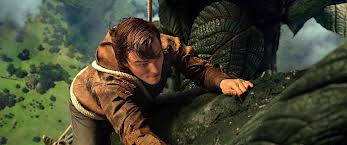
Anyway, Jack comes into possession of a pouch of magic beans that of course grow into a gigantic beanstalk that leads all the way up to the world of the Giants. At this time, Isabelle accidentally winds up stuck as the beanstalk grows, and so a rescue party, including guards Elmont (Ewan McGregor) and Crawe (Eddie Marsan), is sent to climb up after her. Jack accompanies them, along with Roderick (Stanley Tucci), Isabelle’s would-be groom who actually has something far more on his mind than rescuing his bride-to-be.

There are Giants up there, and they are quite big and vicious. And there are a lot of them, which makes rescuing Isabelle far more difficult. Things get even worse when Roderick gains a magical legendary crown that will gain him control over all the Giants. He overpowers the vicious two-headed Giant general Fallon (Bill Nighy) and his hundred followers, and hatches a plan to take over the human kingdom below. While that’s going on, Jack continues to find and free Isabelle, and even manages to slay a couple Giants in the process, hence the title.

While some parts of “Jack the Giant Slayer” are rather predictable, there are quite a few surprises here and there. Some of these surprises have to do with the Giants, who have more personality than you might expect from a film like this. Some, like General Fallon, are suitably threatening, while others are here to display comic relief. And there’s also Fallon’s second head, who is barely able to utter words, that is both creepy and kind of funny. (Their CGI is impressive, especially when you see the Giants in close-ups.) There are some funny moments in the movie as well—sight gags (including Giants’ pigs-in-blankets that are literally pigs, in blankets) and one-liners (“Fear of heights?” “Fear of FALLING!” “Well then don’t fall!”). And it’s also self-aware of its fantasy-adventure genre, cracking jokes at the story’s expense when the time calls for it. For example, when Isabelle at the beginning tells her father that she doesn’t want to marry Roderick, she immediately turns to Roderick, and tells him “Sorry.” How does Roderick respond? He shrugs. I laughed out loud at that moment.

The inevitable action-climax featuring man versus Giant is quite entertaining as well, and it’s hard to tell exactly how everything is going to turn out, since there can never be a fair fight between a giant…er, GIANT and a puny little man. There’s a lot of tense action and some pretty terrific special effects—it really does look like these armies of different sizes are there in the same shot.

Nicholas Hoult stars as Jack, and it’s further evidence that this young actor is a genuine star. With this and “Warm Bodies,” I expect bigger things to come for him in the future. He’s quite effective and likeable here, going through Jack’s expected character arc from commoner to hero. Eleanor Tomlinson is fun and fetching as the princess Isabelle. Stanley Tucci has a lot of fun hamming it up as the human-villain, while Bill Nighy is invaluable as always, even when playing a gigantic CGI monstrosity. Also, Ewan McGregor is fun as the dashing Elmont, who could be the hero but has his weak points that slow him down.

I enjoyed the film, but some parts were a little sloppy. For example, we never see Jack’s uncle again after the first half-hour, and the movie never tells us what he’s doing or where he’s gone. And also, why would Roderick want to rule Giants and crush his fellow mankind anyway? Wouldn’t destroying humanity make things kind of boring afterwards? Dude, you’re marrying a princess and thus commanding a kingdom!

And I also found myself questioning the Giants’ lifestyle at certain points. For example, it’s established that humans are a delicacy for Giants, so what do they usually eat on their land? And also, there doesn’t seem to be one female among them. How exactly…actually, never mind. I shouldn’t read much into this.

Thanks to sharp direction by Bryan Singer, a top-notch cast, and some pretty damn good-looking special effects, “Jack the Giant Slayer” is a terrific adventure. I’m glad I took it, despite my doubts before.

A Good Day to Die Hard (2013)

15 Feb

A-Good-Day-To-Die-Hard-Trailer-2013

Smith’s Verdict: **

Reviewed by Tanner Smith

1988’s “Die Hard” is considered one of the very best action films ever made, and their sequels have their shares of thrills as well. Though, it’s hardly a secret that the first film’s exhilaration has since diminished with each sequel…and unfortunately, its fifth installment, “A Good Day to Die Hard,” is enough evidence to show that the franchise is dying…hard.

“A Good Day to Die Hard” doesn’t even seem or feel like a “Die Hard” movie. It just seems all too generic—here’s a conflict no one should care about; here’s a few generic bad guys who love to shoot everything up; and here’s a load of explosions, and lots of ‘em! Add the wisecracking hero and an annoying sidekick, and…really? This is “Die Hard?” The other movies had more going for them than this—characterization, proper setups-and-payoffs, and memorable villains. Those elements are what made “Die Hard” and some of its following sequels fun to watch—they added to the excitement of the action sequences so we cared about what was happening on-screen.

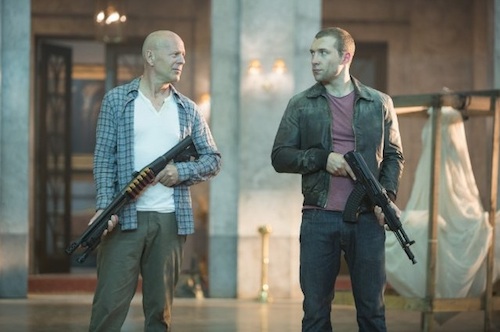
But at least we have Bruce Willis, again playing the hero cop Det. John McClane and again finding himself in one unusual predicament after another. And to be fair, he’s the best thing in this movie. Sure, he’s noticeably aged, but his wisecracking personality is still welcome. (He even says his “yippie-ki-yay” line, which I’m sure people missed in the previous “Die Hard” film.) However, there’s one question regarding his character—why is he suddenly so freaking invincible?! Remember when in the first movie, his feet were torn to shreds after having to escape barefoot on shards of broken glass? Now, whenever he crashes through plate-glass windows or survives car crashes, he only has a few scratches instead of ten or fifteen broken bones! Did John McClane just turn into the Terminator, as he got older?

But I digress. The action takes place in Moscow, Russia. John’s son Jack (Jai Courtney), a CIA agent, has been arrested for murder and is awaiting trial. John and Jack haven’t spoken to each other in years, but John wants to travel to Russia to…actually, I just realized I have no idea what his original plan was. Was he going to try and negotiate with the authorities? What can he say? He’s obviously out of his jurisdiction, to say the least. On top of that, he can barely speak a word of Russian. So what was he going to do originally? Plan a jailbreak? He’s clearly working alone!

I don’t know; and frankly, I don’t care. But it doesn’t matter anyway because as John gets to the courthouse, all hell breaks loose and Jack manages to escape Russian justice. Along with him is a political dissident, Komarov (Sebastian Koch), who has some sort of…”McGuffin,” I guess, that a band of terrorists are trying to get their hands on. John ends up in the mix, and thus we get to add awkward father/son bonding to standard, generic, shoot-em-up, action-movie elements. Oh. How. Exciting.

While the “Die Hard” movies have had some pretty effective villains (the one that particularly comes to mind is Alan Rickman’s Hans Gruber from the first movie), there is no real villain in this movie, strangely. There are just certain villainous characters who seem to one-up each other for complicated reasons, along with several henchmen. When the top villain is finally unmasked, however, it comes as no surprise (you’ll figure it out early on). Motivations are clumsily written, and so it’s hard to follow everything that’s being thrown at us. The action, as a result, comes across as (broken record) generic.

Bruce Willis is Bruce Willis, and he’s still likeable as always. But as his sidekick in the action, Jai Courtney is just a crushing bore. He’s whiny, annoying, and ultimately bland. Oh, and here’s the worst thing about him. He’s the central figure of this “Die Hard” movie—not John; he’s merely there for support. Yeah, because I’m sure we want to see this guy backed up by the iconic Bruce Willis character!

“A Good Day to Die Hard” at least has a few good-looking action sequences, and director John Moore is evidently a capable action director. But the main thing missing from this action film is the energy and creativity that the original film had. It just feels like a throwaway action flick that is subjected to our minds and then leaves very little impact. Maybe it’s time for this “Die Hard” franchise to…”die hard.”

Warm Bodies (2013)

14 Feb

warm-bodies-image08

Smith’s Verdict: ***1/2

Reviewed by Tanner Smith

Ever so often, we get one of those “zombie-movies” in which a strange infection devastates a population, and a small, diverse group of survivors defend themselves against a hostile race of staggering, man-eating walking-dead, and sometimes against each other. “Warm Bodies” is not that movie.

Yes, “Warm Bodies” is a zombie-movie, and the zombies are as predictable as you’d expect. They groan; they stagger; they crave human flesh; they lurch; and they get shot in the head by human survivors of…I don’t know, insert apocalyptic reasoning here. And the people include the usual gun-toting military who will shoot first and ask questions later (if at all), and of course, because they’ve never seen zombie movies, they use a special device to make sure that someone is or isn’t a zombie. Yeah, because it’s so hard to tell by appearance, isn’t it?

But wait! Didn’t I say “Warm Bodies” was not the typical zombie-movie? Yes I did. In fact, this is one of the more original zombie-movies to come around in a long time. It mixes elements of “Dawn of the Dead” with some of “Romeo and Juliet,” and it tells the story from the zombies’ point-of-view! It’s a refreshing move (among many in this movie), as if to say, “Forget the boring people who are trying to defend themselves! Let the zombies tell their story!” For the longest time, zombies have been simply known as walking allegories (who’s more human in the case of people-versus-zombies?) and have become more predictable as a result. Not here.

The main protagonist of “Warm Bodies” is “R” (Nicholas Hoult), a young zombie who narrates the story through thought. He knows he’s a zombie; he knows he has to eat human flesh; and he knows his many limitations. R slouches around the post-apocalyptic ruins of a city, and mostly hangs around an airport terminal and an airplane he has made his home. (And he doesn’t remember his first name, but he knows it starts with “R.”)

Those who have seen “The Princess Bride” will know that “there’s a difference between mostly-dead and all-dead.” Such is the case in “Warm Bodies,” in which the “all-dead,” the truly-dead zombies, have become so hungry for human flesh that they have even eaten their own, revealing skeletal bodies and becoming even more brutal monsters known as “bonies.” There’s no hope for them anymore. Is there hope for the, um, “mostly-dead?” This is where “Warm Bodies” develops its plot, as a young woman named Julie (Teresa Palmer), one of the human survivors, scouts the outskirts of the city with others for supplies, and to shoot up anything that staggers. Surely enough, some zombies find them and R eats the brains of Julie’s jackass boyfriend (Dave Franco). This somehow triggers some of the boyfriend’s memories, and also starts R’s own transformation to live again. His heart starts beating; he can form words; and he is smitten by the appearance of Julie, and he even protects her from the other zombies.

This begins a star-crossed romance, as R takes Julie to his home. Julie learns to trust R; R becomes more human as they spend more time together; they both have fun together; and they form a strong bond together.

Wait a minute—Romeo and Juliet? R and Julie? I just got it! (And yes, there is a balcony scene in this movie.)

Anyway, the idea is that love is the main thing that can bring the dead back to life. At least, that’s the case for the “mostly-dead,” and not the “truly-dead” bonies who have no purpose but to chase and kill.

There are a lot of refreshing pleasures to be found in “Warm Bodies,” thanks to some clever writing by Jonathan Levine (who also directed the film, and whose previous film was “50/50”). For example, R’s narration is full of deadpan-satiric references to other zombie-movie elements; some nice inside-jokes (though with some more obvious than others); and such.

Now I’m going to tell a little story:

I was not so anxious to see this movie. Seeing the trailer, I could see where the originality was coming from with the plot elements of this zombie-human love story (though, admittedly, I kept flashing back to “Twilight”), but I thought I could tell where the movie was going to go. I went anyway, because of a few friends who were saying how much they loved this movie. But I was constantly on guard. I was expecting to predict what was going to happen with each plot development. And because I liked the beginning of the movie so much, as R narrates his life (very clever writing involved here), I whispered a silent prayer that this would not go the way I expected. As it turned out, whatever I thought was going to happen either did happen in a more delicately-handled way, or not at all! For example, when we meet Julie’s cocky boyfriend, I immediately thought he was going to be the boring, jealous villain at whom everything in the obligatory action-climax could be pointed to. And what happens? He’s disposed of quickly!

Then, R takes Julie back home after he first meets her. I asked why Julie didn’t just run, since these zombies are somewhat slow—as it turned out, these zombies are kind of fast when they need to be.

And of course, I kept saying to myself that there would be a “liar-revealed” type of cliché in which Julie would find out that R has eaten her ex-boyfriend’s brains and then suddenly not trust him, and leave him, and there’d be a long, long stretch of time before R has to find some way to make her forgive him so they can be together in the end…Granted, that is a very grim situation and I wouldn’t expect Julie to shrug it off, but then again, the longer they hold out this secret, the more it becomes annoying when you think about it. So how does this secret become revealed to her, and how does she respond to it? All I can say is, it was treated in such a plausible way that I just let it be…

But then of course, there’s the obligatory military force who will shoot any corpse that comes their way, and ask no questions. Yeah, yeah, yeah—the leader of the force is Julie’s father (John Malkovich); he’s a hardass; he won’t listen to reason; he’ll never understand R and Julie’s love; blah blah blah, I kept waiting for this one. It’s the “prejudice” element that comes about in every one of these movies. But even this plot element is well-handled! And so is the climax in which the military doesn’t know which to shoot—the zombies or the bonies who seem to be fighting each other?

I wouldn’t want to give away too much, but you get my point. “Warm Bodies” ultimately won me over by how smart its writing was. Whichever direction I expected it to take, it either didn’t take or did take it, but with nice touches. I actually wanted to yell in the theater.

Nicholas Hoult and Teresa Palmer, as the two leads, are both winning and appealing in “Warm Bodies.” Hoult gives probably the best “earnest performance” that an undead character could be given. Palmer gives her character Julie good doses of sweetness and spunkiness—even if she does a few dumb things, you forgive her because of that. Both actors exhibit convincing chemistry on-screen, and they manage not to make a romance between a beautiful girl and a walking corpse less icky than you might imagine.

Of the supporting cast, there are two actors who deserve mention. One is Rob Corddry, who does a great job as R’s friend M who has his own transformation as well; and the other is Analeigh Tipton, who is very funny as Julie’s friend who awkwardly accepts the fact that Julie is with a zombie. John Malkovich is…well, let’s face it, he’s John Malkovich.

I can’t think of any recent zombie movie with this much heart added to it. “Warm Bodies” is sweet, original, nicely-directed, and over in just an hour-and-a-half. And even though some of it is silly (and the herky-jerky effects of the bonies don’t help much either), the movie has the nerve to be upbeat and optimistic with its subject matter, as well as tell the familiar story from a different viewpoint. It’s a terrific film; my favorite film of 2013 so far.