Archive | 2012 RSS feed for this section

The Avengers (2012)

21 Feb

The-Avengers-2012-Movie-Image

Smith’s Verdict: ***1/2

Reviewed by Tanner Smith

Hey, guys! Wanna see Iron Man, Thor, Captain America, and the Incredible Hulk banding together, in a summer blockbuster, to fight evil?

I do too! And this movie has been built up for about four years, since the original “Iron Man” was released to success in May 2008. It began simply with a credit cookie featuring the one-eyed Nick Fury (Samuel L. Jackson) telling billionaire/genius/hero Tony “Iron Man” Stark (Robert Downey, Jr.) that he plans to start the Avengers. And a month later, “The Incredible Hulk” was released, with a scene at the end that featured Tony Stark mentioning the Avengers. 2010’s “Iron Man 2” had a little more input to the idea (for those who don’t know the Avengers’ history in comic books), as 2011’s “Thor” and “Captain America” introduced two new candidates, as well as setting up certain plot elements for…2012’s “The Avengers!” And the verdict is that this inevitable summer-blockbuster lives up to its hype.

I’m not a comic book reader, per se, but I was still intrigued when hearing the basic storyline for “The Avengers”—Iron Man, Hulk, Thor, and Captain America band together. Having seen and liked all of these characters’ earlier movies (particularly the first “Iron Man”), I was hyped. There’s no way I wouldn’t be interested in seeing this movie.

Well, first, we get a introduction featuring the story’s McGuffin (a story’s catalyst)—a device that opens a tesseract (a portal through other dimensions)—and the arrival of our main villain, which turns out to be Thor’s adopted brother Loki (reprised from the earlier movie by Tom Hiddleston), who plans to use the tesseract to unleash an army of monstrous beings from his own world in order to conquer the Earth. This leads to Nick Fury (Samuel L. Jackson, of course) planning to assemble a team of superheroes in a race to stop him from carrying out his plan. Now, while I have to admit this introduction is somewhat tedious in the way it plays out (with certain “techno-babble,” exposition, and…well, the very idea of another villain planning to take over the world—of course), it is necessary to set up the rest of the movie.

We’re met again with those intriguing Marvel characters introduced in earlier film adaptations of their comic books. We have the rich, bright, and constantly wisecracking billionaire/hero Tony Stark (Robert Downey, Jr.) a.k.a. Iron Man, complete with flying iron suit. We have weakling-turned-superman Steve Rogers (Chris Evans) a.k.a. Captain America, who has a costume that is essentially a bulls-eye, but a shield that deflects bullets—now that’s cool. We have Norse god Thor (Chris Hemsworth) with his mighty hammer. And of course, we have Natasha (Scarlett Johansson), a feisty femme fatale introduced in “Iron Man 2” and also known as Black Widow, as she is told by S.H.I.E.L.D. Agent Coulson (Clark Gregg, reprising his character from earlier movies) to enlist the help of Bruce Banner (Mark Ruffalo, taking over for Edward Norton)—for those who don’t know, let’s just say Bruce Banner has a condition that comes with some serious anger issues.

As these heroes are teamed up together and planning out their next move, they also have to face each other. There’s a struggle between Iron Man and Thor when they first meet, Stark and Rogers banter a lot, and mostly, they don’t seem to want to rely on each other as much. But they realize that they’re all in this together and they’ll stand and fight Loki’s invading army on the battlegrounds of Manhattan, turning it into a disaster of epic proportions.

I’m just going to come out and say it—I wasn’t looking forward to seeing Loki as a villain in this movie. In “Thor,” I didn’t find him charismatic nor did I find him particularly interesting, and here, that feeling’s kind of the same. But there were a few scenes where I found myself laughing at his expense, rather than being menaced by his continuing plan. There’s a scene in which he gathers people in the city and orders them to “kneel” before him and I had to bite my lip to keep from laughing so hard because all I was thinking was, “He’s turned into General Zod!” Yeah, remember how “menacing” that villain was in “Superman II?” That’s Loki for “The Avengers” for you. And there’s another scene that got the biggest applause in the screening I attended—it involves a showdown between delusional-with-superiority Loki and damn-angry Hulk, and gives new meaning to the phrase “punch line.”

And speaking of which, “The Avengers” does indeed have a sense of humor. In fact, this movie maybe has the funniest moments I’ve heard in a movie so far this year. It’s self-aware, but that doesn’t mean it condescends to its iconic characters or its target audience. I wouldn’t dream of giving away the film’s best moments, so I won’t. Sure, there is a lot of humor in “The Avengers,” and that keeps “The Avengers” from getting too serious—that’s not a criticism, mind you, because it’s a masterstroke when it doesn’t descend itself into campiness.

There’s great action in this movie—it’s involving, features top-notch special effects, and showcases some pretty nifty fight sequences. Two sequences in particular stand out—one is an attack from Loki’s minions on S.H.I.E.L.D.’s flying, camouflaged ship, and the other is the battle in the streets (and rooftops and skies) of Manhattan, which takes the final half-hour of the movie. That final sequence is jaw-droppingly intense, and we’re involved because we like these characters and we admire the stages of action and special effects. But what’s also important is that each character has moments to shine in the midst of the action.

All the actors are game and their characters are still strong. Tony Stark, again played perfectly by Robert Downey, Jr., keeps his unique personality—constantly cracking one-liners even in the face of danger. (In a talk-down between Stark and Loki, it’s obviously who the cooler person is, even if you could take Loki seriously.) He’s great in this movie. Rogers, or Captain America, is a likable guy and is reasonably strong, though that costume still looks somewhat ridiculous. Thor is as awesome as ever, with his barbarian manner that contrasts heart of gold. Natasha, or Black Widow, is still sexy and shows some feisty moves. We’re also introduced to a new recruit midway through the movie, a sharp-shooter nicknamed Hawkeye (played well by Jeremy Renner), whose bow has laser scope for his arrows to never miss—awesome. As for Bruce Banner, with Mark Ruffalo’s vulnerable performance and upgraded CGI “Hulk” form, this is the best representation of the Incredible Hulk I’ve seen.

And like I said, it’s absolutely great that these heroes are all here, like the toughest kids on the block who learn to work well with others. It’s also great that Samuel L. Jackson’s Nick Fury has something better to do than spew ominous foresights (as he did in the earlier movies, to annoying effect).  

“The Avengers” has been built up for four years—it was worth the wait. It’s exciting, entertaining, and a lot of fun.


The Secret World of Arrietty (2012)

13 Feb

The-Secret-World-of-Arrietty-image-6

Smith’s Verdict: ****

Reviewed by Tanner Smith

Ever since I was a child, I was a fan of the stories involving the Borrowers—the little people who live in the walls or under the floors of your house. There was a series of books written by Mary Norton that made them popular, as well as a few film adaptations—including two 3-hour British TV specials and an entertaining 1998 update on the story. And I just love the idea of this secret world that would be In jeopardy if it was found out by human beings (or as the Borrowers call them, “beans”), so when I heard that Studio Ghibli was making a new adaptation (yes, with the great Hayao Miyazaki one of the people behind the production), I was hyped. The child in me was curious and the critic in me was interested in how this new version would turn out. I can now say that this film—entitled “The Secret World of Arrietty”—is the best representation of the Borrowers that I’ve ever seen.

Miyazaki’s company Studio Ghibli has delivered some of the best-looking animated features anybody has ever seen. The visuals stand out as mesmerizing and serve the stories well—see “Princess Mononoke,” for example. There’s such a distinct look and feel to the animation in each of these films and each detail is given special attention. I’ve said the same thing about PIXAR’s computer animation, but that doesn’t make this any less of a compliment, except that the animation is hand-drawn (with occasionally computer help) and thus more complicated than you might think.

One great example of this look in “The Secret World of Arrietty” is the scene in which the three-inch adult Borrower named Pod (voiced by Will Arnett for the US dubbing) takes his 14-year-old daughter Arrietty (Bridgit Mendler) on her first trip into the house they live under. Their first stop is the kitchen—with the kitchen being so huge from their point of view, it makes for a threatening environment. Another example is the outside yard of the house, where Arrietty spends a lot of her time. Look at the leaves and the plants next to her as she walks/runs. It looks like another world when it’s really our own.

The story of “The Secret World of Arrietty” is mostly the same as the first “Borrowers” book and has the same basic idea. There is a family of three Borrowers secretly living within a house in the middle of the forest—Pod, his wife Homily (Amy Poehler), and their daughter Arrietty. They have their own home underneath the floorboards and when the “beans” aren’t around, they sneak into the house to “borrow” the essential needs of survival—mind you, it’s never borrowing; it’s stealing, but it wouldn’t make them look good if they were known as the Thieves, right? This family is seemingly the only family of Borrowers in the house. In the old days, there used to be more families until they were discovered by beans and had to move away (it’s also hinted at that others were squashed by the beans). Life is a danger for Borrowers and there’s always a high risk, which is why they have to be extra-careful not to be discovered while they go on their occasional “borrowings.”

The characterizations are direct. Arrietty, just turning 14 years old, is tenacious and courageous. She uses her size as an adventure and delights in discovering more about the world outside her own. Her father Pod, kind of a three-inch Indiana Jones type, is more surly with age. He has had too much adventure in his life and is probably getting too old to borrow. But that doesn’t stop him from smiling when Arrietty fights off a bug (to her, it’s about the size of a canine)—“That’s my girl,” he declares to himself. Homily, however, is a nervous wreck, all the time—always worrying, screaming, shrieking, trembling, nervously rambling on and on, etc.

On Arrietty’s first borrowing in which she “borrows” a sugar cube, she is seen by a sickly human boy named Shawn (David Henrie) and drops the cube. But Shawn doesn’t pose as a threat and kindly leaves the sugar cube next to where he thinks these little people live, with a note saying, “You forgot something.” This increases Arrietty’s curiosity of the outside world and starts to wonder if not all beans are dangerous. But Pod makes it very clear that once Borrowers are seen, they must move away to make sure it doesn’t happen again and that their world is never discovered. Despite this, Arrietty and Shawn do meet each other and form a friendship. However, once the housekeeper Hara (Carol Burnett) notices strange things happening around the house lately, that’s when the Borrowers’ secret does indeed turn to jeopardy.

The elements that made the Borrowers special are present here—the Borrowers sneaking around avoiding being caught, the interaction and friendship between a Borrower and a bean, and the world that the Borrowers created. There’s a lot of tension in the scenes where they go outside, hoping they aren’t seen by beans. There’s a great, tense scene in the middle in which a crow attacks little Arrietty and Shawn must rescue her. And of course, there’s the cat that sometimes chases her around (you can tell Arrietty is faster and used to it—the cat just misses her and she smiles and waves while taunting, “Nice try”). There are a lot of things that are updated from the original story. For one thing, we see more detail in how these Borrowers move around, instead of just climbing or rappelling down a rope tied to a fishhook. Early on, for example, we see that in order to climb something like a cabinet, they use double-sided tape on their hands and feet to scale it. That’s a very clever bit. There’s also a neat invention with sewing thread and a weight that works as an elevator. The biggest difference from the original book to this film is that there is no climax involving the exterminators threatening to destroy the Borrowers’ home, but I didn’t miss it. What they went with, with Hara capturing Homily and Arrietty and Shawn having to find a way to rescue her, is good enough. I was actually glad that they didn’t have to succumb to a basic action climax, and very surprised too, considering that studios love to end family films in that way. But instead, we have a thoughtful climax and a moving ending that opens more for curiosity. Also, the complex issues present in the book like friendship, bravery, and settling are all present and very effective.

The growing friendship between Arrietty and Shawn is well-handled. It takes a while for Arrietty to finally trust Shawn and go visit him, adding more to the discovery of the outside world and the new curiosity that she has surrounded herself with. When it gets there, though, it’s very touching and she even gives this boy who’s twelve times her size helpful advice about being brave when he reveals that he needs an operation for his heart.

Each character is memorable. In particular, Arrietty is a fun character, Pod is an interesting figure, and there’s another Borrower that they meet later in the movie—a wild-boy Borrower named Spiller (Moises Arias) who tells the family of more Borrowers out in the forest. The voiceover work is nicely done. Bridgit Mendler, of Disney Channel’s “Good Luck Charlie,” brings a fresh friendliness to the role of Arrietty. Will Arnett is suitably rogue as Pod. David Henrie is just OK as the boy—sometimes a line of dialogue rings false, but his speech about the character’s illness is actually heartbreaking. Amy Poehler, voicing Homily, is an absolute hoot—she’s very funny in the way she quickly delivers the nervousness in the scenes in which she’s panicking for her family and especially when she is seen and trapped by the housekeeper. Speaking of which, Carol Burnett as the housekeeper Hara is a lot of fun as well. The way she’s drawn is funny enough (looking more like E.T.’s grandmother), but with Carol Burnett adding several “Hmm’s” to each confused facial expression, it’s downright hilarious.

“The Secret World of Arrietty” is a wonderful movie for people of all ages. It’s obviously marketed at children, but adults will most likely enjoy it as well. Even if some children won’t appreciate the complexity of many of the moments in this movie, they at least deserve to choose whether or not they’ll accept them, especially considering the fast-moving, action-packed movies that they watch. Should they decide to watch something a little quieter, “The Secret World of Arrietty” is the movie for them.

The Hunger Games (2012)

13 Feb

images

Smith’s Verdict: ***1/2

Reviewed by Tanner Smith

So imagine this—sometime in the distant future, the nation of Panem has grown from the remains of what used to be North America. A new world order has been arranged, as Panem is divided into 12 districts surrounding the powerful central Capitol. After a failed rebellion with a 13th district, there was a peace settlement that comes with a raffle (known as a “Reaping”) that forces the other districts to participate in the death match known as the “Hunger Games.” Every year, two “tributes” are chosen from each district. The tributes are a young man and young woman in the age range of 12 to 18 who compete against the other tributes (and each other) in a gladiatorial battle for the biggest televised event in the nation. The only way to win is to survive.

That’s the main plot element to “The Hunger Games,” a post-apocalyptic action-thriller based on the popular novel of the same name by Suzanne Collins.

The “Hunger Games” book series is probably the most popular book series out nowadays. The teens are drawn in and adults take notice as well. So it should come as no surprise that when a film adaptation of the first book is announced, a huge amount of hype is garnered. But does the movie lead up to its hype?

The answer is yes. “The Hunger Games” is an intense, entertaining action-thriller that remains faithful to its source material. Fans will be happy, and I think those who aren’t familiar with the books are going to be drawn in as well.

The heroine of the story is 16-year-old Katniss Everdeen (Jennifer Lawrence) from District 12. She’s a strong young woman who cares for her mother and younger sister Prim (Willow Shields). She also has experience in hunting and is a darn good shot with a bow and arrow, as she illegally hunts for food outside the boundaries with her best friend Gale (Liam Hemsworth).

The 75th annual Hunger Games are approaching and the Reaping begins as the movie does. But the female tribute turns out to be Prim, and so Katniss volunteers to take her place in order to save her. The male tribute is Peeta Mellark (Josh Hutcherson), a baker’s son who is very strong, but also gentle. Katniss and Peeta are escorted to the Capitol and advised by impressionist Effie Trinket (Elizabeth Banks, sporting a ridiculous amount of makeup), former champion (now bitter drunk) Haymitch (Woody Harrelson), and stylist Cinna (Lenny Kravitz) to prepare for the Games.

The 24 tributes train in preparation, are evaluated for odds by viewers of the televised show, and are interviewed by the blue-haired on-air commentator (Stanley Tucci) to win support from the public before the big event. Katniss gains the most odds with her showmanship and confidence, but for Peeta to enhance his own image, he announces in his TV interview that he has had a crush on Katniss, letting the “star-crossed lover” angle win both of them admiration from the public. However, as it turns out, Peeta was honest in his statement and Katniss does develop a genuine interest in him. But this comes as a problem, since he must die in order for her to win.

The movie has a running time of two hours and twenty-four minutes. It takes an hour and ten minutes, more or less, to set up the Hunger Games and introduce the characters. Once the actual Games, set inside a giant outdoor arena, are underway, you realize how much is at stake by this point. I admire that the movie takes its time to set up the action before it happens and the entire second half is intense, brutal, and thrilling. It involves Katniss relying on her wits and her skills to survive her competitive, bloodthirsty peers, including the fearsome Cato (Alexander Ludwig) and the knife-throwing Clove (Isabelle Fuhrman).

I should add that despite the ages of these young people competing in the Hunger Games, there is a lot of violence and plenty of gore, pushing the boundaries of the PG-13 rating. The way it starts is particularly cruel, as a bloodbath ensues before some of the tributes have a chance to get their supplies. This is not a film for young children.

This is a shocking development for entertainment—young people killing each other as hidden cameras are placed in the trees to show it—and it seems like the people watching really get a kick out of the violent nature of it. And the fact that these 24 competitors are in the age range of 12 to 18 is scary enough to think about. But the fact that this new world order is forcing them all to accept it for their own good makes it all the more effective. And the villains of the movie—the gamemaker Seneca Crane (Wes Bentley) and snarling President Snow (Donald Sutherland)—are ruthless enough to show exactly where these people stand. They even force obstacles upon Katniss and Peeta to make sure nothing comes easy, even setting their part of the forest ablaze. This movie is a great mix of action-violence and social commentary. Is this what mankind could succumb to when things go very wrong for us?

The original novel of “The Hunger Games” is mainly popular because of its protagonist Katniss Everdeen, and for good reason—she’s an interesting, compelling heroine to follow. She fends for herself, but also cares for those who need (and deserve) her help. She knows how to hunt and survive, but isn’t a bloodthirsty monster. In the movie, she’s brought to life by who is probably my favorite young actress working today—Jennifer Lawrence. Lawrence is absolutely perfect for the role and delivers an excellent performance, giving the right blend of strength and vulnerability for the character. She’s in almost every shot of this two-and-a-half-hour movie—she’s captivating to watch throughout. And I’m going to just say it—even though I respect the other actresses who auditioned for Katniss (including Shailene Woodley and Saoirse Ronan), I couldn’t imagine anyone else other than Jennifer Lawrence to portray the role. Or maybe she’s just that good.

The supporting cast does a nice job—I especially liked Woody Harrelson and Lenny Kravitz in their roles, and the constantly working yet mostly-underrated young actor Josh Hutcherson (in his fifth book-to-film-adaptation, I believe) is solid and likable as Peeta.

“The Hunger Games” was directed and co-written by an unlikely source—Gary Ross, the co-creator of pleasant comedy-dramas like “Big” and “Pleasantville.” As much as I respect Ross, I wouldn’t have expected him to handle the violence of the actual Hunger Games event so effectively. But the truth of the matter is that he’s fully capable of keeping us involved. I have to admit I thought he was relying too much on the “shaky cam” gimmick in the first half of the movie, but as with the “Bourne” movies, once the action kicks in, it adds to the intensity and brutality of the action scenes. Even before the action, there are plenty of quiet moments to be invested in—in particular, the scenes with Katniss saying goodbye to her family and Gale, and Peeta’s talk with Katniss about how he’s not just a pawn in the Games. Credit for keeping the audience involved should also go to the actors, but also to the other two writers of the screenplay—Billy Ray, writer of “Shattered Glass,” and Suzanne Collins, the author of the original source material this movie is based upon.

Having read the book, I was less concerned about story changes (of which there are little to none) and more concerned about how the violence of the Hunger Games would be handled. But the truth is that “The Hunger Games” is very well-done—the Games are gripping, the action is intense, the parable aspect is clear (subtly, but still there), and we have a compelling character played by a fully capable actress.

I look forward to the film adaptations of the other two books in the series, although this movie works well as a stand-alone movie.

The Perks of Being a Wallflower (2012)

12 Feb

the-perk-of-being-wallflower101

Smith’s Verdict: ****

Reviewed by Tanner Smith

People will say that they hated high school. I think they’re only thinking of the bad occurrences (lost opportunities, broken hearts, feeling left out of the crowd, etc.), rather than the warm, nostalgic, refreshing moments that changed their lives forever (friendships, accomplishments, even quirkiness in classrooms). High school may have had its negative moments, but its positive points were always present. It can be weird and crazy, but also warm and funny. That statement alone can be used to describe “The Perks of Being a Wallflower.”

“The Perks of Being a Wallflower” is a true delight and it understands what it was like to be an outsider during high school. People looking back will notice that they all went through the motions of high school—awkwardness, loneliness, confusion, and the unexpected camaraderie that came with—and then they’ll realize that they all felt like outsiders, even the popular crowd. “The Perks of Being a Wallflower” doesn’t present these elements as a bad thing. It’s a moving coming-of-age story about such a high school kid who begins his freshman year miserably, but finishes it by embracing who he really is.

Based on a popular young adult novel, the film takes place in the early 1990s as a teenager named Charlie (Logan Lerman) begins his first year of high school. Charlie is a shy, quiet kid who has trouble making friends, and his old friends are too busy with their new crowd to pay attention to him. (And he also has a troubled past, which is revealed later.) The only connection he makes so far is with his English teacher (Paul Rudd).

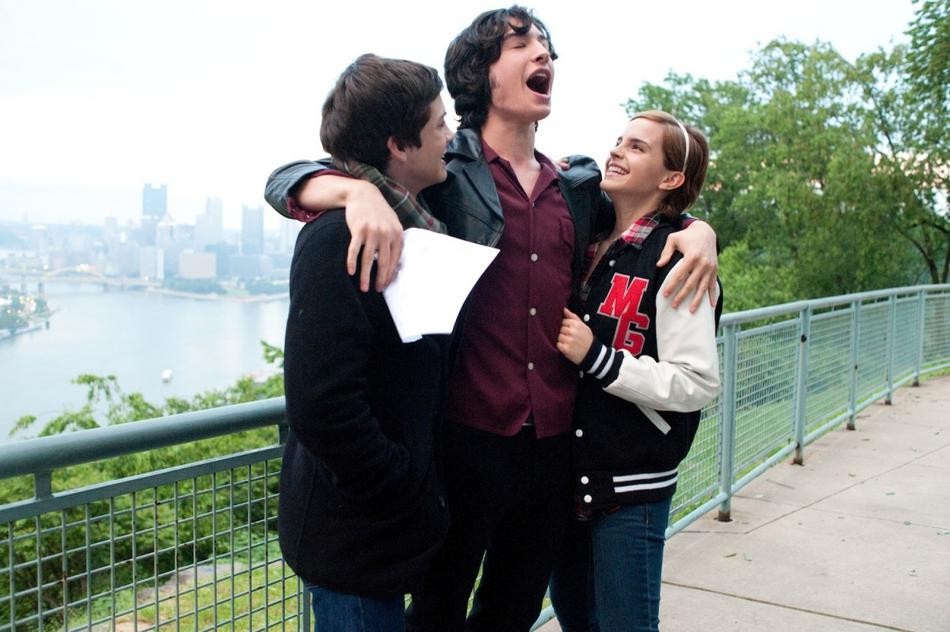
Soon enough, Charlie meets two seniors—Sam (Emma Watson) and her stepbrother Patrick (Ezra Miller), who aren’t conformists in the slightest and revel in knowing so. When they learn that Charlie doesn’t have any friends, they welcome him into their crowd. They enjoy each other’s company.

For Charlie, this is a way of stepping out of his dork-status and his despair. It’s a despair that runs deeper than one might expect that comes with clues such as his constant writings to a certain “friend” about certain updates, and his late aunt (Melanie Lynskey) who had a certain bond with the boy, and possibly something a little more suspicious (things are left vaguely). His parents (Kate Walsh and Dylan McDermott) are in their own world, and his usually reliable older sister (Nina Dobrev) is in a somewhat odd relationship with an idiot named Ponytail Derek (Nicholas Braun). Bottom line is, this is a kid who needs friends in his life. Who better to be his friends than Sam, friendly and appealing, and Patrick, witty and high-spirited (and openly gay).

Charlie isn’t the only one with problems, of course. Patrick and the football jock Brad (Johnny Simmons) are seeing each other secretly, as Brad isn’t ready to come out of the closet yet. But the tension is getting to be too much for him. And Sam is trying to live down a reputation, which began during her freshman year. She regrets the past, and dates someone else—a nice college guy named Craig (Reece Thompson). Charlie develops a quick crush on Sam, but still supports their friendship. But Sam, not knowing that Charlie is hopelessly in love with her, keeps finding ways for Charlie to like her even more, which makes things very difficult. Life may be sweet, but also very complicated, and it gets even more so when Charlie finds himself in a weird relationship with punk-Buddhist Mary Elizabeth (Mae Whitman).

If any of this sounds familiar, it should. We’ve not only seen this in many high-school coming-of-age movies, but I think most of us have known what this felt like when we were in high school. We can’t deny it—we have all felt the confusion, the awkwardness, the loneliness, and the unusual developed friendships that come with high school. And this movie knows what high school felt like. What surprised me is how this film separated itself from the “mainstream” aspects by really tapping into its subject matter, as well as developing into a rather dark final act (which I will not give away). The screenplay by Stephen Chbosky (based upon his own novel!) is warmer than I expected it to be. It’s insightful, sincere, and very effective.

What also makes “The Perks of Being a Wallflower” special are the performances. Logan Lerman is likable and effective as Charlie. Emma Watson, in her first attempt to distance herself from the Hermione Granger image that made her noticeable in the first place, does great work as Sam. She has more of a display of range and ability than the “Harry Potter” movies ever permitted her to show. (Both Watson and Lerman share convincing chemistry together.) But the real surprise was Ezra Miller as Patrick. Miller plays the exact opposite of his psychopathic-teenager role in last year’s “We Need to Talk About Kevin,” and he delivers a performance equally strong. Miller is enthusiastic, energetic, likable, credible, and engaging.

If you feel alone, then remember that good things can happen in ways you don’t expect them to. That’s the overall moral, you could say, for “The Perks of Being a Wallflower.” With a smart script, good acting, and an overall feel for what it’s like to be a high school outcast, this movie is observant, fun, amusing, sweet, sad, nostalgic, and very effective.

Chronicle (2012)

10 Feb

Dane-DeHaan-in-Chronicle-2012-Movie-Image1

Smith’s Verdict: ***1/2

Reviewed by Tanner Smith

“Chronicle” mixes a superhero origin story with a teenage coming-of-age drama and presents it in a first-person perspective. If that doesn’t sound like an ambitious project, I don’t know what does. “Chronicle” is a well-made movie, and it was thoroughly entertaining. Just when I thought I was getting tired of the first-person perspective (I’ve seen it in “Blair Witch Project,” “Cloverfield,” “District 9,” every episode of “The Office,” and don’t get me started on the “Paranormal Activity” series), “Chronicle” sneaked up on me. I say this because I avoided the trailers and TV spots for this movie and knew hardly anything of the plot, except that it was played as if it was actually documented and there was a poster that looked like a kid was giving a thundercloud the middle finger. I wasn’t anxious to see this movie, but I did the immature thing and gave in to peer pressure. What I saw was a film that has a lot more on its mind than you might expect.

The film’s story is seen through a video camera, though not just the main character’s camera. Sometimes, we see through a v-logger’s camera, and other times, we see through surveillance cameras or any camera that comes into the scene. The film stars a high school senior named Andrew (Dane DeHaan), who is shy, awkward, and standoffish. Girls ignore him, jerks pick on him, and he only has one friend—his popular cousin Matt (Alex Russell). Also, his mother is dying and he’s the constant punching bag of an abusive father who drinks a lot. Andrew has bought a video camera and documents his home life and his high school, though really that makes him even more awkward.

Matt brings Andrew to a rave party, where they and another kid—Steve (Michael B. Jordan), the big man on campus running for class president—stumble across a hole in the ground nearby. It’s circular, seems to tunnel underground, and gets deeper and deeper as the three boys explore.

Now, would you step into something like that? I didn’t think so.

But they do, and Andrew brings along his camera. They come across a strange object, which, because it glows, may give the possibility that it’s alien. The boys are exposed to a kind of force that destroys Andrew’s camera. But luckily, Andrew buys a new camera and we see that a few days have gone by and the boys suddenly possess powers of the mind. They throw baseballs at each other’s chests so they can stop them in mid-air before they get hit. They build a tower out of their Legos without touching them. They start a leaf blower to lift up cheerleaders’ skirts. They play pranks in a department store (like bringing a teddy bear to life in front of a little girl). They can even move themselves up in the air!

They have a lot of fun with their new talents and behave like teenagers while fiddling with them because…they are teenagers. But these kids have no adult mentors (as most superhero stories do) to tell them how to use their powers responsibly. However, Matt decides to lay down some rules after Andrew’s irresponsibility nearly kills someone. This is the start of the dark, disturbing plot thread that follows Andrew’s tortured personal life to something really dangerous. Later in the movie, after being humiliated at a party, he addresses to the camera that he’s evolved into something better than he was and the way he feels about hurting a person leaves him with the same lack of remorse after killing a bug. He thinks of it as natural selection.

The first half of “Chronicle” is the most fun part of the movie. It has fun with these kids experimenting with these new powers and gaining more from them, such as when they realize they can soar through the air together. There are a lot of laughs, particularly with the one-liners the kids spew and the constant mishaps that occur when first testing their powers. My favorite scene is when Andrew and Steve perform at a talent show, showing off their powers, pretending to perform magic tricks, and wowing everyone in the process. But then the movie develops into something more deep and dark that comes mainly from Andrew’s slowly but surely loss of innocence. One tragedy leads to certain danger and that leads to a total mental breakdown. With someone of his abilities, that can’t be good.

“Chronicle” may be inconsistent that way—different second half in contrast to the second—but the second half is admittedly very strong. It shows Andrew’s problems in a convincing way and when you think about it, there are moments in the first half that do lead to what Andrew could be capable of. I remember Andrew always learning his powers faster than Matt and Steve can because he focuses the hardest, and when he records himself with his camera (while moving the camera in the air and letting it hover in his bedroom), he ponders. Now we’re aware what he was thinking about doing all along. We see some of his home life when he’s not fooling around with his friends, and it is enough to show the pain he goes through, what with his ailing mother and his jerk of a father.

Give credit to the director—newcomer Josh Trank—and the writer—also-newcomer Matt Landis, John Landis’s son—for making these kids seem like actual teenagers and behaving like they would behave if they were suddenly telekinetic. I believed these young actors were living their characters and I felt their excitement. But I suppose that could also be because of the first-person perspective, seeing things through the video camera’s point of view. And to keep things from being repetitive, “Chronicle” beat the problem by showing things through the view of other cameras, particularly the camera belonging to a cute blogger named Casey (Ashley Hinshaw), whom Matt has a bit of a crush on. This works especially well in a conversation scene—we first see through Casey’s camera to see Matt talking (while he has Andrew’s camera), then through the other camera to see Casey as she talks. And using other cameras for perspective works especially well in the film’s explosive climax in which Andrew completely loses his sanity and lets out all of his rage onto public property and unlucky people.

So, from goofing around comes deep trouble. But isn’t that what would happen if a troubled teenager really did gain mind powers and decide not to use them responsibly? Not that it could happen, but what if? That’s why the first-person perspective tells this story—to give a great kind of “what-if” tale. What have I left out of this review? Only the effects. The special effects used to make objects float and make the kids fly are downright first-rate. They look extremely convincing and make the production values even more impressive. To wrap this up, even if “Chronicle” switches gears, it has a lot of fun before doing so.

The Impossible (2012)

7 Feb

the-impossible_2012-4-1200x800

Smith’s Verdict: ****

Reviewed by Tanner Smith

Knowing what “The Impossible” was about, a feeling of nervousness overwhelmed me and yet a feeling of fascination followed it. The fascination came from the notion that this movie would set up many things that would pay off later after a harrowing journey. The first few minutes feature the central characters—a family of five—enjoying their vacation time at a resort beach in Thailand. They’re solidly developed and feel like a real loving family. But then when there’s a shot of the family looking at the peaceful-looking beach at sunset, a feeling of horror took hold of me because I knew that this was to be a huge amount of irony for what will happen very soon. And surely enough, the next day, they’re enjoying the day after Christmas; the kids are playing in the pool with their father; the mother is reading a book on a beach chair. And then there’s an ominous wind…

Describing it like that would make “The Impossible” seem like a clichéd disaster movie, but there’s something about the way director Juan Antonio Bayona sees these scenes that make them convincing and unnerving. The audience is seeing this movie because of what is going to happen to them and for them, and thus seeing these opening scenes play themselves out as peacefully as possible works in the film’s advantage as an element of suspense.

“The Impossible” tells the story of this family as they endure one of the worst natural disasters in the world—the 2004 tsunami that devastated the Pacific Basin. You would think after Clint Eastwood’s 2010 film “Hereafter,” there couldn’t be another film to portray the outcome of its survivors. Well, “Hereafter” relied on a character’s psychic connection as a need for redemption in that case. Here, it’s pure hope—hope that all your close friends and family members are still alive after a disaster that claimed the lives of millions. That’s the case here, with this central family in “The Impossible.” They’re based on a real family—though their nationality has been changed from Spanish to British for international appeal. This is the story of how they were separated from each other and struggled to survive in the catastrophe’s aftermath to be reunited.

But first, a word about the tsunami sequence. My mouth was open the entire time at how phenomenally brilliant the special effects were, and how masterful the scene was executed. I could barely breathe—you read that right; I could barely breathe. I felt like I was there with the characters just struggling to stay afloat as the water rushed through the village. This was a brilliantly-executed sequence—one of the most terrifying disaster scenes I’ve ever experienced in a movie theater.

Maria Bennett (Naomi Watts) and her oldest son, 12-year-old Lucas (Tom Holland), are separated from Henry Bennett (Ewan McGregor) and the two younger sons, Simon and Thomas (Oaklee Pendergast and Samuel Joslin), as they struggle through the aftermath (floodwaters and mud) to seek help.

A good portion of the movie is seen through the eyes of young Lucas, who has to learn to grow up fast. His mother is badly injured with punctures to her right leg and chest, and so he must help her to keep going. But he also feels the worst for his father and two little brothers, so his mother has to keep hope alive for him. Lucas and Maria do find refuge at a hospital, where many of the tsunami survivors are being treated. It’s then that Lucas is asked to seek patients’ family members who may be around the hospital somewhere. And it’s here that hope comes for Lucas—if they’re alive, then maybe his father and brothers are too. This makes “The Impossible” an effective coming-of-age tale as well as an effective disaster movie.

Extreme devastation; a paradise turned into a wasteland; many people dead; separation from loved ones; not knowing who’s dead or alive. All of these elements are ongoing in “The Impossible” and they’re all powerfully portrayed. The fear and despair that come with these characters are existent. You really get a sense of what they’re all going through, and sincerely hope for the best (although, those who know the true story of this family already know the outcome).

The performances from the principal actors are spot-on. Naomi Watts has the most physically-challenging role, since her character is mostly confined to a hospital bed as she’s in critical condition. Her Oscar nomination for her work is well-deserved. Ewan McGregor, as her husband, is powerful as well. Of the three child actors, Tom Holland, as Lucas, is just brilliant in his feature debut. He has Lucas’ emotions down to a T and delivers the complexity of a little kid looking to live through this crazy situation.

I don’t want to say too much about “The Impossible,” especially for the sake of those who don’t know the story of this family. I didn’t know, when I saw this movie. I think the less you know, the more emotionally involved you are with the story’s execution. From the beginning to the middle to the end, I was absorbed by “The Impossible.” If you’re looking for a disaster movie in the style of Michael Bay or Roland Emmerich, then just keep looking. “The Impossible” is not escapist entertainment. It’s much more complicated than that.

21 Jump Street (2012)

3 Feb

21-Jump-street-21-jump-street-2012-26466089-1280-853

Smith’s Verdict: ***

Reviewed by Tanner Smith

Remember in the buddy-cop movie-spoof “The Other Guys” when Will Ferrell and Mark Wahlberg are blown out of proportion after an explosion nearby? Remember how Will Ferrell complained, “How do they walk away in movies without flinching when it explodes behind them?! There’s no way! The movie industry is completely irresponsible for the way they portray explosions!” So sue me—I didn’t laugh at that. The picking-out of the clichés in action movies (though mainly in horror movies as well) has itself become a tired cliché. Quite odd that I’m criticizing what the screenplay was criticizing because it criticized them too much. It was fresh before, like the original clichés themselves. But nowadays, whenever a movie tries to do that, it doesn’t quite work and I wind up saying, “Weak.”

That is why within the supposed-clever satire of the big-screen adaptation of the late-1980s/early-1990s TV show “21 Jump Street,” there was a scene that really made me smile—it involves a police chief moving the movie’s central characters, two misfit cops, to a place that was tried before in the late-1980s and returning to business because “originality is gone and no one has any good ideas.” (It’s sad to admit that I’m paraphrasing; I should’ve written the line down in my phone immediately after I heard it.) It’s no secret that that line is a direct reference to the movie itself. The movie is based on a popular show called “21 Jump Street” that ran from 1987 to 1991. Now for early 2012, Hollywood executives must have thought it’d be great to greenlight if it was a very loose adaptation—not a drama like the original show, but a mashup of screwball comedy. I’m not saying I had a problem with that—I was quite interested when I heard that this new version of “21 Jump Street” was taking the more comedic approach. But that’s mainly because—and I’m just going to come out and say it—I never really liked the show. Even though a lot of people are fond of it and it jump-started its star Johnny Depp’s high-profile acting career, I just felt that the show itself was pretty bland. (But to be fair, I’ve only seen the first few episodes on DVD—maybe the show got better, but I don’t know.)

But anyway, back to the review of the movie. “21 Jump Street” has about as many tongue-in-cheek approaches to certain buddy-cop movie clichés that you would expect, and its satire is about as subtle as “The Simpsons,” but I must say I got more stupid laughs from this movie than I did with “The Other Guys.” “21 Jump Street” does pick out the clichés and isn’t afraid to do so. As a result of a merrily vulgar screenplay, there are jokes that don’t work, but luckily, most jokes that do. And more importantly, I laughed. That is the purpose of a comedy, and I did laugh quite a lot during this big-screen version of “21 Jump Street.”

“21 Jump Street” stars Jonah Hill and Channing Tatum as cops Schmidt and Jenko. In high school, they were complete opposites—Schmidt was a shy nerd; Jenko was a dumb jock. But seven years later, they meet again at police academy and become good buddies, despite their differing personalities. Schmidt and Jenko expect chases and explosions to come into their lives, but as of now, they’re stuck riding on bicycles for park patrol. A bust goes wrong—Schmidt is too nervous to fire his gun, and when they finally catch a suspect, the arrest isn’t precise because Jenko doesn’t remember the Miranda Rights. (Apparently, you have the right to be an attorney.) Schmidt and Jenko are then sent to an undercover unit called “21 Jump Street” (you know, the project that is starting over again because “nobody has any good ideas anymore”), where they’re assigned by their new captain (Ice Cube, consistently funny as the angry boss) to investigate a dangerous new drug being sold at a high school. This means they’ll have to infiltrate the school, masquerading not just as brothers…but as high school students.

These two 20-something-year-old guys make look to old to be in high school (and that’s brought up in the movie sometimes, too), but let’s face it—they’re able to keep their dignity in sense of appearance, which is more than I can say for Johnny Depp, who in the first episode of the original show had to dress like an 80s punk. At least these guys, in this day and age, can dress casually and fit in. Anyway, Schmidt is supposed to be the nerd in AP Chemistry and band class, while Jenko is supposed to be in drama class, but due to a mixup on their part, the roles are reversed. This leads to some pretty funny situations where these guys, posing as teenagers, are in the wrong place at the wrong time, and just attempting to wing it.

This is a preposterous premise, but to me, it’s fun to see an adult go back to high school in a comedy under these certain circumstances—I guess that’s why I liked “17 Again.” I don’t know why I like this gimmick, seeing as how I’m just a couple years out of high school, and wouldn’t dream of going back myself (not yet, anyway), but it does show promise for a comedy. In this movie, Schmidt and Jenko throw their responsibilities as police officers away just to find the right ways to fit in—they throw a party at Schmidt’s parents’ house, Schmidt tries out for the school musical with a popular girl (Brie Larson, with a sweet smile), and the two guys even, in one of the funniest scenes in the movie, are forced to take the new drug that’s being dealt at the school, just to prove to the smooth dealer (Dave Franco, smooth but kind of weak villain) that they’re not “narcs.” One of the more appealing subplots involves Jenko as he falls in with a trio of nerdy outcasts, who are good kids and resourceful enough to help with the bust. This is also one of those movie high schools where authority figures are either clueless or invisible. There doesn’t seem to be much control in this school—the principal is only seen in a couple of scenes. There’s a chemistry teacher (Ellie Kemper) who takes a sexual interest in Jenko, a drama teacher (Chris Parnell) in his own world, and a gym teacher (Rob Riggle), who’s about as dumb as they come. Am I crazy or does that make Schmidt and Jenko, these misfit odd-couple cops, the more mature people in the school?

There are a few things in “21 Jump Street” that don’t work. A few satirical lines don’t reach the pinnacle for good laughs, the addition of Schmidt’s parents who still treat Schmidt like a little boy doesn’t work to its full potential, and the chases and explosions, when they do come, aren’t as funny, save for a few effective tongue-in-cheek approaches. But there are more laughs to be had when it focuses on the two guys as they continue their way back into high school. And there’s also a hint of sweetness in this friendship between Schmidt and Jenko. As played by Jonah Hill and Channing Tatum, they click well together and form an authentic friendship among the ridiculousness of the script.

It’s a funny thing about Jonah Hill’s career. In his first few roles, he’s been known to be an obnoxious presence that you either accept as a character or just want to shut up. I think, since the comedy “Get Him to the Greek” in 2010, Hill has found a way to relax on-screen and connect with the audience (and still be funny) without having to scream every other line in anger. That served him well in the indie comedy-drama “Cyrus” and especially well in the sports drama “Moneyball,” which garnered him an Oscar nomination. Now, after the dreary return to obnoxiousness in “The Sitter,” he’s relaxed (and slimmed down, as well) for “21 Jump Street” while still being likable and pretty funny.

Channing Tatum hasn’t shown a lot of promise in movies—he usually comes off as pretty stiff. But now, people have found a simple solution—put the guy in a comedy! Tatum is hilarious in this movie. His approach to everything he doesn’t understand and yet has to follow through with gets a laugh just by his attitude. Tatum is willing to try something new here, and as a result, he’s charismatic and pretty funny. Put him in more comedies.

The final action climax is where the movie almost lost me, but there are still enough gags and satirical references to get me through it, complete with a fun payoff for a setup having to do with a chemistry experiment.

“21 Jump Street” is a nice surprise, given where it was thought of. I guess someone really did run out of ideas and decided to borrow the premise from a popular TV show and bring it to the big screen. Well, if you’re going a different approach, be sure to have a lot of fun with it.

Project X (2012)

28 Jan

project-x_photo

Smith’s Verdict: ***

Reviewed by Tanner Smith

“Project X” is a loud, obnoxious teensploitation movie that at some points reminded me of the offensive, tasteless moments in “Porky’s”…but also the finer moments in “The Hangover,” “Superbad,” and “Animal House.” At times when I was nearly feeling unclean or rolling my eyes in disbelief, I have to admit I laughed, but more importantly, I marveled at the film’s bravery to go the extra mile. Going the extra mile in a teen movie like this should make me hate it, but instead, I found “Project X” to be funny, nicely-made, and even intense when it needed to be.

The film is presented in the “found-footage” concept, which I have to admit I am growing tired of with each film using this format—films like “Blair Witch Project,” “Cloverfield,” “Paranormal Activity,” and even “Chronicle,” a film released a month before this one. “Project X” is mostly seen through the point of view of a video camera used to document the ultimate, “game-changing” house party.

It starts out as a birthday party for likable, average high-schooler Thomas (Thomas Mann), whose parents leave him in charge of the house for a couple of days. You know the drill—throw a party, get in trouble, raise some hell, and clean it all up before the parents return. We’ve seen all this before; it can be traced back to “Risky Business” in 1983.

The hosts are the overweight, geeky, glasses-wearing J.B. (Jonathan Brown) and the loud, crude, vulgar, loathsome, sweater-vest-wearing Costa (Oliver Cooper). They recruit an AV Club member named Dax (Dax Flame) to bring a camera around and record the party. Thus, we see the setup to the event—the parents leaving, Thomas forced to drive Mom’s minivan to school, Costa sending texts to everyone in school to show up at the party, as well as Costa constantly bragging about getting laid. I’m serious—this kid never shuts up. He’s probably the most unlikeable teenage-movie jerk you’ll ever come across, and you just want to hit him with a blunt object. Things don’t get much better with him, such as whenever something is damaged, he constantly says he can fix it; “no problem.”

Then we have the party—we have beer, we have drunk teenagers dancing and making fools of themselves, and we get more than three montages of them having a great time to a heavy soundtrack. (These montages grow monotonously with each one.) But we also have some trouble, like you’d expect from…well, every teenage house-party movie. There are too many people than expected (“Of course; it’s ‘plus-one,’” Costa explains to Thomas), a few freshmen try to sneak into the party, and Thomas attempts to get lucky with the popular girl in school, not realizing that his best girl-pal Kirby (Kirby Bliss Blanton) is the right one for him. When will we—er, I mean, he—ever learn?!

That’s how the party starts out, if you can believe it. As the night goes on, like you’d expect, things go wrong. But in the case with “Project X,” things go very, very wrong. In fact, the movie becomes less of a comedy and more of a horror movie. Things get more intense, mostly unbelievable, with each new twist in the event. And to be honest…that’s kind of funny. Not knowing what’s going to happen, and just knowing that every new occurrence is going to be worse than the last one, makes “Project X” a cross between “Risky Business” and “Cloverfield.” Everything you couldn’t think of going wrong goes wrong here. And I won’t give anything away.

And the way the party ends—the final five minutes of the event—is just crazy. It’s so exaggerated and so violent that I realize that I did not merely see a teenage comedy—I saw a teenage horror movie. It’s so “out there,” but I loved it. And the point-of-view of the video camera really adds to the intensity.

Why did I like “Project X” when I despised the same material that made teensploitation films like “Porky’s” so popular? I think the main reason I liked the film was because with all the craziness that occurs in this movie (the party becomes a life-endangering event rather than just a drunken, loud, naked, sex-crazed house party), this is that rare teen film in which every dangerous deed has consequences. And no consequences will ever be as memorable as the aftermath of a crazed druggie with a flamethrower.

Life of Pi (2012)

22 Jan

images

Smith’s Verdict: ****

Reviewed by Tanner Smith

It’s amazing how my expectations were only partially met and yet how much I still embrace the film “Life of Pi.” In fact, I sort of wonder what would have happened if the film did go the way I expected it to be. But forget it—I love this movie!

Ang Lee’s “Life of Pi” is advertised in a way that it’s expected to be a great experience such as “2001: A Space Odyssey”—random actions with excellent visuals and (here’s the expected price) very little words. While it’s certainly talkative for the most part (sort of “showing-and-telling,” if you will), “Life of Pi” is still an unbelievably great achievement in narrative storytelling and masterful special effects. It’s based on a novel (unread by me) by Yann Martel that many readers (and critics) have thought to be “unfilmable.” When you know the premise, you know what I mean. But let’s face it—you’ve seen the advertisements, and the idea on display is enough for you to want to check out the film.

The story involves several months surrounding shipwrecked survivors drifting across the Pacific Ocean in a lifeboat. Actually, there’s one human survivor—a young Indian man nicknamed “Pi.” He is alone in the vast, empty ocean with only one “companion”—a ferocious Bengal tiger. They find themselves in the same lifeboat and are forced to outwit each other so they’ll survive themselves. How can you not be interested to see how that plays out, especially when you notice the technical achievements, just by watching the trailer? Imagine what the whole film is like.

The story begins with a colorful, well-done prologue showing the childhood of Piscene, who changed his name to “Pi” because his real name sounded too much like “pissing.” He grows up in India, where his family owns a zoo. His favorite, but most terrifying, animal is the tiger—named “Richard Parker.” He feels comfortable around the animals, until his father (Adil Hussain) gives him an unforgettable lesson about the true nature of the beast, forcing Pi to watch as Richard Parker as he makes a meal out of a live goat.

We also see Pi go through a time in which he explores faith and religions, including Christianity and Hinduism. He wants to know God, so he chooses all sorts of religion to try and get to Him. He goes through the next few years, growing to his late teens, with no clear answer. Then, his family announces that they are selling the zoo and moving to Canada. They pack up the animals and take a ship across the Pacific when something goes terribly wrong.

This is all narrated by a much older Pi (Irrfan Khan), telling a reporter (Rafe Spall) his own life story, and he claims that the story that changed his life will make him believe in God. And speaking of that story, the sinking of the ship, which only young Pi (played by sensational newcomer Suraj Sharma) and a few other animals survive, takes place about 45 minutes into the film. This is where the story really begins, and you would think that it would be interrupted by more narrations from the older Pi and scenes that return to the present time. But you’d be wrong. “Life of Pi” lets the next hour (the heart of the film) take over without cheating. We are always there with Pi and “Richard Parker” and wondering what is going to happen to them until they find their way to shore.

This tiger is not a family-friendly tiger. This is an untrained, carnivorous beast, as Pi saw earlier. And thus, when the tiger kills the other animals, Pi has to fight for his life out there in the ocean and only confined to the lifeboat and a small, manmade raft he made from extra parts of the boat. He manages to outwit the animal for so long before he realizes he has to learn to share the same boat with it, leading to scenes in which he attempts to train it.

I don’t want to say too much about it, but trust me when I say that the surprises pile on one after the other. It’s an incredible, ingenious piece of storytelling that just gets better and more intriguing as it goes along.

“Life of Pi” is one of the absolute best films of 2012. I’ve already praised the absorbing story outline and the effective way it’s delivered. Now I want to praise the visuals. And before I do that, I’m going to praise an aspect of film that I never thought I would again—the use of 3-D! I’m not even kidding. This is quite possibly the best use of 3-D since “Avatar” almost three years ago, and it might even be better. The 3-D isn’t merely used for trickery or perceptions. It’s only used to deepen the atmospheric environment all throughout the film, especially in the scenes set in the ocean. There are scenes in which the camera is placed in the sea looking up at the surface of the sea (with the lifeboat and whatnot), and the effects are so seamless that I was mesmerized by how “real” it all seemed. This film takes us to a wonderful place—that is the reason films were made in the first place. This is a gorgeous movie to watch.

“Life of Pi” is as clever a survival story as one can get, but it’s just about faith and spirituality as it is about survival. Much like “Cast Away” and “127 Hours,” “Life of PI” is about one thing that causes the central character to continue the courage to face the next day until survival. “Cast Away” featured the hero’s hope of seeing his loved one again; “127 Hours” featured the hero’s wish to never die alone; and “Life of Pi” features the hero’s search for a sign from God. Pi believes that it is by the will of God that he has survived for months at sea, even with a tiger who could have eaten him much sooner. He takes and accepts every setback that comes his way, even if he comes close to cracking under pressure. He’s a modern-day Job. Everything pays off in the final act, which I will not give away, but it delivers a possibility in the story structure that has you wondering what it is you really believe.

I opened this review by saying that “Life of Pi” had me hooked from its trailer, even if I expected something more. Now that I think about it, a film featuring a man and a tiger alone at sea must have been very tough to market. But I have decided that the final product is majestic and tremendously well-done, and it’s one of the best films I’ve seen in 2012.

Argo (2012)

22 Jan

Argo

Smith’s Verdict: ****

Reviewed by Tanner Smith

“Argo” bears the “based-on-a-true-story” label, and it’s also one of those movies that not only feature that label, but also make you forget about that until the obligatory, informative captions appear before the end credits roll. But when you think about it, this is also one of those movies, which feature that label, where the story is so full of intrigue that you start to wonder if Hollywood writers could get that creative. Either way you think about it, “Argo” is a wonderfully-made film that is one of the best of 2012.

“Argo” is based on the Canadian Caper that occurred during the Iran hostage crisis in 1979 and 1980. While it is based on true events, some parts are exaggerated for a more cinematic feel, working to its advantage and providing more tension. The source for this material is Joshuah Bearman’s “Wired” article, “Escape from Tehran: How the CIA Used a Fake Sci-Fi Flick to Rescue Americans from Tehran,” about CIA specialist/”extractor” Tony Mendez’s involvement in the rescue of six US diplomats, with help from Canadian government.

52 Americans were held hostage by Islamic militants who took over the US embassy in Tehran. Six others escaped and hid in the residence of the Canadian ambassador, for almost three months. The CIA helps in the decision to attempt a rescue mission and are under pressure because time may be running out. Tony Mendez (Ben Affleck) is called in by CIA director Jack O’Donnell (Bryan Cranston) to hatch a plan to get the six people out. What they need is a reason for Americans to be wandering the streets of Tehran during this political crisis. But then, Mendez comes up with a preposterous yet possible scheme that just might work. The plan is to create a fake production crew for a Canadian sci-fi adventure called “Argo.” Mendez will hire a make-up artist—John Chambers (John Goodman)—and a producer—Lester Siegel (Alan Arkin)—and create a cover story for the six Americans. Mendez will go to Tehran and train them to masquerade as the film’s crew members, just scouting for locations in Iran, so that hopefully they can pass through airport security and board a flight back home. The plan seems so crazy, it just might work.

Ben Affleck stars in “Argo” and also directs it. While Affleck is a solid actor when he needs to be (which is the case here), he’s a damn good director. Following harrowing thrillers “Gone Baby Gone” and “The Town,” Affleck brings about his most accomplished work in “Argo.” The choices he makes in production works to the film’s advantage, including actually using film to give “Argo” a sense that is was shot in the 1970s. (Speaking of which, the vintage Warner Bros. logo even starts the film.) The recreation of many events this is based upon is excellent, with great location work and effective execution. The opening sequence, in which the US Embassy is taken over by militants, is especially compelling.

The pacing is just right, making the film’s two-hour running time go by smoothly without getting tiresome. The whole final act is the final plan that leads to the moments of truth. This is when Mendez has to lead the six, who have to prove themselves of their fake identities so they can get past airport security. It’s not that easy and so they just have to continue harder to play along without giving themselves away. This sequence is intersected with scenes that feature someone finally identifying them and having to make his way to the airport in order to stop them. So, what we have is a race against time that is both suspenseful and effective. It’s an excellent sequence that keeps you on edge until the final outcome.

“Argo” also has its comic moments. Even in that tense final sequence, there’s an enchanting scene in which the “fake” director shows off the “Argo” storyboards to the authorities, who do their best to hide their interest as movie buffs. And when they’re allowed to keep the storyboards, they pass them around as if they got an autographed picture of Orson Welles.

Most of the laughs come from Alan Arkin and John Goodman. These two are so great at displaying comic timing, and deliver the funniest lines in the movie, that you wonder if they could ever spin off into a TV sitcom. There’s a running phrase delivered by Arkin that has fun with the “f” word, and thus having fun with the R rating. But my favorite line, from Arkin, is “If I’m going to make a fake movie, it’s going to be a fake hit.”

The fake “Argo” project itself is pretty funny as well—a clever send-up to those cheesy sci-fi B-movies that pokes fun at “Star Wars” elements. It may be fake, but it’s somewhat fascinating. And the Affleck film “Argo” is a triumph that deserves the Oscar buzz it’s been getting at the Toronto Film Festival. It’s greatly executed, well-acted, suspenseful, funny, and just all-around fantastic.