Archive | 2012 RSS feed for this section

Red Dawn (2012)

12 Mar

GGT_24-11-2012_SCREENLIFE_01_SCN091112Red3_fct1025x631x78_t460

Smith’s Verdict: ***

Reviewed by Tanner Smith

Suspend your disbelief. Sit back and relax…and then next thing you know, you’re on the edge of your seat in the middle of intense action! That is the best way to enjoy “Red Dawn”—at least, that’s how it was for me. Yes, it’s true—I rather enjoyed this modern retelling of the popular 1984 war film (also called “Red Dawn”), while most critics found it to be disposable entertainment. But here’s the obvious wrong element to that phrase—it’s still entertainment in my eyes. With nicely orchestrated action sequences, and a go-for-it style and tone, I found “Red Dawn” to be a suitably energetic action flick.

For those who don’t recall the original 1984 film, it was about a group of high school teenagers who transform into soldiers when their hometown is in the hands of a foreign army. The idea of young people being able to perform great heroic deeds to defend their home and freedom is still a very intriguing idea, and I’m always interested in checking out what the newest movie of such elements has to offer. Earlier this year, I enjoyed the Australian teenage action/adventure “Tomorrow, When the War Began.” Now about eight months later comes “Red Dawn,” the modern remake of the 1984 film of the same name. And I’ll state right now—I understand the film’s flaws. I get it, OK? The war element is defined in an improbable way. The characters aren’t developed enough. The shaky-cam gimmick that they use gets old, as it usually does. The pacing is a bit rushed. The ending feels more like the end of a first-entry in a franchise (which there probably won’t be).

I get it. I don’t care. I know that’s weird of me to say, but…I don’t care. I was entertained. The action was very intense and it kept me interested in what was going to happen. The teenage characters, while not really developed enough, are still likable enough for us to root for them, and they’re played by appealing young actors. The first sights of jets and paratroopers arriving, as seen looking from a suburban front lawn, are chilling and visceral. And I even bought some of the dramatic moments as well.

Instead of the Russians occupying the hometown of our young heroes, and with connections to other parts of America, it’s North Korea that has become our invaders. (Although, it’s said that Russians have helped—and by the way, don’t ask. You shouldn’t care.) They land in Spokane, Washington the morning after a hard-fought high-school football game. The “Wolverines” star player—Matt Eckert (Josh Peck)—has just cost the game, and goes home in misery, while the next morning, he and his visiting older Marine brother Jed (Chris Hemsworth) are awakened by the thud of bombs. They look outside, see the chaos appearing from the sky as enemy troops attack, and get the hell out of dodge, along with a few friends—including Robert (Josh Hutcherson); Daryl (Connor Cruise); Toni (Adrianne Palicki); Danny (Edwin Hodge); Julie (Alyssa Diaz); and Greg (Julian Alcaraz).

The setup is probably the best part of the movie. Introducing these kids as regular teenagers before putting them in this heavy situation was a smart move—in this way, it plays like the regularity of “Friday Night Lights,” with a neatly-cinematographed football game sequence, as well a brief scene involving small-town mingling, that suddenly gets interrupted by a Roland Emmerich/Michael Bay type of invasion. The sequence in which the attack arrives, recalling 9/11 moments, is very well-done and makes for a very forceful action scene in which Jed, Matt, and friends desperately race to escape town before it gets even worse. But did they really have to shake the camera so much?

So with the town in control of the communistic invaders, and most of their parents already killed (and Daryl’s father is the mayor who has no choice but to help the interlopers), Jed takes charge of the small group and ultimately decides to fight. Thankfully, he has military training and so he trains the younger ones to become soldiers as they plan their moves as a guerilla hit-and-run defense force. They use their name—the Wolverines—as a term of rebellion.

Where’s the US Army, you may ask? Well, they help in the background, and the Wolverines do come across a small group of American fighters, led by Lt. Tanner (Jeffrey Dean Morgan), who can’t believe that a group of small-town teenagers could possibly be the great line of defense they’ve been hearing about. (Hey, it could happen. And who knows—maybe other football team members have decided to rebel as well.)

I mentioned that the pacing of “Red Dawn” was somewhat rushed. I could have used more scenes in which Jed trains these inexperienced kids how to fight, instead of a quick montage, and I also am a bit confused as to whether or not this is a national invasion or a local invasion. I think they explained it, but it was somewhat brief and I wasn’t sure what was happening to the rest of the United States. There’s the supposed evolving of young Robert as he makes his first kill and then has a supposed “change”—we never see enough of that, nor do we know what he’s going through. The storyline is not easy to figure out once the Wolverines have made themselves known, and that’s what made it more fun, as they race about in one combat sequence after another, and finally planning what they hope to be a final blow (which we all know it is not) as they sneak through the local police station that the enemy has taken as their headquarters.

We still have moments among the characters—not much, but they’ll do. Most of which involve Jed and Matt’s sibling rivalry, as Matt is a class-A screwup trying things his way and unwittingly putting the rest of the team in danger (most of which, from earlier, are attempts to rescue his captured girlfriend Erica, played by Isabel Lucas). Then there’s a very brief subplot in which Toni develops a crush on Jed, and wouldn’t you know it—just before they’re about to get intimate, there’s an explosion in the distance.

Chris Hemsworth plays the strong, effective leader type as well as Patrick Swayze did in the original film 28 years ago. Adrianna Palicki could have had more to do, but she makes the most of her underwritten role. The constantly-working young actor Josh Hutcherson is fine, while newcomer Connor Cruise is adequate at best. Josh Peck’s mumbling sort of got annoying, as did his character’s ego, but the performance kind of grew on me after a while.

I guess I’ll also say this about this “Red Dawn” remake (although I get the feeling I’m never going to live down this positive review)—it’s consistently entertaining. It knows it’s a movie and never tries to become reality, unlike the original film which tried too hard to play at both the violent angles and the dramatic elements to the point where it sort of put itself in the “strong first half/lackluster second half” category. Here, “Red Dawn” is a popcorn movie through and through. It’s fun, it’s exciting, it’s intense—just don’t expect too much in the sense of logic and you won’t be disappointed.

NOTE: Years later, I took back this positive review. Read the Revised Review here.

The Hole (2012)

8 Mar

Joe-Dantes-The-Hole-Now-Scaring-Up-Thrills-in-Theaters-and-on-DVD

Smith’s Verdict: ***

Reviewed by Tanner Smith

Why Joe Dante’s “The Hole” didn’t get a US theatrical release is totally beyond me. Let’s look at the facts: Joe Dante directed this movie, as well as “Gremlins” and “Small Soldiers,” and I’m sure he still has some mainstream status today. What these movies have in common is the fun way they bring terror with a certain whimsy to what seems like our world. Audiences like that—“Gremlins” was a box-office hit and was also received positively by critics, and “Small Soldiers” did fine too. Are we just supposed to assume that it wouldn’t work again with “The Hole” and that’s why it’s facing difficulty with US distribution?

Also, the film was shot in 3D. Studios are fearless of advertising and releasing “The Nutcracker in 3D” while “The Hole (in 3D)” is left in the shadows? That’s kind of hard to believe. I mean, give props to not releasing “The Hole” as just a 3D gimmick, but now look at this little detail: this movie got a positive reception at the Toronto Film Festival and won the “Best 3D Film” award at 2009’s Venice Film Festival, beating “Up” and “Journey to the Center of the Earth 3D.” What more is there to convince studio executives that…I don’t know, maybe “The Hole” should be released?

Well, someone was convinced and it, in fact, did get a theatrical release…in the UK. D’oh!

OK now that that’s all said, let me review “The Hole.” I didn’t see it in a cinema, and so I didn’t see it in 3D. (It was finally released to DVD in October 2012, after a short-lived limited release in select theaters.) But the 3D is not missed. The truth of the matter is that “The Hole” is a treat—a fun, appealing, and even scary family-horror film. Like most good ones of this genre, younger kids may be scared by a lot of the material on screen, but older ones will most likely be delighted and parents will most likely be entertained as well.

The hole in the title refers to a seemingly bottomless pit in the basement of a suburban house in a small town called Bensonville. The original owner was an old man who is now reclusive, lives in an abandoned factory, and is given the name “Creepy Carl” by all the kids in town. The new owners are a single mother (Teri Polo) and her two sons—seventeen-year-old Dane (Chris Massoglia, “Cirque du Freak: The Vampire’s Assistant”) and ten-year-old Lucas (Nathan Gamble, “The Mist”)—who move around a lot for a mysterious reason that involves the past (not giving anything away).

Dane is bummed—of course, what teenage boy isn’t bummed about moving into a new house? But there is one good thing about this move: Julie (Haley Bennett), the smokin’-hot next-door neighbor whom Dane has his eye on. But the little smart aleck Lucas humiliates him in front of her, causing Dane to chase him into the basement, where they both find a strange door in the floor with six locks keeping it shut. They open the locks and look in the hole. This hole seemingly has no end to it. The boys drop a bucket of nails into it and never hear them drop. They tie a paint can to fishing line and the whole rod unreels. And then, they tie a doll to a rope and…something inside the hole grabs hold of it. What’s going on here?

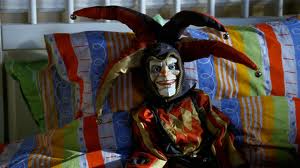
As the boys bring Julie in on their discovery, strange things start to happen: They lower a video camera into the hole and a strange eye is seen. Ghosts and monsters come out of the hole to scare the kids. A creepy jester clown puppet comes to life and attacks Lucas.

images

The setup of “The Hole” is fun, as the kids experiment with the “gateway to hell” in the basement. They even meet the so-called “Creepy Carl” (Bruce Dern) in a room with a dozen light bulbs surrounding him, to protect himself from the “darkness.” Later on though, the movie gets more interesting. Without giving away the secret of the hole, it causes the kids to confront their own pasts and conquer their fears. What makes “The Hole” interesting is that it’s more of a coming-of-age tale than a horror film. There are scares, but story and characters come first. There’s a sense of who these kids are and how they’ll grow in their misadventures with the hole.

The three young actors aren’t strangers to strangeness. Chris Massoglia traveled with a freak show as a half-vampire in “Cirque du Freak,” Haley Bennett was the protagonist of a much-lesser horror film called “The Haunting of Molly Hartley,” and Nathan Gamble encountered giant bugs in “The Mist.” All three are appealing here, but it’s Nathan Gamble that really stands out as the irrepressible but likable little brother.

“The Hole” isn’t a great horror film. Some of the choices the kids make are kind of dumb, like Dane and Lucas not telling their mother about the strange happenings. And also, the ending is not the right one—it’s supposed to resolve all that happened before, but it just feels like an anticlimax. But for the most part, “The Hole” is an entertaining movie with an intriguing story and some good scares along with likable characters to root for. And it still makes me wonder what it takes to get this film a US distribution, and how long it ultimately took.

NOTE: The MPAA rated this movie a PG-13 rating. After the PG-rated “Monster House” and “The Spiderwick Chronicles,” the MPAA is starting to understand that certain family-horror movies are likely to frighten younger kids—this one included.

ANOTHER NOTE: Or maybe they just rated it a PG-13 rating due to certain profanities like the “s” word.

THIRD AND FINAL NOTE: Every film directed by Joe Dante features an appearance by Dick Miller. Watch out for him as a pizza delivery guy in this movie.

The Amazing Spider-Man (2012)

7 Mar

images

Smith’s Verdict: ****

Reviewed by Tanner Smith

Two years ago, when a friend told me that he heard that the “Spider-Man” movie franchise was being “rebooted,” I didn’t believe him. But two years later, here it is—ten years since the original film, and five years since its latest film. I was aware that 2007’s “Spider-Man 3” failed to satisfy audiences with its many plot developments, but I had a feeling that the franchise would redeem itself with a fourth entry. But no—Columbia Pictures apparently wants to start from scratch, even with the same producer of the other films (Laura Ziskin).

Luckily, I was pleasantly surprised by this reboot of the Marvel Comics-based half-arachnid/half-human superhero. We all knew the origin story of Spider-Man/Peter Parker, but that doesn’t mean the story isn’t told as effectively as before. There are many twists and turns in the storytelling of this retelling of Spider-Man, all executed wonderfully.

My guess is that they made this reboot was because they didn’t know where to take the story from “Spider-Man 3” to a “Spider-Man 4.” But I am disappointed that they didn’t at least try—even Paramount’s “Star Trek” movies have gotten their way out of similar messes. So they better get it right this time with the inevitable sequels.

“The Amazing Spider-Man,” of course, retells the story of how high school geek Peter Parker became Spider-Man, but with different circumstances from the original film. (And no, I’m not going to go into great detail to explain the comparisons and contrasts.) It begins with Peter as a little boy playing an innocent game of hide-and-seek when he enters his scientist father’s office and discovers that it’s been ransacked. The parents, hoping for the best for their son, send Peter to live with his aunt and uncle (for reasons that will probably be explained in the sequel, but I’ll let it ride). Years later, Peter (Andrew Garfield) is seventeen, gawky, and somewhat of a loner (pretty much the last person you’d expect to become a superhero).

Peter finds an old satchel belonging to his late father and can’t help but go through it. He finds documents containing specific information about his cross-species-intersection experiment with Dr. Curt Connors (Rhys Ifans), who works as Oscorp Industries. Peter makes his way into the building to find out the real deal, when he is bitten by one of the experimental, radioactive spiders in Connors’ laboratory. On the way home, he experiences some intense side effects from the bite—he’s completely hyperactive (I suppose you’d call it “spider-like reflexes”), is unbelievably strong, and can even scale ceilings and walls.

These scenes in which Peter learns of his new abilities are well-handled and make for some comedic moments as well. He at first finds these powers difficult to control (he nearly destroys his own bathroom while trying to brush his teeth, he shoots a dangerous projectile of toothpaste, and also breaks the door). He does get the hang of his abilities by taking it slowly and easily, but he uses them irresponsibly, as when he humiliates the school bully on the basketball court. This causes his fatherly uncle Ben (Martin Sheen, very strong here) to tell him that just because he can do these things doesn’t mean he can perform them whenever he wants to.

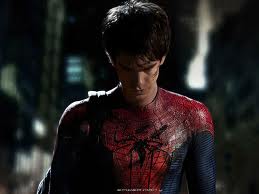
Later, Uncle Ben is killed by a street thug and Peter realizes that he could use his powers to help people in need. So he dons a costume he made himself, creates man-made spider-web-slingers that cause him to swing around New York, and becomes a masked half-arachnid vigilante called Spider-Man. He protects people in need, keeps his true identity a secret, and of course the police see him as a menace.

But with every superhero, there must always be a villain for each tale. Origin stories are no exception. While most are coincided with the hero’s newly-developed powers, Peter is actually the cause of the supervillain in this movie. You see, earlier in the movie, he gave Dr. Connors his father’s secret algorithm that could make Connors’ cross-species project work. What it’s supposed to do is regrow lost limbs (three-legged mice are used as experiments). Thanks to the equation that Peter gave Connors, the experiment finally works. But later in the movie, Connors decides to use it on himself to regrow his disembodied right arm. And because some of the serum comes from lizard blood (if I remember correctly), Connors mutates into a man-size lizard that terrorizes the city.

Connors makes an intriguing villain and his plan is legitimately diabolical. His plan is to take the serum and take it to the top of the tower of Oscorp and unleash it all over the city, via a chemical cloud, so they undergo the same effects as he. He says he’s doing this to get rid of “weakness.” Connors is an interesting villain because he doesn’t do this just to be anarchic and chaotic. He’s doing it for what he thinks is for the good of mankind. (Though, let’s face it—none of us want to be transformed into giant lizards, of course.) This is a scientist who searches for further truth in his research and gets more than he bargained for. He becomes a monstrous beast as it all just toys with his own sanity. Rhys Ifans does a terrific job at making a three-dimensional villain, and the computer-effects design of his lizard form is gruesomely impressive as well.

The effects are first-rate. Sure, most of it is CGI, but it really did look like Spider-Man was flying around the city on those spider webs. And they, along with the camerawork, make the action sequences effectively intense and a lot of fun to watch. I can think of many final action climaxes where I feel worn out, just waiting for them to end. But there were enough turns in this film’s climax to keep me invested.

And I should also mention the change of tone this movie has, compared to the other three “Spider-Man” movies. The previous three were lighthearted, energetic romps. In this reboot, the attitude is suitably more dark and dramatic with a smoother look, although that doesn’t mean there isn’t room for comic relief (such as how Spider-Man, in a teenage boy fashion, mocks a car thief while thwarting him). Also, I have to give credit to the screenwriters (including Steve Kloves, who wrote all but one of the Harry Potter movies) for giving better reasons for Peter to become Spider-Man.

Andrew Garfield has been in movies like “The Social Network,” “Never Let Me Go,” and “Red Riding: 1974.” I can say that this actor can either be very likeable or very stiff. In some of his work, he seems to walk that line in between, seeming uncertain about a few things his characters go through. But as Peter, he’s pretty good here. He’s very convincing and just so likeable, and makes for a nice hero to root for. But I have to admit, the updated Spider-Man costume looks a little silly…or sillier.

And don’t think I forgot about Peter’s relationship with Gwen Stacy (Emma Stone), the pretty girl in the class. Every superhero story, as far as I’m concerned, has a girlfriend to support the hero, and “The Amazing Spider-Man” is no exception. Now, I have to admit that I didn’t really care much for Gwen in the first half of the story, nor was I interested in hers and Peter’s relationship. It was pretty awkward and they didn’t share much chemistry, mainly because Gwen wasn’t given much of a personality…until midway through the movie, when these two started to have realistic conversations and I actually started to care. Or maybe things just get more complicated when the police chief (Denis Leary, very good), seeking to arrest Spider-Man (who is actually Peter), is Gwen’s father.

And here’s what really made me care about Gwen—she’s smart. She’s not the typical damsel-in-distress you see in most superhero movies; she’s no Mary Jane Watson (from the original film). And there are many scenes that show that she is smart and can fend for herself. For example, there’s one scene in which she’s hiding from the Lizard in a locker in a laboratory, and you would think this would be predictable. You would think that she would be captured and Spider-Man would have to save her. But nope. She fights back; she sets the monstrosity on fire!

“The Amazing Spider-Man” is a welcome retelling of the Spider-Man origin story—darker, more complex, entertaining, and very amusing when it needs to be. I’d even put this is in a class with “Batman Begins” (which told Batman’s origin story) and that’s a very high class for me indeed. I loved this movie, and I look forward to its predestined sequel.

Brave (2012)

2 Mar

Brave-2012-movie

Smith’s Verdict: ***

Reviewed by Tanner Smith

“Brave” is an animated family movie that at first seems to go back to the traditional Disney princess material. But it’s far from that, for you see, the Scottish heroine Merida (voiced by Kelly Macdonald) is a princess, in the Viking era, but not the dim, usual damsel-in-distress who constantly needs to be rescued by a handsome prince. She’s actually a brave, adventurous, quick-witted, free-spirited tomboy who is great with a bow and arrow. It’s her mother—Queen Elinor (Emma Thompson)—who wants her to be the standard princess character. She doesn’t like the idea that Merida is…independent! Oh heaven forbid!

Merida is apparently at the age to be married, as Elinor decides it’s time to choose among three possible royal suitors. There are two problems, however. The first is, Merida doesn’t want to be forced into marriage—she isn’t ready, if only her mother would listen. The second is that all three suitors are bumbling idiots—one of which is an absolute weakling. After putting herself into an archery contest (saying she’s shooting for her own hand in marriage) and being scorned upon by her mother because of it, Merida hops on her trusty steed Angus and rides off into the forest, where she encounters some will-o’-the-wisps that lead her to a witch’s house (which looks like a woodcarver’s shed with many wooden bear figures around, but go outside then back inside and look what you get—I love magic). Merida offers to buy everything in exchange for a spell from the witch (Julie Walters) that will give her a different fate. The easy solution—give the mother a cursed treat that will change her mind about the marriage situation.

What happens to Queen Elinor is something that the advertisements have tried to keep hidden from the audience before seeing the movie, and it really ticks me off that the critics reviewing this movie are giving it away now that it’s released. I didn’t know what was coming when I saw this movie and it’s a good thing I read the reviews after I saw the movie. So I’m going to try and do the noble thing and just say that what comes after some magical occurrence leads to quite a troublesome situation that Merida has to deal with herself. And along the way, she learns that the relationship between mother-and-daughter is a strong one and in order to save the day, she and Elinor must rekindle their love.

“Brave” is the latest film from Disney and Pixar and while it’s not quite up there with “Finding Nemo” or “Up” (though to be fair, not all animated family films can be), it’s still a pretty entertaining film. It has a lot of funny moments, the characters are memorable, and as you’d expect from Pixar, it has top-notch computer animation. But it does bring about a personal disappointment for me, because this could have been great. For the first hour-and-a-half, it is pretty great. In the final twenty minutes, however, it resorts to one of those obligatory action climaxes that seem to come into place in family films that run out of ideas.

It’s strange too, because it seems like it’s saying, “Hey! You know that thing we do in the end of most family films nowadays? We’re not going to do that!” But once we get to a huge misunderstanding, it immediately tells us, “Psych!” and gives us a series of chases, fights, tears afterwards, and then a cheerful ending. I’m sure the makers of “Brave” could have thought of something better.

The characters are indeed memorable. Merida is a lot of fun as a teenage tomboy who fends for herself and is very spunky and quick-thinking. Her peg-legged, dim-witted-but-supportive, overweight Viking of a father King Fergus (Billy Connolly) is an absolute riot. Whether he’s going on about going after the gigantic bear that bit off his leg or constantly being used as a pawn in Elinor’s trickery to get Merida to the status quo, he’s just a ton of fun to watch. The three wild little brothers of Merida’s have been marketed like crazy, and deservedly so. These kids are just hilarious. They have little to no dialogue, so their facial expressions, body language, and just overall speed (whenever they sneak around the castle or run away after pulling a prank) take up most of their roles. Queen Elinor is a bit of a blank slate. But just what until you see what happens to her after she eats the cursed treat.

Do I even need to say how great-looking “Brave” is? I mean, it’s Pixar animation. Call me lazy, but it’s just pointless to talk about the visual creativeness of “Brave.” But if I had to point out some highlights, one prime example is a scene that has been used in every trailer, when Merida fires her arrow at a target with another arrow at the bull’s-eye (with Merida already a more-than-sharp shooter, the outcome is incredible). It’s a perfectly-animated moment. Another example is a slapstick comedy sequence in which Merida, with help from her brothers, has to sneak out of the castle while distracting her father and his buddies—the physical comedy is so well-timed, you can feel it off the screen. I know Pixar animation isn’t supposed to be known for its slapstick comedy visual gags, but this really was a treat to watch. I laughed and laughed.

“Brave” ends with a message of self-fulfillment and a mother and daughter finding common ground with each other. It’s sweetly-handled in the way that you can kind of forgive the movie’s flaws (aside from the standard climax, there are a few little inconsistencies in the story) and just enjoy “Brave” for what it is. It’s not one of Pixar’s best, but I enjoyed it nonetheless.

Tomorrow, When the War Began (2012)

28 Feb

Tomorrow-When-The-War-Began-A

Smith’s Verdict: ***

Reviewed by Tanner Smith

To tell the truth, the idea has always fascinated me. Imagine being a teenager, and you and your high-school friends are the last line of defense against an army of soldiers who invade your home. It’s a great characteristic of the term “unlikely heroes” in that the heroes are all teenagers with hardly any experience in military tactics. 1984’s “Red Dawn” is a classic example of that idea—in that film, a high school football team became America’s guerilla force when foreign armies invaded.

But now it’s time for teenagers from Down Under to take charge in “Tomorrow, When the War Began.”

Based on the first entry in the “Tomorrow” novel series, “Tomorrow, When the War Began” introduces a group of Australian teenagers who ultimately decide to turn the tables on the foreign army that has taken over their home.

It all begins when they skip the Australia Day festival to go on a camping trip in a remote land dubbed “Hell.” Why is it called Hell? Well…they say it’s because people give uninviting names to places they don’t understand, but let’s be honest—they call it “Hell” so they have fun with saying what a paradise “Hell” is. They even share a toast, “To Hell!”

One night, they notice military aircraft racing over them and don’t think much of them until they all return home to learn that the electricity is out, their houses are empty, the phone lines are down, and their families and friends have been taken, some of which executed, by a faceless enemy. The only lights on in town are the hospital and the fairgrounds, where the people are held.

Who is this army? Why do they pick this place to invade? I don’t know. They don’t address it. If they did, they did it briefly. Unlike in “Red Dawn,” there’s no movement of Communism to be found here—in fact, we never even have a scene featuring just the enemy. We just stay with these teenagers as they’re forced to do whatever they can to survive their attack and find some way to strike back.

This is fun. This is just what I wanted in this idea—teenagers banding together to fight an army. The idea is fun and there are some well-crafted action sequences for us to endure throughout the movie, as the teens use their limited resources to fight. For example, in the middle of the film, three of the kids are being chased by enemy soldiers in these really nifty armed buggies, and having to escape by driving a garbage truck. But it’s OK, because the farmer girl can drive a tractor! How hard can a big truck like this be?

Oh, and what do they do to slow the enemy down? Dump the rubbish, of course!

“Tomorrow, When the War Began” doesn’t require a lot of thinking on our parts. The best way to enjoy this movie is to accept it as a film about teenagers who know their home better than these heavily armed, totally overpowering foreign soldiers, and use that to their advantage. The climax is quite fun, as they come up with a plan to blow up the Heron Bridge so nothing more from the enemy will be deposited (easily) from outside. The funniest part of this sequence—two of the girls talk about their crushes, turn off their two-way radios in embarrassment, and are unable to hear their friends’ warnings that a few soldiers are approaching their way. In this way, it’s interesting to see a culture brought into something that they were clearly not prepared for, and that could describe the whole movie.

And give it some credit for actually having a conscience about the issue of killing human beings in order to stay ahead. Is it right to kill in battle? Who’s to decide, really?

Almost all of the young heroes look as if they stepped out of an Abercrombie & Fitch ad, but they’re all pretty good actors and make decent, ironic use of their characters’ stereotypes (for example, one’s a Christian pacifistic girl who will eventually pick up a gun when she has no choice). In particular, Caitlin Stasey, as the protagonist Ellie, shows a great mix of anger and vulnerability. The other actors are Rachel Hurd-Wood (“Peter Pan”) as Ellie’s best friend Corrie, Lincoln Lewis as the cowardly Kevin, Deniz Akdeniz as bad-boy Homer, Chris Pang as Ellie’s romantic interest Lee, Ashleigh Cummings as the aforementioned Christian pacifist Robyn, and Phoebe Tonkin as rich-girl Fiona.

Oh, and I forgot to mention their school chum Chris (Andy Ryan), whom they meet midway through the film. He’s a stoner character who is of absolutely no purpose except to display poor comic relief. This character is not only useless; he’s also very obnoxious.

The ending is weak, obviously setting up for a sequel. The book series this is based upon has seven entries and this ending to the first adaptation is obviously so confident that it will spawn a sequel. That is probably my biggest pet peeve when it comes to adapting “firsts” in a series of books, because just setting up for a sequel doesn’t automatically guarantee one. As I’m typing this, plans for a sequel to “Tomorrow, When the War Began” aren’t exactly in demand. We’ll just have to wait and see what happens.

Silent House (2012)

28 Feb

2012_silent_house_004

Smith’s Verdict: **1/2

Reviewed by Tanner Smith

For about the first forty-five minutes, the thriller “Silent House” delivers what you expect to find in a thriller—a sense of creepy atmosphere, a legitimate fear aspect, some good scares and unnerving moments, a main character to root for, and a large amount of tension. “Silent House” has all of that and it makes for one of the best, most intense horror movies I’ve seen recently. Unfortunately, that’s only the first half of “Silent House” which means there’s a second half to the movie that will undermine what it had going and end on a scene that is not only anticlimactic, but also very disappointing and unbelievably stupid. And it brings the movie down with it.

It’s a shame too, especially considering the talent in front of and behind the camera. First, let’s start with the technical style. “Silent House” has been shot using long takes that can create what appears to be one unbroken shot, thanks to some clever editing. This is undoubtedly a callback to Alfred Hitchcock’s “Rope,” which used the same technique. And thanks to today’s technology, we have an upgrade—in fact, the film’s opening shot (or rather, start of the shot that consists of the whole movie, practically) is spectacular, as it starts from high above our protagonist and then eases its way down to join her as she walks and continues to follow her from there.

This inventive technique is handled effectively because we are with our protagonist the entire time. No time-lapses or motioning over to something less important—our attention is focused on who it should be focused upon: our female protagonist. Her fear becomes our fear. However, this style does manage to wear out its welcome once we realize we’re in the middle of a project with a shaky handheld camera. Very shaky indeed.

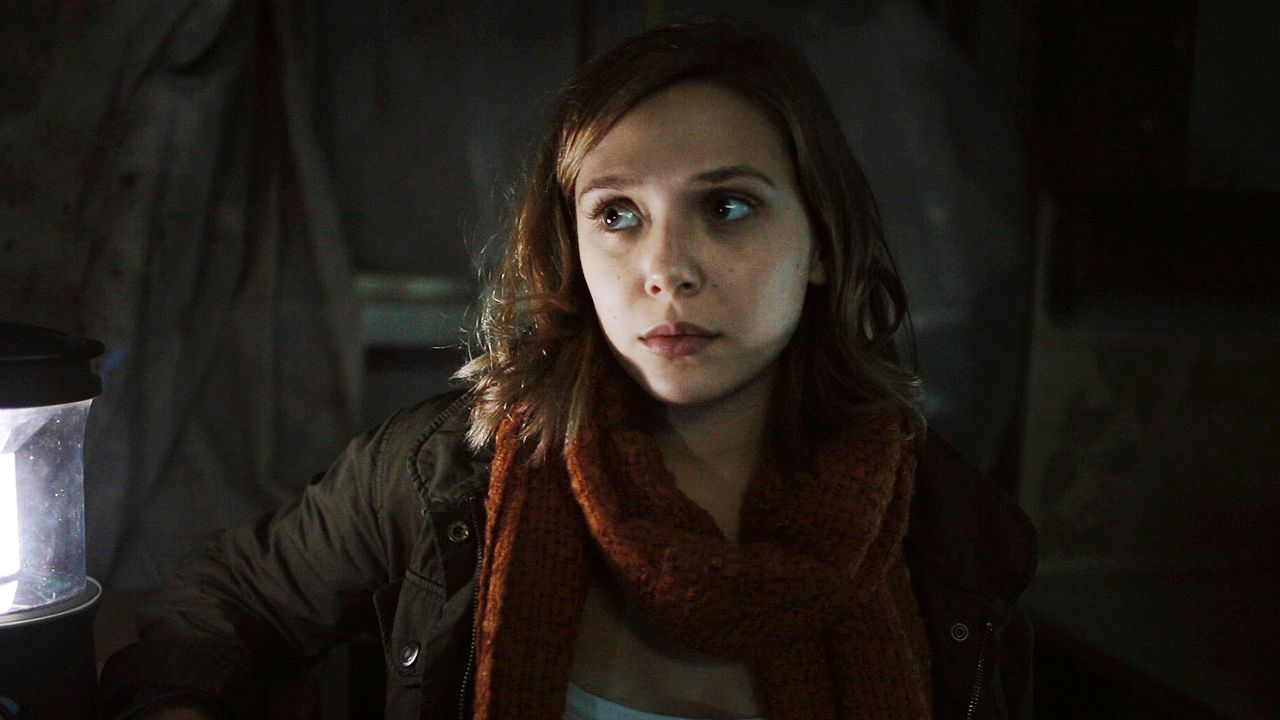
The setting is an old country house in the middle of nowhere where most of the action takes place, thus giving us the hint of claustrophobia. There’s no cell phone service, no electricity, and most of the windows and doors are padlocked. (Don’t say nobody tries to escape from the house when things go wrong.) A young woman named Sarah (Elizabeth Olsen, showing extraordinary work here), her father (Adam Trese), and her uncle Peter (Eric Sheffer Stevens) hope to sell it sometime soon. But later that day, Sarah and her father are alone in the house and when Dad investigates a strange noise coming from upstairs, Sarah hears a loud thud and calls for him, with no answer. Soon, she realizes that there is someone in the house and that “someone” has Sarah’s father, is looking for her, and there is hardly a way for her to escape.

This is the part of the movie that is very frightening. We follow Sarah to many hiding spots throughout the dark house and we know just as much as she does that someone is following her and will find her if she doesn’t keep moving. It’s so tense and unnerving that you need to chuckle a little bit to relieve the tension. This whole first half is borderline “Halloween” territory. I mean it—it’s that good.

As underwhelming as the second half is, I have to give it credit for one utterly fearsome sequence that comes later in the film. It’s when Sarah is surrounded by complete darkness and has to use her Polaroid camera to create a little flash of light so she can see where she is. We know that once in those flashes of light, we’re going to see something shocking and we don’t want to see it. That was a disturbing scene that worked.

“Silent House” would have been great, if not for the disappointing ending. It’s supposed to shock us with something we haven’t picked up on before, but the result is clumsily handled and very weak. If you’re willing to accept it for what it is, and if you’re a hardcore horror fan, “Silent House” will probably please you. It didn’t do much for me, except for the first half. After that, you’re on your own.

Dredd (2012)

26 Feb

Dredd_01

Smith’s Verdict: ***

Reviewed by Tanner Smith

I never considered “Judge Dredd” a household name when it comes to comic book lovers, but then again, I myself am not a comic book lover (not that there’s anything wrong with being one), so I’m not one to talk. Maybe there is a fan base out there, though I’m certain if there is, they didn’t take well to the cheesiness of the 1995 film adaptation “Judge Dredd,” starring Sylvester Stallone as the title character. That being said, this 2012 “second try” to adapt the comic book series—simply entitled “Dredd” or “Dredd 3D”—is probably the best film adaptation those people could ask for.

To put it simple, “Dredd” is a heavily-stylized, extremely-violent action film that kicks ass. It’s an insanely forceful thrill ride from start to finish, with a dose of intense violence mixed with dark comic streaks. Once the action picks up, it never lets up—in fact, by the time this movie was over, I was exhausted by what was being thrown at me.

It’s an odd thing for me to say “being thrown at me,” since I didn’t wind up seeing it in 3D. Speaking of which, I’m glad I didn’t. Forget that 3D kind of makes things unbearable in movies; even if “Dredd” did it right, I would still be suffering vertigo nonetheless. We get towering, hovering, panning shots above and below great tower heights, among many instinctual visuals done greatly by cinematographer Anthony Dod Mantle. His artistic style to “Dredd” is unbelievable and the action scenes, as a result, are suitably graphic and well-choreographed. “Dredd” is a visual treat, to say the absolute least.

But it’s also not for the faint of heart. An example of this style comes early in the film (and which makes a few reprisals here and there)—you don’t just see a bullet enter someone’s face; you see every blood drop explode outward, in slow-motion.

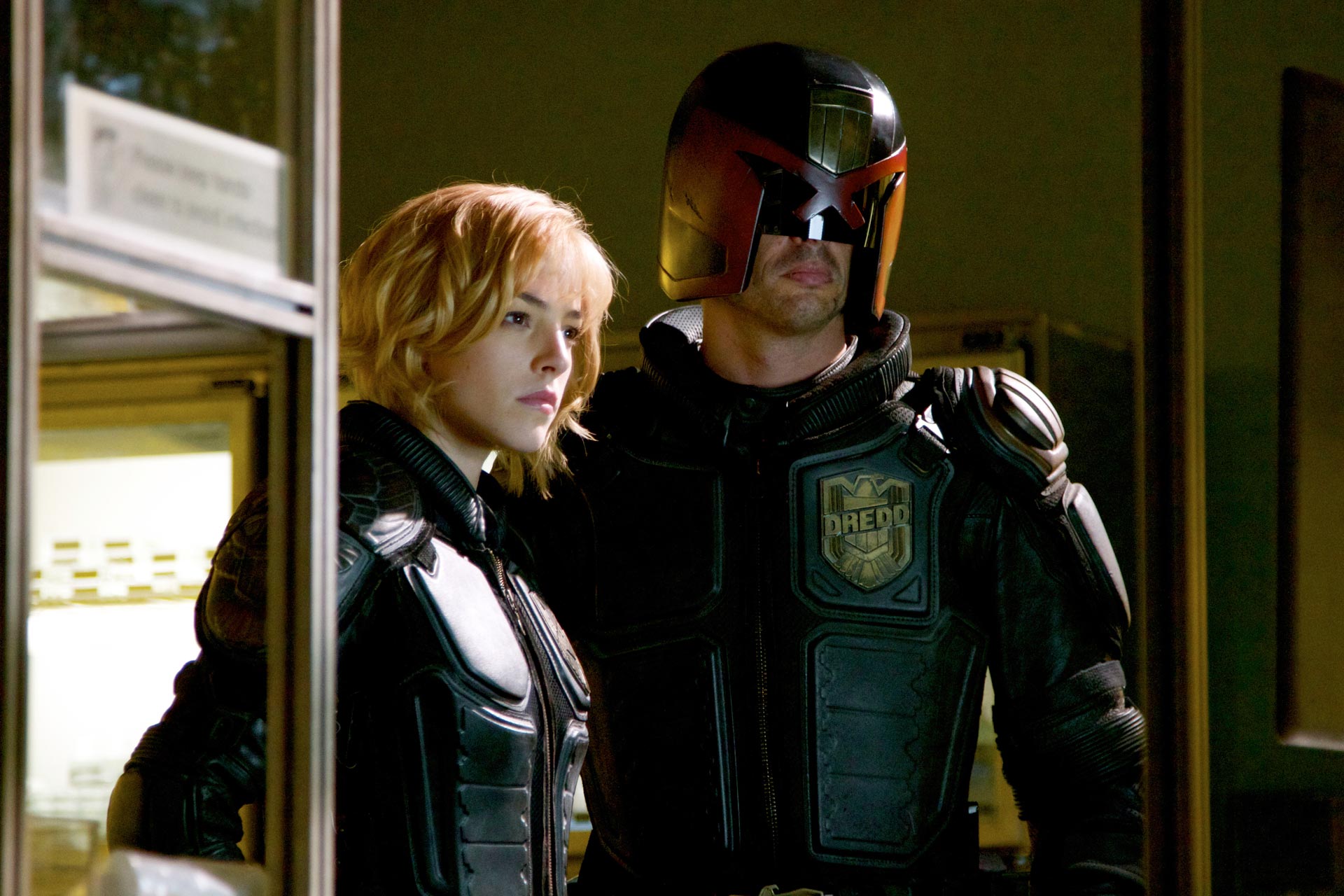
The story takes place in the future, which of course sucks. It’s always lousy in the future in the movies, isn’t it? In this “cursed Earth,” a dystopian large city, the law enforcers serve as judge, jury, and executioner all in one. The baddest of them all is Judge Dredd (Karl Urban)—with a cool uniform, a helmet that covers the top half of his face (we never see him take the thing off), and a cold, monotone voice recalling Clint Eastwood and Batman.

Karl Urban is unrecognizable as Dredd. That’s not just because we never see his face partially covered by that helmet, leaving his mouth and chin exposed, but because of his deep growl and his deadpan persona. You’d never link this man to the 2009 “Star Trek” (he played young Bones McCoy). He’s also grimly funny too, as he delivers one-liners in the most depraved situations he runs into, providing some very big laughs.

Also a lot of fun is Olivia Thirlby, best known for her indie roles as “Juno’s” best friend and the pretty high school girlfriend in “Snow Angels.” Here, she plays a blonde mop-haired psychic “mutie” (slang for “mutant” in this world—I guess stealing “muto” from “Waterworld” was too much) who becomes the rookie Judge Anderson. Thirlby displays a calm (yet somewhat ethereal) yet confident screen presence, whether it’s looking danger in the eyes or through their heads (because she has the power to enter your mind and mess with it to seek information—now that’s awesome). She’s a ton of fun and delivers some badass moments as well. She is no damsel in distress.

The real story begins as Dredd and Anderson respond to a disturbance at the 200-tower Peach Trees housing complex and interrupt a party where the latest drug is being used—a drug that allows everything in your perspective to slow down time (this is where a lot of slow-motion visual styles come into place). Facial-scarred drug-lord Ma-Ma (Lena Headey) has been killing her subjects by enforcing the drug onto them, and pushing them out the window from the top floor, making their fall seem longer than it is. Dredd and Anderson take a suspect (Wood Harris) into custody. Knowing that they will interrogate him for information, Ma-Ma forcefully arranges for the entire building to be locked down and insists that she’ll keep it this way until the Judges are caught and killed.

This sets up a series of events that lead to close calls, strikebacks, shootouts, and just about everything else you’d expect to see here. “Dredd” pulls out all the stops and then some. This film is alive with energy as Dredd and Anderson find new ways to outsmart the heavily dangerous thugs looking to shoot anything that moves. But it’s OK—the Judges have specially designed guns that have voice command and many features (automatic fire, stun, double-whammy, and more). That gives them advantages that lead to some impressive developments.

“Dredd” is violent, bloody, heavily-stylized…and it’s just so freaking cool. There’s never a dull moment, it’s visually exciting, the action is top-notch, and it’s just an intense thrill ride from beginning to end. I look forward to a sequel, and I think there will be one, seeing as how audiences are hungry for mindless entertainment. I guess I could describe “Dredd” as precisely that, but that would be considered an understatement. This movie just kicks ass.

Safety Not Guaranteed (2012)

24 Feb

images

Smith’s Verdict: ***1/2

Reviewed by Tanner Smith

“Safety Not Guaranteed” takes a neat idea and uses it for an independent film that starts out as cynical as its characters (and as many other smart-aleck indie films I’ve seen lately), but then turns into a pleasant, involving experience once the characters have become more involved in the mystery of the situation.

What is the situation, the neat idea? It’s a “classified” ad in a newspaper. And a most unusual one at that—it reads: “WANTED: Someone to go back in time with me. This is not a joke. You will get paid after we get back. Must bring your own weapons. I have only done this once before. SAFETY NOT GUARANTEED.”

How can you ignore an ad like that? You can’t help but be the least bit curious about the person who placed that ad in the paper. Sure, you wouldn’t actually try and track him or her down; you’d think about doing it, but you’d never actually do it. “Safety Not Guaranteed” plays that angle, as three Seattle magazine employees decide to track down and report on whoever placed that ad—is it a joke or is it for real?

The slacking reporter, named Jeff (Jake Johnson), volunteers to take this story and brings two interns with him to Ocean View, Washington. The interns are Darius (Aubrey Plaza) and Arnau (Karan Sonl). Darius is a disillusioned college grad and Arnau is an Indian-American studious biology major. They all drive down to Ocean View to do some digging, but since Jeff is more focused on hooking up with a high-school girlfriend, the interns do most of the investigative work.

Finding the guy comes off as pretty easy—Darius and Arnau spy on the post office until someone opens the Box posted in the ad. The man who placed the ad is a mid-30s grocery clerk named Kenneth (Mark Duplass). Darius has her own simple way of approaching him—by answering his ad, convincing him that she’s the right one for him to “travel back in time with,” and find out what his deal is. It turns out that Kenneth is dead serious about time travel and Darius manages to get him to trust her because she’s quirky, aggressive, challenging, and quick. And as Darius finds out more about Kenneth, she finds herself more intrigued and fascinated and just wondering, just like us, what exactly is going to happen with this time travel plan.

Who is Kenneth? Why does he want to travel through time so bad? Why does he want a partner? Can he really create a time machine? Is that what’s going on in his secretive shed? Is there really someone following him, like he says? All of these questions aren’t given simple answers. There are some answers, mind you, but director Colin Trevorrow and screenwriter Derek Connolly handles them subtly and impeccably. But more importantly, they make us care for the characters involved. A crucial example is the scene in which Kenneth reveals why he wants to travel back in time—we can easily relate to his reasons.

“Safety Not Guaranteed” starts out as an oddball road comedy with these three diverse people looking to find something unusual. But once we get into Kenneth’s characterization, whatever it may be, and further into the sweet relationship that develops between Kenneth and Darius, the movie does become a more involving, more pleasant movie that deals with its characters and their situations in a paranoid and quirky yet intriguing and investing way.

Darius becomes less of a deadpan cynic and shows moments of vulnerability that really make us care about her. The same can be said for Jeff and Arnau. Jeff, in particular, starts out as a typical unlikeable jerk, looking to hook up and also to get Arnau laid before the trip is over, until we go through a subplot involving him and his old girlfriend (Jenica Bergera). When he notices that the years haven’t been kind to her, he still enjoys being with her and realizes that beauty is in the eye of the beholder. Arnau becomes less of a stereotypical Indian-American sidekick and has his own life-changing moment as well. Actually, the whole movie could be like these three, particularly Darius—sardonic on the outside, sweet on the inside. It starts out as a grim, cynical indie flick and turns into a pleasurable story.

“Safety Not Guaranteed” can be seen as a star vehicle for Aubrey Plaza. Usually known for her deadpan-sarcastic, comic supporting roles on TV’s “Parks & Recreation,” as well as movies “Funny People” and “Scott Pilgrim vs. the World,” Plaza tries a lead role this time and succeeds. She proves a real acting talent when she’s calmed down and displays a true sense of vulnerability.

Mark Duplass, as Kenneth, hits the right notes with his performance. He’s a misfit and an oddball, but also earnest and somewhat relatable. You can tell he means everything he’s saying and just want things to go well for him. Even when it seems like he’s possibly gone off his rocker, it’s hard not to empathize with him. What should also be noted is that not once does the movie make fun of him—even in the “training montage” in which Kenneth gets Darius prepared for their trip through time, we’re still with him instead of making fun of him. He’s taking this whole thing seriously, and we have to know if he’s on the right path.

Is time travel possible in this movie? I’m not saying. Though I can tell you this—“Safety Not Guaranteed” is not about time travel. It’s about right here, right now. It’s about these characters who become people we care about and these ideas that we’re fascinated by. The end result is quite satisfying—showing little, but leaving a lot to the imagination. I did not correctly guess the ending to “Safety Not Guaranteed” and I find myself thinking about what I’d just seen. As I continue to think about this movie, I find myself liking it more and more. That is the sign of a terrific movie.

NOTE: By the way, is it a coincidence that Darius resembles MTV’s “Daria?” Just askin’.

Sound of my Voice (2012)

23 Feb

sound_of_my_voice_rectangle

Smith’s Verdict: ***1/2

Reviewed by Tanner Smith

I love these science-fiction thrillers that keep the sci-fi elements in obscurity (for the most part, at least). “Sound of my Voice” is an example of this type. The basic idea is that there’s an underground cult led by a woman who claims to be from the future. So OK, you have the time-travel element that is talked about a lot in this film. Is it true or false?

And to be honest, I can’t exactly write about “Sound of my Voice” without mentioning a film that was released the same year as this—another indie film that also had to do with the possibility of time-travel, titled “Safety Not Guaranteed.” That film was more of a lighthearted, upbeat comedy-drama—the exact opposite of “Sound of my Voice,” which is grim, more mysterious, and even kind of creepy.

But it’s still as fascinating.

“Sound of my Voice” was co-written by writer-actress Brit Marling, who also co-wrote and starred in the terrific sci-fi/drama (if you will) “Another Earth.” The best thing about both films is that they use their sci-fi elements to serve the human stories that are the main focus.

The plot involves a Los Angeles couple—aspiring filmmakers Peter (Christopher Denham) and Lorna (Nicole Vicius)—as they decide to make a documentary that exposes a mysterious cult. In order to do so, they have to join the cult. On the first night, they are blindfolded and led to a basement to join cult members, dressed in white robes. And they learn the cult’s complicated secret handshake as well.

The cult’s leader, also dressed in white, is Maggie (Marling). She comes into the room, and the cult just bows down to her, as if she was their Savior. When she tells the new members her story, those who buy it sort of see why the others see her like this. She announces that she is from the year 2054 and she started this cult to prepare them for a civil war. She seems very serious about this, and her voice is quite comforting, so people will listen to her—even Peter, who at first seems cynical about all of this. Among her peculiarities—she carries an oxygen tank because she’s allergic to our air; because present-day toxins are easy for her to catch, so she eats organic food grown by one of her followers; and her methods are most unusual. For example, she gets the cult members to purge themselves by vomiting. Peter won’t do it (though he says instead that he can’t do it), and so Maggie does some pushing to get him to do it. She even manages to touch at something so personal from his past that he ultimately and successfully hurls.

By the way, if you’re wondering how Peter and Lorna are getting their footage, I forgot to mention—Peter has a hidden camera in his eyeglasses, and he also swallowed a small radio transmitter to record audio.

Anyway, who is this woman Maggie? Is she telling the truth? Is she a con artist, like Peter believes? Even he is starting to have doubts about what he thought before, which is actually starting to bring concerns from Lorna, as motivations for joining the group are starting to feel unsure.

The odd thing about “Sound of my Voice” is that Maggie’s stories of her “appearance in the present-day” and her “future-day” aren’t as convincing because time-travel is not the only explanation. She says she woke up in an apartment, with no memory and a tattoo that made her realize who she was—there’s some kind of symbol tattooed to her ankle, and the number “54,” which she “recollects” as being the sign of the traveler from 2054. And how about when the cult asks her to sing a song from the future? “We want to hear the future,” someone says. She chooses a popular song from the Cranberrys, saying it was covered by a future artist. I don’t want to give too much away, but “Sound of my Voice” has this odd tendency to keep Maggie talking about her back-story without ever declaring if it’s true.

“Sound of my Voice” has a consistently-unnerving tone as it progresses, and manages to tell an effective commentary on changing lives and beliefs or disbeliefs with tense results. It also helps to have solid characterizations to tell a more human story than you might expect. Peter is classified as a cynic to this cult’s existence, but he’s a nice guy and grade-school teacher, and honestly, who wouldn’t feel this way at first? But he also has a tragic past (his mother died on the night before his 13th birthday) that Maggie is able to play to with the “sound of her voice” (if you will) and this starts to open something in his mind. It’s almost as if he’s starting to be like the brainwashed followers she has led. Christopher Denham delivers a great performance, in a role that could have been thankless. He nails it.

Nicole Vicius is also good as the girlfriend who too is fascinated by what goes on in this cult, but she still remembers why she and Peter joined the group and is starting to question Peter’s sanity, even though he insists that he still believes it’s all a con. But it really comes down to Brit Marling, whose ethereal performance as Maggie brings so many fascinating details to wonder about with this character. She’s perfect here. (And I look forward to another one of her screenplays as well.)

The final act gets more suspenseful, as it moves into a plot development, which I won’t give away, that is both eerie and unusual. But I will say this—I mentioned that nothing is truly declared in this plot, so don’t be surprised if the ending leaves things unresolved. Like “Another Earth,” it’s an ending that leaves things open for interpretation. The mystery is still there, but there’s one little bit that they end on that brings about a whole other part of the mystery to read into. “Sound of my Voice” is an intriguing sci-fi thriller that keeps you guessing all the way through, and still has you guessing after it’s over.

Looper (2012)

22 Feb

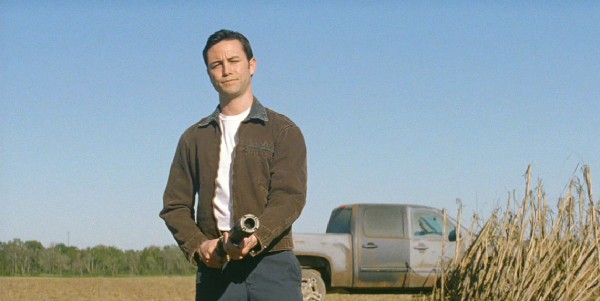
Joseph-Gordon-Levitt-in-Looper-2012-Movie-Image1-600x301

Smith’s Verdict: ***1/2

Reviewed by Tanner Smith

I love movies that involve time-travel. You have to shut your mind out to logic and science, and let the paradox elements win you over, if the script is smart enough not to overanalyze them. “Looper,” an especially tricky sci-fi story, does indeed play it smart. Instead of overruling all of the time-travel paradoxes, this film plays off from them and gives us a wild and brilliant sci-fi thriller.

The story takes place in the future. It looks somewhat normal, like a realistic variation of the American present-day, but it wouldn’t be a sci-fi thriller if there wasn’t something wrong (and unusual), now would it? In this case, it’s 2044 and hired assassins called “loopers” are called upon to kill time-travelers. You see, time-travel hasn’t been discovered yet, but it will be, about thirty years later. But it’s illegal and used only by the most powerful criminals (when I say “powerful,” I mean some people have telekinetic abilities in this time period—but face it; they’ve got nothing against the kids in “Chronicle”). A mafia company in Kansas City hires loopers to dispose of agents sent back in time (by their corporate employers in Shanghai). The way it works is; a looper stands at a certain place and time, the time-traveler is put in front of him, and the looper shoots him at close range. In return, they get paid with silver. The main rules—don’t hesitate and don’t let your target get away.

But corporate has a unique way of terminating a looper’s contract, or “closing the loop,” by sending their older versions to be killed by their younger versions (they get paid in gold). This is what leads to the main conflict of the story, in which the best of the loopers, Joe (Joseph Gordon-Levitt), doesn’t succeed in assassinating his older self (Bruce Willis).

With young Joe and old Joe now in the same time period and on the run from the mob, they meet in a small countryside diner, where they discuss terms of this truly bizarre situation. This is one of the best scenes in the movie, one of the joys of time-travel in a movie is you can have a scene in which younger and older versions of the same person can have a conversation together. But instead of playing it merely for intrigue, it plays with the reactions and metaphysics of their current position. The result is a deeply effective scene—it’s portrayed in a realistic manner, as is the rest of the movie.

The realistic style of the film’s execution is what makes “Looper” special. It brings about emotional depth, human relations, and a surprising amount of grittiness to the quieter moments. This isn’t one of those time-travel stories in which common twists and turns take place, leaving the plot to be bogged down into overuse of clichéd detail. There’s a genuine richness to the story here. It only gets better as young Joe is forced to hole up in the boondocks with the aid of a strong, independent woman named Sara (Emily Blunt, sporting a more-than-capable American accent), who wields a shotgun and does what she can to keep her five-year-old son safe. She doesn’t trust Joe at first and wants nothing to do with him, but she does help him as long as he helps her from any suspicious visitors…

The problems I have with “Looper” are slight, and no worries about the sci-fi “logic,” because these criticisms have nothing to do with them. It’s just that there are some little inconsistencies and pointless shots that get a little distracting—for example, what was the point of Sara having T.K. if she only uses it once for play? Also, I have trouble with the speech of that little kid Cid—he doesn’t come off as natural; he sounds like a young adult, at least, in a five-year-old body. And the supposed twist approaching the final half of the movie is a letdown because I saw it coming miles away. I won’t give it away, but you can probably guess it as well as I did. A little more development in that area would have created a great flow.

Many time-travel stories wear out by the time their climaxes approach—not “Looper,” however. Instead, “Looper” provides us with a conclusion that pays off from the introduced elements and gives us some real surprises. You care about the outcome, which is important of any sci-fi thriller.

Joseph Gordon-Levitt, continuing to show his reputation as one of the best actors of this generation, gives a strong performance as the antihero Joe; tough but likable enough for us to connect with him and root for him. Oh, and I forgot to mention—if Joseph Gordon-Levitt looks just the slightest unfamiliar to you, he was made up to appear as if he were the younger version of…let’s say Bruce Willis. Speaking of which, Willis makes a nice impression as old Joe, mixing humanity with elements of an action-hero. There are times when you may hate him for the things he winds up doing, but strangely enough, you can see why he does them and feel even more disturbed for having understanding. Emily Blunt is more than the “love interest” that her character Sara could easily have become. She brings a lot of weight to her role. Also strong are the performances by Jeff Daniels as the calm mob boss and Paul Dano as a looper who also breaks the main rules.

“Looper” takes the interesting concept of taking the younger and older versions of the same character and have them heading off against each other, and creates with it a powerfully-told tale of time-travel and its effects, while also delivering well-developed characters and plenty of human elements among the action and suspense. It’s energetic, well-told, and interesting from start to finish.