Archive | 2011 RSS feed for this section

The Artist (2011)

24 Feb

video-artist-anatomy-articleLarge-v2

Smith’s Verdict: ****

Reviewed by Tanner Smith

“The Artist” may be the subject of many cynics who haven’t even seen the movie yet. There’s no point of trying to figure out why. It’s clear that people without a high outlook on film (early film, in particular) aren’t interested in seeing a silent film in black-and-white. Yes, “The Artist” is the first silent film released in cinemas since Mel Brooks’ 1976 satire “Silent Movie.” And it doesn’t just pay homage to the silent film—that would be understating it, really. It really does tell a story with emotions, movement, and music…and it happens to be presented in black-and-white, filmed in 1.33:1 ratio, and mostly without a sound or line of dialogue. Oh, there are subtitles—83 of them, if I counted them all.

“The Artist” does start out as homage to silent film, and a wonderful one at that. It starts with the lay-about opening credit cards and even begins the story in 1927 as a silent adventure film is shown within this silent film. This film within the film is wonderful on its own. It has the same energy and spirit that most adventure films back then. It stars George Valentin (Jean Dujardin), the world’s number-one silent-film star, who knows his fame and wallows in it. He seemingly has more power than the directors and producers who cast him.

After the film’s premiere, George poses for a photograph with an attractive fan—a young dancer named Peppy Miller (the radiant Berenice Bejo). Peppy decides to try acting and appears as an extra in George’s next film. But it turns out that Peppy is about to have the same amount of fame that George has. You see, silent films are making way for “talkies” (sound movies), which, for George, means his career is over. His executive producer (played by John Goodman) breaks the news that the studio is all about sound now.

George doesn’t realize what’s to become of him until he funds his own film, which ultimately flops. Peppy’s new starring role in a talkie, however, gets everyone talking (forgive the pun). She’s a star now—she’s headlining the newspapers, people are raving about her radiance, and she’s become America’s sweetheart. She stars in film after film, but George is in financial trouble, even going as far as to selling all of his possessions. He also fires his loyal chauffeur Clifton (James Cromwell), leading to a heartbreaking goodbye: “But I don’t want another job,” as a subtitle (and Cromwell’s face) states. But since George got Peppy interested in acting and is also responsible for her beauty mark above her lip (brushed upon, mind you), Peppy still cares for George and tends to him when he most needs help.

The first half of “The Artist” is lovable—I can’t tell you how much I was enjoying myself. I was laughing quite a lot (some of them came from the antics of George’s well-trained dog), but mostly, I was smiling. The orchestral music that plays throughout, composed by Ludovic Bource, is a definite tribute to music telling a story. But the music isn’t only what helps make the film come alive. If it did, I’d be criticizing the acting. But all of the actors are forced to carry their character’s emotions, use excessive body language, and make it all credible. And because the film is shot in this 4:3 ratio, it gives the actors opportunity to make use of their limited space.

Then the second half develops into something stronger, as George Valentin’s life goes down the drain. It’s telling a story. I cared about this suave, likable guy and was hoping that he can catch another break to get his life on track. All this man knows is the entertainment value he put into his work and the appropriately-named Peppy would like nothing more than to bring it back for him, while her own fame is increasing. This is all very strong and very well put together. There’s one scene in particular that really got me—it’s midway through the movie and George has realized what little he has in life anymore, so he tears apart all of his films and burns them. The music and acting bring about the sheer intensity of the scene. And that’s not the end of the film. I wouldn’t give away how everything turns out, or even if everything works out, but it’s all very fitting for the film.

True effort was put into “The Artist” to make it into something special. Everything, from the script to the execution to the acting to the music to the overall spirit, adds to the charm and whimsy of this treat of a movie—enjoyable, entertaining, and beautiful. I love this movie.

Harry Potter and the Deathly Hallows: Part 2 (2011)

23 Feb

Harry Potter and the Deathly Hallows Part 2

Smith’s Verdict: ***1/2

Reviewed by Tanner Smith

At age 11 (“Harry Potter and the Sorcerer’s Stone”), the young wizard Harry Potter and his friends Ron and Hermione spent their first year at Hogwarts School of Witchcraft and Wizardry as they encountered a giant three-headed dog, fought a troll, and played a life-size game of chess. At age 12 (“Harry Potter and the Chamber of Secrets”), they solved a deadly mystery that included mutant spiders, a dark underground chamber, and a giant snake. At age 13 (“Harry Potter and the Prisoner of Azkaban”), they were pursued by a mysterious prisoner of Azkaban (the wizard prison) who turned out to be something more. At age 14 (“Harry Potter and the Goblet of Fire”), Harry was faced by deadly challenges (including a dragon, vicious merpeople, and a treacherous hedge maze) before he witnessed the return of the evil Lord Voldemort, the former Hogwarts student who became evil and tried to overrun the wizarding world before he disappeared (but not before killing Harry’s parents). Now Voldemort is back and is slowly but surely gathering other wizards and witches to create an army to finish what he started. So at age 15 (“Harry Potter and the Order of the Phoenix”), Harry taught other students how to defend themselves, should they have to fight against Voldemort and his followers. Then at age 16 (“Harry Potter and the Half-Blood Prince”), Harry and school headmaster Dumbledore discover a way to defeat Voldemort. But Dumbledore is killed, leaving Harry, Ron, and Hermione to eventually, at age 17 (“Harry Potter and the Deathly Hallows: Part 1”), find hidden objects that contain remnants of Voldemort’s soul. Once they destroy them, Voldemort is vulnerable.

Whew! I tell you, these kids have been on more adventures than Indiana Jones.

Anyway, they’ve destroyed three of these “Horcruxes” so far, now with two more to go as Voldemort and his army grows stronger. Thus, we have the long-awaited cinematic conclusion to the beloved and successful “Harry Potter” film series, adapted from the most-beloved book series by J.K. Rowling. This is Part 2 of the seventh and final book “Harry Potter and the Deathly Hallows,” leaving this to be the eighth and final film. The result is a most satisfying conclusion to a wonderful series of films.

“Harry Potter and the Deathly Hallows: Part 2” picks up where “Part 1” left off. Voldemort has found the wand that is said to be the most powerful of them all as he seeks out Harry and sends out his army of Death Eaters to overtake Hogwarts. In the meantime, Harry, Ron, and Hermione still have to find the last two horcruxes. They locate one in a scene that’s in the spirit of the previous films’ harrowing adventure scenes (this one involving a dragon) before racing off to find themselves back at Hogwarts.

The only thing I can say about the rest of the plot is this: For those who were upset that “Part 1” may have ended abruptly (by the way, what’d you expect from a “part 1” anyway?), it’s time to watch “Part 2” and witness what we’ve all been waiting for—the final confrontation between Harry Potter and Lord Voldemort. The previous films have been building up to it and now it’s finally here. I can say that it doesn’t disappoint. It’s dark and epic, just as we wanted it to be.

Every past setup has its payoff and every character has his/her moment (I especially like how Professor McGonagall, played by Dame Maggie Smith, rolls up her sleeves) as Hogwarts becomes a battleground for the students and teachers of Hogwarts versus Voldemort and his large army Death Eaters.

Now, I can’t say exactly what the bolts shot out of each character’s wands do to whoever is hit by them. But I don’t care—they’re lethal. Isn’t that enough? I suppose so.

We get an introduction to Dumbledore’s brother Aberforth Dumbledore (Ciaran Hinds) who helps the central trio back to Hogwarts. Then, we get other sides of characters we already knew, particularly Snape (delightful deadpan Alan Rickman) who has become Voldemort’s assistant. We had our suspicions about him before we found out he was just unpleasant. Now, he’s turned over to the dark side and even killed Prof. Dumbledore (Michael Gambon) in the sixth film. Not giving anything away, we discover why Snape wasn’t so fond of Harry from the start and why…he is what he is. As for Draco Malfoy (Tom Felton), Harry’s slimy bully at Hogwarts who also became a Death Eater along with his father (Jason Isaacs) and mother, we get hints at where he’s going but we get the point nonetheless. We get a more heroic side of the once-nervous Hogwarts student Neville Longbottom (Matthew Lewis) and—I swear, I am not kidding here—an actual emotion—though brief, mind you—from Luna Lovegood (Evanna Lynch). And then there’s Voldemort (Ralph Fiennes). We know what we already knew from the previous films and that’s all the character needs in the end. Who have I left out? Well, two characters briefly seen in the first film make appearances here (but they’re very crucial)—they’re played by Warwick Davis and John Hurt. Oh, and of course, there’s Ginny Weasley (Bonnie Wright), Harry’s love interest. Well, let’s just leave it at that.

The actors—young and old—have become their roles, as is expected after seven previous films. In fact, you wonder what feature film roles the young actors Daniel Radcliffe (Harry), Rupert Grint (Ron), and Emma Watson (Hermione) will take on next. To me, they will always be Harry, Ron, and Hermione. They have become their characters in these movies, physically and emotionally. It will be interesting to see what they do next.

So what else is there to say about “Harry Potter and the Deathly Hallows: Part 2?” The pacing is brilliant (there isn’t a dull moment here), the dialogue isn’t hurried, and there are pleasant surprises for those who haven’t read the books and are fans of the films (don’t worry—those who read the books may be delighted as well). Even though the epilogue leaves an open door for a continuation, J.K. Rowling informs the public that it won’t happen. So I suppose what is left to say is…goodbye.

Another Earth (2011)

21 Feb

images

Smith’s Verdict: ****

Reviewed by Tanner Smith

It’s a wonderful, thought-provoking image—another planet looking very much like Earth just visible up there in the sky. If you saw that, what would you feel? I’d be asking many questions—What is it like up there? Is something up there? If this is indeed another Earth (“Earth 2,” everybody calls it), does that mean there are mirrored identities of ourselves up there as well? We all imagine traveling to distant worlds “up there.” Only this one seems to be “another Earth.”

This image is seen through “Another Earth,” a low-budget indie drama with science fiction elements and a human emotion story. It gives us the premise of an essay contest that NASA is throwing, and whoever wins gets to travel to Earth 2, four years after it was first seen in the sky. What is truly up there? This is a big chance to find out, given that those chosen to travel up there don’t perish from the journey. But then something mysterious happens. On the TV news, “first contact” is attempted and accomplished…seemingly by an exact copy of the woman making radio contact with Earth 2. Whatever she went through, the other went through. What does this mean? Earth 2 is a mirror of us and our own planet?

Here’s a great dialogue exchange between the two central characters of “Another Earth”—she asks him, “If you met yourself, what would you say?” (pause) “’Hey, wanna play a video game?’…He’d probably beat me.”

OK, since the planet is right up there in the sky, you can go ahead and question the laws of physics—say that the planets would collide and we’d all be cosmic dust, instead of having us so close to each other that we could visit each other. But maybe there’s another possibility. Maybe this Earth 2 is parallel to our own. If you’ve seen “The Twilight Zone,” you’d know that science doesn’t always explain everything. Maybe this is a mysterious entity wrapped around a newly-formed planet that mirrors our own—thus a parallel dimension that could give us all second chances in our other selves up there. Physics wouldn’t matter anything then, if it doesn’t matter much itself.

“Another Earth” is also about the crossing paths of a bright young woman named Rhoda Williams (Brit Marling, who also co-wrote the screenplay with the director Mike Cahill) and accomplished composer John Burroughs (William Mapother, Ethan from “Lost”). This was the night when Earth 2 was discovered in the night sky, just as Rhoda was celebrating her acceptance into M.I.T. by getting drunk. When she looks up at the sky while driving to see the other Earth, she crashes into John Burroughs’ car, accidentally taking the lives of John’s wife and son, and placing him in a coma.

Four years later, Rhoda is released from prison and feels like an outcast. There doesn’t seem to be anything there for her anymore. She feels devastated by the deaths she has caused and wishes for a way to redeem herself. Then, she learns that John has awakened from his coma and decides to pay him a visit, posing as a cleaning lady. She wants to tell him that she’s the one responsible for the death of his loved ones, but she’s too afraid to say anything.

“Another Earth” is far from a typical sci-fi movie. It has sci-fi elements, but it keeps the human elements in focus. As Rhoda and John get more acquainted with each other (with John still not knowing who Rhoda really is—because she was a minor at the time of the accident, he was never told her real name), they really become good friends together. Rhoda is the only one of the two that is aware of their deep connection with each other and it’s because of her that John stops becoming a depressed recluse and starts becoming more open and friendly.

The relationship is brought upon by chance of Earth 2, and meanwhile, Rhoda has submitted her own essay into the contest to go into Earth 2 and see if there’s another Rhoda up there that deserves a second chance because of the original Rhoda’s first chance. Maybe John can get another chance as well. Just maybe.

I cared very much for the plot of “Another Earth” and found myself thinking more about the possibility of another world out there similar to ours. I was also interested by this relationship between Rhoda and John. Brit Marling and William Mapother do convincing jobs at showing us these characters and what they’re going through.

Now, without giving anything away, I’m not quite sure I understand the ending correctly. And this ending is split with people—they either hate it or tolerate it. I don’t hate it. In fact, writing this review just gets me thinking about it. If you want to know what I mean, seek out “Another Earth” and come up with a conclusion for yourself.

Hitchhiker (Short Film) (2011)

17 Feb

459142_294920593909216_2141328867_o

Smith’s Verdict: ***

Reviewed by Tanner Smith

OK, we all know the story. An innocent person drives on an empty road in the middle of the night when along comes a hitchhiker, whom the innocent decides to take a chance on and give the stranger a ride. Only it turns out that this hitchhiker is quite different and may actually be a dangerous stalker. It’s an old campfire story that has also been included in many horror films, in which that element leads to certain doom.

But I don’t think there has been a hitchhiker story quite like this. In this ten-minute short film—aptly titled Hitchhiker — the innocent person may not be so innocent in the first place, the hitchhiker has something more on his mind that you’d like to know about, and there’s a neat, original twist revolving around redemption.

The film, written and directed by Allison Hogue, is set up in the middle of the night. A young woman (Courtney Howard) is out for a drive when she runs out of cigarettes. She comes around a man in a hooded sweatshirt on the side of the road, signaling for a ride. She stops, and asks the hitchhiker (J.D. Cariker) if he might have any cigarettes. He offers a pack for a ride into town. She agrees, and the two are in each other’s uncomfortable company. The hitchhiker asks her ominous questions, such as why she usually wouldn’t pick up a hitchhiker. After an awkward talk, you’d think this would be the moment when danger strikes. And at this point, I have to warn that SPOILER ALERTS are coming! SPOILER ALERTS are coming! Before reading the rest of this review, I ask that you check out Hitchhiker by Allison Hogue on Vimeo (or above) and come back. SPOILER ALERT!

The opening seems like standard stuff for this kind of story (although the soothing spiritual pop music manages to give a sense of ominousness). The reason I’m recommendingHitchhiker is the twist. The woman drops off the hitchhiker at his destination, only to find that that he is pursuing her. When he catches up with her at her house, she finds that a gun-wielding intruder (the late Keith Mulberry) has been waiting for him. It is then that the hitchhiker makes himself known as probably something not of this world, but possibly from the next world.

The characters are not how we expected. For example, the woman could be seen as the innocent that gives the hitchhiker a ride and finds herself in a bizarre situation she didn’t want to be in. But maybe she isn’t so innocent. When we first see her driving, we see someone who is either hiding something or trying to get over something she may have started in her life. Whatever it is has her somewhat bitter and cold. You can feel it in the scene in which she at first refuses to give a ride—she’d rather stop and ask a hitchhiker for cigarettes than give him a ride. That’s really low, if you ask me. Then, there’s the ending, in which she is redeemed and given a second chance. We’re not entirely sure of exactly what it was that she began with before this night—things are left somewhat vague. And also, who is that intruder? Is he a burglar in the wrong place at the wrong time? Or did he have connections to the woman? There’s a lot you can read into this.

Then, there’s the hitchhiker. At first, he seems like he can’t be trusted, but that’s because he’s asking the questions that would put you on edge. The reality is that he’s testing you when he asks those questions. Then, when he chases the woman home and saves her from the intruder, he gives her a Bible and a message saying that she deserves a second chance. And then he leaves, to find someone else to deliver the message to. The hitchhiker is not a madman. He has the motivations of a savior.

Hitchhiker begins as a typical horror film and turns into something more of a spiritual tale than anything else. It’s an effective short film that plays with the seen-before hitchhiker story element, and leaves with something special that you didn’t expect.

Watch the film here: https://vimeo.com/31127434

50/50 (2011)

7 Feb

50-50-movie-images-seth-rogen-joseph-gordon-levitt-01

Smith’s Verdict: ****

Reviewed by Tanner Smith

When a movie is made in which cancer is the central conflict, it’s so easy to go overboard with the movie’s dramatic elements. And it’s hard to feel anything for the cancer patient when the movie is trying so hard to make the audience weep that it just becomes corny. But “50/50” managed to beat that problem and is, in my opinion, one of the very best films of 2011.

The film stars Joseph Gordon-Levitt as a young man named Adam Lerner who learns that he has a rare form of spinal cancer and the chances for survival are 50/50. He feels his life turning upside down, as he didn’t expect to be expected to die so young. He breaks the news to the people in his life, who react in different ways. He first tells his girlfriend Rachael (Bryce Dallas Howard), who guarantees to stand by him and look out for him. Then he tells Kyle (Seth Rogen), his vulgar but loyal best friend who wants to keep Adam’s spirits up even though sometimes he can go too far when it comes to parties. And then he tells his mother (Angelica Huston), who constantly calls to check on him and already has to care for her husband who has Alzheimer’s disease.

During chemotherapy, he befriends two other cancer patients (Philip Baker Hall and Matt Frewer) who are constantly stoned with medical marijuana and “weed macaroons.” He also gets a therapist—a pretty, naïve, innocent 24-year-old named Katherine (Anna Kendrick) whose new patient is her third.

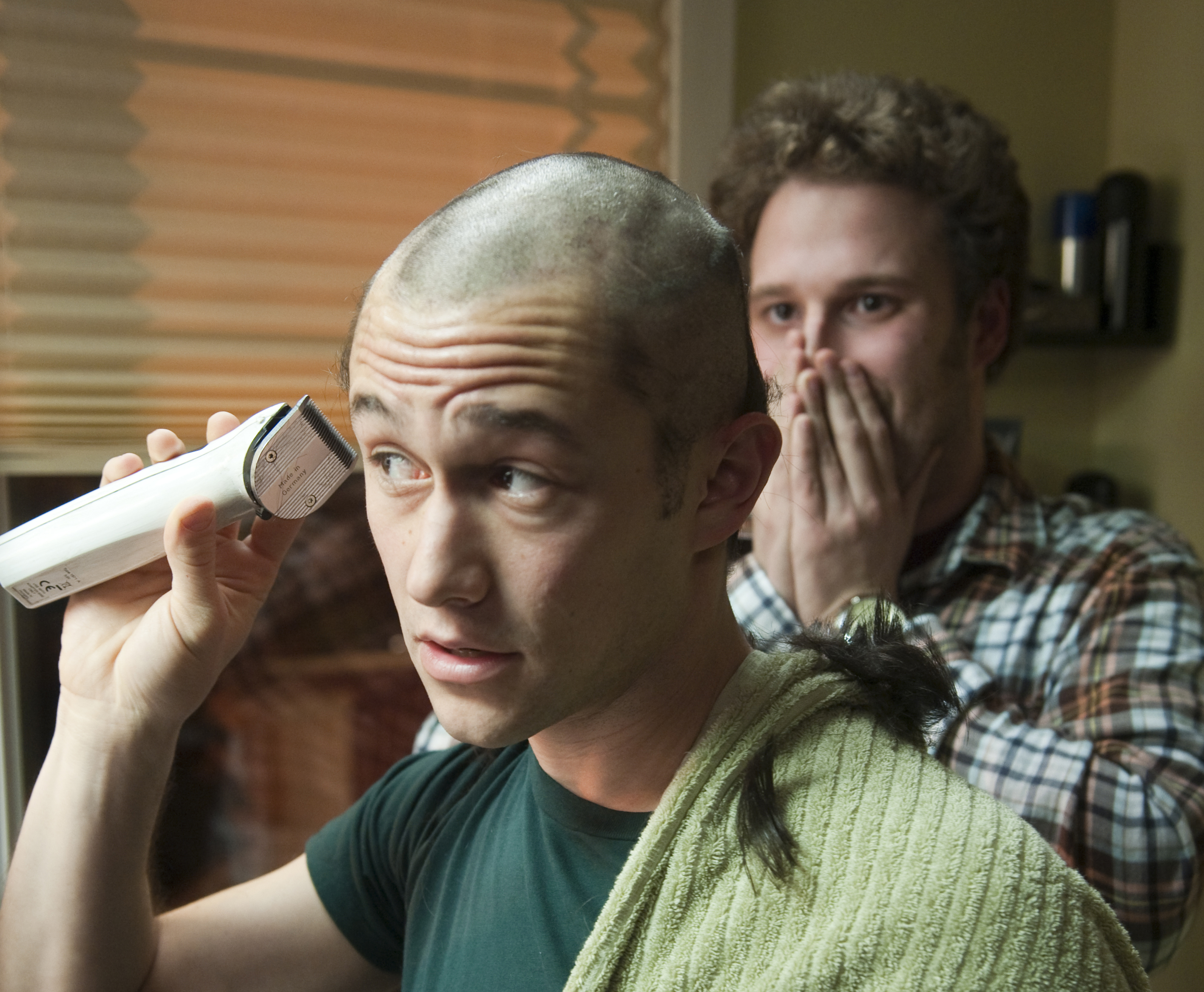
The screenplay for “50/50” by Will Reiser, a comedy writer, is loosely based on his life, as he had spinal cancer like the main character of this movie. Mostly, he writes from past experience about dealing with this disease, and delivers well-written scenes that feature how Adam deals with his cancer and how his friends react around him. But more importantly, he adds another key ingredient to making “50/50” work—comic relief. Observe the naïve behavior of the Kendrick character in her first scene, and then keep watching and listening to the dialogue in the following scenes that feature her. They’re both funny and endearing. And then there’s the improvised-in-character scene as Adam shaves his head as Kyle watches in confusion and something close to fright. And then you have Seth Rogen, who specializes in playing the goofy, profane, vulgar best friend in many other movies. Rogen is Reiser’s friend in reality and his role is essentially based on how he dealt with his friend’s cancer. Reiser and Rogen take Rogen’s usual characteristics that people have seen in other movies and just when you think it’s starting to wear thin on us, the story moves on to something else for a while before coming back to him. Don’t get me wrong—Rogen is pretty funny in most of his scenes, but when a lot of other situations in the movie are to be taken seriously, only sometimes he seems out of place. But then, Rogen’s character becomes even more endearing when we get to his payoff in the final act of the story. It’s handled in a very effective way. The drama and comedy in “50/50” blend wonderfully.

The actors in “50/50” are all wonderful as well. Joseph Gordon-Levitt, one of the best young actors in recent memory (he was also fantastic in 2009’s “(500) Days of Summer”), as Adam is so winning and endearing that when the time came for his final surgery, I was almost as worried about what his outcome would be as he and his family and friends were. There’s one scene in particular that is just heartbreaking—it’s when he finally snaps and lets out all of his anger on the night before his surgery. I sure hope he gets an Oscar nomination for this performance. Seth Rogen, like I said, is more than a smartass best friend. Angelica Huston avoids the cliché of overbearing mother and makes her character more three-dimensional than she starts out with when she hears the news. Philip Baker Hall and Matt Frewer steal their scenes together. And then there’s Anna Kendrick, the Oscar-nominated actress from “Up in the Air” and who was also in the “Twilight” movies. She always has a charming screen presence and makes her character likable, always. I will watch her in any movie, even if it’s just a brief appearance. Many reviews of this movie have complaints against the Bryce Dallas Howard character because of her actions as the movie progresses. I have no complaints because even if what she did was a wrong move, I believe she did learn her lesson and actually sympathetic towards her in her final scene.

With great acting and a great screenplay, “50/50” is a movie dealing with cancer in a touching but also funny way. It reminds us that when faced with a situation like this, there are only two ways to get through it—with tears or with amusement. This is one of the best films of 2011.

The Adventures of Tintin (2011)

3 Feb

images

Smith’s Verdict: ***1/2

Reviewed by Tanner Smith

“The Adventures of Tintin” is a welcome callback to exciting adventure films for families to enjoy, and also, its opening credit sequence is a callback to those wonderful animated opening-credit sequences that are the perfect ways of letting us know what we’re in for (remember the exciting animated opening-credit sequence in “Honey, I Shrunk the Kids,” for example). While the actual movie is done in motion-capture computer animation, the opening-credit sequence in “The Adventures of Tintin” is back to the traditional hand-drawn animated style (with help from computers).

By the way, since we’re on the subject of credits, have you noticed that these opening-credit sequences are very rare? Usually, movies will show what should be the opening credits at the end, as if we‘re supposed to be surprised by who directed it or wrote it. (To be fair, I know movies just show the title at the opening to get the movie going.) Some movies that do have credits at the opening just show them during the opening scene, as if the editors don’t care how the credits are shown. But with opening credits, you can really get your audience invested in what they’re about to see. While the credits appear, have some creative visuals and have some exciting music. I was glad to see that kind of sequence in a movie again, and here it is in “The Adventures of Tintin.”

“The Adventures of Tintin” is based on Herge’s classic comic books from long ago, and is also director Steven Spielberg’s first animated feature—and in 3D, no less. It’s an imaginative, exciting adventure that features some stunning action sequences and keeps the journey lively as it goes along. Spielberg must have been studying his Indiana Jones guide to remember what makes adventures exciting to execute.

Tintin (Jamie Bell) is a young, lively investigative reporter that apparently has been all over the world, as things in his apartment suggests (I must admit I’ve never read the original comic books), solving many mysteries and making them into stories for the newspaper. He has a loyal dog named Snowy, who is very gifted and possibly even smarter than Tintin. Sometimes on the same cases as him are two bumbling police detectives named Thompson and Thomason (Simon Pegg and Nick Frost, showing great comic relief)…they’re not particularly reliable because they’re so dim.

Tintin purchases a model ship called the Unicorn and believes that there’s something special about it, since the mysterious Sakharine (Daniel Craig) is trying to get his hands on it. Tintin does find a very important clue hidden inside the ship and later meets up with the rarely-sober Captain Haddock (Andy Serkis). Haddock’s seafaring ancestors have hidden a treasure long ago, which Sakharine and his crew are seeking. So the race is on to find many clues that lead to the treasure’s location.

“The Adventures of Tintin” uses entire motion-capture style animation. It’s when an entire movie is digitally animated after live actors perform their roles, in black box theater, with sensors all over their bodies. With this animation, you can do whatever you want. In “The Polar Express” and “A Christmas Carol,” in particular, this style of animation was really taken advantage of because with this technology, you can really play around with atmosphere and create some sensational energetic scenes.

Take a chase scene late in the movie, where Tintin and Haddock are after an important clue in Morocco, and the bad guys are seeking possession of it as well. There is one shot that lasts for about five minutes as the chase continues—the shot swipes from spot to spot and goes all around the place, further intensifying the action. That’s a marvelous visual shot, and it shows just how far this motion-capture computer animation can be pushed.

There are other sensational action sequences in the movie—Tintin, Snowy, and Haddock must escape from the villains on their ship after being captured; they hijack a small plane and must learn to land it, and fast; and there’s also a flashback involving the back story of the life-sized Unicorn that seems pretty heavy. These scenes are exciting and well-crafted.

The human characters in this movie certainly look better than the other characters used in other motion-capture movies. Tintin does look very human, but I must ask, why do the other characters resemble the doll-like figures in “Monster House?” They either have big heads or big noses, but then again, I don’t care—at least the eyes aren’t too big or too small to be creepy. There is one exception, aside from Tintin and that is the villain Sakharine.

By the way, I must ask, was it the animators’ intention to make Sakharine resemble director Spielberg?

The performers/voice-actors are well-chosen. Jamie Bell gives Tintin an appealing, intense curiosity and carefully avoids steering into blandness. Andy Serkis is wonderful as the constantly-drinking Haddock, who is Tintin’s sole human ally and provides some great comic moments while on this crazy adventure. I’m not really surprised—Serkis is probably considered the king of motion-capture. Remember, this is the man who played Gollum in the “Lord of the Rings” movies and Caesar in “Rise of the Planet of the Apes.”

With the right blend of humor and action, and a first-rate technical look to the film, “The Adventures of Tintin” is an ambitious, well-crafted adventure movie. I hope there’s a sequel so these new Spielberg adventures can continue; especially since I doubt people will be expecting “Indiana Jones 5” pretty soon. It has a lot of energy and enough potential to become a film series.

Source Code (2011)

30 Jan

© 2010 Vendome Pictures

Smith’s Verdict: ***1/2

Reviewed by Tanner Smith

If I said “Source Code” was a mix between “Groundhog Day” and “Inception,” people might think I copied Richard Roeper’s first comment in his review. Good thing I actually checked out his review before I wrote mine. Actually, I’m thankful because I realize that saying a title is a mix of something and something, where does that leave the title I’m really referring to? Think about that. But seriously, “Source Code” is a strange, bewildering, and terrific science-fiction thriller with so many ideas, all of them intriguing.

As the movie opens, a man named Colter Stevens awakes from a nap and finds everything around him strange. So right away, we’re interested because he’s wondering the following: Why is he on this Chicago commuter train? Who is this lovely woman who apparently knows him? Why is she calling him “Sean?” And more importantly, why does he see another face looking back at him in the mirror of the restroom? All he knows is that his name is Colter Stevens and he’s a helicopter pilot. All we know is that he’s played by Jake Gyllenhaal.

It’s a mystery that I’m already interested in seeing solved. Without giving too much away from the story (actually, going by what the TV spots show), the train explodes with him on it. But wait! He awakens in a secret Army lab without a scratch. How can this be? Colter knows he’s himself again (and not “Sean”) and the people holding him know him as well. A scientist named Colleen Goodwin (Vera Farmiga) talks to him and tells him that the train was destroyed by a terrorist bomb and is not the only one. Apparently, a bigger explosion is set for the middle of Chicago. Where does Colter fit into this? Well, the brain of one of the unfortunate souls on that train saved memories of the last eight minutes on the train before the explosion.

OK, so I can’t say why Colter himself is involved because it would give something in the plot away. What I’ve just written is the first fifteen minutes of the movie. But let me continue to say that the rest of the movie (I’m only setting a small description) features Colter as he relives the final eight minutes on the train before the explosion to find the bomb and identify the bomber. He has to do this until he gets it all right. And of course, with these multiple trips, Colter is experiencing it all over again, while the passengers always feel like this is the first time this happened.

So with that last statement, there’s the “Groundhog Day” distinction. With the futuristic technology that allows space travel, there’s the “Inception” distinction. There’s nothing wrong with that at all—this is fun. I’m excited and riveted. I’m racing along with the likable Colter, trying to piece together everything. Even if this technology doesn’t exist, it does seem plausible enough for this movie. This is the kind of science fiction film that is set with ideas. It’s not just special effects that are brought to the screen that impress us—it’s a sense of wonder and mystery that wins us over.

There’s a human element to “Source Code” in that Colter thinks about what it’d be like to have less than eight minutes to live. He wants to contact his father, with whom he hasn’t spoken in a long time. He also feels sympathy for the female passenger named Christina Warren (Michelle Monaghan), “Sean’s” close friend who has had a crush on him for the longest time. Soon, through these multiple trips, Colter begins to care for her and feels like he should save her and change fate. He also gets to know some of the other passengers, including a comedian preparing for a show in Chicago, and sees that he can’t just let them die.

Jake Gyllenhaal is a solid lead—it should also be mentioned that he’s solving a more complicated mystery here than in “Donnie Darko.” We believe what he’s going through, mainly because we know as much as he does to begin with, but he’s also a stable anchor for a protagonist, showing a blend of cockiness and confusion. Michelle Monaghan is also good as the beautiful train passenger who is also living the same event over and over but just not noticing it and wondering what is going on with her friend lately (each time). How can you not like Michelle Monaghan? She’s a lovely woman and shows a lot of credibility as an actress. That can also be said for Vera Farmiga, who takes over with her strong presence every time she’s on screen.

“Source Code” is a powerful, ingenious thrill ride. Why wasn’t this released in the summer is beyond my understanding. Maybe it’s the length of 93 minutes, while other summer blockbusters are close to or over two hours in length. Maybe it’s the title, I don’t know. I do know that I wasn’t bored—there wasn’t one moment when I was checking my cell phone for the time. I was intrigued by everything on screen. I’m not quite sure I figured out everything that was resolved in the final half, but I will see it again to see if I can solve everything along the way.

NOTE: I have seen “Source Code” several other times since I wrote this review. I still have a bit of trouble trying to analyze every sci-fi element. I decided, let it be. It’s thrilling sci-fi. Deal with it.

We Need to Talk About Kevin (2011)

27 Jan

images

Smith’s Verdict: ***1/2

Reviewed by Tanner Smith

If you’re feeling happy, like you’re finally in control of your life after a hard day or week, “We Need to Talk About Kevin” is definitely not the film you want to see sometime soon. This is a film so bleak and disturbing that even the popular “slasher-film” genre would be considered watchable. If you’re happy or relieved right before watching this movie, this film will change that quickly.

However, this is undoubtedly a powerful film—skillfully-made and powerfully-acted. The horror adds to the drama that’s being presented, which makes the film more effective. There’s no reason why one shouldn’t feel unpleasant after watching this film. By that definition, I should probably hate it. But how can I ignore or pan a film that’s done well by the right people?

The story, based on the novel of the same name by Lionel Shriver, is told in a jumbled series of events, leaving us to piece everything together. But we figure out quickly what the central conflict is. As the film moves from past to present and back again, we see a woman named Eva (Tilda Swinton), who is not only depressed and practically lifeless, living like a zombie pretty much, but is also glared upon among society. In an early, disturbing scene, we see her walk down the street, minding her own business, when a woman she obviously knew in the past comes up to her and sarcastically asks, “Enjoying yourself?” Then she slaps her hard in the face and shouts, “I hope you rot in hell!”

How could this happen to a woman who keeps to herself? Well, we see flashbacks of what led to this terrible life, as Eva was married to nice-guy Franklin (John C. Reilly) and gave birth to her firstborn child Kevin. These flashbacks take up most of the movie, as we see Kevin as a baby, then a toddler, then a little kid, and then as a teenager. And right from the cradle, we know that something is definitely wrong with this kid.

To his father, Kevin is a nice, cute kid, but to his mother, Kevin is a budding sadist and knows exactly how to psychologically torture Eva, doing things so cruel that at one point, Eva can’t take anymore and throws her own son across the room, breaking his arm. But that’s just at his age of 6 or 8. When Kevin is a teenager, things get creepier, as we get more hints of his sadism—he loves to shoot his bow-and-arrows, he has an odd look on life that he isn’t afraid to express freely, and things get even worse when Eva suspects that Kevin might have been responsible for the glass eye the youngest daughter now has to wear.

It’s no secret that Kevin is a sociopath, as we see in present times the survivors of Kevin’s high school massacre. And this is Eva’s way of coping with it, and also having to deal with the people who despise her for what her son did. Some are hostile and brutal towards her, like in the scene I mentioned before; a few others, including a young survivor in a wheelchair, seem to understand that it wasn’t her fault.

From what we see in the flashbacks, it probably wasn’t her fault. It wasn’t even entirely Franklin’s fault either—he’s nice, attentive, somewhat ignorant but sweet-natured. However, you could make the argument that because he teaches Kevin to shoot a bow-and-arrow, that makes him responsible for Kevin’s mass murder. But you can tell the kid had a problem even before then, so it’s unfair to blame Franklin.

Lynne Ramsey, director and co-writer of “We Need to Talk About Kevin” makes brave choices here to make this movie far from ordinary. The past/present time-switches are one thing, but they’re also placed without pattern, which confuses but mostly keeps you wondering. There aren’t any parent/teacher meetings involving Kevin acting out in school—heck, we never even see Kevin interact with students. And despite the title, Eva never really does talk about Kevin with someone. Not with teachers, counselors, or even her own husband. Some choices Ramsey makes are somewhat grating (such as an early scene where Eva is participating in some sort of tomato festival, which looks like she’s soaking in a lake of blood), but other elements work very well.

Tilda Swinton, as Eva, is just perfect. You can easily feel the pain she’s going through as a person who is going through shock and simply can’t take anymore. Her son has committed a horrific crime, taken lives, and ruined lives (including hers), and now she’s stuck wondering if she really is to blame, or if she was the wrong woman to deliver the wrong child. Swinton’s portrayal is sometimes painful to watch, but that’s what makes it an excellent performance.

John C. Reilly is suitably wholesome, but the real supporting role to be noted is of course Ezra Miller as the little psycho himself, Kevin. If there was evil in this world, you can easily find it in this kid. Miller gives a creepy performance, keeping us uneasy as he (assumingly) secretly plans his attack. It’s a brave acting job.

“We Need to Talk About Kevin” is very bleak. Needless to say, this is definitely not for everyone. It may hardly be for anyone. This is not entertaining; not even by ordinary horror-film standards. But this horror-drama is far from ordinary. It’s here to give an effective emotional response, and it has succeeded all too well that even if it makes me feel uneasy, at least it did its job in effectiveness.

Thor (2011)

27 Jan

images

Smith’s Verdict: ***

Reviewed by Tanner Smith

I shouldn’t be too surprised that Kenneth Branagh, the great cinematic adaptor of Shakespearean work, directed a movie based on a Marvel comic book series. I mean, after all, every director likes to try new territory. I mean, look at Ang Lee—he made a “Hulk” picture and then followed it up with “Brokeback Mountain.” And let’s not beat around the bush—Branagh’s “Thor” is a fast, energetic entertainment. It’s well-made, exciting, and features a charismatic new superhero brought from the page to the screen.

Thor (Chris Hemsworth) isn’t your ordinary superhero (boy, that’s a phrase I thought I’d never use). In the land of Asgard, within the “nine realms,” he’s the arrogant god of thunder with an all-powerful hammer. Ascending to the throne by his father Odin (Anthony Hopkins), his ceremony is interrupted by otherworldly beasts known as the Frost Giants of Jotunheim, who are at war with Asgard. In anger, Thor attempts to damage the land of the Frost Giants, which only risks further war.

This nearly-half-hour-long prologue is undoubtedly silly in its storytelling, but it is necessary in developing the continuing story, and it includes the expository rules-and-regulations of this world for us to watch out for. And I have to admit, the battle between Thor and his friends vs. the Frost Giants is well-edited and very riveting.

But the movie really picks up at the half-hour mark, as Thor is ridden of his godly powers (and his hammer) and banished to modern-day Earth for his egotism. There, he meets scientists Jane Foster (Natalie Portman), Erik Selvig (Stellan Skarsgard), and Darcy Lewis (Kat Dennings).

This is the most interesting part of the movie because it shows Thor without his powers and having to deal with being in a strange world as a human. At first, he isn’t so accepting of it—and why wouldn’t he, after going from hero to zero? But what gives the story a breath of fresh air is that this arrogant, stubborn barbarian is willing to learn how to adapt. For example, he has a drink of coffee, he enjoys the drink, and he smashes the cup and yells for more. Jane tells him he can’t do that and Thor just accepts that.

Anyway, there’s a conflict back home involving the Frost Giants seeking to kill Odin, and Thor’s brother Loki (Tom Hiddleston) rising to power after Odin is suddenly in godly traction, I should say. (By the way, am I the only one confused that gods just slip into comas? But I digress.) And then there’s the matter of Thor seeking to gain his power pack, and his hammer held by the government who are trying to figure out what this is. And wouldn’t you know it—it’s the S.H.I.E.L.D. group that’s holding it. Who else would it be, right? Luckily, that annoying, ominous, eye-patch sporting Samuel L. Jackson only waits until after the end credits, for yet another setup to the upcoming superhero epic “The Avengers.”

The stuff with the Frost Giants and the war between Asgard and Jotunheim is pretty clustered and clumsily handled. While it does make some neatly-paced action scenes, I’m not sure I understand what’s really at stake. We start out believing that these Frost Giants are the bad guys and yet Thor grows to try and stop Loki from forming an annihilation of their land. I don’t know, maybe he’s figured out that all life is sacred.

Chris Hemsworth portrays an appealing Thor. He’s strong, but has a heart of gold. He’s arrogant, but knows when to focus. He’s wild at times, but he tries to make something out of himself. Hemsworth brings Thor more dimensions than you’d expect, especially if the character is going to change from a god to a mortal and having to learn from it.

The three people befriended by Thor are also well-cast. Natalie Portman is lovely and likable as always, although I probably could have used a stronger love story between her character and Thor. As it is, it seems rushed and forced, but it’s not Portman’s fault. Stellan Skarsgard is outstanding as Erik, who does more than deliver helpful advice. On hand for comic relief is Kat Dennings as deadpan cynic Darcy, who has some of the funniest lines in the movie (one of which is, “You know, for a crazy homeless guy, he’s pretty cut”).

Now, I want to talk about Thor’s brother Loki, who becomes the villain. When I first saw this movie, I didn’t find Loki to be a charismatic, or even interesting, arch-nemesis for Thor. Right from the get-go, I thought he might as well be walking around with a thought bubble hovering over his head, saying “Oh you’re so dead.” Don’t tell me I didn’t get it. I got it, alright? It’s the Shakespearean element of the jealous brother looking to be rid of his more skillful older brother so he can gain no more attention than him, and so he goes mad with power and decides to further declare war over these Nine Realms. And particularly, he’ll destroy the Earth. Of course.

The truth is, watching the film a second time, I see that I may have missed a few things with this character and realizing that, I can see the effective buildup to this character. You totally buy why he would do these things. But once he goes gain power, he’s still as disappointingly adequate as I remember.

So even if the villain isn’t that charismatic, the screenplay can be a little rushed, and elements from this other-world can seem ridiculous, “Thor” is still a grand production, as you’d expect from Kenneth Branagh’s films. You can tell that Branagh, and designer Bo Welch, went all out to make everything creatively huge—it’s more than notable that the sets and costumes really stand out. And Thor himself is how I imagined him to be, with credits going to his costume design and of course the performance by Chris Hemsworth. Add an interesting fish-out-of-water tale featuring Thor adapting to Earth, as well as some Shakespearean elements to be found here, and “Thor” is an entertaining superhero tale.

NOTE: I really hate to have to say that about Samuel L. Jackson’s Nick Fury, since he’s one of my favorite actors. But his coolness has worn out its welcome after the second time he’s brought up the Avengers project.

Mission: Impossible–Ghost Protocol (2011)

25 Jan

mission-impossible-ghost-protocol-tom-cruise-brad-bird-burj-khalifa-dubai

Smith’s Verdict: ***1/2

Reviewed by Tanner Smith

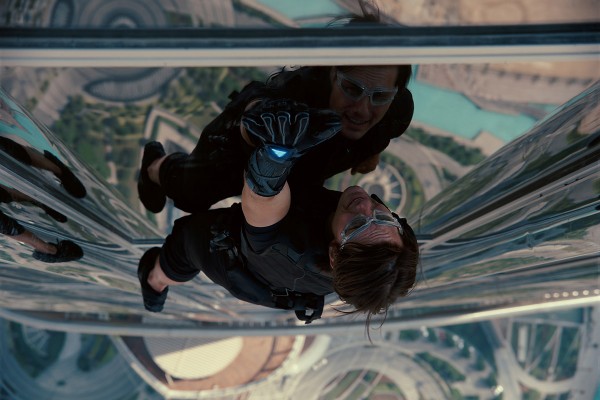
There’s no doubt about it—the best action sequence in the fourth “Mission: Impossible” movie (subtitled “Ghost Protocol”) is the one in which Tom Cruise’s Ethan Hunt has to scale a skyscraper. But not just any skyscraper—the Burj Khalifa in Dubal. The world’s tallest building. Ethan has to scale the glass windows from the outside, more than a hundred stories up. He’s equipped with special gloves that stick to a surface, which of course malfunction so that Ethan can hang on for dear life.

Why doesn’t anyone else do this? Simon Pegg’s Benji’s reponse is simple: “I’m on the computer.” Jeremy Renner’s Brandt’s response: “I’m…the helper.” And Ethan is…well, he’s the hero. He was going to scale that tower no matter what. What floor does he have to stop at? 130.

Pulling off a sequence like this is tricky enough, but then I found out this piece of information—apparently, Tom Cruise did his own stunts. Wait…what?

OK, maybe some heavy wirework was involved or there were unseen footholds around, but Tom Cruise reportedly insisted on performing his own stunts. I simply can’t believe it. There’s a shot where we actually pan out from Cruise scaling the building to where we get a full shot of the place, and I simply can’t believe that anybody would really try this. But apparently, Cruise isn’t CGI in these shots and we really are looking at him. This either means that Cruise is very brave or very stupid.

Either way, this whole sequence is impactful. I have an underlying fear of heights and seeing this on the big screen gave me vertigo. It’s that impressive.

This may be the standout, but there are other terrific action sequences in “Mission: Impossible—Ghost Protocol,” an exciting thriller that comes along like the lost James Bond picture. We have it all—stunts, chases, explosions, neat gadgetry, a megalomaniac villain with a thuggish henchman, and wall-to-wall action. It’s a lot of fun and easily the best entry in the “Mission: Impossible” franchise, proving that sometimes the fourth entry can be the charmer (see “Live Free or Die Hard” or “Star Trek IV”—just please don’t see “Superman IV” or “Batman and Robin”).

OK, maybe the story is a bit muddled and somewhat confusing in that certain things are left unsaid, but there are still some kick-ass action sequences to turn this into a thrill ride to make us care for it. It begins with a prison break, as Impossible Mission Force (IMF) need Ethan back to take care of something big. Ethan is stuck in a Russian prison, so agents Benji and Jane (Paula Patton) break him out in a nicely-done opening scene. The team is hunting down the international terrorist Hendricks (Michael Nyqvist), a genius who is looking to gain control of nuclear weapons. He must be stopped before he succeeds in unleashing nuclear war—he believes that the way to gain world peace is to start over, from the rubble.

Hendricks and his brutish sidekick Wistrom (Samuli Edelmann) blow up the Kremlin and frame IMF, forcing “ghost protocol.” But Ethan, Benji, Jane, and analyst Brandt are still carrying out the mission.

Aside from the skyscraper scene, there are some neatly-staged sequences in the movie. Of course, a lot of these aren’t plausible, but they are thrilling. There’s one in particular that comes in the final half of the movie where the team is in Mombai, and Brandt jumps into a ventilating shaft somewhere. I guess he wears a steel belt so that Benji can keep him safe in the shaft via a mobile magnet. Of course, there are close calls in that sequence as well, as you’d predict. But close calls are what make action scenes all the more exciting.

I liked the four central cast members. They do appealing work and I was interested in following them because they were entertaining. Tom Cruise is on hand for action as he always is in these movies (although you have to wonder, in those sequences where he’s running like mad, if he’s going crazy). Jeremy Renner is apparently stepping in for Cruise in a fifth “Mission: Impossible” movie; he’ll have earned his position as a new lead. (I forgot to mention that his character Brandt isn’t just an analyst—he has field agent training.) Simon Pegg has nice moments providing comic relief. I hate to actually have to type this in a review, but…Paula Patton is hot! And she gets some neat girl-on-girl action in a fight scene between her character and a sexy female assassin played by French actress Lea Seydoux.

This is the live-action film debut of the great animation director Brad Bird (“The Iron Giant,” “The Incredibles,” “Ratatouille”) and it proves to be a spectacular one. “Mission: Impossible—Ghost Protocol” is alive and entertaining with nifty action sequences and an exciting feel.

And the next best thing I can say about the skyscraper scene is this: I wish I had seen it on IMAX…or maybe I don’t. Like I said, I have a fear of heights.