Archive | 2009 RSS feed for this section

Star Trek (2009)

22 Feb

star-trek-2009-sample-003

Smith’s Verdict: ***1/2

Reviewed by Tanner Smith

“Star Trek” has generated many fans with its long-running TV series, originated from Gene Roddenberry, and numerous films. Now here is the prequel in which the characters, that fans have grown to know and love, meet each other for the first time. You’d think from seeing the cast list of this film that the actors seem be playing trick-or-treat with the “Star Trek” characters because they’re so young. But that’s the fun of “Star Trek”—this movie is a prequel to the show and other films. Every superhero story (or any other popular franchise) requires an origin story and here we have the origins of Capt. James T. Kirk, Mr. Spock, Uhura, Bones McCoy, Sulu, Chekov, and Scotty. So it makes perfect sense why the characters are younger this time around.

“Star Trek” is directed by J.J. Abrams who delivers slam-bang action sequences that are all great fun. And seeing as how special effects have improved long since the original show, all of the effects in the action scenes are extremely well done. More importantly, I wasn’t bored. The film looked great, the special effects were first-rate, and the characters were interesting, which made the action all the more exciting.

We have the younger versions of the well-known “Star Trek” characters here and the actors seem to be channeling their adult counterparts. We meet James T. Kirk as a rebellious, hotheaded young man (played by Chris Pine) who gets into all sorts of trouble, even when he believes he is right about how to take control when flying a spacecraft. This raises an issue with young Spock (Zachary Quinto) who created the flight-simulation test that James has taken three times now.

For fans of the “Star Trek” franchise, this is great fun. Seeing James and Spock as young adults (and at each other’s throats every now and then) will delight many viewers. Without giving much away, I have a feeling they’ll be even more delighted when the old Spock (reprised by Leonard Nimoy) arrives from the future and meets young James. Now see, young James does believe that this is Spock Prime, but he just can’t believe that he’ll be Spock’s dear friend, as Spock Prime calls him, because the young Spock that he already knows is an emotionless, somewhat-pompous guy.

Yes, time travel is part of the movie’s plot, which could explain the origin story itself.

The main villain in “Star Trek” is the evil Romulan Capt. Nero (Eric Bana) who, along with his forces, are destroying planets (including Spock’s home planet Vulcan) and going through (and creating) black holes that devour everything in sight. James and Spock are two of many space cadets chosen to do battle with Nero, so it’s onboard the U.S.S. Enterprise in its visual glory. Among the cadets are Communications Officer Uhura (Zoe Saldana), Doctor Leonard “Bones” McCoy (Karl Urban), and Navigators Sulu (John Cho) and Chekov (Anton Yelchin). Scotty (Simon Pegg) will join later, but I won’t go into it—I don’t want to go into heavy detail as to how everything comes to anything in this film, but then again, I already mentioned Spock Prime. One weakness with the film is that sometimes, the situations feel just a bit rushed.

Among the brilliant action scenes—the opening space battle, the scene in which James and Sulu use swords and fists to fight off a couple of Romulans after landing on a platform in the air from which the Romulans are drilling a hole into the core of Vulcan (…OK that’s cool with me), and the final climax. Each of these are thrilling and great entertainment.

The characters in this movie are well-developed. They have to be, since their characters will become the people that “Star Trek” fans know and love already. They are all given their moments and they all work fine. Spock, in particular, is half-human and half-Klingon, so he is constantly taunted by his peers as a child and by the Ministry of Vulcan. Klingons supposedly have no emotion and Spock is always trying to betray emotion, but being also half-human, it’s hard. You really want to see him lose it and shed a tear or even smile once in a while. And then you have Spock Prime, who seems more human. You get the two of them together and…what can I say? It’s satisfying. Also satisfying is the relationship between James and Spock—their beginning rivalry and their eventual teamwork in the final climax.

The actors are all solid here—Chris Pine is suitably cocky and charismatic as James T. Kirk, Zachary Quinto does a nice understated job as Spock, and Leonard Nimoy is excellent in reprising his role from the original show and films. Zoe Saldana and Karl Urban are spot-on in physique and personality of their older counterparts; and John Cho, Anton Yelchin, and Simon Pegg are also fun company. Eric Bana is quite effective as the villain.

I need to be honest—before I saw this movie, I had never seen a single “Star Trek” TV episode or movie. So this was my introduction to the “Star Trek” franchise. I knew a few things about the show and films—I just hadn’t seen either of them. This is a solid introduction for me and it deserves a solid recommendation from me. It’s a well-done space opera that packs the punches and delivers the goods. I look forward to checking out any other “Star Trek” film (or maybe an episode) sometime soon. Or maybe there will be a sequel to this one coming soon…can’t wait!

Harry Potter and the Half-Blood Prince (2009)

21 Feb

bilde

Smith’s Verdict: ***

Reviewed by Tanner Smith

After being somewhat disappointed by “Harry Potter and the Order of the Phoenix,” which was the fifth film in the popular “Harry Potter” series, I found myself pleased with the sixth film, “Harry Potter and the Half Blood Prince.” This film sets up the final act (“Harry Potter and the Deathly Hallows,” which is released in two parts—part 1 in November 2010 and part 2 in July 2011) and leaves us enchantment, terror, and a few laughs along the way.

Everyone in the Hogwarts world is now convinced that the evil Lord Voldemort has returned. We all know that there must be a huge climactic battle between Harry Potter and Lord Voldemort. But before that happens, we get “Harry Potter and the Half Blood Prince,” in which Harry and headmaster Dumbledore must receive information from the past in order to find a way to vanquish Voldemort. But it can be assured that the battle will not begin here—in fact, Voldemort doesn’t even appear in this film. Instead, he has his army of Death Eaters to make sure things are going according to plan. And there is a plan, mind you.

The whole movie is a foreboding of what may occur in the final entry (or entries, considering the seventh and final book in the series is going to be adapted into two films instead of one). But this is necessary—you have to pay attention to what is happening so what you’ll see in the final entries will make more sense.

The Death Eaters are on the move and are on the path of destruction. As the movie opens, we see that they are the cause of a bridge collapsing with many innocent Muggles walking along it. Then we cut to Harry Potter (Daniel Radcliffe) reading a newspaper in a subway diner—the headline reads, “Is Harry Potter the Chosen One?” “Who’s Harry Potter,” a cute waitress asks Harry. Harry has a crush on this girl and just says that Harry Potter is nobody. She tells him she’ll be off work at 11. But a possible date will have to wait because Dumbledore awaits Harry nearby.

Dumbledore (Michael Gambon) gives Harry an important assignment for Harry’s sixth year at Hogwarts—to retrieve any kind of information from Professor Horace Slughorn (Jim Broadbent) about what he has told Tom Riddle a long time ago. Tom Riddle, as you recall, was the young wizard who became Lord Voldemort. Dumbledore shows Harry a collection of memories from Voldemort’s past as a boy—when Dumbledore first met him and a distorted discussion of forbidden magic between the boy and Slughorn. Dumbledore leaves Harry to the task of befriending Slughorn and somehow getting him to reveal what Slughorn has told him. This information could be useful in the final entries. It contains a key as to how Voldemort can be defeated.

Meanwhile, Harry’s student enemy Draco Malfoy (Tom Felton) is being initiated into joining Voldemort’s army of Death Eaters. But that’s not all—Professor Snape (Alan Rickman) is making sure nothing bad happens to him. Snape has joined the army as well, but still, Dumbledore trusts him. This is a sign that Dumbledore is reaching his weak points. Also back is Bellatrix Lestrange (Helena Bonham Carter), who killed someone very important to Harry and is continuing to raise hell. But at school, while Harry is trying to persuade Slughorn, he and his friends are faced with teenage angst. Harry is attracted to Ron’s sister Ginny (Bonnie Wright); Ron Weasley (Rupert Grint) is in a relationship with the school vixen; and Hermione Granger (Emma Watson) is jealous because she has developed somewhat of a crush on Ron, though she won’t admit it. I love that Harry’s best friends are interesting again, seeing as how they were basic bystanders in the previous film.

The whole movie is a setup, but we’re interested because we have grown to love these characters after five movies and we just can’t wait to see what happens here before we can’t wait to see what happens in the final entries. Jim Broadbent is an absolute delight as Slughorn—he’s a brilliant character actor and somehow I had the feeling he’d show up in a Harry Potter film sooner or later. The stuff with the kids is interesting because it gives us more rooting interest and Dumbledore has become even more appealing than Harry in this film. Michael Gambon plays Dumbledore as a wizard of action (a la Gandalf in “Lord of the Rings”) and is given much more to do than before. Also given more to do than before is Alan Rickman as Snape—his character is more chilling this time around. The final half is amazing—it takes place in a dark cavern where danger awaits, and then it returns back to Hogwarts in a great conclusion that reaches the emotional impact of the tone. Also, the cinematography in that cave is truly amazing. “Harry Potter and the Half Blood Prince” ends with a bang, although a “To Be Continued” sign would have been appropriate.

And in the final entries—“Harry Potter and the Deathly Hallows Part 1” and “Part 2”—it will be Harry, Ron, and Hermione, the three engaging wizards we care about, in the mix of something bigger awaiting. But in the end, it will be Harry Potter alone, dead or alive. What will happen?

NOTE: Don’t let the PG rating fool you—the “Harry Potter” films get darker and darker. This is no exception.

(500) Days of Summer (2009)

14 Feb

500_days_of_summer_2

Smith’s Verdict: ****

Reviewed by Tanner Smith

“(500) Days of Summer” is the best romantic comedy to come around in a long, long time. There were many terrible ones and a few mediocre ones, though there have been a few fair ones, but none as fantastic as this one. I’d even put this in a class with Woody Allen’s “Annie Hall” and that’s a pretty highly-regarded class indeed. It’s a romantic comedy for those who normally don’t go to romantic comedies because there were so many bad ones. You know it’s different from the hilarious disclaimer at the beginning, which states it isn’t based on anybody in particular. (“Especially you Jenny Beckman. Bitch.”)

But the situations that ensue in this story of boy-meets-girl feel like they’ve happened to you. Even if they haven’t, you still feel the reality of the situation. This is a romantic comedy that doesn’t result to cheap ploys such as sappy overhanded drama or ineffective, unfunny gross-out gags. The comedy comes from the realism, which is portrayed in a pleasant but unforced fashion.

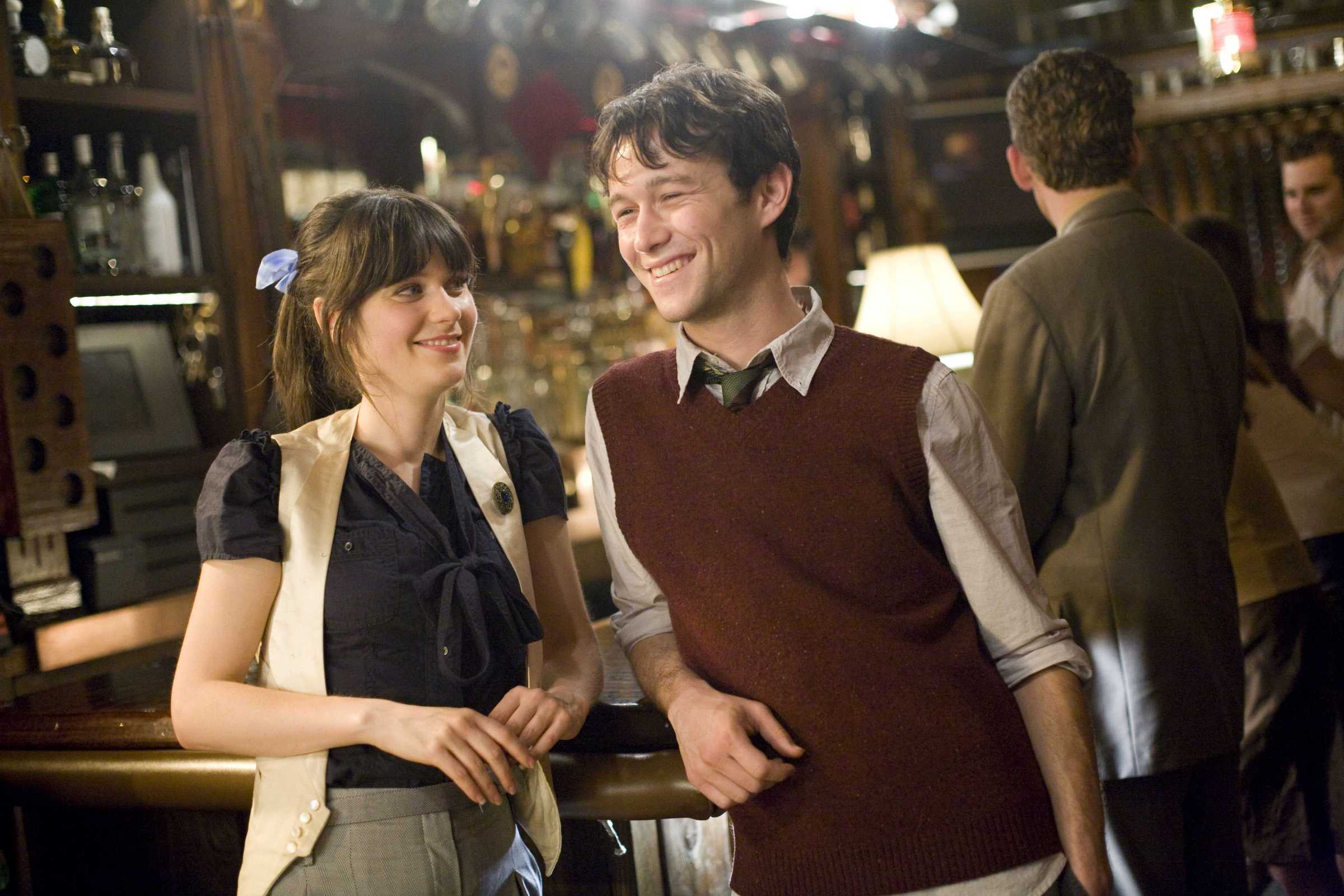
The film chronicles the 500 days surrounding the romance between Tom (Joseph Gordon-Levitt) and Summer (Zooey Deschanel)—from their first glances to their final goodbyes. Everything in between is complicated enough, that Tom would rather remember the good times of the relationship than the bad. Wouldn’t we all, though? The story is told in a non-linear fashion, with a segue that ensures us of which day we’re in. Now, we already know that things aren’t going to turn out well between Tom and Summer, but it’s fun to see the events play themselves out.

Tom is a hopeless romantic who believes he’ll never find true love until he meets “the one.” Who is “the one?” Tom believes it is Summer, a realist who doesn’t necessarily believe in the idea of love. Despite this, Summer likes Tom and wants them to be friends. They hang out together, fool around together, and eventually, they start a potential boyfriend/girlfriend relationship. But will it last? Reality takes its toll, unfortunately.

“(500) Days of Summer” doesn’t result in ridiculous clichés to tell the story of this relationship. There are no silly misunderstandings where the characters think they hate each other and they mope until they realize they do. There are no stupid bullies—like an ex-boyfriend—trying to keep the lovebirds apart. Heck, Tom and Summer aren’t even necessarily “lovebirds.” Tom is the one head-over-heels in love with Summer, and it’s Summer that isn’t so sure about the idea of being someone’s romantic partner.

Instead, we have genuine chemistry between Joseph Gordon-Levitt and Zooey Deschanel, who are both excellent in their roles. Gordon-Levitt, in particular, has the same starmaking ability that made Tom Hanks a household name. I really think he’s that good. It’s his character’s story that’s being told throughout “(500) Days of Summer”—he’s likeable and convincing all the way through. And Deschanel is the kind of fun, free-spirited, attractive woman that we all wish we could meet.

Supporting roles consist of Tom’s wisecracking buddies played by the appealing Matthew Gray Gubler and Geoffrey Arend who have a lot of fun with these obligatory roles; Tom’s surprisingly-insightful younger sister, nicely played by Chloe Grace Moretz; and Tom’s boss, played by Clark Gregg. They all have their fine, funny moments here.

There’s a lot of offbeat humor throughout “(500) Days of Summer,” most of which comes from Tom as the unreliable narrator—we get many sequences that play with whimsy and perception. For example, after Tom and Summer finally have intercourse, we get a bright musical number—a song-and-dance sequence set to Hall and Oates’ “You Make My Dreams Come True.” Everyone is politely nodding/greeting and then they all join Tom as he dances with joy. This is complete with a marching band and an animated bird.

And how about the sequence shown in split-screen, differing “expectations” from “reality?” How often have we been down this road? We expect one thing—one great thing to occur the whole evening—when we wind up with something totally different than we wanted. This is my favorite scene because I can relate to it. It’s a very satisfying scene.

This humor shows that this isn’t one of those gritty indie films that try to make it feel like we’re eavesdropping on the characters. We know we’re seeing a story unfold.

“(500) Days of Summer” is as far from formulaic as you can get, and that’s one of the many reasons I loved it so much. There’s a lot to love in this movie. Aside from the perfect casting, authentic chemistry between the two leads, and a great deal of funny offbeat comedy, there are little things to acknowledge as well—the soundtrack (particularly the Smiths, which Tom likes to listen to), the whole deal with the greeting card company’s creativity or lack thereof, Tom and Summer’s attempt at copying a porno film, the satire of a sad French film when things start to go wrong for Tom and Summer, I could go on and on. Many pleasantries can be found in this wonderful, wonderful movie.

2012 (2009)

13 Feb

2012moviebooks

Smith’s Verdict: **1/2

Reviewed by Tanner Smith

John Cusack plays Jackson Curtis, a talented but struggling author of adventure novels who is divorced from his wife Kate (Amanda Peet). Kate has a new boyfriend (Tom McCarthy)—a nice guy who loves their two small children (Liam James and Morgan Lily) as much as Jackson, who spends very little time with them. Now something is destined to bring this broken family together and Roland Emmerich doesn’t disappoint with a simple solution. What is the solution? Well, seeing as how it’s a Roland Emmerich movie, you know it has something to do with massive destruction. But here’s something that makes it even harder—it’s the whole planet that’s now a hazard! We’re talking violent earthquakes, monster tsunamis, and a massive volcanic eruption that destroys all the major cities in the world like Los Angeles, Las Vegas, and Washington, D.C. We also get annihilation on Mount Everest, in which everyone must be protected from the grandmother of all tsunamis.

Wow! What a trip! Roland Emmerich and his co-writer Dean Devlin have done it again—they destroyed a lot of popular landmarks and killed dozens of people. Only this time in the movie “2012,” they’ve really gone too far—they’ve turned the whole world into the Poseidon ship from “The Poseidon Adventure.” This makes their earlier end-of-the-world movie “The Day After Tomorrow” look simple. This movie, “The Day after Tomorrow,” and “The Poseidon Adventure” are all disaster movies in which something hazardous occurs and a colorful group of people must set aside their differences in order to survive together.

But is “2012” as good as those other two disaster movies? I’m afraid, not quite. There is hardly a sense of quality character development (then again, there is hardly any quality in this movie), there are many scientific inaccuracies that would have been OK if it didn’t seem too silly, and the movie runs for almost 2 hours and 40 minutes which seems way longer, even through what the characters have to go through in the final half. But there are things I found pleasurable about “2012.” One is, even though these characters aren’t particularly well-developed, I still get an adrenaline rush watching them survive one disaster after another, barely escaping death about…2,012 times! I’ve always liked John Cusack, who is one of the most reliable actors not to get to an Oscar nomination yet, and he makes his writer character likable enough for us to root for him. The best performance in the movie goes to Chiwetel Ejiofor, who carries the movie’s major subplot. You see, while Cusack is racing to keep his family safe as the world collapses around them, Ejiofor is a geologist who really knows what’s going on and constantly argues with his superior (Oliver Platt), telling him that they need to save as many people as possible. But Platt is telling him that there’s no time and that they need to save the people they reserved for seats in secret arks (don’t ask) and not to worry about the other people. So while Cusack races to save his family, Ejiofor races to save what’s left of humanity and that’s kind of interesting to me. Plus, Chiwetel Ejiofor is an actor who has one of those voices that you can’t help but listen to in times of warning and trouble.

There are some pretty nifty disaster scenes, including the destruction of Los Angeles. These special effects are definitely top-notch. The adventure is set in motion when Jackson grows suspicious after what he had heard from wacky radio operator Woody Harrelson (a hoot), who warns Jackson of the coming apocalypse and shows him a video he made indicating when it would happen (reminds me of the video in “Jurassic Park”). So when Jackson returns home in a stretch limo, he picks up his wife, her new boyfriend, and the kids and they drive away right when the monstrous earthquakes (excuse the pun) shake everything up. To me, it’s fun when you’re driving away from something and there’s someone shouting, “Car! Tree! Donut!” (The big plaster donut rolls along the streets of LA.) There are also attempts at black humor, such as when the big Randy’s Donuts plaster donut comes sliding down the street and when the boyfriend says to take the freeway, there’s an instant cut to the freeway being destroyed as well. Now, it’s impossible to outrun falling buildings and earthquakes in a stretch limo, but I have to admit I didn’t care. All I kept thinking was, “GO GO GO!!!”

There are many more disasters these characters must face. Will they survive all of them? Well, let me say this. This is another Roland Emmerich disaster movie that makes you feel good at the end. Billions of people may have died, but as the feel-good music is heard, you feel a sense of redemption and relief. But there is a sense of creeping past billions of people who are definitely not going to make it out alive while you’re rooting for the main characters (including kids and a little dog) to survive. While I can’t recommend “2012,” I do have some affection for it. This is kind of a black joke at prophecy and disaster movies themselves and at that level, I guess I enjoyed it. But as a whole, the movie tries too hard and gets too silly that it’s almost tiresome.

War Eagle, Arkansas (2009)

29 Jan

Luke Grimes and Dan McCabe in "War Eagle, Arkansas."

Smith’s Verdict: ****

Reviewed by Tanner Smith

Enoch is a talented teenaged baseball player. He pitches strikeouts when he’s not under pressure. However, there are times when he does get under pressure—mostly because of his best friend, nicknamed “Wheels.” The reason Enoch is not popular among his peers is not just because of his stutter that prevents him from letting out a full sentence. It’s also because of his friendship and assistance to Wheels. Wheels is a smart aleck who won’t shut his mouth for even a minute. He also has Cerebral Palsy and is in a wheelchair, hence the nickname. These two share an odd friendship, having grown up together in a small community called War Eagle, in the Ozark Mountains. Enoch can’t talk, but can pitch very well; Wheels can’t walk, but he almost speaks for Enoch at some points—he can’t shut up. These two are the best of friends and they need each other. But Wheels is afraid of dragging Enoch down in the future.

The friendship between Enoch and Wheels is the main element of the independent film “War Eagle, Arkansas.” Theirs is a very refreshing coming-of-age story in that they don’t simply talk to each other about why they’re great friends or why they’re afraid of the future (it also helps that one of them has an uncontrollable stutter—I’m repeating myself, but let the record show that this kid has an even worse stutter than the geeky, stammering high school student who joined the debate team in 2007’s “Rocket Science”). When they get together and Enoch tries to come to Wheels with a problem, Wheels advises him and tries to help him, but not before using his acid tongue to a somewhat cruel outburst, even if some of what he’s saying is the truth.

“War Eagle, Arkansas” is a splendid piece of work. It doesn’t slip into melodramatic elements that would belong in a “movie-of-the-week.” Thankfully, the script by Graham Gordy doesn’t dumb down this coming-of-age story even when Enoch’s grandfather (well-played by Brian Dennehy) gives him multiple lectures about life. There are also nice, realistic supporting characters including Enoch’s mother (Mare Winningham) and Wheels’ mother (Mary Kay Place)—both love their children—and a video store owner named Jack (James McDaniel), who tries to build and open his own church in this small town. And then there’s a nice relationship between Enoch and a girl named Abby (helium-voiced Misti Traya), which has some comic timing in the ways that Enoch tries to use poetry as a pickup line, or when he writes conversations on his forearm to look at and bring up on their date. The relationship between Enoch and Abby almost strains the friendship between Enoch and Wheels when Enoch brings Abby to Wheels’ house. Wheels almost immediately regrets encouraging Enoch to ask Abby out. But he can’t just confront his friend and say how much jealousy contains him, not even when Enoch has a shot at a baseball scholarship for an out-of-state college.

And this friendship is one of the best coming-of-age teenage friendships I’ve seen in a movie. It helps especially that both boys are very well-acted. Enoch is played by Luke Grimes and Wheels is played by Dan McCabe. Both are newcomers, but they live and breathe their characters and do tremendous acting jobs. They play characters with differing personalities that really develop into one personality. The very best parts of the movie are when they’re together.

Also, the setting of the movie (a rural community) really makes you understand why Enoch and Wheels feel confused about their surroundings.

“War Eagle, Arkansas” is well-made with great performances. What I don’t understand is why, according to http://www.rottentomatoes.com, the sole review of this movie is from Philip Martin of the Arkansas Democrat-Gazette. Why is this movie so ignored? People need to see it because this is a terrific coming-of-age drama; one of the best I’ve ever seen.

Bandslam (2009)

29 Jan

bilde

Smith’s Verdict: ***1/2

Reviewed by Tanner Smith

“Bandslam” is advertised as sort of a “High School Musical” or “Camp Rock” clone. If you’re not familiar with those two references, you probably have a kid or two in your family that can explain. But you think that the actual film “Bandslam” really is a clone of those two full-of-pep, bit overly energetic Disney Channel movies, you’d be wrong. This is a really good teen film with fully-realized teen characters, snappy dialogue, good coming-of-age drama, and entertainment.

On second thought, this does have a lot of music and teenagers involved. And it is a feel-good movie. I don’t think it’s fair to blame the advertisements for selling it as an “HSM” clone but the film doesn’t go for the pep and energy all throughout.

The film’s central character is Will Burton (Gaelon Connell), who lives in a world all his own. He goes to high school, is new in town, and doesn’t fit in, like most teenagers. But he knows a lot about music and has a shrine dedicated to David Bowie. (The film’s narration comes from his writing letters to Bowie, who never responds.) He even judges people by what kind of music they listen to.

One day, he meets popular, attractive high school senior Charlotte (Aly Michalka, from that lame Disney Channel sitcom “Phil of the Future,” and of Aly & AJ). She shows him her band, complete with a drum loop, bass-playing Flea-wannabe “Bug,” and electric guitar-playing Asian-American British-wannabe Omar. They want to enter “Bandslam,” a battle-of-the-bands competition that everyone in school anxiously awaits. But Will doesn’t think they have a chance. Charlotte knows he knows a lot about music, so she appoints him as band manager.

One of the best things about this film is that the film and its stars really do know a lot about music. The script is very fresh and funny with references to Bowie, Springsteen, Red Hot Chili Peppers, and the CBGB, a legendary New York club that was the start of punk rock. The film also delivers not the kind of teen characters we would expect in a film like this—an example is the third central character Sa5m (the “5” is silent). Vanessa Hudgens (HSM alum) portrays Sa5m not the way I would’ve imagined. She is NOT the Girl Who’s Full of Pep and Enthusiasm Who Falls for the Guy that she usually plays. Here, she’s an original—a loner, secret-keeping girl dressed usually in black who talks deadpan to keep herself from stuttering. She befriends Will as they work together on a human studies project and she has a musical talent too.

As the band—now labeled (get this) I Can’t Go On, I’ll Go On—gains new members, which include a drummer with anger issues and a girl who plays classic piano, but is really good on a pop keyboard, Will starts to have fun for the first time in this new town. He teaches the band to improve at crucial points (I love the scene in which he makes them start out with “blue-beat” and work their way up), his friendship with Charlotte grows, as well as his friendship (and possible relationship) with Sa5m.

“Bandslam” is a very satisfying film—it’s intelligent in the way that it avoids the teen film clichés and gives us original, quirky characters and is also nonoffensive. Here’s a nice touch—none of the three main female characters (including Lisa Kudrow, who has a good role as Will’s supportive single mother) fall into the romantic comedy trap. Only one scene in this film falls into that category and that is the scene that we’ve all seen before—Sa5m wants Will to go see “Evil Dead 2” with her, but Charlotte has provided tickets to a rock band and Will totally forgets about the date with Sa5m, upsetting her. But luckily, the movie redeems itself with a satisfying scene in which Will and Sa5m present their own human study project.

The actors here are very good. Newcomer Gaelon Connell is especially good as the film’s lead—a likable awkward teen that makes us feel for him in the moments of drama (yes, there is drama involved, so take that into consideration). Vanessa Hudgens is compelling here as well—lovely singing voice too, but I already knew that. What also surprised me was the performance by Aly Michalka. After seeing her as the peppy, dumb girl in “Phil of the Future,” I was surprised by how well she can act and be taken seriously as an actress. When she shows how upset she is in those moments of drama, we believe her. We wonder what she’s doing hanging around with a few outcasts for a band, but the answer is revealed later in the movie and I will not give it away. Lisa Kudrow, as the mother, avoids the clichés of the overprotective mother and gives credible reasons for why she’s concerned about her son.

I enjoyed “Bandslam” very much. It has a good script and appealing characters—it does have a competition at the end between I Don’t Go On, I Go On and Charlotte’s boyfriend’s band, but even that scene is well done too. Parents, if you’re looking for a “High School Musical/Camp Rock” clone to dump the kids to see, my advice—keep looking, because “Bandslam” has a lot more on its mind than the advertisements gave itself credit for. I liked it very much.

Me and Orson Welles (2009)

17 Jan

1b7e6_christian_mckay_in_a_scene_from_richard_linklaters_me_and_orson_welles_-_photo_credit_liam_daniel

Smith’s Verdict: ****

Reviewed by Tanner Smith

Director Richard Linklater’s films always has a sense of reality and accurate pacing (see “Dazed and Confused,” “Before Sunrise,” and even “School of Rock,” which had realistic discussions about music among its formulaic story), and so it’s more than interesting to see him handle a story featuring the late, great Orson Welles. For “Me and Orson Welles,” an adaptation of the semi-biographical novel by Robert Kaplow, Linklater takes not only Welles seriously, but also the theater. To put it simply, “Me and Orson Welles” is one of the best films about the theater you’re likely to come across. It’s charming and well-made, but there may be something a little more.

Let me just get this out of the way—how much is based on fact, I’m sorry to say, is beyond me. Linklater and the writers, Holly Gent Palmo and Vincent Palmo, Jr., take the novel and historical events and blend them to create a fairy-tale type of story. The story takes place in 1930s New York City, as a high school student named Richard (Zac Efron), an optimistic aspiring actor, walks down the street and stumbles upon Orson Welles (Christian McKay), John Houseman (Eddie Marsan), and the other members of the Mercury Theatre. Welles likes Richard’s spirit and decides to hire him to act in a small role in his stage adaptation of William Shakespeare’s “Julius Caesar.” Richard is seduced by the wonders of the theatre and in one long week before showtime, he is a completely different person than he was before he started. He loves what he sees, wants more, and admires Welles’ spirit and energy, even if Welles’ directing methods can get very strict.

Christian McKay’s performance as Orson Welles has to be seen to be believed. It doesn’t merely feel like a portrayal; it feels like we’re really seeing Orson Welles, and not Christian McKay. The mannerisms, the expressive voice, the arrogance, the sheer ruthlessness towards others, the improvisations, the theatrical directions he delivers—all of which show that it will be impossible for anyone not to see him as Orson Welles himself. I mean it; he’s that good.

Zac Efron, taking the role to transition himself from his most notable teen-heartthrob work, is quite good here—playing Richard with a sweet innocence, but also some naivety as well (it’s the kind of role Patrick Fugit took in “Almost Famous”). Claire Danes is a real standout among the supporting cast as Sonja, a fetching, keen Mercury member who may or may not have a thing going with the ruthless Welles, but she admires Richard’s innocence enough to try some kind of romantic relationship with him. The rest of the supporting cast members—including Eddie Marsan, Ben Chaplin, Kelly Reilly, James Tupper, Leo Bill, and Zoe Kazan—each have their moments.

There’s a real charm to this coming-of-age story featuring Richard as he becomes more intrigued by what he is a part of and learns some important lessons in the process, for good or bad. We see all the aspects of the theater through his eyes, and by Welles’ vision and passion—there certainly is a fascination to these elements even if you aren’t a fan of the theater. The story moves briskly, despite a nearly-two-hour running time, and like most of Linklater’s work, you really get a sense that these characters, most of which based on real people, get a real sense of their environment and their limitations/traits (credit for that should go to Linklater’s direction, as well as the actors). “Me and Orson Welles” is a pure treasure.