Archive | 2004 RSS feed for this section

Saw (2004)

11 Mar

saw1

Smith’s Verdict: ***

Reviewed by Tanner Smith

There’s a new unique serial killer in the horror movie genre these days and he’s labeled only as the Jigsaw Killer. Jigsaw is known as a mysterious person who kidnaps people and brings them to his deadly traps that they can get out of by doing inhumane (mostly gruesome) deeds. The victims are people he sees as being wasteful of their lives and his games are their ways of redemption, if they make it out alive. Jigsaw never kills any of his victims—he sets it up so that they can either live or die by these tests. Do they have the will to survive, is his key question.

He cuts a jigsaw puzzle piece into the flesh of his unsuccessful subjects, hence the nickname Jigsaw Killer. Nobody knows his true identity—his only distinguished manners are his deep, raspy voice and his demonic-looking clown puppet doll that “speaks” for him on video. As if that wasn’t creepy enough, he’s rigged to ride a tricycle to “congratulate” his survivors.

The Jigsaw Killer is one of the more distinctive villains in horror movie history—ranking with Hannibal “The Cannibal” Lector and the killer from “Seven.” He makes himself known in the film “Saw,” a slick, suitably gruesome, tense thriller that is both psychological and gory. There’s blood and gore, but there’s also emotional tension and stress that keeps this from being a freak show.

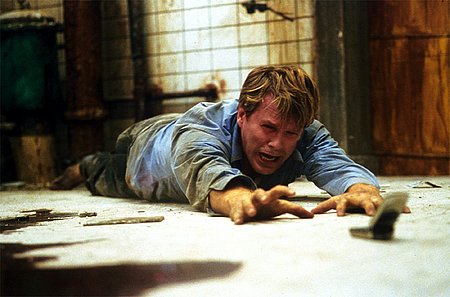
Two men—Adam (Leigh Whannell, who also co-wrote the screenplay with director James Wan) and Lawrence (Cary Elwes)—awaken to find themselves chained by their ankles to pipes in a long-forgotten bathroom. Trapped, with a dead body lying in the middle of the floor, the two try to figure out why this happened and what they should do. They have instructions from their captor, as it’s all part of a game. If they don’t play it by Jigsaw’s rules, one or both of them will die.

Riddles and tools have also been left for Adam and Lawrence, including a gun, a tape recorder, and two hacksaws. What are the hacksaws for? “He doesn’t want us to cut through our chains,” Lawrence declares somberly. “He wants us to cut through our feet.”

The danger grows beyond the bathroom for Lawrence, as he learns his wife (Monica Potter) and daughter have been captured as well. Lawrence’s clear instruction is to kill Adam, or they’ll die. Meanwhile, the killer is being tracked by Detective Tapp (Danny Glover), looking to avenge his late ex-partner Sing (Ken Jeung) who fell victim to the killer. And we also get flashbacks to other bizarre occurrences set up by Jigsaw, including a drug addict (Shawnee Smith) who survived her “game” and claims that it actually helped her to see the finer things in life. And there’s a creep named Zep (Michael Emerson) who works as the hospital, where Lawrence is a surgeon, who may or may not be the killer.

A lot of these elements being thrown at us make “Saw” an overstuffed picture. Actually, I could have done without the subplot involving the detectives and the many twists that continue on. And I hated the rough editing that occurs whenever we flash back to a victim—the frantic fast-motion editing does nothing for me in those scenes. But the real tension comes from the two men in that bathroom and how they’re going to find ways to save themselves. “Saw” does a great job at keeping the suspense alive during these scenes. Also, the scenes of the drug addict getting over her near-death experience are effectively done. This sets the status for this intelligent psychopath who chooses his victims by what they do and how they act, and he puts them into these games as a bizarre act of irony and as a way of possibly surviving by doing horrible things that they could do if they had the willpower.

Really think about it—if you were given the choice to die or cut off your chained foot, what would you choose?

“Saw” is not only psychological; it’s also very gory. Those with weak stomachs should stay away from this film, because there are many disturbing images displayed in “Saw.” Enough to keep an R rating, but others that are a mere inch from an NC-17—in particular, the drug addict is forced to retrieve something from her dead fellow captive’s stomach with a knife, and we actually see the intestines as she pulls them out. Tell me that’s not NC-17 material.

The ending is unforgivable albeit effective. It’s a shocking development that reminded me of what I’ve endured and that the film did indeed work for me. “Saw” is a well-crafted thriller that introduces a new memorable killer to the cinema and terrifies in doing so.

Starsky & Hutch (2004)

5 Mar

The Flick Chicks Movie Reviews critics Starsky & Hutch

Smith’s Verdict: ***

Reviewed by Tanner Smith

You don’t have to be a fan of a TV show that a new movie is based off of. You don’t even have to have watched it. I was completely ignorant of the 1970s TV cop show “Starsky & Hutch,” and watching the 2004 movie adaptation of the same name, I didn’t care that I didn’t see the show. I laughed. Isn’t that enough for a comedy? I did laugh. I enjoyed this film for two reasons—1) it was funny, and 2) most of the fun came from the chemistry between the two actors Ben Stiller and Owen Wilson as the title characters.

Ben Stiller is the hyperactive, worrisome, ridiculously-curly-haired Starsky (“For your information, my hair is naturally curly. Feel it.”) and Owen Wilson is the more outgoing, blond-haired bad boy Hutch. Both men are cops, but Hutch knows more about life on the streets. Pretty soon, their police chief (Fred Williamson) believes they deserve each other, and so he assigns them as partners. At first, they aren’t very fond of each other—Hutch insults Starsky’s hair right away—but they become friends and go on a case that the movie requires them to figure out.

The bad guy in this movie is a drug dealer named Reese Feldman (Vince Vaughn). He and his assistant (Jason Bateman) have just created a new kind of cocaine that police dogs can’t sniff or track down. What gets Starsky and Hutch on the case is when they discover a dead body near the river—the dead body of a man killed by Reese.

Their investigation leads them to picking up a couple of cheerleaders (Carmen Electra and Amy Smart, “B-E-A-U-tiful,” as Jim Carrey would say) and taking them to their apartment so they can share a funny moment that reminds us that the movie takes place in the 70s. I like it when Owen Wilson croons a single originally sung by David Soul, who played the original Hutch in the TV show. Starsky and Hutch’s investigation also leads them to a scene that audiences seem to love and got a big laugh, but for me, I felt a little indifferent. Maybe I didn’t find it hilarious when Starsky interrupted Reese’s daughter’s Bar Mitzvah party, shot through the garage door, opened it to reveal a pony as a gift for the daughter, and then everyone sees the pony fall down dead. (“Are you OK, little pony?”) Maybe it rubbed me the wrong way.

This is one of those comedies in which a lot depends on the chemistry from the actors. This is the sixth movie featuring Ben Stiller and Owen Wilson in a movie together and they come off as a really effective comedy duo. Separately, you get almost too much of them. But when you put them together, they create the perfect comic timing. Owen Wilson was in another film adaptation of a TV show called “I Spy.” That movie didn’t do much for me and I didn’t laugh much. I did laugh a lot during “Starsky & Hutch.”

Todd Phillips, who also did “Old School,” has a movie that is rich with ideas. Also enjoyable is Snoop Dogg as Huggy Bear, a Superfly clone whose fashion remains in the 70s. And then there’s the running joke about Starsky’s great-looking Ford Gran Torino and Starsky’s attachment to it. There’s one scene in which Starsky and Hutch try the impossible that always seems to work in action movies. They try to drive the car really fast off a pier to land it on the bad guy’s boat. Does it make it? I will not say. What I will say is this—I love it when Starsky tries to rescue the car. Some ideas that don’t really work (for me, at least) include the pony scene. And then there’s a very weird cameo by Will Ferrell, which I will not give away. “Starsky & Hutch” is a fun, satisfying comedy.

Anchorman: The Legend of Ron Burgundy (2004)

28 Feb

Anchorman The Legend of Ron Burgundy movie image Will Ferrell

Smith’s Verdict: ***

Reviewed by Tanner Smith

I can’t deny it—Will Ferrell is a very funny guy. Watching him run naked on a street in “Old School” or acting like a man-child in a tight elf suit in “Elf,” I can see that Will Ferrell is not afraid to take chances in making us laugh. He has a goofy, likable presence and proves he can carry a movie well with his gift. With “Anchorman: The Legend of Ron Burgundy,” he brings his goofy charm to a new (maybe even unhealthy) level. He plays Ron Burgundy, a self-absorbed, legendary top news anchor residing in San Diego. His catchphrase: “You stay classy, San Diego.” He’s the main character in “Anchorman: The Legend of Ron Burgundy,” a vulgar, slapstick, satirical comedy that is very funny and is helped by Ferrell and the strong supporting cast. However, the laugh ratio is only half as funny as Ferrell’s previous films, but it’s still a pretty good ratio.

“Anchorman: The Legend of Ron Burgundy” takes place in the 70s, a time before cable and VCR—a time when everyone listened to the news, only men were allowed to anchor the news, and everyone was as classy as a clown on his day off, so to speak. While “This is Spinal Tap” was a satire about rock music, “Anchorman’s” satirical subject matter is broadcast television in the 70s. First, we get a narration by Bill Curtis, and then we see the typical TV intros to the “Channel 4 News Team,” in which Ron Burgundy and the three other team news members seem like one big happy family. There are also these silly news stories they have to cover, such as a waterskiing squirrel and a Panda Watch to make sure the news is able to capture on camera a panda giving birth.

The other news team members are Brian Fantana (Paul Rudd), Brick Tamland (Steve Carell), and Champ Kind (David Koechner). They get together with Ron to talk about vulgar subjects, swap manly stories, and, yes, even sing “Afternoon Delight” when they’re alone. They are all talk when it comes to women, while they are secretly terrified of them. And then they start to get cold feet when a striking blonde woman named Veronica Corningstone (Christina Applegate) is hired by Ed, the station’s news manager (played by the always-reliable Fred Willard), to bring “diversity” to the station. They have a problem because she’s a WOMAN and only MEN are allowed to say the news. The dumbest of them, Brick, warns the others that, “women’s periods attract bears.” Ron and Veronica are attracted to each other, but as co-workers, they keep getting involved in many brawls.

This is a funny movie that almost comes close to being tedious when we see the ridiculousness of this news team one time too many. But they’re a likable and funny bunch. After all this, Ron does turn out to be a nice guy. And Veronica, while trying to keep her reputation as a serious anchor on the line, still loves this dim person.

It’s also funny for the obvious reason—the actor’s improvisations are funny. Every comic actor knows that they can come up with better lines of dialogue than most of what the script has to offer, and so they just go all out. And also, there are many scenes that are very funny and quite memorable. One features Brian as he tries to impress Veronica by wearing cologne that smells “worse than the time the raccoon got in the copier.” And then there’s the brawl in an alleyway involving every news team in San Diego, complete with cameos by actors I will not give away. You’ll know them when you see them, don’t worry. Oh, I should also mention that this brawl has a heavy amount of violence. Mostly, it’s played for laughs.

Steve Carell, Paul Rudd, and David Koechner make for some effective comedic foil, Christina Applegate is fantastic as the sort-of Cameron Diaz type of comedic female role, and Fred Willard, as if predictably, is invaluable. But it’s really Will Ferrell who scores big time here. He becomes this character and makes him into such a great comedic presence. He makes “Anchorman: The Legend of Ron Burgundy” his own movie.

Undertow (2004)

25 Feb

undertow_devonalan_jamiebell_1098413543

Smith’s Verdict: ****

Reviewed by Tanner Smith

Wow…where do I start with this movie?

“Undertow” is one of those “experimental projects” that every director goes through to make sure they can step outside of their comfort zones. Even if that wasn’t the case, “Undertow” is an amazing movie. It takes a fairly straightforward story inside a marathon of deep, personal fantasies and experimented camera shots. This movie is weird. I know that’s a strange criticism to make for a movie that I’m rating four stars, but that’s the spirit of this entire movie. It’s strange, unusual, unbelievable, unnerving, dark, unsettling, disturbing…and I loved every minute of it.

“Undertow” was directed and co-written by David Gordon Green, one of the most intriguing moviemakers I’ve ever come across. His work before this were the indie favorites “George Washington” and “All the Real Girls.” There has always been a certain quality to his films that made them special. Maybe it’s the way he lets the characters breathe and gives them room to express in just one camera shot. Maybe it’s the countryside atmosphere he’s surrounded them with. Whatever it is, he uses a lot of it in “Undertow.” In fact, he uses just about everything he can think of to make this familiar story…unfamiliar.

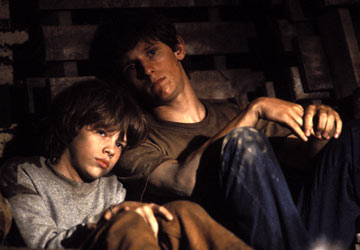
The story follows two brothers—16-year-old Chris (Jamie Bell) and 10-year-old Tim (Devon Alan). Chris is a rebel who is constantly in trouble with the law; Tim is a little weirdo who has habits of eating things like mud and paint, and also “organizing my books by the way they smell.” They live in a rural area of Georgia with their widower father John Munn (Dermot Mulroney), so out-of-the-way from society that they can’t even have friends—the only ones to celebrate Tim’s birthday are Chris and Dad.

Their lives are interrupted by John’s brother Deel (Josh Lucas), who hasn’t been in contact with his brother for years—he didn’t even know John had two sons. Deel is said to be a wild card, having been in prison for a mysterious reason. John believes Deel wants to do right from now on, so he lets him stay at the farm and work. But Deel is more sinister the more times he becomes acquainted with his two nephews, particularly Chris—there’s a scene in which he intimidates him while speeding in his nice car and saying things like, “I knew your ma first; she was my girl.”

There’s a rare gold collection said to be the gold drachmas that are good for admission across the River Styx into Hades when you die. The collection was given to John by his father, and has hidden them somewhere in the house. That’s exactly what Deel is here for—nothing more, nothing less. But after a violent incident, Chris and Tim run away from home with the gold coins, with Deel searching for them.

Chris and Tim trek along some desolate Southern landscapes and come across some very original individuals, including a young black couple who are accustomed to their rural lifestyle most comfortably and take the boys in briefly. Later, they also come across a camp for homeless people, mainly young people who have nowhere to go.

The story is somewhat similar to “The Night of the Hunter”—children go on the run from a violent man for greed, and they come across unique characters along the way—and the look of the film is as unusual. Also in mind when Green was coming up with the idea, as he said at the Toronto Film Festival, were stories by the Grimms, Mark Twain, and Robert Louis Stevenson, as well as Capote’s “In Cold Blood.” Legends and fairy tales take up a lot of the movie’s spirit and dialogue—the legend of Charon and the River Styx and that old tale about writing a wish on a piece of paper and throwing it inside a bottle into a river. There are many monologues as the boys venture through these desolate, haunting Southern landscapes that it reminds of a film made by Terrence Malick (he actually is a co-producer for the film).

What do I mean when I say David Gordon Green might be “experimenting” with “Undertow?” Consider the opening-credit sequence—there are different video filters (even negative, of all filters), pauses, slow-motion shots, and everything else that can be toyed with, all in a chase scene. As if using all of those editing tricks wasn’t enough, the chase itself is just bizarre. It introduces Chris as he breaks the window of his girlfriend’s bedroom, causing her father to chase after him. It’s a merry chase until Chris, barefoot, accidentally jumps and lands on a nearby wooden plank with a nail sticking out of it. It’s even less pretty to see as it is to hear—it’s a very painful moment. And then, Chris continues to hobble along on his way, with the board still attached to his foot.

And that’s just the beginning of the movie! Trust me; it gets just as strange, if I haven’t already made that point.

Hearing the storyline, one would get the idea that this is a chase picture. But it’s not, in the conventional sense. David Gordon Green doesn’t go for the kicks; he goes for the dread, despair, and menace of the situations—fitting, because they match the landscape.

Jamie Bell, a young British actor (from “Billy Elliot”), has no trouble perfecting his American accent nor does he have trouble making us feel sympathy for Chris. Devon Alan suits the role of Tim well. Dermot Mulroney has a reassuring presence as the boys’ father, and Josh Lucas, playing against type, is certainly menacing as Uncle Deel.

What have I left out? Only the music, I hope. The film is covered by an ominous music score by Philip Glass that gets deeper as the story continues. It’s a chilling, non-comforting score that’s perfect for the film.

There is a chance I may have left something out from “Undertow.” But if there is, you can discover for yourself exactly how unusually thrilling this film is. However, I must warn you that this is not a film that’s easy to watch. It’s the kind of “Southern Gothic” tale that leaves audiences with an uneasy feeling. I won’t lie; it left me uneasy too. “Undertow” is strange, unusual, unbelievable, unnerving, dark, unsettling, disturbing…and I loved every minute of it.

Spanglish (2004)

23 Feb

02

Smith’s Verdict: ***1/2

Reviewed by Tanner Smith

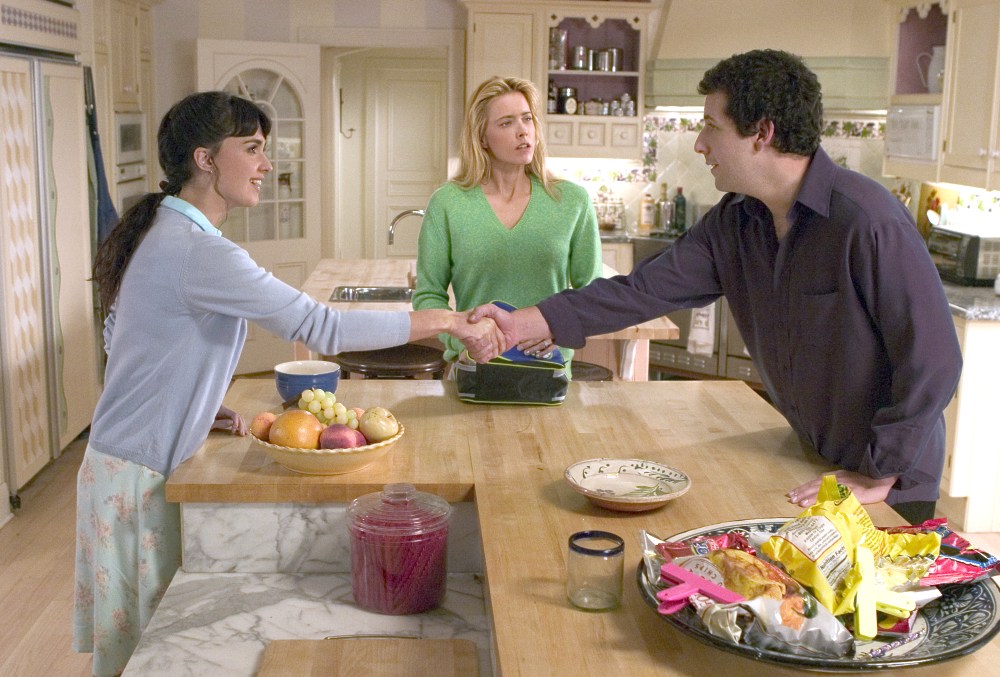
OK, what would you say if I told you that Adam Sandler starred in a movie that featured a family with a crazy member? You’d just say, “OK. So?” But what would you say if I told you that Adam Sandler does not play the crazy family member? That this movie is not a typical “Adam Sandler comedy,” but a James L. Brooks comedy-drama? “Spanglish” is that movie and it does star Adam Sandler. But Sandler plays a man who is trying to keep everything calm. His wife is played by Tea Leoni, and she isn’t just simply crazy—she shouldn’t even be living in a house with a relatively calm husband and two innocent kids. I feel sorry for those kids living in this household.

There’s a third major character in “Spanglish”—a quiet, sensitive Mexican woman named Flor (Paz Vega). Her husband has died, meaning she has to look after her daughter by herself. She leaves Mexico to live in America. To support her daughter (named Cristine), she goes to work for the Claskys, an American dysfunctional family. She is sucked into the drama that happens in this family. John (Sandler) is a chef who is named the Number One Chef in America, but really doesn’t want a lot of attention. His wife Deborah (Leoni) isn’t making life any easier for him. He is so “stark raving calm,” as Deborah puts it, and Deborah simply waves good-bye to reality as she goes cuckoo. She sounds so desperate about everything, stumbles over things, and has a bizarre sexual encounter (though this movie is rated PG-13). John and Deborah have two kids—one of which is teenaged Bernice (Sarah Steele).

Flor doesn’t speak fluent English (she only knows a few words), but she’s patient and tries her best to go along with this family. Complications arise when Deborah practically steals Flor’s daughter (who speaks fluent English) and takes her shopping. In a brilliant comic scene, Flor expresses her anger to John and asks Cristine to translate into English for her. The comic timing of Paz Vega and Shelbie Bruce (as the daughter) in that scene is just great.

A relationship builds slowly and tentatively between Flor and John. One of the movie’s finer things about it is that the relationship is so nicely developed. It doesn’t start quickly; it simply builds up to it. They spot each other on the street, say “hi” a few times at glances in the house, and have late-night chats after Flor is just learning to speak English. The chemistry between these two is convincing. Also, the relationship between Flor and Cristine as mother and daughter is handled quite nicely. I love the final scene they share together. Without giving too much away, it shows convincingly that all parents fear for their children’s futures. That scene is an excellent curtain-closer for this film, which is well-acted and powerful.

It’s nice to see Adam Sandler in this kind of relaxed performance. He’s a lot better as an actor when he isn’t manic, sadistic, or obsessive. Here, he’s restrained and gives a convincing performance as a guy who just things to be better. (After all, who doesn’t?) Tea Leoni is great at making her character not a monster, but rather an unfit parent and uptight klutz. You have to wonder if she took lessons from Adam Sandler’s previous films and brought more class to the character. Also, Paz Vega is wonderful here. One of the best things about “Spanglish” is that while she speaks Spanish (and she does speak fluent Spanish through the first hour of the film), she isn’t given English subtitles popping up on the screen for us to understand her. We don’t need subtitles. Her expressions and actions say it all. It’s a wonderful performance. Also delightful is Cloris Leachman as Deborah’s alcoholic mother. She starts out as a drunk and ends up being an actually wise person in the ways of relationships. I love the scene where she corners Deborah and warns her about what would happen if she keeps messing up.

“Spanglish” is an effective comedy-drama. This is not simply a sitcom featuring caricatures with phony problems. Real people have real problems. Relationships are complicated. Flor’s “fixing” of the family may not end the way we expect it to be. “Spanglish” is a nice movie with a terrific ensemble cast, a good script, and a good dose of comedy and drama. And after “Punch-Drunk Love,” this is further proof that Adam Sandler can handle serious roles well.

Harry Potter and the Prisoner of Azkaban (2004)

18 Feb

harry-potter-and-the-prisoner-of-azkaban

Smith’s Verdict: ***1/2

Reviewed by Tanner Smith

It seems like young wizard Harry Potter is heading straight into darker territory. I think he is cursed in the way of never having a quiet year at Hogwarts. He’s 13 years old and he has already searched for the sorcerer’s stone and discovered the Chamber of Secrets. And now, he is being pursued by a Prisoner of Azkaban. OK, enough with the bad title references. You get my point though—Harry Potter will go through four more years after this and he will never have a quiet year at Hogwarts. Let’s just hope he is able to survive so he can graduate Hogwarts School. To think he is the Boy Who Lived possibly leaping towards certain doom—wonder what is in store for him in his seventh and final year at Hogwarts…assuming he lives that long.

I’m making the third entry in the “Harry Potter” series—entitled “Harry Potter and the Prisoner of Azkaban”—sound too grim. Indeed, Hogwarts has become menacing and even more dangerous than before. But this is probably nothing compared to what may happen in the later installments.

Harry Potter (Daniel Radcliffe) has grown as a person—he is not the poor young boy living a miserable life with his hateful relatives. This time, he’s developed an edge to himself. This is proven in the opening scene, in which he is fed up with an overly unpleasant relative invited to dinner and casts a spell that blows her up like a balloon and floats her away. This would’ve been one of the cruelest things a young wizard can do…but it’s just so funny.

Harry runs away to meet his old friends in time to leave for Hogwarts (this is after a wonderful scene in which he boards a fast-speed wizard bus with a Cockney guide and a shrunken head for a navigator). He is reunited with the still-cheerful Ron Weasley (Rupert Grint) and still-bookish Hermione Granger (Emma Watson). But something is wrong this year—the sinister Sirius Black (Gary Oldman) has escaped from Azkaban Prison. Sirius is said to have betrayed Harry’s parents and was the cause of their murderous deaths by Lord Voldemort, the late Dark Lord who killed Harry’s parents and failed to do so with Harry as a baby (hence the scar, in case you forgot, which you probably haven’t). On the search for Sirius are a swarm of Dementors, which are hovering, life-sucking demons that pay Harry unfriendly visits from time to time.

This year at Hogwarts, there are new faculty members. One is Professor Lupin (David Thewlis), the newest teacher of the defense against the dark arts. Harry knows that Sirius will finish what he started and come after him, so he asks Lupin to train him to protect himself. But it’s not so easy. Then there is the addition of Professor Trelawney (Emma Thompson), a psychic teacher who believes the blackness in Harry’s tealeaves means death. Also, Hagrid (Robbie Coltrane) is promoted to teaching—he has a large feathered animal named Buckbeak, which is a Hippogriff. Harry is to ride the bird-beast to set an example, but pathetic Draco Malfoy (Tom Felton) is too much of a show-off. This is why the audience cheers when Hermione finally gives him a punch right square in the face. “That felt good,” she says to her friends after Malfoy runs away whimpering. What a wimp Malfoy is.

This time, Harry doesn’t go looking for trouble, but trouble always seems to find him, Ron, and Hermione. Once again, they are propelled on another journey within school grounds and are met with many terrific action sequences. They encounter a shape-shifting dog, a werewolf, and (my most favorite) a living tree that tries to crush anyone who comes near with its branches and limbs. That tree is a beyond-terrific computer effect—I don’t believe real trees can shake off leaves in the fall and snow in the winter (I love it when the snow hits the camera).

And then there is an enchanted map that shows where people are within every minute of every day inside the school—it can be brought to life when Harry summons, “I solemnly swear that I am up to no good” and turned into a regular piece of paper when he says, “Mischief managed.” Also, there is the final half of the film—not giving anything away, but it fiddles with time in ways we’ve always admired in time-travel movies. It works here as well.

But the important thing here is that Harry, Ron, and Hermione are not children anymore. They are teenagers. Their characters have grown, but so have Radcliffe, Grint, and Watson. In later installments, they will still be likable even when they are young adults ready for something bigger in the final chapter of the final entry. Radcliffe is still a likable young hero, Grint is still cheerful but comically nervous when it comes to terror, and Watson has a way of taking charge no matter what. Coltrane as Hagrid continues to be lovable, Emma Thompson is a delightful addition to the movie, David Thewlis is great as the new teacher with a secret, and Michael Gambon, filling in for the late Richard Harris as Dumbledore, has the convincing mysticism of bearded headmaster Dumbledore.

Hogwarts may have gotten darker, but it’s still wonderful. And you do want Harry, Ron, and Hermione to be there when Hogwarts is under terror again. The series is approaching something bigger than this. It’s only a matter of which movie it will start. “Harry Potter and the Prisoner of Azkaban” is not quite up there with the first two films, but it’s still a terrific adventure.

Cellular (2004)

25 Jan

Chris-Evans-in-Cellular-2004-Movie-Image

Smith’s Verdict: ***

Reviewed by Tanner Smith

When rushed for time, either going to a certain location or staying at a certain spot, it’s the journey that matters the most in the case of constructing an action-thriller. Examples include “Speed,” which had the concept of a bus that will explode if traveling below 50mph, and “Phone Booth,” which had the concept of a man held by a sniper to remain inside a phone booth lest he get shot. It’s always the high-concept gimmicky-setups that interest people in seeing the film and it takes skill on the filmmakers’ part to keep it on its toes in order to keep the audience on the edge of their seats. That is why despite how dated “Cellular” might be with its central portable technology, which has been through constant upgrades (and is still increasing in new developments), the film still holds up as a tense, adrenaline-filled thrill ride.

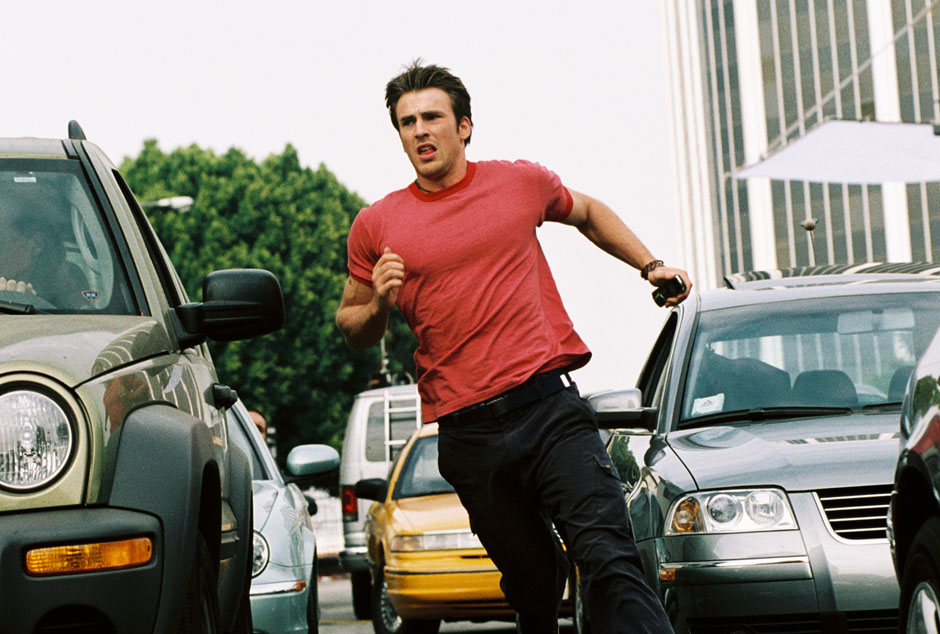
“Cellular” practically opens by showcasing its 2004 “new, edgy improvements in technology.” As people walk about the boardwalk in Los Angeles, they’re admiring their new cellphones, amazed that they can take pictures of chicks in bikinis and send them to other people’s phones. (Ah, the good old days when we were impressed.) But once that’s out of the way, the story for “Cellular” kicks in. We meet our hero—a hunky surfer-type named Ryan (Chris Evans)—who is walking about the beach with his even-less-ambitious buddy (Eric Christian Olsen) and trying to make amends with his ex-girlfriend (Jessica Biel). But soon enough, his cellphone rings. He answers it and it’s the desperate call for help from a schoolteacher who has been kidnapped. The teacher, Jessica Martin (Kim Basinger), has been kidnapped by corrupt cops, led by Greer (Jason Statham), who know that her husband has stumbled upon one of their operations. She doesn’t know what they want, and believes they have the wrong family. Convinced that they’ll kill her once they get what they want, she manages to use a smashed phone (by touching a couple wires together) to make a random call and see if she can get some help. And so, Ryan winds up on the other end of the line, and while he doesn’t quite believe her, her desperate pleas keep him from hanging up. So he agrees to take his phone to the police and have her talk to them about the situation. But when a cop named Mooney (William H. Macy) listens to Jessica’s story, he’s interrupted and distracted, leaving Ryan to take charge of the rescue and thus thrusting him into a race to save the day.

Ryan must keep Jessica on the phone, or else he’ll lose her and be of no help in rescuing her. (Jessica’s phone doesn’t dial normally.) This of course sets off the inevitable series of events that get in the way. Just about every cellphone cliché you can think of comes into play here. Signals get crossed, the battery is dying, the signal is poor, other calls come in at the wrong times, etc. “Cellular” stays alive by thinking of new ways in creating obstacles that get in the way of Ryan, forcing him to outwit and maneuver every which way, all while he has to make Jessica’s husband and child aren’t kidnapped as well, and following different clues that lead to her and the bad guys. But things get even more complicated once Greer learns that Ryan is involved, and also when Mooney discovers some things about the situation he knows very little about that doesn’t hold water, leading him to do his own investigation.

There are chases (both foot and car), drawn fire, fistfights, and other elements that make “Cellular” a regular action-packed thrill ride. It’s never boring, and it even takes a few rest stops, most of which include Mooney as he is planning out his and wife’s new “day spa,” but different circumstances force him into investigating the central situation. Unfortunately, this also leaves room open for exposition. All of this builds up to an over-the-top (albeit inevitable) climax in which Ryan and Mooney join in ultimately saving the day. At an hour-and-a-half of running time, “Cellular” is an enjoyable, entertaining movie that packs many thrills by using clever gimmicks in its action sequences. It’s nicely developed, action-packed, and it doesn’t matter if your phone now is different than phones back then. If your phone has new apps, the situation can still be the same. Stop laughing and enjoy the movie.

Before Sunrise (1995) – Before Sunset (2004)

16 Jan

before sunrise sunset

Smith’s Verdict: ****

Reviewed by Tanner Smith

The films in the romance genre are a mixed bag. Once in a while you get a good/great one, but for the most part, they’re made up of the most annoying clichés and generically ineffective dialogue. Highlighting fresh young talents doesn’t do the job on its own. A good script and genuine chemistry among the romantic leads helps make a romance work. This is where “Before Sunrise” comes in.

This is unlike most romances, in that it takes place in just a single day. As a sigh of relief, the story is very simple—here’s a man and woman, they meet, they enjoy each other’s company, and so they spend the night together before one of them has to leave. That is such a relief because it keeps itself contained to these limitations and makes the most of them. This short-lived romance just develops through this long night with no standard occurrences you see in most movies in the genre.

I shouldn’t even use the words “romance” and “couple,” since the alleged two people are only together for 24 hours (actually 14, I think). It’s just these two people meet, they engage in a friendly conversation, they decide they want to spend more time together before they separate, they have a most pleasant night together, and when they leave, they realize they weren’t ready for this. And that’s it. No melodrama. No misunderstandings. No bullies. There’s hardly even an agenda. We just enjoy the company of twenty-somethings Jesse (Ethan Hawke) and Celine (Julie Delpy) as they enjoy each other’s company.

They meet on a train in Austria. Celine is a French woman returning to a university in Paris; Jesse is an American headed to Vienna for a flight back to the United States. Celine sits next to Jesse. They go to the lounge car and make conversation. It’s a real talk too that attracts them to each other, wanting them to know more about each other. If only they could continue…When they reach Vienna, Jesse comes up with a crazy idea for Celine to get off the train with him so they can be together until he catches his plane. Celine agrees.

Jesse and Celine wander the streets through the night; still talking, learning more about each other, and their relationship gets stronger as it continues. But they do their best to keep from expressing their perfect feelings for each other and just try to keep a “perfect night.” This way, they don’t get hurt. Then comes two important questions—should they sleep together that night, and will they see ever each other again after they separate? They do love each other. Should they admit that?

“Before Sunrise” relies on two important things that make it work, and they’re both great—great dialogue and great acting. The screenplay is full of sharp dialogue (this is mainly an all-talk film) and the conversations that these two people share are worth listening to because they’re smart, amusing, and actually relatable. They don’t talk about anything spectacular; they talk about love, former lovers, school, parents, truth, music, even death and reincarnation. It all seems so natural, as does the acting by Ethan Hawke and Julie Delpy, who share an excellent rapport with each other. Their unquestionable chemistry onscreen seems absolutely genuine.

Aside from the two leads, however, Richard Linklater, director and co-writer (with Kim Krizan), has to take most of the credit for the treasure that is “Before Sunrise.” It’s pure movie magic all the way through. It’s sweet, it’s convincing, and always sincere.

—————————————————————————————————————–

Sequels are always successful when they actually continue the story. “Before Sunset” is one of those sequels. Nine years since its predecessor, “Before Sunrise,” “Before Sunset” continues with the growing relationship of Jesse (Ethan Hawke) and Celine (Julie Delpy), who are or aren’t meant to be together.

In “Before Sunrise,” the likable American man Jesse met the attractive, appealing French woman Celine on a train to Vienna, and talked her into getting off the train with him so they can spend the night together before he left for home. It was a perfect night that ended with their departing of each other. They arranged for them to meet in one year, but now in “Before Sunset,” nine years have passed and their rendezvous hasn’t occurred…until now.

Jesse is in Paris representing his novel, “This Time,” which is a fictionalized retelling of his and Celine’s night together. He is surprised to see Celine at the book signing. They encounter again and their feelings from before have come back.

Jesse has about an hour before his flight for America takes off and he and Celine decide to spend it together. And here, “Before Sunset” doesn’t cheat. It takes place in real time. It doesn’t transition to a different scene and a different conversation. We’re always in the company of these two as they go from place to place, and as they have conversation after conversation.

They share the same kind of whimsical dialogue shown in the original story. But this time around, they also share conversations that are darker. The question of love comes back into place, the way their lives have turned around since their night together has sad surprises, and the question of happiness is complicated for them. And then you get that pivotal thought if these two are meant to be together. Has fate brought them back for a second chance? They know they love each other, but can they act on these feelings?

“Before Sunset” is a remarkable technical and acting achievement, as director Richard Linklater has long shots (about five or six minutes long) as Hawke and Delpy continue to engage in discussion. This cannot be easy, but luckily, the actors are excellent here. They were great in the original film; they’re even better here. They know their characters inside and out, and at no moment are we seeing actors. We see Jesse and Celine together again. And it also helps that Hawke and Delpy also co-wrote the screenplay with Linklater and Kim Krizan.

The film has a great ending that leaves things open for interpretation until another sequel, which I seriously hope comes around because I want to see more of these two people interact with each other. And who knows? Maybe things will be better for them. Together. I really hope so. These two movies—“Before Sunrise” and “Before Sunset”—are two of the best romance films I have ever seen and there’s enough intelligence for a third entry.