Archive | 1990 RSS feed for this section

Stephen King’s It (1990) (TV)

27 Feb

Send_in_the_Creepy_Clowns_Just_in_time_for_Halloween_a_gallery_of_13_scary_clowns

Smith’s Verdict: ** (Part 1: *** – Part 2: *1/2)

Reviewed by Tanner Smith

I make it almost a rule not to review made-for-TV movies, let alone TV miniseries’. But the three-hour TV miniseries “It,” adapted from Stephen King’s best-selling 1986 novel, has become so popular (for good and bad reasons that I shouldn’t go into) that I decided to give it a shot. It’s hard to review a movie like this, especially when it is split into two parts and one part is far more interesting than the other. But here’s my shot at it.

In part one of the miniseries, events are being set to take place in apparently part two. “It” begins with Mike Hanlon (a quite effective Tim Reid), the librarian of a small town in Maine called Derry (notice that a lot of Stephen King’s stories take place in Maine), who is at the crime scene of the murder of a little girl. Apparently, this is not the first child murder or disappearance. Mike knows that something is terribly wrong and comes to a conclusion. What is it? We have to wait and see.

Mike spends Part 1 of the story calling his childhood friends, telling them to come back to Derry and explaining “It’s back.” They know what he means. With each friend Mike calls, we experience different flashbacks that seem to be in chronological order. The flashbacks tell the story of the “Lucky Seven”—seven young outcasts who become best friends and stick by each other. There’s Bill (Jonathan Brandis); Ben (Brandon Crane); Eddie (Adam Faraizl); Richie (Seth Green); Stan (Ben Heller); Beverly (Emily Perkins); and Mike (Marlon Taylor), who is the last to join the club after the other kids save him from a sadistic bully named Henry Bowers (Jarred Blancard). All seven of these kids keep to themselves in the barren areas of town, building a dam. These scenes are intersected with scenes in the future as each friend (grown up to become successful individually—for example, Bill is a best-selling author) remembers their experience with the “it” that Mike refers to when he calls.

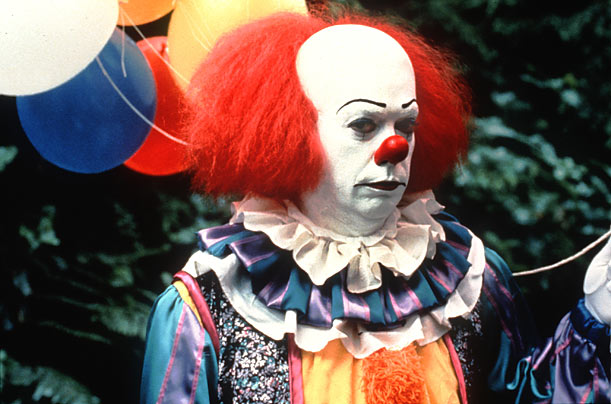
Who or what is “it?” Well, It is a clown named Pennywise (played by Tim Curry)…or is it? You see, Pennywise kills kids after either using his image to fool them or taking the shapes of their fears. Pennywise is some kind of creature that reads minds and becomes your fears before it eats you. And only children can see it, and not adults. Why? (“You grow up,” young Bill says. “You stop believing.”) Each of the seven kids is silent about their own experiences with “it,” which scares them like a cat-and-mouse game, until it finally frightens them all at once. They realize that they have to stop it, so they venture into the sewer tunnels to kill it.

This first part of the “It” miniseries is very interesting in the way it draws you into the story. The kids are all very good actors, especially Brandon Crane who avoids the “fat kid” stereotype as the overweight, sensitive Ben. And their characters are interesting as well. Also, Tim Curry, as the clown, plays it so over-the-top that it’s almost funny when being frightening at the same time. It’s unnerving just to think about a clown coming after these kids. Tim Curry is great as Pennywise. And also, the scenes in the tunnel in which the kids are finally faced with Pennywise is interesting because it’s fun to see them come together and confront their fears. Is it a great climax? Well, no. But this is more about feeling than about gimmick.

This brings us to Part 2, in which all of the adult versions of the Lucky Seven reunite in Derry Maine—Bill is played by Richard Thomas, Ben is John Ritter, Eddie is Dennis Christopher, Richie is Harry Anderson, Stan is Richard Masur, and Beverly is Annette O’Toole. They have forgotten most of their experiences with Pennywise and became successful, but when Mike calls them back saying it’s come back, they have new experiences that make them remember. This is fine, but we also get a series of ludicrous back stories that really slow the movie down. These back stories take a long time to be explained and the viewer is left shaking his or her head. And then when it tries again for horror (like when Pennywise comes back every now and then), it’s just dull instead of frightening. Also, the characters that were compelling as children have become dullards this time around. It doesn’t help that half of these adult actors are badly miscast. And then when the apparent final climax arrives, it’s just silly, silly, silly. It also has one of the worst creature effects in the history of TV movies.

You’d think that with a strong first half, you’d have a second half to be just as strong, especially when the running time is 192 minutes. But “It” doesn’t succeed. The first half (with maybe only the flashbacks) could have made a whole movie and I would’ve recommended it as a whole—I liked the kids, Tim Curry was fun, and there were a couple scenes that scared me, believe it or not (like the scene in which young Bill mourns the death of his kid brother and something creepy happens). But the second half is bogged down to horror clichés, dull plotlines, horrible special effects, and melodrama. Not even the presence of reliable actors Tim Reid and John Ritter could help.

So in conclusion, “It” is a mixed bag—strong first half, insipid second half. I have not read the novel so I can’t quite make comparisons to that. But there are a lot of Stephen King book-to-film adaptations that hardly capture the flavor of King’s stories (examples are “Cujo” and “Children of the Corn”). This is one of those adaptations, although I guess I should be kind enough to say that this is in the same league as “Cujo” and better than “Children of the Corn.” Oh, and don’t get me started on “Pet Sematary.” That’s a review all its own.

Edward Scissorhands (1990)

19 Feb

johnny-depp-as-edward-scissorhands-1990

Smith’s Verdict: ***

Reviewed by Tanner Smith

“Edward Scissorhands,” a weird fantasy fable by Tim Burton, has a unique and intriguing premise that begins with one gimmick, which is that the main character has scissors for hands. The premise is this: A young man named Edward was created in a mansion near a small town by a loving inventor, but the inventor died before he could finish his creation with hands. He is left “unfinished” with his scissors for hands. One day, Edward is found by a local woman, who brings him home and offers hospitality, and he becomes the talk of the town. This is an engaging premise and “Edward Scissorhands” plays it with magic realism and a real charm to it.

Johnny Depp stars as the title character, and it’s a more-than-successful creation. Sporting a fright wig, a plaintive expression, and a pure innocence within him, it is impossible not to care for Edward, played wonderfully by Depp. And as for those scissor-hands, it’s a great sight gag, even if it doesn’t make a lot of sense as a metaphor (if that’s what Burton was going for).

Edward has been living in the mansion alone ever since the death of his inventor (the fantastic Vincent Price, seen in flashbacks). His hands are the one aspect that the inventor was never able to create for him, leaving him with long, sharp razorblades. One day, he is found by the Avon saleswoman, Peg (Dianne Wiest), who feels sympathy towards this man and invites him to live at her home in the neighborhood nearby. When he’s there, he adapts to suburban life, becomes the talk of the street, impresses everybody with his skills with his hands (he can make gigantic hedge animals and give haircuts to the local women and their dogs), and also begins to fall in love with Peg’s teenage daughter Kim (Winona Ryder).

This is no ordinary neighborhood, mind you. This looks and feels like something out of a comic book or an animated sitcom. I admire the visual style that Burton shows throughout this film—every film he makes seems to turn our everyday world into something resembling a fairy tale, for example. But there is one thing that kind of bugs me. The early scenes that the strangeness of this movie’s suburban world, with the bright colored visuals (houses with bright paint colors and people dressed in practical-Technicolor, looking an awful lot like “Pee-Wee’s Big Adventure”), don’t leave us with that much wonder when we see the amazing-looking garden at the mansion—wonderful set design, with hedge animals and bright flowers. And thus, once we leave the mansion with Edward, the world just gets even stranger. That being said, I have to ask, wouldn’t it be more interesting to have Edward’s world collide with the real world? This is not the real world—this is a strange world in which the Avon lady looks at a creepy-looking mansion up on a hill and thinks there will be someone there who could use her materials, and just walks around the place and looks around for someone, saying “Avon calling.”  And some really strange people, too—the women in this weird neighborhood make “Steel Magnolias” look like a soap opera. At least the teenagers are normal enough, and react how anyone would react to a man with scissors for hands. Although, come to think of it, that means they’re less funny.

But here’s my major problem with “Edward Scissorhands” that almost kills the movie. It’s not that all the townspeople turn against Edward when they see how dangerous he can be with those scissor-hands, even if he doesn’t intend to hurt people. I get that; it’s like “Frankenstein,” which Tim Burton sort-of satirizes here. But that’s enough. Just give us the mob of local folks as a catalyst for conflict. And that brings us to the unnecessary, unwelcome addition to the villain role—Kim’s jealous, hostile, and unbelievably dull boyfriend Jim (Anthony Michael Hall). Good Lord, is this guy boring. We know that Jim is going to be jealous of Edward being in love with Kim, and know just about everything that he’s planning to do. Every time he shows up, I groan. No thought went into this character at all and it leads to a boring climax—a fight between hands and scissors.

There are enough things that “Edward Scissorhands” does right that I can marginally recommend it, despite that aforementioned boring element. I’ve already mentioned Depp’s great performance as the immensely-appealing Edward, but there’s also the sweetness that envelops around Winona Ryder. She does a really good job as Kim, who sometimes seems like the only person capable of loving Edward. The best, most touching moment in the movie is when she finds him and says, “Hold me.” Edward tries, but is too afraid of hurting her—“I can’t,” he says miserably. So, she helps him to let him hold her. That is a beautiful moment, and so is the sequence in which Edward uses his blades to scrape a giant ice block in such a way that it looks as if it’s snowing on Kim. The Danny Elfman music score in both scenes is very effective.

The first half is engaging in its weirdness of the locations and the characters, and lead to some nice sight gags and funny lines of dialogue—I love the bit in which Edward carves up some meat and offers some to one of Kim’s friends at the dinner table, and she says, “I can’t eat that—you used your hands.” I don’t even care about logic in this world, so I don’t even question how Edward is able to make shrubbery sculptures where no shrubs should ever grow. That’s just the kind of world this is. It’s a fantasy; deal with it.

There’s enough love and imagination to the making of “Edward Scissorhands” that I am recommending the movie for its strong, charming points. Sure, I hate the grudging boyfriend character and I kind of wish the ending was more about dealing with problems and accepting them, instead of resorting to an automatic fight scene. But until that point, the film is as innocent and appealing as the main character.

Flatliners (1990)

5 Feb

flatliners

Smith’s Verdict: ***

Reviewed by Tanner Smith

“Flatliners” is a thriller that asks the question, “What happens to us when we die?” According to the main character in the film, no one can know for sure…unless someone dies and then lives to tell about the afterlife experience. But how is that possible? Well, for the characters in “Flatliners,” it’s possible. As for me, I’m not sure if the method would work, but I personally wouldn’t try it out either.

Let me explain—the movie is about a group of medical students who one-by-one stop each other’s heartbeats, to die. Before too long, the others revive the person. So that person will have come back from the dead to live to explain what was happened.

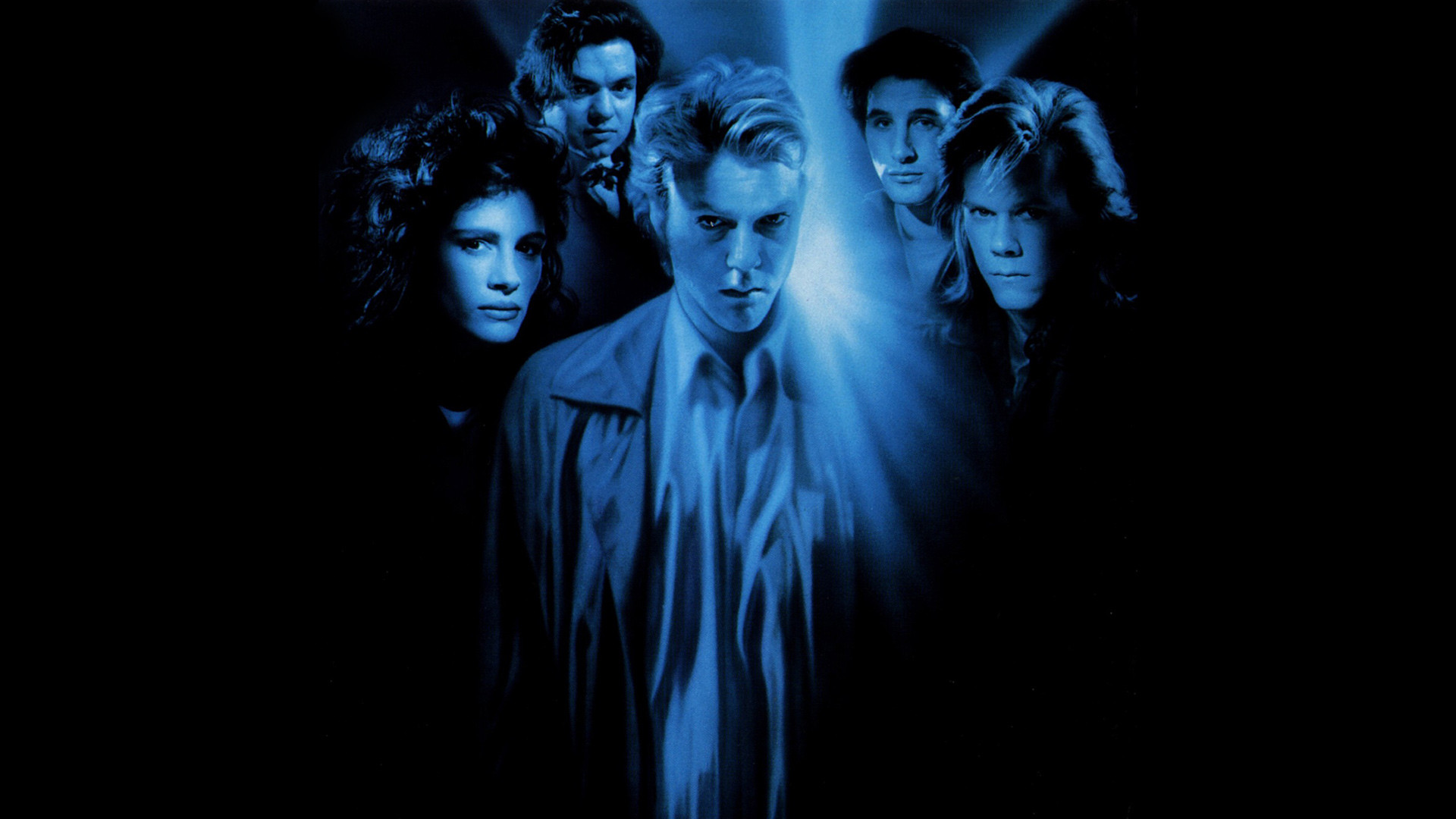
Being medical students, these people have been taught to play God to their patients. It’s Nelson (Kiefer Sutherland) who has the idea to look God in the eye with this little experiment. He enlists the help of Rachel (Julia Roberts), Labraccio (Kevin Bacon), Joe (William Baldwin), and Steckle (Oliver Platt) to sneak into the school after hours with medical equipment, in order to lower his heart rate, die, and have the others revive him by emergency measures. This experiment is dangerous, and would result in both death and expulsion…but it works. Nelson has come back from the afterlife, convincing the others to try it out themselves. Thus tampering with God’s plans for them.

This is an intriguing concept for a movie and it has a top-notch cast, as well as a unique, incredible style to it, from director Joel Schumacher. Also, the idea behind the afterlife’s plans after their experiment is quite something indeed. You know how when you nearly escape death and your life flashes before your eyes? In “Flatliners,” when the characters kill themselves and then are revived again, their biggest sins and fears (mainly to do with guilt) are brought back along with them. They haunt them to no end—for example, William Baldwin’s character is known for his one-night stands and secretly videotaping sexual intercourse; now whenever he looks through a camera or to a TV, he sees those same women, asking “How could you do this to me?” or saying, “I trusted you.” They conclude that the solution is to face them instead of run away from them. This is the movie’s way of saying that you should have your emotions in check before you die. That’s very clever.

This is when “Flatliners” stops becoming an adventure and a thriller and turns into drama. But while I got into Kevin Bacon’s story, and Kiefer Sutherland’s story becomes the central conflict, I feel like William Baldwin’s story had no satisfying turn and Julia Roberts’ entire story is handled so heavily that I felt like I was watching an afterlife-themed soap opera. (Oliver Platt doesn’t “flatline,” which he gladly mentions.)

There’s one thriller aspect that annoyed me, and it had to do with the “flatlining.” Actually, it’s not necessarily the flatlining; it’s the reviving. The first time you see it is kind of suspenseful, but when you have to see it a few more times, suspense is long gone and the scenes desperately try to hammer in the tension to little prevail. I was also annoyed by the competition among the characters based on who can stay dead the longest.

“Flatliners” works as a thriller, and works fine as a drama (though like I said, that’s mainly coming from Sutherland and Bacon’s separate story arcs, which are the strong points). Is there a tunnel with a bright light leading to heaven after you die? I don’t doubt it. Just don’t ask me to undergo this sort of therapy to find out.

The Freshman (1990)

28 Jan

freshman

Smith’s Verdict: ***1/2

Reviewed by Tanner Smith

“The Freshman” could be considered a spin-off of “The Godfather,” since both movies feature a character who is not only entirely similar to each other, but also played by Marlon Brando. In “The Godfather,” he was Don Vito Corleone. In “The Freshman,” he’s Carmine Sabatini, the man that is said to have inspired the character in “The Godfather” (despite the fact that “The Godfather” was a novel before it was a film). In every way respectful, he is the Godfather. He looks like him, acts like him, talks like him, and has the same kind of what could be considered discreet authority as him. With Marlon Brando playing the role of Sabatini, it’s in the great tradition of the original character Corleone, and not taken as a ripoff or a cheap shot.

And what’s better is that “The Freshman” is not supposed to be as serious and epic as “The Godfather.” It’s a comedy—this is the joke; Brando pays a Mafia man extraordinary similar in every way to Don Corleone. And the screenplay and supporting actors don’t let him down.

The story isn’t necessarily about him, like how “The Godfather” wasn’t necessarily about the Godfather. But like the Godfather, Sabatini plays a crucial role in a young man’s life. The young man in “The Freshman” is a film school student Clark Kellogg (Matthew Broderick). He has left his home in Vermont to attend New York University to study film. Things don’t start out very well, as his luggage and money are stolen by thief Victor Ray (Bruno Kirby). When Clark goes to school, his film professor (Paul Benedict) doesn’t tolerate excuses.

Clark confronts the thief and demands his stuff back. Instead, Victor offers Clark a job. He brings him down to Little Italy, where Carmine Sabatini socializes and keeps his office. Clark can’t believe the striking resemblance to Marlon Brando’s Don Corleone, but Victor advises him not to bring it up. Clark has a conversation with Sabatini and it is like he’s actually talking to the Godfather. It intrigues him (and in some way, scares him), so Clark takes the job when the offer is made.

The job involves the movement of a giant lizard—a Komodo Dragon. In a very funny sequence of events, Clark and his roommate Steve (Frank Whaley) attempt to be discreet about moving this lizard from an airport and driving it (an especially difficult task) to an animal smuggler (Maximilian Schell) and his assistant (B.D. Wong).

But before he knows it, Clark finds himself a part of the Mafia family. Clark is doing what Sabatini and Victor tell him to do through a lot of convincing, and he’s also in the middle of a relationship with Sabatini’s daughter Tina (Penelope Ann Miller) that goes way too fast for him, even pressuring into marriage. Everyone is even doing favors for him, like subtly threatening Clark’s film professor for an A-grade. And things get him in more legal danger than he expected. What’s he to do?

“The Freshman” is a sharp, funny, well-written movie that really makes good use, paying homage to “The Godfather” (clips of it are even shown in film class as examples). And it features a highly respectable performance by Marlon Brando, who is truly marvelous in playing a variation of the iconic character he brought to life. It’s strange that Brando didn’t think as highly of the film as I do, as well as most people who saw it. It’s reported that he attacked the movie when it first screened, calling it trash. Well, Brando may be a highly dedicated actor, but he’s no film critic. “The Freshman” is very enjoyable.