

Archive | 1989 RSS feed for this section

Do the Right Thing (1989)

24 Feb

images

Smith’s Verdict: ****

Reviewed by Tanner Smith

Spike Lee is a director that tackles controversial subjects and brings them to independent films that go beyond the usual mainstream prospects. He loves to speak valuable issues through film and brings everything he can get to the screen—even if it’s light comedy to contrast the heavier material. Lee is a prominent voice in American cinema and his third film, “Do the Right Thing” (following “She’s Gotta Have It” and “School Daze”), was the one that made him known as the risky filmmaker with the eyes and the ears.

Oddly enough, “Do the Right Thing” is also the angriest and most aggressive of Lee’s films—showing racism head-on. He shows it like it is, rarely flinches at the subject at hand, and doesn’t resort to political correctness or sermons. He tells a story—he sets up the characters and allows set-up events to play out around them.

The film takes place in a 24-hour period in the Bedford-Stuyvesant area of Brooklyn, on the proclaimed hottest day of the summer. We meet many of the neighborhood locals as they go about their daily lives. Most of them meet at Sal’s Famous Pizzeria, which has been around for about 25 years. The owner Sal (Danny Aiello) has seemingly gotten used to working in a neighborhood mostly composed of African-Americans, and believes that whites and blacks can live together in harmony, though there are some hints of racism partially present. His two sons work with him—Pino (John Turturro) and Vito (Richard Edson). While Vito is easy-going and color-blind, Pino is a hot-headed racist who mostly uses vulgarities about the black customers that come in for pizza.

We also meet other characters such as—Sal’s pizza delivery boy Mookie (Spike Lee) who is hostile and bored, but responsive when he wants to be (there are times when he offers Vito advice not to listen to Pino all the time); Da Mayor (Ossie Davis), an old gentleman whom everyone else constantly ranks out because he’s constantly drunk; Mother Sister (Ruby Dee), the strict, self-proclaimed “high-and-mighty” elderly woman that Da Mayor tries to court; and Tina (Rosie Perez), Mookie’s girlfriend who cares for their toddler son Hector. Others start up the conflict of the story—particularly Mookie’s friend Buggin Out (Giancarlo Esposito) and mild-mannered, boombox-carrying giant Radio Raheem (Bill Nunn). Buggin Out notices that the pictures all over Sal’s pizzeria wall are all of Italian celebrities, and not one “brother,” and attempts to boycott the restaurant. He gets Radio Raheem to help him and this leads to a long day that ends with the occurrence of something alarming.

The film has just been a slice-of-life picture up until this final act, in which a fight occurs, a character dies, chaos ensues, and there’s a full-scale riot.

The title comes from a quote by Malcolm X—“You’ve got to do the right thing.” Let’s look at the facts here—Malcolm X is considered a leader and one of the greatest, most influential African-American leaders in history; a character named Smiley is going around trying to sell pictures of Malcolm X, as well as Martin Luther King, Jr.; and the film is centered around racial tension in the projects. I suppose we’d like to think that racism is toning down in our society, but as Spike Lee shows in “Do the Right Thing,” it’s always going to be present and it can sometimes spin things out of control. And it can be brought back to this simple statement—because of this, everyone in this movie fails to do the right thing. What is the right thing? Who does it? The way I see it, nobody does. That’s what makes it ironic and all the more credible and disturbing. We even have a character that we have come to like performing an action that makes the violent situation even worse than it already was. (By the way, props to that, because in a more mainstream movie, I bet someone we’ve come to hate would’ve done the exact same thing.)

This is what Lee sees and that’s what he brings to the screen, while having his own understanding of what’s happening. This film is not trying to offend races—it’s not anti-white, nor is it anti-black. It just shows how misunderstanding and racial tension would/could lead to violence.

The oddest thing about the movie is actually the most interesting—amongst the angry, aggressive tone that’s felt throughout the movie, the filmmaking is so lively. The camera focuses on many images, a rocking soundtrack is present in a lot of scenes (Public Enemy’s high-powered “Fight the Power” serves as the film’s anthem, especially in the opening-credit sequence, featuring a young woman dancing in the street), the colors stand out, and just a thrilling sense of entertainment. How can you describe a film like this? It’s so angry, so aggressive (sorry for repeating myself here), and yet so damn entertaining. Also, the performances each have a high power to them—particularly Danny Aiello, Ossie Davis, John Turturro, and Spike Lee himself (he’s actually a pretty good actor).

So maybe there isn’t a solution to the racism problem in society that we can find in “Do the Right Thing,” but there’s not supposed to be. What Lee is trying to do is bring the problem to realization, if it hasn’t been realized already. This is a film that’s trying to say something and throwing all it can to make you listen. That’s a film to be duly noted, in my opinion.
Say Anything (1989)

8 Feb

say-anything-1040cs022412

Smith’s Verdict: ****

Reviewed by Tanner Smith

In the 1980s, movies featuring teenagers were just as popular then as they are now. But they were very rarely given a good name. There would be sleazy teenage sex movies and deplorable slasher movies. Every once in a while in the ‘80s, there would be welcome exceptions—teen movies that feature solid writing and good development for their teenage characters, like “Lucas,” “Tex,” “Risky Business,” “The Breakfast Club,” and “Permanent Record,” among others. Then near the decade’s end, “Say Anything” came along and made itself known as what is not only a great teen romance movie, but possibly the best of its kind. It’s treated intelligently with well-developed, likable characters, credible situations, and well-drawn relationships that are emotionally involving. At times it’s funny, other times time it’s touching, and mostly it’s engaging.

“Say Anything” stars John Cusack as Lloyd Dobler, a recent high school graduate. Lloyd has no future plans as of yet, because there’s nothing out there that catches his interests except kickboxing. He tells one of his teachers that he’s looking for “something great, you know—a dare-to-be-great situation.” He’s a real optimistic guy and has his hopes up when he decides to ask out the class valedictorian Diane Court, said to be “a brain trapped in the body of a game show hostess.” True, Diane Court (Ione Skye) is very smart and very beautiful, and most people wouldn’t see her and average Lloyd together. But Lloyd gives it a shot and calls her up—I love the bit in which Lloyd dials her phone number and checks himself in the mirror before pressing the last digit.

At first, Diane doesn’t answer the phone—her father (John Mahoney) does. Lloyd asks him to have her call him when she gets a chance, and his tone of voice gives the assumption that Lloyd isn’t the only guy that’s called for Diane. “Is this the guy with the Mustang,” he asks. “Why don’t you just leave a message—that’s usually how it works,” he says. Lloyd repeatedly tells him his phone number. Then he hangs up the phone, shrugs it off, and quickly goes back to reading his magazine. But Diane does call Lloyd back and Lloyd asks her to a graduation party. At first, Diane tries to let it down easy, but changes her mind when Lloyd makes her laugh.

Diane is someone who needed a good laugh, as a lot of things are going on in her life. As she confides with her caring father, she’s scared for her future even though things seem to be going great for her. Really, her father is more excited for her than she is. What she needs is someone outside of her father to socialize with. She realized while making her valedictorian speech that no one at school actually knew her—they knew of her. She wishes she didn’t take any summer school courses. And so, when Diane agrees to go to the party with Lloyd, she’s able to finally mingle with her peers. And not only that—even though she and Lloyd have very little in common, she finds that she genuinely likes him.

The relationship between Lloyd and Diane is sweet and believable, but another key relationship is between Diane and her father James. It’s a trusting, confiding relationship between the two; Diane feels she can say anything to him. But when Diane wins a scholarship at a school in England, James is more excited for it than Diane is. Diane is scared for the future, but the father just wants her to deal with it. Then, Lloyd comes along and as their relationship grows, the father becomes skeptical since Lloyd has no real plans for the future except “to spend as much time as possible with your daughter.”

James is written with more intelligence than one would expect from a parent in a teen movie. He has his own problems too, and there’s a pivotal subplot involving a pair of tax collectors that turns his world upside-down. Mostly though, he’s Diane’s confidant. And he tries to keep his daughter close to him as they usually are, but the screenplay doesn’t turn him into a device to try and keep Lloyd and Diane apart. (Though, there is a time when they do separate, but for believable reasons.) And when he does get angry, he respects his daughter enough to listen to what she has to say, leading to one of the best scenes in the movie, as Diane tells James what happened between her and Lloyd on one of their dates. The scene cut away from when it looked like Lloyd and Diane were about to have sex, right to when Diane comes home the next morning—the way she describes to her father what exactly happened is a smart, well-written moment. It’s very rare in a teen movie that a teenager has this kind of relationship with his or her parent(s).

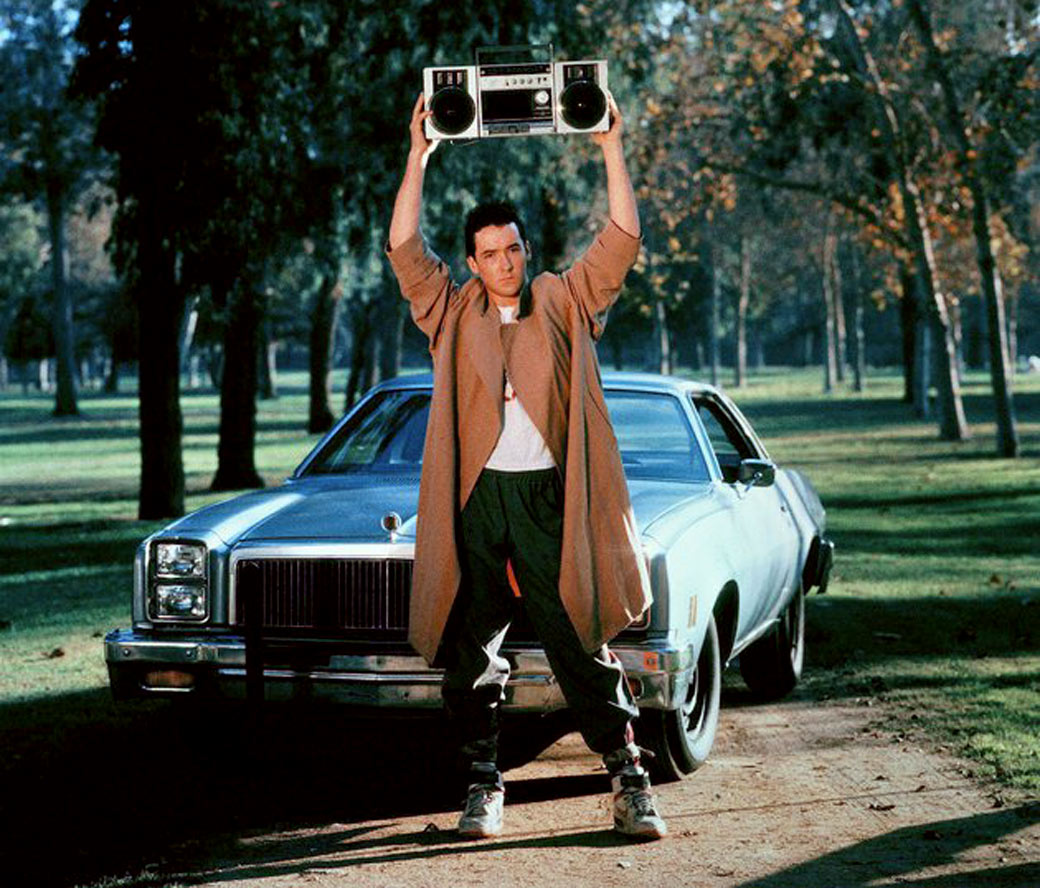
This is a great screenplay by Cameron Crowe (who also directed the film). All three central characters—Lloyd, Diane, and James—are well drawn out and easily identifiable. Every one of their situations seems believable, thus making it all effective. Aside from the great scenes I mentioned before, there are many other great ones—Diane’s amusing first talk with Lloyd, Lloyd’s best friend Corey (Lili Taylor) using her guitar at a party to get over a breakup, Lloyd meeting up with some guys at a gas station after he and Diane break up (they think they know a lot about women, even though they hang out with each other on Saturday night), and who could forget the later scene featuring Lloyd as he stands in front of Diane’s house and holds a boombox over his head, playing Peter Gabriel’s “In Your Eyes” in an attempt to win Diane’s heart again.

I love this exchange between Lloyd and Diane when Lloyd takes Diane home the morning after their first date. Diane says she’ll call him tomorrow. Lloyd: Today is tomorrow. (beat) Diane: I’ll call you later, then.

John Cusack is perfectly cast as Lloyd Dobler. He’s immediately likable and so sincere in his performance that it’s so hard not to feel for him. He has a great deal of optimism, humanity, and self-respect to believe that he deserves the prettiest and smartest girl in the class, and we’re hoping for the best. (There’s no surprise that the film’s poster features the tagline, “To know Lloyd Dobler is to love him.”) Ione Skye is wonderful and totally convincing as Diane Court—a better performance than her role in the 1987 teen drama “River’s Edge.” Both actors share great chemistry together. John Mahoney does great work, making James into a three-dimensional father character. Llil Taylor and Amy Brooks as Lloyd’s friends, and Joan Cusack as Lloyd’s older sister whom he lives with, fill supporting roles effectively.

“Say Anything” is such a treasure. It’s very human, very believable, always pleasant, extremely-well-written, and wonderfully-acted. It features a teen romance, but to be honest, it’s not necessarily a “teen movie.” This is a movie for all people—it’s a movie about relationships and trust. It doesn’t condescend to romantic comedy clichés—it tells it like it is. The result is a wonderful movie that I can’t imagine anyone not enjoying.

Chances Are (1989)

27 Jan

chances-are_l

Smith’s Verdict: ***1/2

Reviewed by Tanner Smith

“Chances Are” is a movie that, at first, doesn’t seem too original and sort of doesn’t know what kind of movie it wants to be, but then finds its footing soon enough and develops into a sweet, funny, lighthearted romance with a fantasy element that is crucial to settling fresh relationships put into the story. That element is reincarnation, which is used as a mind-swap situation as one of the film’s two main characters suddenly has memories of his past lifetime. See if you can follow…

The movie has its somewhat weak setup in which we meet a young married couple—Louie, played by Christopher McDonald, and Corinne, played by Cybill Shepherd. Shortly, Louie is killed in an accident and then, he finds himself in the same heaven that is seen in countless other movies. You know, the kind of Movie Heaven where there is smoke all around, everyone wears white suits, and there seems to be a wide-open space with a lot of people wandering around. These people are in line to be reincarnated. Louie is in such a hurry to get back to Earth that he runs off without getting his injection that apparently forces him forget his previous life when he enters his next life.

That’s an odd start and you’re not sure where “Chances Are” is gong to go from there.

Fade to 23 years later, when we see that Corinne is still adjusting to the death of her husband. She raises her daughter Miranda (Mary Stuart Masterson) and never remarries. She doesn’t even notice that the family’s best friend Philip (Ryan O’Neal) has always been in love with Corinne and even briefly told Louie, on their wedding day, about his feelings for her. She still has her love for Louie in her heart and is totally oblivious to see Philip’s true feelings for her.

But more importantly, we get an introduction to a 23-year-old Yale graduate named Alex Finch (Robert Downey, Jr.), who befriends Miranda and Philip and is brought home for dinner. This is when the movie starts to kick in—we learn, if we didn’t already, that Alex is Louie reincarnated. When Alex arrives at the house, he immediately begins to remember who he used to be, and he definitely remembers Corinne. This leads to an awkward but funny scene in which Alex freaks out at the dinner table.

Now, at the thirty-minute mark, the movie has really begun. Everything earlier was just buildup to introduce the characters. Maybe not much else about the plot should be said, but the movie has fun with the many implications and paradoxes. Miranda has a crush on Alex and the feeling is somewhat mutual, but if Alex is Corinne’s husband Louie reincarnated, then Alex could technically be dating his own daughter. Then, there’s the plot point in which Alex tries to convince Corinne who he really is. Then, there’s the plot point about Philip’s feelings for Corinne and how Alex reacts to them. There’s more fresh material (and fresh relationships) in the screenplay for “Chances Are,” written by Perry and Randy Howze, the writer duo who also wrote 1988’s “Mystic Pizza.” They, along with director Emile Ardonlino, take certain plot elements that are not particularly original (heaven/reincarnation/mind swap) and turn the story into something special.

The actors play this material with dedication and credibility. Cybill Shepherd is convincing as the widow who doesn’t know how to react to this strange young man, who could be her reincarnated dead husband. Ryan O’Neal and Mary Stuart Masterson are fine in their roles. But the real star is Robert Downey, Jr. His is the most crucial role—if he doesn’t bring weight and plausibility to his role, it wouldn’t be easy to follow the story, or believe it, for that matter. But Downey, Jr. pulls it off with a convincing performance.

“Chances Are” is a surprisingly effective film. It shows that artistry can redeem any subject matter. Credit the director and writers for adding lighthearted romance and humor into the mix, and also credit the actors for bringing conviction to their roles. They make the film smart and entertaining.