Archive | 1987 RSS feed for this section

Superman IV: The Quest for Peace (1987)

7 Feb

superman-iv-still-121

Smith’s Verdict: Half-a-star

Reviewed by Tanner Smith

The only reason I choose to give “Superman IV: The Quest for Peace” a half-star rating instead of a dreaded zero-star rating is because the movie is good-natured and real little kids may find some enjoyment out of it. For everyone else, and especially for those who enjoyed the first “Superman” movie (I also enjoyed the second one and found the third one to be dull as dishwater), it’s a waste of time and a mystery that needs to be solved. That mystery is, who thought a fourth entry in this big franchise would have a script this lame and effects so terrible?

The story is this: with the Cold War getting everyone paranoid, a grade-school kid writes a letter to Superman. The letter asks that he do something about the nuclear weapons in the world. So what does Superman do? He announces to the world that he will destroy them all.

And everyone’s OK with this? No one’s arguing with him?

Anyway, Superman (Christopher Reeve) destroys every nuclear missile by launching them into the sun, burning them up. This gives an opportunity for archvillain Lex Luthor (Gene Hackman), with his annoying “tubular” nephew (Jon Cryer) in tow, to send a missile with a strand of Superman’s hair attached into the sun so…(sigh) Nuclear Man can be born and be ordered to destroy Superman. Nuclear Man is a Dolph Lundgren type who has the same powers as Superman and this should lead to some interesting action sequences, right? Not even close to exciting—just bad filmmaking.

This is the fourth film in the franchise and I ask the question: Wouldn’t the effects have advanced over time? How bad are the effects? Consider the first “Superman,” which had the tagline, “You’ll believe a man can fly.” Did we see any wires? No. Did we notice a green-screen effect at times? Yes, not so distracting. Now, consider “Superman IV: The Quest for Peace.” The wires on the flying characters are visible, black curtains are seen instead of a space background when a scene is set on the moon, and I won’t even mention the bridge-effect. Also, the film suffers from bad editing to hide most of the effects.

Meanwhile in the story, there’s a subplot involving a love triangle between Superman’s secret identity—the nervous Clark Kent—and Lois Lane (Margot Kidder) and the daughter of the paper’s new editor (Mariel Hemingway). This leads to a scene in which one woman needs to be with Superman and another with Clark at the same time.

Christopher Reeve and Gene Hackman do what they can with their reprising roles. But Margot Kidder seems mostly gone through the movie, Mariel Hemingway should have known that a character with a line like “all men like me; I’m rich” isn’t interesting, and Jon Cryer deserves a slap in the face—he’s annoying all the time.

I could also argue that the production team of Golan-Globus is responsible for most of the film’s failings, but I don’t feel like writing another word about this terrible movie.

Fatal Attraction (1987)

6 Feb

52179.6a00d83451b05569e2013480acb22a970c-800wi

Smith’s Verdict: ***1/2

Reviewed by Tanner Smith

What “Fatal Attraction” is trying to get across is very simple—don’t cheat on your spouse. Even when you think there’s a way out of a one-night stand or an affair, don’t take the chance that it will turn against you and threaten the lifestyle of your family. In “Fatal Attraction,” family man Dan Gallagher (Michael Douglas) has a one-night love affair with another woman and wants to end it the morning after. But the woman won’t let it end, no matter what…

This would be the premise for a broad comedy, but “Fatal Attraction” is a thriller—and an effective one, at that. It shows the consequences that occur not only when a married man cheats on his wife, but also with the wrong woman.

The film’s opening scenes feature the life of successful, happily married lawyer Dan Gallagher, his wife Beth (Anne Archer), and adorable six-year-old daughter Ellen. While Beth and Ellen are out of town for the weekend, Dan meets Alex Forrest (Glenn Close), an editor for a publishing company. They have dinner together, Alex seems like an intelligent, passive woman, and she and Dan wind up having a passionate affair that very night. Alex assures Dan that it would’ve only been a simple thing, a fling to be forgotten about later, and Dan falls for it.

Big mistake. Dan leaves the next morning, hoping to forget all about this and go back to his normal life. But Alex doesn’t let it go—she wants to further the relationship and clings to Dan. Dan tries to let it down easy on her that they should never have a relationship together…only to have Alex attempt suicide. And it gets worse—it turns out that Alex is pregnant with Dan’s baby.

Or is she? We’re never quite sure of this. But what we do know is that Alex is obsessive and undoubtedly insane. Dan wants nothing to do with her, but Alex keeps coming and coming, threatening the lifestyle of Dan and his family. Dan tells Alex to leave him alone, to which Alex replies “I’m not going to be ignored, Dan!”

This is one crazy lady. And the odd thing is that she starts out seemingly normal. It’s this affair with Dan that sets her on edge, and the fact that she can’t have him enrages her. Her rage continues to grow every day and her obsessiveness takes her over to the point of violence. Who is at fault for all of this? Is it Dan, for falling into this affair with a woman other than his wife, and then hoping to forget about it immediately? Is it Alex, for leading him on in the first place? You can read much into this.

Dan is a likable guy, despite what he does. He’s just trying to do right by his wife, whom he still loves. He’s smart too—when things turn ugly, he follows advice that many characters in thrillers seem to neglect. He calls the police to see about a restraining order. He even tells his wife about the affair, later in the movie. Understandably, Beth doesn’t take this very well—especially not when Dan tells her that Alex is pregnant. There’s great family drama in occurrence in “Fatal Attraction,” particularly in the scenes in which Dan is trying to fix everything to keep his wife and daughter from any harm.

Michael Douglas and Glenn Close do great jobs at portraying these characters, and Anne Archer is effective as Dan’s wife Beth.

Some critics, including Roger Ebert, were bothered by the film’s ending, in which Alex officially loses it and attempts to slash Beth before Dan can try and stop her. This has been likened as a “Friday the 13th” style ending, and to be honest, the only time I made this distinction is with the brief fake-out after it seems that Alex is finally dead. Of course not; she comes back for one cheap scare. The climax itself worked for me; it’s effective in showing how far Alex was pushed in her mental obsessiveness. But that cheap scare at the end didn’t work at all. It did indeed make it seem like a slasher film. Mostly though, “Fatal Attraction” is a terrific psychological thriller. The acting is great, the dilemmas are legitimately tense, and it’s executed with convincing realism

Raising Arizona (1987)

31 Jan

images

Smith’s Verdict: ***1/2

Reviewed by Tanner Smith

Where did a comedy like “Raising Arizona” come from? This movie is all over the map and to call the comedy offbeat would be an understatement—everyone in this movie is either foolish or insane, the screenplay’s dialogue for the characters is quirkily poetic, and it’s hard to figure whether it takes place in reality or another dimension (though I’m close to picking the latter). But I loved this movie mainly because it’s consistent—consistently funny and crazy.

In a 13-minute pre-opening credit sequence that is pure montage and narration, we meet our main characters—an ex-convict named H.I. “Hi” McDonough (Nicolas Cage) and his wife Edwina “Ed” (Holly Hunter), who takes police mug shots. Actually, in a funny twist, that’s how they met. Hi meets Ed as she takes his pictures when he’s first convicted. Then the second time he’s convicted, he notices some sadness in her life and begins to charm her. Then the third time he’s convicted, he actually proposes to her. (You see, Hi has a tendency to rob convenience stores, which always lands him in jail.) When Hi is released, again, he decides to start a clean wife and actually marries Ed. They live in a trailer out in the boonies, near a small town in Arizona. They want to have a child, but can’t because Ed can’t conceive and adoption is out of the question since Hi is a repeatedly-convicted ex-felon. But then they hear of popular furniture dealer Nathan Arizona’s newly-born quintuplets and decide that that’s too much for him and wife to handle, so…they decide to borrow one of them.

Sheesh, so much story put into the first thirteen minutes, before the credits appear. But I thought it was quite enjoyable because of how it never seemed to stop. With Hi’s “poetic” voiceover narration of the sequence and just the over-the-top delivery of the characterizations of Hi and Ed make for a zany experience that I quite enjoyed. And that sets the tone for the rest of the movie, which is equally zany.

For example, the following scene is in which Hi sneaks into the babies’ room to steal one of them. He inspects them all to see which one seems right, and they all run (or crawl) amok around the room, while Hi tries to control them while also attempting not to make any noise while Arizona is downstairs. The wide-angle shots, low-angles, and closeups add to the wackiness of a situation that…to tell the truth, could be very disturbing. Somehow Nicolas Cage makes “baby-stealing” seem less creepy. It’s strange.

Another overly-executed sequence is when Hi and Ed go to a convenience store to buy the baby (whom they call “Junior”) a pack of Huggies. The big mistake Ed makes is letting Hi go in while she stays in the car with the baby. Of course Hi robs the clerk, and this leads to a chase scene that is…well, not boring. Madness ensues during the chase, as Hi goes through streets, backyards, and a supermarket while being chased by the crazed clerk, armed police, and even a pack of snarling dogs!

“Raising Arizona” was the second movie written and directed by Joel and Ethan Coen, who obviously know how to make exciting movies. They certainly showed that in their debut film, “Blood Simple,” a completely different film than this one. They use unique camera angles and quirky characters to tell their stories, and the results are quite effective.

All of the characters in “Raising Arizona” are memorable. Nicolas Cage’s Hi is charmingly dangerous with some sincerity in him, Holly Hunter’s Ed is ultimately stubborn to the point where she seems somewhat psychotic, Trey Wilson’s Arizona is suitably flamboyant, and then there are these folks—two escaped convicts (John Goodman and William Forsythe) who are dumb as posts, Hi’s boss Glen (Sam McMurray) who gladly tells bad joke after bad joke, and Glen’s perky wife (Frances McDormand). They’re all enjoyable to watch and the Coen Brothers cast game actors who really go for it with their roles. I should also mention that their dialogue is not normal. These rural folks all talk like they’re in a Shakespearean play, with countryside jokes put in for good measure. How weird is that?

Oh, and I almost forgot to mention Randall “Tex” Cobb as Hell’s Angel type who may be just a bounty hunter, but Hi describes him as a demonic being who rides on his motorcycle with a blaze trail following. He becomes an important asset to the story when Arizona hires him to get the baby back. This subplot is very silly, to tell the truth, but it’s also a lot of fun and as wacky as the rest of the movie.

“Raising Arizona” is a weird, preposterous and yet mostly hilarious and well-put-together offbeat comedy with a lot of material, aided by flashy camera work and eccentric characters. It’s weird, goofy to say the least, and very entertaining.

The Lost Boys (1987)

28 Jan

Lost-Boys_l

Smith’s Verdict: ***

Reviewed by Tanner Smith

It’s always fun to see horror movies that use old-school elements and update them into fresh modern entertainments, and “The Lost Boys” represents an appealing, fun look at the definitive vampire stories. This movie has the traditional vampire elements—vampires stalk the night and kill for human blood, and for weapons to fight them off, wooden stakes and holy water always come in handy. Where “The Lost Boys” differs is the teenage outlook. The lost boys in the title are teenage vampires living in Santa Carla, California—they dress like punk rockers, ride through the beach on their motorcycles in the night, and live in a cavern (with a Jim Morrison poster on the wall). They just happen to grow fangs, fly through the air and attack people (and drink their blood).

Oh, and who do they have to lure people into their traps occasionally? They have a “lost girl” who looks stunning while the boys look threatening. The latest person that falls for this is a young man named Michael (Jason Patric). Michael has moved to Santa Carla (which is often referred to as the Murder Capital of the World) with his divorced mother (Dianne Wiest) and younger brother Sam (Corey Haim). While checking out the boardwalk on their first night in town, Michael sees the girl—Star (Jami Gertz)—at a rock concert and follows her until they stop for a chat. It’s then that the Lost Boys—led by David (Kiefer Sutherland)—introduce themselves to Michael and decide to let him join their crowd.

Sam, a comic book geek, visits the local comic store and encounters a pair of brothers who work there—Edgar and Alan Frog (Corey Feldman and Jamison Newlander). They warn him of vampires swarming Santa Carla and they’re the ones to wipe them out. They give him a special comic titled “Vampires Everywhere.” “Think of it as a survival manual,” one of them tells Sam. “Our number’s on the back, and pray you never need to call us.” This proves to come in handy, as Michael falls in with the Lost Boys after drinking a little wine (which could be blood) and joining in on their bizarre activities (such as clinging on to a railroad bridge while a train passes by). But Michael himself is going through some changes—he sleeps during the day, barely has a reflection, and is starting to crave his brother’s blood. Sam freaks out, “You’re a vampire, Michael! My own brother—a damn bloodsucking vampire! You wait ‘til Mom finds out, buddy!”

This vampire problem is more of a way of Santa Carla’s nuisance, among the weird locals, mainly youths, of the town (most of which we see in an opening montage as The Doors’ “People are Strange” is playing). With that said, who would believe that these teenage punks who dress in leather and spikes could turn out to be vampires? But when they ultimately make themselves known, they mean business. These aren’t teenagers merely having fun—these are vile humanistic beasts that slaughter without mercy, while having fun doing it.

But hey, it’s nothing that some wooden stakes, garlic, and holy water can’t fix, right?

“The Lost Boys” is far from a standard horror film. It has a nice serious-satiric edge that fits nicely with the teenage-vampire-horror elements. The idea of these vampires being teenage punks living in a cavernous hangout (did I mention the Jim Morrison poster?) is fun enough, but then they are found deeper in the caves, hanging from the ceiling while sleeping. “I thought they were supposed to be in coffins.” “That’s what this cave is—one giant coffin.” The funniest parts of the movie are with the Frog brothers, whom Sam of course calls to help kill the vampires and save his brother. These are two teenagers who pretend to be Rambo and have suitable game-faces for going into battle. What’s great about this is that it’s not played for laughs—it’s the way that both young actors play them, as serious as possible, that makes these two characters enjoyable.

But of course, they are just teenage boys fighting vampires. At their crucial point of battle, their lives are actually saved by a dog. How embarrassing for them.

“The Lost Boys” is an immensely entertaining movie with wild ideas, a nice comic edge, and good acting. It’s also great to look at. The movie was photographed in rich, dark colors by Michael Chapman, and as a result, “The Lost Boys” always contains that grimness that should come in a vampire story. The night scenes particularly look fantastic. But that’s not to say the movie doesn’t have its flaws. For one thing, it’s a little overstuffed, especially with elements of Dianne Wiest as Michael and Sam’s unbelievably dim mother (she’s too slow to catch on with the madness), and Ed Hermann as a video store clerk who dates her, and whom Sam believes is the head vampire. Actually, that’s necessary. But then there’s Barnard Hughes playing a caricature of an eccentric Grandpa (“Read the TV Guide, you don’t need a TV”). He’s funny, but at times very distracting.

Of the actors, Corey Haim is very likable as Sam, and displays good comic timing while reacting to most of everything around him. Corey Feldman and Jamison Newlander steal the show as the in-over-their-heads Frog brothers. Jason Patric is merely adequate as Michael, but to be fair, I don’t believe the character was written properly. But the real standout is Kiefer Sutherland as David, the leader of the Lost Boys. Sutherland smirks like no other and has a natural menace within him. It’s a strong performance.

The final act of “The Lost Boys” features Michael, Sam, Star, and the Frog Brothers as they fight off the vampires who storm Grandpa’s house while the mother and Grandpa are away. While it is exciting and has its share of awesome and darkly funny moments (they fill a bathtub up with holy water and garlic so that a vampire implodes inside it, damaging the plumbing of the house), I have to wonder if there was some other way this could have gone. Maybe this could’ve taken the direction of a psychological or philosophical look at what it means to be a teenage vampire, for example. But that was just a personal preference. Otherwise, the climax is relatively electrifying and quite fun. And that’s what can be said of the whole movie.

The Big Easy (1987)

28 Jan

MCBR01_0

Smith’s Verdict: ****

Reviewed by Tanner Smith

“The Big Easy” starts out as a thriller, and then it turns into an erotic romance. Then it goes back to being a thriller again and then an erotic romance again, until the film finally becomes a romance/thriller. That usually comes rare in the movies, since in most thrillers, whatever romance develops isn’t quite as important as its own central story. But “The Big Easy” manages to keep consistency in both elements.

As you may have guessed, the Big Easy in the title refers to the nickname of New Orleans, Louisiana. And New Orleans is quite a unique city to set a thriller, as it’s one of the most mysterious cities, as far as I’m concerned. It’s humid and quite eerie with its many alleyways and courtyards. There had to be a thriller to come around and use it as its location.

“The Big Easy” starts with an investigation of the dead body of a Mafia (or “wise-guy”) member, found lying in a fountain. We meet our two main characters who are on the case. They’re a police lieutenant named Remy McSwain (Dennis Quaid) and an assistant district attorney named Anne Osborne (Ellen Barkin). They meet in Remy’s office and are immediately attracted to each other, despite Anne wanting to keep this a professional relationship. They go out to dinner that night, and she rightfully accuses Remy of being on the take, to which Remy responds by saying she doesn’t know how the system works around here.

After some bickering between them, they wind up forming a passionate love affair with each other, mainly because Remy is too persistent. But after a couple days, their affair ends when Remy is caught on videotape while accepting payoffs in an Internal Affairs sting. Anne becomes his prosecutor, which makes things pretty tense for both of them.

Anne takes her job (and burden) seriously, despite her affair with Remy, and she nearly puts him in jail. But with the help of some folks at the station, the evidence is destroyed and Remy gets off scot-free. Anne wants to forget about all of this, but Remy has arranged for her to be “arrested” and brought to his mother’s house, where a party is being held and Remy would like to dance with her, as he’s still in love with her. This is a great scene.

But soon enough, more killings continue and it seems like someone on the police force might be involved, and so Remy and Anne work together again. While doing so, their romance is further developed.

“The Big Easy” is great because it manages to take a string of these nicely-developed, interesting characters and manages to fit them into a thriller that is not one of those assembly-line thrillers, but a real interesting caper that gets more intriguing and investing as it goes along. I wasn’t expecting much from the story in the first few minutes as much as I was enjoying the company of these characters on-screen. That’s why I was pleasantly surprised when I realized that I was really getting into the mystery. And when one of the characters that I have become accustomed to turns out to be involved with the bad guys, I was actually pretty surprised because I didn’t want that person to be associated. That lets you know a thriller is working.

The two leads are intriguing roles and real three-dimensional characters as well. Remy, we see, is both honest and dishonest in doing his duty as a cop. Sometimes he does the wrong things, but for what he thinks are the right reasons—like arranging a “widow and children’s fund” so he can use the money to keep his younger brother (Tom O’Brien) through college. He’s also cocky and very persistent, and that’s how he usually gets his way. But that doesn’t mean that Anne isn’t a tough cookie. She’s smart, fierce, and will do anything to get what she needs, and yet she falls for this guy because she notices his charm. Dennis Quaid and Ellen Barkin do excellent jobs at playing these characters, and their love scenes are some of the most erotic I’ve seen in a movie—it’s mostly realistic.

But the supporting characters are given time to develop and shine. There’s the sincere police chief (Ned Beatty, excellent here) who isn’t constantly arguing with Remy like most chiefs, but actually fools around with him because the two are good buddies. And there are the other guys down the station, constantly making wisecracks at each other, even at a crime scene. There’s Remy’s younger brother who comes in at the wrong times. And last but not least, in fact he’s my favorite supporting character—Lamar Parmentel (Charles Ludlam), a Cajun-accented defense attorney in a Panama hat and a summer suit.

New Orleans also seems like a major character in the movie—no wonder the movie is called “The Big Easy.” The feel of the city is just right—the people, the locations, the music, and even the food are given notice as colorful New Orleans elements.

Sure, the movie ends with a typical showdown involving Remy and Anne versus the revealed killers, but even that’s well-done. It’s not as long as most climaxes go, and it even does the smart thing by making it seem like the characters’ actions are in their nature. “The Big Easy” is not just a thriller, and it’s not just a romance either. Those expecting either of those will be surprised by a great movie.

The Monster Squad (1987)

27 Jan

images-1

Smith’s Verdict: ***

Reviewed by Tanner Smith

One of my favorite movies from my childhood was “The Monster Squad,” a 1987 horror-comedy/kid-adventure with a neat premise—think of the original Movie Monsters vs. the Little Rascals, and you have “The Monster Squad.”

I loved watching this movie when I was a kid. It was entertaining, had a neat story idea that came through, and couldn’t find a single flaw. Watching it now, I notice differences between the movie I loved as a kid and the movie I’m watching now. But I still enjoyed the movie. It’s not the classic I remember, but it’s still an entertaining watch.

The Monster Squad in the title are a group of savvy middle-school outcasts who form their own club in a treehouse, where they talk mainly about their favorite subject—monsters. They draw pictures of “spider with human head” in science class, have discussions of whether or not Wolfman can drive a car, and in initiating a new member, they ask questions like how to kill a vampire and “What’s the second way to kill a werewolf?”

But meanwhile, Count Dracula (Duncan Regehr) is alive and plans to rule the world. To his aid are a wolf-man, a two-thousand-year-old mummy that just gets up and walks away from a museum, and a Gillman who…is just there. There’s a lot of story to go with this plan, but I’ll try and explain. But don’t ask how all of these Movie Monsters got associated with it because it’s never really explained. That’s not the main concern and besides, who cares anyway? They’re all here. It’s movie magic.

Anyway, there’s a magical ancient amulet that maintains some sort of balance between good and evil in the world, which can shift if the amulet is destroyed. It’s indestructible, but every one hundred years, the amulet can become vulnerable until a young virgin can read a magic spell that will maintain the amulet’s power and the balance between good and evil. Dracula hopes to find the amulet and destroy it so he can rule the world.

OK…I don’t quite get it either. I didn’t think about it too much when I was a kid, but I can’t ignore it anymore. This story is much more complicated than any other with a magical element. The amulet is simply there as a McGuffin—a story catalyst to get the story where it needs to be.

Anyway, the monster club finds out about the appearance of Dracula in their hometown, and following an old diary with sinister information, they find out what’s going on and set out to find the amulet and fight the monsters, thus the appointed name the Monster Squad.

Maybe the kids in this movie are not the Little Rascals, as I metaphorically described—even though these kids hang out in a clubhouse and have a cute little dog with them, they are also slightly older than the Rascals, are modernized for their time, and cuss because they think it’s cool.

Actually, the kids’ constant swearing, and some occasions of intense violence, is the reason this movie was granted a PG-13 rating. Because of this, audiences didn’t know why they should see this movie—a lot of people thought it would be too scary for kids, while others thought the exact opposite; thinking this was a kids’ film. Therefore, the film did very poorly at the box office. But it did gain a strong cult following by people who discovered it on TV and practically demanded a 20-year anniversary special edition DVD, which they got.

What makes this film so special? Well, for all the “80s cheese” movies that people hold in regard, “The Monster Squad” does have a great deal of production value. Director Fred Dekker and his crew used every ounce of their budget to give the movie an epic feel. You can tell right away in a well-crafted opening sequence set in the 1800s, when Abraham Van Helsing (yes, the scientist from “Dracula”) and his band of freedom fighters storm Dracula’s castle to kill monsters. The interior-castle set is incredible, as it incredibly resembles Dracula’s castle in the original 1931 “Dracula” film. And the creature effects—skeletons that come to life and grab people—are legitimately frightening.

You could argue that this opening sequence is better than the movie itself, but let’s just keep going.

The special effects are quite good, particularly the creature makeup on creatures like Frankenstein’s Monster and the Gillman. Although, the Wolfman isn’t as successful—there are times when you can tell the actor is wearing an obvious mask. (But the wolf-paws look realistic.)

Everyone remembers three particular members of the Monster Squad—the leader Sean (Andre Gower) for his wits and bravery, rebel Rudy (Ryan Lambert) for his bad-boy style and the lion’s share of the monster slaying, and Horace (a.k.a. Fat Kid—well, at least he’s supposed to be a stereotype) for not only playing a stereotypical fat kid (I mean, why else would he carry around a slice of pizza if he wasn’t use its garlic to burn Dracula’s face?), but also for delivering the film’s infamous line after kicking Wolfman in his personal area—his reaction in shocking bewilderment, “Wolfman’s got nards!”

The climax of the movie—in which the kids and monsters battle each other at the town square—is pretty exciting, with one showdown after another without getting boring. How can you not love the part where Horace kills the Gillman with a shotgun?

Duncan Regehr has fun with the role of Dracula, and there’s also Tom Noonan as Frankenstein’s Monster. Dracula brings “Frank” back to life and orders him to find the kids and kill them. But the Monster instead turns on Dracula and winds up befriending the Squad, particularly Sean’s innocent, cute little sister Phoebe (Ashley Bank).

So what about “The Monster Squad” doesn’t hold up very well for me? For starters, the story is all over the place and is a little too much for a film that runs about 82 minutes. In fact, parts of the movie just seem rushed at times. We don’t get enough of this likable Frankenstein character (though he does have an awesome final moment) and the subplot involving Sean’s bickering parents (Stephen Macht and Mary Ellen Trainor) is overlooked once the monsters appear. Oh, and there’s also a recluse simply known as Scary German Guy (Leonardo Cimino) who, in one shot, shows an interesting background that we’d like to get to know about, but no.

Actually, that’s a problem with “The Monster Squad”—for a movie with a short running time as this, it’s pretty overstuffed. Additional stuff with Sean’s police officer father and his comedic partner (Stan Shaw), the human form of the wolf-man (Jonathan Gries, simply credited as “Desperate Man”), and the school bullies (Jason Hervey and Adam Carl) are glanced over and then forgotten without much of a payoff, with the possible exception of the bullies who witness Horace killing the Gillman and respect him for it.

Also, there are quite a few nonsensical moments. For example, when Sean reads a message from someone named “Alucard,” how does he automatically know that the name is an anagram for Dracula? And there’s a scene in which the Squad’s youngest boy—Eugene (Michael Faustino)—tells his father that the Mummy is in his bedroom closet, which he certainly is. Why in the world is the Mummy in a little boy’s closet?

And while Sean, Rudy, and Horace are all entertaining while portraying their stereotypes, the other members of the Squad aren’t as much. One of them—Patrick (Robby Kiger)—is simply on hand so he can have a sexy sister that likes to undress in front of a window that the boys can see with their zoom-lens camera from their treehouse. Oh, and he makes calling cards with just “MONSTER SQUAD” printed on them—no number, address, or anything. Who let this kid in? I can also ask the same about Eugene. Eugene is in this monster club and yet he closes his eyes whenever he gets scared. He doesn’t even do anything in the actual battle except scream and close his eyes at crucial points. (Oh, and he complains constantly, “Mummy came in my house.”) His cute beagle Pete is pointless as well.

I mentioned “80s cheese” before. That’s how you can explain other parts of the movie, like the central montage of the kids getting ready for battle while a cheesy 80s rock song by Michael Sembello plays. Actually, this montage is kind of fun—it shows how the kids are able to get their hands on wooden stakes and also create silver bullets. And the song isn’t that bad either. But there’s another song by Sembello that is just terrible—it’s a rap song (that’s right—a rap song) called “Monster Squad.” It’s one of the cheesiest things you’ll ever come across.

Did I leave anything out? Boy, I hope not, because this review is getting pretty long.

The bottom line is that, despite its flaws, “The Monster Squad” is still as entertaining as I remember it. The filmmaking is nice, there are a good dose of amusing moments, the monsters are entertaining, the kids are likable, and the final battle is quite fun. And yes, Horace, Wolfman still has nards.
Innerspace (1987)

25 Jan

images

Smith’s Verdict: ***

Reviewed by Tanner Smith

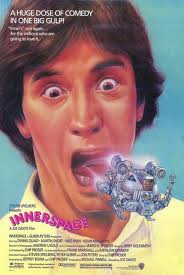
“Innerspace” is a movie full of ideas—perhaps too many ideas that don’t work entirely. But still, there are enough intriguingly silly ideas that are executed well and acted with enough game that I’m recommending the movie as absurd fun.

It’s a blend of science fiction, comedy, thriller, action, and romance that begins with a crazy idea: test pilot Tuck Pendleton (Dennis Quaid) has volunteered for a secret government experiment that involves a miniaturization device and a capsule suited for it. The experiment would cause surgeons to operate on patients from inside them. To test it out, Tuck is supposed to be miniaturized to about the size of a molecule (by estimation, at least) so that he’ll be injected into the bloodstream of a lab rabbit.

It works, and Tuck (and the capsule) is placed inside a syringe. But there’s a problem—high-tech thieves send their hit men to break in and steal the technology from the experiment. One of the scientists run off with the syringe holding Tuck and as he’s shot and killed by one of the hit men, he uses his final action to inject Tuck and the capsule into a random passerby—a grocery clerk named Jack Putter (Martin Short). As we see in introductory scenes, Jack is nervous enough. How’s he going to take the news that someone is inside him?

Tuck wades through Jack’s bloodstream and discovers soon enough that he’s inside a stranger. He uses a little gizmo to stick to one of Jack’s eyes in order to see from a screen inside the capsule exactly what Jack sees, and he also uses a communications system to talk to Jack from inside. Jack at first thinks he’s hearing things—“I’m possessed!” Jack exclaims—but eventually comes to grips with the situation and decides to help Tuck out.

If you’re following this, you’re a smart reader. But believe me—things get even stranger.

That’s mostly what’s part of the fun. There’s a limit to how long Tuck can stay inside the capsule before his oxygen runs out; the villains get closer and closer, and must be outwitted each time; the villain’s new hit man enters into the scene—a bizarre character named The Cowboy (Robert Picardo); and soon, Tuck’s former girlfriend Lydia (Meg Ryan) gets involved.

Oh, but that’s not all. Jack develops a crush on Lydia and constantly forgets that Tuck—Lydia’s former boyfriend—is still around, much closer than he thinks, to say the least.

The plot goes all over the place in “Innerspace.” Most of it is fun, and directed with a sense of silly amusement by Joe Dante (director of “Gremlins”), but you kind of wonder what would happen if the editing was tighter (the movie’s running time is 120 minutes). And there are a few holes that are kind of hard to overlook—there’s a “face-change” that is difficult to explain, and Tuck is as small as the molecules in the liquor that Jack drinks for him but it doesn’t look or seem that way. At the same time, there’s a lot to like in “Innerspace.” Not just the chances the story takes, but also the special effects and the acting.

There are many wonderful visual scenes in which Tuck travels through Jack’s bloodstream. It looks remarkable and surprisingly realistic. The computer-animated effects here are definite first-rate. Though, I would’ve liked to see Tuck fight some white-blood cells or antibodies. No such luck here, but he does eventually have to fight off a hit man who’s been miniaturized and place inside the body to get to him. Oh, and there’s also a sequence involving the heart that’s probably the best sequence in the movie. It looks realistic, as the effects involving Tuck’s capsule were combined with actual footage of a beating heart. “That’s a hell of a pump you got there,” Tuck tells Jack.

Dennis Quaid’s character of Tuck could’ve been a bore, as he spends most of his time confined to the capsule. But with his personality and constant one-liners, it feels like he’s still here. Quaid plays a hero who can’t move while Martin Short plays a nerd who wasn’t expected to be the hero. Quaid and Short have nice moments in developing their friendship.

Martin Short, the manic “SNL” alum, is wonderful in this movie. He’s extremely likable, very funny without being too manic, and is fun to watch throughout this movie. It’s hard not to like this guy.

The love story in “Innerspace” is surprisingly nicely done, and Meg Ryan makes a fun, plucky woman put into the confusion of everything. How would she handle the news that her old boyfriend is inside this nerdy guy she’s just met?

“Innerspace” is completely ambitious. It may have worn me out, and the scenes with the thieves aren’t as interesting as the relationships between Tuck, Jack, and Lydia (with the exception of the Cowboy’s scenes, which are manic), but it still provided a good time for me with its intriguing special effects, good acting, and constant use of story twists.

The Stepfather (1987)

23 Jan

500full

Smith’s Verdict: ***

Reviewed by Tanner Smith

“It’s like I have Ward Cleaver for a dad.”

In the low-budget thriller “The Stepfather,” teenager Stephanie Blake doesn’t know the half of it when she delivers that simile about her new stepfather. This new man in hers and her mother’s life seems like the perfect family man, or he just wants the perfect family. It seems like he wants his family to be like those in “Father Knows Best.” But there’s something we know that Stephanie and her mother don’t. The stepfather Jerry is undoubtedly an unstable, sick mind. As we see in a creepy, gripping opening scene, this man has murdered his family (we don’t see the murders, but we do see the bodies in the living room), changed his appearance (shaved his beard and wears contact lenses), and went off to find a new family. One year later, he has changed his identity and remarried Susan Blake (Shelley Hack) to come across, possibly yet again, as an ideal family man. Susan falls for it, but daughter Stephanie (Jill Schoelen) sees right through him—she complains to her mother, “It’s not even our house anymore—it’s his.”

The stepfather goes through the notions of an ideal family man, fooling everybody in the neighborhood. He hosts dinner parties with his real-estate clients, gives Stephanie a puppy as a present, and even calls her Pumpkin, which creeps her out even more. Stephanie’s therapist (Charles Lanyer) thinks she’s just having trouble adjusting to having a stepfather to replace her deceased father, and her acting up in school—and getting expelled—doesn’t make her any more credible. But she knows that something is wrong with this man.

“The Stepfather” has its share of effectively disturbing moments—the most memorable is that opening scene I described. Just as tense is the scene in which Stephanie comes across the stepfather having a mental breakdown before immediately snapping back into character when he sees her. But it also has one other, very important thing going for it, and that is the performance by Terry O’Quinn as the stepfather. O’Quinn is great in the role—chilling, subtle, and even strangely likable at some points. He’s convincing as a psychopath who acts as a normal person but has an unbalanced mind that resorts him to murder when everything goes wrong. The tension is always there when he’s on screen.

Not particularly strong is the subplot involving the brother of his latest victim trying to track down the killer, by using a newspaper reporter and a police detective to try and track him down. It’s not particularly interesting and pretty distracting, compared to the family aspects and tension.

What really satisfied me about the film was that the characters weren’t necessarily idiots to figure this guy out, especially when the film shows the audience right from the start. I feel like this man could fool anybody; of course, that includes Susan. And Stephanie does her own detective work. She has a sure plan to figure him out, which backfires, making her feel like she was wrong about him. This helps raise the tension level.

“The Stepfather” isn’t like the usual slasher films you come across. Sure, it does have a rising action that comes down to a climactic confrontation between the psychotic killer and his family, and you could use that for the climax for any other film of this sort. But what makes “The Stepfather” special is the characterization and performance of the title character, its successful scary moments and haunting feel, and a sharp script by Donald Westlake. It’s an effective thriller.

La Bamba (1987)

22 Jan

bamba-1987-06-g

Smith’s Verdict: ***

Reviewed by Tanner Smith

“La Bamba” tells the story of late rock star Ritchie Valens, who at the age of seventeen and in the time span of six months, had three hit songs that made him famous and a declared rock-n-roll sensation. And because that isn’t quite enough material for a biopic such as this, most of the events that took place in the lives of Ritchie and his family are stretched out for the film, mostly to effective results.

In the 1950s, Ritchie Valens (whose real surname was Valenzuela) was a Mexican-American who was raised in migrant labor camps in Northern California, idolized his older, motorcycle-riding half-brother, and had a deep admiration for his music. When he moved to a suburb in Southern California, along with his mother and siblings, he performed wherever he could until he finally got himself noticed by more and more people to become something special.

I guess you could consider “La Bamba” to be a follow-up to the great “The Buddy Holly Story,” which told the events of rock star Buddy Holly, because Buddy Holly, Big Bopper, and Ritchie Valens on February 3, 1959. That day was described as “the day the music died.” Maybe it didn’t die, but it was a dreadful event for all three individuals. It was all the more tragic, in that Ritchie was only seventeen years old when he died.

So how does “La Bamba” fare out, telling the story of Ritchie Valens this time? Well, just fine.

What problems do I have with “La Bamba,” which is otherwise a sweet-natured feel-good movie about a kid following his dreams and becoming famous for his music? Well, there are two issues I have with this movie, and unfortunately, they are major. For one thing, adding that Ritchie has nightmares about plane crashes, thus increasing his fear of flying, makes it kind of sick, considering that we know that Ritchie Valens (along with Buddy Holly and Big Bopper) died in a plane crash. When Ritchie takes that fateful trip, he seems relaxed over his fear by now. Why was this necessary?

The other problem I have is with the music. I mean, the music sounds nice—of course, they’re memorable tunes by Ritchie Valens (“Come On, Let’s Go,” “Donna,” and of course, “La Bamba”). But the real issue with the musical performances in this movie is that I really didn’t believe that what I saw on screen was actually being performed. It was just so obvious that the performances were overdubbed, which I realize must be done in movies like this. But the trick is to hide the fact that the music is being dubbed over; “La Bamba” doesn’t succeed. There are some exceptions, though. For example, when Ritchie and Bob visit Tijuana for a night, the folk performing the original “La Bamba” (which inspires Ritchie’s rock-n-roll version) sounds nice and credible. And the concert performing of Ritchie’s “La Bamba” does indeed sound like a genuine concert performance. Other than that, however, I was never convinced I was seeing Ritchie Valens sing or hearing him perform—I just saw actor Lou Diamond Phillips acting like him.

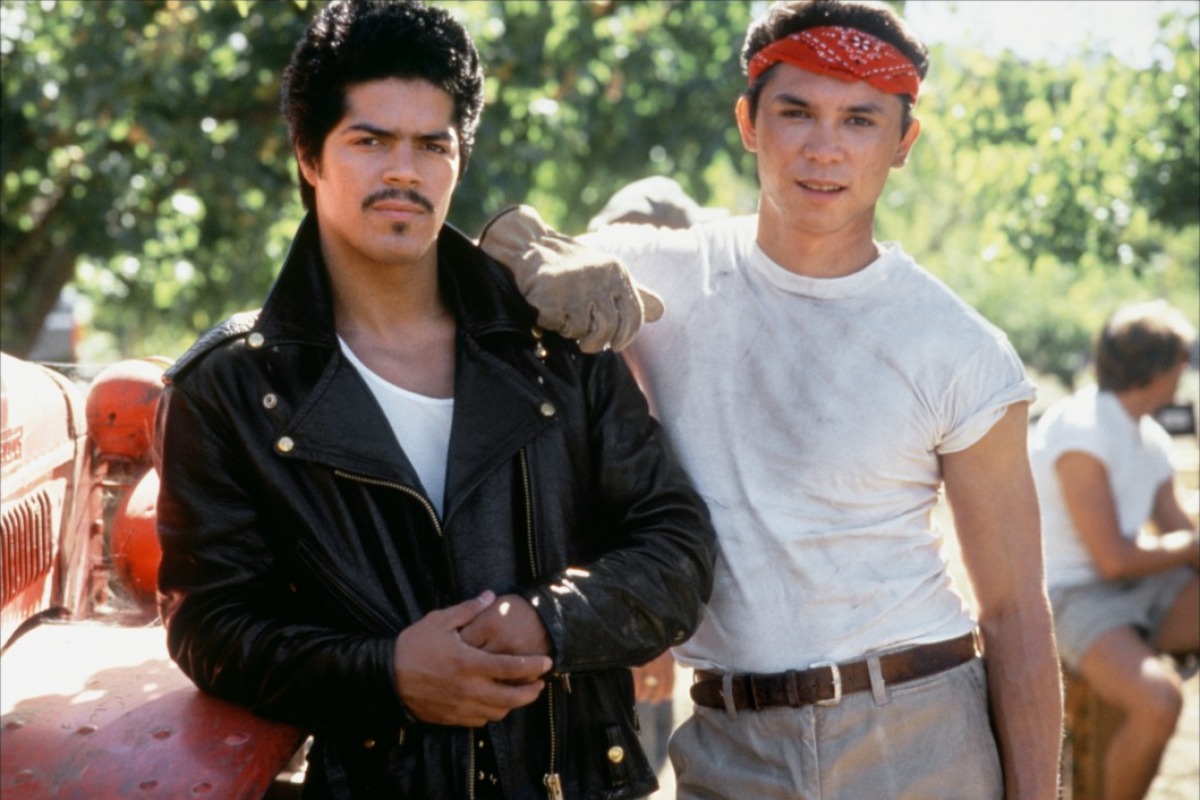
What do I like about “La Bamba?” To tell the truth, I liked the stuff that had nothing to do with the music, particularly the family aspects and conflicts. Ritchie (Lou Diamond Phillips) has help from his hard-working, caring mother Connie (Rosana DeSoto) to get his music career going. She works as his manager for small stuff, like performing at a bar, until Ritchie gets an agent—Bob Keene (Joe Pantoliano), who is a wise-guy type but reliable nonetheless. But then, there’s Ritchie’s rebellious half-brother Bob (Esai Morales). There are times when he is supportive of his younger brother’s fame, but other times when he’s resentful. He becomes a source of certain trouble for the family and Ritchie’s career. There’s also a sweet relationship between Ritchie and his Anglo girlfriend Donna (Danielle von Zernick), whose father don’t approve of Ritchie either because of his race or because of his “jungle music,” which the father calls it. Each of these scenes have a nice sentimental quality to them and they make the movie work, despite its flaws. They give a nice portrait of everyday life and there are good actors playing these roles. Lou Diamond Phillips is appealing as Ritchie, Rosana DeSoto is convincing and winning as the mother, and Esai Morales is excellent as the older brother who both loves and resents his brother. “La Bamba” isn’t the great movie that it could have been, but its sweet, fun moments weigh a little more than the unnecessary parts.

Near Dark (1987)

16 Jan

near-dark-1

Smith’s Verdict: ***1/2

Reviewed by Tanner Smith

“Near Dark” features a band of outlaws who are much more than anyone would think. People see these people coming and they suspect trouble, but don’t quite know exactly how much trouble. These people aren’t necessarily human, and I don’t mean that as a metaphor. As one character points out after barely surviving an encounter with them, “Those people back there—they wasn’t normal. Normal folks don’t spit out bullets when you shoot ‘em!” Indeed, conventional weapons can’t kill this family and they don’t feel pain. The only thing that can hurt and kill them is sunlight. So they sleep during the day and stalk the night. As one of them puts it, “We keep odd hours.”

And also, the only thing they can eat is human blood. This means every night, they go from place and place to find new victims, hence their outlaw status. When they keep feeding on blood, and stay out of the sunlight, they can live forever.

Are they vampires? I honestly don’t know. They share some of the same traits of such humanistic creatures, but not in the conventional way. They don’t sprout fangs or fly or morph into bats. They just feed on blood, live eternal life in the dark, and can only be killed by sunlight. And “Near Dark” isn’t an old-fashioned vampire movie—it’s a contemporary thriller, and a Western—it takes place in the South and has certain elements of a Western, such as shootouts, showdowns, and bar fights.

What do we have here that’s different? Well, having the villains be these supernatural beings is actually pretty remarkable and leads to some original story pieces. The biggest showdown is between one of these “vampires” on foot and the hero in a large truck. Should be a no-brainer, right? The hero runs down the rascal, but he’s still not dead yet (though he doesn’t look too good with his head split open). And there’s a bar fight in the middle of the movie, like a lot of Westerns. Only this one is bloodier, as the outlaws take out every person in the bar, one by one (the bartender has his throat slit by boot spurs), and drink their blood. It’s a chillingly funny moment when the wildest one in the bunch, Severen (Bill Paxton), licks a victim’s blood off his fingers and chuckles, “It’s finger-lickin’ good!”

And of course, there’s a shootout in which the law lets loose everything they have at the outlaws in a motel room, while the outlaws shoot back from inside. But the police’s bullets don’t hurt them in the slightest; however, since it’s during the day, the bullet holes that let in the light—those are what really hurt them. That’s very clever.

In fact, all of these added elements to the usual shtick are clever. And the look of the film looks quite nice, considering the subject matter—looking like a painting, especially in the scenes that take place at night. We admire the night as much as the central young couple—Mae (Jenny Wright) and Caleb (Adrian Pasdar)—who fell in with the gang. Mae tells Caleb to look and listen to the night, that it’s the most beautiful thing in the world to live with. From the look of the film, we believe her.

I should also point that “Near Dark” has one terrific opening shot. It’s a mosquito sucking blood from Caleb’s arm—just a mosquito, but it’s a classic case of foreshadowing. Caleb squashes the blood-sucking insect, calling it a “dumb suck,” and has no idea what he’s in for later, when he has to deal with practical human-sized mosquitoes.

I suppose I should share the story of “Near Dark.” The story features Caleb, a young man who goes on a date with Mae, whom he just met that night. Their date continues through the night, as Caleb quickly realizes that Mae isn’t like any other girl he’s picked up before. She commands him to stop the truck so that she can “show him the night,” as she crazily exclaims, “The night—it’s deafening! Do you hear it?” Caleb just sort of plays along, “Well, I’ll hold your ears.” Of course he can’t tell right away that she’s a vampire, even though she practically begs to be taken home before dawn. Then, Caleb and Mae share a passionate kiss…which ends with Mae biting his neck and running away. “Sure was some kiss,” Caleb says to himself.

When Caleb has to walk home as the sun comes up, he realizes what effect the sun has on him now. He nearly burns to death until he is rescued by Mae and her “family,” who show up in a blacked-out Winnebago. When they see that Caleb has been bitten, they realize that he’s “turned.” So they give him a week to call him one of them, and Mae makes it very clear that in order to survive, he has to learn to kill. Caleb doesn’t want to kill, but “the night has its price.”

As you may have guessed from many scene descriptions and lines of dialogue, “Near Dark” has a terrific script, written by Eric Red and director Kathryn Bigelow. Most of the film’s dialogue I have memorized by heart. My favorite line comes from the leader Jesse Hooker (Lance Henriksen), when Caleb asks how old he is. His response: “Let me put it this way—I fought for the South…We lost.”

Adrian Pasdar is at first playing Caleb as a dumb horny teenager, and him being from Texas don’t make him any different from most teenage sex movies. But when he understands his plight and we see him go through these changes, he does become more human, and therefore more likeable. Jenny Wright makes a charismatic complicated love interest. In fact, I was wishing for more scenes featuring these two together. We get a fair amount, but “fair” isn’t enough.

As the antagonists, the performances are first-rate. Lance Henriksen has a convincing menace to his character of Jesse, trying to keep things in check while resorting to deadly measures in the process. Bill Paxton is perfect as Severen—chilling and yet amusing at the same time. This is the guy you want to party with, given that you don’t know his true intentions and would most likely become his next victim. Also on board is Jenette Goldstein as Jesse’s wife (at least, I think she’s his wife—back stories with these characters are left vague, which I didn’t mind either) and Joshua Miller (the creepy little brother from “River’s Edge”) as Homer, the little boy with a middle-aged mind. Other supporting cast members with significant screen time are Tim Thomerson and Marcie Leeds as Caleb’s father and little sister Sarah, who look for Caleb after he’s been missing for days. The final conflict of the film is whether the vampires will turn Sarah the way they turned Caleb.

There are a few problems I have with “Near Dark.” For one thing, the transitions from day to night are very clumsy, like they transform just too easily. There’s one scene where the characters are in the motel at night, and just a few minutes later, it’s full daylight outside. Talk about dumb luck! Also, I didn’t full appreciate the ending—not just because it was one of those standard chase endings in which the hero is able to kill the villains after all this madness, but because it ended too quickly for everything to sink in. The final payoff between Caleb and Mae could have had more weight, but it’s just all too brief. But for the most part, “Near Dark” is a neat little horror movie that goes beyond all the usual vampire-movie clichés, as well as Western clichés, that we’re used to.