Archive | 1987 RSS feed for this section

Spaceballs (1987)

7 Mar

MV5BOTg2OTg3OTYwMF5BMl5BanBnXkFtZTcwNjc0MjI3NA@@._V1._SX640_SY430_

Smith’s Verdict: ***

Reviewed by Tanner Smith

“Spaceballs” is a comedy by Mel Brooks which has a lot of jokes that are hit-and-miss, but also has just about the same amount of jokes that are hits in the way that I laughed. This is not one of Mel Brooks’ best films—it doesn’t rank up there with “Young Frankenstein.” Or rather, it’s not one of Mel Brooks’ best scripts. There are so many lame puns and juvenile humor. What had me laughing, however, were the visual gags and the behavior of some of the characters, especially the villains. So there are enough funny moments in “Spaceballs” that I’m giving it a mild recommendation.

The whole movie is a parody of the “Star Wars” movies. We have almost everything from the famous George Lucas saga spoofed here. We have Luke Skywalker/Han Solo type Lone Starr, the beautiful but stuck-up Princess Druidia (a “Druish” princess), a droid named Dot Matrix (oh yeah, and voiced by Joan Rivers), a half-man/half-dog Chewbacca replacement named Barf (“I’m my own best friend”), the short wise alien named Yogurt, and of course, the villain Dark Helmet. There are other characters, but I’ll get to them later.

The film begins with those “Star Wars” opening texts that scroll into space, explaining the back story of “Spaceballs” and ending with a fade-in saying, “If you can read this, you don’t need glasses.” That’s funny. But—and maybe I missed something here—there’s a long, tedious shot of the villain’s spaceship that goes on for a minute and a half and doesn’t seem to show anything…well, funny. But then we’re introduced to the villain Dark Helmet (Rick Moranis), who has a large dark helmet that brings his voice to a James Earl Jones baritone type. How do we know it’s Rick Moranis, though? Because Dark Helmet can’t keep the helmet on all the time (he can’t breathe, he can’t see straight, he has to drink a cappuccino, you name it). And he’s a nerd. One of the joys about “Spaceballs” is that Dark Helmet, his second-in-command Sandurz (George Wyner), and President Skroob of Spaceball City (Mel Brooks)—the three villains of the movie—are so dumb, you can’t believe that they’d lead any army. It’s very funny when they plan any evil plot in this movie.

The heroes are the rebellious Lone Starr (a very bland Bill Pullman) and his partner Barf (a very likable John Candy), who as I said is half-man/half-dog (with paws and a tail). They fly through outer space into a flighty Winnebago (nice visual gag) on the run from Pizza the Hutt, a Jabba the Hutt type except he’s a mountain of cheese and pepperoni. Pizza the Hutt is just as disgusting as Jabba the Hutt, but also the funniest gag in the whole movie.

Lone Starr and Barf are called upon by King Roland of Planet Druidia, which is in danger of being destroyed by the Spaceballs of Planet Spaceball—run by President Skroob (Dark Helmet is in charge of the spaceship Spaceball One). King Roland (Dick van Patten) needs the heroes to rescue Princess Vespa (Daphne Zuniga, “The Sure Thing”) and Dot Matrix from capture by Dark Helmet. They succeed, but find themselves lost on a desert planet, where Lone Starr and Princess Vespa argue as Barf and Dot Matrix look on and spew one-liners, and they meet a Yoda type named Yogurt (also played by Mel Brooks) who gives Lone Starr a special ring and gives them the phrase, “May the Schwartz be with you.” This constant repeating of the phrase is so hoping for memorable payoff that it isn’t funny.

As I said, “Spaceballs” has many jokes that are hit-and-miss. The script has a lot of puns and juvenile humor (there’s a difference here). But there are other jokes that do work in the way that I laughed joyfully and recommending the movie. I loved the Pizza the Hutt gag, I liked John Candy and Rick Moranis, Mel Brooks gives two wacky performances, I liked the gag where the villains  try to watch the movie itself to find the heroes, I liked the satire on stunt doubles, and uh…I think there are a couple more if I can think of them.

Dirty Dancing (1987)

5 Mar

Dirty-Dancing-lift_l

Smith’s Verdict: **1/2

Reviewed by Tanner Smith

So many people have told me to watch the 1987 movie “Dirty Dancing,” and I’m not usually one to give in to peer pressure, as I’ve heard of it six years before I finally got around to checking it out.

What is it about this movie that people just go crazy over? Well, the dancing is certainly fun to watch as the actors turn out to be good, lively dancers. The romance between the two star-crossed lovers seems to have people interested. What do I think of the movie, personally? Well, the dancing isn’t bad, like I said. The acting’s not bad either, and we have an engaging young couple, played by Jennifer Grey and Patrick Swayze, to follow. But as a story, “Dirty Dancing” tells us nothing new. This is all stuff we’ve seen before.

Let me give the gist of the story and you see if you can predict the rest of it. The story takes place in summer 1963, as 17-year-old “Baby” Houseman (Grey) is vacationing with her rich family at a resort in the Catskill Mountains. Her father is Dr. Houseman (Jerry Orbach), the personal physician of the owner of the resort (Jack Weston). The owner tries to set Baby up with his obnoxious son Neil (Lonny Price), but she doesn’t like him. Baby finds excitement in the after-hours parties thrown by the hotel staff. She’s intrigued by the “dirty dancing” and wants to get a lesson from hunky dance instructor Johnny Castle (Swayze).

At first Johnny is hesitant, as he doesn’t like the fact that this “cute little rich girl” is hanging around on his and his friends’ turf. But Johnny’s dance partner Penny (Cynthia Rhodes) is pregnant by a waiter who wants nothing to do with her. So Baby helps out by getting money from her father (not telling him what it’s for, but it’s OK—he trusts her) and paying for Penny’s abortion. Then, Johnny agrees to teach Baby and make her his dancing partner for the resort’s final show, and they form a secret relationship.

Can you guess where this is going? Misunderstandings? Attempts to keep them apart? Final reconciliation? The other people realizing their mistakes? Happy ending?

You bet!

Yes, later in the movie, the secret is out, and Baby’s father couldn’t be more disappointed. I was hoping for more understanding by this character, since in the first half of the movie, he seems like a good guy—he’s trusting, listening, and reasonable. But when he finds that Johnny is with his daughter, his ethics are practically nonexistent. Anyone can see that this is a good guy and wouldn’t hurt Baby in any way—anyone, that is, except him.

The “dirty dancing” in the title is somewhat false. Some moves are hot enough, but since the movie is rated PG-13, it doesn’t get much hotter than that. For a movie called “Dirty Dancing,” this is pretty tame.

Patrick Swayze and Jennifer Grey are likable, share good chemistry, and are actually great dancers. And “Dirty Dancing” does have its cute moments, as well as a nicely-done (though clichéd) final dancing sequence, taking place during the final show at the resort. So this isn’t a bad movie; but the story gave me nothing new. I wouldn’t mind so much except so much dwells on many clichés that there are many times when I didn’t really care about what was happening.

Three Men and a Baby (1987)

1 Mar

selleck-danson-guttenberg-three-men-baby

Smith’s Verdict: ***

Reviewed by Tanner Smith

“Three Men and a Baby” is the American remake of a French comedy, which I never saw. But it doesn’t matter much anyway, since remakes are supposed to stand alone as movies instead of always being compared to the original all the time (even though we can’t help ourselves). So I don’t know what was upgraded and what was downgraded for this American remake of “3 Men and a Cradle” (the French film). But as a movie, “Three Men and a Baby” is a nice, gentle comedy with good laughs and a real sweetness to it.

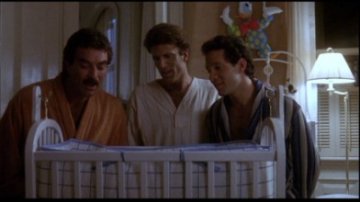
The movie features Tom Selleck, Steve Guttenberg, and Ted Danson as three bachelors who share a luxury apartment as their own bachelor pad in New York. (By the way, I love the look of the place; paintings of the city and portraits of the three guys outline the walls…though I don’t think it’d be suitable for a bachelor pad.) The first fifteen minutes of the film is just them delivering wisecracking dialogue and gawking over women. They have a seemingly endless series of girlfriends, some of which we see at a birthday party of one of the guys.

Then, the next day, actor Jack (Danson) leaves to shoot a film in Turkey for about ten weeks, but architect Peter (Selleck) and cartoonist Michael (Guttenberg) find a big surprise waiting on their doorstep. It’s a little baby, asleep in a bassinet with a note attached to it. The baby is Jack’s after an affair from long ago. The mother has sent the baby, named Mary, to the apartment. With Jack not around, Peter and Michael are forced to handle the situation, but of course know absolutely nothing about taking care of a baby. They refer to Mary as “it,” don’t know how to entertain her when she’s crying, doesn’t know what she eats, and, in one of the film’s funniest scenes, they figure out how to change a diaper. Their confusion is not helped when they go out to the store to buy baby food, and there seems to be a lot depending on the age, which they don’t know. Each day passes by and they’re still miserable and confused with this bundle. All the baby does is eat and poop. But later with each day, they actually start to love Mary.

When “Three Men and a Baby” focuses on these scenes in which these guys deal with the baby and grow to love her, it works. There are a lot of big laughs in the complaints that these men have (such as how Peter wonders if feeding the baby every two hours means from start to finish) and in how people react to the situation (a grocery clerk asks suspiciously, “You don’t know how old your own baby is?”). And then when Jack comes home, Peter and Michael use this as revenge for leaving them here with his own baby. Jack nervously tries to handle it himself, as Peter and Michael did, because “I’m an actor—I can play a father.” He tries to get his mother to help, but she sets him straight, saying it’s his turn to take care of things for himself for once.

The best moment in the movie is when all three guys softly sing the baby to sleep with “Good Night, Sweetheart.” It’s a touching, genuinely moving scene.

“Three Men and a Baby” succeeds when handling this forming relationship these men have with the baby. What doesn’t work is a tired subplot involving another package delivered to the apartment; only, this one is full of heroin. Some drug dealers come by, asking about the package, which the guys at first think they mean is the baby. Once they realize what they really want, they can’t find the package and are not only in trouble with the dealers, but also with the cops who are investing a drug-included case. And this leads to a confrontation between the men and the drug dealers in a construction site, the screenwriter’s reliable Hollywood cliché. Why, when the central story is cute and funny and heartwarming, did they have to add a subplot about drugs? It’s unnecessary, and the final confrontation is not effectively staged, even though director Leonard (Spock) Nimoy and writers James Orr and Jim Cruikshank try their best to keep it tense. I guess it’s supposed to show how far the guys will go to protect the baby, since the dealers actually leave a note saying they’ll take her next time. But we didn’t need a drug-related subplot.

But there is plenty of material with the three men and the baby that the comedy elements outweigh the “suspense” elements. All three actors do game jobs, especially Tom Selleck who does a great job mixing tenderness with light comedy. He’s convincing throughout the movie. Steve Guttenberg has good moments (such as when he tries to entertain the baby while she’s crying) and Ted Danson is credible as a snobbish, handsome actor.

“Three Men and a Baby” is a funny, moving movie when it focuses on the title roles. Sure, the screenplay doesn’t take the high road and like I said, I could’ve done without the drug stuff, but it mostly succeeds in winning us over.

Planes, Trains & Automobiles (1987)

26 Feb

000096_20

Smith’s Verdict: ****

Reviewed by Tanner Smith

When you team up a pair of comic actors in a movie, there’s either a danger of going over the top or not having enough chemistry on screen. But Steve Martin and John Candy are perfectly cast and are in a script that doesn’t let them down and carry the film, “Planes, Trains & Automobiles,” greatly. There is chemistry here and they never go over the top.

The film is about a road trip featuring two strangers who have to be home for Thanksgiving and will get there any way they can—planes, trains, or automobiles. Steve Martin plays Neal Page, an uptight advertising salesman trying to get from New York to Chicago. During rush hour (and two days before Thanksgiving), he has a hard time finding a cab in the city and when he finally flags one down, it is stolen (unintentionally) by Del Griffith (John Candy), a traveling shower-curtain-ring salesman. He’s also from Chicago. When the two men meet at the airport, Del feels genuinely sorry for stealing Neal’s cab. Neal tells him to forget it. But as fate would have it, Neal and Del wind up trapped in each other’s company, on the plane and off.

This leads to a night in which the two land in Wichita, Kansas, since a snowstorm has hit the O’Hare airport in Chicago. “We’d have a better chance of playing pick-up sticks with our butt cheeks than getting a flight out of here tonight,” Del tells Neal. And this also leads to a night at a motel…but their room is a single. That’s right—one bed. In one of the funniest scenes in the film, Neal and Del wake up the next morning cuddled against each other. (“Why are you holding my hand?” “Where’s your other hand?” “Between two pillows.” “Those aren’t pillows!”)

And as the film goes on, Neal and Del continue to make their way home, while Neal tries multiple times to get rid of Del. But there’s nothing that can separate them forever. In one of the best scenes in the film, they wind up renting a car and driving at night together when they don’t realize that they are going the wrong way on an expressway. This results in what is probably the only funny joke that a movie can make about a car and two oncoming trucks.

“Planes, Trains & Automobiles” is written by John Hughes, who also serves as director and producer, and it’s a pleasant surprise, considering that John Hughes specializes in teenage comedies and apparently searched for something more. So now he has “Planes, Trains & Automobiles,” a movie featuring a road trip with a great deal of character development and physical comedy. John Hughes had written a comedy about a road trip before (1983’s “Vacation”). This film is even better because the comedy is based on character and reveals heart and truth.

For example, we have the scene in which Neal snaps at Del that night in the motel in Wichita. He shows no mercy, telling Del that he doesn’t know how to tell an interesting story and that he would rather attend an insurance seminar than listen to another one of his anecdotes again. He goes on and on, as Del doesn’t show anger. His face falls; he’s genuinely sad and hurt. He realizes that he was so eager to please and has tried too hard. It’s a scene that reveals comedy and drama in the way that it reveals heart and truth. And that’s not even close to the end of the film, even though it could be the end of a short film (and feels like it, too). It’s this point in which Del wins our hearts and we enjoy watching him through the rest of the film. As for Neal, he learns about patience and slowly but surely develops a friendship with Del.

This is where the film really shines—Steve Martin and John Candy are absolutely great together and they play characters that are funny and empathetic. They’re the classic Odd Couple—one is ordinary and wound up while the other is a slob but more outgoing. But if I didn’t make it clear in the paragraph above, they don’t play caricatures. They play three-dimensional human beings.

“Planes, Trains & Automobiles” leads to the emotional payoff in the final scenes. After all we’ve seen of these two characters and been through what they’ve been through, you’d expect a great payoff. Luckily, this film has one in the way that it gives us exactly what we needed for this material.

NOTE: This film is rated R by the MPAA. Well, I’ll tell you this—fast-forward through the scene midway through the film in which Neal confronts a car rental agent played by Edie McClurg. That scene has the only times you’ll hear the F word—19 times, in fact. Omit that scene and the film is good viewing for the whole family on Thanksgiving night.

Like Father, Like Son (1987)

23 Feb

Like Father Like Son3

Smith’s Verdict: *

Reviewed by Tanner Smith

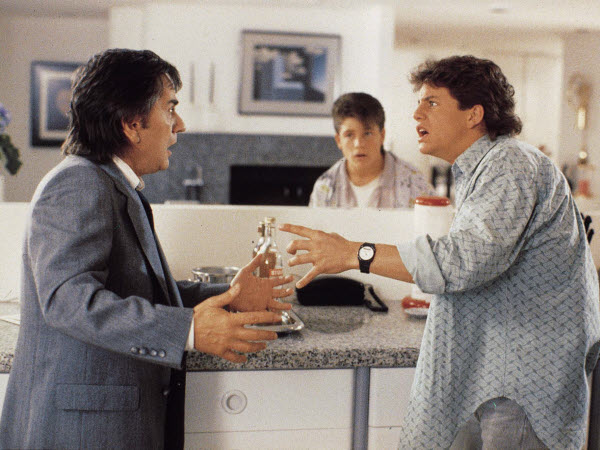
“Like Father, Like Son” is a comedy so desperate to get any kind of laugh just by one gimmick only. That gimmick is the same one used in “Freaky Friday,” in which parent and child switched places for a day. Well, a gimmick isn’t enough. A smart, funny screenplay was needed to lift it into the air. “Like Father, Like Son” barely makes it off the runway.

It’s a shame too, because it stars Dudley Moore, who has shown in many other comedies to be an effective British comedic actor. It also stars 1980s teen idol Kirk Cameron (best known as the smarmy teenager from the TV sitcom “Growing Pains”), who I believe is capable of a good performance when he’s not incredibly annoying (I’m not much of a “Growing Pains” fan…anymore). But these two don’t have any juicy material to work with. They play a squabbling father and son. (Where’s the mother? Never addressed.) Moore plays a doctor who wants Cameron to follow in his footsteps. (“But I’m 17,” Cameron complains, to which Moore responds, “When I was 17, I was in my second year at Oxford.”) But Cameron’s highest grade in high school biology class is a C, which won’t do well with Dad.

Cameron has a wisecracking friend nicknamed “Trigger” (played by Sean Astin in, believe it or not, a smarmier teen performance than…Kirk Cameron’s “Growing Pains” role), who has a weird uncle who came across a magic potion that can transfer minds.

Moore accidentally drinks the mind transference serum and suddenly, he and Cameron switch bodies. So, Moore is inside Cameron’s body, and vice versa. And so, until Trigger can get in contact with his uncle again and find an antidote, the father and son have to lead each other’s identities. Moore (with Cameron’s mind) goes to work in the hospital and Cameron (with Moore’s mind) goes to high school. Constant misunderstandings occur, and not one of them made me laugh. Cameron acts with a certain authority to his high school teachers; Moore behaves silly without understanding medical procedure. So what?

See if you can follow this. Apparently, if you drink the mind transference serum, you look at somebody and switch bodies with him or her. So, how would you change yourself back to normal?

Exactly! Drink the potion and look at the same person again. There’d be another switch—problem solved. See? You’re already smarter than the writers and the characters they created.

I’m serious—Moore and Cameron’s characters never consider just doing the same thing again, because the movie would be over too quickly. Also, it’s not a mind transference serum; they make it perfectly clear that it’s a “brain” transference serum. In that case, how come the brain isn’t connected to the tongue in this movie? In the first test of this potion, it is. Cameron and his friend test the potion on a cat and a dog, so that the cat has the dog’s mind and vice versa. The cat growls and barks like the dog. So then, when father and son switch places, why doesn’t Kirk Cameron speak with Dudley Moore’s British accent? Moore, with Cameron’s mind, still speaks in that accent, and Cameron, with Moore’s mind, still sounds like a Southern California teenager.

Here’s a surprise—the writing is so inept that the dog/cat joke isn’t taken advantage of. In fact, it’s never mentioned again.

This is one of those movies where all of the characters have to be total idiots to keep the story going. Why is this interesting? Why is this funny? Just because two guys switch bodies, that itself isn’t funny. You need actual jokes, characters, and a well-developed script. I didn’t care about these two clods. You could have two guys trade law files and it’d be more interesting. Dudley Moore is trying his best, as in one plot thread, he’s seduced by his boss’ wife. But Kirk Cameron doesn’t get one good moment. He’s forced to wade through the script just simply misreading things. Yes, he thinks the music at a rock concert is too loud. Where does this lead him on his date? Nowhere. Come on! There could’ve been an interesting discussion with him and the girl he was dating. But no. It’s just glanced over. It’s 1987, writers—you’re not helping with Kirk Cameron’s movie career. He could show talent; give the guy something to do.

“Like Father, Like Son” stinks all the way through. All we’re left asking ourselves after watching it is, “Were they really that cheap to not synch Moore’s voice with Cameron’s?” The premise didn’t work, I never cared, and most criminal of all for a comedy, I never laughed.

RoboCop (1987)

22 Feb

robocop_1987_6

Smith’s Verdict: ***1/2

Reviewed by Tanner Smith

“Robocop” sucks us in almost immediately with a scene that features a giant robot. This robot has been programmed to act immediately to an armed criminal—to shoot him if he doesn’t obey the robot’s orders to drop the gun. A young executive tests the big hunk of metal by aiming a gun at it, the robot acts right away, warns the young man that he has twenty seconds to drop his gun. The man drops his gun, but the robot still warns him, counts down to zero, and ultimately shoots him dead. Now, that scene may be unsettling, but honestly it’s also funny. And it lets us know that “Robocop” is not just going to be a serious thriller. There are many moments like that, but the film keeps us waiting to find out where it’s headed.

A lot of critics are criticizing the look of “Robocop,” which is set in the future. If you think about it, almost every “future” in the movies is bleak, isn’t it? And a lot of critics are pointing fingers at “Robocop” as something no different. But honestly, I don’t see why it should be different. And for the record, I didn’t see any kind of change in the world at all. So why should I complain? The technology looks better; why should the city of Detroit, in which this movie is set (or accordingly, the city of Detroit in the “future”)?

We’re introduced to a rookie cop named Murphy (Peter Weller), who is recruited to join the police force in Detroit. A woman cop named Lewis (Nancy Allen) shows him the ropes, but before long, they run into a band of criminals who mercilessly shoot Murphy dead.

But he’s not entirely dead. Something inside him is still alive and that brings the company that created the killer robot at the beginning of the film to rebuild him as a cyborg. They believe this is a better type of policeman to fight crime downtown. They call him a “robocop,” a half-man, half-machine with little to no memory of Murphy’s human life. Oh, and only his mouth and chin are visible under a heavy amount of metal armor. Robocop does become the next best thing on the force and goes around protecting the innocent and arresting criminals. (There’s one great moment that involves Robocop stopping a rapist, but I won’t give away the outcome.) Lewis, however, recognizes this half-man, half-machine as her old partner and tries to make Robocop remember her.

“Robocop” is a mixture of a thriller, a comedy, and a romance, each one hitting the right notes. There is slapstick and political satire involved, most of the laughs coming from the big robot again. The romance aspect works as well; the idea of having Weller and Allen play with this strange occurrence is cute, despite its silliness. But mostly, the movie wants to thrill us and it works as a thriller. The action scenes are compelling and well-directed by filmmaker Paul Verhoeven. And also, the movie’s bad guys are real bad guys; not just exaggerated morons with guns. They are ruthless, violent, and merciless. For example, when they kill Murphy, they don’t just shoot him and leave him. They do worse.

Through it all is Peter Weller as Robocop. He begins in human form as Murphy with little to no personality as the new man on the force. But once he is in all that circuitry and his voice is electronic monotone, most of his (as Robocop) personality comes from that voice. It’s the voice that computers have had in movies for years and with Robocop, it blends assurance with confusion in the character. This is where the character wins our sympathy and strangely enough, he’s more human as this Robocop than he was as an actual human. He has a heavy amount of appeal with this performance, despite having his face nearly hidden and his voice mechanically altered. Nancy Allen is effective as she tries to find out what really happened to her old partner and what she can do to help him.

Mostly, “Robocop” is entertaining. It’s an action-thriller with a heart but most importantly, with also a brain.

Light of Day (1987)

20 Feb

images

Smith’s Verdict: ***1/2

Reviewed by Tanner Smith

Admittedly, I thought that “Light of Day” was going to be a rock-n-roll fable about an aspiring rock band hoping to make it big. Seeing that rocker Joan Jett was one of the leads, and that the title “Light of Day” refers to her featured song (co-written by Bruce Springsteen), can you really blame me?

While that would have been an interesting film to see, and I think it would have, “Light of Day” is more than I expected. It features rock music and a rock band led by a character played by Joan Jett, but it’s really a serious drama in which problems are introduced and handled, and music seems to be the best way for the characters to compensate for them. It’s a quite effective movie, with great acting and intelligent writing.

Jett plays Patti Resnick, a rebellious young woman who sings for a rock band every night. In the meantime, her life means nothing to her. Only two things matter most to her—rock-n-roll and her six-year-old son Benji (Billy O’Sullivan). But because of her love for the music, her home is not a very healthy environment for Benji, who was born out of wedlock.

Patti and her mother (Gena Rowlands) haven’t been on good terms for a long time. The mother is a Christian woman who doesn’t approve of her daughter’s lifestyle. She resents Patti, while trying not to show it. But it comes through in the more subtle ways, such as an early scene where we’re introduced to this wedge between mother and daughter. It’s a scene in which Patti, due to the wishes of her brother Joel (Michael J. Fox) who wants to make peace between the two, goes to her mother’s birthday dinner and the situation has already been somewhat uneasy for the family, and the mother says grace at the table as her prayer slowly but surely becomes something more specific—she asks God to forgive her daughter.

Patti storms out and we see the tension that’s always present between the members of the family. The mother resents Patti’s behavior and lifestyle and is especially resentful of Patti having a child out of wedlock (though she does love the child). Patti is obsessed with rock-n-roll, but has a lot of anger that she takes out on the stage. She also finds herself wondering how her life would’ve turned out if she had had an abortion. This is one of the strongest scenes in the movie—Benji has been taken away to live with Patti’s mother for his own good, and Patti tells Joel, “You know, I could’ve had an abortion and Mom would’ve never found out.” Pause. Then she wonders what would’ve happened with her music career if she had—“I’m a good singer.” But then she states that she just wants to hit herself for thinking that way, because she does love her son.

Joel, who also performs in the band and works in a factory during the day, is the reactor to these expressed feelings (some straightforward, some subtle) by his mother and his sister. He tries to make peace between the two, but it’s not easy. He doesn’t want to risk hurting the people he loves, but he can’t really help them much either. And then Joel becomes more of a father than an uncle to little Benji, because of how he always has to make sure that he’s given proper care. He even objects to defiant Patti taking the kid on the band tour—cheap motel rooms, free beer—but Patti won’t listen. This is also quietly tragic in that Joel used to idolize Patti’s spirit.

How about the father (Jason Miller)? He’s a wimp, basically. He stands by while everyone else goes about their problems and feels it’s best not to be involved. (In the dinner scene, he stays on the couch in the living room before dinner is served, so that he doesn’t start anything beforehand.) He’s a sensitive man who should be the peacemaker in the family, but alas, it’s his son that is doing the job for him. He’s in the background quite a lot in this movie until later when he gives an insightful speech about what is going on with this family.

The family aspects are very well-handled by writer/director Paul Schrader. He effectively tells a story about a family that has fallen apart, but maybe could have a chance of reconcilement. Rock-n-roll music may be a good element in compensation for these issues, but the family elements are the backbone of the story. Things get more serious and more effective with the news that the mother is very ill with cancer and most likely not going to make it. This provides the payoff between her and Patti, with strong, effectively done bedside scenes between the two.

The acting is across-the-board solid. Michael J. Fox is very good as the quiet reactor to most of these situations and it’s heartbreaking to know he’s doing what he can, but can’t do enough. Despite given top billing in the credits, however, he isn’t the lead. That notion belongs to Joan Jett, who makes an excellent acting debut. Jett brings to her performance a great deal of depth and weight, and completely sells the film’s stronger scenes, including that scene I mentioned about the abortion, and especially the bedside scene involving her mother. This scene means everything to the film and the superb performances by her and Gena Rowlands, as the mother. This is the payoff in which the two set aside their differences and have a real talk about what has happened in their lives. This is the best scene in the movie—it’s heartbreaking, excellently-acted, well-handled, and downright effective.

There’s something else I should bring up, since there is quite a lot of rock music in “Light of Day.” The soundtrack—Patti and Joel’s band, in particular—is pretty memorable. (The title song Light of Day” is a pretty good song.)

“Light of Day” is a well-acted, well-made movie that would probably satisfy those who appreciate well-crafted family dramas, such as “Terms of Endearment” which people would probably think of. Who wouldn’t like it? Probably those who thought this was just a movie about a rock band. To be clear, “Light of Day” is a lot more than that. It was a pleasant surprise for me.

Throw Momma from the Train (1987)

19 Feb

ThrowMama46

Smith’s Verdict: ***

Reviewed by Tanner Smith

Not many movies inspired by other movies have the nerve to name their sources on screen, let alone have a character watch the source in a movie theater. But Danny DeVito obviously knows that and gives his character a scene in “Throw Momma from the Train”—a film that is sort of a comedic version of the Hitchcock film “Strangers on a Train”—in which he goes to a movie theater, sees that movie, and it inspires him to set up the plot.

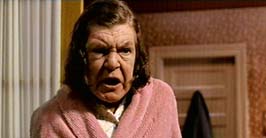
“Strangers on a Train” was about two strangers who meet on a train and one proposes a plot to commit a murder for each other. In “Throw Momma from the Train,” there are also two strangers who have people they wish were dead. Writer Larry Donner (Billy Crystal) feels anger for his wife, who has stolen his book and published it with her name. Owen Lift (DeVito), who is somewhat of a pathetic schlub, lives with his overbearing mother, who is sort of a cross between Quasimodo and the Wicked Witch of the West. He dreams of killing her, but grows spineless at every attempt.

Owen is a student in Larry’s creative writing class. When he asks Larry what he can do to improve on his writing, he tells Owen to go see an Alfred Hitchcock film for inspiration. One day, at lunch, Larry’s wife is mentioned to Larry and he responds by exclaiming, “I wish she was dead!”

Owen goes to see “Strangers on a Train,” he gets the idea of the movie, and believes that the choice of the film was a message from Larry. Larry only says he wants his wife dead, but Owen takes him seriously. He supposedly (the murder is off-screen) kills Larry’s wife and expects Larry to “return the favor” and kill his mother.

And who could blame Owen for wanting his mother dead? Momma is a monster and Larry knows that too—he has a line later in the film, “She’s not a woman—she’s the Terminator.” Anne Ramsey goes all out with this performance, and she is more than game.

DeVito is the star of this movie. He delivers a performance of a man who really needs help and we start to care for the guy. He’s a good director too—he frames certain shots in which he almost looks like a small boy; he has a tendency to make the everyday world seem somewhat surreal; and he gets the material. The best scene in the film is a sweet one—it’s a scene in which he shows Crystal his coin collection. Those aren’t coins that are really worth anything but they remind him of places his dad used to take him. That’s a very good scene, with a real amount of whimsy put to it.

There are also a couple of big laughs in this movie—one of them involves Crystal at the river trying to find an opening line for his book. And the other involves DeVito and Crystal in DeVito’s house—they’re having breakfast in the kitchen, Crystal meets Momma, and without giving too much away, there’s a frying pan involved, and the scene delivers possibly the funniest moment in the movie.

Admittedly, the whole murder situation is a little uneven. But with a few sweet scenes, some good laughs, and good performances by DeVito, Crystal, and Ramsey, this is an enjoyable, entertaining comedy.

Some Kind of Wonderful (1987)

14 Feb

images

Smith’s Verdict: ***

Reviewed by Tanner Smith

“Some Kind of Wonderful” is written by John Hughes and has a similar story to Hughes’ other screenplay, “Pretty in Pink.” The story itself is old, but people will see the connection from “Some Kind of Wonderful” to “Pretty in Pink” because they were both written by John Hughes and they both feature teenagers. (Both movies also have the same director—Howard Deutch.) What’s the story? A high school outcast has a crush on a more popular student, while the outcast’s best friend (of the opposite sex) has a crush on the outcast and situations follow that could or could not bring them together. You know, the protagonists in these movies never know better than to just go with the pal—see “Secret Admirer,” see “The Sure Thing,” even see “Lucas” and you’ll see what I mean.

The story follows a high school senior named Keith (Eric Stoltz), who comes from a working-class family, loves art, works at a gas station, and is an outcast at school because of all of the above. His best friend is a tomboy named Watts (Mary Stuart Masterson), who cares about two things—her drum-kit and Keith. But of course, Keith doesn’t even know about Watts’ feelings towards him, because he has a crush on Amanda Jones (Lea Thompson), the school’s rich “uptown girl.” He gets his chance to ask Amanda out on a date when her boyfriend Hardy (Craig Sheffer) cheats on her and she says yes to Keith.

Keith finds out that if he goes on his date with Amanda, then Hardy and his friends will humiliate him that same night, but Keith decides to continue with the date and hopefully find some way to teach Hardy a lesson. But on his date with Amanda, he asks himself what he should have been asking himself before. Is he interested in Amanda’s soul or just her body? In fact, that’s exactly what Amanda asks Keith on their date to an art museum, after Keith hangs up his own painting of her. And what about Watts…? This is the movie’s more intriguing concept—to ask the question of whether or not the guy deserves the girl, not merely the question of will the guy get the girl?

While all this is going on, Keith is constantly pushed by his father (John Ashton) to start applying to different colleges, so he’ll get into at least one. But Keith doesn’t want to go to college—his father never went to college, and Keith would rather devote his life to artwork. And here we have a rarity in John Hughes’ teenager movies—an adult character that is just as interesting as the teenagers. I can only remember two before “Some Kind of Wonderful”—the father characters in “Sixteen Candles” and “Pretty in Pink”—here’s another one. (The principal in “Ferris Bueller’s Day Off” was only interesting in that movie’s first half.) And it’s pleasing to see how the situation resolves—not with a shouting match, but with a civilized argument.

There are problems with “Some Kind of Wonderful”—some scenes progress slowly, and some characters are pretty standard; particularly Hardy, who’s a one-dimensional snobby, begrudging rich kid. But it’s pleasing to see Keith make friends with someone who could have been a villain—a punk kid named Duncan (Elias Koteas) whom Keith meets in detention. I suppose that’s supposed to make it OK that the rich Hardy is the villain of this movie. There’s also Keith’s incorrigible junior-high-aged sister (Maddie Corman), who, like most junior high girls, is a brat who just wants to be cool.

(By the way, the funniest scene is when the sister just flat-out SCREAMS when her father says, “Hi, honey,” outside her classroom at school. Tip for junior high school kids—if you want to be cool and not be made fun of, don’t scream in the classroom.)

The three central young actors are appealing—Eric Stoltz is dim but likable as Keith, and Lea Thompson isn’t the snob that Amanda could have been. But my favorite is Mary Stuart Masterson as Watts. As a tough tomboy, she’s a lot of fun, though she has a tough exterior but a soft interior. She’s dedicated to the things she cares about. She even volunteers to chauffer Keith and Amanda around on their date—it’s weird, but kind of sweet. And who could forget the look in her eyes when she sees the other two together? There are a lot of scenes in which Masterson must feel one way about something while pretending to feel another way, and she’s a fully capable actress.

“Some Kind of Wonderful” is an improved version of “Pretty in Pink,” which was too full of itself, in my opinion. “Some Kind of Wonderful,” for it’s faults, actually takes more chances for us to like the characters and has an ending that is near perfect for the movie. It’s a movie about insecure teenagers making smart and dumb decisions and dealing with rejection and acceptance. It’s a nice movie.

Full Metal Jacket (1987)

8 Feb

images

Smith’s Verdict: ****

Reviewed by Tanner Smith

The opening sequence of Stanley Kubrick’s war film “Full Metal Jacket” features young Army recruits getting their heads shaven in time for training camp. The expressions on each of their faces represent misery…but they haven’t experienced anything yet.

That’s one of many amazing, complex touches added to this story set during the Vietnam War. It’s the story of the descent into madness that war can bring. “Full Metal Jacket” is not a warm, heavy-handed movie about the Vietnam War, but a traumatic, blunt tale about war itself.

But what more could you expect with this kind of complexity from the great director Stanley Kubrick? This is a director who goes out of his way to make sure not one shot rings false or forced, to the extent of filming more takes than any other director (or actors to be directed) could imagine. Kubrick makes sure to capture every little detail on screen, positioning the cameras right where he needs them so we can feel what he captures.

Kubrick’s favorite close-up shot to use in each of his movies—a character has his chin down, but his eyes straight up at the camera. In “Full Metal Jacket,” that close-up is focused on Pvt. Leonard “Gomer Pyle” Lawrence, a chubby misfit who is the subject of humiliation at basic training on Parris Island and is about to be pushed over the edge.

Kubrick’s favorite camera movement—the Steadycam. This comes in handy almost throughout the entire movie, particularly in sequences that feature the drill sergeant on Parris Island instructing the marine grunts, and sequences in the final half that feature heavy war action in Vietnam.

Those are all essential to the tension that “Full Metal Jacket” brings—first to training camp, then to war.

The first 45 minutes of “Full Metal Jacket” are just brilliant, as we see the marine grunts undergoing basic training. Sometimes, it’s funny, but it’s mostly brutal, mainly because of the grunts’ instructor (R. Lee Ermey) making their lives hell when not giving speeches about the great Marine marksmen, which include Lee Harvey Oswald. Especially vulnerable is “Pvt. Pyle” (Vince D’Onofrio) who starts out as a complete loser not cut out for all of this. I’ll never forget the unbroken shot in which the other men thrash the poor guy at night in bed. That pummeling opens his eyes to what’s around him and causes him to slowly but surely give in to the madness.

That’s the first half of “Full Metal Jacket” and it’s pure Kubrick—irony, harshness, terror, and art. It’s so good that it comes close to overshadowing the rest of the movie, which takes place in Vietnam, following another Marine nicknamed “Pvt. Joker” who was the squad leader on Parris Island. Now he’s a journalist who doesn’t take the War seriously (he wears a peace symbol while wearing a hat that has “BORN TO KILL” written on it). Joker goes out into the wild to do a story on a platoon, just to relieve himself from boredom in De Nang, and gets more than he expected.

But even the second half is well put together and pretty strong. It’s also where “Full Metal Jacket” comes full circle—from basic training to real warfare. It shows how war affects these characters and in a key scene, we see the startled but joyful nature of these soldiers.

The Vietnam sequences were shot on stages and outdoor sets in England, and they look so realistic that, with the cinematography and no-nonsense acting, it feels like a documentary is being shot instead of a war narrative (that’s even more convincing when a news camera crew comes in to interview the soldiers—“We’re getting killed for these people, and they don’t even appreciate it. They think it’s a big joke,” one of them declares). This is one of the best-looking war movies I’ve ever seen.

The acting is excellent, particularly from Vince D’Onofrio and R. Lee Ermey in the first half of the movie. Matthew Modine, as Joker, takes a little getting used to, with the constant joking despite knowing where he is. But as the movie progresses, he does become more of a character than a “joker” and Modine shows how surprisingly solid he is at playing him. The other actors—which include Adam Baldwin, Arliss Howard, Dorian Harewood, and Kevyn Major Howard—seem so real, they help make the movie feel like a documentary. Kubrick has directed them well, as he always does (though I can imagine the hard work they must have been put through).

“Full Metal Jacket” makes Oliver Stone’s war drama “Platoon” look like a bedtime story. While that film was about embracing the soldier within, this film digs deeper into the terrors of the Vietnam War and the insanity that was brought about. It’s a harrowing, tensely-built story that is not for the faint of heart.