Archive | 1986 RSS feed for this section

Lucas (1986)

15 Mar

tumblr_l3phddo2TP1qzcwkno1_1280

Smith’s Verdict: ****

Reviewed by Tanner Smith

I have seen many high school movies in which the jock gets the cheerleader, the class brain is harassed, and the football team wins the big game at the end. However, with “Lucas,” it is as if I have never seen it before. What I mean is that this is truly an original high school movie with teenagers not full of lust, selfishness, and hate. Those three traits are what Hollywood filmmakers think every teenager has. For “Lucas,” what we have here is something really special—that very first feeling of falling in love.

Lucas (Corey Haim) is a truly original character. He is a teenager who doesn’t look old enough for high school (“I’m accelerated,” he proudly states), wears thick glasses, is shorter than the other teenagers at school, and is really a sweet kid. Every day, he goes into the fields to look at insects—he does not collect them, only looks at them. He’s also sort of an outcast because his mouthing off about useless information makes him the butt of the football team’s jokes.

One day, Lucas walks near a tennis court and sees her—we all know “her;” she’s that girl we all see for the first time and start to fall instantly in puppy love with. The girl’s name is Maggie (Kerri Green) and she is astonishingly beautiful. Lucas meets Maggie and not only is she beautiful; she is also smart. They soon begin talking. Lucas becomes sort of a guidance counselor to her—saying that sports and cheerleading are just superficial. The two soon become fast friends. They play tennis, they have nice little talks, they even listen to classical music from inside a sewer tunnel. Lucas is deeply in love with Maggie, but she is two years older than him. Maggie sees him as a real good friend and declares him “special.”

Things go great until school starts. Other teenagers are out to make Lucas miserable and Maggie starts to fall for Cappie (Charlie Sheen), the captain of the football team. Then, she considers trying out for cheerleading. Soon, Maggie and Cappie go together to the school dance. That makes Lucas jealous. Therefore, he tries out for the football team to see if he will make an impression.

The film centers on the Lucas character—he’s not like one of those cute-boy roles who just look at the camera as if saying “Aren’t I cute?” He sports thick glasses, is skinny, and has a gift for talking himself into situations where he doesn’t belong. Corey Haim, who plays the kid, is excellent for the part. He gives us one of the most interesting and complicated portrayals of a teenager I’ve ever seen. Haim is wonderful as Lucas. Also, the other two main actors in this movie are Kerri Green (“The Goonies”) as Maggie the loved one and Charlie Sheen as the football captain. They’re both effective as well. Green gives a wonderful performance as sweet, sensitive Maggie and Sheen gives a nice surprise to his character in an especially effective performance. His character of the popular jock is original because he isn’t played as the jerk that practically rubs everything into everyone’s face and wins the heart of the girl with his position in the game. Instead, the original part and the surprising aspect is that he likes Lucas. He protects him from the bullies at school and does what he can to keep him from getting hurt and while he won Maggie away from Lucas, he still cares for the kid’s feelings. Sheen is given the most difficult role in the film and he pulls it off big time. All three performances by Haim, Green, and Sheen really make this film work.

The performances aren’t the only things that make “Lucas” work. There are many scenes in this movie that are just so well-written and so well-directed, it’s just so hard to decide which one is the best. Almost every scene in this movie works with great dialogue, terrific characterization, and excellent performances. The last half of the movie worries us a little because it revolves around the “big game.” Of course when a movie talks about football and has a couple of scenes of football practice, you’d expect a “big game.” And of course, you’d expect the underdog to impress the girl by winning the game and getting the respect he deserves and then, the credits start to roll. But you’d be wrong. As it turns out, the “big game” succeeds far from falling into predictability. What a relief too.

Director/writer David Seltzer has given us a real terrific piece of work. He obviously knows that not all teenagers are full of lust, selfishness, and vulgarity, but that there are a lot that are actually sensitive, innocent, and vulnerable. When the kids in this movie talk, we’re actually interested in what they have to say. “Lucas” is smart, funny, sweet, non-condescending, non-vulgar, and very well-done with the three great performances, well-executed sequences, and a terrific script. I love this movie.


The Boy Who Could Fly (1986)

14 Mar

MSDBOWH FE015

Smith’s Verdict: ***1/2

Reviewed by Tanner Smith

“The Boy Who Could Fly” is a movie with a great deal of sentimentality. But that’s the point. This movie didn’t need to hint out the moral to its story—it just says it out loud in the final scene. What you’ll be more impressed with is how magical it seems, given that it takes place in everyday suburban life. It’s touching, it moves, and you feel good by the time the movie is over. You either get into it, or you don’t. I did.

As the title suggests, there is a boy and he could fly. But here’s the real situation—the teenage boy, named Eric (Jay Underwood), is autistic and is constantly sitting out on his windowsill, pretending to fly. Sometimes he will even go to the roof of his own house and pretend. According to a teacher at school, Eric’s parents died in a plane crash and Eric started to pretend to fly at that exact moment, as if he could’ve saved them. Eric lives in an urban home with his constantly-drunken uncle Hugo (Fred Gwynne), who isn’t abusive but more confused because of the alcohol. He claims he has seen the boy fly, but then again, he sees a lot of things. And then there’s the story of how Eric may have flown up to a power pole to hide a neighbor’s BB gun, as well as a situation in which he is sitting at the main character’s window and when the main character turns away and back, he’s back on his own windowsill. Can he really fly? Who knows?

The main character—a 14-year-old girl named Milly Michaelson (played by Lucy Deakins)—is already told the stories about Eric’s parents and Eric’s actual flying. She also sees him pretend to fly while sitting on his windowsill. Since she moved into the house next door to Eric, she can’t help but wonder about him. She suddenly feels like it’s her responsibility to watch out for him—she’s the one who “rescues” Eric from the roof of the house (I used quotation marks because Uncle Hugo says later that he couldn’t fall). As time goes by, she and Eric become close with one another. She seems to be the only thing that can break Eric free of his world of fantasy. First he mimics her every move, then (slowly but naturally) realizes what he’s doing and tries to do his best around her. But the problem is, you never can tell what he’s thinking or even if he’s thinking. He only cares about flying…and right now, he also cares about Milly. At one point, he catches a fly ball that almost hits Milly in the head so you can tell he can set his mind to one thing, even if that one thing is caring for Milly’s wellbeing.

Then something happens. Milly is saved from almost certain death when she slips and falls off the side of the bridge while reaching for a flower. The only one that could have saved her life was Eric, who was with her at the time…and the only way he could’ve possibly saved her is if he flew.

“The Boy Who Could Fly” does a nice job of setting up its story by introducing the characters. Milly has moved into this urban neighborhood (complete with white picket fences and identical houses) with her single mother (Bonnie Bedelia) and little brother Louis (Fred Savage). The father, revealed in a scene with a cameo by Louise Fletcher as a psychiatrist, had committed suicide when he realized he had cancer, leaving the family in dismay. Milly is in high school trying to fit in with the snobby types all around her; her mother is back to doing her job in the insurance company but doesn’t know how to use a computer; and feisty Louis has his own little adventures as he tries to get around the block on his tricycle (bullies and a Rottweiler keep stopping him). We’re also introduced to Milly’s nice teacher (Colleen Dewhurst), who believes Milly can get through to Eric when no one else can.

This seems like the kind of movie Frank Capra would have liked to make—a movie that actually tells a story with compelling characters and a neat storyline. The ending, though, is somewhat preposterous but to be fair, you can already see it coming even if you don’t want to. But I was satisfied, nonetheless. In fact, before I was typing this, I was considering a three-star rating for this. I know now that I would much rather rate it three-and-a-half. That’s the kind of impression this movie left on me.

Another reason this movie works is acting, especially with the lead performance by Lucy Deakins. Deakins is wonderful as Milly. Every line of dialogue she says, you believe her. She’s so warm, empathetic, pretty, sensitive, and believable. I liked Jay Underwood, controlled and convincing as Eric; Bonnie Bedelia, convincing as a housewife mourning her dead husband; and Fred Savage who has a watchable kinetic energy to his performance.

I guess I should tell you the moral (if you want the movie to tell you itself, stop reading): if you believe and love long enough, anything is possible. It’s not subtle, but I got into it anyway because everything leading up to it. It earned its message, and “The Boy Who Could Fly” is a treasure of a movie.

SpaceCamp (1986)

9 Mar

joaquin phoenix SpaceCamp

Smith’s Verdict: **1/2

Reviewed by Tanner Smith

“SpaceCamp” had the misfortune of being released around the time of the tragic 1986 Challenger accident. The movie features a group of kids accidentally sent into space after a failure engine test on a shuttle, and the movie handles it very tensely so you couldn’t help but have flashbacks of that terrible occurrence with the Challenger. So the film wasn’t necessarily dead on arrival, but it certainly was doomed on arrival.

But how does the film itself hold up nowadays? Better, but that’s not saying much.

The movie is about a group of teenagers at NASA Space Camp. On a roll call by their astronaut host Andie (Kate Capshaw), there’s Kathryn (Lea Thompson, “Back to the Future”), a space enthusiast who really wants to be shuttle commander for the camp’s shuttle simulation, but is shifted to pilot; Kevin (Tate Donavan), a ne’er-do-well slacker who only signed up for Space Camp for his own Jeep, and has the hots for Kathryn; Tish (Kelly Preston), a new-age girl with a photographic memory; Rudy (Larry B. Scott) who lacks confidence; and Max (Joaquin Phoenix), the younger kid who is also a “Star Wars” fanatic and loves to spew its references.

In the first half of the movie, we see them go through the standard Space Camp procedures, though not standard to most of us watching it. Actually, this is one of the pleasures of the film—watching certain detail of the technical aspects at this camp has a real appeal. In particular, there’s a flight simulator and a pilot mechanical chair that spins about. I would have liked to see more of these elements, but they make way for moments of teenage melodrama, including a romance between Kevin and Kathryn that isn’t as interesting as what they’re going through with the camp activities.

I’ve heard arguments that the kids aren’t very bright and they make many mistakes. Well…some of these kids are first-timers. What do you expect? But then again, Andie puts a lot of pressure on them, like she expects more from them after what I guess is a week! No wonder they mess up badly in the simulator.

And if you can believe this, the Camp thinks this group is the right one to actually sit inside an actual shuttle during an engine test. How they were chosen after the washout simulator test is beyond me. And on top of that, why would NASA allow real kids to sit inside a real shuttle while real rockets are being fired? Shouldn’t they have taken into consideration that something could go wrong—something like, say…thermal curtain failure?

For those who don’t know, the movie explains that thermal curtain failure is very rare and it means that only one rocket will launch the shuttle and cause it to crash. Surely enough, through the efforts of an annoying robot (voiced by Frank Welker) befriended by Max that takes everything too literally, the thermal curtain does fail and NASA is forced to launch the shuttle, lest the shuttle crashes with the kids inside it.

So the kids, along with Andie, are thrust into space. At first, it seems like a dream come true. In a marvelous scene, we see them float around the cabin and get a great view of the sun setting on Earth. But there’s the issue of getting home without burning up in the Earth’s atmosphere. There’s no radio contact and there’s only one tank of oxygen left that won’t leave enough time for them to make the nearest window home. Luckily, Andie is an experienced astronaut and there’s a currently-under-construction space station that’s nearby with plenty of oxygen tanks.

The film has its share of chilling moments that should have been exciting. For a family film, this conflict is too heavy. We have many scenes that come across as unsettling. Like, how about we let the little boy out into space to help get the oxygen tanks from the unfinished space station?! Let’s have him suddenly lose control and fly out into space so Andie can save him! Then let’s have the conflict of hooking up the tank the right way! Then let’s have the final climax in which Kathryn must get the shuttle through the atmosphere without incinerating everyone on board! This is supposed to be a high-powered family adventure, right?

So I’m guessing people didn’t like “SpaceCamp” because it reminded them too much of the risks of being in space rather than being bewildered by the amazing emptiness of it all, not just because of the Challenger accident. While the special effects are impressive and the acting isn’t so bad (Kate Capshaw stops whining for once and Lea Thompson shows a sense of conviction to her role), “SpaceCamp” isn’t as wonderful as we’d like to think a movie about kids going into space would be. Maybe if it was just about a group of juvenile space nuts and their lives at space camp—learning all the technical aspects while also adjusting their social lives—it would be a nice, entertaining movie. As it is, it’s a half-baked adventure.

The Manhattan Project (1986)

28 Feb

man

Smith’s Verdict: ****

Reviewed by Tanner Smith

“The Manhattan Project” is probably mentioned, if at all, in the same league as “WarGames” and “Real Genius”—you know, the kind of comedy/thriller in which intelligent teenagers are able to make the kind of scientific advances that intelligent adults would be envious of. In my opinion, however, “The Manhattan Project” is probably the best in this category. Some people have called this one the most preposterous (and boring) of the lot. I never saw that. I believed what was happening in the story, and was entertained by the events that occurred once the “science experiment” element was underway. I wasn’t bored; I was invested.

One major advantage that “The Manhattan Project” has for itself is its young hero. He’s very smart, like the other kids in the movies I mentioned. But he’s still a kid—he can get envious, he can be zealous, and he doesn’t always make the wisest choices. Whatever bad choice he makes isn’t because he’s smart, but because when all is said and done, he’s still a kid.

By the way, I like that he’s not labeled as a “geek” or a “nerd” because of his brain—though, that’s because he mostly uses his intelligence for mischief. In an opening scene, he pulls a prank on the jerkiest nerd in his high school, using what random (or are they random?) substances in chemical lab.

The kid is Paul Stevens (Christopher Collet), a 16-year-old boy-genius. He’s self-aware in the way of making sure he isn’t known for being as much a nerd as the very one he pranked (if he was, the other kids in the class wouldn’t have cheered him on like they did). And he observes and listens closely to everything he finds interesting. In the case of the movie’s plot, it’s the “medical company” in his hometown of Ithaca, New York, that interests him. Paul’s mother (Jill Eikenberry) is dating one of the workers of this new development—Dr. John Mathewson (John Lithgow)—and Paul decides to check it out for himself. Dr. Mathewson gives him a tour, showing him “one of the sexiest lasers in the entire free world” (I’m serious—that’s what he calls it, trying to relate to the kid), but what Paul quietly realizes is that the place is actually a laboratory for testing plutonium.

Feeling like he’s been duped, Paul decides to expose the lab. His aspiring-journalist girlfriend Jenny (Cynthia Nixon) suggests writing an exposé on the matter, but Paul has something more extreme in mind. His plan is to sneak in, grab some plutonium from the lab, and use it to create his own atomic bomb, which he will enter in the upcoming science fair!

If that doesn’t make front-page news, I don’t know what will!

And surely enough, Paul does build a nuclear bomb and plans to unveil at the science fair. But the government agents bent on keeping their secret find out about it, and so Paul and Jenny are on the run, viewed as young terrorists. Now it’s up to Paul’s smarts to get them out of trouble.

One of the best things about “The Manhattan Project” is that it shows the action in such a way that it makes it all seem plausible. Take the heist sequence in which Paul sneaks into the lab to steal a bottle of plutonium—this sequence lasts almost a half-hour, showing every little detail that made it work credibly. Then there’s a montage showing Paul put together for his bomb (mostly with household appliances). The whole midsection of “The Manhattan Project” is all about showing the process…and I am aware that this is probably why people found this movie “boring.” Funny, I would’ve thought they wanted more explaining. (Though, if that happened, I worry kids would have tried making their bomb from household objects.)

The only thing that didn’t seem plausible to me was that Paul and Jenny planned their heist so quickly that it all goes well without a hitch.

The writing is very smart. It treats its characters cleverly with enough ingenuity. I actually barely began to talk about probably the most complex character in the film. Not Paul, but Mathewson. While this is in many ways Paul’s story, it’s Mathewson that has the strongest emotional arc in “The Manhattan Project.” As the movie opens, he’s showing off his new creation and is very proud of his work. But as the movie progresses, he sees more clearly that he is no better than the Army and government who try to silence Paul to protect this secret—if not by reason, then by force. He knows there must be a way to protect Paul and also a chance for self-redemption. It also leaves for some tense sequences in which you figure out along with the characters how they’re going to get themselves out of each situation that comes.

The screenplay is also smart in the way it develops this relationship between Paul and Mathewson, especially since Mathewson may having an affair with Paul’s mother, and how they deal with that as well. And also, it pauses every now and then for moments such as when Paul has to help Mathewson with a specific mathematic formula. Moments like that are pleasurable in such a way that they give the characters more dimensions than you’d expect just from hearing the film’s premise.

The ending is probably when the movie is at its most predictable, in which the bomb is finally armed, after a series of complicated events. However, it is pretty inventive in the way it has smart people helping other smart people, not with force, but with reason just like Mathewson would like to do.

With strong acting by the principal actors (Collet, Lithgow, Nixon, Eikenberry, and also John Mahoney as one of the government types), smart writing, and intriguing moments that combine everyday conflicts with a “what-if” science-experiment element, “The Manhattan Project” is a tense, fun, well-crafted (not to mention, underrated) thriller.

The Great Mouse Detective (1986)

24 Feb

images

Smith’s Verdict: ***1/2

Reviewed by Tanner Smith

Well it figures that, in a Disney animated feature, when a father and daughter are having a good time, and the little daughter calls her father the “best daddy in the whole world,” it only makes it necessary for the father to suddenly be taken out of the picture. This way, she can embark on the movie’s adventure. But here’s a surprise (for a Disney animated movie)—the father isn’t dead. He’s just been kidnapped, that’s all.

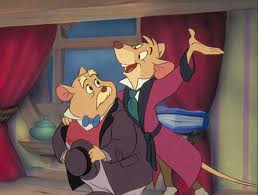
The main gimmick of Disney’s “The Great Mouse Detective,” a very well-put-together family-adventure, is that the main characters are all mice and rats living in Victorian London. It’s like a parallel world underneath our own, which makes sense considering the title character (indeed a “great mouse detective”) lives under the dwelling of Sherlock Holmes. The film draws heavily on traditional Sherlock Holmes elements—of course, for example, the main character, named Basil, is a heroic mouse who has the intelligence and personality of the famous fictional detective.

The aforementioned little girl (or mouse, whatever) witnesses her father being captured by a nasty, peg-legged bat. So with the aid of friendly Dr. Dawson, she tracks down the rodent-equivalent of Sherlock Holmes himself, Basil of Baker Street. She hopes that Basil will be able to help get her father back. While following a series of clues, Basil, Dawson, and the girl (aided by a loyal dog named Toby) set out to rescue the kidnapped parent and stop an evil scheme devised by a villainous sewer rat named Ratigan, whose plan requires the help of the father.

By the way, the father is a toymaker and Ratigan plans to use his inventiveness to create a robotic clone of the mouse Queen, so that it can trick the attendees of a royal event into thinking that Ratigan is now ruler of the land…I am aware of how dumb that sounds, but I’ll let it slide because it’s Disney-magic. The mice talk, yet Toby the dog and Ratigan’s pet cat don’t. Let them do whatever they want.

“The Great Mouse Detective” is quite the entertaining Disney film. It takes us on a wild adventure through this intriguing mouse-world and has sequence upon sequence of pure delight and mystery. It will delight kids, and also keep their parents entertained as well.

While it does feature a little mouse-world mixing with the giant human world, what “The Great Mouse Detective” is really centered around are the characters that go through it and have this adventure. The hero and villain are very enjoyable. Basil (voiced by Barrie Ingham) is a great hero to follow—he’s quick-thinking; he’s intelligent; he’s observant; he’s energetic; and he’s narcissistic yet still very likeable. You can tell that from the first moment he arrives on screen that you’re going to enjoy watching this guy (or mouse) on this film’s journey. And the villain is great. Ratigan is voiced by Vincent Price, whose sliminess is very existent in his voiceover work for this character. Ratigan is brilliant, dastardly evil, and enjoys every second of what he does. He’s enjoying what he does so much that even we as a result can’t help but enjoy it as well. The hero and villain of “The Great Mouse Detective” are very appealing, and they play off each other perfectly as two intelligent minds trying to outwit each other.

Dawson, who becomes Basil’s loyal sidekick, is also very likeable. With nervous mannerisms, a distinguished quality to himself, and a loyalty that leads to bravery as the journey continues, Dawson is an effective equivalent of Holmes’ partner Dr. Watson.

But being a Disney animated feature, the animation deserves credit, especially since this is apparently the first time Disney used computer-generated animation. What really stands out among this animation is the climax, in which Basil and Ratigan have a showdown in the clock tower. The way this sequence is animated is just so fascinating, and the way it’s put together makes for a quite intense fight scene.

“The Great Mouse Detective” constantly gets overlooked when it comes to mentioning Disney animated films, but it really is a small treasure. It may be the mouse version of the Sherlock Holmes story, but don’t let that throw you off. It’s an entertaining movie with terrific animation, interesting characters, and a good sense of fun.

Star Trek IV: The Voyage Home (1986)

18 Feb

vs8

Smith’s Verdict: ***1/2

Reviewed by Tanner Smith

“Star Trek” has been known as ideal science fiction—it’s an intriguing, fun presentation of ideas and creativity when it’s not filled with action and visuals like the “Star Wars” movies. The “Star Trek” TV show, created by Gene Roddenberry, may have been silly in execution, but you can’t deny that there was effort to try and make it work. There were interesting concepts and fun characters to follow, even if the effects were pretty cheesy.

Then, the movies based on the series came about. The first movie—“Star Trek: The Motion Picture”—had some creativity put into it, but was mostly a dull attempt to become the next visual treat (complete with long effects shots of the ship moving into space…slowly). The second movie—“The Wrath of Khan”—was an improvement, bringing back the imagination, the terror and excitement of the subjected “trek,” and the same chemistry among the characters seen in the series. The Vulcan Spock sacrificed his life to save his friends on the U.S.S. Enterprise at the end of that movie, leaving an open door for the third movie—“The Search for Spock”—that brought Spock back to life, but after the others deal with those menacing alien species known as Klingons.

That brings us to the fourth movie “Star Trek IV: The Voyage Home,” which in my opinion is the most imaginative and most enjoyable in the series.

“The Voyage Home” takes place where “The Search of Spock” left off. Spock is brought back to life on the Vulcan planet and the rest of the crew have to repair a stolen Klingon ship (after the Enterprise was destroyed in the previous movie) to get back. But there isn’t going to be a welcome back, as they’re approaching a court martial for blowing up their ship and disrupting the “peace treaty.” Yeah, ‘cause Klingons are known for peace after blowing up whatever they don’t understand, but I digress.

Now, see if you can follow this. A space probe threatens to destroy the Earth by draining all of its oceans, unless its call is responded to. The Enterprise crew, on their way back home, receives a distress call from Earth and discovers what the call means. Unfortunately, the call comes from the sound of humpback whales, a species extinct in the 23rd century. They have a new mission—to travel back in time to the late 20th century and pick up some humpback whales to bring back to the future with them so they can answer the probe, thus saving Earth.

It’s fitting that “Star Trek IV: The Voyage Home” would be released the same year as “Crocodile Dundee”—both movies have a plot element known as the “fish-out-of-water” tale. In “Crocodile Dundee,” an Australian jungle guide was brought to venture New York City. In “Star Trek IV: The Voyage Home,” the Enterprise crew—Admiral James T. Kirk (William Shatner), Mr. Spock (Leonard Nimoy), Dr. Bones McCoy (Deforest Kelley), Uhura (Nichelle Nichols), Sulu (George Takei), Scotty (James Doohan), and Chekov (Walter Koenig)—are in the year 1986 to explore San Francisco, California. When you know who these characters are and become accustomed to them, it’s a lot of fun to see them in strange places. What stranger place for them to explore than…ours?

All of this is good fun. I imagine the writers of “The Voyage Home” must have decided to forget the stuff with the Klingons and the family history involving Kirk (his son died in the previous movie), and decided to have some fun with this series. There are some very funny bits using the fish-out-of-water formula—Sulu, the pilot of the Enterprise, is now flying a simple helicopter; Scotty, the computer expert on the Enterprise, is working simple systems and baffling a curious computer operator in the process; and Chekov…well, let’s just say a Russian in the Cold War era asking where he can find nuclear vessels (to power the ship they came in) is not in good taste.

The funniest bits involve Mr. Spock as an alien come down to Earth. He uses a headband to cover his pointed ears, so people just think he’s some weirdo. He uses his sleeper hold on a punk who has his boombox turned up too loud on a public bus. And he can’t pass off as human—he learns from Kirk that adding profanity in every other sentence is effective; Spock can’t pull it off. He also can’t tell lies, so there’s constant banter between him and Kirk, particularly when they’re asked if they like Italian food—“Yes.” “No.” “No.” “Yes.”

The crew finds a pair of humpback whales held in captivity. A marine biologist (played with great spunk by Catherine Hicks) plans to release the whales into the ocean. It’s Kirk and Spock’s job to find out when that will happen so they can set out to find them and beam them aboard their ship (there’s a special tank for them, in case you’re wondering). This means that Kirk must ask her out to dinner.

This entire portion of the Enterprise crew in 1986 San Francisco is the best part of the movie. The setup is typical and the final climax is the least interesting part of the movie. But when they’re in San Francisco, the movie is a good deal of fun. It’s not just entertaining because of the situations the characters get into, but also because since it’s the fourth movie, there was time to develop the relationship between the crew, after a whole TV series and three feature-length adventures. There’s a sense of easy interaction among these characters; they talk with each other, gently joke with each other, and seem comfortable with each other.

“Star Trek IV: The Voyage Home” is fun and imaginative without having to resort to a real villain or a lot of action (the sequence at the end is a pushover). Instead, it tells an intriguing story that allows the characters to breathe (with an interesting romance between Kirk and the marine biologist) and enlivens comic situations that could have been silly in the wrong hands. “Star Trek IV: The Voyage Home” is a fun voyage indeed.

Children of a Lesser God (1986)

14 Feb

6a00d8341c5d8753ef0120a8ac9371970b-800wi

Smith’s Verdict: ****

Reviewed by Tanner Smith

When someone going to the movies sees a title like “Children of a Lesser God” on the marquee, I imagine just looking at the title turns them off, not knowing at all what the movie is about. And I’d be lying if I said I wouldn’t feel the same way—I did feel the same way having heard the title a few times, not knowing what the film was about. Thankfully, after watching a vintage 1986 “Siskel & Ebert” two-thumbs-up review of the film, I was interested in what they were saying about the film so I was actually interested in the film itself.

“Children of a Lesser God”—how pretentious of a title could you get? That may seem like a downer title for a film, but the truth is, the actual film itself is a true delight.

“Children of a Lesser God” is a love story, and a wonderful one at that. It’s the story of a relationship that develops between a young woman who is deaf and a teacher determined to bring her out of her shell. Along the way, the teacher learns about love and about accepting his lover’s needs.

William Hurt plays the teacher, named James Leeds. He has an impressive resume and is welcome to teach at a school for the deaf, where he’ll teach his students to read lips and speak without using sign language. His methods are somewhat unusual but very effective, like, for example, when he stands on his head and can’t use his hands for sign language so he must speak, or when he uses timing and rhythms to teach music to the students.

On his first day at the school, a beautiful woman Sarah (Marlee Matlin) catches his eye. Sarah works at the school as a janitor, is very bright but also very stubborn, and is completely deaf. He wants to know more about her, and arranges for her to meet with him so he can teach her to speak. But Sarah couldn’t be less interested—she doesn’t believe she needs to learn how to speak. She’s accustomed to being deaf and using sign language all her life and doesn’t feel like she needs to belong in a hearing world. This brings more determination from James to bring Sarah out of her shell, but he also finds himself more and more attracted to her. “You’re the most mysterious, beautiful, angry woman I’ve ever met,” he finally tells her.

James and Sarah do go out on a date together and that leads to trust and respect for each other’s company, but the tension and determination is still there for James and he knows that Sarah will never break. But if she could have a meaningful relationship, would it matter?

A love story, especially one as complicated as this one, wouldn’t work unless there was chemistry amongst the leads. William Hurt and Marlee Matlin play characters who are constantly in a battle of wits, but mostly attracted to each other because of their own qualities. Hurt and Matlin work great together—they’re comfortable with each other and you can feel their chemistry on screen as their relationship continues.

The writing of “Children of a Lesser God” is just fabulous. There are many great moments in the story—not just with the relationship between James and Sarah, but with James and his students. The first scenes in which he teaches them to speak are freshly well-handled. There’s also a scene midway through the film in which they dance and sing to a pop song on Parent’s Day.

My favorite scene in the film comes after a loud party at James’ apartment with James’ students. When everything is finally quiet, James tells Sarah that he’s going to rest his hands and his eyes and just listen to 20 minutes of Bach. He says he hasn’t been able to listen to Bach since Sarah moved into his home, Sarah thinks he blames her, James says otherwise, Sarah says to go ahead, James turns on the music and listens for a moment…he can’t enjoy it. He sees Sarah sitting at a table, staring off into space and waiting. That’s when James thinks, how can he enjoy it if Sarah can’t enjoy it? And then Sarah asks him to “show” him the music like she “shows” him the sound of the ocean waves. He can’t do it. That’s a beautifully-written, wonderfully-acted scene that pretty much states the purpose of the entire relationship—if he truly loves her, he must welcome himself into her world of silence.

William Hurt has been good in movies before, mainly because he acts in roles that are written within his limitations—he’s not terribly exciting or expressive, but he’s mostly charismatic. This is his first role after his flamboyant Oscar-winning performance in “Kiss of the Spider Woman” and in an arguably more demanding role, he’s just fine. Marlee Matlin, who really is deaf, has the more complicated role—using facial expressions, body language, and sign language to get her point across. In a silent role, she owns the screen. She’s beautiful, forceful, haunting, and all-around brilliant as Sarah—it’s an excellent performance. And like I said, both Hurt and Matlin have great chemistry together, and I cared very much about their characters. Another good performance comes from Piper Laurie as Sarah’s mother, who hasn’t seen her daughter in quite a long time and regrets that.

When all is said and done, James realizes that he should become part of Sarah’s world if they are together in love and learns a thing or two about respect for deafness and about respect for his lover. “Children of a Lesser God” is a wonderful love story with clever storytelling, great acting, and a subject that really should be taken into consideration. And don’t let that downer title fool you—“Children of a Lesser God” is great.

Ruthless People (1986)

11 Feb

images

Smith’s Verdict: ***1/2

Reviewed by Tanner Smith

If I had to pick my favorite Danny DeVito role, it would probably be rich businessman Sam Stone in “Ruthless People.” DeVito plays the villain that you love to hate—a man so ruthless that he would even cheer at the thought of his own wife dead. In fact, that’s what he’s talking about in the very first scene of “Ruthless People”—he’s telling his mistress Carol (Anita Morris) that he’s planning to swiftly do away with his annoying wife Barbara (Bette Midler). We find out that Sam married her just for her money, and if he kills her, he’ll gain her late father’s inheritance.

This is a vile man. He’s selfish, shallow, and ruthless. But he’s so earnest and passionate in his schemes and purposes that you can’t help but admire DeVito for making this villainous character so entertaining.

“Ruthless People” has the comic premise of Sam’s wife actually being kidnapped before Sam has a chance to do her in (he planned to fill her with chloroform and hurl her off a cliff). He gets a call from the kidnappers who threaten to kill her if he doesn’t pay the ransom. Watch his face as he listens to every detail and knows that his wife could be killed if he doesn’t meet their demands—this is his dream come true! He’s not supposed to tell the police; he tells the police and the story hits the news. He’s told to pay the ransom; he doesn’t.

But the kidnappers, as it turns out, are inane at their title. They’re actually a nice suburban couple (Judge Reinhold and Helen Slater) who kidnap Sam’s wife Barbara for reasons of ruthlessness. Reinhold’s Ken decides that they both need to be ruthless to succeed in this world, and holds a grudge against Sam for stealing spandex designs from his wife Sandy (Slater) and passing them off as his own, and becoming very rich because of them. Now they want their share and hold Barbara hostage until Sam pays the ransom…. Yeah, that’s not gonna happen.

This is a simple idea of a nagging wife being kidnapped and her husband doesn’t want her back. It’s stretched out into a very funny comedy with charismatic acting and a sharp screenplay brough to life by the three-man directing team of Jim Abrahams, David Zucker, and Jerry Zucker—the same guys who made “Airplane.” This script is full of funny jokes and does a good job of making the story be as complicated as it can with this premise, just barely going over-the-top with its conclusion (a standard car chase). I don’t want to give away most of the gags, because that takes away the elements of surprise in this movie.

Bette Midler’s Barbara has a great share of screen time, and I’m sorry I forgot to talk about her. Midler is hilarious in this movie, making her character as stubborn as possible while being held by these two nice losers. She starts out as a shouting whiner (which I know you’d expect, since we first see her in a bag and her mouth is gagged), and then delights in teasing her captors, sometimes intimidating them by saying she’s going to turn them in later, and driving them crazy. Later on, though, she does soften up and even befriends Sandy, and she delivers the funniest line in the movie when she realizes that the ransom number has decreased. I won’t write what it is; just see the movie. Trust me—it’s worth it.

An amusing subplot involves Sam’s mistress Carol as she attempts to blackmail Sam by having him give her all the money, or else she turns him in for killing Barbara. But due to a series of hilarious misunderstandings, she and her buffoonish lover (Bill Pullman, hilarious) find themselves in many unsuccessful attempts to do so. That is all I am going to say about that. Period.

One failing in “Ruthless People,” besides the conclusion, is that there is no dueling confrontation between DeVito and Midler. We only see them together once, to deliver a weak punchline to the story, and I would have liked to see them really have it out with each other.

With some big laughs, game performances, and a very funny screenplay by Dale Launer, “Ruthless People” is a goofy, hilarious movie about…ruthless people. They’re ruthless, but they’re likable and memorable. DeVito is a joy to watch as the lovable villain, Midler is suitably stubborn, Reinhold and Slater are pretending to be ruthless but are truthfully nice enough for us to like them, and Morris and Pullman are hilariously idiotic. They help make “Ruthless People” a very funny movie.

The Fly (1986)

6 Feb

images

Smith’s Verdict: ****

Reviewed by Tanner Smith

David Cronenberg’s “The Fly” is a perfect example of the “experiment-gone-wrong” movie. It’s when a mad scientist wants to create a device that will change the way humanity sees things and something goes terribly wrong, and the direst consequences occur. That’s always one of the enjoyable of stories to be told in movies, and “The Fly,” a re-imagination of the 1958 sci-fi thriller of the same name (but a different story), is one of the best. It’s one of those horror movies in which we get to know the characters first and know the important setups to the oncoming rules of the gimmicks, so that when the terror happens, it amounts to something.

It begins as scientist Seth Brundle (Jeff Goldblum) meets a pretty journalist named Veronica (Geena Davis) and wants to impress her. So he puts it bluntly, starting out by saying that he has an invention that will change the world as we know it. Being a curious mind, Veronica accompanies Seth to his home. Seth wastes no time in impressing her—he shows her a pair of “telepods” connected together by cable and run by computer. He explains to Veronica that it’s a sort of “teleportation” device, which can move something from one telepod to another. It works great on items, such as a stocking that’s used as a test…but it turns living things inside out. (There’s a really gruesome scene in which Seth tests the machine on a baboon, and we actually see the outcome.)

One of the interesting elements of “The Fly” is that the science seems believable. That’s rare for a movie like this—usually, you roll your eyes at the very idea of certain experiments. But not here—I believed in this experiment, whether it could work or not.

Anyway, Seth figures out the problem with the invention, tests it another baboon with success, and then finally decides to try it on himself. However, something unexpected happens during the process. A housefly has made its way into the telepod with Seth and he makes it out, but with certain side effects. He suddenly has a great amount of energy and increased strength. However, that’s just the beginning and it may seem positive…but things are about to get a whole lot worse.

Seth is no longer Seth. He’s slowly but surely turning into a man-sized fly—or “Brundlefly,” as he describes himself. Ugliness starts to emerge and, thanks to first-rate makeup and effects, only looks worse and worse every time we see him again. Also, Seth’s nature is reversed, letting the menacing insect side take over what little of Seth is left. What’s Veronica to do? She wants to help him, but she’s ultimately powerless to do anything for him.

Too many of these mad-scientist movies are focused on ideas, but not so much with characters. Of course, there are exceptions, like “Frankenstein.” Now, here’s “The Fly,” in which we get to know and care for the two central characters played by Jeff Goldblum and Geena Davis. Goldblum’s Seth is a socially awkward but excited and likable character who gets his enthusiasm from his continuing experiment and his relationship with Davis’ Veronica, a curious reporter who gets way more than she bargained for. Goldblum gets lost in the role—it has to do with the way his eyes get wider whenever he gets excited or when he casually tries to explain certain elements of this new experiment. He plays it like he sees it. The result is a powerful performance. Davis is very good too, and she and Goldblum show great chemistry together.

The character development and interaction is arguably the most important aspect of “The Fly.” We care about these people, we fear for them, and we hope that somehow things will turn out all right for them. There’s a particularly strong scene in which we see Seth probably as bad as he’ll get before his human side is completely gone—the line “I’ll hurt you if you stay” (Seth saying it to Veronica) is chilling because of everything that led up to it.

The makeup and creature effects, created by Chris Walas, are horrifyingly excellent. I mentioned that Seth looks worse and worse every time we see him again, and I wasn’t exaggerating. The work done on making Jeff Goldblum look nearly human before transforming into a horrific insect-beast is consistently effective—creepy and sometimes even hard to watch, but remember, this isn’t a geek-show. The effects don’t make the movie—they’re there to serve the story.

There are troubling scenes in “The Fly,” but it’s a great film with terror that actually amounts to something with two well-developed, likable characters to feel for. And for people out there who search for new ways of changing the world as we know it, just be sure you know what you’re doing.

Oh yeah, I almost forgot—Be afraid. Be very afraid.

Manhunter (1986)

5 Feb

images

Smith’s Verdict: ***1/2

Reviewed by Tanner Smith

I get the feeling that Thomas Harris really gets what it means to set up a gripping murder mystery. In his books “Red Dragon” and “The Silence of the Lambs,” Harris creates memorable, three-dimensional characters and brings them on some of the more original mysteries of identifying some of the more original serial killers. For movies to be adapted from these works, it’s important to capture the same sense of suspense, intrigue, and danger. It helps to have an artistic look as well. With “Manhunter,” writer-director Michael Mann brings the novel “Red Dragon” to life and delivers a gritty, tense, stylish thriller with a talented cast and a gripping mystery.

For starters, it has an intriguing main character for us to follow, played with an intense, mesmerizing performance by William Petersen. Petersen plays an FBI agent named Will Graham, a brilliant mind that can enter the mindset of a killer and read into how he acted. But after a breakdown after catching an equally brilliant serial killer, Dr. Hannibal Lecktor (Brian Cox), he went into retirement. But now, he’s called back to help his former FBI superior Jack Crawford (Dennis Farina, in a strong performance) in a new case—a serial killer known as the Tooth Fairy because of the bite-marks on his victims.

In one of the more disturbing early scenes, we see Graham as he investigates one of the murders. As he thinks everything through, you feel a great sense of unease because you feel like he is actually thinking like a sick killer himself. He isn’t merely having an epiphany—it’s almost as if he’s thinking of what he would have done if he committed the murder. This makes him an effective anti-hero—always wavering between good and evil, if you will. You know he’s not of a fully stable mind.

The killer, the Tooth Fairy, is Francis Dolarhyde (Tom Noonan), an odd person who works at a photo lab where he strikes a relationship with a blind woman, Reba (Joan Allen). We meet him later in the film, when he’s torturing a jackass journalist (Stephen Lang) who printed an article about him that he certainly didn’t agree with. In one of the creepiest scenes in the movie, the journalist is strapped to a wheelchair and has no choice but to tolerate the killer as he goes about his idea of changing into a Red Dragon (inspired by the William Blake paintings). How he does away with the journalist is especially unnerving. And then when you see how he works, and his interaction with Reba who doesn’t know who he really is and likes the way he speaks, it becomes clear that Reba will become the next victim, unless Will can find the killer and save her.

You could say that because you don’t know all that much about the killer and his relationship with Reba is somewhat rushed, then it just seems like another killing for him. While I can agree with the second part (I did want to see more of the Reba character beforehand), I think that of the first part, that you don’t know much about him, just makes him a more chilling villain. You don’t know what he’s thinking, but you know that something can put him on edge anytime and he can kill people. It’s more unnerving when you don’t know much about the killer. You know his motives, you know he’s up to no good, and Tom Noonan delivers a great sense of terror within strangeness.

There’s another killer in this movie—Dr. Hannibal Lecktor, whom was captured and locked away by Graham. Now, Graham requires Lecktor’s insight and assistance in helping him capture the killer, by using his sick mind to figure the Tooth Fairy’s move. Lecktor enjoys playing mind games with Graham, since he believes that they are “just alike,” as they are brilliant minds on the edge of destruction. On top of that, secretly, Lecktor is grudging against Graham and actually figures a way from inside his cell to get to him and his family.

“Manhunter” also allows us to see Graham with his family. The scenes in which his wife (Kim Griest) and his son (David Seaman) are effective because it gives Graham something to live for and something to protect. We care about them and hope nothing bad happens to them, and so we root for Graham to solve the case and catch the killer. In particular, the scene in which Graham talks about his son about why he was sent to the psychiatric hospital ward is very strong with the right element of tenderness.

The story unfolds quite smoothly and we’re involved all the way through, but I wish that the movie would end on something more than a climax featuring a violent showdown between Graham and the killer when they finally meet and try to kill one another. I was hoping for a more psychological element to take over since these two have been developed as mentally-unstable minds, one more than the other. But instead, it’s just a standard climax. Fortunately, it doesn’t shoot the movie in the foot, because of everything that has happened before.

The actors deliver excellent performances. William Petersen, as I’ve said, is mesmerizing as the hero Will Graham, seeking redemption by stopping the actions of a sick mind. Tom Noonan is a chilling villain, Brian Cox is a slimy catch-you-off-guard mad intellectual, Dennis Farina is an intense superior, Stephen Lang is a memorable jackass reporter, Joan Allen makes the most of her scenes, and Kim Griest and David Seaman do good jobs as Graham’s family. The characters are memorable and actors portraying them do great jobs.

The visuals in the film stand out—blank walls, long beaches, and colorful palette make the most of scenes—and while admittedly some of them get a little tiresome after a while, they still stay in your mind. Technical detail is given the appropriate attention in “Manhunter.” And while that doesn’t make it necessarily subtle, it’s still effectively chilling enough. “Manhunter” is a disturbing but active thriller that keeps you invested from beginning to end.