Archive | 1985 RSS feed for this section

The Sure Thing (1985)

12 Feb

images

Smith’s Verdict: ***1/2

Reviewed by Tanner Smith

Rob Reiner’s “The Sure Thing” could have been one of those dumb teenage sex comedies of the 1980s, and for those who were tired of that “genre,” the opening scenes probably turned them off immediately. You’d think you could tell from the first five or ten minutes what was going to happen in this movie, but you’d be wrong, and that’s how the movie tricks you. Rather than going along the lines of the distasteful “Porky’s,” “The Sure Thing” is sweeter and more mature in tone than one might expect.

Surely enough, “The Sure Thing” starts offputtingly. For one thing, the opening credits (which are written in that cheesy, pink-colored cursive font you see in most 80s teen comedies) are played over a sequence in which the title character—a blonde bombshell in a bikini—sits on a California beach and rubs lotion all over herself. Very appealing to look at, I have to say. But there are many other teenage movies that start out this way. Then, we meet our main character—a recent high school graduate named Walter “Gib” Gibson (John Cusack) trying unsuccessfully to pick up girls at a party, and then chatting with his buddy Lance (Anthony Edwards) who keeps telling him to “get back out there” and get laid. Lance is just as annoying as any other “supportive-sexist-best-friend” character you see in this kind of movie—we’ve seen this guy before. He’s boring.

In fact, we’ve seen this opening before. Any groaner will tell you that “The Sure Thing” is going to be just another one of those sleazy teen sex romps. But this is a most pleasant surprise—instead of resorting to that sort of sleaziness that made movies such as “Porky’s” and “Losin’ It” box-office hits at the time, “The Sure Thing” turns out to be a gentle love story that begins as Gib attends an Eastern college and meets Alison Bradbury (Daphne Zuniga) in his English class. He’s attracted to her, and he uses unusual pickup tactics to ask her out. But Alison is not one of your standard dumb movie broads—she’s an intelligent woman (who happens to be good-looking). On their date together, just when the two start to really hit it off, Gib ultimately winds up acting like a total jerk.

Lance invites Gib to spend Christmas vacation in Los Angeles, where a “sure thing” (the blonde at the beginning) is waiting for him—no strings attached, no guilt involved. He plans to get there, from New England to Los Angeles, any way he can. So, he goes to a bulletin board offering rides, and gets a ride with a friendly, showtunes-crooning couple (Lisa Jane Persky and Tim Robbins), but guess who’s also along for a ride to L.A. That’s right—it’s Alison. She’s on her way to spend the holidays with her preppy boyfriend (Boyd Gaines). From here, it’s a combination of a road movie, a comedy, and a romance.

“The Sure Thing” follows a basic Hollywood three-act structure. The first act introduces the characters at the northeastern university; the second act, the most lengthy section of the movie, in which they travel to California while running into some trouble and hitching rides, while surely becoming attracted to each other; and then the final act, in which they reach their destination and ask themselves if they’re there with the right person. You can guess the outcome of the story, but that’s not the point of the movie. What really counts about “The Sure Thing” is that there is genuine chemistry between the two leads, as every good romantic comedy should have. For us to buy the story, we have to buy the attraction between the two. There is conflict between the two at first, but as they get to know one another, they start to really like one another. Sure, they’re opposites, and they’re going to California for another person. But when has that ever stopped true love? We like Gib and Alison—we care about them and we root for them to end up together. And that’s a compliment to the script and a key tribute to John Cusack and Daphne Zuniga, who are both gifted, charismatic, and convincing when playing the old reliable “love/hate” interaction.

My favorite scene in the movie is when Gib and Alison share a bed together. Alison is the first to awaken in the morning, and she notices that Gib has his arm wrapped around her. How does she react? She smiles and keeps lying there. That’s a genuinely sweet moment and it becomes an important turning point in Gib and Alison’s relationship.

And “The Sure Thing” does what every romantic comedy should do once they’ve gotten the sweet elements out of the way—provide the comedy. And surely enough, there are many comedic moments in this movie that work greatly. These scenes include—Gib’s introduction to the “sincerity lie” by his college roommate (Joshua Cadman); a predictable scene involving Alison hitching a ride with a redneck that suddenly becomes unpredictable once Gib comes to her rescue in a hilarious way; a scene in which Gib teaches Alison to “shotgun beer”; and more. More importantly, the comedy comes from the character’s behavior and the situations they go through.

More pleasantly, “The Sure Thing” is not about the “sure thing” (and there’s never any “meanwhile in California” scenes to interrupt the road trip). It’s about this young man falling genuinely in love. When Gib and Alison finally arrive in L.A., and end up at the same party, Gib is starting to feel as if he’s there for the wrong person. Little does he know that Alison feels the same way—she feels no excitement with her boring, middle-class boyfriend.  “The Sure Thing” has something to say about sex and love, and it’s one of those rare teen-comedies in the ‘80s in which sex and love are two completely different things. (So many others at the time pretended they were one and the same.) With realistic teenage characters, a funny script, and a tenderness to the story, “The Sure Thing” is a treasure in the teenage romantic-comedy genre.

Real Genius (1985)

6 Feb

RealGenius1985anamorphicWSDVDRip-1

Smith’s Verdict: ***1/2

Reviewed by Tanner Smith

“Real Genius”—you know, some films just have accurate titles. In a decade where a lot of society’s movies are about teenagers (that decade would be the 1980s), “Real Genius” is one of the real good ones. It’s a surprise too—this film was released in 1985 and was one of three movies about teenagers and their science projects. The other two such films were “Weird Science” and “My Science Project,” two lousy teenage comedies. “Real Genius” is a real treat, however—it’s very funny and well put together.

The film’s central teenage characters are college students who are not quite the sex-crazed goons you would find in lesser teen movies. The protagonists in this movie are actually well-developed, likable three-dimensional characters who don’t always play by the rules, but there are teenagers like that around. They are Mitch (Gabe Jarret), a 15-year-old boy genius who is the youngest person to be accepted at Pacific Tech, and Chris (Val Kilmer), another young brain who has spent four years at the school and is about to graduate. Mitch and Chris are two of the students chosen to work on a laser experiment. But little do they know that they are being used by Professor Jerry Hathaway (William Atherton), who wants to use the experiment—if it gets finished—to sell it to a military as a weapon.

But in the meantime, Chris is a class-A prankster who uses his genius to set up all sorts of things to make life on campus less boring. For example, he turns the dorm hall into an ice-skating rink, and he turns the lecture hall into a swimming pool. He tells Mitch that he used to be just like him—nervous and socially awkward—until he learned how to relax. Now he feels like it’s his duty to take Mitch out of his shell and teach him to have fun. “Real Genius” is most fun when it comes to showing Chris’ antics. There’s another scene in which Chris and Mitch get revenge on an uptight nerd named Kent, who is also Professor Hathaway’s fink and Mitch’s bully, by disassembling his car and reassembling it in his own dorm room. Brilliant and…dare I say, ingenious.

There are two other quirky characters are crucial to the movie. One is a scruffy-bearded strange man named Laszlo (Jonathan Gries) who used to be the top brain on campus until he cracked and is now living in the steam tunnels below the school (the way in is through Chris and Mitch’s closet, which makes things awkward at first). The other is a hyperactive girl named Jordan (Michelle Meyrink). She never sleeps and is the kind of girl who would run into the men’s restroom to show Mitch a sweater that she made for him. She and Mitch share a cute relationship together. Chris, Mitch, Laszlo, Jordan, and another genius nicknamed “Ick” (he helped Chris with the ice in the dorm) discover about Professor Hathaway’s plan later in the film and decide to strike back.

“Real Genius” is packed with characters and jokes. It is well-written with a real integrity and intelligence (although some jokey lines of dialogue using the word “penis” get old). The writers know that teenagers can have the freedom to be themselves—not just slobs or sex-crazed maniacs or idiots. They’re funny enough being geniuses in this film. That’s a pleasure among many pleasures that lie within “Real Genius.”

Cocoon (1985)

3 Feb

Cocoon1985-01

Smith’s Verdict: ***1/2

Reviewed by Tanner Smith

“Cocoon” is another modern-day science-fiction tale in which advanced aliens from outer space visit Earth with no plans to destroy us, but just to visit us. But these aliens in “Cocoon” are easy to communicate with, simply because they could easily pass off as human. Sure, their true form is pure light, but when they put their latex rubber body suits on, they just seem like rich tourists who have their own business to tend to. They could easily pass as human!

Character actor Brian Dennehy plays Walter, the leader of the group of Antareans, as they’re called, who come to Earth on a mission. He and three of his friends (one of them played by Tahnee Welch, Raquel’s daughter) rent a boat from a young broke skipper named Jack (Steve Guttenberg) to go out into the ocean, dive deep underwater, and retrieve many cocoons of their friends that were left behind on the previous mission decades (maybe even centuries) ago.

You see, it’s said that on their planet, there’s no such thing as sickness or death and so none of the Antareans have experienced the sadness of such. And if the cocoons are taken back to the planet, those inside will be free again. In the meantime, the cocoons that are already found are being kept in the swimming pool near a retirement home, where three senior citizens (Don Ameche, Wilford Brumley, and Hume Cronyn) are tired of their boring lives and take joy in trespassing over at the pool for a little fun. But now, with the strange stones at the bottom of the pool, the pool has become a fountain of youth for them. They feel young again and are suddenly joyful of their lives.

With Walter’s permission, the three men bring their wives (Maureen Stapleton, Jessica Tandy, Gwen Verdon) to the amazing discovery and they all get second chances in being young. They go for nights on the town and even tick off others at the home.

All of this is pure delight. Just about every character is either interesting or enjoyable to watch. We have the scenes with the three guys, who are all wonderful, especially Wilford Brumley who always has a twinkle in his eye that reminds us of a kind grandfather we either had or wish to have had. (Actually, I didn’t know that he wasn’t even at age 50 when this movie was filmed!) Then, we have the scenes with the aliens who just want their friends back and when things go wrong midway through the film, there’s a shocking look of revelation on Brian Dennehy’s face that brings his character full-circle. There’s also a sweet relationship between Guttenberg and Welch and one bizarre scene in which Welch shows Guttenberg her planet’s way of sharing affection with one another.

What I didn’t like about “Cocoon” was its ending. As everyone is invited to stay with the Antareans on their planet, we get a race, a chase, a child in the mix, confused orderlies and police, and a spaceship—just a typical, average Spielbergian ending that wasn’t like anything we’ve seen up until that point.

But everything else in “Cocoon” is just wonderfully entertaining, with great acting and a real feel of whimsy. It’s just a wonder as to why director Ron Howard wanted to end this wonderful film with a climax?

Witness (1985)

3 Feb

witness-1985

Smith’s Verdict: ****

Reviewed by Tanner Smith

“Witness” could be considered a crime thriller, as some would recall it to be, but you’d only be sort-of right. Aside from being a thriller, it’s also a love story and a fish-out-of-water tale featuring the clash of cultures. Strangely enough, all of these elements come together not merely in a capable way, but in a masterful way. “Witness” is everything it needs to be—sometimes sweet, sometimes tense, and always gripping. Add it to the great direction by Peter Weir, an intelligent screenplay by Earl W. Wallace William Kelley, and great performances from actors including Harrison Ford and Kelly McGillis, and “Witness” is a great triumph.

This was Harrison Ford’s first opportunity to try something different in his acting career, in a time when he was free from his Han Solo image but still stuck to his Indiana Jones character. With his great performance in “Witness,” Ford was able to prove to people that he was more than just an action/adventure icon, and that he was a legitimate capable actor that can play drama convincingly. In “Witness,” he plays Detective John Book, who is called upon to investigate the murder of a police officer. He has one witness—an eight-year-old Amish boy, Samuel Lapp (Lukas Haas). Samuel and his mother Rachel (Kelly McGillis) were waiting in a Philadelphia train station for a train to take them to Baltimore, as Samuel witnesses the murder while hiding in one of the bathroom stalls. He was able to make out one of the two killers. And so, Book keeps Samuel and Rachel in the city for a while so Samuel can help him out.

At this point, it would seem like a simple homicide with different cultures. We see some early scenes that feature a bit of lifestyle for Rachel and Samuel in their Amish community, and then once they come into the mainland and this unexpected event occurs, they get a sense of modern police work as well as other cultural aspects, such as hot dogs, which Samuel enjoys. But “Witness” doesn’t keep it that simple. It only gets more complicated once Book discovers that it was a cop that was involved in the crime, and that changes things. Book tells his superior, Chief Schaffer (Josef Sommer), what he knows, only to find that he too is involved, thus putting Book, the kid, and his mother in danger. Book has no choice but to give up on the case and take Samuel and Rachel back home and go into hiding with nowhere else to go. Back at the Amish community, while Book recovers from a bullet wound brought on by a fiery encounter, Rachel lets the locals believe that Book is a cousin. Book is planning his next move, and in the meantime, helps out around the farm, doing chores and eventually helping to build a new barn.

All while this is happening though, Book falls in love with Rachel and the feeling may be mutual; Schaffer is searching for answers as to where Book is so he can silence him and even the kid and mother if need be; and Book has to make an important choice to either stay with the Amish community where he finds himself actually fitting in or back to where he’s more accustomed in the world of modern convenience. There is one person that he would stay for, and that is Rachel.

This story has so many levels to it that I wonder if Alfred Hitchcock could have hooked us in further. In some ways, “Witness” could be considered a Hitchcockian exercise, if you will, Hitchcock always loved to play his audience like a piano, and so director Peter Weir follows the same way and gives us a story that has so many things with it and yet is consistent in its structure and execution. His approach is quite unique in the way that “Witness” is not mainly about the crime aspects, as you’d expect it to be. It’s mainly about a man struggling and adapting to a new lifestyle. It’s not played for comedy; it’s played as straight drama to establish characters, relationships, and routines. And it states positions in clashing cultures with symbolism, such as Book’s gun, and moments of clarity and revelation.

The defining moments come after Book has been more or less accepted into the Amish community, and then encounters a topless Rachel who then offers herself to him. In this dialogue-free scene, Book declines, feeling embarrassed and uneasy. He later explains that if he and Rachel had made love that night, that he would have to stay or she would have to leave. She may be ready to risk a relationship, but Book isn’t so sure. What makes this romance interesting is that while they exchange friendly glances, which lead to good moments with each other and even a kiss, they may not have a future together. The real world would only get in the way. It’s a great example of tragic romance.

Another defining moment is when Book comes into town for a while and encounters some rowdy thugs who mock his clothing. He strikes back by punching one of them out, something that goes against the Amish culture. And then later, when the thriller aspects finally returns to the story in the inevitable climax, they amount to something because of everything that has been built up before. Book is forced to act in defense of the pacifistic Amish against the corrupt cop-killers. It’s not your standard action climax—it’s about something. There’s something to fight for and a reason for being. (And there’s also a clever use of a grain bin as a death machine.)

Harrison Ford is great and convincing as John Book, playing it straight and credible. But he’s not the only actor to earn praise in “Witness.” Kelly McGillis, as Rachel, is equally excellent. I heard that she took lessons in acting like an Amish widow, by experiencing life with the Amish and also trying to get her character’s speech just right. It all pays off. McGillis’ performance is note-perfect and feels very authentic. Also having their preparations paid off for the Amish roles are Jan Rubes as Rachel’s concerned father and Lukas Haas as Samuel the titular “witness.”

And by the way, I should point out that “Witness” shouldn’t be considered an insult to the Amish community. The movie never shows them in a negative way; they show them in a believable way. And I should also give credit to all the actors playing the Amish side characters for doing convincing work. You’d probably think that some Amish folks were brought along to become extras, but actually, no Amish appeared in the film because they believed that being photographed diminishes them. (Reportedly, however, the filmmaking process intrigued them.)

“Witness” gives us a murder to hook us into the story and then lets loose with the love story and the fish-out-of-water tale. It has many great moments, including the ones I described and also the murder sequence that brings the plot into motion is suspenseful on its own (as Samuel must avoid being seen by the killers). The acting is great, the story continues to invest as it goes along, and the result is a satisfying, terrific film.

Explorers (1985)

31 Jan

Explorers_kids

Smith’s Verdict: ***

Reviewed by Tanner Smith

“Explorers” is a family-friendly gem that is sort of let down by its final act. This film has a great setup that doesn’t leave a strong payoff—in fact it’s real silly. But that doesn’t mean I won’t recommend the film. It’s just that maybe it deserved a little more than what it had to offer. Besides, maybe the journey is the most important part of the movie.

The film is a kid’s science-fiction fantasy directed by Joe Dante (“Gremlins”) and it features three young boys as the central characters. One is a dreamer; one is a young scientist; and the other is a loner that the other two boys befriend in the beginning of the story. The dreamer, Ben (Ethan Hawke), has been having these strange dreams that involve a circuit board. Intrigued by the dream, he draws what he can remember of the circuit board on a sheet of paper to see what his genius friend, Wolfgang (River Phoenix), can make of it.

Don’t ask me how, but with the aid of Ben’s dream, Wolfgang is able to create a solid sphere that can break through a brick wall and can be controlled by Wolfgang’s computer. Loner Darren (Jason Presson) is in on the secret as the boys realize that, when enlarging the sphere, they all can fit inside this thing and use it as a force field…and also are able to fly around in it. So, they get this idea to make an aircraft out of an old Tilt-a-Whirl.

If you think this sounds like a silly idea, you’re not far off. It is a silly idea. But the strange thing about “Explorers” (and yet so wonderful about it) is that it takes this idea seriously but not too much. I love how everything develops as the kids are figuring what to do with this new discovery. It helps that the kids are fresh and likable. It’s fun to watch them as they go on.

But that’s only the first half of the movie. When the second half approaches, the boys have already flown above town in their own homemade spaceship and are reaching signals from what could be another planet. (Some of these signals come from within their own dreams.) But what happens when they actually do go into outer space, I probably shouldn’t give away. But I will say this—these boys are bright enough that we want them to find something really interesting; their find isn’t up to it. I suppose it’s fine and fun for younger kids, but for others who really get into this film from the start, it’s kind of disappointing.

I don’t want to sound too harsh, because the payoff is kind of amusing if not what one might expect. Maybe this is why I’m recommending the film. And besides, what really matters is the journey, and “Explorers” is a very fun journey. It’s a delightful, entertaining watch.

Young Sherlock Holmes (1985)

24 Jan

Ysh_poster

Smith’s Verdict: ***

Reviewed by Tanner Smith

“Young Sherlock Holmes” imagines what it would be like if Sir Arthur Conan Doyle’s notorious detective characters Sherlock Holmes and Dr. Watson met as young men. And even if the screenplay calls for young Holmes and young Watson to embark on an adventure of Spielberg proportions not necessarily worthy of the Doyle tales (indeed, Steven Spielberg was one of the film’s producers), it’s a pretty entertaining watch.

The introduction of young Holmes and young Watson is wonderful—a real treat. Young Watson is the new-boy-at-school in every sense—he’s near-sighted and slightly round. His first encounter with a fellow student is a young genius named Holmes. Just as Watson is about to introduce himself, Holmes stops him, saying “Let me.” After an awkward pause, Holmes, without stuttering, states proudly, “Your name is James Watson, you’re from the North of England, your father is a doctor, you’ve spent a considerable amount of leisure time writing, and you have a particular fondness for custard tarts. Am I correct?” He was right about everything except that Watson’s name is John. Watson asks how he did that, to which Holmes responds that it was clear, elementary deduction from a close look at his belongings.

“The name tag on your mattress reads J. Watson. I selected the most common name that belongs with ‘J’—James. John would have been my second choice.”

The boarding school that Holmes and Watson attend is in the great tradition of English locations used in fiction, in which a great sense of unconventionality is always visible. In particular, living in the school, is a retired old professor, Dr. Waxflatter (Nigel Stock). He has many bizarre, clever, wonderful inventions in his workplace. His latest is a contraption much like a one-man pedaling airplane—however, his many tests have proven unsuccessful.

And let’s not forget that nosy dark-cloaked figure that stalks the grounds and uses a blowpipe to shoot special thorns into his victims. The thorns are dipped in a solution that causes those exposed to it to experience frightening hallucinations. The victims seem to be killing themselves to escape their drug-induced nightmares—these include a gargoyle that comes alive and attacks; a coat hanger that turns into snakes; and the most impressive (although definitely underused) special effect, a stained-glass-window knight that jumps off the window and walks toward the victim. (For you trivia buffs out there—That knight is the first entirely computer-generated character to be released in a feature film.)

When Waxflatter falls victim to the hallucinations, Holmes and Watson are left important clues. Holmes is determined to get to the bottom of this foul play, as he, Watson, and Holmes’ girlfriend Elizabeth race to solve the mystery.

What they find, I’ll admit, is not worthy of Holmes and Watson. It’s a secret Egyptian religious cult that partakes in human sacrifice of young female virgins, inside an underground pyramid. Just call this “Young Sherlock Holmes and the Temple of Doom” and you get the idea. (Fittingly enough, in some countries, this film is entitled “Pyramid of Fear.”)

“Young Sherlock Holmes” is essentially Doyle mixed with Spielberg, and it does more justice to Spielberg than it does to Doyle. But there are many Doyle elements to enjoy—such as the references to the Holmes/Watson elements we know of (Holmes’ pipe, his cloak, his violin-playing, etc.). The characters of young Holmes and young Watson are portrayed and written convincingly in the great spirit of Doyle, and played wonderfully by Nicholas Rowe as the charismatic young genius and Alan Cox as the loyal Watson. They’re effective so that Holmes purists won’t be offended.

There’s one element that fans will notice doesn’t fit into this Holmes story and that’s the character of Elizabeth (Sophie Ward), a beautiful young woman who lives at the school and serves as Holmes’ love interest. She’s beautiful, nice, and attentive; but you can tell where the character is going so that no woman will ever touch Holmes’ heart again, hence his bachelor lifestyle. However, to her credit, if anyone were to be the only woman for Holmes, it would have to be Elizabeth.

Even if the special effects don’t belong in a Holmes story, they’re still fun, and so is this movie. “Young Sherlock Holmes” gives us interesting heroes to root for, an engaging mystery for us to follow, and more-than-capable execution from director Barry Levinson, writer Chris Columbus, and cinematographer Stephen Goldblatt.

The Breakfast Club (1985)

22 Jan

Image

Smith’s Verdict: ***1/2

Reviewed by Tanner Smith

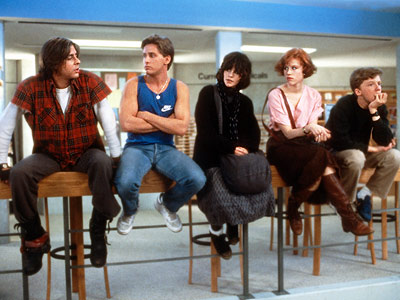
“The Breakfast Club” is a delight. It’s a wonderful, funny, feel-good comedy/drama with this simple premise—five strangers spend a day together and become closer than anyone could have imagined. Make the five strangers into teenagers from different high school cliques and have them in detention together and you have “The Breakfast Club,” a movie written, produced, and directed by John Hughes, who also made the sweet “Sixteen Candles” and actually takes teenagers seriously. Hughes creates teenage movie characters as real teenagers—young people wanting to belong in this world. Usually for the 1980s, a lot of movies will depict teenagers as simply sex-crazed or dumb or just victims in a slasher movie, like the “Friday the 13th” movies. But not with John Hughes writing the material. “The Breakfast Club” is one of those rarities that makes teenagers into three-dimensional characters while adding realistic drama and comic relief.

So we have the five teenage leads from different groups in high school—we have Brian who is a brain (ha ha), Andrew Clark who is a jock, Bender who is a rebel, Claire who is the queen bee, and Allison who is a “basket case.” They are forced to spend a Saturday in the library for a full-day detention and are checked up on every now and then by the strict vice principal Vernon (Paul Gleason).

When the day starts, they have nothing to say to each other and want nothing to do with each other. By the end of the day, they have shared their feelings and realize that they can become friends. All of this is told almost all in dialogue. Each character has his/her moment to express themselves. We feel for each of them. And the way the script is almost entirely written in dialogue, you think this could possibly be a play, especially in the scene in which the kids all sit in the floor and have a sort-of “group therapy” session. This goes on for 20 minutes, but it doesn’t get boring because we really do feel for these people.

For example, we learn that Andrew (Emilio Estevez) has a father who is a practical perfectionist who wants Andrew to win every time, and that drove Andrew to the point where he went over the edge just to please him. For Bender (Judd Nelson), the idea of pleasing his own father is difficult, since his own father is the possible abusive type who probably can never please him, whatever he does. Maybe this is why Bender is a rebel. Isn’t rebellion started by parents’ ignorance? Come to think of it, that could be why Allison (Ally Sheedy) is a recluse.

The acting is very good, especially from Judd Nelson as the down-on-his-luck criminal Bender; he’s very good here. And the other actors, more experienced than Nelson at the time, are good too—Molly Ringwald shows a different side to the character of a high school beauty, Emilio Estevez is strong as a tortured athlete, Ally Sheedy is suitably weird as the weirdo who is also a compulsive liar, and Anthony Michael Hall is a likable (and realistic) nerd (he shows you don’t have to look like a geek—he doesn’t have zits or thick glasses; you just have to act like one to be labeled a “geek”).

If there’s a weakness, it’s that the adults aren’t as drawn out. John Kapelos, as a smart-aleck janitor named Carl, is OK in his small role, but Paul Gleason’s character of the strict vice principal is one-dimensional and the scene in which he tries to connect with Carl is brief and not very interesting.

The question that Brian, the brain, asks near the end of the film is shocking to hear because even though we all were probably expecting the subject to come around, I wasn’t ready for it. Brian asks the question of what’s going to happen when all five of them go back to school. Will they still be friends? The answer he receives is the harsh truth. This is the film’s most powerful moment because it has a ring of truth and really draws the line as to where high school kids stand as individuals. What will happen? Who knows? But the ending does what it can to have the assumption that maybe they can still be friends. We don’t know what happens after this day, which is why we really have to think about who these people are and what sort of people they’re going to become.

I don’t want to make “The Breakfast Club” sound so deep that people wouldn’t be interested because there are moments when it’s fun, particularly when the kids sneak out of the room and have to get back before Vernon realizes they’re gone. But at the surface, this is a strong coming-of-age teenage film that has more than meets the eye.

Runaway Train (1985)

22 Jan

52471

Smith’s Verdict: ****

Reviewed by Tanner Smith

When I heard that “Runaway Train” featured a runaway train loose on train tracks in Alaska, it didn’t sound like an exciting film. With the grim look that can only be executed when a film takes place in snowy weather—and a film that is supposedly action-packed, for that matter—I asked myself how I could get excited or even invested in “Runaway Train.” But then I saw the film, directed by Andrei Konchalofsky, and I realized that this wasn’t a formula action picture. This isn’t only about stopping a runaway train; this is actually a character-based story in which the characters happen to be on a runaway train. In this case, it doesn’t matter where the film takes place; if the characters are rich and plausible, we’ll go along with it.

The movie stars Jon Voight and Eric Roberts as two convicts who escape from a maximum-security prison in Alaska. But first, we get proper introductions to the two men while they’re in prison. Voight plays Manny, a man so untrusted by the warden that his cell doors have been welded shut for years—the warden tells the press, “He’s not a man—he’s an animal.” Roberts plays Buck, a convicted rapist (“statutory rape,” as he corrects Manny) who works for the prison laundry and whose sentence is almost finished.

The warden is Ranken (John P. Ryan), who personally has it in for Manny and arranges for him to be let out among the prison. He hopes that Manny will escape so Ranken can hunt him down and kill him himself. That’s exactly what Manny does—the dim-witted Buck tags along with him because he’s in the mood for excitement. The two men escape through a sewage drain tunnel and stumble through the mountains.

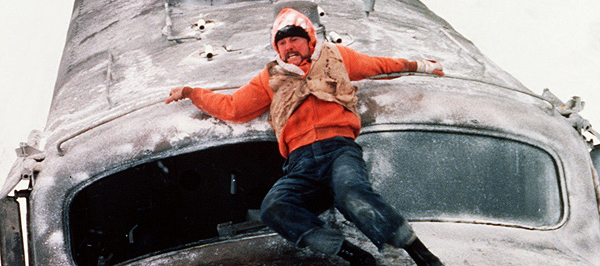
Then, they sneak into one of the back cabs of a train that is carrying four cars linked together. But what they don’t know is that the engineer has had a heart attack shortly before the train left, and fallen off. The two men are alone, not knowing why the train is picking up a ridiculous amount of speed or why the train whistle is never blown…or why the train is crashing through things. We get a second series of events that involve the railway dispatchers who try desperately to find a way to stop the runaway train.

Oh, and of course, the slimy Warden knows that Manny is inside. He is desperate to find the train and kill whoever is inside. Back on the train, Buck and Manny don’t know what’s going on until they come across a female worker on the train (played by Rebecca De Mornay), who tells them about the situation. Now these three people must band together and try to survive this incredible ordeal.

“Runaway Train” is more about characters than about action. This is a real surprise—the real suspense doesn’t come from the notion of whether or not the characters can stop the train before it heads for disaster. It comes from the notion of whether or not the characters can survive together. Although, if you want action, there are great stunts and moments of real tension, particularly when the train crashes through the caboose of another train (which nearly makes it into a siding), and when the characters attempt to slow the train down a little bit after climbing alongside the ice-covered cabs. (There’s no walkway from the second to first engine, heightening the danger.) There are two perfect scenes of tension that really takes us on edge. One scene involves a showdown over sacrifice and friendship as Manny and Buck circle each other; Buck with a wrench, Manny with a knife. At this point, Manny’s hand is badly injured, but Manny still doesn’t see that Buck is the bigger threat in this situation. This scene is intense, mostly because it shows how these characters will act in dire circumstances. The outcome of this sequence comes as a surprise, but it’s believable.

The other sequence comes near the end, as the warden Ranken catches up with the train by helicopter and dangles from the chopper to get inside and kill Manny. Manny isn’t giving in—he goes for Ranken himself, risking his life to get to the front of the train. I won’t give away the outcome of this also-intense sequence, because it would be giving away the ending of the film.

Jon Voight gives one of his best performances as the convict Manny, a man who is intelligent and philosophical in his own way. I love the speech he gives to Buck, played by Eric Roberts as a man with little intelligence and looks to Manny as a hero, about how limited their own choices will become in the future. Voight brings a powerful presence in that scene, and throughout this movie.

Rebecca De Mornay doesn’t play the standard female love interest, but then again, she isn’t playing much of a character in this movie. But the reason that audiences can identify with her is because she acts as outsider to Manny and Buck’s attitudes to the situation and to each other.

“Runaway Train” isn’t a standard action picture—it’s a special film that mixes action and suspense with three-dimensional characters. It doesn’t matter where it takes place. It’s still exciting and riveting.

Blood Simple. (1985)

22 Jan

images

Smith’s Verdict: ****

Reviewed by Tanner Smith

“Blood Simple.” is the first film created by the Coen Brothers—directed by Joel Coen, produced by Ethan Coen, and written by both. Like many first-time directors fresh out of film school, they take joy in showing everything they can, involving “style” into their first big project. The product works—“Blood Simple.” is a tense, well-executed thriller that proves great talent by promising filmmakers.

“Blood Simple.” Isn’t one of those thrillers that keeps you guessing with its many “uncertainties” that the filmmakers love to play with. It tells a straightforward story, but goes through entire detail in showing it. There are many twists and turns as the film continues, but the strange thing is that they all seem like they were meant to be. And while doing so, it taps into fear and guilt—what happens after a murder is committed, you think you might be blamed for it, and you try to dispose of the body?

What’s the story? This is going to be difficult to explain without giving away certain things that I would rather not reveal. The less you know about it, the better. I’ll just give you the setup. Julian Marty (Dan Hedaya) hires a private investigator (M. Emmet Walsh) to spy on his wife Abby (Frances McDormand) and her lover Ray (John Getz). The private investigator takes many pictures, which further enrages Julian. So he pays the P.I. to murder them. But something goes very, very wrong.

Period. That’s all I’m going to say about the plot. I knew close to nothing about this movie when I first watched it, and trust me—not knowing what’s going to happen makes it more special. Let’s just say that there is a lot of trouble in disposing a corpse in the film’s very best sequence. Without naming names, someone finds the body, thinks he knows who committed the crime, decides to dispose of it himself, and clean up the mess. There’s blood everywhere, and it stays there no matter how hard he tries to clean it all up. Then he puts the body in his car, but wait a minute! While the car is stopped, the body gets up and tries to crawl away! And someone is coming! Then what? It’s just a crazy sequence that gets more complicated and more dangerous as it goes along.

Everything is so mixed up, the characters don’t even know who’s really who during this mess. It leads to further complication, more guilt, more fear, and a heavy dose of tension. This is one of the more gripping, shocking thrillers I think I’ve ever seen.

The visual style is incredible. Every shot in this moment has something interesting to look at; even everyday things, like a simple door or a plowed field (with tire tracks across it), or gruesome things, like a bullet hole in the chest. There’s even a shot in which a character feels guilt and a newspaper is thrown at the screen door, looking like a soaring missile about to strike. The cinematography is great, with its low-angle shots, high-angle shots, zoom-ins, and tilt shots, and never to the point where it’s all over the map. It’s consistently brilliant. We’re interested in keeping our eyes on the screen the whole time.

“Blood Simple.” is a stylish film and an original, intelligent thriller, and it just shows how far the Coen Brothers will go from it.

Fright Night (1985)

16 Jan

petervincenteh3

Smith’s Verdict: ***

Reviewed by Tanner Smith

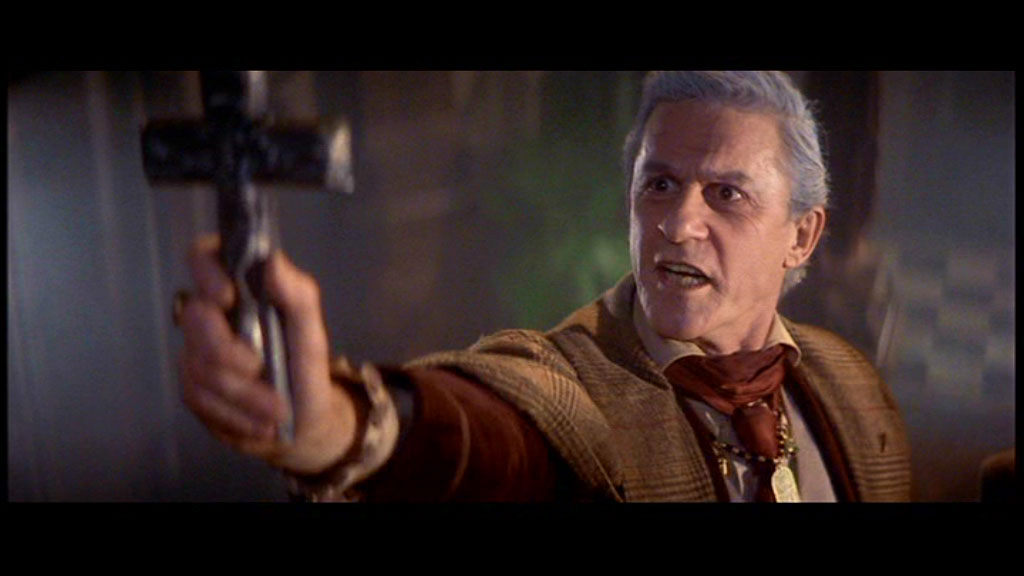
“Fright Night” respects the vampire genre and recalls back to the old elements of Bram Stoker’s Dracula. But it also modernizes them. The vampire lives in suburbia and can easily be seen as an eccentric suburbanite. But as a vampire, his strengths are the same—he can live forever, he can transform into either a bat or a wolf, and he can hypnotize people so he can drink their blood (the rest he just kills quickly). And his weaknesses are the same—particularly sunlight, crucifixes, and wooden stakes through the heart (though a stake through the heart will kill anybody). Yes, the traditional, old-school vampire elements are in check for “Fright Night.” And they’re quite welcome.

The film takes place in a suburb where something strange has moved in, and no one has noticed except for teenager Charley Brewster (William Ragsdale), who one night is making out with his girlfriend Amy (Amanda Bearse) until he notices while looking out the window that two guys are moving a coffin into the basement next door. The next night, he hears a woman’s scream coming from the house. And he notices that all the windows in the cellar are completely painted black by the new house owner’s live-in carpenter. Where’s the owner, who apparently sleeps during the day?

You starting to see a connection here?

Charley spies on the house one night to make the chilling revealing discovery that the new guy living next door to him is a vampire. But of course, no one will believe him—not his mother, not Amy, and not even the police. Worse yet, the vampire—known as Jerry Dandrige socially, or how social he can be anyway—knows that Charley knows about him. Desperately seeking help, he gets in touch with Peter Vincent (Roddy McDowell), the well-known B-movie actor known for killing monsters, particularly vampires. But Peter Vincent doesn’t truly believe in vampires until he has his own encounter with one. After some reluctance, Peter joins Charley in a race to kill Jerry before he kills them.

One of the strengths of the movie is Roddy McDowell as Peter Vincent. He delivers a terrifically comic performance as a washed-up actor who gets roped into the situation. He doesn’t believe in vampires, but for a good sum of money (he’s in danger of being evicted from his apartment), he’ll do anything until he realizes that these are real humanistic beasts. He may seem tough killing vampires in movies, but in reality when facing vampires, he’s a frightened, nervous wimp of a man who runs away when he gets a chance. This character is a comic masterstroke in “Fright Night.”

Chris Sarandon plays the vampire Jerry and it’s also a terrific performance. He plays Jerry with a casual, snooty sense that you’d think he’s just a reclusive, eccentric businessman. But once you get him started, he shows his true colors and becomes a convincing vampire. This is a real feel of split-personality, and Sarandon handles both parts really well.

A particular problem I have with “Fright Night,” and it is major, is that William Ragsdale as the hero and Amanda Bearse as his girlfriend are horribly miscast. Ragsdale is just a one-dimensional whiner that you just want to see get killed by the vampire, because that would mean you’d never have to hear his peevish, droning voice ever again. That would be just fine with me. Bearse is worse—neither appealing or convincing. And she becomes the one that the heroes have to save from becoming a full-fledged vampire, after Jerry has seduced her and changed her. Let Amy be a vampire—at least she’s more interesting that way.

Another problem I have with the film is the middle part of the film, particularly in which Amy and the crazed teen Evil Ed—getting to him later—hire Peter to convince Jerry that he is a vampire). I know that Amy is trying to snap Charley out of what she thinks is a delusion, but why is the movie acting like it’s a big shock when Peter realizes that Jerry’s a vampire? Did it hope we’d forget that Charley was already our hero?

And what about Jerry’s roommate/vampire’s-assistant Billy Cole (Jonathan Stark)? Apparently, he’s human, since he can walk in the daylight. So, simple bullets can kill him, right? Peter even states before he and Charley go into Jerry’s house to strike, “He walks out in the sunlight—then he’s human.” Then he goes ahead and shoots him, but…he just keeps coming. OK, it’s creepy enough, to be sure. But what’s the deal? Did Jerry turn him into a vampire that night? Is he a partial zombie? I don’t know; the movie never tells us.

But “Fright Night” has enough strengths for us to forgive its flaws. The performances by Roddy McDowell and Chris Sarandon are good, and so is the performance by Stephen Geoffreys in a comical supporting role as a crazy teenager nicknamed Evil Ed who becomes a vampire midway through the movie—his over-the-top delivery, along with his Jack Nicholson resemblance, is just hilarious. The creature effects are suitably gruesome, and the final half of the movie—the battle between the heroes and the monsters—is bloody entertaining. “Fright Night” is a fun horror movie.

NOTE: “Fright Night” was remade in 2011 as a more self-referential horror-comedy, starring Colin Farrell and David Tennant—that film is worth checking out as well.