Archive | 1985 RSS feed for this section

Mask (1985)

29 Mar

MASK19

Smith’s Verdict: ****

Reviewed by Tanner Smith

“Mask’s” opening scene in which the central, disfigured young character first appears on screen delivers a visceral reaction. With a strange face, he certainly doesn’t look like a normal teenage boy. But as he talks and goes about his day, we realize he is a teenage boy. His name is Rocky Dennis, and he’s just a normal kid with an unfortunate facial abnormality. He collects baseball cards, he has dreams of traveling the world, and there’s no reason as to why he shouldn’t attend public school like other kids his age.

Rocky’s face resembles that of a lion, as his disease is sometimes known as “Lion-itis.” It’s called craniodiaphyseal dysplasia, and it causes calcium on his skull to distort the face. People see him, and keep staring in disbelief, to which he likes to ask, “What’s the matter? You never seen anyone from the planet Vulcan before?” But just because he looks different doesn’t mean he’s any less special. He’s a good kid; just see the good in him. That’s why we accept Rocky almost immediately after we’ve seen what he looks like. And right away, you see the point “Mask” makes—don’t judge people by how they look.

Rocky does encounter people who judge too quickly. In an early scene, his mother, Rusty (Cher), registers Rocky at a new school district and sees the school principal who takes one look at the boy and suggests “special schools” that fit his “needs.” “Do you teach algebra, biology, and English here?” “Of course,” the principal responds reluctantly. “Those are his needs,” Rusty says with a grin. She shows him the report card from Rocky’s last school, which shows he’s a good student, and she practically calls him a jerk before giving the name of her “lawyer.” (She doesn’t really have one, but who doesn’t cringe at that word?)

That’s just less than 10 minutes into “Mask” and we’re already absorbed into the material. Right at that scene, you can see that Rusty is the ideal mom for Rocky. But that’s not to say she’s normal; far from it. She rides with a motorcycle gang, heavily takes drugs, brings strange men home with her night after night, and I wouldn’t guess she’s employed. She’s a free-spirited, wild, complicated, angry-at-the-world woman who does love her son, even if he sometimes gets on her nerves as he tries to get her to stop taking drugs. But she will if it will make him happy, or at least she’ll try. This is an outstanding character study, and Cher turns in an excellent performance as Rusty, bringing further effectiveness to an already well-written role.

Eric Stoltz, buried under a very convincing latex mask, does a terrific job at making Rocky into a normal teenager with a handicap, and not some special case like the Elephant Man. He’s very likeable and convincing, and we accept him as Rocky Dennis.

“Mask,” directed by Peter Bogdanovich and written by Anna Hamilton Phelan, shows us almost a year in the life of these characters. We spend time with them and get into their relationships—the relationship with Rocky and Rusty, the relationships they have with the motorcycle gang who acts as surrogate fathers to Rocky, the relationship between Rusty and her old lover Gar (Sam Elliott) whom she really loves, and also there’s even a sweet romance between Rocky and a cute blind girl (Laura Dern) who feels Rocky’s face and says, “You look all right to me.” (And unfortunately, wouldn’t you know it, her parents see his face and that’s all they notice of him.)

All of these make “Mask” into a unique, wonderful movie full of high spirits and good intentions, but never to a point where this could have been a stale Disease-of-the-Week TV movie. It’s smartly written, nicely-executed, and we like and care for the characters. The point of “Mask” is delivered effectively—looks don’t matter. Anyone who accepts Rocky right away at the beginning of the movie is most likely to apply that lesson to life.

The Man with One Red Shoe (1985)

29 Mar

M8DMAWI FE007

Smith’s Verdict: *1/2

Reviewed by Tanner Smith

I haven’t seen the French mistaken-identity comedy entitled “The Tall Blond Man with One Black Shoe,” so I can’t say how its American remake—entitled “The Man with One Red Shoe”—follows it. But it doesn’t matter. “The Man with One Red Shoe,” also about a case of mistaken identity, is a mess. It’s not very funny and what’s worse is that it’s boring.

It features an ordinary man walking his way through a story of CIA situations, as a violinist (played by Tom Hanks) is followed around, believed to be a spy for reasons that I can’t recollect. Apparently, they needed an innocent man to be their target and went for Hanks’ character because he walks around one day wearing mismatched shoes (yes, one of the shoes is red).

Wait—something is coming back to me. I think Dabney Coleman and Charles Durning played two CIA spies from different sides and Durning needed an innocent bystander to confuse Coleman and his team. So they pick this “man with one red shoe” and treat him as if he were spy who has information on Coleman. The running gag is that Hanks has no idea just what in the world is going on.

Things get even more confusing (and exciting) for him when a bombshell of a young female spy (Lori Singer) winds up falling for Hanks. There’s an uncomfortable scene in which they date each other and her hair is stuck in his pants zipper.

But the movie seems more focused on its spy story than its attempts to create written humor. I wouldn’t mind so much except that this isn’t a good spy movie. Good spy movies have a tendency to be exciting (even the bad ones do), but it’s still boring because very little thought went into creating a fully-detailed story. And then near the end, it has the gall to have a character say a line like, “This affair must end in a shooting match, just like all good spy stories.”

With a cast like Tom Hanks, Dabney Coleman, Lori Singer (“Footloose”), and Charles Durning, you’d expect a better movie than this. A cast can’t just carry a movie like this—the best comedies have scripts to support their performances. Tom Hanks, usually known for dramatic roles (and amazing at them too), has shown what he can do with comedy, but even he’s boring beyond belief. He plays it straight—with all that happens, this isn’t funny. Maybe Bill Murray would have pulled it off in this role. Coleman isn’t any better—all he does in this movie is scowl.

A word about Lori Singer as the seductive female spy—she isn’t the least bit convincing as a spy. It’s not because she’s so beautiful—I’m sure a spy can be as beautiful as that (I even know of a movie producer as beautiful as she, but I’m not naming names), but every line she says just sounds like it came from a script and worse, it sounds forced.

The only two amusing bits feature Jim Belushi as Hanks’ best friend. One scene has him chasing after the spies’ borrowed ambulance on his bike, because he hears the bugged recording of his wife (Carrie Fisher, so annoying here) putting moves on Hanks and…making “Tarzan” noises—don’t ask, you shouldn’t care—coming from inside the vehicle. That was kind of a funny chase scene.

Another funny bit is after Belushi tries to convince Hanks that there are dead spies on the floor in his apartment, but the ones that killed them keep hiding them from sight to the point where Belushi cries because he thinks he may be crazy and then takes a leak—a dead body is hanging from the bathroom door and his reaction is priceless: “Oh, come on!”

Those are the only funny bits in this depressing, boring picture called “The Man with One Red Shoe.” The only thing left to say in this review is that the French filmmakers (who made the film this was based on) should sue.

Sylvester (1985)

25 Mar

syn__0023_sylvester

Smith’s Verdict: ***

Reviewed by Tanner Smith

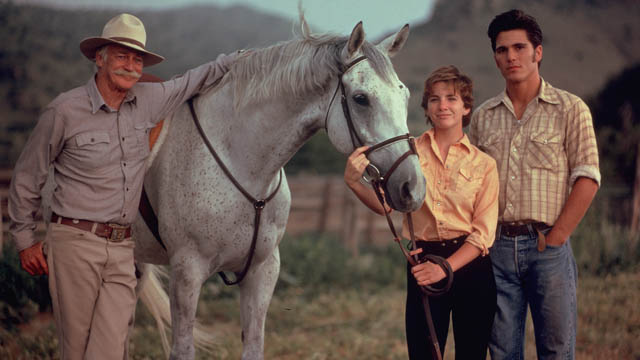
The story for “Sylvester” is nothing new. It’s the story of a spunky young woman and her equally gutsy horse. The horse is reckless at first, but maybe it can be trained to become a champion. We’ve seen this before, particularly in “National Velvet” starring Elizabeth Taylor. But “Sylvester” has something going for it, and it’s not in the predictable story; it’s in the actors’ performances and the story around the girl and the horse.

Melissa Gilbert, from TV’s “Little House on the Prairie,” turns in an excellent performance as Charlie, a sixteen-year-old orphan girl who cares for her two younger brothers by herself and works at a ranch. She wants to train horses and wants a challenge. She finds one, all right, in Sylvester Stallone (no, really—that’s what she names the wild horse of the bunch). This is a wild, unruly horse—not the kind of horse you’d see competing in the steeplechase trials.

But hey, maybe…just maybe…Sylvester will be able to do it.

OK, we all know the conflicts at hand here. Charlie has to deal with the court officials concerning her and her brothers living alone; they later live with the farmer who becomes a father figure; the father figure is skeptical about the horse being trained by Charlie; Charlie gets Sylvester in good riding form; and of course, with help from the farmer, her brothers, and her boyfriend, Charlie is able to compete in the steeplechases. We go through the checklist of events.

BUT among the formula and the obligatory scenes that come with it, we still have the pleasure of watching of viewing the actors portraying these characters. Melissa Gilbert is great in this movie—she has a unique star presence and brings conviction to the role of young Charlie. Richard Farnsworth is also great as the grizzled old farmer who takes her and her brothers in, showing more dimensions than we’re used to. Even Michael Schoeffling (“Sixteen Candles”), as the obligatory handsome boyfriend, does a nice job.

The horse is the least interesting element in the movie. He’s just there as a way to get the story and the heroine in the directions they’re supposed to go. But to be fair, I’m glad this isn’t one of those movies where the horse makes everything happy when the girl is sad. The horse isn’t a practically human reincarnate. It’s just a horse. The story isn’t about the horse, despite this horse’s name Sylvester being the title of the movie. It’s about the people this time.

“Sylvester” isn’t particularly original, except for when it’s dealing with Charlie’s issues and the development of the people around her. It is also harmless for kids and I think adults will enjoy the more mature aspects of the story. It’s a nice family film that could have been great, but as it is, it’s a good movie.

Vision Quest (1985)

23 Mar

images

Smith’s Verdict: ***1/2

Reviewed by Tanner Smith

Even though “Vision Quest” follows a routine that most sports movies follow, it’s still a nicely done, entertaining film about a high school wrestler who has two dreams that must come true before the movie is over. The first dream is to go to the state championship and take on the toughest guy on the mat. The other dream is to win the love of a girl who has come into his life.

The kid’s name is Louden Swain (played by Matthew Modine). He has dropped from 200 pounds to 178 to join a different weight division on the school wrestling team. He baffles the coach, but is determined enough to continue working out and lose more pounds to compete against the toughest wrestler in the state, named Shute.

As you can read, the protagonist is about as standard as a sports film can ask for, but Matthew Modine is a fine actor and does what he can with his attitude as an actor to make his character quirky and engaging, and therefore a nice leading man to follow.

On his side are Louden’s respectful father (Ronny Cox); an English teacher, Tanneran (Harold Sylvester); a wrestling coach (Charles Hallahan) though sometimes he feels negatively about Louden’s determination; and his best friend Kuch (Michael Schoeffling), a teenage punk with a Mohawk hairstyle and describes himself as “Half-Indian,” though he might just be going through a phase. All of these characters are not like the usual types you would see in most sports films. For example, the father in this movie is not scornful and skeptical; the coach isn’t entirely cynical; the best friend is an actual individual instead of a one-dimensional, loudmouthed idiot. They’re all fresh and original characters.

But then there’s the girl that Louden tries to win the heart of. Her name is Carla and she’s hands-down the best character in “Vision Quest.” She’s a 21-year-old independent drifter who stays with Louden and his dad while her car, which has broken down while passing through town, is being fixed. Carla (Linda Fiorentino) is a woman who doesn’t look at anybody the wrong way; just as they are. But at the same time, she still keeps her cunning attitude and uses it to see who is real and who is a phony. Maybe this could explain why, after Louden realizes he’s infatuated by her, she doesn’t question why he sniffs her panties when he thinks no one Is looking. She doesn’t confront him about it; she waits it out to see what he’ll do next before passing judgments. What develops is a sweet relationship that doesn’t revolve around sex, but with trust. By the end of the film, you have to wonder what will happen for them in the future. That’s where the real suspense is; not just with the big match at the end.

We know that Louden will reach down to the weight limit to fight Shute, we know that they will fight in a big match with a large crowd watching, and we know there will be certain complications beforehand. But the twist is that those complications are uncertain when we follow Louden and Carla as their relationship grows. Now I have to confess something—as I mention this relationship (and continue to think about those remarkable supporting characters), I change my rating from three stars to three-and-a-half stars. I guess what can be said about “Vision Quest” is that if a seemingly-tired genre film is written well and acted beautifully, it can redeem the subject matter.

Jagged Edge (1985)

18 Mar

jagged-edge-1985--02-650-75

Smith’s Verdict: ***1/2

Reviewed by Tanner Smith

Maybe it’s because I’ve seen too many movies, but whenever I hear the setup for a thriller and I hear from other people (or most critics who are almost like people) that it has a “twist ending,” I always believe I can guess exactly what the twist is. And some of the time, I am correct. Twist endings just don’t surprise me anymore because when there are so many thrillers with these alleged turns, they’re just easier for me to guess.

I bring this up because the 1985 murder thriller “Jagged Edge,” written by Joe Eszterhas and directed by Richard Marguand, is notable for its particular twist ending. And even though I didn’t know the twist, I knew there was one. And so, being the investigative reviewer that I am, I kept track of all the clues as the story continued. What surprised me, however, was just how much was being pitched into the story. In this particular “whodunit” mystery, we have clue upon clue upon clue, as they’re all introduced sneakily and smoothly. So by the time that particular twist came along, I must confess I did not guess correctly what the resolution was going to be.

“Jagged Edge” is a thriller that recalls the Hitchcock direction in that it likes to “play the audience like a piano.” In this case, with everything being thrown at us (and if we’re all caught up in the mystery), we can’t help but decide whodunit ourselves. It’s an efficiently made, well-put-together thriller that kept me on edge until the very last shot.

The mystery is this—Jack Forrester (Jeff Bridges), a San Francisco publisher, is accused of brutally murdering his wife. As the assistant Defense Attorney Krasny (Peter Coyote) points out, Jack has the motive, which is he may have murdered his wife so that he could inherit her entire fortune. Jack’s defense attorney is Teddy Barnes (Glenn Close), who used to work for Krasny and hasn’t worked in criminal law for four years since. She chooses to take the case because as she spends time with Jack, she’s convinced that he’s innocent…but also convinced that they’re in love, which only makes things a little more complicated.

Aside from the tricky storytelling, what really makes “Jagged Edge” stand out is the character of Teddy Barnes, played by Glenn Close with a great mix of vulnerability and intelligence. This is mainly her story that is centered upon in this film. We find that she hasn’t taken courtroom cases because of a certain case four years ago in which an innocent man still went to prison and later hanged himself. Seeing this new case, and believing her client truly is innocent, she sees this as a way of redemption. Even though some people believe Jack is guilty, Teddy is determined to prove otherwise and get him off the hook—she states right at the start, “If he didn’t do it, I’ll get him off.” And then she starts to fall for Jack the more time she spends with him. But then there’s the court case itself—it turns out there is a lot of evidence on both sides, and this is where Teddy (and as a result, ourselves included) asks herself a lot of questions. Is she defending Jack out of bias because she loves him? Did Jack really kill his wife? Did he not, like she thinks? Is she defending a brutal killer who may just as well murder her soon enough? The most unnerving aspect of “Jagged Edge” is that both sides of the case state plausible reasons to be true, leaving us to keep guessing what is true and what’s not. What can we truly believe?

Glenn Close does a wonderful job playing the protagonist, and you really do feel for her when she’s trying to figure things out and when her life is in peril. Jeff Bridges is great as the alleged killer whose personality constantly keeps you guessing—did he do it, or did he not? Peter Coyote is instantly (yet intentionally, mind you) unlikeable as the unethical DA who always thinks he’s right, and also holds a grudge against the defendant (for publishing some unfair stories about him) and defense attorney. Also terrific is Robert Loggia as Sam Ransom, Teddy’s investigative friend who does some digging into the case, but not without frank skepticism.

“Jagged Edge” has so many twists and turns, and it succeeded as a courtroom drama and as a genuinely scary thriller. Admittedly, I didn’t correctly guess the ending, and I was unnerved by what I going to discover. If there’s one thing about the film that kind of disappointed me, it’s that maybe I didn’t need the final shot of the film, because it already has you guessing at each part and where it was going to head; I just thought maybe they could’ve ended it ambiguously and kept us guessing as to whether Jack was innocent or guilty. But to be honest…it still shocked me.

St. Elmo’s Fire (1985)

18 Mar

st_elmos_fire_tv_show

Smith’s Verdict: *

Reviewed by Tanner Smith

“St. Elmo’s Fire” is a great piece of ‘80s cheese—catchy, energetic, and fun to listen to.

Oh wait, I’m sorry—that’s the great 1985 John Parr single that serves as the theme song to the movie “St. Elmo’s Fire”…a movie which I do not consider a great piece of ‘80s cheese. Actually, I think it’s rather terrible.

It is possible to make a powerful, effective film about post-college graduates who go through the traumas of real life and have to deal with new issues. “St. Elmo’s Fire” is just not that film. The reason for that is that the characters—seven (yes, seven) materialistic young Georgetown graduates—are so bratty and so unlikeable that it’s hard to sympathize with any of them. And because there’s so many (yes, seven), that makes it all the more unpleasant to watch these people. We don’t care about their plights.

Where do I begin with the character descriptions? First, there’s Kirbo (Emilio Estevez)—a would-be lawyer (and also a waiter at St. Elmo’s Bar, where the group hangs out from time to time) who falls head-over-heels with an older woman (Andie MacDowell), a hospital intern whom Kirby is obsessed with. How obsessed? Well, later in the film, he’s turned down for a date so she can skiing and he follows her and knocks on her door repeatedly while yelling! Class act, guy.

Then, there’s Kevin (Andrew McCarthy)—a newspaper reporter who is a hopeless romantic. That’s his excuse for not having sex and remaining a virgin. His friends think he’s gay because he’s still a virgin. (Early in the film, one of them tries to set him up with a male neighbor. Ha ha.) He even strikes up a conversation with a prostitute and asks why she never tried to beseech him—she thought he was gay. So rather than ultimately sleep with Rob Lowe’s mother, like McCarthy did in 1983’s “Class,” he does manage to sleep with Leslie (Ally Sheedy), a young yuppie woman who seeks to be an architect…and who happens to be Kevin’s best friend’s girl.

Leslie’s boyfriend is Alec (Judd Nelson), a congressional aide who is easily the most detestable character in the bunch. He confesses to Kevin that he has been having sex with lingerie saleswomen while buying lingerie for Leslie who doesn’t know about his “extracurricular love life.” He presses Leslie to get married even though he’s out every night cheating on her, and yet when she does find out, he uses probably one of the worst defenses a disloyal boyfriend could use. This is after Alec found out that Leslie slept with Kevin after Leslie found out that Alec cheated on her: “You slept with Kevin!” “You slept with many!” “Yeah, many faceless women!” That’s his defense? I can’t write a certain seven-letter word for “jerk,” so…what a jerk!

Then, there’s Jules, a sexy young banker who has an acid tongue, isn’t afraid to speak her mind, and cannot wait ‘til the stepmother she hates dies…She functions for the film’s emotional climax in which I guess we’re supposed to feel sorry because of what she’s going through.

Then, there’s Billy (Rob Lowe), a former frat boy now drunk-driving musician who can’t handle his young marriage and is just too reckless to consider. The opening scene features him being taken away by police because he got in a car accident with his girlfriend Wendy (Mare Winningham), a nice girl who is probably the only decent character in the movie (but her stereotype is too heavily composed). He’s just laughing and pretending everything’s totally fine, even though he totaled Wendy’s car because he drove drunk. This is the first scene in the movie, and it shows why the movie can’t work. These characters are made into heroes—the film glorifies these young people instead of presenting them with a more acute attitude to better acknowledge their problems.

So we have Emilio Estevez, Andrew McCarthy, Rob Lowe, Judd Nelson, Ally Sheedy, Demi Moore, and Mare Winningham. These were some of the best young actors of the 1980s, and it seems like every young actor in that decade wanted to be in this movie. Too bad they were trapped within smugly-written and obnoxiously-developed characters that makes them all look like idiots pretty much. No wonder young actors in young-adult ‘80s movies were considered the Brat Pack.

There are other problems with the script and how it heavily resembles TV material (and the way director Joel Schumacher frames certain shots in closeup doesn’t help much either), such as the gang all coming back together when something goes wrong, even though half of them are angry at each other. But it really comes down these characters. They’re not fun; they’re not sympathetic, they’re rude and obnoxious; they hang out at the same bar where they think they’re hot stuff (singing loudly and drinking sloppily); and I felt nothing at the end of “St. Elmo’s Fire” when they realize what they need to do in order to set out on a new experience—reality.

The Goonies (1985)

14 Mar

goonies

Smith’s Verdict: ****

Reviewed by Tanner Smith

I’m going to state in this review right at the start that “The Goonies” is one of those movies that just get better and better to me every time I watch it. I loved it as a kid, and I still love it now. By this point, I must have watched it over a hundred times. I feel I have a tough grasp on everything in “Goonies trivia,” I’ve watched it that much.

Actually, I’ll just confess that I can’t just watch the movie itself anymore. I have to watch the DVD bonus features as well—the cast/director commentary, the deleted scenes, even the cheesy music video for Cyndi Lauper’s theme song (which I ironically hate).

You get the point—I love “The Goonies.” I can’t help myself. I understand that there are some obvious flaws and it’s not perfect, and I know people are rather split on this movie—some people love it, while others are incredibly annoyed by it. But I am going to give this movie four stars anyway, just for personal fondness.

(And for the record, I am probably at that point where personal fondness overtakes me—in fact, after watching “Runaway Train” so many times now, I’m even considering changing its rating from three-and-a-half to four.)

For so few of you who don’t know what “The Goonies” is (even modern-day kids have had this movie shown to them by their parents), it’s a 1985 fantasy-adventure flick about a group of young teenagers who find a lost pirate map, and they explore underground tunnels and brave treacherous traps as they set out for the treasure. Directed by Richard Donner of “Superman,” executive-produced by Steven Spielberg, marketed as an “Indiana Jones for kids,” and a controversial overuse of the “s” word, no kid in the ‘80s was going to miss seeing this on the big screen. It became a box-office hit, and since then, it has become a cult-classic and is still remembered with fondness today (mostly).

OK, enough of the “retrospective” shtick. On to the review…

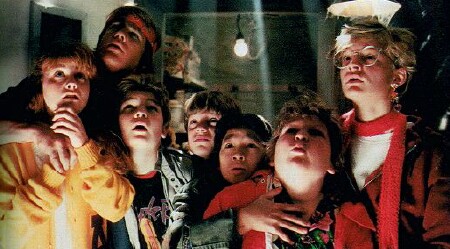
The story takes place in Astoria, Oregon. A neighborhood known as the Goon-Docks is known as the “poor part of town,” and the local kids who live there are dubbed the “Goonies.” Unfortunately, their homes are about to be foreclosed upon to expand Astoria’s country club. On the “last Goonie weekend,” a small group of Goonies—asthmatic Mikey (Sean Astin), his cool older brother Brand (Josh Brolin), overweight Chunk (Jeff Cohen), wisecracking Mouth (Corey Feldman), and little-Asian-genius Data (Ke Huy Quan, Short Round from “Indiana Jones and the Temple of Doom”)—hang out and explore the attic of Mikey and Brand’s house, where a lot of museum artifacts are stored (their father was a museum-curator). There, they discover an old map that supposedly leads to the lost ancient treasure of pirate One-Eyed Willy. So, seeing this as an opportunity to possibly save their homes, Mikey decides that they all should follow the map and retrieve the hidden loot.

Accompanied by two girls—Andy (Kerri Green), who has a crush on Brand, and Stef (Martha Plimpton)—the Goonies head to the first spot, an old restaurant just near the coast. They sneak around the basement, where they discover the secret entrance to a tunnel cave. But they also discover that the restaurant is also the hideout for a family of crooks, the Fratellis—Mama Fratelli (Anne Ramsey) and her two dim-witted sons Jake (Robert Davi) and Francis (Joe Pantoliano). They chase after the kids, hoping to get their hands on the pirate treasure themselves. As the kids venture further into the tunnels, getting closer to the tunnels and away from the crooks, they have to endure a series of life-threatening booby traps, just like in “Indiana Jones.” There are crashing boulders, sharp spikes, and many more.

It’s easy to admire the craftsmanship of these impressive cavern sets, as well as one hell of an ancient pirate ship that the kids come across later in the film. But it’s also just a ton of fun! These kids go through one entertaining adventure after another, and it’s just a thrilling rollercoaster ride all the way through. My favorite sequence features a piano made up of skeleton bones—there are notes on the back of the map that the kids must play, and every time they hit a wrong note, a large chunk of ground disappears into the deepest cavern. It’s a well-paced, well-edited, and quite tense sequence.

Some of you might be thinking, how is it even possible to make a piano like that? I don’t know, and frankly, I don’t care. It’s a fantasy, it’s an adventure! I don’t want to think about little details like, how is it that one rigged boulder conveniently crushes someone and yet, when the Goonies set off that trap, all of them come crashing down. Or how Data survives a fifty-foot fall into a cavern (nearly being skewered by spikes) by using plastic-chompers (“Pinchers of Peril,” he calls them) to grab onto the cave wall and save his life. (That’s a great sight gag, by the way.) Or even why the cavernous waterslide the Goonies slide through looks more like a Disneyland attraction. “The Goonies” doesn’t require you to ask questions like that; it just wants you to have fun. It’s not trying to insult audiences; it’s just telling an adventure story. You don’t ask these kinds of questions in “Indiana Jones” movies, do you? In fact, a lot of Steven Spielberg elements are found in “The Goonies”—the energy of the kids calls back to “E.T.,” the idea that the greedly land developers wanting to destroy the Goonies’ homes is a callback to “Poltergeist,” and of course, the adventures recall “Raiders of the Lost Ark.” Also added, and evident in “Jaws,” “Close Encounters,” “Gremlins,” etc., is a brisk pace to keep things interesting and intriguing from each setup to each payoff. There are shocks, comic relief, special effects, and thrills just about every minute of this movie. Some people will argue that this makes “The Goonies” quite noisy, but if you’ve gotten into the spirit of things by the time the adventurous second half comes around, it’s more appreciated. It’s a nice mixture of the joyful and the macabre.

I mentioned the overuse of profanity in this movie. Oddly enough, for a PG-rated family movie, the “s” word is said about 19 times, and this created a huge controversy when it was released. But it reminded me of the line in Spielberg’s “E.T.” when a kid called his older brother “penis-breath”—kids love to incorporate vulgarity into their everyday conversations because it just sounds cooler and more honorable to them. Plus, they can be funny when used right. Also, I should add that these kids act and talk like real kids should, right from the beginning. In the first half, they’re all constantly talking over each other, interrupting each other, arguing, trading insults—just like any group of kids would do!

I can’t deny that most of the Goonies are stereotypes—the wisecracking cutup, the Asian inventive genius, and of course, the fat kid. Every “fat-kid” stereotype that can be found in some family movies can be traced back to Chunk in this movie. He eats constantly, he loves to talk about eating, and constantly complains about everything. That doesn’t mean it doesn’t garner a few funny moments every once in a while, but the bit starts to become old…until when he’s captured by the Fratellis. Chunk is not with the others for most of the action; he’s locked inside the old restaurant with the other Fratelli—a deformed, Quasimodo-like figure named Sloth (John Matuszak) who is chained to the wall in the basement where he watches TV. And he’s just as hungry as Chunk is, which means they have something in common. This is where Chunk becomes less of a stereotype and more of a three-dimensional character, as he develops a sort of bond with Sloth (and they even share a Baby Ruth bar together).

The rest of the kids remain within their stereotypes, but they’re still likeable and quite memorable. Mikey is the brave leader, keeping the others in line, including his older brother; Brand is the strongest and oldest whose only concern is impressing Andy; Mouth and Stef deliver some witty one-liners; Data’s gadgets come in handy; and Andy…is pretty much the damsel-in-distress waiting for Brand to save her. If you thought Willie from “Indiana Jones and the Temple of Doom” did very little, Andy does even less. Though, to her credit, she is the one who plays the bone-piano and manages to play enough right notes to save everyone’s lives. (And she remembers the retrieve the map afterward when everyone else forgets about it—somehow, that little moment is quite satisfying.)

The soundtrack, by Dave Grusin, is fantastic as well—ranging from soft and whimsical to grand and adventurous.

“The Goonies” is fast, funny, cheerful, gruesome, and flat-out entertaining. The adventure sequences are a lot of fun, the sets are unique, the Goonies themselves are fun to watch as they solve clue after clue, Richard Donner’s direction is very brisk, and…you know, I could go on and on about how much I love this movie (despite its flaws I already mentioned), but this review is already so long that I have to quit while I’m ahead. Bottom line here—“The Goonies” is a real treasure.
Commando (1985)

4 Mar

commando-schwarzenegger

Smith’s Verdict: ***

Reviewed by Tanner Smith

“Commando” is an action flick that goes by every action cliché in the book—one-liners, explosions, chases, camouflage (that really doesn’t cover much), kidnapped children, and the Austrian muscleman himself, Arnold Schwarzenegger. This film does everything you can think of for an action picture and more. It’s silly…but it’s also a ton of fun. It’s an explosion-filled, shoot-em-up tale that is the key picture for a good time. It’s easy to laugh at all of the clichés, but I personally embraced them.

Schwarzenegger plays Col. John Matrix, a retired commando, who lives in the mountains with her eight-year-old daughter. They live a sweet life (maybe too sweet; we get an opening-credit montage of them doing things like eating ice cream, going fishing, and feeding a deer in the woods) until a group of thugs working for a deposed Latin American dictator (Dan Hedaya) kidnap the daughter. They want Matrix to kill the president of Val Verde or they’ll kill him and the girl. So Matrix escapes the thug holding him and sets out on a vengeful quest to get his daughter back.

His companion on the quest is a sexy flight attendant named Cindy (Rae Dawn Chong). She assists Matrix in a series of strange and funny action sequences. Yes, there is humor involved, particularly involving Matrix’s hunt for a thug named Sully (David Patrick Kelly) in a mall. Whether or not this was intended to be humorous, I laughed and had a good time.

OK, that’s probably a harsh statement because I’m sure a lot of the comedy is intentional. I know the wisecracks are in high class. My favorite is, “You’re a funny guy, Sully. I like you. That’s why I’m going to kill you last.” Said in deadpan by Schwarzenegger is just fabulous.

But when all is said and done, this is an action picture. Matrix does all sorts of things to get where he needs to go. He pushes a truck (with himself inside it) down a mountain even though his brakes have been cut just so he can catch up with the bad guys. He jumps from an airplane into a lake. He fights a dozen mall cops who misunderstand this giant beefcake. Even the likable Cindy has her moment with a bazooka. It all leads to a noisy, explosive climax at an island full of bad guys with guns and it features the number-one cliché in an action climax: when the bad guys shoot at the good guy, they miss while the good guy never misses. Do you even wonder if he’s even aiming? And of course, he has to take on the main villain one-on-one. And this film doesn’t have one (the Dan Hedaya character), but two—the other villain is someone who used to work in the same field as Matrix.

“Commando” is a silly action film through and through and it looks like Arnold Schwarzenegger and Rae Dawn Chong were having a great time filming it. It’s explosive, violent, silly, stupid…and just a ton of fun.

Tuff Turf (1985)

25 Feb

images

Smith’s Verdict: *1/2

Reviewed by Tanner Smith

“Tuff Turf” was supposed to be the ‘80s version of “Rebel Without a Cause” and “West Side Story” in that it features teenage hoodlums and a heavy soundtrack. In this case, it’s a confusing bunch of youngsters and an obnoxious rock soundtrack that help make “Tuff Turf” one of the worst, most unpleasant teen movies to come around in the ‘80s.

The strange thing is that it starts out all right. In fact, I really liked the opening scene in which the local teenage gang is mugging an innocent bystander when a kid on a speeding bicycle comes along and is able to foil them, and get away fast. That was inspired and amusing. I was interested in seeing where this was going.

That kid is the protagonist of the story, named Morgan (James Spader), a preppy, rebellious teenager who has moved from Connecticut to the San Fernando Valley after his father lost his business and has taken a job as a taxi driver. Morgan attends his new school, where that same gang from the other night also attends. They’re out to get him, to humiliate him. They thrash his bike. Morgan could have fought back, but he chooses not to because his family keeps telling him that he brings trouble everywhere he goes. But the gang leader’s girlfriend (Kim Richards) catches Morgan’s eye, and his charm turns her on, leading to more danger from the gang.

James Spader and Kim Richards are likable actors, but their characters continue to make one stupid decision after another, just because the plot demands it. What infuriated me about the Richards character was her bizarre motivation (if there was any sort) for choosing to marry the gang leader, after she has realized that she likes Morgan and that the gang leader has treated her like scum.

The soundtrack to the film is just terrible. I wouldn’t even mind half of the rock songs that play throughout the movie, except that they’re all pretty bad. They’re not catchy, nor are they very memorable, except for a terrible cover of the Beatles’ “Twist and Shout.”

There’s one nice scene in the middle in which Morgan, the girlfriend, and their friends (including one played by Robert Downey, Jr. who is appealing, but not used enough) sneak into a country club, and Morgan sings a pleasant song while playing the piano. After all the loud, annoying rock music that has stormed over the film, it was nice to have a quieter, more pleasant music piece.

The film descends into complete madness in the final showdown between Morgan and the gang. It’s so badly-handled, so over the top, and so sadistic that it makes the central fight in “West Side Story” look supervised. What is this movie trying to say with its ending? Violence is the easy way out? There is nothing to gain from this ending—it’s another one of those “if the villain is dead, everything will be fine” climaxes. And what’s worse—the movie laboriously tries to regain its somewhat-light tone by taking us back to a night club immediately after the final fight. Here we are again, it’s fun, we’re hanging out with Morgan and the girl who seem happy together. Then what happens? The credits roll. I have never felt so angry about an ending quite like this.

“Tuff Turf” didn’t know what it wanted to be, so I don’t know what to take more from it. I felt unclean right after I watched it. This movie needed a serious script doctor, a better editor, and much more engaging material for James Spader, who’s actually pretty good in this movie under the circumstances. “Tuff Turf” is a shallow mess.

Back to the Future (1985)

15 Feb

Back To The Future 2

Smith’s Verdict: ****

Reviewed by Tanner Smith

“Back to the Future” is an enjoyable, well-crafted, fantastic movie that has probably one of the best screenplays ever executed to film. Written by Robert Zemeckis (who also directs the film) and Bob Gale, I can just watch this movie and imagine what it would have been like for these two to write this script. They must’ve had a great time—I see beers and snacks all around, with chuckling, laughing out loud, and collaborating on new ideas and nodding in agreement. Or maybe I’m just being too positive. But what they delivered is a screenplay that, directed by Zemeckis, makes for a fun, entertaining, very well-written, even deep-at-some-points movie.

The story for “Back to the Future” takes place in 1985 (when this movie was made). Why do I bring this up? You’ll find out—though most of you reading this will already know why.

The hero is a California teenager named Marty McFly (Michael J. Fox). He plays lead guitar for a garage band and has a nice, attractive girlfriend, but his home life is an embarrassment. His older brother and sister are underachievers, his mother is a chronic drunk, and his father is such a nerdy wimp that he still lets his high school bully push him around.

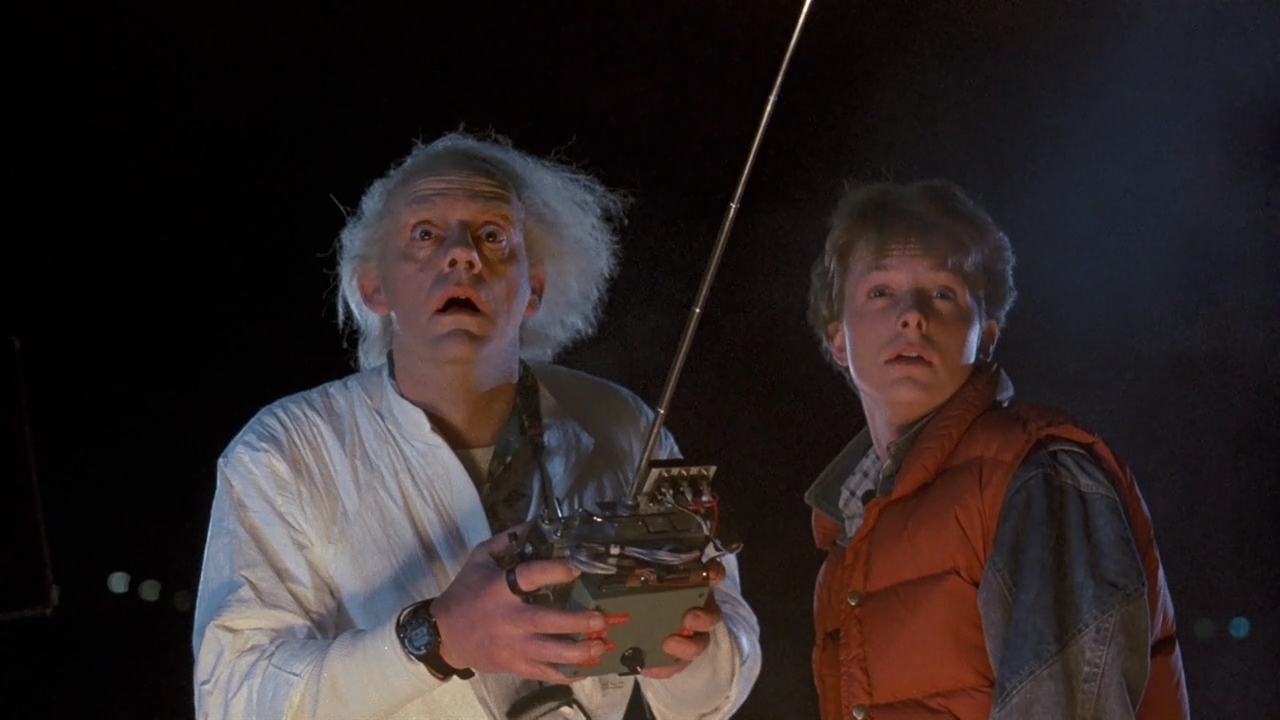
Marty’s zany scientist friend Doc Brown (Christopher Lloyd) is excited about his newest creation and asks Marty to come to the local mall and document by video camera the experimental testing. The invention is a DeLorean vehicle that turns out to be a time machine. Doc has remodeled it with all sorts of gadgets to make it possible, and it turns out to work like a charm. But for complicated reasons, Marty winds up in the car/time machine and accidentally sends himself thirty years into the past.

It’s the year 1955. It’s the same town, same school, and same neighborhood…but the twist is that he’s now the same age as his parents. This is where the story really gets interesting and very funny—Marty’s relationships with his parents, who of course don’t know who he really is. Marty befriends his father George (Crispin Glover), who is still as nerdy now/then as he was then/now and letting the school bully Biff (Thomas F. Wilson) pick on him. His mother-to-be Lorraine (Lea Thompson), who in the future became a skeptical, slightly-ugly, overly protective mother, is a beautiful, popular girl who cheats on school exams and follows boys around. These two are supposed to meet an upcoming school dance and fall in love. But Marty accidentally interferes with their meeting for the first time and Lorraine, his own mother-to-be—get this—is infatuated by him. This means that Marty has to undo the mess he made and set up the date with George and Lorraine himself, so they’ll meet, fall in love, and have children…or he’ll be erased from existence.

Marty never would have thought that his mother used to act this way or that his father was always as wimpy as he is. But something that just every person thinks of their parents, or at least every kid or teenager, is that their parents were never young. They were always the cynical, uptight beings that their kids see them as. Maybe the adults think they’re never as old as they really are, I don’t know. But “Back to the Future” has a pleasant fantasy spin to that. It answers the question of how a teenager would react if he saw his or her parents as teenagers.

Anyway, a few circuits on the time machine have been fried and as he convinces the 1955 version of Doc Brown that he’ll create this contraption, it turns out that the best thing to start it back up is with a bolt of lightning. But luckily, Marty knows when lightning will strike the town’s central clock tower and they have a week to prepare for it and get Marty back to the future. In the meantime, of course, Marty must settle things with his parents if they are still to become his parents.

This is great stuff! “Back to the Future” is full of neat ideas, it’s played for laughs (though there are some serious moments in the mix), its characters are memorable, and it constantly pleases with surprise after surprise. Everything has a setup and it all pays off by the time the movie is over—even the little details that you notice the second or third time watching it. There’s a great sense of comic timing along with its charming, lighthearted feel that you love watching this movie, even if the best parts haven’t occurred yet.

Some of the funniest bits involve the “fish-out-of-water” story with Marty interacting with a different place—or in his case, the past. For example, everyone mistakes his down jacket for a life jacket, and he can break the handles off of a scooter and use the board as a skateboard to escape from Biff and his cohorts. My favorite bit is how everyone reacts when he performs guitar at the dance and plays his solo a little too wildly. What really should be noted is the set design for the town, recreating a 1980s small town to show certain similarities and differences for the ‘50s version. It’s very well-done and quite creative.

With the wrong actor to play Marty, the character wouldn’t have gained our sympathies with him and since a lot rides on him, we wouldn’t have cared that much for the movie. This shows that a great screenplay doesn’t just make a movie—execution is probably the most important detail, and that includes casting and acting. But Michael J. Fox is perfect as Marty—he’s cocky, frantic, and wisecracking, but he’s also friendly, bright, and has an unforced, natural charm that makes us like Marty and root for him to work everything out.

Christopher Lloyd, as both versions of the Doc (past and future), is memorably wonderful. He plays him like a stereotypical mad scientist (and even sports a lab coat and a fright wig)—brilliant, zany, and constantly exclaiming in excitement. He has some of the best, funniest reaction shots I’ve seen in a movie. The supporting cast is also solid—Lea Thompson and Crispin Glover have fun with their roles, past and present. (Glover, in particular, is wonderful as the nerdy George who just needs to boost his self-respect and self-esteem.) Thomas F. Wilson is cartoonish but very memorable as the bully Biff.

There is so much to enjoy in “Back to the Future” that when it’s over, we feel joyful, energized, and glad to have seen it. I can’t imagine anyone not enjoying this movie—it’s fantastic fun.