Archive | 1985 RSS feed for this section

Code of Silence (1985)

28 May

1361805476_tumblr_m77o8mFMJg1rwq85xo1_500

Smith’s Verdict: ***

Reviewed by Tanner Smith

Chuck Norris has pretty much become a human punchline, hasn’t he? Anytime the bearded martial-arts “god” is mentioned, no one can help but crack one of those infamous Chuck Norris jokes (my favorite being, “There’s only another fist under Chuck Norris’ beard”), and yet he’s always labeled as “awesome.” And when I think about it…yeah. He is rather awesome, isn’t he? While he seems like a nice guy (and probably is a nice guy), he can also kick some serious ass with his fighting moves (including a roundhouse kick…to the face?). How is he as an actor though? That’s a little tougher to describe. The reason he was a movie star was because of his image and multiple fights without a stuntman. His acting is not very impressive, as he has a very limited range.

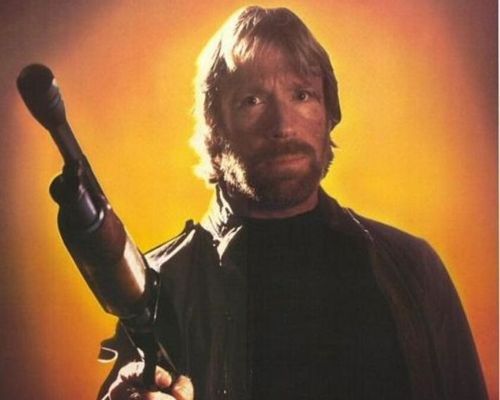
But given a good director, Norris can give a solid performance. And he found one in Andrew Davis, who cast him in the lead role in 1985’s “Code of Silence,” which itself was a breath of fresh air at the time of its release. At a time when Norris was constantly doing schlocky karate flicks, he’s cast here in an intense thriller as he plays a good cop “having a very bad day” (as the tagline states). Norris is surprisingly solid here, and the movie itself is quite thrilling.

The film takes place in Chicago, as straight-arrow cop Eddie Cusack (Norris, even though you’ll never call him “Cusack” in this movie) who is caught up in a Mob war after a sting operation goes wrong, resulting in Italian and Latino mobsters out for each other’s blood. Norris is worried about the safety of a mobster’s innocent daughter, a young artist named Diana (Molly Hagan), and decides to protect her. But she gets kidnapped and Norris decides to save her.

While all that’s going on, there’s also a subplot involving a “code of silence,” which is a police officer’s cover whenever that officer makes a mistake or is corrupt. In this case, there’s a hearing for an alcoholic old officer (Ralph Foody) who has accidentally murdered a young man in action and then planted his weapon on the victim, so that he can say it was done in self-defense. A rookie cop (Joseph Guzaldo) witnessed the incident and attempts to cover it up. Norris decides to back the kid up at the hearing.

It’s interesting how much goes on in “Code of Silence” and how complicated most of it is, and yet how less than obligatory and simple it all seems. It’s as if the usual clichés are downplayed, if still existent at all. Interesting characters, capably performed by good actors, help with that, as well as intense direction from Davis.

The action in “Code of Silence” is very well-done. You can see it fine and are surprisingly invested in what’s occurring on-screen. There’s a solid 15-minute opening scene that is all about the preparation and resolution of a drug-bust (and it does set up the story). There’s a fistfight on top of an elevated train going through Chicago, after which both Norris and the crook dive into the Chicago River. There’s also a nicely-done barfight late in the movie, in which Norris takes down several roughnecks at a time (and even delivers a roundhouse kick to one of them—awesome). The stuntwork in this movie is quite incredible.

There are amusing moments as well—my favorite being a duo of robbers who plan to overtake a bar, only to discover that just about everyone in that bar is packing. And there’s also a crime-fighting robot created by the police to mow down criminals with an advanced armory. This is known as the Prowler, which looks like one of those mobile NASA food-delivery robots if it was packing. It comes to the unexpected assistance of Norris in the film’s climax.

Not everything about “Code of Silence” works, though. You can follow the story fine, but some parts just sort of pass by really quick. And while most of the action scenes are riveting, the others seem rather inexplicable.

But what it really comes down to is the spirit of things with “Code of Silence,” and holding it all together is Chuck Norris, who is solid and surprisingly convincing as a cop. He’s able to show off some fighting moves some of the time, as Davis has him in check, but all in all he has a unique, rock-solid presence. He’s terrific; the whole film is terrific, and it’s arguably the best of the “Chuck Norris movies.”

The Purple Rose of Cairo (1985)

25 May

images-1

Smith’s Verdict: ****

Reviewed by Tanner Smith

What if you saw the same movie so many times that one of the characters (who is practically the main reason you keep seeing this movie in the first place) actually starts to notice you? That’s what happens to Cecilia (Mia Farrow) in Woody Allen’s delightful fantasy-comedy “The Purple Rose of Cairo.” During the Great Depression era, in a distressing time in her small-town life, Cecilia finds solace in the cinema, feeling the magic of the movies. The movie she goes to see is “The Purple Rose of Cairo,” an adventure movie about an archaeological explorer named Tom Baxter. After Cecilia sees the film several times, in a fabulous scene, Tom notices her seated in the audience, breaks the fourth wall, and starts up a conversation with her. He has apparently noticed her watching all this time, and so he literally steps off of the movie screen and into the real world, as Cecilia decides to show him around town.

This is fantastic! It’s great wish-fulfillment for movie buffs alike; what if this happened to you? What if your favorite actor/actress (or rather, your favorite actor/actress playing a character) suddenly emerged off the silver screen just to talk to you and be with you? “The Purple Rose of Cairo” wants to play that, and the way it goes along with this idea is thought-provoking, fun to watch, amusing, and sweet. This is a movie that truly loves movies and is made with skill and delight by the great writer-director Woody Allen.

The movie has fun with the simplicity of this woman and this movie character in how they can develop a romance with no setbacks whatsoever. Tom knows that things aren’t so simple as in the movies, but his presence is a relief to Cecilia who sees him as a way of making her bleak, unfair life feel better. There are problems, though. In the movie’s funniest subplot, the rest of the characters in the fictional film are still lingering about on the screen, waiting impatiently for Tom to return so the movie can keep going. Audience members that pop in complain, stating “they didn’t do this last time I saw the movie.” And also, the theater owner has called the studio that distributed the film, stating the problem that the character is missing. And so what do the studio executives do? They bring in the actual actor of that character of Tom, Gil Shepard (both roles played by Jeff Daniels, by the way), and send him to that town so that he can convince his character to go back into the movie. He encounters Cecilia, who understands the situation…and then they develop a sort of romance themselves!

I love how creative Allen gets with the storytelling here, with the love triangle between Cecilia, Tom, and Gil; the other characters lingering on the screen; the decision that Cecilia must make between the two men now in her life; and so on. “The Purple Rose of Cairo” is a wonderful film from beginning to end. Even in the ending, which people have questioned Allen about, there’s something to be said about the sudden frankness of the situation. Without giving it away, there’s not a “happily-ever-after” in a traditional sense; it resolves itself as a reality sense. But there’s still one element of comfort—the movies. When Allen was asked why he didn’t film a happy ending for the film, his reaction was simple enough: “That was the happy ending.” The more you think about that while watching this film and pondering the details these characters go through, the more intriguing it is. “The Purple Rose of Cairo” is pure movie-magic.

Weird Science (1985)

19 Apr

weirdscience-blog-jpg_183740

Smith’s Verdict: **1/2

Reviewed by Tanner Smith

“Weird Science” has its pleasurable elements. It mixes teenage male fantasies with “The Bride of Frankenstein” and adds some science, as well as magic. It’s a movie written and directed by John Hughes, who specializes in putting people (mostly teenagers, like “Sixteen Candles” and “The Breakfast Club”) in mostly realistic situations while writing some very clever dialogue for his characters to say to keep the comedy and drama in the same rhythm. “Weird Science” has some clever dialogue, but the realism is replaced with more of a fantasy. I don’t mind that, but the premise doesn’t quite follow up to its own potential.

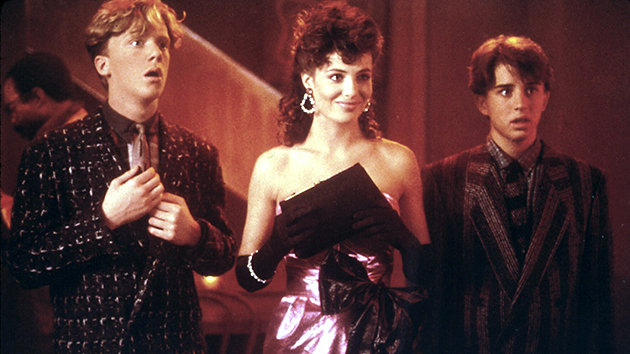
Anthony Michael Hall (Hughes’ typecast geek) and Ilan Mitchell-Smith play two dorky buddies named Gary and Wyatt who fantasize about becoming popular and winning the girls of their dreams. One night, they watch “The Bride of Frankenstein” and that’s when Gary gets the idea of creating their own girl. But not by digging up any dead girl and reanimating her, as Frankenstein did. They create a girl on Wyatt’s computer by hacking into main computer systems and simulating a woman that they can create and fill knowledge into. But as in “The Bride of Frankenstein,” lightning strikes and things go way beyond what they expected. Before you can say “it’s alive,” the girl (no, WOMAN) they created is real enough to stand in their doorway (looking almost impossibly stunning) and shower with the boys.

This perfect woman is played by Kelly LeBrock, complete with beauty, sensuous lips, and a heavy British accent to go along with it. Named Lisa, she is no ordinary woman. She is not a dumb bimbo or the cover of this week’s Playboy. She actually has a brain. She’s intelligent and sensitive to the boys’ needs. She also has magic powers (she can get a car, change the boys’ suits at parties, make anything happen). Lisa realizes the boys’ insecurities and spends the movie attempting to make them feel better about themselves.

Of John Hughes’ latest teenage movies, this is probably the least in the entries. The movie starts out with a lot of clever ideas, but the problem is the movie doesn’t really seem to go through with them. The performances by Hall and Mitchell-Smith are engaging and Kelly LeBrock is perfect as Lisa. I just wish they were involved in a better story. A supporting character that is supposed to be funny doesn’t fit here at all—that is Bill Paxton as Chet, Wyatt’s nasty, sadistic older brother. He doesn’t fit in this movie at all, except to provide nasty jokes. His come-uppance (or rather, his punchline from Lisa) is also nasty and not very funny.

“Weird Science” has plenty of good ideas that could’ve made it a better movie. But because it does have its moments, I would say rent it.

D.A.R.Y.L. (1985)

17 Apr

4346

Smith’s Verdict: ***

Reviewed by Tanner Smith

If there’s a kid who can win video games at the first try, hit home runs in his first baseball game, and even correct test answers before they’re given, you can already guess that there is far more to this kid than meets the eye. “D.A.R.Y.L.” is a sweet little movie about a boy who is the perfect kid. The kid’s name is Daryl and he is just one sweet, caring, and very talented little boy.

As the movie opens, Daryl (Barret Oliver, “The Neverending Story”) is found in the woods. He lost his memory; he doesn’t remember his family, his friends, his school, but he remembers his name and how to speak. He’s taken in by a nice couple who have fostered young children for quite some time now. Mary Beth Hurt is Joyce Richardson, a loving piano instructor; and Michael McKean is Andy, Joyce’s husband who coaches a local little league team. Joyce and Andy take a care to Daryl and the kid across the street, named Turtle, becomes his good friend. Daryl surprises his new family and friends by being extremely nice without forcing himself, getting a high score on “Pole Position” on the first try, and hitting home runs at Andy’s little league team’s game.

But once everything goes perfect, Daryl’s real family comes along to take him back. As they take Daryl away from his loving foster family, it becomes discovered by the audience (this is not necessarily a spoiler) that Daryl is in fact a government experiment. Daryl is taken back to the lab he was created in. What is he? Well, “D.A.R.Y.L.” stands for Data Analyzing Robot Youth Lifeform. That’s right—the perfect kid is in fact…a robot (or a cyborg, to be more specific).

The D.A.R.Y.L. experiment was originally planned and funded by the military to be a soldier of advanced proportion. A scientist freed him because he knew that there was more for him to learn. Daryl has absorbed more about love and interaction to his family and other kids and the military consider him a failure. Their decision—to have him “terminated.” However, Dr. Stewart (Josef Sommer), one of Daryl’s designers, knows that Daryl is more than what he was created to be, so he decides to free him and take him back to the Richardsons…with the authorities hot on their trail.

“D.A.R.Y.L.” opens with some genuine sweetness. It’s a great portrait of the world’s greatest kid moving in with a new family and making a great impression. Also, the friendship between the kid and Turtle is sweet—there’s a really good scene where Turtle gives Daryl some advice about grownups. There’s also another great scene where Daryl believes he upset Joyce because he’s so perfect, so he strikes out at the game on purpose.

Then, the movie escapes that mode when Daryl is taken back to the facility where he was created and soon targeted for determination. It turns the movie into a thriller and surprisingly enough, it works. We fear for the kid’s life while he’s being chased by the government. As a thriller, “D.A.R.Y.L.” surprisingly works because it feels like there’s really something at stake. It helps that Barret Oliver plays the kid with credibility, and Josef Summer is quite solid as his protector.

People may complain that “D.A.R.Y.L.” doesn’t quite live up to its opening but not me. I liked where “D.A.R.Y.L.” went, although I sort of wonder how I would’ve went from the wonderful beginning if I made the movie myself. But mind you, that’s not a criticism but more of a thoughtful self-question. “D.A.R.Y.L.” is a nicely-done movie.

Secret Admirer (1985)

15 Apr

secret-admirer-original

Smith’s Verdict: **

Reviewed by Tanner Smith

The ‘80s comedy “Secret Admirer” features teenagers and a lot of them, as did “Fast Times at Ridgemont High,” “Porky’s,” “Valley Girl,” “Sixteen Candles,” and a few other titles I could mention (the worst of them being “Porky’s”). But rarely in a movie like this do you see adults who are given the same amount of screen time. In fact, if you split the scenes with the adults and teenagers apart, and then time them, you’d have almost the same length of each. The adults are the parents of the teenaged main character and his crush. They’re here because of a conflict that was the teenagers’ own business in the first place but became something more—something almost tragic. Read on and you’ll see why.

C. Thomas Howell plays Michael, a teenager who has the hots for the popular girl in school Deborah (Kelly Preston, who spends the duration of the film dressing like a slut—the movie’s target audience will love that), who is dating the tough college guy Steve. Michael’s best friend is Toni (Lori Loughlin), and she likes Michael more than a friend. But of course, Michael doesn’t catch on (they never do in these movies). Toni sends Michael a love letter, anonymously, but Michael believes that it’s from Deborah. So he decides to send his own anonymous letter to her and have Toni deliver it to her, much to Toni’s reluctance.

Now I know what you’re thinking. What does this have to do with their parents? Well, Michael’s little brother finds the letter that was written to Michael and brings it to the breakfast table. After he leaves, the mother (Dee Wallace-Stone) finds the letter, reads it, and suspects that her husband (Cliff de Young) may be having an affair. Then one of Michael’s letters to Deborah winds up with Deborah’s parents and each parent (played by Leigh Taylor-Young and Fred Ward) is suspecting that they’re both having an affair with Michael’s parents (de Young is in Taylor-Young’s night class). Then all of the adults are brought together at a bridge party and slapstick, cartoon violence ensues.

It’s satisfying to see adults put in the same length duration as the teenagers—their scenes are separate from the scenes that show Michael trying to score with Deborah. But why did they have to be treated like idiots? And why did they have to be victims of unfunny comic scenes? Why are they treated like this? But to be fair, they are well-acted—especially Fred Ward, who has a presence that is part-Terminator, part-goofiness.

I was interested in the teenagers’ story until it got to the predictable final half, in which everything is settled and redeemed after an hour of complication. Of course Deborah turns out to be a slut that Michael doesn’t want to bother with anymore. Of course Michael realizes how much Toni feels for him. Of course they’re going to wind up together. I wish I could tell you that how they wind up together was unpredictable…but it wasn’t.

The teenagers are well-played. C. Thomas Howell has an appealing personality, Kelly Preston is suitably attractive and sour, and Lori Loughlin (the best of the bunch) is wonderful and fetching. Then there’s another teenager, played by Casey Siemasko, who is a slob and a party animal who puts himself into the wrong situations every time he tries to smart off. Even he has some appeal.

I wish I could’ve seen these people in a different movie. “Secret Admirer” undermines their uniqueness and talent, which is too bad. I will say this though—this is a much better film that any of the “Porky’s” movies. But of course, that’s not saying much.

Red Sonja (1985)

13 Apr

CONAN012

Smith’s Verdict: *

Reviewed by Tanner Smith

“Red Sonja” is one of the most epically bad movies I’ve ever seen. The production is clumsy, the acting is unbelievably stiff, the dialogue is laughably awful, the special effects are terrible…and it’s a joy of a watch. This is one of those “so-bad-it’s-funny” movies. Many, many things are handled the wrong way, and in that way, it’s never boring. It’s a laugh-a-minute movie, only the laughs are unintentional. I can’t recommend the movie to anyone I respect, hence the one-star rating, but if you do happen to come across it on TV or something, give it a watch just to see how bad it is. Now how’s that for a non-recommendation for a recommendation?

It’s a sword-and-sorcery adventure tale, and those rarely do well to begin with.

The protagonist is a tall, striking female warrior named Red Sonja (Brigitte Nielsen). As the movie opens, her “fairy godmother” (I use quotations because I have absolutely no idea what this unfinished smoke effect is supposed to be, and it doesn’t return anyway, so it doesn’t matter) reminds her (and informs us) of her backstory, and how her family was killed by the evil Queen Gedren (Sandahl Bergman). This spirit grants Red Sonja the strength to become a great warrior.

I’m going to stop right here for this motif of homosexual undertones (or they could be overtones)—it’s highly possible that Queen Gedren is a lesbian. Whether that’s the intention of her character, I do not know. We just know, from that spirit, that she slaughtered Sonja’s family because she “wanted Sonja for herself.” (This is told over a clip of Gedren seductively motioning for Sonja to come to her.) Does anyone want to tell me what the deal is? I just came up with the conclusion and that’s why she continues the rest of the movie searching for her.

Anyway, years later, Queen Gedren is seeking the evil talisman, which looks like a giant radioactive green Jawbreaker, that can give power to the whole world. Oh, and apparently, only women can touch it—men who touch it just disappear, or jump-cut, from existence. Red Sonja is out to stop her from gaining control of it, and also to gain vengeance for her family’s slaughter. Aiding her is a strong male warrior named Kalidor (Arnold Schwarzenegger), a bratty little prince (Ernie Reyes, Jr.) whose kingdom was just attacked, and the prince’s loyal bodyguard Falkon (Paul L. Smith).

Of course, Sonja and Kalidor are attracted to each other, but Sonja has sworn an oath that the only man that may have her is one who has defeated her in battle. But as Kalidor points out, just as we do, if a man can defeat her in battle, where’s the fun in a relationship? You can’t honor the acting by Brigitte Nielsen and Arnold Schwarzenegger, as they both do equally terrible jobs. But you have to love their “dueling accents” battle as opposed to their badly-choreographed actual battle.

The dialogue is laughably atrocious, full of magic mumbo-jumbo and lines like “In order to be a great swordsman, you must have a great sword.” “Red Sonja” is such an entertaining watch and a fun movie to review, because I get to pick out my favorite moments to pick on. I almost forgot to mention the badly-constructed creature effect of a “vicious” sea monster that attacks Sonja and allows Kalidor to ride on him while supposedly fighting him. And get this—that “creature” turns out to be a “machine,” as they find out, and poking out its eyes will kill it. How can you not love such stupidity! And what about the giant statue that stands near Red Sonja’s training camp. I guess it’s supposed to be Buddha, but here’s the thing—he looks like he’s going to the bathroom. I am not making this up—he’s crouching down in a relieving position.

You may already get the point of this review—I am not recommending “Red Sonja,” but it’s just so spectacularly silly.

Mad Max Beyond Thunderdome (1985)

9 Apr

Mad_Max_Beyond_Thunderdome_37773_Medium

Smith’s Verdict: ****

Reviewed by Tanner Smith

In my humble opinion, “Mad Max Beyond Thunderdome” is the best of the “Mad Max” movies, which is very surprising considering the impact of “The Road Warrior,” the sequel to the original film “Mad Max” that I liked more than the original, actually. “Mad Max Beyond Thunderdome” is the third in this post-apocalyptic action-film series about a man named Max, who walks around the wasteland that was once America. I liked this better than “The Road Warrior” because of its greater surprises, amazing locations in its fictional world, and (I’m not gonna lie) some of the best action sequences I’ve ever seen. Mad Max remains the same, but the world around him has improved greatly.

To begin the movie, we get aerial shots of this world as Mad Max is forced to ride through the desert on a carriage carried by camels. And as the movie goes on, we see that mankind lives by its own set of new rules and order. Mad Max (Mel Gibson) finds his way to Bartertown, a village constructed out of automobile parts. In Bartertown, anything goes and anything stays. You sell, you buy, you do whatever. The ruler is an imperious queen named Aunty Entity (Tina Turner) and the supervisor is a fat man named the Collector (Frank Thring). And there’s also a little man with an attitude.

Bartertown is powered by an energy source driven by the leavings of…pigs. You see, there are countless pigs in Bartertown’s main factory that eat. Their leavings are used as methane gas. Mad Max finds a job, working with the pigs. However, that requires walking through piles of pig crap.

Bartertown itself makes the first half-hour of this movie memorable and enchanting. But that’s just the beginning. Also in this new world is Thunderdome, a spherical arena that includes the most original idea in the whole series. The spectators climb on the dome to watch matches being fought between two competitors. How do you win? Don’t die. The competitors use harnesses to leap up and down and try to kill each other. As Mad Max is chosen to compete in Thunderdome, it turns into one of the best fight scenes I’ve ever seen in an action movie.

Mad Max survives Thunderdome and escapes Bartertown but then comes across a tribe of children, who dress and act like Native Americans. They believe that they will be saved by someone and they believe that Mad Max is that person. But of course, Mad Max doesn’t know what they’re talking about, or even who he is anymore, for that matter.

Everything comes down to a thrilling action scene that occurs on a train. Tina Turner and her cohorts must fight Mad Max, whose only army is the tribe of savage children.

I don’t really know what else to write about “Mad Max Beyond Thunderdome” except that I very much admired it. I admired it for its look and how the characters were projected, I admired it for the sets (especially Bartertown, Thunderdome, and even the kids’ home which looks like the home of Peter Pan’s Lost Boys), and I admired it for the spirit in its storytelling. Director George Miller also made the original Mad Max movies and delivers true craftsmanship and a great deal of fun. And I believe “Mad Max Beyond Thunderdome” is the best in the series.

Stephen King’s Silver Bullet (1985)

8 Apr

garey_busey

Smith’s Verdict: ***

Reviewed by Tanner Smith

We can point out all the clichés in Stephen King’s supernatural stories mainly because they’re kind of fun. And a screenplay by King, based on his own “novelette,” is no exception. Indeed, we have the King-penned “Silver Bullet,” based on the novelette “Cycle of the Werewolf.” Thankfully, it’s not as awful as other film adaptations of King’s writing (see “Children of the Corn,” for example). Sure, it’s nothing special (like “Carrie” or “The Dead Zone,” for example) and at times it can get pretty stupid, but there’s a certain charm to it that makes it tolerable. You just have to suspend your disbelief.

There are many Stephen King clichés put at work here, and I suppose I shall start by counting them down:

1. A supernatural being that is never fully explained in origin (at least in the movies). In this case, it’s a werewolf—a man who becomes a vicious beast when the moon is full and invades a small town called Tarker’s Mills. Who is the man? No one knows (but you will, very soon into the movie).

2. The dumb townsfolk who are broadly developed to make the wrong, stupid decisions and get inevitably slaughtered by the monster. Some of these people are just annoying stereotypes, but others (including the local sheriff, played by Terry O’Quinn) are quite amusing, especially when they venture into the woods at night to search for the beast—one asks the other, “Are you gonna make lemonade in your pants?”

3. Alcoholic. In this case, however, the alcoholic is one of the film’s heroes. He’s Red—you know, when you name your child “Red,” are you asking for them to become drunken bums? Played with comic appeal by Gary Busey, Red is the uncle of 11-year-old Marty (Corey Haim), who is the only one who knows that a werewolf is the thing that has caused all the mayhem in town. While Red doesn’t believe that Marty was almost attacked by the werewolf, he does ask that the sheriff look more into it, now that he has a clue. And when all else fails, Red eventually goes to a local gunsmith and asking him to create a silver bullet to stop the werewolf.

Oh, and the first victim of the monster in an early scene might as well hear a sign that reads “alcoholic.” He sings the Rheingold Beer song to himself, staggers as he works the railroad, and you just know he hasn’t got a prayer. Nor does…

4. Abusive jackasses. In particular, Marty’s girlfriend has a mean-spirited father whose sole purpose is to yell and be savaged by the werewolf. No other reason whatsoever.

The only things missing here are flashback sequences and I’m not sure if Tarker’s Mills is in Maine, but I’m not ruling out the possibility.

The werewolf creature effects range from effective (when seen in glimpses in the shadows) to silly (when seen in full view). In particular, when the werewolf goes for Marty while he’s shooting off fireworks, the effect of the werewolf taking Marty’s rocket to the eye is so sloppily done, I couldn’t help but laugh. Was I supposed to laugh? I know I’m supposed to laugh because some elements are intentionally funny—like the townsfolk, the character of Uncle Red, and the neat motorcycle-like design of his new motorized wheelchair (dubbed the Silver Bullet). But what about the narration? Apparently, while the story takes place in 1976 and the film was released in 1985, we get a voiceover narration from Marty’s older sister Jane (Megan Follows), who resents her brother getting all the attention because he’s in a wheelchair—Jane is about 15, and so we should hear from her narrating as a 24-year-old woman, right? Not here—the actress they got to provide the voiceover work is obviously too proper and mature to sound that way.

There are certainly some silly moments in “Stephen King’s Silver Bullet,” but that also makes it kind of fun. Everything leads to an obligatory climax in which Marty, Jane, and Uncle Red are forced to square off against the werewolf. By this time, I was surprised to find myself caring for these three. Corey Haim and Megan Follows are convincing as a squabbling brother and sister who now have to protect each other, and Gary Busey is a riot as Uncle Red. Actually, Busey is possibly the sole character to be fully-developed—at times, he’s a drunken rascal, but he’s a good guy at heart and would never hurt his nephew who idolizes him. Uncle Red’s actions serve purpose.

Also, I should also add that Busey delivers my favorite line in the film with brilliant comedic timing—“I’m a little too old to be playing the Hardy Boys meet Reverend Werewolf!”

And while I’ve given that away, I’ve already stated that you’ll know very soon who the werewolf is before the supposed “reveal” midway through the movie, as Jane searches the town for a man or woman with one eye (because Marty fired at a rocket at the werewolf’s eye). It turns out to be Reverend Lowe (Everett McGill), who knows that Marty knows who he is, and in one scene that I’m sure is supposed to be a sick joke, actually chases down the kid in his wheelchair and attempts to run him down. As if to say even the clergyman is out to get you, kid! You don’t have a prayer!

I really shouldn’t rate “Stephen King’s Silver Bullet” three stars out of four. It is silly and sometimes pretty stupid, but also has a certain charm that makes it fun to watch. Consider it the least bad of the lesser Stephen King film adaptations and take it for what it’s worth.

Teen Wolf (1985)

8 Apr

Scene-from-Teen-Wolf-1985-001

Smith’s Verdict: **

Reviewed by Tanner Smith

“Teen Wolf” has a couple of good ideas and a likable leading actor, but it’s too busy trying to rebuke on old ideas from better high school movies. It’s about a high school teenager who discovers that when he gets excited or nervous, he gains wolf-like abilities, as well as full-body fur, fangs, and claws. But unlike most werewolves, his personality remains the same. It’s only his appearance and abilities that have changed.

Michael J. Fox plays the teen wolf. In the beginning of the movie, he, as teenager Scott Howard, is shown as a high school basketball player whose team is last place in the state. Gee, haven’t we seen this before? If only there was some way the team could redeem themselves in a climactic “big game”…

Yes, I was being sarcastic. “Teen Wolf” does end with a big game and it’s obvious which team is going to win.

But I digress. Scott is also insecure about himself. He’s not like his best friend Stiles (played almost over the top with slyness and can-do attitude by Jerry Levine), who is so wild and cool that he’ll pretend to surf on top of a moving van to the tune of “Surfin USA” by the Beach Boys.

Another cliché—Scott has a crush on the busty blonde girl in school and doesn’t even realize that the nice brunette girl (named Boof, whatever kind of name that is) has liked him for a long time. Don’t teenagers in movies notice anything anymore? They’re not in junior high anymore—it’s time for them to open their eyes.

Scott begins to turn into a wolf when excited and nervous while spending “seven minutes in heaven.” It turns out his dad has the same curse (actually, according to him, it’s a gift) and it runs in the family. Scott can turn into a wolf and back into a kid whenever he wants to. This brings many advantages to his high school life as he becomes popular with the nickname “Teen Wolf” and the captain of the basketball team, which suddenly has a winning streak, now that Scott’s powers make him the star player.

“Teen Wolf” has gained a cult status. I’m not (nor am I going to be) a part of that cult because this, to me, is feeble, innocuous, and doesn’t take many chances with Scott’s newly discovered wolf. And it laboriously gives us the moral of being yourself. I could have told you that. Michael J. Fox is likable in the lead role, but compare this to “Back to the Future” and he plays the same character, only this time with fangs, pointy ears, and fur. “Back to the Future” was a great movie with a tricky premise and complicated yet fun storyline. “Teen Wolf” is not a good movie because it doesn’t take as many chances as “Back to the Future.” I wish the director and writers had better story material go on for this premise.

Rocky IV (1985)

5 Apr

rocky iv 1985

Smith’s Verdict: ***

Reviewed by Tanner Smith

I want to ease into reviewing “Rocky IV,” the fourth entry in the “Rocky” film series, because I really shouldn’t rate it three stars (out of four). I should give it two-and-a-half stars—it’s not a good movie, but not a bad one either. But I won’t give it a mixed review because to me, this is a certain guilty pleasure. That’s what the “Rocky” series has stooped to—silliness yet a great deal of fun. The Academy Award-winning original film, “Rocky,” is an all-American classic, the second film is about as strong, and the third one was only decent. You notice how the films are descending from “all-American classic” to “just as strong” to “only decent” to “silliness yet a great deal of fun?”

Yet, I just can’t help myself. I enjoyed “Rocky IV” as a silly sports film. Yes, it’s predictable. Yes, it’s full of sports film clichés—hammy motivational speeches and training montages (there are many to be found here). Oh, and there’s more…

“Rocky IV” takes place a few years after the climactic fight between Rocky Balboa (Sylvester Stallone) and Mr. T. He, his wife Adrian (Talia Shire), and their 8-year-old son attend a birthday party for Rocky’s brother-in-law Paulie (Burt Young). Apparently, Paulie doesn’t have a lot of friends, seeing as how Rocky, Adrian, and Rocky Jr. are the only ones that are there. If that’s not enough, here’s the most bizarre part of this scene—Rocky’s birthday present for Paulie is a robot that apparently understands human statements and responds to them. All I’m thinking is—what was Sylvester Stallone thinking when he wrote the screenplay for this film, like he wrote the first three films? Did he really think a talking robot was necessary for the “Rocky” films? I mean, you don’t even see something like that in “Staying Alive,” which Stallone directed.

Five minutes in and there you go: the most bizarre thing you’ll find in a sequel to an “all-American classic.”

Then, we meet Drago (Dolph Lundgren), a 6 ft. 4, 261-pound Russian genetically-altered boxer. (This guy could make a great video game villain.) He comes to America to take on some great American fighters. So Apollo Creed (Carl Weathers), feeling like he’s lost his strength, decides to fight the giant monster himself. Needless to say, this doesn’t go too well, so Rocky spends the rest of the film training to take on Drago for a big climactic fight in Russia.

So there you go. The robot and the “super boxer” make the first half into something bizarre for the “Rocky” films. Then, in the second half, we get Adrian’s worrying (as usual), Paulie’s comic relief (as usual), and the climactic fight (as usual). Don’t think I forgot the training montages because I’m going to say that there are a lot of them in this movie—no exaggeration whatsoever. The rich dialogue and characters from the original “Rocky” are gone—“Rocky IV” is a silly sports film. It even has the people of Moscow chanting, “Rocky! Rocky! Rocky!”

What’s fun about this movie? Well, the fact that Rocky’s rival-turned-buddy Apollo Creed and Rocky’s soon-to-be opponent Drago are fighting each other for a match is fun even of itself, but before the fight begins, James Brown comes along and sings “Living in America”—I couldn’t help but smile during that scene. Rocky is still the man he was and played by Stallone with gusto. Dolph Lundgren is suitably menacing as Drago, though I’d like to see another side of him, preferably with his wife, played by Brigette Nielsen. And of course, I’ll never get tired of Paulie.

Oh yeah, and just to make sure the film doesn’t end as the first three movies did (the fight ends, the victory music is played, and Rocky hugs Adrian), the screenplay finds it fitting for Rocky to give a hokey speech about how people can change.

I am dead serious. Rocky makes a speech about world peace after he and Drago pummel each other almost to death. I want to hate this movie, but I just can’t!