Archive | 1984 RSS feed for this section

Friday the 13th: The Final Chapter (1984)

6 Mar

friday-the-13th-the-final-chapter-2

Smith’s Verdict: **

Reviewed by Tanner Smith

“Friday the 13th: The Final Chapter” couldn’t have been a good movie. It suffers from being the fourth movie in a deplorable slasher-film franchise that only had teenagers getting picked off one by one by a killer with no personality. This is just like any other horrible movie with that same premise and somehow, four of these films share the same name and the same killer. I never understood what made the original “Friday the 13th” so special that it needed a series of sequels to go along after it. And it gets worse—this is not the final chapter. The ending is an open door for another sequel.

The killer Jason, who sports a hockey goalie mask now, is just a big guy with no personality and apparently no inner being—oh, and he has a knife, too. Actually, the thought of a killer with no inner thoughts is kind of scary, but after two films, it’s tiresome and not scary anymore. Just like in the previous films, it’s easy to know who’s going to die in “Friday the 13th: The Final Chapter.” This is a rule for slasher movies such as this—whenever a movie lingers on someone who isn’t a main character, that person is going to be killed. What’s tedious about the gimmick is how it lingers on that character before the killer finally attacks.

The slasher scenes are there just to be slasher scenes. The most unpleasant murder occurs after the teenagers in this movie pass by a female hitchhiker. The scene stays with that female hitchhiker right to Jason’s arrival and victimizing of that poor woman. Why was this necessary? Who was this woman? We’ll never know.

“Friday the 13th: The Final Chapter” does try to develop characters this time. We have the usual gang of teenagers that will undoubtedly become stalked by Jason, for no reason whatsoever. Only this time, they’re angst-ridden and that at least counts for something, which is more than I can say for a lot of the teenagers in the previous “Friday the 13th” films. But the real protagonist is more interesting—he’s a twelve-year-old horror film buff named Tommy Jarvis (Corey Feldman), who lives with his mother and older sister (Kimberly Beck—no bets on whether or not she’ll be the obligatory “final girl” who ends up fighting Jason) near that stupid Crystal Lake, where all those murders occurred in the previous films. Having a twelve-year-old kid around is strange enough for a slasher film.

(By the way, don’t you think the Jarvis family would have heard about them? Why didn’t they just move away?)

I suppose I should give away the ending of “Friday the 13th: The Final Chapter.” What should it matter, anyway? This isn’t really the “final chapter,” after all. Jason has picked off all of the teenagers who just came in for a good time at the lake and has now come after Tommy and his sister. After the sister has tried to fight him off, little Tommy, who grabs a machete and slices the originally invincible killer apart, rescues her. That’s right—the little kid has done what all the older teenagers should have done in the other movies. He kills Jason…but he’ll come back. You’ll see.

Beverly Hills Cop (1984)

3 Mar

beverlyhillscop_article_story_main

Smith’s Verdict: ***

Reviewed by Tanner Smith

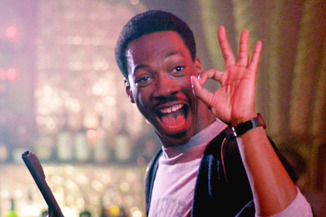
Reportedly, the screenplay for “Beverly Hills Cop,” an action film about a Detroit cop solving a case in Beverly Hills, has been passed around for years before it was finally greenlit. It went through several story developments, and tossed around actors for the lead role such as Mickey Rourke and Sylvester Stallone. But then came Eddie Murphy for the part, which led to massive rewrites. Although, if you ask me, that’s a little hard to believe, because Eddie Murphy is such a master of improvisation that I wouldn’t be surprised if director Martin Brest just informed him of the situation his character was in, and then rolled the camera to see what he could do.

If that was the case, why was the screenplay for “Beverly Hills Cop” nominated for an Academy Award? The writing, aside from Eddie Murphy’s one-liners (most of which I believe were improvised), is quite generic.

Eddie Murphy stars as a tough, streetwise Detroit detective named Axel Foley. He gets himself in trouble with his commanding officer because he does things his own way. Axel’s friend comes to town, after six months of working in California. But some unfriendly visitors follow him because the friend has negotiable bonds that belong to them. They murder Axel’s friend, and Axel decides to use his “vacation time” to go to Beverly Hills and track the guys who did this. And while solving the case, Axel finds himself more at home in these posh California settings than in his ghetto Detroit origins, as he constantly adjusts to Beverly Hills customs.

Let’s face it—no one really cares about the story for “Beverly Hills Cop,” because mainly people seem to like “Beverly Hills Cop” just because of Eddie Murphy. Suffice it to say, Eddie Murphy is hilarious in this movie. Coming off of “SNL,” “48 HRS,” and “Trading Places,” Murphy again proved that he was one of the great comedic talents of his generation, and in “Beverly Hills Cop,” he does what he did best—playing the fast-talking, with-it underdog who also ended up being the smartest guy in a rich world. You can keep calling him Axel Foley in this movie, but let’s face it—we all called him Eddie Murphy. And no one plays Eddie Murphy like Eddie Murphy.

The entertaining aspects of “Beverly Hills Cop” aren’t merely the action scenes that take place, though admittedly some of them are kind of fun (including an opening chase scene in Detroit). Instead, they are the scenes in which Axel finds new ways to get by in Beverly Hills, always having the upper hand. It’s just a great amount of confidence that doesn’t get Axel down—there’s never a scene where he mopes because he doesn’t feel like he belongs. He’s just on vacation, and happens to be solving a case as he goes along with this challenge.

The only bit of this sort I didn’t find funny was the scene in which Axel loudly intimidates the desk clerk of a fancy hotel, playing the race card and thus getting himself a suite with a single-room discount. This scene was just uncomfortable to watch and listen to, and it’s also kind of embarrassing in the way it’s portrayed.

But just about every other scene of this sort gets a good laugh. Axel’s beater of a car driving on the same streets as Porsches and Cadillac’s is a good sight gag. Axel’s reaction to Michael Jackson impersonators walking the streets is good for a laugh. And how can you not love his reaction when he is thrown out of a window by five bodyguards of Axel’s main suspect, art dealer Victor Maitland (Steven Berkoff)? Axel was there to ask Maitland a few questions (and Maitland does not look like the trustworthy type, despite his sophisticated manner), and then security came along, threw Axel out of a plate-glass window, and the cops show up. “You believe this?!” Axel asks the cops. “I can describe all of ‘em!” Then the cops arrest him. But why? “Disturbing the peace?! I got thrown out of a window! What’s the charge for getting pushed out of a moving car? Jaywalking?!” (No prizes for whoever guesses correctly whether or not that line was improvised.)

There are many other funny moments like that, and they also come with the Beverly Hills police force who get to know him after arresting him. Two detectives—stuffy sergeant Taggart (John Ashton) and young naïve Rosewood (Judge Reinhold, very funny)—are hired to follow him around, and Axel manages to befriend them because he’s able to teach them how to bend the rules and come up with fish tales to get off the hook. (Of course, he manages to befriend them after sticking a banana in the tailpipe of their patrol car, distracting them with a shrimp sandwich.) Axel takes them to a strip joint, where they manage to stop a violent situation from occurring.

But of course, there’s also the plot as it thickens. Maitland, it turns out, did arrange for Axel’s buddy to be murdered, and Axel sets out to prove it. Taggart and Rosewood wind up helping him, going beyond the book and doing things Axel’s way. And Axel’s old girlfriend Jenny (Lisa Eilbacher, quite appealing) gets caught up in the mix and gets kidnapped. And of course, this all leads to a climactic gunfight between the cops and the armed guards at Maitland’s house.

Actually, even in the action-filled climax, there are some good laughs to be had here—though, it’s mostly with Taggart and Rosewood reacting to their current situation. (it’s usually not a good idea to hold up a policeman’s badge and yell to a bunch of armed security that they’re all under arrest.)

Eddie Murphy, as I’ve said, is a lot of fun and has a great comedic energy to his performance. But he also has some interesting comic foils to work with and play off of. John Ashton and Judge Reinhold are effective while playing their roles straight, especially Reinhold whose naivety is quite amusing. Ronny Cox has some good moments as a Beverly Hills lieutenant who can’t believe how Axel is able to mess with two of his detectives. Lisa Eilbacher is game for reacting to Murphy’s antics. And there’s also a small part by Bronson Pinchot as one of the art gallery workers—his odd accent is indistinguishable, and Pinchot even manages to steal scenes from Murphy. And that’s no small feat.

But really, it all comes back to Eddie Murphy. He knows what he’s doing throughout this movie, and he’s clearly having fun while constantly keeping the upper hand. Even with the screenplay he’s saddled with, he still manages to make us laugh and care. He makes “Beverly Hills Cop” worth watching.

The Natural (1984)

19 Feb

11-top-sports-movies---The-Natural-jpg_1349001541229_162280_ver1.0_640_480

Smith’s Verdict: ***1/2

Reviewed by Tanner Smith

I love baseball. Who doesn’t? It’s a lot of fun to play and arguably even more fun to watch (yeah, I was never that good at the game, even when it was called “whiffleball” in P.E. class). Heck, it’s America’s pastime! You could show me a football game on TV or let me play in flag-football for fun, and I wouldn’t fully understand it. No, baseball is the sport I can easily get into. I mean, I’m not saying I collect baseball cards or even memorize statistics (or else I wouldn’t be much of a movie critic, would I?), but I really adore the sport itself. So when a movie that’s centered around a baseball player comes around, of course I hope that it gets everything right.

This is where “The Natural” comes in. This movie isn’t merely artistic and wonderfully acted. It’s also amazingly accurate about the game of baseball—not just in representation of what happens on the field, but also the spirit of the game. How can you not be excited when a character hits a home run in this movie? Or when the ball is mid-air, flying somewhat gracefully? That’s the spirit of the baseball game sequences in “The Natural.”

The movie is a fable that features a natural player named Roy Hobbs. As a young man, Roy played catch with his father and carved a wooden bat out of a fallen tree, dubbing the bat “Wonderboy.” As he gets older, he gets a chance to try out for a team in Chicago and even strikes out big-league ballplayer “The Whammer” in three pitches. It’s then that people see real talent in this person. Unfortunately, those people include a deranged woman who makes it her business to kill off “the best” in every sport.

Roy (Robert Redford) survives his encounter with the woman (Barbara Hershey), but it’s 16 years in oblivion before he finally appears as a thirty-something rookie. He signs up for the New York Knights, who can’t believe he’s on the team at his age. His manager Pop (Wilford Brumley) even states cynically that players his age retire rather than begin playing. Through half the season, Roy sits on the bench, but he eventually does make it into the starting lineup on the field and shows his skills. Everyone is impressed and amazed by him and want to find out more about him, for their own reasons.

It’s within the story of “The Natural” and the sport of baseball that these themes are represented—lighter ones like redemption, and darker ones like corruption, greed, and temptation. We have the redemptive tale of a man who steps out of nowhere after a deadly experience and uses baseball as the pathway to the right track. Within the darker themes, baseball brings about the joys (and dangers) of gambling, contracts, and fame. As the story progresses, Roy comes along corruptive characters like the Knights’ owner (known as the Judge, played by Robert Prosky) who will give Roy a long-term contract if he throws the next game, a sports writer named Max Mercy (Robert Duvall) who wants to know everything about this strange natural ballplayer, a gambler named Gus Sands (Darren McGavin) who manipulates Roy’s refusal to agree to anything dishonest, and his girl Memo Paris (Kim Basinger) who tempts Roy into all of their traps.

It’s Roy Hobbs who must make the right choices to make himself into a hero. But even if we know that Roy will aim to do the right thing, we wonder ourselves if the right thing is enough. It’s because of the writing by Roger Towne and Phil Dusenberry, based on the novel by Bernard Malamud, that the tension is there and we feel it in the scenes in which Roy must figure out what to do as he discovers he has something to prove.

Roy Hobbs is a great role model for young children—he’s not perfect, but an individual that shows character and principles as he sets out to fulfill his dreams. He’s played by Robert Redford in a believable, winning performance. He’s charming, but more importantly, he’s also convincing as a baseball player.

The movie has an outstanding supporting cast—Robert Duvall, Wilford Brumley, Kim Basinger, Robert Prosky, and Darren McGavin are all solid in their roles. There are two more important roles—Richard Farnsworth, just wonderful as the faithful bench coach Red, and Glenn Close, excellent as the angel-in-disguise: Roy’s old girlfriend Iris, a passive woman who dresses in white and wears a hat that represents a halo. Notice how she’s bathed in white light at Wrigley Field at the end of the movie. (I should also note that Barbara Hershey’s mysterious character is dressed entirely in black in her scenes, like a black widow spider about to attack her prey.)

But like I said, the very best element about “The Natural” is how well it accurately portrays baseball. This movie gets the feel just right in its ballgame sequences, and the final game is involving to say the least. The outcome is one of the most satisfying in any sports-movie big-game climax. Something it didn’t need was a heroic music score by Randy Newman, but I let it slide because it sounds great.

“The Natural” is one of the best sports films I’ve ever seen—a magical tale of the human element and a fable of a destined hero. Even if some cheesy moments and a few not-so-subtle touches (see two paragraphs above) seem a little “out there,” I enjoyed every minute of it.

Children of the Corn (1984)

17 Feb

images-2

Smith’s Verdict: *

Reviewed by Tanner Smith

“Children of the Corn” is a movie in serious need of punishment. This is a sick, depraved movie that isn’t enjoyable unless you like to see children under the age of 19 butcher adults and attempt to sacrifice a woman to their deity He Who Walks Behind The Rows, shouting “Kill! Kill! Kill!” Why is their deity called that, anyway? He doesn’t walk behind the rows, he tunnels underneath them.

These little monsters are led by the sadistic young preacher named Isaac (John Franklin), who brings the children of small town Gatlin, Nebraska into the clearing of the corn fields to preach about He Who Walks Behind The Rows. He orders the children to follow his orders and kill all of the adults in town. His main executioner is another sadistic little snot named Malachi (Courtney Gains), who always has his hunting knife handy for slitting throats of children who rebel against Isaac.

Where did Isaac come from? How did he get to be this way? We don’t know. All we know is that we would love to kill this kid, along with Malachi with his own hunting knife. The rest of the kids are practically just their robots, agreeing with them in deadpan.

The narrator of the movie is a boy named Job (Robby Kiger)—he explains in narration that the town has been adult-free for three years. He, his older brother Joseph, and his psychic sister Sarah (she can draw what is going to happen) are nonbelievers, but they keep it a secret from the other children. Joseph plans to run away from Gatlin through the cornfield. He doesn’t make it—he gets his throat cut by Malachi and is thrown out into the road, where his body is hit by a traveling young couple (Peter Horton and Linda Hamilton). The couple is traveling to Seattle and is passing through Gatlin to report the body but they don’t know what they’re in for.

The only thing that looks good in “Children of the Corn” are the shots of the cornfield (someone running through them looks like someone stumbling through a maze) and the music score, which is quite eerie and belongs in a different, more acceptable horror movie. The character are uninteresting—the young couple is bland and stupid and the kids are annoying and sadistic—and the movie is not well-made by most means. There are cheap shots through almost 85% of the movie. Also, there’s a character of a grizzled gas station manager played by R.G Armstrong that doesn’t work at all.

The climax of the film in which He Who Walks Behind The Rows must be stopped is tacky with an unfinished and unsatisfying feeling.

Then there’s the narration by the kid named Job. For the first half-hour, we hear his narration and then the filmmakers just forget to finish it up or pay it off. There is no ending narration—instead, there is a credit that seems to come out of nowhere rather than end the movie.

“Children of the Corn” is loosely based on Stephen King’s short story in his collection of short stories called “Night Shift.” I don’t know what he was thinking of when he wrote the story to begin with. This premise could never work. It certainly doesn’t work here. However, to be fair about the story, it has more cleverly-written dialogue than any of the lines in this movie.

Star Trek III: The Search for Spock (1984)

16 Feb

621_356_star_trek_3_the_search_for_spok

Smith’s Verdict: ***

Reviewed by Tanner Smith

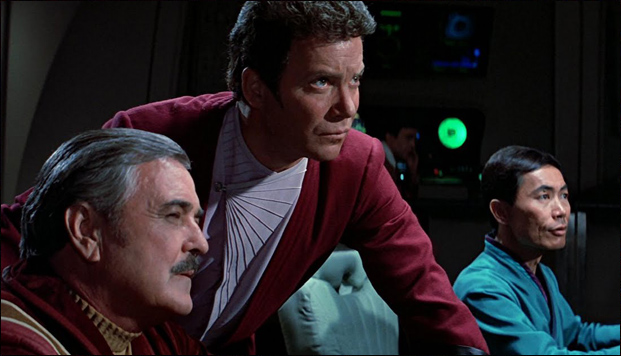
The third “Star Trek” movie is subtitled “The Search for Spock,” leading to the possibility that by the time this movie is over, Mr. Spock will return to join the USS Enterprise crew once again. But it starts out with Spock not merely missing—in fact, for those who don’t recall the end of the previous movie (if you don’t, this movie recaps the moment), Spock sacrificed his life to save the ship and the crew. The crew threw a funeral for him, launched him out into space, and fans of the series undoubtedly cried at the fact that Mr. Spock (Leonard Nimoy), arguably the most famous character in the “Star Trek” franchise, has died. But in the movies, anything can happen—thus, we have “Star Trek III: The Search for Spock,” in which Admiral Kirk and his crew are going to find Spock and bring him back from wherever he is.

Strangeness occurs that gets the search underway. For one thing, Dr. Bones McCoy (DeForest Kelley) seems to be of two minds, so to speak. It seems as if some of Spock’s memories have been stored into McCoy’s mind. He begs Kirk (William Shatner) to find Spock on the Genesis planet, where it turns out Spock has been reborn due to the planet’s growth. (At least I think that’s how it worked—certain parts of the story seem kind of odd to me.) For those who remember, the Genesis planet, from the previous movie, was created for new life. Kirk and the crew are to be reassigned and are forbidden by the Federation to go to the planet to search for Spock. But they disobey their orders and go for it anyway. However, they run into trouble with a ship of aggressive Klingons, led by the ruthless Kruge (Christopher Lloyd), who want to steal the secret to Genesis.

The search is a good deal of fun, though the scenes leading up to it could’ve used either tighter editing or a simpler script. There’s a great deal of heavy exposition involving the location and rebirth of Spock, mostly by Spock’s father (Mark Lenard), and they go on for quite a while. But once Kirk steals the Enterprise from the Federation, in a terrific ten-minute sequence, the movie gets on its feet and gets more interesting. The afore-mentioned sequence is quite impressive and very well-paced. There’s some tension on the planet, as Kirk’s son David (Merritt Butrick) and Vulcan Saavik (Robin Curtis, taking over for Kirstie Alley) make their own expedition on the planet for inspecting a “mysterious life form.” The Klingons continue to zero in on the heroes, such as when the Enterprise is met with a Klingon bird-of-prey. And of course, everything must come down to a battle between Kirk and the nasty Kruge, and once that’s done, we can deal with the matter of Spock’s return.

Christopher Lloyd’s Kruge is just an OK villain—he doesn’t really have the same kind of menace that Ricardo Montalban’s villain had in the previous movie. Sometimes, with Lloyd’s eyes bugging out half the time, it’s hard to take him seriously. And when you’re familiar with the actor’s other work, hearing him speak Klingon (which sounds like a cat throwing up half the time) is, let’s face it, quite hilarious.

I won’t be spoiling anything when I say that Spock does return at the end. What, did you expect the Enterprise crew do go on this search and not find him? This isn’t that kind of movie, guys. I’ll praise the scene involving his return because it reigns as one of the more satisfying moments in the “Star Trek” series—I was glad to see him again.

“Star Trek III: The Search for Spock” isn’t as great as “Star Trek II: The Wrath of Khan”—there are some overlong scenes, some moments that are silly, and the villain isn’t particularly compelling. But the theme of sacrifice is still present—like how Kirk has to sacrifice just about everything to save his best friend—and the action is still tense and exciting, while leaving for the beloved character interaction “Star Trek” fans have grown accustomed to. This is a good “Star Trek” movie, but not a great one. Still, like all good movies, that doesn’t mean it doesn’t deserve to be checked out.

The Karate Kid (1984)

8 Feb

karate-kid1

Smith’s Verdict: ****

Reviewed by Tanner Smith

Any subject matter can be done well. In the case for “The Karate Kid,” it’s an underdog story that is done very well. This movie could be considered as a “younger Rocky,” since it’s from the same director—John G. Alvidsen—and has the same basic premise of a character—younger this time—preparing for a big fight at the end. But it’s not fair to make that comparison because this movie stands out on its own. This is a much better film than you’d expect when you hear the title of the film—it’s touching, fun, well-acted, and well-made.

Ralph Macchio plays the protagonist—sixteen-year-old Daniel Larusso. He and his mother (Randee Heller) move from Newark, New Jersey to Reseda, California and Daniel isn’t as excited as his mother. (“This is the end of the line,” the mother says as they arrive at their new home. “You’re tellin’ me,” Daniel sullenly says under his breath.) Then he meets a beautiful blonde girl named Ali (Elisabeth Shue) and they hit it off nicely. But that angers her ex-boyfriend Johnny (William Zabka), a blond hunky jerk with a black belt in karate. He beats the stuffing out of Daniel, who tries to fight back but he’s only studied karate at the YMCA in Jersey; this kid is from Southern California and takes karate at the dojo near the drug store.

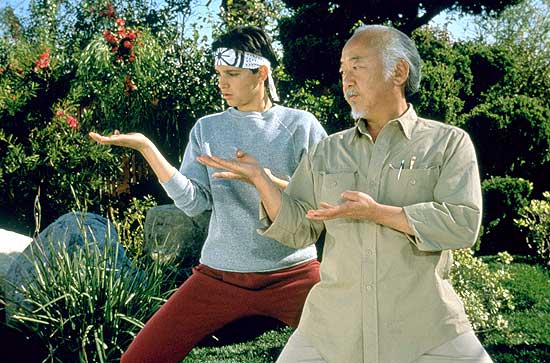
Daniel is menaced and beaten more and more as days go by—he considers checking out the karate place, but the problem is the instructor is a sadistic Army vet who believes in “no mercy.” Daniel is amazed to discover that Mr. Miyagi (Pat Morita), the Japanese handyman at the apartment building he lives in, knows a great deal about karate as he takes down Johnny and the bullies one night. Mr. Miyagi offers to teach Daniel karate in preparation for a karate tournament, in which Daniel must beat Johnny and the other Cobra Kai students in order to gain respect. His methods are not promising—Miyagi has Daniel wash his car, paint the fence, paint the house, and sand the deck. Daniel thinks he’s doing manual labor, but it turns out there’s a method here.

This is great—it’s smart writing here. And while Miyagi still teaches Daniel karate, there’s a nice friendship between the two. It seems fresh and original—this is a wonderful student/teacher relationship. They understand each other and feel like they’re each other’s best friends in quite a while. Actually, there are more relationships within characters and they all work fine. The romance between Daniel and Ali is nicely handled and then there’s the relationship between Daniel and his mother. All of these relationships are credibly handled and acted. There hardly seems to be a moment of acting. It all seems natural.

And that’s a wonderful thing about this movie—the filmmakers know what to do to make a movie with martial arts as a central theme. They think of the story and characters before they think of the martial arts. Too many kung-fu or karate movies would care less—not “The Karate Kid.”

Ralph Macchio is a natural actor and extremely likable as Daniel. He has a wit, but knows when to shut up and pay attention. He’s nervous, but good at hiding it. That makes him a likable main character to follow. Pat Morita is wonderful as Mr. Miyagi. In reality, Morita is a Japanese-American, but in the movie, he plays a different person (of course, that’s acting) by playing a Japanese import with a struggle for English. On top of that, the character is a true original—a breath of fresh air for the “wise old man” character. He has a sense of humor and knows a convincing lot about karate, but he also has his tragic past to try and forget. Morita is great here. The supporting cast is strong as well. Elisabeth Shue is beautiful, sweet, and likable. Randee Heller portrays a tough mom character, enthusiastic and with a street-smart personality. William Zabka is suitably slimy. And then there’s Martin Kove as the psycho karate instructor—“ruthless” is an understatement description of his character. He makes this character so villainous that it’s so over-the-top…but it’s so darn memorable and fun to watch.

Just like “Rocky,” “The Karate Kid” ends with a fight climax, in which Daniel must finally fight the bullies after learning everything he was taught by Mr. Miyagi and putting it to use. These fight climaxes seem almost obligatory, but this one is well-handled and it actually means something because we feel like we know the characters and buy into their relationships with each other. The heart is with “The Karate Kid’s” story and characters, and unlike most underdog stories, it’s about something.

Amadeus (1984)

31 Jan

Tom-Hulce-in-Amadeus-1984-001

Smith’s Verdict: ****

Reviewed by Tanner Smith

“Amadeus” is a film that gives a positive answer to the question “is a film about an artist as interesting as his or her work?” The answer is yes, as “Amadeus” is a historic-fiction period drama/portrait of Wolfgang Amadeus Mozart, and is also a high achievement in cinema history. This is one of those movies that, like most of the actual Mozart’s work, is just perfect. It’s a compelling story, a powerful drama, and a showcase of great talent.

“Amadeus” occurs through ten years of Mozart’s life, mostly spent in Vienna from the year 1781 to 1791. The film chronicles his successes and failings, but it covers more than just Mozart’s talent. It’s also an amazing portrait of creativity and envy. For you see, this film is not merely about Mozart and his work, but more of how envious the most miserable of colleagues in this craft can be to the point of trying to destroy him.

The envious one is Mozart’s rival Antonio Salieri (F. Murray Abraham) whom we first meet in the 1820s as an old man who attempts suicide while exclaiming that he killed Mozart. He is sent to an insane asylum where he gives his confession to a priest. As we see in flashback, Salieri looks back on his days as Court Composer for Emperor Joseph II (Jeffrey Jones) in Vienna. Mozart was Salieri’s idol, as he recognizes greatness in Mozart’s work, even when he was a young lad. Salieri himself is actually a mediocre composer, which he doesn’t realize and no one seems to point out because the Emperor himself is tone-deaf—he wouldn’t know a great music piece if he played it himself.

Salieri meets Mozart and is utterly shocked and dismayed when he realizes that Mozart is actually just an immature child stuck in a man’s body. He simply can’t believe that one of the greatest music creators in the world, if not the greatest, behaves wildly—chasing women, making inappropriate remarks, and having very little manners. But he truly is a genius and Salieri can’t deny it. However, Salieri is saddened and confused that God would display this great talent to this “creature,” as he calls him. As Mozart grows more and more famous and infamous, Salieri becomes more envious and wants nothing more than to plot Mozart’s downfall. But what always sets him back is the power of his music.

As you may have guessed, the most complex character in “Amadeus” is not Mozart, but Salieri. This is the one telling the story; this is the one who is envious the genius brought to this spoiled brat of a man; this is the one who is caught in a mixed bag of emotions; this is the one who has ignored all of the things that Mozart has enjoyed in life, just to be noticed for his own music, but alas he’s a second-rate composer. He even goes as far as pretending to be his late (disapproving) father’s ghost to work hard on the grandest opera the world has ever known, putting Mozart to a large amount of stress. And as Mozart is lying there, suffering and pretty much close to death, Mozart begs Salieri to help him finish the composition, while Salieri plans to steal it and claim it as his own.

That piece, by the way, is of course “Requiem,” and the scene is probably the most touching in the movie, because Mozart is willing to go all out with his creativity and genius, even on his deathbed. And a great touch added to it—as the piece is written, the actual music (imagined) is developed right along with it.

Mozart is an interesting portrayal. As I’ve said, he’s an immature child trapped in a man’s body. He can be loud and obnoxious, especially with his trademark braying laugh, as he could be considered to be trapped in a state of arrested adolescence. He’s mainly like a modern-day rock star—easing his way into this world and just having the time of his life. Sometimes, he’s nervous—such as when the Emperor orders for a piece to be shortened because the music has “too many notes,” and especially when his father, whom he’s devoted to, judges him. (Even when his father dies, Mozart is still haunted by him.) But sometimes Mozart can be unpleasant. There are moments when he’s either cruel to his wife Constanze (Elizabeth Berridge) or just unfaithful to her, though he does love her, and there’s also a scene in which he flat-out mocks Salieri’s work without knowing he’s present.

Tom Hulce plays the complicated role of Mozart and does an excellent job at playing him like Salieri sees him, as thus how we see him. Sometimes he’s likeable, sometimes he’s rude and obnoxious, but when you get down to it, he is Wolfgang Amadeus Mozart.

F. Murray Abraham is perfect as Salieri. He’s not a standard villain for Mozart; he’s a classic, tragic figure of envy. Though we wouldn’t prefer to stir through his sort of measures, we understand the pain he’s going through. And I also have to give him credit for playing both the young and old versions of the character—thanks to some great makeup work and equally great acting by Abraham, I never would have guessed this was F. Murray Abraham playing the older Salieri. But it is. Great work!

Is “Amadeus” completely historically accurate? Maybe not. But what should it matter when this much heart is put into the story and film? Maybe some parts were exaggerated; maybe other parts were stretched out. Either way, it’s known as “historic fiction,” and not to be one-hundred-percent accurate. It’s just a movie. And it’s an excellent one too.

The Neverending Story (1984)

28 Jan

4713453351_92a459c777_z

Smith’s Verdict: ***1/2

Reviewed by Tanner Smith

“The Neverending Story” is a clever, original, entertaining fantasy-adventure that uses familiar elements and creates inventive new turns for them. As a result, it’s an engaging adventure all the way through.

The most notable of these inventive twists is the lack of a standard villain. Instead of a high-ruling, magic, boring, evil wizard looking to destroy the fantasy world, we have something more complex. In the fantasy land called Fantasia, set in “The Neverending Story,” there’s an abstract entity known as the Nothing. It obliterates everything it touches so that there’s absolutely nothing left. It’s growing more powerful and about to destroy all of Fantasia. Now that’s a threat.

“The Neverending Story” begins in the real modern world as a bright, imaginative young boy named Bastian (Barret Oliver) is picked on by the school bullies who chase him into a bookstore. He’s interested in the book that the librarian is reading. The librarian tells him that the books Bastian reads are safe because they’re only stories. He mystically implies that this book—the Neverending Story—has a lot more to offer, and so Bastian takes it in curiosity. He skips school and follows the world of Fantasia, as the Nothing is a worldwide menace.

Sent to seek out a way to stop the Nothing is a child warrior named Atreyu (Noah Hathaway), who ventures off into the weird lands of Fantasia. Along the way, he encounters many strange, helpful creatures, runs into some heavy obstacles, and as the story continues and Atreyu is finding answers, Bastian, still reading the book, is starting to believe that these new twists and turns in the story are because of his own imagination filling in most of the story. And it seems like the people of Fantasia actually know of Bastian. Impossible, right? That’s exactly what Bastian believes. But things get stranger and clearer until it seems as if the one that can save Fantasia is indeed Bastian.

That concept is actually probably the most intriguing part of the movie—the idea that a child’s faith can control fate and save lives (and possibly along with a whole new world). And it’s also interesting that while the cowardly Bastian is reading a book in which a boy his age is the exact opposite of him, it helps that when Atreyu does lose confidence, Bastian is the one who has to gain it back. “Be confident,” Bastian says, now very much caught up in the story. He’s really telling himself that so that later he’ll have the courage to follow his dreams. That was a clever touch.

The creatures that Atreyu encounters are all appealing and memorable. In particular, Atreyu’s Yoda-like figure on this adventure is an insightful, optimistic, humble “Luckdragon” called Falkor, who looks like a dog but can also fly, with Atreyu on his back. There are other weird creatures in this movie (you can see a lot in the gathering in one of the early scenes—it reminded me of the bar scene in “Star Wars”), and my absolute favorite is a hundred-story-high, gentle stone creature known as a Rockbiter (guess what he eats).

The sets are very impressive. Fantasia sort of resembles Wonderland and features the same kind of strange characters as such, like the scientific gnome and the man riding a racing snail. The art direction is quite imaginative. And the special effects are quite impressive here, considering most of them were probably models, puppets, and animatronics. They’re all pretty convincing and they actually manage to take what could have been a silly creature like the Rockbiter and make him into a sympathetic character.

I also really enjoyed the story and how creative it was along the way. Aside from Bastian possibly becoming the real hero and the whole concept of the Nothing itself, there are entertaining obstacles for Atreyu to overcome. I’ve already mentioned this scene briefly in an above paragraph, but it’s the most tense—it’s a scene in which Atreyu must be brave enough to make his way through a magic gate to the other side; otherwise, he’ll be zapped and destroyed. And then there’s a wolf creature that’s bent on destroying Atreyu before he succeeds on his quest—he gives a speech about lack of human imagination that is surprisingly complicatedly effective for a children’s movie. And that sets up the whole final act.

This isn’t really an actors’ movie, though the two young leads—Barret Oliver and Noah Hathaway—are adequate enough. But the voice acting of the Rockbiter, Falkor, and G’Mork (the wolf) deserve praise, and strangely enough, they were all done by one voice actor—Alan Oppenheimer. Oppenheimer has a talent for voice acting and has many distinct voices, all of which give new personality to each character.

The ultimate weapon throughout “The Neverending Story” is imagination. Stories don’t create themselves. It takes a special creative mind to keep them going. Although, you could argue that this might not be the best message for kids, since the movie opens with Bastian’s father telling him to grow up and face reality, and then he ultimately decides to use imagination to save a fantasy world. But the best way to accept this development is to look at “The Neverending Story” strictly as a fairy tale. Who really grows up in a fairy tale? And for that matter, it’s not like we all forget our imaginations in the real world, no matter how old we get. If we didn’t, there wouldn’t be any filmmakers to create something as fresh and inspired as “The Neverending Story.”

Starman (1984)

27 Jan

images-1

Smith’s Verdict: ***1/2

Reviewed by Tanner Smith

John Carpenter’s “Starman” is an effective mix of science fiction and romance. It uses a science fiction gimmick to set up the two central characters (a man and a woman) and carefully develop a trusting relationship that turns into love. The twist in this romance, however, is that the man is an alien from outer space. The movie opens as the satellite Voyager 2, first launched in 1977, is floating through space. It contains a message of peace and inviting anyone or anything out there to come to the planet Earth. It turns out that something out there has found it and accepts the invitation. What exactly it is, I’m not quite sure. Yes, it’s an alien and we see it as a ball of light (or is a star?), but that’s all we know about it. Actually, that may be all we’d need to know.

Anyway, instead of a welcome greeting to Earth, the U.S. Government shoots down the spaceship, and the alien crashes somewhere in Wisconsin. There, it finds the home of a widow named Jenny Hayden (Karen Allen) and through a strand of her dead husband’s hair acquires the DNA of the husband and transforms into him. Jenny sees the alien in the form of her dead husband, knows that it isn’t really him, and is very frightened. However, Starman (who is never really called that in this movie) needs her to give him a ride to his ship, being kept and studied halfway across the country. If he doesn’t get there and leave the planet within the next couple of days, he will die. Jenny is afraid of Starman and thinks she’s being held against her will to drive him there. She tries a few times to get help, but then realizes that Starman means no harm. Starman doesn’t intend to frighten her, but doesn’t understand that taking the shape of her dead husband won’t calm her down—“I look like Scott so you not be…little bit jumpy,” he tries to explain after learning a few words in English.

Starman has a lot to learn, but is very smart and understands quickly. While on the trip, he takes in everything he notices. He learns to speak and eventually speaks English somewhat well enough, though not entirely. The way he moves is awkward, as he constantly is learning to control this new human body—whenever he looks around, he twitches quickly in every direction, like a bird. Along the way, Jenny learns to trust Starman and does her best to help him get back to his home planet. She explains more things about human life to him, like mortality and love. “What is love,” Starman asks. It’s at this point when “Starman” starts to become less of a science-fiction movie and more of a drama. Starman begins to feel genuine feelings toward Jenny and can’t explain it, and Jenny is able to explain what love is because the feeling does become mutual.

Jeff Bridges portrays Starman and it’s a great performance. He’s entirely convincing as an alien curious about everything he sees and uses body language and facial expressions to show what he’s thinking, as well as a partially-mumbled speech impediment. Bridges is winning in this role, and Karen Allen makes for an effective foil.

But because Bridges and Allen are so winning on screen, it makes the countless scenes of the Government hunting down the alien seem a lot less interesting. They want to experiment on it, to kill it if necessary, and the only one of the group (played by Charles Martin Smith) to realize that they’re going against the very message they sent out through Voyager. He’s the only one out of these villainous characters to appear as human, so to speak. But they don’t ruin the movie entirely.

“Starman” could have been executed as a silly sci-fi flick, but John Carpenter is smarter than that and creates an interesting feel for the characters and convincing dramatic moments for them. There are also some good laughs, such as when Starman uses his abilities to win the slot machines in Las Vegas so that he and Jenny will have money. “Starman” is more than it could’ve been.

NOTE: Don’t be put off by the title “Starman”—he’s never referred to by name.

Firstborn (1984)

15 Jan

firstborn1984avisnapsho

Smith’s Verdict: ***

Reviewed by Tanner Smith

“Firstborn” is an accurate, effective portrait of a broken suburban family that just gets better every time I watch it…or rather, the first hour and 15 minutes to be exact. The remaining twenty minutes are on autopilot and every repeated viewing keeps me from rating the film four stars. I really think it’s think it’s that good, so I’m giving it a three as a fair deal. I just wish it didn’t end with a typical, standard, (and worst of all) unnecessary action-film climax.

“Firstborn” begins pleasantly, as we’re introduced to a family that consists of a divorced mother, Wendy Livingston (Teri Garr), and her two sons—teenage Jake (Christopher Collet) and eleven-year-old Brian (Corey Haim). Theirs is a quiet, happy life; at least for the boys—Jake is on the lacrosse team and has a cute girlfriend (Sarah Jessica Parker), and he and Brian each have a lot of friends to hang around with. But there seems to be something missing in their lives and it becomes more evident with the news that Wendy’s ex-husband, whom she still loves, is remarrying.

The next day, Jake and Brian are having their usual morning breakfast—bickering while eating. Suddenly, they hear a cough and they know someone spent the night with their mother. At first, they assume it’s their mother’s ex-boyfriend whom she recently broke it off with. But instead it’s Sam (Peter Weller), a pickup from last night. In one of the movie’s best scenes, Sam meets Jake and Brian and they try to engage in awkward conversation. (“Sleep okay?” Jake asks to break the silence at one point.) This scene has ring of truth to it—what do you say when you meet a complete stranger in their house, after a one-night stand, that awkwardly?

But as it turns out, it wasn’t a one-night stand. Sam continues to date Wendy, and so Jake, being the oldest and most responsible boy, subtly tests him to see if he’s OK. Sam seems like a with-it guy, and has big plans for himself and even wants to share them with Wendy. And he also buys Jake a dirt bike as a present, which earns good points for him. But soon enough, Sam’s talk of businesses (with a home-security service and a new restaurant) gets Jake to believe that he’s all talk, and that “he’s an a**hole trying to make us think he’s OK.”

A few days later, Sam moves in. Wendy assures her sons that it feels right—for her, maybe, but to Jake, it’s all going so fast. Wendy feels like she’s in love with this man who seems as uncomfortable with his point in life as she is with hers. She doesn’t see that Sam is a put-on, though her sons are quick to catch on. Things get tougher around the house as Jake continues to challenge Sam closely about his future plans. Sam is lazy—he raids the fridge, sits around the house, and watches TV all day. At one point, Sam shoves Jake, telling him menacingly, “Get off my back.” Suddenly, this once-happy suburban family life is turned upside-down and it gets even worse when Jake learns that Sam is a small-time cocaine dealer and has even gotten Wendy hooked on the stuff.

The first hour and 15 minutes of “Firstborn” is very effective. It’s a credible, carefully-executed family drama with great performances, a steady pace, realistic dialogue, and some powerful scenes of truth. You feel the conflict that the characters are going through, and even if you want to shake Wendy into believing that she is making the wrong choices, you forgive her because you know people like her—looking for love in all the wrong places and not exactly knowing what to do after she’s found it. Jake is of course the character to sympathize with, since he is the one has to look out for his mother as well as the wellbeing of his kid brother, only because his mother is not the best one to take care of things around the house anymore. He even has to go in and see Brian’s principal one day just because the mother is coked up. The dad can’t help anymore, and on top of that, Jake can’t even call the police because most of the money spent on the drugs is Wendy’s. This is a lot for a teenager to go through, and Jake had to grow up fast and ultimately do something about this.

The acting is solid across-the-board. Christopher Collet is very good as Jake, delivering a natural and effective performance as a conflicted teenager. Corey Haim is convincing as Jake’s little brother Brian, who likes to hit other kids to take out his anger. Teri Garr has appealing scenes with the boys in the earlier scenes, and when she takes her own plunge into nothing, she’s pretty convincing (even if like I said, you want her to finally wake up and catch on). Peter Weller is brilliant as Sam—smooth when he needs to be, slimy when pushed over the edge. It’s a great performance.

Great scenes include—the aforementioned introduction of Sam; the scene in which Wendy tells the boys that he’s moving in; the moment when Jake tries to convince his mother that Sam is a phony, followed by a confrontation in which Sam tries to keep his cool to Jake (the end of that scene is just right); and the strong moment when Brian ultimately decides to sleep at a friend’s house because of everything going on at home—he doesn’t feel that his mom loves him anymore. There’s a subplot involving Jake’s snobby English teacher that at first seems unnecessary, but even that pays off, as it mirrors Jake’s home life. Jake finally snaps, “If you’re that great, why are you trying so hard to impress us?!”

And this is where “Firstborn” unfortunately loses its footing. With such a strong story with these kids facing a harsh dilemma such as this, we now have Jake ultimately deciding to stand up and get rid of Sam once and for all. He does this by hiding the cocaine, in an attempt to blackmail Sam into leaving. Where does this lead? Not to a battle of wits, which would have been acceptable. But it leads instead to a chase scene, with Sam in his car and Jake on his dirt bike, all over town. Would you believe that Jake gets attacked by a dog and nearly gets hit by a train?

But that’s not all. The film ends with a brutal fight scene in which everyone gets pummeled until we have the predictable victor (even little Brian gets beaten, after defending the family with a baseball bat). Where in the world did this come from? This is not the film we started out with. The film we started out with is called “Firstborn,” and this final twenty-minute sequence is essentially a throwaway climax. What happened? Did the writers give up on the story? Did they feel they couldn’t come up with something as strong as what was introduced to us before?

I guess I should only be glad that (SPOILER ALERT) it didn’t end the way most climaxes such as this turned out, with a death. (END OF SPOILER ALERT)

The first hour and 15 minutes keeps me coming back to watch “Firstborn,” but even when I love the same things again and again, it only makes it all the more disappointing every time it reaches the final act. But I just can’t bring myself to give it less than a positive review. Like I said, I praise the acting, the story structure, the credibility of the central determined dilemma, and the dialogue, but I just can’t figure out why “Firstborn” had to end so misguidedly. I guess I should say see it, but prepare to be disappointed. Is that fair? Maybe not. But it’s how I feel.