Archive by Author

Me and Orson Welles (2009)

17 Jan

1b7e6_christian_mckay_in_a_scene_from_richard_linklaters_me_and_orson_welles_-_photo_credit_liam_daniel

Smith’s Verdict: ****

Reviewed by Tanner Smith

Director Richard Linklater’s films always has a sense of reality and accurate pacing (see “Dazed and Confused,” “Before Sunrise,” and even “School of Rock,” which had realistic discussions about music among its formulaic story), and so it’s more than interesting to see him handle a story featuring the late, great Orson Welles. For “Me and Orson Welles,” an adaptation of the semi-biographical novel by Robert Kaplow, Linklater takes not only Welles seriously, but also the theater. To put it simply, “Me and Orson Welles” is one of the best films about the theater you’re likely to come across. It’s charming and well-made, but there may be something a little more.

Let me just get this out of the way—how much is based on fact, I’m sorry to say, is beyond me. Linklater and the writers, Holly Gent Palmo and Vincent Palmo, Jr., take the novel and historical events and blend them to create a fairy-tale type of story. The story takes place in 1930s New York City, as a high school student named Richard (Zac Efron), an optimistic aspiring actor, walks down the street and stumbles upon Orson Welles (Christian McKay), John Houseman (Eddie Marsan), and the other members of the Mercury Theatre. Welles likes Richard’s spirit and decides to hire him to act in a small role in his stage adaptation of William Shakespeare’s “Julius Caesar.” Richard is seduced by the wonders of the theatre and in one long week before showtime, he is a completely different person than he was before he started. He loves what he sees, wants more, and admires Welles’ spirit and energy, even if Welles’ directing methods can get very strict.

Christian McKay’s performance as Orson Welles has to be seen to be believed. It doesn’t merely feel like a portrayal; it feels like we’re really seeing Orson Welles, and not Christian McKay. The mannerisms, the expressive voice, the arrogance, the sheer ruthlessness towards others, the improvisations, the theatrical directions he delivers—all of which show that it will be impossible for anyone not to see him as Orson Welles himself. I mean it; he’s that good.

Zac Efron, taking the role to transition himself from his most notable teen-heartthrob work, is quite good here—playing Richard with a sweet innocence, but also some naivety as well (it’s the kind of role Patrick Fugit took in “Almost Famous”). Claire Danes is a real standout among the supporting cast as Sonja, a fetching, keen Mercury member who may or may not have a thing going with the ruthless Welles, but she admires Richard’s innocence enough to try some kind of romantic relationship with him. The rest of the supporting cast members—including Eddie Marsan, Ben Chaplin, Kelly Reilly, James Tupper, Leo Bill, and Zoe Kazan—each have their moments.

There’s a real charm to this coming-of-age story featuring Richard as he becomes more intrigued by what he is a part of and learns some important lessons in the process, for good or bad. We see all the aspects of the theater through his eyes, and by Welles’ vision and passion—there certainly is a fascination to these elements even if you aren’t a fan of the theater. The story moves briskly, despite a nearly-two-hour running time, and like most of Linklater’s work, you really get a sense that these characters, most of which based on real people, get a real sense of their environment and their limitations/traits (credit for that should go to Linklater’s direction, as well as the actors). “Me and Orson Welles” is a pure treasure.

War of the Worlds (2005)

17 Jan

war-of-the-worlds

Smith’s Verdict: ***

Reviewed by Tanner Smith

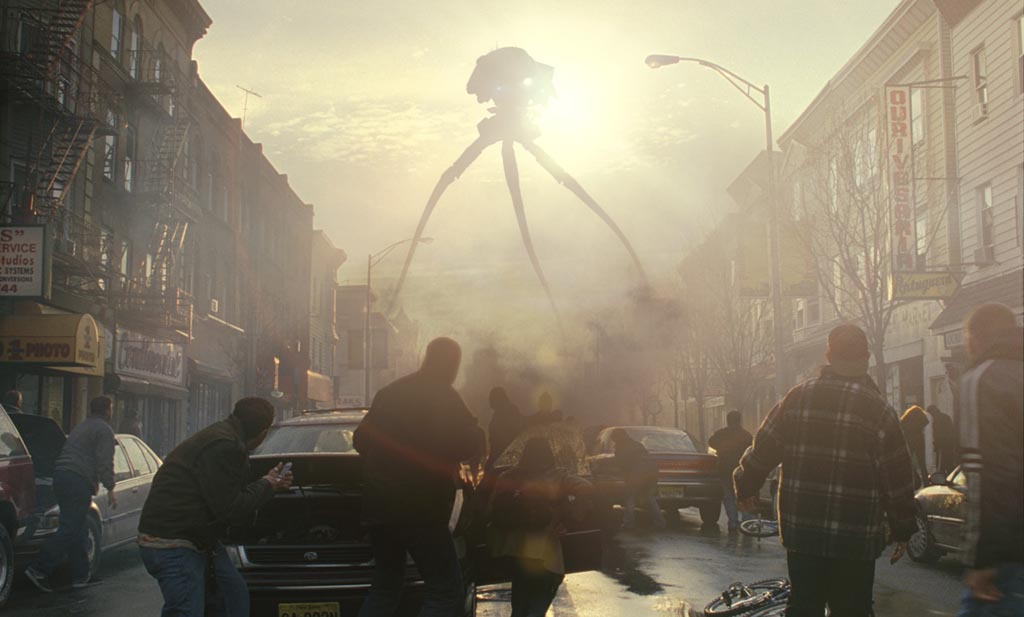
“War of the Worlds” is an updated version of the famous H.G. Wells story, and it’s by far the loudest and most tense version to come to the screen. Written by David Koepp (“Jurassic Park,” “Panic Room”) and directed by Steven Spielberg, “War of the Worlds” is mildly successful, but a pretty good time.

It’s a mediocre screenplay; I’m not going to lie. In fact, Koepp comes across better as a storyteller, and the story is well-paced and well-put-together. But it is merely an alien invasion thriller and we get the usual stuff we expect from this sort. (Although, there are a few nice little touches thrown in.) However, give Spielberg the job of directing this feature and you’ve got…a mediocre screenplay executed by a great director. But hey, it’s a nice attempt.

“War of the Worlds” is a summer blockbuster and you get the thrills and chills that come with the best feelings of such. The entire film is intense with underlying feelings of suspense, terror, and madness. The big action sequences are masterfully created with top-notch special effects and they just keep you on the edge of your seat. This is really the best way to watch “War of the Worlds”—see it on the big screen. It’s a great cinematic experience that the feelings of tension come with. (I was 13 years old when I first saw it in a cinema—it blew me away!) Even in the quiet moments, there’s still a good deal of tension because we know at any minute that something could go wrong and the heroes have to be one step ahead of it so they can survive.

The film centers around a divorced father named Ray Ferrier (Tom Cruise) who is left in charge of his two kids for the weekend by his ex-wife (Miranda Otto). The kids are rebellious, teenage Robbie (Justin Chatwin) and accepting, younger Rachel (Dakota Fanning). Ray doesn’t have the best relationship with them—in fact, Robbie sort of hates him and always calls him “Ray” instead of “Dad.” Things are awkward and uncomfortable for them, and then things get even worse once the lightning storm hits.

It starts out somewhat peaceful, like a big light show in the sky with a big funnel cloud that doesn’t seem to be harmful. Ray even brings his daughter outside to “see something cool,” assuring her that it’s like the 4th of July. But then the lightning hits just a little closer and that’s when things start to get scary. “Lightning doesn’t strike twice in the same place,” he calmly assures Rachel. Well, it does today.

Like everyone else, Ray goes to town to see what has happened. And then, something rises up from the ground and brings death to all. Ray survives the attack and, expecting another very soon, packs up the kids and everything he has in his house to get the hell out of dodge.

When did Spielberg become so cynical about his alien figures? This is the man who has shown through movies like “E.T.” and “Close Encounters of the Third Kind” that life “out there” can be full of hope and friendliness. But not here; not with “War of the Worlds.” These aliens in this movie are as ruthless as the shark in “Jaws.” They hunt, they feed, and they don’t stop.

These aliens leave a great amount of dread whenever you don’t see them. You just see their mechanical giant tripod death machines for the first hour or so, and you even see a probe searching all over for the heroes while they hide, and that somehow still keeps you on the edge of your seat. But once you see the actual aliens, the fear is gone. The aliens look the same as any other alien you see in any big-budget alien-invasion picture—they look like something the cat threw up, nothing like Spielberg’s original alien creatures.

There’s something I don’t understand, though. These aliens apparently want our blood—to exterminate and harvest us. But when they first arrive, they’re using heating rays to zap everyone on the streets to ashes. I don’t get it—why destroy what you want to eat later?

There are some great visual shots in the film—in particular, there’s one featuring a fast-moving train with each car on fire, another featuring dead bodies flowing along a river, and another in which Ray exits a house he hid inside during a bigger occurrence to find a crashed plane that has trashed the place. And the audio aspects of the picture make the film even more intense—the sound editing and mixing aid the visuals to create an intense, visceral experience. Listen to the tripods’ roar in surround sound—it’s genuinely frightening.

Tom Cruise has a physical presence that he has shown particularly in the “Mission: Impossible” movies, but I have to admire the fact that his main character of Ray is not an action hero. He’s a lousy, divorced father and a hard-time working man. When the aliens attack, he relies on his quick wit and thinking to keep his kids safe and stay alive himself. Cruise acquits himself nicely in the role. The two young actors are fine, although I tire of Dakota Fanning’s precociousness too easily. There are times when I wanted her to just shut up. There’s a suitably chilling performance by Tim Robbins as a survivalist who provides shelter for Ray and Rachel, and whose head may not be tightly screwed on. There’s a question of trust in his scenes.

The ending doesn’t quite work. It ends too quickly and without the right satisfying note. It’s a clever twist, mind you, but I would have liked to see a more compelling conclusion.

“War of the Worlds” is not about fighting the enemy. It’s about fighting to survive. Our heroes are not the typical heroes who man up and fight against the monstrous aliens (although near the end, Ray does get inside a tripod to save his daughter when she gets captured—but even that’s just selfless bravery and the end of Ray’s character arc). It’s cinematically dramatic and visually interesting. And though it has its flaws, I enjoyed “War of the Worlds” as an intense action picture.

X-Men: First Class (2011)

17 Jan

xmen first class cast group

Smith’s Verdict: ***

Reviewed by Tanner Smith

The X-Men have always been kind of an interesting band of superheroes because instead of one hero, we have many. We have a group of interesting, likable characters with some pretty neat superpowers to follow adventures with in the comic book franchise in their name, the animated TV series, and the four “X-Men” action movies. For those who don’t know, the X-Men are mutants—genetically altered people with a special power, kind of like the new evolution of man.

With all superhero tales, the origin story is always the most crucial, although we’ve already gotten a movie featuring the origin story of the mutant Wolverine (the one with the metallic razor-sharp “fingernails”) and that didn’t turn out well with most movie audiences. So now, we have “X-Men: First Class,” which follows the origin story of Professor X and Magneto. For those who don’t know, both characters are teachers for the other mutants…but on opposing sides. One side wants mutants to live alongside normal people, the other wants to destroy the humans.

I know, we’ve seen how all of that goes in the first three “X-Men” movies. But if I’m going to write the review for “X-Men: First Class,” certain details have to be acknowledged.

“X-Men: First Class” opens in a Nazi concentration camp, during World War II, where we see a young boy named Erik Lehnsherr (later to be known as Magneto). The Nazi Sebastian Shaw (Kevin Bacon) learns of the boy’s newly developed mutant powers as a telepath—able to read minds and manipulate objects, particularly metal, without touching them—and kills his mother as a way of showing that anger can bring his powers to life. Years later, in the early 1960s, Erik (Michael Fassbender) is a young man bent on vengeance against Shaw.

We also see the young Charles Xavier (later to be known as Professor X) and his stepsister Raven (later to be known as Mystique). Xavier (James McAvoy) is a telepath who has his own theory of mutants in this world, hence the nickname “Professor,” while Raven (Jennifer Lawrence) is a shape-shifter whose true form is a blue-skinned creature with golden eyes, but takes the form of an attractive blonde. (And she’s probably actually a lot older than she looks, as a line of dialogue hints at later on.)

OK, this is why I hate reviewing superhero origin stories that are released years after the first few movies. I bet so many readers of this know who these people are and what powers they have. But bear with me; I’m getting to the story.

A CIA agent named Moira MacTaggart (Rose Byrne) needs the help of Xavier, with his expertise of mutation. It turns out Shaw is assembling his own team of mutants, and he himself is a mutant—a telepath who can absorb any sort of energy, even from a live grenade. Shaw’s intention is to launch hundreds of nuclear missiles to strike Russia and launch a nuclear war, eliminating the humans and putting mutants in the lead. Xavier agrees to help stop him, as he and Erik meet each other and form as allies, among other recruits that include a young scientist with hands for feet and a taxi driver who learns to adapt, hence the name…Darwin.

“X-Men: First Class” is about as good as an “X-Men” movie can get, which is to say it’s the best one in the franchise. The setup is effective, the acting is nice, it’s proficiently made, and the action—especially the climax, surprisingly—is well-staged and pretty intense. The heroes are admirable and appealing, with the exception of one whose intentions run deeper than the others would think, and the villain is effectively ruthless. All I’ve mentioned feature elements that good superhero movies should feature.

That’s not to say the movie doesn’t have problems. While continuity connected with the other “X-Men” movies isn’t a major problem in the first half, there are moments in the second half that don’t seem possible, given that you’ve seen the other movies. (I won’t give those errors away.) Actually, that’s a minor criticism—there are only a few big errors, meaning less than smaller ones, making it somewhat passable. Also, as much as I love Jennifer Lawrence as an actress, she doesn’t have much to do with the character of Mystique, with the exception of full-body blue, scaly makeup some of the time (which I have to admit is strangely attractive—shut up). I feel like her character was underdeveloped and I don’t feel much of Lawrence coming through. Another problem, and let’s face it now—some of the mutant powers you see in this movie are pretty silly.

But for the stuff that doesn’t work in “X-Men: First Class,” there are things in the movie that really do. For one thing, it’s nice to see Professor X and Magneto, before they were known as such, in their beginnings and as allies, no less. The relationship between these two is interesting, compelling, and always risky. In some ways, they’re on the same mission to stop Shaw from starting World War III, but in other ways, they have different views on how to handle things, given their abilities. Xavier believes that mankind and…mutantkind (?) can live in peace, while Erik is taken over by his violent nature and believes that it doesn’t matter if this nuclear war is prevented—it will happen either way—as long as he exacts his revenge on Shaw. Because of their differing ethics, it makes it more tragic that their friendship will not end well, to say the least. James McAvoy is likable as Xavier, and Michael Fassbender is excellent—Fassbender has a forceful screen presence that practically demands you to watch him for two hours, and that’s a sign of a great actor.

The villain is an interesting, truly cold-blooded antagonist, and played by Kevin Bacon with efficient sliminess. The character is interesting because he takes different sides in order to make sure that he comes out on top, no matter what the case may be. And as a mutant, he has his own insane ideas of how the idea of man and mutant should be handled. In that case, he’s a respectable role model for Erik, who has pretty much the same ideas. “Unfortunately,” Erik states, “You killed my mother.” So it’s not hard to see where this will go, if you haven’t seen the other movies—it’s no question that Shaw is the early Magneto (and even has the same ridiculous headgear to keep his mind intact).

Also, there are training sequences in which Xavier teaches the other mutants, brought in to become the alliance against Shaw and his group, to control their powers. These are also fun to watch and well-edited—it makes a bold choice in showing them back and forth and surprisingly works.

The climax is extremely well-done. The scale seems huge here. It really does feel like a lot is at stake as all this madness is occurring. And the best part—we’re involved. We actually care about what’s happening. The pacing is carefully done to make sure we don’t miss anything. This is one of the best action climaxes I’ve seen in a superhero movie with an epic feel and impressive special effects. What follows are heartbreaking decisions, but is expected, given the knowledge from the other movies.

“X-Men: First Class” runs two hours and 10 minutes—it doesn’t feel that long. This is an exciting superhero flick that I would actually like to see more stories based upon. And I don’t just mean watching the first three movies again—there’s another story with the young versions of these characters to be found. They just need to find it. I’d be excited to see it.
Near Dark (1987)

16 Jan

near-dark-1

Smith’s Verdict: ***1/2

Reviewed by Tanner Smith

“Near Dark” features a band of outlaws who are much more than anyone would think. People see these people coming and they suspect trouble, but don’t quite know exactly how much trouble. These people aren’t necessarily human, and I don’t mean that as a metaphor. As one character points out after barely surviving an encounter with them, “Those people back there—they wasn’t normal. Normal folks don’t spit out bullets when you shoot ‘em!” Indeed, conventional weapons can’t kill this family and they don’t feel pain. The only thing that can hurt and kill them is sunlight. So they sleep during the day and stalk the night. As one of them puts it, “We keep odd hours.”

And also, the only thing they can eat is human blood. This means every night, they go from place and place to find new victims, hence their outlaw status. When they keep feeding on blood, and stay out of the sunlight, they can live forever.

Are they vampires? I honestly don’t know. They share some of the same traits of such humanistic creatures, but not in the conventional way. They don’t sprout fangs or fly or morph into bats. They just feed on blood, live eternal life in the dark, and can only be killed by sunlight. And “Near Dark” isn’t an old-fashioned vampire movie—it’s a contemporary thriller, and a Western—it takes place in the South and has certain elements of a Western, such as shootouts, showdowns, and bar fights.

What do we have here that’s different? Well, having the villains be these supernatural beings is actually pretty remarkable and leads to some original story pieces. The biggest showdown is between one of these “vampires” on foot and the hero in a large truck. Should be a no-brainer, right? The hero runs down the rascal, but he’s still not dead yet (though he doesn’t look too good with his head split open). And there’s a bar fight in the middle of the movie, like a lot of Westerns. Only this one is bloodier, as the outlaws take out every person in the bar, one by one (the bartender has his throat slit by boot spurs), and drink their blood. It’s a chillingly funny moment when the wildest one in the bunch, Severen (Bill Paxton), licks a victim’s blood off his fingers and chuckles, “It’s finger-lickin’ good!”

And of course, there’s a shootout in which the law lets loose everything they have at the outlaws in a motel room, while the outlaws shoot back from inside. But the police’s bullets don’t hurt them in the slightest; however, since it’s during the day, the bullet holes that let in the light—those are what really hurt them. That’s very clever.

In fact, all of these added elements to the usual shtick are clever. And the look of the film looks quite nice, considering the subject matter—looking like a painting, especially in the scenes that take place at night. We admire the night as much as the central young couple—Mae (Jenny Wright) and Caleb (Adrian Pasdar)—who fell in with the gang. Mae tells Caleb to look and listen to the night, that it’s the most beautiful thing in the world to live with. From the look of the film, we believe her.

I should also point that “Near Dark” has one terrific opening shot. It’s a mosquito sucking blood from Caleb’s arm—just a mosquito, but it’s a classic case of foreshadowing. Caleb squashes the blood-sucking insect, calling it a “dumb suck,” and has no idea what he’s in for later, when he has to deal with practical human-sized mosquitoes.

I suppose I should share the story of “Near Dark.” The story features Caleb, a young man who goes on a date with Mae, whom he just met that night. Their date continues through the night, as Caleb quickly realizes that Mae isn’t like any other girl he’s picked up before. She commands him to stop the truck so that she can “show him the night,” as she crazily exclaims, “The night—it’s deafening! Do you hear it?” Caleb just sort of plays along, “Well, I’ll hold your ears.” Of course he can’t tell right away that she’s a vampire, even though she practically begs to be taken home before dawn. Then, Caleb and Mae share a passionate kiss…which ends with Mae biting his neck and running away. “Sure was some kiss,” Caleb says to himself.

When Caleb has to walk home as the sun comes up, he realizes what effect the sun has on him now. He nearly burns to death until he is rescued by Mae and her “family,” who show up in a blacked-out Winnebago. When they see that Caleb has been bitten, they realize that he’s “turned.” So they give him a week to call him one of them, and Mae makes it very clear that in order to survive, he has to learn to kill. Caleb doesn’t want to kill, but “the night has its price.”

As you may have guessed from many scene descriptions and lines of dialogue, “Near Dark” has a terrific script, written by Eric Red and director Kathryn Bigelow. Most of the film’s dialogue I have memorized by heart. My favorite line comes from the leader Jesse Hooker (Lance Henriksen), when Caleb asks how old he is. His response: “Let me put it this way—I fought for the South…We lost.”

Adrian Pasdar is at first playing Caleb as a dumb horny teenager, and him being from Texas don’t make him any different from most teenage sex movies. But when he understands his plight and we see him go through these changes, he does become more human, and therefore more likeable. Jenny Wright makes a charismatic complicated love interest. In fact, I was wishing for more scenes featuring these two together. We get a fair amount, but “fair” isn’t enough.

As the antagonists, the performances are first-rate. Lance Henriksen has a convincing menace to his character of Jesse, trying to keep things in check while resorting to deadly measures in the process. Bill Paxton is perfect as Severen—chilling and yet amusing at the same time. This is the guy you want to party with, given that you don’t know his true intentions and would most likely become his next victim. Also on board is Jenette Goldstein as Jesse’s wife (at least, I think she’s his wife—back stories with these characters are left vague, which I didn’t mind either) and Joshua Miller (the creepy little brother from “River’s Edge”) as Homer, the little boy with a middle-aged mind. Other supporting cast members with significant screen time are Tim Thomerson and Marcie Leeds as Caleb’s father and little sister Sarah, who look for Caleb after he’s been missing for days. The final conflict of the film is whether the vampires will turn Sarah the way they turned Caleb.

There are a few problems I have with “Near Dark.” For one thing, the transitions from day to night are very clumsy, like they transform just too easily. There’s one scene where the characters are in the motel at night, and just a few minutes later, it’s full daylight outside. Talk about dumb luck! Also, I didn’t full appreciate the ending—not just because it was one of those standard chase endings in which the hero is able to kill the villains after all this madness, but because it ended too quickly for everything to sink in. The final payoff between Caleb and Mae could have had more weight, but it’s just all too brief. But for the most part, “Near Dark” is a neat little horror movie that goes beyond all the usual vampire-movie clichés, as well as Western clichés, that we’re used to.

Fright Night (1985)

16 Jan

petervincenteh3

Smith’s Verdict: ***

Reviewed by Tanner Smith

“Fright Night” respects the vampire genre and recalls back to the old elements of Bram Stoker’s Dracula. But it also modernizes them. The vampire lives in suburbia and can easily be seen as an eccentric suburbanite. But as a vampire, his strengths are the same—he can live forever, he can transform into either a bat or a wolf, and he can hypnotize people so he can drink their blood (the rest he just kills quickly). And his weaknesses are the same—particularly sunlight, crucifixes, and wooden stakes through the heart (though a stake through the heart will kill anybody). Yes, the traditional, old-school vampire elements are in check for “Fright Night.” And they’re quite welcome.

The film takes place in a suburb where something strange has moved in, and no one has noticed except for teenager Charley Brewster (William Ragsdale), who one night is making out with his girlfriend Amy (Amanda Bearse) until he notices while looking out the window that two guys are moving a coffin into the basement next door. The next night, he hears a woman’s scream coming from the house. And he notices that all the windows in the cellar are completely painted black by the new house owner’s live-in carpenter. Where’s the owner, who apparently sleeps during the day?

You starting to see a connection here?

Charley spies on the house one night to make the chilling revealing discovery that the new guy living next door to him is a vampire. But of course, no one will believe him—not his mother, not Amy, and not even the police. Worse yet, the vampire—known as Jerry Dandrige socially, or how social he can be anyway—knows that Charley knows about him. Desperately seeking help, he gets in touch with Peter Vincent (Roddy McDowell), the well-known B-movie actor known for killing monsters, particularly vampires. But Peter Vincent doesn’t truly believe in vampires until he has his own encounter with one. After some reluctance, Peter joins Charley in a race to kill Jerry before he kills them.

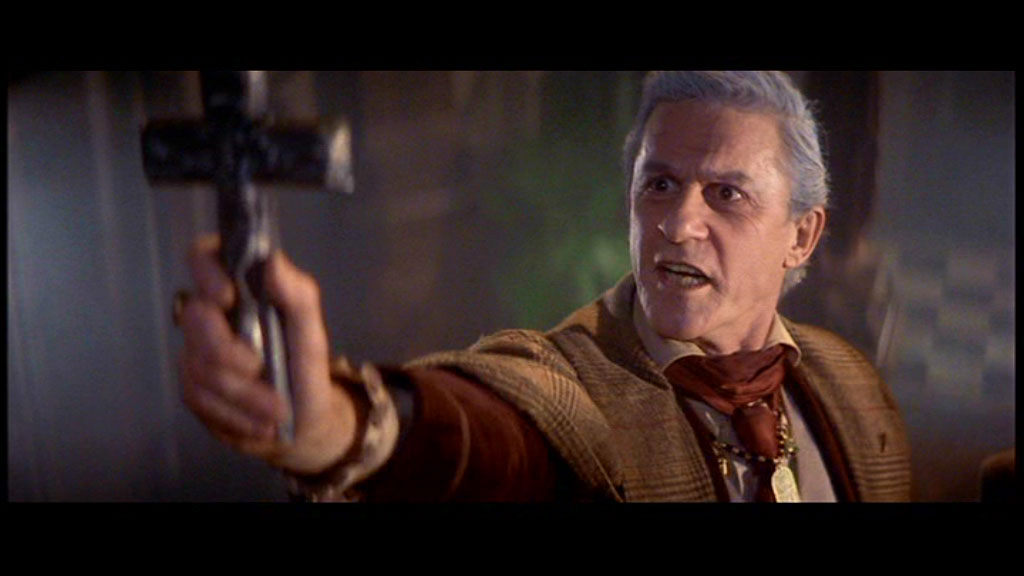
One of the strengths of the movie is Roddy McDowell as Peter Vincent. He delivers a terrifically comic performance as a washed-up actor who gets roped into the situation. He doesn’t believe in vampires, but for a good sum of money (he’s in danger of being evicted from his apartment), he’ll do anything until he realizes that these are real humanistic beasts. He may seem tough killing vampires in movies, but in reality when facing vampires, he’s a frightened, nervous wimp of a man who runs away when he gets a chance. This character is a comic masterstroke in “Fright Night.”

Chris Sarandon plays the vampire Jerry and it’s also a terrific performance. He plays Jerry with a casual, snooty sense that you’d think he’s just a reclusive, eccentric businessman. But once you get him started, he shows his true colors and becomes a convincing vampire. This is a real feel of split-personality, and Sarandon handles both parts really well.

A particular problem I have with “Fright Night,” and it is major, is that William Ragsdale as the hero and Amanda Bearse as his girlfriend are horribly miscast. Ragsdale is just a one-dimensional whiner that you just want to see get killed by the vampire, because that would mean you’d never have to hear his peevish, droning voice ever again. That would be just fine with me. Bearse is worse—neither appealing or convincing. And she becomes the one that the heroes have to save from becoming a full-fledged vampire, after Jerry has seduced her and changed her. Let Amy be a vampire—at least she’s more interesting that way.

Another problem I have with the film is the middle part of the film, particularly in which Amy and the crazed teen Evil Ed—getting to him later—hire Peter to convince Jerry that he is a vampire). I know that Amy is trying to snap Charley out of what she thinks is a delusion, but why is the movie acting like it’s a big shock when Peter realizes that Jerry’s a vampire? Did it hope we’d forget that Charley was already our hero?

And what about Jerry’s roommate/vampire’s-assistant Billy Cole (Jonathan Stark)? Apparently, he’s human, since he can walk in the daylight. So, simple bullets can kill him, right? Peter even states before he and Charley go into Jerry’s house to strike, “He walks out in the sunlight—then he’s human.” Then he goes ahead and shoots him, but…he just keeps coming. OK, it’s creepy enough, to be sure. But what’s the deal? Did Jerry turn him into a vampire that night? Is he a partial zombie? I don’t know; the movie never tells us.

But “Fright Night” has enough strengths for us to forgive its flaws. The performances by Roddy McDowell and Chris Sarandon are good, and so is the performance by Stephen Geoffreys in a comical supporting role as a crazy teenager nicknamed Evil Ed who becomes a vampire midway through the movie—his over-the-top delivery, along with his Jack Nicholson resemblance, is just hilarious. The creature effects are suitably gruesome, and the final half of the movie—the battle between the heroes and the monsters—is bloody entertaining. “Fright Night” is a fun horror movie.

NOTE: “Fright Night” was remade in 2011 as a more self-referential horror-comedy, starring Colin Farrell and David Tennant—that film is worth checking out as well.

Before Sunrise (1995) – Before Sunset (2004)

16 Jan

before sunrise sunset

Smith’s Verdict: ****

Reviewed by Tanner Smith

The films in the romance genre are a mixed bag. Once in a while you get a good/great one, but for the most part, they’re made up of the most annoying clichés and generically ineffective dialogue. Highlighting fresh young talents doesn’t do the job on its own. A good script and genuine chemistry among the romantic leads helps make a romance work. This is where “Before Sunrise” comes in.

This is unlike most romances, in that it takes place in just a single day. As a sigh of relief, the story is very simple—here’s a man and woman, they meet, they enjoy each other’s company, and so they spend the night together before one of them has to leave. That is such a relief because it keeps itself contained to these limitations and makes the most of them. This short-lived romance just develops through this long night with no standard occurrences you see in most movies in the genre.

I shouldn’t even use the words “romance” and “couple,” since the alleged two people are only together for 24 hours (actually 14, I think). It’s just these two people meet, they engage in a friendly conversation, they decide they want to spend more time together before they separate, they have a most pleasant night together, and when they leave, they realize they weren’t ready for this. And that’s it. No melodrama. No misunderstandings. No bullies. There’s hardly even an agenda. We just enjoy the company of twenty-somethings Jesse (Ethan Hawke) and Celine (Julie Delpy) as they enjoy each other’s company.

They meet on a train in Austria. Celine is a French woman returning to a university in Paris; Jesse is an American headed to Vienna for a flight back to the United States. Celine sits next to Jesse. They go to the lounge car and make conversation. It’s a real talk too that attracts them to each other, wanting them to know more about each other. If only they could continue…When they reach Vienna, Jesse comes up with a crazy idea for Celine to get off the train with him so they can be together until he catches his plane. Celine agrees.

Jesse and Celine wander the streets through the night; still talking, learning more about each other, and their relationship gets stronger as it continues. But they do their best to keep from expressing their perfect feelings for each other and just try to keep a “perfect night.” This way, they don’t get hurt. Then comes two important questions—should they sleep together that night, and will they see ever each other again after they separate? They do love each other. Should they admit that?

“Before Sunrise” relies on two important things that make it work, and they’re both great—great dialogue and great acting. The screenplay is full of sharp dialogue (this is mainly an all-talk film) and the conversations that these two people share are worth listening to because they’re smart, amusing, and actually relatable. They don’t talk about anything spectacular; they talk about love, former lovers, school, parents, truth, music, even death and reincarnation. It all seems so natural, as does the acting by Ethan Hawke and Julie Delpy, who share an excellent rapport with each other. Their unquestionable chemistry onscreen seems absolutely genuine.

Aside from the two leads, however, Richard Linklater, director and co-writer (with Kim Krizan), has to take most of the credit for the treasure that is “Before Sunrise.” It’s pure movie magic all the way through. It’s sweet, it’s convincing, and always sincere.

—————————————————————————————————————–

Sequels are always successful when they actually continue the story. “Before Sunset” is one of those sequels. Nine years since its predecessor, “Before Sunrise,” “Before Sunset” continues with the growing relationship of Jesse (Ethan Hawke) and Celine (Julie Delpy), who are or aren’t meant to be together.

In “Before Sunrise,” the likable American man Jesse met the attractive, appealing French woman Celine on a train to Vienna, and talked her into getting off the train with him so they can spend the night together before he left for home. It was a perfect night that ended with their departing of each other. They arranged for them to meet in one year, but now in “Before Sunset,” nine years have passed and their rendezvous hasn’t occurred…until now.

Jesse is in Paris representing his novel, “This Time,” which is a fictionalized retelling of his and Celine’s night together. He is surprised to see Celine at the book signing. They encounter again and their feelings from before have come back.

Jesse has about an hour before his flight for America takes off and he and Celine decide to spend it together. And here, “Before Sunset” doesn’t cheat. It takes place in real time. It doesn’t transition to a different scene and a different conversation. We’re always in the company of these two as they go from place to place, and as they have conversation after conversation.

They share the same kind of whimsical dialogue shown in the original story. But this time around, they also share conversations that are darker. The question of love comes back into place, the way their lives have turned around since their night together has sad surprises, and the question of happiness is complicated for them. And then you get that pivotal thought if these two are meant to be together. Has fate brought them back for a second chance? They know they love each other, but can they act on these feelings?

“Before Sunset” is a remarkable technical and acting achievement, as director Richard Linklater has long shots (about five or six minutes long) as Hawke and Delpy continue to engage in discussion. This cannot be easy, but luckily, the actors are excellent here. They were great in the original film; they’re even better here. They know their characters inside and out, and at no moment are we seeing actors. We see Jesse and Celine together again. And it also helps that Hawke and Delpy also co-wrote the screenplay with Linklater and Kim Krizan.

The film has a great ending that leaves things open for interpretation until another sequel, which I seriously hope comes around because I want to see more of these two people interact with each other. And who knows? Maybe things will be better for them. Together. I really hope so. These two movies—“Before Sunrise” and “Before Sunset”—are two of the best romance films I have ever seen and there’s enough intelligence for a third entry.

Attack the Block (2011)

16 Jan

images

Smith’s Verdict: ***1/2

Reviewed by Tanner Smith

How often does it happen in a movie—and a monster movie, at that—when you start out hating the main characters and then wind up rooting for them when things get crazy? One example that comes to mind is “From Dusk Till Dawn.” If you recall that movie, it was about two murderous fugitives who kidnap a family and then have to work together to fend themselves against vile vampires. Now in “Attack the Block,” a sci-fi/horror film from the UK, we have a thuggish gang of inner city London teenagers banding together with their latest victim of mugging to fight a swarm of predatory creatures from outer space.

That’s a central element in “Attack the Block,” an entertaining thriller with an adventurous feel, decent special effects, and a cast of mainly unknown but talented young actors. It begins as a young nurse named Sam (Jodie Whitaker) is walking home on the bad side of town, where she is mugged by a gang of five young hoodlums. A meteorite lands nearby, interrupting the mugging, and scampers in the form of a small, furry, fanged alien that scratches the face of the gang leader Moses (John Boyega). The kids chase after the little beast and beat it to death, like the big shots they think they are.

But guess what! There are a lot more where that came from. So Moses and the others—Pest (Alex Esmail), Dennis (Franz Drameh), Biggz (Simon Howard), and Jerome (Leeon Jones)—get excited and grab a bunch of weapons (including swords, fireworks, and a baseball bat) to take them down. But it turns out that these creatures are bigger and more vicious than the thing they killed before. When one of them bites Pest’s leg, they need Sam’s nursing training to help. The gang assures her that there are worse things out there to be scared of than them. While inside their tower block, they, along with a druggie named Brewis (well-played by Luke Treadaway, who provides comic relief), band together to survive the night.

It’s so strange how this movie develops with its characters. When the movie starts with Sam, walking down the street and talking to her mum on her cell phone, we immediately suspect that she’s the central character. But then the gang shows up and mugs her and we follow them for just about the rest of the movie. These are people we’re supposed to hate. And we don’t like them indeed, at first. They’re vile, they talk trash, and they get stoned. Then the aliens show up and the boys realize they might not stand much of a chance against them. That’s when the gang starts to become sympathetic individuals. They think things through, attempt to keep each other safe, and rely on their wits to survive. This ordeal is also a great learning experience for them. Moses realizes later that everywhere he goes, trouble seems to follow him and everyone near him. He shouldn’t have gone looking for trouble in the first place. He chased down the first creature, killed it, and now the others are here for vengeance. At one moment, he tells the others, “I don’t want no one else to die.”

“Attack the Block” is the film debut of writer-director Joe Cornish, who also would co-write Spielberg’s “The Adventures of Tintin.” Like most ambitious filmmakers, he starts out with a familiar genre to see what he could do with it before seeing what else he could do, which I am curious about. He takes what could have been just a monster movie and surrounds it with a sense of place (London after dark looks nice and mysterious), real personalities of the characters, and some truly gruesome monsters. He also brings about a mixed bag of characters. Aside from Moses, his friends, Sam, and Brewis, we also have—Hi-Hatz (Jumayn Hunter), the block’s main thug who chases the kids and the aliens; Ron (Nick Frost, “Shaun of the Dead” and “Hot Fuzz”), the local drug dealer; the gang’s girlfriends whose main purpose is to scream and laugh; and Probs and Mayhem (Sammy Williams and Michael Ajao), two nine-year-olds who want to be the big shots on the block and go after the aliens themselves (armed with a Super Soaker).

I should also give credit to Cornish for the use of the aliens. These vile, nasty creatures are coated in entirely black fur to blend into the night. They resemble werewolves, except that they have no glowing eyes (they have none), but neon green fanged teeth. That’s kind of weird though, if you think about it. Would you really believe that these predatory monsters would have the right tools for space travel? They don’t seem to be that smart, really. They merely act on instinct. But they work as gruesome monsters.

The young actors are all exceptionally terrific, especially John Boyega who has a commanding presence as Moses, and Alex Esmail as Pest, who provides comic relief and has a backpack full of fireworks that come in handy.

The British slang that these kids use—“bruv,” “fam,” “wagwan,” to name a few—grows tiresome, even if that is how inner city kids in London talk. And Hi-Hatz’s motive for going after both the kids and the aliens doesn’t hold very well. Wouldn’t it be more interesting if he were willing to stand by Moses’ side to fight the aliens themselves? It seems like Hi-Hatz is the most ruthless person on the block. But then again, Moses did need a ruthless, cold-blooded, older person to convince him (unintentionally) that this isn’t who he should become. But for the most part, “Attack the Block” is a good deal of fun. The action and characters go well together, the creatures are suitably gruesome, and it’s over in just an hour and a half. It’s awesome, bruv!

Firstborn (1984)

15 Jan

firstborn1984avisnapsho

Smith’s Verdict: ***

Reviewed by Tanner Smith

“Firstborn” is an accurate, effective portrait of a broken suburban family that just gets better every time I watch it…or rather, the first hour and 15 minutes to be exact. The remaining twenty minutes are on autopilot and every repeated viewing keeps me from rating the film four stars. I really think it’s think it’s that good, so I’m giving it a three as a fair deal. I just wish it didn’t end with a typical, standard, (and worst of all) unnecessary action-film climax.

“Firstborn” begins pleasantly, as we’re introduced to a family that consists of a divorced mother, Wendy Livingston (Teri Garr), and her two sons—teenage Jake (Christopher Collet) and eleven-year-old Brian (Corey Haim). Theirs is a quiet, happy life; at least for the boys—Jake is on the lacrosse team and has a cute girlfriend (Sarah Jessica Parker), and he and Brian each have a lot of friends to hang around with. But there seems to be something missing in their lives and it becomes more evident with the news that Wendy’s ex-husband, whom she still loves, is remarrying.

The next day, Jake and Brian are having their usual morning breakfast—bickering while eating. Suddenly, they hear a cough and they know someone spent the night with their mother. At first, they assume it’s their mother’s ex-boyfriend whom she recently broke it off with. But instead it’s Sam (Peter Weller), a pickup from last night. In one of the movie’s best scenes, Sam meets Jake and Brian and they try to engage in awkward conversation. (“Sleep okay?” Jake asks to break the silence at one point.) This scene has ring of truth to it—what do you say when you meet a complete stranger in their house, after a one-night stand, that awkwardly?

But as it turns out, it wasn’t a one-night stand. Sam continues to date Wendy, and so Jake, being the oldest and most responsible boy, subtly tests him to see if he’s OK. Sam seems like a with-it guy, and has big plans for himself and even wants to share them with Wendy. And he also buys Jake a dirt bike as a present, which earns good points for him. But soon enough, Sam’s talk of businesses (with a home-security service and a new restaurant) gets Jake to believe that he’s all talk, and that “he’s an a**hole trying to make us think he’s OK.”

A few days later, Sam moves in. Wendy assures her sons that it feels right—for her, maybe, but to Jake, it’s all going so fast. Wendy feels like she’s in love with this man who seems as uncomfortable with his point in life as she is with hers. She doesn’t see that Sam is a put-on, though her sons are quick to catch on. Things get tougher around the house as Jake continues to challenge Sam closely about his future plans. Sam is lazy—he raids the fridge, sits around the house, and watches TV all day. At one point, Sam shoves Jake, telling him menacingly, “Get off my back.” Suddenly, this once-happy suburban family life is turned upside-down and it gets even worse when Jake learns that Sam is a small-time cocaine dealer and has even gotten Wendy hooked on the stuff.

The first hour and 15 minutes of “Firstborn” is very effective. It’s a credible, carefully-executed family drama with great performances, a steady pace, realistic dialogue, and some powerful scenes of truth. You feel the conflict that the characters are going through, and even if you want to shake Wendy into believing that she is making the wrong choices, you forgive her because you know people like her—looking for love in all the wrong places and not exactly knowing what to do after she’s found it. Jake is of course the character to sympathize with, since he is the one has to look out for his mother as well as the wellbeing of his kid brother, only because his mother is not the best one to take care of things around the house anymore. He even has to go in and see Brian’s principal one day just because the mother is coked up. The dad can’t help anymore, and on top of that, Jake can’t even call the police because most of the money spent on the drugs is Wendy’s. This is a lot for a teenager to go through, and Jake had to grow up fast and ultimately do something about this.

The acting is solid across-the-board. Christopher Collet is very good as Jake, delivering a natural and effective performance as a conflicted teenager. Corey Haim is convincing as Jake’s little brother Brian, who likes to hit other kids to take out his anger. Teri Garr has appealing scenes with the boys in the earlier scenes, and when she takes her own plunge into nothing, she’s pretty convincing (even if like I said, you want her to finally wake up and catch on). Peter Weller is brilliant as Sam—smooth when he needs to be, slimy when pushed over the edge. It’s a great performance.

Great scenes include—the aforementioned introduction of Sam; the scene in which Wendy tells the boys that he’s moving in; the moment when Jake tries to convince his mother that Sam is a phony, followed by a confrontation in which Sam tries to keep his cool to Jake (the end of that scene is just right); and the strong moment when Brian ultimately decides to sleep at a friend’s house because of everything going on at home—he doesn’t feel that his mom loves him anymore. There’s a subplot involving Jake’s snobby English teacher that at first seems unnecessary, but even that pays off, as it mirrors Jake’s home life. Jake finally snaps, “If you’re that great, why are you trying so hard to impress us?!”

And this is where “Firstborn” unfortunately loses its footing. With such a strong story with these kids facing a harsh dilemma such as this, we now have Jake ultimately deciding to stand up and get rid of Sam once and for all. He does this by hiding the cocaine, in an attempt to blackmail Sam into leaving. Where does this lead? Not to a battle of wits, which would have been acceptable. But it leads instead to a chase scene, with Sam in his car and Jake on his dirt bike, all over town. Would you believe that Jake gets attacked by a dog and nearly gets hit by a train?

But that’s not all. The film ends with a brutal fight scene in which everyone gets pummeled until we have the predictable victor (even little Brian gets beaten, after defending the family with a baseball bat). Where in the world did this come from? This is not the film we started out with. The film we started out with is called “Firstborn,” and this final twenty-minute sequence is essentially a throwaway climax. What happened? Did the writers give up on the story? Did they feel they couldn’t come up with something as strong as what was introduced to us before?

I guess I should only be glad that (SPOILER ALERT) it didn’t end the way most climaxes such as this turned out, with a death. (END OF SPOILER ALERT)

The first hour and 15 minutes keeps me coming back to watch “Firstborn,” but even when I love the same things again and again, it only makes it all the more disappointing every time it reaches the final act. But I just can’t bring myself to give it less than a positive review. Like I said, I praise the acting, the story structure, the credibility of the central determined dilemma, and the dialogue, but I just can’t figure out why “Firstborn” had to end so misguidedly. I guess I should say see it, but prepare to be disappointed. Is that fair? Maybe not. But it’s how I feel.

E.T. the Extra-Terrestrial (1982)

15 Jan

et2

Smith’s Verdict: ****

Reviewed by Tanner Smith

There are so many things that “E.T. the Extra-Terrestrial” pull off greatly that it’s going to be difficult to name them all. This is one of those movies that just strike me as perfect. Everything this movie throws at you, you buy, you believe, you care, you admire, and in the end, you love. It comes from the idea that if an alien (or many aliens, for that matter) came to visit Earth with no plans of destruction or annihilation of mankind whatsoever, then it could be a friend to us if we let it. This is a movie about a lonely little boy who comes across a stranded alien and forms his own friendship with it. It’s the idea that could have been a tamed throwaway family picture, but it’s instead structured as something that becomes an instant family classic. It’s a wonderful, wonderful movie.

“E.T. the Extra-Terrestrial” begins in a forest as an alien ship lands and these pudgy, ugly little alien botanists come to bring back a couple of plants that they come across. But a group of people arrives with flashlights and chase down one of the little creatures. They miss it, but it misses its ride home. So the thing is stranded on Earth and makes its way to the nearest suburb, where it comes across a ten-year-old lonely, friendless boy named Elliott (Henry Thomas). Elliott is at first scared at first sight of this creature, but becomes more curious and leads it to his house and bedroom (with Reese’s Pieces), where he decides to keep it and take care of it. He lets his teenage brother Michael (Robert MacNaughton) and his five-year-old sister Gertie (Drew Barrymore) in on the secret, as they give it the name “E.T.” (it’s short for extra-terrestrial, get it?), decide to keep it hidden from the authorities and their mother (Dee Wallace), and eventually come up with a plan to help it get back home.

That’s the storyline and unless you feel sympathy for the creature when its life is in jeopardy, the whole movie could fall apart. But E.T. is one of the most convincing special effects creatures I’ve ever seen. It’s so convincing that I constantly had to remind myself that it was an effect. On screen, E.T. has a distinct look, a curious personality, imitation of human speech, and is completely lovable. It’s a triumph of special effects done right.

Steven Spielberg is the director (and co-producer) of this movie and it’s reportedly his most personal work. He pays attention to detail. He tells a story. He makes us care. He originally got this idea from looking back on his childhood and remembering to have imagined an alien companion during his parents’ divorce as a child. During delays of making his film “1941,” Spielberg wondered what would happen if he brought that little creature to the screen. He expressed the idea to screenwriter Melissa Matheson, who wrote the script for “E.T.”

Spielberg’s direction and Matheson’s writing really bring the story to life and keep to every little detail. Where do I even start? First, there’s the idea of keeping the adults’ faces obscure until they take over in the third act of the movie keeps the focus on the kids—Elliott, Michael, Gertie, and their friends. (The mother of the three kids is the only adult fully seen until later.) The adults are mainly government agents who know there’s an alien somewhere in the area and constantly spy on the neighborhood to track it down. They want to study it, while the kids simply want to help it. They make for effective villains, though they may not be villains in some people’s eyes. Even one of these adults—not given a name, but is dubbed “Keys” because of his jangling keys attached to his belt—isn’t a bad guy. He’s just very interested in this incredible discovery. Who wouldn’t be?

The movie gets the family life just right. Elliott, Michael, and Gertie are the children of a failed marriage and while Michael has his buddies to fool around with and Gertie is too innocent to worry about not having a father figure around, Elliott has nothing to fall back on, until E.T. comes along and Elliott feels a friendship, as well as a need and responsibility to keep it safe. Also, the way the house is lit at dinnertime, the consistent mess of Elliott’s bedroom, and the relationship between these kids and their mother has a natural feel.

Also, the way these kids talk is absolutely right. When we first see Elliott, he’s constantly yelling for the attention of Michael and his three friends while they’re playing a dungeons-and-dragons game in the kitchen—they talk over one another, sometimes argue, and mock each other, just like how any group of teenage boys would act. The little sister Gertie also constantly says things that any kid of that age would say if she saw an alien (“I don’t like his feet,” “Is he a boy or a girl,” etc.).

The chase scene, in which the adults chase the kids on their bicycles, that leads to the final emotional moment as E.T. must return with his own family is thrilling and it succeeds in fulfilling childhood dreams—haven’t you ever daydreamed about your own bicycle flying? That’s right—E.T. makes the kids fly on their bikes and it’s a wonderfully pleasing moment. It’s one of the most magical moments I’ve ever seen in a movie.

Oh, and of course in that sequence, there has to be at least one kid who’s scared of heights—“Tell me when it’s over!”

All of the young actors are spot-on. Henry Thomas as Elliott possibly delivers one of the best child performances seen in a movie. He’s perfectly natural, always convincing, has a real energy to himself, and when all is said and done, he’s still a kid. He’ll get greedy, he’ll get whiny, he’ll get touched, he’ll get excited, etc. Robert MacNaughton and Drew Barrymore are good, and the other three young actors playing the friends—K.C. Martel, C. Thomas Howell, and Sean Frye—are appealing.

What have I left out? The memorable music score by John Williams, sequences involving Elliott showing E.T. some random things in his bedroom, Elliott’s emotional (and telepathic) connection with E.T., the moment where we fear the worst for poor E.T. and we actually feel something because of that, and the excellent final moment when E.T. bids farewell to his human friends and finally to his best friend Elliott. “E.T. the Extra-Terrestrial” mixes innocence, charm, adventure, joyfulness, and suspense, and the result is what reminded me of why I love movies.