Archive by Author

Life of Pi (2012)

22 Jan

images

Smith’s Verdict: ****

Reviewed by Tanner Smith

It’s amazing how my expectations were only partially met and yet how much I still embrace the film “Life of Pi.” In fact, I sort of wonder what would have happened if the film did go the way I expected it to be. But forget it—I love this movie!

Ang Lee’s “Life of Pi” is advertised in a way that it’s expected to be a great experience such as “2001: A Space Odyssey”—random actions with excellent visuals and (here’s the expected price) very little words. While it’s certainly talkative for the most part (sort of “showing-and-telling,” if you will), “Life of Pi” is still an unbelievably great achievement in narrative storytelling and masterful special effects. It’s based on a novel (unread by me) by Yann Martel that many readers (and critics) have thought to be “unfilmable.” When you know the premise, you know what I mean. But let’s face it—you’ve seen the advertisements, and the idea on display is enough for you to want to check out the film.

The story involves several months surrounding shipwrecked survivors drifting across the Pacific Ocean in a lifeboat. Actually, there’s one human survivor—a young Indian man nicknamed “Pi.” He is alone in the vast, empty ocean with only one “companion”—a ferocious Bengal tiger. They find themselves in the same lifeboat and are forced to outwit each other so they’ll survive themselves. How can you not be interested to see how that plays out, especially when you notice the technical achievements, just by watching the trailer? Imagine what the whole film is like.

The story begins with a colorful, well-done prologue showing the childhood of Piscene, who changed his name to “Pi” because his real name sounded too much like “pissing.” He grows up in India, where his family owns a zoo. His favorite, but most terrifying, animal is the tiger—named “Richard Parker.” He feels comfortable around the animals, until his father (Adil Hussain) gives him an unforgettable lesson about the true nature of the beast, forcing Pi to watch as Richard Parker as he makes a meal out of a live goat.

We also see Pi go through a time in which he explores faith and religions, including Christianity and Hinduism. He wants to know God, so he chooses all sorts of religion to try and get to Him. He goes through the next few years, growing to his late teens, with no clear answer. Then, his family announces that they are selling the zoo and moving to Canada. They pack up the animals and take a ship across the Pacific when something goes terribly wrong.

This is all narrated by a much older Pi (Irrfan Khan), telling a reporter (Rafe Spall) his own life story, and he claims that the story that changed his life will make him believe in God. And speaking of that story, the sinking of the ship, which only young Pi (played by sensational newcomer Suraj Sharma) and a few other animals survive, takes place about 45 minutes into the film. This is where the story really begins, and you would think that it would be interrupted by more narrations from the older Pi and scenes that return to the present time. But you’d be wrong. “Life of Pi” lets the next hour (the heart of the film) take over without cheating. We are always there with Pi and “Richard Parker” and wondering what is going to happen to them until they find their way to shore.

This tiger is not a family-friendly tiger. This is an untrained, carnivorous beast, as Pi saw earlier. And thus, when the tiger kills the other animals, Pi has to fight for his life out there in the ocean and only confined to the lifeboat and a small, manmade raft he made from extra parts of the boat. He manages to outwit the animal for so long before he realizes he has to learn to share the same boat with it, leading to scenes in which he attempts to train it.

I don’t want to say too much about it, but trust me when I say that the surprises pile on one after the other. It’s an incredible, ingenious piece of storytelling that just gets better and more intriguing as it goes along.

“Life of Pi” is one of the absolute best films of 2012. I’ve already praised the absorbing story outline and the effective way it’s delivered. Now I want to praise the visuals. And before I do that, I’m going to praise an aspect of film that I never thought I would again—the use of 3-D! I’m not even kidding. This is quite possibly the best use of 3-D since “Avatar” almost three years ago, and it might even be better. The 3-D isn’t merely used for trickery or perceptions. It’s only used to deepen the atmospheric environment all throughout the film, especially in the scenes set in the ocean. There are scenes in which the camera is placed in the sea looking up at the surface of the sea (with the lifeboat and whatnot), and the effects are so seamless that I was mesmerized by how “real” it all seemed. This film takes us to a wonderful place—that is the reason films were made in the first place. This is a gorgeous movie to watch.

“Life of Pi” is as clever a survival story as one can get, but it’s just about faith and spirituality as it is about survival. Much like “Cast Away” and “127 Hours,” “Life of PI” is about one thing that causes the central character to continue the courage to face the next day until survival. “Cast Away” featured the hero’s hope of seeing his loved one again; “127 Hours” featured the hero’s wish to never die alone; and “Life of Pi” features the hero’s search for a sign from God. Pi believes that it is by the will of God that he has survived for months at sea, even with a tiger who could have eaten him much sooner. He takes and accepts every setback that comes his way, even if he comes close to cracking under pressure. He’s a modern-day Job. Everything pays off in the final act, which I will not give away, but it delivers a possibility in the story structure that has you wondering what it is you really believe.

I opened this review by saying that “Life of Pi” had me hooked from its trailer, even if I expected something more. Now that I think about it, a film featuring a man and a tiger alone at sea must have been very tough to market. But I have decided that the final product is majestic and tremendously well-done, and it’s one of the best films I’ve seen in 2012.

Argo (2012)

22 Jan

Argo

Smith’s Verdict: ****

Reviewed by Tanner Smith

“Argo” bears the “based-on-a-true-story” label, and it’s also one of those movies that not only feature that label, but also make you forget about that until the obligatory, informative captions appear before the end credits roll. But when you think about it, this is also one of those movies, which feature that label, where the story is so full of intrigue that you start to wonder if Hollywood writers could get that creative. Either way you think about it, “Argo” is a wonderfully-made film that is one of the best of 2012.

“Argo” is based on the Canadian Caper that occurred during the Iran hostage crisis in 1979 and 1980. While it is based on true events, some parts are exaggerated for a more cinematic feel, working to its advantage and providing more tension. The source for this material is Joshuah Bearman’s “Wired” article, “Escape from Tehran: How the CIA Used a Fake Sci-Fi Flick to Rescue Americans from Tehran,” about CIA specialist/”extractor” Tony Mendez’s involvement in the rescue of six US diplomats, with help from Canadian government.

52 Americans were held hostage by Islamic militants who took over the US embassy in Tehran. Six others escaped and hid in the residence of the Canadian ambassador, for almost three months. The CIA helps in the decision to attempt a rescue mission and are under pressure because time may be running out. Tony Mendez (Ben Affleck) is called in by CIA director Jack O’Donnell (Bryan Cranston) to hatch a plan to get the six people out. What they need is a reason for Americans to be wandering the streets of Tehran during this political crisis. But then, Mendez comes up with a preposterous yet possible scheme that just might work. The plan is to create a fake production crew for a Canadian sci-fi adventure called “Argo.” Mendez will hire a make-up artist—John Chambers (John Goodman)—and a producer—Lester Siegel (Alan Arkin)—and create a cover story for the six Americans. Mendez will go to Tehran and train them to masquerade as the film’s crew members, just scouting for locations in Iran, so that hopefully they can pass through airport security and board a flight back home. The plan seems so crazy, it just might work.

Ben Affleck stars in “Argo” and also directs it. While Affleck is a solid actor when he needs to be (which is the case here), he’s a damn good director. Following harrowing thrillers “Gone Baby Gone” and “The Town,” Affleck brings about his most accomplished work in “Argo.” The choices he makes in production works to the film’s advantage, including actually using film to give “Argo” a sense that is was shot in the 1970s. (Speaking of which, the vintage Warner Bros. logo even starts the film.) The recreation of many events this is based upon is excellent, with great location work and effective execution. The opening sequence, in which the US Embassy is taken over by militants, is especially compelling.

The pacing is just right, making the film’s two-hour running time go by smoothly without getting tiresome. The whole final act is the final plan that leads to the moments of truth. This is when Mendez has to lead the six, who have to prove themselves of their fake identities so they can get past airport security. It’s not that easy and so they just have to continue harder to play along without giving themselves away. This sequence is intersected with scenes that feature someone finally identifying them and having to make his way to the airport in order to stop them. So, what we have is a race against time that is both suspenseful and effective. It’s an excellent sequence that keeps you on edge until the final outcome.

“Argo” also has its comic moments. Even in that tense final sequence, there’s an enchanting scene in which the “fake” director shows off the “Argo” storyboards to the authorities, who do their best to hide their interest as movie buffs. And when they’re allowed to keep the storyboards, they pass them around as if they got an autographed picture of Orson Welles.

Most of the laughs come from Alan Arkin and John Goodman. These two are so great at displaying comic timing, and deliver the funniest lines in the movie, that you wonder if they could ever spin off into a TV sitcom. There’s a running phrase delivered by Arkin that has fun with the “f” word, and thus having fun with the R rating. But my favorite line, from Arkin, is “If I’m going to make a fake movie, it’s going to be a fake hit.”

The fake “Argo” project itself is pretty funny as well—a clever send-up to those cheesy sci-fi B-movies that pokes fun at “Star Wars” elements. It may be fake, but it’s somewhat fascinating. And the Affleck film “Argo” is a triumph that deserves the Oscar buzz it’s been getting at the Toronto Film Festival. It’s greatly executed, well-acted, suspenseful, funny, and just all-around fantastic.

ParaNorman (2012)

22 Jan

ParaNorman-2012-Movie-Image1-600x337

Smith’s Verdict: ****

Reviewed by Tanner Smith

I could say that “ParaNorman” is quite the unusual family entertainment, and you might think that, just by seeing the trailer and assuming that it’s a family-horror animated film. But a film like that isn’t unusual; it’s just sort of rare, is all (“Coraline,” the stop-motion film from three years ago, is an example—fittingly enough, this film is released by the same studio as that film). “ParaNorman” is actually one of three family-horror animated films released in 2012, followed by “Hotel Transylvania” and “Frankenweenie.” And to be honest, it will be interesting to see those other two measure up against “ParaNorman,” because this is one of my favorite films of the year. It’s fresh and inventive with extraordinary visuals, top-notch animation, and a clever blend of comedy, horror, and even drama.

The story centers around an odd little boy named Norman (voiced by Kodi Smit-McPhee) who “sees dead people.” Actually, he sees dead people almost everywhere. It’s not only his deceased grandmother, who watches zombie flicks in the living room with him (by the way, I love the zombie film that they watch in the beginning of this film—it’s such a clever sendup to the slow zombie and the dumb, screaming broad). Dead people are everywhere in Norman’s neighborhood—it’s a practical traffic jam of specters on his way to school. People think he’s weird—he’s picked on at school by a beefy bully (Christopher Mintz-Plasse) and even his family, especially his father (Jeff Garlin), doesn’t understand him. His only friend is an eccentric, overweight goofball named Neil (Tucker Albrizzi), who is also an outcast.

Norman is haunted by the ghost of his crazy uncle (John Goodman), who shared Norman’s gift. He warns Norman of an impending doom caused by a 300-year-old curse. The dead will raise and an angry spirit will awaken and destroy Norman’s New England hometown, which has historical ties to witchcraft (which they love to exploit). Of course, no one will believe him until things start to get crazy. Once the dead has risen, and zombies are roaming the town, it’s up to Norman and his band of misfits—which include Neil, the bully, Neil’s buff older brother (Casey Affleck), and Norman’s stuck-up older sister (Anna Kendrick)—to figure out a way to put an end to it.

The animation for “ParaNorman” is outstanding. Apparently, the makers of the film have mixed stop-motion figures and sets with CGI effects. The result is a visual treat from beginning to end. In particular, the visuals that stick out are those many ghostly figures that Norman bumps into in an opening scene (some here, some there—when you get the DVD for this film, it’s going to be fun to pause and look in the background); the trees that come alive in one of Norman’s psychic visions (yeah, I bet Sam Raimi wishes he tried this style for his “Evil Dead” movies, huh?); and the climax of the film in which Norman is jumping onto/dangling from pieces of ground that is falling through the earth to keep track of his mission. Everything seems to come alive in this film (which is strange, since the film is mostly obsessed with death).

“ParaNorman” is indeed obsessed with death, and its macabre elements are likely to disturb younger viewers, but delight older ones. (I’m not quite sure how kids are going to handle the scene in which Neil plays with his ghost dog, whom only Norman can see—the dog is split in half). And while the film has its share of comedic moments, it is rather dark and very sad, especially in the final half when we see exactly what caused this curse in the first place. It’s a real heavy issue, without giving too much away, but it’s done very well. I really cared for the story as it developed, and that really surprised me.

But “ParaNorman” isn’t a complete downer. It’s also very entertaining and very funny, especially in the scenes featuring the attacking zombies. Critics have stated that zombies have become more funny than scary (especially since “Zombieland”), and “ParaNorman” knows this. The zombies are slow and somewhat intimidating when they advance in a pack, but they’re also the butt of many jokes. For example, I love the gag in which Norman opens a door to see a growling zombie and as he’s about to approach, Norman quickly closes the door and the zombie’s teeth is stuck through the wood. And when he opens the door to leave, the zombie is hanging there like a door-knocker. That’s funny, but the best gag in the movie involves a race between an approaching zombie and a slowly-dispensing vending machine. And wouldn’t you believe it—instead of the townspeople panicking and running away from the beasts, they decide, “Hey, these things are dumb—let’s kill ‘em!” They get so vicious that the zombies are more scared of the humans, rather than vice versa. That’s brilliant, and it pays off later in the movie with how the townspeople during the Witch Trials long ago were reacting with fear because of something they don’t understand. Indeed, maybe these zombies aren’t the monsters after all—the always-reliable allegory of human nature is present here.

“ParaNorman” completely won me over with its ambition. I love how this film took chances in its story—giving us details about certain characters (especially that evil witch that haunts the sky in the final half), giving us great gags with these macabre elements, and blending in some legitimate drama that you’re surprised the filmmakers had the guts (or brains, so to speak) to deliver. Add all of that to captivating animated visuals and you have a film that is flowing with life, even though it features the walking dead.

End of Watch (2012)

22 Jan

end_of_watch_2012_640x360_913709

Smith’s Verdict: ***1/2

Reviewed by Tanner Smith

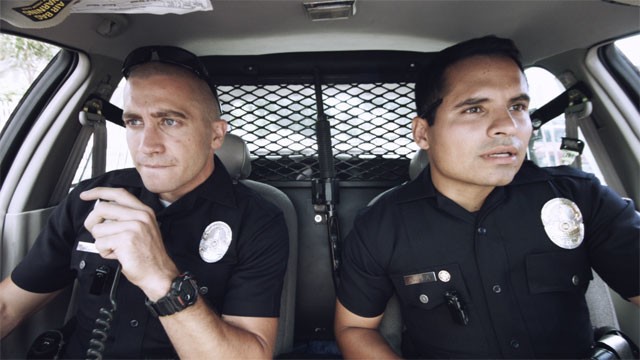
There is one unfortunate problem with the police drama “End of Watch” that sometimes makes it hard to handle; not just because some audience members couldn’t seem to bear it, but also because it’s an overused gimmick that does not work in the film’s favor. But first, let it be said that aside from said-problem, “End of Watch” is a gripping, insightful and effective tale about L.A. street cops who risk their lives with such importance of their mission.

Jake Gyllenhaal and Michael Pena star as Brian Taylor and Mike Zavala, a pair of South Central cops. Paying acknowledgement to everything that “End of Watch” does right (before getting to that important thing later), Gyllenhaal and Pena deliver excellent performances. They’re two ordinary guys who have a strong bond with each other, and the chemistry is existent and natural throughout the film.

Taylor and Zavala’s night-shift job is nothing new for them—responding to disturbance-of-peace calls, rescuing children from house fires, etc. But their beat is mostly full of drugs and gangs, so there’s always that feeling of wanting to look behind you at every step. And surely enough, because they take their job seriously, Taylor and Zavala are watched upon by a Mexican druglord who wants them stopped (meaning “killed”) before they can delay his plans.

While all that’s going on, “End of Watch” progresses with the lives of Taylor and Zavala. This is the best thing about “End of Watch”—it takes the time to develop the central characters outside of their police cars. While the film has the usual ride-along, crime-spree elements (with daring heroics and “that-was-close” moments), it also goes into the lives of these two cops as they connect to each other, banter with other officers, and spend time with their women (Zavala’s wife Gabby, played by Natalie Martinez; Taylor’s girlfriend Janet, played by Anna Kendrick). These sequences are handled with credibility and effectiveness. They’re needed to make the audience care for the lives of Taylor and Zavala when things get nasty on the beat.

“End of Watch” also takes the audience on what feels like an authentic ride-along in its sequences where Taylor and Zavala constantly come across one major situation after another. The action scenes that follow are realistically gruesome and impactful, and it mostly rings so true that you would think you were watching a documentary on the subject…and this would be as good a spot to bring up the key problem with the movie. Taylor, along with other officers (and even some of the gang members), constantly film everything happening around them with handheld digital cameras. This means that the filmmaking technique of constantly-shaking-the-camera-so-the-scene-feels-even-more-intense is evident for the most part of the film. Why does this not work? Well, number one—this gimmick doesn’t work anymore; it’s awkward and overdone. Number two—because a lot of the action scenes consist of the camera shaking, it’s difficult to see some of the action, which is not supposed to be the case of an action film (action films exist to show the action). Number three—what is the point of when the film finally does move to the third-person perspective, the camera still continues to shake violently? It’s distracting, as well as dizzying, and because writer-director David Ayer is already a proven talent, it’s not needed.

Despite that, however, “End of Watch” is recommended because of its riveting elements that make similarly-themed movies look like nursery rhymes. Thanks to solid acting, convincing human drama, a good deal of plausibility, and hard-edged action violence, “End of Watch” works effectively.

NOTE (two years later): After seeing this a third time, two years since I originally wrote this review, I kind of got used to the shaky-cam. It’s like an episode of “Cops” with the double the authenticity. So there you go–I changed the Verdict rating from a 3 to a 3.5 with that in mind, because the film overall is too strong for a 3. (Also, two years later, just a random statement, but I love this line from Michael Pena: “Policing is all about comfortable footwear.”)

True Grit (1969)

22 Jan

truegritremake

Smith’s Verdict: ****

Reviewed by Tanner Smith

“True Grit” is a Western—that old reliable genre that promises excitement, danger, and a likable hero trailing through the great outdoors. “True Grit” features all three of those elements and stretches them out to their strongest.

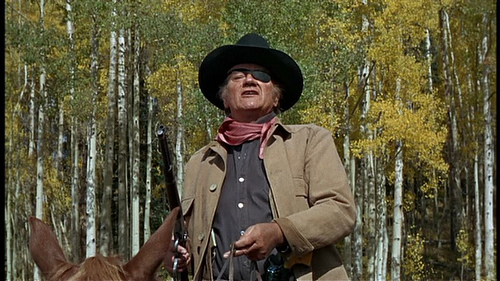
And what classic Western would be complete without the Duke himself, John Wayne? Yes, John Wayne—the good ol’ cowboy who stands up for himself and for others in the most entertaining way, usually leading to a shootout. He’s an iconic legend. And let’s call him the lead actor in “True Grit,” because despite the protagonist position being filled by a young actress named Kim Darby, John Wayne can never be considered a “supporting character.”

In “True Grit,” based on a novel by Charles Portis, John Wayne plays Rooster Cogburn—a one-eyed, overweight, constantly drunk U.S. Marshal. He’s approached by the movie’s heroine—a young woman named Mattie Ross (Kim Darby) whose father has recently been killed by a drunken coward—to lead a manhunt into the Indian Territory to hunt down the rogue that killed her father and see him to justice. He agrees, but only after a bargain, and they set off on their journey. Accompanying them on the hunt is a Texas Ranger named La Boeuf (Glen Campbell), who seeks the same scoundrel for a reward.

There are a lot of neat ideas thrown into the story of “True Grit.” The long setup is at its appropriate length to introduce the characters, build up the tension, and explain things in great detail—including a fresh conversation between Mattie and a local horse-trader. When the journey finally starts midway through the film, you feel like something is at stake here. The journey itself is well paced and put together. There’s a sense of terror and excitement, and the outdoor cinematography is lovely. And I also love how the murderer the three heroes are going after—Tom Chaney is his name—is not a menacing mastermind. He’s just a dumb drunk with a gun. When we finally see him, it’s refreshing to see how truly pathetic he is. More interesting is Chaney’s new leader Ned Pepper, well-played by Robert Duvall. Duvall plays it like an annoyed criminal who should be in a different movie, but is caught up in some mess that one of his gang got him into.

Mattie is able to overcome her fears and learn new things along the way, much like young Huckleberry Finn in his trip across the Mississippi.

What can you say about John Wayne? He’s a distinctive personality—so distinctive that even he can’t shake it. He plays Cogburn the way John Wayne would play it. But let’s face it—you don’t see a movie starring John Wayne to see John Wayne disappear into different roles. You see him to play John Wayne. Putting an eye patch on him doesn’t make the slightest difference in character. But this is not a criticism. John Wayne is always likable in his roles; nobody can play John Wayne like John Wayne.

The casting of Glen Campbell as the cowboy La Boeuf and Kim Darby as the heroine Mattie has garnered criticism from people. They call Campbell a bad actor who struggles with his lines, and John Wayne himself has expressed a certain hatred for his young female co-star Darby, which is strange considering the chemistry that is shown between the characters. I actually had no problem with Campbell or Darby. Campbell is a likable cowboy and seems perfect for the role—grin, personality, etc.

Kim Darby is very convincing as Mattie Ross and plays her character realistically. Mattie is seen as a no-nonsense young gal who’s brave enough to attempt a dangerous trek, but, as most women were in that era, not ready to go on a manhunt. This makes her reactions to many grey scenarios on this trek pretty legit. I liked the character’s dedication and the actress’ freshness. Let’s face it—Kim Darby is the real star of this movie.

Everything leads to a big-bang climax that of course features a shootout, but the odds couldn’t be any less in Wayne’s favor. We’re talking five against one here in an unlikely confrontational situation.

“True Grit” is a fun Western with it all—excitement, atmosphere, danger, and John Wayne! It’s entertaining, thrilling, unpretentious, and a joy to watch.

True Grit (2010)

22 Jan

images

Smith’s Verdict: ****

Reviewed by Tanner Smith

“True Grit” is not so much the remake of the 1969 Western of the same name that won John Wayne his Oscar, but more of a new adaptation of the novel by Charles Portis. But to be fair, practically everyone else is going to label it as a “remake” of the 1969 version. And it was a dang good Western too—adventurous, exciting, and fun. Now we have this new version created by the Coen Brothers—Joel and Ethan Coen of masterpieces such as “Fargo” and “No Country for Old Men.” If anyone, they’re two of the first few people I would be interested in seeing pull this off. The result is more compelling than you might think.

This update is not, by any means, a joyful Western. It’s a dirty, terrifying, disturbing adventure-thriller that happens to take place in the Old West. In other words, it’s one of the best Westerns to come around in a long time. It’s kind of a refreshing change of pace. And besides, when you remake a movie, it’s almost pointless unless artistry is thrown in.

The story is the same as in the original film. 14-year-old Mattie Ross’ father has been killed by a drunken cowardly snake named Tom Chaney. So she goes into the city to hire US Marshal Rooster Cogburn, a fat, dirty, constantly drunk, vile man, to lead a manhunt into the Indian Territory to find him. Accompanying Mattie and Cogburn is only one Texas Ranger named La Boeuf (sounds like “La Beef”). The journey is essentially the same as in the original—the unlikely trio of heroes ride along the Indian Territory on their horses and come across some grim situations involving outlaws until they finally come across Tom Chaney, his leader Ned Pepper, and their gang.

There are new touches added this time around, with some disturbing imagery. For example, there’s a man hung high from a tree and Mattie has to cut him down for Cogburn to see if he knew who he was. Then there’s a man clothed in a bear-skin who takes the body’s teeth and asks if there’s an offer for the “rest of him.” So strange, so disturbing…so brilliant. It adds to the grimness that Mattie has to learn to conquer.

Here’s another new touch added to the new version—Mattie’s attitude towards this whole adventure. In the original, Mattie Ross, played by Kim Darby (much older than her character—she was about 20 while her character was 14), was a realistic figure—showing that there is fear to overcome while knowing that she’s out of her limit on this manhunt. In this remake, Mattie, solidly played by newcomer Hailee Steinfeld, is much more bitter and far more determined to hunt down the man who killed her father. She’s so determined to the point where she just doesn’t care about what may lie ahead for her on this journey. All she has is vengeance on her mind. Don’t get me wrong—Mattie in the original had determination for justice too. But this Mattie is determined to a more extreme level.

John Wayne played Rooster Cogburn in the original film, but let’s face it—not many people called him Rooster Cogburn throughout the movie; we called him John Wayne, because there’s no one else he can play (not that that means he isn’t great at it). In this remake, he’s played by Jeff Bridges—kind of an odd choice for the great actor, although he has disappeared into his roles to the point where we forget that it is Jeff Bridges playing them (like the Coen Brothers’ other production, “The Big Lebowski”). But the truth of the matter is that Jeff Bridges is absolutely perfect as Rooster Cogburn. He looks right and more importantly, he feels right. This is a role that he gets completely lost in. Even his speech, though somewhat indistinct at times, seems legit. It’s all the more effective when you realize that you would rather spend more time with John Wayne’s welcome presence than Jeff Bridges’ intimidating swagger. What makes him interesting is we don’t know what makes him tick. We don’t know what puts him on edge, but we don’t want to be around when he is.

La Boeuf was played with grinning delight by Glen Campbell in the original film. This time, he’s played by Matt Damon. And if you think Matt Damon doesn’t belong in this movie, here’s a news flash—La Boeuf doesn’t belong in this journey. He’s like a hero from another movie that found himself out of his element, playing sidekick in this movie. And the truth is Matt Damon does do a credible job at playing the cowboy who’s in way over his head.

The villains are about the same, but still well-acted. Josh Brolin is the dumb, pathetic Tom Chaney and Barry Pepper is the tough, thinking Ned Pepper (wait, what?) and they’re well-suited for their roles.

So the mood and character traits are darker this time around. But it’s not just that. The cinematography is dark and moody as well. Remember how in the original film, we caught those beautiful landscapes? Well here, the landscapes are about as empty and unpromising as an apocalyptic wasteland. This is a darker, more complex re-imagining of a Western that seemed fun. Even the ending is different and more sour. There’s no happy ending with John Wayne riding off on his horse into the sunset. Heck, there’s barely even a happy ending. It just…ends. And strangely, that’s so effective. It teaches that a life fueled by vengeance is not the best way to live.

“True Grit” has the same quality of a Coen Brothers’ movie, so it came as no surprise that they made it. The dialogue is quirky, the side characters steal the show (particularly a horse trader played by Dakin Matthews and a landlady played by Candyce Hinkle), and there are some odd little touches added to the shots—that’s how you know this is a Coen Brothers’ movie. And it’s dark, mysterious, and compelling, like their best thrillers. And if you think you’re ready to see Jeff Bridges play a cowboy, don’t say you weren’t warned, partner.

NOTE: There’s a subtle music score that seems to follow the melody of the hymn, “Leaning on the Everlasting Arms.” I noticed it midway through the movie and was wondering if there’d be a lyrical rendition for it later. And if there’s one thing I hate about this movie, it’s whoever they chose to sing that song in the end credits!

Runaway Train (1985)

22 Jan

52471

Smith’s Verdict: ****

Reviewed by Tanner Smith

When I heard that “Runaway Train” featured a runaway train loose on train tracks in Alaska, it didn’t sound like an exciting film. With the grim look that can only be executed when a film takes place in snowy weather—and a film that is supposedly action-packed, for that matter—I asked myself how I could get excited or even invested in “Runaway Train.” But then I saw the film, directed by Andrei Konchalofsky, and I realized that this wasn’t a formula action picture. This isn’t only about stopping a runaway train; this is actually a character-based story in which the characters happen to be on a runaway train. In this case, it doesn’t matter where the film takes place; if the characters are rich and plausible, we’ll go along with it.

The movie stars Jon Voight and Eric Roberts as two convicts who escape from a maximum-security prison in Alaska. But first, we get proper introductions to the two men while they’re in prison. Voight plays Manny, a man so untrusted by the warden that his cell doors have been welded shut for years—the warden tells the press, “He’s not a man—he’s an animal.” Roberts plays Buck, a convicted rapist (“statutory rape,” as he corrects Manny) who works for the prison laundry and whose sentence is almost finished.

The warden is Ranken (John P. Ryan), who personally has it in for Manny and arranges for him to be let out among the prison. He hopes that Manny will escape so Ranken can hunt him down and kill him himself. That’s exactly what Manny does—the dim-witted Buck tags along with him because he’s in the mood for excitement. The two men escape through a sewage drain tunnel and stumble through the mountains.

Then, they sneak into one of the back cabs of a train that is carrying four cars linked together. But what they don’t know is that the engineer has had a heart attack shortly before the train left, and fallen off. The two men are alone, not knowing why the train is picking up a ridiculous amount of speed or why the train whistle is never blown…or why the train is crashing through things. We get a second series of events that involve the railway dispatchers who try desperately to find a way to stop the runaway train.

Oh, and of course, the slimy Warden knows that Manny is inside. He is desperate to find the train and kill whoever is inside. Back on the train, Buck and Manny don’t know what’s going on until they come across a female worker on the train (played by Rebecca De Mornay), who tells them about the situation. Now these three people must band together and try to survive this incredible ordeal.

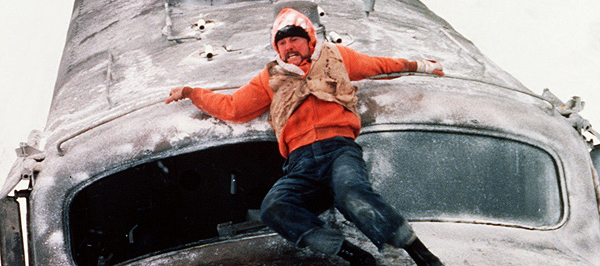
“Runaway Train” is more about characters than about action. This is a real surprise—the real suspense doesn’t come from the notion of whether or not the characters can stop the train before it heads for disaster. It comes from the notion of whether or not the characters can survive together. Although, if you want action, there are great stunts and moments of real tension, particularly when the train crashes through the caboose of another train (which nearly makes it into a siding), and when the characters attempt to slow the train down a little bit after climbing alongside the ice-covered cabs. (There’s no walkway from the second to first engine, heightening the danger.) There are two perfect scenes of tension that really takes us on edge. One scene involves a showdown over sacrifice and friendship as Manny and Buck circle each other; Buck with a wrench, Manny with a knife. At this point, Manny’s hand is badly injured, but Manny still doesn’t see that Buck is the bigger threat in this situation. This scene is intense, mostly because it shows how these characters will act in dire circumstances. The outcome of this sequence comes as a surprise, but it’s believable.

The other sequence comes near the end, as the warden Ranken catches up with the train by helicopter and dangles from the chopper to get inside and kill Manny. Manny isn’t giving in—he goes for Ranken himself, risking his life to get to the front of the train. I won’t give away the outcome of this also-intense sequence, because it would be giving away the ending of the film.

Jon Voight gives one of his best performances as the convict Manny, a man who is intelligent and philosophical in his own way. I love the speech he gives to Buck, played by Eric Roberts as a man with little intelligence and looks to Manny as a hero, about how limited their own choices will become in the future. Voight brings a powerful presence in that scene, and throughout this movie.

Rebecca De Mornay doesn’t play the standard female love interest, but then again, she isn’t playing much of a character in this movie. But the reason that audiences can identify with her is because she acts as outsider to Manny and Buck’s attitudes to the situation and to each other.

“Runaway Train” isn’t a standard action picture—it’s a special film that mixes action and suspense with three-dimensional characters. It doesn’t matter where it takes place. It’s still exciting and riveting.

Jurassic Park (1993)

22 Jan

jurassicpark061411[1]

Smith’s Verdict: ***1/2

Reviewed by Tanner Smith

When it comes to monster movies, I can barely think of one with as much production value as “Jurassic Park.” The budget was huge enough to afford the best dinosaurs that could be created in Stan Winston’s Creature Workshop. As a result, we don’t merely get scary dinosaurs. We don’t go to see this movie for just-scary dinosaurs. What we get really seems like real dinosaurs.

Steven Spielberg’s “Jurassic Park” has some of the best-looking creatures I’ve seen in a movie. When you first see them the same time the protagonists see them, you’re in as much awe as they are. Here are these giant, elegant creatures traveling in herds. You look in awe and wonder because they look real, as do the other dinosaurs that the characters come across later in the movie—a ferocious Tyrannosaurus Rex, a herd of stampeding Gallomimus (spell-check?), and the fearsome Raptor. But of course, with those, you look less with awe…but more with fear.

The premise for “Jurassic Park,” based on a popular novel by Michael Crichton (unread by me), is an intriguing one. It features an eccentric billionaire named John Hammond who funds a theme park on a remote island only reachable by helicopter. What’s the theme? Dinosaurs!

This place is called Jurassic Park and it promises a tour through a forest to see live dinosaurs, cloned by the DNA found in a fossilized mosquito. (Don’t ask—it’s complicated.) The dinos are separated and kept obscure by electric fences. The park needs endorsements, so Hammond calls paleontologists Dr. Alan Grant and Dr. Ellie Sadler (Sam Neill and Laura Dern) and mathematician Ian Malcolm (Jeff Goldblum). Also along for the ride are members of the park’s target audience—Hammond’s grandchildren Lex and Tim (Ariana Richards and Joseph Mazzello).

The park’s tour turns to be a bust, but it only gets worse as one of the park’s operators—an overweight sleazeball, played by Wayne Knight (Newman from “Seinfeld”), has shut down most of the electrical system for his selfish reasons. Among those shut down are the electric fences, allowing the dinosaurs to roam free about the park while the people are trapped. The terror begins in a sensational sequence in which a T-Rex attacks the two kids in the tourist car.

So mainly the second half of “Jurassic Park” is a monster movie, as Grant and the two kids are separated from the others, who try to get the park back in control from inside the command center, and come across more obstacles and more beasts. The more dangerous of these beasts, you would suspect, would be the T-Rex, but that’s only because he’s bigger. The more frightening creatures on the loose are the raptors, which are smaller but more ruthless and more vicious. They wind up being the ones the characters have to face near the end of the movie.

OK, so the technical aspect of “Jurassic Park” has been praised. How does characterization do? Well…not so strong. Grant and Sadler aren’t fully developed as individuals and seem more like figures than actual characters. The Wayne Knight character is as developed as…well let’s face it, Newman. The kids are fine.

Hammond and Malcolm do close closer to being fully realized individuals. Hammond’s greed and love for dinosaurs gets to him and he slowly but surely realizes it when things go very wrong, and Sadler brings things to a new perspective for him in a scene midway through the movie. Malcolm is an interesting character, always discussing chaos theory and giving more input along the lines of “when-man-plays-god-man-loses.” The only reason Hammond doesn’t listen to him is because of his sharp wit, which Jeff Goldblum can deliver in a funny deadpan way.

The characters in Spielberg’s  “Jaws” and “Close Encounters of the Third Kind” are well-developed and fully realized. In “Jurassic Park,” it seems more time was spent on making the dinosaurs look real than the characters who have to face them. But you can’t deny the thrilling action scenes, the fun monster movie style, and those sensational dinosaur effects.

La Bamba (1987)

22 Jan

bamba-1987-06-g

Smith’s Verdict: ***

Reviewed by Tanner Smith

“La Bamba” tells the story of late rock star Ritchie Valens, who at the age of seventeen and in the time span of six months, had three hit songs that made him famous and a declared rock-n-roll sensation. And because that isn’t quite enough material for a biopic such as this, most of the events that took place in the lives of Ritchie and his family are stretched out for the film, mostly to effective results.

In the 1950s, Ritchie Valens (whose real surname was Valenzuela) was a Mexican-American who was raised in migrant labor camps in Northern California, idolized his older, motorcycle-riding half-brother, and had a deep admiration for his music. When he moved to a suburb in Southern California, along with his mother and siblings, he performed wherever he could until he finally got himself noticed by more and more people to become something special.

I guess you could consider “La Bamba” to be a follow-up to the great “The Buddy Holly Story,” which told the events of rock star Buddy Holly, because Buddy Holly, Big Bopper, and Ritchie Valens on February 3, 1959. That day was described as “the day the music died.” Maybe it didn’t die, but it was a dreadful event for all three individuals. It was all the more tragic, in that Ritchie was only seventeen years old when he died.

So how does “La Bamba” fare out, telling the story of Ritchie Valens this time? Well, just fine.

What problems do I have with “La Bamba,” which is otherwise a sweet-natured feel-good movie about a kid following his dreams and becoming famous for his music? Well, there are two issues I have with this movie, and unfortunately, they are major. For one thing, adding that Ritchie has nightmares about plane crashes, thus increasing his fear of flying, makes it kind of sick, considering that we know that Ritchie Valens (along with Buddy Holly and Big Bopper) died in a plane crash. When Ritchie takes that fateful trip, he seems relaxed over his fear by now. Why was this necessary?

The other problem I have is with the music. I mean, the music sounds nice—of course, they’re memorable tunes by Ritchie Valens (“Come On, Let’s Go,” “Donna,” and of course, “La Bamba”). But the real issue with the musical performances in this movie is that I really didn’t believe that what I saw on screen was actually being performed. It was just so obvious that the performances were overdubbed, which I realize must be done in movies like this. But the trick is to hide the fact that the music is being dubbed over; “La Bamba” doesn’t succeed. There are some exceptions, though. For example, when Ritchie and Bob visit Tijuana for a night, the folk performing the original “La Bamba” (which inspires Ritchie’s rock-n-roll version) sounds nice and credible. And the concert performing of Ritchie’s “La Bamba” does indeed sound like a genuine concert performance. Other than that, however, I was never convinced I was seeing Ritchie Valens sing or hearing him perform—I just saw actor Lou Diamond Phillips acting like him.

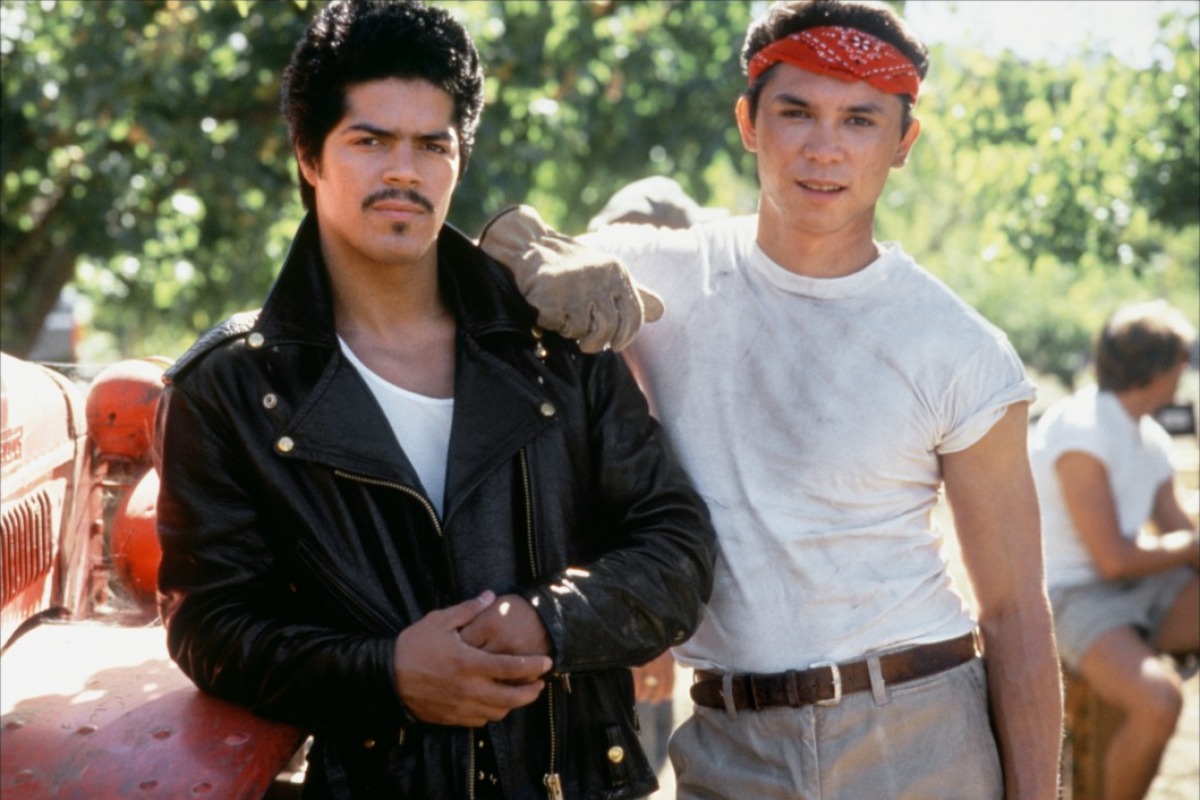
What do I like about “La Bamba?” To tell the truth, I liked the stuff that had nothing to do with the music, particularly the family aspects and conflicts. Ritchie (Lou Diamond Phillips) has help from his hard-working, caring mother Connie (Rosana DeSoto) to get his music career going. She works as his manager for small stuff, like performing at a bar, until Ritchie gets an agent—Bob Keene (Joe Pantoliano), who is a wise-guy type but reliable nonetheless. But then, there’s Ritchie’s rebellious half-brother Bob (Esai Morales). There are times when he is supportive of his younger brother’s fame, but other times when he’s resentful. He becomes a source of certain trouble for the family and Ritchie’s career. There’s also a sweet relationship between Ritchie and his Anglo girlfriend Donna (Danielle von Zernick), whose father don’t approve of Ritchie either because of his race or because of his “jungle music,” which the father calls it. Each of these scenes have a nice sentimental quality to them and they make the movie work, despite its flaws. They give a nice portrait of everyday life and there are good actors playing these roles. Lou Diamond Phillips is appealing as Ritchie, Rosana DeSoto is convincing and winning as the mother, and Esai Morales is excellent as the older brother who both loves and resents his brother. “La Bamba” isn’t the great movie that it could have been, but its sweet, fun moments weigh a little more than the unnecessary parts.

Blood Simple. (1985)

22 Jan

images

Smith’s Verdict: ****

Reviewed by Tanner Smith

“Blood Simple.” is the first film created by the Coen Brothers—directed by Joel Coen, produced by Ethan Coen, and written by both. Like many first-time directors fresh out of film school, they take joy in showing everything they can, involving “style” into their first big project. The product works—“Blood Simple.” is a tense, well-executed thriller that proves great talent by promising filmmakers.

“Blood Simple.” Isn’t one of those thrillers that keeps you guessing with its many “uncertainties” that the filmmakers love to play with. It tells a straightforward story, but goes through entire detail in showing it. There are many twists and turns as the film continues, but the strange thing is that they all seem like they were meant to be. And while doing so, it taps into fear and guilt—what happens after a murder is committed, you think you might be blamed for it, and you try to dispose of the body?

What’s the story? This is going to be difficult to explain without giving away certain things that I would rather not reveal. The less you know about it, the better. I’ll just give you the setup. Julian Marty (Dan Hedaya) hires a private investigator (M. Emmet Walsh) to spy on his wife Abby (Frances McDormand) and her lover Ray (John Getz). The private investigator takes many pictures, which further enrages Julian. So he pays the P.I. to murder them. But something goes very, very wrong.

Period. That’s all I’m going to say about the plot. I knew close to nothing about this movie when I first watched it, and trust me—not knowing what’s going to happen makes it more special. Let’s just say that there is a lot of trouble in disposing a corpse in the film’s very best sequence. Without naming names, someone finds the body, thinks he knows who committed the crime, decides to dispose of it himself, and clean up the mess. There’s blood everywhere, and it stays there no matter how hard he tries to clean it all up. Then he puts the body in his car, but wait a minute! While the car is stopped, the body gets up and tries to crawl away! And someone is coming! Then what? It’s just a crazy sequence that gets more complicated and more dangerous as it goes along.

Everything is so mixed up, the characters don’t even know who’s really who during this mess. It leads to further complication, more guilt, more fear, and a heavy dose of tension. This is one of the more gripping, shocking thrillers I think I’ve ever seen.

The visual style is incredible. Every shot in this moment has something interesting to look at; even everyday things, like a simple door or a plowed field (with tire tracks across it), or gruesome things, like a bullet hole in the chest. There’s even a shot in which a character feels guilt and a newspaper is thrown at the screen door, looking like a soaring missile about to strike. The cinematography is great, with its low-angle shots, high-angle shots, zoom-ins, and tilt shots, and never to the point where it’s all over the map. It’s consistently brilliant. We’re interested in keeping our eyes on the screen the whole time.

“Blood Simple.” is a stylish film and an original, intelligent thriller, and it just shows how far the Coen Brothers will go from it.