Archive by Author

Thor (2011)

27 Jan

images

Smith’s Verdict: ***

Reviewed by Tanner Smith

I shouldn’t be too surprised that Kenneth Branagh, the great cinematic adaptor of Shakespearean work, directed a movie based on a Marvel comic book series. I mean, after all, every director likes to try new territory. I mean, look at Ang Lee—he made a “Hulk” picture and then followed it up with “Brokeback Mountain.” And let’s not beat around the bush—Branagh’s “Thor” is a fast, energetic entertainment. It’s well-made, exciting, and features a charismatic new superhero brought from the page to the screen.

Thor (Chris Hemsworth) isn’t your ordinary superhero (boy, that’s a phrase I thought I’d never use). In the land of Asgard, within the “nine realms,” he’s the arrogant god of thunder with an all-powerful hammer. Ascending to the throne by his father Odin (Anthony Hopkins), his ceremony is interrupted by otherworldly beasts known as the Frost Giants of Jotunheim, who are at war with Asgard. In anger, Thor attempts to damage the land of the Frost Giants, which only risks further war.

This nearly-half-hour-long prologue is undoubtedly silly in its storytelling, but it is necessary in developing the continuing story, and it includes the expository rules-and-regulations of this world for us to watch out for. And I have to admit, the battle between Thor and his friends vs. the Frost Giants is well-edited and very riveting.

But the movie really picks up at the half-hour mark, as Thor is ridden of his godly powers (and his hammer) and banished to modern-day Earth for his egotism. There, he meets scientists Jane Foster (Natalie Portman), Erik Selvig (Stellan Skarsgard), and Darcy Lewis (Kat Dennings).

This is the most interesting part of the movie because it shows Thor without his powers and having to deal with being in a strange world as a human. At first, he isn’t so accepting of it—and why wouldn’t he, after going from hero to zero? But what gives the story a breath of fresh air is that this arrogant, stubborn barbarian is willing to learn how to adapt. For example, he has a drink of coffee, he enjoys the drink, and he smashes the cup and yells for more. Jane tells him he can’t do that and Thor just accepts that.

Anyway, there’s a conflict back home involving the Frost Giants seeking to kill Odin, and Thor’s brother Loki (Tom Hiddleston) rising to power after Odin is suddenly in godly traction, I should say. (By the way, am I the only one confused that gods just slip into comas? But I digress.) And then there’s the matter of Thor seeking to gain his power pack, and his hammer held by the government who are trying to figure out what this is. And wouldn’t you know it—it’s the S.H.I.E.L.D. group that’s holding it. Who else would it be, right? Luckily, that annoying, ominous, eye-patch sporting Samuel L. Jackson only waits until after the end credits, for yet another setup to the upcoming superhero epic “The Avengers.”

The stuff with the Frost Giants and the war between Asgard and Jotunheim is pretty clustered and clumsily handled. While it does make some neatly-paced action scenes, I’m not sure I understand what’s really at stake. We start out believing that these Frost Giants are the bad guys and yet Thor grows to try and stop Loki from forming an annihilation of their land. I don’t know, maybe he’s figured out that all life is sacred.

Chris Hemsworth portrays an appealing Thor. He’s strong, but has a heart of gold. He’s arrogant, but knows when to focus. He’s wild at times, but he tries to make something out of himself. Hemsworth brings Thor more dimensions than you’d expect, especially if the character is going to change from a god to a mortal and having to learn from it.

The three people befriended by Thor are also well-cast. Natalie Portman is lovely and likable as always, although I probably could have used a stronger love story between her character and Thor. As it is, it seems rushed and forced, but it’s not Portman’s fault. Stellan Skarsgard is outstanding as Erik, who does more than deliver helpful advice. On hand for comic relief is Kat Dennings as deadpan cynic Darcy, who has some of the funniest lines in the movie (one of which is, “You know, for a crazy homeless guy, he’s pretty cut”).

Now, I want to talk about Thor’s brother Loki, who becomes the villain. When I first saw this movie, I didn’t find Loki to be a charismatic, or even interesting, arch-nemesis for Thor. Right from the get-go, I thought he might as well be walking around with a thought bubble hovering over his head, saying “Oh you’re so dead.” Don’t tell me I didn’t get it. I got it, alright? It’s the Shakespearean element of the jealous brother looking to be rid of his more skillful older brother so he can gain no more attention than him, and so he goes mad with power and decides to further declare war over these Nine Realms. And particularly, he’ll destroy the Earth. Of course.

The truth is, watching the film a second time, I see that I may have missed a few things with this character and realizing that, I can see the effective buildup to this character. You totally buy why he would do these things. But once he goes gain power, he’s still as disappointingly adequate as I remember.

So even if the villain isn’t that charismatic, the screenplay can be a little rushed, and elements from this other-world can seem ridiculous, “Thor” is still a grand production, as you’d expect from Kenneth Branagh’s films. You can tell that Branagh, and designer Bo Welch, went all out to make everything creatively huge—it’s more than notable that the sets and costumes really stand out. And Thor himself is how I imagined him to be, with credits going to his costume design and of course the performance by Chris Hemsworth. Add an interesting fish-out-of-water tale featuring Thor adapting to Earth, as well as some Shakespearean elements to be found here, and “Thor” is an entertaining superhero tale.

NOTE: I really hate to have to say that about Samuel L. Jackson’s Nick Fury, since he’s one of my favorite actors. But his coolness has worn out its welcome after the second time he’s brought up the Avengers project.
A Simple Plan (1998)

26 Jan

Simple Plan

Smith’s Verdict: ****

Reviewed by Tanner Smith

The title of the thriller “A Simple Plan” represents a form of irony. There is no simple plan. Every time the characters think they’re following a “simple plan,” things just get more complicated and difficult as they go along. The plan ends with disastrous results. Nothing is simple in this movie.

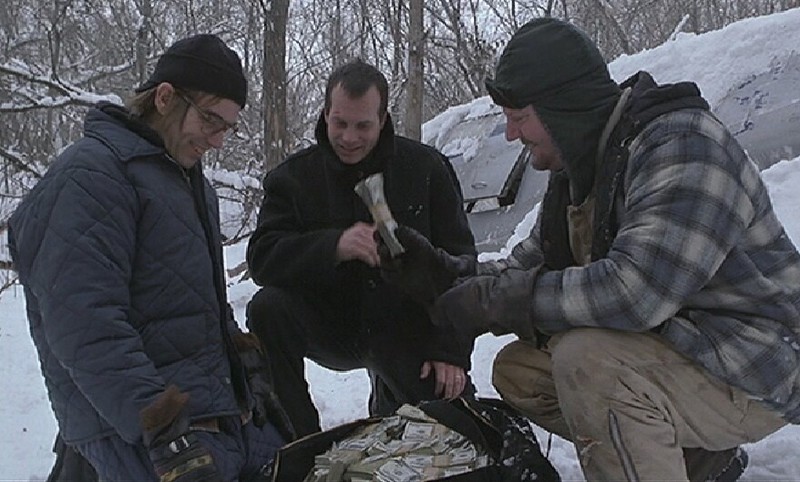
The film takes place in the winter in a small, rural Midwestern town. The protagonist Hank (Bill Paxton) is a nice, bright man living a happy life with his wife Sarah (Bridget Fonda). He has everything he believes a happy man should have, which he states in an opening narration—a lovely wife, a decent job, and people who like and respect him. Then one day, something happens that changes his life. As he, his mentally-slow brother Jacob (Billy Bob Thornton), and their rowdy, drunk friend Lou (Brent Briscoe) stumble through the woods, they come across the wreckage of a crashed plane, where they find a duffel bag filled with money—millions of dollars in cash.

Amazed by this discovery, the trio is split about what to do with it. Hank wants to do the reasonably smart thing and turn it in to the authorities to let them handle this. Lou believes that nobody has to know and that they should all keep the money. Jacob has no opinion—he’ll just go along with whatever his brother and friend agree on. Lou acts as the devil on Hank’s back—“It’s the American Dream in a gym bag and you wanna walk away from it.” Hank tries to counter by saying, “You work for the American Dream. You don’t steal it.” Lou and Jacob think that since the money probably belonged to some drug dealers, then it’s no problem if they keep the bundle for themselves.

Reluctantly, Hank agrees to hide the money until they’re sure no one’s looking for it or the plane. Then they’ll all split it. In the meantime, Hank keeps the money in his house and lets his wife in on the secretive “simple plan.” Sarah becomes Hank’s silent partner in keeping the money hidden and making sure that no suspicion is present.

This seems like a relatively harmless and, for lack of a better word, simple plan. Hank is undoubtedly the most responsible in the group and as long as Jacob and Lou keep it a secret (and they will, if they want to keep the money), nothing should go wrong. But Sarah suggests that Hank return $500,000 to the plane, so that whoever’s looking for the money won’t be suspicious if they find the plane. OK, a little roadblock. Easily fixable, right?

Wrong. Everything you think can go wrong with this plan goes wrong from that point on. There are consequences, mistrusts, further complications, and the whole situation just becomes a disaster that Hank has to face. Oh, and just when you think everything is finally going to go right, they still have a way of turning around. The money is still around and it will always be a problem. Hank’s right—“You don’t steal the American Dream,” no matter how easy it may seem at this moment.

“A Simple Plan” is an ingenious thriller that plays with tension and storytelling. The screenplay was written by Scott Smith, based on his novel, and it’s brilliantly written in the way it handles this bizarre situation and its further implications. The director was Sam Raimi, who wonderfully portrays the small-town life in the surface of the growing tension between the characters. He keeps the suspense alive. He also uses a snowy backdrop for a chilling atmosphere, much like how the Coen Brothers handled their environment in “Fargo.” (Incidentally, Raimi asked the Coens for advice in filming in this weather.)

“A Simple Plan” faces its moral implications head-on. In order to keep the plan a secret, a character has to do something horrible to help it remain a secret. And then, the characters are forced with the crisis of what they’re going to do, and their decisions bring additional complications for them to handle. The characters deal with it, they talk about it, they have discussions, etc. And we, as an audience, are involved and brought along to follow the story, wondering how they’re going to get out of this.

The performances are flawless. Bill Paxton brings an everyman quality to the role of Hank, and he’s easily identifiable. This is why when paranoia and deception sometimes takes over in his mind to the result of a horrible deed, we feel sorry for him. We’re hoping that things will turn out okay for him. Brent Briscoe is suitably slimy as Lou, who winds up demanding his share of the money soon enough. Bridget Fonda is ultimately solid as a woman who starts to take charge of the situation for the good of her husband.

But in an ensemble cast of flawless performances, one that will undoubtedly catch the most attention is Billy Bob Thornton as Hank’s dim-witted but good-natured brother Jacob. Thornton is absolutely perfect in this film. Playing Jacob by walking a fine line between gentle and psychotic, Thornton delivers a striking portrayal of a slow-minded man who learns to think faster than he has before, and actually has his moments of revelation as well—probably more than what can be said for the other characters who attempt to go on with this secret. Thornton is always appealing in this role, and sometimes even quite haunting.

“A Simple Plan” is a superb thriller with greatly effective storytelling and great acting. It’s an involving story from beginning to end—suspenseful, tense, stylistic, complex, and plausible. And just remember—if you think you can get away with something like thievery, just remember to think about what you’re getting yourself into. There is no simple plan.

Batman Forever (1995)

26 Jan

batman-forever-twoface-the-riddler-tommy-lee-jones-jim-carrey

Smith’s Verdict: **1/2

Reviewed by Tanner Smith

“Batman Forever” is the third entry in the Batman film adaptation series, following the box-office hits “Batman” and “Batman Returns.” Those two movies were directed by Tim Burton, who certainly gave the Caped Crusader a dark edge and a really dark story in each of the movies. They weren’t necessarily aimed at smaller children, which kind of ticked some people off, since they were hoping for lighthearted family adventures to take the whole family to see. So, for the third movie, Tim Burton wasn’t the director, and made way for Joel Schumacher. The result is “Batman Forever,” which is not completely satisfying, but still the Batman movie that audiences were hoping for—an amusing, high-spirited, brighter, more colorful, fast-paced thrill ride.

There are certainly more kid-friendly jokes such as the closeups of the batsuit buttocks and batsuit nipples, which are shown right at the opening as Batman is suiting up and preparing for action. And there are some pretty cheesy lines, like—“It’s the car, right? Chicks dig the car”—and—“Not every girl makes a superhero’s nightstand.” And to keep things less terrifying for the kids (I mean, compared to Danny DeVito’s repulsive Penguin in the previous film), Tommy Lee Jones and Jim Carrey as Batman’s arch-nemeses play their roles so over-the-top that you can’t take their roles seriously. You just sit back and laugh at their goofy antics.

A lot happens in “Batman Forever.” So I’ll try to fit everything into the story description. Batman a.k.a. eccentric billionaire Bruce Wayne (Val Kilmer, taking over for Michael Keaton) is still fighting crime in Gotham City, but now has two villains to conquer. The first is Two-Face (Tommy Lee Jones), who was the former lawyer Harvey Dent until he went insane after half of his face was badly burned. He has his own aids by his side and he’s diabolical enough, but he’s not necessarily intelligent. This is where Edward Nygma (Jim Carrey) comes in. Nygma is a scientist working in Bruce Wayne’s electronics department. He has invented a machine that to beam television waves to your brain—just think of the ultimate 3-D. He tries it on himself and becomes…well, “wacko.” He hopes to ultimately humiliate Bruce since he was the one who shunned his invention, and also hopes to rule Gotham City. Getting a green suit & mask and calling himself the Riddler because he loves to create difficult riddles for his new subjects to solve, he joins up with Two-Face as they race to kill Batman.

But meanwhile, Bruce has a few problems to deal with. One is seducing a female psychiatrist named Chase Meridian (Nicole Kidman), who only has eyes for the Caped Crusader. (“It’s the car, right? Chicks dig the car.”) But she seems to know a lot about split personalities, which everyone in this movie seems to have, so it shouldn’t take too long for her to figure out who Batman is.

Also, there’s a new boy in Wayne Manor—a young acrobat named Dick Grayson (Chris O’Donnell) whose parents are killed by Two-Face at their circus show, while Two-Face tries to get to Batman. Bruce feels sorry for Dick and, along with his butler Alfred (Michael Gough, reprising his role), takes him in. But the problem is Dick is a rebellious, motorcycle-riding street punk who sometimes attempts to run away. However, Bruce shows Dick his motorcycle collection and everything seems cool. And if Dick proves to be loyal enough, maybe he’ll become Batman’s sidekick, called Robin.

The storyline is overstuffed, as you may have noticed. But they do deal with some interesting developments, such as the new romance and the new father/son type relationship with Bruce and Dick. And like I said, the movie is mostly cheerful fun in its action, which is fine for those who thought “Batman Returns” was too dark and gloomy for audiences. We have many one-liners from the heroes, laughs for the villains (particularly the Riddler), and some cute visual gags that pass for neat gimmicks and some outstanding stuntwork. For example from that last one, I love how the Batmobile rolls straight up the edge of a skyscraper—it’s one of those moments that remind you of the original campy 1960s TV series “Batman.”

The movie looks good—brighter and more colorful in how it presents Gotham City, with its many towers, bridges, and expressways. There are many impressive sets along with fantastic art direction—like the villains’ lairs and laboratories. There’s a really neat visual style in “Batman Forever.”

Val Kilmer makes a nice Bruce Wayne, though a little pale in comparison to Michael Keaton’s great performance. In fact, there are times when he comes off better as the role of Batman than Bruce Wayne. Tommy Lee Jones is wonderfully over-the-top as Two-Face, but not so much as Jim Carrey, who goes beyond nutty as the Riddler. Nicole Kidman is suitably bright and feisty, and as Dick “Robin,” Chris O’Donnell is an appealing casting choice.

By the way, there’s something I should say about the portrayal of Robin. This is possibly the only thing that’s taken seriously in “Batman Forever,” if you can believe it. You can feel Dick’s plight, having losing his parents and understanding why he does what he does in the final act—suiting up as Robin. Also, while the other Robins sport suits that act as human bullseyes, this Robin’s outfit is still somewhat flashy, and yet this one looks pretty cool.

Now, even though I’ve mentioned a lot of positive things about “Batman Forever,” I can’t quite recommend the movie, mainly because I didn’t buy into the lightheartedness as a whole movie. Batman is conflicted and the other two films did terrific jobs at showing that while also have their light moments to balance out the really dark moments. This Batman movie is sort of all over the place, not really making us feel like this is the Batman we all know and admire. Even though there were things I liked about “Batman Forever,” the movie as a whole didn’t work for me.

Wes Craven’s New Nightmare (1994)

26 Jan

wes-cravens-new-nightmare

Smith’s Verdict: ***

Reviewed by Tanner Smith

“Wes Craven’s New Nightmare” is the seventh entry in the “Nightmare on Elm Street” horror movie franchise, with director Wes Craven back in the saddle after the original film ten years before. I liked Craven’s original film, and I thought the five sequels that followed were dull, standard slasher films (though with a few good twists thrown in, particularly in the third movie), all of which Craven had little to do with. But Craven has returned for a seventh film, and it’s the best one in the series.

The “Nightmare on Elm Street” franchise has been popular mainly because of its villain—the serial killer with knives for fingers and a dark comic personality: Freddy Krueger. But wait. If Freddy died in the sixth film—actually entitled “Freddy’s Dead”—then how can he come back for a seventh film? It’s the same reason killer Jason Voorhees came back for more “Friday the 13th” sequels. The public wants him back, so the character keeps coming back. Horror movie monsters can transform into cultural phenomenon to the point where maybe they create their own existence in reality that forces the writers to create a new script for them.

That’s a crazy idea, but “Wes Craven’s New Nightmare” is centered around that idea. What if Freddy wasn’t a horror movie character, but more like a real thing? What if he didn’t like, as much as his fans, the idea that his character was killed off? This movie plays with that concept and has a lot of fun with it. The result is a quite intriguing horror film.

“Wes Craven’s New Nightmare” brings Freddy back to life, as he haunts the nightmares of a few people who worked on the original “Nightmare on Elm Street” film. Most notably troubled is Heather Langenkamp, who played the heroine Nancy in the original film. She gets strange, harassing phone calls from a caller who sings the haunting “Freddy” song (the one that goes, “1, 2, Freddy’s coming for you”). Her son Dylan (Miko Hughes) has an odd habit of sleepwalking and murmuring, “Never sleep again,” while also putting himself in great danger. Robert Englund, who played Freddy in the films, is having nightmares and painting weird pictures.

And Wes Craven himself has been having nightmares too, and is writing a script for a new screenplay. When things start to go very wrong, and Heather actually starts to believe that Freddy might be alive in the real world, she asks Craven about what he’s writing. It turns out that what he’s writing becomes real in Heather’s life. Craven believes that the only way to stop Freddy is to make another movie, and because most of the story involves Heather’s original character, Heather is the focus. This means she has to fight Freddy as Nancy again. Only this time, there’s no shouting of “cut” for reshoots. This is real, or as real as you can be in a dream where if you die in the dream, you die for real.

By the way, Heather is asked to play Nancy for another “Nightmare” movie even though she clearly died in the third movie. But if they can bring Freddy back to life, I don’t see why Nancy doesn’t have a fighting chance.

The idea of “Wes Craven’s New Nightmare” being a horror film within a horror film is unusual, but I’ll take this concept over just another standard story of Freddy just invading people’s dreams. While “Wes Craven’s New Nightmare” follows the “Nightmare on Elm Street” tradition in that it plays with visions of fantasy and reality (in fact, the contrasts grow kind of tiresome after a while, because they seem kind of obvious at times), and while it also keeps the blood and gore consistently horrifying (and the special effects are top-notch), it’s mainly focused on the people who know the tradition by heart because they love to watch horror films. What effect do they have on these people? This includes the actors, who are pleased by the cult following that the series has brought onto the public, and then are horrified by the evil force that the series has generated upon them as well. This affects their own lives.

Having these people play themselves (more or less) in this movie is quite fun. Heather Langenkamp actually shows more dimensions as herself than as Nancy in the original film. She had to, if she was to remain credible. She’s game as an actress who appreciates the fame, but concerned about why she is famous. Wes Craven is terrific, playing himself as a bright filmmaker who knows more about what’s happening and keeps most details a mystery in order to keep the “story” going. Bob Shaye, head of New Line Cinema (which released this film and the predecessors), is gamely satirical as himself stating reasons why there should be a new movie—it’s what the fans want. Robert Englund seems like a fun guy to talk to, despite his reputation as a movie monster. And John Saxon, who played the father in the original film, has a chance to be Heather’s “counselor” in reality when things go wrong and Heather warns him about Freddy.

There are darkly comic moments in “Wes Craven’s New Nightmare,’ such as in an early scene where we see the making of a “Nightmare” movie, with an animatronic Freddy glove and it comes to life and slaughters the special-effects guys (that’s a dream sequence, foreshadowing events in the movie—very clever). But also, there are some genuinely frightening moments in “Wes Craven’s New Nightmare.” Most of them have to do with Heather’s young son Dylan, who is constantly put in harm’s way. One scene has him on top of a jungle gym, possibly being manipulated by Freddy, and about to fall as Heather races to get to him. Then there’s the scene in which Dylan is sleepwalking and makes his across a freeway, nearly being hit by cars and trucks. These are done very well; they’re sincerely creepy moments.

Freddy Krueger himself has updated. While he’s best known as a twisted killer with many one-liners that give him a dark-comedic personality, he actually comes across as legitimately frightening here. He’s more threatening and less comical. He’s more of a monster here than in the other movies. Also, and here’s a nice touch, his appearance is somewhat different than in the films—not too much, but you can tell the difference between the movie-Freddy and the movie-within-the-movie-(reality)-Freddy. Robert Englund is game too and has fun contrasting his actor role with his Freddy role. You can take the campiness of his original Freddy; this is the more frightening Freddy here.

Oh, and I should also mention that Freddy Krueger is listed in the end credits as playing himself. Mwahahaha!

Another positive element to mention for “Wes Craven’s New Nightmare” is that it’s unpredictable. There are many neat tricks and twists to be found throughout this story (or story-within-a-story, if you will). And there are some neat omens, like the constant earthquakes in the earlier scenes and even the earlier dream sequences that foreshadow some important deaths. You’re wondering how is this going to pay off, and it does.

Though admittedly, some of the “meta” elements can get confusing, especially at the very end, “Wes Craven’s New Nightmare” as a whole is a hip, funny, and scary horror film. It’s odd that the two “Nightmare” movies with Wes Craven turned out to be the most successful. I honestly don’t mind Craven working on another “Nightmare” movie. Just hope he’s not doing it because of crazy nightmares, though.

Rookie of the Year (1993)

26 Jan

images

Smith’s Verdict: ***

Reviewed by Tanner Smith

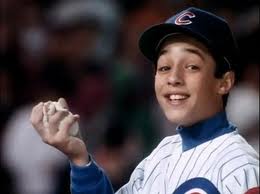
“Rookie of the Year” is a pleasing family sports picture that plays to every Little League baseball player that would love to be the star player, but is mostly benched because he’ll screw things up if he plays. This movie is the story of one of those boys who has a miraculous change of skill that ultimately gets him to pitch for the Chicago Cubs. Of course, it’s not a true story; it’s pure fantasy wish-fulfillment. What kid obsessed with baseball doesn’t wish they could play in the major leagues?

“Rookie of the Year” is about a kid named Henry Rowengartner (Thomas Ian Nicholas), who is probably the worst Little Leaguer in history. He gets called out to right field and tries to catch a fly ball—but he trips, stumbles about trying to find the ball with his cap rim covering his eyes, and then throws it over the fence behind him when he finally grabs it. That’s it—this kid is bully meat for the rest of his life…or is he?

Things start to change for Henry once he trips in the schoolyard and breaks his pitching arm, forcing him to spend the summer in a cast that lifts his arm likes he’s always raising his hand. When the cast is off, the arm is healed in such a way that his tendons are actually tightened closely to one of the bones. When Henry and his friends Clark (Robert Gorman) and George (Patrick LaBrecque) attend a Cubs game at Wrigley Field, where they catch a home run ball in the bleachers. Henry throws it back and everyone is amazed to discover that Henry’s arm is so powerful that Henry is actually able to throw the ball from the stands to home plate.

The kindly Cubs owner (Eddie Bracken) and the slimy General Manager (Dan Hedaya) want to sign Henry onto the team, as it seems he can throw the ball faster than anybody else. Manager Sal Martinella (Albert Hall) gives the kid a tryout and immediately is called upon to play for the Chicago Cubs. Henry pitches several games and becomes an immediate celebrity.

One of the strengths of “Rookie of the Year” is Thomas Ian Nicholas as Henry Rowengartner (his last name is constantly mispronounced by Sal as a running joke). Nicholas gives Henry an appealing personality. He’s openly curious, bright, and excited, and his reactions to almost everything that happens to him is priceless. And then there’s the way he deals with certain games where he’s put on the spot. He has many schemes and tricks up his sleeve that come in handy in two particular game sequences that are both funny and bright. One is when he’s actually called up to bat, and tricks his way around running the bases (he has a small strike zone, causing him to take the base in the first place). Another is the obligatory Big Game—this one, in particular, can’t only be praised for the young actor, but also for the script. It starts out the usual way that all Big Games are supposed to be, but then something happens—I won’t give away what—that forces Henry to rely on his wits to help the team win the game. He plays it like a smart-aleck kid, mocking the other players and at one point “daring” one of them to run.

The whole movie is bright in that way, and has a good amount of clever, funny moments. Most of the comedy comes from a loopy pitching coach, played by Daniel Stern (who also directed the movie). He has an unusual way of speaking and a tendency to hit himself in the head with baseballs after practicing hitting them. The funniest bit in the movie—Stern gets himself caught in a tiny, cramped little closet area in a hotel, and no one is around to help. We see an above shot of just how tight the area is, as Stern looks straight up and says, “Little help now.” That was hilarious.

But the movie also has its dumb moments too. The final pitch, without giving anything away, is handled in a too-corny way. And John Candy, uncredited as a Cubs announcer, tries way too hard to imitate the appropriate voice for a Harry Carey type. I don’t like to criticize John Candy, but I was hoping for something more from him. Other stuff is obligatory, but kind of overdone—the basic example is not the Big Game, but the faltering relationship between Henry and his friends when Henry becomes too busy to hang out with them.

However, there are quite a few nice parts too. Gary Busey is very good as an over-the-hill pitcher who starts out grumpily with Henry, but eventually gives him advice and encouragement. There’s also another appealing character on Henry’s side—Henry’s strong, supportive mother, well-played by Amy Morton. And the scene in which Henry steps onto Wrigley Field for the first time captures the magic that a kid would feel if living this position.

“Rookie of the Year” is unlikely, which is the point for a fantasy. But it’s entertaining, funny, creative, and features a nice leading performance by Thomas Ian Nicholas. It’s a nice film for the whole family to enjoy.

Back to School (1986)

26 Jan

images

Smith’s Verdict: ***

Reviewed by Tanner Smith

“Back to School” is a comedy starring comedian Rodney Dangerfield—that it’s delightful is a rarity since many movies featuring the hilarious Dangerfield tend to underplay his talent, rather than glorify it. Dangerfield is a very funny guy. He not only looks funny (which I mean in the nicest way possible—I mean, he looks funny because he widens his eyes and sweats whenever he’s anxious). He is funny. His infamous one-liners hit almost every time he delivers.

But about “Back to School”—Rodney Dangerfield is this movie. The movie is as routine as you’d expect, but it is pleasant enough and Dangerfield has a lot of fun playing center stage. He plays Thornton Melon, a wealthy clothing manufacturer (he owns a chain of Tall & Fat Shops) who cares for his son Jason (Keith Gordon, playing it sincere), a college student. Melon believes his son is a fraternity member and a star of the diving team. But when he arrives at the university for a surprise visit, he finds that Jason is actually the campus wimp who “don’t get no respect.” (By the way, I love this line Dangerfield delivers when Jason reveals that he lied about his popularity—“I’m your father. You don’t lie to me—you lie to girls.”)

Jason tells his dad that he’s thinking of dropping out. To change his mind, Melon decides to enroll himself as a freshman, to show Jason how important and easy it is to stay in school (which has the obvious flaw, since Melon never had a full education). Thanks to the venal administrator (get this—he’s referred to as “Dean” Martin), he’s able to take classes and show Jason the ropes while also playing by his own rules.

“Back to School” has its share of predictable stock characters—the bland but attractive bombshell that Jason pines for (who is a brunette instead of a blonde—a change for the 80s teen movie genre); the mean-spirited jock who always gives Jason and his punk buddy Derek (Robert Downey, Jr.) a hard time; and of course, the stuffy, overdressed professor (Paxton Whitehead) who, of course, doesn’t find Melon’s charm and humor appealing and sees Melon as a threat to a prestigious institution. (Oh, and did I mention that he has a snooty British accent?) While these three are obligatory and not that entertaining, other side characters are obligatory but also welcome and well-cast. One is that “punk buddy” character I mentioned, played by Robert Downey Jr., who has a unique comic presence; one is Ned Beatty as “Dean” Martin; another is Burt Young as Lou, Melon’s chauffer; there’s the reliable character actor M. Emmet Walsh as the diving instructor; and of course, there’s the sweet romantic interest—Sally Kellerman as the English teacher who shares a relationship with Melon as the story continues. But my favorite has to be Sam Kinison as a crazed Vietnam-veteran/history-teacher. He has very little to do, but his moments are very amusing.

The story is as standard and predictable as the characters, but it still has its funny moments, mostly thanks to fresh touches provided by the film’s writers (Steven Kampmann, Will Porter, Peter Torokvei, and Harold Ramis) and of course Dangerfield’s improvisations. For example, get a load of the scene in which Melon has to buy his books, using many credit cards—“Shakespeare for everybody!” he exclaims to everyone present. How about when he is assigned term papers? Who do you get to help? Kurt Vonnegut, Jr., of course! And I won’t give away more of the film’s gags. This isn’t going to one of those reviews of comedies that spoil gags to make the review funnier.

What it all comes down to is Rodney Dangerfield as Melon. He is what makes “Back to School” delightful. He’s hilarious every time he’s on screen. His improvisational one-liners are enough to make anyone smile, and it seems that everyone in the movie (aside from the snooty professor who practically has no soul) smile and chuckle, while the rest of us are laughing more. He makes this movie work.

Cellular (2004)

25 Jan

Chris-Evans-in-Cellular-2004-Movie-Image

Smith’s Verdict: ***

Reviewed by Tanner Smith

When rushed for time, either going to a certain location or staying at a certain spot, it’s the journey that matters the most in the case of constructing an action-thriller. Examples include “Speed,” which had the concept of a bus that will explode if traveling below 50mph, and “Phone Booth,” which had the concept of a man held by a sniper to remain inside a phone booth lest he get shot. It’s always the high-concept gimmicky-setups that interest people in seeing the film and it takes skill on the filmmakers’ part to keep it on its toes in order to keep the audience on the edge of their seats. That is why despite how dated “Cellular” might be with its central portable technology, which has been through constant upgrades (and is still increasing in new developments), the film still holds up as a tense, adrenaline-filled thrill ride.

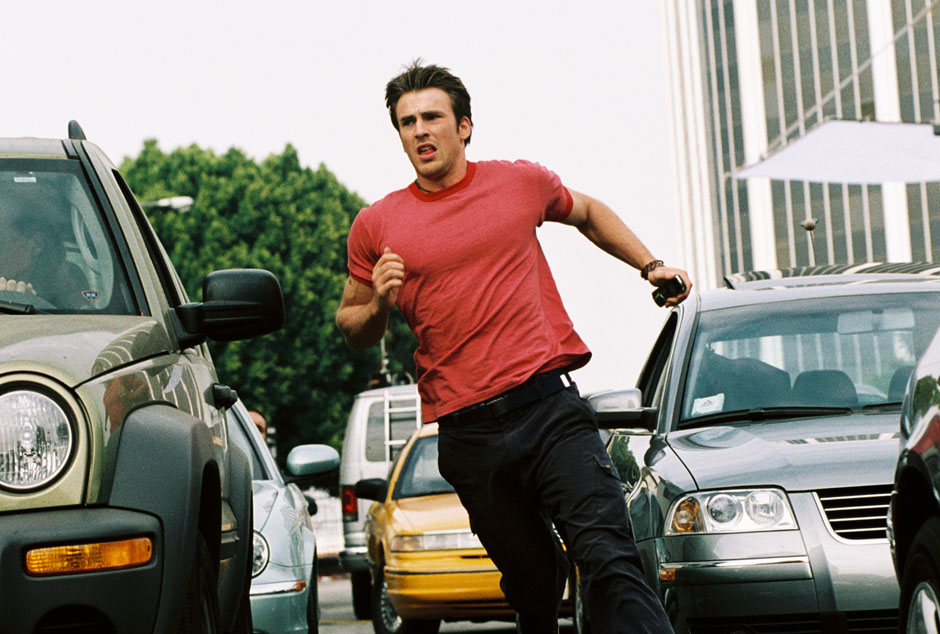
“Cellular” practically opens by showcasing its 2004 “new, edgy improvements in technology.” As people walk about the boardwalk in Los Angeles, they’re admiring their new cellphones, amazed that they can take pictures of chicks in bikinis and send them to other people’s phones. (Ah, the good old days when we were impressed.) But once that’s out of the way, the story for “Cellular” kicks in. We meet our hero—a hunky surfer-type named Ryan (Chris Evans)—who is walking about the beach with his even-less-ambitious buddy (Eric Christian Olsen) and trying to make amends with his ex-girlfriend (Jessica Biel). But soon enough, his cellphone rings. He answers it and it’s the desperate call for help from a schoolteacher who has been kidnapped. The teacher, Jessica Martin (Kim Basinger), has been kidnapped by corrupt cops, led by Greer (Jason Statham), who know that her husband has stumbled upon one of their operations. She doesn’t know what they want, and believes they have the wrong family. Convinced that they’ll kill her once they get what they want, she manages to use a smashed phone (by touching a couple wires together) to make a random call and see if she can get some help. And so, Ryan winds up on the other end of the line, and while he doesn’t quite believe her, her desperate pleas keep him from hanging up. So he agrees to take his phone to the police and have her talk to them about the situation. But when a cop named Mooney (William H. Macy) listens to Jessica’s story, he’s interrupted and distracted, leaving Ryan to take charge of the rescue and thus thrusting him into a race to save the day.

Ryan must keep Jessica on the phone, or else he’ll lose her and be of no help in rescuing her. (Jessica’s phone doesn’t dial normally.) This of course sets off the inevitable series of events that get in the way. Just about every cellphone cliché you can think of comes into play here. Signals get crossed, the battery is dying, the signal is poor, other calls come in at the wrong times, etc. “Cellular” stays alive by thinking of new ways in creating obstacles that get in the way of Ryan, forcing him to outwit and maneuver every which way, all while he has to make Jessica’s husband and child aren’t kidnapped as well, and following different clues that lead to her and the bad guys. But things get even more complicated once Greer learns that Ryan is involved, and also when Mooney discovers some things about the situation he knows very little about that doesn’t hold water, leading him to do his own investigation.

There are chases (both foot and car), drawn fire, fistfights, and other elements that make “Cellular” a regular action-packed thrill ride. It’s never boring, and it even takes a few rest stops, most of which include Mooney as he is planning out his and wife’s new “day spa,” but different circumstances force him into investigating the central situation. Unfortunately, this also leaves room open for exposition. All of this builds up to an over-the-top (albeit inevitable) climax in which Ryan and Mooney join in ultimately saving the day. At an hour-and-a-half of running time, “Cellular” is an enjoyable, entertaining movie that packs many thrills by using clever gimmicks in its action sequences. It’s nicely developed, action-packed, and it doesn’t matter if your phone now is different than phones back then. If your phone has new apps, the situation can still be the same. Stop laughing and enjoy the movie.

Innerspace (1987)

25 Jan

images

Smith’s Verdict: ***

Reviewed by Tanner Smith

“Innerspace” is a movie full of ideas—perhaps too many ideas that don’t work entirely. But still, there are enough intriguingly silly ideas that are executed well and acted with enough game that I’m recommending the movie as absurd fun.

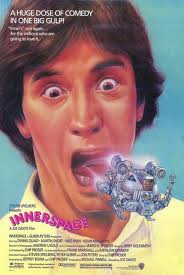
It’s a blend of science fiction, comedy, thriller, action, and romance that begins with a crazy idea: test pilot Tuck Pendleton (Dennis Quaid) has volunteered for a secret government experiment that involves a miniaturization device and a capsule suited for it. The experiment would cause surgeons to operate on patients from inside them. To test it out, Tuck is supposed to be miniaturized to about the size of a molecule (by estimation, at least) so that he’ll be injected into the bloodstream of a lab rabbit.

It works, and Tuck (and the capsule) is placed inside a syringe. But there’s a problem—high-tech thieves send their hit men to break in and steal the technology from the experiment. One of the scientists run off with the syringe holding Tuck and as he’s shot and killed by one of the hit men, he uses his final action to inject Tuck and the capsule into a random passerby—a grocery clerk named Jack Putter (Martin Short). As we see in introductory scenes, Jack is nervous enough. How’s he going to take the news that someone is inside him?

Tuck wades through Jack’s bloodstream and discovers soon enough that he’s inside a stranger. He uses a little gizmo to stick to one of Jack’s eyes in order to see from a screen inside the capsule exactly what Jack sees, and he also uses a communications system to talk to Jack from inside. Jack at first thinks he’s hearing things—“I’m possessed!” Jack exclaims—but eventually comes to grips with the situation and decides to help Tuck out.

If you’re following this, you’re a smart reader. But believe me—things get even stranger.

That’s mostly what’s part of the fun. There’s a limit to how long Tuck can stay inside the capsule before his oxygen runs out; the villains get closer and closer, and must be outwitted each time; the villain’s new hit man enters into the scene—a bizarre character named The Cowboy (Robert Picardo); and soon, Tuck’s former girlfriend Lydia (Meg Ryan) gets involved.

Oh, but that’s not all. Jack develops a crush on Lydia and constantly forgets that Tuck—Lydia’s former boyfriend—is still around, much closer than he thinks, to say the least.

The plot goes all over the place in “Innerspace.” Most of it is fun, and directed with a sense of silly amusement by Joe Dante (director of “Gremlins”), but you kind of wonder what would happen if the editing was tighter (the movie’s running time is 120 minutes). And there are a few holes that are kind of hard to overlook—there’s a “face-change” that is difficult to explain, and Tuck is as small as the molecules in the liquor that Jack drinks for him but it doesn’t look or seem that way. At the same time, there’s a lot to like in “Innerspace.” Not just the chances the story takes, but also the special effects and the acting.

There are many wonderful visual scenes in which Tuck travels through Jack’s bloodstream. It looks remarkable and surprisingly realistic. The computer-animated effects here are definite first-rate. Though, I would’ve liked to see Tuck fight some white-blood cells or antibodies. No such luck here, but he does eventually have to fight off a hit man who’s been miniaturized and place inside the body to get to him. Oh, and there’s also a sequence involving the heart that’s probably the best sequence in the movie. It looks realistic, as the effects involving Tuck’s capsule were combined with actual footage of a beating heart. “That’s a hell of a pump you got there,” Tuck tells Jack.

Dennis Quaid’s character of Tuck could’ve been a bore, as he spends most of his time confined to the capsule. But with his personality and constant one-liners, it feels like he’s still here. Quaid plays a hero who can’t move while Martin Short plays a nerd who wasn’t expected to be the hero. Quaid and Short have nice moments in developing their friendship.

Martin Short, the manic “SNL” alum, is wonderful in this movie. He’s extremely likable, very funny without being too manic, and is fun to watch throughout this movie. It’s hard not to like this guy.

The love story in “Innerspace” is surprisingly nicely done, and Meg Ryan makes a fun, plucky woman put into the confusion of everything. How would she handle the news that her old boyfriend is inside this nerdy guy she’s just met?

“Innerspace” is completely ambitious. It may have worn me out, and the scenes with the thieves aren’t as interesting as the relationships between Tuck, Jack, and Lydia (with the exception of the Cowboy’s scenes, which are manic), but it still provided a good time for me with its intriguing special effects, good acting, and constant use of story twists.

Mission: Impossible–Ghost Protocol (2011)

25 Jan

mission-impossible-ghost-protocol-tom-cruise-brad-bird-burj-khalifa-dubai

Smith’s Verdict: ***1/2

Reviewed by Tanner Smith

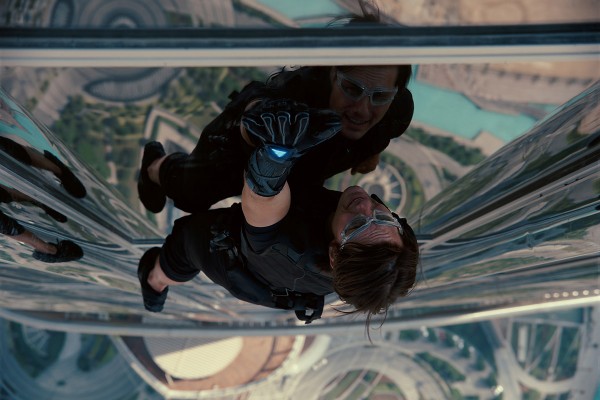
There’s no doubt about it—the best action sequence in the fourth “Mission: Impossible” movie (subtitled “Ghost Protocol”) is the one in which Tom Cruise’s Ethan Hunt has to scale a skyscraper. But not just any skyscraper—the Burj Khalifa in Dubal. The world’s tallest building. Ethan has to scale the glass windows from the outside, more than a hundred stories up. He’s equipped with special gloves that stick to a surface, which of course malfunction so that Ethan can hang on for dear life.

Why doesn’t anyone else do this? Simon Pegg’s Benji’s reponse is simple: “I’m on the computer.” Jeremy Renner’s Brandt’s response: “I’m…the helper.” And Ethan is…well, he’s the hero. He was going to scale that tower no matter what. What floor does he have to stop at? 130.

Pulling off a sequence like this is tricky enough, but then I found out this piece of information—apparently, Tom Cruise did his own stunts. Wait…what?

OK, maybe some heavy wirework was involved or there were unseen footholds around, but Tom Cruise reportedly insisted on performing his own stunts. I simply can’t believe it. There’s a shot where we actually pan out from Cruise scaling the building to where we get a full shot of the place, and I simply can’t believe that anybody would really try this. But apparently, Cruise isn’t CGI in these shots and we really are looking at him. This either means that Cruise is very brave or very stupid.

Either way, this whole sequence is impactful. I have an underlying fear of heights and seeing this on the big screen gave me vertigo. It’s that impressive.

This may be the standout, but there are other terrific action sequences in “Mission: Impossible—Ghost Protocol,” an exciting thriller that comes along like the lost James Bond picture. We have it all—stunts, chases, explosions, neat gadgetry, a megalomaniac villain with a thuggish henchman, and wall-to-wall action. It’s a lot of fun and easily the best entry in the “Mission: Impossible” franchise, proving that sometimes the fourth entry can be the charmer (see “Live Free or Die Hard” or “Star Trek IV”—just please don’t see “Superman IV” or “Batman and Robin”).

OK, maybe the story is a bit muddled and somewhat confusing in that certain things are left unsaid, but there are still some kick-ass action sequences to turn this into a thrill ride to make us care for it. It begins with a prison break, as Impossible Mission Force (IMF) need Ethan back to take care of something big. Ethan is stuck in a Russian prison, so agents Benji and Jane (Paula Patton) break him out in a nicely-done opening scene. The team is hunting down the international terrorist Hendricks (Michael Nyqvist), a genius who is looking to gain control of nuclear weapons. He must be stopped before he succeeds in unleashing nuclear war—he believes that the way to gain world peace is to start over, from the rubble.

Hendricks and his brutish sidekick Wistrom (Samuli Edelmann) blow up the Kremlin and frame IMF, forcing “ghost protocol.” But Ethan, Benji, Jane, and analyst Brandt are still carrying out the mission.

Aside from the skyscraper scene, there are some neatly-staged sequences in the movie. Of course, a lot of these aren’t plausible, but they are thrilling. There’s one in particular that comes in the final half of the movie where the team is in Mombai, and Brandt jumps into a ventilating shaft somewhere. I guess he wears a steel belt so that Benji can keep him safe in the shaft via a mobile magnet. Of course, there are close calls in that sequence as well, as you’d predict. But close calls are what make action scenes all the more exciting.

I liked the four central cast members. They do appealing work and I was interested in following them because they were entertaining. Tom Cruise is on hand for action as he always is in these movies (although you have to wonder, in those sequences where he’s running like mad, if he’s going crazy). Jeremy Renner is apparently stepping in for Cruise in a fifth “Mission: Impossible” movie; he’ll have earned his position as a new lead. (I forgot to mention that his character Brandt isn’t just an analyst—he has field agent training.) Simon Pegg has nice moments providing comic relief. I hate to actually have to type this in a review, but…Paula Patton is hot! And she gets some neat girl-on-girl action in a fight scene between her character and a sexy female assassin played by French actress Lea Seydoux.

This is the live-action film debut of the great animation director Brad Bird (“The Iron Giant,” “The Incredibles,” “Ratatouille”) and it proves to be a spectacular one. “Mission: Impossible—Ghost Protocol” is alive and entertaining with nifty action sequences and an exciting feel.

And the next best thing I can say about the skyscraper scene is this: I wish I had seen it on IMAX…or maybe I don’t. Like I said, I have a fear of heights.

October Sky (1999)

25 Jan

octobersky

Smith’s Verdict: ***1/2

Reviewed by Tanner Smith

“October Sky” has the feel a smart feel-good sports drama, mostly in the notion in that it’s not just about the sport, but about life’s ambitions and relationships. (“Hoosiers” was a great example of showing that.) But if you don’t care that much for athletics, then “October Sky” is even better for you. The “sport” in this movie is rocket-building, which doesn’t make very exciting competition. But that’s OK, because the rocket stuff isn’t competitive in the slightest. The characters in “October Sky” do what they do because they love doing it and they want to share it with people once they get it right, and hope that the people they love will approve of their goals.

“October Sky” is based on a novel by Homer Hickam and relates to the true story of Homer and his three friends who were experimenting with rocketry when they were high school teenagers in the autumn of 1957, when the Russian satellite Sputnik was first launched. Seventeen-year-old Homer (Jake Gyllenhaal) lives in small coal mining town Coalwood, West Virginia. On the night Sputnik is seen soaring over Coalwood, Homer is amazed by the sight that man has put right up there in space, so much so that he decides he’s going to build a rocket.

His first attempt is not a successful one—it’s a flashlight with a fuse that of course explodes, and blows up part of Homer’s fence. So, Homer—who is a bright student, but science and math are his weak subjects—enlists the help of science nerd Quentin (Chris Owen) to help him and his two friends Roy Lee (William Lee Scott) and O’Dell (Chad Lindberg) build their own homemade rockets. Their first rocket together isn’t as successful as they imagined—they launch it, all right, but it makes its way through town, nearly hurting someone. So the boys make their own launching post eight miles outside of the coal mine and spend their days together making more rockets, hoping at least one of them will them will soar.

On Homer’s side is an encouraging, supportive teacher, Miss Riley (Laura Dern), and his mother (Natalie Canerday) is fine with this new hobby as long as Homer doesn’t blow himself up. But Homer’s father John (Chris Cooper), who runs the mine, doesn’t believe in Homer’s dream. He thinks of it as foolish and believes he should just get his head out of the clouds and down into the mine to work. This is a town that feels like a dirty prison and the only ones that get out of here are those who get college sports scholarships. The rest are stuck to work and mine coal. And so John believes that conducting these rocket experiments, entering and winning the national science fair, and hoping to get into college is just a waste of effort, and doesn’t want Homer to even try it.

And this is where the real tension of “October Sky” lies—not merely with the boys trying to create a successful rocket, although you do really hope that they do. It’s with Homer having different dreams than his father. And his father is not a bad person—he does what he does (confiscating the rocket equipment, forbidding Homer to use it near company property) because he’s doing what he believes is best for his son. He thinks his son just needs to face reality. And he makes sacrifices at work—he looks out for his fellow workers, fights for their jobs, and when we first see him, he even saves a life. He wants Homer to follow in his footsteps. So what we have is a legitimate realistic movie confrontation between a boy and his father—not the one-dimensional arguing that you see in most movies that have this element. It’s characterized on both sides of the confrontation and played very convincingly.

The stuff with Homer and his friends building the rockets has its own whimsy and entertainment value without getting tedious (although you can sometimes predict which rocket is going to explode, during a montage, and that gets kind of old). The boys are excited about doing this, and we’re excited for them. And when they finally get one up there (and good timing too, because everyone in town is watching) midway through the movie, it’s a glorious, joyful moment.

Of course, there must be a central conflict that nearly makes Homer change his mind about what he’s doing and it’s a pretty substantial one. It starts after Homer and friends have made their first successful launch—a forest fire is said to be caused by one of the boys’ faulty rockets and so they’re forbidden to continue with their experiments again. Actually, that’s somewhat obvious, but then John injures an eye in an emergency down in the mine and has time off for recovery. Taking his place is Homer, who learns the responsibilities his father had to go through and ponders about whether he should work down there full-time. But Miss Riley convinces Homer that he should do what he dreams of doing, and that also gets Homer thinking.

This leads to Homer and his friends rejoining to work on rockets again and enter the national science fair, but first they have to figure out, using trigonometry that they learned during all of this, whether or not it was their rocket that started that fire.

“October Sky” is a wonderful movie that has deep values within it. It has a real go-for-it, feel-good spirit in the sequences with the boys making their rockets, and a real connection between a father and son that comes rare in the movies. It’s helped by intelligent writing and more-than-capable acting by Jake Gyllenhaal who gives a winning performance as Homer, Chris Cooper who is excellent and three-dimensional as John, Laura Dern as encouraging Miss Riley, Natalie Canerday as Homer’s loving mother, and Chris Owen, William Lee Scott, and Chad Lindberg as the three friends (Scott, in particular, has some pretty funny moments, even though his fake Southern accent is somewhat forcibly thick).

I will not forget “October Sky” any time soon. It’s a delightful movie that deserves to be seen by everybody. Forget that it’s a mainstream movie that doesn’t feature tired action or forced melodrama, and enjoy it for what it is—a nicely-done, well-acted, free-spirited movie that is likely to satisfy even the most stubborn of audience members.

NOTE: Here’s a fun fact I came across—“October Sky” is actually an anagram for “Rocket Boys,” the title of the autobiography this movie is based upon.