Archive by Author

Tuck Everlasting (2002)

4 Feb

images

Smith’s Verdict: ***1/2

Reviewed by Tanner Smith

“Don’t be afraid of death. Be afraid of the unlived life.”

These are the words said by Angus Tuck to Winnie Foster. Winnie is a teenager from a wealthy family who has stumbled upon the secret of the Tucks, a family living/hiding in the woods who hold the secret to eternal life. She has lived with the Tucks and fallen in love with Angus’ young son Jesse, who finally reveals the secret to her and would like to share it (eternal life, that is) with her.

As Jesse puts it, “I’m going to be 17 until the end of the world.” The Tucks didn’t choose to live this full life. They happened upon it—you see, it’s the spring in the middle of the woods that causes those who drink from it to become immortal. The Tucks were able to realize it later. And they do have their regrets. The oldest son Miles, in particular, has a tragic past and would prefer to die—but it can never happen.

Angus—the oldest in the family—tells Winnie that if she chooses to drink from the spring, she will live forever, but there will be things to miss, especially at her young age—much like Jesse, caught in limbo at more than a hundred years of age, but still in a 17-year-old body. So the choice is to live an everlasting life with the Tucks, or live a normal life with her family.

The question of immortality is the main strength of the wonderful family film “Tuck Everlasting,” based on the popular young adult novel of the same name. Maybe the term “family film” is somewhat unnecessary. Younger viewers may not think much of immortality because they already feel like they’re never going to die. But for older ones, it’s a remarkable concept. What would you choose if you were faced between a normal life and an everlasting one? What would you feel? You could say “yes” immediately, but would you think about it first? Some would, some wouldn’t. Winnie is given moments to think about a lot of things and only after does she make her decision. That’s how “Tuck Everlasting” plays out and as a result, the movie is thought-provoking and enchanting.

As it opens, Winnie (Alexis Bledel) is a teenaged rich girl who is tired of being kept inside her huge house with her overbearing parents (Victor Garber and Amy Irving) and wishes for something more in life. She runs away from home, into the woods, where she meets Jesse (Jonathan Jackson) at the spring. Jesse warns her to go away, but Winnie is stubborn and doesn’t leave that easily. It’s then that Miles (Scott Bairstow) comes along, sees her as a threat, grabs her, and takes her back to the Tuck home. Winnie is treated like a prisoner at first, to be sure she doesn’t go back and tell people where they are. But Winnie knows nothing of their true origins at the time, and opens up to their lifestyle.

A romance develops between Winnie and Jesse, and it’s developed nicely. It’s not cloying or forced—it’s sweet and innocent. By the time Winnie must make her choice, you genuinely wonder what will happen for them. Will Winnie stay with Jesse or will she leave him, knowing he’ll outlive her? There’s weight added to the question of immortality.

The Tucks are well-developed and have their own shadows and advantages. Angus and Mae (William Hurt and Sissy Spacek), the parents, are stuck in middle-aged bodies, but remain lively. Miles, stuck in the prime of his life, is the most tragic of the family, with a past revealed later that makes him more like a zombie stuck in a lifelike state without ever dying. Jesse is more like Peter Pan—never growing old, never dying, and forever young.

As if the choice of normality and eternity wasn’t enough, there’s a rising action featuring another character crucial to the story—a mysterious Man in a Yellow Suit (Ben Kingsley) who knows the Tucks’ secret and is determined to expose it. And of course, there’s the conflict of Winnie’s parents intent on finding their daughter, also risking the Tucks’ hideaway. These elements may be necessary, but they almost make the final act of the story seem somewhat overstuffed, with all the right payoffs.

But that’s a minor quibble, mind you. Ben Kingsley is suitably menacing in the role and the determination of the parents wanting their daughter back is realistic enough. However, Winnie’s important choice is the element that should address the most concern, in my opinion.

“Tuck Everlasting” is a wonderful film—one that makes you wonder, and provokes thoughts such as, “If you live forever, what do you live for?” That’s at the center of the movie and it’s very engaging.

21 Jump Street (2012)

3 Feb

21-Jump-street-21-jump-street-2012-26466089-1280-853

Smith’s Verdict: ***

Reviewed by Tanner Smith

Remember in the buddy-cop movie-spoof “The Other Guys” when Will Ferrell and Mark Wahlberg are blown out of proportion after an explosion nearby? Remember how Will Ferrell complained, “How do they walk away in movies without flinching when it explodes behind them?! There’s no way! The movie industry is completely irresponsible for the way they portray explosions!” So sue me—I didn’t laugh at that. The picking-out of the clichés in action movies (though mainly in horror movies as well) has itself become a tired cliché. Quite odd that I’m criticizing what the screenplay was criticizing because it criticized them too much. It was fresh before, like the original clichés themselves. But nowadays, whenever a movie tries to do that, it doesn’t quite work and I wind up saying, “Weak.”

That is why within the supposed-clever satire of the big-screen adaptation of the late-1980s/early-1990s TV show “21 Jump Street,” there was a scene that really made me smile—it involves a police chief moving the movie’s central characters, two misfit cops, to a place that was tried before in the late-1980s and returning to business because “originality is gone and no one has any good ideas.” (It’s sad to admit that I’m paraphrasing; I should’ve written the line down in my phone immediately after I heard it.) It’s no secret that that line is a direct reference to the movie itself. The movie is based on a popular show called “21 Jump Street” that ran from 1987 to 1991. Now for early 2012, Hollywood executives must have thought it’d be great to greenlight if it was a very loose adaptation—not a drama like the original show, but a mashup of screwball comedy. I’m not saying I had a problem with that—I was quite interested when I heard that this new version of “21 Jump Street” was taking the more comedic approach. But that’s mainly because—and I’m just going to come out and say it—I never really liked the show. Even though a lot of people are fond of it and it jump-started its star Johnny Depp’s high-profile acting career, I just felt that the show itself was pretty bland. (But to be fair, I’ve only seen the first few episodes on DVD—maybe the show got better, but I don’t know.)

But anyway, back to the review of the movie. “21 Jump Street” has about as many tongue-in-cheek approaches to certain buddy-cop movie clichés that you would expect, and its satire is about as subtle as “The Simpsons,” but I must say I got more stupid laughs from this movie than I did with “The Other Guys.” “21 Jump Street” does pick out the clichés and isn’t afraid to do so. As a result of a merrily vulgar screenplay, there are jokes that don’t work, but luckily, most jokes that do. And more importantly, I laughed. That is the purpose of a comedy, and I did laugh quite a lot during this big-screen version of “21 Jump Street.”

“21 Jump Street” stars Jonah Hill and Channing Tatum as cops Schmidt and Jenko. In high school, they were complete opposites—Schmidt was a shy nerd; Jenko was a dumb jock. But seven years later, they meet again at police academy and become good buddies, despite their differing personalities. Schmidt and Jenko expect chases and explosions to come into their lives, but as of now, they’re stuck riding on bicycles for park patrol. A bust goes wrong—Schmidt is too nervous to fire his gun, and when they finally catch a suspect, the arrest isn’t precise because Jenko doesn’t remember the Miranda Rights. (Apparently, you have the right to be an attorney.) Schmidt and Jenko are then sent to an undercover unit called “21 Jump Street” (you know, the project that is starting over again because “nobody has any good ideas anymore”), where they’re assigned by their new captain (Ice Cube, consistently funny as the angry boss) to investigate a dangerous new drug being sold at a high school. This means they’ll have to infiltrate the school, masquerading not just as brothers…but as high school students.

These two 20-something-year-old guys make look to old to be in high school (and that’s brought up in the movie sometimes, too), but let’s face it—they’re able to keep their dignity in sense of appearance, which is more than I can say for Johnny Depp, who in the first episode of the original show had to dress like an 80s punk. At least these guys, in this day and age, can dress casually and fit in. Anyway, Schmidt is supposed to be the nerd in AP Chemistry and band class, while Jenko is supposed to be in drama class, but due to a mixup on their part, the roles are reversed. This leads to some pretty funny situations where these guys, posing as teenagers, are in the wrong place at the wrong time, and just attempting to wing it.

This is a preposterous premise, but to me, it’s fun to see an adult go back to high school in a comedy under these certain circumstances—I guess that’s why I liked “17 Again.” I don’t know why I like this gimmick, seeing as how I’m just a couple years out of high school, and wouldn’t dream of going back myself (not yet, anyway), but it does show promise for a comedy. In this movie, Schmidt and Jenko throw their responsibilities as police officers away just to find the right ways to fit in—they throw a party at Schmidt’s parents’ house, Schmidt tries out for the school musical with a popular girl (Brie Larson, with a sweet smile), and the two guys even, in one of the funniest scenes in the movie, are forced to take the new drug that’s being dealt at the school, just to prove to the smooth dealer (Dave Franco, smooth but kind of weak villain) that they’re not “narcs.” One of the more appealing subplots involves Jenko as he falls in with a trio of nerdy outcasts, who are good kids and resourceful enough to help with the bust. This is also one of those movie high schools where authority figures are either clueless or invisible. There doesn’t seem to be much control in this school—the principal is only seen in a couple of scenes. There’s a chemistry teacher (Ellie Kemper) who takes a sexual interest in Jenko, a drama teacher (Chris Parnell) in his own world, and a gym teacher (Rob Riggle), who’s about as dumb as they come. Am I crazy or does that make Schmidt and Jenko, these misfit odd-couple cops, the more mature people in the school?

There are a few things in “21 Jump Street” that don’t work. A few satirical lines don’t reach the pinnacle for good laughs, the addition of Schmidt’s parents who still treat Schmidt like a little boy doesn’t work to its full potential, and the chases and explosions, when they do come, aren’t as funny, save for a few effective tongue-in-cheek approaches. But there are more laughs to be had when it focuses on the two guys as they continue their way back into high school. And there’s also a hint of sweetness in this friendship between Schmidt and Jenko. As played by Jonah Hill and Channing Tatum, they click well together and form an authentic friendship among the ridiculousness of the script.

It’s a funny thing about Jonah Hill’s career. In his first few roles, he’s been known to be an obnoxious presence that you either accept as a character or just want to shut up. I think, since the comedy “Get Him to the Greek” in 2010, Hill has found a way to relax on-screen and connect with the audience (and still be funny) without having to scream every other line in anger. That served him well in the indie comedy-drama “Cyrus” and especially well in the sports drama “Moneyball,” which garnered him an Oscar nomination. Now, after the dreary return to obnoxiousness in “The Sitter,” he’s relaxed (and slimmed down, as well) for “21 Jump Street” while still being likable and pretty funny.

Channing Tatum hasn’t shown a lot of promise in movies—he usually comes off as pretty stiff. But now, people have found a simple solution—put the guy in a comedy! Tatum is hilarious in this movie. His approach to everything he doesn’t understand and yet has to follow through with gets a laugh just by his attitude. Tatum is willing to try something new here, and as a result, he’s charismatic and pretty funny. Put him in more comedies.

The final action climax is where the movie almost lost me, but there are still enough gags and satirical references to get me through it, complete with a fun payoff for a setup having to do with a chemistry experiment.

“21 Jump Street” is a nice surprise, given where it was thought of. I guess someone really did run out of ideas and decided to borrow the premise from a popular TV show and bring it to the big screen. Well, if you’re going a different approach, be sure to have a lot of fun with it.

Hot Rod (2007)

3 Feb

hot-rod-2007

Smith’s Verdict: ***

Reviewed by Tanner Smith

I’m a huge fan of the SNL Digital Shorts and the three guys who make them—Andy Samberg, Jorma Taccona, and Akiva Schaffer. Their “Lazy Sunday” and “In A Box” creations are some of the funniest videos I’ve ever seen. Even with its occasional racy material, these videos are so upbeat, positive, and just so darn funny. Even their stupidest gags get laughs.

So with me being a huge fan of these guys—who call themselves The Lonely Island—you can imagine how hyped I was when I found out about a movie created by them. Well, they did, and it’s an energetic, cheerfully funny little movie called “Hot Rod.”

It’s a pure “family affair”—Andy Samberg is the film’s star, Jorma Taccone is a supporting character, and Akiva Schaffer is the film’s director. Samberg stars as Rod Kimble, a novice stuntman who doesn’t go a day with nearly killing himself with a crazy stunt. As the movie opens, he attempts to jump a trailer when the takeoff ramp falls apart and Rod falls straight over. But it’s OK—he’s fine. So he can do practically the same thing every day. He never gives up and his failures don’t discourage him. He knows that he will become a great, infamous daredevil (“infamous” for the right reasons, of course).

Oh, and he also sports a fake mustache during each of his stunts, because he thinks it makes him look professional.

Rod is also trying to earn respect from his jerk of a stepfather—Frank (Ian McShane). Every now and then, Rod and Frank engage in a duel (with Rhodesian fighting sticks and throwing stars) to which Frank always wins. But now, it is learned that Frank is dying due to a heart condition. If he dies, Rod will never have gained his respect. So what’s his plan? Raise 50 thousand dollars to pay for Frank’s life-saving heart operation and make him healthy enough so that he can beat him to death! How’s he going to do it? Jump 15 buses, he explains to his crew—his nerdy but loyal stepbrother Kevin (Taccone) and the less ambitious Dave (SNL’s Bill Hader) and Rico (Danny McBride). Rico responds by saying, “Come on, Rod. That’s nearly as much as Evel Knievel jumped.” Well, it’s actually one more than Evel Knievel jumped.

As you can tell, the story is all over the place. It gets crazier during its progression, with Rod raising money to fund the big jump by engaging in stunts like being blown up, set on fire, and even acting as a human piñata. But this is one of the reasons it’s so funny—the zanier the story gets in a lowbrow comedy such as this, the better. And it’s also funny because it’s sincere. It never becomes mean-spirited or condescending in the slightest. It’s just telling a lighthearted story about a likable ne’er-do-well racing to succeed in the most improbable situations—not only with the stunts and the big jump that he must conquer in order to raise enough money to save his stepfather (just so he can beat the crap out of him), but also with attempting to score with the pretty young woman next door named Denise (Isla Fisher) who joins the crew because she likes Rod’s determination. But unfortunately, she has an obnoxious jerk of a boyfriend—played by Will Arnett, who kind of overdoes it with his performance, but I’ll take it—who drives a Corvette, constantly looks down on Rod, and even at one point leaves his girlfriend on a date so he can punch an old buddy in the groin. (By the way, I love his line to Rod and Denise when he leaves—“Don’t you two go falling in love while I’m gone.”) Will Rod get the girl away from this jerk?

Of course he will.

And there’s just a ton of flat-out funny gags scattered throughout “Hot Rod.” This mess of a movie got even bigger laughs out of me in a theater than the overrated Will Ferrell sports-comedy “Talladega Nights.” In just about every scene of this movie, there’s a new gag. Some of them are failures (the enunciating of the word “whiskey” bit shown in the film’s trailers gets a bit old before it finishes), but like with comedies such as “Airplane,” where there’s a gag just about every minute, you wait for the next one to come along and make you laugh. While there are a few gags that didn’t work, many others made me laugh out loud. A few examples—I won’t give away all of them to make the review funnier—include a theoretical discussion about whether or not a taco would beat a grilled cheese sandwich in a fight, a nasty sight gag involving Bill Hader’s Dave in a slight injury due to an acid trip, and (undoubtedly the biggest laugh of the movie) a parody of the punch-dancing scene in “Footloose” that results in the longest, funniest fall in movie history (I will say no more about that—watch the movie; you’ll laugh your ass off).

Andy Samberg has a likable comic presence and makes Rod instantly sympathetic. His goofiness is enough for good laughs as well—he’s as capable as Jim Carrey and Eddie Murphy when it comes to comic actors in comedic leading roles. Jorma Taccone, Bill Hader, and Danny McBride have a lot of great moments to share as Rod’s three-man working crew. And give Sissy Spacek credit for playing her role as Rod’s mother completely straight.

“Hot Rod” is a modest, very funny movie that not only makes me excited for the next Lonely Island video, but mostly for the next Lonely Island movie. Let’s hope these three get a new movie idea together very soon.

The Adventures of Tintin (2011)

3 Feb

images

Smith’s Verdict: ***1/2

Reviewed by Tanner Smith

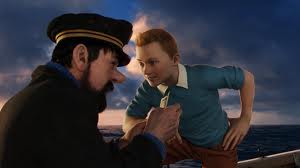
“The Adventures of Tintin” is a welcome callback to exciting adventure films for families to enjoy, and also, its opening credit sequence is a callback to those wonderful animated opening-credit sequences that are the perfect ways of letting us know what we’re in for (remember the exciting animated opening-credit sequence in “Honey, I Shrunk the Kids,” for example). While the actual movie is done in motion-capture computer animation, the opening-credit sequence in “The Adventures of Tintin” is back to the traditional hand-drawn animated style (with help from computers).

By the way, since we’re on the subject of credits, have you noticed that these opening-credit sequences are very rare? Usually, movies will show what should be the opening credits at the end, as if we‘re supposed to be surprised by who directed it or wrote it. (To be fair, I know movies just show the title at the opening to get the movie going.) Some movies that do have credits at the opening just show them during the opening scene, as if the editors don’t care how the credits are shown. But with opening credits, you can really get your audience invested in what they’re about to see. While the credits appear, have some creative visuals and have some exciting music. I was glad to see that kind of sequence in a movie again, and here it is in “The Adventures of Tintin.”

“The Adventures of Tintin” is based on Herge’s classic comic books from long ago, and is also director Steven Spielberg’s first animated feature—and in 3D, no less. It’s an imaginative, exciting adventure that features some stunning action sequences and keeps the journey lively as it goes along. Spielberg must have been studying his Indiana Jones guide to remember what makes adventures exciting to execute.

Tintin (Jamie Bell) is a young, lively investigative reporter that apparently has been all over the world, as things in his apartment suggests (I must admit I’ve never read the original comic books), solving many mysteries and making them into stories for the newspaper. He has a loyal dog named Snowy, who is very gifted and possibly even smarter than Tintin. Sometimes on the same cases as him are two bumbling police detectives named Thompson and Thomason (Simon Pegg and Nick Frost, showing great comic relief)…they’re not particularly reliable because they’re so dim.

Tintin purchases a model ship called the Unicorn and believes that there’s something special about it, since the mysterious Sakharine (Daniel Craig) is trying to get his hands on it. Tintin does find a very important clue hidden inside the ship and later meets up with the rarely-sober Captain Haddock (Andy Serkis). Haddock’s seafaring ancestors have hidden a treasure long ago, which Sakharine and his crew are seeking. So the race is on to find many clues that lead to the treasure’s location.

“The Adventures of Tintin” uses entire motion-capture style animation. It’s when an entire movie is digitally animated after live actors perform their roles, in black box theater, with sensors all over their bodies. With this animation, you can do whatever you want. In “The Polar Express” and “A Christmas Carol,” in particular, this style of animation was really taken advantage of because with this technology, you can really play around with atmosphere and create some sensational energetic scenes.

Take a chase scene late in the movie, where Tintin and Haddock are after an important clue in Morocco, and the bad guys are seeking possession of it as well. There is one shot that lasts for about five minutes as the chase continues—the shot swipes from spot to spot and goes all around the place, further intensifying the action. That’s a marvelous visual shot, and it shows just how far this motion-capture computer animation can be pushed.

There are other sensational action sequences in the movie—Tintin, Snowy, and Haddock must escape from the villains on their ship after being captured; they hijack a small plane and must learn to land it, and fast; and there’s also a flashback involving the back story of the life-sized Unicorn that seems pretty heavy. These scenes are exciting and well-crafted.

The human characters in this movie certainly look better than the other characters used in other motion-capture movies. Tintin does look very human, but I must ask, why do the other characters resemble the doll-like figures in “Monster House?” They either have big heads or big noses, but then again, I don’t care—at least the eyes aren’t too big or too small to be creepy. There is one exception, aside from Tintin and that is the villain Sakharine.

By the way, I must ask, was it the animators’ intention to make Sakharine resemble director Spielberg?

The performers/voice-actors are well-chosen. Jamie Bell gives Tintin an appealing, intense curiosity and carefully avoids steering into blandness. Andy Serkis is wonderful as the constantly-drinking Haddock, who is Tintin’s sole human ally and provides some great comic moments while on this crazy adventure. I’m not really surprised—Serkis is probably considered the king of motion-capture. Remember, this is the man who played Gollum in the “Lord of the Rings” movies and Caesar in “Rise of the Planet of the Apes.”

With the right blend of humor and action, and a first-rate technical look to the film, “The Adventures of Tintin” is an ambitious, well-crafted adventure movie. I hope there’s a sequel so these new Spielberg adventures can continue; especially since I doubt people will be expecting “Indiana Jones 5” pretty soon. It has a lot of energy and enough potential to become a film series.

Cocoon (1985)

3 Feb

Cocoon1985-01

Smith’s Verdict: ***1/2

Reviewed by Tanner Smith

“Cocoon” is another modern-day science-fiction tale in which advanced aliens from outer space visit Earth with no plans to destroy us, but just to visit us. But these aliens in “Cocoon” are easy to communicate with, simply because they could easily pass off as human. Sure, their true form is pure light, but when they put their latex rubber body suits on, they just seem like rich tourists who have their own business to tend to. They could easily pass as human!

Character actor Brian Dennehy plays Walter, the leader of the group of Antareans, as they’re called, who come to Earth on a mission. He and three of his friends (one of them played by Tahnee Welch, Raquel’s daughter) rent a boat from a young broke skipper named Jack (Steve Guttenberg) to go out into the ocean, dive deep underwater, and retrieve many cocoons of their friends that were left behind on the previous mission decades (maybe even centuries) ago.

You see, it’s said that on their planet, there’s no such thing as sickness or death and so none of the Antareans have experienced the sadness of such. And if the cocoons are taken back to the planet, those inside will be free again. In the meantime, the cocoons that are already found are being kept in the swimming pool near a retirement home, where three senior citizens (Don Ameche, Wilford Brumley, and Hume Cronyn) are tired of their boring lives and take joy in trespassing over at the pool for a little fun. But now, with the strange stones at the bottom of the pool, the pool has become a fountain of youth for them. They feel young again and are suddenly joyful of their lives.

With Walter’s permission, the three men bring their wives (Maureen Stapleton, Jessica Tandy, Gwen Verdon) to the amazing discovery and they all get second chances in being young. They go for nights on the town and even tick off others at the home.

All of this is pure delight. Just about every character is either interesting or enjoyable to watch. We have the scenes with the three guys, who are all wonderful, especially Wilford Brumley who always has a twinkle in his eye that reminds us of a kind grandfather we either had or wish to have had. (Actually, I didn’t know that he wasn’t even at age 50 when this movie was filmed!) Then, we have the scenes with the aliens who just want their friends back and when things go wrong midway through the film, there’s a shocking look of revelation on Brian Dennehy’s face that brings his character full-circle. There’s also a sweet relationship between Guttenberg and Welch and one bizarre scene in which Welch shows Guttenberg her planet’s way of sharing affection with one another.

What I didn’t like about “Cocoon” was its ending. As everyone is invited to stay with the Antareans on their planet, we get a race, a chase, a child in the mix, confused orderlies and police, and a spaceship—just a typical, average Spielbergian ending that wasn’t like anything we’ve seen up until that point.

But everything else in “Cocoon” is just wonderfully entertaining, with great acting and a real feel of whimsy. It’s just a wonder as to why director Ron Howard wanted to end this wonderful film with a climax?

Witness (1985)

3 Feb

witness-1985

Smith’s Verdict: ****

Reviewed by Tanner Smith

“Witness” could be considered a crime thriller, as some would recall it to be, but you’d only be sort-of right. Aside from being a thriller, it’s also a love story and a fish-out-of-water tale featuring the clash of cultures. Strangely enough, all of these elements come together not merely in a capable way, but in a masterful way. “Witness” is everything it needs to be—sometimes sweet, sometimes tense, and always gripping. Add it to the great direction by Peter Weir, an intelligent screenplay by Earl W. Wallace William Kelley, and great performances from actors including Harrison Ford and Kelly McGillis, and “Witness” is a great triumph.

This was Harrison Ford’s first opportunity to try something different in his acting career, in a time when he was free from his Han Solo image but still stuck to his Indiana Jones character. With his great performance in “Witness,” Ford was able to prove to people that he was more than just an action/adventure icon, and that he was a legitimate capable actor that can play drama convincingly. In “Witness,” he plays Detective John Book, who is called upon to investigate the murder of a police officer. He has one witness—an eight-year-old Amish boy, Samuel Lapp (Lukas Haas). Samuel and his mother Rachel (Kelly McGillis) were waiting in a Philadelphia train station for a train to take them to Baltimore, as Samuel witnesses the murder while hiding in one of the bathroom stalls. He was able to make out one of the two killers. And so, Book keeps Samuel and Rachel in the city for a while so Samuel can help him out.

At this point, it would seem like a simple homicide with different cultures. We see some early scenes that feature a bit of lifestyle for Rachel and Samuel in their Amish community, and then once they come into the mainland and this unexpected event occurs, they get a sense of modern police work as well as other cultural aspects, such as hot dogs, which Samuel enjoys. But “Witness” doesn’t keep it that simple. It only gets more complicated once Book discovers that it was a cop that was involved in the crime, and that changes things. Book tells his superior, Chief Schaffer (Josef Sommer), what he knows, only to find that he too is involved, thus putting Book, the kid, and his mother in danger. Book has no choice but to give up on the case and take Samuel and Rachel back home and go into hiding with nowhere else to go. Back at the Amish community, while Book recovers from a bullet wound brought on by a fiery encounter, Rachel lets the locals believe that Book is a cousin. Book is planning his next move, and in the meantime, helps out around the farm, doing chores and eventually helping to build a new barn.

All while this is happening though, Book falls in love with Rachel and the feeling may be mutual; Schaffer is searching for answers as to where Book is so he can silence him and even the kid and mother if need be; and Book has to make an important choice to either stay with the Amish community where he finds himself actually fitting in or back to where he’s more accustomed in the world of modern convenience. There is one person that he would stay for, and that is Rachel.

This story has so many levels to it that I wonder if Alfred Hitchcock could have hooked us in further. In some ways, “Witness” could be considered a Hitchcockian exercise, if you will, Hitchcock always loved to play his audience like a piano, and so director Peter Weir follows the same way and gives us a story that has so many things with it and yet is consistent in its structure and execution. His approach is quite unique in the way that “Witness” is not mainly about the crime aspects, as you’d expect it to be. It’s mainly about a man struggling and adapting to a new lifestyle. It’s not played for comedy; it’s played as straight drama to establish characters, relationships, and routines. And it states positions in clashing cultures with symbolism, such as Book’s gun, and moments of clarity and revelation.

The defining moments come after Book has been more or less accepted into the Amish community, and then encounters a topless Rachel who then offers herself to him. In this dialogue-free scene, Book declines, feeling embarrassed and uneasy. He later explains that if he and Rachel had made love that night, that he would have to stay or she would have to leave. She may be ready to risk a relationship, but Book isn’t so sure. What makes this romance interesting is that while they exchange friendly glances, which lead to good moments with each other and even a kiss, they may not have a future together. The real world would only get in the way. It’s a great example of tragic romance.

Another defining moment is when Book comes into town for a while and encounters some rowdy thugs who mock his clothing. He strikes back by punching one of them out, something that goes against the Amish culture. And then later, when the thriller aspects finally returns to the story in the inevitable climax, they amount to something because of everything that has been built up before. Book is forced to act in defense of the pacifistic Amish against the corrupt cop-killers. It’s not your standard action climax—it’s about something. There’s something to fight for and a reason for being. (And there’s also a clever use of a grain bin as a death machine.)

Harrison Ford is great and convincing as John Book, playing it straight and credible. But he’s not the only actor to earn praise in “Witness.” Kelly McGillis, as Rachel, is equally excellent. I heard that she took lessons in acting like an Amish widow, by experiencing life with the Amish and also trying to get her character’s speech just right. It all pays off. McGillis’ performance is note-perfect and feels very authentic. Also having their preparations paid off for the Amish roles are Jan Rubes as Rachel’s concerned father and Lukas Haas as Samuel the titular “witness.”

And by the way, I should point out that “Witness” shouldn’t be considered an insult to the Amish community. The movie never shows them in a negative way; they show them in a believable way. And I should also give credit to all the actors playing the Amish side characters for doing convincing work. You’d probably think that some Amish folks were brought along to become extras, but actually, no Amish appeared in the film because they believed that being photographed diminishes them. (Reportedly, however, the filmmaking process intrigued them.)

“Witness” gives us a murder to hook us into the story and then lets loose with the love story and the fish-out-of-water tale. It has many great moments, including the ones I described and also the murder sequence that brings the plot into motion is suspenseful on its own (as Samuel must avoid being seen by the killers). The acting is great, the story continues to invest as it goes along, and the result is a satisfying, terrific film.

Beauty and the Beast (1991)

31 Jan

Belle-and-Beast-in-Walt-Disneys-Beauty-and-The-Beast-1991-0

Smith’s Verdict: ****

Reviewed by Tanner Smith

“Beauty and the Beast” may just be the greatest animated movie I’ve seen. It’s certainly the finest I’ve seen, but it deserves a spot on any list of all-time great movies. I really think it’s that good. It’s a wonderfully told, great-looking, joyfully-animated movie that has the same magic as other great Disney animated features such as “Snow White,” “Pinocchio,” and “The Little Mermaid,” but the movie may just be something more.

The “beauty” of the movie’s title is a beautiful young woman named Belle (voiced by Paige O’Hara), who lives in a French provincial town where she is the oddball and everybody knows it. The locals can’t believe that a woman of her beauty keeps to herself, cares for her inventor father Maurice (Rex Everhart), is obsessed with books and stories, and wants “more than this provincial life,” as her opening song suggests. The town’s handsomest man—a narcissistic, buffoonish hunter named Gaston (Richard White)—believes he should have the town’s most beautiful girl and sets out to marry Belle, who is repelled by him.

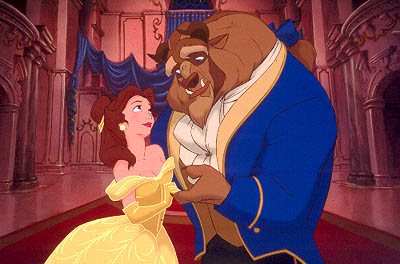
Maurice goes on a journey through the mysterious forest nearby and loses his way, leading him to the dark castle of the Beast. The Beast is a monstrous, uncompassionate, half-man/half-wolf creature who takes Maurice as his prisoner. When Belle finds him, she begs to take his place. We already know the origins of the Beast, explained in opening narration over a series of pictures on stain-glass windows. The Beast was a handsome but horrid prince whose cruelty got him into trouble with a witch, who transformed him into the Beast and everyone living in the castle into household objects—the butler is now a candlestick and the maid is now a teapot, for example. The only way to reverse the spell if the Beast can love and be loved in return before a magic rose, held in the west wing of the castle, wilts away.

Belle and Beast start off unpleasantly. His attitude is hostile towards her and she finds life in the castle very dreary. But with help of the helpful live objects, they learn to accept one another. As their relationship develops further, so does their romance as they realize they start to love each other, despite their differences. But Gaston will not stand for it as he rallies the whole town to come to kill the Beast and take Belle back.

“Beauty and the Beast” provides a pair of memorable, three-dimensional characters to follow, making this romance into a wonderful tale. Belle is not like all the other Disney animated heroines, and hardly like any animated heroine as far as I’m concerned. She’s independent, bright, strong-willed, kind, free-spirited, and is beautiful but doesn’t flaunt it. She doesn’t care about how she looks and doesn’t share Gaston’s logic (or lack of logic) that beautiful people should be together. All the other women in this movie are dim-witted and constantly swooning over men. Belle just keeps her nose in the books and doesn’t bat an eye when confused passersby notice her as the odd one in the neighborhood. When Gaston comes on to her, she turns him down, not taking any of his bull. And when she sees the Beast, she’s admittedly frightened of his appearance, but lets down her defense and sees the Beast for whom he could be, and who she could help make him to be. Belle is a perfect leading character for this story, and the animators do great jobs at creating her facial expressions—happiness, sadness, fear, anger, skepticism, and concern.

Now the Beast—there’s something monstrous and frightening about his giant stature, long brown fur, giant fanged teeth, beast-like walk, and deep roaring voice, but there can also be something worth caring for. The Beast learns he can genuinely love and even makes his own sacrifice to show his true nature and win Belle’s heart.

The supporting characters are memorable—every single one of them. The father Maurice is enjoyable in how curious he is about everything (his reactions to the enchantments of the castle are winning). The household objects that have personalities really take advantage of their screen time. There’s a candlestick named Lumiere (Jerry Orbach) who has a sophisticated manner and a welcoming personality (although I have to ask—why is he the only one in this movie with a French accent?); a clock named Cogsworth (David Ogden Stiers) who has a nervous, uptight personality and likes to keep things in control; a kindly teapot named Mrs. Potts (Angela Lansbury); Mrs. Potts’ young son Chip (Bradley Pierce), now a little teacup; and a footrest that acts as the castle’s dog. All of these characters deliver many wonderful moments, including an exciting musical number called “Be Our Guest” in which they make Belle feel right at home.

Then there’s the villain Gaston—I love this guy. His idea of logic just cracks me up with laughter. He doesn’t know he’s being ridiculous in thinking that since Belle is the most beautiful woman in town, he should marry her. Everyone else in that town thinks the same way, and besides, he’s the town hero. He could be the lead character of another movie—he’s charming, good-looking, and heroic. But here, he doesn’t get his way and the more he resorts to, the more of a beast he becomes, leading to a necessary line delivered by Belle about the Beast—“He’s no monster, Gaston—you are!”

The voiceover work is perfect. Paige O’Hara gives likeability and personality to Belle; Richard White is deliciously despicable as Gaston; Jerry Orbach, David Ogden Stiers, and Angela Lansbury are all fantastic; and then there’s the actor voicing the Beast—if you told me Robby Benson, the wimpy, wispy actor from films such as “One on One,” provided the voice for the Beast, I wouldn’t have believed it. In fact, I didn’t even know that it was Robby Benson until I saw the credits. And to be honest, he’s excellent in this movie!

Now that I’ve talked about the memorable characters, I should get to an important topic—the animation. This is some of the best looking animation I’ve seen in a movie. It’s amazing that the animators pay attention to every detail. There’s a great, polished look to the film that helps make it inviting. The settings are drawn perfectly, especially the castle which looks unbelievably amazing. There’s a neat gothic exterior that looks like something out of the best haunted-house movies—it’s just incredible. And I should also point out a central sequence in which Belle and Beast dance in the ballroom—using computer-generated backgrounds with hand-drawn characters, there’s an extraordinary shot that works as a crane shot, moving all over the room as the two dance. It’s moments like this that make this look as real as live-action.

Then there are the songs/musical numbers—music by Alan Menken and lyrics by Howard Ashman, both of whom worked on the music for “The Little Mermaid.” These are some of the best, most memorable songs in any Disney movie, and the production numbers are well-drawn, well-timed, and outstanding. There’s the opening number “Belle,” the villain’s theme “Gaston,” the joyous “Be Our Guest,” the observant, lighthearted song “Something There,” and the lovely, slow, noteworthy title ballad “Beauty and the Beast.”

It’s hard to resist loving “Beauty and the Beast.” It’s a perfect mix of characters, romance, music, enchantment, and animation. I can’t imagine anyone not enjoying this movie—kids will love its energy and spirit; adults will get even more from it. It’s a great family film that provides great entertainment.

Amadeus (1984)

31 Jan

Tom-Hulce-in-Amadeus-1984-001

Smith’s Verdict: ****

Reviewed by Tanner Smith

“Amadeus” is a film that gives a positive answer to the question “is a film about an artist as interesting as his or her work?” The answer is yes, as “Amadeus” is a historic-fiction period drama/portrait of Wolfgang Amadeus Mozart, and is also a high achievement in cinema history. This is one of those movies that, like most of the actual Mozart’s work, is just perfect. It’s a compelling story, a powerful drama, and a showcase of great talent.

“Amadeus” occurs through ten years of Mozart’s life, mostly spent in Vienna from the year 1781 to 1791. The film chronicles his successes and failings, but it covers more than just Mozart’s talent. It’s also an amazing portrait of creativity and envy. For you see, this film is not merely about Mozart and his work, but more of how envious the most miserable of colleagues in this craft can be to the point of trying to destroy him.

The envious one is Mozart’s rival Antonio Salieri (F. Murray Abraham) whom we first meet in the 1820s as an old man who attempts suicide while exclaiming that he killed Mozart. He is sent to an insane asylum where he gives his confession to a priest. As we see in flashback, Salieri looks back on his days as Court Composer for Emperor Joseph II (Jeffrey Jones) in Vienna. Mozart was Salieri’s idol, as he recognizes greatness in Mozart’s work, even when he was a young lad. Salieri himself is actually a mediocre composer, which he doesn’t realize and no one seems to point out because the Emperor himself is tone-deaf—he wouldn’t know a great music piece if he played it himself.

Salieri meets Mozart and is utterly shocked and dismayed when he realizes that Mozart is actually just an immature child stuck in a man’s body. He simply can’t believe that one of the greatest music creators in the world, if not the greatest, behaves wildly—chasing women, making inappropriate remarks, and having very little manners. But he truly is a genius and Salieri can’t deny it. However, Salieri is saddened and confused that God would display this great talent to this “creature,” as he calls him. As Mozart grows more and more famous and infamous, Salieri becomes more envious and wants nothing more than to plot Mozart’s downfall. But what always sets him back is the power of his music.

As you may have guessed, the most complex character in “Amadeus” is not Mozart, but Salieri. This is the one telling the story; this is the one who is envious the genius brought to this spoiled brat of a man; this is the one who is caught in a mixed bag of emotions; this is the one who has ignored all of the things that Mozart has enjoyed in life, just to be noticed for his own music, but alas he’s a second-rate composer. He even goes as far as pretending to be his late (disapproving) father’s ghost to work hard on the grandest opera the world has ever known, putting Mozart to a large amount of stress. And as Mozart is lying there, suffering and pretty much close to death, Mozart begs Salieri to help him finish the composition, while Salieri plans to steal it and claim it as his own.

That piece, by the way, is of course “Requiem,” and the scene is probably the most touching in the movie, because Mozart is willing to go all out with his creativity and genius, even on his deathbed. And a great touch added to it—as the piece is written, the actual music (imagined) is developed right along with it.

Mozart is an interesting portrayal. As I’ve said, he’s an immature child trapped in a man’s body. He can be loud and obnoxious, especially with his trademark braying laugh, as he could be considered to be trapped in a state of arrested adolescence. He’s mainly like a modern-day rock star—easing his way into this world and just having the time of his life. Sometimes, he’s nervous—such as when the Emperor orders for a piece to be shortened because the music has “too many notes,” and especially when his father, whom he’s devoted to, judges him. (Even when his father dies, Mozart is still haunted by him.) But sometimes Mozart can be unpleasant. There are moments when he’s either cruel to his wife Constanze (Elizabeth Berridge) or just unfaithful to her, though he does love her, and there’s also a scene in which he flat-out mocks Salieri’s work without knowing he’s present.

Tom Hulce plays the complicated role of Mozart and does an excellent job at playing him like Salieri sees him, as thus how we see him. Sometimes he’s likeable, sometimes he’s rude and obnoxious, but when you get down to it, he is Wolfgang Amadeus Mozart.

F. Murray Abraham is perfect as Salieri. He’s not a standard villain for Mozart; he’s a classic, tragic figure of envy. Though we wouldn’t prefer to stir through his sort of measures, we understand the pain he’s going through. And I also have to give him credit for playing both the young and old versions of the character—thanks to some great makeup work and equally great acting by Abraham, I never would have guessed this was F. Murray Abraham playing the older Salieri. But it is. Great work!

Is “Amadeus” completely historically accurate? Maybe not. But what should it matter when this much heart is put into the story and film? Maybe some parts were exaggerated; maybe other parts were stretched out. Either way, it’s known as “historic fiction,” and not to be one-hundred-percent accurate. It’s just a movie. And it’s an excellent one too.

American Pie (1999)

31 Jan

images

Smith’s Verdict: ***

Reviewed by Tanner Smith

Many people would call the 1982 raunch-o-rama box-office hit “Porky’s” a treasure (not me); many others will call it more sick and inappropriate than funny (like me). That brings to what could be considered the “Porky’s of the 1990s”—a movie called “American Pie.” This is a better, brighter, and funnier movie than “Porky’s” and people need to look to see that because there is a difference between cruelty and humor.

The teenagers in this movie are nicer and more appealing than anybody in “Porky’s”—also, they look and feel like high school teenagers when it seemed disturbing to look at the “teenagers” in “Porky’s.” The movie focuses mainly on four high school boys who make a pact to lose their virginities by the end of the senior year. They are nervous Jim (Jason Biggs), who doesn’t know what approach to take toward girls; slow-thinking but good-natured jock Oz (Chris Klein, also good in “Election”); Kevin (Thomas Ian Nicholas), who has a girlfriend (Tara Reid) but is afraid of commitment; and Finch (Eddie Kaye Thomas), the smart one who is so wound up that he never uses the school’s bathroom. They’re all best friends and they’re all virgins. They make their pact when a less-popular student loses his virginity to a popular girl.

Right away, you see how fresh the movie is—how many high school movies nowadays allow their central characters to be virgins? The four teenagers in this movie look and feel like real teenagers because they’re insecure about themselves and about women. And they’re inexperienced in sex. But they’re willing to have sex before graduation day and target the prom to lose their virginities after. In his part of the pact, Oz even joins the glee club to get closer to girls. This is dangerous for his social image because he also has lacrosse to think about. A refreshing move is that Oz doesn’t care much about that.

Jim has his eyes on an attractive foreign exchange student named Nadia (Shannon Elizabeth). After finally convincing her to come to his house, Jim is totally embarrassed when his webcam is turned on and pointed at him and Nadia as they get kinky in Jim’s bed. Everyone with a computer is watching…

Most of “American Pie’s” humor takes place in the form of vulgar gags, most of which make the movie so close to an NC-17 rating (instead, it is given an R). A couple comedies before this have had such gags—the hair gel scene in “There’s Something about Mary” and the tissue sample mistaken for coffee in the “Austin Powers” sequel. This time, in “American Pie,” semen has become main ingredient—for beer and for a pie, hence the title (which has nothing to do with the popular song). This is funny because the characters are not part of the joke. Here, they’re embarrassed, and we feel their embarrassment—how could we not? They don’t know what they’re doing, so it’s funny. Most gross-out gags in movies are not funny because we see them coming and they live to gross us out. Here, in “American Pie,” they’re here just to make us laugh. I laughed a lot during this movie. Also, the movie seems to be very frank about sex. The R rating just doesn’t give in.

There are three supporting characters that stand out among the other characters. One of them is Jim’s dad (Eugene Levy), who completely understands and tells his son how proud he is of him and that he feels his pain—maybe he’s been there before. I loved his lecture on the birds and the bees, using visual aids. When he finds his son doing something very unusual to the apple pie they were supposed to eat for dinner, he just says, “Well…we’ll just your mother we ate it all.” This is one of the best movie fathers in any teenage comedy. Another character that stands out is Kevin’s girlfriend’s best friend (Natasha Lyonne, whose deadpan comic timing is wonderful here). Finally, there’s the irritating (but also very funny) Steve Stifler (Seann William Scott). He’s enough of a sleazeball for us to want to slap him in the face, but enough of a smartass for us to laugh at him. He never shows any sign of sympathy for any of the other characters and would love to create misery for his own amusement. And I won’t dare say how he gets his comeuppance at the end of the movie, but let’s just say Finch now understands why “The Graduate” is a classic film.

“American Pie” has as many laughs as “Animal House” and a lot more laughs than “Fast Times at Ridgemont High.” And like I said, it’s a much better film than “Porky’s” because it’s OK to be raunchy, crude, and vulgar…as long as it’s funny instead of cruel.

Explorers (1985)

31 Jan

Explorers_kids

Smith’s Verdict: ***

Reviewed by Tanner Smith

“Explorers” is a family-friendly gem that is sort of let down by its final act. This film has a great setup that doesn’t leave a strong payoff—in fact it’s real silly. But that doesn’t mean I won’t recommend the film. It’s just that maybe it deserved a little more than what it had to offer. Besides, maybe the journey is the most important part of the movie.

The film is a kid’s science-fiction fantasy directed by Joe Dante (“Gremlins”) and it features three young boys as the central characters. One is a dreamer; one is a young scientist; and the other is a loner that the other two boys befriend in the beginning of the story. The dreamer, Ben (Ethan Hawke), has been having these strange dreams that involve a circuit board. Intrigued by the dream, he draws what he can remember of the circuit board on a sheet of paper to see what his genius friend, Wolfgang (River Phoenix), can make of it.

Don’t ask me how, but with the aid of Ben’s dream, Wolfgang is able to create a solid sphere that can break through a brick wall and can be controlled by Wolfgang’s computer. Loner Darren (Jason Presson) is in on the secret as the boys realize that, when enlarging the sphere, they all can fit inside this thing and use it as a force field…and also are able to fly around in it. So, they get this idea to make an aircraft out of an old Tilt-a-Whirl.

If you think this sounds like a silly idea, you’re not far off. It is a silly idea. But the strange thing about “Explorers” (and yet so wonderful about it) is that it takes this idea seriously but not too much. I love how everything develops as the kids are figuring what to do with this new discovery. It helps that the kids are fresh and likable. It’s fun to watch them as they go on.

But that’s only the first half of the movie. When the second half approaches, the boys have already flown above town in their own homemade spaceship and are reaching signals from what could be another planet. (Some of these signals come from within their own dreams.) But what happens when they actually do go into outer space, I probably shouldn’t give away. But I will say this—these boys are bright enough that we want them to find something really interesting; their find isn’t up to it. I suppose it’s fine and fun for younger kids, but for others who really get into this film from the start, it’s kind of disappointing.

I don’t want to sound too harsh, because the payoff is kind of amusing if not what one might expect. Maybe this is why I’m recommending the film. And besides, what really matters is the journey, and “Explorers” is a very fun journey. It’s a delightful, entertaining watch.