Archive by Author

Road Trip (2000)

6 Feb

4fdea77cb18fc

Smith’s Verdict: ***

Reviewed by Tanner Smith

In 1978’s “National Lampoon’s Animal House,” Tim Matheson uttered the words “road trip” and that led to a very funny sequence while the Deltas are on a road trip. “Road Trip” seems like an extended play on that sequence—it makes sense, considering that the executive producer is Ivan Reitman, who produced the former. The result for “Road Trip” is somewhat uneven but mostly very funny and, in its own way, kind of sweet.

The main character is Josh (Breckin Meyer), a student of the University of Ithaca. He has a long-distance relationship with Tiffany (Rachel Blanchard), who goes to the University of Austin. They call each other every day and Josh sends videotapes of himself to her. But lately, Tiffany doesn’t call Josh back. This upsets Josh, who thinks that Tiffany may be cheating on him. It also drives him to give in to the seductiveness of the attractive Beth (Amy Smart), who has a crush on Josh and is being stalked by the nerdy teaching assistant Jacob (Anthony Rapp). They have sex after Josh bids on her at a girl auction held at a party, while being videotaped by Josh’s camcorder. But the next day, Tiffany finally returns Josh’s calls and says that she went through a mourning period due to her grandfather’s death. But wait. It gets worse—the sex video is accidentally mailed to Tiffany (one of Josh’s roommates mixed it with Josh’s “I miss you” tape, which he meant to send). Josh has three days to get from Ithaca to Austin before Tiffany comes back to school and sees the tape. Josh is joined by three friends (Seann William Scott, D.J. Qualls, Paulo Costanzo) on…what else, a road trip.

Of course, it’s not whether or not characters in road-trip movies make it to their destination that’s important. It’s what happens on the way. A lot happens on this road trip—their car explodes after jumping a huge ditch, they steal a bus, they spend the night in an African-American fraternity house, and more that I can’t give away. Some of the jokes are hit and miss, but there are more laughs. There is also a great deal of raunchiness—a diner cook makes French toast in such a nasty way that you might not want to try it again, there is a lot of nudity, sexual references, and sperm donations (in the most unusual way). You could call this the first follow-up to “American Pie,” which redefined the genre of teen sex comedies. (Oddly enough, Seann William Scott, who played Stifler in “American Pie,” plays a big-mouth best friend here.) Oh, and I almost forgot to mention the subplot involving MTV’s Tom Green as a seven-year student at Ithaca who tries to feed a mouse to a snake and terrorizing it until the moment of “fury.” That’s funny, too. And also a subplot involving D.J. Qualls’ hard-as-nails father (played by Fred Ward) who believes his son is kidnapped and waves a gun at anyone who doesn’t answer questions. A lot happens in “Road Trip” and even if all of it doesn’t mesh well, you still have a good time.

The real show-stoppers of “Road Trip” are D.J. Qualls and (sue me) Tom Green. D.J. Qualls is brilliant as the nerdy, cowardly college student who is afraid of his father and has a redeeming point on this road trip. Observe his performance and notice how flawless he is at playing this character. And as for Tom Green as the film’s narrator—this is probably the only time I’ve found him amusing. Then again, he tones down his persona here. All in all, I did like the characters and laugh a lot, so I recommend “Road Trip” while saying it could have been better.

Red Dragon (2002)

5 Feb

images-1

Smith’s Verdict: ***1/2

Reviewed by Tanner Smith

“Red Dragon” begins with an unnerving shot of an audience at a concert hall. The reason it’s unnerving is because of the one person we recognize before the camera pushes in on him. There’s a subtle lighting on that shot that isn’t too flashy so that we recognize right away who the guy is, but it just comes naturally. We can see that it’s Hannibal Lector, the infamous, cannibalistic psychiatrist/serial killer played by Anthony Hopkins in the role that won him an Oscar in 1991’s “The Silence of the Lambs.” Seeing Lector among people, wearing a suit, is unnerving even of itself, but his emotion of disgust when he studies the one flutist playing the wrong notes is even more so.

That may be because we realize who this man is and understand that “Red Dragon” is actually a prequel to “The Silence of the Lambs.” And it’s also because the director Brett Ratner has a way of showing things as they are and yet keeping an eye for important things, like the best directors of thrillers. It’s surprising that Ratner’s previous work was directing the “Rush Hour” movies.

But anyway, what follows that first scene is something even more disturbing when you’ve studied Lector in “Silence of the Lambs”—Lector is hosting a dinner party. You heard that right—a dinner party. I don’t even want to know what he serves to his dinner guests, but they seem to enjoy it. I don’t even want to think about it.

What follows isn’t as terrifying as its great opening, but it’s still pretty suspenseful. “Red Dragon” is actually a well-put-together, gripping thriller. That comes as a surprise, because while it’s an adaptation of Thomas Harris’ novel of the same name, it’s also a remake of the stylized 1986 thriller “Manhunter,” by Michael Mann. I loved the original film, and that’s why I was surprised to like this remake (or more accurately, re-adaptation) just as much. Sure, it doesn’t have the same amount of style, but not all movies can be the same.

“Red Dragon” follows an FBI Special Agent named Will Graham, who has a gift for deduction (he’s like a modern day Sherlock Holmes). He goes to Lector’s house the same night as the party and tells him, as his psychiatrist, that he’s found an extra clue in the latest killings—body parts are missing from the bodies, like livers and hearts. Soon enough, he realizes that Lector is a cannibal and he’s responsible for the killings. Graham is able to capture him, but after he nearly dies.

Several years later, Will goes into retirement is called back from his family life into the field to track down a new sick serial killer dubbed “The Tooth Fairy.” After finding some clues, Will realizes to know a serial killer is to capture one, so he goes to the prison where Lector is being held to ask Lector if he knows anything about the Tooth Fairy or if he would know what his next move would be, as a psychopath. It’s psychiatry and psychopath mixed in one, just as Lector showed in the previous film. He’ll give his answers only after he’ll share his delusions of the human mind.

These scenes are different from Lector’s talks with Jodie Foster’s Clarice Starling in “Silence of the Lambs” in two ways. The first way is, Will is too smart to fall for Lector’s delusions. In “Silence of the Lambs,” Clarice pays attention and looks on with frightened awe. But in “Red Dragon,” Will takes none of that. He’ll just get the answers he needs and get the hell out of there. And the second is that there’s a constant battle of wits between Lector and Will. While in “Silence of the Lambs,” Lector grew to care for Clarice (you have your version, I have mine), Lector hates Will in “Red Dragon.” He knows that Will isn’t interested in Lector’s off-subject rambles and is still steamed that Will found a way to get him in this prison, and that stretches to the point that he actually finds a way from inside his cell to tell the Tooth Fairy where Will’s family lives. There’s a great deal of tension between these two.

Edward Norton plays the intelligent, insightful Will Graham and sells the role. Norton has a powerful screen presence shown in countless other movies and he makes a great hero for this sort of movie.

As for the Tooth Fairy, he’s played by Ralph Fiennes in a chillingly good performance. He plays the Tooth Fairy as a tortured soul fighting his emotions the way Gollum fights his double personality. One moment, the Tooth Fairy (or Francis Dolarhyde, as he’s known at his job) is a frightened man tortured by his abusive past. The other moment, he’s a twisted killer who kills as part of his own transformation from a coward to a conqueror. Whatever part of him that’s still human is kept alive by a blind woman (played by Emily Watson) who feels compassion for him.

Anthony Hopkins is still spot-on as Hannibal “The Cannibal” Lector, the role that won him an Oscar, this fascinating character that has room for more back-story to be told. He’s a psycho, but he’s charismatic and shares his views of the human mind with exact pronunciation and a sense of irony in his wit.

There are other characters in “Red Dragon,” like Will’s wife (Mary-Louise Parker), Will’s boss (Harvey Keitel), and memorably, the reprehensible tabloid reporter (Philip Seymour Hoffmann) who finds out more than he should know and ultimately becomes the Tooth Fairy’s latest victim. What’s engaging about “Red Dragon” is that it takes its time to develop its characters while keeping the gore at a more minimum level than you might expect. There is suspense, intelligence in Will’s way of figuring all of these things out, and Norton has a mighty screen presence that balances out Lector and the Tooth Fairy.

“Red Dragon” is a smart thriller with sharp direction, great acting, and a real sense of tension, not to mention a great, memorable music score by Danny Elfman. It’s an appropriate prequel to “The Silence of the Lambs” and well-drawn-out remake to “Manhunter” and captures the right amount of menace compared to each.

Manhunter (1986)

5 Feb

images

Smith’s Verdict: ***1/2

Reviewed by Tanner Smith

I get the feeling that Thomas Harris really gets what it means to set up a gripping murder mystery. In his books “Red Dragon” and “The Silence of the Lambs,” Harris creates memorable, three-dimensional characters and brings them on some of the more original mysteries of identifying some of the more original serial killers. For movies to be adapted from these works, it’s important to capture the same sense of suspense, intrigue, and danger. It helps to have an artistic look as well. With “Manhunter,” writer-director Michael Mann brings the novel “Red Dragon” to life and delivers a gritty, tense, stylish thriller with a talented cast and a gripping mystery.

For starters, it has an intriguing main character for us to follow, played with an intense, mesmerizing performance by William Petersen. Petersen plays an FBI agent named Will Graham, a brilliant mind that can enter the mindset of a killer and read into how he acted. But after a breakdown after catching an equally brilliant serial killer, Dr. Hannibal Lecktor (Brian Cox), he went into retirement. But now, he’s called back to help his former FBI superior Jack Crawford (Dennis Farina, in a strong performance) in a new case—a serial killer known as the Tooth Fairy because of the bite-marks on his victims.

In one of the more disturbing early scenes, we see Graham as he investigates one of the murders. As he thinks everything through, you feel a great sense of unease because you feel like he is actually thinking like a sick killer himself. He isn’t merely having an epiphany—it’s almost as if he’s thinking of what he would have done if he committed the murder. This makes him an effective anti-hero—always wavering between good and evil, if you will. You know he’s not of a fully stable mind.

The killer, the Tooth Fairy, is Francis Dolarhyde (Tom Noonan), an odd person who works at a photo lab where he strikes a relationship with a blind woman, Reba (Joan Allen). We meet him later in the film, when he’s torturing a jackass journalist (Stephen Lang) who printed an article about him that he certainly didn’t agree with. In one of the creepiest scenes in the movie, the journalist is strapped to a wheelchair and has no choice but to tolerate the killer as he goes about his idea of changing into a Red Dragon (inspired by the William Blake paintings). How he does away with the journalist is especially unnerving. And then when you see how he works, and his interaction with Reba who doesn’t know who he really is and likes the way he speaks, it becomes clear that Reba will become the next victim, unless Will can find the killer and save her.

You could say that because you don’t know all that much about the killer and his relationship with Reba is somewhat rushed, then it just seems like another killing for him. While I can agree with the second part (I did want to see more of the Reba character beforehand), I think that of the first part, that you don’t know much about him, just makes him a more chilling villain. You don’t know what he’s thinking, but you know that something can put him on edge anytime and he can kill people. It’s more unnerving when you don’t know much about the killer. You know his motives, you know he’s up to no good, and Tom Noonan delivers a great sense of terror within strangeness.

There’s another killer in this movie—Dr. Hannibal Lecktor, whom was captured and locked away by Graham. Now, Graham requires Lecktor’s insight and assistance in helping him capture the killer, by using his sick mind to figure the Tooth Fairy’s move. Lecktor enjoys playing mind games with Graham, since he believes that they are “just alike,” as they are brilliant minds on the edge of destruction. On top of that, secretly, Lecktor is grudging against Graham and actually figures a way from inside his cell to get to him and his family.

“Manhunter” also allows us to see Graham with his family. The scenes in which his wife (Kim Griest) and his son (David Seaman) are effective because it gives Graham something to live for and something to protect. We care about them and hope nothing bad happens to them, and so we root for Graham to solve the case and catch the killer. In particular, the scene in which Graham talks about his son about why he was sent to the psychiatric hospital ward is very strong with the right element of tenderness.

The story unfolds quite smoothly and we’re involved all the way through, but I wish that the movie would end on something more than a climax featuring a violent showdown between Graham and the killer when they finally meet and try to kill one another. I was hoping for a more psychological element to take over since these two have been developed as mentally-unstable minds, one more than the other. But instead, it’s just a standard climax. Fortunately, it doesn’t shoot the movie in the foot, because of everything that has happened before.

The actors deliver excellent performances. William Petersen, as I’ve said, is mesmerizing as the hero Will Graham, seeking redemption by stopping the actions of a sick mind. Tom Noonan is a chilling villain, Brian Cox is a slimy catch-you-off-guard mad intellectual, Dennis Farina is an intense superior, Stephen Lang is a memorable jackass reporter, Joan Allen makes the most of her scenes, and Kim Griest and David Seaman do good jobs as Graham’s family. The characters are memorable and actors portraying them do great jobs.

The visuals in the film stand out—blank walls, long beaches, and colorful palette make the most of scenes—and while admittedly some of them get a little tiresome after a while, they still stay in your mind. Technical detail is given the appropriate attention in “Manhunter.” And while that doesn’t make it necessarily subtle, it’s still effectively chilling enough. “Manhunter” is a disturbing but active thriller that keeps you invested from beginning to end.

Flatliners (1990)

5 Feb

flatliners

Smith’s Verdict: ***

Reviewed by Tanner Smith

“Flatliners” is a thriller that asks the question, “What happens to us when we die?” According to the main character in the film, no one can know for sure…unless someone dies and then lives to tell about the afterlife experience. But how is that possible? Well, for the characters in “Flatliners,” it’s possible. As for me, I’m not sure if the method would work, but I personally wouldn’t try it out either.

Let me explain—the movie is about a group of medical students who one-by-one stop each other’s heartbeats, to die. Before too long, the others revive the person. So that person will have come back from the dead to live to explain what was happened.

Being medical students, these people have been taught to play God to their patients. It’s Nelson (Kiefer Sutherland) who has the idea to look God in the eye with this little experiment. He enlists the help of Rachel (Julia Roberts), Labraccio (Kevin Bacon), Joe (William Baldwin), and Steckle (Oliver Platt) to sneak into the school after hours with medical equipment, in order to lower his heart rate, die, and have the others revive him by emergency measures. This experiment is dangerous, and would result in both death and expulsion…but it works. Nelson has come back from the afterlife, convincing the others to try it out themselves. Thus tampering with God’s plans for them.

This is an intriguing concept for a movie and it has a top-notch cast, as well as a unique, incredible style to it, from director Joel Schumacher. Also, the idea behind the afterlife’s plans after their experiment is quite something indeed. You know how when you nearly escape death and your life flashes before your eyes? In “Flatliners,” when the characters kill themselves and then are revived again, their biggest sins and fears (mainly to do with guilt) are brought back along with them. They haunt them to no end—for example, William Baldwin’s character is known for his one-night stands and secretly videotaping sexual intercourse; now whenever he looks through a camera or to a TV, he sees those same women, asking “How could you do this to me?” or saying, “I trusted you.” They conclude that the solution is to face them instead of run away from them. This is the movie’s way of saying that you should have your emotions in check before you die. That’s very clever.

This is when “Flatliners” stops becoming an adventure and a thriller and turns into drama. But while I got into Kevin Bacon’s story, and Kiefer Sutherland’s story becomes the central conflict, I feel like William Baldwin’s story had no satisfying turn and Julia Roberts’ entire story is handled so heavily that I felt like I was watching an afterlife-themed soap opera. (Oliver Platt doesn’t “flatline,” which he gladly mentions.)

There’s one thriller aspect that annoyed me, and it had to do with the “flatlining.” Actually, it’s not necessarily the flatlining; it’s the reviving. The first time you see it is kind of suspenseful, but when you have to see it a few more times, suspense is long gone and the scenes desperately try to hammer in the tension to little prevail. I was also annoyed by the competition among the characters based on who can stay dead the longest.

“Flatliners” works as a thriller, and works fine as a drama (though like I said, that’s mainly coming from Sutherland and Bacon’s separate story arcs, which are the strong points). Is there a tunnel with a bright light leading to heaven after you die? I don’t doubt it. Just don’t ask me to undergo this sort of therapy to find out.

Election (1999)

5 Feb

top20jerks-election-590x350

Smith’s Verdict: ***1/2

Reviewed by Tanner Smith

“Election” is one of those movies that is even better the second viewing. I saw it once and wasn’t all that impressed. Then days later, I saw it again and was ultimately surprised by how much this film really is. This is a sharp, smart satire about high school with more to it as well. It’s about a high school teacher who is not perfect and gets himself in a weird situation during the student body election. And I have to ask, how often do teachers get as much good treatment as teenagers in even the best teen movies? Let alone a satire of teen movies?

We not only get one narrator, but four different narrators telling their sides of the story in this movie. One is that teacher I mentioned above. His name is Jim McAllister (Matthew Broderick). He gets involved with his students some of the time and is deeply dedicated to his work.

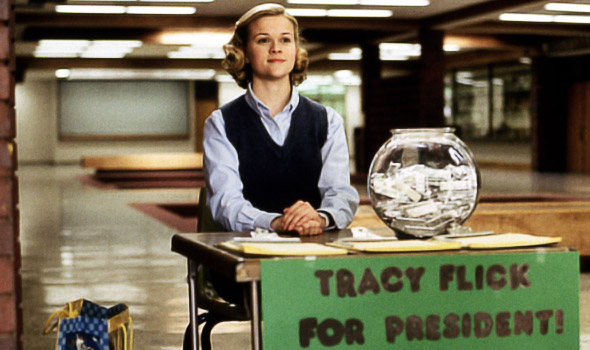
But there is another main character that really gets our attention—a student named Tracy Flick (Reese Witherspoon). To say she’s an overachiever is an understatement. She doesn’t just conquer all; she waves goodbye as she moves from regular student to obsessive, perfect student. She always has her hand up in class, leaving the teacher wishing someone else would raise a hand. She is always perky, neat, seemingly good-natured, and so-called “perfect.” But in truth, she’s a snobby wench. Her overachieving personality and unpopularity to her peers may remind the audience of a female politician. Mr. McAllister doesn’t like Tracy. She was involved as a “victim” in a sex affair that involved McAllister’s best friend, who was also a teacher. And now, she’s running unopposed for class president.

McAllister will not have this, so he decides to encourage another student to run for president against Tracy. His choice is one of the more popular and most sincere students named Paul Metzler (a third narrator played by Chris Klein). Paul was upset because of his broken leg that will not allow him to play football again and now, McAllister brightens his spirits up a little bit and convinces him to make a difference as student body president. Tracy is appalled. She will not stand for this. But what’s worse? Paul’s adopted sister Tammy (Jessica Campbell, the fourth and final narrator) is an angry lesbian whose former lover left her for Paul. So she decides to run for president as revenge.

This leads to a great scene in the gym, in which the whole school watches as the candidates give their speeches. Tracy’s speech is delivered with as much pep as possible, Paul is completely honest but his delivery is monotone, and then everyone is surprised by Tammy’s speech, simply saying that she doesn’t care about any of this and calls it a “pathetic charade.” That gets a huge round of applause from everybody except the other candidates and the teachers because…let’s face it, the students are bored by this “pathetic charade.” I know I was (and I’m sorry for saying so). That’s a great scene.

We follow all of these characters on their sides of the storyline. Mostly, we stay with McAllister. One of the darker sides of the story doesn’t even take place on school grounds. He begins to have an affair with the wife of his original best friend, who was thrown out of the house. It’s totally wrong and he’s just as bad as his friend was with Tracy. But he goes through with it and later, his life and career is all downhill. One of the strangest things about this movie is just how frank it is about sex. We get one too many bizarre sex scenes, one of which features McAllister imagining he’s having sex with Tracy (!). That frankness is a bit uneven and loses the film its fourth star from me.

But the other stuff is great. It’s all nicely directed and well-written by Alexander Payne. There are some big laughs, some touching moments, and despite everything, McAllister is someone to care about. The acting is solid here. Matthew Broderick has come back to high school after movies in the 1980s, such as “WarGames” and “Ferris Bueller’s Day Off,” where he played a high school student in each. As a teacher, he seems strangely more comfortable here than in anything else he was in recently. Chris Klein is likable as the jock that really wants to make a difference in school. He doesn’t play Paul as the stereotypical jerk who gets the hot cheerleader friend and puts everybody down. He’s just a nice guy who is completely honest about his campaign. Jessica Campbell is very good as the budding lesbian who can’t take it anymore. But it’s really Reese Witherspoon who really should have gotten an Oscar nomination for this performance as the overachieving Tracy Flick. She is absolutely fantastic here. Watch the scene in which she tries to fix her banner in the school hallway, which winds up destroyed, and watch how she reacts to one little thing becoming a mess. The way she reacts to her imperfect deeds is an absolute classic. Oh, and she thinks she knows how everything works in the world. Well, she doesn’t but she thinks she does.

We’ve all known students like Tracy, Paul, and Tammy, so we care what happens to them. Because of this, we actually care what will be the outcome of the election. They are well-developed and not just comic foils for a terrific script but real people.

There are laughs in “Election,” but this is a dark comedy, so you get the kinds of laughs you would expect about the frankness of sex I tried to explain about above. The ending is a bit overlong but it makes up for the perfect touch of irony that is developed. Director/co-writer Alexander Payne doesn’t go for the cheap laughs or cheap shots or even cardboard characters—he just wants to tell a story. “Election” is a satire that is bright, alive, sharp, funny, and endearing.

Running on Empty (1988)

5 Feb

MSDRUON EC021

Smith’s Verdict: ****

Reviewed by Tanner Smith

Children, and even teenagers, sometimes feel like they’re being punished for crimes they didn’t commit. In the case of Danny Pope, they don’t know the half of it. Here’s this kid who has not only moved from place to place, but also changed his entire identity countless times, along with his family. He’s living in a world of secrets and hiding. He can pretend to lead a normal life, every time he moves to a different place and engages a new identity, but he never truly will. And it’s all because of his parents.

Danny has kept an enormous secret with the family. Before he was even born, his parents were radicals in the ‘60s. They blew up a napalm laboratory, nearing killing a janitor whom they didn’t know would be there. Since then, they’ve been living underground, hiding from the authorities and raising Danny and his younger brother to their same lifestyle. Every time it seems like their identities are discovered, the Pope family moves away to create new ones.

The Pope family are the central characters in the film “Running on Empty” and it tells the story of how Danny (River Phoenix), now a high school senior, would love to live a normal life, for once. He’s a gifted piano player and has finally shown his gift in this new town to his music teacher at school. With the teacher’s help, Danny gets a scholarship to the Juilliard School. But he can’t accept it, because then he would have to abandon his lifestyle and leave the family.

For Danny, this is his chance to actually become an individual. Why must he pay his parents’ mistakes? Why shouldn’t he go out and live his own life, now that he’s turning 18? For his parents, it’s a real complication. His father Arthur Pope (Judd Hirsch) is a real hard-ass who has kept the family in line for years and is not about to mess it up now. He either doesn’t understand Danny’s plight, or simply doesn’t want to understand. Then, there’s the mother Annie Pope (Christine Lahti), who has made her mistakes and barely regrets them because she did what she felt she had to do, back in the time when radical politics were hers and Arthur’s lifestyle along with others in the ‘60s. What she does care about, and what causes her heart to break, is the fact that Danny would be sacrificing his future if he stays hidden, paying for mistakes that she made. She doesn’t know if she can handle it. The big issue is that if Danny comes clean and goes to college, he can’t see his family again because he may just have the FBI following his every move—who knows?

This is all powerfully well-done and very effective in the way this family’s lives are developed and how their plight is legitimately told. We see it right away in an opening scene in which the family must leave another town—they leave their dog on the side of the road and drive away, and it feels like this isn’t the first time they’ve done this. Then there’s the situation of Danny gaining more than he did in previous lives—not only with his music and the college scholarship, but also with his first girlfriend (Martha Plimpton). She’s the daughter of the music teacher and together, they form a trusting relationship in which there are hardly any secrets, leading to the scene in which Danny finally confesses and tells her everything she wanted to know about him—how it begins: “My name isn’t Michael…It’s Danny.”

The emotional high point of the film comes during the question of whether Danny will go to the school. The film’s strongest scene features Annie arranging to meet her father (Steven Hill) for lunch—she hasn’t seen her father for years, since she disappeared from his life completely. Now she must ask him to take her son away from her so that he can live the future that she has denied herself. It’s a very heartbreaking scene.

“Running on Empty” is an extremely moving drama about choices and about consequences. It’s well-acted, especially by Christine Lahti and River Phoenix (who, despite his character’s story being told, was only given a Best Supporting Actor nomination), and well-executed, with direction by Sidney Lumet and a great screenplay by Naomi Foner. This easily could have been a throwaway melodrama made for TV, but it’s smarter than that. It’s played in a realistic way and is specific in exactly what it’s trying to convey. It’s a great film.

Cujo (1983)

4 Feb

images

Smith’s Verdict: **

Reviewed by Tanner Smith

Reportedly, Stephen King was drinking rather heavily when he wrote his novel “Cujo,” about a rabid killer dog, and apparently has no recollection of writing it. I don’t know what mood he was in when he wrote the novel, but he must’ve had it pretty bad, for him to drink so much. What other excuse would there be for Stephen King to create such an uncomfortable story? I realize the point of horror stories is to unnerve and scare, but “Cujo” goes too far by basically taking a friendly, gentle dog and turning it into a vicious killing machine. Being a dog lover myself, I speak only from a personal standpoint. And that’s pretty much how this review of the film adaptation of the same name is going to be. If you think you’re going to be annoyed by my objections, I suggest you stop reading.

I can’t necessarily knock the novel, as I haven’t read it. But I can knock the movie instead. The idea for this story is one of the cruelest for a horror story, possibly worse than a story about a psychotic killer child. It begins in a cruel way, as the lovable 200-pound St. Bernard named Cujo (what kind of name is that, anyway?) playfully chases a rabbit across a field behind his owner’s house, at the end of a dead-end road. Next thing he knows, he gets his head stuck in a small cave full of bats and actually getting himself bitten by one of them.

Cujo isn’t feeling very well and hasn’t gotten his rabies shots. As days go by, he seems to get worse and worse. And here’s one of the problems with logic in the movie—neither Cujo’s young owner nor his parents seem to notice the nasty bat bite on the poor dog’s nose. If they did, Cujo wouldn’t get rabies and we wouldn’t have a story. And surely enough, Cujo becomes rabid and vicious. He kills the man of the house, mechanic Joe Camber (Ed Lauter), and a friend (Mills Watson). This leads us to the second half of “Cujo,” in which Donna Trenton (Dee Wallace, giving the best performance in the movie) and her five-year-old son Tad (Danny Pintauro) drive out to the house, in the middle of nowhere, in a faulty Ford Pinto. Surely enough, they are trapped in the car by the newly-formed beast, because the car’s alternator dies.

This is actually the part of the movie that is admittedly suspenseful. I consider myself a sucker for movies that feature characters limited to one spot—the claustrophobia and vulnerability aspects make for effective terror. Donna and Tad are trapped for days, knowing that Cujo will somehow make his way into the car to get them. The owner is dead, the others have left, the mailman isn’t coming around anytime soon (because mail is supposed to be on hold for a while), and no one knows where they are…except Cujo. This is a convincing setup and has some tense, frightening moments. It’s just too bad we had to see this formerly cute dog transformed into a monster in order for it to come about.

What does “Cujo” really amount to? Is it telling us to make sure that our dogs have all of their shots? Well, that’s effective enough, but you’d think that that would have happened already. Basically, “Cujo” requires its characters to be idiots for all of this to happen in the first place, and even the protagonists aren’t all that bright, as Donna just continues to stand around while trying to escape, even after given enough time to see if the coast is clear.

As hard as it is to admit, the dog isn’t consistently convincing. Sometimes it’s vicious enough, but other times it just looks like a dog playing around with snarling-dog sound effects. It doesn’t matter how bad they make the dog look after it transforms into the killer dog, drenching him with blood and foam (speaking of which, I felt sorry for the dog having to go through all of that). Whatever Stephen King was thinking when he wrote “Cujo” and inspired this movie, I can only say that this deserves to be put down.

At Close Range (1986)

4 Feb

At-Close-Range-1986-Christopher-Walken-pic-7

Smith’s Verdict: ***1/2

Reviewed by Tanner Smith

“At Close Range” tells a sad, cruel, merciless story about a boy who respects his father who would just as soon kill him in order to save himself. And as a movie, it’s violent and unforgiving, but it’s also powerfully acted and very effective. Even more shocking is that it’s based on true events that occurred in 1978.

Sean Penn stars as young Bradford Whitewood, Jr., a rebellious young misfit with little to no potential and lives in a life of untidy poverty in Tennessee with his divorced mother, grandmother, and half-brother Tommy (Christopher Penn, Sean’s real-life younger brother). Two very important people come into his life (or one of them actually back into his life). One is a neat farm girl, named Terry (Mary Stuart Masterson), whom he meets and starts hanging out with. Another is Bradford Whitewood, Sr. (Christopher Walken), his criminal father who only comes in every now and then to give money. Brad Sr. seems to be doing all right for himself, as Brad Jr. notices. Brad Jr. wants to know more about him, so he decides to live at his place with his gang of professional thieves. Brad Jr. isn’t necessarily the criminal type, but he is reckless, as we saw in an opening scene where he deals unusually and effectively with a man who cheated Tommy and a buddy of his out of a bottle of liquor. He decides he wants a taste of his father’s gang’s action, since it seems a lot more exciting than what he has now. So he rallies his own gang—Tommy and his friends (Stephen Geoffreys, Crispin Glover, and Kiefer Sutherland)—and Brad Sr. assigns them to perform easy robbery tasks for them, in order to prepare for the big stuff that they want to try sometime. But while Brad Jr. is in orbit around his father’s world, his relationship with Terry, who becomes his girlfriend, strengthens and he’s hoping Brad Sr. will “come up with some money” in order to provide a place for him and her to live. However, he finds that Brad Sr. is more than a robber, but that he’s a sick, twisted killer who kills anyone who gets in his way. Brad Jr. learns the hard way when he witnesses Brad Sr. shoot a former member of his gang in the head at close range. Then, things get more dangerous when Brad Jr.’s gang messes up on a job and are busted. Brad Sr. knows that he and his own gang will be connected to all of this, and ultimately decides to take drastic measures to save himself. This also means betraying his son, to kill him if need be.

Brad Sr. is a ruthless S.O.B. and Christopher Walken shows the dark side with intensity. This is one of Walken’s best performances in a film—he has a great ability to move between easygoingness to straight-up malice, and it really comes through in this film. Sometimes he can be a wise guy, as when he enjoys the fact that Brad Jr. idolizes him and plays around it, acting like a big shot most of the time. But when he’s mad, he can turn into a truly evil creature of a man. And he won’t care whom he has to kill to save himself.

“At Close Range” is sometimes an uneasy film to watch. It’s not pleasant or particularly charming, except for the first scenes featuring Brad Jr. and Terry (their relationship is the only sweet part of the movie). It’s very violent, especially in the final act, and seems to glamorize the lifestyles of this gang of violent criminals that Brad Jr. wants to be a part of. And when things go very wrong, the movie still doesn’t let up. But it also makes “At Close Range” an effective portrait of human nature while also delivering the much-needed subtle message against violence and gun use.

Sean Penn is excellent as Brad Jr., creating a conflicted young man caught between two worlds—the nice little world he shares with his girlfriend and the mysterious world with his father that later becomes life-threateningly violent. He’s perfectly natural and very strong in the role.

Maybe “At Close Range” isn’t the movie for you, if you don’t like violence or think this story is too much. But I think it is worth seeing for the performances by Penn and Walken. These are two of the brightest, strongest actors who deliver excellent performances.

On Golden Pond (1981)

4 Feb

images

Smith’s Verdict: ****

Reviewed by Tanner Smith

SPOILERS THROUGHOUT REVIEW

“On Golden Pond” is a collection of brilliant short segments that wraps around at the end so that the film has a linear story structure. It has a story with a beginning, middle, and end, but even between them, if it’s possible, the story has its own wraparound with the two central characters—an elderly couple who love each other to death.

The couple is Norman and Ethyl Thayer (Henry Fonda and Katharine Hepburn). They’re long-married and still share strong simple affection for each other. But Norman is feeling like he’s getting older and it seems that she’s the only thing in his life that matters anymore. That’s good enough for him, since he gripes about everything else.

Anyway, as the story opens, Norman and Ethyl arrive to their lakeside summer cottage near Golden Pond. It’s here that we see Ethyl’s free-spiritedness that apparently stays with age, and Norman’s shyness and stubbornness towards pretty much everything, even Ethyl. He knows he’s getting older and we suspect that he doesn’t see what one more summer at this old place will do to him anymore. But Ethyl assures him that he’s her “knight in shining armor” and will always be.

That’s the opening segment of the film, which could make for a short film of its own. By the time it gets to that pivotal scene, we feel like these two characters have been developed and we like them almost as much as they like each other. But this is just the setup for the real story, which begins as Normal and Ethyl’s grown-up daughter Chelsea (Henry Fonda’s real-life daughter, Jane Fonda) arrives to the cottage to celebrate Norman’s birthday. She brings along her new boyfriend Bill (Dabney Coleman) and his thirteen-year-old son Billy (Doug McKeon). And this is where the conflicts are established. We discover that Chelsea feels resentment towards her father, as Norman has never really given Chelsea her due. It’s as if he really wanted a son to bond with, or he just never really understood how to be a father.

The midway point arrives as Norman and Ethyl agree to let young Billy stay with them while Chelsea and Bill take a trip to Europe. Of course, with no TV and no “chicks” to “cruise” (he’s from San Francisco, where he and his friends “cruise chicks”), the kid acts like a brat. But with some pushing from Ethyl, Norman takes the kid fishing, and the two develop a sort-of father/son relationship together. They bond together, share communication, and trust each other. Later, Norman has learned how to be a father.

By the time Chelsea returns to pick up Billy, she notices the friendship between her father and her new stepson (she married Bill in Brussels, as it turns out), and is even more resentful because Billy is having the relationship with Norman that she never had. But maybe there’s still time for reconciliation.

When Norman and Ethyl are alone again at the cottage, the story ends with the payoff of Norman’s realized mortality. Even though it’s predictable, it’s touching nonetheless. When “On Golden Pond” is over, we feel like we’ve spent time with warm, appealing characters in a peaceful place like Golden Pond. The emotions are there and you feel good about yourself while watching this film.

The performances are first-rate. Henry Fonda and Katherine Hepburn share amazing chemistry together and share distinct characteristics that make them memorable. A lot rides on these two veteran actors and there’s nothing short of greatness for them. Jane Fonda acquits herself nicely to the role of Chelsea, Dabney Coleman shares a great scene with Henry Fonda about asking permission to sleep in the same room as Jane (the questions and reactions are just fantastic), and Doug McKeon does more than expected with the plain role of the kid—he starts out as a bratty tyke, but becomes likeable as his coming-of-age story continues.

I heard that this is the only film featuring Henry and Jane Fonda together. Maybe some of the character Chelsea’s resentment is reflected from a possible, similar relationship between these two. Whatever the case, having this father and daughter together in the film just adds to its effect.

“On Golden Pond” deals honestly with its issues of relationships, resentment, realization, and mortality, while also showing that life can be beautiful, even if things don’t go as planned. With great acting, nicely staged scenery, and a darn good screenplay, “On Golden Pond” is a real treasure of a movie.

The Iron Giant (1999)

4 Feb

tumblr_l6kz3yqDII1qzoa9f

Smith’s Verdict: ****

Reviewed by Tanner Smith

1999 brought a string of first-rate animated features, four of which in particular stood out among the rest, in my opinion. One was “Princess Mononoke,” a feature of Japanese-style animation. Another was the computer-generated “Toy Story 2.” But definitely not the least of these movies are hand-drawn animations Disney’s “Tarzan” and Warner’s “The Iron Giant.” “The Iron Giant” is the subject of this review, and it’s a wonderful movie—well-crafted, entertaining, funny, charming, witty, wonderfully-drawn, and just a joy to watch.

“The Iron Giant” mixes certain elements from science-fiction thrillers from the 1950s (such as “The Day the Earth Stood Still”) and brings to a level not unlike a “boy and his pet” story. In this case, it means that a giant metal robot man from outer space crashes down to Earth and is befriended by a young boy who vows to keep him hidden from the government and the Army. This giant robot could have been a threat to society (and we see that it can become a deadly weapon when it reacts to being fired upon, even by a toy space gun), like in the traditional sci-fi thrillers. But with help from a well-meaning little boy, he becomes a harmless being that learns as it goes along its journey on Earth. The boy describes him as Superman, in that he too has crash-landed on Earth without knowing why and using his power for good instead of evil—although, there’s another comic book character called Atomo which resembles the giant in every way except that he’s the villain instead of the hero. Will the giant continue the path of the hero?

The movie takes place in the mid-1950s, suitably enough. The hero boy’s name is Hogarth Hughes (voiced by Eli Marienthal). Hogarth lives in Rockwell, Maine, and would like to have a pet, which his mother (Jennifer Aniston) won’t allow. One night, while Mom is working late, he’s watching cheesy monster movies when his TV antenna suddenly disappears, which Hogarth suspects as the workings of “invaders from Mars.” So he goes outside to investigate, when he finds the giant robot. The robot is about fifty feet tall and can only eat metal. When it tries to eat a power station and is nearly electrocuted by the wires, Hogarth arrives in time to save him, thus beginning the friendship between the two.

“My own giant robot! I am now the luckiest kid in America!” Hogarth proudly exclaims.

The giant won’t hurt the boy, and Hogarth believes he isn’t here to hurt people. He takes it upon himself to teach him certain things, like how to speak, and also to try and keep it a secret. But unlike E.T., however, hiding a fifty-foot metal man is not going to be an easy task. This leads to many funny moments; my favorite being a scene in which the giant’s disembodied hand scampers around the house like a puppy dog as Hogarth desperately tries to get it out before his mom notices.

But as he finds somebody to trust with his secret—a beatnik junkyard-owner/artist named Dean (Harry Connick, Jr.), whose junkyard cars provide food for the giant—Hogarth also comes afoul of a sneaky, conniving, dastardly government agent named Kent Mansley (Christopher McDonald), who knows of the giant and is constantly questioning for Hogarth to find out what he knows about it.

This Kent fellow is a caricature of a G-man if I ever saw one. He doesn’t care about human nature, and even states out loud that if he doesn’t understand it, then it must be killed. He brings forth the U.S. Army to come and take out the iron giant, and doesn’t listen for a moment when Dean and Hogarth try to explain that it’s harmless if not fired upon. This is a heavy caricature of a government agent we’ve seen in other movies, but at least he knows it. And he does have a great final moment of comeuppance, which I won’t reveal.

The giant learns about friendship, the boy learns about tolerance, and everyone learns a certain expense that should or should not be made. “The Iron Giant” is a family film that teaches us all of these important lessons without ever being too preachy. And there’s a very strong anti-violence notion that comes midway through the film and continues in the final act, as the giant realizes that “guns kill” and just because the giant was possibly built for destruction doesn’t mean he has to be a weapon because as Hogarth puts it, “You are who you choose to be.”

The iron giant himself , voiced by Vin Diesel, is a lovable character. He’s well-designed and instantly appealing. This is a nice, gentle hunk of junk that we all come to care for and even feel sorry for. That’s saying something when you can make a robot lovable.

“The Iron Giant” is a delightful family film—wonderfully-crafted, nicely-animated, and surprisingly smart. It’s rare to come across a family film of this caliber, and when it comes around, it’s always welcome. I loved this movie.