Archive by Author

Smokey and the Bandit (1977)

7 Feb

smokey_and_the_bandit_1977_685x385

Smith’s Verdict: ***1/2

Reviewed by Tanner Smith

“Smokey and the Bandit” starts slow, but ends fast. It’s the strangest thing—it’s a movie that I wanted to just move along at first, but as it ended, I wanted to see more. It happened after about twenty minutes in that I started to really enjoy myself. Actually, I can tell you the moment it happened. It happened when Sally Field appeared on screen and joined the adventure of Burt Reynolds’ “Bandit” (as he’s known by his CB radio handle) and Jerry Reed’s “Snowman” as they go on an urgent trip to haul a truckload of Coors beer from Texas to Georgia.

To be sure, I was enjoying the company of Reynolds and Reed, who have a nice comic rapport with each other as they kid with around in their introductory scenes together. What I wasn’t enjoying was the way the bet for the beer was set up, by rich Big Enos and Little Enos (annoying), and I also wasn’t looking forward to how it would all turn out since Bandit and Snowman got the beer with no trouble at all and only fifteen minutes into the movie. I was hoping something would bring the movie to life—hard to believe I could ask for that, since Bandit is driving a cool-looking black Trans Am, but I need more than a car to get me interested. I’m not driving the car, and Reynolds and Reed communicating by CB radio (Reed drives the truck full of beer) could get boring. That’s how I felt while watching this movie.

But thankfully, director Hal Needham apparently knew someone like me would feel this way. So instead of a mere “getaway show,” he brings along three things to make “Smokey and the Bandit” into something fun.

The first is the character of Carrie, played by Sally Field. She’s an excited young woman who joins Bandit after hitching a ride with him, while wearing a wedding dress. She ran away from a wedding and wants something new. What she gets is Bandit’s exciting reckless-driving. What Bandit finds (and what we find) is a terrific gal. She’s attentive, fun, excitable, and so darn cute. She even gets her own CB handle—“Frog.” (“’Cause you hop around like one,” Bandit explains. “And I’d like to jump you.”) And as Sally Field plays her, she brings the heroic side of the movie to life. She’s very funny as she shouts for joy over Bandit’s driving and attempts to explain her background to this charming person she just met (while Bandit has his CB radio on for Snowman to listen to her ramblings). I loved watching her.

The second is the villain—a Texas Mountie with the handle of “Smokey Bear.” He could have been just a boring, one-dimensional caricature. Well, as played by Jackie Gleason, Smokey has two of those things right—“one-dimensional” and “caricature”—but never “boring.” In fact, Gleason is absolutely hilarious as this overweight lawman who chases Bandit along the trail and doesn’t give up for anything. He doesn’t care if he’s far out of his jurisdiction. He just wants to find Bandit and nab him. He’ll shout if he doesn’t get what he wants and takes it out on his idiot son, Junior (whom “Frog” was about to marry), even going as far as to say “There is no way that you could come from my loins.”

The third is the staging of each scene that follows as those two characters are introduced. As Smokey chases Bandit from place to place, the chases are well-staged, well-shot, and most importantly, fun to watch. Pretty much every way Bandit can evade Smokey is put on display here. They’re to the point where I found myself actually involved and I was proud of the movie for bringing me to this after a slow opening.

So what if there’s no feel for Bandit and Snowman to deliver the beer to Big and Little Enos on time? Let these folks drive, let Field keep talking, let Gleason keep chasing after Bandit like Wile E. Coyote, let Reed get beat up by some tough guys at a bar so he can gain revenge by running over their motorcycles in his truck (I love that scene). Once “Smokey and the Bandit” gets going, it really gets going. And as I said, when it was over, I wanted it to keep going.

I love you, Sally Field. I really love you.
Alive (1993)

7 Feb

fears-alive-590x350

Smith’s Verdict: ***1/2

Reviewed by Tanner Smith

“Alive” is based on the true story from 1972 of a chartered plane carrying friends, families, and members of a Uruguayan rugby team that crash-landed in the Andes. For a little more than two months, before they were finally rescued, the survivors struggled to survive the cold and also resorted to cannibalism, eating parts of the dead, to keep from starvation. The story was made into a best-selling novel by Piers Paul Read, and has been adapted into the uplifting drama “Alive.”

“Alive” opens with one of the most frightening, convincing plane crash sequences you’ll see in a movie. It’s perfectly executed and captures the intense fear of being on a falling plane. It starts out just unnervingly, as the plane goes through some turbulence, but then it gets crazier and more terrifying as the plane surely is crashing down. It’s unforgettable, as sights such as seats with people still in them being hurled outward through a gaping hole where the back cabin used to be. At that point, we’re hooked and wondering what’s going to happen next.

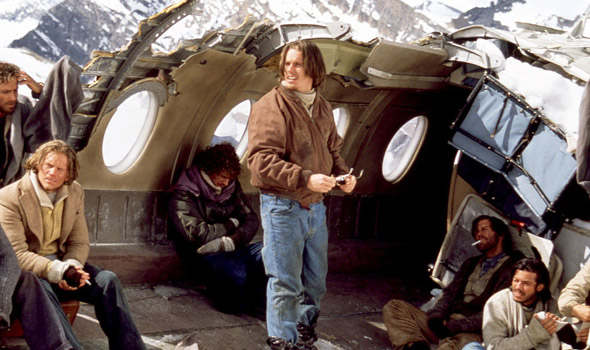
The survivors are stuck on a mountain slope in the Andes and they do what they can to stay alive until a rescue team comes for them. They ration what little food they have, use seat covers as blankets, go inside the fuselage at night and curl up next to each other to stay warm. But with the continual freezing weather, food running out, and a rescue that has been called off, they realize they must do whatever they can to survive, even if that means eating the flesh off of their dead.

The subject of cannibalism is horrid and “Alive” doesn’t shy away from the horrific reality of the situation. It confronts it realistically. The characters talk about it with credible unease and tension. Some are even afraid to say the word “cannibal,” and when one does, it makes the situation even more uneasy. When one does eat, no one asks how it tastes, so no one says what it tastes like—someone eats for the first time and then leans his head down in disgust and holds out the cutting tool used to slice some meat and says quickly, “Someone take this.” When they’re all used to it, though, they manage to crack a few awkward jokes, like “If you eat me, be sure to clean your plate.” This is all done genuinely, with the characters reacting with authentic horror at the situation and then trying to relieve the tension.

“Alive” is something of a “triumph of the human spirit,” as an ordinary group of people is pushed to their limits to survive an extreme situation. The film has a bright look, an uplifting tone, and constant talk about religion and God that make “Alive” more of an inspirational survival tale than a dark thriller confronting the horror of cannibalism. This is why the true event is sometimes remarked as “the Miracle of the Andes.”

One problem I have with “Alive” is that with a large group of people as the film’s central characters, only a few of them can have enough screen time to be considered independent while the others just blend into the film. The only actors I can think of that have a significant amount of screen time are Ethan Hawke as reckless Nando; Vincent Spano as take-charge Antonio; Josh Hamilton as reasonable Cannessa; Bruce Ramsay as optimistic Carlitos; and Kevin Braznahan as pessimistic Roy. Another problem I have with “Alive” is the ending. This is supposed to be the big dramatic payoff, but it just felt sort of rushed and looked over without really gathering a lot of much-needed weight.

But for the most part, “Alive” is very much indeed alive. It’s well-crafted, well-acted, and quite effective. Instead of becoming a mere adventure story, and the final half does venture into that territory (though respectively), “Alive” becomes a more visionary tale about survival and experience that works.

Dracula (1931)

7 Feb

vlcsnap-2011-10-23-17h48m58s209

Smith’s Verdict: ***

Reviewed by Tanner Smith

“Dracula” remains one of the most notable titles in horror movie history, as well as a common spot in the most influential “talkies” of the 1930s. But despite its reputation, does it still hold up? Well, the answer would be “no.” This movie has not aged well—it’s campy, hokey, and really dated. By today’s standards, it’s not very scary and you really can’t take a lot of it seriously. It’s a lesser movie that a lot of people make it out to be. Watch it again, and you’ll probably see what I mean. But “Dracula” is still an entertaining watch. It’s atmospheric, has its share of memorable moments, and features an entertaining villain in Bela Lugosi’s Count Dracula, a vampire. For these reasons, I can recommend the film…slightly.

What do I mean by atmospheric? Look at the scene in the beginning of the film when a British real estate agent named Renfield (Dwight Frye) visits the dark and decaying Castle Dracula, high in the mountains of Transylvania. Look at the inside of this castle and just how decrepit it is. You totally buy this as Dracula’s castle. (Though, why are there armadillos in Transylvania?) It’s here where Renfield meets the sinister Count Dracula who stands on top of the stairs, hears a wolf howl, and states, “Listen to them—children of the night. What music they make.” Yes, this was the 1930s—subtlety in villain characters weren’t exactly a staple in horror movies. But I don’t care—it’s an iconic line for a good reason. Anyway, Renfield quickly falls under Dracula’s spell and becomes his assistant as he helps transport him to England. But upon arriving, Renfield is committed to an insane asylum because he has completely changed from sane and nervous to maniacal and ranting. He also eats flies and spiders.

Meanwhile, Dracula roams the village and seeks new victims to feed upon. He bites a woman on the neck and she becomes a vampire. But his next pick, Mina (Helen Chandler), is more of a challenge, since she’s constantly protected by her boorish fiancé John Harker (David Manners), her father (Herbert Bunston), and clever Professor Abraham Van Helsing (Edward Van Sloan). Van Helsing is the only one who believes in vampires and also delivers the line that hits a strong note in the screenplay—“The strength of a vampire is that no one will ever believe in them.” He soon becomes a threat to Dracula, since he knows how to stop him.

It’s so good to see most of the vampire trademarks in this movie. You can pretty much count them off and smile whenever they’re mentioned or shown. There’s the coffin for the vampires to sleep in during the day (because they only come out at night), the bites on victims’ necks, the setting of the castle in Transylvania, Dracula’s hypnotic eyes, the crucifixes that (for some reason) seems to harm vampires, the giant bat form of Dracula, Dracula not casting a reflection in a mirror, a wide-eyed, crazy assistant, and of course Dracula’s long black cape. It’s nice to see them all in one movie, and I enjoyed singling them out. \

If there’s one very important element to consider from “Dracula,” it’s Bela Legosi. His distinctive accent, calm manner, and huge eyes can make for a realistic vampire. Aside from Legosi, however, the only two actors who stand out in the cast are Edward Von Sloan who’s a hoot as the wily Van Helsing and Dwight Frye as the manic Renfield. Everyone else is either bland or unconvincing.

The film is anticlimactic. From everything Van Helsing states about handling the situation of saving Mina and killing Van Helsing, it’s a huge disappointment. It’s much ado about nothing, as most of it is taken place off-screen, it’s not exciting in the slightest, and the whole final act is let down already by its neverending, calm orchestra background music score.

“Dracula” may not be the classic that it’s been said to be, as it has many flaws. But it is still an entertaining watch.

The Impossible (2012)

7 Feb

the-impossible_2012-4-1200x800

Smith’s Verdict: ****

Reviewed by Tanner Smith

Knowing what “The Impossible” was about, a feeling of nervousness overwhelmed me and yet a feeling of fascination followed it. The fascination came from the notion that this movie would set up many things that would pay off later after a harrowing journey. The first few minutes feature the central characters—a family of five—enjoying their vacation time at a resort beach in Thailand. They’re solidly developed and feel like a real loving family. But then when there’s a shot of the family looking at the peaceful-looking beach at sunset, a feeling of horror took hold of me because I knew that this was to be a huge amount of irony for what will happen very soon. And surely enough, the next day, they’re enjoying the day after Christmas; the kids are playing in the pool with their father; the mother is reading a book on a beach chair. And then there’s an ominous wind…

Describing it like that would make “The Impossible” seem like a clichéd disaster movie, but there’s something about the way director Juan Antonio Bayona sees these scenes that make them convincing and unnerving. The audience is seeing this movie because of what is going to happen to them and for them, and thus seeing these opening scenes play themselves out as peacefully as possible works in the film’s advantage as an element of suspense.

“The Impossible” tells the story of this family as they endure one of the worst natural disasters in the world—the 2004 tsunami that devastated the Pacific Basin. You would think after Clint Eastwood’s 2010 film “Hereafter,” there couldn’t be another film to portray the outcome of its survivors. Well, “Hereafter” relied on a character’s psychic connection as a need for redemption in that case. Here, it’s pure hope—hope that all your close friends and family members are still alive after a disaster that claimed the lives of millions. That’s the case here, with this central family in “The Impossible.” They’re based on a real family—though their nationality has been changed from Spanish to British for international appeal. This is the story of how they were separated from each other and struggled to survive in the catastrophe’s aftermath to be reunited.

But first, a word about the tsunami sequence. My mouth was open the entire time at how phenomenally brilliant the special effects were, and how masterful the scene was executed. I could barely breathe—you read that right; I could barely breathe. I felt like I was there with the characters just struggling to stay afloat as the water rushed through the village. This was a brilliantly-executed sequence—one of the most terrifying disaster scenes I’ve ever experienced in a movie theater.

Maria Bennett (Naomi Watts) and her oldest son, 12-year-old Lucas (Tom Holland), are separated from Henry Bennett (Ewan McGregor) and the two younger sons, Simon and Thomas (Oaklee Pendergast and Samuel Joslin), as they struggle through the aftermath (floodwaters and mud) to seek help.

A good portion of the movie is seen through the eyes of young Lucas, who has to learn to grow up fast. His mother is badly injured with punctures to her right leg and chest, and so he must help her to keep going. But he also feels the worst for his father and two little brothers, so his mother has to keep hope alive for him. Lucas and Maria do find refuge at a hospital, where many of the tsunami survivors are being treated. It’s then that Lucas is asked to seek patients’ family members who may be around the hospital somewhere. And it’s here that hope comes for Lucas—if they’re alive, then maybe his father and brothers are too. This makes “The Impossible” an effective coming-of-age tale as well as an effective disaster movie.

Extreme devastation; a paradise turned into a wasteland; many people dead; separation from loved ones; not knowing who’s dead or alive. All of these elements are ongoing in “The Impossible” and they’re all powerfully portrayed. The fear and despair that come with these characters are existent. You really get a sense of what they’re all going through, and sincerely hope for the best (although, those who know the true story of this family already know the outcome).

The performances from the principal actors are spot-on. Naomi Watts has the most physically-challenging role, since her character is mostly confined to a hospital bed as she’s in critical condition. Her Oscar nomination for her work is well-deserved. Ewan McGregor, as her husband, is powerful as well. Of the three child actors, Tom Holland, as Lucas, is just brilliant in his feature debut. He has Lucas’ emotions down to a T and delivers the complexity of a little kid looking to live through this crazy situation.

I don’t want to say too much about “The Impossible,” especially for the sake of those who don’t know the story of this family. I didn’t know, when I saw this movie. I think the less you know, the more emotionally involved you are with the story’s execution. From the beginning to the middle to the end, I was absorbed by “The Impossible.” If you’re looking for a disaster movie in the style of Michael Bay or Roland Emmerich, then just keep looking. “The Impossible” is not escapist entertainment. It’s much more complicated than that.

The Outsiders: The Complete Novel

7 Feb

Curtis_Brothers_Talking

Smith’s Verdict: ****

Reviewed by Tanner Smith

I gave 1983’s “The Outsiders” a negative but affectionate review, saying that it needs more material to be a better movie. Well, fans of the movie, who were also fans of the novel it was based on, wrote many letters to the director Francis Ford Coppola and they all asked the same question as to why the film wasn’t more like the book. And now, in 2005, there is a much better version of “The Outsiders” with twenty minutes of deleted scenes. It’s called “The Outsiders: The Complete Novel” because it covers more of the original novel. It also makes the story more clear, gives room for the characters to develop, and gives the thought of why in the world didn’t Warner Bros. release this film in the first place?

I love this movie. It reminds me so much of why I love reading the book in the first place. It’s touching, powerful, and a much better film than its original cut. I am even going to give it four stars. I think it deserves that rating.

In a never-before-seen opening scene, the hero Ponyboy Curtis, a fourteen-year-old greaser who lives on the wrong side of the tracks, is jumped by the socs, a gang of rowdy rich kids from the other side of town. His older brothers and buddies come to his rescue. This is great—we are given proper introductions to all of the “greaser” characters and we get a sense of the relationship between Ponyboy (C. Thomas Howell) and his brothers Darrel and Sodapop (Patrick Swayze and Rob Lowe). With other additional footage, the characters are given room to develop into people we care about. One character in particular who given special treatment is Sodapop. His added scenes—especially one in which he breaks down at the end—remind us that Rob Lowe is a very good actor for dramatic situations, not just deadpan comic effect.

Ponyboy and his buddies—tough, mean Dallas (Matt Dillon) and scared, sensitive Johnny Cade (Ralph Macchio)—are hunting for action one night at the local drive-in. While there, Dallas tries, very rudely, to pick up a soc girl named Cherry Valance (Diane Lane). She tells him to go away and then she unexpectedly picks up Ponyboy and Johnny, knowing very well who they are (she tells them, “I’ve met people like Dallas Winston; you two don’t look mean”). Her friend Marcia is picked up by Ponyboy and Johnny’s friend Two Bit (Emilio Estevez), the jokester of the greasers who loves Mickey Mouse cartoons. But soon, there’s trouble. The girls’ boyfriends spot them with the greasers which leads to them hunting Ponyboy and Johnny, finding them alone later that night. While drunk, they come very close to drowning Ponyboy in a fountain and one of them—Cherry’s boyfriend Bob (Leif Garrett)—is murdered by Johnny. This leads to Ponyboy and Johnny being aided by Dallas to figure out what to do about this situation. They hide out in a church for a week, then they become heroes for saving children in a fire, then they return home to resolve issues with the socs.

There are more touches to this director’s cut that really make this film special. The story is better developed, the characters are more complex, and that music from the original film is gone—thank God (I hated that music in the first place). This is a much more faithful adaptation to the beloved book by S.E. Hinton.

Watching this new cut, it’s fun to see all of these actors before they made their big career moves. Matt Dillon is fantastic as Dallas, the rebel without a cause—it’s fun seeing him here and in “Tex” and “Rumble Fish” (all of which were film adaptations of S.E. Hinton novels) as this tough teenager with a lot to do and say. Ralph Macchio (yes, the Karate Kid) is very good as Johnny—he’s just that kid you want to see good things happen to, despite his murderous deed. Patrick Swayze, Rob Lowe, Diane Lane, Emilio Estevez, and Tom Cruise (yes, Tom Cruise) are all great in their roles. What really surprised me was that C. Thomas Howell, playing the narrator of the film, didn’t go on to bigger and better things like his co-stars. Howell is wonderful here—he gives a convincing, complicated performance as this nice, scared kid who is smart and thoughtful. Since this movie, he’s played pretty much the same character until his career bomb, “Soul Man,” in 1986.

“The Outsiders: The Complete Novel” is a much better film than Warner Bros. thought it to be in 1983 and I loved it.

The Outsiders (1983)

7 Feb

283965_1251572218752_295_300

Smith’s Verdict: **1/2

Reviewed by Tanner Smith

“The Outsiders” is a film based on a best-selling young adult novel written by S.E. Hinton, who specializes in teenagers as complex characters (also read “Tex”). Francis Ford Coppola made this beloved book (beloved particularly by junior high and high school students) into a film at the request of a junior high English class who all signed a letter, asking Coppola to adapt this book. The result is a mixed bag.

The narrator is a fourteen-year-old “greaser” named Ponyboy Curtis (C. Thomas Howell) whose friends are all greasers. Greasers are the social outcasts on the north side of Tulsa, Oklahoma—most of which are hoods and they all have greasy hair. “Socs” (pronounced “soeshes”) are the rich kids from the south side of town—most of which have fun jumping greasers. There’s a conflict among them and occasionally, they throw rumbles to fight each other.

Ponyboy is basically a nice, smart kid—he reads books, keeps his mouth shut, and tries to stay out of trouble. His best friend is Johnny Cade (Ralph Macchio), a scared sixteen-year-old greaser who was beat up terribly by a soc long ago. Both wind up in a nasty situation after Ponyboy and Johnny pick up a couple of soc girls and their boyfriends catch them. This results in the murder of one of the boyfriends (committed by Johnny, who wouldn’t hurt a fly before) and the scared kids are forced to run away.

There are many characters among the greasers. There’s Two Bit (Emilio Estevez), a likable scalawag who has his fair share of screen time. There are Ponyboy’s older brothers Darrel (Patrick Swayze) and Sodapop (Rob Lowe). And last but certainly not least, there’s Dallas Winston (Matt Dillon), the rebel without a cause. Dallas helps Ponyboy and Johnny hide out after the murder.

All of the actors are great in their roles—the central trio of Howell, Dillon, and Macchio are convincing. But the problem comes with the story and development. The story is not particularly convincing and most of the characters aren’t developed properly. I didn’t really buy the conflict between the greasers and the socs. And some of the greasers who are in the film’s advertising don’t even have time to breathe—they just appear briefly. I bought the friendship between Ponyboy and Johnny, but not so much of the relationships with Ponyboy and his brothers. Here’s another thing wrong with the movie—Ponyboy talks about his brothers a lot more than he talks with them to the point where he just seems like annoying exposition. Sodapop just seems invisible throughout the movie. And then, there’s the plot thread in which Ponyboy is possibly going to be taken away from Darrel and Sodapop and must go to juvenile court for running away. That element is dropped and never spoken of again. It didn’t matter much because I didn’t care much about the brothers anyway.

I also didn’t like the music composed by Carmine Coppola. It’s all over the map here and, along with Francis Ford Coppola’s direction, seems like “The Outsiders” is trying this generation’s “Gone with the Wind.” I wouldn’t mind so much if it wasn’t distracting.

So I can’t recommend “The Outsiders” mainly because of its execution. I like Ponyboy, Johnny, Dallas, and Two Bit. I like Coppola’s direction. I love the book—the original making of this film was to cover the whole novel, which tells the story better. Apparently, Warner Bros. thought it’d be too long for the young audience’s interest and asked for the film to be cut from nearly two hours to an hour and a half, which isn’t enough time to tell this story. I’ll just quote Roger Ebert and argue that a good film isn’t long enough. And I’ll also say that “The Outsiders” needed more material to be a better movie.

50/50 (2011)

7 Feb

50-50-movie-images-seth-rogen-joseph-gordon-levitt-01

Smith’s Verdict: ****

Reviewed by Tanner Smith

When a movie is made in which cancer is the central conflict, it’s so easy to go overboard with the movie’s dramatic elements. And it’s hard to feel anything for the cancer patient when the movie is trying so hard to make the audience weep that it just becomes corny. But “50/50” managed to beat that problem and is, in my opinion, one of the very best films of 2011.

The film stars Joseph Gordon-Levitt as a young man named Adam Lerner who learns that he has a rare form of spinal cancer and the chances for survival are 50/50. He feels his life turning upside down, as he didn’t expect to be expected to die so young. He breaks the news to the people in his life, who react in different ways. He first tells his girlfriend Rachael (Bryce Dallas Howard), who guarantees to stand by him and look out for him. Then he tells Kyle (Seth Rogen), his vulgar but loyal best friend who wants to keep Adam’s spirits up even though sometimes he can go too far when it comes to parties. And then he tells his mother (Angelica Huston), who constantly calls to check on him and already has to care for her husband who has Alzheimer’s disease.

During chemotherapy, he befriends two other cancer patients (Philip Baker Hall and Matt Frewer) who are constantly stoned with medical marijuana and “weed macaroons.” He also gets a therapist—a pretty, naïve, innocent 24-year-old named Katherine (Anna Kendrick) whose new patient is her third.

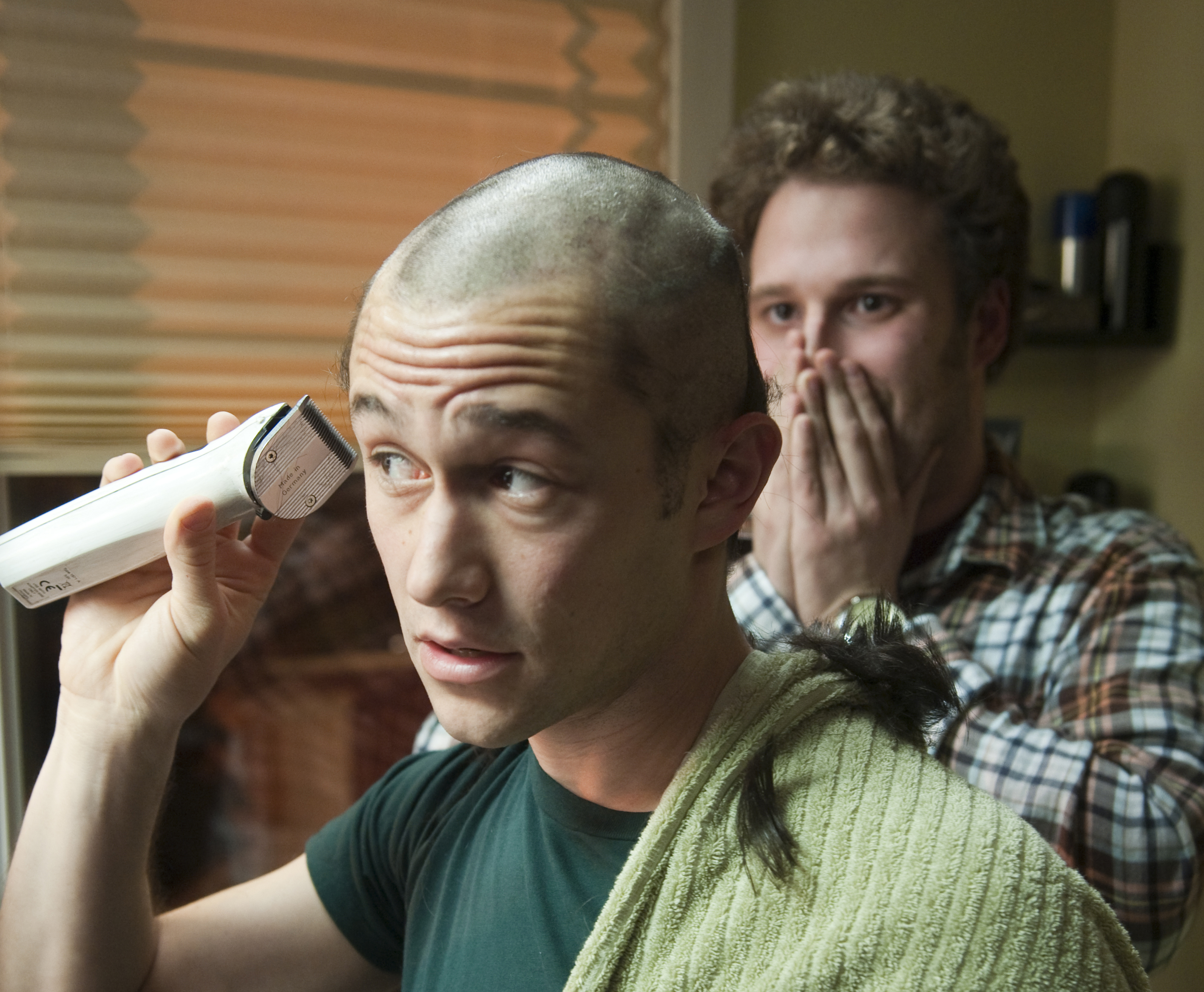
The screenplay for “50/50” by Will Reiser, a comedy writer, is loosely based on his life, as he had spinal cancer like the main character of this movie. Mostly, he writes from past experience about dealing with this disease, and delivers well-written scenes that feature how Adam deals with his cancer and how his friends react around him. But more importantly, he adds another key ingredient to making “50/50” work—comic relief. Observe the naïve behavior of the Kendrick character in her first scene, and then keep watching and listening to the dialogue in the following scenes that feature her. They’re both funny and endearing. And then there’s the improvised-in-character scene as Adam shaves his head as Kyle watches in confusion and something close to fright. And then you have Seth Rogen, who specializes in playing the goofy, profane, vulgar best friend in many other movies. Rogen is Reiser’s friend in reality and his role is essentially based on how he dealt with his friend’s cancer. Reiser and Rogen take Rogen’s usual characteristics that people have seen in other movies and just when you think it’s starting to wear thin on us, the story moves on to something else for a while before coming back to him. Don’t get me wrong—Rogen is pretty funny in most of his scenes, but when a lot of other situations in the movie are to be taken seriously, only sometimes he seems out of place. But then, Rogen’s character becomes even more endearing when we get to his payoff in the final act of the story. It’s handled in a very effective way. The drama and comedy in “50/50” blend wonderfully.

The actors in “50/50” are all wonderful as well. Joseph Gordon-Levitt, one of the best young actors in recent memory (he was also fantastic in 2009’s “(500) Days of Summer”), as Adam is so winning and endearing that when the time came for his final surgery, I was almost as worried about what his outcome would be as he and his family and friends were. There’s one scene in particular that is just heartbreaking—it’s when he finally snaps and lets out all of his anger on the night before his surgery. I sure hope he gets an Oscar nomination for this performance. Seth Rogen, like I said, is more than a smartass best friend. Angelica Huston avoids the cliché of overbearing mother and makes her character more three-dimensional than she starts out with when she hears the news. Philip Baker Hall and Matt Frewer steal their scenes together. And then there’s Anna Kendrick, the Oscar-nominated actress from “Up in the Air” and who was also in the “Twilight” movies. She always has a charming screen presence and makes her character likable, always. I will watch her in any movie, even if it’s just a brief appearance. Many reviews of this movie have complaints against the Bryce Dallas Howard character because of her actions as the movie progresses. I have no complaints because even if what she did was a wrong move, I believe she did learn her lesson and actually sympathetic towards her in her final scene.

With great acting and a great screenplay, “50/50” is a movie dealing with cancer in a touching but also funny way. It reminds us that when faced with a situation like this, there are only two ways to get through it—with tears or with amusement. This is one of the best films of 2011.

Real Genius (1985)

6 Feb

RealGenius1985anamorphicWSDVDRip-1

Smith’s Verdict: ***1/2

Reviewed by Tanner Smith

“Real Genius”—you know, some films just have accurate titles. In a decade where a lot of society’s movies are about teenagers (that decade would be the 1980s), “Real Genius” is one of the real good ones. It’s a surprise too—this film was released in 1985 and was one of three movies about teenagers and their science projects. The other two such films were “Weird Science” and “My Science Project,” two lousy teenage comedies. “Real Genius” is a real treat, however—it’s very funny and well put together.

The film’s central teenage characters are college students who are not quite the sex-crazed goons you would find in lesser teen movies. The protagonists in this movie are actually well-developed, likable three-dimensional characters who don’t always play by the rules, but there are teenagers like that around. They are Mitch (Gabe Jarret), a 15-year-old boy genius who is the youngest person to be accepted at Pacific Tech, and Chris (Val Kilmer), another young brain who has spent four years at the school and is about to graduate. Mitch and Chris are two of the students chosen to work on a laser experiment. But little do they know that they are being used by Professor Jerry Hathaway (William Atherton), who wants to use the experiment—if it gets finished—to sell it to a military as a weapon.

But in the meantime, Chris is a class-A prankster who uses his genius to set up all sorts of things to make life on campus less boring. For example, he turns the dorm hall into an ice-skating rink, and he turns the lecture hall into a swimming pool. He tells Mitch that he used to be just like him—nervous and socially awkward—until he learned how to relax. Now he feels like it’s his duty to take Mitch out of his shell and teach him to have fun. “Real Genius” is most fun when it comes to showing Chris’ antics. There’s another scene in which Chris and Mitch get revenge on an uptight nerd named Kent, who is also Professor Hathaway’s fink and Mitch’s bully, by disassembling his car and reassembling it in his own dorm room. Brilliant and…dare I say, ingenious.

There are two other quirky characters are crucial to the movie. One is a scruffy-bearded strange man named Laszlo (Jonathan Gries) who used to be the top brain on campus until he cracked and is now living in the steam tunnels below the school (the way in is through Chris and Mitch’s closet, which makes things awkward at first). The other is a hyperactive girl named Jordan (Michelle Meyrink). She never sleeps and is the kind of girl who would run into the men’s restroom to show Mitch a sweater that she made for him. She and Mitch share a cute relationship together. Chris, Mitch, Laszlo, Jordan, and another genius nicknamed “Ick” (he helped Chris with the ice in the dorm) discover about Professor Hathaway’s plan later in the film and decide to strike back.

“Real Genius” is packed with characters and jokes. It is well-written with a real integrity and intelligence (although some jokey lines of dialogue using the word “penis” get old). The writers know that teenagers can have the freedom to be themselves—not just slobs or sex-crazed maniacs or idiots. They’re funny enough being geniuses in this film. That’s a pleasure among many pleasures that lie within “Real Genius.”

The Fly (1986)

6 Feb

images

Smith’s Verdict: ****

Reviewed by Tanner Smith

David Cronenberg’s “The Fly” is a perfect example of the “experiment-gone-wrong” movie. It’s when a mad scientist wants to create a device that will change the way humanity sees things and something goes terribly wrong, and the direst consequences occur. That’s always one of the enjoyable of stories to be told in movies, and “The Fly,” a re-imagination of the 1958 sci-fi thriller of the same name (but a different story), is one of the best. It’s one of those horror movies in which we get to know the characters first and know the important setups to the oncoming rules of the gimmicks, so that when the terror happens, it amounts to something.

It begins as scientist Seth Brundle (Jeff Goldblum) meets a pretty journalist named Veronica (Geena Davis) and wants to impress her. So he puts it bluntly, starting out by saying that he has an invention that will change the world as we know it. Being a curious mind, Veronica accompanies Seth to his home. Seth wastes no time in impressing her—he shows her a pair of “telepods” connected together by cable and run by computer. He explains to Veronica that it’s a sort of “teleportation” device, which can move something from one telepod to another. It works great on items, such as a stocking that’s used as a test…but it turns living things inside out. (There’s a really gruesome scene in which Seth tests the machine on a baboon, and we actually see the outcome.)

One of the interesting elements of “The Fly” is that the science seems believable. That’s rare for a movie like this—usually, you roll your eyes at the very idea of certain experiments. But not here—I believed in this experiment, whether it could work or not.

Anyway, Seth figures out the problem with the invention, tests it another baboon with success, and then finally decides to try it on himself. However, something unexpected happens during the process. A housefly has made its way into the telepod with Seth and he makes it out, but with certain side effects. He suddenly has a great amount of energy and increased strength. However, that’s just the beginning and it may seem positive…but things are about to get a whole lot worse.

Seth is no longer Seth. He’s slowly but surely turning into a man-sized fly—or “Brundlefly,” as he describes himself. Ugliness starts to emerge and, thanks to first-rate makeup and effects, only looks worse and worse every time we see him again. Also, Seth’s nature is reversed, letting the menacing insect side take over what little of Seth is left. What’s Veronica to do? She wants to help him, but she’s ultimately powerless to do anything for him.

Too many of these mad-scientist movies are focused on ideas, but not so much with characters. Of course, there are exceptions, like “Frankenstein.” Now, here’s “The Fly,” in which we get to know and care for the two central characters played by Jeff Goldblum and Geena Davis. Goldblum’s Seth is a socially awkward but excited and likable character who gets his enthusiasm from his continuing experiment and his relationship with Davis’ Veronica, a curious reporter who gets way more than she bargained for. Goldblum gets lost in the role—it has to do with the way his eyes get wider whenever he gets excited or when he casually tries to explain certain elements of this new experiment. He plays it like he sees it. The result is a powerful performance. Davis is very good too, and she and Goldblum show great chemistry together.

The character development and interaction is arguably the most important aspect of “The Fly.” We care about these people, we fear for them, and we hope that somehow things will turn out all right for them. There’s a particularly strong scene in which we see Seth probably as bad as he’ll get before his human side is completely gone—the line “I’ll hurt you if you stay” (Seth saying it to Veronica) is chilling because of everything that led up to it.

The makeup and creature effects, created by Chris Walas, are horrifyingly excellent. I mentioned that Seth looks worse and worse every time we see him again, and I wasn’t exaggerating. The work done on making Jeff Goldblum look nearly human before transforming into a horrific insect-beast is consistently effective—creepy and sometimes even hard to watch, but remember, this isn’t a geek-show. The effects don’t make the movie—they’re there to serve the story.

There are troubling scenes in “The Fly,” but it’s a great film with terror that actually amounts to something with two well-developed, likable characters to feel for. And for people out there who search for new ways of changing the world as we know it, just be sure you know what you’re doing.

Oh yeah, I almost forgot—Be afraid. Be very afraid.

Fatal Attraction (1987)

6 Feb

52179.6a00d83451b05569e2013480acb22a970c-800wi

Smith’s Verdict: ***1/2

Reviewed by Tanner Smith

What “Fatal Attraction” is trying to get across is very simple—don’t cheat on your spouse. Even when you think there’s a way out of a one-night stand or an affair, don’t take the chance that it will turn against you and threaten the lifestyle of your family. In “Fatal Attraction,” family man Dan Gallagher (Michael Douglas) has a one-night love affair with another woman and wants to end it the morning after. But the woman won’t let it end, no matter what…

This would be the premise for a broad comedy, but “Fatal Attraction” is a thriller—and an effective one, at that. It shows the consequences that occur not only when a married man cheats on his wife, but also with the wrong woman.

The film’s opening scenes feature the life of successful, happily married lawyer Dan Gallagher, his wife Beth (Anne Archer), and adorable six-year-old daughter Ellen. While Beth and Ellen are out of town for the weekend, Dan meets Alex Forrest (Glenn Close), an editor for a publishing company. They have dinner together, Alex seems like an intelligent, passive woman, and she and Dan wind up having a passionate affair that very night. Alex assures Dan that it would’ve only been a simple thing, a fling to be forgotten about later, and Dan falls for it.

Big mistake. Dan leaves the next morning, hoping to forget all about this and go back to his normal life. But Alex doesn’t let it go—she wants to further the relationship and clings to Dan. Dan tries to let it down easy on her that they should never have a relationship together…only to have Alex attempt suicide. And it gets worse—it turns out that Alex is pregnant with Dan’s baby.

Or is she? We’re never quite sure of this. But what we do know is that Alex is obsessive and undoubtedly insane. Dan wants nothing to do with her, but Alex keeps coming and coming, threatening the lifestyle of Dan and his family. Dan tells Alex to leave him alone, to which Alex replies “I’m not going to be ignored, Dan!”

This is one crazy lady. And the odd thing is that she starts out seemingly normal. It’s this affair with Dan that sets her on edge, and the fact that she can’t have him enrages her. Her rage continues to grow every day and her obsessiveness takes her over to the point of violence. Who is at fault for all of this? Is it Dan, for falling into this affair with a woman other than his wife, and then hoping to forget about it immediately? Is it Alex, for leading him on in the first place? You can read much into this.

Dan is a likable guy, despite what he does. He’s just trying to do right by his wife, whom he still loves. He’s smart too—when things turn ugly, he follows advice that many characters in thrillers seem to neglect. He calls the police to see about a restraining order. He even tells his wife about the affair, later in the movie. Understandably, Beth doesn’t take this very well—especially not when Dan tells her that Alex is pregnant. There’s great family drama in occurrence in “Fatal Attraction,” particularly in the scenes in which Dan is trying to fix everything to keep his wife and daughter from any harm.

Michael Douglas and Glenn Close do great jobs at portraying these characters, and Anne Archer is effective as Dan’s wife Beth.

Some critics, including Roger Ebert, were bothered by the film’s ending, in which Alex officially loses it and attempts to slash Beth before Dan can try and stop her. This has been likened as a “Friday the 13th” style ending, and to be honest, the only time I made this distinction is with the brief fake-out after it seems that Alex is finally dead. Of course not; she comes back for one cheap scare. The climax itself worked for me; it’s effective in showing how far Alex was pushed in her mental obsessiveness. But that cheap scare at the end didn’t work at all. It did indeed make it seem like a slasher film. Mostly though, “Fatal Attraction” is a terrific psychological thriller. The acting is great, the dilemmas are legitimately tense, and it’s executed with convincing realism