Archive by Author

2012 (2009)

13 Feb

2012moviebooks

Smith’s Verdict: **1/2

Reviewed by Tanner Smith

John Cusack plays Jackson Curtis, a talented but struggling author of adventure novels who is divorced from his wife Kate (Amanda Peet). Kate has a new boyfriend (Tom McCarthy)—a nice guy who loves their two small children (Liam James and Morgan Lily) as much as Jackson, who spends very little time with them. Now something is destined to bring this broken family together and Roland Emmerich doesn’t disappoint with a simple solution. What is the solution? Well, seeing as how it’s a Roland Emmerich movie, you know it has something to do with massive destruction. But here’s something that makes it even harder—it’s the whole planet that’s now a hazard! We’re talking violent earthquakes, monster tsunamis, and a massive volcanic eruption that destroys all the major cities in the world like Los Angeles, Las Vegas, and Washington, D.C. We also get annihilation on Mount Everest, in which everyone must be protected from the grandmother of all tsunamis.

Wow! What a trip! Roland Emmerich and his co-writer Dean Devlin have done it again—they destroyed a lot of popular landmarks and killed dozens of people. Only this time in the movie “2012,” they’ve really gone too far—they’ve turned the whole world into the Poseidon ship from “The Poseidon Adventure.” This makes their earlier end-of-the-world movie “The Day After Tomorrow” look simple. This movie, “The Day after Tomorrow,” and “The Poseidon Adventure” are all disaster movies in which something hazardous occurs and a colorful group of people must set aside their differences in order to survive together.

But is “2012” as good as those other two disaster movies? I’m afraid, not quite. There is hardly a sense of quality character development (then again, there is hardly any quality in this movie), there are many scientific inaccuracies that would have been OK if it didn’t seem too silly, and the movie runs for almost 2 hours and 40 minutes which seems way longer, even through what the characters have to go through in the final half. But there are things I found pleasurable about “2012.” One is, even though these characters aren’t particularly well-developed, I still get an adrenaline rush watching them survive one disaster after another, barely escaping death about…2,012 times! I’ve always liked John Cusack, who is one of the most reliable actors not to get to an Oscar nomination yet, and he makes his writer character likable enough for us to root for him. The best performance in the movie goes to Chiwetel Ejiofor, who carries the movie’s major subplot. You see, while Cusack is racing to keep his family safe as the world collapses around them, Ejiofor is a geologist who really knows what’s going on and constantly argues with his superior (Oliver Platt), telling him that they need to save as many people as possible. But Platt is telling him that there’s no time and that they need to save the people they reserved for seats in secret arks (don’t ask) and not to worry about the other people. So while Cusack races to save his family, Ejiofor races to save what’s left of humanity and that’s kind of interesting to me. Plus, Chiwetel Ejiofor is an actor who has one of those voices that you can’t help but listen to in times of warning and trouble.

There are some pretty nifty disaster scenes, including the destruction of Los Angeles. These special effects are definitely top-notch. The adventure is set in motion when Jackson grows suspicious after what he had heard from wacky radio operator Woody Harrelson (a hoot), who warns Jackson of the coming apocalypse and shows him a video he made indicating when it would happen (reminds me of the video in “Jurassic Park”). So when Jackson returns home in a stretch limo, he picks up his wife, her new boyfriend, and the kids and they drive away right when the monstrous earthquakes (excuse the pun) shake everything up. To me, it’s fun when you’re driving away from something and there’s someone shouting, “Car! Tree! Donut!” (The big plaster donut rolls along the streets of LA.) There are also attempts at black humor, such as when the big Randy’s Donuts plaster donut comes sliding down the street and when the boyfriend says to take the freeway, there’s an instant cut to the freeway being destroyed as well. Now, it’s impossible to outrun falling buildings and earthquakes in a stretch limo, but I have to admit I didn’t care. All I kept thinking was, “GO GO GO!!!”

There are many more disasters these characters must face. Will they survive all of them? Well, let me say this. This is another Roland Emmerich disaster movie that makes you feel good at the end. Billions of people may have died, but as the feel-good music is heard, you feel a sense of redemption and relief. But there is a sense of creeping past billions of people who are definitely not going to make it out alive while you’re rooting for the main characters (including kids and a little dog) to survive. While I can’t recommend “2012,” I do have some affection for it. This is kind of a black joke at prophecy and disaster movies themselves and at that level, I guess I enjoyed it. But as a whole, the movie tries too hard and gets too silly that it’s almost tiresome.

Star Trek II: The Wrath of Khan (1982)

13 Feb

images

Smith’s Verdict: ****

Reviewed by Tanner Smith

When “Star Trek: The Motion Picture” was released in cinemas in 1979, audiences—particularly fans of the original TV series “Star Trek”—were either glad to see the familiar characters again or upset that the movie tried to pass off a sci-fi “experience” rather than an adventure. “Star Trek” was never intended to be an out-of-body experience, like “2001: A Space Odyssey” was, but “Star Trek: The Motion Picture” seemed to forget that “Star Trek” was mainly about ideas, characters, and creativity—not stunning visuals.

Luckily, the following “Star Trek” movie, subtitled “The Wrath of Khan,” put “Star Trek” back to the status quo. The result is not just a satisfying “Star Trek” movie, but in my opinion, one of the best science-fiction films. Period.

“Star Trek II: The Wrath of Khan” gave “Star Trek” the certain gusto it needed after the slow pacing of the first movie. The elements that made “Star Trek” special are back, and they’re even updated—the Enterprise looks great this time around, the special effects are better, and the occasional drama is even somewhat heavier. The result is a strong piece of work. And of course, the “Star Trek” characters—the crew of the Starship USS Enterprise—are back and still as likable as they were on the show. We have the egotistical but likable Capt. James T. Kirk (now promoted to “Admiral”), his loyal half-Vulcan (and half-human) friend Spock (Leonard Nimoy), skeptical and arrogant Dr. Bones McCoy (DeForest Kelley), and the four memorable flight crew members—Uhura (Nichelle Nichols), Chekov (Walter Goenig), Sulu (George Takei), and Scott (James Doohan).

I understand that “Star Trek II: The Wrath of Khan” is necessarily a sequel to a first season episode of the show (“Space Seed,” unseen by me). It features the villainous Khan (Ricardo Montalban), who long ago was marooned on a desert planet by Kirk. Since then, his brilliant mind has crossed with insanity. He and his leftover crew members/followers have found a way to escape, and all that’s on his mind is revenge. He hijacks a Federation starship, tortures newly appointed crew member Chekov and his captain Terrell (Paul Winfield), and steals a new project called Genesis, created by Kirk’s ex-lover Carol (Bibi Besch) and David (Merritt Butrick), the son Kirk hasn’t met yet. Genesis was created as a way of creating new life on barren planets, though if proven wrong, it could be used as a doomsday weapon. With Khan in possession of it, it’s up to the Enterprise crew to save the day.

There’s a lot of creativity flowing through the storyline of “Star Trek II: The Wrath of Khan.” In particular, the Genesis device is quite intriguing in the way it can be used for either regeneration or Armageddon, there’s a frightening subplot involving parasitic creatures that Khan uses to torture Chekov and Terrell, and there’s an epic space battle near the end that’s very enjoyable.

Ricardo Montalban creates a terrific villain as Khan—an intelligent person driven to madness and crime by isolation and betrayal. He wants to kill Kirk, but more terrifyingly, he realizes that when Kirk and his crew may be stranded somewhere, it’s actually better to make them suffer as he and his own crew did. Characterization aside, Montalban has a unique, slimy delivery that helps make Khan a strong and chilling villain.

The conversations/bantering between the Enterprise crew is fun, and leads to some nice character development, such as how Spock is becoming more human and how Kirk goes through a middle-age crisis. William Shatner is strong in the role of Kirk, mixing gallantry with vulnerability. DeForest Kelley as McCoy still has winning sardonic one-liners, and Leonard Nimoy is comfortable in the role of Spock—Nimoy really sells an important scene near the end, and the less said about that, the better. A surprise in the cast of heroes for this movie—Kirstie Alley, of TV’s “Cheers,” acquits herself nicely in the new role of Vulcan recruit Saavik. She has a handful of scenes to steal.

“Star Trek II: The Wrath of Khan” is a well-executed, wonderful adventure that not only would delight fans of the original series, but also people who aren’t affiliated and would just appreciate an entertaining sci-fi film. The heroes are appealing, the villain is intriguing, the imagination is existent, the story moves quickly, and we’re met with real tension along the way.

Milk Money (1994)

13 Feb

600full-milk-money-screenshot

Smith’s Verdict: *

Reviewed by Tanner Smith

Is “Milk Money” for kids or adults? I think a better question is—is “Milk Money” trying too hard to let itself off easy? Either way, it stinks.

This is either a charming family film, a romantic comedy, a thriller, or all three. I can’t tell, because it switches back and forth. What’s the premise? Well, a trio of pre-teen boys go to the city to see a naked lady and she winds up living in their suburban home, where she hides from gangsters and falls in love with the single father of one of the boys.

Wow. With a premise like that, I’m surprised you’re still reading this.

The boys—shy Frank (Michael Patrick Carter), neat-freak Kevin (Brian Christopher), and cool Brad (Adam LaVorgna)—are about twelve years old and go to middle school, where they learn sex education. (By the way, isn’t 9th grade when you’re supposed to start taking that class?) In an opening scene, we see them talk about stuff they find in their mothers’ and sisters’ rooms, like a diaphragm. They notice the girls in their school, and they also watch porn, to look further into their curiosity.

The boys come across some money and they ride their bikes into the nearby city of Pittsburgh, where they hope to find a prostitute naked and pay her for it. This is where they meet “V” (Melanie Griffith), who takes her shirt off for $103.

Right away, you can probably tell how uncomfortable this is. The scene in which she takes her shirt off to the boys is creepy. OK, we don’t see any nudity except from the back, since this movie is rated PG-13, but that doesn’t make the scene any less creepy to see the boys’ reactions—one of which has his eyes closed. (“I can’t do it—I wanna be a gentleman!”) How does the movie try to force itself out of the awkwardness? By cutting to the boys walking down a nearby alley, with cigarettes in the mouth—the cigarettes aren’t lit and there’s cheerful music playing over the scene. This is far from less-than-awkward.

The boys’ bikes are stolen, so V gives them a ride home. But as V drops Frank off at his house, her car stalls and she’s forced to stay in the suburbs—specifically, Frank’s treehouse. Frank’s dad Tom (Ed Harris) is led to believe she’s a math tutor, helping a friend with his homework. And of course, there are many misunderstandings and misreading of double meanings, neither of which are more painful than funny. This sets up the romantic angle of the film, as V and Tom start to fall for each other, with Tom not knowing until later that she’s a hooker living in his son’s treehouse until her car is fixed. It’s more unfortunate that Griffith and Harris don’t share much chemistry together, so it’s harder to buy into their supposed romance.

But wait a minute—it turns out the broken-down car belongs to V’s pimp (Casey Siemaszko) who has hidden a load of money in the trunk (V doesn’t know this). So, an angry gangster, who has killed the pimp, is looking for V because he knows she has the money and thinks she stole it. This leads to an action climax to show that the film surely just does not care about what it’s supposed to be about. We have it all—the gangsters crashing the kids’ school dance, the kids getting away by driving a car, and can you believe that car actually blows up?

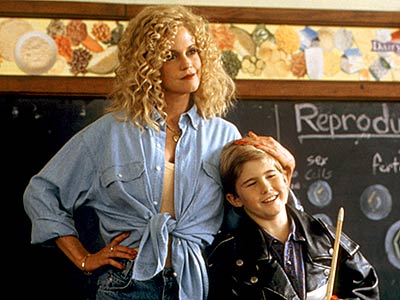
The worst scene in the movie is when Frank brings V to class for his sex ed presentation. Tell me if this makes any sense—Frank locks the teacher out of the classroom, surely doesn’t get graded for this, sneaks V in through the window, uses her as a visual aid for a reproduction assignment, and doesn’t even get punished for it.

What were these writers thinking when they wrote “Milk Money?”

The three young actors—Michael Patrick Carter, Brian Christopher, and Adam LaVorgna—are fine, despite given clichéd writing to their characters. Ed Harris does what he can with his role and even manages to give the character some dignity—he’s a high school science teacher trying to save some wetlands. But Melanie Griffith, who used to be an exciting comic actress (see “Working Girl”), is pretty bad. She fails miserably at her dramatic moments and her comic moments are merely OK.

“Milk Money” is a mess. When its writing isn’t embarrassing, it’s very much clichéd. The film pretty much fails when the setup makes itself known, the stuff with the gangsters is completely unnecessary, the romance isn’t convincing, and it tries to make itself into a charming family comedy when really it’s a mashup of stuff for kids and adults. Well, let’s face it—“Milk Money” isn’t for either. It’s made for rocks.

The Perks of Being a Wallflower (2012)

12 Feb

the-perk-of-being-wallflower101

Smith’s Verdict: ****

Reviewed by Tanner Smith

People will say that they hated high school. I think they’re only thinking of the bad occurrences (lost opportunities, broken hearts, feeling left out of the crowd, etc.), rather than the warm, nostalgic, refreshing moments that changed their lives forever (friendships, accomplishments, even quirkiness in classrooms). High school may have had its negative moments, but its positive points were always present. It can be weird and crazy, but also warm and funny. That statement alone can be used to describe “The Perks of Being a Wallflower.”

“The Perks of Being a Wallflower” is a true delight and it understands what it was like to be an outsider during high school. People looking back will notice that they all went through the motions of high school—awkwardness, loneliness, confusion, and the unexpected camaraderie that came with—and then they’ll realize that they all felt like outsiders, even the popular crowd. “The Perks of Being a Wallflower” doesn’t present these elements as a bad thing. It’s a moving coming-of-age story about such a high school kid who begins his freshman year miserably, but finishes it by embracing who he really is.

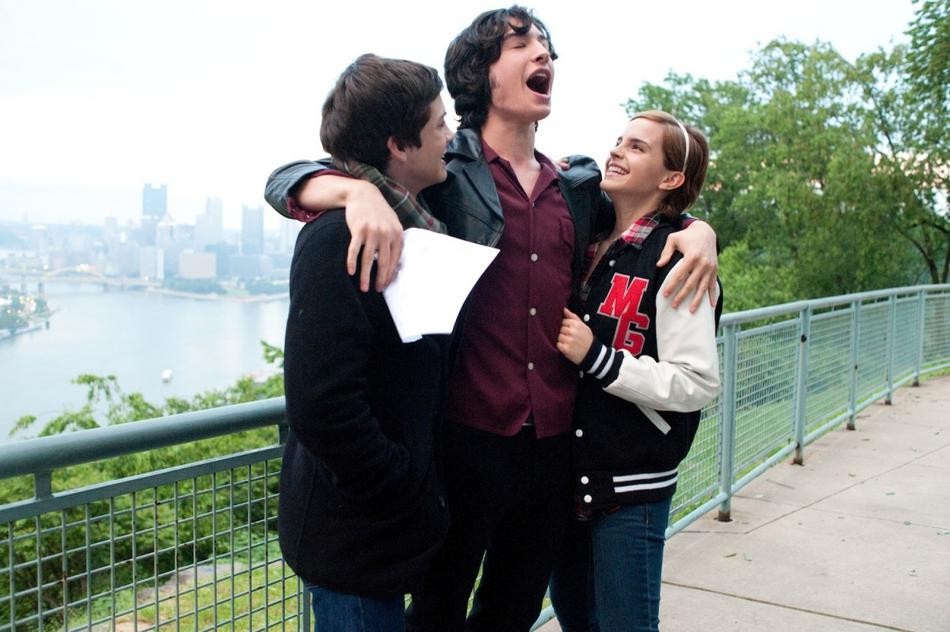
Based on a popular young adult novel, the film takes place in the early 1990s as a teenager named Charlie (Logan Lerman) begins his first year of high school. Charlie is a shy, quiet kid who has trouble making friends, and his old friends are too busy with their new crowd to pay attention to him. (And he also has a troubled past, which is revealed later.) The only connection he makes so far is with his English teacher (Paul Rudd).

Soon enough, Charlie meets two seniors—Sam (Emma Watson) and her stepbrother Patrick (Ezra Miller), who aren’t conformists in the slightest and revel in knowing so. When they learn that Charlie doesn’t have any friends, they welcome him into their crowd. They enjoy each other’s company.

For Charlie, this is a way of stepping out of his dork-status and his despair. It’s a despair that runs deeper than one might expect that comes with clues such as his constant writings to a certain “friend” about certain updates, and his late aunt (Melanie Lynskey) who had a certain bond with the boy, and possibly something a little more suspicious (things are left vaguely). His parents (Kate Walsh and Dylan McDermott) are in their own world, and his usually reliable older sister (Nina Dobrev) is in a somewhat odd relationship with an idiot named Ponytail Derek (Nicholas Braun). Bottom line is, this is a kid who needs friends in his life. Who better to be his friends than Sam, friendly and appealing, and Patrick, witty and high-spirited (and openly gay).

Charlie isn’t the only one with problems, of course. Patrick and the football jock Brad (Johnny Simmons) are seeing each other secretly, as Brad isn’t ready to come out of the closet yet. But the tension is getting to be too much for him. And Sam is trying to live down a reputation, which began during her freshman year. She regrets the past, and dates someone else—a nice college guy named Craig (Reece Thompson). Charlie develops a quick crush on Sam, but still supports their friendship. But Sam, not knowing that Charlie is hopelessly in love with her, keeps finding ways for Charlie to like her even more, which makes things very difficult. Life may be sweet, but also very complicated, and it gets even more so when Charlie finds himself in a weird relationship with punk-Buddhist Mary Elizabeth (Mae Whitman).

If any of this sounds familiar, it should. We’ve not only seen this in many high-school coming-of-age movies, but I think most of us have known what this felt like when we were in high school. We can’t deny it—we have all felt the confusion, the awkwardness, the loneliness, and the unusual developed friendships that come with high school. And this movie knows what high school felt like. What surprised me is how this film separated itself from the “mainstream” aspects by really tapping into its subject matter, as well as developing into a rather dark final act (which I will not give away). The screenplay by Stephen Chbosky (based upon his own novel!) is warmer than I expected it to be. It’s insightful, sincere, and very effective.

What also makes “The Perks of Being a Wallflower” special are the performances. Logan Lerman is likable and effective as Charlie. Emma Watson, in her first attempt to distance herself from the Hermione Granger image that made her noticeable in the first place, does great work as Sam. She has more of a display of range and ability than the “Harry Potter” movies ever permitted her to show. (Both Watson and Lerman share convincing chemistry together.) But the real surprise was Ezra Miller as Patrick. Miller plays the exact opposite of his psychopathic-teenager role in last year’s “We Need to Talk About Kevin,” and he delivers a performance equally strong. Miller is enthusiastic, energetic, likable, credible, and engaging.

If you feel alone, then remember that good things can happen in ways you don’t expect them to. That’s the overall moral, you could say, for “The Perks of Being a Wallflower.” With a smart script, good acting, and an overall feel for what it’s like to be a high school outcast, this movie is observant, fun, amusing, sweet, sad, nostalgic, and very effective.

The Sure Thing (1985)

12 Feb

images

Smith’s Verdict: ***1/2

Reviewed by Tanner Smith

Rob Reiner’s “The Sure Thing” could have been one of those dumb teenage sex comedies of the 1980s, and for those who were tired of that “genre,” the opening scenes probably turned them off immediately. You’d think you could tell from the first five or ten minutes what was going to happen in this movie, but you’d be wrong, and that’s how the movie tricks you. Rather than going along the lines of the distasteful “Porky’s,” “The Sure Thing” is sweeter and more mature in tone than one might expect.

Surely enough, “The Sure Thing” starts offputtingly. For one thing, the opening credits (which are written in that cheesy, pink-colored cursive font you see in most 80s teen comedies) are played over a sequence in which the title character—a blonde bombshell in a bikini—sits on a California beach and rubs lotion all over herself. Very appealing to look at, I have to say. But there are many other teenage movies that start out this way. Then, we meet our main character—a recent high school graduate named Walter “Gib” Gibson (John Cusack) trying unsuccessfully to pick up girls at a party, and then chatting with his buddy Lance (Anthony Edwards) who keeps telling him to “get back out there” and get laid. Lance is just as annoying as any other “supportive-sexist-best-friend” character you see in this kind of movie—we’ve seen this guy before. He’s boring.

In fact, we’ve seen this opening before. Any groaner will tell you that “The Sure Thing” is going to be just another one of those sleazy teen sex romps. But this is a most pleasant surprise—instead of resorting to that sort of sleaziness that made movies such as “Porky’s” and “Losin’ It” box-office hits at the time, “The Sure Thing” turns out to be a gentle love story that begins as Gib attends an Eastern college and meets Alison Bradbury (Daphne Zuniga) in his English class. He’s attracted to her, and he uses unusual pickup tactics to ask her out. But Alison is not one of your standard dumb movie broads—she’s an intelligent woman (who happens to be good-looking). On their date together, just when the two start to really hit it off, Gib ultimately winds up acting like a total jerk.

Lance invites Gib to spend Christmas vacation in Los Angeles, where a “sure thing” (the blonde at the beginning) is waiting for him—no strings attached, no guilt involved. He plans to get there, from New England to Los Angeles, any way he can. So, he goes to a bulletin board offering rides, and gets a ride with a friendly, showtunes-crooning couple (Lisa Jane Persky and Tim Robbins), but guess who’s also along for a ride to L.A. That’s right—it’s Alison. She’s on her way to spend the holidays with her preppy boyfriend (Boyd Gaines). From here, it’s a combination of a road movie, a comedy, and a romance.

“The Sure Thing” follows a basic Hollywood three-act structure. The first act introduces the characters at the northeastern university; the second act, the most lengthy section of the movie, in which they travel to California while running into some trouble and hitching rides, while surely becoming attracted to each other; and then the final act, in which they reach their destination and ask themselves if they’re there with the right person. You can guess the outcome of the story, but that’s not the point of the movie. What really counts about “The Sure Thing” is that there is genuine chemistry between the two leads, as every good romantic comedy should have. For us to buy the story, we have to buy the attraction between the two. There is conflict between the two at first, but as they get to know one another, they start to really like one another. Sure, they’re opposites, and they’re going to California for another person. But when has that ever stopped true love? We like Gib and Alison—we care about them and we root for them to end up together. And that’s a compliment to the script and a key tribute to John Cusack and Daphne Zuniga, who are both gifted, charismatic, and convincing when playing the old reliable “love/hate” interaction.

My favorite scene in the movie is when Gib and Alison share a bed together. Alison is the first to awaken in the morning, and she notices that Gib has his arm wrapped around her. How does she react? She smiles and keeps lying there. That’s a genuinely sweet moment and it becomes an important turning point in Gib and Alison’s relationship.

And “The Sure Thing” does what every romantic comedy should do once they’ve gotten the sweet elements out of the way—provide the comedy. And surely enough, there are many comedic moments in this movie that work greatly. These scenes include—Gib’s introduction to the “sincerity lie” by his college roommate (Joshua Cadman); a predictable scene involving Alison hitching a ride with a redneck that suddenly becomes unpredictable once Gib comes to her rescue in a hilarious way; a scene in which Gib teaches Alison to “shotgun beer”; and more. More importantly, the comedy comes from the character’s behavior and the situations they go through.

More pleasantly, “The Sure Thing” is not about the “sure thing” (and there’s never any “meanwhile in California” scenes to interrupt the road trip). It’s about this young man falling genuinely in love. When Gib and Alison finally arrive in L.A., and end up at the same party, Gib is starting to feel as if he’s there for the wrong person. Little does he know that Alison feels the same way—she feels no excitement with her boring, middle-class boyfriend.  “The Sure Thing” has something to say about sex and love, and it’s one of those rare teen-comedies in the ‘80s in which sex and love are two completely different things. (So many others at the time pretended they were one and the same.) With realistic teenage characters, a funny script, and a tenderness to the story, “The Sure Thing” is a treasure in the teenage romantic-comedy genre.

Pleasantville (1998)

12 Feb

images

Smith’s Verdict: ****

Reviewed by Tanner Smith

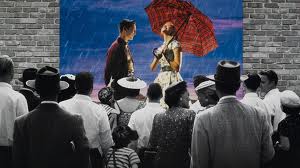
“Pleasantville” is a wonderful fantasy that is funny, great-looking, effective, well-acted, and very clever. First, it parodies those old TV black-and-white sitcoms, such as “Father Knows Best” and “Leave it to Beaver,” then it gets even better as it continues with its own sitcom plot and transforms into a strong story with a message of the power of change.

“Pleasantville” is the name of a TV black-and-white sitcom that features the same happy family we’ve seen in those other old sitcoms. They live in a small town called “Pleasantville.” Every day is the same—father comes home from work and yells in a pleasant tone, “Honey, I’m home!” Dinner is always on the table when Father comes home. (Making dinner is all Mother does, apparently.) The kids are pleasant too. In fact, everyone around them is pleasant and happy.

‘90s teenager David (Tobey Maguire) watches the reruns of “Pleasantville” and knows the show very well. We’d think that teenagers wouldn’t be interested in a show like that, but David feels left out of place in the 1990s and is more at home in the dream world of “Pleasantville.” His sister Jennifer (Reese Witherspoon), however, is right at home here—she’s popular and has experience with sex. One night, while their mother squabbles with their divorced father, David and Jennifer fight over the remote control for the TV, which breaks. To the “rescue” is a mysterious, friendly TV repairman (Don Knotts), who supplies them with a new remote that will “put you through the screen.” They click it and find themselves magically transported into the black-and-white world of Pleasantville. Horrified by her complexion, Jennifer exclaims, “Look at me! I’m pasty!”

So far so good—the idea of having modern-day teenagers in a wholesome, pleasant 1950s TV world is clever. The script has fun with the kids learning about this new world—everyone sticks to the script; no one does anything different; every breakfast is no choice of pancakes, eggs, sausage, bacon, and a ham steak; the basketball team never misses a single shot, no matter where they aim; the books in the library are blank; nothing burns (the firemen only rescue cats from trees); everyone sleeps in twin beds; and there is nothing outside of Pleasantville (the school history class is only about Main Street and Elm Street and it begins where it ended again). No one has ever even heard of sex. David has seen all of the episodes, and so he knows this world well. Jennifer, on the other hand, finds this world mysterious and creepy. “We’re stuck in Nerdville!,“ she exclaims.

David and Jennifer attempt to cope with this world until the TV repairman feels pleasant enough to send them back home. Their names are now Bud and Mary Sue, their parents’ names are Betty and George Parker (Joan Allen and William H. Macy), and Bud works at the soda shop with Mr. Johnson (Jeff Daniels). But any change can alter this universe and who knows what’ll happen? And there are changes, starting when Jennifer goes on a date with the cool guy in school and gives him his first sexual experience. That’s when things start to spread around town, and things and people slowly turn into Technicolor.

I mentioned at the beginning of this review that “Pleasantville” is great-looking and I wasn’t exaggerating. Almost every shot from that point on is amazing to look at because writer/producer/director Gary Ross and his cinematographer John Lindley use special effects to show a black-and-white world mixed with characters in color. Some of them are still in black-and-white so they interact with the ones in color. How does it happen? As it turns out, whenever anyone in this pleasant world experiences any change of any kind, they turn color and the world becomes more like ours. One of the very best scenes involving this technique is the scene in which Betty, now turned color, is assisted by David to put grey makeup on her face. That scene is very well done. Also, there are bits where things in color are reflected onto the black-and-white characters, like a fire and the moonlight over a river. I was absolutely bedazzled by the effects in this film.

People are ready for change, and the more serious subject of the film are the questions they ask of who they are, what is their purpose, what will happen next—questions they’ve never thought about before. Mr. Johnson becomes interested in art and Betty does something for herself for once. But George is distraught—he’s used to getting dinner on the table when he comes home and distraught when he comes home and the house is empty. His routine is ruined. Finally, the Mayor (the late J.T. Walsh, in his last performance) announces to the remaining “true” citizens of Pleasantville, “Something is happening to our town.” He’s right.

Even David and Jennifer have the ability to change. For example, Jennifer is less interested in keeping her sexual reputation, and wondering what else there is to do. She even starts to take up reading (although, she has to wait until the words appear back in the library books).

The writing is fantastic. The directing is great. Credit Gary Ross for making this movie like it is. In lesser hands, the movie would’ve been as bland as the show it lampoons. Ross delivers the goods here.

The performances are terrific. Tobey Maguire and Reese Witherspoon are good and convincing as the bewildered teenagers. William H. Macy is delightfully deadpan as the father, Joan Allen is fantastic as the mother, and Jeff Daniels is also good and funny as Mr. Johnson.

“Pleasantville” is also thought-provoking. It’s a magical piece of work that allows us to think about who we are and why we’re here. Can we, as individuals, make differences? I loved every moment of “Pleasantville”—it’s a clever, well-written, great-looking, solidly-acted, fantastic, satirical, fun feel-good movie. (Good Lord, is that enough adjectives?)

The Good Son (1993)

12 Feb

images

Smith’s Verdict: **

Reviewed by Tanner Smith

“The Good Son” is a thriller that features a good nephew, but not a good son. But as the parents see it, it’s the nephew that concerns them more than the son, whose deeds are surprisingly unnoticed by them. Of course, he seems like the sweet innocent kid that the parents would like to think they’ve raised him to be. But instead, the boy—named Henry—is a diabolical little demon that makes his cousin Mark’s life a living hell while also causing great harm to family members, innocent bystanders, and a dog.

As if poor Mark didn’t have enough to go through already. He’s already lost his mother after making a promise that he wouldn’t let her die. His father leaves him in his time of need at his brother’s house on an island in Maine for a couple of weeks so that on his business trip, he’ll have enough money for them both to be set for life. Mark gets along well with his aunt and uncle, and their two children—one of whom, of course, is the little demon spawn named Henry. Henry and Mark become good friends and hang out around the island. But later on, Mark has his suspicions of Henry’s true nature as Henry kills a dog with an invention he made that shoots nails and screws. He becomes even more convinced that the kid is sick when he throws a man-size dummy on a highway, causing multiple cars to crash into each other.

Henry’s sole explanation as to why he’s this way is revealed only to Mark, as he tells Mark that he was as scared as he was before he found ways to get away with doing certain things. But those “certain things” wind up harming innocent people. Wouldn’t it be more interesting if the screenplay had been written so that another part of Henry’s influence was watching violent action movies? Wouldn’t it make a more effective, chilling message if movie violence were the cause of the development for a child’s sociopathic mind?

But no—Henry is just plain evil at a shockingly young age, and I suppose that’s enough reason for us as a movie audience to be frightened by him. Henry is played by Macaulay Culkin, the sweet, charming kid from the family hit movie “Home Alone.” He’s playing against type in “The Good Son,” but sometimes it works, and other times it doesn’t. In the first half of the movie, he does very well at keeping the balance between guilt and innocence. He just seems like the kid whom everyone his age would like to be friends with, but he still gives hints about his true nature that would fool them. The development that leads Mark to really see his true nature is handled effectively as well. Mark befriends Henry, they hang out together, Mark is suspicious of him after a while, and then he sees something that really convinces him that Henry is not a “good son.” But the problem is that Culkin isn’t convincing when playing sinister. He speaks in a monotone voice and with a deep, twisted philosophy that a James Bond villain would have—only to Mark, of course. Where did he learn to talk like this? His parents are good-natured, he doesn’t watch TV, and he’s already stated that he doesn’t read comic books. This can’t be natural, but to be fair, I think this has more to do with the writing rather than Culkin himself.

Culkin does seem like an innocent child whom you wouldn’t suspect of any wrongdoing, so that gives him an edge. And when Mark tries to tell people about the boy’s psychotic antics, no one believes them. They don’t want to—they want to believe that Henry is the good little boy that he only pretends to be. And soon, it is Mark they all come to fear. But here’s the main problem with “The Good Son”—with his sophisticated speech that I’ve already mentioned, Henry doesn’t seem much like a kid. No kid talks the way he does. And it’s hard to believe that later in the movie, the parents and even a child psychologist can’t tell that this little robot is lying.

The script has many problems like that. One in particular is with that scene in which Henry and Mark watch the cars pile up after the dummy falls onto the street. We see a brief news report about the incident, but the dummy is never mentioned. Neither are the two kids who were in plain sight on the bridge above. There’s another moment in the middle of the movie that is inexcusable. It’s when Henry takes his little sister (played by Culkin’s real-life sister Quinn) to go ice-skating on a frozen pond and then pushes her onto some thin ice, which she falls through. Get this—she falls through the thin ice and yet her rescuers walk on it fine…and use an axe to break through it and save the girl! What conveniently thin ice.

Elijah Wood, as Mark, gives the film’s best performance. He’s the kind of kid that Henry’s parents see Henry as, and Wood has a natural screen presence that doesn’t bore us or make us want him to go away. It’s so hard not to feel sorry for Mark in this truly messed-up situation.

The ending is the more suspenseful piece of filmmaking to be found here. It involves the two boys and Henry’s mother (Wendy Crewson) on top of a cliff. Without giving too much away, it leads to a masterful climax. But then immediately following it is the film’s final line, which is completely unnecessary and kind of sick, the way it asks about the mother’s choices. To sum up “The Good Son” is like this—Elijah Wood’s performance is effective, the setup is good, the photography is lovely (the way it captures the island as if it were a painting), and the climax is suspenseful; but the writing is devoid of substance and reality. And the question that it all comes down to is, “Do we really want to see Macaulay Culkin in an R-rated movie about a young killer?”

Disney’s The Kid (2000)

12 Feb

images

Smith’s Verdict: ***

Reviewed by Tanner Smith

Adding the name “Disney” to the title of your movie must mean that families will automatically rush to the theater for some good, solid family entertainment from the Magic Kingdom. But you could call “Disney’s The Kid” just “The Kid” and it wouldn’t make much difference. Either way, this is a nice little movie that’s good for the family. It has its comic moments that entertain the kids, but it also has thankfully mature moments for the adults. It’s an involving, sweet, innocent family film—a feel-good story that Disney has been known for—and not just a kids’ movie, despite it having the “Disney” name in the very title.

The story is centered around hard-edged image consultant Russ Duritz (Bruce Willis). He focuses on his own image, while consulting the image of others—mostly celebrities and politicians. He gives brash-but-somewhat-helpful advice to his clients about omitting “self-pity” and also gives enough insults to everyone he meets, so that they all call him “jerk.” Not a day goes by without someone calling him “Jerk” either behind his back or right at his face. He alienates himself from family, he tyrannizes his personal assistant Janet (Lily Tomlin), and is even dismissive to his co-worker Amy (the always-delightful Emily Mortimer) who could be his girlfriend if he wasn’t such a “jerk.”

A few days before his 40th birthday, something strange happens. He’s visited by a little boy—a chubby lively kid named Rusty (Spencer Breslin). But this isn’t just any kid. As they both realize, Rusty is really Russ, at age eight. Somehow, Rusty has traveled forward in time to meet his 40-year-old self. Rusty is not so thrilled at his future self’s occupation—he doesn’t have a family, nor a dog, and has a job that just isn’t very exciting. “I grow up to be a loser,” the kid grimly states.

You can tell where this is going—Russ is going to realize through this kid what led him to become a loser and, with help from his past, is going to learn how he can become a better person. Now, I’m sure kids won’t appreciate this story very much, but they’ll still have the kid to identity with and the occasional slapstick humor that comes long (most of it is tame). The adults will get more out of it—this is their fantasy of revisiting their past. Yeah, the plot gets a little corny as it goes along, with story elements that seem added on for further drama, such as the subplots involving Russ’ on-again/off-again relationship with Amy and the heavy deal with Rusty being told that his mother is going to die from cancer. But most of the material does work, and leads to good lightly comic moments (most of which playing with Russ and Rusty’s relations with each other, or the question as to why the moon sometimes look orange), as well as effective dramatic scenes.

The acting helps give the movie its credibility. Bruce Willis is an effective leading man and shows dimensions far from being a deadpan, wisecracking beatnik (a role he’s usually known for). He shares terrific moments with Spencer Breslin, who is very appealing as Rusty the kid. Of the supporting cast, Emily Mortimer is always a delight to watch, Lily Tomlin is quite droll as Russ’ bored assistant, Chi McBride has a nice moment as a boxer/client who teaches bullied Rusty how to fight, and even the appealing Jean Smart, who has the least amount of screen time, has some wonderful moments as a Southern newscaster, who is one of Russ’ clients and gives him helpful advice about dealing with his own past.

“Disney’s The Kid” nearly ends with the message that learning to fight leads to a successful life. And I’m glad it didn’t go that route, because that seems to be the staple for movie messages in a lot of movies; particularly action films. It seems like it’s going to go that way, in a scene in which Rusty uses his new fighting skills on school bullies. But then we get to the satisfactory happy ending in which Russ and Rusty realize the true meaning and ambition of their lives, and Russ realizes that if he can’t change his own life by having his past self deal with his present self, then maybe the best is yet to come.

The River Wild (1994)

11 Feb

River-Wild-cast

Smith’s Verdict: ***1/2

Reviewed by Tanner Smith

“The River Wild” is predictable. I’ll admit that. You can guess more-or-less where the film’s story is going to go. But that doesn’t make it a bad movie. Actually, I think it’s a terrific action-thriller. It has top-notch acting; it features a fully-realized main character played with more than the right amount of gusto by Meryl Streep than it deserves; it’s shot wonderfully in the great outdoors, the Salmon River in Idaho; and it has its share of tense moments. I enjoyed watching “The River Wild.”

So what do I mean by predictable? Well, here’s the setup:

Meryl Streep plays Gail, a former river guide and rafting expert who decides to take her son Roarke (Joseph Mazzello) on a whitewater rafting journey for his birthday. Her husband Tom (David Strathairn) is a workaholic architect who is reluctant to go on this trip. But he shows up at the last minute, though he is more concerned with getting work done than enjoying the outdoor life and spending time with his family. Gail knows the territory well, and even once braved the challenge known as the Gauntlet, which is said to be the most dangerous set of rapids. (She tells her family that one person was killed and another was paralyzed for life.) Also on the river are Wade (Kevin Bacon) and Terry (John C. Reilly), who are not so experienced in this sort of thing and have lost their guide. They meet Gail and family who decide to let them come along and join them. Roarke is able to befriend them because Wade seems like a nice guy. But the further they go downstream, the more distrust Gail and Tom feel towards Wade and Terry. And things get more ominous when Wade shows Roarke a loaded gun, and Tom plans to confront Wade…

So from reading that setup, you might have already guessed where this is going. Wade and Terry are on the run; they know that Gail knows the river, so she can help them escape; they make their true presence known, as they’re midway through; Gail, Tom, and Roarke are held hostage; and the way Wade and Terry want to go is through the Gauntlet. I was almost about to give a “SPOILER ALERT” for this review, but what’s the point?

The plot is thin and predictable as they come.

But there’s more than enough to make up for that. First and foremost is the fine acting by the cast. They aren’t caricatures or one-note figures thrown in for marketable reasons; they’re well-developed characters played by great actors. Meryl Streep is wonderful as to be expected, and is really the backbone of this movie. She’s physically fit, which is something you rarely see in her other roles, and she plays the character as smart and as tough as we would like to see in this role. Streep captures Gail’s energy and terror perfectly. She has the makings of a strong female action hero.

Kevin Bacon is well-cast as the ruthless Wade, delivering an effective mix of menace and charm. David Strathairn is convincing as an uptight workaholic suddenly pushed to his limits. John C. Reilly is good as Wade’s sidekick whose hesitance, especially when the group is shooting the rapids, makes for some comedic moments.

“The River Wild” also has top-notch production values important to the film’s success. The cinematography is outstanding and the suitable music score is effective assistance. The climax of the film, in which the group inevitably race down the aforementioned dangerous Gauntlet, is exhilarating. Watch this movie on a big screen—you might feel like you’re experiencing this with the characters.

I’m not going to lie—I think that maybe “The River Wild” would have been more effective if it was just about this woman bringing her family to see the beautiful river before it’s “polluted,” and trying to settle things with her distant husband along the way. (And just drop the whole thing about the two guys and the thriller aspects.) That would have been an interesting family drama, and there could have been a lot played off from that.

But while reviewing for “The River Wild” for it is rather than what it isn’t, I still think it’s an effective thriller. Is it familiar? Yes. But it’s also well-executed and delivers the goods.

Free Willy (1993)

11 Feb

images

Smith’s Verdict: ***

Reviewed by Tanner Smith

The pre-production meeting for “Free Willy” probably went like this:

Quick! We need a family film with a save-the-whales message to give the kids! How do we do it?

What do you mean, “How do we do it?” Why don’t we just make a documentary about the danger that whales face?

Because A) Documentaries don’t make money unless they’re narrated by Morgan Freeman, and nobody will know how cool his voice is until next year when “Shawshank Redemption” is released! And B) Come on, we’re Warner Bros. Family Entertainment now. Let’s make a sweet, charming family-adventure…and make money off of it!

OK, OK, I gotcha. So how about this—we tell the traditional story of a boy and his dog. People eat this stuff up—we’ve had a boy and his dog, a boy and his raccoon, and a boy and his alien. Why not have the whale be boy’s best friend?

Hm, that could work. But we need a certain thing to make sure that people are going to see it…maybe a pop star to sing the theme song!

Michael Jackson?

THAT’S IT!

Yes, “Free Willy” tells the usually reliable boy-and-his-animal story, only it’s an unusual relationship between a young street kid and a killer whale. And while that does seem out there (and sometimes it is) “Free Willy” is innocent and charming enough to make for a winning family entertainment.

Jesse (Jason James Richter) is a young boy living on the streets after being abandoned by his mother and escaping from an orphanage. When he is caught spraying graffiti at an aquatic theme park, he is forced as part of his probation to clean up the mess he made. The main attraction at the park is an orca named Willy, with whom Jesse strikes up an unusual friendship. Soon enough, he finds that Willy is able to respond to the sound of his harmonica. He’s even able to train Willy to do certain tricks that the whale’s trainer Rae (Lori Petty) hasn’t been able to do, and so he’s hired as a co-worker.

Jesse lives with a pair of foster parents (Michael Madsen and Jayne Atkinson), who are both patient and loving towards Jesse. But Jesse doesn’t take to his new home very well, and rebels by giving insults and sneaking out at night. Jesse just doesn’t comfortable with these because he would rather be with his own mother, who would just as soon not want him around. This is how he relates to Willy, who was taken away from his family in the nearby ocean. Both Jesse and the whale are homeless and maybe unable to make the best of their surroundings.

There are not many surprises in this movie—just look at the poster, trailer, or DVD cover and you know how the movie is going to end. And it relies on many clichés and formulas, although while some of these are acceptable because they still work, it’s pretty easy to make fun of the rest of them. The most particular of these elements is the villainous park owners, played by Michael Ironside and Richie Riehle. How can you not laugh when Ironside (who I suppose always has to play the villain) states out loud that they’re both about “making money?”

And while whales are undeniably beautiful creatures (which the movie reminds you right from the beginning, in an opening sequence that stretches out the action of whales jumping), Willy (played by “Keiko”) is probably the least interesting element of the movie, because he’s mostly seen as a big blob for Jesse to interact with, and I can barely see the whale’s eyes to connect with him myself.

And by the way, is it me or does Willy understand English? There are moments in which he nods for “yes” and shakes his head” for “no.”

But despite that, “Free Willy” is a solid family film, mainly because of its dramatic elements with Jesse trying to cope with his foster parents. It also works with how Jesse is able to redeem himself by changing from delinquent to hero, because of having this friendship with Willy whom he wants to help out. This is a gentle movie about a young boy discovering himself, and the relationship between Jesse and his foster parents ring true.

The acting is one of the strongest assets of the movie. Jason James Richter is naturally winning as Jesse—if his performance didn’t work, the whole film might fall apart. Lori Petty is strong as reliable, helpful Rae; August Schellenberg is quite solid as Haida-native handyman Randolph who knows a thing or two about orcas; and Michael Madsen as the foster father Glen is excellent, portraying a three-dimensional individual as he tries patiently to give Jesse a good home while also trying to relate to him. Also good is Mykelti Williamson as Dwight, Jesse’s social worker.

The whale effects are outstanding. Sometimes they would use a real whale (Keiko), but other times, the filmmakers would use animatronic whales. To be honest, I could never tell the difference between which whale was real and which whale was mechanical.

“Free Willy” has its heart in the right place, and the “save-the-whales” message is quite clear, but not so over-the-top that adults will be groaning in annoyance. It’s shot nice, the special effects are convincing, the actors are good, and as I said, the family-drama aspects are well-developed. It’s a charming film.

NOTE: Yes, as I mentioned above, Michael Jackson sings the film’s theme song, “Will You Be There.” It’s a touching song, and this was back when MJ was still king of pop and so if he told people to see this movie, they would. And that’s mainly why this movie was a box-office hit.