Archive by Author

Friday the 13th (1980)

15 Feb

FT13th_Still_2

Smith’s Verdict: *1/2

Reviewed by Tanner Smith

“Friday the 13th” started a ridiculously popular series of deplorable slasher films, neither of which I can recommend. Did this film deserve a sequel to lead to more sequels? Well, no. In fact, I really don’t understand why the film was so popular with the horror-movie crowd. It’s poorly made, slow moving, and, to be honest, not very memorable, save for a few creepy moments.

It is, however, another example of a slasher film in which teenagers, mostly women, are alive at the beginning, and then dead by the end. Ever since the iconic “Halloween,” there have been so many of these going around. Heck, the filmmakers actually make a note that their intention for “Friday the 13th” was to “rip off ‘Halloween’”—class act. All that was missing was the tension, excitement, and suspense—instead, we just have pretty, poorly-developed young people as characters waiting to be hacked off one by one.

The story pretty much sets them up for it. It’s about a closed-down summer camp that is finally about to be reopened years after supposed deaths. There is rumors spread by the nearest town’s loony that it has a “death curse,” and the locals refer to it as “Camp Blood.” But the new owner Steve Christy (Peter Brouwer) decides to get finally get things up and running again. The movie takes place in a day and night at the camp in which six counselors get everything prepared for campers. But someone is watching them from afar…

Many people know the killer Jason from the “Friday the 13th” series—the husky, silent killer in the hockey goalie mask that never stops killing and never dies permanently (he always comes back). But wait a minute—Jason isn’t the killer in this movie. In fact, he doesn’t even appear until the very end of the movie, and that’s just Jason as a little boy, in a dream. And I have to point that that dream sequence in which little Jason suddenly pops out of the river, grabs the Final Girl, and pulls her under (then she wakes up) is a shocker, although I think the better credit for that should go to the music accompanying it.

Speaking of which, Harry Manfredini’s music score for “Friday the 13th” is simple but effective, and it really ups the creepiness when the killer is around and something is about to happen. I don’t normally like it when the music sets up something big to happen, but the music here is something that gives “Friday the 13th” some merit.

And there are times when “Friday the 13th” is atmospheric, using the outdoors as the wide-open space that it is, where there are many places to run, but not always to hide.

The characters are paper-thin, and there are only three that are memorable for unfair reasons. One is Jack, played by Kevin Bacon—the reason he’s memorable is because…he’s played by Kevin Bacon, who went on to bigger and better things long since this movie. Another is Ned, played by Mark Nelson—he’s memorable because…he’s annoying as hell. And then there’s Alice (Adrienne King). She has no personality, but we’re supposed to follow her because she’s the film’s obligatory Final Girl who fights off the killer in the final act. Only one character seemed kind of interesting—an independent young woman named Annie (Robbi Morgan), the camp’s hired cook, who is hitchhiking to get to the camp…and gets murdered for it. I liked her; she had an appealing presence and before they could develop her character, they killed her off after a few scenes.

Another problem with “Friday the 13th” is its terribly slow pacing. The scene just goes on and on with many characters, individually, until the killer finally kills them off. We’re just stuck waiting and waiting for the person to die, without any sense of nail-biting tension. This is the movie that people are afraid of? I can’t imagine an audience being on the edge of their seats during this movie.

The final twenty minutes of the film is where the action picks up, as Alice is forced to fight against the killer after learning the killer’s identity. I won’t mind giving away the “big secret” because a lot of other people have. The killer isn’t Jason—it’s his mother Megan Voorhees. She’s played by Betsy Palmer, in a Razzie-worthy performance; her role and her motive is laughably absurd and her wide-eyed imitation of her son saying, “Kill her Mommy! Kill her!” is just embarrassing.

“Friday the 13th” is unremarkable. It’s a deplorable, weak rip-off of “Halloween” (and no, that’s not a compliment to the filmmakers). It was just another one of those unnecessary movies that led to unnecessary sequels and you can’t believe it got this popular status.
The Borrowers (1998)

15 Feb

MSDBORR EC007

Smith’s Verdict: ***

Reviewed by Tanner Smith

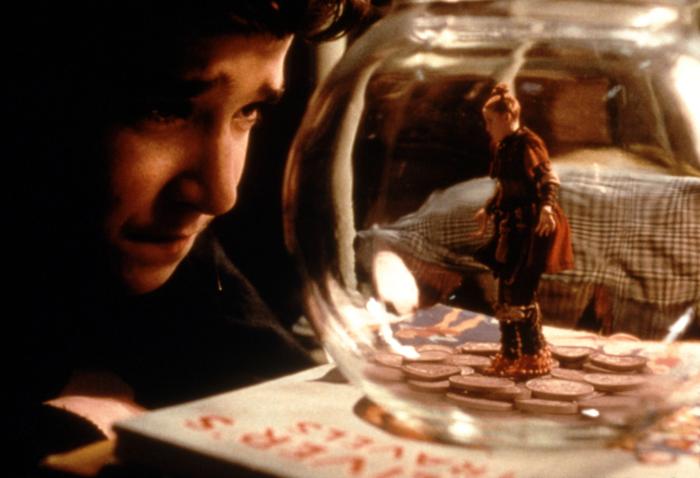
“The Borrowers” is based upon a series of books (by British novelist Mary Norton) centered around a premise that has always fascinated me ever since I was a child. You know how little things around your house seem to go missing? We naturally think we merely misplaced them and can’t remember where we placed them before, but what if there was another reason? What if there are little people living under the floorboards or within the walls, and they pilfer these objects when we don’t notice? These tiny people are known as “Borrowers,” as they “borrow” (kind term for “steal,” in their case) their survival needs—just little things lying around the house. The idea is intriguing and any book or movie centered around it interests me.

Now to be sure, this 1998 film adaptation “The Borrowers” from director Peter Hewitt is very, very loosely based on its source material. The only elements that remain the same are the central idea and the “Borrower” characters. But I don’t care how little it has to do with the book; as a stand-alone movie, it’s a charming, entertaining family film. It has fun with its premise, has top-notch special effects, and is flat-out entertaining.

The four-inch Borrowers that serve as the central characters of the movie are the Clock family—Pod (Jim Broadbent), his wife Homily (Celia Imire), and their two children Arrietty (Flora Newbigin) and Peagreen (Tom Felton). They live under the floorboards of the Lenders’ house, unbeknownst to the Lenders who serve as their human “beans” who unknowingly provide them with things to borrow, but will squish them once they see them. At least, that’s how it goes. Arrietty goes exploring the bedroom of Pete (Bradley Pierce), the child of the “beans,” and winds up being seen. But when she finds that the boy doesn’t want to hurt her, she’s able to convince her parents to let him help them out of the house, which is about to be demolished.

However, on the way to their new location, Arrietty and Peagreen are accidentally separated from Pod and Homily. The kids make it back to the house in time to notice that an evil lawyer, Ocious Potter (John Goodman), has in fact cheated the Lenders out of their house by lying about the will for the house never showing up. It turns out Potter has found it and wants to destroy it. But the Borrower kids mess with his plan by “borrowing” the will in hopes of saving the day. So Potter, along with an exterminator (Mark Williams), comes after them.

This leads to several events in which the kids are placed in more danger by the gigantic bean, but always have the upper hand in comic fashion. Actually, you could call this movie “’Home Alone’ with tiny people” in the way these four-inch children (later joined by another young Borrower, named Spiller) constantly outsmart the normal-sized lawyer in a sort of live-action cartoon violence. Potter is covered in burning insecticide foam; he’s slightly electrocuted; he has a needle stuck in his behind; and so on. Neither of these is terribly harmful, compared to the “Home Alone” movies, but they are enthusiastically exaggerated and still force chuckles out of the ingenuity of the idea that these “little” kids always have the upper hand on this guy.

This fantasy-adventure is brought to life with sensational special effects and amazing-looking, greatly-imagined sets. The sets that make the everyday world, with everyday items all around, look giant. Most of the charm comes from these set pieces alone. And the more complicated effects, integrating the humans with the Borrowers (including one complicated shot that looks like a steadycam shot of Pete looking down and talking to Arrietty who is standing on a table), are competently well-done.

There are many creative, adventurous sequences that follow as the plot continues. Most of these involve little Peagreen. One has him clinging for dear life onto a dangling light bulb, as Potter turns on the light and is ready for the bulb to burn his hands so he can fall. And Arrietty has to save him with a tape measure.

Another, quite possibly the most exciting scene in the movie, is the sequence in which Peagreen ends up in an empty milk bottle and taken to a dairy plant. Arrietty and Spiller (Raymond Pickard) must race to save him before it fills up with milk and is capped shut.

All of this is good fun, and it moves at a brisk pace. I admire the visual imagination and the creative storytelling that went into this film. Although, a minor drawback is that because it’s so fast-paced, that it’s kind of easy to miss something in the plot. We never even see Arrietty convincing her family to trust a previously-feared human “bean” to let him help them; they’re just in the back of the moving truck, and Pod just sort of trusts Pete. Other little details like that get kind of annoying, but I didn’t mind all that much.

Solid characterizations are given to the Borrowers and the beans, and they make the film more successful than it already is. And the characters are well-played by an ensemble of game actors. John Goodman is clearly enjoying himself, playing the nasty Potter who will stop at nothing to get his way; Flora Newbigin is excellent as the feisty, teenage Borrower Arrietty; Jim Broadbent is entertaining as Pod, who winds up barking orders at the human-sized Pete in order to find his and Homily’s children; and Mark Williams (as Potter’s henchman “Exterminator Jeff”) and Hugh Laurie (as a patrol cop) are on hand for effective comic relief.

Director Peter Hewitt has shown in “Bill and Ted’s Bogus Journey” that he’s game for visual imagination and creative storytelling, and he’s just as solid in exhibiting it this time, though maybe on a larger scale (so to speak). “The Borrowers” is a delightful, entertaining fantasy-adventure that makes great use of its fascinating premise and delivers the goods.

A Good Day to Die Hard (2013)

15 Feb

A-Good-Day-To-Die-Hard-Trailer-2013

Smith’s Verdict: **

Reviewed by Tanner Smith

1988’s “Die Hard” is considered one of the very best action films ever made, and their sequels have their shares of thrills as well. Though, it’s hardly a secret that the first film’s exhilaration has since diminished with each sequel…and unfortunately, its fifth installment, “A Good Day to Die Hard,” is enough evidence to show that the franchise is dying…hard.

“A Good Day to Die Hard” doesn’t even seem or feel like a “Die Hard” movie. It just seems all too generic—here’s a conflict no one should care about; here’s a few generic bad guys who love to shoot everything up; and here’s a load of explosions, and lots of ‘em! Add the wisecracking hero and an annoying sidekick, and…really? This is “Die Hard?” The other movies had more going for them than this—characterization, proper setups-and-payoffs, and memorable villains. Those elements are what made “Die Hard” and some of its following sequels fun to watch—they added to the excitement of the action sequences so we cared about what was happening on-screen.

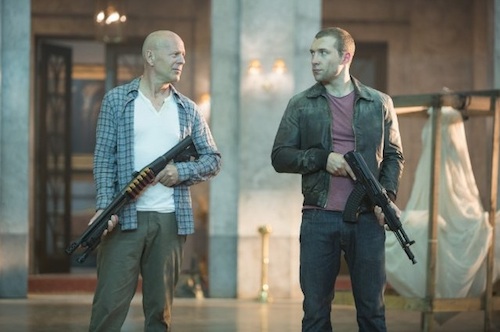
But at least we have Bruce Willis, again playing the hero cop Det. John McClane and again finding himself in one unusual predicament after another. And to be fair, he’s the best thing in this movie. Sure, he’s noticeably aged, but his wisecracking personality is still welcome. (He even says his “yippie-ki-yay” line, which I’m sure people missed in the previous “Die Hard” film.) However, there’s one question regarding his character—why is he suddenly so freaking invincible?! Remember when in the first movie, his feet were torn to shreds after having to escape barefoot on shards of broken glass? Now, whenever he crashes through plate-glass windows or survives car crashes, he only has a few scratches instead of ten or fifteen broken bones! Did John McClane just turn into the Terminator, as he got older?

But I digress. The action takes place in Moscow, Russia. John’s son Jack (Jai Courtney), a CIA agent, has been arrested for murder and is awaiting trial. John and Jack haven’t spoken to each other in years, but John wants to travel to Russia to…actually, I just realized I have no idea what his original plan was. Was he going to try and negotiate with the authorities? What can he say? He’s obviously out of his jurisdiction, to say the least. On top of that, he can barely speak a word of Russian. So what was he going to do originally? Plan a jailbreak? He’s clearly working alone!

I don’t know; and frankly, I don’t care. But it doesn’t matter anyway because as John gets to the courthouse, all hell breaks loose and Jack manages to escape Russian justice. Along with him is a political dissident, Komarov (Sebastian Koch), who has some sort of…”McGuffin,” I guess, that a band of terrorists are trying to get their hands on. John ends up in the mix, and thus we get to add awkward father/son bonding to standard, generic, shoot-em-up, action-movie elements. Oh. How. Exciting.

While the “Die Hard” movies have had some pretty effective villains (the one that particularly comes to mind is Alan Rickman’s Hans Gruber from the first movie), there is no real villain in this movie, strangely. There are just certain villainous characters who seem to one-up each other for complicated reasons, along with several henchmen. When the top villain is finally unmasked, however, it comes as no surprise (you’ll figure it out early on). Motivations are clumsily written, and so it’s hard to follow everything that’s being thrown at us. The action, as a result, comes across as (broken record) generic.

Bruce Willis is Bruce Willis, and he’s still likeable as always. But as his sidekick in the action, Jai Courtney is just a crushing bore. He’s whiny, annoying, and ultimately bland. Oh, and here’s the worst thing about him. He’s the central figure of this “Die Hard” movie—not John; he’s merely there for support. Yeah, because I’m sure we want to see this guy backed up by the iconic Bruce Willis character!

“A Good Day to Die Hard” at least has a few good-looking action sequences, and director John Moore is evidently a capable action director. But the main thing missing from this action film is the energy and creativity that the original film had. It just feels like a throwaway action flick that is subjected to our minds and then leaves very little impact. Maybe it’s time for this “Die Hard” franchise to…”die hard.”

Warm Bodies (2013)

14 Feb

warm-bodies-image08

Smith’s Verdict: ***1/2

Reviewed by Tanner Smith

Ever so often, we get one of those “zombie-movies” in which a strange infection devastates a population, and a small, diverse group of survivors defend themselves against a hostile race of staggering, man-eating walking-dead, and sometimes against each other. “Warm Bodies” is not that movie.

Yes, “Warm Bodies” is a zombie-movie, and the zombies are as predictable as you’d expect. They groan; they stagger; they crave human flesh; they lurch; and they get shot in the head by human survivors of…I don’t know, insert apocalyptic reasoning here. And the people include the usual gun-toting military who will shoot first and ask questions later (if at all), and of course, because they’ve never seen zombie movies, they use a special device to make sure that someone is or isn’t a zombie. Yeah, because it’s so hard to tell by appearance, isn’t it?

But wait! Didn’t I say “Warm Bodies” was not the typical zombie-movie? Yes I did. In fact, this is one of the more original zombie-movies to come around in a long time. It mixes elements of “Dawn of the Dead” with some of “Romeo and Juliet,” and it tells the story from the zombies’ point-of-view! It’s a refreshing move (among many in this movie), as if to say, “Forget the boring people who are trying to defend themselves! Let the zombies tell their story!” For the longest time, zombies have been simply known as walking allegories (who’s more human in the case of people-versus-zombies?) and have become more predictable as a result. Not here.

The main protagonist of “Warm Bodies” is “R” (Nicholas Hoult), a young zombie who narrates the story through thought. He knows he’s a zombie; he knows he has to eat human flesh; and he knows his many limitations. R slouches around the post-apocalyptic ruins of a city, and mostly hangs around an airport terminal and an airplane he has made his home. (And he doesn’t remember his first name, but he knows it starts with “R.”)

Those who have seen “The Princess Bride” will know that “there’s a difference between mostly-dead and all-dead.” Such is the case in “Warm Bodies,” in which the “all-dead,” the truly-dead zombies, have become so hungry for human flesh that they have even eaten their own, revealing skeletal bodies and becoming even more brutal monsters known as “bonies.” There’s no hope for them anymore. Is there hope for the, um, “mostly-dead?” This is where “Warm Bodies” develops its plot, as a young woman named Julie (Teresa Palmer), one of the human survivors, scouts the outskirts of the city with others for supplies, and to shoot up anything that staggers. Surely enough, some zombies find them and R eats the brains of Julie’s jackass boyfriend (Dave Franco). This somehow triggers some of the boyfriend’s memories, and also starts R’s own transformation to live again. His heart starts beating; he can form words; and he is smitten by the appearance of Julie, and he even protects her from the other zombies.

This begins a star-crossed romance, as R takes Julie to his home. Julie learns to trust R; R becomes more human as they spend more time together; they both have fun together; and they form a strong bond together.

Wait a minute—Romeo and Juliet? R and Julie? I just got it! (And yes, there is a balcony scene in this movie.)

Anyway, the idea is that love is the main thing that can bring the dead back to life. At least, that’s the case for the “mostly-dead,” and not the “truly-dead” bonies who have no purpose but to chase and kill.

There are a lot of refreshing pleasures to be found in “Warm Bodies,” thanks to some clever writing by Jonathan Levine (who also directed the film, and whose previous film was “50/50”). For example, R’s narration is full of deadpan-satiric references to other zombie-movie elements; some nice inside-jokes (though with some more obvious than others); and such.

Now I’m going to tell a little story:

I was not so anxious to see this movie. Seeing the trailer, I could see where the originality was coming from with the plot elements of this zombie-human love story (though, admittedly, I kept flashing back to “Twilight”), but I thought I could tell where the movie was going to go. I went anyway, because of a few friends who were saying how much they loved this movie. But I was constantly on guard. I was expecting to predict what was going to happen with each plot development. And because I liked the beginning of the movie so much, as R narrates his life (very clever writing involved here), I whispered a silent prayer that this would not go the way I expected. As it turned out, whatever I thought was going to happen either did happen in a more delicately-handled way, or not at all! For example, when we meet Julie’s cocky boyfriend, I immediately thought he was going to be the boring, jealous villain at whom everything in the obligatory action-climax could be pointed to. And what happens? He’s disposed of quickly!

Then, R takes Julie back home after he first meets her. I asked why Julie didn’t just run, since these zombies are somewhat slow—as it turned out, these zombies are kind of fast when they need to be.

And of course, I kept saying to myself that there would be a “liar-revealed” type of cliché in which Julie would find out that R has eaten her ex-boyfriend’s brains and then suddenly not trust him, and leave him, and there’d be a long, long stretch of time before R has to find some way to make her forgive him so they can be together in the end…Granted, that is a very grim situation and I wouldn’t expect Julie to shrug it off, but then again, the longer they hold out this secret, the more it becomes annoying when you think about it. So how does this secret become revealed to her, and how does she respond to it? All I can say is, it was treated in such a plausible way that I just let it be…

But then of course, there’s the obligatory military force who will shoot any corpse that comes their way, and ask no questions. Yeah, yeah, yeah—the leader of the force is Julie’s father (John Malkovich); he’s a hardass; he won’t listen to reason; he’ll never understand R and Julie’s love; blah blah blah, I kept waiting for this one. It’s the “prejudice” element that comes about in every one of these movies. But even this plot element is well-handled! And so is the climax in which the military doesn’t know which to shoot—the zombies or the bonies who seem to be fighting each other?

I wouldn’t want to give away too much, but you get my point. “Warm Bodies” ultimately won me over by how smart its writing was. Whichever direction I expected it to take, it either didn’t take or did take it, but with nice touches. I actually wanted to yell in the theater.

Nicholas Hoult and Teresa Palmer, as the two leads, are both winning and appealing in “Warm Bodies.” Hoult gives probably the best “earnest performance” that an undead character could be given. Palmer gives her character Julie good doses of sweetness and spunkiness—even if she does a few dumb things, you forgive her because of that. Both actors exhibit convincing chemistry on-screen, and they manage not to make a romance between a beautiful girl and a walking corpse less icky than you might imagine.

Of the supporting cast, there are two actors who deserve mention. One is Rob Corddry, who does a great job as R’s friend M who has his own transformation as well; and the other is Analeigh Tipton, who is very funny as Julie’s friend who awkwardly accepts the fact that Julie is with a zombie. John Malkovich is…well, let’s face it, he’s John Malkovich.

I can’t think of any recent zombie movie with this much heart added to it. “Warm Bodies” is sweet, original, nicely-directed, and over in just an hour-and-a-half. And even though some of it is silly (and the herky-jerky effects of the bonies don’t help much either), the movie has the nerve to be upbeat and optimistic with its subject matter, as well as tell the familiar story from a different viewpoint. It’s a terrific film; my favorite film of 2013 so far.

The 40-Year-Old Virgin (2005)

14 Feb

40_year_old_virgin

Smith’s Verdict: ****

Reviewed by Tanner Smith

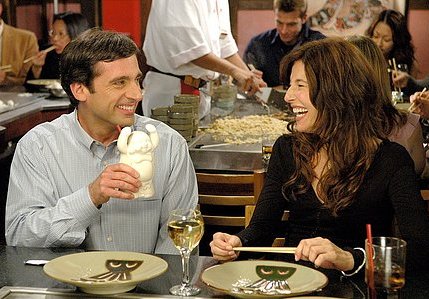
“The 40-Year-Old Virgin”—with a title and story idea like that, you would expect a dumb vulgar comedy. But you’d be wrong…because it’s actually a smart vulgar comedy with more to it than its title and idea. This is one of those comedies where you laugh loudly at many scenes, but more importantly, you feel sympathy for the main character when it goes for drama and it works. “The 40-Year-Old Virgin” is a guy movie written and directed by Judd Apatow and I was surprised by how wise, funny, and insightful this movie really is. There is so much to those standards that yes, I am giving the movie four stars.

One of the movie’s best qualities is the lead performance by Steve Carell. Carell, who also co-wrote the movie along with Apatow, plays Andy, a stockroom clerk who is forty years old and a virgin. He lives all by himself in an apartment full of action figures and video games, and he watches “Survivor” with the neighbors upstairs, although he has to bring the TV. He tried to have sex in high school and in college, but everything turned out so wrong that he just stopped trying. During his job, he has kept his virginity a secret from his ten-year-younger co-workers until they invite him to play poker one night and they share their own sex stories. Andy unintentionally gives away his secret when he says that women’s breasts feel like “bags of sand” to him. The buddies ask if he’s a virgin—he is.

So the buddies—wonderfully-played by Seth Rogen as a guy with advice such as “date drunks,” Romany Malco as a ladies’ man who seems to know his way towards women, and Paul Rudd who can’t seem to get over a breakup with his previous girlfriend—decide to work on him. All three guys have major flaws in the ways of seducing women, and they have major problems of their own, but they truly believe that they know what to do. But their plan to fix Andy with somebody special—actually, that’s a lie; they want to set him up with anybody—does not go very well. They set Andy up with wrong women, including a drunken woman (Leslie Mann, Apatow’s wife) who drives Andy home, barely making it alive and hardly making it clean. (You’ll see.) But midway through the film, Andy meets Trish (Catherine Keener), a kind woman who runs a store across the street from the mall, where she takes your stuff and sells it on eBay. She’s about Andy’s age and is probably not a virgin, but she is attractive and kind. And they start to go out on dates…

This is where the serious side of the movie takes place. How Trish coaxes Andy into asking her on a date when Andy is afraid of looking silly is surprisingly charming and well-written. This sets up their relationship through the rest of the movie, which is handled so wonderfully you forget the movie is also a comedy until Andy or the friends screw up again. The relationship between these two is sincere and very beautiful.

Steve Carell is pitch perfect in this role. He has that balance between comic and sincerity. He makes Andy a lovable main character. And he’s joined by many wonderful supporting characters, including the buddies who have brilliant comic timing, and Paula (Jane Lynch), a tall, striking woman who is Andy’s boss and gives him a tip about the term “sex buddy”—I love the scene where she sings him a Guatemalan love song without even stammering. And Catherine Keener is always fantastic one movie after another—she’s one of the best character actresses ever. Her character likes this guy; we know she’s probably going to end his virginity, but she is also very understanding.

Also, the movie has some huge laughs. One sequence in particular shows Andy getting his incredibly hairy chest waxed. That scene is hilarious and the outcome of that scene is even funnier. And then there’s a Bollywood tribute involving the four guys that had me laughing out loud. There are many other scenes like that that made me laugh—I won’t name them all to make the review funnier. In a way, this movie works both ways (quite strange for a movie called “The 40-Year-Old Virgin”). It works well as both a comedy and a romance.

Now, at almost two hours’ running time, this movie does feel a bit too long—that’s one minor criticism to this otherwise sensational comedy/romance. Judd Apatow and Steve Carell must have tried everything they could to make us laugh and cry. They succeed with flying colors. Thanks to clever writing and superior acting, “The 40-Year-Old Virgin” is a great romantic comedy. With a title like that, who would’ve thought?

Some Kind of Wonderful (1987)

14 Feb

images

Smith’s Verdict: ***

Reviewed by Tanner Smith

“Some Kind of Wonderful” is written by John Hughes and has a similar story to Hughes’ other screenplay, “Pretty in Pink.” The story itself is old, but people will see the connection from “Some Kind of Wonderful” to “Pretty in Pink” because they were both written by John Hughes and they both feature teenagers. (Both movies also have the same director—Howard Deutch.) What’s the story? A high school outcast has a crush on a more popular student, while the outcast’s best friend (of the opposite sex) has a crush on the outcast and situations follow that could or could not bring them together. You know, the protagonists in these movies never know better than to just go with the pal—see “Secret Admirer,” see “The Sure Thing,” even see “Lucas” and you’ll see what I mean.

The story follows a high school senior named Keith (Eric Stoltz), who comes from a working-class family, loves art, works at a gas station, and is an outcast at school because of all of the above. His best friend is a tomboy named Watts (Mary Stuart Masterson), who cares about two things—her drum-kit and Keith. But of course, Keith doesn’t even know about Watts’ feelings towards him, because he has a crush on Amanda Jones (Lea Thompson), the school’s rich “uptown girl.” He gets his chance to ask Amanda out on a date when her boyfriend Hardy (Craig Sheffer) cheats on her and she says yes to Keith.

Keith finds out that if he goes on his date with Amanda, then Hardy and his friends will humiliate him that same night, but Keith decides to continue with the date and hopefully find some way to teach Hardy a lesson. But on his date with Amanda, he asks himself what he should have been asking himself before. Is he interested in Amanda’s soul or just her body? In fact, that’s exactly what Amanda asks Keith on their date to an art museum, after Keith hangs up his own painting of her. And what about Watts…? This is the movie’s more intriguing concept—to ask the question of whether or not the guy deserves the girl, not merely the question of will the guy get the girl?

While all this is going on, Keith is constantly pushed by his father (John Ashton) to start applying to different colleges, so he’ll get into at least one. But Keith doesn’t want to go to college—his father never went to college, and Keith would rather devote his life to artwork. And here we have a rarity in John Hughes’ teenager movies—an adult character that is just as interesting as the teenagers. I can only remember two before “Some Kind of Wonderful”—the father characters in “Sixteen Candles” and “Pretty in Pink”—here’s another one. (The principal in “Ferris Bueller’s Day Off” was only interesting in that movie’s first half.) And it’s pleasing to see how the situation resolves—not with a shouting match, but with a civilized argument.

There are problems with “Some Kind of Wonderful”—some scenes progress slowly, and some characters are pretty standard; particularly Hardy, who’s a one-dimensional snobby, begrudging rich kid. But it’s pleasing to see Keith make friends with someone who could have been a villain—a punk kid named Duncan (Elias Koteas) whom Keith meets in detention. I suppose that’s supposed to make it OK that the rich Hardy is the villain of this movie. There’s also Keith’s incorrigible junior-high-aged sister (Maddie Corman), who, like most junior high girls, is a brat who just wants to be cool.

(By the way, the funniest scene is when the sister just flat-out SCREAMS when her father says, “Hi, honey,” outside her classroom at school. Tip for junior high school kids—if you want to be cool and not be made fun of, don’t scream in the classroom.)

The three central young actors are appealing—Eric Stoltz is dim but likable as Keith, and Lea Thompson isn’t the snob that Amanda could have been. But my favorite is Mary Stuart Masterson as Watts. As a tough tomboy, she’s a lot of fun, though she has a tough exterior but a soft interior. She’s dedicated to the things she cares about. She even volunteers to chauffer Keith and Amanda around on their date—it’s weird, but kind of sweet. And who could forget the look in her eyes when she sees the other two together? There are a lot of scenes in which Masterson must feel one way about something while pretending to feel another way, and she’s a fully capable actress.

“Some Kind of Wonderful” is an improved version of “Pretty in Pink,” which was too full of itself, in my opinion. “Some Kind of Wonderful,” for it’s faults, actually takes more chances for us to like the characters and has an ending that is near perfect for the movie. It’s a movie about insecure teenagers making smart and dumb decisions and dealing with rejection and acceptance. It’s a nice movie.

Children of a Lesser God (1986)

14 Feb

6a00d8341c5d8753ef0120a8ac9371970b-800wi

Smith’s Verdict: ****

Reviewed by Tanner Smith

When someone going to the movies sees a title like “Children of a Lesser God” on the marquee, I imagine just looking at the title turns them off, not knowing at all what the movie is about. And I’d be lying if I said I wouldn’t feel the same way—I did feel the same way having heard the title a few times, not knowing what the film was about. Thankfully, after watching a vintage 1986 “Siskel & Ebert” two-thumbs-up review of the film, I was interested in what they were saying about the film so I was actually interested in the film itself.

“Children of a Lesser God”—how pretentious of a title could you get? That may seem like a downer title for a film, but the truth is, the actual film itself is a true delight.

“Children of a Lesser God” is a love story, and a wonderful one at that. It’s the story of a relationship that develops between a young woman who is deaf and a teacher determined to bring her out of her shell. Along the way, the teacher learns about love and about accepting his lover’s needs.

William Hurt plays the teacher, named James Leeds. He has an impressive resume and is welcome to teach at a school for the deaf, where he’ll teach his students to read lips and speak without using sign language. His methods are somewhat unusual but very effective, like, for example, when he stands on his head and can’t use his hands for sign language so he must speak, or when he uses timing and rhythms to teach music to the students.

On his first day at the school, a beautiful woman Sarah (Marlee Matlin) catches his eye. Sarah works at the school as a janitor, is very bright but also very stubborn, and is completely deaf. He wants to know more about her, and arranges for her to meet with him so he can teach her to speak. But Sarah couldn’t be less interested—she doesn’t believe she needs to learn how to speak. She’s accustomed to being deaf and using sign language all her life and doesn’t feel like she needs to belong in a hearing world. This brings more determination from James to bring Sarah out of her shell, but he also finds himself more and more attracted to her. “You’re the most mysterious, beautiful, angry woman I’ve ever met,” he finally tells her.

James and Sarah do go out on a date together and that leads to trust and respect for each other’s company, but the tension and determination is still there for James and he knows that Sarah will never break. But if she could have a meaningful relationship, would it matter?

A love story, especially one as complicated as this one, wouldn’t work unless there was chemistry amongst the leads. William Hurt and Marlee Matlin play characters who are constantly in a battle of wits, but mostly attracted to each other because of their own qualities. Hurt and Matlin work great together—they’re comfortable with each other and you can feel their chemistry on screen as their relationship continues.

The writing of “Children of a Lesser God” is just fabulous. There are many great moments in the story—not just with the relationship between James and Sarah, but with James and his students. The first scenes in which he teaches them to speak are freshly well-handled. There’s also a scene midway through the film in which they dance and sing to a pop song on Parent’s Day.

My favorite scene in the film comes after a loud party at James’ apartment with James’ students. When everything is finally quiet, James tells Sarah that he’s going to rest his hands and his eyes and just listen to 20 minutes of Bach. He says he hasn’t been able to listen to Bach since Sarah moved into his home, Sarah thinks he blames her, James says otherwise, Sarah says to go ahead, James turns on the music and listens for a moment…he can’t enjoy it. He sees Sarah sitting at a table, staring off into space and waiting. That’s when James thinks, how can he enjoy it if Sarah can’t enjoy it? And then Sarah asks him to “show” him the music like she “shows” him the sound of the ocean waves. He can’t do it. That’s a beautifully-written, wonderfully-acted scene that pretty much states the purpose of the entire relationship—if he truly loves her, he must welcome himself into her world of silence.

William Hurt has been good in movies before, mainly because he acts in roles that are written within his limitations—he’s not terribly exciting or expressive, but he’s mostly charismatic. This is his first role after his flamboyant Oscar-winning performance in “Kiss of the Spider Woman” and in an arguably more demanding role, he’s just fine. Marlee Matlin, who really is deaf, has the more complicated role—using facial expressions, body language, and sign language to get her point across. In a silent role, she owns the screen. She’s beautiful, forceful, haunting, and all-around brilliant as Sarah—it’s an excellent performance. And like I said, both Hurt and Matlin have great chemistry together, and I cared very much about their characters. Another good performance comes from Piper Laurie as Sarah’s mother, who hasn’t seen her daughter in quite a long time and regrets that.

When all is said and done, James realizes that he should become part of Sarah’s world if they are together in love and learns a thing or two about respect for deafness and about respect for his lover. “Children of a Lesser God” is a wonderful love story with clever storytelling, great acting, and a subject that really should be taken into consideration. And don’t let that downer title fool you—“Children of a Lesser God” is great.

(500) Days of Summer (2009)

14 Feb

500_days_of_summer_2

Smith’s Verdict: ****

Reviewed by Tanner Smith

“(500) Days of Summer” is the best romantic comedy to come around in a long, long time. There were many terrible ones and a few mediocre ones, though there have been a few fair ones, but none as fantastic as this one. I’d even put this in a class with Woody Allen’s “Annie Hall” and that’s a pretty highly-regarded class indeed. It’s a romantic comedy for those who normally don’t go to romantic comedies because there were so many bad ones. You know it’s different from the hilarious disclaimer at the beginning, which states it isn’t based on anybody in particular. (“Especially you Jenny Beckman. Bitch.”)

But the situations that ensue in this story of boy-meets-girl feel like they’ve happened to you. Even if they haven’t, you still feel the reality of the situation. This is a romantic comedy that doesn’t result to cheap ploys such as sappy overhanded drama or ineffective, unfunny gross-out gags. The comedy comes from the realism, which is portrayed in a pleasant but unforced fashion.

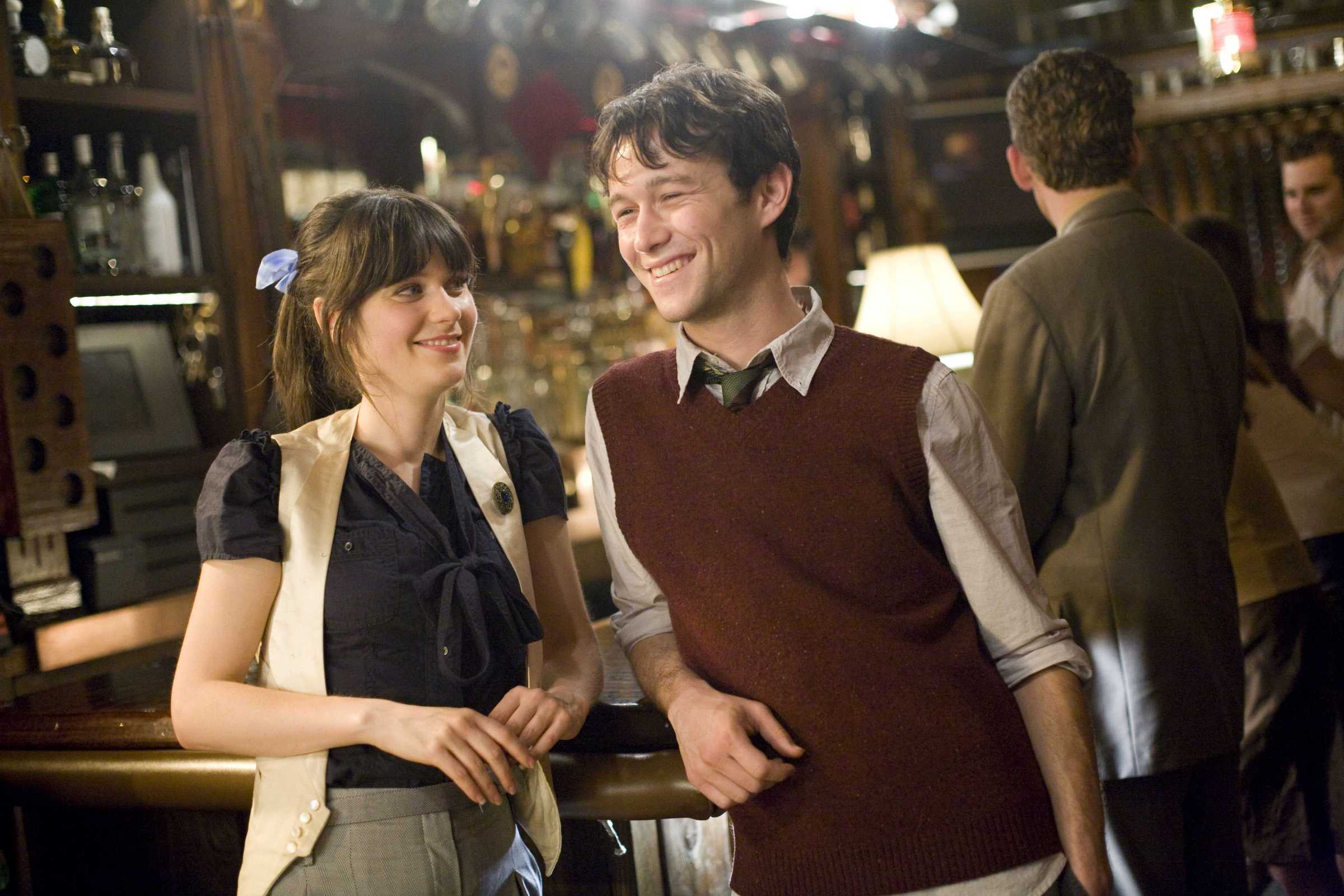
The film chronicles the 500 days surrounding the romance between Tom (Joseph Gordon-Levitt) and Summer (Zooey Deschanel)—from their first glances to their final goodbyes. Everything in between is complicated enough, that Tom would rather remember the good times of the relationship than the bad. Wouldn’t we all, though? The story is told in a non-linear fashion, with a segue that ensures us of which day we’re in. Now, we already know that things aren’t going to turn out well between Tom and Summer, but it’s fun to see the events play themselves out.

Tom is a hopeless romantic who believes he’ll never find true love until he meets “the one.” Who is “the one?” Tom believes it is Summer, a realist who doesn’t necessarily believe in the idea of love. Despite this, Summer likes Tom and wants them to be friends. They hang out together, fool around together, and eventually, they start a potential boyfriend/girlfriend relationship. But will it last? Reality takes its toll, unfortunately.

“(500) Days of Summer” doesn’t result in ridiculous clichés to tell the story of this relationship. There are no silly misunderstandings where the characters think they hate each other and they mope until they realize they do. There are no stupid bullies—like an ex-boyfriend—trying to keep the lovebirds apart. Heck, Tom and Summer aren’t even necessarily “lovebirds.” Tom is the one head-over-heels in love with Summer, and it’s Summer that isn’t so sure about the idea of being someone’s romantic partner.

Instead, we have genuine chemistry between Joseph Gordon-Levitt and Zooey Deschanel, who are both excellent in their roles. Gordon-Levitt, in particular, has the same starmaking ability that made Tom Hanks a household name. I really think he’s that good. It’s his character’s story that’s being told throughout “(500) Days of Summer”—he’s likeable and convincing all the way through. And Deschanel is the kind of fun, free-spirited, attractive woman that we all wish we could meet.

Supporting roles consist of Tom’s wisecracking buddies played by the appealing Matthew Gray Gubler and Geoffrey Arend who have a lot of fun with these obligatory roles; Tom’s surprisingly-insightful younger sister, nicely played by Chloe Grace Moretz; and Tom’s boss, played by Clark Gregg. They all have their fine, funny moments here.

There’s a lot of offbeat humor throughout “(500) Days of Summer,” most of which comes from Tom as the unreliable narrator—we get many sequences that play with whimsy and perception. For example, after Tom and Summer finally have intercourse, we get a bright musical number—a song-and-dance sequence set to Hall and Oates’ “You Make My Dreams Come True.” Everyone is politely nodding/greeting and then they all join Tom as he dances with joy. This is complete with a marching band and an animated bird.

And how about the sequence shown in split-screen, differing “expectations” from “reality?” How often have we been down this road? We expect one thing—one great thing to occur the whole evening—when we wind up with something totally different than we wanted. This is my favorite scene because I can relate to it. It’s a very satisfying scene.

This humor shows that this isn’t one of those gritty indie films that try to make it feel like we’re eavesdropping on the characters. We know we’re seeing a story unfold.

“(500) Days of Summer” is as far from formulaic as you can get, and that’s one of the many reasons I loved it so much. There’s a lot to love in this movie. Aside from the perfect casting, authentic chemistry between the two leads, and a great deal of funny offbeat comedy, there are little things to acknowledge as well—the soundtrack (particularly the Smiths, which Tom likes to listen to), the whole deal with the greeting card company’s creativity or lack thereof, Tom and Summer’s attempt at copying a porno film, the satire of a sad French film when things start to go wrong for Tom and Summer, I could go on and on. Many pleasantries can be found in this wonderful, wonderful movie.

The Secret World of Arrietty (2012)

13 Feb

The-Secret-World-of-Arrietty-image-6

Smith’s Verdict: ****

Reviewed by Tanner Smith

Ever since I was a child, I was a fan of the stories involving the Borrowers—the little people who live in the walls or under the floors of your house. There was a series of books written by Mary Norton that made them popular, as well as a few film adaptations—including two 3-hour British TV specials and an entertaining 1998 update on the story. And I just love the idea of this secret world that would be In jeopardy if it was found out by human beings (or as the Borrowers call them, “beans”), so when I heard that Studio Ghibli was making a new adaptation (yes, with the great Hayao Miyazaki one of the people behind the production), I was hyped. The child in me was curious and the critic in me was interested in how this new version would turn out. I can now say that this film—entitled “The Secret World of Arrietty”—is the best representation of the Borrowers that I’ve ever seen.

Miyazaki’s company Studio Ghibli has delivered some of the best-looking animated features anybody has ever seen. The visuals stand out as mesmerizing and serve the stories well—see “Princess Mononoke,” for example. There’s such a distinct look and feel to the animation in each of these films and each detail is given special attention. I’ve said the same thing about PIXAR’s computer animation, but that doesn’t make this any less of a compliment, except that the animation is hand-drawn (with occasionally computer help) and thus more complicated than you might think.

One great example of this look in “The Secret World of Arrietty” is the scene in which the three-inch adult Borrower named Pod (voiced by Will Arnett for the US dubbing) takes his 14-year-old daughter Arrietty (Bridgit Mendler) on her first trip into the house they live under. Their first stop is the kitchen—with the kitchen being so huge from their point of view, it makes for a threatening environment. Another example is the outside yard of the house, where Arrietty spends a lot of her time. Look at the leaves and the plants next to her as she walks/runs. It looks like another world when it’s really our own.

The story of “The Secret World of Arrietty” is mostly the same as the first “Borrowers” book and has the same basic idea. There is a family of three Borrowers secretly living within a house in the middle of the forest—Pod, his wife Homily (Amy Poehler), and their daughter Arrietty. They have their own home underneath the floorboards and when the “beans” aren’t around, they sneak into the house to “borrow” the essential needs of survival—mind you, it’s never borrowing; it’s stealing, but it wouldn’t make them look good if they were known as the Thieves, right? This family is seemingly the only family of Borrowers in the house. In the old days, there used to be more families until they were discovered by beans and had to move away (it’s also hinted at that others were squashed by the beans). Life is a danger for Borrowers and there’s always a high risk, which is why they have to be extra-careful not to be discovered while they go on their occasional “borrowings.”

The characterizations are direct. Arrietty, just turning 14 years old, is tenacious and courageous. She uses her size as an adventure and delights in discovering more about the world outside her own. Her father Pod, kind of a three-inch Indiana Jones type, is more surly with age. He has had too much adventure in his life and is probably getting too old to borrow. But that doesn’t stop him from smiling when Arrietty fights off a bug (to her, it’s about the size of a canine)—“That’s my girl,” he declares to himself. Homily, however, is a nervous wreck, all the time—always worrying, screaming, shrieking, trembling, nervously rambling on and on, etc.

On Arrietty’s first borrowing in which she “borrows” a sugar cube, she is seen by a sickly human boy named Shawn (David Henrie) and drops the cube. But Shawn doesn’t pose as a threat and kindly leaves the sugar cube next to where he thinks these little people live, with a note saying, “You forgot something.” This increases Arrietty’s curiosity of the outside world and starts to wonder if not all beans are dangerous. But Pod makes it very clear that once Borrowers are seen, they must move away to make sure it doesn’t happen again and that their world is never discovered. Despite this, Arrietty and Shawn do meet each other and form a friendship. However, once the housekeeper Hara (Carol Burnett) notices strange things happening around the house lately, that’s when the Borrowers’ secret does indeed turn to jeopardy.

The elements that made the Borrowers special are present here—the Borrowers sneaking around avoiding being caught, the interaction and friendship between a Borrower and a bean, and the world that the Borrowers created. There’s a lot of tension in the scenes where they go outside, hoping they aren’t seen by beans. There’s a great, tense scene in the middle in which a crow attacks little Arrietty and Shawn must rescue her. And of course, there’s the cat that sometimes chases her around (you can tell Arrietty is faster and used to it—the cat just misses her and she smiles and waves while taunting, “Nice try”). There are a lot of things that are updated from the original story. For one thing, we see more detail in how these Borrowers move around, instead of just climbing or rappelling down a rope tied to a fishhook. Early on, for example, we see that in order to climb something like a cabinet, they use double-sided tape on their hands and feet to scale it. That’s a very clever bit. There’s also a neat invention with sewing thread and a weight that works as an elevator. The biggest difference from the original book to this film is that there is no climax involving the exterminators threatening to destroy the Borrowers’ home, but I didn’t miss it. What they went with, with Hara capturing Homily and Arrietty and Shawn having to find a way to rescue her, is good enough. I was actually glad that they didn’t have to succumb to a basic action climax, and very surprised too, considering that studios love to end family films in that way. But instead, we have a thoughtful climax and a moving ending that opens more for curiosity. Also, the complex issues present in the book like friendship, bravery, and settling are all present and very effective.

The growing friendship between Arrietty and Shawn is well-handled. It takes a while for Arrietty to finally trust Shawn and go visit him, adding more to the discovery of the outside world and the new curiosity that she has surrounded herself with. When it gets there, though, it’s very touching and she even gives this boy who’s twelve times her size helpful advice about being brave when he reveals that he needs an operation for his heart.

Each character is memorable. In particular, Arrietty is a fun character, Pod is an interesting figure, and there’s another Borrower that they meet later in the movie—a wild-boy Borrower named Spiller (Moises Arias) who tells the family of more Borrowers out in the forest. The voiceover work is nicely done. Bridgit Mendler, of Disney Channel’s “Good Luck Charlie,” brings a fresh friendliness to the role of Arrietty. Will Arnett is suitably rogue as Pod. David Henrie is just OK as the boy—sometimes a line of dialogue rings false, but his speech about the character’s illness is actually heartbreaking. Amy Poehler, voicing Homily, is an absolute hoot—she’s very funny in the way she quickly delivers the nervousness in the scenes in which she’s panicking for her family and especially when she is seen and trapped by the housekeeper. Speaking of which, Carol Burnett as the housekeeper Hara is a lot of fun as well. The way she’s drawn is funny enough (looking more like E.T.’s grandmother), but with Carol Burnett adding several “Hmm’s” to each confused facial expression, it’s downright hilarious.

“The Secret World of Arrietty” is a wonderful movie for people of all ages. It’s obviously marketed at children, but adults will most likely enjoy it as well. Even if some children won’t appreciate the complexity of many of the moments in this movie, they at least deserve to choose whether or not they’ll accept them, especially considering the fast-moving, action-packed movies that they watch. Should they decide to watch something a little quieter, “The Secret World of Arrietty” is the movie for them.

The Hunger Games (2012)

13 Feb

images

Smith’s Verdict: ***1/2

Reviewed by Tanner Smith

So imagine this—sometime in the distant future, the nation of Panem has grown from the remains of what used to be North America. A new world order has been arranged, as Panem is divided into 12 districts surrounding the powerful central Capitol. After a failed rebellion with a 13th district, there was a peace settlement that comes with a raffle (known as a “Reaping”) that forces the other districts to participate in the death match known as the “Hunger Games.” Every year, two “tributes” are chosen from each district. The tributes are a young man and young woman in the age range of 12 to 18 who compete against the other tributes (and each other) in a gladiatorial battle for the biggest televised event in the nation. The only way to win is to survive.

That’s the main plot element to “The Hunger Games,” a post-apocalyptic action-thriller based on the popular novel of the same name by Suzanne Collins.

The “Hunger Games” book series is probably the most popular book series out nowadays. The teens are drawn in and adults take notice as well. So it should come as no surprise that when a film adaptation of the first book is announced, a huge amount of hype is garnered. But does the movie lead up to its hype?

The answer is yes. “The Hunger Games” is an intense, entertaining action-thriller that remains faithful to its source material. Fans will be happy, and I think those who aren’t familiar with the books are going to be drawn in as well.

The heroine of the story is 16-year-old Katniss Everdeen (Jennifer Lawrence) from District 12. She’s a strong young woman who cares for her mother and younger sister Prim (Willow Shields). She also has experience in hunting and is a darn good shot with a bow and arrow, as she illegally hunts for food outside the boundaries with her best friend Gale (Liam Hemsworth).

The 75th annual Hunger Games are approaching and the Reaping begins as the movie does. But the female tribute turns out to be Prim, and so Katniss volunteers to take her place in order to save her. The male tribute is Peeta Mellark (Josh Hutcherson), a baker’s son who is very strong, but also gentle. Katniss and Peeta are escorted to the Capitol and advised by impressionist Effie Trinket (Elizabeth Banks, sporting a ridiculous amount of makeup), former champion (now bitter drunk) Haymitch (Woody Harrelson), and stylist Cinna (Lenny Kravitz) to prepare for the Games.

The 24 tributes train in preparation, are evaluated for odds by viewers of the televised show, and are interviewed by the blue-haired on-air commentator (Stanley Tucci) to win support from the public before the big event. Katniss gains the most odds with her showmanship and confidence, but for Peeta to enhance his own image, he announces in his TV interview that he has had a crush on Katniss, letting the “star-crossed lover” angle win both of them admiration from the public. However, as it turns out, Peeta was honest in his statement and Katniss does develop a genuine interest in him. But this comes as a problem, since he must die in order for her to win.

The movie has a running time of two hours and twenty-four minutes. It takes an hour and ten minutes, more or less, to set up the Hunger Games and introduce the characters. Once the actual Games, set inside a giant outdoor arena, are underway, you realize how much is at stake by this point. I admire that the movie takes its time to set up the action before it happens and the entire second half is intense, brutal, and thrilling. It involves Katniss relying on her wits and her skills to survive her competitive, bloodthirsty peers, including the fearsome Cato (Alexander Ludwig) and the knife-throwing Clove (Isabelle Fuhrman).

I should add that despite the ages of these young people competing in the Hunger Games, there is a lot of violence and plenty of gore, pushing the boundaries of the PG-13 rating. The way it starts is particularly cruel, as a bloodbath ensues before some of the tributes have a chance to get their supplies. This is not a film for young children.

This is a shocking development for entertainment—young people killing each other as hidden cameras are placed in the trees to show it—and it seems like the people watching really get a kick out of the violent nature of it. And the fact that these 24 competitors are in the age range of 12 to 18 is scary enough to think about. But the fact that this new world order is forcing them all to accept it for their own good makes it all the more effective. And the villains of the movie—the gamemaker Seneca Crane (Wes Bentley) and snarling President Snow (Donald Sutherland)—are ruthless enough to show exactly where these people stand. They even force obstacles upon Katniss and Peeta to make sure nothing comes easy, even setting their part of the forest ablaze. This movie is a great mix of action-violence and social commentary. Is this what mankind could succumb to when things go very wrong for us?

The original novel of “The Hunger Games” is mainly popular because of its protagonist Katniss Everdeen, and for good reason—she’s an interesting, compelling heroine to follow. She fends for herself, but also cares for those who need (and deserve) her help. She knows how to hunt and survive, but isn’t a bloodthirsty monster. In the movie, she’s brought to life by who is probably my favorite young actress working today—Jennifer Lawrence. Lawrence is absolutely perfect for the role and delivers an excellent performance, giving the right blend of strength and vulnerability for the character. She’s in almost every shot of this two-and-a-half-hour movie—she’s captivating to watch throughout. And I’m going to just say it—even though I respect the other actresses who auditioned for Katniss (including Shailene Woodley and Saoirse Ronan), I couldn’t imagine anyone else other than Jennifer Lawrence to portray the role. Or maybe she’s just that good.

The supporting cast does a nice job—I especially liked Woody Harrelson and Lenny Kravitz in their roles, and the constantly working yet mostly-underrated young actor Josh Hutcherson (in his fifth book-to-film-adaptation, I believe) is solid and likable as Peeta.

“The Hunger Games” was directed and co-written by an unlikely source—Gary Ross, the co-creator of pleasant comedy-dramas like “Big” and “Pleasantville.” As much as I respect Ross, I wouldn’t have expected him to handle the violence of the actual Hunger Games event so effectively. But the truth of the matter is that he’s fully capable of keeping us involved. I have to admit I thought he was relying too much on the “shaky cam” gimmick in the first half of the movie, but as with the “Bourne” movies, once the action kicks in, it adds to the intensity and brutality of the action scenes. Even before the action, there are plenty of quiet moments to be invested in—in particular, the scenes with Katniss saying goodbye to her family and Gale, and Peeta’s talk with Katniss about how he’s not just a pawn in the Games. Credit for keeping the audience involved should also go to the actors, but also to the other two writers of the screenplay—Billy Ray, writer of “Shattered Glass,” and Suzanne Collins, the author of the original source material this movie is based upon.

Having read the book, I was less concerned about story changes (of which there are little to none) and more concerned about how the violence of the Hunger Games would be handled. But the truth is that “The Hunger Games” is very well-done—the Games are gripping, the action is intense, the parable aspect is clear (subtly, but still there), and we have a compelling character played by a fully capable actress.

I look forward to the film adaptations of the other two books in the series, although this movie works well as a stand-alone movie.