Archive by Author

Stephen King’s It (1990) (TV)

27 Feb

Send_in_the_Creepy_Clowns_Just_in_time_for_Halloween_a_gallery_of_13_scary_clowns

Smith’s Verdict: ** (Part 1: *** – Part 2: *1/2)

Reviewed by Tanner Smith

I make it almost a rule not to review made-for-TV movies, let alone TV miniseries’. But the three-hour TV miniseries “It,” adapted from Stephen King’s best-selling 1986 novel, has become so popular (for good and bad reasons that I shouldn’t go into) that I decided to give it a shot. It’s hard to review a movie like this, especially when it is split into two parts and one part is far more interesting than the other. But here’s my shot at it.

In part one of the miniseries, events are being set to take place in apparently part two. “It” begins with Mike Hanlon (a quite effective Tim Reid), the librarian of a small town in Maine called Derry (notice that a lot of Stephen King’s stories take place in Maine), who is at the crime scene of the murder of a little girl. Apparently, this is not the first child murder or disappearance. Mike knows that something is terribly wrong and comes to a conclusion. What is it? We have to wait and see.

Mike spends Part 1 of the story calling his childhood friends, telling them to come back to Derry and explaining “It’s back.” They know what he means. With each friend Mike calls, we experience different flashbacks that seem to be in chronological order. The flashbacks tell the story of the “Lucky Seven”—seven young outcasts who become best friends and stick by each other. There’s Bill (Jonathan Brandis); Ben (Brandon Crane); Eddie (Adam Faraizl); Richie (Seth Green); Stan (Ben Heller); Beverly (Emily Perkins); and Mike (Marlon Taylor), who is the last to join the club after the other kids save him from a sadistic bully named Henry Bowers (Jarred Blancard). All seven of these kids keep to themselves in the barren areas of town, building a dam. These scenes are intersected with scenes in the future as each friend (grown up to become successful individually—for example, Bill is a best-selling author) remembers their experience with the “it” that Mike refers to when he calls.

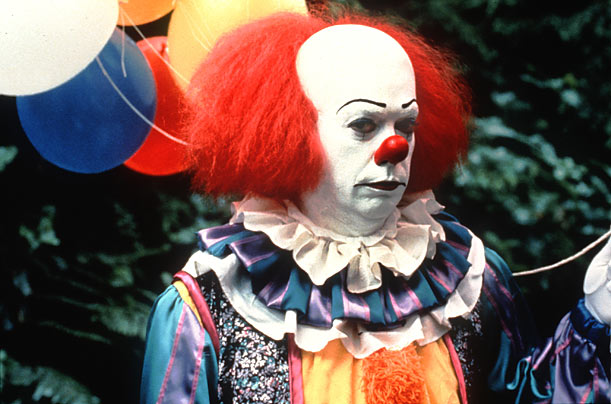
Who or what is “it?” Well, It is a clown named Pennywise (played by Tim Curry)…or is it? You see, Pennywise kills kids after either using his image to fool them or taking the shapes of their fears. Pennywise is some kind of creature that reads minds and becomes your fears before it eats you. And only children can see it, and not adults. Why? (“You grow up,” young Bill says. “You stop believing.”) Each of the seven kids is silent about their own experiences with “it,” which scares them like a cat-and-mouse game, until it finally frightens them all at once. They realize that they have to stop it, so they venture into the sewer tunnels to kill it.

This first part of the “It” miniseries is very interesting in the way it draws you into the story. The kids are all very good actors, especially Brandon Crane who avoids the “fat kid” stereotype as the overweight, sensitive Ben. And their characters are interesting as well. Also, Tim Curry, as the clown, plays it so over-the-top that it’s almost funny when being frightening at the same time. It’s unnerving just to think about a clown coming after these kids. Tim Curry is great as Pennywise. And also, the scenes in the tunnel in which the kids are finally faced with Pennywise is interesting because it’s fun to see them come together and confront their fears. Is it a great climax? Well, no. But this is more about feeling than about gimmick.

This brings us to Part 2, in which all of the adult versions of the Lucky Seven reunite in Derry Maine—Bill is played by Richard Thomas, Ben is John Ritter, Eddie is Dennis Christopher, Richie is Harry Anderson, Stan is Richard Masur, and Beverly is Annette O’Toole. They have forgotten most of their experiences with Pennywise and became successful, but when Mike calls them back saying it’s come back, they have new experiences that make them remember. This is fine, but we also get a series of ludicrous back stories that really slow the movie down. These back stories take a long time to be explained and the viewer is left shaking his or her head. And then when it tries again for horror (like when Pennywise comes back every now and then), it’s just dull instead of frightening. Also, the characters that were compelling as children have become dullards this time around. It doesn’t help that half of these adult actors are badly miscast. And then when the apparent final climax arrives, it’s just silly, silly, silly. It also has one of the worst creature effects in the history of TV movies.

You’d think that with a strong first half, you’d have a second half to be just as strong, especially when the running time is 192 minutes. But “It” doesn’t succeed. The first half (with maybe only the flashbacks) could have made a whole movie and I would’ve recommended it as a whole—I liked the kids, Tim Curry was fun, and there were a couple scenes that scared me, believe it or not (like the scene in which young Bill mourns the death of his kid brother and something creepy happens). But the second half is bogged down to horror clichés, dull plotlines, horrible special effects, and melodrama. Not even the presence of reliable actors Tim Reid and John Ritter could help.

So in conclusion, “It” is a mixed bag—strong first half, insipid second half. I have not read the novel so I can’t quite make comparisons to that. But there are a lot of Stephen King book-to-film adaptations that hardly capture the flavor of King’s stories (examples are “Cujo” and “Children of the Corn”). This is one of those adaptations, although I guess I should be kind enough to say that this is in the same league as “Cujo” and better than “Children of the Corn.” Oh, and don’t get me started on “Pet Sematary.” That’s a review all its own.

Jack’s Back (1988)

27 Feb

et_jacks_back_james_spader

Smith’s Verdict: ***

Reviewed by Tanner Smith

Warning: Possible Spoiler Alert

1988—a century since the serial murders committed by Jack the Ripper. This time around, someone is repeating those same murders—a copycat killer. It doesn’t really help that the obvious killer’s name seems to be “Jack.” If that premise sounds like it’d never work as a film, “Jack’s Back” is surprisingly effective in never giving us the obvious, expected elements. This is a gripping thriller—not an exploitation film.

The poster and trailer don’t make “Jack’s Back” seem as interesting as it is. The poster, in particular, has this tagline: “One hundred years ago, in the city of London, a man shocked the world by raping, murdering, and mutilating women…He was never caught.” The marketing for this movie must have thought we were dumb. It’s an insult to movie audiences’ intelligence.

James Spader stars in “Jack’s Back” as two characters—twin brothers who are linked to these new murders. One brother is a medical student named John and the other is a rebel named Rick who runs a shoe store and has been in trouble with the law in the past. (This may be a spoiler, since we don’t find out until the first half-hour that there is another brother.) It’s interesting how Spader creates two different personalities.

John discovers one of the murderer’s victims and Rick is a prime suspect. How could they think Rick is a suspect instead of John? Well…(possible spoiler alert) John is killed a half-hour into the film. This is after John discovers of the murderer’s victims. John was seen leaving the room while chasing after the possible murderer named Jack. Since John and Rick are twins, Rick is suspected for the murders.

And so as the movie’s second half comes into place, Rick is chased by the police and races to clear his name. To his aid is a possible love interest—an attractive medical student named Christine, played by Cynthia Gibb. But she may be the killer’s new target.

“Jack’s Back” does a great deal in interesting us with his many plot gimmicks (there’s an unexpected surprise in the plot every ten or twenty minutes) and the idea of someone copying the Jack the Ripper murders is creepy on its own. And then there’s the ending, which I wouldn’t dare give away. (No spoilers beyond the half-hour mark of the film will be exposed here!) This is a hard move to make for a thriller and it doesn’t do a great job, but a good one. What really makes this movie worth watching, aside from the interesting plot gimmicks, is the performance by James Spader. He’s a great actor who makes his twin-brother characters seem extremely different. And because he plays two good guys, this doesn’t mean he has to be dull or boring. For example, John (who is supposedly the better one of the two brothers) has his share of one-liners and kidding charisma—he’s not the stuck-up, serious medical student you’d expect. And with Rick, he’s not the delinquent we’d expect him to be. He’s just a good guy who gets into trouble at times because he can’t help himself at times. But when he rises to the occasion, we do like him. James Spader is fantastic in this movie.

Cynthia Gibb is also good as the love interest. Her timing with Spader is very effective. Both Spader and Gibb play three-dimensional characters who don’t dumb down their roles. That’s a very tricky performance for one, let along two, in a movie that is a thriller.

“Jack’s Back” is a thriller through and through. What’s surprising is that most of the time, it’s not as routine as we’d expect. I enjoyed “Jack’s Back”—I enjoyed the performances from Spader and Gibb and the contrivances of the plot.

Rocky II (1979)

27 Feb

z2l

Smith’s Verdict: ***1/2

Reviewed by Tanner Smith

Here is a sequel that works—one that delivers the goods and doesn’t deliver just the same material that you’ve seen in the original. This is the sequel to the Oscar-winning film “Rocky,” which starred (and was written by) Sylvester Stallone in a knockout performance as the boxer Rocky Balboa who also has a life aside from fighting. In that movie, what made the movie really special was that great leading performance, as well as the supporting performances of truly original characters. Now, here’s “Rocky II”—the characters are back and just as fresh as they were before. “Rocky II” probably isn’t as great as the original film (I gave that four stars), but it’s still an effective movie.

Sylvester Stallone directs and writes this sequel, and reprises his leading role again. Rocky Balboa is a true original—his personality and his actions are unlike any other movie character that came before. He talks street-smart and ends a lot of his sentences with “ya know,” and he’s really a nice guy. He also has a sense of humor in the way that sometimes, he doesn’t know he’s funny. And when he fights in the boxing ring, it’s just something he feels like doing for a hobby. He’s not a bad guy at all. Stallone lives and breathes this character and makes him just as lovable as he was in the original “Rocky.”

“Rocky II” picks up where the original film left off. If you recall, in the original film, Rocky Balboa (“The Italian Stallion”) had the chance to fight the heavyweight-boxing champion Apollo Creed (Carl Weathers). If you don’t recall, the last scene of the original film is played as the opening scene of this film. Rocky doesn’t win the fight—in fact, he barely survives it. His intensity, and willingness to keep going, had people cheering for him. Those qualities also got his girlfriend Adrian (Talia Shire) to say, “I love you.”

In “Rocky II,” Apollo is very disappointed in everyone’s praises for Rocky that he demands a rematch. But Rocky is more interested in raising a family. He and Adrian wind up married and Adrian winds up pregnant. Rocky isn’t regretful of any of this—he is excited about it. He wonders what the kid will be like, if it’s a boy or a girl.

Rocky also has to get a job to support Adrian and his child, not born yet. Being the “Italian Stallion” who refused to go down in the fight with Apollo, Rocky has an opportunity to star in many commercials and get paid big bucks. Unfortunately, he has a bit of trouble reading. There is a great comic scene in which he reads off the cue cards in deadpan—he’s not messing with the director; he’s just sincerely screwing up.

But Apollo, being the pompous man that he is, demands a rematch. He goes out of his way to humiliate Rocky to the point where Rocky has to accept. This leads to more training with Mickey (Burgess Meredith), the gym owner who trained Rocky in the original film. This also leads to more support from Adrian and her mildly-annoying (but mostly funny) brother Paulie (Burt Young), who is still loyal but somewhat bitter; however, there is a scene in which he is more resentful, but I will not give away why.

The characters are given room to grow and they make up for the probability that the film is not particularly well-shot. Though to Stallone’s credit, he’s trying. There are some great lines of dialogue (some written by Stallone, the others improvised by him) and moments of humor and touching sadness. They, along with the characters (especially Rocky), make “Rocky II” a worthy sequel.

The Mummy (1999)

27 Feb

images

Smith’s Verdict: ***

Reviewed by Tanner Smith

“The Mummy” is a special-effects action movie that is not by any means a great piece of work, hardly anywhere in the same league as “Raiders of the Lost Ark.” It’s trash, yes, but it is good trash that entertained me from start to finish. I had a good time with this silly action flick.

Actually, beneath the action/adventure elements, there is a great deal of comedy—so much that you have to wonder if the filmmakers were intending on creating a parody of these action-adventure stories. To take “The Mummy” seriously would be as ridiculous as anything the story has to offer. As a thriller, it doesn’t work. As a campy, special-effects filled, funny action movie, “The Mummy” does work. I wasn’t bored in the two hours of the film’s running time. I was very entertained.

The film begins with a flashback to (“insert year here”) BC with heavy-handed narration from a very deep voice within scenes that explain the back story to us. We all love it when that happens, don’t we? We also love it when the narrator informs us that a mummy will rise.

Then we flash forward to many centuries later to the early 1920s in Cairo. A clumsy British librarian named Evelyn (Rachel Weisz) and her immature, pickpocketing brother Jonathan (John Hannah) have found a map that leads to the lost city of Hamunaptra in Egypt, also known as “The Land of the Dead” (whoa, not a good sign). Joined by American adventurer Rick O’Connell (Brendan Fraser), they decide to take a trip down there to retrieve a lost treasure within its tombs. But also racing to retrieve the treasure is a band of American fortune hunters, led by a nervous traitor named Beny (annoyingly played by Kevin J. O’Connor with a less-than-convincing Arabic accent). Threatening to kill both teams to protect the treasure is a band of black-robed horsemen.

While down there, Rick, Evelyn, and Jonathan come across an ancient sarcophagus and a book known as the “Book of the Dead.” (Uh-oh.) And wouldn’t you know it? They open the book, unleashing the ten plagues of Egypt, although I only counted less than 10 that actually happen in this movie—I’ve seen fireballs, locusts, blood flowing in rivers, earthquakes, and flies. There are also many, many flesh-eating beetles, although I’m unsure if they’re part of the plagues or if they just live in the caves. Also unleashed from the grave is the mummy Prince Imhotep, which starts out as a disgusting skeleton, but can reproduce organs just by taking them from the rival American team. Once he is complete, he will raise his dead girlfriend and rule the world. Of course Evelyn is captured by the mummy, which causes Rick to set out and “save the girlfriend, kill the bad guy, and save the world.”

All of this is good dumb fun. As I mentioned above, there is also a great deal of comedy within the action/adventure stuff. One of the best moments is at the beginning, in which we get a glimpse of Evelyn’s clumsiness—she accidentally knocks over a bookshelf and the rest of the shelves come crashing down, much like the domino effect. Another funny bit is when she hears a strange noise in the museum: “Abdul? Mohammed? Bob?” There are many other funny moments like those; I won’t give away all of them. There is also a heavy amount of action that didn’t bore me, mainly because we have a likable hero in this series of battles with mummies, most of which are comical. Brendan Fraser plays Rick as a low-rent Indiana Jones and he has fun with the character and performance. Also fun to watch is Rachel Weisz as his could-be girlfriend—she projects a great deal of comedic timing.

The special effects work very well. That really does look like a decomposing mummy threatening to kill the main characters and conquer the world. But a flaw in “The Mummy” is that it seems like a half-hour too long. “Men in Black,” which also featured special effects and a comic undertone, featured the best it could with a half-hour too short of running time. But “The Mummy” maybe needed less of a good time. But even during tidbits of the final climax, such as when Jonathan is stumbling trying to help “save the day,” I wasn’t bored. To sum it up, I was entertained by “The Mummy,” even when the dumbness took over the thriller aspects. It’s a fun ride that I do not regret taking.

Winter’s Bone (2010)

26 Feb

images

Smith’s Verdict: ****

Reviewed by Tanner Smith

Ree Dolly is an unflinching, tough, 17-year-old Southern girl who does not take “no” for an answer and believes that anything not offered shouldn’t be asked for. She acts as a parent to her two younger siblings, while her real mother is mentally absent and her father, a meth cooker, is arrested. She cares for them all (except her father, of course) with welfare and help from a friendly neighbor—they all live in the backlands of the Ozarks, near the Arkansas border line. She is also the most engaging movie heroine in a long time. In Debra Granik’s film, “Winter’s Bone,” she is forced to carry a task to save her family’s property. She is an ordinary person who must rise to an occasion.

The conflict: Ree’s father, who was arrested for cooking meth, is missing and he put everything on bond, including the family house. Ree is visited by the sheriff, who tells her on the house porch that if her dad doesn’t show up at court, she and her family lose the house. She looks into the woods in thought when the sheriff asks, “You got someplace to go?” She says, “I’ll find him.” The sheriff doesn’t believe her—“Girl, I been lookin’.” She looks back at him and sternly repeats, “I said I’ll find him.” And just like that, she sets out to question many family members for clues or answers as to where her father is.

The whole family, except for Ree who would want her siblings to never fall into the habit as well, cooks methamphetamine and keeps to themselves. They give wary looks to outsiders (like the sheriff and the bond trader) who visit Ree and constantly remind her that the house will no longer be their property. Ree’s uncle Teardrop doesn’t know where his brother is and advises Ree not to go looking for him either. But she does, and this leads to brutal confrontations—one of which brings a league of mountain women to beat her hard. (When she comes to, she asks if they’ll kill her. One of them says they were thinking about it.) It seems like this search will jeopardize her life, but she will never stop looking for her father, dead or alive.

“Winter’s Bone” was filmed on location in one of the bleakest of living environments. Living in the backlands of the Ozarks, the rural area looks like it used to a town but is now caught in a Depression-type state. There are houses, but there are also shacks, sheds, and piles of junk almost all around. With only a few modern conveniences, the locals live here in relaxation. But from another perspective, it’s depressing rather than relaxing. I loved how director Debra Granik framed every shot to make us see something new about this place. Ree has lived here her whole life and is becoming a strong, independent woman and her younger siblings are as cheerful as they can be, without knowing what misfortune they have. This may not be true, but maybe the reason that the mother is mentally absent is because of the depression of her surroundings—maybe she realized the difficulty of her situations in parenting and couldn’t take it anymore. Maybe. But anyway, the rest of the people in this rural area are suspicious, violent, and cold-hearted.

Ree Dolly is played by Jennifer Lawrence in an excellent, star-making performance. There is no wrong note in this performance. She has a convincing, forceful personality that really brings this character to life. Also very effective is John Hawkes, as fearsome uncle Teardrop, and Dale Dickey as one of the mountain women who challenges Ree, and also assaults her midway through the film. There are other effective performances from amateur actors who make their first appearances in this film and it’s amazing to see how natural they are—there is no cliché dealing with their characters.

“Winter’s Bone” has suspense, a compelling main character, intriguing supporting characters, a murky look to the Ozarks, and a story worth telling. To me, this is one of the best movies of 2010 and I certainly hope this film is remembered as years go by, most notably for Jennifer Lawrence’s flawless portrayal of an ordinary person rising to the occasion.

NOTE: “Winter’s Bone” also won the Grand Jury Prizes at Sundance for “Best Picture” and “Best Adapted Screenplay.” It also won the Golden Rock Award at the Little Rock Film Festival—at the awards gala (I won an award there too—a screenwriting award), I was fortunate enough to meet Shelley Waggener, the actress who played Sonya, the friendly neighbor who helps Ree and her family.

Dredd (2012)

26 Feb

Dredd_01

Smith’s Verdict: ***

Reviewed by Tanner Smith

I never considered “Judge Dredd” a household name when it comes to comic book lovers, but then again, I myself am not a comic book lover (not that there’s anything wrong with being one), so I’m not one to talk. Maybe there is a fan base out there, though I’m certain if there is, they didn’t take well to the cheesiness of the 1995 film adaptation “Judge Dredd,” starring Sylvester Stallone as the title character. That being said, this 2012 “second try” to adapt the comic book series—simply entitled “Dredd” or “Dredd 3D”—is probably the best film adaptation those people could ask for.

To put it simple, “Dredd” is a heavily-stylized, extremely-violent action film that kicks ass. It’s an insanely forceful thrill ride from start to finish, with a dose of intense violence mixed with dark comic streaks. Once the action picks up, it never lets up—in fact, by the time this movie was over, I was exhausted by what was being thrown at me.

It’s an odd thing for me to say “being thrown at me,” since I didn’t wind up seeing it in 3D. Speaking of which, I’m glad I didn’t. Forget that 3D kind of makes things unbearable in movies; even if “Dredd” did it right, I would still be suffering vertigo nonetheless. We get towering, hovering, panning shots above and below great tower heights, among many instinctual visuals done greatly by cinematographer Anthony Dod Mantle. His artistic style to “Dredd” is unbelievable and the action scenes, as a result, are suitably graphic and well-choreographed. “Dredd” is a visual treat, to say the absolute least.

But it’s also not for the faint of heart. An example of this style comes early in the film (and which makes a few reprisals here and there)—you don’t just see a bullet enter someone’s face; you see every blood drop explode outward, in slow-motion.

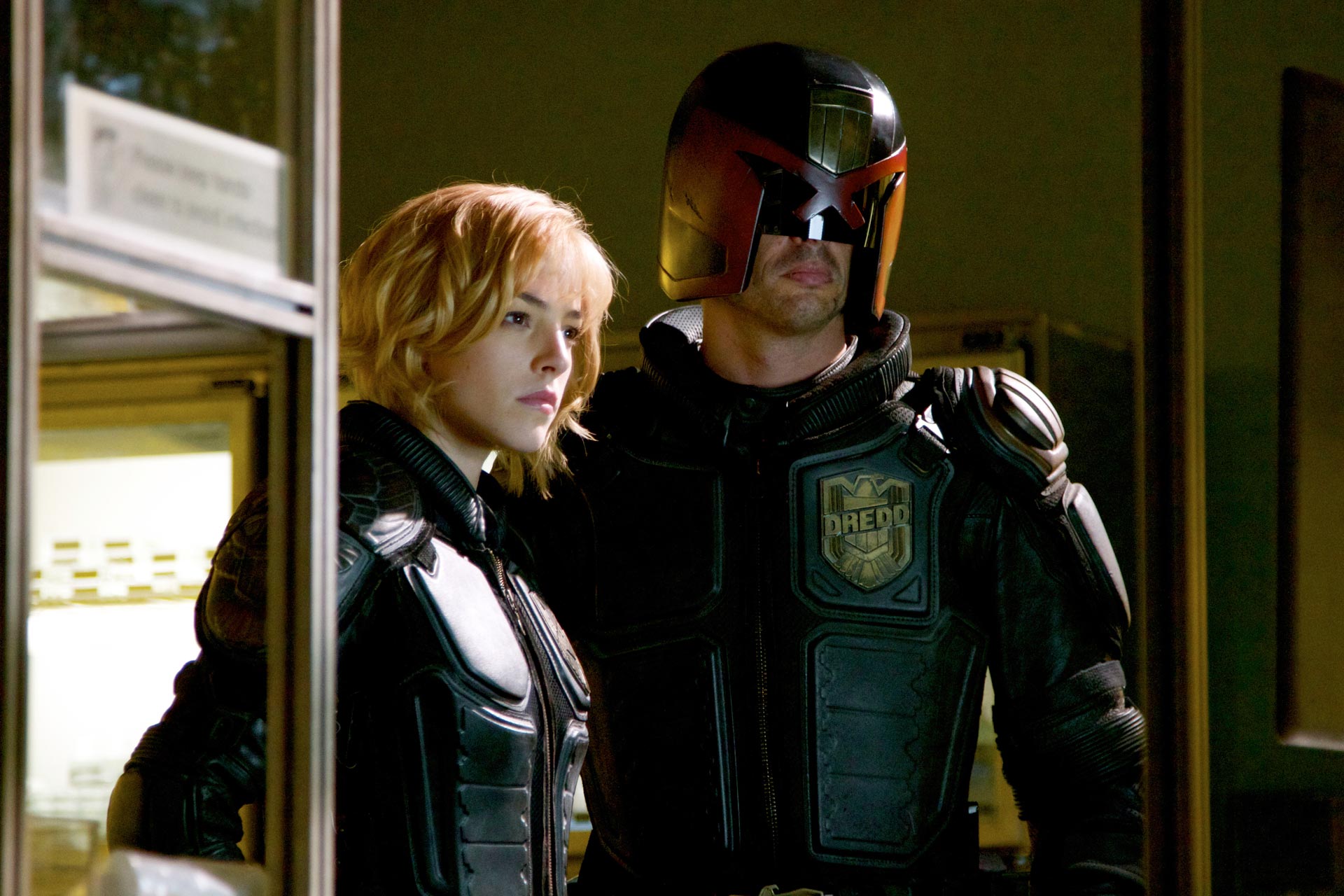
The story takes place in the future, which of course sucks. It’s always lousy in the future in the movies, isn’t it? In this “cursed Earth,” a dystopian large city, the law enforcers serve as judge, jury, and executioner all in one. The baddest of them all is Judge Dredd (Karl Urban)—with a cool uniform, a helmet that covers the top half of his face (we never see him take the thing off), and a cold, monotone voice recalling Clint Eastwood and Batman.

Karl Urban is unrecognizable as Dredd. That’s not just because we never see his face partially covered by that helmet, leaving his mouth and chin exposed, but because of his deep growl and his deadpan persona. You’d never link this man to the 2009 “Star Trek” (he played young Bones McCoy). He’s also grimly funny too, as he delivers one-liners in the most depraved situations he runs into, providing some very big laughs.

Also a lot of fun is Olivia Thirlby, best known for her indie roles as “Juno’s” best friend and the pretty high school girlfriend in “Snow Angels.” Here, she plays a blonde mop-haired psychic “mutie” (slang for “mutant” in this world—I guess stealing “muto” from “Waterworld” was too much) who becomes the rookie Judge Anderson. Thirlby displays a calm (yet somewhat ethereal) yet confident screen presence, whether it’s looking danger in the eyes or through their heads (because she has the power to enter your mind and mess with it to seek information—now that’s awesome). She’s a ton of fun and delivers some badass moments as well. She is no damsel in distress.

The real story begins as Dredd and Anderson respond to a disturbance at the 200-tower Peach Trees housing complex and interrupt a party where the latest drug is being used—a drug that allows everything in your perspective to slow down time (this is where a lot of slow-motion visual styles come into place). Facial-scarred drug-lord Ma-Ma (Lena Headey) has been killing her subjects by enforcing the drug onto them, and pushing them out the window from the top floor, making their fall seem longer than it is. Dredd and Anderson take a suspect (Wood Harris) into custody. Knowing that they will interrogate him for information, Ma-Ma forcefully arranges for the entire building to be locked down and insists that she’ll keep it this way until the Judges are caught and killed.

This sets up a series of events that lead to close calls, strikebacks, shootouts, and just about everything else you’d expect to see here. “Dredd” pulls out all the stops and then some. This film is alive with energy as Dredd and Anderson find new ways to outsmart the heavily dangerous thugs looking to shoot anything that moves. But it’s OK—the Judges have specially designed guns that have voice command and many features (automatic fire, stun, double-whammy, and more). That gives them advantages that lead to some impressive developments.

“Dredd” is violent, bloody, heavily-stylized…and it’s just so freaking cool. There’s never a dull moment, it’s visually exciting, the action is top-notch, and it’s just an intense thrill ride from beginning to end. I look forward to a sequel, and I think there will be one, seeing as how audiences are hungry for mindless entertainment. I guess I could describe “Dredd” as precisely that, but that would be considered an understatement. This movie just kicks ass.

Planes, Trains & Automobiles (1987)

26 Feb

000096_20

Smith’s Verdict: ****

Reviewed by Tanner Smith

When you team up a pair of comic actors in a movie, there’s either a danger of going over the top or not having enough chemistry on screen. But Steve Martin and John Candy are perfectly cast and are in a script that doesn’t let them down and carry the film, “Planes, Trains & Automobiles,” greatly. There is chemistry here and they never go over the top.

The film is about a road trip featuring two strangers who have to be home for Thanksgiving and will get there any way they can—planes, trains, or automobiles. Steve Martin plays Neal Page, an uptight advertising salesman trying to get from New York to Chicago. During rush hour (and two days before Thanksgiving), he has a hard time finding a cab in the city and when he finally flags one down, it is stolen (unintentionally) by Del Griffith (John Candy), a traveling shower-curtain-ring salesman. He’s also from Chicago. When the two men meet at the airport, Del feels genuinely sorry for stealing Neal’s cab. Neal tells him to forget it. But as fate would have it, Neal and Del wind up trapped in each other’s company, on the plane and off.

This leads to a night in which the two land in Wichita, Kansas, since a snowstorm has hit the O’Hare airport in Chicago. “We’d have a better chance of playing pick-up sticks with our butt cheeks than getting a flight out of here tonight,” Del tells Neal. And this also leads to a night at a motel…but their room is a single. That’s right—one bed. In one of the funniest scenes in the film, Neal and Del wake up the next morning cuddled against each other. (“Why are you holding my hand?” “Where’s your other hand?” “Between two pillows.” “Those aren’t pillows!”)

And as the film goes on, Neal and Del continue to make their way home, while Neal tries multiple times to get rid of Del. But there’s nothing that can separate them forever. In one of the best scenes in the film, they wind up renting a car and driving at night together when they don’t realize that they are going the wrong way on an expressway. This results in what is probably the only funny joke that a movie can make about a car and two oncoming trucks.

“Planes, Trains & Automobiles” is written by John Hughes, who also serves as director and producer, and it’s a pleasant surprise, considering that John Hughes specializes in teenage comedies and apparently searched for something more. So now he has “Planes, Trains & Automobiles,” a movie featuring a road trip with a great deal of character development and physical comedy. John Hughes had written a comedy about a road trip before (1983’s “Vacation”). This film is even better because the comedy is based on character and reveals heart and truth.

For example, we have the scene in which Neal snaps at Del that night in the motel in Wichita. He shows no mercy, telling Del that he doesn’t know how to tell an interesting story and that he would rather attend an insurance seminar than listen to another one of his anecdotes again. He goes on and on, as Del doesn’t show anger. His face falls; he’s genuinely sad and hurt. He realizes that he was so eager to please and has tried too hard. It’s a scene that reveals comedy and drama in the way that it reveals heart and truth. And that’s not even close to the end of the film, even though it could be the end of a short film (and feels like it, too). It’s this point in which Del wins our hearts and we enjoy watching him through the rest of the film. As for Neal, he learns about patience and slowly but surely develops a friendship with Del.

This is where the film really shines—Steve Martin and John Candy are absolutely great together and they play characters that are funny and empathetic. They’re the classic Odd Couple—one is ordinary and wound up while the other is a slob but more outgoing. But if I didn’t make it clear in the paragraph above, they don’t play caricatures. They play three-dimensional human beings.

“Planes, Trains & Automobiles” leads to the emotional payoff in the final scenes. After all we’ve seen of these two characters and been through what they’ve been through, you’d expect a great payoff. Luckily, this film has one in the way that it gives us exactly what we needed for this material.

NOTE: This film is rated R by the MPAA. Well, I’ll tell you this—fast-forward through the scene midway through the film in which Neal confronts a car rental agent played by Edie McClurg. That scene has the only times you’ll hear the F word—19 times, in fact. Omit that scene and the film is good viewing for the whole family on Thanksgiving night.

Children of Men (2006)

26 Feb

bilde

Smith’s Verdict: ****

Reviewed by Tanner Smith

“This is how the world will end…this is how the world will end…this is how the world will end…not with a bang but with a whimper.” –T.S. Eliot

That is exactly what is happening to the world in the action film “Children of Men,” a bleak, action-packed, wicked thriller that takes place in the year 2027. The Earth has become practically uninhabitable and anarchic. Natural disasters, terrorism, and war have brought the world to hell. All borders are closed permanently, which means anyone who tries to step into new territory is declared an illegal immigrant and forced to go with others to a prison where they will eventually be executed. But it gets worse—humans have become infertile. It is exceedingly rare for a woman to be pregnant. As the movie opens, a newscast informs us that the world’s youngest person (at age 18) is dead. With this knowledge, you can sense that in a few decades, the human race will become extinct. Soon, others will die until the last man on Earth will die. No one else will go on because there are no more births. That is the subtext throughout “Children of Men” and it’s a profoundly creepy one.

The movie takes place in England, where a man named Theo (Clive Owen) gets a coffee one morning and sees the newscast about the death of the youngest person on the planet. He then steps outside to wait for a bus when suddenly, the coffee house explodes! Not only is this surprising, but watch Theo’s reactions to the destruction. At first, we see him as this ignorant tough guy we see in a lot of action movies. But when the coffee house explodes, he shows off a real sense of fear—he is startled by this occurrence, as anyone would be.

Theo has his way of showing concern about this now-damaged world, but he prefers to think about being with his pot-smoking best friend Jasper (a bewigged Michael Caine, wonderfully cast), who is even more ignorant of more or less…everything. But he is soon captured by his former wife Julian (Julianne Moore) and her associate Luke (Chiwetel Ejiofor), who are part of a rebellion against the now-corrupt government (or what’s left of a government). They need Theo to help them to smuggle a young African woman named Kee (Clare-Hope Ashitey) out of the country to a place where she might be safe from everyone else. (It is said that there is a ship called The Tomorrow, which rescues and harbors said “illegal immigrants”). This woman needs to be protected because she holds the key to the future of Earth’s society. Theo doesn’t realize why Kee is so important until after a few angry run-ins with wild townspeople and the police. It turns out Kee is pregnant—the first baby to be born in 18 years. “Now you know what’s at stake here,” Luke calmly explains to Theo.

Soon, Theo and Kee are on the journey to get past the border unseen and unharmed. But of course, this is not going to be easy. They are pursued by many people (including security troops) and partake in many action sequences. But these scenes are so convincing—so well-executed—that you realize just what they’re about. You never forget what is at stake in this story. Director Alfonso Cuaron (who also directed “Harry Potter and the Prisoner of Azkaban”) has an amazing visual style and executes every action sequence well, and I love how a lot of these scenes are in a single ongoing shot. Every action scene is desperate and with purpose. Cuaron knows how to stage this kind of situation and Clive Owen captures the sense of fear and desperation. Owen is ultimately solid in this movie. He has a cool attitude, yet has a sense of vulnerability that he doesn’t show but you can tell during certain shots.

I love the way the storyline of “Children of Men” develops into something bigger than it began with. When the movie opens, we already sense the world ending because of humanity’s wasting away. Now when Kee arrives and needs to be saved, we see that the world can either remain the way it is (maybe even worse) or be preserved for a new generation. It all depends on Theo’s actions—he has his own demons with his former wife, which haunts him after her arrival.

Also, there is great cinematography. When Theo walks through a desolate London, it looks like a real place. It’s incredible, how the filmmakers were able to make this into a dark, scary place to live in (or even walk in). The settings get darker as Theo goes on this dangerous journey to the border and even through the immigrant prison. It’s all convincing.

“Children of Men” belongs in a class with “Mad Max” and “Blade Runner,” but it may be better than those two references. This is a movie that shows an even darker approach to futuristic fiction and serves as a cautionary tale. It shows a world that is indeed not ending with a bang but with a whimper.

Friends with Benefits (2011)

26 Feb

friends-with-benefits-still03

Smith’s Verdict: ***1/2

Reviewed by Tanner Smith

“Friends With Benefits” is the title of a romantic comedy featuring exactly what the title suggests—a man and woman who are friends but also sexual partners with no plans of a loving relationship. (I think Jane Lynch put it best in “The 40-Year-Old Virgin”—the easiest term is “*bleep*-buddy.”) But “Friends With Benefits,” despite its title, is not the first movie to show us this relationship. It hasn’t even been a year since “Love and Other Drugs” and “No Strings Attached” were released, featuring the same “friends with benefits” element. There really isn’t anything new in “Friends With Benefits”—it’s a romantic comedy in which the two leads start out as friends, have sex repeatedly, realize they have feelings for each other, have certain complications in dealing with those emotions, and (spoiler alert) they end up together. But that doesn’t mean it doesn’t work. In fact, I really liked “Friends With Benefits.” It uses rom-com formulas, but has fun with them in a self-referential way.

One of the reasons for the success behind “Friends With Benefits” is the pairing of Justin Timberlake and Mila Kunis as the two leads. These two are impossible to dislike—they’re appealing individually and engaging together. They’re not mismatched in the slightest, their characters are well-developed, and they never annoy the audience.

Describing the plot is somewhat pointless, but it’s probably best to mention a few things. Timberlake plays Dylan, a Los Angeles-based editor of a popular blog, who is recruited for a job in New York working for GQ Magazine. Kunis plays Jamie, a headhunter who flew Dylan there and shows him around the city. Soon, Dylan and Jamie become good friends, but are also attracted to each other physically. So they agree to become friends without romance—“No relationship,” Jamie explains, “No emotions, just sex.”

Of course, this works for a while. Of course, they start to fall for one another. Of course, they don’t know how to handle this. Of course—well, you get it, mainly. You know the formula; it’s been done before. But what makes “Friends With Benefits” worth watching is not only the convincing chemistry and charm between Justin Timberlake and Mila Kunis, but also its self-aware screenplay. There are a lot of funny lines of dialogue (mostly involving the leads picking apart some romantic comedy clichés) and some running gags (some including references to rapper-duo Kriss Kross) that work. This movie is quite funny in a dopey but consistently smart way.

The supporting cast is also game and funny. Jenna Elfman has some funny lines as Dylan’s knowing, sassy sister; Patricia Clarkson is hilarious as Jamie’s wisecracking mother; Richard Jenkins doesn’t overdo it with his character of Dylan’s father, diagnosed with Alzheimer’s disease; there are welcome cameos by Andy Samberg, Emma Stone, and the pairing of Jason Segel & Rashida Jones (whose rom-com-within-a-rom-com that the characters watch is hilarious); and there’s also a young actor named Nolan Gould who has his share of funny moments as Dylan’s aspiring magician nephew. I know I should have already mentioned Woody Harrelson as a gay sports editor who constantly comes on to Dylan, but to be honest…I never found him very funny in this. He just came across as obnoxious.

So even if “Friends With Benefits” is mostly predictable, it makes up for it with two charming lead actors, an engaging supporting cast, and a winning screenplay. It’s easy to like “Friends With Benefits” and not feel embarrassed by saying so.

Undertow (2004)

25 Feb

undertow_devonalan_jamiebell_1098413543

Smith’s Verdict: ****

Reviewed by Tanner Smith

Wow…where do I start with this movie?

“Undertow” is one of those “experimental projects” that every director goes through to make sure they can step outside of their comfort zones. Even if that wasn’t the case, “Undertow” is an amazing movie. It takes a fairly straightforward story inside a marathon of deep, personal fantasies and experimented camera shots. This movie is weird. I know that’s a strange criticism to make for a movie that I’m rating four stars, but that’s the spirit of this entire movie. It’s strange, unusual, unbelievable, unnerving, dark, unsettling, disturbing…and I loved every minute of it.

“Undertow” was directed and co-written by David Gordon Green, one of the most intriguing moviemakers I’ve ever come across. His work before this were the indie favorites “George Washington” and “All the Real Girls.” There has always been a certain quality to his films that made them special. Maybe it’s the way he lets the characters breathe and gives them room to express in just one camera shot. Maybe it’s the countryside atmosphere he’s surrounded them with. Whatever it is, he uses a lot of it in “Undertow.” In fact, he uses just about everything he can think of to make this familiar story…unfamiliar.

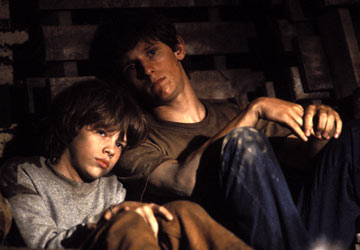
The story follows two brothers—16-year-old Chris (Jamie Bell) and 10-year-old Tim (Devon Alan). Chris is a rebel who is constantly in trouble with the law; Tim is a little weirdo who has habits of eating things like mud and paint, and also “organizing my books by the way they smell.” They live in a rural area of Georgia with their widower father John Munn (Dermot Mulroney), so out-of-the-way from society that they can’t even have friends—the only ones to celebrate Tim’s birthday are Chris and Dad.

Their lives are interrupted by John’s brother Deel (Josh Lucas), who hasn’t been in contact with his brother for years—he didn’t even know John had two sons. Deel is said to be a wild card, having been in prison for a mysterious reason. John believes Deel wants to do right from now on, so he lets him stay at the farm and work. But Deel is more sinister the more times he becomes acquainted with his two nephews, particularly Chris—there’s a scene in which he intimidates him while speeding in his nice car and saying things like, “I knew your ma first; she was my girl.”

There’s a rare gold collection said to be the gold drachmas that are good for admission across the River Styx into Hades when you die. The collection was given to John by his father, and has hidden them somewhere in the house. That’s exactly what Deel is here for—nothing more, nothing less. But after a violent incident, Chris and Tim run away from home with the gold coins, with Deel searching for them.

Chris and Tim trek along some desolate Southern landscapes and come across some very original individuals, including a young black couple who are accustomed to their rural lifestyle most comfortably and take the boys in briefly. Later, they also come across a camp for homeless people, mainly young people who have nowhere to go.

The story is somewhat similar to “The Night of the Hunter”—children go on the run from a violent man for greed, and they come across unique characters along the way—and the look of the film is as unusual. Also in mind when Green was coming up with the idea, as he said at the Toronto Film Festival, were stories by the Grimms, Mark Twain, and Robert Louis Stevenson, as well as Capote’s “In Cold Blood.” Legends and fairy tales take up a lot of the movie’s spirit and dialogue—the legend of Charon and the River Styx and that old tale about writing a wish on a piece of paper and throwing it inside a bottle into a river. There are many monologues as the boys venture through these desolate, haunting Southern landscapes that it reminds of a film made by Terrence Malick (he actually is a co-producer for the film).

What do I mean when I say David Gordon Green might be “experimenting” with “Undertow?” Consider the opening-credit sequence—there are different video filters (even negative, of all filters), pauses, slow-motion shots, and everything else that can be toyed with, all in a chase scene. As if using all of those editing tricks wasn’t enough, the chase itself is just bizarre. It introduces Chris as he breaks the window of his girlfriend’s bedroom, causing her father to chase after him. It’s a merry chase until Chris, barefoot, accidentally jumps and lands on a nearby wooden plank with a nail sticking out of it. It’s even less pretty to see as it is to hear—it’s a very painful moment. And then, Chris continues to hobble along on his way, with the board still attached to his foot.

And that’s just the beginning of the movie! Trust me; it gets just as strange, if I haven’t already made that point.

Hearing the storyline, one would get the idea that this is a chase picture. But it’s not, in the conventional sense. David Gordon Green doesn’t go for the kicks; he goes for the dread, despair, and menace of the situations—fitting, because they match the landscape.

Jamie Bell, a young British actor (from “Billy Elliot”), has no trouble perfecting his American accent nor does he have trouble making us feel sympathy for Chris. Devon Alan suits the role of Tim well. Dermot Mulroney has a reassuring presence as the boys’ father, and Josh Lucas, playing against type, is certainly menacing as Uncle Deel.

What have I left out? Only the music, I hope. The film is covered by an ominous music score by Philip Glass that gets deeper as the story continues. It’s a chilling, non-comforting score that’s perfect for the film.

There is a chance I may have left something out from “Undertow.” But if there is, you can discover for yourself exactly how unusually thrilling this film is. However, I must warn you that this is not a film that’s easy to watch. It’s the kind of “Southern Gothic” tale that leaves audiences with an uneasy feeling. I won’t lie; it left me uneasy too. “Undertow” is strange, unusual, unbelievable, unnerving, dark, unsettling, disturbing…and I loved every minute of it.