Archive by Author

Bill and Ted’s Excellent Adventure (1989)

1 Mar

eaclose2

Smith’s Verdict: ***

Reviewed by Tanner Smith

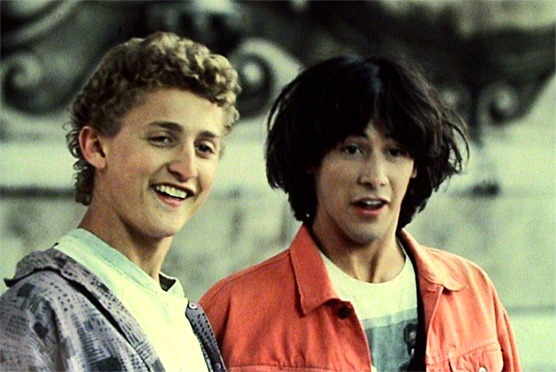
It’s the moment in “Bill and Ted’s Excellent Adventure” where California dudes Bill S. Preston, Esq. and Ted “Theodore” Logan meet their future selves that really let me know that I was in for a treat. About twenty minutes into the film, we’ve met these two lunkheads and were already introduced to an earlier plot point involving the future. Bill and Ted are sitting on the curb outside a Circle K, studying for their history class oral report (they ask passersby when the Mongols ruled China) when suddenly, a flying telephone booth lands in the parking lot. A strange man (from the future) steps out of it and approaches the awed dudes. They don’t know what to make of it, until another flying telephone booth lands next to them. In this one are Bill and Ted from some point in the near future. They approach their present selves and joyfully tell them that they’re going to have an excellent adventure through history, using the phone booth that is really a time machine from the future.

This is a great moment—my favorite line in this scene is from Future Bill who says, “Look dudes, we know how you feel. We didn’t believe it either when we were you and we-us said what we-us are saying right now.” It lets us know, as well as Bill and Ted, that what will follow is going to result in silly fun.

And that’s what “Bill and Ted’s Excellent Adventure” really is—silly fun. Bill and Ted (Alex Winter and Keanu Reeves) are two friends who live in San Dimas, California, and apparently each share a brain…or whatever they have. These two may seem dumb (they speak in dude-surfer talk and say phrases like “Excellent!” or “Whoa!” or “Bogus!”), but they’re smart enough to know that if they fail their final history exam, they’ll fail the class and Ted’s uptight father will ship him off to military school. This is real “bogus,” because if that happens, Bill and Ted will be separated and never start their own band, Wyld Stallyns.

This is where Rufus (George Carlin), the man from the future, comes in—you see, Bill and Ted are supposed to start their band so that they become world famous and create a movement that will eventually lead to world peace. Rufus is sent to help them pass their report so that Ted won’t be sent away and ruin the space-time continuum. Confused? Don’t worry—it’ll make sense soon.

Wait a minute! That’s what Rufus said at the beginning of this movie! (Don’t worry—it DOES make sense soon. That time, it was me saying that.)

And so, Bill and Ted use their new time machine to go to many places in the past and take with them many historic figures, including Billy the Kid, Socrates, Napoleon, and Abraham Lincoln. They have to get them all together, have them experience San Dimas, and have them speak for their presentation about what they think.

That’s a fun premise and the movie keeps to the silliness of it, making it “silly fun.” It also has fun with uses of time travel—I love the scene in which Bill and Ted use it to create multiple diversions in order to free their new friends from jail. Keanu Reeves and Alex Winter are likable, but also convincing as doofuses. It was fun taking this adventure with these two—it’s not “excellent,” but it is in their vocabulary.
Three Men and a Baby (1987)

1 Mar

selleck-danson-guttenberg-three-men-baby

Smith’s Verdict: ***

Reviewed by Tanner Smith

“Three Men and a Baby” is the American remake of a French comedy, which I never saw. But it doesn’t matter much anyway, since remakes are supposed to stand alone as movies instead of always being compared to the original all the time (even though we can’t help ourselves). So I don’t know what was upgraded and what was downgraded for this American remake of “3 Men and a Cradle” (the French film). But as a movie, “Three Men and a Baby” is a nice, gentle comedy with good laughs and a real sweetness to it.

The movie features Tom Selleck, Steve Guttenberg, and Ted Danson as three bachelors who share a luxury apartment as their own bachelor pad in New York. (By the way, I love the look of the place; paintings of the city and portraits of the three guys outline the walls…though I don’t think it’d be suitable for a bachelor pad.) The first fifteen minutes of the film is just them delivering wisecracking dialogue and gawking over women. They have a seemingly endless series of girlfriends, some of which we see at a birthday party of one of the guys.

Then, the next day, actor Jack (Danson) leaves to shoot a film in Turkey for about ten weeks, but architect Peter (Selleck) and cartoonist Michael (Guttenberg) find a big surprise waiting on their doorstep. It’s a little baby, asleep in a bassinet with a note attached to it. The baby is Jack’s after an affair from long ago. The mother has sent the baby, named Mary, to the apartment. With Jack not around, Peter and Michael are forced to handle the situation, but of course know absolutely nothing about taking care of a baby. They refer to Mary as “it,” don’t know how to entertain her when she’s crying, doesn’t know what she eats, and, in one of the film’s funniest scenes, they figure out how to change a diaper. Their confusion is not helped when they go out to the store to buy baby food, and there seems to be a lot depending on the age, which they don’t know. Each day passes by and they’re still miserable and confused with this bundle. All the baby does is eat and poop. But later with each day, they actually start to love Mary.

When “Three Men and a Baby” focuses on these scenes in which these guys deal with the baby and grow to love her, it works. There are a lot of big laughs in the complaints that these men have (such as how Peter wonders if feeding the baby every two hours means from start to finish) and in how people react to the situation (a grocery clerk asks suspiciously, “You don’t know how old your own baby is?”). And then when Jack comes home, Peter and Michael use this as revenge for leaving them here with his own baby. Jack nervously tries to handle it himself, as Peter and Michael did, because “I’m an actor—I can play a father.” He tries to get his mother to help, but she sets him straight, saying it’s his turn to take care of things for himself for once.

The best moment in the movie is when all three guys softly sing the baby to sleep with “Good Night, Sweetheart.” It’s a touching, genuinely moving scene.

“Three Men and a Baby” succeeds when handling this forming relationship these men have with the baby. What doesn’t work is a tired subplot involving another package delivered to the apartment; only, this one is full of heroin. Some drug dealers come by, asking about the package, which the guys at first think they mean is the baby. Once they realize what they really want, they can’t find the package and are not only in trouble with the dealers, but also with the cops who are investing a drug-included case. And this leads to a confrontation between the men and the drug dealers in a construction site, the screenwriter’s reliable Hollywood cliché. Why, when the central story is cute and funny and heartwarming, did they have to add a subplot about drugs? It’s unnecessary, and the final confrontation is not effectively staged, even though director Leonard (Spock) Nimoy and writers James Orr and Jim Cruikshank try their best to keep it tense. I guess it’s supposed to show how far the guys will go to protect the baby, since the dealers actually leave a note saying they’ll take her next time. But we didn’t need a drug-related subplot.

But there is plenty of material with the three men and the baby that the comedy elements outweigh the “suspense” elements. All three actors do game jobs, especially Tom Selleck who does a great job mixing tenderness with light comedy. He’s convincing throughout the movie. Steve Guttenberg has good moments (such as when he tries to entertain the baby while she’s crying) and Ted Danson is credible as a snobbish, handsome actor.

“Three Men and a Baby” is a funny, moving movie when it focuses on the title roles. Sure, the screenplay doesn’t take the high road and like I said, I could’ve done without the drug stuff, but it mostly succeeds in winning us over.

The Battle of Shaker Heights (The Project Greenlight Movie) (2003)

1 Mar

MV5BODcyMzg0MzQ4NV5BMl5BanBnXkFtZTYwODAzMDk2._V1._SX485_SY331_

Smith’s Verdict: ***

Reviewed by Tanner Smith

“The Battle of Shaker Heights” is the second movie filmed out of competition for the “Project Greenlight” contest. “Project Greenlight” was an HBO behind-the-scenes TV series that documented the winners of a contest for screenwriting and directing (sponsored by Matt Damon and Ben Affleck and Chris Moore)—amateur writers and directors who never worked on a movie before finally get their chance. The series followed the contest winners as they get together to make a movie with a small budget given to them. Throughout the series, we were with the people as they talked through their problems of making this movie and understood what they were going through. Then they finally get their movie done and the movie is shown in theaters on a limited release with the tagline “The Project Greenlight Movie”—a somewhat sad distinction. However, I can’t really say that the movies themselves are more compelling than the TV series that shows them being made. The show had more a more compelling storyline and even more compelling “characters.” The first “Project Greenlight” show featured the making of the movie “Stolen Summer,” a coming-of-age movie featuring Aidan Quinn and Bonnie Hunt (and a couple of annoyingly-cute child actors), if you recall. Now, the second “Project Greenlight” movie features the making of the movie “The Battle of Shaker Heights,” a coming-of-age story about a teenager who is ticked off at life.

The show is more interesting than the movie. But does it look like a movie more than a product? Yes. Is it worth recommending? Just barely, but there are some things to like about it.

I saw the show—I felt like I was with screenwriter Erica Beeney and directors Efram Potelle and Kyle Rankin as they had arguments/disagreements about certain parts of pre-production, production, and post-production. Beeney has a lot of potential in her screenplay and Potelle and Rankin show some talent, but there’s too much going on in the screenplay and sometimes the movie is uncertain about which way it wants to go.

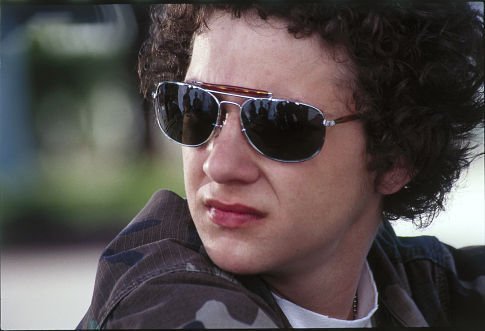
The main reason I am recommending this movie is because of the lead performance by Shia LaBeouf, who is very appealing as the lead named Kelly Ernsweiler, a 17-year-old war reenactor who takes his hobby very seriously and puts down the other reenactors who aren’t very serious—and he questions his history teacher about his teaching methods. His home life isn’t pleasant—his mother (Kathleen Quinlan) is an artist and caring enough, but Kelly doesn’t like his father (William Sadler), who used to take drugs and tries to tell the boy that he’s clean now (Kelly replies, “So what? I’ve been clean all my life.”).

Kelly makes a new friend in Bart Bowland (Elden Henson), a rich kid Kelly meets on the reenacting battlefield. They bond and become great friends and together, they form a plan to gain revenge on the school bully who gives Kelly a hard time. There’s a problem here—Kelly has a crush on Bart’s attractive (and engaged) older sister Tabby (Amy Smart) and so, Kelly is trying to impress her but Tabby only finds him slightly amusing. She doesn’t take his puppy love seriously. (Of course, what Kelly doesn’t know is that his attractive co-worker at a grocery store has a crush on him—that story element has been done too often, and here, it’s underdeveloped.)

There you see how much is in Beeney’s screenplay—I won’t even go into Bart’s father’s weird hobby of collecting nesting dolls. But there are a lot of clever lines in this movie—I’m glad to see on the show that none of them are improvised (at least, not a lot).

Shia LaBeouf is a very talented young actor, and here, he makes his character winning and three-dimensional. Elden Henson (“The Mighty”) and Amy Smart are very good here as well. Elden Henson, in particular, seems like someone you would want as a best friend.

I’m recommending “The Battle of Shaker Heights” just barely. I liked the performances very much. Maybe what would have improved the “Project Greenlight” scenario is if Matt Damon and Ben Affleck really got into the action instead of just disappearing and showing up when they need to. Then they could convince Miramax to send them a real budget. The possibilities (especially since “Good Will Hunting”) are endless.

Kick Ass (2010)

1 Mar

2010_kick-ass_005[1]

Smith’s Verdict: ***

Reviewed by Tanner Smith

As far as I can tell from reviews, “Kick-Ass” is a movie you either love or you hate. Is it possible to “only like” it? I guess it is possible, because I “only liked” it. I did not love it, but I do not dislike or hate it either. Yes, it is overly violent. Yes, it has uneven humor. Yes, it tries to be a mixture of both. But about that last “yes,” it does work at a mixture of both funny and violent. We’ve seen the superhero-set-in-reality gimmick before, like we did with the great Disney/Pixar film “The Incredibles” and Will Smith’s surly superhero “Hancock”—we just haven’t seen it with teenagers in the lead roles or with graphic violence that would make Tarantino wince. The movie takes place in the “real world”—crime is where you least expect it and nobody has superpowers.

The film’s narrator Dave Lizewski (Aaron Johnson) is a geeky high school teenager who is just plain average—his only superpower is being invisible to girls, he doesn’t have a lot of friends on MySpace, and he has his own fantasies. He is heavily influenced by comic books and wonders why nobody ever tried to become a superhero in this crime-ridden world—he thinks that all a person needs in order to be a superhero is a costume and a weapon. So, under the name “Kick-Ass,” he tries it out—he orders a green wetsuit complete with mask, carries two blunt objects, and looks for crime. His first attempt is a failure as he is almost killed. But that doesn’t stop him. Soon, he scares off a group of muggers and is caught on somebody’s iPhone. Soon, Kick-Ass is a YouTube sensation and the inspiration for other “superheroes.”

If Kick-Ass’ beatings are violent enough, you haven’t seen anything yet. A subplot involves a mob boss (Mark Strong) who kills people mercilessly without explanation—a bad influence for his teenage son (Christopher Mintz-Plasse, best known as “McLovin”). In one scene, the man even fries one person with a man-sized microwave. But even that’s nothing compared to what I am about to explain next. It turns out that a father and daughter have become costumed vigilantes of their own, inspired by Kick-Ass. They are Big Daddy and Hit Girl. Big Daddy dresses up like Batman (complete with Adam West voice—he pauses. like. this.) and his true identity is a near-crazy father to eleven-year-old Mindy, who is Hit Girl. How crazy? Consider an early scene where he uses his own daughter as target practice (Mindy wears a bulletproof vest so she can feel what it’s like being hit with a bullet). He wants to do it three times—Mindy asks for ice cream and bowling afterwards. Big Daddy has taught Mindy the ways of the weapon—from butterfly knives to handguns—and together, Big Daddy and Hit Girl are more experienced than Kick-Ass.

_1271370281

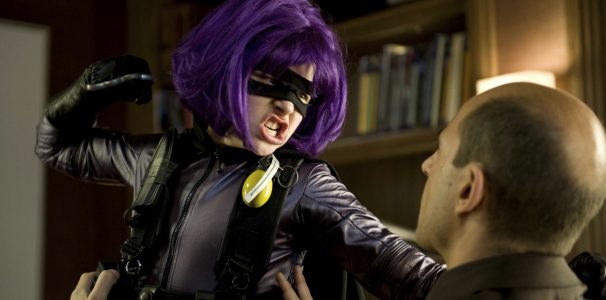
Here’s what will draw the most controversy for “Kick-Ass” but will also be the most memorable—Hit Girl is not playing a game like Kick-Ass is. She is overly serious about this new identity—she doesn’t just outsmart the criminals; she kills them stone-cold dead. She cannot be reasoned with. Complete with a purple wig, a leather outfit and mask, Hit Girl is an eleven-year-old nightmare for all parents.

The crime boss doesn’t like that Kick-Ass, Hit Girl, and Big Daddy are wasting his men, so he declares open season on them. His son gets a costume of his own and names himself Red Mist. His job is to trick Kick-Ass into leading him to Hit Girl and Big Daddy. This sets up the final half of the movie, which is more violent than funny. But when you raise a climax for a movie like this, what more can you ask for? It’s a final showdown—you saw it coming, deal with it.

What I liked about “Kick-Ass” was that it featured a main superhero that has no experience whatsoever. As a hero, Kick-Ass is better off staying home. But he tries his best. This is what gives the film an edge—both for effectiveness and for humor. I liked Kick-Ass’ true identity Dave’s high school problems that could be resolved with his secret identity now that he has self-confidence. He even scores the girl of his dreams (Lyndsy Fonseca), who at first thinks he’s gay. Now, portrayed by Aaron Johnson, Dave may be a bit bland, but he is believable and that’s what the film needed. He is not supposed to steal the show, so he doesn’t. What really gives “Kick-Ass” its kick are the characters of Big Daddy and Hit Girl. Big Daddy is played by Nicolas Cage in his craziest performance in a long time. He understands this material and plays with it. I can’t think of another actor who could pull off this character. I love it when he says his dialogue while in the Big Daddy suit—his speech impediment in those scenes makes the film work greatly for Cage. Chloe Grace Moretz is a true find as Hit Girl. She may get the most attention for a girl of her age doing all of these horrible things to people, but it helps that she is an extraordinary young actress.

“Kick-Ass” is original, alive, well-made, and powerfully-acted—it also bloody and violent. It deserves its R rating. The trailers for this movie make it seem like a PG or PG-13 family superhero movie. (Parents will most definitely be shocked by the language that comes out of this little girl’s mouth, though the kids will love it.) I was interested in these kids and I feared for them when they were in real danger. Not that I approve of Hit Girl killing hit men. But done in the wrong hands, this material could’ve easily failed. Luckily, it finds its place and keeps it there. Is “Kick-Ass” a masterpiece? No. But it’s a fun thrill ride.

Bad Boys (1983)

1 Mar

4513729_l2

Smith’s Verdict: ***

Reviewed by Tanner Smith

The opening-credit sequence in “Bad Boys” includes pictures of who I suppose are the actors (or specifically, in this case, the characters the actors portray) as little children. They look like harmless, clean-cut, innocent, sweet kids and they probably were for a time. But they must have gone down the wrong path to become what the title of the movie describes them as—“Bad Boys.” What caused them to be like this? It could be neglect, abuse, or maybe (and most chillingly) they just didn’t care about anything anymore. Any one of those would be good reason as to why these boys act like this. In “Bad Boys,” the bad boys aren’t romanticized, but are more like objects for a cautionary tale.

Sean Penn acts convincingly in a role that made him a star as the main focus of this story—a young Chicago thug named Mick O’Brien. The only thing he’s ever cared for is his girlfriend JC (Ally Sheedy). He hates his life at home and performs felonies all over the city. But one night, something goes wrong with a local drug dealer—Paco Mareno (Esai Morales), also a teenager—and results in the death of Moreno’s younger brother. O’Brien is sent to a juvenile reformatory where the worst sort of teenagers do time and act out violently against each other.

The first half of “Bad Boys” is the best part of the whole movie. While O’Brien is in the reformatory, he learns the ropes, finds out who to trust—including his smart-aleck roommate Horowitz (Eric Gurry), and later becomes respected after pummeling a couple of sadistic thugs nicknamed “Viking” (Clancy Brown) and “Tweedy” (Robert Lee Rush). He learns that in this place, only the strong survive. The strengths of the first half come from the first-rate direction by Rick Rosenthal and the performances from the actors—especially Sean Penn, who is excellent and three-dimensional as the bad boy who seeks redemption in the wrong places.

But when Moreno brutally rapes O’Brien’s girlfriend and is put into the same reformatory as O’Brien, the movie starts to become predictable. It’s obvious that the two are going to duel to the death and that’s exactly how the movie is going to end. On top of that, it’s sort of obvious who’s going to win. Was a fighting climax really necessary?

But you can’t let something like that stop you from recommending a movie that is so strong up until that point. “Bad Boys” works for the most part because it shows realistic situations involving troublesome (and troubled) teenagers together in one building. Like I said, only the strong survive here. But these are people whose adult lives are over before they’ve barely begun. It’s a sad case for these kids because very few of them will get redemption—the rest of them will simply ask for more trouble. Take Horowitz, for example. There’s a scene later in the movie when he sets up a radio to explode in Viking’s face. Sure, Viking was a sadist to begin with and probably deserved what he had coming. But now, Horowitz has a troubling punishment all because of his actions. Only he’d stopped to think. That’s what the audience would think about every central character in this movie at this point. Actually, that’s something else to think about too—after the big climax at the end, everyone else is surprised by the outcome. Since I am recommending “Bad Boys,” I guess it’s fair to say that you should watch the final scene and wonder what the characters are thinking.

“Bad Boys” isn’t a great movie, but it comes so close to it. The performances from Sean Penn, Esai Morales, Eric Gurry, Ally Sheedy, Clancy Brown, Robert Lee Rush, and Reni Santoni (he plays a counselor in the reformatory) are very strong. The direction from Rick Rosenthal is excellent. Why did the movie have to end with a fight climax?

Transformers (2007)

28 Feb

images

Smith’s Verdict: ***

Reviewed by Tanner Smith

Michael Bay is a director with maybe too much ambition with his work, to say the least. He doesn’t even hold a good track record with his films (examples are “Bad Boys,” “Armageddon,” “Pearl Harbor,” and “Bad Boys II”). He has many trademarks of his own—swift camera movements, frantic editing, two-and-a-half hours of running time, colorful stereotypes, intense slow motion shots of characters, tight close-ups, intense music cues, and even more notably, over-the-top visuals. He made one terrific film so far out of all of those elements—a solid thriller called “The Rock.” Now here’s Michael Bay’s “Transformers,” which almost serves as a parody of Michael Bay’s earlier films. We get just about every trademark from Michael Bay, with a handful of CGI metal robots called Transformers, based upon a popular toy franchise by Hasbro.

This is a totally preposterous and goofy-fun movie in which good Transformers and evil Transformers fight on our world, and a group of central human characters are caught in the middle of the war and race to aid the good Transformers (called Autobots) in holding the key to Earth’s survival.

These Transformers are marvelous creatures to behold. They fold and unfold like Rubik’s cubes from automobile to giant robot and then back again. Both races of robots are drawn to Earth because decades ago, the fearsome leader of the evil Transformers (called Decepticons) named Megatron crash-landed there. It is said now that he holds the All-Spark, a cube that is the key to the rebirth of their dying home planet Cybertron.

The central human characters are introduced in different subplots. We meet armed services, including Sgt. Lennox (John Duhamel) and Tech. Sgt. Epps (Tyrese Gibson), who are attacked by a helicopter that transforms into a Decepticon. These guys are under the impression that this ten-foot-tall metal robot can be put down easily with automatic gunfire, and much later, they’re fighting a scorpion-like Decepticon in the middle of the desert. Then we meet the Secretary of Defense (Jon Voight) who is trying to figure out what exactly attacked the armed forces, with help from computer whizzes, including the beautiful, Australian blonde Maggie (Rachael Taylor) and optimistic hacker Glen (Anthony Anderson, overacting but funny). The political satire of this movie is that the Secretary of Defense is seemingly running the country while the President is relaxing on Air Force One, asking for a Ding-Dong.

There’s another character that is crucial to the story. His name is Sam Witwicky (Shia LaBeouf) and he’s a teenager who just bought his first car—a rundown yellow Camaro with racing stripes and apparently, a mind of its own. He uses it to try and pick up the popular girl in school named Mikaela Banes (Megan Fox, not entirely convincing as a high school student, but wow, is she great to look at) and the radio pretty much plays what Sam is thinking, kind of like Herbie the Love Bug. But it turns out that the car is actually an Autobot named Bumblebee. His job is to protect Sam from the Decepticons because apparently, he holds the key to Earth’s survival—a pair of glasses with a sort of map imprinted in the lenses that leads to the All-Spark (I would like to explain why there is a map on the glasses, but I’m almost getting exhausted trying to piece together the plot myself).

Oh, and I should also mention the character of the secret ops guy (John Turturro) who runs a top-secret government facility called Sector Seven and is holding the now-frozen Megatron underground. He has the priceless line, “Do you want to lay the fate of the world on a kid’s Camaro?”

All of these character plotlines lead down to the big epic battle between the Autobots and the Decepticons. And that’s when I started to grow tired and bored. I loved the setup—the characters were colorful and appealing, if not fully-developed, and the action sequences in which the armed forces shoot up Decepticons in the desert is fun. And these Transformers look great. Created by Industrial Lights and Magic, they are truly sights to behold. In their true forms, you can still see the outside parts of the automobile they transformed from—hubcaps, windshields, and all metal. Their movements are incredible and their transforming is amazing. There is also a spiderlike robot that creeps around Air Force One, hacking into the computer for information about the All-Spark. I loved watching these creations but even so, it was hard to pay much attention to the big battle in the final half. The robots fight each other in the big city, causing millions of dollars damage to buildings and cars. The military is firing at the Decepticons. The music is extremely intense. I’m thinking, “OK, OK, calm down a little bit.”

This, I think, is Michael Bay’s weakest point—giving us never-ending epic battles that don’t catch our attentions. The movie is 144 minutes. By the way, I have to ask—why does Michael Bay always love his films to be two-and-a-half hours long? Does he think one of his films will be the next big epic, this side of “Titanic?”

The CGI is impressive in the climax, but I think if the scene was trimmed down in the editing a little bit, this movie would’ve been something great. Instead, “Transformers” is only something good and worthy of three stars.

Anchorman: The Legend of Ron Burgundy (2004)

28 Feb

Anchorman The Legend of Ron Burgundy movie image Will Ferrell

Smith’s Verdict: ***

Reviewed by Tanner Smith

I can’t deny it—Will Ferrell is a very funny guy. Watching him run naked on a street in “Old School” or acting like a man-child in a tight elf suit in “Elf,” I can see that Will Ferrell is not afraid to take chances in making us laugh. He has a goofy, likable presence and proves he can carry a movie well with his gift. With “Anchorman: The Legend of Ron Burgundy,” he brings his goofy charm to a new (maybe even unhealthy) level. He plays Ron Burgundy, a self-absorbed, legendary top news anchor residing in San Diego. His catchphrase: “You stay classy, San Diego.” He’s the main character in “Anchorman: The Legend of Ron Burgundy,” a vulgar, slapstick, satirical comedy that is very funny and is helped by Ferrell and the strong supporting cast. However, the laugh ratio is only half as funny as Ferrell’s previous films, but it’s still a pretty good ratio.

“Anchorman: The Legend of Ron Burgundy” takes place in the 70s, a time before cable and VCR—a time when everyone listened to the news, only men were allowed to anchor the news, and everyone was as classy as a clown on his day off, so to speak. While “This is Spinal Tap” was a satire about rock music, “Anchorman’s” satirical subject matter is broadcast television in the 70s. First, we get a narration by Bill Curtis, and then we see the typical TV intros to the “Channel 4 News Team,” in which Ron Burgundy and the three other team news members seem like one big happy family. There are also these silly news stories they have to cover, such as a waterskiing squirrel and a Panda Watch to make sure the news is able to capture on camera a panda giving birth.

The other news team members are Brian Fantana (Paul Rudd), Brick Tamland (Steve Carell), and Champ Kind (David Koechner). They get together with Ron to talk about vulgar subjects, swap manly stories, and, yes, even sing “Afternoon Delight” when they’re alone. They are all talk when it comes to women, while they are secretly terrified of them. And then they start to get cold feet when a striking blonde woman named Veronica Corningstone (Christina Applegate) is hired by Ed, the station’s news manager (played by the always-reliable Fred Willard), to bring “diversity” to the station. They have a problem because she’s a WOMAN and only MEN are allowed to say the news. The dumbest of them, Brick, warns the others that, “women’s periods attract bears.” Ron and Veronica are attracted to each other, but as co-workers, they keep getting involved in many brawls.

This is a funny movie that almost comes close to being tedious when we see the ridiculousness of this news team one time too many. But they’re a likable and funny bunch. After all this, Ron does turn out to be a nice guy. And Veronica, while trying to keep her reputation as a serious anchor on the line, still loves this dim person.

It’s also funny for the obvious reason—the actor’s improvisations are funny. Every comic actor knows that they can come up with better lines of dialogue than most of what the script has to offer, and so they just go all out. And also, there are many scenes that are very funny and quite memorable. One features Brian as he tries to impress Veronica by wearing cologne that smells “worse than the time the raccoon got in the copier.” And then there’s the brawl in an alleyway involving every news team in San Diego, complete with cameos by actors I will not give away. You’ll know them when you see them, don’t worry. Oh, I should also mention that this brawl has a heavy amount of violence. Mostly, it’s played for laughs.

Steve Carell, Paul Rudd, and David Koechner make for some effective comedic foil, Christina Applegate is fantastic as the sort-of Cameron Diaz type of comedic female role, and Fred Willard, as if predictably, is invaluable. But it’s really Will Ferrell who scores big time here. He becomes this character and makes him into such a great comedic presence. He makes “Anchorman: The Legend of Ron Burgundy” his own movie.

Tomorrow, When the War Began (2012)

28 Feb

Tomorrow-When-The-War-Began-A

Smith’s Verdict: ***

Reviewed by Tanner Smith

To tell the truth, the idea has always fascinated me. Imagine being a teenager, and you and your high-school friends are the last line of defense against an army of soldiers who invade your home. It’s a great characteristic of the term “unlikely heroes” in that the heroes are all teenagers with hardly any experience in military tactics. 1984’s “Red Dawn” is a classic example of that idea—in that film, a high school football team became America’s guerilla force when foreign armies invaded.

But now it’s time for teenagers from Down Under to take charge in “Tomorrow, When the War Began.”

Based on the first entry in the “Tomorrow” novel series, “Tomorrow, When the War Began” introduces a group of Australian teenagers who ultimately decide to turn the tables on the foreign army that has taken over their home.

It all begins when they skip the Australia Day festival to go on a camping trip in a remote land dubbed “Hell.” Why is it called Hell? Well…they say it’s because people give uninviting names to places they don’t understand, but let’s be honest—they call it “Hell” so they have fun with saying what a paradise “Hell” is. They even share a toast, “To Hell!”

One night, they notice military aircraft racing over them and don’t think much of them until they all return home to learn that the electricity is out, their houses are empty, the phone lines are down, and their families and friends have been taken, some of which executed, by a faceless enemy. The only lights on in town are the hospital and the fairgrounds, where the people are held.

Who is this army? Why do they pick this place to invade? I don’t know. They don’t address it. If they did, they did it briefly. Unlike in “Red Dawn,” there’s no movement of Communism to be found here—in fact, we never even have a scene featuring just the enemy. We just stay with these teenagers as they’re forced to do whatever they can to survive their attack and find some way to strike back.

This is fun. This is just what I wanted in this idea—teenagers banding together to fight an army. The idea is fun and there are some well-crafted action sequences for us to endure throughout the movie, as the teens use their limited resources to fight. For example, in the middle of the film, three of the kids are being chased by enemy soldiers in these really nifty armed buggies, and having to escape by driving a garbage truck. But it’s OK, because the farmer girl can drive a tractor! How hard can a big truck like this be?

Oh, and what do they do to slow the enemy down? Dump the rubbish, of course!

“Tomorrow, When the War Began” doesn’t require a lot of thinking on our parts. The best way to enjoy this movie is to accept it as a film about teenagers who know their home better than these heavily armed, totally overpowering foreign soldiers, and use that to their advantage. The climax is quite fun, as they come up with a plan to blow up the Heron Bridge so nothing more from the enemy will be deposited (easily) from outside. The funniest part of this sequence—two of the girls talk about their crushes, turn off their two-way radios in embarrassment, and are unable to hear their friends’ warnings that a few soldiers are approaching their way. In this way, it’s interesting to see a culture brought into something that they were clearly not prepared for, and that could describe the whole movie.

And give it some credit for actually having a conscience about the issue of killing human beings in order to stay ahead. Is it right to kill in battle? Who’s to decide, really?

Almost all of the young heroes look as if they stepped out of an Abercrombie & Fitch ad, but they’re all pretty good actors and make decent, ironic use of their characters’ stereotypes (for example, one’s a Christian pacifistic girl who will eventually pick up a gun when she has no choice). In particular, Caitlin Stasey, as the protagonist Ellie, shows a great mix of anger and vulnerability. The other actors are Rachel Hurd-Wood (“Peter Pan”) as Ellie’s best friend Corrie, Lincoln Lewis as the cowardly Kevin, Deniz Akdeniz as bad-boy Homer, Chris Pang as Ellie’s romantic interest Lee, Ashleigh Cummings as the aforementioned Christian pacifist Robyn, and Phoebe Tonkin as rich-girl Fiona.

Oh, and I forgot to mention their school chum Chris (Andy Ryan), whom they meet midway through the film. He’s a stoner character who is of absolutely no purpose except to display poor comic relief. This character is not only useless; he’s also very obnoxious.

The ending is weak, obviously setting up for a sequel. The book series this is based upon has seven entries and this ending to the first adaptation is obviously so confident that it will spawn a sequel. That is probably my biggest pet peeve when it comes to adapting “firsts” in a series of books, because just setting up for a sequel doesn’t automatically guarantee one. As I’m typing this, plans for a sequel to “Tomorrow, When the War Began” aren’t exactly in demand. We’ll just have to wait and see what happens.

Silent House (2012)

28 Feb

2012_silent_house_004

Smith’s Verdict: **1/2

Reviewed by Tanner Smith

For about the first forty-five minutes, the thriller “Silent House” delivers what you expect to find in a thriller—a sense of creepy atmosphere, a legitimate fear aspect, some good scares and unnerving moments, a main character to root for, and a large amount of tension. “Silent House” has all of that and it makes for one of the best, most intense horror movies I’ve seen recently. Unfortunately, that’s only the first half of “Silent House” which means there’s a second half to the movie that will undermine what it had going and end on a scene that is not only anticlimactic, but also very disappointing and unbelievably stupid. And it brings the movie down with it.

It’s a shame too, especially considering the talent in front of and behind the camera. First, let’s start with the technical style. “Silent House” has been shot using long takes that can create what appears to be one unbroken shot, thanks to some clever editing. This is undoubtedly a callback to Alfred Hitchcock’s “Rope,” which used the same technique. And thanks to today’s technology, we have an upgrade—in fact, the film’s opening shot (or rather, start of the shot that consists of the whole movie, practically) is spectacular, as it starts from high above our protagonist and then eases its way down to join her as she walks and continues to follow her from there.

This inventive technique is handled effectively because we are with our protagonist the entire time. No time-lapses or motioning over to something less important—our attention is focused on who it should be focused upon: our female protagonist. Her fear becomes our fear. However, this style does manage to wear out its welcome once we realize we’re in the middle of a project with a shaky handheld camera. Very shaky indeed.

The setting is an old country house in the middle of nowhere where most of the action takes place, thus giving us the hint of claustrophobia. There’s no cell phone service, no electricity, and most of the windows and doors are padlocked. (Don’t say nobody tries to escape from the house when things go wrong.) A young woman named Sarah (Elizabeth Olsen, showing extraordinary work here), her father (Adam Trese), and her uncle Peter (Eric Sheffer Stevens) hope to sell it sometime soon. But later that day, Sarah and her father are alone in the house and when Dad investigates a strange noise coming from upstairs, Sarah hears a loud thud and calls for him, with no answer. Soon, she realizes that there is someone in the house and that “someone” has Sarah’s father, is looking for her, and there is hardly a way for her to escape.

This is the part of the movie that is very frightening. We follow Sarah to many hiding spots throughout the dark house and we know just as much as she does that someone is following her and will find her if she doesn’t keep moving. It’s so tense and unnerving that you need to chuckle a little bit to relieve the tension. This whole first half is borderline “Halloween” territory. I mean it—it’s that good.

As underwhelming as the second half is, I have to give it credit for one utterly fearsome sequence that comes later in the film. It’s when Sarah is surrounded by complete darkness and has to use her Polaroid camera to create a little flash of light so she can see where she is. We know that once in those flashes of light, we’re going to see something shocking and we don’t want to see it. That was a disturbing scene that worked.

“Silent House” would have been great, if not for the disappointing ending. It’s supposed to shock us with something we haven’t picked up on before, but the result is clumsily handled and very weak. If you’re willing to accept it for what it is, and if you’re a hardcore horror fan, “Silent House” will probably please you. It didn’t do much for me, except for the first half. After that, you’re on your own.

The Manhattan Project (1986)

28 Feb

man

Smith’s Verdict: ****

Reviewed by Tanner Smith

“The Manhattan Project” is probably mentioned, if at all, in the same league as “WarGames” and “Real Genius”—you know, the kind of comedy/thriller in which intelligent teenagers are able to make the kind of scientific advances that intelligent adults would be envious of. In my opinion, however, “The Manhattan Project” is probably the best in this category. Some people have called this one the most preposterous (and boring) of the lot. I never saw that. I believed what was happening in the story, and was entertained by the events that occurred once the “science experiment” element was underway. I wasn’t bored; I was invested.

One major advantage that “The Manhattan Project” has for itself is its young hero. He’s very smart, like the other kids in the movies I mentioned. But he’s still a kid—he can get envious, he can be zealous, and he doesn’t always make the wisest choices. Whatever bad choice he makes isn’t because he’s smart, but because when all is said and done, he’s still a kid.

By the way, I like that he’s not labeled as a “geek” or a “nerd” because of his brain—though, that’s because he mostly uses his intelligence for mischief. In an opening scene, he pulls a prank on the jerkiest nerd in his high school, using what random (or are they random?) substances in chemical lab.

The kid is Paul Stevens (Christopher Collet), a 16-year-old boy-genius. He’s self-aware in the way of making sure he isn’t known for being as much a nerd as the very one he pranked (if he was, the other kids in the class wouldn’t have cheered him on like they did). And he observes and listens closely to everything he finds interesting. In the case of the movie’s plot, it’s the “medical company” in his hometown of Ithaca, New York, that interests him. Paul’s mother (Jill Eikenberry) is dating one of the workers of this new development—Dr. John Mathewson (John Lithgow)—and Paul decides to check it out for himself. Dr. Mathewson gives him a tour, showing him “one of the sexiest lasers in the entire free world” (I’m serious—that’s what he calls it, trying to relate to the kid), but what Paul quietly realizes is that the place is actually a laboratory for testing plutonium.

Feeling like he’s been duped, Paul decides to expose the lab. His aspiring-journalist girlfriend Jenny (Cynthia Nixon) suggests writing an exposé on the matter, but Paul has something more extreme in mind. His plan is to sneak in, grab some plutonium from the lab, and use it to create his own atomic bomb, which he will enter in the upcoming science fair!

If that doesn’t make front-page news, I don’t know what will!

And surely enough, Paul does build a nuclear bomb and plans to unveil at the science fair. But the government agents bent on keeping their secret find out about it, and so Paul and Jenny are on the run, viewed as young terrorists. Now it’s up to Paul’s smarts to get them out of trouble.

One of the best things about “The Manhattan Project” is that it shows the action in such a way that it makes it all seem plausible. Take the heist sequence in which Paul sneaks into the lab to steal a bottle of plutonium—this sequence lasts almost a half-hour, showing every little detail that made it work credibly. Then there’s a montage showing Paul put together for his bomb (mostly with household appliances). The whole midsection of “The Manhattan Project” is all about showing the process…and I am aware that this is probably why people found this movie “boring.” Funny, I would’ve thought they wanted more explaining. (Though, if that happened, I worry kids would have tried making their bomb from household objects.)

The only thing that didn’t seem plausible to me was that Paul and Jenny planned their heist so quickly that it all goes well without a hitch.

The writing is very smart. It treats its characters cleverly with enough ingenuity. I actually barely began to talk about probably the most complex character in the film. Not Paul, but Mathewson. While this is in many ways Paul’s story, it’s Mathewson that has the strongest emotional arc in “The Manhattan Project.” As the movie opens, he’s showing off his new creation and is very proud of his work. But as the movie progresses, he sees more clearly that he is no better than the Army and government who try to silence Paul to protect this secret—if not by reason, then by force. He knows there must be a way to protect Paul and also a chance for self-redemption. It also leaves for some tense sequences in which you figure out along with the characters how they’re going to get themselves out of each situation that comes.

The screenplay is also smart in the way it develops this relationship between Paul and Mathewson, especially since Mathewson may having an affair with Paul’s mother, and how they deal with that as well. And also, it pauses every now and then for moments such as when Paul has to help Mathewson with a specific mathematic formula. Moments like that are pleasurable in such a way that they give the characters more dimensions than you’d expect just from hearing the film’s premise.

The ending is probably when the movie is at its most predictable, in which the bomb is finally armed, after a series of complicated events. However, it is pretty inventive in the way it has smart people helping other smart people, not with force, but with reason just like Mathewson would like to do.

With strong acting by the principal actors (Collet, Lithgow, Nixon, Eikenberry, and also John Mahoney as one of the government types), smart writing, and intriguing moments that combine everyday conflicts with a “what-if” science-experiment element, “The Manhattan Project” is a tense, fun, well-crafted (not to mention, underrated) thriller.