Archive by Author

Scott Pilgrim vs. the World (2010)

3 Mar

scott_pilgrim_vs_the_world_01-535x294-454x249

Smith’s Verdict: ***

Reviewed by Tanner Smith

What a world that Scott Pilgrim has to fight through! In this “world,” Scott Pilgrim (along with us, as the audience for the movie “Scott Pilgrim vs. the World”) is sucked into action sequences that defy gravity, bend physics, and seem almost hilariously and epically vicious. What a trip.

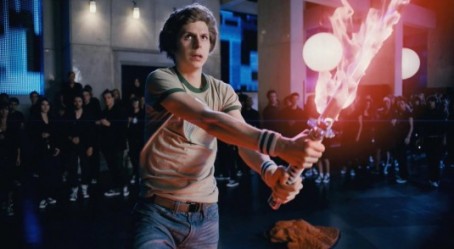
“Scott Pilgrim vs. the World” is a movie based on the popular graphic novel of the same name. I guess it could be described as a satire—not only of the graphic novel, but of comic books, video games, and all graphic novels. This movie was brought to the screen by Edgar Wright, whose previous films were “Shaun of the Dead” and Hot Fuzz,” and he specializes in this sort of satire. There are quickly paced editing in non-action sequences, good pacing, great comedic writing, and then there’s the action itself. These action sequences blend comic books, graphic novels, and video games into one and the result is outstanding. Scott Pilgrim and his opponent face each other in exaggerated (but very funny) manner, then they fight—they jump high through the air, freeze when necessary, punch and kick each other even harder than you can without getting seriously injured, and when the opponent is defeated, he explodes into coins (points you would receive when playing a video game for an extra life). Scott has to do the same thing multiple times in this movie.

OK, I’m praising the action a bit too early. Let’s just talk about the plot to “Scott Pilgrim vs. the World.” Scott Pilgrim is a 22-year-old Canadian currently dating a Chinese high school girl named Knives Chau (Ellen Wong). Scott plays in a hardcore rock band called Sex Bob-omb and lives with a gay roommate (Kieran Culkin, sort of overdoing it with the gayness, but mostly funny). He has fun with Knives at first, but he starts to get a little tired of it. Enter New York transplant Ramona Flowers (Mary Elizabeth Winstead). To Scott, this is the coolest girl in the world. She’s a tough babe sporting leather jacket and boots, as well as changing her hair color every week. Ramona tells Scott that they can date if he can fight and defeat her “seven evil exes.” And just like that, the battles begin!

These action sequences will relieve those who were disturbed by the graphic realistic violence in this year’s earlier comic book superhero-satire “Kick-Ass.” In that movie, you knew that there really were people becoming part of a bloodbath. With “Scott Pilgrim vs. the World,” it’s different because this movie does not take place in reality (I don’t think). It’s exaggerated, fun, hilarious, and amazingly done so that we don’t feel disturbed. Good casting composes of Brandon Routh (the previous Superman) and Chris Evans (the Human Torch) as two of the evil exes.

Oh, I cannot believe I forgot to mention the actor playing Scott Pilgrim. Well, it’s Michael Cera, who has great deadpan comic timing, which he proved so with the TV show “Arrested Development” and with the movies “Superbad” and “Juno.” Recently, he hasn’t been in a good movie since “Juno,” in my opinion. I didn’t like “Nick and Norah’s Infinite Playlist,” “Year One,” or “Youth in Revolt.” The material just wasn’t there for him. Here, Michael Cera feels right at home, oddly enough. His deadpan comic personality fits right in with the video game/comic book scenarios. He can seem like a sissy and he shows that he might be, especially when he has to break up with Knives so he can be with Ramona—“I think we should break up, or whatever…”

I laughed a lot at the non-action scenes, especially the “Seinfeld” satire (complete with music and laugh track). I liked the songs performed by Sex Bob-omb and how the movie kids with the video game elements (the Universal logo even gets the treatment). There are many overly edited bits that are just plain funny. And there is an action sequence that I couldn’t help but laugh out loud with. It’s another one of the evil exes that Scott has to vanquish, in which Mae Whitman (recently co-starring in the TV series “Parenthood”) plays the evil ex (don’t ask). Diehard “Arrested Development” fans (like me) may recognize her as Michael Cera’s “Arrested Development” character George Michael’s girlfriend Ann. Maybe I was just having my own imaginative battle while watching this particular one, but watching George Michael and Ann fight in an overly-exaggerated action sequence just made me laugh out loud.

I have a couple of criticisms—one somewhat obvious and one somewhat personal. The one personal criticism, just to get it out of the way, is that I would have loved to see more of Anna Kendrick as Scott’s younger sister. Anna Kendrick is a go-to actress for any movie, even if it’s just a small part for her. She has that gutsy, witty attitude that I just can’t resist. I think she’s criminally underused here. An obvious criticism—seven evil exes just seems like too much. The movie stretches out a bit too long. Maybe it would’ve been better if Ramona just had five evil exes.

I would probably take “Scott Pilgrim vs. the World” over “Kick-Ass.” Over “Sky High?” Well, maybe. This is a crazy and exaggerative but hilarious and awesome movie. I haven’t read the original graphic novel of the same name, so I can’t make comparisons. On the film adaptation, however, it’s a fun ride to take.
Hot Tub Time Machine (2010)

3 Mar

hot_tub_time_machine_a_l

Smith’s Verdict: ***

Reviewed by Tanner Smith

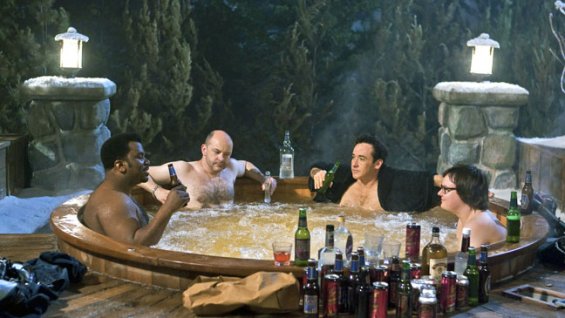
Four men from 2010 have just discovered that they are in 1986. They believe that the hot tub they partied in is the cause of this. How does one of them consider this phenomenon? “It must be some kind of…hot tub time machine.”

That line in the movie aptly titled “Hot Tub Time Machine” is said directly to the camera, almost as if saying, “I know it sounds crazy. Just go with us.” That kind of confidence (I really believe that’s how the line was implied to turn out) is what makes “Hot Tub Time Machine” not as bad as it may sound. The filmmakers take chances with this premise and the actors have fun with it.

“Hot Tub Time Machine” is a cross between “Back to the Future” and “The Hangover” (with a hard R rating). Four men take a road trip to recapture their youth, and after stepping into the hot tub time machine, they find they are now living their youth in the mid-80s. While there, they try to have some fun, but also discover that they were just as miserable then as they were in 2010.

The friends are miserable enough. First, there’s Nick (Craig Robinson from TV’s “The Office”), a dog groomer whose wife is cheating on him. Then, there’s Adam (John Cusack), an insurance salesman whose wife just left him because he’s a bit boring. Then there’s Lou, the worst of them. He’s a party animal who may be suicidal. He lives too much in the past and never stops with the constant partying and ranting. Nick and Adam decide to bring Lou to the ski lodge they messed around at when they were young and having fun. Along for the ride is Adam’s 20-year-old nerdy nephew Jacob (Clark Duke), much to Lou’s anger.

When they find themselves back in 1986, looking the way they did back then (Jacob looks the same because he wasn’t even born then, although he flickers at some points that require it). They have to relive the events that occurred when they originally lived it—breakups that end in pain (for Adam, that pain comes from being stabbed in the eye with a fork) and concerts (Nick was a musician) that may go wrong. In the meantime, the hot tub time machine is being fixed by a mysterious fix-it guy, played by Chevy Chase. But trying to relive these events is harder than they imagined but funnier to us.

Lou supplies most of the film’s raunchiness and vulgarity. He’s played by Rob Corddry, who was previously seen in “Harold and Kumar Escape from Guantanamo Bay,” a film I hated (Corddry’s over-the-top performance in that movie didn’t help much either). I recall writing my review for that movie and stating that Corddry’s well-done yet ultimately sleazy and nasty performance as that movie’s main racist villain should have received a punch in the face for being so unlikable. He barely redeems himself here, stealing every scene he’s in (give or take about 3 or 4). It is possible to dislike this guy as Lou, but once you’ve gotten into the mood of the movie like I have, you come so close to forgiving him. OK, Corddry, you’ve gotten away with it this time.

The film is alive and supplies two terrific running gags. One involves a squirrel (I wouldn’t dare give away the surprise) and the other involves Crispin Glover as a bellman who has only one arm in 2010 but both arms in 1986…but it doesn’t seem like his arm will last long. This is a great running gag; many accidents happen in which the man may have lost his hand. If and when he loses it in their time period doesn’t matter. I laughed loudly. I also laughed at many of the complicated occurrences, such as when Jacob meets his future mother, who is a horny slut, and also funny are the pop-culture 80s references. There’s a great cover of “Jesse’s Girl,” a retro look at the ski lodge, and a ski patroller who believes the time travelers are actually Russian spies and that their energy drink-can is actually a bomb. Oh, and there’s a cameo by William Zabka (the bully from “The Karate Kid”).

John Cusack is good, but then again, he usually is. Craig Robinson and Clark Duke are great deadpans and strike the right notes in their performances—they’re very funny. It all comes back to Rob Corddry, who practically steals this movie. Like I said, he’s very easy to dislike and I’m willing to let him slide for this movie. After all, he just wants to be funny.

Oh, and there’s Chevy Chase as the mystical hot-tub repairman. I really didn’t find him very funny or effective at any point of the movie. He doesn’t even serve much of a purpose—he just shows up, winks at the audience, and that’s it. Worst of all, like I said, he’s just not very funny.

I enjoyed “Hot Tub Time Machine” for its quirkiness, its comedy, and its vulgarity in the right places. It’s not for everyone. Certainly not for people offended by the f-word (said probably more than 200 times here) and definitely not for people who think the whole idea of a hot tub time machine is lame.

I Love You, Man (2009)

2 Mar

alg-i-love-you-man-jpg

Smith’s Verdict: ***

Reviewed by Tanner Smith

I’m going out on a limb here having to explain the details of a “bromance.” A “bromance” is a special platonic relationship between two men who not only see each other as best friends, but also as brothers (or “brothers-from-other-mothers”). When it comes to movies, we’ve had plenty of male-bonding/”buddy” movies, but “I Love You, Man” is billed as the first “bromantic”-comedy to be released. This means there’s more emotion to the guys than just being buddies, and it’s like a romantic comedy, but without the sex.

Peter Klaven (Paul Rudd), a real-estate agent, is engaged to marry his adorable, loving girlfriend Zooey (Rashida Jones). But as they start to prepare their wedding, they draw a blank at the position of “best man.” Peter realizes that while he gets along great with women, he has never had any male best friends. He’s one of those guys who has had more longing relationships with women than men. Even his dad (J.K. Simmons) and brother Robbie (Andy Samberg) are that close to him, though the two are best friends with each other. So Peter decides to search for a new best friend in the way that one would search for a romantic partner—“man-dates.” These don’t work, and in the film’s funniest scene, a candidate played by Thomas Lennon may seem like the right guy but…just wait and see.

At an open house (Lou Ferrigno’s house up for sale), Peter meets Sydney Fife (Jason Segel) and they hit it off pretty well. Sydney’s a beach bum (who invests every now and then) who likes nothing better than to hang out and do stuff when he’s not lazing about in his “Man Cave,” a separate garage beside his house. Peter and Sydney start hanging out together—they both love the band Rush, they’re honest with each other, and their friendship grows…while Peter’s relationship with Zooey is being questioned.

I had a friend like Sydney. He’s the kind of guy that in many ways is not the right friend for you, but in most ways, he’s the friend that kind of helps boost your self-esteem because he does the things that guys only think about. He just likes to have fun and wants to share it with you. Peter needed a Sydney to balance out his well-organized (albeit boring) lifestyle, especially to boost his own self-esteem. You see, Peter is, with all due respect, a loser. He fails at imitations (he always winds up with an Irish accent), comes with up strange nicknames that don’t make any sense at all, and tries unsuccessfully to deliver jive-talk wisecracks to fill in awkward pauses. He may have a Zooey in his life, but he needs a Sydney.

Paul Rudd as Peter and Jason Segel as Sydney are both likable and play well off one another. You really buy these two as best friends. Of the supporting cast, Rashida Jones is lovely and gamely comedic as Peter’s fiancée, J.K. Simmons and Jane Curtin do nice work as Peter’s parents, and Jon Favreau and Jaime Pressly are hilarious as the married couple from hell—the couple that argues constantly that is not only a funny running gag, but also a clever, subtle message about finding the right partner (romance or bromance, doesn’t matter). Andy Samberg, as Peter’s gay brother who helps set him up on man-dates in the earlier scenes, is basically a one-joke caricature, but he has a few funny lines as well. Thomas Lennon, though his role is short, is freaking hilarious. His voice and mannerisms reminded me a lot of Bill Murray and I mean that in the best possible way.

But wait, how’s the humor? This is after all a comedy and “I Love You, Man” even has this premise that would have fit in a sitcom. And as a result of a funny script, there are many funny one-liners, some shock-value chortles, character-based jokes (such as what goes on inside Sydney’s “Man Cave”), and a great running gag about Lou Ferrigno that is probably best left from this review. However, there are some gags that are hit-and-miss, that leave a trail of awkwardness because there’s hardly a way to recover from them. You have to wait for the next one. And there are also a few jokes that are almost too self-referential that you wonder if Judd Apatow was involved in this project. For the most part, though, “I Love You, Man” is a well-executed, funny, feel-good “bromantic” comedy with engaging performers and surprisingly something sincere to say about relationships.

Shanghai Knights (2003)

2 Mar

shanghai-knights-1

Smith’s Verdict: ***

Reviewed by Tanner Smith

“Shanghai Knights” is the sequel to the 2000 comedic Western “Shanghai Noon,” teaming up kung-fu expert Jackie Chan with smooth-talking, surfer-type Owen Wilson. That film was a modest success, with mainly the likable presence of both actors to make the film consistently entertaining. “Shanghai Knights,” three years later, brings Chan and Wilson back for another crazy adventure, but this time is different in these ways—the film moves to London, England, there are a lot more choreographed fight sequences, and the humor comes from all sorts of historical inaccuracies that recall moments from “Bill and Ted’s Excellent Adventure.” As a result, “Shanghai Knights” is a bit of a mess. It’s dumb and tries too hard at certain points when it loses consistency from the rest of the movie. However, it is also cheerfully goofy and quite funny. Chan and Wilson remain as likable as in the previous film, but also, “Shanghai Knights” delivered more stupid laughs from me than the predecessor did, which I liked fine.

I suppose I should start with the plot, which is arbitrary to say the least. Chan reprises his role as Chon Wang (say it out loud), who is now a sheriff in Carson City, Nevada. (Although, what happened to his Native American wife in the original film is anyone’s guess.) Someone has murdered Chon’s father—the guardian of the Great Seal of China— and Chon hears of the tragedy from his sister Lin (Fann Wong), who has tracked the murderer to London. So Chon goes to team up with his old friend Roy O’Bannon (Wilson) and together, they travel to London to find the culprit and…

Do you even care about the plot? No. Do you get nervous about the tight spots in which Chon and Roy get involved? No. “Shanghai Knights” is merely a source for mindless entertainment. It’s just a setup for comedy, action, or sometimes both. There are many fight sequences in the movie that are choreographed as if they were musical dance numbers (of course, the instrumental score helps to keep the moves in sync). My favorite is a sequence in which Chon is fighting off a gang of thieves in Fleet Street and grabs ahold of an umbrella—cue the “Singin’ in the Rain” music! These sequences are fast, amusing, and just a ton of fun.

It makes things better that Chan does most of his stunts. At least, that’s what I’m assuming, since the outtakes reel at the end show Chan messing up on certain stunt work (though, not terribly). Fann Wong, as Chan’s sexy sister whom Wilson of course becomes interested in, has some feisty moves as well.

Most of the gags come from the use of locations in royal olde England and characters in English literature. We have gags involving an encounter with Jack the Ripper, a visit to Buckingham Palace (they make fun of the royal guards—they don’t like to be touched), and a close call on the minute hand of Big Ben (a la Harold Lloyd). Also making appearances are Charlie Chaplin and Sir Arthur Conan Doyle, and Sherlock Holmes also makes his name known. Neither are those are meant for any type of historical accuracy. The filmmakers know they’re making a silly movie with these references and they just have fun with them. (So what if they add some 1960s pop songs that don’t fit at all?) And I also appreciate the main portion of “Shanghai Knights” takes place in London for evil plotters to make their schemes and moves.

Chan and Wilson are appealing, as is the whole movie. It’s dumb, silly, and thoroughly enjoyable all the way through. Even in the blooper reel, I was cracking up. It shows that the people involved in the making of this movie were clearly having a great time.

Fear (1996)

2 Mar

fear4big

Smith’s Verdict: ***

Reviewed by Tanner Smith

“Fear.” What a generic title if I ever heard one. You could give that title to any thriller and it’d make about as much sense. It’s a thriller, it’s a horror film, it acts upon fear. There has to be a better title than…”Fear.”

Now that I’ve got my issues with the title out of the way, I’ll state right away that “Fear” is a well-made thriller that fits into the class of deceptive-individual movies. Those are movies in which a character is introduced as a nice person for the other character to befriend and interact with, and then by the end of the movie, that person will have tried to kill the other person after revealing his or her true nature. There’s a whole list of them—“Firstborn,” “Fatal Attraction,” “Single White Female,” “The Hand that Rocks the Cradle,” “Unlawful Entry,” all of which follow the same formula. “Fear” still manages to succeed due to craftsmanship and conviction.

“Fear” takes its time to develop the characters so that it’s all the more troubling when things inevitably don’t turn out to be as they seem. Instead of the antagonist being the most interesting character, as most of these movies go, the protagonists are set up in an interesting way so that we grow to care about them and root for them when things get ugly.

16-year-old Nicole Walker (Reese Witherspoon), after living with her mother for most of her life, is now living with her father Steve (William Peterson), his second wife Laura (Amy Brenneman), and their son Toby (Christopher Gray). As to be expected, she doesn’t quite like this adjustment. The problems with this family are developed in a credible way, with tension and partial dysfunction.

While at a rave with her best friend Margo (Alyssa Milano), Nicole meets an older, gentle guy named David (Mark Wahlberg), who seems like the perfect boyfriend. He’s a nice guy, he respects her wishes, he doesn’t pressure her into sex, and says and does everything right. Nicole falls for him, and Laura sees him as a nice guy for her stepdaughter to date. But Steve, on the other hand, has his suspicions. To him, David just seems too right. And when David starts to show signs of his real (dangerous) personality, and Nicole comes home with a black eye, it becomes clear that David is not the nice guy that Nicole fell for.

This was Mark Wahlberg’s first real chance to handle a difficult acting lead role after his former fame as the rapper Marky Mark. As David, Wahlberg delivers a genuinely unnerving performance in the way he switches back and forth from kind and earnest to psychotic and furious. It’s like you can actually hear the ticking of the timebomb about to go off in his mind. As for the other actors, Reese Witherspoon is very convincing as the innocent, corrupted Nicole; William Petersen does strong work as the father trying to protect her; and Amy Brennerman is fine as the confused parent in the mix.

“Fear” doesn’t offer that many surprises, but it is well-acted and effectively creepy. It sets up the characters in interesting ways and plays the story from the sympathy we gain for the protagonists, so that the horrific moments really mean something. Everything builds up to an inevitable climax in which David and his friends attack the house with the family inside. It’s standard, but offers a few surprises as well. “Fear.” Boring title, nicely-done thriller.

Rise of the Planet of the Apes (2011)

2 Mar

images

Smith’s Verdict: ***

Reviewed by Tanner Smith

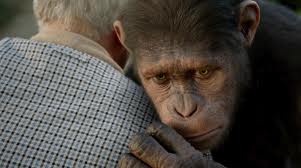
I’ll admit I was never really interested in seeing this movie. I mean, what can be done to create the origin story of “Planet of the Apes?” We all know what’s going to happen and we know things are going to work out terribly for us human beings so that primates can rule the world. However, “Rise of the Planet of the Apes” (which should simply have been changed to “Rise of the Apes”) finds a way to beat that problem. The result is a sometimes-silly, sometimes-scarily-effective B-movie.

“Rise of the Planet of the Apes” isn’t the first movie to feature an animal as the main character, however it is the first movie to treat the animal as an actual main character. This animal—a chimpanzee named Caesar—is actually thoughtful, feeling, and self-aware. Caesar was born to a mutated laboratory ape which was injected with an experimental gene-therapy drug created by scientist Will Rodman (James Franco). The drug was invented as a possible cure for Alzheimer’s disease and was tested upon the chimp to see the effects. With the ape taken away after a rampage (caused by a side effect), and now that the experiment is shut down because of it, the chimp’s baby—Caesar—was secretly left in the care of Will.

As years go by, we learn that Caesar has inherited his mother’s genes and has exhibited human intelligence and understanding. The early scenes featuring Caesar adapting to the world, being what he is, is done quite effectively, especially in the scene where he goes outside on his own for the first time and learns the bad side of humans (he scares a couple kids, whose father goes after him). And there’s another effective scene in which Will takes Caesar to a redwood forest park and discovers the meaning of “pets.” Will has to convince Caesar that he’s not a pet and he’s much more than that.

After Caesar hostilely defends Will’s father (John Lithgow) from an angry neighbor, Caesar is placed in an animal sanctuary, where he is with regular apes (chimps, gorillas, and orangutans). It’s a hard life that constantly eats at Caesar’s nature more and more until he finally decides to hatch a plan to turn the tables on man…

“Rise of the Planet of the Apes” takes a lot of its time building up to the inevitable climax—the beginning of the end, if you will—and that’s what really surprised me. We see a lot of this ape, and even more surprisingly, we understand his plight. I love movies that take its time to build up the story elements, so that when the payoff occurs, it really means something, as it should. It’s in the final half-hour that Caesar uses this drug to effect all the apes, escape their prison, run amok, and attack whoever tries to stop them. This sequence is as terrifying (though sometimes as silly) as it’s been built up to be.

Apes can be smart and friendly, but they can get bigger and quite vicious. With Caesar as this sort-of humanistic ape, if you will, it fits into the always-reliable allegory of who-is-man-and-who-is-beast. It’s the allegory that seems like an old friend that comes to visit in science-fiction thrillers, for the most part, and it’s welcome when it can experiment new territory.

Caesar is a very well-developed character. We experience the important elements of the story with him. A lot of credit for that has to go to the performance by Andy Serkis, who performs in the role of Caesar thanks to performance-capture and computer effects. Serkis has carried this sort of performance before as Gollum in “The Lord of the Rings” and Kong in “King Kong.” With Caesar, he can add himself as a special name in motion-capture animation history. Serkis gives the best performance in the movie.

The human performers more or less do what they’re required to do, and some of them are either useless or underused. James Franco is a little bland as Will, and that’s unfortunate considering that he’s practically the father of the apocalypse. Freida Pinto, as Will’s girlfriend, is essentially pointless other than just being the hero’s girlfriend. Tom Felton plays the nasty son of the sanctuary owner (Brian Cox, doing what’s required of his underwritten role), and his name is Dodge Landon (an in-joke referring to the original 1968 “Planet of the Apes” movie), but you might as well keep calling him Draco Malfoy. The best human performance comes from John Lithgow, heartbreaking as Will’s Alzheimer’s-diagnosed father.

“Rise of the Planet of the Apes” has its pleasures—an extraordinary use of CGI effects, a convincing animal protagonist, and some terrific sequences of real power—and for that, I’m recommending the movie. But one major problem I had with this movie was its ending. Not only does the story just come to a halt, obviously setting for a sequel (I guess the origin story isn’t enough to set up the events in the previous movies), but it delivers mixed feelings about what we’ve just seen—all this violence and anger, ending on a triumphant note. Is it supposed to be a happy ending? Watch the movie, watch the ending, and watch James Franco’s face as he observes this new “revolution,” and maybe you’ll see what I mean.

Frequency (2000)

2 Mar

frequency_2000_2

Smith’s Verdict: ***

Reviewed by Tanner Smith

Remember the scene in 1986’s “Peggy Sue Got Married” where Kathleen Turner’s character has just traveled back in time and was shocked to hear the voice of her dead grandmother on the telephone? That was a heartbreaking scene because it tapped into genuine emotions. What would you say if a dead relative—one that was very dear to you—was suddenly speaking to you again? What would you feel? Your heart would probably leap into your throat and you would probably want to cry for them.

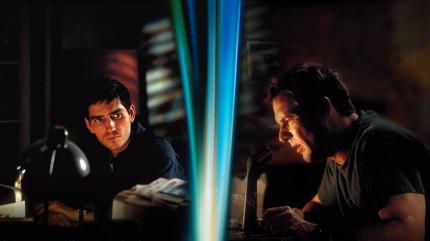
“Frequency” is a science-fiction film that plays that way. It’s about a man in 1999 who finds his late father’s old ham radio and finds he is actually able to talk to the father from the year 1969. It’s as if time is continuing 30 years ahead or behind, depending on which side you consider.

The man in 1999 is a cop named John Sullivan (Jim Caviezel). When he was six years old, in 1969, a warehouse fire took the life of his firefighter father Frank (Dennis Quaid). One night, John looks through his father’s old trunk and finds his father’s ham radio. The radio still works and John decides to try it out. But who calls him on it? A man who seems to be “lost in the past,” if you will. This man is Frank. He’s talking about the 1969 World Series, and John laughs about the games he saw then. Frank wonders what he means, since the first game had just started. But John knows something about the outcomes of the games.

It’s later revealed to both John and Frank that they’re talking to each other thirty years apart via this ham radio. It’s a miracle that seems to have occurred thanks to extraordinary solar activity (Aurora Borealis). It’s a big, unbelievable occurrence.

Like most films dealing with such oddness in time, like time-travel stories, John learns that time can be altered. On the day that Frank is supposed to die in that warehouse fire, John warns him not to trust his instincts for once and he won’t perish in the flames. It works—the present time has changed.

This must be somewhat complicated. In fact, there are certain things that I was a bit confused by. For example, John feels like he remembers the original timeline but still has new memories of the altered timeline. If he and Frank changed the future, wouldn’t John be an altered John? He probably wouldn’t remember the old timeline. Everyone else has changed; they believe that Frank died of lung cancer instead of a fire. But then again, I don’t think you ask those kinds of question in time-travel stories.

Then, things get even more complicated as it turns out that this change in time has set off a chain reaction for the new present. The film transforms into a murder mystery as John discovers that the infamous Nightingale Killer has taken ten victims instead of the original timeline’s three. And one of those victims is his own mother (Elizabeth Mitchell). So, Frank and John use information they gain from their own time periods to put pieces of the puzzle involving the killer’s identity in order to prevent the killings from occurring, thus changing time again and saving lives.

The entire second half of the movie is focused on this murder mystery, and at first, it’s quite intriguing in the way that it’s set up. But then it sort of grows tiresome and drags on when we’d much rather see more of the relationship between father and son, which is really the heart of the story. That’s why I’m recommending “Frequency.” There are a few plot holes and inconsistencies, but the premise of the film and this relationship between Frank and John is endearing enough to make me care.

Dennis Quaid turns in a terrific performance as Frank. He’s likeable, convincing, and quite a father too. Jim Caviezel as John is merely adequate, but he does sell those intense moments. Of the supporting cast, Elizabeth Mitchell is underused as Frank’s wife and John’s mother, but Andre Braugher is excellent as Satch, Frank’s best friend.

The science of “Frequency” shouldn’t really matter, as not much is made out of it. But the fiction is a true delight. It shows good family values with its engaging premise and the relationship between a man and his late father provides the film’s heart.

Horrible Bosses (2011)

2 Mar

charlie-day-jennifer-aniston-horrible-bosses

Smith’s Verdict: ***

Reviewed by Tanner Smith

“Horrible Bosses” does indeed feature three horrible bosses—bosses that go beyond the very description and just venture into dreadful people entirely. There’s a sadistic psychopath, a vicious sexual predator, and a coke-addicted tool. Those are the three “horrible bosses” of three underappreciated friends who would like nothing more than to kill them and end their misery. And “Horrible Bosses” is a movie with that very premise.

Cheerfully macabre, “Horrible Bosses” is an effectively comedic version of “Strangers on a Train,” and also following 1987’s black comedy “Throw Momma From the Train” (both films are mentioned by the characters in this movie). The guys want to kill their own bosses, but they realize that they each have their own motives. So they all agree to kill each other’s bosses instead of their own.

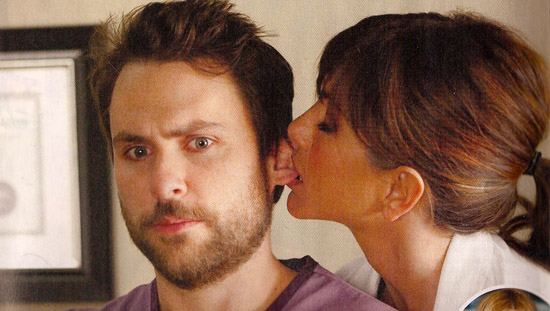
And trust me—these bosses are horrible people indeed. You have to praise the casting on this one. While the writing of the characters’ descriptions are suitably horrid in their favor in the screenplay by Michael Markowitz, John Francis Daley, and Jonathan Goldstein, the casting of the bosses must be given as much credit for bringing them to life and making us love to hate them. Kevin Spacey plays to his strengths as a disdainful sadist who loves to mess around with his middle manager Nick (Jason Bateman). Jennifer Aniston plays against type as a sexy dentist who wouldn’t know the meaning of sexual harassment if it came onto her as much as she does with her nervous (and married) assistant Dale (Charlie Day). Colin Farrell, a handsome guy who allows the makeup artist to make him look as repulsive as possible, plays Bobby, the cokehead son of Kurt’s (Jason Sudeikis) beloved employer (Donald Sutherland) who unfortunately dies at the beginning of the movie.

Nick, Dale, and Kurt don’t know anything about killing while covering up their tracks, and they’re not as sophisticated as they pretend to be. So they go to a rough bar, where they hope to hire someone to help them out. They come across someone they think is a hitman (whose name has undoubtedly inspired the MPAA’s R rating), played by Jamie Foxx. It’s his idea to have them swap murders. But first, they must do some reconnaissance, which involves breaking into their houses to find weaknesses of the bosses. Most of the laughs around these three come from bumbling about and only occasionally (and accidentally) doing something right.

Jason Bateman, Charlie Day, and Jason Sudeikis are reliable comic actors (though Day can occasionally become obnoxious and unbearably annoying), but their characters are not particularly well-written. The characters aren’t developed properly and there isn’t a great deal of chemistry among the three (mainly because Day has a tendency to make things a bit awkward). But they are individually funny enough for us to laugh at them, as well as sympathetic enough for us to root for them.

The final half is when things really start to heat up. Without giving too much away, things get even more sadistic, and funnier as well, as the Spacey character becomes less of a sadistic jerk and more of a psychopathic unstable mind. Spacey really sells it here.

“Horrible Bosses” has a good amount of gleefully vulgar moments, a few cheerfully stupid moments, and slick evil performances from Spacey, Aniston, and Farrell that makes for a funny hard-R-rated comedy. The movie has a wicked energy in its situation comedy that results in some big laughs. And who can look at Jennifer Aniston the same way again after seeing her as her crazy bitch of a character?

Brave (2012)

2 Mar

Brave-2012-movie

Smith’s Verdict: ***

Reviewed by Tanner Smith

“Brave” is an animated family movie that at first seems to go back to the traditional Disney princess material. But it’s far from that, for you see, the Scottish heroine Merida (voiced by Kelly Macdonald) is a princess, in the Viking era, but not the dim, usual damsel-in-distress who constantly needs to be rescued by a handsome prince. She’s actually a brave, adventurous, quick-witted, free-spirited tomboy who is great with a bow and arrow. It’s her mother—Queen Elinor (Emma Thompson)—who wants her to be the standard princess character. She doesn’t like the idea that Merida is…independent! Oh heaven forbid!

Merida is apparently at the age to be married, as Elinor decides it’s time to choose among three possible royal suitors. There are two problems, however. The first is, Merida doesn’t want to be forced into marriage—she isn’t ready, if only her mother would listen. The second is that all three suitors are bumbling idiots—one of which is an absolute weakling. After putting herself into an archery contest (saying she’s shooting for her own hand in marriage) and being scorned upon by her mother because of it, Merida hops on her trusty steed Angus and rides off into the forest, where she encounters some will-o’-the-wisps that lead her to a witch’s house (which looks like a woodcarver’s shed with many wooden bear figures around, but go outside then back inside and look what you get—I love magic). Merida offers to buy everything in exchange for a spell from the witch (Julie Walters) that will give her a different fate. The easy solution—give the mother a cursed treat that will change her mind about the marriage situation.

What happens to Queen Elinor is something that the advertisements have tried to keep hidden from the audience before seeing the movie, and it really ticks me off that the critics reviewing this movie are giving it away now that it’s released. I didn’t know what was coming when I saw this movie and it’s a good thing I read the reviews after I saw the movie. So I’m going to try and do the noble thing and just say that what comes after some magical occurrence leads to quite a troublesome situation that Merida has to deal with herself. And along the way, she learns that the relationship between mother-and-daughter is a strong one and in order to save the day, she and Elinor must rekindle their love.

“Brave” is the latest film from Disney and Pixar and while it’s not quite up there with “Finding Nemo” or “Up” (though to be fair, not all animated family films can be), it’s still a pretty entertaining film. It has a lot of funny moments, the characters are memorable, and as you’d expect from Pixar, it has top-notch computer animation. But it does bring about a personal disappointment for me, because this could have been great. For the first hour-and-a-half, it is pretty great. In the final twenty minutes, however, it resorts to one of those obligatory action climaxes that seem to come into place in family films that run out of ideas.

It’s strange too, because it seems like it’s saying, “Hey! You know that thing we do in the end of most family films nowadays? We’re not going to do that!” But once we get to a huge misunderstanding, it immediately tells us, “Psych!” and gives us a series of chases, fights, tears afterwards, and then a cheerful ending. I’m sure the makers of “Brave” could have thought of something better.

The characters are indeed memorable. Merida is a lot of fun as a teenage tomboy who fends for herself and is very spunky and quick-thinking. Her peg-legged, dim-witted-but-supportive, overweight Viking of a father King Fergus (Billy Connolly) is an absolute riot. Whether he’s going on about going after the gigantic bear that bit off his leg or constantly being used as a pawn in Elinor’s trickery to get Merida to the status quo, he’s just a ton of fun to watch. The three wild little brothers of Merida’s have been marketed like crazy, and deservedly so. These kids are just hilarious. They have little to no dialogue, so their facial expressions, body language, and just overall speed (whenever they sneak around the castle or run away after pulling a prank) take up most of their roles. Queen Elinor is a bit of a blank slate. But just what until you see what happens to her after she eats the cursed treat.

Do I even need to say how great-looking “Brave” is? I mean, it’s Pixar animation. Call me lazy, but it’s just pointless to talk about the visual creativeness of “Brave.” But if I had to point out some highlights, one prime example is a scene that has been used in every trailer, when Merida fires her arrow at a target with another arrow at the bull’s-eye (with Merida already a more-than-sharp shooter, the outcome is incredible). It’s a perfectly-animated moment. Another example is a slapstick comedy sequence in which Merida, with help from her brothers, has to sneak out of the castle while distracting her father and his buddies—the physical comedy is so well-timed, you can feel it off the screen. I know Pixar animation isn’t supposed to be known for its slapstick comedy visual gags, but this really was a treat to watch. I laughed and laughed.

“Brave” ends with a message of self-fulfillment and a mother and daughter finding common ground with each other. It’s sweetly-handled in the way that you can kind of forgive the movie’s flaws (aside from the standard climax, there are a few little inconsistencies in the story) and just enjoy “Brave” for what it is. It’s not one of Pixar’s best, but I enjoyed it nonetheless.

Con Air (1997)

2 Mar

con-air_1561256i

Smith’s Verdict: ***

Reviewed by Tanner Smith

“Con Air” is an energetic, thrilling action flick that delivers what audiences (and secretly, most critics) want from a film like this—absurd action, impressive pyrotechnics, over-the-top villains, a reckless good guy, and dumb, dumb, dumb authority figures. They always have to be dumb in these movies, don’t they? They never listen to the sensible one who knows what’s going on, and so that person tries his hand at helping to solve the situation with the hero.

But I digress. “Con Air” stars Nicolas Cage as the hero—ex-Army Ranger Cameron Poe, who has served eight years in prison on a manslaughter charge, after accidentally killing a man who threatened his pregnant wife). Eight years later, he is going home on parole to see his wife and meet his daughter for the first time. He and his prison buddy Baby-O (Mykelti Williamson) catch a flight, which also carries a load of the most deadliest criminals in America, on their way to a new Alabama prison. These sick thugs include the insane Cyrus “the Virus” (John Malkovich); black militant Diamond Dog (Ving Rhames); and 23-time rapist Johnny 23 (Danny Trejo) who hopes to make the female guard Bishop (Rachel Ticotin) his 24th. (“It would’ve been Johnny 600 if they knew the whole story.”) There are many more of these creeps on board, including intellectual-type serial killer Garland Greene (Steve Buschemi) who is quite the possibly the scariest man on the flight in his ways of looking at the world.

Unfortunately, they get loose, kill the guards hostage (except Bishop, who is now a hostage and the subject of Johnny 23’s taunts), and overtake the plane, with Cyrus in charge. Cameron and Baby-O pretend to be involved in the scheme, while Cameron tries whatever he can to secretly inform the authorities of what’s happening. Once word gets through, on the ground, we meet U.S. Marshal Larkin (John Cusack), a good guy who tries to resolve the condition peacefully, while a S.O.B. Federal agent (Colm Meaney) wants nothing more than to blow the plane out of the skies.

“Con Air” shares the common aspects that producer Jerry Bruckheimer’s (and his late partner Don Simpson’s) other action films had—fast editing, macho style, swift camera shots, and a booming soundtrack. While it’s not as smart or as intriguing as 1996’s “The Rock,” for example, the fun comes through and “Con Air” becomes a wild ride. Unfortunately, its weakest part is its final act, in which pure, nonsensical action completely takes over and becomes less interesting as the plane must ultimately land, and Cameron must finally square off against Cyrus.

What leads up to that is quite a kick, as action and comedy have an effective blend with each other. The criminals each have a sickly sardonic edge to themselves, and there are some grotesquely funny sight gags (including a corpse that falls from the plane and causes a traffic accident—and just when the driver had washed his car!). And how about those one-liners, especially including Cyrus’ whisper to the psychotic Garland when he first meets him (“You’re your work!”). There are also real moments of tension, when the criminals are so close to getting caught or when Cameron is almost given away one time too many. And I don’t even want to bring up the sequence in which a little girl may or may not become Garland’s latest victim.

The actors are game for their roles. John Malkovich is very menacing as the insane, predatory Cyrus the Virus. Among his backup, Ving Rhames is suitably nasty as Diamond Dog who plans to make his move against Cyrus soon enough. Steve Buschemi is absolutely mesmerizing as Garland Greene, the serial killer with reason and a soft voice that makes him even creepier—this character could have been just a cardboard cutout version of Hannibal Lector, but Buschemi makes it his own. John Cusack is game for his role of second-hero (though most of his role requires a lot of desperate shouting over the phone).

Also, Dave Chappelle, as a convict nicknamed Pinball, has some very funny lines that we’d like to expect from the great comedic actor.

I didn’t forget to mention Nicolas Cage as the hero Cameron Poe. But he is admittedly one of the least interesting parts of the movie. As much fun company he was as the hero in “The Rock,” here, he just seems rather bored and would rather be somewhere else. I understand that’s what any good-guy would feel like in a situation like this, but you know you’re in trouble when Steven Seagal is more exciting in “Under Siege” than Nicolas Cage is in “Con Air.” He’s not charismatic, nor is he very convincing with his too-thick Southern accent.

That aside, “Con Air” is a neat series of action scenes, witty dialogue, and I cannot believe I forgot to mention lots of explosions! And need we forget that while Cyrus’ cohorts walk away from explosions in an abandoned air field, Cyrus alone is man enough not to look back? Well, there you go.