Archive by Author

Spider-Man (2002)

4 Mar

Spiderman-Kiss

Smith’s Verdict: ***

Reviewed by Tanner Smith

Every superhero must have an origin story and “Spider-Man” is an intriguing one. Spider-Man, of course, is the popular superhero from Marvel Comics. As many of his fans will know, Spider-Man is young Peter Parker when he’s not saving lives. This first film adaptation of the comics tells us how Peter Parker became Spider-Man. The result is quite entertaining.

The best thing about “Spider-Man” is the casting of Tobey Maguire as the hero. I’m not sure they could have picked a better young actor to make Peter Parker likable and convincing (except maybe Jake Gyllenhaal). Peter is a nerdy high school senior who hardly gets any respect. His best friend is Harry Osborn (James Franco), the underachieving son of rich scientist Norman Osborn (Willem Dafoe). And his crush is Mary Jane Watson (Kirsten Dunst), who lives in the house next to his Aunt May (Rosemary Harris) and Uncle Ben (Cliff Robertson). Oh yeah, and she’s currently dating Harry.

One day on a school trip to a lab at Columbia University, Peter is bitten by a spider of unknown species. That’s when things really start to change. He develops arachnid powers. He can see without his glasses, he is suddenly strong, he has spider-like reflexes, he can make webs appear out of his hands, he can climb walls, and he has amazing agility. At first, Peter wants to use his powers for personal gain (fighting a wrestling match for three thousand dollars so he can buy a car to impress Mary Jane—he wins the fight, but he gets conned). But after a serious tragedy occurs, Peter learns that “with great power comes great responsibility.” He creates a suit suitable for his powers and becomes New York’s arachnid superhero Spider-Man, fighting crime and rescuing people in need.

But it wouldn’t be a full superhero movie without a villain to develop powers coincidentally as Peter gets used to his own. Norman Osborn has been creating a new kind of energy source for superhuman strength and a jet-powered one-man glider. But something goes very wrong and Norman develops a sort of “Jekyll and Hyde” double personality. Norman is constantly controlled by something strange and sinister (I don’t know what—the movie calls for a certain suspension of disbelief). He becomes the Green Goblin, complete with that same glider and a horrific-looking metal suit. This is where the movie actually starts to falter.

The first half of the movie is better than the second. It’s so much more interesting to see Peter learn to use his powers accurately (or as accurate as can be). He stands up to the school bully and has enough confidence to have occasional conversations with Mary Jane. But more importantly, he learns that because he has these amazing powers, he has to use them responsibly. The second half is full of action and there are times when I could tell a CGI Spider-Man from a live actor, mainly because at times, Spider-Man moves almost like a cartoon character than a flesh-and-blood hero.

“Spider-Man” was directed by Sam Raimi, who also made the superhero tale “Darkman,” as well as the “Evil Dead” movies. He has fun giving the characters comic-book reactions to Peter/Spider-Man when something amazing happens. How can you not like the moment when Peter quickly rescues Mary Jane after she slips over some apple juice split on the cafeteria floor? He’s able to catch all the condiments on Mary Jane’s lunch tray before they drop to the floor so that Mary Jane can say, “Wow—great reflexes!”

I did enjoy Willem Dafoe’s “Jekyll and Hyde” persona, but as the Green Goblin, he’s not an effective villain. Take the scene where he makes himself known for the first time—in appearance, he looks like he would fit in through an episode of “Power Rangers.” And when he goes over the top, he really goes over the top, although his manic persona does cause a few good laughs.

One of the best things about “Spider-Man” is surprisingly not the action sequences, but the more quiet, simpler scenes that are touching, memorable, and great to watch. Peter’s talks with the supporting characters and the kiss between Spider-Man and Mary Jane are among those (that kiss is the most memorable—he’s upside down and she’s standing in the street, she takes half of his mask off, revealing his mouth and chin, and kisses him). Also, Peter and Mary Jane make a cute couple. But since Mary Jane is someone Peter really cares about, that puts her in more sticky situations than Lois Lane.

I want to say more about Tobey Maguire—he’s brilliant in this movie. He has never, to my knowledge, turned in a bad performance. As Peter, Maguire brings a lot of appeal and emotion depth. He never seems to be overacting. He takes the situation how any average teenager would react if he discovered he was half-spider. We are with Peter throughout this movie and we care for him. Also in times of tragedy, Maguire doesn’t hit a wrong note. I think Tobey Maguire is a part of perfect casting. Kirsten Dunst is suitably spunky as Mary Jane. James Franco, however, is a bit stiff as Harry.

“Spider-Man” is not one of the best superhero movies. But I am giving it three stars because I was intrigued by the origins of Spider-Man and the casting of Tobey Maguire as Peter Parker. You can enjoy it for what it is.

First Blood (1982)

4 Mar

sylvester-stallone-first-blood-431x300

Smith’s Verdict: ***

Reviewed by Tanner Smith

“First Blood” is a movie about a Vietnam vet/war hero who fights in a new war—this time, in the woods outside a small town against its police force. That premise alone sounds like it’d make an intriguing action film while also making for some legitimate drama, and for the most part, “First Blood” succeeds. Sure, there’s implausibility in many of its stunts and tactics, but they work mainly because Sylvester Stallone, acting as the hero, makes it work. Already making his mark as the physical-type title role in “Rocky,” Stallone also made his mark as one of the great physical actors. In “First Blood,” we can believe that he can escape an entire police force in their station simply because he wills it. That leads to the chase outside of town, into the woods, and into a situation he shouldn’t be able to escape. Even that, no matter how implausible it is, seems believable enough because that’s how Stallone plays it.

Stallone is easy to catch our attention in “First Blood”—he owns the screen. He plays John Rambo, a drifter who is also a returned Vietnam veteran that we learn later has experience in survival. He’s just passing through a small town, hoping to meet one of the people from his troop only to discover that he died of cancer. Realizing he’s the lone veteran in his troop, he walks sullenly through town. However, the local sheriff Teasle (Brian Dennehy) is suspicious of him. He stops Rambo and gives him a ride to the town limits, hoping he’ll go away and non-subtly hinting that “his kind” aren’t welcome in this town. But Rambo doesn’t want to leave just yet without getting something to eat, and Teasle places him under arrest.

This is where things get pretty intense. Rambo’s interrogation is not handled well and the cops’ behavior evokes painful memories from his experiences in Vietnam, so Rambo escapes and makes his way outside the town and into the forest, with the police force in pursuit. However, what they didn’t count in was Rambo’s resourcefulness. He’s able to make things miserable for these people, and he does this because they deserve what they get coming to them. He wasn’t even a threat to them before, and yet they treat him as such. Even when Rambo unintentionally kills one of them and tries to give himself up so no one else will die, they continue to open fire at him. Sheriff Teasle will not let it go, but Rambo’s skills turn out to be too much for his men. And so, the military arrives, led by Rambo’s former commanding officer in Vietnam, Colonel Trautman (Richard Crenna).

The first half of “First Blood,” in which Rambo lives off the land and uses his skills to nab the hunting police, is well-done. We feel sympathy for Rambo and anger for Teasle and his men. We want Rambo to give it to these jackasses. There are many ways Rambo is able to outsmart them—even by camouflaging himself (in a hurry, I’d guess) in the green so he can strike and then sink back into invisibility.

But the second half has its problems. For one thing, the action isn’t as intense or even as interesting as two other main elements it has to it. One of those two elements is the character of Trautman, whose loyalties are in question. He wants to help the man he trained into this fighting machine, but at the same time, he’s in charge of those looking to bring him down as Rambo starts his own war with them. This is intriguing irony and makes for some good moments. The other element that I felt was very strong was Rambo’s final speech to Trautman about how he’s haunted by his nightmares of Vietnam, but will never survive in this society because of what he was taught. He feels like he belongs in a world of war, not in a peaceful society. That’s a powerful speech, but it was followed by an action sequence that wasn’t particularly well-done as Rambo finally raises all hell on the town. It’s not that it isn’t shot right or anything, but it’s that it’s mainly just executed as a bore, especially compared to the stimulating first half.

Mostly though, “First Blood” is a good movie. It’s not merely about an action hero walking around, kicking ass. It’s about something more than you’d expect from hearing about it—how one chooses to live through one society after the nightmares conveyed by the past. It’s treated with more intelligence than you’d expect. Stallone’s great, but also, Richard Crenna is strong and Brian Dennehy plays the sheriff character as so hateful that you anticipate his comeuppance. “First Blood” is a well-acted, well-paced action film.

One on One (1977)

4 Mar

628x471

Smith’s Verdict: ***

Reviewed by Tanner Smith

“One on One” is a sports film that is utterly predictable, but has its heart in the right place. It’s a feel-good comedy that is quite engaging, getting past the clichés seen in most sport movies. If the story of a small-town jock making it into a big-city university and hoping to win the girl of his dreams sounds familiar, it basically is. It’s a reliable formula that audiences are interested in. Audiences can guess (and mostly guess correctly) who will the big game at the end of s sports film, but it’s the journey that leads up to it that really matters most. “One on One” is a good movie—it’s well-acted, funny, and has a good sense of its environment, particularly when the environment is a basketball court.

Robby Benson, who co-wrote the screenplay at age 21 with his father, portrays the protagonist, a small-town, high school basketball player named Henry Steele. He’s a shy, naïve teenage boy with wide eyes, certain gullibility, good nature, and, of course, great skills in basketball. He’s only 5 feet 10 inches, but the coach from a big university thinks he could use him. The coach grants him a scholarship (and a new car), which Henry accepts.

Henry is welcomed into the system and is given a tutor, an alumnus big brother, and a spot on the team. His tutor is a cute young woman named Janet, played by Annette O’Toole with great appeal. In this film, O’Toole shows a remarkable screen presence and an appealing personality so that when Henry surely falls in love with her midway through the film, we don’t doubt it. Their scenes are the best thing about “One on One.” They’re played with soft humor and genuine sweetness. At first, this naïve kid doesn’t know how to feel around this cute grad student. But the next time they meet for a tutoring session, he impresses her—she says that he’s the first jock she’s met that has read “Moby Dick.”

Then later in the film, Janet breaks up with her boyfriend—a bearded professor for whom she’s a teaching assistant—and gives Henry support off the court. As their relationship develops, she even asks him to move in with her. (I love how Henry silently mouths, “Wow!,” after being asked to move in with this gorgeous grad student,)

But there’s a problem—Henry, who started out playing well on the team, is playing lousily and it becomes revealed that that’s because he’s constantly thinking of Janet. At one point, his friend helps him by taking him to a party—this doesn’t go well and it leads to the coach’s secretary (Gail Strickland, very funny) making a pass at Henry…in a very big way, let’s just leave it that. Also, the same friend gives Henry some speed to make him play basketball with manic energy.

This leads to the coach (G.D. Spradlin) into believing he’s made a mistake in granting this kid a four-year sports scholarship. He asks Henry to give up the scholarship. Henry refuses, so the coach does many things to humiliate/hurt him. What do you call a guy like this, without typing a certain seven-letter word for “jerk?” Well, believe me—“jerk” isn’t enough to a guy as despicable as is portrayed in this film.

All I’ve mentioned is handled well. As predictable as this film can be, particularly with the final climax involving the big game, “One on One” is still sweet and funny. Robby Benson is likable in the main role, Annette O’Toole is engaging, and on top of this, the film’s message about not giving up isn’t thrown in your face. “One on One” is a nicely-done feel-good movie.

Captain America: The First Avenger (2011)

4 Mar

captain-america-the-first-avenger-movie-image-76

Smith’s Verdict: ***

Reviewed by Tanner Smith

“Captain America: The First Avenger” is the last piece of the superhero puzzle to give the general public yet another superhero to join as part of the Avengers. Knowing the Avengers from the comic book series, it was inevitable that a “Captain America” film had to be released among the two “Iron Man” movies, “The Incredible Hulk,” and “Thor.” After that, we would have to wait for “The Avengers.” So, it would seem like this would be more of a bland requirement than a real movie. But having different people work on these films works as an advantage.

“Captain America: The First Avenger” is a real movie. It has setups, payoffs, action, adventure, characters, and another superhero origin story. Yes, it has a great share of CGI action sequences and it can get pretty silly at times, but it’s far from an incomprehensible mess. It has real production value, a nice weight to the story, and a hero we care about and root for.

The reason the film is subtitled “The First Avenger,” even though it’s the last entry before “The Avengers,” is because its main story occurs during World War II. How Captain America is brought to life in the modern-day is comic-book logic (obviously not a spoiler), but as long as I don’t get to see that annoying eyepatch-sporting Samuel L. Jackson character giving yet another ominous warning of something big to come, I’m fine. (By the way, I truly hate to dis Jackson, one of my favorite actors, for this.)

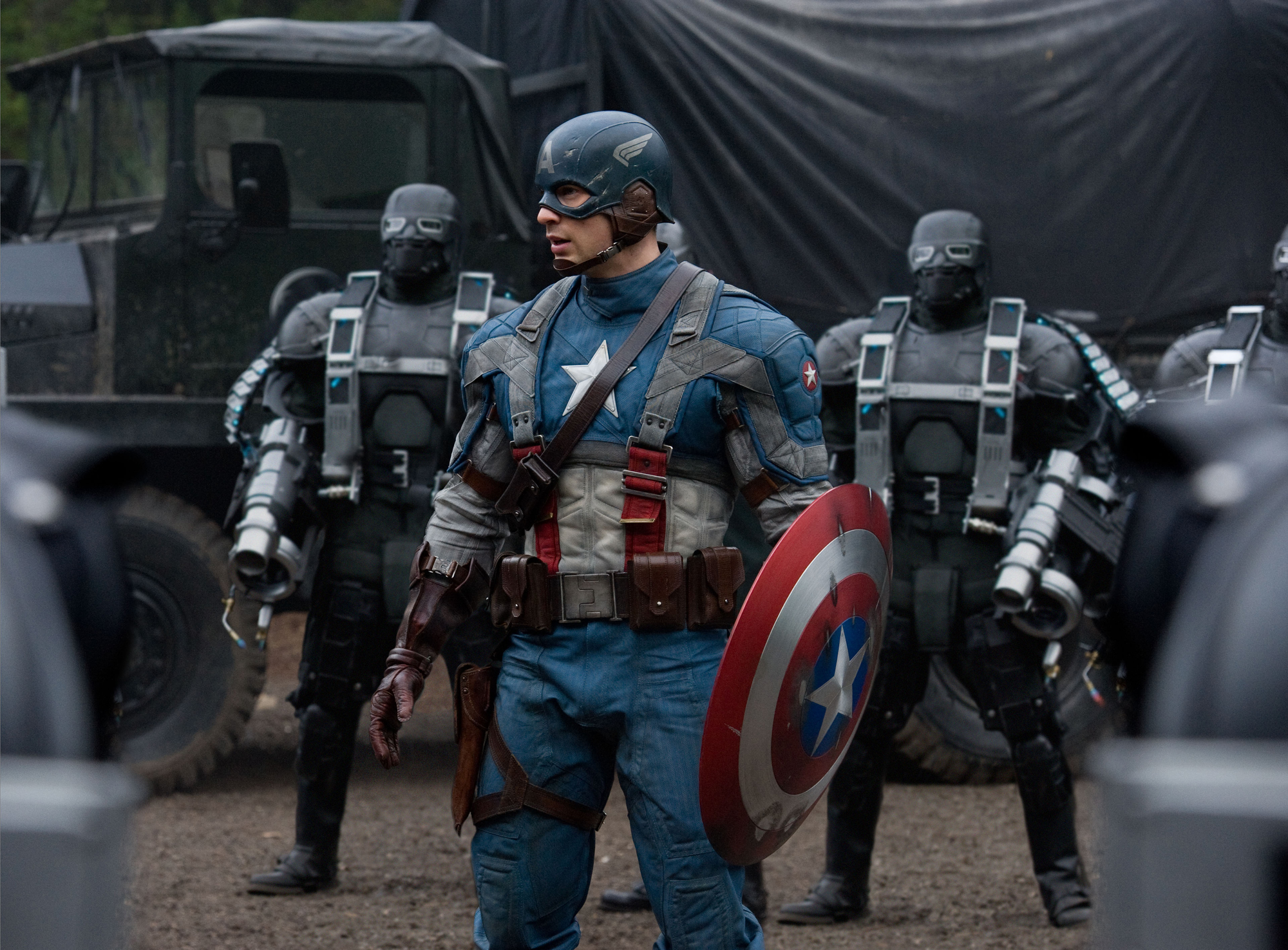
The story centers around a 90-pound, five-foot-nothing weakling named Steve Rogers (Chris Evans, much more appealing here than he was as one of the Fantastic Four). He’s a stubborn kid with a can-do attitude, but a tendency to get himself beat upon by bullies because he doesn’t run away from a fight. He gets rejected by the US Army, but after trying and trying, he eventually makes it into basic training. He’s usually the one slowing down from everyone else, but he seems like the perfect choice for the testing of a scientific experiment, supervised by a scientist (Stanley Tucci with a German accent) and Col. Phillips (Tommy Lee Jones, playing the always-welcome role of…Tommy Lee Jones), that will apparently enhance a weakling’s physical strength.

Admittedly, this experiment is pretty silly, as it’s described as making it so that your nature will come through to your physicality, so that if you have a good mind, you become great. Courageous Steve goes into the machine and becomes a strong supersoldier. He’s a foot taller, is very muscular, and is faster than most men alive. The Army gives him a silly costume, though a cool-looking shield, and markets him as Captain America, the great American hero.

The first half of the movie is pretty strong, as we get the origin story of Steve Rogers becoming Captain America. It’s nicely-paced, well-developed, and with some pretty darn convincing effects—the effects that make Chris Evans into a short, wimpy dwarf are incredibly seamless. The character is quite likable and his early dilemmas are engaging. He wants to do right, even if he doesn’t have the physical strength, and has a can-do attitude with the courage to go for it. When he becomes Captain America, there’s a nice sendup to the ‘40s war-time relief in which Captain America makes public appearances, complete with a cheesy song and female dancers. Other good things about the first half—Steve has a nice relationship with the sultry Agent Peggy Carter (Hayley Atwell); there’s a manufacturer character named Howard Stark (Dominic Cooper), whom we all know is Tony “Iron Man” Stark’s grandfather; and there are some pretty exciting action sequences, particularly one in which Captain America sneaks into enemy territory to break out prisoners of war.

The second half of the movie is exciting, yes. But it’s somewhat ordinary. We know the drill—more action sequences (though some good ones) and a final showdown between the hero and the villain. And that’s another problem with the movie—the villain. Honestly, I don’t remember much about him, nor did I care for what he was after. Give the over-the-top Loki in “Thor” some credit for being deliciously (and needlessly) evil. I’m not sure what Red Skull (Hugo Weaving) had in mind. I guess he had this secret society that was planning to use this McGuffin to rule the world, but nothing is as clear as we’d like it to be in our superhero movies. Also, this is where the pacing starts to become inconsistent—for a film with two hours of running time, there are many parts that felt rushed.

However, “Captain America: The First Avenger” has more pleasures than flawed faults. Comic book readers will be pleased and those who love superhero movies will find enjoyment from this. Director Joe Johnston (directing his first superhero movie since 1991’s “The Rocketeer”) creates a broad narrative that entertains and has waiting for more adventures of Captain America. And be honest—you’re even more excited when you stick around after the end credits and see another foreword about “The Avengers.”

Commando (1985)

4 Mar

commando-schwarzenegger

Smith’s Verdict: ***

Reviewed by Tanner Smith

“Commando” is an action flick that goes by every action cliché in the book—one-liners, explosions, chases, camouflage (that really doesn’t cover much), kidnapped children, and the Austrian muscleman himself, Arnold Schwarzenegger. This film does everything you can think of for an action picture and more. It’s silly…but it’s also a ton of fun. It’s an explosion-filled, shoot-em-up tale that is the key picture for a good time. It’s easy to laugh at all of the clichés, but I personally embraced them.

Schwarzenegger plays Col. John Matrix, a retired commando, who lives in the mountains with her eight-year-old daughter. They live a sweet life (maybe too sweet; we get an opening-credit montage of them doing things like eating ice cream, going fishing, and feeding a deer in the woods) until a group of thugs working for a deposed Latin American dictator (Dan Hedaya) kidnap the daughter. They want Matrix to kill the president of Val Verde or they’ll kill him and the girl. So Matrix escapes the thug holding him and sets out on a vengeful quest to get his daughter back.

His companion on the quest is a sexy flight attendant named Cindy (Rae Dawn Chong). She assists Matrix in a series of strange and funny action sequences. Yes, there is humor involved, particularly involving Matrix’s hunt for a thug named Sully (David Patrick Kelly) in a mall. Whether or not this was intended to be humorous, I laughed and had a good time.

OK, that’s probably a harsh statement because I’m sure a lot of the comedy is intentional. I know the wisecracks are in high class. My favorite is, “You’re a funny guy, Sully. I like you. That’s why I’m going to kill you last.” Said in deadpan by Schwarzenegger is just fabulous.

But when all is said and done, this is an action picture. Matrix does all sorts of things to get where he needs to go. He pushes a truck (with himself inside it) down a mountain even though his brakes have been cut just so he can catch up with the bad guys. He jumps from an airplane into a lake. He fights a dozen mall cops who misunderstand this giant beefcake. Even the likable Cindy has her moment with a bazooka. It all leads to a noisy, explosive climax at an island full of bad guys with guns and it features the number-one cliché in an action climax: when the bad guys shoot at the good guy, they miss while the good guy never misses. Do you even wonder if he’s even aiming? And of course, he has to take on the main villain one-on-one. And this film doesn’t have one (the Dan Hedaya character), but two—the other villain is someone who used to work in the same field as Matrix.

“Commando” is a silly action film through and through and it looks like Arnold Schwarzenegger and Rae Dawn Chong were having a great time filming it. It’s explosive, violent, silly, stupid…and just a ton of fun.

Joy Ride (2001)

3 Mar

joy-ride-original

Smith’s Verdict: ***1/2

Reviewed by Tanner Smith

“Joy Ride” is a popcorn movie that doesn’t require a lot of intelligence—it’s just one of those thrillers that require a suspension of disbelief, has a consistent fast pace with a running time of 90 minutes, and is also a good deal of fun. To be sure, there are questions to ask about certain parts of the movie (and I’ll get to that later), the bottom line is that the makers of “Joy Ride” succeeded in making a preposterous, entertaining, adrenaline-filled thrill ride.

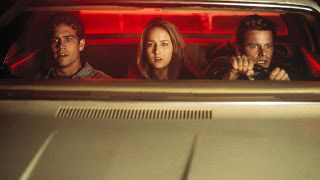
The movie starts out in a suitably plausibly manner. Nice-guy/college-student Lewis (Paul Walker) is going home for the summer, from California to New Jersey. His best friend Venna (Leelee Sobieski), whom he actually wants to be his girlfriend, goes to school in Boulder, Colorado. So, Lewis decides to buy a used car (a 1971 Chrysler Newport) and drive them both home. On the way, Lewis makes a stop to bail his incompetent older brother Fuller (Steve Zahn) out of jail in Salt Lake City. Fuller has a knack for getting himself into trouble, so it becomes natural that the elements that follow in the plot can be traced back to him.

Fuller rides with Lewis on the way to Boulder. When regular small-talk doesn’t work between the two brothers, Fuller buys a CB radio (“it’s like a prehistoric Internet”) for entertainment on the road. Fuller talks Lewis into imitating a woman’s voice in the hopes of suckering some poor trucker in for a joke. With the handle of Candy Cane, Lewis is able to set up a date with a certain Rusty Nail. That night, Fuller and Lewis set it up so that Rusty Nail believes that “Candy Cane” is at the motel they’re staying at, in Room 17, where an obnoxious customer stays. Fuller and Lewis are in the room next door, listening in on their prank going underway…and then they hear some weird noises, almost like thudding and choking.

It’s then that the practical joke takes a dark turn. The man in the room is murdered (with his jaw ripped off). Fuller and Lewis are thrown out of town, but they have something bigger to worry about—a stalking, taunting, psychotic trucker hot on their tail. They barely survive an encounter, thinking it’s over. But by the time they pick up Venna, the terror is far from over.

One of the elements that show “Joy Ride’s” effectiveness is the fact that the villain is never seen. We see his big-ass truck approaching; we hear his gravelly voice (which only Ted Levine can provide) on the CB; and he constantly sets up ominous trick after trick to terrorize Fuller, Lewis, and Venna. If that sounds like Steven Spielberg’s 1971 thriller “Duel,” which was also about a character being chased by a faceless truck driver, you’d be half-right. While both movies feature an ominous-looking, huge truck whose driver is never seen, they’re different in tone. “Duel” was a psychological thriller that featured the insanity that ensued as the hero became more and more frightened as he kept running from the villain. “Joy Ride” doesn’t go for that—it’s just mainly a chase picture with nothing specifically deep to be found.

But there’s not anything wrong with that if the movie is entertaining, which it is. There are some good tense moments as well, including that motel-room scene I mentioned where Lewis and Fuller start to worry about what they hear, and the realization that someone is following them the next day (Rusty Nail says on the CB, “You really oughta get your taillight fixed.”).

What also helps make the movie work are convincing characters to follow, and the three principal actors do game jobs. Steve Zahn, in particular, is quite excellent here, playing the ne’er-do-well who keeps getting into trouble, and whose “harmless little prank” gets himself, his brother, and his girlfriend into danger. While he plays the role relatively straight, Zahn displays effective comic relief here as well. He’s goofy, but credibly so. (My favorite bit is when he tries to imitate the noises he heard that night to a questioning cop.) Paul Walker is likeable as nice-guy Lewis—he’s just so clean that it’s easy to let any stupid thing he does slide. Leelee Sobieski is charming as always.

Now, as for the questions I’m sure people would ask about the logic of the movie. 1) How does Rusty Nail know everything the heroes are going to do? 2) Are there other truckers helping him out? Is that he’s able to pull off most of what he does? 3) There’s a sequence in which he chases the heroes through a cornfield; why do the heroes run straight through a row? Rusty Nail can’t turn his big semi around, so why don’t the heroes just run the opposite way? 4) By the way, if Rusty Nail has been following them all this time, how did his large truck go unnoticed?

But because of the pacing and the capable execution of the story, it’s easy to conclude that the unlikeliest situations are expected.

Everything leads to a well-crafted climactic final act that is both effective and breathlessly chilling.

Perhaps it’s not best to ask questions that “Joy Ride” raises a few times. It’s just a fun, scary thriller. It delivers what it promises—nothing more, nothing less. And I was glad to go along for the ride.

Jack the Giant Slayer (2013)

3 Mar

images

Smith’s Verdict: ***

Reviewed by Tanner Smith

Going by the marketing for “Jack the Giant Slayer,” I really wasn’t expecting much from this movie. It looked like just a throwaway CGI action flick with nothing particularly special to deliver its audience. It just looked so generic and not worth checking out. But I guess you can’t judge a book by its cover, because “Jack the Giant Slayer” quite the enjoyable entertainment. It’s fun, amusing, rousing, and surprisingly original.

“Jack the Giant Slayer” is an updated re-telling of “Jack and the Beanstalk,” and while that fairy tale was never admittedly gripping, this time there’s something to be said about the adventures and the appealing characters that endure them.

As the movie opens, a young boy named Jack is having a story read to him by his father, while at the same time, a little princess named Isabelle is coincidentally having that same story read to her by her mother. It’s the story of a world of giants in a magical place between Heaven and Earth—apparently, a long time ago, giants invaded the village below until they were vanquished and banished to stay on their own land. How? Well, it’s magic, of course!

Ten years later, Jack (Nicholas Hoult) is a farmhand, princess Isabelle (Eleanor Tomlinson) is about to marry against her will, both people are adventurous young souls, and both have lost the very parent that read them the story all those years ago. (Well, of course.)

By the way, I have to say I found this first act very well handled, in the way it establishes character for Jack and Isabelle. It shows both sides as they seem to have something similar in common—it’s even more evident when Jack and his uncle are arguing while Isabelle and her father (the king) are arguing. As the scenes play back and forth, it’s almost like they’re saying the same thing. That’s very clever.

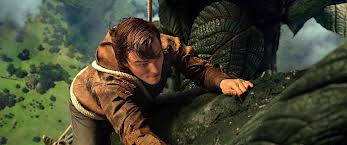
Anyway, Jack comes into possession of a pouch of magic beans that of course grow into a gigantic beanstalk that leads all the way up to the world of the Giants. At this time, Isabelle accidentally winds up stuck as the beanstalk grows, and so a rescue party, including guards Elmont (Ewan McGregor) and Crawe (Eddie Marsan), is sent to climb up after her. Jack accompanies them, along with Roderick (Stanley Tucci), Isabelle’s would-be groom who actually has something far more on his mind than rescuing his bride-to-be.

There are Giants up there, and they are quite big and vicious. And there are a lot of them, which makes rescuing Isabelle far more difficult. Things get even worse when Roderick gains a magical legendary crown that will gain him control over all the Giants. He overpowers the vicious two-headed Giant general Fallon (Bill Nighy) and his hundred followers, and hatches a plan to take over the human kingdom below. While that’s going on, Jack continues to find and free Isabelle, and even manages to slay a couple Giants in the process, hence the title.

While some parts of “Jack the Giant Slayer” are rather predictable, there are quite a few surprises here and there. Some of these surprises have to do with the Giants, who have more personality than you might expect from a film like this. Some, like General Fallon, are suitably threatening, while others are here to display comic relief. And there’s also Fallon’s second head, who is barely able to utter words, that is both creepy and kind of funny. (Their CGI is impressive, especially when you see the Giants in close-ups.) There are some funny moments in the movie as well—sight gags (including Giants’ pigs-in-blankets that are literally pigs, in blankets) and one-liners (“Fear of heights?” “Fear of FALLING!” “Well then don’t fall!”). And it’s also self-aware of its fantasy-adventure genre, cracking jokes at the story’s expense when the time calls for it. For example, when Isabelle at the beginning tells her father that she doesn’t want to marry Roderick, she immediately turns to Roderick, and tells him “Sorry.” How does Roderick respond? He shrugs. I laughed out loud at that moment.

The inevitable action-climax featuring man versus Giant is quite entertaining as well, and it’s hard to tell exactly how everything is going to turn out, since there can never be a fair fight between a giant…er, GIANT and a puny little man. There’s a lot of tense action and some pretty terrific special effects—it really does look like these armies of different sizes are there in the same shot.

Nicholas Hoult stars as Jack, and it’s further evidence that this young actor is a genuine star. With this and “Warm Bodies,” I expect bigger things to come for him in the future. He’s quite effective and likeable here, going through Jack’s expected character arc from commoner to hero. Eleanor Tomlinson is fun and fetching as the princess Isabelle. Stanley Tucci has a lot of fun hamming it up as the human-villain, while Bill Nighy is invaluable as always, even when playing a gigantic CGI monstrosity. Also, Ewan McGregor is fun as the dashing Elmont, who could be the hero but has his weak points that slow him down.

I enjoyed the film, but some parts were a little sloppy. For example, we never see Jack’s uncle again after the first half-hour, and the movie never tells us what he’s doing or where he’s gone. And also, why would Roderick want to rule Giants and crush his fellow mankind anyway? Wouldn’t destroying humanity make things kind of boring afterwards? Dude, you’re marrying a princess and thus commanding a kingdom!

And I also found myself questioning the Giants’ lifestyle at certain points. For example, it’s established that humans are a delicacy for Giants, so what do they usually eat on their land? And also, there doesn’t seem to be one female among them. How exactly…actually, never mind. I shouldn’t read much into this.

Thanks to sharp direction by Bryan Singer, a top-notch cast, and some pretty damn good-looking special effects, “Jack the Giant Slayer” is a terrific adventure. I’m glad I took it, despite my doubts before.

Body Snatchers (1994)

3 Mar

snatch10

Smith’s Verdict: ***

Reviewed by Tanner Smith

“Body Snatchers” is not necessarily a full adaptation of the famous novel of the same name, written by Jack Finney. In some ways, it’s a sequel to the 1978 film adaptation “Invasion of the Body Snatchers” (which itself was a remake of the first film adaptation from 1956). That’s one way you could look at this 1994 version, in that we’re secluded to one particular setting that could show that the events in the original 1978 film are just continuing with the characters in this one.

For the few who don’t know who (or what) these “body snatchers” are, they’re pod-like alien beings that come to invade Earth by cloning humans and taking their place (and destroying the originals). The scary thing is that anyone on Earth could be one of these aliens. It could be your mother, father, sibling, lover, friend(s), mailman—anybody. There is one giveaway—they may look normal, but what keeps these duplicates indistinguishable from normal people is their complete lack of emotion.

“Body Snatchers” takes place on a military base, which is probably the perfect place for these “body snatchers” to hide. For one thing, they have easy access to weapons and armored vehicles. And also, the soldiers there are already practically emotionless to begin with. Who would suspect these stone-faced people to be pod people if you didn’t already think they sort of were? That’s a clever move that this movie makes.

Teenager Marti (Gabrielle Anwar) has moved to the base with her family. Her father (Terry Kinney) is an E.P.A. consultant brought along to study these drums of toxic chemicals put on the base. Marti, like most teenagers, is bummed about the move, but more unnerved by a visit to a gas station on the way, where she is grabbed by a runaway soldier (Forest Whitaker) who screams hysterically, “They’re out there!”

He’s right—the body snatchers are taking over the base, unloading pods in a nearby swamp. The soldier warns “they get you when you sleep,” meaning that the pods unleash tentacles that trace around people’s bodies and snake into noses, ears, and open mouths so that they drain their life forces. Then the pods are grown into perfect clones of those people, who have been literally drained of their lives in the process.

Marti’s stepmother (Meg Tilly) is the first of the family to fall victim to the body snatchers, and the only one who knows is her five-year-old half-brother Andy (Reilly Murphy) who, in an effectively disturbing scene, has witnessed her mother’s lifeless body crumble before his eyes and the new duplicate walk out of the closet, naked. Andy can’t get Marti or Dad to believe that this person isn’t Mommy. But then things get really crazy as the stepmother, along with just about everyone else on the base, goes after the three of them.

Now to be honest, I wasn’t really enjoying the first half of “Body Snatchers” very much. Gabrielle Anwar, who was luminous as Al Pacino’s dance partner in “Scent of a Woman,” comes off as sort of bland in the lead role of Marti. And Terry Kinney, as her father, is worse. One would suspect that he already is a body snatcher just by looking at him, even though he isn’t supposed to be. A lot of moments seem rushed and others seem painfully obligatory. And also, Meg Tilly doesn’t have much of a character to show enough dimensions for us to know the difference between her human form and her alien form. But to be fair, there are a couple genuinely creepy moments that kept me interested in seeing if the movie could top them. One is a scene featuring Andy in a daycare center, as every other kid has the same drawing (of tentacles spreading) except him. And another is the scene I just mentioned, in which Andy sees a newly-formed alien in the form of his mother.

Then about forty-five minutes into the movie, “Body Snatchers” really comes alive with a tense, suspenseful second half in which Marti, her father, Andy, and her helicopter pilot boyfriend (Billy Wirth) are on the run from the pod people. The structure is very clever, the horror continues with further suspense, we feel the characters’ fear, and the visuals are stunning.

Frightening moments include—shots of the pod people giving chase in packs (it’s always frightening when groups of people go after one small group); a scene in which the boyfriend finds Marti in a shed full of pods ready to take over (her body double is already formed as the boyfriend must save the real Marti); and a sequence involving an attack on a helicopter.

There are many other unnerving moments, mainly those including the few human characters left having to pass themselves off as a pod person in order to blend in and attempt an escape from the base. For example, when the young pilot boyfriend is confronted by duplicates of his friends, he forces himself not to show an emotion. But then there’s a line that would get any teenage boy angry and you have to wonder, can he keep pulling this off so he’ll still convince them? This scene is carried over in a scene where Marti is looking for Andy—if she asks the wrong person to help her, she gives herself away. Who can be trusted?

This is the strength of “Body Snatchers”—the situations are well-established so that the terror generates convincingly.

I may have complained about Meg Tilly, but how can you not love the scene where she widens her eyes and lets it clear to Kinney, in a disturbingly calm manner, that there’s nowhere to run or hide. Tilly owns that moment, as well as a following point when she points her finger at the escaping family and screams hysterically—by the way, that’s the signal for the body snatchers to give chase.

Even if the characters aren’t well-developed and some parts of the story come off as pretty obvious, “Body Snatchers,” mainly in the second half, works as a horror film. It’s suspenseful, has a few shocking surprises, and keeps you interested in the story’s outcome. That’s good enough for me to recommend “Body Snatchers.”

Beverly Hills Cop (1984)

3 Mar

beverlyhillscop_article_story_main

Smith’s Verdict: ***

Reviewed by Tanner Smith

Reportedly, the screenplay for “Beverly Hills Cop,” an action film about a Detroit cop solving a case in Beverly Hills, has been passed around for years before it was finally greenlit. It went through several story developments, and tossed around actors for the lead role such as Mickey Rourke and Sylvester Stallone. But then came Eddie Murphy for the part, which led to massive rewrites. Although, if you ask me, that’s a little hard to believe, because Eddie Murphy is such a master of improvisation that I wouldn’t be surprised if director Martin Brest just informed him of the situation his character was in, and then rolled the camera to see what he could do.

If that was the case, why was the screenplay for “Beverly Hills Cop” nominated for an Academy Award? The writing, aside from Eddie Murphy’s one-liners (most of which I believe were improvised), is quite generic.

Eddie Murphy stars as a tough, streetwise Detroit detective named Axel Foley. He gets himself in trouble with his commanding officer because he does things his own way. Axel’s friend comes to town, after six months of working in California. But some unfriendly visitors follow him because the friend has negotiable bonds that belong to them. They murder Axel’s friend, and Axel decides to use his “vacation time” to go to Beverly Hills and track the guys who did this. And while solving the case, Axel finds himself more at home in these posh California settings than in his ghetto Detroit origins, as he constantly adjusts to Beverly Hills customs.

Let’s face it—no one really cares about the story for “Beverly Hills Cop,” because mainly people seem to like “Beverly Hills Cop” just because of Eddie Murphy. Suffice it to say, Eddie Murphy is hilarious in this movie. Coming off of “SNL,” “48 HRS,” and “Trading Places,” Murphy again proved that he was one of the great comedic talents of his generation, and in “Beverly Hills Cop,” he does what he did best—playing the fast-talking, with-it underdog who also ended up being the smartest guy in a rich world. You can keep calling him Axel Foley in this movie, but let’s face it—we all called him Eddie Murphy. And no one plays Eddie Murphy like Eddie Murphy.

The entertaining aspects of “Beverly Hills Cop” aren’t merely the action scenes that take place, though admittedly some of them are kind of fun (including an opening chase scene in Detroit). Instead, they are the scenes in which Axel finds new ways to get by in Beverly Hills, always having the upper hand. It’s just a great amount of confidence that doesn’t get Axel down—there’s never a scene where he mopes because he doesn’t feel like he belongs. He’s just on vacation, and happens to be solving a case as he goes along with this challenge.

The only bit of this sort I didn’t find funny was the scene in which Axel loudly intimidates the desk clerk of a fancy hotel, playing the race card and thus getting himself a suite with a single-room discount. This scene was just uncomfortable to watch and listen to, and it’s also kind of embarrassing in the way it’s portrayed.

But just about every other scene of this sort gets a good laugh. Axel’s beater of a car driving on the same streets as Porsches and Cadillac’s is a good sight gag. Axel’s reaction to Michael Jackson impersonators walking the streets is good for a laugh. And how can you not love his reaction when he is thrown out of a window by five bodyguards of Axel’s main suspect, art dealer Victor Maitland (Steven Berkoff)? Axel was there to ask Maitland a few questions (and Maitland does not look like the trustworthy type, despite his sophisticated manner), and then security came along, threw Axel out of a plate-glass window, and the cops show up. “You believe this?!” Axel asks the cops. “I can describe all of ‘em!” Then the cops arrest him. But why? “Disturbing the peace?! I got thrown out of a window! What’s the charge for getting pushed out of a moving car? Jaywalking?!” (No prizes for whoever guesses correctly whether or not that line was improvised.)

There are many other funny moments like that, and they also come with the Beverly Hills police force who get to know him after arresting him. Two detectives—stuffy sergeant Taggart (John Ashton) and young naïve Rosewood (Judge Reinhold, very funny)—are hired to follow him around, and Axel manages to befriend them because he’s able to teach them how to bend the rules and come up with fish tales to get off the hook. (Of course, he manages to befriend them after sticking a banana in the tailpipe of their patrol car, distracting them with a shrimp sandwich.) Axel takes them to a strip joint, where they manage to stop a violent situation from occurring.

But of course, there’s also the plot as it thickens. Maitland, it turns out, did arrange for Axel’s buddy to be murdered, and Axel sets out to prove it. Taggart and Rosewood wind up helping him, going beyond the book and doing things Axel’s way. And Axel’s old girlfriend Jenny (Lisa Eilbacher, quite appealing) gets caught up in the mix and gets kidnapped. And of course, this all leads to a climactic gunfight between the cops and the armed guards at Maitland’s house.

Actually, even in the action-filled climax, there are some good laughs to be had here—though, it’s mostly with Taggart and Rosewood reacting to their current situation. (it’s usually not a good idea to hold up a policeman’s badge and yell to a bunch of armed security that they’re all under arrest.)

Eddie Murphy, as I’ve said, is a lot of fun and has a great comedic energy to his performance. But he also has some interesting comic foils to work with and play off of. John Ashton and Judge Reinhold are effective while playing their roles straight, especially Reinhold whose naivety is quite amusing. Ronny Cox has some good moments as a Beverly Hills lieutenant who can’t believe how Axel is able to mess with two of his detectives. Lisa Eilbacher is game for reacting to Murphy’s antics. And there’s also a small part by Bronson Pinchot as one of the art gallery workers—his odd accent is indistinguishable, and Pinchot even manages to steal scenes from Murphy. And that’s no small feat.

But really, it all comes back to Eddie Murphy. He knows what he’s doing throughout this movie, and he’s clearly having fun while constantly keeping the upper hand. Even with the screenplay he’s saddled with, he still manages to make us laugh and care. He makes “Beverly Hills Cop” worth watching.

Chasing Amy (1997)

3 Mar

chasing-amy-1997-ben-affleck-joey-lauren-adams-pic-1

Smith’s Verdict: ***1/2

Reviewed by Tanner Smith

Kevin Smith is a great screenwriter—he doesn’t just write dialogue; he creates characters that actually have something interesting to say. His characters are quirky, three-dimensional, and fun and when they talk, it feels like regular everyday people talking. Even Smith realized this when he tried to create an action comedy with slapstick and special effects in his less-than-successful 1995 film “Mallrats.” In fact, he even calls himself a horrible director and actor, but a great writer. He’s better off writing—his direction is not special in a certain sense. But with his movies, we don’t really care because his direction lets the characters breathe and talk through his writing. He did it with his debut “Clerks,” a low-budget comedy, directed by him, with a fantastic script, written by him. Then when “Mallrats” was released, it was such a disappointment that during the screening for his next movie “Chasing Amy,” Kevin Smith even apologized for it. And in the end credits of “Chasing Amy,” this quote is used—“And to all the critics who hated our last flick—all is forgiven.”

“Chasing Amy” is linked with “Clerks” and “Mallrats” with some of the writer/director’s trademarks like pop culture references (discussions of “Star Wars”) and a touch of “Jaws” (in “Chasing Amy,” two characters discuss their scars…from what, I won’t give away). It also has raunchy and vulgar humor and here, it almost goes a little overboard with its frankness of sex. But I have to give credit for not wimping out during these discussions, especially when the main male character asks how the main female character, who is a lesbian, is able to have sex with women. Some people may laugh out loud—others may cringe. But there are many other big laughs, great surprises, and a heart that comes along in the midst of this story.

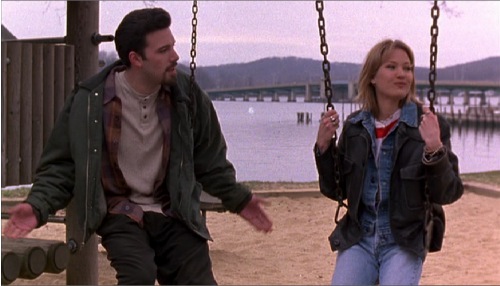
The premise of “Chasing Amy” may sound like another dumb sex comedy, but Smith handles it more intelligently than you could possibly imagine. Two comic book artists—laid-back Holden (Ben Affleck) and his brash roommate Banky (Jason Lee)—are signing autographs at Comic Con for their latest creation—a comic book about stoner superheroes called “Bluntman and Chronic.” They meet another comic book artist—a woman named Alyssa Jones (Joey Lauren Adams)—and Holden has a crush on her. But then he finds out that she’s a lesbian. But even though she’s gay, he falls in love with her and tries to have a loving relationship with her. This premise may sound confounded, but it’s handled so maturely that you have congratulate Smith for creating something so fresh.

I mentioned above that the characters are fun to watch and that they talk like regular people rather than characters—even though they are playing characters—and they do. Holden and Banky create comic books—what do I know about comics? Very little. But it’s great to listen to these guys talk about their work because that’s what they love doing. These characters are so well-developed. I loved the relationship that Holden and Banky have as great friends (although for Banky, it may be a little more). And then there’s the discussions Holden has with Alyssa (sometimes, Banky has his own conversations with her). This is the heart of the movie. Watching these two talk and relate to each other is great to watch and fun to listen to. These two have great chemistry together. But then there comes the more serious scenes which are even better. Holden tells Alyssa that he loves her in one scene and Alyssa doesn’t have a clue about how to respond. Is it possible for her to have second thoughts on her sexuality? Could Holden have a chance with her? One of the very best things about “Chasing Amy” is how unpredictable it is. If you can answer those questions right away, I bet you would be only close but with very little dice.

The script is full of wonderful dialogue. There’s a supporting character—a gay black man named Hooper (Dwight Ewell)—who has a whole speech about racism involved with the “Star Wars” trilogy and his own opinions on the sexuality of Archie and Jughead. And then there’s Jay and Silent Bob, returning from “Clerks” and “Mallrats” and played again by Jason Mewes and Kevin Smith himself, who has their own conversation with Holden. Once again, Jay is a foul loudmouth who can’t shut up. But here’s a surprise—Silent Bob finally opens up and gives his own speech about who the titular Amy was and why she was worth chasing. And also, have you ever wondered what lesbians thought about sex and virginity? Well, those discussions are here too.

“Chasing Amy” is one of Kevin Smith’s best films—funny but also intelligent. When it gets into serious mode, we are brought right into it. We believe everything that is happening on screen because it is handled so maturely and delicately. It’s helped by a fantastic script, a touch of comedy, drama and romance, and its ensemble of great actors. Ben Affleck, who plays Holden, is a nice guy for us to follow, Jason Lee goes as far as he can go with Banky without making him so obnoxious that he’d be unwatchable, and Joey Lauren Adams, who is a real discovery, embodies a really complicated character who is forced to think about her own self and creates a surprising amount of range and wit. Minor missteps for this movie can be forgiven and so can Kevin Smith for “Mallrats.”