Archive | May, 2013

Bad News Bears (2005)

4 May

images

Smith’s Verdict: ***

Reviewed by Tanner Smith

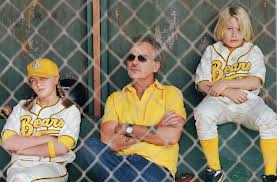
2005’s “Bad News Bears” is the remake of the beloved 1976 kids-sports comedy “THE Bad News Bears.” You know the drill—alcoholic former baseball-player Morris Buttermaker is roped into coaching a Little League team, mostly composed of losers. They start the season terribly, but through many practices and hard work, they gain a winning streak and eventually make it to the championship game where they must play against their arch-rivals.

It’s a bit odd, and kind of disappointing, that Richard Linklater is as faithful to the source material as you could practically follow it about the same as the original film (save for a few altered bits for comedic effect). I say that because Linklater is one of the most creative, insightful filmmakers around, what with films such as “Dazed and Confused,” “Before Sunrise”/”Before Sunset,” and “School of Rock” (all of which are very different films). I’m surprised he didn’t add that amount of creativity for this remake. I know some people prefer that remakes stay faithful to the original, but really, you could watch both movies and notice a great lot of similarities in element. It doesn’t feel like a Linklater film in that sense.

But to Linklater’s credit, he does get the majority of what made the original film special. In fact, he actually updates from it for the modern time. Buttermaker is more of a sex fiend than a grump this time around (and even manages to sleep with one of the kids’ mothers), and also uses his attitude and personality to get a strip joint, “Bo-Peeps,” to sponsor the team (so some of the women who work there stop by the games to cheer them on—they’re the loudest, most excited people in the crowd). The profanity that the original was known for is also updated, in that being a PG-13 movie, everything but the “F” word is said constantly. That’s pretty surprising; you’d think it would have been toned down, but nope. Another noticeable update, which you could probably tell from other concepts I mentioned—this remake is darker in tone and very un-PC.

What really makes “Bad News Bears” entertaining throughout, and what makes it worth watching rather than just watching the original, is the lead performance from Billy Bob Thornton. In a role originally portrayed by Walter Matthau as a grumpy drunk, Thornton doesn’t imitate Matthau in the slightest. Instead, he makes the role all his own. He’s crude, brash, nasty, deceitful, and creepy. But Thornton does manage to make us like him, just as he made us like his character in “Bad Santa.” And while Matthau’s advice to the kids in the original was more heartwarming than funny, Thornton’s advice to the kids in this remake is absolutely hilarious. Since the kids’ parents are never around, he has to be the surrogate-father to most of the members of the team, including an Armenian kid whose father doesn’t approve of his playing sports. What’s his advice? Lie. Say, “Guess what, Dad! We won today! He’s not gonna know the difference—he’s from Ricky-Ticky-Taffy or wherever it is, you know?”

And Thornton’s one-liners are very funny. Here’s my favorite: “You can love baseball, but it don’t always love you back. It’s kinda like dating a German chick, you know?”

Greg Kinnear plays an opposing coach, played in the original by Vic Morrow. Kinnear can play a nice guy in many movies, but in my opinion when he really shines is when he’s just playing a downright jerk. Here, he’s a winning-obsessed coach who doesn’t care what it takes to get his team to win, and also tries to intimidate Buttermaker and some of his team members when he gets the chance (but ultimately fails at it).

As for the kids, they’re good comic actors and play their stereotypical roles (mostly copied from the original) to a T. Timmy Deters, as the little tough guy Tanner Boyle, is a riot, and so is Troy Gentile as a wheelchair-bound smart aleck who always reminds Buttermaker that he’s in a wheelchair and yet still goes out to play the infield in the climactic big game. But of course, there’s the case of the role of Amanda, the girl pitcher played memorably by Tatum O’Neal in the original. Here, she’s played by Sammi Kraft, who acquits herself to the role effectively. And there’s also Kelly Leak, the rebellious bad-boy originally played by Jackie Earle Haley. Here, he’s played by Jeffrey Davies, who unfortunately is not as good.

While I give “Bad News Bears” a mild recommendation, I still find myself asking why it was made and why a director like Richard Linklater would be on board to direct it. Was it money? Were they hoping to cash in on the summer sports comedy? Well, however it worked, “Bad News Bears” is still an entertaining remake.

NOTE: Upon closer investigation of the film’s credits, I learned that the script is co-written by Bill Lancaster, who wrote the original 1976 screenplay. That would explain how faithful this remake is.

Platoon (1986)

2 May

images

Smith’s Verdict: ****

Reviewed by Tanner Smith

Oliver Stone’s “Platoon” is arguably the strongest, most powerful war film to released in cinemas. I know I’m making a bold statement by saying that, seeing as “Apocalypse Now,” “The Deer Hunter,” and “Full Metal Jacket” are held in high regard when it comes to the genre. But as great as those films are, “Platoon” gets my vote as number-one mainly because of one important detail—this is not a war movie based on opinion. It doesn’t matter who is right and who is wrong; “Platoon” doesn’t work that way. Instead, “Platoon” is all about experience. It’s the middle-ground. We see in great detail what it really meant to be serving in the Vietnam War. What happened? Why did it happen? How did it feel? Those answered questions are what really make “Platoon” into a great film. You do see what happened, you do understand why it happened (even if you don’t approve most of it), and you do know how it felt when it did happen. Vietnam vets are going to see this film as a flashback to the times they fought in the actual war; those who were born long after the war are going to be given a history lesson that they’ll never forget.

Oliver Stone is the writer and director of “Platoon,” and he makes it as somewhat of an autobiographical look at his experiences in the Vietnam War. He bases his main character upon himself from when he was an infantryman in Vietnam, and also bases his supporting characters upon those he served with in the war. Arguably, this is why “Platoon” is so strong in the way it deals with experience—it’s Stone’s experience. He went through it, he wrote about it, he made a film, and he just tells it like it is.

Charlie Sheen stars in the “Stone” role as Chris Taylor, a fresh-faced newcomer to the Vietnam War. The film begins as he first arrives after basic training and meets his fellow soldiers. Some of them respect him for not having gone through what they have, while others have him do some of the harder work (e.g. digging foxholes). But he does manage to survive a few ambushes and gain the respect of most of the infantrymen.

Two of Chris’ sergeants are Barnes (Tom Berenger), an angry, straightforward veteran who is scarred physically and emotionally and pushes his men to be as brutal as the war made him to be, and Elias (Willem Dafoe), who still remembers that his men are still human beings. Chris is unsure of which one to follow, as he tries to be as gruff and fierce as Barnes but then remembers his human side which he recognizes in Elias. And so there’s an interesting question of which one Chris will pledge his loyalty to in order to survive his experience in the war. On top of that, there’s already an hint of tension between both sergeants, and midway through the film, that tension ultimately erupts into a projected anger that splits the platoon apart.

The characterization of both sergeants is fascinating in the way they seem to represent the loss of innocence and the true casualties of war. Barnes isn’t merely an effective killer; his mind is at the point in which his human side is practically gone. War has overtaken him as it becomes a part of his existence. And yes, Elias would act decisively at times too, but never to the point where he loses his humanity. I think the sequence that makes it clear what war is about and how it affects people is the sequence in which the platoon enters a Vietnamese village and discover that the villagers are hiding supplies for the Viet Cong, and the body of one of their men is found nearby. The platoon reacts extremely, killing innocent civilians and torching the village. Barnes nearly shoots a little girl before Elias comes in to help, and another girl is being raped by some of the platoon until Chris comes to stop them. (“She’s a person, man!”)

By the time the film has ended, Chris will have been a changed man after coming into this world as an innocent, rich college dropout (who volunteered for this duty) to committing as many mindless and violent acts as Barnes.

Those who have seen news reports and read articles in the paper about such behavior have probably questioned and debated why these American men would act this way. Here

The acting is a crucial element to “Platoon’s” success. If we didn’t believe in any of these characters, the film would fall apart because it would have lost the harsh credibility. You could argue that Charlie Sheen didn’t really belong in this role, that he seems a little too clean to be in this performance. But the truth is, his character doesn’t belong in the platoon at first, and slowly but gradually he does find his way in the platoon. Sheen delivers effective work as he grows into the role of Chris Taylor.

Tom Berenger and Willem Dafoe provide two great performances as opposing figures of war. They’re both intense and fierce, one probably more than the other. They’re great in this film, and so are the other cast members, which include John C. McGinley as a not-so-eager sergeant; Kevin Dillon as a scared kid who acts tougher than he really is; Francesco Quinn as Rhah; Mark Moses as Lt. Wolfe; Forest Whitaker as Big Harold; Johnny Depp as Lerner; and more.

The combat scenes add to the realism of the film, because unlike most movies about war, these scenes don’t have the distinction of being planned out. Nothing feels as if something is going to turn out in a certain way, because like real war, it’s unpredictable what will happen, such as who will live and who will die. What’s more interesting is that this movie was released at a time when Hollywood seemed to promote war as a fun shoot-em-up entertainment, such as the “Rambo” movies. After seeing “Platoon,” I think some people felt a bit differently in that there’s hardly an exaggeration that “war is hell.”

“Platoon” doesn’t care about the politics, the symbolism, or the basic conflicts of the Vietnam War. It just tells the story as an experience, like a nightmare that was based upon war flashbacks. Death surrounds these soldiers, overtaking several of them. And it really did happen. Nothing in “Platoon” seems forced in the slightest—it effectively gives us a tale of war, survival, mental state, and as Chris puts it in a voiceover narration describing the war, “Hell without reason.” Nothing is as clear as what we feel throughout “Platoon”—that alone is the main reason I think it works so well.

Freaky Friday (1976)

2 May

MV5BMTY0MjIyNjUxNl5BMl5BanBnXkFtZTcwNDU0OTAyNw@@._V1._SX640_SY534_

Smith’s Verdict: ***

Reviewed by Tanner Smith

1976’s “Freaky Friday” is one of those Disney live-action comedies that people just go nuts over. People love the gentle comedy that comes with the vintage Disney style of the 1970s. And when I was a kid, I watched this multiple times as well. Also, despite it already being based on a popular novel by Mary Rodgers, it’s also said to be the film that spawned the “body-swap” genre (movies, mostly comedies, in which a man turns into a boy or the other way around, or both), for better or worse.

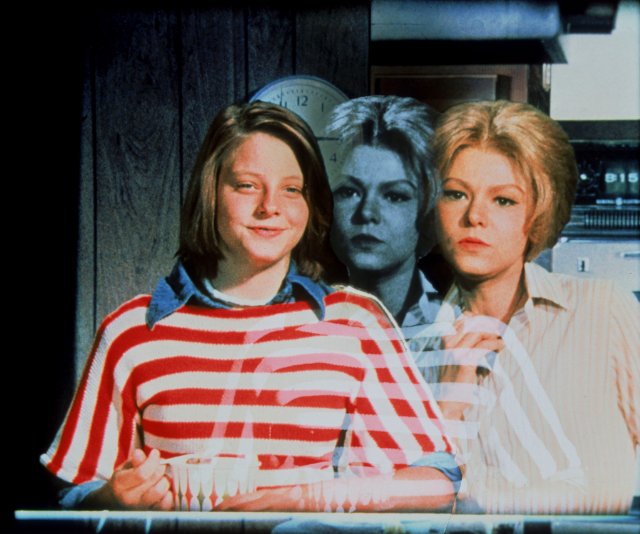
Here’s the story: A thirteen-year-old tomboy named Annabel Andrews (Jodie Foster) and her mother Ellen (Barbara Harris) aren’t getting along very well. Secretly, they each wish that they could just switch places with each other so that one will see how difficult the other’s life is, and vice versa. And on Friday the 13th, they say their wish out loud, at the same time (despite them being in two different locations). Their wish is granted—Annabel’s mind inside her mother’s body, and the mother is inside her daughter. So now they must lead each other’s lives for the day.

They each find that leading the other’s life is not as easy as they think it is. For example, how can junior high school be anything but fun? Ellen (in Annabel’s body) learns the hard way that knowing all the right answers can make her the object of practical jokes, and she doesn’t know the first thing about field hockey (Annabel’s the captain of the team). Meanwhile, Annabel (in Ellen’s body) realizes that being a stay-at-home mom isn’t all that’s cracked up to be, as she’s the one that has to do all the housework.

Watching “Freaky Friday” now, I find it’s a tad overrated. It doesn’t hold up very well and it’s a tad too goofy for its own good, especially in the final act of the movie. It’s an energetic chase scene in which Annabel drives a car in order to get to Ellen. Hijinks ensue as police give chase. The chase continues through narrow alleyways, on a public sidewalk, a walking-bridge, and eventually ends up in the lake.

Where did this come from? I mean sure, in that era, the Disney studio was crazy about exploiting their budget and letting loose a lot of energetic action sequences purely made for laughs. But while “Freaky Friday” is still silly before that point, it’s a different kind of silly. The screenplay is mainly full of dialogue and little situations for the characters to go through. Why unleash the hijinks-filled madness in the last reel?

Though, to be fair, this chase does lead to the funniest sight gag in the movie—the police car, split down the middle in half after crashing into a wall edge. Of course, the car would crash and wouldn’t rip in two pieces like a sheet of paper. But I don’t care—I laughed.

OK, what don’t I like about the movie? Aside from unleashing all the goofy, action-filled antics in the last reel, what specifically is wrong with this movie? Well…the two lead actresses. Actually no, it’s not the two lead actresses. They’re both very talented and have fun in delivering differing personalities for their age—one acts old, the other acts young. But the problem is that we don’t get enough of their real characters before the big switch. If they hadn’t said anything about this miracle, I probably wouldn’t have noticed any difference. And I sort of don’t—Jodie Foster and Barbara Harris have already played these roles many times, which I know makes them ideal casting choices, but doesn’t make them anything new. Jodie Foster was mature for her age and Barbara Harris was always young for her age. They’re well-cast, but for these roles, you need actresses who will take chances.

Also, I’m all for Disney magic, but there’s one part at the end that just got me scratching my head. When Annabel and Ellen switch back to their normal selves, they suddenly find themselves in the wrong places. How is this possible? (Well, that’s a dumb question—that’s like asking how switching bodies is possible.) Wouldn’t it make more sense if Annabel found herself back in her own body in the place where her body was, instead of being in the same place, only with her own body? It may be nitpicking, but…I don’t get it.

So what do I like about the movie, and why I think it’s worth recommending? Well honestly, it’s the script. The first half of the movie is well-written. Most of the dialogue is very funny and there are a lot of interesting ideas that come about. Even if the problems that these two leads face are predictable, they’re still pretty amusing. My favorite parts are—Annabel-as-Ellen dealing with the drapery man, the carpet cleaners, the mechanic, and a neighbor asking for her hair dryer back ALL AT THE SAME TIME; Annabel-as-Ellen dealing with her picky maid (Patsy Kelly, droll); Annabel-as-Ellen having a pleasant conversation with her crush Boris (Marc McClure), who would rather not be around the real Annabel but has fun with this middle-aged woman, not knowing who she really is; Annabel-as-Ellen bonding with her little brother Ben (Sparky Marcus), whom she hated before; and Annabel-as-Ellen forced into a meeting with her own teacher and principal, (I realized by this point that Barbara Harris has the best moments of the two leads.)

I also really liked John Astin as Bill, Annabel’s father and Ellen’s husband. Bill is the self-centered man who is trying to get these two to hold together in order to impress his bosses at a water-shoe he set up at the lake, where Annabel must water-ski and Ellen must make a feast. He’s constantly reminding them of what they’re supposed to do. He’s also the main reactor to these strange situations. Astin’s bewildered expressions are just hilarious.

So despite my issues with “Freaky Friday,” I do find it to be an enjoyable watch. The film has the usual Disney lighthearted feel and does generate some good laughs in its screenplay. I understand why people love this movie. I only like it—it’s not a great movie, but it’s a good one if you’re looking for something to watch on a rainy day.

NOTE: Now I just remembered my favorite moment from Jodie Foster—Ellen-as-Annabel’s encounter with her husband’s sexy, new secretary and scaring her into showing less cleavage. That was a nice scene.

Mona Lisa (1986)

2 May

capture3

Smith’s Verdict: ****

Reviewed by Tanner Smith

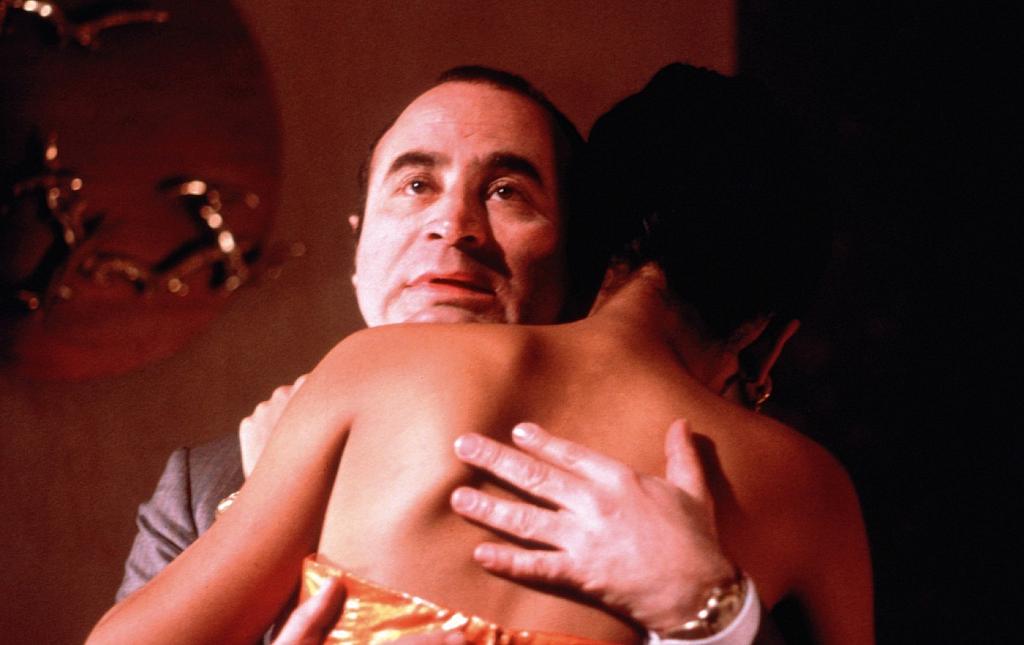
“Mona Lisa” tells the story of a man and woman who start out hating each other before coming to like each other. But unlike most movies that share that premise, “Mona Lisa” delivers in a slap-in-the-face way that it’s not so easy. This is not merely a romance. In fact, it’s hardly a romance. The best way to describe it is to remind of how most of us thought of someone of the opposite sex as not only beautiful and cryptic, but also unattainable. It’s like a crush from afar. Whomever that is, you see that person as a mysterious figure—you don’t know that person’s story or that person’s history, and that notion draws you in further. Only for the most part, you find out more about that person and find that you weren’t very pleased by that person’s personality. But until then, that person is like Da Vinci’s portrait of the Mona Lisa. In “Mona Lisa,” George (Bob Hoskins) feels the same way. His representation of the Mona Lisa is a young, beautiful prostitute named Simone (Cathy Tyson). She’s attractive, mysterious, and unreachable—but who is this person, really?

George is a foot soldier for the London underworld, working for the smooth boss (Michael Caine) who may have been the reason he served a long term in prison. Now that he’s released, and with hardly a way of connecting to his family (including a teenage daughter he never got to know), he is hired by the boss’ henchman to chauffer a young, tall, black, striking local prostitute, Simone. Their first meeting is not hopeful. George is repulsed by her profession; Simone sees him as a cheap bastard. They argue frequently, day and night, until they realize that they enjoy (and are entertained by) each other’s arguments. They form somewhat of a friendship with each other, and Simone sees something in George that could help her with a certain thing. She tells him a story that ends with her subtly asking for help, which he does offer once she’s finished her story. But what he learns causes trouble for himself and Simone.

“Mona Lisa” is more of a drama and a thriller than it is a romance, but more importantly it is an effective character study of George. Here is this conflicted criminal, working for such a sleazeball like Michael Caine’s character, who puts himself back in the underworld even though he should be reformed after a stint in prison. But he still would like to get to know his young daughter, despite his ex-wife’s objections. And then there is his fascination with Simone, as he finds himself able to love. Although, the relationship between George and Simone is purely platonic—there’s not a scene in which they sleep together, which is what you would expect in a film like this. But the main problem is that most of what Simone tells him isn’t true, and she is actually using him to get to someone else that she loves—this upsets George; his feelings are hurt; and worst of all, he doesn’t know how to cope with his feelings. Bob Hoskins was nominated for the Best Actor Oscar for his performance here; it’s easy to see why. He’s brilliant in the role, effectively delivering a credible, sympathetic character to follow throughout the film. He’s ably supported by a luminescent Cathy Tyson, a menacing Michael Caine, and strong support by Robbie Coltrane as George’s friend who gives George a place to stay.

“Mona Lisa” is a great film with solid acting, some good surprises here and there, and a great deal of atmosphere in the way the writer-director manages to capture the essence of the streets of London, both night and day. And it delivers a concept about love that is not only heartbreaking, but even more so, it’s true.

Tropic Thunder (2008)

1 May

TropcThndr_H2L

Smith’s Verdict: ***1/2

Reviewed by Tanner Smith

Where do I begin with the sheer comic brilliance of Ben Stiller’s fantastic comedy “Tropic Thunder?” Should I merely start with the inventive plot? The brilliant cast of characters? The way it seems to understand and love movies? Or even the real show-stealer of the film that everyone remembers with great fondness? Well…I guess I should go ahead and start with the plot.

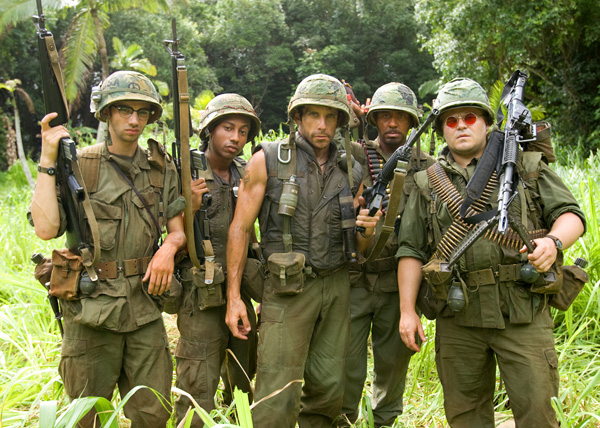
The movie tells the fictional story of the making of a war film based on the (fake) true story about a Vietnam vet. Among the main cast is a diverse group of actors/personalities. There’s Tugg Speedman (Ben Stiller, who also directed and co-wrote the film), a former big-time action hero who needs a big break after his attempt of a dramatic performance (as a retarded farmhand named “Simple Jack”); Jeff Portnoy (Jack Black), a heroin-addicted comic actor best known for his comedy franchise, “The Fatties,” which seems to be filled with flatulence jokes; Alpa Chino (Brandon T. Jackson), a hiphop artist who promotes his own merchandise (including the energy drink Booty Sweat); newcomer to the acting department, nerdy Kevin Sandusky (Jay Baruchel); and last but definitely not least, five-time Academy-Award winner Kirk Lazarus (Robert Downey, Jr.), an Australian method actor who goes to many extremes to play roles—for this particular movie, he received “pigment alteration” in order to portray the African-American sergeant that takes center-stage.

And yes, Robert Downey, Jr. spends a majority of the movie in black makeup, and actually plays it like an Australian actor playing an African-American man while constantly keeping in character even when the cameras aren’t rolling—he’s that committed to the role. Downey is not only hilarious in this movie, but he’s convincing in the role. It’s amazing how he’s able to pull this off, and it’s a great deal of fun to watch him continue to do this throughout the movie. It never gets old. He is comedic gold in this movie.

To be sure, this is the most controversial aspect of “Tropic Thunder,” putting Robert Downey, Jr. in blackface. It’s a very bold, risky move to make, and Stiller, as director and co-writer, has the nuts to go ahead and go through with it. Thankfully, he has the intelligence to back it up by casting Downey in the role, and also by having him go up against Brandon T. Jackson, whose Alpa Chino (say it out loud) really is black and constantly tears into Lazarus for “keeping in character.” It helps that the character of Lazarus isn’t aware that he’s being somewhat offensive in his portrayal.

Anyway, I’m getting sidetracked. As for the plot of “Tropic Thunder,” the director of the fake movie, Damien (Steve Coogan), can’t seem to control his actors, nor can he get the realistic reactions he needs from them (particularly from Speedman). Four-Leaf Tayback (Nick Nolte—yes, Nick Nolte), the old Vietnam vet turned screenwriter, suggests that he takes them out into the actual jungles of Vietnam and have them act out the entire war film while being filmed with hidden cameras in the trees (how exactly that works, seeing as how actors don’t know where to go, is beyond me, but who cares?), while supposed surprises are waiting for them as they continue. But something goes wrong when Damien is blown up (quite unexpectedly) by an old land mine, and Speedman, thinking it was fake (there’s a particularly disgusting bit in which he carries Damien’s “prop-head” and tastes his “corn-syrup” blood), takes charge of the movie. But it may not actually be a movie anymore, as heroin processors become involved and open fire on the actors for real.

I love this distinct group of actors that are playing in this movie-within-the-movie—they’re all different but appealing personalities. And they’re all established early on, as “Tropic Thunder” opens with (get this) fake trailers and advertisements, each featuring one of the actors. We have Alpa Chino hawking his Booty Sweat; Tugg Speedman in his sixth “Scorcher” action flick; Jeff Portnoy in “The Fatties: Fart 2” (Black portrays all members of the Fatty family, much like Eddie Murphy in “The Nutty Professor”); and the funniest of them all, Kirk Lazarus as an Irish priest in a period drama with Tobey Maguire as his lover. These fake previews are among the most hilarious parts of the movie, which is mainly a 100-minute rip of Hollywood filmmaking. There are many elements of the Hollywood system (such as the egotistical director, the obsessive agent, the overzealous producer, etc.) that are broadened for good laughs, while also providing a bit of truth to them. I won’t give away most of the details that are brought upon by Stiller’s deranged, brilliant mind, but they’re beyond funny.

Ben Stiller, as the heroic leading actor, acquits himself nicely as basically an idiot who thinks he’s better than the movie he’s in, and then takes it upon himself to run the show. He gets his laughs from sheer goofiness in the way he thinks he’s right about everything. Jack Black, despite being given second-billing between Stiller and Downey, is not particularly a scene-stealer except for one particularly funny scene in which he begs for the others to tie him to a tree while going through heroin withdrawals, and then begs to be untied. Brandon T. Jackson is brilliant as he speaks for African-Americans who might be offended by Downey’s performance. Jay Baruchel is probably the weakest of the group, but I guess that’s the point—he’s mainly the straight arrow; nothing else is required of him.

Other actors include Matthew McConaughey, who is an absolute delight as Speedman’s agent who is determined to make sure he gets his TiVo; Danny McBride as the team’s pyromaniac explosions-expert; and probably the most holy-bleep-I-can’t-believe-it performance to come around in a long, long time—Tom Cruise as a fat, balding, profane producer who cares about nothing but making money. Cruise almost challenges us to forget about Downey and focus on his character; it’s just too bad the two don’t share any scenes together.

Oh, and let’s not forget the cameos. Tobey Maguire isn’t the only recognizable face to make a cameo appearance. Keep an eye out.

“Tropic Thunder” is also high on violence and energy, particularly in the climactic sequence in which Speedman is captured and the other actors have to sneak into a heroin-processing plant to rescue him. But even that gets its share of laughs, and even moments of character development, such as when Speedman and Lazarus think about what distinguishes themselves from the characters they play. It’s an odd but effective moment to have in an action scene.

“Tropic Thunder” has so much energy that it’s hard not to pay attention to it, and has so many broadly developed moments that you can’t help but laugh at. It’s funny, it’s smart, it’s energetic, and it’s just a true blast!

Sweeney Todd: The Demon Barber of Fleet Street (2007)

1 May

sweeneytodd_l

Smith’s Verdict: ****

Reviewed by Tanner Smith

Most films released in 2007 dealt with darker plots, such as “No Country for Old Men” and “There Will Be Blood.” But those two weren’t musicals. Tim Burton’s “Sweeney Todd: The Demon Barber of Fleet Street” is one of the best musicals to come around in a long time, and I’m pretty sure it’s the darkest (and bloodiest). “Sweeney Todd: The Demon Barber of Fleet Street” was originally a Broadway play, and for years I don’t think just any filmmaker would have dared to make a film adaptation until Tim Burton decided to give it a shot. If you know the story, or even if you don’t know the story, you’ll be amazed by this film of great direction, amazing sets, memorable characters, and a great story of revenge.

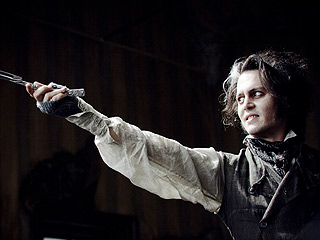
The story—Benjamin Barker (brilliantly played by Johnny Depp in his seventh Depp-Burton collaboration) is a barber living in London with his wife and baby daughter. But when the dastardly Judge Turpin (Alan Rickman) notices his wife’s beauty, he ships him to Australia on false charges to be with her and adopts his daughter. Years later, Barker is a changed man. He’s released from prison and has come back to London to discover that his wife is dead and his daughter is locked up by the judge. He hears this news from Mrs. Lovett (Helena Bonham Carter), who is noted to make the “worst pies in London.” He changes his name to Sweeney Todd and reopens his barber shop right next to Mrs. Lovett’s pie shop. He vows revenge on Judge Turpin and is just waiting to slit his throat. In the meantime, he practices on unworthy throats…

Well, it is a musical. How’s the singing? Well, people may think that Johnny Depp sings in “Crybaby,” but some people forget that wasn’t his voice. We hear him sing throughout the whole movie, and it’s not exactly a big Broadway voice but he doesn’t need one. His acting is unique and now, so is his singing. And this movie never has more than five minutes of no singing. The songs are quite good and very memorable. Stephen Sondheim is the finest music maker, having to keep these songs alive for this movie. The music is amazing and intriguing.

There are also subplots involving a young sailor who falls in love with Sweeney’s daughter and may end up helping getting her back (without knowing who she really is), and a boy who is adopted by Sweeney and Mrs. Lovett that could cause trouble when Sweeney is acting strange, or even more so. And also, we know that Mrs. Lovett is absolutely in love with Sweeney while Sweeney couldn’t care less about she feels. To him, Mrs. Lovett is like a sister to him and she doesn’t understand that Sweeney’s only love is his wife. These are created so we don’t have to see a whole lot of blood throughout the whole movie’s running time, and they work effectively.

We also get a great comic moment from “Borat’s” Sacha Baron Cohen as an Italian rival barber who has a shaving contest with Sweeney. He’s hilarious here, and that’s great comic timing in such a film that has Sweeney slitting the throats of his customers and Mrs. Lovett cutting the remains up and cooking them into her meat pies. Suddenly, she doesn’t make the worst pies in London anymore.

Like most Burton movies, the movie looks so good while also looking quite eerie. Tim Burton has yet another unique style of filmmaking. He’s made London look so dark because this is a dark movie and the character’s faces look so gothic to blend in with the dark surroundings. Burton scores again here and this is most definitely his best film since “Ed Wood.” The acting is first rate. Johnny Depp is such a great actor who has all these memorable roles. He creates another memorable character for his career as the vengeance-seeking Sweeney Todd. And Alan Rickman is game enough to make a role his own. This is the best I’ve seen him act since 1988’s “Die Hard.” And also there’s Timothy Spall as the silly assistant to Rickman’s character Beadle, who’s also very good.

To sum it all up, with Stephen Sondheim’s spellbinding music, Tim Burton’s direction, Johnny Depp’s fantastic role, and a few scares here and there makes this one of the best musicals I’ve seen in a long time. And I guess the blood spurting out of the throats also makes this the bloodiest classic musical I’ve ever seen.

Tucker and Dale vs. Evil (2011)

1 May

images

Smith’s Verdict: ***

Reviewed by Tanner Smith

Remember how in “Scream” teenagers had seen “Halloween” and thus took it as a crash course in how to survive a horror movie? Well, the college students in “Tucker and Dale vs. Evil” have obviously seen “The Texas Chain Saw Massacre” and maybe “Deliverance,” and take what they can to survive a similar scenario…and yet they still die in many horrific ways!

Here’s the setup—a group of obnoxious college students (all of which you’d like to see get slaughtered by a psychotic hillbilly soon) go on a camping trip in the middle of nowhere. Along the way, they receive glares from passing rednecks in a pickup truck, and also encounter them again at the obligatory Wrong Gas Station—that rundown old gas station that looks like a regular end-of-the-line shack. Of course, those two same “hillbillies” are staying in a cabin near their campsite (which is also where a certain Memorial Day Massacre took place, wouldn’t you know it), and they happen to show up when one of the girls goes skinny-dipping. Their appearance frightens her, as she gets into an accident after which the two take her away.

To be sure, the two guys—Tucker (Alan Tudyk) and Dale (Tyler Labine)—are not the psychotic hillbillies that serve as antagonists for this kind of movie. They’re just two dim-witted buddies who only hope to enjoy a fishing trip at Tucker’s cottage in the woods (though it really doesn’t help that the interior of the cabin makes the place look haunted and also has newspaper clippings of the infamous massacre reported). They’re only out there near the college kids’ camp because they were fishing, and Dale happened to see the beautiful young woman and became infatuated. When she has her accident, they rescue her and bring her unconscious back to the cabin. Meanwhile, the other kids, led by Chad (Jesse Moss), believe that she was kidnapped and because they’ve seen too many movies about psychotic mountain men, they…decide to fend for themselves and try and get her back instead of going straight for the police…

OK.

The girl, Allison (Katrina Bowden), quickly realizes that she isn’t in any danger from these two men, and even spends some time with Dale. They play board games together and talk with one another and start to hit it off pretty well. But that doesn’t make the others understand the situation as they race to “rescue” her. But the problem is (and this is a running joke), every time they attempt to make a move, they accidentally wind up killing themselves in horrifically tragic ways!

Many young people die in the most hilariously unintentional ways, but mind you, they’re the most gruesome ways as well. (I won’t even mention the woodchipper, but let’s just say that “Fargo” made it look dignified.) And thankfully, this is the first “slasher-movie” (if you will) in which you actually get your wish about the character you wish would die dies. They are not likable, and they are very obnoxious, but they are supposed to be that way. They are the butt of the running joke. And while the running joke is violent, it is still funny because of the clichés that they try to avoid and yet come back to, leading to their deaths.

Tucker and Dale are pretty likable, and are played with a great Laurel-and-Hardy rapport by Alan Tudyk and Tyler Labine. The pudgy Labine, in particular, has a puppy-dog likeability that you can’t help but sympathize with this guy. And that’s also why Katrina Bowden, as Allison, is appealing as well—she sees through the bullcrap that her friends always think they see.

Just remember this little message, you dumb college-student losers who decide to go camping in the middle of nowhere, where a “redneck’s” cabin happens to be…for whatever reason you would choose that location. “Hillbillies” are people too.