Archive | May, 2013

A Time to Kill (1996)

14 May

FailureToLaunch2

Smith’s Verdict: ***

Reviewed by Tanner Smith

Before I review “A Time to Kill,” I want to state a regular “blog-thought” (if you will). With “A Time to Kill” the next John Grisham film adaptation after “The Client,” I have to wonder—do director Joel Schumacher and screenwriter Akiva Goldsman truly get John Grisham? Or are John Grisham’s novels able to give these otherwise-mediocre-at-best artists the outer limits of material for them to use effectively? I like both “The Client” and “A Time to Kill”—they’re very good adaptations. I dislike more of Schumacher’s and Goldsman’s work separately—with Schumacher, there’s “Batman & Robin,” “St. Elmo’s Fire,” among others; with Goldsman, it’s also “Batman & Robin,” as well as “Lost in Space.” But “The Client” and “A Time to Kill,” it’s hard to deny that there is expert direction and good writing within both of them, to me anyway. So I don’t know, maybe they’re better at doing adaptations; maybe Grisham is better suited for them; I don’t know. But there is proof of talent here, in my opinion.

I could do a whole blog entry that isn’t merely a review, going into analysis on why I think “The Client” and “A Time to Kill” work. But for now, I need to review “A Time to Kill,” which is one of the best film adaptations from a John Grisham novel.

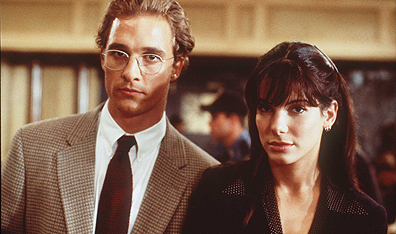
“A Time to Kill” is a compelling story with one of the most complicated scenarios that lead to the surface of morality tale. It includes racial tension, deceit, violence, and the hopes for a fair trial. It all begins as a ten-year-old black girl is brutally raped and beaten by two drunken rednecks in a small backwater Mississippi town. The two men are arrested, but the girl’s father, Carl Lee Hailey (Samuel L. Jackson), is unsure of what to do. Should he trust the justice system to give them the punishment they deserve, or should he take immediate action now, thinking they’ll get off scot-free? He shares his intentions to an old friend, a local, white, up-and-coming lawyer named Jake Brigance (Matthew McConaughey), who doesn’t quite believe that Carl Lee will murder the two men. But then the next day, Carl Lee does show up with a shotgun, killing both men and severely injuring a cop in the process. Now on trial for murder, Carl Lee chooses Jake as his attorney, his logic being he thinks like a jury would and thus would be an ideal “secret weapon.” The main question here is whether or not a black man can receive a fair trial after murdering two white men, for what they did to his daughter, especially in this time in the South. So Jake, along with his old mentor (Donald Sutherland), a divorce specialist (Oliver Platt), and an energetic (and unpaid) assistant, Ellen Roark (Sandra Bullock), Jake prepares to go up against the local DA (Kevin Spacey) and help Carl Lee.

There are numerous subplots in “A Time to Kill” that bring the film to just barely pass the two-hour-thirty-minute mark. While some of these work in serving the plot, like the scenes involving the NAACP’s legal defense representatives (led by Joe Seneca) and the plight of Jake’s wife (Ashley Judd) and daughter who are now facing threats because of the case. And there’s also developing the relationship between Jake and Roark so they’ll work together—she offers to help, he gently turns her down repeatedly, she then delivers some helpful leads, and he brings her onboard as an unpaid aide. I’m glad these two don’t develop a romance together; their relationship is purely platonic and work-related. But the one subplot that I’m still quite unsure about, and it is an important one, is the presence of the Ku Klux Klan, led by the brothers of the two men killed by Carl Lee. They threaten the lives of Jake, his family, and his friends. Making the Klan into villainous thugs in this film is prominent, but it feels like it’s going way too far to get the story’s point across. I can’t help but think that the film would be just as effective if a smaller, more moderate group in this small town would represent the “prejudice” roles. I don’t know, but to me, the Klan subplot seems like a bit much.

One subplot I missed was the plight involving Carl Lee’s family. We hardly ever see them after the half-hour mark, and I was wondering how they were reacting to this situation. What is Carl Lee’s wife going through? How is his daughter holding up? What about his other kids? Now that I think about it, with most screen time devoted to white characters (with the exception of Charles S. Dutton as the town sheriff, who is black), are the black characters just here to serve as atmosphere fuel?

John Grisham obviously specializes in characterization in relation to court cases, and “A Time to Kill” is no exception. And the way Joel Schumacher sees it is in great respect to the novel in that it doesn’t go for cheap tricks or insane plot twists to keep the audience invested. There are a few twists, but nothing bizarre. Mainly we just have this controversial trial that searches for answers to the question of whether or not Carl Lee can get a good jury and a fair trial, given what he did. In the end, there is no clear answer. I’m not even sure there can be a clear answer.

The acting in “A Time to Kill” is top-notch. Samuel L. Jackson is excellent as Carl Lee, with a great mix of grief and anger. Sandra Bullock does some of her most appealing acting as Ellen Roark. Kevin Spacey is suitably slimy as the DA, Ashley Judd is convincingly frightened as Jake’s wife, Charles S. Dutton is great as the no-nonsense sheriff, and Donald Sutherland and Oliver Platt deliver strong support as well as comic relief. But what it really comes down to is the performance of Matthew McConaughey as the hero, Jake Brigance. McConaughey is great in this role—he exhibits a powerful presence with his charisma and intensity.

It’s easy to predict the verdict at the end of the story, but “A Time to Kill” is more concerned about how it happens. It produces a good, solid story arc for Jake as he starts out as a rookie lawyer, uses professional tactics to show up the DA, and when all else fails, in a powerful speech near the end, he plays the trial with pure emotion and has the jury truly think about Carl Lee’s situation as if it were happening to them. There’s more to it, but I won’t go into it for the sake of this review. “A Time to Kill” is well-made, powerfully-acted, involving, and thought-provoking. I kind of wish Schumacher and Goldsman made more Grisham adaptations after this.
I Know What You Did Last Summer (1997)

14 May

1997-as-buffy-fever-raged-gellar-launched-her-movie-career-with-i-know-what-you-did-last-summer-alongside-a-trifecta-of-90s-pop-celebrities-freddie-prinze-jr-ryan-philippe-and-jennifer-love-hewitt-the-movie-grossed-125-million.jpg

Smith’s Verdict: *1/2

Reviewed by Tanner Smith

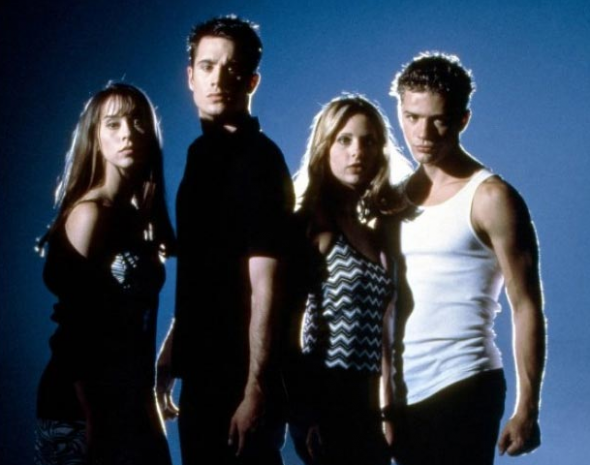
Of all the boring, deplorable slasher-movies to resurface in the mid-1990s, “I Know What You Did Last Summer” at least has an advantage of having an interesting story. (In fact, it sounds more interesting than it actually is.) Here’s the setup: four young friends celebrate the 4th of July when they get into an accident. That night, they accidentally hit a man on a dark highway with their car, and kill him. Unwilling to face manslaughter charges, they decide to take the body and dump it off a pier and into the sea, and never speak of it again. Exactly one year later, they’re reunited in their hometown when they receive notes that say “I know what you did last summer” and are stalked by a mysterious figure. Who is it? Was it someone who saw what they did that night? is it the same person, revealed not to be dead? Is it one of his relatives or friends? One thing is for sure—whoever it is wants to pay them back.

That sounds like a good idea, and you can develop dramatic tension with that premise, as well as suspense. For example, the guilt that these four people feel since that accident must be a huge amount of such, and that it drifted them apart makes it more complex. And there is a character—the victim’s sister—that is probably the most interesting person in the movie. She’s a recluse who lives alone in a country house and apparently has not fully come to grips with her brother’s death.

I wish the movie had been more about her. It would have been more interesting than how it is now, because as it is now, “I Know What You Did Last Summer” is just a bore. It’s a typical slasher movie. The characters are not developed in a way that you care for who lives and who dies. The situations are laughably bad. And the killer in this movie is a fisherman with a slicker, hat, and hook (in a fishing town it’s said that a lot of people wear slickers, but in the middle of summer, I don’t think so). There’s more to do with setups and slashings than much else, story-wise. The large-breasted heroine screams at the most inopportune moments, especially in the climax. And it ends with a particularly uninteresting twist that didn’t make a lot of sense to me (though to be fair, that’s probably because it was a weak twist to begin with).

What else can be said about a film like this? It’s just a dumb, insipid slasher-movie with hardly anything to offer, except a subplot involving that character I mentioned above. She’s played by Anne Heche and she does give a solid performance. I want to know her story. Better yet, I’d like to rewrite the entire screenplay so that this admittedly-interesting story can be delivered in a much more involving way than it is now. I guess I give actors Jennifer Love Hewitt, Sarah Michelle Gellar, Freddie Prinze Jr., and Ryan Philippe credit for trying to make something out of their lazily developed characters, but they needed better material to work with here.

Cloverfield (2008)

13 May

images

Smith’s Verdict: ***

Reviewed by Tanner Smith

The date was July 3rd, 2007. The movie was Michael Bay’s “Transformers.” The place was Paragould Cinema 8 in Paragould, Arkansas. The coming-attractions trailers included an engrossing “sneak-peek” that showed a scene of a Manhattan party being interrupted by exploding buildings and some sort of attack, seen from the point of view of a home-video camera. What’s going on? What’s attacking the city? Hell, what’s the title of the freaking movie? The end of this ingenious trailer only showed “From Executive Producer JJ Abrams” and “Coming 1/18/08.”

That was terrific. That had me thinking what the film was going to be when it was released. What we got was “Cloverfield,” released January 18th, 2008, which is pretty much the “inside-out” version of a monster movie, much like how “The Blair Witch Project” was the case with the ghost story. Like “Blair Witch,” the film “Cloverfield” is entirely the content of one video tape, as one among a group of people documents “how it all went down” as some thing attacks Manhattan.

That means the majority of “Cloverfield’s” running time consists of shakiness of handheld camerawork, undoubtedly giving some audience members motion-sickness. (I sat in the front row of the cinema—it’s no doubt after all.) You either get into it or you’re very annoyed by it. (But for those who say people don’t really shake the camera like the camera-holder does in this movie, newsflash—people running from disaster don’t usually care about keeping the camera steady!) Besides, I can see the effect that director Matt Reeves was going for with this—not the standard monster movie; mainly a major disastrous event seen from ground-level. After all, ever since 9/11, everyone likes to record anything out of the ordinary, to say the least.

“Cloverfield” starts out as a farewell video for a sincere young man named Rob (Michael Stahl-David) at his going-away party, as he is able to leave Manhattan for a new job in Japan. Documenting the party is Rob’s best friend, goofball Hud (TJ Miller, whose line-deliveries said from behind the camera make for appealing comic relief). Also at the party are Rob’s brother Jason (Mike Vogel), Jason’s girlfriend Lily (Jessica Lucas), Hud’s crush Marlena (Lizzy Caplan), and, to Rob’s surprise, Rob’s ex-girlfriend Beth (Odette Yustman).

“Cloverfield” spends a little more than 15 minutes with these people, making it feel like a different movie than what was advertised. This actually works in the film’s favor because it really sneaks up on you the same way it sneaks up on the characters when chaos ultimately ensues. It really got me when they’re just having normal conversation and then out of nowhere, the building shakes, things start blowing up, people ask “What was that?” etc. Once the madness gets started, the film becomes exhilarating.

And by the way, I’m sure the realization that the attacker in “Cloverfield” was just a regular monster, and not Godzilla (though pretty close in shape and size), disappointed a lot of hyped moviegoers, but I’m sure any reveal would have disappointed them, so forget that. As for me, I was one of the people who didn’t care what the attacker was, as long as it was sci-fi based and big enough to be threatening. The monster itself is scary when seen in glimpses, like when the camera switches to and from it in a hurry, and also when it’s kept in the shadows so there’s that foreboding aspect to “Cloverfield.” Even scarier though are these parasitic spider-like creatures that apparently come from the big creature and attack people. The creepiest scene in the movie involves these little beasts as they attack our heroes in a dark subway tunnel. These things mean business.

What exactly is this monster? Where did it come from? What can kill it? None of that is answered. “Cloverfield” has no backstory or any kind of explanation for the monster’s origins. All we know is that it’s big, it’s mean, and it’s here. That’s it—the whole movie stays with Rob, Hud, and company as they race to survive the night and escape the city before things get worse. That’s actually kind of refreshing, in that there’s no bizarre B-movie type of explanation like it came from pollution or something like that. And the actors playing these admittedly-generic characters are pretty good and quite likable for us to follow them. They, along with some first-rate special effects, add to the realism, grittiness, and terror of this “inside-out” monster movie.

Pearl Harbor (2001)

13 May

images

Smith’s Verdict: *1/2

Reviewed by Tanner Smith

Michael Bay tends to make his big-budget action films an hour longer than they need to be. Apparently, how he and producer Jerry Bruckheimer manage to do that is to keep holding onto whatever eye candy they can create and market from their popcorn movies. Special effects take center while scripts are not usually called upon to serve them. And with “Pearl Harbor,” Bay and Bruckheimer take things a few steps further. This is their “epic” effort, set against a historical backdrop and attempting to tell a compelling human-interest story with a running time of 183 minutes. 183 minutes—if Bay’s earlier action films were an hour too long, then this one is about an hour-and-a-half too long.

Did Bay think he was making “Titanic?” Like that film, “Pearl Harbor” spends a majority of running time with a romantic couple and their conflicts with being together, with a historical event looming and waiting to come around until later in the film, when said-characters would have to endure true danger.

Actually, yes, I am convinced that this was an attempt to cash in on the success of “Titanic.” But the main problem with “Pearl Harbor” is the lazily-written screenplay. The dialogue is laughably bad; clichés in romances and war films are present; and the human-interest story is hardly interesting. So much money went into the look of “Pearl Harbor” that I’m surprised that the rest of it wasn’t used to create a more complex script. As it is, it looks nice, the cast is solid, the special effects are very impressive, and it has the potential to be something better than it is, given the subject matter which is admittedly captivating. Having a story set around the surprise Japanese attack on Pearl Harbor on December 7th, 1941 is interesting enough if given the right human-interest story. But I couldn’t care less about most of what was happening onscreen. That it runs over three hours in length makes it even more unbearable to watch.

The story centers on bomber pilots Rafe McCawley (Ben Affleck) and Danny Walker (Josh Hartnett), who are best friends and practically brothers. Evelyn Johnson (Kate Beckinsale) is a nurse who passed Rafe in a medical exam for the Air Corps, even though he is dyslexic. Rafe and Evelyn are fools for each other until Rafe announces to her that he’s joining the Eagle Squadron very soon.

Get this—Rafe gives Evelyn the news the night before he’s supposed to leave and denies her a night of romance so that the lust will be a good motivator not to be killed in the war, and return home. Then he tells her not to see him off, stating that if she does come, it proves that she loves him. Sheesh, this is the human-interest story we have to go through? That’s just the beginning. It gets worse as we endure a second romance between Evelyn and Danny, after Rafe is declared dead, killed in battle. And wouldn’t you know it—after all that time, we find that Rafe is still alive, as he comes home and discovers Evelyn’s relationship with Danny. And there you have it—a love triangle that will undoubtedly be interrupted and resolved by one of the key actions of World War II.

An hour-and-a-half into the proceedings is when we finally endure the attack on Pearl Harbor. Admittedly, it’s pretty intense and is told in a somewhat-credible way, given the goofiness of certain situations (such as a stutterer who alerts his fellow soldiers of the attackers, and even a private who runs out to find out what the commotion is all about, while brushing his teeth and wearing a towel). But here’s a major problem with this action sequence—we never got to know any of the soldiers getting killed in the attack. Rafe and Danny are unwinding from an argument the night before, and aren’t in the middle of the attack. And as for Evelyn, she and her giggling friends are attacked at the base hospital, even though I don’t think I’ve read that the Japanese fired on civilians. Everyone else is just an extra. That’s a very bad move to set up these three characters and not put them in real danger for the attack, and even worse not to give us memorable character traits for the ones that are getting killed.

I never cared for the protagonists, or the love-triangle they have to endure. Dramatic tension is cast aside for clichéd writing and uninteresting situations. The romance is recycled from what seems like soap-opera material. When the attack does come is when things are more interesting—even though the poorly-developed characters aren’t in much danger in that central sequence, at least we don’t have to deal with their story for a while. But once that’s done with, there’s still an hour left, with more monotonous characterization and dull conditions. You know you’re in trouble when you find yourself wishing for more over-the-top action in a Bay picture.

The only redeeming aspects of the final hour of “Pearl Harbor” are the moments involving actors playing true-life characters. In particular, Jon Voight (sporting a rubber chin) plays Franklin D. Roosevelt who of course declares that America join the war—he has a particularly “awesome” moment in which he, out of anger, wills himself to stand up from his wheelchair and stand up to Congress. Also entertaining is Alec Baldwin as General Doolittle, who late in the film states every single obligatory war-movie-speech cliché in the book. That is irritating yet funny at the same time.

I can’t really blame Ben Affleck, Josh Hartnett, and Kate Beckinsale because they are admittedly solid in their lazily constructed roles. The blame has to go to Randall Wallace’s screenplay. It lacks dramatic pull, wastes a great chunk of running-time on uninteresting characters, and lacks an element as vital as intelligence. “Pearl Harbor” is overlong, unexciting, and unremarkable. And it just shows everything that “Titanic” did right (whether you like it or not) and what this movie does wrong.

Hulk (2003)

9 May

images

Smith’s Verdict: ***1/2

Reviewed by Tanner Smith

Let’s take a look at 2003’s “Hulk” from a 2013 perspective and find out what summer-movie audiences really seemed to hate about it. When Ang Lee’s film adaptation of the Marvel comic book series “The Incredible Hulk” was released in the summer of ’03, audiences walked out very disappointed and practically calling it a sad excuse for a summer-blockbuster. What was the cause of the hate? What went wrong?

Was it the numerous conversations within the characters? Isn’t it important for characters in superhero-movies to talk about their plight?

Was it the dark, depressing storyline? I think we’ve grown used to that by now, what with the releases of Christopher Nolan’s rebooted “Batman” films, for instance.

Was it the poor rendering of a CGI-Hulk running around and smashing things in his path? Well…fair enough. But haven’t we seen worse CGI? And aren’t we always aware that CGI is used in these movies? Granted, this Hulk looks more like Shrek on steroids, but he does interact with the real world very well—he smashes objects, encounters people, blends into shadows, etc. And in closeups, he doesn’t even look fake.

My guess is that “Hulk” was a superhero movie that was ahead of its time. Surely, CGI would progress in these films, but in the years since this film’s release, we’ve gotten used to action films of this type having many complex issues and dark material (see “The Dark Knight,” for example). With “Spider-Man” and “Daredevil” (both films based on Marvel comic book characters) already released before this one, people thought they were going to get just good solid entertainment with hardly anything more. I don’t think they were prepared for “Hulk.”

But wait a minute, you may exclaim. What about Tim Burton’s “Batman” films? Those came out more than ten years before “Hulk” and they were pretty dark for comic-book movies! Well since then, the superhero-movie genre was declared dead, not only with the Shaq vehicle “Steel,” the Pamela Anderson striptease “Barb Wire,” but even with Joel Schumacher’s embarrassing “Batman & Robin.” Then, “X-Men” was released in 2000, and it seemed like the superhero-movie was back, high on entertainment, low on much else, but entertaining nonetheless. So audiences figured we’d get more and more of these as they went along, and it would take a more iconic figure (like Batman) to make people ease into darkness.

I wonder what would happen if those people watched “Hulk” again nowadays because, to get straight to the point (if you didn’t figure it out already), I think “Hulk” is pretty good. It’s inventive, it’s involving, and well-executed. And more importantly, it’s successful in its character development and even how it represents the green behemoth himself, the Hulk. How Ang Lee sees the Hulk is probably different from the comic-book story (I admit never having read it), but all the more intriguing. Hulk is more of a tragic figure in this movie—a victim of unfortunate circumstances and consequences of a world he didn’t make. He can’t help but let out the rage in the physical form of a gigantic beast.

The Hulk is the rage that comes from within Dr. Bruce Banner (Eric Bana), a scientist working on a complicated radioactive experiment. He works with his ex-girlfriend, Betty Ross (Jennifer Connelly), whom he’s still friendly with. Their experiment is still is the staging process, but things get even worse as a laboratory accident exposes Bruce to radiation. It doesn’t kill him, but it does enhance something inside of him, which isn’t clear until he transforms into the Hulk—a giant, green-skinned monster with great strength and speed. He discovers he is able to transform when he’s angry and can change back when his rage dwindles down.

Bruce also learns that there’s more to him than that, as he gets in contact with an old man who turns out to be his father, David Banner (Nick Nolte). He knows of Bruce’s ability and plight, and has also passed it on to him to begin with, by experimenting with his own DNA code and passing along transformed genes to his son. He then tried to kill him before being taken away for 30 years. Betty’s father, General Ross (Sam Elliott), knows of David’s history and keeps an untrusting eye on Bruce before realizing what he has become and takes him away. But that may turn out to be a mistake…

So, while Bruce is locked up and experimented upon, he becomes the Hulk again and runs amok, leaving General Ross and his men to decide whether to kill him or help him.

Remarkably for a supposed summer-blockbuster, “Hulk” is very somber in tone. There’s some good action and some intriguing entertainment values, but for the most part, it’s pretty dark. There’s a tragic backstory involving David and what he may have attempted to do with Bruce (to end his “curse” early), as well as the philosophy of who’s human and who’s not, which is something that any science-fiction story likes to use. But more importantly, the characters talk about their situations at hand. They discuss their plight and how it’s affecting them all. That’s kind of refreshing. The film’s audience in 2003 may have found the conversations too “talky”—so what? I felt for the protagonists even more because of that. Probably the strongest moment is when Bruce and Betty discuss this transformation alone in a cabin before Bruce is taken away. Bruce reveals that it scares him most when he realizes that he likes it when he completely loses himself into being the Hulk. It’s a revealing moment and it sets the mood for the rest of the movie, in that Betty knows how her father and the authorities will treat him and hopes to be able to soothe him.

I don’t even want to call “Hulk” a superhero-movie. It’s more of an Incredible Hulk version of the classic monster movies, such as “Frankenstein,” “King Kong,” and “Dr. Jekyll and Mr. Hyde.” Elements of all three titles are evident here in a modern light. I think more of those titles than I do of “Spider-Man” or “Daredevil.” With “Frankenstein,” we have the creation gone wrong, the belief that humanity will never accept the unusual, and the creature unfairly hunted by those who don’t understand. That last one also resembles “King Kong,” in that Hulk is seen as a monster and hunted by the authorities. Also resembling “King Kong” are the action sequences, in which Hulk fights off mutated dogs that were part of David Banner’s genetics experiment, and an extended sequence in which Hulk battles Army tanks and helicopters (those scenes resemble Kong’s battle with dinosaurs and his last stand). As for the “Dr. Jekyll and Mr. Hyde” aspects, it pretty much explains itself. Bruce is Jekyll. Hulk is Hyde. Simple.

I mentioned before that I didn’t want to call “Hulk” a superhero-movie. But I can’t deny that it is a comic-book movie. Ang Lee goes all out to give it the look of a comic-book. He positions many shots to look like comic frames; he uses mobile camera movements to keep the flow of the mood; and more frequently, he uses multiple split-screens that show one area or another while keeping in the same scene. Watch this movie, and you’ll see what I mean. It’s very clever.

Oh, and should I also mention that the credits are also in that Comic Sans font that is used in descriptions of…comic books?

As for the action, it’s pretty good too. That lengthy sequence in which the Hulk battles the Military is exciting and intense. And because of everything that’s happened before, we always root for the Hulk to escape this situation.

The acting is across-the-board solid. Eric Bana is great as Bruce, giving us a complicated character to like and root for. Jennifer Connelly is appealing as Betty, who is stronger than you might think in this “girlfriend” role—she’s better than that. Sam Elliott is not entirely villainous as General Ross—he gives the character a more human side than you might expect. He’s very stubborn, yes; but he’s not evil. And then there’s Nick Nolte who is just perfect as David Banner. This is a mad scientist done right. Not manic or campy in the slightest—just a deranged, self-centered lunatic who cares more for how his experiment progressed with his son, rather than rekindling a relationship with his son.

OK, now what about the Hulk himself? Yes, I know he’s entirely CGI and people have attacked this creation as looking very fake. It’s easy to make fun of this Hulk, apparently. And I have to admit, it is the least interesting element in the movie. That might be because while in closeup, it looks very real and like I said, it interacts with the real world fine. But when you see it in faraway shots, it does look quite fake with herky-jerky movements and a cartoon-like look.

But for the most part, I really like “Hulk.” I know I’m in a minority on this, but hopefully that’ll change if people actually give this a second look. When you really think about it, comic-book movies have improved into being movies for people who don’t like comic-book movies (and thus, making them like even more comic-book movies, ironically). “Hulk” was one of the first to share that label, while other fans of the superhero-movie genre were left disappointed by the heavy dramatic situations and the dark storyline. Times have changed. It’s time to watch this movie again. Hopefully you’ll see it a different way.

The Happening (2008)

9 May

images-1

Smith’s Verdict: *1/2

Reviewed by Tanner Smith

I hate to pick on M. Night Shyamalan. I really do. His successful 1999 thriller “The Sixth Sense” is a masterpiece in my eyes. I really like his follow-up thrillers “Unbreakable” and “Signs,” and I find “The Village” to be quite underrated. But as “Lady in the Water” declared his downfall as a filmmaker by just trying too hard to make a complicated, laughable story into something even more so in execution, this is also proven in the follow-up to that film, “The Happening.” For those who thought “Lady in the Water” was inept, “The Happening” is even more so. It’s strange (not in a good way) and just laughably bad.

This is one of the stupidest apocalyptic thrillers I’ve ever seen. See if you follow this—it begins as some sort of neurotoxin hits several people in New York, causing them to freeze in time, take a few steps backward, and then ultimately kill themselves.

Richard Roeper put this best, by the way—“Something wicked this way comes, and when it does, you die.”

Anyway, this airborne silent-invisible killer spreads from city to city. It’s posted by the media as a terrorist attack, but (get this) there’s a different theory that maybe nature has something to do with it, that it’s extremely ticked off at society and has found a way to communicate through the trees in order to spread a toxin in the air that will destroy all of humanity.

Yeah, that’s silly enough. It’s even more laughable as the heroes we follow in “The Happening” actually talk to the trees and plants in an attempt to soothe them and spare their lives.

Our heroes are a high-school science teacher, Elliot (Mark Wahlberg); his emotionally withdrawn wife, Alma (Zooey Deschanel, keeping her eyes as wide as she possibly can); Elliot’s best friend, Julian (John Leguizamo); and Julian’s young daughter, Jess (Ashlyn Sanchez). They leave the city of Philadelphia by train after news of the attack, but then are stranded in a rural area where they must…outrun the wind?

Yep, they outrun the wind and find shelter easily. And get this—they never stay in one spot and hole up! They keep going from place to place without having the intelligence to just hide in one location and wait out the storm. These characters are too dumb for a slasher-movie, let alone a disaster-movie.

The atmosphere is practically nonexistent. There’s hardly a sense of menace in the air (so to speak), so it’s hard to fear for the characters when the threat is near. And characterization is even worse—it’s stilted and forced, and the dialogue doesn’t help either. Speaking of which, say this line without cracking up (I dare you)—“Don’t take my daughter’s hand unless you mean it!” I don’t know about you, but that line kills me.

What was M. Night Shyamalan trying to pull off here? An environmental message within an apocalyptic thriller? Well, if he can’t make trees or plants seem ominous or threatening, there’s hardly anything that can be worth recommending for “The Happening.”

The Island (2005)

9 May

images

Smith’s Verdict: ***

Reviewed by Tanner Smith

To be completely honest, I had no idea what Michael Bay’s “The Island” was about when I first watched it. I didn’t know the premise, except that it took place in a dystopian future and, being a Michael Bay film, it would feature a heavy dose of action. That’s why as I watched “The Island,” not knowing what was going to happen, I became fascinated by each twist and turn that it would deliver.

I found myself enjoying “The Island” and its clever, intriguing story that involves a lot of science-fiction elements and gripping action sequences to keep its status as a summer-blockbuster. Michael Bay is usually known for overkill in his movies, such as “Armageddon,” “Pearl Harbor,” and the two “Bad Boys” movies. But “The Island” is more on the same dosage of entertainment as Bay’s best film, “The Rock.”

Don’t get me wrong—this isn’t a great movie. Some of the story developments are somewhat dumb, others are unresolved, and the character development is hardly solid. But most of them do work, enough to be intrigued by the creativity of such. The action is well-executed with some original touches to keep them interesting (for example, one chase scene involves a load of heavy barbells to hold off company). The production design is impressive. The actors look like they’re having fun. And the twist that comes midway through is actually pretty good, and allows for some very interesting moments of thought (quite unusual for a Bay picture).

The film begins as a sci-fi parable in a sterile, technologically-advanced, futuristic environment that features inhabitants who are survivors of a “contaminated” world outside. The residents wear entirely white clothing (while the supervisors wear entirely black) and go about a certain system that requires them to remain obedient. Big-screen TVs scattered throughout this sealed bubble announce a Lottery that declares a winner to go to the only safe place left on Earth—the “Island.”

Now, even though I didn’t know what was going to happen, I can tell you that even a grade-schooler could tell that something is not right with this futuristic society. And thankfully, our hero, Lincoln Six Echo (Ewan McGregor), conveniently starts to ask the right questions to his supervisors and his friends. This is somewhat of a surprise to Merrick (Sean Bean), one of the supervisors, since the people in the white suits aren’t supposed to think very deeply about these sorts of things.

Lincoln’s friend, Jordan Two Delta (Scarlett Johansson), has been chosen to go to the Island, but Lincoln still isn’t so sure of this system and how it works. When he discovers the truth, however, he and Jordan escape into the outside world…

It’s going to be hard to go into the second half of “The Island” without having to give away spoilers. But I will give away only one certain spoiler, and that is that the world seems fine for a future that is supposed to be “contaminated.” The world has not changed; it’s this society that has been created within it for mysterious reasons involving the Government.

Period. That’s all I’m going to describe. The less you know about the story, the more you’ll get into it. It really depends on whether or not you buy into it. I did. I thought it was very entertaining and quite intriguing. That’s not to say there aren’t problems, of course. Like I said, not everything pays off and some points are admittedly ridiculous. But there are enough aspects that I found rather fascinating.

I liked the relationship between Lincoln and Jordan. Unusually for these action movies, the romance is not so complicated. It’s nice that these two are already friends before the action takes place, and it doesn’t subject us to that clichéd forced romance in which a man and woman hate each other and then start to love each other as the action continues. I thought the relationship in “The Island” was refreshing, and I liked Ewan McGregor and Scarlett Johansson in their roles.

But being a Michael Bay film, there are all sorts of action—we have chases, shootouts, showdowns, fistfights, etc. with explosions, noise, and “permanent sunsets.” (Did you ever notice that each of Bay’s movies seem to take place at sunset most of the time?) Aside from the obligatory climax in which Lincoln and Jordan must ultimately make things right after all this peril and adventure, I was hooked by the action sequences. I already mentioned the barbells in the chase scene; that was a very original touch.

“The Island” starts out as a sci-fi parable, turns into an entertaining action flick, and as a whole, it’s quite a good movie.

Avatar (2009)

8 May

Scene-from-Avatar-2009-001

Smith’s Verdict: ****

Reviewed by Tanner Smith

(Originally reviewed early 2010)

“Avatar” is an extraordinary spectacle to behold—a film with the same kind of science-fiction/fantasy heart and energy that made “Star Wars” and “The Lord of the Rings” trilogy hits. James Cameron (director of the Terminator movies and “Titanic”) takes a story and fills it with amazing sights and gives “Avatar” a lot more than people would expect from him.

The film is set in the year 2154. U.S. Armed forces are set on a mission to an earth-sized moon called Pandora to locate a rare piece of mineral that the Earth desperately needs. The natives on Pandora are the Na’Vi, 12-ft. tall blue-skinned beings who respect their environment. They do not present a threat to Earth but nevertheless, the Armed forces are planning to attack them and retrieve that rare mineral that is somewhere in their dwelling. To venture out of their drafts, the people use avatars—Na’Vi lookalikes that are genetically created from observing the natives and are mind-controlled by humans, whose bodies still lay inside a machine in a trance-like state.

This new breakthrough is amazing to the hero Jake Sully (Sam Worthington). Jake is a paraplegic assigned on the mission because he is a genetic match for his dead identical twin, who already had an avatar ready for him. With this new body he inhabits, he can walk and run again. He can also venture out into the Pandora wilderness. Technically, there is no danger for him. If his avatar is destroyed, the human mind returns to its own body unharmed. Maybe.

“Avatar” is mostly about Jake as he changes his life on Pandora. First he’s a good soldier who wants to go along with the group. But then not much later, a series of events happens and he becomes a Na’Vi native. He befriends a female native named Neytiri (Zoe Saldana), who saved his life. He learns that the Na’Vi, who live in an enormous tree, are in harmony with nature and survive only because they know their planet well. To get around, they are forced to tame wild creatures, much like the Native Americans. In this case, they tame dragons that can be controlled once its tail and a Na’Vi’s tail are connected together. Strange.

Then the film sets into darker territory. The Armed forces are prepared to attack, given orders by the ruthless, aggressive Col. Miles Quaritch (Stephan Lang, who really lets it all out with this performance). We get many battle/action sequences, but these have purpose. “Avatar” has already established the characters so we fear for them. These scenes are powerful and frightening and well-handled. The movie is full of scenes that fall into those three adjectives. I can also add “amazing” in the scene in which Jake tames a dragon-like beast and later flies on it. That is a great sequence. It works even better in 3-D. 3-D is starting to become a trend nowadays but I watched this film in IMAX True 3-D and found myself (I’m not kidding) holding on to my own seat. 3-D works best when the film shown in 3-D gives us amazing-looking flying sequences. We can experience the flight ourselves while watching it.

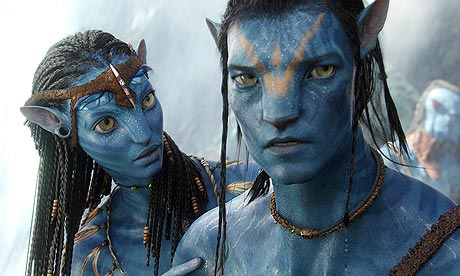
The film looks great. “Avatar” is not only a sensational entertainment but also a technical breakthrough. Pandora was created by a large amount of CGI and it looks fantastic. We haven’t seen this place before; we would love to return someday. The Na’Vi are created by using real human actors in motion-capture technology. All is done convincingly—that is most important when working with technology like this. The Na’Vi look like unique individuals and give Cameron and the artists a lot of credit for making Neytiri, a female blue-skinned, golden-eyed giantess, look beautiful. Another pleasure in the movie is the relationship that builds up when Jake and Neytiri train together and learn to trust each other and even love each other. This is very risky to pull off, especially once you consider what would happen if Neytiri found out Jake’s body was only an avatar. But it works here. I loved watching these two together.

The film is 163 minutes. I have to admit, I never checked my watch—that’s a good sign. Though I also must admit, I thought the movie was going to end about an hour-and-a-half into the movie (that’s just a guess). But no, I was given an hour of more amazing visuals and more interesting story to experience. The running time of 163 minutes doesn’t seem like a long time. “Avatar” interested me from beginning to end.

James Cameron has done it again. This is his first film since “Titanic” twelve years ago and he spent all that time developing this project. He never took a step wrong. “Avatar” is one of the best films of 2009. Maybe James Cameron really is “king of the world.”

Hannibal (2001)

8 May

Hannibal

Smith’s Verdict: **

Reviewed by Tanner Smith

You know that old saying, “Less is more?” That was certainly true of “The Silence of the Lambs,” which implied heavy violence while actually showing the aftermath so that we, as an audience, can picture what it must have been like. It maintained a terrific amount of psychological tension that way. It would be a mistake to show in graphic blood-and-gore details and lose the psychological terror of the situations. I say this because 10 years after “The Silence of the Lambs” was released, “Hannibal” would come around and also turn things around. It shows more; it delivers more blood and gore. It seems as if a majority of the film’s budget went into how the filmmakers were going to gross people out. So much for psychological terror.

“Hannibal” is the sequel to “The Silence of the Lambs,” both films based on novels by Thomas Harris. Director Jonathan Demme has not returned this time around, and instead has been replaced by Ridley Scott. And also, Jodie Foster, whose portrayal of heroine Clarice Starling in “The Silence of the Lambs” won her a richly-deserved Academy Award, has decided not to return to the role this time. Instead, she’s replaced with Julianne Moore. But we still have Anthony Hopkins back in the iconic villainous role of cannibalistic serial killer/former psychiatrist Hannibal “The Cannibal” Lecter. But even his psychotic charisma isn’t enough to save “Hannibal,” which is a big step down from what made “The Silence of the Lambs” special.

This is not the gripping psychological thriller it would like us to believe. We see everything that would have been implied in the original film in graphic detail, just because Scott feels the need to shock his audience. We have a man cutting off his face (and then feeding it to his dogs); we have men being eaten alive by numerous boars; and there’s also a scene in which a man has his skull cut open, exposing his brain and having Lecter cut out a part of it, sauté it, and then feed it to the man, who is still alive.

While Clarice Starling was a complex center of the original story, Clarice this time around is hardly anything more than a plot device. She is brushed aside to make room for running time with Lecter, who is really the center of “Hannibal” (going by the title, that should be obvious). The intricate characterization of Clarice Starling is practically nonexistent here. The relationship between Lecter and Clarice (the most captivating part of the original film) is barely here, as the two only have a few scenes together. And even then, when they have their final encounter in the climax, it’s more disappointing than it is compelling. I give Julianne Moore credit for doing what she can with the role, but she’s given much of interest to do. (Besides, it’s hard to imagine anyone but Jodie Foster in the role anyway.)

Hopkins’ creepiness factor that came with the character of Hannibal Lecter has been toned down for “Hannibal,” which also seems like a disadvantage. While it does make Lecter more of an anti-hero than a full-fledged villain this time around, it’s not exactly what we like to see from the character. Oh, he still commits horrible crimes in this one, but there’s never a sense that we wish he would get caught, which itself makes it kind of sick in a way.

And here’s a question—even though Lecter’s disappearance and the search for him has become so notorious that his stuff is selling on eBay, Lecter has somehow managed to create a false identity among society in Florence; how is it that only one person seems to notice who he is?

Other characters include—hateful politician Paul Krendler (Ray Liotta) who is constantly on Clarice’s case; Rinaldo Pazzi (Giancarlo Giannini) is that aforementioned person to see through Lecter’s phony identity, as he attempts to capture him for the reward money; and there’s also one of Lecter’s previous victims, an attorney named Mason Verger (Gary Oldman, uncredited) whose face is horribly disfigured since his encounter with Lecter and is more ruthless than Clarice suspected when he put her on the case for a new lead in the search for Lecter. Neither one of these characters reach three-dimensionality; though to be fair, Merger comes somewhat close, but not quite enough.

But what about Scott? How does he fare as the director this time around? Well, being a Ridley Scott film, “Hannibal” is laced with atmosphere and inventive shots, and I suppose I can give him credit for being able to pull off what probably couldn’t have been filmed by many other filmmakers (the brain-eating scene, for example). One thing “Hannibal” that is undeniable is that it’s stylistic.

“Hannibal” is clumsy, ordinary, unnecessary, and worst of all, it’s anticlimactic. After so much buildup waiting for Lecter and Clarice to square down, we’re subjected to a “climax” (if you would even call it that) that is so disappointing that it’s hardly worth talking about. Something terrific could have been made here; as it is, it’s pretty much disposable.

Death Proof (2007)

8 May

Grind House (Death Proof)

Smith’s Verdict: ***

Reviewed by Tanner Smith

Quentin Tarantino’s “Death Proof” was the second of two films (the first directed by Robert Rodriguez) to pay homage to a type of ’60-‘70s exploitation film known as the “grindhouse,” which was commonly made for drive-in theaters. The films were made with very little money and usually bad quality in the filmmaking and acting department. They have since been accepted as guilty pleasures. Rodriguez and Tarantino are apparently among those fans, and these two films they created (released as a “Grindhouse” double-feature) are practically their love letter to the type. It’s not conventional in the slightest (compared to what we’re used to now), and it’s all about cheese, pulp, sex, and gore.

There are two main differences between Robert Rodriguez’s “Planet Terror” and Quentin Tarantino’s “Death Proof,” however. Rodriguez’s intention was to make a bad film with a tongue-in-cheek approach to the splatter-movie/zombie-flick that goes incredibly over-the-top. Tarantino plays it straight with a sincere approach in his story. “Death Proof” was the true attempt to make a “grindhouse” production.

It seems as if Tarantino was tailor-made for this type of film. It’s oddly-structured, incredibly over-the-top, and fast-and-furious in its filmmaking style, which is everything Tarantino pushes to great effect in his films.

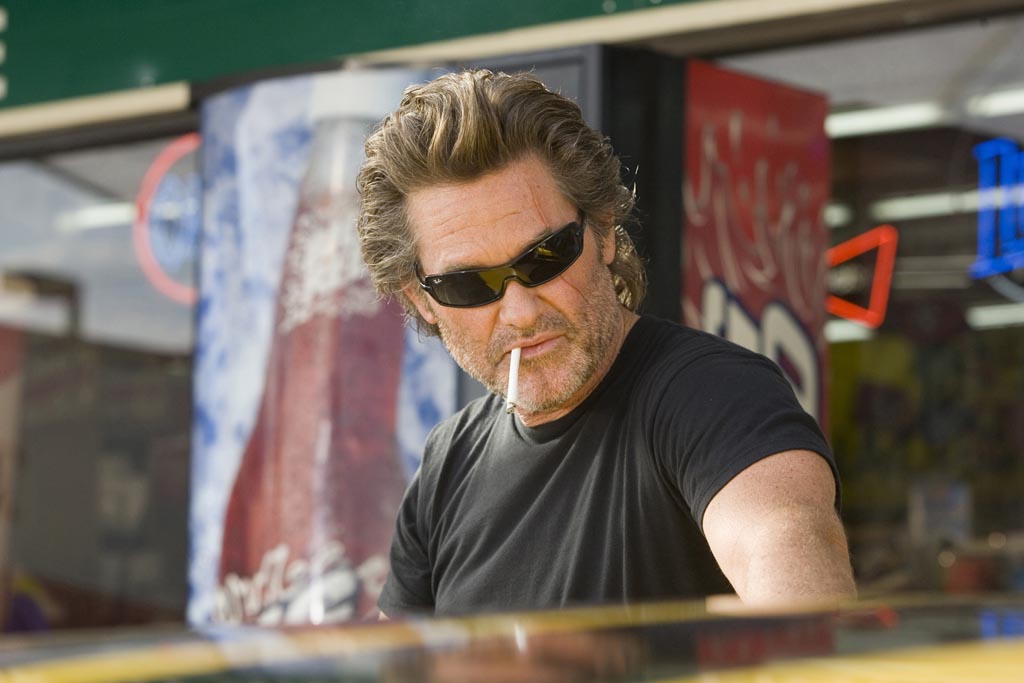
“Death Proof” stars Kurt Russell as a psychopathic stuntman, aptly named Stuntman Mike. He revels in extremities and drives a kick-ass muscle car that is guaranteed “100% death-proof.” He hangs out at a bar where several loud, obnoxious young women (with whom the film spends a lot of time with before introducing us to Stuntman Mike) are hanging out on a road trip. He picks up one of the women, takes her for a drive in his car, and gives her a ride she’ll never forget…because she’ll be dead. (Apparently, to feel the edge of a “death-proof” car is to sit in the driver’s seat.) He then performs a dangerous stunt that claims the lives of her friends, before focusing on another group of women about a year later.

For the first half-hour, we’re subjected to the girls’ chitchat amongst each other in a flat attempt to establish character development. While there are some good Tarantino-esque lines (or rather, “conversations”), I have to admit I didn’t care much for these people. And I was hoping that Stuntman Mike would show up a lot sooner so that he could dispose of these nymphs ahead of time.

Then, the film switches gears and follows a whole other group of young women. While they’re about as compelling as the first group, they at least have the honor of having New-Zealand-stuntwoman Zoe Bell among them. The idea of this striking young stuntwoman (who was Uma Thuman’s stunt-double in Tarantino’s “Kill Bill” movies) taking center-stage (and playing herself) in a movie about a psychotic stuntman brings numerous possibilities, and while it doesn’t follow through with all of them, it still brings about the most important aspect—squaring off against Stuntman Mike, giving him a worthy opponent.

Bell and her friends (played by Rosario Dawson and Tracie Thorns) come to a Tennessee town to test-drive a white 1970 Dodge Challenger R/T and perform a dangerous stunt known as “Ship’s Mast” (which requires Bell riding on the car’s hood with leather straps to hold on to). Then, Stuntman Mike comes along and messes around with them, endangering their lives. But with the extremist attitude these girls have, this may end up being his biggest mistake…

That’s the payoff to “Death Proof” and it’s a damn good one. In fact, the whole second half is the best thing about “Death Proof.” The conversations are pure-Tarantino; the intensity is taken up a notch once the women and Mike engage in their stunt-driving; and it just feels like an engaging “grindhouse” feature. If the first half represents everything people hate about the “grindhouse” element, then the second half represents what everything loves about the “grindhouse” element. Tarantino set out to deliver a love-letter to this type of film; for the most part, he succeeds.