Archive | April, 2013

The Double McGuffin (1979)

12 Apr

Mcguffin11

Smith’s Verdict: ***

Reviewed by Tanner Smith

Alfred Hitchcock and Orson Welles used McGuffins in almost each of their own movies. A McGuffin, as described by Orson Welles’ narration at the beginning of “The Double McGuffin”, is a missing piece of a puzzle that leads to what the main characters in a story are trying to figure out. (“Usually there’s only one.”)

In “The Double McGuffin,” a children’s movie directed, written, and produced by Joe Camp (“Benji”), the heroes are a group of prep school kids who stumble upon the double “McGuffin.” One of them discovers a briefcase full of money and brings his friends to see it. Instead, they discover, to their terror, a dead body in its place. But when they bring police chief Talasek (George Kennedy) to its location, the body is missing. Then they notice a man carrying the same briefcase discovered earlier.

So, of course the kids are going to figure exactly what’s happening, and why, and everything leads to the discovery of a murder plot…but who is going to murdered? And why? And where? What makes the movie enjoyable is how bright these kids are and how fun it is watching them figure out a new clue whenever one comes up.

Ernest Borgnine plays the man with the briefcase. I really don’t see the point in casting a high-profile actor as a villain in a film that truly makes us want to follow along with the kids, who are appealing and very likable. He doesn’t have many scenes, but to give credit, despite being a children’s film, the adult actors—George Kennedy included—don’t dumb down their roles. Borgnine, in the few scenes he’s in, is calmly menacing and George Kennedy is convincing as the police chief who doesn’t like to be distracted. But Elke Sommer, as a mysterious woman, is given nothing special to do at all but to be stared upon constantly.

I mentioned that the kids were likable—these kids have to carry the whole movie and they do it very well. Dion Pride is Specks, the unofficial leader of the group; Greg Hodges is Homer, a spunky, witty young boy with a handy Swiss Army knife; Jeff Nicholson is Billy Ray, a young Texan who is probably the bravest of the group; Vincent Spano is Foster, the most enthusiastic of the group; Lisa Whelchel is Jody, the controlling, smart, pretty editor for the school newspaper; and Michael Gerard is Arthur, the stereotypical nerd. Now, it’s dangerous to use the word “stereotypical” in a positive review but I’ll take the chance because the kid is likable. All of these kids are well-cast and the movie works best when it’s alone with them.

What doesn’t quite work is the final half of the film. While not action-packed, the outcome is a bit confusing and set for a typical Hollywood ending.

But “The Double McGuffin” is a little treasure. It features kids and adults who are not dumb and a mystery that is actually worth investigating. I believed it when the kids solved something and was with them every step of the way.

The Change Up (2011)

12 Apr

images

Smith’s Verdict: *1/2

Reviewed by Tanner Smith

Not since “Your Highness” have I felt so unclean from a theatrical gross-out comedy in 2011. To get things straight, I am not against gross-out comedies. I’m only against gross-out comedies that have more “gross-out” than laughs. I mentioned “Your Highness.” That movie was obsessed with making sure that every single joke focused on one of two things—penises and weed. This movie, “The Change-Up,” released a few months later, is obsessed with making sure that when its story gets underway, every single joke is focused also two things—Jason Bateman and Ryan Reynolds switch bodies, and things get ugly.  

Yes, two people switch bodies in this movie as the main gimmick. This type of comedy has been used a dozen times—some to good use, some to bad. But to my knowledge, this is the first body-switch comedy with an R rating from the MPAA, implying that it’s aimed at adults. Well guess what, guys—there’s a difference between “adult” and “immature.” It’s like saying, Hey guys! Want to see projective poop shoot into Jason Bateman’s mouth as he attempts to change a baby’s diaper? Want to see exposed female breasts just for the sake of nudity rather than exoticism? Want to hear the “F” word repeated over and over and over until you realize it was written just to keep the “R” rating?

I don’t! When I saw that distasteful scene where Batman changes the diaper, I was saying to myself, “Wow, two minutes in, and already, this movie wants me to walk away.”

OK, I’m getting ahead of myself. But here you have it—the R-rated body-switch comedy. As is typical of body-switch comedies, you have to have the introductions to the characters that will the subjects of this change-up—show their jobs, show their homes, show their personalities. To the film’s credit, even in about fourteen minutes, those three are developed easily. We see Jason Bateman as Dave, a good-natured lawyer and a father of three; and Ryan Reynolds as Mitch, a lazy, wisecracking pothead. Since they envy each other’s lives and actually say to each other that one would prefer the other’s life, they get their chance to actually endure each other’s lives. Oh yeah, they make their wish while taking a leak in a public “magic fountain.”

So Dave’s mind is in Mitch’s body and vice versa. Mitch moves in with Dave’s wife (Leslie Mann) and takes over his job, but can’t quite cut it. Dave finds himself in the making of a “light porn” movie and hates how Mitch is now hitting on his wife, but he likes his newly found freedom because Mitch does practically nothing anyway.

OK, there you go with the story. Now for the humor—There are many gross-out gags, like getting a tattoo with Olivia Wilde as Dave’s co-worker (don’t ask where she gets her tattoo), but I just didn’t laugh very much. I mean, a few chuckles here and there, but when you have a gross-out comedy, it’s timing that matters. Not just simple gross-out gags. I felt dirty watching this movie—afterwards, I felt like taking a shower.  

I’m a fan of Jason Bateman’s dry wit that made him popular in TV’s “Arrested Development” and good movies like “Juno,” though I have to admit I have mixed feelings toward Ryan Reynolds—I liked him in “Definitely, Maybe” and in “Adventureland” and thought he was a legitimate good actor in “Buried,” but in many of his other comedies (“Van Wilder,” in particular), he comes off as just bland to me. Nevertheless, it would be interesting to see these two imitate each other in this movie in which these two…change up. (Yeah, “The Change-Up” is one of the most generic titles in recent memory.) But the problem is that once these two have switched personalities, there isn’t any promising material. I smiled when these two first acted off each other (as each other), but after a few minutes, it just wore off.

The biggest insult “The Change-Up” has to offer is the forced sentimentality that follows through in the final act. You know what I mean—basic sentiments are given, the guys learn things about themselves and other people they interacted with, and of course the soft music in the background that does the acting for the actual actors. Did the filmmakers forget that it was all followed by stuff like Olivia Wilde’s nudity, Leslie Mann’s intestinal disorder, Reynolds’ porn experience, and more? This has got to be the clumsiest adding-in of sentimentality I’ve ever seen in a comedy. “The Change-Up” goes out of its way to be vulgar and offensive and then it goes for the heart. Unbelievable.

“The Change-Up” had two good comic actors to make the idea work, and anything can be done well (see “Vice Versa,” see “Big,” see “Freaky Friday,” I could go on with a few others, I think). But the actors needed better material and the audience needed a break.

P.S. I just looked up body-switch movies and there are two others I can recommend, aside from the three I’ve already mentioned—“Peggy Sue Got Married,” starring Kathleen Turner; “Chances Are,” starring Robert Downey Jr.; and I kinda liked “17 Again,” starring Zac Efron. Oh, I should also mention “Being John Malkovich,” in which John Cusack became…John Malkovich.

Mystery Men (1999)

12 Apr

mystery_men_1999_2

Smith’s Verdict: ***

Reviewed by Tanner Smith

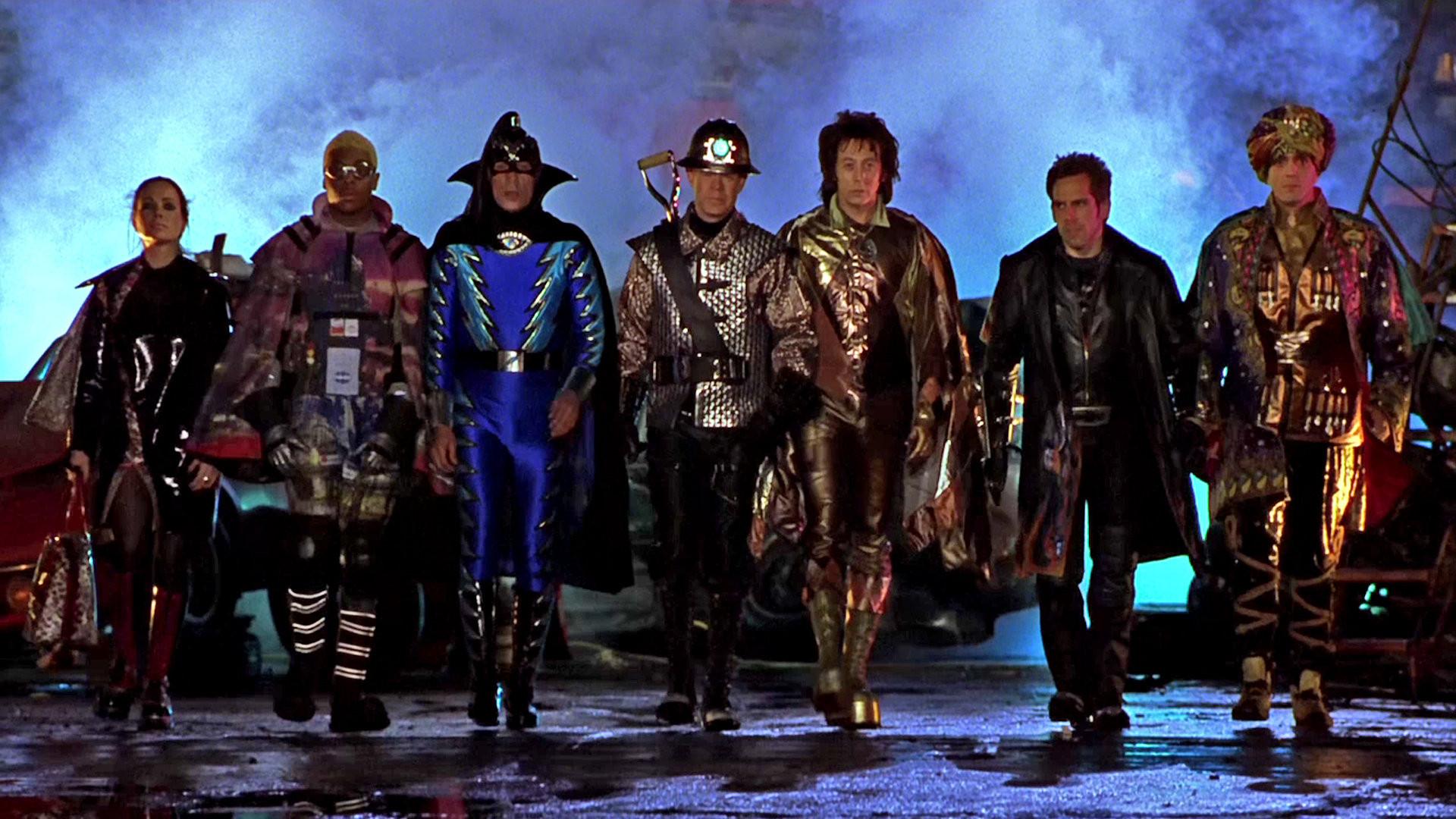
Every kid in the world dreams of being a superhero—they know their superheroes, such as Batman, Superman, and Spider-Man, among others. They believe they have their own powers within them, but it’s very rare that the adults in the world would have their own fantasies too. But then again, there are adults that are just plain bored. “Mystery Men” features a group of adults who band together to become the Mystery Men in their home Champion City, a metropolis nearly resembling Gotham City. They have no powers and neither does Captain Amazing, Champion City’s lone costumed vigilante. However, Captain Amazing has a ton of gadgets and swift energy, as does Batman in Gotham City. And he also has a fan base, which is where the Mystery Men come in.

A trio of superhero wannabes—Furious (Ben Stiller) who gets his “powers” from extreme rage, Shoveler (William H. Macy) who is known as the “best shoveler in the world,” and Blue Raja (Hank Azaria) who hurls silverware (forks and spoons but never knives) with great strength—have a dream to become the backup crew for Captain Amazing (Greg Kinnear) some day. But it seems like they will have to be Amazing’s rescuers as Amazing is captured by his arch enemy from jail Casanova Frankenstein (Geoffrey Rush), a disco-loving villain who is released because Amazing thinks it’d make for great publicity—it’s refreshing to see that this superhero is not very smart.

So it’s up to the second-rate superheroes to save Amazing. They recruit new members on their team—they get Invisible Boy (Kel Mitchell) who can only turn invisible when no one is watching, Spleen (Paul Reubens—yes, it’s Pee-Wee Herman) whose weapon is unbearable flatulence, Bowler (Janeane Garofolo) who hurls a fast-speed bowling ball with her deceased father’s skull inside it, and The Sphinx (Wes Studi) whose power is cliché-spewing dialogue. They band together, borrow some unique nonlethal weapons from a friend, plan to infiltrate Casanova Frankenstein’s disco lair and rescue Amazing (and soon, rescue their city from mass destruction).

All of this is good fun and the actors look like they’re having a good time. Greg Kinnear hams it up as Captain Amazing (respectively), Ben Stiller in usual likable straight-man mode, William H. Macy and Janeane Garofolo have the film’s best lines, Geoffrey Rush is a hoot as the villain, and Hank Azaria, Kel Mitchell, Paul Reubens, Wes Studi are all fun company. And the best part—the actors portraying the Mystery Men portray their roles with straight faces.

Also, there is humor for everyone. There are puns, sight gags, satirical dialogue about the superhero gimmicks, and juvenile humor. And there are some good memorable moments, such as the superhero interview, the first attempt to rescue Amazing, and the Invisible Boy’s “time to shine” (or in this case, time not to be seen). Some scenes are uneven, but as a whole, “Mystery Men” is a satisfying ride to take.

Final Destination 3 (2006)

11 Apr

final_destination_3_07

Smith’s Verdict: **1/2

Reviewed by Tanner Smith

It’s a neat premise, really—once you discover that Death has a design, you can cheat it. It fits right into the type of movie that Chicago Sun-Times film critic Roger Ebert called the Dead Teenager Movie. You know the type—teenagers are alive in the beginning and at the end, they’re all dead (except for one, who is kept alive to return in the obligatory sequels).

The premise was used in the 2000 DTM (Dead Teenager Movie) “Final Destination,” which had fun with the theory that Death’s design can be messed with by teenagers. Its sequel, awkwardly titled “Final Destination 2,” didn’t thrill me because of its monotonous tone. Now we have “Final Destination 3,” which has the same spirit and amount of thrills and fun as the first film. The premise is about the same—the main teenager (out of many introduced along with) has a premonition of disaster that will kill many teenagers, the main teenager and a few others are stopped from doing what would have been done, the premonition comes true, but Death isn’t finished yet. It will set up many accidents (yes, I’m calling them “accidents”) that will kill off the ones who were supposed to die—not later, but sooner. About the same premise as the previous films.

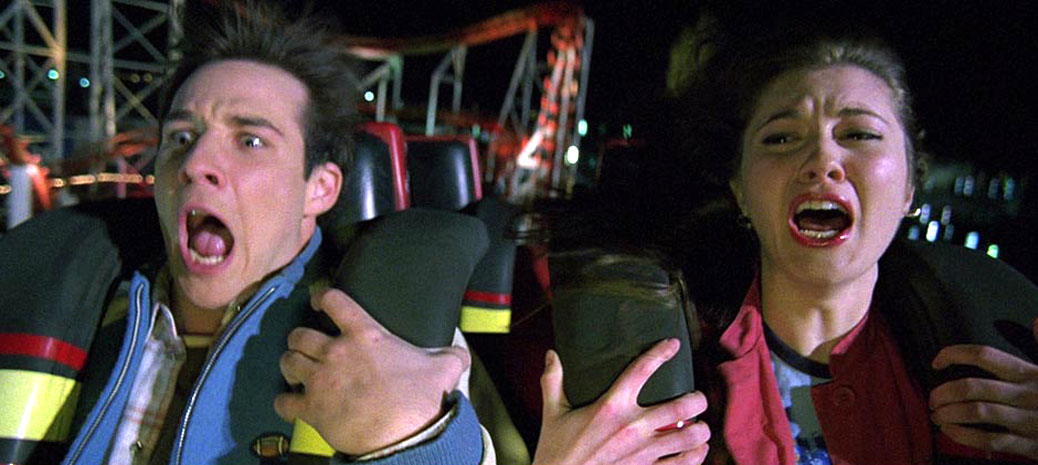
Here, the heroine is named Wendy (Mary Elizabeth Winstead). With her boyfriend and his friends, she is about to board a roller coaster called “The Devil’s Flight.” But in a very convincing, frightening, and well-executed scene (better than the opening sequence in the first film, in my opinion), she has a vision that the roller coaster will go out of control and she and her friends will die. She freaks out and is let off the roller coaster, many of her classmates follow, but the roller coaster takes off and the worst occurs. But of course, it’s not over for those “lucky survivors.”

As sick as this may sound, Death is getting better at forming these accidents (shut up). But It also has a sick sense of humor. There’s one sequence in particular that will most likely frighten the audience the most—I won’t describe it but it involves two dumb blondes and tanning booths. Death shows no mercy (nor should It) and obviously neither does director James Wong. It becomes apparent that the pictures Wendy took of the surviving teenagers before the roller coaster disaster show clues revealing how they will die. To prove that, Wendy shows a friend a picture of the Twin Towers, one of which features the shadow of an airplane…

As a whole, the film isn’t quite up there with the first film, though I was frightened of the tanning booth scene and many of the other deaths that occur and I liked the characters. Mary Elizabeth Winstead shows a lot of pluck as the heroine Wendy and Ryan Merriman is equally good as her friend Kevin—their appearances and performances make up for the fact that no one from the previous two films makes an appearance. I can’t quite recommend this movie. The other characters are all high school caricatures (dumb blondes, jock, skeptic, etc.). They don’t make much of an impression—they’re just the targets of one of Death’s clever traps. And also, why is it that nobody mourns the dead teenagers? Isn’t it sad that these teenagers who have a lot to live for don’t even make it to college? I could ask where the parents are, but that’d be silly. This is a Dead Teenager Movie—it features teenagers; the parents aren’t supposed to be there.

“Final Destination 3” will please fans of the series, but I was searching for more in the premise. I might as well just watch the first movie again.

The Man with Two Brains (1983)

11 Apr

tumblr_m9nqrmRBrP1qd3oh7o1_400

Smith’s Verdict: ***

Reviewed by Tanner Smith

So it’s 1983—Steve Martin, in the few years since his big break in 1979’s “The Jerk,” is either a guy you love or you hate. In movies like “The Jerk” and “Dead Men Don’t Wear Plaid,” he comes across as a comic actor who REALLY doesn’t know when to quit or control himself. In 1983’s “The Man with Two Brains,” he has toned down just a little bit (emphasis on “little bit”).

Martin plays Dr. Hfuhruhurr, a brain surgeon. Right away, you can see what kind of movie this is and know right away that his character’s last name is going to be mispronounced as a running joke throughout the movie.

Hfuhruhurr accidentally hits an attractive temptress (Kathleen Turner) who ran out in the middle of the road, chasing after her latest victim who is fed up with her (after she cooks one of his own goldfish). Hfuhruhurr has no idea what kind of woman she is and performs an operation that saves her life. Later, they get married but their sex life is dull, mainly because…there is no sex. That drives Hfuhruhurr crazy.

In an attempt to finally make love, he arranges for a honeymoon in a strange hotel. How strange? The elevator doesn’t hit the bottom floor, so Hfuhruhurr has to climb out halfway down. There’s also a mysterious Elevator Killer that kills people before they reach the top floor. But that’s just the beginning. There’s a secret laboratory in which Dr. Necessiter (David Warner) is conducting the strangest experiments ever. An example is there are several brains in jars that are kept alive, even though their bodies are dead. And that brings us to the second half of the film, which is ultimately silly yet funny and kind of charming in a bizarre way—Hfuhruhurr falls in love with one of the brains (voiced by an uncredited Sissy Spacek) while tired of his married life with Turner and discovering he can speak to this brain via telepathy. So he puts lips on the jar to make “her” more human.

The second half of “The Man with Two Brains” is the best thing about this movie. I must admit, when the movie started, I felt the movie was trying to be more like “The Jerk” in the way Martin behaves and the script was giving us some tired gags (with the exception of one big laugh involving his superior and his fingers close to his own face). But once we are in that laboratory, “The Man with Two Brains” becomes both funny and sweet. And I love the sincere goofiness of the situation in which Hfuhruhurr is in love with this brain while he still has Kathleen Turner’s character, who is a complete tramp.

Kathleen Turner and David Warner have a lot of fun with their roles and Steve Martin, as Hfuhruhurr, has learned to tone down his scene chewing and becomes a more likable person. It’s about time someone told him that behaving like his character in “The Jerk” was not a good career move. “The Man with Two Brains” is funny and goofy and though I was unsure of where it was going, it came back with a good second half—so good that I’m giving the movie three stars.

Soul Man (1986)

11 Apr

6a014e607ae8b2970c01538e236d48970b-800wi

Smith’s Verdict: *

Reviewed by Tanner Smith

“Whites passing for blacks” is not a subject easily done in movies. In the case of “Soul Man,” it just doesn’t work. This is the premise: a UCLA graduate can get into Harvard Law School, but he needs a scholarship and there’s one just right for him. The only problem is he’s not black and that’s a requirement. So he buys some special “tanning pills” and uses them, changing the color of his skin. So he gets the scholarship and passes for black.

Given this premise, “Soul Man” actually sounds like a semi-interesting idea for a movie. A man sees the world as someone else. Also, it sounds good as a comedy and we’ve seen it work in comic situations—remember that hilarious SNL skit in which Eddie Murphy posed as a white man? But it sounds even better as a comedy-drama. Unfortunately, “Soul Man” is reduced to idiotic TV sitcom situations and misses the entire point of this premise. It’s not race that needs to be showcased as much as ethics. This person is lying to everyone he meets and pretending to be someone he’s not…by masquerading as a black man.

C. Thomas Howell plays the now-black student. You probably know him as the protagonist in 1983’s “The Outsiders.” He’s a talented actor, but he just doesn’t have much to work with here. His character Mark Watson changes his skin color and gets a perm (though I think he looks more suntanned than black). He faces many situations at Harvard. His landlord isn’t pleased with him renting an apartment, a sex-crazed white woman has a father who doesn’t want him dating her, and then we get a lot of offbeat humor, in which stereotypical moments ensue. The basketball teams fight over who should pick Mark, they call him “Marcus,” he keeps running into a bunch of jerks who make racist jokes whenever he walks by, and he impersonates Stevie Wonder’s movements in order to disguise himself from somebody he knows. (And by the way, this is not by any means the real Harvard as much as it is a movie Harvard.) But he does meet two interesting characters. One of them is his black professor (James Earl Jones) who shows no pity. The other is a black fellow student (Rae Dawn Chong), whom Mark starts to like.

His interactions with these two people could make “Soul Man” very interesting and it makes you want to overcome its other scenes. But it just doesn’t have the wit that it needs to work. This is described as a comedy, yet its drama is a lot more interesting than anything that is supposed to be funny. Every joke here is predictable—you can see the punch line coming from a mile away.

And then once the first half is lacking in potential, the second half comes along and it’s just horrible. We get a Groucho Marx-type sequence in which the mad white woman is in Mark’s room, Chong is in the living room, and the parents (who do not know he’s black) are in the kitchen. So Mark is forced to go from place-to-place, sometimes changing his appearance in order to do so. At this point, I lost all hope for the movie.

It gets even worse when it reaches the courtroom scene, in which the wrong sort of dialogue is said in Mark’s defense when we all know this is a criminal offense. James Earl Jones should have confronted Mark about his lie. But no, he drops all charges after Mark apologizes. And I wanted Rae Dawn Chong and Mark to talk about this—just really talk about this situation.

Rae Dawn Chong and James Earl Jones give the best performances in this movie because they portray real characters. But I couldn’t identify with C. Thomas Howell as the main character Mark.

“Soul Man” is a trashy comedy that could’ve gone one way but ended up going another way—and that was the way I hated to see it go through.

This is Spinal Tap (1984)

11 Apr

this-is-spinal-tap-1984-01-g

Smith’s Verdict: ****

Reviewed by Tanner Smith

It would just be one thing to make a documentary about a rock band with a few issues. It’s quite another to make a mock-documentary about a fictional rock band with more than a few issues.

“This is Spinal Tap” is a mock-“rockumentary” about a British band called Spinal Tap who, according to an introduction, has been pretty famous back in the day because they’re the loudest band on earth. But now back on tour for their newest album, they are just loud. How are they the loudest band on earth? Well, when most bands crank their amps’ volumes up to 10, they take it up to 11.

Spinal Tap guitarist Nigel Tufnel (Christopher Guest) explains the amp to filmmaker Marty DiBergi (Rob Reiner, the film’s director). “Most amps go to 10?” “Exactly.” “Does that mean it’s louder?” “Well, it’s one louder, right?”

“Why don’t you just make 10 louder, and make 10 be the top number, and make that a little louder?”

Baffled by that notion, Nigel just replies by restating, “These go to 11.”

Nigel’s ideas aren’t logical and DiBergi realizes that a little too late. Nigel obviously lives in a world of his own.

“This is Spinal Tap” is one of the funniest, original, and most intelligent movies ever made. Spinal Tap does not exist, although the actors playing the band wrote and performed their own songs for the fictional band. But it could. While on tour in America, their career is heading downhill. Back in the day, the arenas were packed. But now, not many people care. Some may have forgotten about them. But who’s to blame for the reason that Spinal Tap is a bad rock-n-roll band?

Director DiBergi narrates throughout the documentary. He likes Spinal Tap’s music and follows the group on tour, asking them questions about themselves. I was chuckling when they explained what happened to their old drummer (“He choked on vomit…but it wasn’t his own vomit.”). But I was laughing when I found out that that drummer wasn’t the only Spinal Tap drummer who died. Apparently, they have a new and clever way of killing off all of their drummers. Maybe the other guys don’t kill him—maybe it’s a “drummer curse” that occurs when a new drummer is brought to the band, which means that the current drummer in this movie is not going to last very long.

Bad luck happens with the band when rhythm guitarist/lead singer David’s (Michael McKean) girlfriend Jeanine (June Chadwick) arrives to join the tour. Gigs are cancelled, the lady and the band’s manager Ian (Tony Hendra) have an argument which results in him quitting, the cover for the new album stinks, and a gig at a military base is a disaster with all of the planes roaring off outside. The events that occur in this movie—even the quiet moments, such as when the group visits Elvis’ tombstone—are funny and original; even more funny is that they’re all played naturally.

Other funny scenes—the band gets lost on a gig on their way to the stage (not to the place but to the stage); bassist Derek Smalls (Harry Shearer) is trapped in a womblike stage prop but keeps his cool while the others perform and a stage crew member tries to get him out; a set designer is assigned to create an 18-foot replica of a Stonehenge element but instead creates an 18-inch replica that the band is forced bring out dramatically…and embarrassingly.

That last scene mentioned is very funny because the band members don’t know what the thing will look like and when they see it finally, on stage, their surprised reactions are hilarious.

“This is Spinal Tap” is a great, funny movie not just because of the really funny scenes but because Spinal Tap aren’t mean-spirited, and the way that they are going about this film is not cruel. The appeal of this movie is how it shares the pleasure of just being themselves. They love to rock, they love to entertain—they probably go out there every performance just to hear and feel the beat.

American comic actors Christopher Guest and Michael McKean give respectable British accents and heartfelt performances. Guest, McKean, Shearer, and Reiner co-wrote the script themselves—they went through improvisational stages and wrote the Spinal Tap songs (most memorable are “Sex Farm” and “Hellhole”). “This is Spinal Tap” is also Rob Reiner’s directorial debut. I love the way he puts background information and glimpses of style into almost each frame of the film.

You could call “This is Spinal Tap” a spoof. But the laughs aren’t coming from sight gags such as “Airplane!” or “Top Secret.” But it’s more of a satire in the way that this movie feels like a real documentary with the dumb questions and the ridiculously funny answers. This is a really rare, specific type of satirical comedy to do. It’s a brilliant satire on documentaries, stage decorations, rock music, and troubles with rock bands. “This is Spinal Tap” rocks!

Harold and Kumar Go to White Castle (2004)

11 Apr

harold-and-kumar-go-to-white-castle-1

Smith’s Verdict: ***

Reviewed by Tanner Smith

“Harold and Kumar go to White Castle” features two stoner minority characters named Harold and Kumar that do go to White Castle, but not without a bunch of misadventures along the way. This is an enjoyable comedy with two likable leads and funny situations.

Harold and Kumar are two roommates who smoke more pot than I think any other stoner duo could handle (hello, “Cheech and Chong”). Harold Lee (John Cho) is a hard-working, Korean-American accountant who is shy towards women. Kumar Patel (Kal Penn), an Indian-American slacker, is way more outgoing than Harold—he’s a party animal whose parents are in the medical profession, yet he knows a lot about medicine although he’d rather smoke pot all day. In his introduction, Kumar is interviewed by a dean of medical school (Fred Willard) and impresses him at first until he calls Harold and tells him his plan to be “blitzed out of their skulls tonight” right in front of the dean. That forces the dean to reject him.

So, Harold and Kumar are getting stoned one night and when they get the munchies, Kumar states that he wants the “perfect food.” That’s when a commercial for White Castle appears on the TV screen and hypnotizes them into a slider obsession. Kumar says there is a White Castle nearby, so they decide to drive there and eat. Unfortunately, the White Castle has been replaced by another burger joint. The guy at the drive-thru (Anthony Anderson) tells them that there is a White Castle about forty-five miles ahead.

So, the guys drive to get those sliders and along the way, they get involved in all sorts of adventures—they save a man’s life, wind up in jail by racist cops, encounter a mechanic with a really bad complexion, and come across a hitchhiking Neil Patrick Harris.

Neil Patrick Harris plays himself in this movie, and Harold and Kumar know him best from his “Doogie Howser” persona. There are some jokes about the show in this movie, particularly about asking if he had sex with “the hot nurse.” Harris is hilarious in this movie and way weirder than these guys. He wants sex, he wants to roam free, and he even steals Harold’s car. (“Did Doogie Howser just steal my car?” Harold asks.) He steals his car for a good reason too—so that when they meet again, Harold can ask, “Dude, where’s my car,” and reference the director Danny Leiner’s previous directorial effort, “Dude, Where’s my Car?”

HAROLD: Dude, where’s my car?

KUMAR: Where’s his car, dude?

While there are a lot of laughs in this movie, one particularly distasteful moment occurs when the boys arrive at Princeton and share a bathroom scene that is so disgusting that it makes you cringe. I was afraid of where the film was going after that scene. Also, there are a lot of racism jokes in this movie—a running gag keeps the boys running into American jerks who tease the boys’ backgrounds—and most of them are not that funny. Luckily, the movie redeems itself with the likability of these two characters, some big laughs that come unexpectedly, and a nice subtext that if you want something, you just have to go for it.

The Descendants (2011)

10 Apr

581848-2011_the_descendants_011

Smith’s Verdict: ****

Reviewed by Tanner Smith

“The Descendants” is the latest from writer-director Alexander Payne. Payne specializes in bizarre comedy (read “Election,” read “Sideways”). How bizarre? Well, bizarre enough to make you question whether it should be labeled as a comedy. I’ve met a lot of people who saw the film and couldn’t decide to label it as a comedy or a drama.

To those people, I say this: Well…yeah, doesn’t that go without saying? It’s a comedy-drama. Why are you looking forward into this? Comedy-dramas do exist, or have you forgotten that? “The Descendants” is a comedy-drama. You laugh, you cry. This genre is not new. You’ve seen plenty of TV shows like this too.

Anyway, “The Descendants” goes through comedy and drama. However, it has a consistent tone, along with some great acting and a well-executed script, which makes for a touching and funny film that takes chances and delivers much more than you’d imagine. It’s strange, mind you, as most Alexander Payne productions are, but it’s also very effective.

The film features one of George Clooney’s best performances as Matt King, a lawyer based in Honolulu, Hawaii, whose life is falling apart as his wife Elizabeth is comatose after a boating accident. It’s his job to keep the family together. He starts by trying to keep his youngest daughter, 10-year-old Scottie (Amara Miller), out of trouble in school—she behaves inappropriately with other kids. Matt’s other daughter, 17-year-old Alex (Shailene Woodley, from TV’s “The Secret Life of an American Teenager”), is at a boarding school and as Matt finds out when he comes to take her home, she drinks. Matt has never been close to these girls, as he’s usually labeled as the “back-up parent,” but now he has to be the one to tell them that their mother will never wake up from her coma and it states in her living will that the situation requires removing her from life support.

From here, many complications arise. Matt of course has to tell everyone related or acquainted to Elizabeth that she’ll die soon. His father-in-law (Robert Forster) flat-out tells Matt that he should have been a better husband. Alex and Scottie attempt to cope with the situation. Stuff you’d expect from this type of crisis. But there’s more. Alex’s idiot boyfriend Sid (Nick Krause) stays over to help out and constantly says or does the wrong things, while possibly stoned (I’m not sure—there’s a line of dialogue indicating that he smokes pot). And Alex breaks the news to Matt that Elizabeth has been cheating on him!

All this happens while Matt and his cousins—including Hugh, played by Beau Bridges—tries to sell acres of land on the island of Kawai in order to open a new resort. Not a good time for Matt.

So…yeah! The “Terms of Endearment” elements have flown out the window since we discover that the woman on the verge of death has pretty much caused trouble even before the accident. Alex recognizes the guy who was sneaking around with her mother, and decides to help her father find him. He’s a real-estate agent named Brian Speer (Matthew Lillard, looking middle-aged) and he’s been cheating on his own wife (Judy Greer) for Matt’s. What Matt is going to say when he finally meets Brian is always in question.

“The Descendants” balances comedy and drama, mostly in an effective way. But it’s not conventional. It deals with the deeper issues realistically. These are realistic people in a realistic crisis that happens to be saddled with all sorts of little twists and turns in the midst of it all. That the film takes place in Hawaii lets the record show that life itself isn’t paradise. Things are just as complicated here as anywhere else. Even the moments that practically force you to weep aren’t conventional either. The dialogue is right, the awkwardness in most scenes is believable, and just about every scene just plays itself out.

George Clooney is very good in this movie—he’s low-key, convincing, and delivers some parts comedy and other parts drama. In that case, he’s equal to the material he’s working with. The young actors are strong, especially Shailene Woodley as the oldest daughter who constantly battles her emotions. Nick Krause as the dumb boyfriend is very funny and actually proves to play a dummy with more dimensions than you might think, as we see in a scene in which Matt and the kid have a little heart-to-heart. He’s not so dumb. Also, Matthew Lillard and Judy Greer do nice work, and Robert Forster is solid in a small but effective role.

“The Descendants” is an odd but wonderful movie. The story had me guessing, I was invested in the characters, there are moments of accurate truth, and it’s probably Alexander Payne’s best work.

Dickie Roberts: Former Child Star (2003)

10 Apr

dickieroberts

Smith’s Verdict: **

Reviewed by Tanner Smith

“Dickie Roberts: Former Child Star” is an inspired idea for a comedy, or even a serious drama. It’s about a washed-up former child actor who attempts to get a comeback. This is actually an interesting story idea. There are a lot of former child stars whose careers ended too quickly, and for a movie about them, you can play off on the notion that they’d want a comeback. Unfortunately, “Dickie Roberts: Former Child Star” is not that movie. It’s a false attempt that could have been funny if it wasn’t so smarmy.

Dickie Roberts (David Spade) is a former child star famous for his starring role in a ‘70s TV sitcom. Now he’s working as a valet parker at a restaurant. He desperately wants a comeback and keeps telling his friends that it’s going to happen. And he thinks he can catch a break if he auditions for the lead role in the new Rob Reiner film. But Reiner (yes, the Rob Reiner playing himself) tells Dickie he’s all wrong for the part, which is just a normal person—something that Dickie never got the chance to be. Reiner says he’d have to relive his childhood, just like how actors research their roles.

And that’s what Dickie does—he hires a family in the suburbs to let him stay with them, so that he can learn what it’s like to be a kid. The two kids of the house—Sam (Scott Terra) and Sally (Jenna Boyd)—call him “Stranger Danger” and give him a hard time at first. But they befriend him, as do their mother Grace (Mary McCormack), and they help him get ready for the audition in time.

The main problem with the movie is the character of Dickie Roberts, former child star, himself. Played by David Spade (who also co-wrote the screenplay), he’s a creepy, irritating menace who is supposed to be our hero. Spade can be funny, but he just tries too hard to generate laughs. He thinks the best way to make Dickie into a lovable character is to play him as narcissistic as possible. When the movie gives us scenes in which we’re supposed to sympathize with him, it doesn’t work because of what followed. (To be fair, at least Spade tries to make us care in those scenes, particularly the scene in which he tells his agent Sidney about a memory he had with his real father—not David Soul.) Bottom line—I wanted to smack him.

The movie starts out promisingly with a mock E! Hollywood story telling the biography of Dickie. When he was a little boy, his materialistic actress mother (Doris Roberts) made him audition for everything, until he got his big break at age 6 as the center of a TV show. His catchphrase: “This is nucking futs!” (Aw, ain’t that cucking fute?) This opening skit alone is pretty funny, as we learn of rumors that David Soul (Hutch from “Starsky and Hutch”) is Dickie’s father, and get a cameo from “Eight is Enough” regular Dick Van Patten, talking about the danger of being a child star, having worked around eight…which is enough. And it’s followed by a Celebrity Boxing stint in which he gets beat up by Emmanuel “Webster” Lewis, which is also funny. But then, we get a better look at Dickie’s personality and the film becomes less funny.

The screenplay is full of sitcom clichés, mainly involving Dickie and the two kids. Dickie goes through all the motions—he tells off the school bullies, helps Sally make it into the pep squad, and aids Sam in impressing the girl next door. But even sitcoms aren’t as distasteful as the scene in which Sally auditions for the squad—you see, this is followed by a very disturbing bit in which her rival dirty-dances to “Bad” by Britney Spears. Ick!

And of course, Dickie and Grace must fall in love because that’s what happens in comedies like this. Grace’s husband George (Craig Bierko) will grow to become a jerk and leave her for Dickie’s slutty ex-girlfriend Cyndi (Alyssa Mulano), so that Dickie and Grace can be together. How convenient.

There are some things to like about “Dickie Roberts: Former Child Star.” For one thing, I really enjoyed the cameos that are scattered throughout the movie. I already mentioned Rob Reiner, who gamely plays…himself. He has some funny moments, which include his Nicholson impression. And there’s a scene in which Dickie plays poker with his friends, all former child stars—Leif Garrett, Barry Williams, Danny Bonaduce, Dustin Diamond, and Corey Feldman, all playing themselves. I liked that scene—their conversations were nice to listen to. (But dude, if I found out that Barry Williams really does carry around so many “Brady Bunch” props to bet on, I’d give him a psychiatrist’s number.)

And the best sequence in the movie comes during the end credits. It’s a video featuring a ton of former child stars, having their own song about how they’re not who they were anymore and would rather move on to other things. (Gee, if only Dickie took that route.) Among these welcome attractions are Maureen McCormick (don’t ever call her “Marcia” again!), Butch Patrick (Eddie Munster), the three Brady brothers, and Todd “Willis” Bridges (“You wanna autography, well I’m-a tell you this, don’t ask a brother when he’s takin’ a piss!”), to name a few.

There’s another laugh I got from this movie. It’s a visual gag in which Dickie tries out a Slip-n-Slide for the first time in his life. Only, on his first try, there’s no water yet. Maybe it’s because I wanted inflicted pain among this guy, but I laughed out loud.

Mary McCormack is charming in her lazily-written role as Grace and does what she can with it. I liked the two kids, who do suitable jobs. Jon Lovitz is very funny as Dickie’s agent Sidney who gives a liver if it means getting Dickie an audition. He has some of the best lines in the movie. Craig Bierko and Alyssa Mulano, however, are horribly miscast.

What’s more insulting? Just like in every other Adam-Sandler-produced film such as this, this movie tries to add a heavy dose of sentimentality for the ending. When is Sandler going to learn that it doesn’t mix with overdone slapstick comedy? OK, fine—Dickie gets what he wants, he learns the value of family, and everyone lives happily ever after. Even Dickie’s friends, who—and I’m not going to lie; this part was appealing—get roles in Dickie’s new sitcom about his life (Leif Garrett plays Dickie.) I would rather see a movie about that, or just the series. I want to watch these former child stars. Not Dickie Roberts.