Archive | April, 2013

The Blair Witch Project (1999)

14 Apr

tumblr_lavp8uWGkX1qzzh6g

Smith’s Verdict: ***1/2

Reviewed by Tanner Smith

It’s one thing for a thriller/horror film to claim that it’s based on a true story. It’s quite another to make us believe that statement. You know how Orson Welles’ “War of the Worlds” radio play frightened people into believing something terrible was really happening? How can you transfer that same kind of reaction to film? I mean, let’s face it—whenever we see that a narrative thriller, especially a ridiculous-sounding one, is captioned “based on a true story” or “inspired by true events,” we roll our eyes in disbelief. How can a film be so effective by introducing itself with a disclaimer that it was based on true events, and then making us start to believe it?

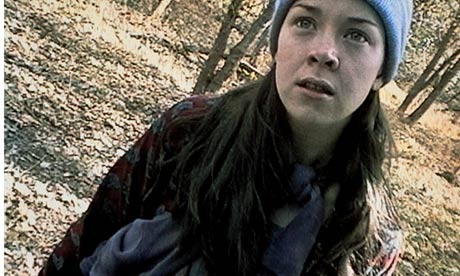
“The Blair Witch Project” provides a successful answer to that query. It opens with the ominous statement, “In October of 1994, three student filmmakers disappeared in the woods near Burkittsville, Maryland while shooting a documentary. A year later their footage was found.” From then on, the entire film is presented as home-video camera footage, in chronological order as if we’re seeing actual found footage leading up to something horrible for three characters who act and feel like real people.

This is great. I knew that “The Blair Witch Project” was fictional, but it’s such a harrowing experience that it manages to take the audience off guard. I know it took me off guard quite a few times. The illusion that this is a documentary-in-the-making is consistently applicable. With this unusual way of showing the film’s story, this is a brilliantly effective horror film and a prime example of independent filmmakers taking advantage of a miniscule budget.

The footage in the film was shot with two cameras—a color video handheld camcorder and a 16-mm. black-and-white camera. The former is used by aspiring director Heather (Heather Donahue) to document the making of her documentary in production, using the latter. With the aid of cameraman Josh (Joshua Leonard) and soundman Mike (Michael Williams), Heather decides to make a documentary about the mythical, legendary Blair Witch, said to haunt the woods near small town Burkittsville, Maryland. All three pack camping gear and prepare for hiking and sleeping in tents in the woods.

We first see them goofing around like normal college students. They playfully make fun of each other, mug for the camera, and joke around, while also filming the opening scene (at a cemetery, where Heather delivers the opening monologue, telling part of the supernatural legend) and interviewing the townspeople who state what they heard about the Blair Witch, whether they believe it or not—one of which happens to believe she had an encounter with the witch. Then it’s off to the forest, where they explore where the legend supposedly takes place. It’s here where a seemingly planned trip to make a film is surely damaged once the three become lost.

There’s most likely something supernatural occurring here, as many clues are left for the three characters to discover, including strange piles of rocks and creepy stick figures hanging from trees. And let’s not forget something going bump in the night, like distant noises and the tent shaking. But what really makes the terror in “The Blair Witch Project” so effective is that it gives an intentionally disorganized production setup that really gives us the feeling of being there with the people that this is happening to. On top of that, the film never shows the monster. This is one of the most successful of thrillers, particularly those based upon ghost stories—our imagination is more creative than anything else. It’s what we don’t see that scares us. (See 1963’s “The Haunting” as another example.) Sounds, darkness, or both can become effective elements in horror. We’re all afraid of things we can’t see because we don’t want to see them. Say, for example, you’re alone in the dark and you suddenly hear some sort of noise. You’re immediately scared and you wonder if you really want to know what’s out there, if anything. “The Blair Witch Project” taps into our fear of everyday things such as darkness, wildlife, and lack of direction. It uses this fear to its advantage. Also, because you don’t see a lot of the action and you’re stuck with growing fear of the unknown, “The Blair Witch Project” can be seen as a psychological thriller rather than just a ghost story.

The acting is excellent. Heather Donahue, Michael Williams, and Joshua Leonard were all unknown actors who also used their real names to add to the illusion that the film was real, and also improvised quite a lot to make lines seem more natural. (I even read somewhere that at the film’s premiere, there were “missing” posters for all three actors, “presumed dead.”) The effect works. I cared very much for what was happening to these three and was worried for them, since I knew that they weren’t going to make it out of this terrifying situation they brought themselves into. In particular, Heather Donahue delivers a heartbreaking monologue to the camera in one of the final scenes, stating with quivering fear that she apologizes to the families of her companions for bringing them out into the place where they’ll all probably die. That scene is extraordinarily acted.

“The Blair Witch Project” is a nearly perfect horror film, but I have to wonder if anyone really would leave the camera on for so long after everything that has been experienced. But then again, I am a filmmaker as well and if I knew that something strange was going to happen, even something potentially life-threatening, I’d probably want to keep rolling in order to let people what happened. So if I’m not going to pick on that very much, I should also mention that while the film is an hour and twenty minutes, I have to admit that the pacing can be very awkward, especially in the setup leading up to the middle part of the film which at times seems pretty slow-moving.

But for the most part, “The Blair Witch Project” is a truly scary experience that shows just how much of an impact a shoestring-budget film can bring to an audience. My best piece of advice: don’t see this film right before an overnight camping trip in the woods.

Stranger Than Fiction (2006)

14 Apr

images

Smith’s Verdict: ****

Reviewed by Tanner Smith

“Stranger Than Fiction” is a delightful, thought-provoking film with an ingenious premise. What if you and your life were subjects of a novel being written as you live your life? What if you heard the writer talking in your head, as a narrator of your life? And what if the writer foretold that a harmless act will lead to your imminent death? That’s the idea for “Stranger Than Fiction.” It’s executed remarkably well, hardly ever stepping wrong. It’s a comedy-drama, a fantasy, and romance all in one, while featuring great work from the cast and great moments of eccentric humor, happy-or-sad truth, and genuine tenderness.

Before I write the review, I want to tell a little story. I have to be honest. I didn’t like this movie when I first saw it. I saw it on the big screen in early December 2006 (it was released in mid-November), when I was fourteen years old. That night, I was going to see “Unaccompanied Minors” with my family. For some reason I can’t quite recall, I saw “Stranger Than Fiction” by myself. So there I was, one of only two people in the theater, and “Stranger Than Fiction” became a much more poignant movie than I was expecting…which disappointed me. I was expecting a broad comedy, especially since Will Ferrell was the star, and was looking forward to seeing one. This wasn’t it. Then, that night, I saw “Unaccompanied Minors,” marketed as a gentle family comedy, and it actually met my expectations.

If you don’t know what “Unaccompanied Minors” is…well, you’re not missing that much. As time went by, that film just wore out on me. But soon enough, I started to recall the other movie I saw that day, and was really starting to think about it. So I rented “Stranger Than Fiction” on DVD and noticed something in it that I never would have seen in my ignorant early-teenage state. It affected me so much that it totally changed my entire view of it. I realize it did leave an impact on me, and the more I thought about it, the more I wanted to see it again.

Anyway, that’s the kind of film “Stranger Than Fiction” is—one that takes you totally by surprise. One of the main surprises is that, yes, Will Ferrell is the star of this complex, touching film. Ferrell has been known for his broad comedic work, whether on “SNL” or movies like “Elf” or “Anchorman.” Although he has done dramatic work a couple times before, none of it was really that memorable. His performance in “Stranger Than Fiction,” however, puts him up there with comedic actors that show that they are capable of equaling their skills to their dramatic capabilities.

Ferrell plays Harold Crick, an IRS auditor whose life is based around numbers—calculating large sums in his head and counting his every move each day. While this is effective in keeping in time with his everyday routines and his work, this doesn’t work well with human interaction. He lives alone, keeps to himself, and has no real friends. Then, something strange happens—Harold starts to hear a woman’s voice, talking about him “accurately and with a better vocabulary.”

Harold becomes convinced he’s hearing the narrating voice of his own narrative being written. He goes to see a shrink (Linda Hunt), who tells him that these symptoms resemble schizophrenia. She then recommends that he visits a literary professor (Dustin Hoffman), who doesn’t believe him at first, but ends up giving him some helpful advice in finding out if his story is a comedy or a tragedy. And Harold must find out soon, because the narrator has already spoken of a foreshadowing to his “imminent death.”

Meanwhile, we do see the author herself—an odd reclusive woman named Karen Eiffel (Emma Thompson) who is suffering from writer’s block. Her trademark in her novels is that her protagonists are dead by the time the story is finished—she can’t decide how to kill Harold Crick. With the aid of her new assistant (Queen Latifah), she attempts to come up with something tragic and fitting, not knowing that Harold is a living person whose life is in her control.

While this is going on, Harold finds he does have something to live for. That would be Ana Pascal (Maggie Gyllenhaal), a baker whom he has to audit. At first, she hates him and does everything she can to make his job miserable. Harold, however, can’t stop thinking about her and is even nervous around her. But eventually, Ana does take pity on Harold and even bakes him cookies. This is the start of a nice relationship between the two, meaning that it’s very important that Harold lives longer than Kay intends him to. Harold has to find her and practically beg for her not to kill him.

Director Marc Forster and writer Zach Helm show a great deal of fondness for these characters and it constantly shows. We like them just as much as they do. These are real, appealing people; not merely caricatures that they could have become. I enjoy spending time with them, and credit for that must also go to the actors. Ferrell is just brilliant. He’s likable, endearing, tragic, and funny when he needs to be. He creates a three-dimensional character in Harold Crick and we don’t want him to die, even if it means that Kay will have her masterpiece if he does. Emma Thompson, as Kay Eiffel, is wonderful—playing her role as an intelligent, but slightly odd, artist obsessed with creating the perfect novel. Maggie Gyllenhaal is delightful as Ana, and displays great, convincing chemistry with Ferrell—they’re great together. Dustin Hoffman plays it straight with the role of the literary professor and he’s allthemore effective because of it.

The story is incredible on paper and comes through on screen with great execution. It just gets better as it goes along, making you feel for these people and the outcome of every situation. And it’s a lot of fun to follow along with the creativity of the tale as it continues—touches such as Harold quietly checking off every mark of a “comedy” or a “tragedy” are just fantastic.

The final half is just perfect. While many films deteriorate and run out of energy before the last reel, “Stranger Than Fiction” just delivers the right amount of payoffs and displays the exact right tone of emotions. It deals with mortality in the sensitive ways you can think of, given the situation. It also asks the questions of whether or not Kay has the right to kill off her main character to have her “masterpiece.” If he dies, the story will come full-circle and there will have been a well-crafted piece of work. The solution fits the film perfectly.

I was expecting a comedy out of “Stranger Than Fiction.” What I got instead was something more wonderful, sweet, and impactful. It’s a great film; one that made me laugh, made me cry, and made me smile. So as you can tell, it did leave an impact on me when I was 14. I just didn’t know it yet.

Scream 2 (1997)

14 Apr

images

Smith’s Verdict: ***

Reviewed by Tanner Smith

Just as the terrific Wes Craven/Kevin Williamson horror film “Scream” featured characters who had seen other horror films and knew the basic formula, its sequel “Scream 2” not only brings back the survivors of the original film’s killings but also features characters who have seen a movie that was based on those killings (the title of that movie is “Stab”). Now they all trapped in another slasher nightmare in which a killer is out to make a real-life sequel.

This leads to two intriguing conversations about sequels. One takes place in a college film-class the day after the first murder has been committed, at the “Stab” premiere screening. The teacher argues that the movie influenced the murder, one student states that movies aren’t responsible for people’s actions (and indeed, if you recall in the first film, “Movies don’t create psychos—movies make psychos more creative!”), and another, film-buff Mickey (Timothy Olyphant), describes it as a “classic case of life-imitating-art-imitating-life.” Is it possible someone’s out to make an actual sequel to “Stab,” which was based on true-life slashings? “Stab 2?” actual-survivor Randy Meeks (Jamie Kennedy) asks. “Who’d want to do that? Sequels suck.” Of course he forgets about “The Godfather Part II.”

The other discussion occurs midway through the movie, as it turns out someone really is making a “sequel” to the original murders, as the body count continues to increase. Randy and visiting survivor, police deputy Dewey Riley (David Arquette), discuss “rules of the sequels”—the body count is always higher and deaths are bloodier (“carnage candy”). Who could be the killer? Whomever it is is already in their lives, so who can be trusted before they can they start to turn on each other? (Of course, they don’t—“If I’m a suspect, you’re a suspect.” “Good point; let’s move on.”)

“Scream 2” deserves credit for knowing that it’s an attempt to cash in on the success of the original “Scream” because that’s exactly what the killer of this “story” is attempting to do: increase the terror brought upon by the release of “Stab.” Not many sequels are as good as their predecessors, but “Scream 2” is about as good—it maintains the effective mix of scares and laughs in Kevin Williamson’s screenplay. (And if a scene needed to be scary, Williamson reportedly added in his script, “Wes Craven will make it scary.” A sad yet accurate distinction.)

Yes, there is a new slasher sporting the same black cloak and white-ghost mask, and he stalks a bunch of college freshmen, particularly Sidney Prescott (Neve Campbell), the heroine from the first movie. Randy is her classmate, and is still as knowledgeable about horror films as he was in the first movie. Dewey has come to aid in campus security once he hears about the murders. And Gale Weathers (Courteney Cox), the bitchy news reporter from the first film and who has written the best-selling novel based on the original killings, is here as well, along with a new cameraman (Duane Martin) after her original cameraman…well, never mind.

New characters include—Sidney’s dull, dim-witted, hunky new boyfriend Derek (Jerry O’Connell); the aforementioned Mickey (“the freaky Tarantino film student”); Hallie (Elise Neal), Sidney’s sassy roommate; Cici (Sarah Michelle Gellar), a sorority girl who may not last very long; and Debbie Salt (Laurie Metcalf), a reporter who rivals Gale for the inside scoop. Mainly suspected is Cotton Weary (Liev Schreiber), whom it turned out was wrongfully accused of the murder of Sidney’s mother two years ago. He wants his time to shine (fame for redemption) and practically stalks Sidney to help him out.

One of the strengths of the two “Scream” movies is that the characters are not cardboard cut-out caricatures just here to be killed off; they’re genuine characters that we come to care about. Even Gale, who can be beastly when she’s desperate for a story, shows signs of humanity so that she isn’t a one-dimensional snob. It’s hard not to care for these people.

The dialogue is still very smart the second time around—particularly engaging are the “sequel” discussions; a scene in which Gale’s African-American cameraman wants to bail (“I don’t want to be the news; brothers don’t last long in situations like this!”) while Gale attempts to calm him down; and in the prologue in which two black characters (played by Jada Pinkett and Omar Epps) discuss the lack of African-Americans in horror films.

I forgot to mention the prologue earlier—these two I just mentioned have come to the free premiere screening of “Stab” where so many horror-movie fans are excited and happy to be there, while also wearing the same killer costume that the actual killer wore. They’re all pumped and cheering in the murder scene of “Stab”…until they notice that Pinkett is at the front of the screen, having been stabbed by a real killer and dying and screaming in pain—that, of course, stops their cheer and laughter. That’s a very clever move; horror-movie fans want more violence and then they notice real-life violence and realize how wrong it was that they were cheering about.

And give Craven a lot of credit for openly parodying “Scream,” particularly when he gets to allow Robert Rodriguez to direct his own version of the Drew Barrymore shocker-opening from the original, and making that the opening scene for “Stab.” (The “Casey Becker” role is played by Heather Graham this time.) And there’s also a clip featuring Tori Spelling in the “Sidney Prescott” role that we see later on a TV. I wish there were more of those “Stab” scenes, and I also wish there could have been some acknowledgement that this horror film “Stab” has become exactly what “Scream” itself was lampooning.

The resolution of the killer’s identity is as effective here as it was in the original film. Actually, I think it’s even more thought-provoking. While it does have its wink at the audience (“Didn’t see it coming, did you?”), it also has a uniquely interesting argument about the killer that I wish I could give away in this review. But I wouldn’t dare ruin the surprise for you. Let me just say that the effect that young killers leave on certain people, especially those closest to them, leaves more a drastic impact than you might think.

Wes Craven really knows how to play with the horror genre, as much of an admirer of the genre as he is. With this, and also with “Scream” and “Wes Craven’s New Nightmare,” Craven can come up with enough clever ideas to make an entire TV miniseries dedicated to designing parallels between plot and reality. “Scream 2” allows him to take that notion for a sequel—if he had just taken it a step further, the movie would have been great. As it is, “Scream 2” is still pretty good.

Three Short Films by Jordan Mears

14 Apr

75080_10152468408285080_113412405_n

Santa Run

Smith’s Verdict: ***1/2

Reviewed by Tanner Smith

Here’s a delightful lump of coal for your stocking come Christmastime. Written, produced, and directed by Jordan Mears, the 10-minute short “Santa Run” is a Christmas fable that can best be described as “naughty.” It’s a crude, vulgar, profane, shocking dark-comedy that is also unique, original, and imaginative.

“Santa Run” is mostly made up of dialogue, and so it belongs to the group of independent short films that are created by the thought, “I have no money; I’ll write funny jokes.” (See my review of Daniel Campbell’s “Antiquities” as well.) I honestly have no idea what was going through Mears’ mind when he decided to write “Santa Run,” but I’d like to know.

The concept is inventive, to say the least. The film takes place on the night before Christmas, just a few minutes before midnight, as (get this) two Santa Claus clones sit in a car and prepare to deliver gifts in a certain neighborhood. Apparently, Santa Claus can’t deliver presents to every child in the world in just one night—his scattered clones do the work for him. Santa doesn’t even go out to do what he should be doing (“Santa Claus gets to sit naked in a hot tub full of eggnog,” one of the clones complains to the other).

One of those clones (whom we learn has dyed his hair and shaved his chin, in contrast to his partner who resembles the traditional Santa Claus) is a rebellious young man who decides not to go through with this this Christmas. This leads to an argument between the rebellious Santa clone and the good-natured Santa clone…and I can’t believe I just typed that.

Despite that silly premise, this is about as dark a Christmas movie could possibly get (with the exception of sexual activity in “Bad Santa” starring Billy Bob Thornton). Both Santa clones constantly spew profanities (it’s more shocking to hear the “traditional-Santa” say “f***in’ quit” than to hear the “rebellious-clean-shaven-Santa” angrily yell to the sky, “I f***ed Mrs. Claus!”); one of them snorts cocaine and drinks booze; they both talk about having sex with Santa’s elves (herpes is even mentioned at one point); and the resolution of the argument, without giving anything away, results in a tremendously dark matter. “Santa Run” may open and close with shots of Christmas decorations in a suburban neighborhood, but the central section is anything but jolly.

It’s weird how this twisted short film “Santa Run” works, but it is original and it is intriguing, and Mears’ script hardly lets up on how devious the tale can get (though I wonder what a feature-length script of this idea would look like). The acting is somewhat natural, as Shannon Dellapelle (as the traditional Santa clone) and Ryan Heumier (as the rebellious Santa clone) deliver convincing banter with each other. The cinematography is surprisingly well-handled. And more importantly, I did laugh. That was the intention of “Santa Run” to begin with—to shock and to amuse. It did its job well.

NOTE: The film can be seen here: http://www.youtube.com/watch?v=md8avhcwPhI

543611_10151525728415038_1141319815_n

Mime Time

Smith’s Verdict: ****

Reviewed by Tanner Smith

“Mime Time” is yet another imaginative short film from the very talented, creative young filmmaker Jordan Mears, who also made the 10-minute dark-comedy “Santa Run.” While the tone is somewhat lighter now, for “Mime Time,” the inventiveness is still as impressive. What’s the premise? A young street mime must find a new job before is evicted from his apartment. Enough said, right?

I don’t think so.

Seen entirely in black-and-white and virtually no dialogue, the short begins as a talented young street mime (Shannon Dellapelle, from “Santa Run”) is performing on the street, when he is upstaged by a “rocker” mime who performs air-guitar. His decrease of tips (one dollar) forces the Boss Mime to revoke his license—I swear, I am not kidding; there is a Boss Mime that sits behind a desk in a dimly-lit office, and sports white makeup with a black mustache and (get this) exaggeratedly-thick black eyebrows. I don’t care who you are; that is hilarious!

Anyway, the mime is also about to be kicked out of his apartment and has to find a new job soon. This leads to a very funny montage in which he looks through the newspaper want ads and imagines him in certain positions, such as telemarketer, therapist, and even singing-instructor. What can you even say about this? It’s so out-there and so damn funny.

The ending, or rather the “punchline” of the film, I wouldn’t dare give away, but I can truly say it’s beyond hilarious…and yet oddly touching at the same time as well.

“Mime Time” is a treasure. It’s funny, it’s touching, and when all is said and done, it’s just a wonderfully-inventive short film created by a truly talented young filmmaker.

NOTE: The film can be seen here: http://www.youtube.com/watch?v=ryl7KluBoaM

408393_10151197246216447_1988381504_n

A Way Out

Smith’s Verdict: **

Reviewed by Tanner Smith

I can’t blame Jordan Mears for wanting to experiment with something new in filmmaking. Usually known for his wildly-creative short films “Santa Run” and “Mime Time,” Mears tries his hand at directing and co-writing (with Rachel McGee) a serious drama. Unfortunately, while I give credit for effort, “A Way Out” is mainly a rushed, unsatisfying melodrama.

The film is about two sisters who live together—one is in her early-20s and works as a waitress at the local bar in a small community; the other is just about to graduate high school. When the older sister learns that her younger sister has been accepted into college, she learns that she can’t fully pay for tuition, and so she tries to figure out how to handle the situation.

Now let me just state that I am not saying that the drama in this 13-minute short film isn’t legitimate. I’m saying that it’s too rushed for me to care. With a film with this short amount of running time, it’s difficult to make it work effectively. As it is here, there’s hardly enough room for development to make its dramatic payoff fully satisfying. For this to work, maybe at least another 10-15 minutes (in addition to further work on the script) could have allowed for more to tell, and then there would be that chance of pulling viewers further into what’s occurring in the characters’ lives. As it is, in my opinion, there just isn’t enough to work with here.

The film isn’t a total failure, however. F.E. Mosby is quite good in the lead role; she and Johnnie Brannon (as her friend and co-worker) share a nice, credible scene in which they talk about how to pay for Mosby’s sister’s college tuition; and Mears certainly shows his growth as a director (the opening shot that shows the goings-on in a bar, where the lead character works as a waitress, is chillingly realistic). But the dysfunctional interaction between the two sisters is unoriginal, the younger sister is too much of a brat for me to care about whether or not she winds up going to college (and her obligatory mood change, into better understanding, comes so sporadically that the shift doesn’t work), the ending is rushed (we get just one shot to clarify a dramatic payoff, and then boom! Credits roll), and “A Way Out” just wasn’t as effective as it should have been.

NOTE: The film can be seen here: http://www.youtube.com/watch?v=bRR9Cfx_iu4

Collateral (2004)

13 Apr

collateral_001

Smith’s Verdict: ****

Reviewed by Tanner Smith

“Collateral” is a thriller that works as film art, a case of casting-against-type, and an experimental genre picture. It’s a chillingly entertaining film that is trickier than you might expect, but intriguing enough to follow along with.

The film’s two lead actors are Tom Cruise and Jamie Foxx and they both play against type. Cruise surprisingly plays the villain—a contract killer named Vincent who kills without mercy or remorse; he figures that out of more than a million people in Los Angeles, what’s a few dead bodies going to matter? Foxx, usually displaying comedic talents, plays the straight-arrow hero—an L.A. cab driver named Max who on one crazy night winds up as collateral for Vincent. Both actors do great work, playing against the usual types that they’re accustomed to, and playing off of each other.

Here’s the premise—Vincent hails a cab in L.A. and as luck would have it, he gets Max’s. Vincent needs Max to make five stops for him, which Max doesn’t agree to…until Vincent brings $600 into the mix. But Max finds out too late that Vincent isn’t out selling real estate for the night. On Vincent’s first stop, a dead body—killed by Vincent—drops on Max’s cab from four stories up.

“I think he’s dead,” Max exclaims, frightened. “Good guess,” Vincent states before inspecting the body. Pause. Max nervously asks, “You killed him?” Vincent puts it straight, “No. I shot him—the bullets and the fall killed him.”

Now Max is taken hostage by this sophisticated, psychotic hitman for four more stops. He’ll get paid if they both survive the night. Max doesn’t want to go through with assisting a killer, but he has no choice. Vincent is smart, alert, violent, and extremely dangerous. He kills and goes on, and doesn’t care about anybody in this city. Max keeps trying to stop Vincent, with no luck. Even when Max tries to get away, Vincent is always one step ahead of him. The next time he pulls something like this, he could be dead. How can he stop him?

The two men are paired together for most of the movie, but this is not a buddy movie. The two are talking about what’s happening and what’s going on with each other’s lives at this point, and yet they’re still at odds with each other, even if they don’t want to admit it. The conversations are quite fascinating in how Vincent can see through Max’s talk—Max is always talking about opening a limo company, even though he’s been driving a cab for twelve years. He’s a dreamer, and not necessarily a doer. And of course, there’s the issue at hand that comes into the conversations, and that’s well-handled as well—tense and vague.

Tom Cruise is disturbingly convincing as Vincent and his character is given more dimensions than you might expect. He brings a lot more to the role of antagonist than just playing the bad guy. He is a killer, don’t get me wrong. But he’s interesting in the way that he has his own perceptions of life and humanity and isn’t afraid to let anyone know it. He knows what he’s doing is murder, but he doesn’t care and he doesn’t feel guilty. He just thinks it won’t matter in the slightest, as long as he is not caught. Without giving anything away, his final scene, the payoff for this character, shows an enormous amount of gravity.

Even though Jamie Foxx was nominated for the Best Supporting Actor Oscar, this is really his character’s story. He is the lead—we’re with him to the very end. Jamie Foxx has been known for his comedic roles in TV and movies (including “Booty Call”) and his work here is a pleasant surprise, showing a great deal of unexpected dramatic range and depth with his performance. Throughout the movie, we’re rooting for him to survive this crazy night.

(My guess is that the Academy had already nominated Foxx for Best Actor for his starring role in “Ray,” which he did win for, and didn’t want to forget that he was in something else of note that year.)

I’ve gone on enough about the unique premise and great acting by the two leads. Michael Mann, who loves to bring style to his projects, directed “Collateral.” Here, he has the unique visual style that makes the night seem bright and Los Angeles come alive. Los Angeles feels like a character of itself, which shows that Mann really knows this city at night. Sure, it looks nice during the day, but note how mysterious and somewhat beautiful and bright the city looks at night.

There’s also a great deal of humanity in the other characters of the screenplay, written by Stuart Beattie. For example, in an opening scene, taking place before the madness, we see Max pick up an attractive fare—a lawyer, played by Jada Pinkett Smith—and they have a real conversation with each other; not just small talk. It’s a sweet scene and it’s carried over later in the movie as Vincent gives Max some advice about his love life, after seeing the woman’s phone number. And she does become an important asset to the film’s climax, without giving too much away. And there’s a light-comic scene in which Max is forced to visit his ill mother (Irma P. Hall) in the hospital, with Vincent accompanying him. The mother embarrasses Vincent with stories about Max, but her dialogue is also revealing in developing further Max’s character traits.

My favorite is a nightclub owner (played by Barry Shabaka Henley) who meets Vincent and Max and shares a memory he had when Miles Davis came into the club one night. He tells the story with such warmth that we hope nothing bad happens to this person, and we’d like to know more about him. Max feels the same way, smiling as he tells the story, and Vincent actually fools us into thinking that nothing bad is going to happen. But no—this is the nightclub owner’s final night. Max can’t believe it, and neither can we.

This shows that “Collateral” is a thriller that is more about the characters than about the actual plot. Cruise and Foxx’s characters come alive and the supporting characters are interesting as well. We don’t just wait for the big climax to come along so that they can all shoot each other. Situations happen to these characters—mostly with a purpose, sometimes without. And that’s what make “Collateral” as great as it is.

Duel (1971)

13 Apr

images

Smith’s Verdict: ***1/2

Reviewed by Tanner Smith

You know that tense feeling you get when you’re driving on an interstate highway and a big truck (or any vehicle, for that matter) passes you, meaning the driver must be going about 85 or 90? How about when you pass someone, who in turn speeds up and passes you (and then does it again)? Of course, it mostly doesn’t mean anything (and if it does, it’s just a little joke for entertainment that isn’t pushed any further). But what happens when the situation pushes itself way over the edge—meaning, what if you were suddenly chased by an oncoming vehicle (say a semi-truck) that continued to follow you everywhere you go, and just wouldn’t stop?

“Duel” is practically the ultimate chase movie—one big highway pursuit; a cat-and-mouse game in which the driver of a giant oil tanker truck wants nothing more than to hunt down a traveling salesman (played by Dennis Weaver) in his red Plymouth, and kill him. The whole movie, written by Richard Matheson (based on his short story), plays that idea throughout the running time of nearly 90 minutes. It’s as simple as this—the man passes the truck on a two-lane highway in the California desert, only to have it roar past him and then slow down, as if toying with him. Only, it turns out that it’s more deadly than that, as the truck continues to block the man’s path every time he attempts to pass, and then when the trucker signals for him to pass, he nearly hits an oncoming vehicle. Things are more dangerous now, as when the man finally is able to pass the truck, only to nearly be run down at about 90mph.

The driver of this large, imposing truck is never seen or heard. The truck is like a gigantic force that has a mind of its own and just keeps coming. There is no motive, no backstory, nothing—it’s just a simple concept of a man in a nice car being hunted by a big, looming truck, not knowing why, how far the situation is going to go, or when/how this chase is going to end.

To have this fairly simple idea made into such an effective, entertaining road thriller such as this is a tribute to the filmmaking of director Steven Spielberg. “Duel” was the movie that made the name of Spielberg famous—he made his mark with this film, taking advantage of the thinness of the premise by building tension and excitement from simple situations and easy factors. Spielberg clearly loves films and filmmaking, and it’s visible that “Duel” is the work of a remarkably talented young director. The action is delivered in uniquely great detail, from the camera angles of the threatening truck, to the long shots of a desert canyon while the road rage is occurring, to the closeups of anxiety on actor Dennis Weaver’s face as he tries to outsmart his enemy. And there also little eerily effective touches added to the film, such as a railroad track that can be seen on the front bumper of the truck. What that represents, I’m not quite sure. But you can tell it represents something ominous.

This film originally aired on TV; it gained a theatrical release years later when Spielberg became better known for films such as “Jaws” and “E.T.” Either way, “Duel” is very exciting.

Knocked Up (2007)

13 Apr

05_knockedup_lg

Smith’s Verdict: ***1/2

Reviewed by Tanner Smith

“Knocked Up” is a miracle—a romantic comedy that is a clear definition of the phrase. The romance is interesting, the characters are endearing, and last but most definitely not least, it’s freaking hilarious. A sitcom-type love story is covered by dirty humor and a sharp wit, but it’s not mean-spirited, not entirely crude, and is honest in its subject matter. As a result, it’s sweet and funny without transcending to standard romantic comedy clichés.

“Knocked Up” is Judd Apatow’s second outing as a writer/director after 2005’s other great romantic comedy “The 40-Year-Old Virgin.” Apatow has produced many other works, such as the underrated short-lived TV show “Freaks and Geeks,” and has a thing for taking unique characters and surrounding them with ribald humor. That’s pretty much what “Knocked Up” will be remembered for.

The two characters that are subject to the plot are Ben Stone (Seth Rogen) and Allison Scott (Katherine Heigl). Both are almost entirely different from each other. Ben is a pudgy, laid-back 23-year-old slacker/stoner who does nothing but hang out with his buddies and get stoned. Allison is a tall, blonde, attractive woman with a sunny personality and a hint of professionalism that gets her a promotion for the E! Entertainment channel. While celebrating her promotion, Allison meets Ben at a club and share a drunken one-night stand.

Eight weeks later, Ben and Allison haven’t spoken (Allison declares the whole thing a mistake after finding out more about Ben), but Allison experiences morning sickness…that’s right. She’s pregnant. Ben’s the father, so Allison decides to get in contact with him. First there’s uncertainty and then a brief talk about abortion, but Allison decides to keep the baby and Ben decides to support her.

So, Allison and Ben are roped into this weird situation and must get to know one another more in order to stand each other. But what makes this relationship nice is that they’re willing to stand each other and try something new. The problem is, it’s easier said than done. It’s like how Ben realizes that he shouldn’t smoke pot if he’s supposed to be this responsible adult now—he knows he should stop, but does he want to stop? And so, this relationship between Ben and Allison has ups and downs.

The relationship is at the heart of the story. I was surprised to realize just how touched I was by the amount of romance in a movie that is nearly scattered with laughs. It’s touching, how the movie chronicles the efforts of these two opposites to get along perfectly. These are two people who want to fall in love and try not to force themselves into doing so, but to let it flow if they find their own similarities.

Ben’s a likable schmoe, despite his status as a loser—he’s very charismatic and well-played by Seth Rogen. Allison is attractive, energetic, and appealing and is not just a comic foil for Ben—she’s a fully-realized character. As played by Katherine Heigl, sometimes she’s funny, but she’s always convincing.

There are also a lot of funny supporting characters to watch in “Knocked Up,” played gamely by charismatic actors. There’s Allison’s older sister Debbie (Leslie Mann, Judd Apatow’s wife) who has an acid tongue, a need to control things (but also a need to cling to her youth), and some of the more memorable moments in the movie. The always wonderful character actor Paul Rudd plays Debbie’s stressful husband Pete—Rudd delivers his lines as if he doesn’t even know he’s funny. (I love his speech about how marriage is a long episode of “Everybody Loves Raymond.”) There are also Debbie and Pete’s two adorable daughters (played by Apatow’s and Mann’s actual daughters), Allison’s gynecologist who disappears at the worst time imagined, Ben’s supportive father (Harold Ramis) who is not the best person to support anybody, and Ben’s less ambitious slacker buddies (played by Jason Segel, Martin Starr, Jonah Hill, and Jay Baruchel, each keeping their first names for the movie) including one (played by Starr) who grows a beard long enough for the others to make fun of him (“Your face looks like Robin Williams’ knuckles,” for example).

(It’s because of that guy that I shave once a week!)

Amidst the unforced sweetness of the story, “Knocked Up” is straight-up funny! There are so many perfectly delivered one-liners, sharply written dialogue, impeccable comic timing, and public related (and media related) humor. What I mean by that last one is the way the movie uses celebrity cameos (who show up for E! in the movie) is brave and inspired, particularly with Ryan Seacrest’s self-parody. Period. I can’t spoil any jokes; I don’t even know if I can get away with referencing the setups. But trust me when I say there are plenty of laughs in this movie.

What I was wasn’t too crazy about was the climax of the movie, which is possibly the longest delivery room sequence ever put in a movie. There are laughs, to be sure, and the romance pays off, as well as the story. But I feel like most of what was being shown was just padding to build the tension.

What leads up to it, however, is a remarkably funny and sweet romantic comedy that is edgy, joyful, and hard-R-rated (be warned). And I hope that if I ever go to Cirque du Soleil in Las Vegas while on ‘shrooms, I hope Paul Rudd is sitting next to me.

Oh, crap. I referenced a setup. Deal with it. Go watch “Knocked Up!”

Red Sonja (1985)

13 Apr

CONAN012

Smith’s Verdict: *

Reviewed by Tanner Smith

“Red Sonja” is one of the most epically bad movies I’ve ever seen. The production is clumsy, the acting is unbelievably stiff, the dialogue is laughably awful, the special effects are terrible…and it’s a joy of a watch. This is one of those “so-bad-it’s-funny” movies. Many, many things are handled the wrong way, and in that way, it’s never boring. It’s a laugh-a-minute movie, only the laughs are unintentional. I can’t recommend the movie to anyone I respect, hence the one-star rating, but if you do happen to come across it on TV or something, give it a watch just to see how bad it is. Now how’s that for a non-recommendation for a recommendation?

It’s a sword-and-sorcery adventure tale, and those rarely do well to begin with.

The protagonist is a tall, striking female warrior named Red Sonja (Brigitte Nielsen). As the movie opens, her “fairy godmother” (I use quotations because I have absolutely no idea what this unfinished smoke effect is supposed to be, and it doesn’t return anyway, so it doesn’t matter) reminds her (and informs us) of her backstory, and how her family was killed by the evil Queen Gedren (Sandahl Bergman). This spirit grants Red Sonja the strength to become a great warrior.

I’m going to stop right here for this motif of homosexual undertones (or they could be overtones)—it’s highly possible that Queen Gedren is a lesbian. Whether that’s the intention of her character, I do not know. We just know, from that spirit, that she slaughtered Sonja’s family because she “wanted Sonja for herself.” (This is told over a clip of Gedren seductively motioning for Sonja to come to her.) Does anyone want to tell me what the deal is? I just came up with the conclusion and that’s why she continues the rest of the movie searching for her.

Anyway, years later, Queen Gedren is seeking the evil talisman, which looks like a giant radioactive green Jawbreaker, that can give power to the whole world. Oh, and apparently, only women can touch it—men who touch it just disappear, or jump-cut, from existence. Red Sonja is out to stop her from gaining control of it, and also to gain vengeance for her family’s slaughter. Aiding her is a strong male warrior named Kalidor (Arnold Schwarzenegger), a bratty little prince (Ernie Reyes, Jr.) whose kingdom was just attacked, and the prince’s loyal bodyguard Falkon (Paul L. Smith).

Of course, Sonja and Kalidor are attracted to each other, but Sonja has sworn an oath that the only man that may have her is one who has defeated her in battle. But as Kalidor points out, just as we do, if a man can defeat her in battle, where’s the fun in a relationship? You can’t honor the acting by Brigitte Nielsen and Arnold Schwarzenegger, as they both do equally terrible jobs. But you have to love their “dueling accents” battle as opposed to their badly-choreographed actual battle.

The dialogue is laughably atrocious, full of magic mumbo-jumbo and lines like “In order to be a great swordsman, you must have a great sword.” “Red Sonja” is such an entertaining watch and a fun movie to review, because I get to pick out my favorite moments to pick on. I almost forgot to mention the badly-constructed creature effect of a “vicious” sea monster that attacks Sonja and allows Kalidor to ride on him while supposedly fighting him. And get this—that “creature” turns out to be a “machine,” as they find out, and poking out its eyes will kill it. How can you not love such stupidity! And what about the giant statue that stands near Red Sonja’s training camp. I guess it’s supposed to be Buddha, but here’s the thing—he looks like he’s going to the bathroom. I am not making this up—he’s crouching down in a relieving position.

You may already get the point of this review—I am not recommending “Red Sonja,” but it’s just so spectacularly silly.

Lemony Snicket’s A Series of Unfortunate Events (2004)

12 Apr

A-Series-of-Unfortunate-Events-2004-a-series-of-unfortunate-events-20504480-1706-960

Smith’s Verdict: ***

Reviewed by Tanner Smith

“Lemony Snicket’s A Series of Unfortunate Events” is based on a series of children’s books with warnings on the back saying not to read them because they are very depressing and disturbing. But of course, who could resist a warning like that? The movie, adapted from the first three books, opens with such a warning. It opens as a cartoon elf skips along its garden as flowers bloom (as a cheesy song plays) and it stops suddenly, so the film’s narrator, who is Lemony Snicket (voiced by Jude Law), states that the movie that will be shown, instead of this happy-go-lucky cartoon, is a dark and depressing tale about three orphaned children and a villainous actor. Snicket warns us to stop watching the film, but how can we not? The warnings on the back of the books and at the beginning of this film are incredible buildup.

The focuses of the story are the three Baudelaire children with different hobbies—one’s an inventor, one’s a reader, and one’s an odd biter. Despite these different traits, they have each other. One day when they are by the river near their mansion, they are met by Mr. Poe (Timothy Spall), the overweight and clueless manager of their estate, who grieves to inform them that a fire has destroyed their mansion…and killed their parents.

The children—the eldest inventor Violet (Emily Browning), her intelligent brother Klaus (Liam Aiken), and their toddler (“biting”) sister Sunny (Kara and Shelly Hoffman)—are left in the custody of their fourth cousin three times removed (or is he their third cousin four times removed)—an hamming, creepy actor who goes by the name Count Olaf (Jim Carrey). Count Olaf lives in a big, creepy mansion, shows no love for the children, and makes them do terrible chores all day. He desperately wants the family fortune and attempts to kill the kids for it, leaving the car stopped on the railroad tracks with them locked inside of it. The kids survive by using their wits and traits, but that’s only the beginning.

Before I go any further, let me warn you about Jim Carrey’s performance as Count Olaf. He overacts in this movie and he barely gets away with being a distraction to the kids, who are really the main focus of the film and are very smart and likable. However, I can say that most of his shtick is quite entertaining, especially when he shows that the character is such a bad actor. But when he delivers a few pop culture references in a movie that seems to be set in the early 1900s and when his “Ace Ventura” side takes over in a few scenes, it’s mostly distracting. But let me be fair and say this—this is the role that Jim Carrey was born to play.

After Olaf fails to kill the children, the kids are sent by Mr. Poe, who doesn’t see the act as a sign of attempted murder but as irresponsibility, to live with other relatives. But as they get comfortable in their new homes, Count Olaf arrives in disguise to try and take the children back. First they are sent to their friendly Uncle Monty (Billy Connolly), who has a bizarre obsession with snakes and weirdly unknown creatures. Uncle Monty knows what family is all about and wants to really relate to the children.

Then there’s Aunt Josephine (Meryl Streep), a paranoid, neurotic woman who is afraid of…pretty much everything. She lives alone in a house dangerously perched on the edge of a cliff over a leech-infested lake. (How could she not be afraid?)

Both of these relatives have a secret that the kids would like to know more about. All they have to go on is a spyglass. As they go from relative-to-relative, they find out more about it. However with Count Olaf coming along, overacting, and ruining everything from Monty to Josephine, it’s just more than these children can bear, to say the least. But when Count Olaf is around those times, Mr. Poe is such an idiot that he doesn’t see under his disguises. He simply dismisses the kids as imaginative half-pints.

“Lemony Snicket” keeps the darkness of the books. The kids have moments where they grieve over their parents’ deaths, the “unfortunate events” they run into are life-threatening (though almost predictably, they use their wits to survive), and their surroundings are rarely sunny. Count Olaf follows them everywhere they go and all he wants is their fortune and nothing else, even if it of course means killing them.

The kids are a fresh and likable bunch. Violet, played by Australian actress Emily Browning, is a bright 14-year-old girl who invents things frequently and knows that there is always something to make something out of. Klaus, played by Liam Aiken, is a smart young man who remembers everything he reads. Sunny, played by two-year-old twins Kara and Shelly Hoffman, bites and does nothing else except babble unintelligible words that are some of the funniest lines in the movie (English subtitles show what she says). The movie wants us to follow these kids and to root for them to outsmart their wicked relative. The actors playing the kids are a wonderful group and they really keep the movie going.

I’d say the main problem with “Lemony Snicket’s A Series of Unfortunate Events” is that it’s not so much a series of unfortunate events as it the same unfortunate event repeated, as the kids are passed around from relative to relative as they know Count Olaf is close by to mess things up again, and they use their wits to get out of a tricky situation every time. And there’s also a nasty, creepy addition near the end in which Olaf threatens to make things worse unless Violet agrees to marry him so he can inherit the Baudelaire fortune. I’d say to see what Roald Dahl would have done if he wrote the books this movie was based on.

While there are certainly dark currents under the surface of this fantasy, the director Brad Silberling doesn’t let them overtake the film. Yes, bad things happen—people die and children are in jeopardy. But there’s a dry wit that balances out and also a sense of fun in how the kids use their abilities to discover a new way to survive whatever comes next. “Lemony Snicket’s A Series of Unfortunate Events” is a strange, dark film, and I recommend it for being just that.

A Nightmare on Elm Street (1984)

12 Apr

A Nightmare On Elm Street 1

Smith’s Verdict: ***

Reviewed by Tanner Smith

“1, 2, Freddy’s coming for you…3, 4, better lock your door…5, 6, grab your crucifix…7, 8, gonna stay up late…9, 10, never sleep again…”

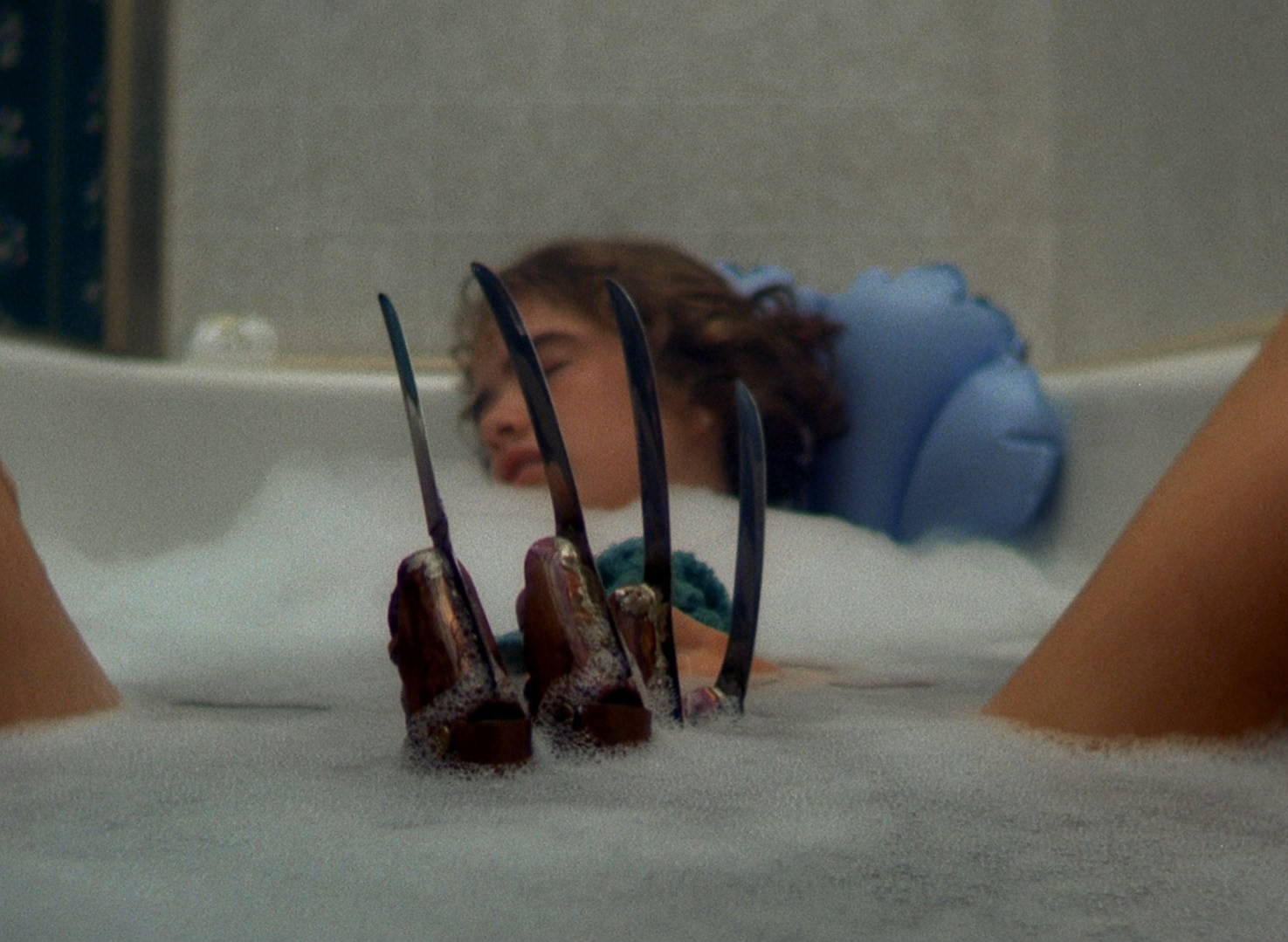
There’s a true boogeyman haunting the dreams of young people, and his name is Freddy—Fred Krueger, to be exact. With a horribly burned face and sporting a dirty red-and-green sweater, a Fedora, and gloves with knives for fingers, he’s the man of your (bad) dreams. But if he kills you in your dream, he actually kills you in reality, which pits the kids who dream about him into real danger. That’s the basic idea for Wes Craven’s “A Nightmare on Elm Street,” a surprisingly-effective slasher film with the most intriguing premise of the lot and more to offer than such films as “Friday the 13th.”

The movie is about a group of typical teenagers whose dreams are invaded by the supernatural boogeyman, Freddy (Robert Englund). It begins as Tina (Amanda Wyss) wakes up from one of these shockers only to find evidence that…maybe it wasn’t a dream.

Dun-dun-DUNNNNNN!!!

Tina tells her friend Nancy (Heather Langenkamp) about the dream, only to discover that she too dreamed about the same “creep.” (And one look on Nancy’s boyfriend Glen’s face indicates that he had the same dream as well.) That night, as she enjoys a rousing night of pleasure with her boyfriend Rod (Nick Corri), she then falls victim to Freddy and is ripped to shreds. (This is yet another example of how sex leads to death in horror movies.) Rod is sent to jail on a murder charge, although Nancy doesn’t quite believe he did it, as her nightmares only get worse and worse. She becomes convinced that Freddy is responsible for her friend’s death, and finds that she, Glen (Johnny Depp, in his first big-screen role), or Rod may be next. So the best way to stay alive is not to fall asleep.

The “nightmare” gimmick is usually not an effective element for a horror film because you see very often a scene in which a character dreams of certain doom and then wakes up in a cold sweat. Come on, who are they trying to fool, especially when it usually occurs early in the movie? It’s a tired, predictable, overdone gimmick that just doesn’t work anymore. But “A Nightmare on Elm Street” centers an entire movie around that element, in that even though you know for sure (and the characters know for sure) that there are many dream sequences, that is where the terror happens: in the notion that the doom in the nightmare becomes the doom in reality. But also, there are some parts (especially in the final act) in which no one, particularly the audience, surely knows what is real and what isn’t. The movie walks that fine line between fantasy and reality mostly, and that’s where the chills come from—uncertainty, suspense, and toying with expectations.

There are enough necessary (sometimes unnecessary) jolts and chills to make horror-film buffs tense, but it’s also a story that makes you really think about the situation. There’s a lot that people can read in the psychology of this idea (such as the notion that Craven based this idea from children who died in their sleep), and also how the gimmick can work in this movie. That way, audiences are attentive and interpreting.

The horribly-scarred Freddy Krueger has of course grown to become an iconic figure in the horror-film genre, thanks to his taking center-stage in the “Nightmare on Elm Street” sequels. Unlike “Halloween’s” Michael Myers/The Shape or “Friday the 13th’s” Jason Voorhees, Freddy does not wear a mask and is not silent. He has a sick, twisted personality that goes with his sick psychoticism. This is a truly an iconic horror-movie villain. But he’s not the center of this original “Nightmare on Elm Street” film, necessarily—he’s just more like the looming demon waiting to strike. We get part of a backstory, but that’s all we know about him in this movie. This makes it more effective, but the less we know about the killer that was Freddy Krueger, the more creepy he is. (The sequels, however, go into more detail stating more of his story and why he’s able to haunt dreams, which doesn’t make him scarier.)

“A Nightmare on Elm Street” is more about Nancy and how she tries to figure out how to save herself, even if it means trying to stay awake. Her police lieutenant father, Donald (John Saxon), is too much of a hardass to pay attention because he’s more concerned about keeping the small community, where they all live, safe from danger. Little does he know that his own daughter’s subconscious is the greater danger. But Nancy’s mother (Ronee Blakley) actually does know something about Freddy and eventually tells her what happened to him and why he’s after certain young targets. Nancy decides to fight back and find a way to bring Freddy out of the dream world and into the real world so he can be stopped.

There are some effectively chilling sequences that occur in these nightmares (one of the most memorable involves a bathtub transforming into a bottomless pit), and like just about every good horror film, the terror is present thanks to a good deal of attention to atmosphere. The lighting is effectively done whenever the dream calls for a certain way. The special effects are good. And the music score is efficiently eerie for the movie.

“A Nightmare on Elm Street” is an effective horror film. The ideas are interesting, the tension is existent, and Nancy as a heroine is not a dumb, screaming idiot (she’s smart and resourceful), therefore able for us to like and root for her. I’m not quite sure I follow the ending, but I guess the point is to leave things open for interpretation. Craven does the material well, as it really seems he gets the genre and knows what his audience wants while also giving them something more in return. It’s a nicely-done chiller.