Archive | April, 2013

The Neverending Story III (1994)

21 Apr

images

Smith’s Verdict: 1/2

Reviewed by Tanner Smith

From an abstract entity to the human form of lack of imagination, the world of Fantasia is constantly under siege in “The Neverending Story” and “The Neverending Story II.” While “The Neverending Story II” didn’t work, it did have an interesting danger for Fantasia (the latter of what I mentioned above), especially compared to the danger in “The Neverending Story III.” What threatens Fantasia this time? A group of high school bullies known as the “Nasties.” That’s one of many signs featuring lack of creativity and inspiration that come with the whole movie.

Before I get into all that, allow me to explain the plot. The young hero Bastian Balthazar Bux (yes, he says his full name in this movie) is back, but facing a few problems. He has a new stepmother, has moved to a new place, and has a brat for a stepsister named Nicole (Melody Kay). Coincidentally, the library at his new school stores the Neverending Story, which apparently tells Bastian’s (Jason James Richter, “Free Willy”) story as it still happens. He uses the book to escape the Nasties, who later find the book and figure out the peculiarity behind it. They use it to attempt to take over the world. So Bastian is sent back to the real world along with other characters from Fantasia in a mission to get the book back and save the world.

This doesn’t seem like the third chapter of “The Neverending Story.” It seems like a sequel to a remake of the original film. For starters, the character of Bastian’s father has changed. In the previous film, the father knew about Bastian’s adventure in Fantasia and here, Bastian and dad seem to have no recollection of that. Bastian is searching for his lost Fantasian friends and hiding one of the found ones in his kitchen, and yet he doesn’t tell his father about the problem, despite the father knowing about it all in the previous film. This would have been a very interesting story element—a father and son banding together to solve the problem. But none of that is found or even explored.

The characters from the original films are developed in a backward way here. Falkor the Luckdragon is no longer the loyal and dignified creature he was in the past two films—instead, he’s an idiot. That’s not all—the Rockbiter has turned into a sitcom character, along with his family. I mean, his family lives in a rock house with a rock kitchen and rock TV.

The only element that remains the same as any of the previous films is how dumb Bastian is. In the second film, he had the power to wish for anything and wished for practically nothing (I’m still angry about that spray can). Here, he uses the power again…for nothing. What an idiot kid.

The Nasties are led by a beefy, Khan-like twentysomething (he’d been left back in high school) named Slip. Why do I mention this character? Because the actor playing him—Jack Black—is the only entertaining element in the film. His character is written terribly, but it’s fun to watch Jack Black try to make something out of this stupid, unimaginative movie.

Harold and Kumar Escape from Guantanamo Bay (2008)

21 Apr

images

Smith’s Verdict: *1/2

Reviewed by Tanner Smith

Harold and Kumar are appealing characters. They’ve certainly proved that in 2004’s “Harold and Kumar go to White Castle.” Harold is of Korean descent, Kumar of Indian descent, but they’re both living in America like every day Americans…and they get along great together because they smoke more pot than Cheech and Chong. In “Harold and Kumar go to White Castle,” they spent a night of funny misadventures trying to find White Castle and eat there like regular Americans. Along the way, they are met by racists who make them miserable. That movie had a heart to it. Their next movie, “Harold and Kumar Escape from Guantanamo Bay,” has no heart and I’ve been unable to locate its brain.

This is a mean-spirited, uninspired sequel to “Harold and Kumar go to White Castle” that is an insult to the eyes and ears of people who love comedy. It does have decent performances by John Cho and Kal Penn, reprising their roles as the likable potheads Harold and Kumar, but the script has nowhere interesting to go and the direction is heavy-handed.

We pick up where the first movie left off, as Harold and Kumar board a plane to Amsterdam to meet the girl of Harold’s dreams. What they didn’t count on was a racist old lady. Get this—what she sees when she sees Kumar on the plane is an Arabian terrorist ready to strike. And then she yells bloody murder and Harold and Kumar are arrested. You can already tell that this movie is going to blow.

Our heroes are accused of being terrorists and brought to the most unlikable character in the movie—a sleazy, slimy, evil-grinning, ultimately racist, hawkish government hotshot Ron Fox (Rob Corddry). There are so many wrong things going on with this character that it’s never funny. I wanted to punch a hole in the screen every time he showed up. What’s worse? Corddry plays the character so well. He locks the boys up in Guantanamo Bay, where no one “even heard of rights.” As the title suggests, Harold and Kumar escape from Guantanamo Bay.

Now, the title suggests at least some funny material. But no. It’s only five minutes out of this mess but an unfunny five minutes.

Anyway, Harold and Kumar are out to clear their name and have many misadventures involving hillbilly in breeders, a KKK rally, a bottomless swimming party, a conversation with an unexpected ally, and a tripping Neil Patrick Harris, played by…Neil Patrick Harris. Harris at least brings charisma to the mix but it’s too little, too late. All the other misadventures—especially the KKK rally and inbred Cyclops—are missed opportunities. And then there are two romantic subplots, but even they seem uninspired.

There is one funny moment that should be mentioned because I can only think of how better the movie would be if it was like that moment—it’s a flashback of the boys in college. Kumar was as uptight as Harold is and vice versa. That was funny and I just wish the movie took chances, like in that scene.

To sum it all up, THIS is what Harold and Kumar are reduced to? After getting to know them in the previous movie, which had laughs throughout, we have to see them be the targets of racism and that sleazy government agent? I mean it—Corddry deserves a punch in the face right now.

I heard there was going to be a third movie featuring Harold and Kumar—“A Very Harold and Kumar Christmas.” If that’s true, the filmmakers need better material to work with. “Harold and Kumar Escape from Guantanamo Bay” is an uninspired sequel and not even Cho, Penn, and NPH’s charm, nor that one funny scene, could save it.

NOTE: Long after writing this review, “A Very Harold & Kumar Christmas” has been released. I still haven’t seen it yet, though I suppose I should.

Sherlock Holmes (2009)

21 Apr

Sherlock-Holmes

Smith’s Verdict: ***

Reviewed by Tanner Smith

Robert Downey, Jr. is one of the best actors of this or any generation. He has this way of becoming his character, rather than saying his lines without a proper motive. He made “Iron Man” his own movie, he deserved his Oscar nomination for the heart he put into his performance of a Aussie-turned-black-man in “Tropic Thunder,” and even if the movie “The Soloist” wasn’t recommended by me, his performance in the movie was still exceptional. That is why it’s no surprise that Downey Jr. can pull off the role of the famous detective Sherlock Holmes in his new movie, “Sherlock Holmes.” Why is it called that? Because there hasn’t been a movie featuring the great detective in quite a long time, so the executives thought, “Hey, let’s just call it ‘Sherlock Holmes’ so people will understand it more.”

Yeah, I’ll buy that.

It’s still early in the century; therefore, Sherlock Holmes and his assistant, Dr. Watson (both characters from Sir Arthur Conan Doyle’s famous detective stories), must be evolved into action heroes—I have noticed that Watson, compared to previous films, had lost weight. They go through several action sequences but they’re always ready because they spring into action as early as Batman and Robin. In the meantime, they behave like college roommates. They do indeed live together and Watson (Jude Law) has a complaint midway through the movie: “Do you hear me complaining about you practicing your violin at 3:00 in the morning?” He also has a problem with Holmes firing his gun at the wall whenever he gets bored. Even riskier: Watson is engaged to marry the beautiful Mary (Kelly Reilly) but Holmes isn’t making their relationship any easier. Holmes fans will want Holmes to figure out a person by looking at his/her clothes and Holmes does that with Mary, only upsetting her. In the meantime, Holmes is trying to get through many meetings with the unbelievably beautiful Irene Adler (Rachel McAdams), who is working for a mysterious criminal mastermind. (His identity is a twist at the end, perfect for Holmes fans.)

The movie’s plot: Holmes and Watson stop the fiendish Satanist Lord Blackwood (Mark Strong) from undergoing a voodoo ritual. Blackwood is hanged for his crime, only to return from the grave soon after. So, Holmes and Watson spring into action to figure out exactly how this happened, what he was up to then, and what he’s up to now.

This leads to many sequences, including a brilliant action scene in a boat shed and a desperate struggle atop the under-construction Tower Bridge. Some of them were kind of confusing, because the plot kept rambling and it was almost hard to keep track of what was happening. However, most scenes—that boat shed scene I mentioned, the duel between Holmes and a 10-foot-tall giant, and a desperate rescue in a slaughterhouse—are riveting and fun. And Holmes makes everything come together at the end.

There are some neat ideas put into the mix, as well as some effective jokes—one, for example, involves a sledgehammer and a smaller hammer—and great visual shots by director Guy Ritchie. I was impressed by how faithful Ritchie was to the source material while also keeping us interested with some comic timing and riveting action sequences. But what really holds it together is Downey Jr. as Sherlock Holmes. He’s great in this movie—he portrays Holmes as a socially awkward narcissist who rubs everyone the wrong way and doesn’t know how to take care of himself. But he’s also a whiz at logic and deductive reasoning, which makes him one of the smartest people on the planet. He’s got a great relationship with Watson, played with appealing wit by Jude Law—it’s almost like a cop buddy picture with them, if you think about it, and it’s very interesting in the way they fight crime together in 19th century London, which is as dark as I’ve ever seen 19th century London displayed in the movies.

I guess the reason I’m giving it three stars is because of the plot’s meandering points, hopefully to be improved in the sequel (and there’s sure to be one, considering the near twist at the end). But what really deserves praise is, again, Robert Downey Jr. and Jude Law’s chemistry and director Guy Ritchie’s riveting directing style with the action sequences. I was entertained by “Sherlock Holmes” and am hoping that the sequel is even better.

Catch That Kid (2004)

21 Apr

images

Smith’s Verdict: ***

Reviewed by Tanner Smith

“Catch That Kid” is a heist movie featuring twelve-year-olds robbing a bank. And to get right off the bat, this is not a great movie, by any means. It has its dumb moments, the techno George Clinton music is overdone, most of the comedy is beyond over-the-top, and some scenes go beyond sensible reasoning. But the energetic spirit, the respectable elements of the heist genre, and a spunky leading performance from Kristen Stewart turn out to be enough for me to enjoy it. So I’m giving it a marginal recommendation. It may be too much for you to handle; I got a kick out of it.

Just because George Clooney, Brad Pitt, Matt Damon, and the rest of the “Ocean’s Eleven” cast can pull off a heist doesn’t mean three pre-teenagers can’t do it any better. And it’s a clever and complicated one too. They have to thwart a new, high-tech security system in order to break into a bank vault and steal thousands of dollars.

It’s for a good cause, to be sure. It’s to pay for a ridiculously expensive operation that will heal the ill father of Maddy (Kristen Stewart). Maddy is a plucky girl who loves to climb the water tower. Her mother (Jennifer Beals) forbids it, but she got it from her father (Sam Robards), who once climbed Mount Everest and had a nasty fall. Nevertheless, Maddy isn’t discouraged and when we first see her in the movie, she’s scaling the town’s water tower. But her father’s injury causes a certain paralysis that causes a certain life-threatening disease (at least, I assume that’s what it is). There’s an institution that has experimented with this disease, but their insurance won’t cover the expense.

Now, in reality, I’m sure there’d be a heavy charity event for this apparently rare disease. But no—Maddy’s mother, who has installed the new bank security system, has to ask for a loan from the bank president Brisbane (Michael Des Barnes, teeth-gnashingly over-the-top) who of course turns her down. So, Maddy decides that she will break into the bank and steal the right amount of money to pay for the operation. Well OK, that’s a good cause. But how exactly does she plan to use the money without anyone, especially her mother, wondering where it came from? I’m not sure you’re supposed to ask questions like that in a movie like this, anyway. So forget it.

Maddy rallies her two best friends—Austin (Corbin Bleu) and Gus (Max Thieriot)—to help her with this mission. Austin is a computer nerd, Gus is a mechanic at the local go-cart track, and both are rivals for Maddy’s affections. In fact, Maddy actually has to lie to each of them, saying she has feelings for them in order to get them to help her.

Maddy has her mother show her around the bank so that she and her co-worker Hartmann (John Carroll Lynch) can give away some details that will ironically become great use to her in a heist. There are things to watch out for—high-powered motion sensors, vicious security Rottweilers, and a nasty chief security guard with a stun gun. What are the kids’ getaway vehicles? Faster, more silent go-carts enhanced by Gus’ mechanical skills. How do they keep surveillance? Hacking into the bank’s computer via Austin’s computer skills. And can Maddy really scale the bank vault suspended 100 feet in the air?

As you can tell, this is not an easy mission. It’s a hard, complicated heist and these kids have the skills to succeed. Well-executed by director Bart Freundlich, the heist that takes up most of the second half of “Catch That Kid” is quite entertaining. It respects the heist movie genre and gives some pleasant surprises as well.

There are some stupid moments in the movie, though. For example, how in the world is Austin able to create a digital hologram of the building the kids are going to break into? I don’t care how smart he is; he’d have to be the head of Apple in order to create that. And a lot of the physical comedy—crotch shots and flatulence—belong to that weirdo chief security guard played by James Legros who really lets it all out with this performance, but really overdoes it big time. Also, when the kids leave the bank on their go-carts, the police come after them immediately. What would make them sure that kids with go-carts automatically makes them believe they robbed a bank? And there’s a central element that occurs during the heist that really bugged me when it should have been exciting—it features Maddy holding on for dear life up near the vault; I didn’t believe for a second that she was really hanging in the air.

I’m willing to forgive the movie for all of that, mainly because of the film’s energy and the performances from the actors. Kristen Stewart is a real star ability—she’s plucky, fun, and instantly likable. She’s at the center of the movie, and she owns it. Max Thieriot and Corbin Bleu are fresh and appealing as her two friends, and their adolescent rivalry for Maddy’s affections are handled and performed realistically.

I also like that “Catch That Kid” is attempting to create something realistic from this “spy-kid” material. As a result, it’s never boring and a good deal of fun. You may disagree, seeing as how it may be seen as a dopey kid-adventure (which I don’t see it as). But I’m not here to agree with you. I’m merely here to state my review.

Tomahawk (Short Film)

21 Apr

183793_130023463737871_130020100404874_186969_2429919_n2

Smith’s Verdict: ***1/2

Reviewed by Tanner Smith

Seeing Eric White’s short film “Tomahawk” for the first time at the Ozark Foothills Filmfest in Batesville, Arkansas a couple weeks ago, I had already known that 13 minutes were cut from the film’s original running time (which was about 30 minutes in length). While I liked the version I saw fine, I did notice a few inconsistencies in its storytelling and maybe it was because I knew there was a longer version, but I did feel the story was somewhat rushed and couldn’t help but wonder what was removed from this “festival cut,” because I could tell White was onto something here. It was well-made, gripping, and had a hell of an ending.

Having met and conversed with White at the festival, and also thanks to a suggestion by filmmaker Sarah Jones (whose “John Wayne’s Bed,” already reviewed by me, was also shown at the event), I managed to gain a DVD copy of the original 30-minute version of “Tomahawk.” That was the cut that White had always preferred in the first place, and as if unsurprisingly, it’s better.

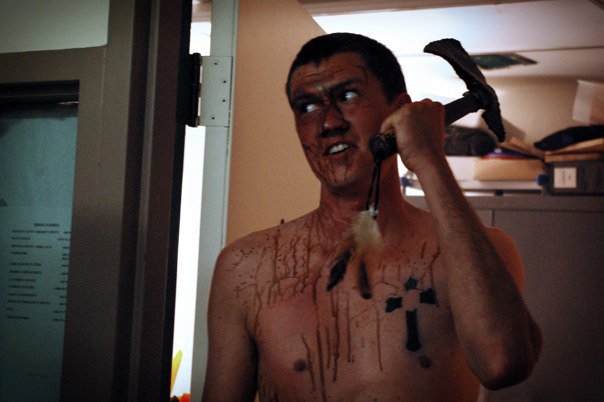
“Tomahawk” is a gritty, violent revenge tale about an ex-convict, John (Steve Helms), who returns to his hometown in Tennessee. Armed with a tomahawk (hence the title), he sets out to deliver revenge on the people who sent him to prison.

There’s a quite curious change between the 17-minute cut and the 30-minute cut. The 30-minute cut tells a story is more shrouded in mystery, as John’s actions are rough but not with much motive. That is, until midway through, when the truth becomes clear. This is pretty interesting, because this buildup makes John seem like the antagonist for the people he’s after—clean-looking Bobby (Shayne Gray), Sheriff Murray (very well-played by Bob Boaz), and a few cops—only to discover in the midsection of the film that they have done him wrong in a horrible way, and thus we sympathize with him.

The 17-minute cut, on the other hand, opens with a quick scene with the “supposed protagonists” that indicates a sense of guilt that sort of lets on that they’re not to be trusted. While John is seen as the rough, vagrant outsider visiting this small town for his own personal business, he could be considered a heroic figure strangely because of that little beginning. With the 30-minute cut, something doesn’t feel right with this guy from the start. He comes across as an Anton Chigurh type feeling the need to cause anarchy and chaos, and that’s what he does for the people he comes across—including two passersby and two obnoxious guys in a bar, before moving on to the people who would turn out to be his true targets.

And for the record, I’m not spoiling much of anything—the 17-minute cut is the version that’s being shown around in film festivals, and so people will already know that John is the hero throughout the film. The most notable changes include the cutting-down of key action sequences, and even the deletion of the whole sequence set in the aforementioned bar. I understand that the action scenes had to be toned down for a shorter running time, and it seems as if the bar scene is rather pointless in a way. But I preferred it when the action went about its own pace in the original—the buildup works, the tension is present, and it makes it seem all the more satisfying.

I mentioned that “Tomahawk” was a well-made film, and it is impressive. The action scenes (including a nicely-done chase near a railroad) are very well-done and believably violent to the point where the hits, kicks, punches, strikes, etc. seem very real. The cinematography is terrific, and there’s a consistently tense tone that flows throughout the film.

And here’s a fascinating story element—save for a couple cops, the people who have wronged John in a big way don’t seem like villainous types. In particular, Bobby seems like an ordinary family man that you wouldn’t suspect of doing something as horrible as revealed. What’s also chilling is the notion that even though Sheriff Murray knows very well that Bobby has done what started this deadly crusade, he actually agrees to assist him in a way out.

The ending…damn. What can I say? Without giving too much away, after an inevitable action climax involving an intense showdown between John and crooked police, I was surprised how strong the final outcome turned out to be. It ends with a sense of psychological terror after the final decision is made about how this is all going to turn out, followed by an unending shot of the victor walking off alone. That last shot is played silently as the end credits roll, without a music score. It allows the audience to sink in everything that has occurred. It either works or it doesn’t; it worked for me. That same impact was present in the 17-minute version too, but with everything else in the 30-minute cut, it’s even more powerful because of everything else that has occurred earlier.

I like the 17-minute “festival-cut” of “Tomahawk” fine; I believe the 30-minute cut is even better. But either way, both versions show the true craftsmanship that was put into it—Eric White proves to be a capable filmmaker; Lyle Arnett Jr.’s cinematography is great; and the hard-edged music score by Kerry Loveless and Avery Moorehead is excellent. So I’d say see either version for its own merits.

Oblivion (2013)

21 Apr

Smith’s Verdict: ***

Reviewed by Tanner Smith

Post-apocalyptic world. Futuristic technology. Aliens. Impending doom. Chases. Dogfights. Crashes. Tom Cruise racing to the rescue. How many times have we seen that in a sci-fi movie? (OK, maybe not all at once, but you get the point.)

“Oblivion” is the latest sci-fi action-thriller to contain all of these elements, and more. We get the usual science-fiction basics that we’ve seen in such movies as “The Matrix,” “Total Recall,” “Minority Report,” and many more I could go on naming. But strangely enough, “Oblivion” is welcome for two reasons—1) It is still pretty intriguing and exciting, and you can sense that the filmmakers have a real respect for the genre; 2) It is always good to see a sci-fi film that is mainly idea-based. There may be a lot of action and special effects, but there are also all sorts of twists and turns along with many different concepts that are brought into the story.

However, that probably wouldn’t work in the film’s favor for box-office reasons and even for narrative reasons. For the former, I mean that “Oblivion” might actually be the rare sci-fi flick that teenagers won’t enjoy unless they’re willing to open their minds to such puzzling inclusions that come into place, particularly in the final half. Therefore, it may not make as much money as it would like to. And for the latter, I mean that there is way too much story material to fit into a 126-minute movie. I admire the creativity, but maybe half of it could have been the main focus (most of it is backstory, anyway). As a result, there are a few questions that come to mind because not all of them are answered in the movie.

But to the credit of the movie, I actually did care about what was happening onscreen, and even though I was somewhat confused by certain parts, I find myself thinking more about possible answers. That’s a sign that the movie did indeed work for me, and so I’m recommending it.

“Oblivion” takes place in the year 2077, years after a war between humanity and an invading alien race. Humanity won but Earth was destroyed—survivors have fled to Titan and set up home there. The Earth is watched by a series of drones and a few humans whose job is to look after them, while a few scattered survivors (known as Scavs) lurk about the remains of New York City. Tom Cruise stars as Jack (because just about every action hero needs the name “Jack,” doesn’t he?) who teams with Vic (Andrea Riseborough) to take care of these drones, just a couple weeks before they’re allowed to join the other humans. Their memories have been wiped out before the mission, but Jack seems to recollect certain vague memories that appear in his dreams, most of which involve a beautiful woman (Olga Kurylenko). Jack spends his days locating and repairing lost drones, but he isn’t as anxious to return to Titan as Vic, who would just as soon forget about anything except Jack and the mission. Jack would rather stay in a make-shift cabin he built himself in a safe zone because Earth feels like home. “We won the war,” Jack thinks to himself. “Why do we have to leave?”

Period. That’s all I’m going to say about the plot. Let’s just say that Jack comes across one important, revealing situation/development after another, and leave it at that. “Oblivion” piles on idea after idea after idea, and you have to pay attention because you just might miss something.

Tom Cruise delivers what the role of Jack needs—the same physicality and roughness that made Tom Cruise eligible for action flicks and sci-fi films in the first place. And he’s pretty solid, making us like and root for him as Tom Cruise does best in this kind of movie. But he shares no chemistry with Andrea Riseborough, who is pretty bland anyway; however, once Olga Kurylenko comes into the picture, those two actually click. And Kurylenko is an actress I can describe as “ethereal”—she has a wonderfully expressive face and brings a true appeal to her character. Also in the cast is a cigar-chomping Morgan Freeman as a ringleader for a human resistance living on Earth (don’t worry, that’s not a spoiler, as the ads for this movie make clear). He does what Morgan Freeman does best—express coolness with that distinctive deep voice of his.

The visual effects in “Oblivion” are practically Oscar-level. We have small aircraft for Cruise to fly around in, a high-rise apartment that sees over practically the entire East Coast, and of course a post-apocalyptic environment that includes the ruins of cities such as Washington DC and New York City. Even though we’ve seen this sort of world before, it’s still an effective setting for this sort of film. Even if people don’t care much for the story and how everything sort of (though sort of doesn’t) play itself out along the way, you can’t deny that “Oblivion” isn’t a great visual experience. See it in IMAX if you can.

After you’ve seen “Oblivion,” it’s probably best to talk about it with someone who already has seen it. This is one of those sci-fi movies that require to really think about what has just been thrown at you. Talking to someone about certain details may surprise you in what you can come with as a result. Or maybe just see it a second time and hope you catch certain things you didn’t notice the first time; that’s exactly what I’m going to do soon. I may have missed something, but I give “Oblivion” credit for actually making me care about what it was I had to consider. For that, I give it a mild recommendation.   

Zathura (2005)

21 Apr

images

Smith’s Verdict: ***

Reviewed by Tanner Smith

“Zathura” is a fun entertainment for the whole family. You could call it the outer space version of “Jumanji.” However, when “Jumanji” had a bit of a mean edge toward younger viewers, “Zathura” is a complete family film. It’s a smart and funny kid-adventure that will keep parents entertained as well. I really like the energy that went into this movie.

“Zathura’s” plot somewhat resembles “Jumanji,” which is obvious as the children’s books both movies were based upon were authored by Chris van Allsburg. “Zathura” features two young squabbling brothers who discover an old game. They begin the game and are suddenly put upon an incredible journey through the game world.

The movie opens with the brothers—ten-year-old Walter (Josh Hutcherson) and six-year-old Danny (Jonah Bobo)—competing for the attention of their divorced dad (Tim Robbins) on a boring Saturday. The boys fight almost all the time—Walter can’t even seem to tolerate Danny’s existence. (Their constant arguing grows kind of tedious but that’s the point. They behave just like realistic sparring brothers.) Dad has to go to work for a while, leaving the boys supervised by their teenaged sister Lisa (Kristen Stewart)…that is, supervised from under the covers of her bed.

In the basement of their house, Danny finds an old game called “Zathura,” a cool-looking, retro board game that seems to have a mind all its own. It has a futuristic look to it and it looks to be just a simple race to a black planet with a huge “Z” marked on it. How to play: Wind the key, push the “GO” button, wait until the timer winds to one number between one and nine, let the little ship move up how many spaces the timer says to go, and read the card that pops out of the game when it stops. Danny brings the game up to the living room, hoping to get Walter to play with him (but Walter would rather watch ESPN), and does just that. But when he gets Walter to read the card that pops out of the game, saying “Meteor Shower—Take Evasive Action,” the two brothers are surprised when a couple of small meteors zoom down into the room! Then, more meteorites attack and pulverize the room, with Danny and Walter racing for shelter.

And right away, you know what kind of adventure this is going to be; during the meteor attack, the kids are untouched. So, right away, you know that nothing is going to happen to them and it’s just going to be fun. You just sit back and enjoy the inventiveness that comes with each danger that both boys come across.

After the meteor attack, the kids look outside and get a fantastic view of not a pulverized neighborhood…but Saturn! The kids are in space now, as their house is floating around, because of that game. After reading the instructions, they learn that in order to get back home, they have to finish the game. With each spin, the boys are put into more adventure and danger—their sister Lisa is frozen in cryonic sleep for five turns; a short-circuited robot runs amok; and alien battleships use their house as a collision course! Eventually, the boys are aided by a mysterious stranded astronaut (Dax Shepard), who guides them through whatever else might happen.

“Zathura” is a smart and funny children’s adventure that will keep the parents entertained as well. There are some good twists at the end, there’s some humor put in, there are moments of suspense, and the special effects aren’t all wall-to-wall CGI but like the robot and the lizard men that invade the house, they’re made the old-fashioned way to look more real. And “Zathura” is just a ton of fun. This is genuine fantasy and that explains why the astronaut hasn’t grown a beard after flying around for years (or light years), and how the kids are able to breathe when they step into space to see Saturn outside. And I loved the way the game looks. It’s an ingenious contraption that moves spaces for you and makes its own cards when the space is reached.

“Zathura” is the third film directed by Jon Favreau who also directed “Made” and “Elf.” Favreau is like Ron Howard—an actor who may have be born to direct, as he clearly knows and loves movies. He does a nice job here, and the movie looks good and bright, whereas “Jumanji” looked a bit too dark and mysterious. “Zathura” isn’t as menacing or as emotional as “The Polar Express,” but it works well as an exciting space opera. “Zathura” is a fun adventure and I was happy to go along with it.

The Help (2011)

20 Apr

images

Smith’s Verdict: ***1/2

Reviewed by Tanner Smith

Before I review “The Help,” I should probably state that I did not want to see it. I saw the trailer and assumed it was another one of those heavy-handed movies that reminds us “racism and prejudice are bad.” Then I was astonished to see that it was nominated for quite a few Academy Awards, including Best Picture. This was the year I made the vow to watch all of the Best Picture nominees. So, a friend lent me the film’s Blu-Ray disc that she owned and I decided to just sit down, prepare for what’s to come, and hope for surprises.

Well, truth be told, there are very little surprises in “The Help,” save for some great performances. But when the story works, I accept the film for what it is. I liked “The Help”—a lot more than I imagined. The wonderful acting, well-developed characters, and involving story drew me in. Is it telling me what I haven’t heard before? No. But I was still quite moved.

“The Help” is a feel-good tale, based on a best-selling novel by Kathryn Stockett (unread by me, however). It presents itself as the story of African-American housemaids in the South, and how they enabled a young white woman to write a book about them.

It takes place in the early 1960s in Jackson, Mississippi, where slavery isn’t far off from house caring. The white women who live there hire black women to raise their children and tend to their houses, while also ruling over them with arrogant attitudes. One maid—named Aibileen Clark (Viola Davis)—worries that the little girl she cares for is going to turn out to be like her boss, and it seems like the other maids think the same way of the children they care of.

The worst of these overpowering women is the constantly-condescending Hilly Hollbrook (played by a scene-stealing Bryce Dallas Howard), who also seems to be the “leader” of this society. Whatever she does, the others want to do…except for one woman. That woman is named Skeeter Phelan (Emma Stone), and she’s returned home from school. She doesn’t fit in well because she’s not all for the other girls’ snooty attitudes, and sees the maids as individuals, particularly because her mother’s maid Constantine (Cicely Tyson) was more of a mother to her than her actual mother (Allison Janney).

Skeeter wants to be a writer and decides to write a book telling the life-stories of the maids. But of course, she needs them from their perspectives. So, she’s able to find two keen participants—Aibileen and her friend Minny Jackson (Octavia Spencer)—to sneak behind their employer’s backs and tell their stories, exposing certain, intriguing secrets in the process. All of the other maids are hesitant about this little project, until they see the confidence in Aibileen and Minny and decide to join in.

This story is told during the Civil Rights Movement and there are notions of violence rising in the backdrop. But mainly, “The Help” tells its story safe and doesn’t veer too far into being uncomfortable. There isn’t a shade of grey to be found here. There is melodrama, along with moments of comedy, tragedy, and triumph—enough to please audiences. It’s easy to see why this film did well with audiences. There’s a nice sense of overcoming for these characters.

I love Emma Stone, but her role is a thankless one and she’s constantly upstaged by the other performers. Aside from Sissy Spacek (who has nice moments as Hilly’s mother), Mary Steenbergen (as Skeeter’s publisher), and Allison Janney (who has more dimensions than expected, as Skeeter’s mother), there are three other actresses who really make impressions. The first is Viola Davis as the maid Aibileen. Davis is so forceful and compelling as this sensible woman who takes a chance and tells her story—it’s an excellent performance. The second is Octavia Spencer as Minny, who has a wonderfully expressive face and a comic wit that works. Minny is the kind of woman who strikes back without thinking of consequences—later in the movie, she strikes back at Hilly for firing her and treating her new employer like slime in a scene that. Uh, don’t ask how she strikes back.

The third, as Minny’s new employer, is Jessica Chastain. Chastain plays a ditzy, white-trash blonde named Celia Foote, who is married to a nice businessman but can’t seem to do much to please him. So she hires Minny to care for the house and cook, while Celia’s husband is at work, so that he’ll think that Celia did it all. Minny knows who she’s really doing this for and also develops a friendship with Celia, while giving her good pieces of advice and explaining why the other women don’t want her around. This leads to a comic scene at a charity event, in which Celia strikes back. I’m sorry for saying so much about the character here when I forgot to mention her in the main story description (her comeuppance doesn’t have much to do with the main story). I should be praising Chastain, as she plays the role. I really love her. Her performance is hilarious, infectious, and sincere. My theory—Jessica Chastain is an angel; she came down to Earth, made up a biography, and decided to act in six or seven movies in the past year to be nominated for an Academy Award.

One character that isn’t as effective is Hilly, mainly because she never comes across as a fully realized character. As played by Bryce Dallas Howard, she’s too much of a cartoonish caricature and only knows two emotions—condescension and shrieking anger.

“The Help” is engaging and at times, very affecting. And while the running time is 146 minutes, the movie gets better as it goes along. With great acting and a nicely told story, “The Help” is a feel-good movie that works.

Teen Wolf Too (1987)

20 Apr

movie_209-2

Smith’s Verdict: 1/2

Reviewed by Tanner Smith

“Teen Wolf Too” is one of the most uninspired sequels ever made. It’s idiotic, not the least bit amusing, and unoriginal. It’s a sequel to the surprise 1985 box office hit “Teen Wolf,” which I didn’t like but is “Back to the Future” compared to “Teen Wolf Too” (I mean it—it’s that bad). While the original film had clichés that I could list five of, it at least had some amusing bits and a likable Michael J. Fox as the lead. “Teen Wolf Too” has more than a dozen clichés that don’t work at all here and instead of Michael J. Fox returning in the role (if he did, the movie would be titled “Teen Wolf Two” instead of “Teen Wolf Too”), we have Jason Bateman, whom back then was best known for the teenage roles he played in TV shows such as “Silver Spoons” and “Valerie.”

Bateman plays Fox’s cousin Todd who is going off to college. He is embarrassed by his uncle’s constant change in appearance from man to wolf. Todd definitely doesn’t want the same thing that happened to his uncle and cousin to happen to him—especially not in his first year at college. But it turns out he does share the same problem, as he discovers when he gets nervous while slow-dancing with the pretty girl on campus.

One thing you’ll notice right away—the wolf makeup is just plain awful. Bateman looks more like a hairy escaped prisoner from Alcatraz. The makeup in the original wasn’t perfect, since the movie called for the wolf to still be a teenager, but it deserved an Oscar nomination compared to the makeup here. (OK, enough comparisons)

So, like in the original film, Todd shows off his wolf persona to the whole college and becomes popular. Soon enough, he’s able to lead the boxing team to a victory. Yes, we get another “big game” and yes, Todd does get into the ring. If that was lazy enough for screenwriters, it’s even lazier for the filmmakers because I bet the reason they had boxing instead of football was so there would be fewer extras to hire. Worse—it’s boring. At least the Rocky sequels had the same endings but were more watchable.

Also weak are the stereotype characters Todd is associated with—the evil blonde, the nice brunette girl who is right for Todd, the fat guy, the wise guy, and the mean preppy guy. I think somebody should start a new therapy group—“Stereotypes Anonymous.” Hey, there’s a movie idea right here.

Jason Bateman, as the lead, is no help at all with this film. He’s bland and uninteresting. He doesn’t have the kind of charisma that Michael J. Fox carried in the original film. (But of course to his credit, he grew into charisma with “Arrested Development” years in the future.) Kim Darby, as the understanding teacher, is OK but is given nothing to do with the character. John Astin overdoes it as the college dean.

“Teen Wolf Too” is an unnecessary sequel with a lame screenplay, bad acting, and horrible wolf makeup. I never thought a movie could falter on makeup. But it just doesn’t help.

The Exorcist (1973)

19 Apr

exorcist-1973-linda-blair-pic-1

Smith’s Verdict: ****

Reviewed by Tanner Smith

“The Exorcist” is regarded as a classic in the horror film genre. People always remember the shocking moments—the projectile vomiting, the spinning head, the floating-above-the-bed, and especially the horrifying appearance of a demon-possessed little girl whose image is still being used to frighten people. Yes, “The Exorcist” has its freaky scenes and real effective scares, but that’s not the main reason it’s hailed as a classic. It’s because it’s so grounded in reality and initiated on characters and story, so that the horror elements take great effect. It was shocking in 1973 and it’s still shocking now.

“The Exorcist” presents a story about a girl being possessed by a demon, and the fight to relieve her from it, in a surprisingly plausible way. It features realistic characters we can sympathize with and root for. It’s directed and lit in such a way that the atmosphere allows the movie to suck you in. And also, it’s as if it doesn’t try to be horrifying. It tells its story in the way that a demon possession, and an exorcism, possibly could happen. The horror mainly comes from what the characters go through; they all have issues and preoccupations. There are two in particular that we focus on. Actress Chris MacNeil (Ellen Burstyn) is busy keeping her career going and raising her only daughter Regan (Linda Blair), but now has to struggle with Regan’s new illness (more on that later) that just seems to get worse and worse; and Father Damien Karras (Jason Miller) seems to have lost his faith recently and is constantly tending to his sick mother. Throughout the movie, Karras has to struggle with his faith—whether or not he can gain it back.

Regan is not well, to say the least. At first it just seems like she’s slightly ill—she swears up a storm and acts a little funny. It only seems like stages of puberty at first, but doctors suspect something a little more serious than that, and give her all sorts of medical tests. But while they show nothing out of the ordinary, there is definitely something wrong not only with her, but around her. Her bed is shaking violently with her on it, there are strange noises in the attic, and other little strange things start to happen, including unexplained movements and even deaths that are possible murders.

Regan’s personality changes (as does her voice, for which actress Mercedes McCambridge takes over), and she even states that she is the Devil taking control of Regan’s body. There’s no doubt that Regan is possessed, and when things get even worse, the situation calls for an exorcism to save Regan and be rid of whatever is controlling her. Chris consults Karras, who agrees to look into it with psychiatry, though he doesn’t believe in exorcism necessarily. But despite his doubts, he calls for help from an experienced exorcist, Father Merrin (Max von Sydow), to perform the exorcism.

The setup is extremely well-done, as it slowly but surely sucks you into the tension of the story. Take the early scene in which Chris hosts a party at her house. The guests are gathered around the piano, singing off-key and unrehearsed to the tune being played. That’s as normal as you can get, and then it eases you into the unsettling moment in which Regan comes in and interrupts by saying in a deadpan tone, “You’re going to die up there,” and then urinates on the floor. What I’m getting at here is that “The Exorcist” eases you into the shock elements by taking relatively normal situations and transforming them into sure unsettlement, so that when the real terror comes, it feels like we’re there and that makes the film more terrifying.

I like that “The Exorcist” keeps this grounded to just here and now. Instead of the whole world and mankind that Merrin and Karras have to fight for, it’s the mind, body, and spirit of this poor little girl that must be won. This leads to the climax, in which Merrin and Karras carry through the exorcism. You’d think this would be the low point of the movie—just a special-effects extravaganza with no real thought or tension. But you’d be wrong. While there are neat effects (the head-spinning and the mystic floating, as everyone knows of), the sequence keeps the edge of everything that has occurred before by adding elements such as the temperature of the room, the intensity of the situation, and no music score to tell us to be on edge. The best part—we’re not sure of the outcome.

Also, have you noticed that it’s not quite clear exactly who or what is inside with Regan? Is it the Devil? Is it one of his followers? Who knows for sure? We only know what the characters know, and it adds to the brilliance of the screenplay.

The acting is excellent all around. Ellen Burstyn turns in a great performance as a mother whose sole concern is the welfare of her child. Max von Sydow is great as Merrin; very solid work here. If I had to pick the best acting job, it wouldn’t be Linda Blair (who, don’t get me wrong, is more than convincing as Regan—in fact, she stands out, even before she’s possessed). It instead would have to be Jason Miller as Karras. He struggles with knowing that he is a man of God who has lost his faith, and keeps most of his pain inside. Miller is utterly convincing in this role. My favorite scene of his is when he meets Regan for the first time, while she is strapped to the bed. He casually introduces himself, in a way a psychiatrist would, to which Regan responds in the demonic voice, “And I’m the Devil! Now kindly undo these straps!” Karras just keeps his cool and plays along, “If you’re the Devil, why don’t you make the straps disappear?” It’s more of a battle of wits between him and Regan (or Regan’s demon) before the exorcism.

“The Exorcist” is without a doubt one of the best horror films I’ve ever seen. It’s right up there with “Psycho” and “Halloween”—movies that scare me, but also make me think and admire its craftsmanship. With great acting, a realistic atmosphere, and memorable images (my favorite, of course, being the shot in which Merrin stands in silhouette, under a street lamp, looking up at the house where he will perform the exorcism), “The Exorcist” is a brilliant and more-than-effective horror film. Something wicked is inside Regan…and we believe it.