Archive | April, 2013

Pineapple Express (2008)

4 Apr

Dale-Denton-Seth-Rogen-left-and-Saul-Silver-James-Franco-right-are-two-lazy-stoners-running-for-their-lives-in-Columbia-Pictures-action-comedy-Pineapple-Express.-2008-Columbia-Pictures-Industries-Inc-0-600x398

Smith’s Verdict: ***1/2

Reviewed by Tanner Smith

Imagine you like to smoke pot—like, a lot—and then you witness a murder by a pot farmer who definitely wants you hunted down and killed. How do you stay alive? Stay sober. It takes the “heroes” in the action-stoner-comedy “Pineapple Express” a long time to figure that one out. And when they do, it’s a pretty good subtext. After all of the crazy stuff that they get into, it’s almost guaranteed that they won’t want to get stoned again.

After “Cheech and Chong” come Dale and Saul—two American stoners. Dale (Seth Rogen) is a twentysomething-year-old process server whose girlfriend is in high school. Saul (James Franco) is his weed dealer. These two guys are sloppy enough for us to laugh at them. They’re not quite Cheech and Chong, or even Harold and Kumar, but I could see a TV series put somewhere in the scenes where the two American stoners hang out together in Saul’s apartment.

When Dale is about to deliver a subpoena to druglord Ted (Gary Cole), he witnesses Ted and a female cop (Rosie Perez) commit murder. Dale panics and flees, making a lot of noise while doing so. Frightened, Dale turns to Saul, and soon, the two are on the run.

That leads to silly, funny, and sometimes exciting action sequences for these characters to fall into—they get chased by the female cop in a car chase (the funny twist there is that their car has a red Slushee spilled all over the windshield), they get in a fight with the hilariously-unreliable Red (Danny McBride), and at the end, they wind up in a “Scarface”-inspired massacre between the drug lord and the Asian competition. And Dale and Saul are stoned throughout most of the situations that occur; during that massacre, it’s unclear if they’re still stoned or smart enough to know that whenever they’re stoned, bad things happen. Maybe this will teach them a lesson.

“Pineapple Express” was produced by Judd Apatow, who also produced R-rated comedy hits “Knocked Up” and “Superbad,” and as if predictably, there are a lot of big laughs in it—I like the part where the two are tied up and use a strange method of trying to get out. However, be advised—this is just as profane as “Superbad.”

There are also some winning performances by Seth Rogen and James Franco and also, Danny McBride, who betrays the two heroes a few times; and despite getting shot multiple times and being blown up, he comes back like Wile E. Coyote. There are a couple of things wrong with Seth Rogen’s character—I mean, he’s funny here (he always is funny in everything he’s in), but it’s almost hard to root for a guy who sells weed to high school students and makes out with his girlfriend (smokin’ hot Amber Heard) by her locker. But by the end, we learn to dismiss all of that.

James Franco gives the best performance in the movie as the weed dealer obviously inspired by Brad Pitt’s character in “True Romance.”  He’s very funny here, and thankfully, he doesn’t bring the annoyance of Jay (of “Jay and Silent Bob” fame) or even Daffy Duck to this character. He’s simply a guy who is confused most of the time (because he’s stoned most of the time).

The three actors I’ve mentioned bring comic timing in this film. If someone like Liam Neeson, Daniel Craig, or even Sylvester Stallone took this on, it would have just been your basic action film. Ed Begley, Jr. and Nora Dunn make funny cameos in a scene set in Dale’s girlfriend’s house—a scene that I probably wouldn’t have liked if they hadn’t shown up.

Director David Gordon Green, whose previous work included indie films “George Washington,” “Undertow,” and “Snow Angels,” is the last director you’d expect to direct this Judd Apatow stoner-comedy/action picture, but he does such a good job at keeping the action and the comedy on mostly the same level—it seems almost like a stoner version of “The Blues Brothers,” which also mixed action and comedy. With great comic timing, a brilliant performance by James Franco, and some nifty (though very violent) action sequences, “Pineapple Express” is the movie that the second “Harold and Kumar” movie wanted to be.

Superman Returns (2006)

4 Apr

superman_returns_2006_3

Smith’s Verdict: **

Reviewed by Tanner Smith

Oh, I so wanted to like “Superman Returns.” This is the fifth entry in the “Superman” series and the return to the big screen for the American superhero since 1987’s awful “Superman IV: The Quest for Peace” and it’s unfortunate to be as disappointing as 1983’s lackluster “Superman III.” The special effects are there and some of the actors are game, but with little story material unnaturally stretched out, it only makes “Superman Returns” encourage apathy.

Superman’s been gone for quite a while, off to find other survivors from the demised planet Krypton, where he came from. Clark Kent’s been gone as well, since well…Clark Kent is Superman. It’s kind of odd that no one working for the Daily Planet realizes that when Clark comes back to work, Superman is back in action. Shouldn’t somebody make some kind of connection? To be fair, that’s not exactly a criticism to be had, since you can’t ask questions like that in a superhero movie. (Otherwise, Bruce Wayne’s cover as Batman would be blown instantly.)

Anyway, Clark Kent returns to Metropolis and finds that things have changed. But I had trouble figuring out if the reasons that things are so different in Metropolis is because Superman’s been gone for a long time, or because the writers didn’t think things were different from the other movies. The Daily Planet is now crowded with corporate sellouts, the shutterbug Jimmy Olsen isn’t as chip as he used to be and is somewhat dumber, and Lois Lane—the spunky reporter/sometimes girlfriend of Superman in the past—is without energy. But to be fair, I think that last one is because Lois isn’t enjoying herself with her fiancé Richard White, who is dull and definitely without energy.

Once Clark Kent returns, as does Superman, beginning with the rescue of Lois and several other passengers of an airplane about to crash. That sequence is actually well-crafted—it’s thrilling, fun, and keeps you on the edge of your seat. It gives a sense of how this modern-day Superman movie could have gone had it kept that energy level.

But what made the good Superman movies work, as well as its action scenes, were the human relationships, particularly with Clark/Superman and Lois Lane. In “Superman” and “Superman II,” there was a real sense of chemistry between Christopher Reeve as Clark/Superman and Margot Kidder as Lois. In “Superman Returns,” Brandon Routh and Kate Bosworth play their characters as tongue-tied as an awkward soap opera teen romance. I didn’t feel any chemistry between them and individually, they’re pretty bland. Brandon Routh has the resemblance of a young Christopher Reeve, but has little to no personality. Kate Bosworth isn’t much better. She looks too young and too innocent and just isn’t as much fun as Margot Kidder played the role years ago. I also didn’t buy her relationship with James Marsden’s boring Richard White in the slightest.

Coincidentally enough, when Superman returns, the villainous Lex Luthor escapes from prison with yet another plan to destroy Superman and rule the Earth. But his plan will either be too ridiculous or too confusing. If I have this right, Lex’s plan is to use crystals from kryptonite to raise up a new continent in the mid-Atlantic and flood most of the populate world’s surface. Once he’s done that, he’ll have his own place. (Well, who’s going to go to go to this rugged and uninhabited landscape anyway?) Kevin Spacey plays Lex Luthor and he’s the best actor in the movie. He has the same kind of fun that Gene Hackman had as this overplotting, egotistical menace.

The plan leads to a climax that just goes on and on and on until I just checked out of the movie entirely. The effects are there, but the excitement is missing in action. Even with the revelation that Lois’ young son (sorry, forgot to mention him) could have Superman’s powers, there’s a real lack of interest.

Yes, Lois has a son, about five or six years old. I mentioned he could have Superman’s powers. That’s because it’s obvious that Superman is the father (remember the scene in “Superman II” when Clark and Lois finally “got together?”). Now, why couldn’t there be more with this kid? He rarely speaks and constantly stares off into space—not interesting.

“Superman Returns” is an attempt to bring Superman into a darker universe, as what was done with Batman and Hulk. But if you’re going to do that, you need better characterization, human relationships, and better paced action sequences (with the exception of the scene where Superman saves the plane). Superman is a duller in this movie and the supposed thrilling climax is at the same level. They ultimately make “Superman Returns” a lackluster return.

Stir of Echoes (1999)

3 Apr

MV5BMTcwOTYwODI1NF5BMl5BanBnXkFtZTcwNzc2NjAxNQ@@._V1._SX640_SY437_

Smith’s Verdict: ***1/2

Reviewed by Tanner Smith

“Stir of Echoes” is a terrific supernatural thriller that uses the horror subgenre, the “ghost story,” and manages to tell a truly original story with intelligent writing, while remembering that the best ghost stories have to do with atmosphere, solid narrative, and character development. And while it does have its jump-scares, it’s not filled with them to attempt more shocks from its audience. Most of it is low-key and the writer-director, David Koepp (best known for his Hollywood screenplays such as “Jurassic Park” and “Death Becomes Her,” among many others), just focuses on telling the story with a quiet approach in order to increase the tension level. As a result, it’s a strong, well-executed, and quite unnerving thriller.

Based on the novel by Richard Matheson, the story involves a husband and wife—Tom and Maggie Witzky (Kevin Bacon and Kathryn Erbe); regular people with normal everyday lives. They live in a working-class neighborhood in Chicago. They’re hard workers. They go out with friends. They have a little son, Jake (Zachary David Cope). And they’re able to make ends meet. They’re very real, and quite likeable as a result.

Tom and Maggie are at a party with Maggie’s sister Lisa (Illeana Douglas) claims she can hypnotize people. Tom states that he believes he can’t be hypnotized, and so he challenges Lisa to attempt it. Lisa manages to put Tom under a deep trance. But when he comes to, he starts to see distorted, fragmented visions of a violent event, as well as the ghost of a teenage girl who seems to be haunting his house.

Who is this ghost? Why is she haunting this house? Why is Tom’s son able to see her too? Can these visions be controlled? How do all these visions fit into what happened (or what will happen)?

It’s obvious these visions are never going to stop, and Tom tries to find answers to all these new questions, as his search to piece together the puzzle leads to obsession. He finds himself neglecting his wife and friends, and even losing his job as well. He becomes so obsessed to solve everything that’s being thrown at him that when he advised, in another hypnosis attempt, to “dig,” he digs up the entire backyard before moving on to the cellar with a jackhammer.

How Koepp is able to show us Tom’s obsession is an example of masterful filmmaking. He actually lets us into Tom’s unhinged mentality (with indistinct point-of-view shots and slick camera movements) so we can be as confused as he is, and therefore can figure things out along with him. Tom is obsessed to the point where he doesn’t care all that much for everything and everyone else around him. And Maggie tries to support him, but this is all becoming too much for her to handle. She’s genuinely worried about her husband, worried that he has lost his mind. Only their son is able to understand, because he has the gift of talking with the ghost girl; while Tom turns to him, Maggie is mostly left in the dark, unable to understand what’s happening. “Stir of Echoes” tells a very effective obsession study in that sense.

Everything in the story builds and builds with new developments regarding the mystery of the plot. It’s interesting how everything seems to fit; you have to watch this movie a second time in order to go back and fully recognize an element you may not have noticed before. I love films that do that. The only thing I wished I could have seen more of is a subplot involving a group of gifted people who share Tom and Jake’s gift of “Receiving.” Maggie has one intriguing scene with a “Receiver,” who is also a cop, and nothing else is made of it, except we know that Tom and Jake have the ability to see the supernatural. I personally would have liked to see more of that group that this guy is in, but oh well—you go with what you got.

The characterization is nicely-handled, as it is always refreshing to find believable protagonists to follow in ghost stories such as this; that’s what helps make them all the more effective aside from the eeriness that is offered. The acting is top-notch. Kevin Bacon, in my opinion, delivers his very best performance as Tom—he’s very believable as a conflicted everyman with a supernatural element that leads him to obsession. Kathryn Erbe does solid work as well, strongly conveying Maggie’s nervousness to aid her husband. I also really liked Illeana Douglas as Maggie’s new-age sister Lisa.

“Stir of Echoes” is a strong, eerie, intelligent, well-acted, very well-done supernatural thriller. It’s smarter than most films of its kind, and manages to keep viewers invested in solving an intriguing mystery along with the characters. It’s a skillful thriller.

The Buddy Holly Story (1978)

3 Apr

bholly

Smith’s Verdict: ****

Reviewed by Tanner Smith

It was described by Don McLean as “the day that rock and roll died”—February 3, 1959; the day in which musicians Buddy Holly, Ritchie Valens, and J.P. “The Big Bopper” Richardson all died tragically in a plane crash. They were each music legends in their time.

I suppose if movies were made about these three talented stars, the best way to start would be to tell the story of how in three short years, Buddy Holly and the Crickets broke new ground in music and shot to national stardom. That story is told in the wonderfully told biopic (the aptly named) “The Buddy Holly Story.”

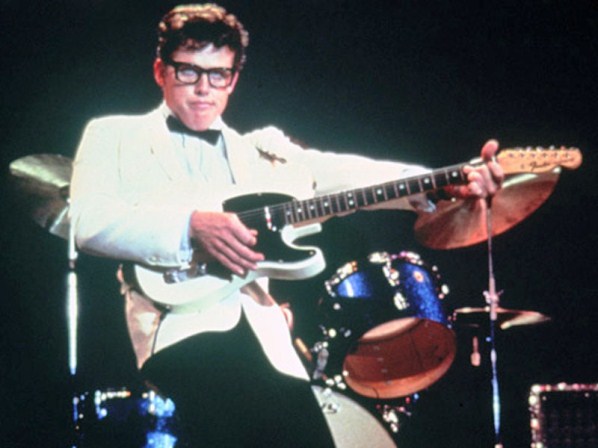
It stars Gary Busey in an electrifying performance as Buddy Holly and it begins as he and his two best friends and bandmates (played by Don Stroud and “American Graffiti’s” Charles Martin Smith) are performing at a skating rink in Lubbock, Texas. They play the traditional country music, which doesn’t sound very exciting to Buddy. And he knows that it doesn’t sound very exciting to the youths at the rink either. So he tells his friends to take it up a notch; bring their music to a bop beat. Everyone at the rink is into it. The radio show they’re performing for is against it and so is the local minister.

Buddy Holly and the Crickets have their way of making music by combining country music and rhythm & blues. The band has a shot at a recording, but that doesn’t go well since the producers just want them to go with the usual stuff and Buddy wants things his own way. One even utters, “He doesn’t like Elvis.” Buddy responds, “I like Elvis fine. But I’m Buddy Holly.” But as a big city radio station plays the band’s demo tape, one thing leads another.

The movie follows the important details of Buddy’s life. We get his beginnings in Lubbock, we meet his snobby girlfriend (soon to be ex-girlfriend), we see the constant arguments that go with Buddy’s music style and what others want him to perform, then comes his early hits, his performances, his marriage, and his final appearance on stage with the other two musicians, Ritchie Valens and Big Bopper. Maybe the movie altered some things or left out some other details, as some rock historians would point out, but the feel of the movie is absolutely right.

There’s a real energy in the performing scenes. The main reason is probably because they were all performed live, not post-dubbing. No moment seems flat or unsuccessful in these scenes. Gary Busey tops off his excellent performance by performing all the songs himself and matching his tone and energy to exact Buddy Holly’s. Busey really gets into his character—I didn’t feel like I was watching Gary Busey performing “Peggy Sue,” “It’s So Easy,” “That’ll Be the Day,” “Oh, Boy!” and the rest; I felt like I was watching Buddy Holly.

Was there anything I didn’t like about “The Buddy Holly Story?” Well…the ending. It ends right after the final performance with Valens and Bopper with a freeze-frame, with dead silence and a pop-up text that states what happened afterward. The credits scroll up while zooming on Buddy’s face. I’m aware that Buddy died after that concert, but the way of explaining it right then and there is just sporadic. It’s just terrible. Younger viewers who watch this are going to be devastated because this movie has such a light, energetic, and inspirational feel to it that is thrown right out the window just as it ends. But for the most part, “The Buddy Holly Story” is a rich, wonderful story of how this small-town kid and his friends made it to the top in music. Add the remarkable performance by Gary Busey and the undoubted energy of the concert scenes and you have a special movie about rock n roll.

Dreamcatcher (2003)

3 Apr

180830.1020.A

Smith’s Verdict: *1/2

Reviewed by Tanner Smith

“Dreamcatcher” is based on a Stephen King novel, which like most of his novels are extremely long in detail. Seeing as how “Dreamcatcher” is a theatrical release and not a TV miniseries, special care would have to be given to trim the novel and make the film a reasonable length while capturing the spirit of the novel. So who do they get? Well, director Lawrence Kasdan (who wrote and directed “The Big Chill,” “The Accidental Tourist,” and “Grand Canyon”) and writer William Goldman (who wrote “Butch Cassidy and the Sundance Kid” and quite a few Stephen King adaptations, like “Misery”) seem like great choices. With that said, how does this great talent behind the screen create a mess like “Dreamcatcher?” This movie is inconsistent in tone, pacing, and style. It’s a lackluster project that starts out one way, enters a different territory, and ultimately is ridiculed for one of the silliest stories you’ll find in a King story.

The story begins with four friends who each possess a psychic gift. As kids, a mentally retarded kid nicknamed Duddits united them with this gift after they protected him from the town bullies. Years later, the friends—Henry (Thomas Jane), Jonesy (Damian Lewis), Beaver (Jason Lee), and Pete (Timothy Olyphant)—still have their abilities and use them as advantages for their jobs. Jonesy has an accident that nearly kills him, and this becomes a compound for a trip to a cabin in the woods, where he and the other three friends fool around and talk about the past. But soon, the entire wooded area is under quarantine by the government, who are on the hunt for…(sigh) alien parasites.

The first half-hour of “Dreamcatcher” is quite interesting, as the development of these friends and their gift comes into place. It seems like it’s going somewhere just as intriguing. But then it gets into the story with the aliens and monsters, and that story takes over as if another movie blended into the one I was just watching. I wouldn’t mind so much except that these aliens and the plot with the friends and their psychic gift just don’t fit together. Maybe they fit better in the novel (which I’ll admit, I haven’t read), but here, they give the movie a real instability. If you want to make a movie that mixes human elements with a monster story, this is not the right way to do it.

There are moments in “Dreamcatcher” that I’m unsure whether or not if they’re supposed to be taken seriously. For example, I think the moment the movie really goes downhill is the scene in which two of the friends discover an infected man dead on the toilet, as a nasty alien worm pops out of him and the friends try desperately to plunge it in the toilet. I’m thinking, this is supposed to be funny, right? And how about when Jonesy’s body is invaded by one of the aliens and speaks in a jolly British accent as it and Jonesy switch personalities to talk to one another? You can tell me; that’s supposed to be funny, right?

The flashbacks that show the four friends as junior-high-school children growing up in (where else?) Maine aren’t particularly well-executed or even well-written. To be fair, that could be because they take up a small portion of the movie, but they’re supposed to give us the origins of this gift, and they just seem rushed. This is particularly strange, considering that “Dreamcatcher” is 136 minutes long. It’s the stuff with the aliens that the movie doesn’t give a rest. We don’t even see the grown-up Duddits (played by Donnie Wahlberg) until the last 15 minutes.

The talented actors put in this movie aren’t enough to save the movie, and you know your movie’s in trouble when the great character actor Morgan Freeman, playing the anti-alien “Captain Ahab” type, can’t save it. This is probably the first time I’ve seen Morgan Freeman give a bad performance. But to be fair, it’s a bad role.

“Dreamcatcher” is ambitious, but a cluttered, unsatisfying mess.

Up the Creek (1984)

3 Apr

MSDUPTH EC001

Smith’s Verdict: ***

Reviewed by Tanner Smith

“Up the Creek” is among the “slob comedies” that has been around since 1978’s “Animal House” introduced a group of slobs who got laughs just for being what they were. It even features actors from some of those said “slob comedies”—Tim Matheson and Stephen Furst from “Animal House,” Dan Monahan from “Porky’s,” and Sandy Helberg from “History of the World: Part 1.” The film borrows elements from “Animal House,” “Porky’s,” and maybe even “Meatballs”—we have competition between colleges, booze, parties, bare-chested women, casual sex, and psychopathic enemies. So basically, “Up the Creek” has all the ingredients of a “slob comedy” but the surprise is that it’s still funny and I liked it. It’s not up there with “Animal House,” but it’s much better than “Porky’s.” It’s stupid, but a likable kind of stupid.

In the movie, four students of Lepetomane University (which is said to be “the single worst educational institution in the country”) are chosen by the dean to race in an intercollegiate whitewater rafting race. These four are told that if they win, they are granted a degree of their choice.

These central characters are the usual types—the Relaxed but Wisecracking Leader (Tim Matheson), the Overweight Eating Slob (Stephen Furst), the Horny Ladykiller (Dan Monahan—don’t worry; he’s more likable here than in “Porky’s”), and the Nervous Nerd (Sandy Helberg). The opening scenes aren’t particularly subtle. They each try to shoot a morning crow with different weapons only to hit other things (and people) and in another scene, when the fat guy throws his sandwich out the car window, it hits a motorcyclist and causes him to lose control and fall off the road. But hey, that’s supposed to happen in movies like these, right?

Even though these guys are types, they are quite likable and play their parts with a good deal of enthusiasm. Tim Matheson, in particular, keeps his charm from “Animal House” and has a nice relationship with the Blonde Babe (Jennifer Runyon)…or as nice as a relationship can be in a movie like this.

The rivals of the race are the defending champions from a military academy, who is later disqualified after a terrible sabotage attempt (I love how it goes wrong—the Leader of the good guys throws the grenade back at the thrower saying, “Hey you dropped this”). So they go through ridiculous lengths just to throw off the good guys as revenge for…not being sabotaged? I dunno. Another rival group is from the Ivy League, who of course are blond and everyone’s favorite.

The race is amusing and fun to watch—real effort was put into the filming of the protagonists going through some tough whitewater rapids. Tricky photography and cinematography was used to make those scenes seem real. The amusing bits are when the rival teams are trying their hardest to throw off the protagonists—the Ivy League even has torpedoes. But it wouldn’t be a positive slob comedy if the slobs didn’t find their way back up, now would it?

Uh-oh! I cannot believe I almost forgot to mention the best character in the movie—a smart dog named Chuck, played by Jake (he deserves credit). He understands human emotions and may even be smarter than anyone else in the movie. The movie’s best scene is when the military academy team kidnaps one of the heroes and Chuck has to play charades to tell the others where he is. I loved that scene, I liked “Up the Creek.” It’s silly, goofy, idiotic, and predictable, but it’s still quite funny.

The Descent (2006)

3 Apr

the-descent-08042006

Smith’s Verdict: ***1/2

Reviewed by Tanner Smith

“The Descent” takes us where a good horror film should—it ventures into the unknown. It starts out with real people, one with real issues to face on her own, and then puts them in a mysterious location where, since it’s a horror film, something goes very wrong and they have to fight for their lives.

That location happens to be underground caverns. Already, that’s a masterstroke of horror-film writing. Just imagine yourself down there, on a spelunking expedition with your friends. It’s dark, it’s deep, and it never seems to end. You have to have a guide on your crew that knows the way out. But imagine that the further down into darkness you descend, the more you might discover…for better or worse. “The Descent” takes that feeling and ups the ante with familiar (but welcome) bump-in-the-night elements, as well as a great sense of atmosphere, and results in a satisfying horror film.

The film is about a group of six daredevil women who plan a trip to go spelunking in the Appalachian Mountains of North Carolina. It should seem like a planned-out, safe journey into well-charted caves. But what they don’t know is that one of them—Juno (Natalie Mendoza)—has actually led them to an unknown crevasse so they can be the first to explore it. Of course, none of them know this until they suddenly find themselves trapped deep within the cavernous underworld, due to a cave-in.

Of these characters, the main focus is on Sarah (Shauna Macdonald), who is distant from her friends due to an accident that took the lives of her husband and daughter. What she didn’t know (and still doesn’t, although we catch on) is that her husband may have had an affair with Juno. Now a year later, Juno invites Sarah and their old friends (and a couple new friends) to go on this trip that could grant him fame (and naming rights of the cavern)…granted they find a way out.

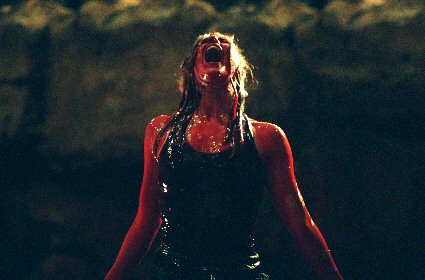
The caves are suitably dark and disturbing with only lanterns and headlamps to light the way—the film captures a great sense of mystery within these deep locations. The director Neil Marshall brings a load of suspense in the early stages of cave exploration in the first hour of the film, and brings about a truly unnerving, stomach-wrenching sequence in which the women are squeezing their way through a tight, cramped space to continue their trek. This scene is the most terrifying for my money. Just the idea of having to crawl through that tight a spot, and being stuck about halfway through is unsettling, because I’m as claustrophobic as they come. The fear of dying miles beneath the surface is brought to attention in “The Descent.”

Midway through the movie, the characters realize that they’re trapped and these caves aren’t marked, meaning they have to fight to survive if they’re going to find a way out. For about ten to twenty minutes, we get more good shock tactics featuring heights, falls, and tension amongst themselves. It’s later in the film when we finally see what the marketing of the film has been setting up, and so it’s no secret that as the characters descend deeper into the caves, they happen upon a strange breed of humanistic creatures that notice them as a threat.

These monsters are albino beings with no eyes, a supersonic hearing ability (like bats), and slime dripping off their naked bodies. Since they show up so late in the film, I could see some people calling this a cheap last-minute story gimmick. But I can let it go for two reasons. 1) They’re suitably scary enough. 2) In some bizarre way, I can accept the fact that these creatures could be found in very deep, underground-unknown places.

As you’d expect, the second half of “The Descent” features the characters fighting against the monsters and trying to save each other. The tension still remains with a great deal of suspense and energy, and the climax of the film actually amounts to something in ways I’ll only describe briefly. You see, the title of the movie has two meanings—a descent into the unknown and a descent into chaos and madness. The protagonist Sarah has been struggling with her sanity ever since the accident that killed her family, and now that this horrifying event is happening to her (which includes the reveal of Juno’s secret involving her husband), it is a further descent into chaos that causes her to attempt to act upon the courage she lost and the rebirth that she deserves. This makes the climax all the more compelling because she knows that if she is going to die, she is going to die fighting.

I’m glad that only one character out of these six was given a traumatic back story for us to focus on, although I admit I could have used a few more personality traits from a few of the other women. In fact, some of them I have to watch the movie for again to remember them.

The ending of “The Descent” is one of the most memorable in a horror film. It’s unsettling and unforgiveable, but more importantly, it’s intriguing and unforgettable.

“The Descent” is a terrific thriller with a dark claustrophobic atmosphere, credible tension, a good cast, a great dose of adrenaline, and suitable psychological issues. It’s so effective that I’m actually thinking more about what goes on in the uncharted caves, rather than the well-charted caves I tour with my family in Arkansas for summer trips. I probably don’t truly believe that there are vicious, slimy monsters down below, but you know there could be anything down there.

December 1982 (Short Film) (2013)

2 Apr

578532_284852491618663_378177824_n

Smith’s Verdict: ***1/2

Reviewed by Tanner Smith

Imagine an era without texting, email, or even the Internet. If you wanted to talk to a girl or ask her out, you had to call her house and ask a parent if she was home. If for some reason you wanted to talk to someone from a different country, you had to send that person a letter and hope that person responds the next day or two, so you can continue the conversation.

As the 30-minute film “December 1982” opens, in August 1981, high-school student Tim (Haulston Mann) is given an assignment to write and send a letter to a student in Beirut. Tim would rather focus on his photography than write a letter to someone he doesn’t know. But then he gets the idea to take a picture of a move on a chessboard in his bedroom, and decides to send that to the student, along with the message, “Want to play?” In Beirut, Yara Hajjar (Ashli Brown) receives this, and responds by sending a picture of a counter-move on her own chessboard.

Months pass, and Tim and Yara’s pen-pal relationship continues. Tim has graduated from high school and is trying to decide what to do with his future. He wants to attend a Chicago university for his photography, but is faced with the difficulties of leaving his hometown friends and knowing that his parents would have to pay a lot to send Tim to college hundreds of miles away. But as Tim faces his own future, Yara and her family find themselves in the midst of something more terrifying, as Israeli military forces invade their country and a war brews outside their home.

This pen-pal relationship that forms between Tim (in Central Arkansas) and Yara (in Beirut) is quite interesting, especially how similar interests, such as chess and photography, keeps them talking to each other. Sometimes one has to wait a couple days for the next letter from the other, but when that letter comes, it leaves them with happiness even when one of them should feel miserable. This is especially effective in the scenes that feature Yara in a time when the world around her becomes a nightmare because of the war—when everything outside her family’s apartment building becomes a living hell, what gives Yara a moment of joy is the next letter from Tim.

“December 1982,” written and directed by Lyle Arnett, Jr. (as his thesis film for the University of Central Arkansas Digital Filmmaking Master of Fine Arts Program), is a small gem. It’s a touching, well-made, effective story of how these two young people draw closer to each other, despite being different parts of the world.

I also admired how the film told its subplot involving the 1982 Lebanon War. It mostly uses sound effects in the Beirut scenes, and that actually works in the film’s favor. There are two particularly-powerful scenes that focus on characters’ reactions. One features the first explosion heard, as Yara is enjoying a sunset at the beach, looking at one of Tim’s pictures that he sent, when suddenly there’s an explosion in the distance as she turns around in fright.

The second particularly-powerful scene features Yara having dinner with her brother and widowed mother. It’s a quiet moment until the sounds of muffled explosions that suddenly turns more dangerous when they seem too close. This is arguably the best scene in the film—the reactions seem surprisingly genuine.

But most of the film focuses more on Tim’s story as he realizes his potential, realizes his friends aren’t the best crowd to be around, and explores Chicago to see what living there would be like. (Also, the scenes set in Tim’s family’s house show (actual) TV news footage on the living-room TV set to show/tell more about the war, and the raid in Beirut, which is admittedly a clever move.) Now, you could argue that maybe Tim’s story is less interesting than Yara’s. Of the two, the latter has the least amount of screen time. And I’m not going to lie—I kind of wished I had seen more of how Yara and her family react to their situation. But to be honest, Tim’s side is still handled well and besides, maybe less is more.

The ending left me with kind of a mixed feeling. On the one hand, it is a satisfying conclusion that did make me smile (and it left a satisfying impression on the audience I saw this film with, as well). But on the other hand, it left me with a question of how it came to this. Even though most audience members of the screening probably expected it, and they were pleased to see this resolution, I was a bit confused as to how exactly it came to be. Without giving too much away, this feeling had to do with how little was shown of Yara’s story.

But for the most part, “December 1982” is an impressive, well-put-together short film. It’s intelligent in its writing and directing, as Arnett, Jr. delivers admirable work as a filmmaker; the actors (including Mandy Fason and Kenn Woodard in brief but pivotal roles as Tim’s parents) are convincing, especially Ashli Brown in a role that requires a gambit of emotions; the central setup is fascinating as you consider the true sentiment that comes with handwritten letters after a while; the drama is credibly handled; and the film itself is a true delight.

NOTE: The film can be seen here: https://vimeo.com/62781258

A Wheel & the Moon (Short Film) (2013)

2 Apr

625488_445476658865564_1831939262_n

Smith’s Verdict: ***1/2

Reviewed by Tanner Smith

“I’ve never really wondered what it would be to lose part of myself. To not feel like a whole person again. Losing someone I love is one thing…but to go on living while part of me dies…” That inner thought that opens the short film “A Wheel & the Moon” says a lot. What if you knew for sure that you were going to lose your vision? What would you feel? What would you do?

Adapted from Jonathan Carroll’s short story, “A Wheel in the Desert, the Moon on some Swings,” and made as a graduate thesis film for University of Central Arkansas’ Digital Filmmaking Master-of-Fine-Arts Program, Chris Paradis’ “A Wheel & the Moon” is about a young man named Norman, who learns he is indeed going blind and tries to imagine his life without eyesight. He finds himself wandering his hometown, hoping to find some way to find something positive about this. The best he can come up with is to buy a camera and take as many pictures as he can that capture the world around him.

“A Wheel & the Moon” effectively tells an interesting tale of how Norman (Justin Pike in an effective low-key performance) continues to try and find the optimistic side to what he fears will come. The people he encounters along the way are interesting and surprisingly, given their short amount of screen time (for a film that is about 20 minutes in running time), have distinct personalities. In particular, there’s a homeless man (Tucker Steinmetz) who claims to be blind and tells Norman what he misses most about not seeing (fried chicken); Norman’s caring sister (Sarah Holderfield); and a makeup artist (Angy Champine) who manages to give Norman a good idea of what he’ll look like “in 50 years”; among others. These are all appealing characters that our protagonist encounters on his personal journey that ultimately results in him finding himself.

The only thing I didn’t particularly like about “A Wheel & the Moon,” which is otherwise a competently-made film that works as slice-of-life and an effective, non-manipulative feel-good drama, was the ending. I can tell there’s a heartwarming message to be said about enjoying the oddness and beauty of life, but it was kind of hard to take it in because it feels somewhat rushed. Although to be fair, I should note that the sequence that comes before that final bit did an effective job at delivering the necessary emotional drive by itself.

“A Wheel & the Moon” is an effective short drama. It actually kind of reminded me of UCA alum Sarah Jones’ MFA film last year, “John Wayne’s Bed,” in that each short film treated its story and its audience with enough regard that it didn’t have to succumb to melodramatic formulas just to make us care—it just efficiently told the story. “A Wheel & the Moon” is moving, and it’s well-done, and it works.

SIDE-NOTE: I love this line about the fried chicken, said in an earlier scene in which Norman encounters the blind homeless man—“Fried chicken is three things—smell, taste, and sight…You gotta see it to really eat it.” KFC would probably kill for that slogan.

Superman III (1983)

2 Apr

super300

Smith’s Verdict: **

Reviewed by Tanner Smith

When you cast a likable comedian like Richard Pryor in a movie, you better have good use of him. Write a good character for him and give him room to breathe more than what the script limits him to, so he’ll feel comfortable. If all that’s done, then there shouldn’t be a problem. And at first, there seems to be promise. There’s a funny opening scene in “Superman III” in which Pryor—playing a down-on-his-luck dishwasher named Gus—faces the unemployment line, and it seems like this could be something special.

Then came the Rube-Goldberg-esque chain of accidents that goes through the opening credits (or is it the opening credits going through the chain of accidents?), and Superman must finally come in to save the day. Look at the credit-sequence and look back at Pryor’s introduction—would you connect these to a Superman movie?

So it seems like “Superman III” is going more for comedy this time around, hence the appearance of Richard Pryor. There isn’t a real sense of human interest that we felt in the previous “Superman” movies. Actually, this could be described as what the first Superman movie could have been—the first Superman movie and its sequel “Superman II” had real charms by mixing this fantasy with reality and without becoming shallow and silly. That was saved for this third entry, apparently.

There’s not only more comedy, but also more action. There are more action sequences and special effects to be found here, and they’re not put to good use. They don’t seem all that exciting and just feel like they’re stretched out. The one exception is a scene midway through the film in which for reasons too complicated to explain, Clark Kent (Christopher Reeve) ends up fighting his own alter-ego Superman. This is actually kind of interesting because it does show Clark Kent confronting his demons in this expressive way and it has us wondering what Superman would (or could) have been like without Clark Kent’s humanity. And speaking of human interest, there’s a new romance introduced here. Since Lois Lane is off on vacation and Clark has gone back to Smallville for his high school reunion, a romance develops between him and a former pal named Lana (Annette O’Toole). It’s sweet, but not as interesting as the previous film’s relationship with Superman and Lois.

The villains aren’t as interesting or as memorable as Lex Luthor and his minions. Here, Robert Vaughn plays a mad billionaire who wants to use satellites to control the Earth’s crops and become even richer. And in case you’re wondering, I did use that description from Roger Ebert’s review of the film. I needed help because I couldn’t remember a darn thing about Vaughn or his scheme.

But back to what I was saying about Richard Pryor. When you get past the opening scene aforementioned and see his character Gus more and more, you realize that he doesn’t create a character to care about. Maybe that’s because this role wasn’t meant for Pryor. Gus is trying to play a likable schmoe to play off the villains (his character is forced to help the Vaughn character with his new-found computer skills) and he just comes across as a man/actor/comedian searching for a laugh. I don’t know whether to place the blame on the writer, the director, or even going on an unfair note to blame Pryor, but Gus just isn’t funny, nor does Pryor make the best attempts. Maybe if he really was despicable and less innocuous, it could somehow make things better and more interesting for Pryor. The strange thing is, it seems like Pryor has as much time on screen as Superman, if not more time on screen.

“Superman III” is just a muddled mess of a movie, trying to jam many things into one movie and not making the best effort. And to think I got through this review in just one page.